Miriams' candle dance |
Gilded
Serpent presents...
Eilat
Oriental Dance Festival
January 2006 - Report
by Sophie
Photos
by Gali Tibon
As my friends'
car was making its way through the desert, the sense of anticipation,
mixed with excitement, was growing inside me. Many changes had
taken place in the dance scene in Israel since I moved to the
San Francisco Bay Area three and a half years ago and I was eager
to catch up with them. What better way to do so than to attend
an annual Oriental Dance Festival in Eilat?
This year
the festival was celebrating its second anniversary, and, having
missed its debut, I wasn't sure what to expect. Unlike the first
Eilat event, which organizers held in low profile "stealth
mode", the second festival was widely advertised, with articles
published in the national press and the appearance of one of the
organizers, Orit
Maftsir, on a Friday night TV show. Of the 900 guests
who eventually registered, 600 were dancers.
While
I was skeptical about the educational value of the trip, imagining
hundreds of students tripping over my toes, I was looking forward
to seeing the best of Israeli instructors teaching and performing
for three days in a row.
Registration
and First Classes
The level of organization showed upon my arrival at the hotel:
the greeting banner, the flock of juvenile dancers prancing around
in bedlah, the abundant lobby decorations, and most importantly
the registration tables. Within a few minutes, staffers handed
me and my friends our orientation kits, which included a festival
schedule, maps, tickets to the shows and keys to our room.
After changing
into my dance attire, I wound my way through the crowds of fellow
dancers, many of whom were showing off their most noisy hip scarves.
My first workshop was to be Natalie Dvir's "Personal
Style". It started with an intense African inspired warm-up
and then moved on to guided improvisation. Unfortunately, I had
to excuse myself at the very beginning, since my bad knee was
giving me trouble during the floorwork session. That's how I found
myself dancing the "Dance of Joy" with Avigail
Klein. What a joy it was! The choreography to Hisham
Abbas's "Wana Wana" showcased Avigail's sharp
technique, precise instruction style and, above all, the flamboyant
personality and witty sense of humor, for which she is so famous.

contest participants- Sonia, Lior, Naomi, Lucy, Daniel,
Smadar, Yahalom, Noa, Suzy, Galit |
Thurday
Evening Show
In the evening, guests gathered in Badia Masabny hall to watch
the opening show, which featured performances of dance ensembles
and of some of the festival's teachers, as well as a talent contest.
Each of the 10 contestants in the contest had only two minutes
to impress the judges and the audience. The first prize, a page
spread feature in a leading Israeli entertainment guide, went
to Lior Bar, who performed an Egyptian-flavored
choreography to "Ya Msafer Whahdak" by Mohamed
Abdel Wahab. However, my first choice went to Yahalom
Hadar, first runner up, mainly because of her joyous
attitude, which could be felt all the way in the back rows, where
I was seated.
 Asi Haskal
performing in opening night show
Asi Haskal
performing in opening night show |
The show that
came later featured three performances that caught my attention.
California-born
Malka Emanuel was the only dancer to accompany
herself with sagat, while performing to "Tahtil Shibbak".
The Pilpel Ensemble presented another refreshing performance,
featuring three percussionists and two dancers, the only live-music
act throughout the festival. The first day of the festival concluded
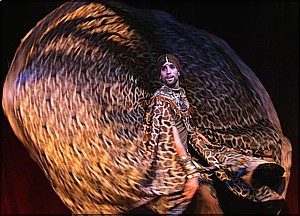
with an energetic performance by Asi Haskal,
vigorously spinning to transform his mantle into the most beautiful
veil.
Friday
Classes
The next morning I arrived strategically early at the Naima Akef
classroom to ensure a spot at Miriam Peretz's
workshop. Having studied earlier with Miriam, I knew that her
workshops were not to be missed. Miriam taught three very short
choreographies: "Hip-Hop Belly Dance Fusion", "Taqseem",
and "Balady.” Each piece comprised several combinations that
could be extended later on to a dance, and Miriam gave us valuable
pointers on how to do this. Miriam's teaching style was very clean-cut,
and she managed about 70 students with ease, arranging everybody
in columns to practice walking steps for the Balady choreography.
After the lunch break I attended the Dynamic Combinations
workshop with Zahava Brunovski. Zahava delighted
the participants with her very graceful and flowing, yet utterly
precise technique. The combinations included some basic layering
and she eventually combined them into a short dance.
After the
class, I decided to take a rest from the dance workshops and attend
a lecture by Rachel Milstein, the head of the
Department of Islamic and Middle Eastern Studies in the Hebrew
University of Jerusalem and a pioneer of Oriental dance in Israel.
The first part of the lecture was dedicated to dispelling the
harem myth and giving an overview of the history of the dance.
Dr. Milstein spoke briefly on such topics as Orientalism, the
status of women in Islamic society, and the role of men and ghawasee
in Oriental dance. In the second half of the lecture Rachel Milstein
imparted to us the story of her involvement with Oriental Dance,
starting with the time she witnessed Lahaluba
giving the first official Middle-Eastern dance concert in Israel
in 1965, and then recounting her extensive performance career
in Israel and abroad, including various anecdotes involving such
celebrities as Gregory Peck and Nagwa
Fouad.

click for lovely enlargement
Nili Mendelson |
Friday
Gala Show
At night, the guests gathered to watch the gala show, which featured
Nili Mendelson, Natalie Dvir, Miriam Peretz, Elina Pechersky,
Avigail Klein and Orit Maftsir. It was
remarkable to see the distinct style, and unique artistic vision
of each artist. Nili Mendelson was aloof and majestic as she opened
the show. She was followed by Natalie Dvir's savage interpretation
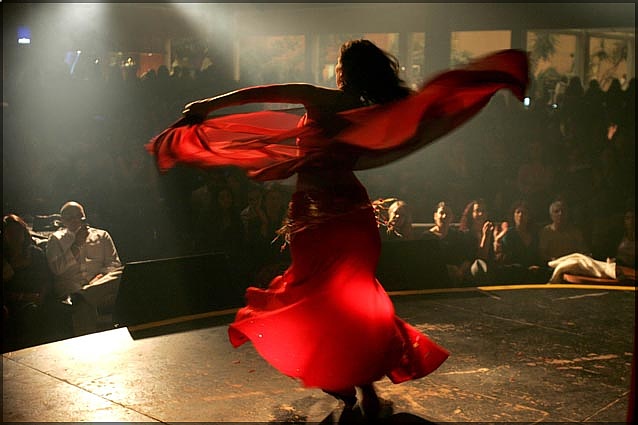
of Turkish Rom. Next, Miriam Peretz's candle dance was mesmerizing
and hypnotic, eyes projecting light, connecting with the audience,
just as she taught us at her workshop. Then Avigail Klein ignited
the theatre, spattering energy, making people laugh out loud,
as they watched her perform her signature pantomimes. The artists
worked hard, dancing in two or three acts to bring variety. The
show continued with Elina Pechersky in a playful cane dance, Orit
and Avigail in an Alexandria-inspired duet, Miriam sending flowers
to the audience in Turkish Rom, Nili and Natalie in veil duet,
Natalie in cabaret act, and Avigail sitting on the bar in the
rear of the theatre flirting with the audience members. Orit closed
the show, leaving the audience with a taste for more.

Participant in Cymbal workshop

Orit workshop
|
Saturday
Classes
The next morning started with a special treat: Miriam's "Turkish
Rom" workshop. We warmed up in a big circle and then proceeded
to learn several basic steps, such as the front-back-back-front
step, followed by layering of shoulder rolls and hip circles.
Miriam also taught a few gestures: some body cuts and hip and
chest punches. At the end, she combined these components into
a dynamic choreography.
While taking
a break from dance workshops, I attended Samer Alian's
sagat class. I find musicians' perspective particularly valuable
for dancers, and I appreciated Samer's introduction to rhythm
fundamentals: a subject often considered to be so self-evident
that it is omitted from regular dance classes altogether.
Despite my
overall mental and physical fatigue, I couldn't resist a shimmy
workshop with Elina Pechersky. Elina started
with a vigorous warm-up, and proceeded to teach various types
of shimmies with Saleh Hibi accompanying us on
doumbek. We shimmied, jittered and three-quarter struggled our
way to the very end of this marvelous weekend. Then we replenished
the calories we'd burned with pastries and cakes in the lobby,
and I took a chance to thank Orit Maftsir and Yael Moav for organizing
such a great event.
Summary
My overall impression of the festival was very positive, with
two suggestions that would make the event even better in the future.
While the dancers were talented and dynamic, I missed the presence
of live music at the festival, since improvisation to live music
is at the heart of this art form. All the performances except
the Pilpel ensemble used recorded music, and the two musicians
present at the festival did not perform. Also, none of the shows
in the festivals included programs, and I missed the chance to
read the artists' bios, and the details about the music and style
of dance they used. Overall, however, the event was most enjoyable
and I look forward to returning to it next year.
The third
international Oriental Dance Festival will be held on January
18-20 2007 in Eilat, Israel.
For more details & photos please visit http://www.eilatfestival.com/
Have
a comment? Send us a
letter!
Check the "Letters to the Editor"
for other possible viewpoints!
Ready
for more?
5-4-04 Belly
Dance in Israel by Orit Maftsir
Belly dancers are the hottest trend at the moment,
unlike the totally frozen attitudes towards the Arab culture in
Israel.
9-4-06
Tatseena's Bellydance Fantasy Festival
2006 Photos by Lynette & Carl Sermon
July 28 & 29, 2006 Marina Community Center, San Leandro,
California. "This festival was created for family, friends,
and fun!" says Tatseena.
8-30-06
Independent Contractor or Employee?
by Taaj
The important thing is that the relationship between
worker and payer be classified correctly for tax purposes so that
you are aware of what taxes and filings you are liable for.
8-28-06
Bellydancing, Mythology and Astrology:
Exploring the creative character of dance expression by Keti
Sharif
Is dance a ritual, a means of celebration, a form of
entertainment, or something more? Could it be a mode of human
expression that harnesses the secrets of the universe?
8-16-07
What Middle Eastern Audiences
Expect from a Belly Dancer by Leila
Audiences in the Middle East, especially Egyptians, see
bellydancing as something to be participated in, critiqued, and
loved (or hated) with gusto.
|