Gilded
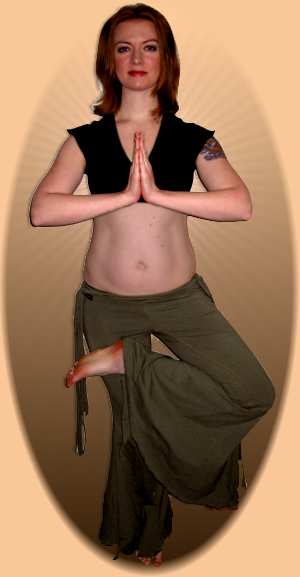
Serpent presents... I started my Yoga practice not long after beginning to Belly Dance. I was drawn to it and stayed with it as I enjoyed the benefits of its complementary practices. The promises of relaxation, strength, flexibility, and spirituality intrigued me and fit right into my Belly dancing lifestyle. I am not alone! Many Belly dancers practice Yoga also and those involved in Yoga are often intrigued by Belly dance. We will explore what the draw is between the two and why. Sterling Painton, from Pittsburgh, Pennsylvania, was already a Yoga instructor with her own studio when she started Belly dance classes with Kari Merlina. Painton’s business partner was interested in adding something different to the class schedule and Merlina’s Belly dance lessons fit the bill. Since Sterling had loved dancing since she was a little girl, she was excited to be able to start formal classes. She had not thought it was possible to start dance training in her 30’s, so she happily embarked on this new journey! On a purely physical level, Yoga conditions ones body and allows Belly dancers to execute movements with fluidity and strength as well as to access muscles with body awareness. Painton reports that she now has an incredible lengthening through her torso in her Yoga postures due to the strengthening and opening that Belly dance provides. Painton found, when she was learning to Belly dance, that the isolations were remotely understandable because she had years of practicing isolations on her body in Yoga (such as lifting the quadriceps off the knees or lifting the ribcage while grounding the feet). She noticed also that she could do Hatha Yoga to counter-stretch an area she just worked while Belly dancing. Additionally, she notes that Yoga will help protect the body from injuries, and, if you do get injured, the recovery time is faster if you are a practicing Yogi. I personally start my classes with a warm-up from Yoga for this reason. Painton points out that both Yoga and Belly dance require a great deal of discipline. Belly dance and Yoga can release trauma, both physical and emotional. At my Yoga for the Special Child ™ training, Sonia Sumar pointed out that after Yoga class, some students felt negative emotions without knowing why because no thoughts were attached to them. However, this was the body releasing trapped emotions! I am sure to point this out especially when working on Ribcage Pops and Body Waves because the heart space tends to hold so much emotion and it is worked so continuously in these movements. Letting go of those feelings that no longer serve you allows you to move forward physically and emotionally. Mentally, Yoga allows the Belly dancer to let go of the mental clutter that prevents one from “getting it” (a movement, combination, emotional expression, timing, etc.). Instead of wondering constantly how you are doing, judging, or criticizing yourself, Yoga allows for “letting go and letting it flow”. “Most of us who practice Yoga have slipped into flow on the mat, probably many times. We know those wonderful moments when postures feel effortless, and the body seems to move on its own without force or strain. We “know” the posture in an entirely new way and come out of these experiences somehow changed. At ease. Knowing ourselves more fully.” (Cope, Yoga Journal, October, 2007.) Belly dancers may recognize flow when they feel at one with the music and everything else slips away; you may notice your audience, but they are quiet witnesses. Or, the audience and your dance partner(s) are part of your flow experience with everyone feeling the music completely and communicating with total ease. Stephen Cope (working with Kripalu) conducted Yoga studies with musicians and athletes. Cope noticed that the more consistent he was in his Yogic practice, the more skillful he was on the piano! This integration of mind, body, and spirit seems to be the biggest factor in creating, not only fully satisfying experiences, but also improvement in performance.
Mihaly Csikszentmihalyi, author of Flow: The Psychology of Optimal Experience, writes that “Training attention to come back over and over again to a complex task allows awareness to become increasingly absorbed in the task at hand.” Yoga does this both in Asanas (physical poses), breath work and meditation (returning to attending to breath, thoughts, sensations, etc.). Belly dancers are experienced with bringing attention back to a task over and over when they drill and rehearse. For example: after 50 Hip-ups, a dancer may wonder what is for lunch, but there are still 50 more repetitions to make, so attention returns to the task at hand. Practicing choreography also requires attending mentally. American Tribal Style's Improv Choreography asks that the dancer stay totally in the present and not only attend to what she is doing, but also what her dance partner is doing. In that respect, Improv Choreography is clearly a Zen process. Spiritually, Yoga centers the Belly dancer. By revisiting Yoga’s non-competitive principals, one can acknowledge the bigger picture instead of any perceived slights or longings of the heart induced by the ins and outs of the dance community. Online communities such as “Too Much Drama to Dance” on Tribe.net show us examples of the struggles many Belly dancers experience. Through practicing yoga, Cope tells us: “The performer, like the Yogi, has a transient but profound experience of feeling more at ease with life, of trusting the ineffable ‘inner self’, and of living free from self-concept in a kind of river of energy and intelligence. This is perhaps the spiritual experience par excellence. Yoga transforms performance in powerful ways, reframing most conventional notions of the very meaning and purpose of performance itself.” Belly dancers report stress and negative energy burning away after class or a great performance. It also often provides a supportive social atmosphere, which may be difficult to find with today's busy schedules. Both practices balance ones Chakras, starting with posture that aligns the spine. (Chakras are energy centers in the body.) Heat, light, electricity and nerve impulses are all energy, and the Chakras correspond to nerve ganglia in the body. By intentionally moving the body parts associated with each Chakra, one releases blocks, energizes, and balances the energy centers. By working the Chakras through two practices, one can experience greater balance and health. Something to note is: while Belly dancing uses the whole body, there is a particular focus on one's belly that one does not find in other movement systems. Intentionally, we not only move the belly on its own, we engage it constantly during posture, and body parts are accessed more fully during ribcage and hip movements, as well as during Body Waves or Undulations. One's Solar Plexus, or Naval Chakra, (Manipura, the third Chakra) is associated with personal power, confidence and the fire element. With a stronger, more activated third Chakra, one exudes more confidence than someone with a less energized Naval Chakra. Perhaps this is the pull Yogis feel, already having been awakened to the energy and drawn to a dance that will further energize their inner fire. There is an innate need for humans to create and to express themselves creatively. The second Chakra (or first, depending on ones reference), which is located in the pelvis, is our creativity center. With a strong emphasis on hip and pelvic movements, Belly dancing activates our creativity, a need often over-looked in Western society. While also energized in Yoga, Yoginis may seek out Belly dance as a way to further strengthen this Chakra. On the other hand, if you are experiencing a creative block in Belly dance, then Yogic meditation, especially creating and meditating on Yantras (geometric designs that are containers for spiritual energy) can remove creative blocks.** Other movements and processes in the Belly dance experience also balance and organize the Chakra system. Floor work and footwork organize the first Chakra; ribcage and arm movements balance the fourth Chakra. Head slides, circles, swings and tosses, as well as zahgareeting and making shouts of encouragement or excitement energize the fifth Chakra; visualizing (a new choreography or costume, a movement, etc.), eye movements and moving meditations activate the sixth Chakra; and connecting with the Divine and/or your fellow dancers (including, but not limited to, the Zen feeling created during Improv Choreography and moving meditation invigorate the seventh Chakra.* Another reason people may be attracted to both Belly dance and Yoga is the release from typical Western thinking. Both Belly dance and Yoga originated in ancient times and on different continents/subcontinent. These practices both offer a tolerance of and acceptance for the self not readily evident to many in our mainstream society. Yoga teaches one to slow down, relax, and process at a gentle, conscious pace. Belly dance demonstrates body acceptance outside of the body images that bombard us in the mainstream media. Rodney Yee, a nationally known Yoga instructor and author of Moving Towards Balance: 8 Weeks of Yoga with Rodney Yee, says that Yoga puts everything into proper place. It allows us to enjoy and experience Belly dance more fully. Belly dance is artistically expressed wellness that offers strong confidence, and Yoga offers a deep, balancing practice, especially for the times when we must look within. Resources: Have
a comment? Send us a
letter! Ready
for more? 12-5-08 Getting
in Shape: Three Core Training DVDs and One Special Treat Review
by Rebecca Firestone 11-8-08 2
DVD Reviews: Must or Must Not for Your Library? FCBD
DVD Steps and Combinations, Vol.7 Fluid Precision Belly
Dance DVD Review by Martha Duran 3-16-05 About
my teacher Magana Baptiste by Horacio Cifuentes 1-8-09 Apprenticing
at ADC by Laura 1-6-09 2008
Drum, Dance, & Music Festival Raqs Taiwan with Karim
Nagi! by Lisa Chen 1-5-09 Now
What? Improvement Ideas for the Growing Dancer by
Anna 12-31-08 8th
Annual Blood Moon Regale: Disease 101 Photos and
text by Brad Dosland 12-16-08 Whose
Dance is This, Anyway? Where Do Men Fit into the Belly
Dance World? by Lara 12-14-08 What’s
in a Name? Orientalizing Oriental by Paola |