
Najia El-Mouzayen
March 18, 1998
Re: accrediting teachers
Each morning, I start my day by reading a page or two of what I think of as a dance related book. This includes cultural anthropology, books on the liberal arts, biographies, and autobiographies. Of most interest to me are the autobiographical works because successful, famous, and notorious people share many of their private thoughts which reveal the often surprising driving forces behind their careers. This subject of careers is presently at the top of my mind because with my new location came a new phone number, meaning I have to produce a useful business card. Formerly, I was using one which included a lovely quotation from Bert Balladine which was a compliment that he gave me about five or six years ago in print. The quotation reflected where my focus of attention was at the time. Now I have moved on and am once again struggling with reforming the essence of my lifework -- dancing and the teaching of dancing.
This week I have been reading the "Dance Pedagogy" of Mary 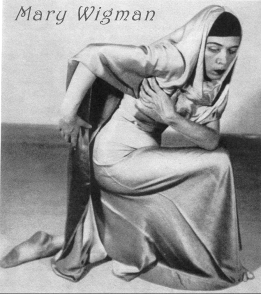 Wigman. At first I was slightly annoyed by the stilted language that I assumed was from
a recently bygone era and yet I was strangely enchanted to see that I had, in fact, been sharing many important
notions of dance with a woman I never met and of whom I had heard very little. Since Bert and I shmoose on the
telephone about dance subjects often, I mentioned how the stilted language of Mary Wigman still rang so true to
the subjects that hold meaning for me within the framework of my dance teaching career. Imagine my surprise when
Bert said, "Oh, I was just thinking of her the other day. I studied with her just after the war." Bert
and I have often laughed about our shared notion of dance lineage. The thought is that my own dance students are,
in fact, his dance grand-children. I have always taken great pride in the fact that one of my first dance teachers
studied formally with the great Martha Graham and that she made it her business to pass on core concepts about
dance that could not only apply to "danse moderne" but to "belly dance" as well. Here, I had
stumbled onto another grandparent of my dance! Bert explained to me that Mary Wigman was a German proponent of
modern dance and that what I had perceived as stilted language of the past was, more appropriately, the result
of translation.
Wigman. At first I was slightly annoyed by the stilted language that I assumed was from
a recently bygone era and yet I was strangely enchanted to see that I had, in fact, been sharing many important
notions of dance with a woman I never met and of whom I had heard very little. Since Bert and I shmoose on the
telephone about dance subjects often, I mentioned how the stilted language of Mary Wigman still rang so true to
the subjects that hold meaning for me within the framework of my dance teaching career. Imagine my surprise when
Bert said, "Oh, I was just thinking of her the other day. I studied with her just after the war." Bert
and I have often laughed about our shared notion of dance lineage. The thought is that my own dance students are,
in fact, his dance grand-children. I have always taken great pride in the fact that one of my first dance teachers
studied formally with the great Martha Graham and that she made it her business to pass on core concepts about
dance that could not only apply to "danse moderne" but to "belly dance" as well. Here, I had
stumbled onto another grandparent of my dance! Bert explained to me that Mary Wigman was a German proponent of
modern dance and that what I had perceived as stilted language of the past was, more appropriately, the result
of translation.
What had charmed me in Mary Wigman’s writing was that she totally validated my thoughts about why true dance pedagogy cannot be taught in the university and cannot be "certified" except in its most insignificant form – that of technique or abstract body movement. She explained that she "never wanted a manual, a technically oriented brochure, or even a teaching method". I had been privately berating myself in my thoughts for having spent so much time "re-inventing the wheel" and yet finding the adventure so rewarding that I could not give up the quest. Here, in print, I found a piece of sage advice from one of my own dance grandmothers. She said, "if I may give you any advice, then let me tell you: Discover it [dance] all over again…" "Do you want to resign yourself to being an imitator? Speak your won language and try to convey to your students something of what drove you once to the dance."
What I considered the ego of being able to produce a functioning dancer, as opposed to unleashing a passionate dancing person, became crystal-clear in just a few pages of Mary Wigman’s written word. Many times, both in print and face-to-face, I have commented to Bert that he was and is a "natural" teacher, that the principles of teaching that were taught in the university setting he seemed to just use without struggle and with an inspired flow. Ms. Wigman writes, "the secret of a pedagogic talent is a gift which you can neither earn or achieve through work: So, in a very real sense, teachers are born, not made. Therefore, the idea of creating a school or program for the express purpose of certifying and accrediting dance teachers is not a productive idea, and yet, Bert tells me that Germany has taken up the idea in relation to the Oriental dance and that the result is far from inspired. Only a very few teachers have tried it in America with, fortunately, little success. Generally these attempts have been made by instructors who tend to be more pedantic and less than creative with their own framework. I think that in our quest to become "a more respectable form of dance within the family of dance arts" we teachers need to be more circumspect about nailing ourselves to the academic pursuit of excellence and being more mindful that dance and the teaching of dance is more whole as a venture of the spirit. If you find yourself re-inventing the wheel of dance, you are, most probably, on the right path!
How to reach Lynette or Snake's Kin Studio:
Send E-mail.......... lynette@snakeskin.com