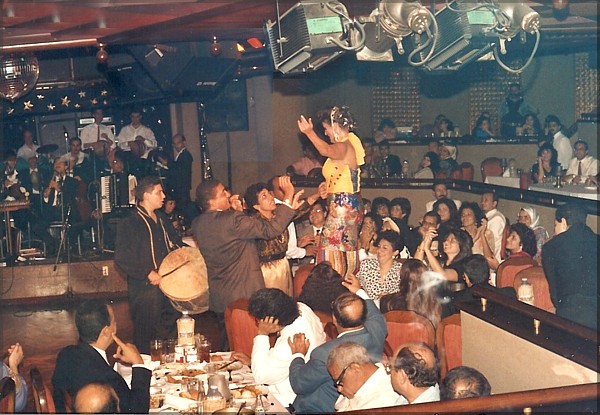
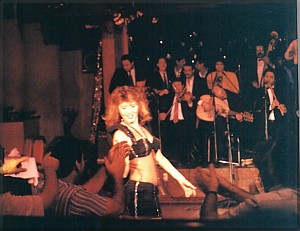
What Middle Eastern Audiences Expect from a Belly Dancer by Leila During my first few months in Egypt, there were times when I felt like crying after my show. Newly arrived from America, I was thrown into dancing two shows a night, seven nights a week at a five star hotel for a predominatly Arabic-speaking audience. I was sometimes met with ambivalent stares, skattered applause and polite smiles. I felt that I didn’t quiet know what was expected of me as a dancer. I had danced successfully for Middle Eastern audiences in Arabic nightclubs in America; why should it be any different here?
Audiences in the Middle East, especially Egyptians, see bellydancing as something to be participated in, critiqued, and loved (or hated) with gusto. Bellydancing is an integrated part of Middle Eastern culture, and most little girls have their favorite dance moves rehearsed for the next wedding where they will show them off. Turn on any old movie and it will have a bellydancer in it, while the Lebanese cable channel LBC has a contemporary bellydancer on, performing, a few nights a week. Although some won’t admit it, all Egyptians have their favorite bellydancer and can give the pros and cons of the dancing of all the famous performers. It is this atmosphere that gives audiences in the Middle East, and in particular Egypt, the discerning ability to judge a “good” dancer.
Nearly four years later, I am still dancing in Egypt but with much different results. It is great to look out and see people engaged in my show, clapping, smiling, or out of their seat dancing. Also, when I dance outside Egypt in Europe or America, it is usually the Middle Eastern members of the audience with whom I have the best rapport. How did I discover what Middle Eastern audiences expect from a bellydancer? I worked with Egyptian dance trainers (Oriental and folkloric), changed my show every few months, organized rehearsals, designed crazy costumes (some worked and some failed miserably), spent hours on stage in extremely varied venues (one nightclub was outdoors in August!), took Arabic lessons and learned to read in Arabic, and watched hours of Egyptian television (from old black and white films to modern television serials). It was a long, hard road and I’m still traveling it, but the work has paid off and I want to share a little of what I learned about what Middle Eastern audiences expect of a bellydancer. 1. Middle Eastern audiences expect the dancer’s appearance to represent an archetype of feminine beauty. Whether she is the femme fatale or the innocent girl next door, she must be larger than life. A dancer’s appearance plays a huge role in her appeal to the audience. This doesn’t mean the dancer has to be a twenty-year-old super model, but it does mean that the dancer has to pay attention to detail. A typical Middle Eastern woman will have her hair, make-up, and manicure professionally done for a special event. No less is expected of a performer.
2. A dancer is expected to have a certain amount of sex appeal, or dela. This is not expressed through erotic moves; it is more about the attitude of the dancer. It is represented in a playfulness, coquettishness and awareness of her sexuality and giving the impression that she is completely in control of it. It is not directed toward the men of the audience but is part of her persona as a dancer. An English dance tour leader who had seen almost every dancer in Cairo commented after seeing my show in my first months in Egypt: “You’re not much of a tart on stage.” I had been so conscious of trying to avoid the negative stereotype of a bellydancer that I had neglected the inherent sexiness of the dance. Of course there are different levels of sexuality on stage: there is a vast difference between the raw abandon of Nagwa Faud and the sweet coquettishness of Samia Gamal. But each in her own way had sex appeal, and audiences in the Middle East expect it.
4. An emotional connection to the music is key. This is the biggest complaint that Arabic audiences have of foreign dancers, that they do not “feel” the music. Part of this may come from foreign dancers not understanding the lyrics, and part of it may come from not having a cultural connection to the music. Possibly because of these difficulties, foreign dancers tend to concentrate on the steps and technique behind the dance and neglect the feeling and interpretation of the music. A Middle Eastern audience will generally choose to watch a less technical dancer who is connected to the music than a dancer who is executing the moves perfectly but seems disconnected. I have even been guilty of dancing to a song that I didn’t particularly like because I learned the choreography from a teacher at her suggestion. A solution to this is to find a song that you really moves you in the same genre of music of your choreography and rework the steps for the new song. (Just be careful of hand gestures and moves that are specific to the words.) 5. A dancer must be relaxed and confident on stage. Nervousness, in emotion or movement, by the performer will turn a Middle Eastern audience against her. Middle Eastern audiences don’t want to be “wowed;” they want to be entertained. This means the dancer must take them through a wide range of emotions and tempos, not rushing, but taking her time to explore the music and having the confidence to bring the audience along with her.
7. Personality and style. A bellydancer in the Middle East is not just a performer but a personality. When I was dancing in the States, I would think of the famous Egyptian dancers for their signature moves: Sohair Zaki’s down step or Fifi Abdo’s 3/4 walk. Now when I think of these dancers, it is for their particular style and personality. A dancer is expected to be unique and true to herself on stage. Can you imagine sweet Sohair Zaki brazenly smoking a sheesha like Fifi? Bring your personality traits on stage with you and incorporate them into your dancing. If you are comic or serious, delicate or reckless, then let this show. If you absolutely love wearing classic bedlas with miles of fringe, then don’t stuff yourself into a Lycra mini. Take the time to develop your own style on stage, being true to yourself, and a Middle Eastern audience will appreciate your effort. Have
a comment? Send us a
letter! Ready
for more? 7-21-04
Leila, An American Dancer
in Cairo by Catherine Barros,
8-15-06
Bellydance Journalism Rhythm
and Reason Series, Article 14 by Mary Ellen Donald 8-13-06
God Belly Danced: Belly Dancers in the
First Century Banqueting Tradition, Part 5, by DeAnna Putnam 8-9-06
A Meeting with Hallah Moustafa, Haute
Couture Costume Designer in Cairo by Milena Miklos |