

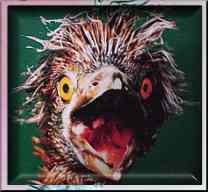
Taming the Wild Frilly-Lou Bird,
Or Training Your Hands to Dance
by Najia Marlyz
May 9, 2001
Hand Care and Pride is the Beginning!
Proclivities toward dance and all the arts begin in early childhood. A stranger set my eventual course in dance when I was a very young girl in my pre-teens when she exclaimed, "What beautiful hands you have for such a young girl!"
In addition, my mother unwittingly charted my initial voyage into dance by encouraging me to care for my nails and to wear beautifying rings and nail polish at a young age. Long before I was allowed to wear eye make-up, I was allowed and instructed to groom my nails and wear rings, and when I was quite young, to color my nails for special occasions. Though I was not allowed to wear nail polish to grade school, I often sported it on my toenails in bright hues beneath bobby sox and oxfords. It made perfect sense to me, therefore, when during my first lesson in belly dance, I was complimented on my "beautiful and graceful hands". I knew that! I had always known it! Perhaps the knowledge had come into my thoughts during my voracious reading of romantic novels, through descriptions of pale hands upon the keys of an instrument, graceful hands embroidering by firelight, or nervous fingers playing with wisps of golden hair. Whatever the source, I knew that my hands could dance. Always!
Mom and I rubbed and massaged our hands with hand cream, and I exercised my fingers and stretched them back so that they would look pretty as they moved across the ivory keys of our mahogany spinet, me, imagining myself a famous piano player and endlessly fascinating! My piano teacher, an elderly powdery haired woman who had two upright pianos in her living room and who was stricken with acute agoraphobia, taught me that I had to sit up and breath correctly and let my fingers work effortlessly from elevated, gracefully arched wrists. We had not heard of Carpal Tunnel Syndrome in those days, but I imagine now, that my piano teacher who taught me the basics of reading music, also saved my wrists and arms from injury when I began to play the finger cymbals as an adult. I did not play the piano well, but I managed to look as if I might.
Positive
& Negative Spaces
My father and I made shadow plays on the wall and ceiling by candlelight. When
it came time for me to attempt to teach others my "hand lore for dance",
it seemed natural to revisit my childhood experiences making "shadow
plays" with my hands. I encouraged my dance students to sit in a darkened
room along with a bare, unfrosted light globe and practice hand
motions while listening to music. The effect can be magical.
Looking at random hand motions in the mirror cannot compare to the fluid,
stylistic movements that are possible when all other considerations are
isolated away from the moment. I refer to distractions reflected in
the mirror of colors and patterns, facial expressions, broken nails or
mind games that encroach upon the meditation of smooth, continuous movement
of positive and negative space.
Few dancers learn to create movements that are composed of both the positive and negative elements.
Their thoughts dwell upon the positive only: their hand and its size and shape, and sometimes, its imperfections. When one is forced to see the negative spaces between moving shadows, one is drawn naturally into the shape of the light, which is often perceived as having a bit more reality than unoccupied air space.
Here is a suggested exercise for your hands and mind:
- Place both hands in front of your face and make your fingers undulate like caterpillars.
- Next, stop looking at your hands and begin to watch the space between your two hands manipulating that empty area into pleasing shapes that are surrounded by your hands.
- Now play music while moving both of your hands (your positive elements). Change the shapes between your hands (your negative elements) in response to the music.
- Last, switch on your bare, unfrosted, light globe and dance your positive and negative shadow hands on the wall. Experiment with it until you are satisfied that your finger and wrist flexibility and quality of movements actually portray the musical sounds you are hearing without jerky awkwardness (unless the music itself is, in fact, jerky and awkward).
Dance is completed and enhanced by your hands! Dance is body language, and you must punctuate dance with your hands just as you might enhance your speech with your hands. In the home of my childhood, it was considered rude to point and gesticulate. It was considered somewhat lowly and illiterate to speak and wave one's hands about in the air. I was greatly pleased when I met the Italian-American family of my first husband and found them rich in the currency of hand gestures, emphasizing and further describing and enhancing all subjects being discussed (all at once and in loud voices). Gestures, though, have an accent, just like the accents imposed upon speech by a foreign speaker. As a dancer, you might well observe and learn the meaning and proper usage of gestures commonly used around the Mediterranean, the Middle East, and in Greece. In addition to that, it would serve you well to make a private collection of "forbidden" and obscene gestures from foreign cultures so that you can avoid making them by accident, and avoid being duped into making them on purpose by jokesters who have questionable judgement.
Among my cherished memorabilia, I have a photo of myself, dancing with my former instructor and my then dance partner, Bert Balladine. My face portends a dreamy romance while my hand is outstretched toward the camera, my large finger cymbal, worn on the center finger, is folded inward, hidden near my palm, along with my ring finger, sending a perfect Italian "cuckold" sign to the audience. Well, some things one has to learn the hard way!
Here is a suggested project
for learning some useful dance gestures:
Rent a movie on videotape or DVD that is from Egypt, Greece,
or Turkey and also has subtitles. Study it for subtle hand gestures and
then compare what is being said at the exact moment the gestures are used. Then,
when a similar subject arises in an Arabic or Turkish song, notice the same
gestures being used. Try them yourself but don't "overdo" it! In
this case, less is more!
Some of the gestures that are often useful in Belly Dance are the following:
- Small,
- petite,
- wait,
- a little bit,
- no,
- go,
- come,
- finally,
- shy,
- jealous,
- showing,
- giving,
- longing, etc.
These are all motions, not hand signs, so that I cannot help you learn them from a still photo and the printed word. For this knowledge, you will have to resort to real people, movies, or television as I have suggested in the project. As a dance instructor, I have attempted to make this type of information available to my students in their lessons and through showing foreign films occasionally. Few "wannabe" dancers truly understand the usefulness and importance of watching foreign films of little literary consequence! The use and understanding of common gestures has greatly helped me get the proper Middle Eastern accent into my dancing.
Aesthetic Hand Conformation
Did you study ballet when you were a child? Good! Many little girls
study ballet and come away with a specific (although rigid) way to hold the
fingers in a position that is both aesthetic and unobtrusive. There is a
similarity of hand conformation in Belly Dance too, but the hand position
is merely a starting point, a resting position, from which gestures and energy
spring forth. I will attempt to describe the position for you! Imagine that
you are wearing a set of finger cymbals (sagat). Whether you are, or are
not, actually playing finger cymbals, tuck your thumb inward as if you were
playing the cymbals. In addition, elevate and separate your index finger,
your ring finger, and your pinky away from the upper cymbal that is worn on
your center finger. The reason for splaying your fingers is both to get them "out
of the way" and to allow them to be held in an open, light, and projecting
gesture. (Poor hand conformation tends to "cut one's projection of energy" and
to cause the hands to lack life and expression.)
Traffic Direction, Focus & Carriage
Next, remember your piano lessons and break slightly (flex) at
the wrists. A sharp break will appear creepy and a bit too affected for true
Middle Eastern accent. When actually playing finger cymbals, the dancer should
hold the cymbals forward usually in the upper regions of the torso rather
than dangling them over head and "threatening" her audience with
them. Lifting them, palms up, over her head as if she were trying to get
them as far away from herself as possible also gives a peculiar body language
signal. Worse yet, holding hands and arms on the same plane as her torso,
somewhat flat and perpendicular to the floor, tends to give her the attitude
of a martyr being crucified, an appearance that is hardly conducive to entertaining
an audience!
Hand placement or "carriage" can help to focus the audience's attention on the movements you intend them to watch. If you place them on the same level as the moving part at least for a few moments, you direct traffic to that area and the motion and effort will not be wasted. All performers, even clowns, "set up" their "tricks and schick" so that the audience knows, in advance, just where it will happen.
Transfer of Energy: Projection by Framing, Presenting, & ReleaseRemember as a "Rule of Thumb" that where the hands go, so go the eyes of the audience. Do not bother yourself with a fancy hip shimmy if you are creating Frilly-Lou Birds with your hands held above your head.
The dancer's hands and her arms too, should act strongly as energy projectors and receivers and need to fulfill that function. Along with gestures, projection allows the dancer to speak body language with her audience in a form similar to "dialogue", both giving and receiving much like an antenna sending signals across space. Great dancers use energy with power and care. Poor dancers use and abuse it, flailing away at the audience with unbridled motion. Yes, I know you have seen them! Their hands twirl and rotate though the air constantly as if they were perpetual motion machines. These movements, though graceful and smooth, almost beautiful, are like a purple poison injected into the essence of the dance, killing the audience's sensibilities, rendering onlookers of all their energy in that great black-hole that is the needy, frenetic dancer! It sucks them dry of vitality and insists, "Look at me! LOOK AT ME! This characteristic movement is what I refer to as Frilly-Lou Bird Hands. They are fancy, but more than a bit silly. Worse yet, they have the wrong accent!
In contrast, the great dancer understands dialogue with her audiences. She learns to frame her movements, lift and present or "gift" them to the audience and release them for a few moments before she starts the cycle over again by sweeping the collective audience attention back into herself and setting up the next movements. The release is such a small gesture; a slight flick of the fingertips as the movement is finished! The fingers, themselves are the last "fine turning" of the sparks that are the dancer's personal electricity.
The constant transfer of energy through focus, in which hands and arms are used as projectors and receivers, creates a relationship between performer and audience. As in Hatha Yoga, the dancer's fingers must not turn inward and return her energy to herself before it reaches her audience. Her wrists must not be allowed to choke off the energy being carried through her arms at a set of wilted hands (or "puppy paws", as we teachers used to call them).
Use of Pulse PointsOnce the dancer learns the skill of audience dialogue through energy transfer, her dance enters a new dance league and she will not be a dull performer. Strange, perhaps, commanding and expressive, we hope, but never dull!
Awareness of pulse points is a major way of projecting energy. The backs of your hands carry very little energy, though you may use them toward an audience indicating a lack of energy, such as in "Woe is me", and "Aye, Carumba, what have I done?" or "Ahm hot, ahm taard, and ah think ahm jest gonna wilt!" When you expose your pulse, the area of your life's blood flow, toward your audience, the perception is that you are open, alive, and sharing the moment--and that moment is music! However, turning with the pulse forward and the hand in slapping position, indicates a sloppy kind of recklessness that gives a bad impression.
Here is a suggested dance experiment:
- Turn or spin with your arms extended outward, pulse forward and hand open, thumbs up. Fine! Now you have just slapped your audience repeatedly across their collective faces!
- If you want them to adore you, spin again, this time pointing your pulse at the floor, and pretend that your hands are eagle wings soaring through the air. Bank your turn like the eagle banks his. You will turn easier and look more finished!
Here is another dance experiment:
- Dance toward your audience showing all of your rings for their admiration.
- Now repeat, flexing at the wrists so that your rings are looking back at you and your pulse point is exposed to your audience. Feels different, No? It carries with it an entirely different body language signal!
One of the simplest of all the hand uses in dance is to echo the movements you are making with your body by repeating the same quality of movement with your hands in the same vicinity as the moving part. For example, if you are making a basic one-hip movement, try echoing it with a similar hand gesture. A large circular movement of the hips can be accompanied by your hands, repeating the motion along with, but in front of, the hip area.
Each time you echo a torso movement with a similar hand movement, you have strengthened and enhanced the movement. You have described it to your audience, "Can you see this large circular movement that I am making with my hips?" Where the hands go, so go the eyes.
Here are some movements to
try:
Make "hip figure-eights" and repeat them with your
strong hand like the motions of a paintbrush. Next, do a small one hip grind
and accent it with percussive drops. At the same moment that you drop your
hip each time, make little pecking motions with your hand to reinforce the
movement and make it send a stronger impact, increasing its rhythmic quality. Try
all of your typical dance movements in this fashion, and observe what hand
motion you can use to accompany them in kind as if you were an orchestra
conductor conducting the music in your body.
Nobody needs to tell you that your arms help you to balance yourself. But we dance teachers have to constantly remind students that a fully extended arm or arms help balance like the long pole carried by tightrope walkers as they cross high expanses of space on a slender wire. Additionally, arms that are not fully extended often indicate indecisiveness, and fear. To gain the respect of your audience, you must make your intent clear and your line strong. Your sense of line and balance can begin with the idea of "completing" and "complimenting" your position. For example, match an extended leg and toe with an equally extended arm and fingertip on the opposite side of your body. (Remember to work "cross-body" line for good balance!) Gaining a sense of good line often grows and develops by the example of another strong dancer and/or experimentation in front of the mirror.
Here is an experiment in developing "Line" that
you may want to try:
Extend your leg in any direction. Close your eyes and
match that extension with the opposite arm making a straight line from toe
to fingertip. Now open your eyes and check your work. Is your line continuous?
Here is your second try:
Extend your leg in a bent position. Close your eyes and match
that position with your opposite arm. Check to see if you were correct in
feeling the line.
If you can feel it, you no longer need the mirror.
When new dancers first begin to dance, the most difficult concept of all for them to grasp is lack of motion. Negative motion. None at all!
Shift those hands into "Park", not "Neutral", (because they have to stay energized) but learn that there is beauty and meaning in stillness. Like the old cliché, "Still waters run deep." The whirring Frilly-Lou Bird hands must stop and roost from time to time. By itself, the rest time creates an interesting negative space and creates contrast that gives importance to the next movement. Hands can rise and fall with the musical tones, they have the power of releasing and gathering energy. They are your punctuation and your completion of movements. They are a part of your voice and your expression. They detail and define your dance.
Here is the most difficult
dance experiment of all:
Dance without using your hands and arms at all. Hold
them above your head or behind your back, and try to think about all the
expressive opportunities that you are rendered unable to use! Feel how you
have impaired your ability to balance when you turn and suspend. Notice
all you have lost!
Secondly:
Reintegrate hand movements sparingly. Use them when you
have the purpose firmly in mind. Sometimes, feature your hand movements alone,
sometimes place them in a pleasant frame, complimentary line, and feature
only your body.
All right now! Isn't that more fun? Don't you feel that you are dancing with a heightened sense of purpose?
Ready for more?
More by Najia--
Put Your Dance on a Pedestal
Many dancers make the mistake of using the entire width of the front part
of their feet when they dance, because they have never been taught dancer's
footwork. "Ankle wobble"indicates...
An Interview with MARLIZA
PONS, by Robyn ("Maya") Hallmark
In a tiny bikini, I'd dive into a lighted pool outside the restaurant,
and come up with a pearl in my mouth!
On the Costumer’s
Bookshelf by Dawn 'Davina' Devine Brown,
The Splendor of Ethnic Jewelry. For the reader or researcher interested
in ethnic jewelry, this sumptuous coffee table book is worth every penny
of its rather steep price


