Gilded Serpent presents...
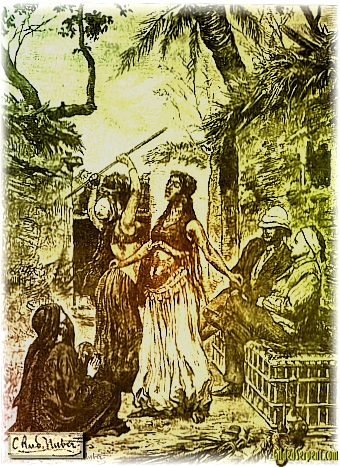
A pair of dancers, probably Ghawazi,
from George Eber's 1878-79 work,
Egypt.
Note the similarity of the dancer's peculiar
belt to that described
by Leland
Sirat Al-Ghawazi
Ghawazi (Epilogue?) part 3
by Edwina
posted October, 2011
Previous published in 1979, Habibi Magazine vol 5 #5 (Zalot era)
From another American travel book, published in 1874, comes this witty and apparently sensible account:
''The great desire of gentlemen who come to Egypt is the dancing girl. If it were put to the vote, most of them would prefer her to the Pyramids, if not to the Nile. Even the moral and pious, the oldest and coldest, cannot forego this bit of temptation; so they get themselves earnestly assured by their dragoman, or, better still, by some gentleman of acknowledged high character - if possible from Boston - that there is really nothing in her performance which would call a blush, et caetera. It is better still if Mr. High Character gravely assures them that in fact he found it very stupid, and the Ghawazi very ugly. All of this is most thankfully accepted, for admitting it in full, the dancers are still Improper - which has a charm beyond beauty or grace; and however good a man may be, he is seldom willing to admit he did not see it, and knows nothing directly about it. Hardened worldlings who frequent the regular ballet are not so deeply disgusted with the Ghazieh, nor do they find her so altogether stupid or so invariably ugly.
''The dancing-girls are obliged by law to remain at one or two places on the Nile. Formerly they strayed through the streets of Cairo and other towns in hordes, and a resident assured me that he had seen them perform on the veranda before Shepheard's Hotel. The result of the moral restriction has been to confine familiarity with their feats to the wealthy, since it is still the fashion for the well-to-do, when they give 'fantasias' in their houses, to send for Ghawazi, who are invariably procured from somewhere ...
"As regards the impropriety of the dancing said to be performed by the Ghawazi in very select and private circles, I have nothing to say, except that it should no more be taken into critical consideration than that of French ballet-girls under the same circumstances. As to the grave question of indecency in their public exhibitions, even before men, when no women were present, I am assured by the most experienced that I had several very good opportunities of judging what it was. And my opinion is that, contrasted with the European ballet, one is just about as good, or as bad, as the other...
"Most of the dancing of the Ghawazi is indifferent enough, especially when European ladies are present, or gentlemen who manifest no interest whatever in their performances. It is, however, remarkable that what skill they do exhibit, even under these circumstances, is seldom appreciated; for the dullest of them generally effect merely muscular feats, such as one never sees in the West, yet which are not directly perceptible. They all seem to have the power of moving any part of the body freely, just as certain persons can move their ears; and it is wonderful how they will continue to agitate every muscle in the most violent and rapid manner for hours, quivering from head to foot as if electrified, without being in the least fatigued, and, what is incredible, without perspiring.
Qamar El-Mulouk
I only once saw Ghawazi dancing, which was, in the opinion of native gentlemen, and of Europeans who had been many years in the country, and had full opportunities of judging, of a really superior and artistic character. This was at Girgeh. There were two girls, one quite pretty and young, the other less attractive, but rather the better dancer. The music consisted of an orchestra of four or five men and women with the tair and darabuka, two kinds of tamborines, the nai or reed-flute, and the rabab or violin. The dancers themselves play invariably, while dancing, on the sa'g’at or brass castanets, which appear to cause no little trouble by getting untied or displaced. Before the regular dancing commences, yet while undulating about the room, the Ghawazi generally sing with constant repetition one or two verses, in which it is not unlikely the ear most unfamiliar with Arabic will soon distinguish the word mahboobe or 'beloved.' The following dance verses were collected by M. Antoine, of the American Legation, Constantinople, from different Ghawazi on the Nile, and by him obligingly translated and
given to me: -'By those black eyes!
By thy forehead and lips!
I do love, and beseech thee
Do not abandon me.'The man I love dislikes me.
In my sorrow I cry
From the bottom of my heart:
Let me a moment enjoy his love,
And afterwards let the world go.'0 thou! help me, I cry,
For the man I love,
The man I love is gone;
He is gone without return.'You are a beauty.
Let the people say it.
Your departure is superb;
He who beholds you
Is maddened by love.'Day and night why art thou angry?
By the mere playing of thine eyelids,
Thou driv'st me mad;
If thou wilt not come,
Send me at least a thought,
I love thee too much,
And great would be my joy in thee.'"These dancing-girls were dressed in long skirts, one over the other, reaching to the ankle, the upper garment being of a whitish-yellow or reddish color. The body and arms were clad in a very dark, tightly fitting chemise, with white stripes, half an inch broad, about two inches apart, looking tiger-like. Over this was worn a very tight jacket of red satin, very short in the waist, with tight short sleeves. On their heads were curiously shaped caps, and their hair hung in long braids. Around the waist was a silver girdle with high bosses, and dependent from it in loops was a very curious and massive ornament or chain, made of eight or ten triangular silver boxes, and many large silver beads. A profusion of gold necklaces, coins, and other ornaments hung from the neck and head. Other Ghawazi at different towns wore dresses very different from this. At one place their garments were of black from head to foot, with silver stripes, while the braids of hair were very prettily made, terminating in many silver balls. At Siout I saw one whose only ornaments were an incredible quantity of gold coins of all sizes...
"The first dancing of all Ghawazi is simply moving about to the music and undulating the body. Then waves of motion are made to run from head to foot, and over these waves pass with incredible rapidity the ripples and thrills, as you have seen a great billow in a breeze look like a smaller sea ribbed with a thousand wavelets. All is done in perfect time with the music. Then the air changes, and there is a variation in the dance. The girl stops - she becomes immovable below the waist, and moves only the body above, rocking and swaying, expressive of suffering from intense passion. At times, and in time with the music, a convulsion thrills the waist, arms, and head, and sometimes the muscles. She becomes quiet; but if you observe closely, the movement, passion, and exertion are not less intense, and the breasts continue to move as if vitality remained in them alone; perhaps only one throbs violently.
''There is another change, and the dancer sinks slowly almost to her knees, as if overpowered with passion, while the arms sweep in singular but graceful gestures. Perhaps she 'waves' slowly in a walking dance, moving the lower part of her body forward more and more with a vigorous quivering, and once in ten seconds starting with a convulsion, which gradually becomes more frequent until she apparently yields and expires.
"The girl at Girgeh performed a very pretty dance, which was quite a poem.
Placing a cup, symbolic of temptation, on the ground, she danced around it in a style which was perfectly Spanish, turning the body and sinking low with great grace and exquisite art. The cup appeared to exercise a terrible fascination, but she seemed afraid to drain it. The fear was perfectly acted. Five times, without aid from her arms, she almost lay on the ground with her thirsty lips just dallying with the edge, and then rising swept in dance, and thrilled, and shivered, and turned, and sank again. The sixth time she had completed a circle, and no longer able to resist, she approached the cup with throbs and pauses, and then, without using her hand, lifted it from the ground with her lips alone, draining it as she rose, and the tragedy of temptation being over, merrily danced about the room in quick step, with her head thrown back, holding the cup all the time in her mouth."Then the elder girl placed a cup on her head, and danced for a long time a great variety of movements without letting it fall, the same being done in turn by the younger. I did not see, however, as my fellow-travellers did on another occasion, dancing-girls, who while dancing made cups run from the head down the side of the face, along the arms and back, as a skilled Hercules in a circus makes cannon-balls travel around him. This is, however, rather juggling than dancing. Sometimes a stick is used in these performances. Sometimes the two girls dance a duo; and I have seen this made quite as improper, though not so sickly sentimental as in any opera-house in Europe, when the ballerina falls back into the male object's arms, eyeing him with a leering smile, while she lifts one leg to the gallery.
"There are 'Awalim and 'Awalim, and Ghawazi and Ghawazi. Some are mere peasant girls who work by day and dance by night; and others are low caste, and dance coarsely, with a male jester taking occasional part in the performances, as I saw at Luxor. I am told that the best are to be seen in Cairo, in the grand harems on great festival occasions ...
"When I was on the Nile, I gave the Ghawazi the name ‘Wavers,' as expressive of their movements. Long may they wave!' "
- Leland, Charles G., The Egyptian Sketch Book. New York, Hurd & Houghton, 1874, pp. 136-144.
Ready for more?
- 02-14-09 My First Experience in Egypt
I have always felt a pull to visit Egypt to experience the history and culture of this dance I love so much. The chance came about just recently and it was so worth the wait.


