


 The
Gilded Serpent presents...
The
Gilded Serpent presents...with Lynette
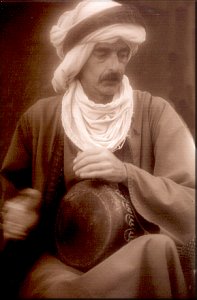
Mark began playing the Arabic drum, tabla, in 1972, and the Persian drum, zarb or dumbek, in 1976. Primarily self-taught, he had the great fortune to study with Farahadman in Tehran, Iran, and with Mahmoud Hamouda at the Conservatory of Music in Giza, Egypt. He has performed professionally for over 25 years. Mark and his wife, Elisabeth, form the music ensemble, "Helm." They have three CDs available now and one more in the making. It is the second in the Tribal Dance/Tribal Drums series with the working title, "Etneen", in collaboration with FatChanceBellyDance.
My story starts
in 1972. At the time I was living in a teepee in Nicasio, California.
I had come back to
Though the dumbek wasn’t part of the curriculum, I included it in my studies. I mistakenly came to the conclusion that playing the dumbek would be easier than playing Indian music. My schedule included my studies at AACM and dumbek lessons at night. I always had my drum with me, playing constantly.
 At
the beginning of the summer, I was involved in a minor legal hassle,
so I needed money for lawyers and to pay back a friend who had put up
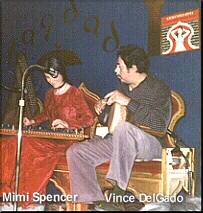
bond money. Somebody, perhaps it was Vince
Delgado, told me that I might be able to get a job a couple of nights
a week at the
Bagdad. So I went to audition at the
At
the beginning of the summer, I was involved in a minor legal hassle,
so I needed money for lawyers and to pay back a friend who had put up
bond money. Somebody, perhaps it was Vince
Delgado, told me that I might be able to get a job a couple of nights
a week at the
Bagdad. So I went to audition at the
I played at the
Renaissance Faire for Jamila
Salimpour in the fall of ''72 (after 8 months of playing dumbek).
Jamila had had a fight with Vince the year before, hired this other
guy who played in
I had a friend, Michael, who had a fruit salad booth at the Faire that year and who in turn had hired other friends of mine. They came back after the first day and said I had to go back with them. I wasn’t really into it, but this one guy, Marco, who was pretty crazy, said I was going or he would knock me unconscious. I knew he would do it, so I went.
Another friend of mine, a San Francisco Sufi, was working at the salad booth. I guess he had made some deal with Jamila to push her cart - a sort of wooden litter/carriage thing - that Suhaila rode around in. Suhaila was six years old at this point, and she played the part very well; she was very gracious. Granted royalty, she didn’t lord it over anyone; she was very warm and had a lot of class. My friend sent me to deliver the message to Jamila that he wasn’t going to wheel Suhaila around. Off I went with my little metal Syrian dumbek on my back.
"Can you play
that?" said Jamila, pointing to my drum,
"Yeah!" said
"Play beledi!" said Jamila.
"Play chiftitelli," said Jamila.
“Do you want to play for my troupe?" she asked.
"Yes!" I said.
 It
was pretty mind boggling to play for Bal Anat. Darioush
Sami was playing santour, with strings breaking and flying
all over the place. The whole bunch of us hippy drummers was pounding
away. Add the dancers with the cymbals and drums, and it was a very
big sound. Jamila was in the center with her big drum, trying to control
everything, marking the beat with one hand.
It
was pretty mind boggling to play for Bal Anat. Darioush
Sami was playing santour, with strings breaking and flying
all over the place. The whole bunch of us hippy drummers was pounding
away. Add the dancers with the cymbals and drums, and it was a very
big sound. Jamila was in the center with her big drum, trying to control
everything, marking the beat with one hand.
It was also at the Ren Faire in ''72 that Salah Takesh played one day. He came on stage and looked at the drumming crew and at me. “Play plenty of 'dooms' so I can trip out,” he said. He wanted us to keep the basic beat so he could improvise over the top. We were reluctantly impressed.
 In
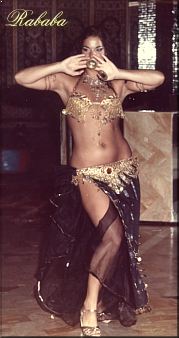
the evenings, at the Ren Faires, before there were curfews, we used
to play until 3 or
In
the evenings, at the Ren Faires, before there were curfews, we used
to play until 3 or
After the Ren Faire
of ''72 we also did the Dickens Faire (a Victorian-themed fair
by the same organizers) with Bal Anat. I think I started playing at
the
One of the images I remember that was really cool, was when George Elias would do a Farid al Atrash oud solo. He used to play it a lot for Amina.
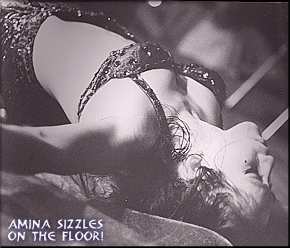
Amina would do an incredible floor taksim, tossing her hair around, flying, kind of beyond the constraints of accepted floor work routines at the time. I don’t know if she tranced out, but it was really wild!
 Tasha
had started working the clubs in
Tasha
had started working the clubs in
A couple of dancers (whom I won’t name) just used the club to help their other nighttime activities. One I knew better than the other; she was one of the nicest people I ever met and directed me to source recordings by Abdul Halem Hafez and other singers. George would never tell me about any of that.
In the winter of
'72, we did the Dickens Faire with Jamila, doing thirteen shows a weekend.
They had Bal Anat in a coffee house nightclub that one would have to
stumble across to find. It was not the major production like she put
on at the Ren Faire. She had a fight with Darioush and then hired Saul
(Sulyman) to do the rest of the Faire. The Dickens Faire was
pretty miserable. It was in a warehouse in
The best thing that came out of the Dickens Faire was that a PBS station asked us (Bal Anat at Dickens) to do a video for their programming. I saw it maybe four or five years later: they were still running it. My initial comment to myself was, “Thank God, the dancers were good!” It's a good thing that I have a big ego that could shut out what I was doing then. I was awful!
That spring the
guy who was working most of the time at the
He was right in that when you aren't born in the culture, you don’t have it in your subconscious mind. You look like a total fool because there are a lot of breaks and stops in the music, and you may have never heard the songs before. If you are playing three or four hours a night, that is a lot of songs to just walk into and play cold. Even if you learn 200 songs, most of these guys know 2000 songs or more! You are at an incredible disadvantage to figure out what is going on!
 Unfortunately
for George, the drummer he had hired got killed over a used car in
Unfortunately
for George, the drummer he had hired got killed over a used car in
Soon (I think 1973)
I finally got enough money together to get a room in John Compton’s
house in San Anselmo. (It was on 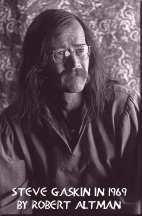 accident
and got hurt very badly; her sessions were not the same after that.
My original finger injury occurred on the bus with Steve Gaskin,
famous for "The Farm”, and “Spiritual Midwifery". Somebody
had a roll of carpet balancing on the stove in the bus. It started to
roll and I went to catch it and caught my hand on the edge of the stove,
causing a deep stab to the back of my hand.
accident
and got hurt very badly; her sessions were not the same after that.
My original finger injury occurred on the bus with Steve Gaskin,
famous for "The Farm”, and “Spiritual Midwifery". Somebody
had a roll of carpet balancing on the stove in the bus. It started to
roll and I went to catch it and caught my hand on the edge of the stove,
causing a deep stab to the back of my hand.
Another colorful
character in the scene was Rashid Kadmeri, a guy from
Samra was another complex dancer in Jamila's troupe. She said she was half Arabic, and studied the Arabic language between sets. She was always going to school and had other non-belly dance gigs too. She showed me the kind of drive you need to succeed. She was at dance classes at 7 or 8 a.m., off to university in the afternoon and dancing in the clubs at night.
Reyna was Italian and had black hair down to her ankles. She was a dancer in the club, and maybe studied with Jamila at some point. Her best bits were in the Casbah, where she would really work over a guy with her eyes and expressions. When she knew that she had him hooked, she would do a fish eye or some grotesque look, looking really weird, to gross him out. It was a game she played. One time when she went for tips, she went into the men’s room just to be funny. (She knew nobody was in there.) We played "Zalati Zane" one night and I remember in the chorus where everyone says “Hey!”, she would walk to the front of the stage and strike a "weight lifter hulk" pose and, flexing her biceps, say "HEY!" in a deep voice.
Working at the
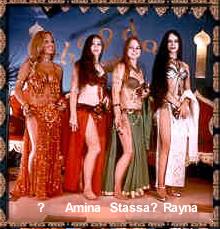
There was a whole world with layers of consciousness that I had no idea about. The intrigues between the dancers and customers, the dressing room scene and past histories between George, Yousef, Fadil and Jalal. I had no idea and nobody filled me in. I was in my own world trying to figure out the music.
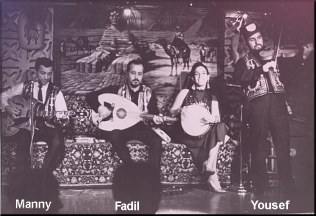 George
was always funny when there was a taxsim, because he would turn on a
rhythm box. To this day I can’t stand boleros. I would just stop,
and wait until it was over. He knew I really liked the Abdul
Halim song called "Ma-oud" . He would wait until I was two
feet from the door to take a break and he would start playing it to
keep me from going outside. He was playing with me. When your club is
dying and you have to amuse yourself, you do anything to keep yourself
going: games or whatever it takes. He knew that I would come back and
sit down to listen.
George
was always funny when there was a taxsim, because he would turn on a
rhythm box. To this day I can’t stand boleros. I would just stop,
and wait until it was over. He knew I really liked the Abdul
Halim song called "Ma-oud" . He would wait until I was two
feet from the door to take a break and he would start playing it to
keep me from going outside. He was playing with me. When your club is
dying and you have to amuse yourself, you do anything to keep yourself
going: games or whatever it takes. He knew that I would come back and
sit down to listen.
One of the other things I remember from that time was one night when I had just come out on a break and Jalal was out on a break from the Casbah, when a Chinese gang pulled up and were going after some Chinese guy with chains. Maybe it was up by the Mabuhay Gardens. (It was a restaurant at that time, not a punk club as it became later.) They were chain-whipping the guy, and an SFPD car was just sitting there in stopped traffic. Jalal ran over to the cop car and said, “Hey, hey, they are killing that guy!” Jalal just tossed up his hands when he realized the police were not going to do anything. When the gang noticed the police, they left in their van. Then the police turned on their siren and pulled up to the guy bleeding on the sidewalk. The police obviously didn’t want to get involved, as they were outnumbered. But at least they could have turned on their siren to get the gang to leave a little sooner. They sure walked around tough once they got out of the car!
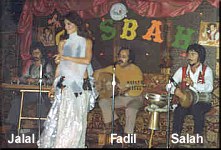 We
used to go back and forth on nights off between the Casbah and Bagdad.
Salah was playing, Jalal was on kanoun, Fadil, Ali Azadan,
a Persian drummer, and Giligili on drum. Fadil played
differently from George, who wasn’t always easy
to get along with. I would sit in with Fadil for a dancer or two. Also
I was looking for musicians better than I was, so I could learn new
things.
We
used to go back and forth on nights off between the Casbah and Bagdad.
Salah was playing, Jalal was on kanoun, Fadil, Ali Azadan,
a Persian drummer, and Giligili on drum. Fadil played
differently from George, who wasn’t always easy
to get along with. I would sit in with Fadil for a dancer or two. Also
I was looking for musicians better than I was, so I could learn new
things.
Mark Jaqua was the coolest guy you’ll ever meet. He was a bongo player that I met at AACM while he was studying tablas. When I first started playing he was interested in the same girl I was. He asked me what it was like to play dumbek. I showed him a baladi rhythm and played him my limited repertoire of baladis. He started playing them immediately. I showed him chiftitelli, which I thought would stump him. He said, “Oh, you mean, 'how much wood could a woodchuck chuck?'” and then immediately played it in a barrage of tabla and bongo strokes. If I remember correctly, I said I needed to be someplace else and left.
He played at the Ren Faire in '74 with Jamila and then moved on to the Bagdad. He took lessons with Vince for a while, and played on a couple of recordings with Jazayer. He got a job working with one of the TV stations after going to school to get a degree doing tech stuff for the newscasts. He was a very smooth dude. One day at Wild Mountain Café, a Mexican vegetarian restaurant in Corte Madera (run by the Yogi Bhajan Ashram who make Golden Temple Granola.), Mark was there when it was filled with people. He asked if he could share the table with a group and within less than thirty minutes he had two dates with the women at the table. I used to call him Mr. Smooth. He was a sweetheart and one of the nicest people you could meet.
In the spring/summer of '73, I was living at John's when Jamila for some reason got it into her mind that she was going to have a male dancer at the Faire in '73. John was peeking in at Jamila's classes during this time because he was already friendly with many of the dancers due to the Ren Faire connections.
For some reason, Jamila started talking to me about being her male dancer. That’s like asking a slug to model Versace gowns. So I told her, "Look, why don’t you get John? He wants to do it and he can dance!"
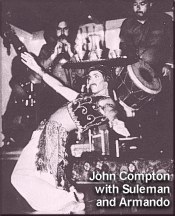 So,
luckily, she got him and not me! John then had one or two weeks before
the Faire and practiced all the time! That was the year that Ernie,
Bob Thomas (cool dude
that later died), (and I don’t remember who else) did a lot of
the Faires. I’m confused because I was exhausted from working
and hitchhiking back and forth between the Faire and the clubs, carrying
my drums. I missed a lot of the fun nightlife at the Faire. After the
Faire, I told George I had to quit because I needed a break.
So,
luckily, she got him and not me! John then had one or two weeks before
the Faire and practiced all the time! That was the year that Ernie,
Bob Thomas (cool dude
that later died), (and I don’t remember who else) did a lot of
the Faires. I’m confused because I was exhausted from working
and hitchhiking back and forth between the Faire and the clubs, carrying
my drums. I missed a lot of the fun nightlife at the Faire. After the
Faire, I told George I had to quit because I needed a break.
I gave him two months notice, but after two weeks he hired Kasim Razizan, a violinist, and Jamil for drum. It totally changed the dynamic of the North Beach clubs when these guys started playing. The Bagdad was now packed every night. Kasim and Jamil were really good. George wasn’t limited by my ignorance of the repertoire. Plus, he didn’t need to carry the whole load. He could be host and play when he wanted and was having much more fun than he was when he was employing just me. (We had been the only musicians , George and I!) George realized that economizing does not always work out for the best. I got paid less than the Arab musicians because I was an American musician.
After this, I didn’t work for months in the clubs. I would still go down to check them out. Then I started working at the Casbah in the spring of ‘74. I got that job because Giligili had had a stroke.
So I got one job because someone was murdered and the other because someone had had a stroke. A lot of my getting the jobs was because I was there available when the opportunity arose. I knew Fadil from my coming in to the club and sitting in. I was lucky! As I look back on it, it’s always been really hard for western musicians to get jobs in the Arab clubs.
|
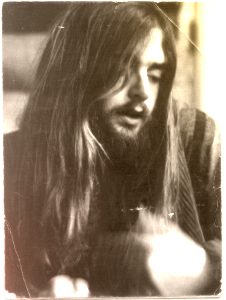
I think Salah left for the summer to go travel in the Middle East. I was working at least five nights a week while he was gone. (We had been splitting the nights when Giligili became ill.) There I was: back in the center of the North Beach scene!
Rassah studied with Jamila (and was a close friend of Malea's). She accompanied me to a party in Santa Cruz where the husband charged us at the door to get in, saying it was for the musicians. I had no problem with this because it was Sirocco and they were my friends. Then the hostess noticed me there, and realizing that her husband probably had charged us, fell all over herself saying how honored she was that I was there, as if playing in North Beach gave me royalty status. Rassah commented to me on the side, "Remind me never to go anywhere with you where you are known!"
| Owsley Agustus Stanley III is the grandson of the Kentucky Governor (1915-1919), he lived with, and sponsored the Grateful Dead in the 1960s. He was also famous for a type of LSD- "Owsley's Acid." He is rumoured to now be living in Australia. |
This was also the year of the big Bal Anat revolt. Augustus Stanley Owsley III said when I walked into the back room after the showdown, “Ah, you're that revolting fellow!”
Pita Gooley was doing the faire, this was Patty Farber’s group. (Babaganoush? Pita Gooley’s ? Or was that the name for just the musicians?) In response to the new competition, Jamila decided we were going to streamline Bal Anat down to mostly solo dancers. Just the best dancers, and in essence we were going to "kick some butt!" One of the main problems with this theory is we never practiced. I never saw the whole show until two days before the Faire, when we had a dress rehearsal at the Casbah. At least I felt good about the musicians. They were Ernie Fishbach, Freddie Mahia, (known as a flamenco guitarist that Ernie had drafted into playing mizmar) and another guy (I think his name was Doug). I remember that upon awaking, he would hang upside down in a tree for a while. Mark Jaqua and I were on drums. Looking back, maybe I should have been worried! The dress rehearsal was okay.
We were supposed to be doing two 30-minute and one 45-minute show. It ended up being two 45-minute shows and an hour-plus show.
I started the show chanting, “Need money!” and the audience threw money on the stage. Sometimes that was the highpoint. For some reason, Ernie and Freddie decided before the Faire that they wanted to take over the show. So for virtually the entire six weeks, they would play each measure a little faster than the preceding measure in an attempt to get Jamila to get off the stage and stop controlling everything. Jamila would look over at me as she noticed that things were getting messed up. I would look over at her and smile like everything was totally fine. Meanwhile, I was trying to hold back the mizmars (Ernie and Freddie).
There was a lot of stuff going on both during and between the shows. Jamila forbade anyone from our group to watch Patty Farber’s show. Of course, we all went to watch from the front of the audience, and when we would scan the audience, lo and behold, there was Jamila!
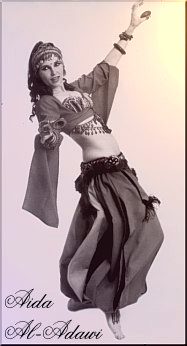 There
was another notable thing, I’m not very good at reading lips,
but I think that at each of John’s shows he would have 20-30 women
saying “I love you!” from the audience while he danced.
There
was another notable thing, I’m not very good at reading lips,
but I think that at each of John’s shows he would have 20-30 women
saying “I love you!” from the audience while he danced.
Details
of the revolt
 That last Saturday of the last weekend of the Faire, as John started
doing his back bend with his tray, Jamila looked at me and with her
lips, motioned me to do a drum roll during John’s backbend. I
knew that if I rolled for John, I might never catch up with the
mizmars, and it would turn into total chaos. I looked at her and acted
confused. She passed the instructions down through the dancers.
I said, "Really, are you sure?" The moment passed and she was pissed.
I ran into her the next morning and she said, “I want you to roll
for John.” I didn’t want to get into the thing with Ernie,
so told her I wouldn’t. She said, “Can’t or won’t?”
I said
"I won’t." She said, “You’re fired." I said, "I quit."
This story got back to the rest of the band. They all decided they were
going to wear black armbands to protest my absence. While Jaqua
was on stage setting up, Jamila told Ernie backstage to take off the
armband. He refused; she fired him. Freddie said he wasn’t going
on without Ernie. Doug still played, and then Jamila had Aida
pick up the mizmar and do that show. It was awful! Aida was a basoon
player and not used to the playing the mizmar. We hung around and listened,
of course. Then she called up Salah to help with the last two shows.
At the end of the day, when she offered Mark Jaqua the position of lead
drummer to teach the girls in the troupe the drum (taking my position),
he declined. He couldn’t stand the politics. "Big Black”
is what he called Jamila.
That last Saturday of the last weekend of the Faire, as John started
doing his back bend with his tray, Jamila looked at me and with her
lips, motioned me to do a drum roll during John’s backbend. I
knew that if I rolled for John, I might never catch up with the
mizmars, and it would turn into total chaos. I looked at her and acted
confused. She passed the instructions down through the dancers.
I said, "Really, are you sure?" The moment passed and she was pissed.
I ran into her the next morning and she said, “I want you to roll
for John.” I didn’t want to get into the thing with Ernie,
so told her I wouldn’t. She said, “Can’t or won’t?”
I said
"I won’t." She said, “You’re fired." I said, "I quit."
This story got back to the rest of the band. They all decided they were
going to wear black armbands to protest my absence. While Jaqua
was on stage setting up, Jamila told Ernie backstage to take off the
armband. He refused; she fired him. Freddie said he wasn’t going
on without Ernie. Doug still played, and then Jamila had Aida
pick up the mizmar and do that show. It was awful! Aida was a basoon
player and not used to the playing the mizmar. We hung around and listened,
of course. Then she called up Salah to help with the last two shows.
At the end of the day, when she offered Mark Jaqua the position of lead
drummer to teach the girls in the troupe the drum (taking my position),
he declined. He couldn’t stand the politics. "Big Black”
is what he called Jamila.
More to come....
including Habi'Ru
and Helm!
Mark Bell can
be contacted at : helmmuseeka@earthlink.net
Check the "Letters to the Editor" for other possible viewpoints!<
Ready
for More?
more North Beach Memories
6-1-02 "Come
with me to the Casbah" by Nisima
...flung
me right into her husband's lap, yelling, "Kiss her Henry...
7-31-01
Salah
Takesh Interviewed
by Janine Ryle
For years, he was involved in the San Francisco North Beach
scene during the eighties as a drummer while
his brother, Jalaleddin Takesh was a kanoonist and restaurant owner.
2-17-01 Yasmeen and the North Beach
of Yore An
interview with Gail by Meredith McGuire
Another wonderful
addition to our North
Beach Memories. Find more names and faces you have known or heard
about!
6-9-03
A New Series! Zaharr's Memoirs, Part 1-
Washington D.C. and Part 2- New York to Berkeley by Zaharr Hayatti
I got really excited, and begged to be allowed to sign up. There was
only silence from my family.
5-20-03
Loving Remembrance & Requiem:
the Best “School” That Ever Was, Part 1 by Morocco/
Carolina Varga Dinicu
I looked at her & said, “If I can’t do better than that,
I’ll hand in my feet!” A case of having more guts than brains.

