|

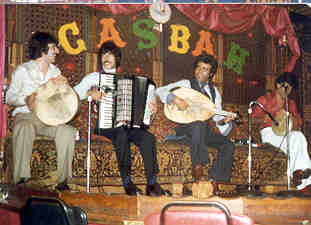
Nazir on his accordian
|
Nazir Latouf recalls
his
memories of North Beach
in San Francisco
Interviewed by Lynette
I arrived on the Broadway/North
Beach scene in February of
1979. I was shocked when I got out of the taxicab and opened the door of the Casbah Cabaret
. This is a nightclub?
I had just come from Kuwait. It was on a Monday, and business
was very slow, nobody was there. Any day in the Middle East,
nightclubs were full. In Damascus, Syria, they call nightclubs,
Cabarets. Anytime you go, They are full, even during the week.
In Damascus, the business hours are 8 a.m.-6 p.m. Even in the
middle of the night, people go out, especially in the summer.
You find something to do anytime of night!
I felt like turning around and going back. "Do you want to drink coffee?" the
bartender asked after I sat
at the bar. Fadil wasn't there, he was involved with his other
restaurant. I knew his brother, Fuoad,
from Kuwait. I had never thought about coming to the U.S.; it seemed so far away.
I was with Fuoad in a band. He talked about his brother, Fadil, and Fadil's restaurant
in the U.S. I was working in a print shop in Kuwait. One person we knew, Samir, decided to go to the U.S. to work at Fadil's
Restaurant. I had to help him make papers at the print shop. Otherwise he couldn't
get a business visa. I told Samir, if you like it in the U.S., after three months,
call me and let me know and I'll come too. He didn't call so, knowing him,it
must have been great. I got into a disagreement with my family in Kuwait and
told them I was leaving. I got my business visa and I had enough money. Fadil,
Fuoad, Samir, didn't know I was coming. I packed my one suitcase and my accordion.
The night I arrived, Samir and Fadil were not working. I didn't have a place
to stay or anything. I asked the bartender, Maher,
if he knew their phone numbers and he called them for me. I talked to Samir like
I was still in Kuwait to tease him and swear at him in Arabic. "How come
you're having a good time in the U.S.?" He gave me excuses. I told him "You
dummy! Just tell me where you live, I am here. I'll take a taxi to see you." So
I went to stay at his apartment.
The next day, I returned to the Casbah, and I met Fadil. Fadil said, the accordion
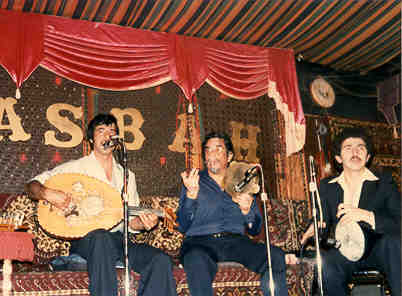
is not very well known here with American audiences. He had two oud players so
they could alternate, a drummer, and a tambourine player. The show was continuous
from 8 to 2 a.m., nonstop. We would have continuous dancers too. The three or
four dancers would alternate, so there was always someone dancing. The first
dancer could leave early and were the last you could arrive later. Fadil asked
me to bring my accordion and we would see how it went with the band. Fadil liked
it, but maybe the dancers didn't. Most of them didn't have any idea that the
accordion had quarter tones.
After that, I didn't care whether I had a job there or not. I felt I couldn't
force myself on people. I had my pride. Then Fadil asked me to play two nights
per week. We didn't have good musicians there at this time. They had basics rhythms
they used all night. We didn't really have any instrumental arrangements of the
music, just basic songs. I had to adapt to this kind of show. We did play "Leilat
Hob." It was new. That was the only thing they could play. We were depending
on songs, and the same routine, dividing the show, fast, slow, veil, whatever.
That was completely different for me.
|

Claudia
dancing at Bagdad |
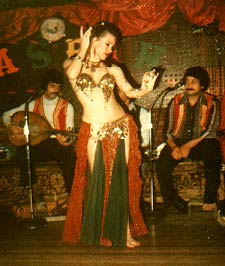
The dancers' costumes here looked different from the ones they wore
in the Middle East. Why did they have all the layers of skirts? They
were not the style we were used to in the Middle Eastern cabarets.
The coin belly dancing costumes were very common in the U.S. I had
never seen that before, myself. Consider these costumes, a Bedouin
skirt bottom, with an American bra for a top. The costumes weren't
true Belly dancing style, they were Hollywood style with added imagination.
The dancers' costumes here were influenced by their American teachers.
I'd say the leg is important in order to see the movement. I think that by having
this type of costume, the leg movement completely eliminated and it is impossible
to see it to the side or from the front. The costumes were all mixed up between
all these various countries; Turkish, Persian, and the Middle East. You didn't
see any of these costumes
on Samia Gamal or
on other famous dancers in the Middle East!
I worked the weekend for a while, and at that time nobody knew that I played
other instruments. I didn't tell them that I played oud. So on one of the nights,
when it was slow, I took the oud from one of the players who was on his break,
and started to play and sing. All the dancers were there, Aida,
Rababa, Yasmeen, Bediya, and Paula. They were surprised and complimented me
when I finished. Since then, most of the dancers asked me to play for their shows
if I could, especially when the oudist took his break. Later on, Fadil asked
to me to play the oud since Ahmad
Sharif was leaving anyway. I told Fadil that if
I start playing the oud, I would not go back to the accordion just because someone
requests it. The accordion is a lot of work to play. It weighs thirty pounds!
Imagine playing that all night for six hours. My shoulders were sore from the
weight. By playing the oud, it allowed me to play and sing different songs. In
less than one month, the other oud player, Samir, also left which left me the
only one to sing and play the main instrument, THE OUD.
There was no audience dancing. They sat and watched and listened.
There was no pressure,
like now, to get the audience up to dance. I could sing
anything. I had more freedom. They were happy with anything
the band played and sung, like the mawaals and takaseem
(improvisation on oud). Now, these days, if you sing a
mawaal, the audience would say, "You put us to sleep!"
Next door to the Casbah was another Middle Eastern club called the Bagdad
. The two clubs were in real competition!
In the break between shows, we would go see what was happening next door,
just
|

Yoko
with Nazir at Bagdad |
out of curiosity. The funny thing was, some people would not step
into the other club, they were very loyal to their favorite club.
Others would go to the one where their friends were or the one that
was busier. Some customers would spend time in each club each night.
Some dancers had followers that would go to the clubs where she would
be dancing.
Later on, an Egyptian musical group, came to town on tour with a dancer. Some
of the members of the group, like Yousef and Yousry the
accordionist, decided to stay in town. They stayed, and played with the band
at the Bagdad. That gave the Bagdad a bigger band than the Casbah. We had to
regroup at the Casbah and add more musicians to compete. Fadil hired three musicians
from the same group. Sheha,
played sax, Magde played
nei, and Jalal Katub played
a bass duff and a big tambourine. This was more fun for us.
The music was great,
but the business was bad. We used to sit and say, "Now
we have very good music, and less customers." We would
joke, "We could play bad music and have more customers."
That was when the clubs began to
go downhill. The two clubs didn't work together on a schedule. Fadil started
to close some nights, like on Mondays. That resulted in less days for
the musicians. The three newly hired musicians started to leave, one by
one, getting different offers from other clubs in different cities. Fuoad
Marzook played the kanoun
and came to the scene. Also Elias
Khoury, played the tabla. So at the end of Casbah's
time, Fuoad, and Elias were the musicians. I was working two or three
nights because I was going to Heald College studying electronics. On weekdays,
Fadil had two musicians. Fuoad, Elias and I came to help them on the weekends.
Then we found out the club had been sold when we read posted change of
ownership notice. Fadil didn't tell us because he was worried we'd leave
to find other jobs.
The dancers, Anisa, Rababa,
Yasmeen, Paula, and Mishmish. seemed to be together; all were friends. Aida and Bediyah were in a different group. On the outside
it seemed they were all good friends. Whenever they had other events outside
the music, you would see them together. I never had a problem with these dancers.
They treated me with respect and vice versa. I wasn't after anything from them,
I guess...
|

Fouad
Marzouk, Nazir, Kahlil Aboud, Reda Darwish |
One of the things we heard, was that the teachers told their students not to
date the musicians. The
teachers seemed to have a Middle Eastern mentality!
In workshops, they
would tell the girls not to date the musicians. The musicians
might ruin a dancer's show if the relationship ended or
if they got jealous, they were told. I believe most of
them didn't listen.
I never understood how these
teachers could tell the students this? In the Middle East, the dancers
were generous to the musicians, getting closer to them by buying
them gifts. The dancers in the Middle East didn't go near the customers
for tips either. If a customer wanted to tip, they had to come to
the dance floor. They could only tip a dancer in the bra strap, never
the belt. A dancer never let herself be touched in front of the audience.
Later I played at the Bagdad too, after the Casbah was sold. George
Elias wasn't very involved
in the Bagdad at that time. He had another business, a liquor store. Jad, his brother, got married at that time, that was when
I got involved in working at the Bagdad. George Elias came to play violin on
the weekend, sometimes. He played a little, and sang a little.
On the street outside the clubs,
the punk movement was happening with spiked Mohawks, chains, and leather.
There was a punk club right next door to the Bagdad. I think it affected
the families that would come to hear our music. I think it contributed
to the downfall of the clubs.
Ready
for more?
more North Bech Memories-
Dancing on the Edge by
Amina
I learned
from the first evening chasing Fatma around the stage that in order
to have a serious dance company in the Egyptian style, I had to
seriously play with the appearance of disorder.
The Beginning by Aziza!
When
she came out to dance in the audience, I thought to myself, "She
better not get too near to my husband!"
Kirk Templeton-The
Last Night at the Casbah |