Gilded
Serpent presents...
The
Summer School of Khaleegy Dance
Dance Style from the Saudi Arabian Penninsula
by Yasmina
Ramzy
Many factors have come together over the last year that have
me finally putting some of my early dance career adventures
down on paper. So far, I have come up with over 35 titles from King
Hussein's brother trying to marry me, eight machine guns at my head
in a back alley of Damascus, being stuck in a war for a few months,
to refusing President Hafiz El Assad's request that I dance for
his 40th anniversary. Some stories are funny, some are scary, some
magical, and some are sad, but most are all of the above.
The Summer of 1990, I call
my Khaleegy Summer. Actually, there is no such thing as a school
for Khaleegy Dance so I will tell you how I learned about even
the existence of such a style of dance.
In the Spring of 1990 I closed the doors of the first Arabesque
Academy in Toronto after three years of endless work. Along
with running the Academy, I had been performing Bellydance off
and on in Jordan and Syria since 1983, usually in one to three
month contracts. The contracts were lucrative, I was still young
with few commitments so I decided I would stick to performing
in the Middle East and leave teaching for later in life. This
meant trading in a rigorous schedule of teaching and running a
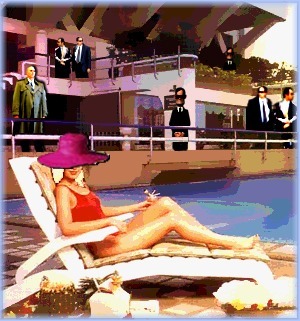
school and office for serious suntanning beside a luxury
hotel pool by day and performing one 45 minute set by night
accompanied with some wicked musicians and to a very appreciative
audience.
I
set off in May of 1990 with plans to live from contract to contract
in the Middle East for a few years until I had a substantial
bank account.
The brand
new Forte Grand Hotel in Amman hired me immediately and kept
renewing my contract intending to keep me there until I
was due in Dubai in September. Every month a new singer would
headline but I was the regular dancer.
Living and dancing in luxury came with a price but one I was
willing to pay. Because Jordan is an Islamic society, my moral
conduct was closely scrutinized. It was important that my behaviour
be irreproachable. Everyday, my photo was in the Jordanian
newspapers advertising the show at the Forte Grand. I had a
very public position at the most prestigious hotel in Amman,
and neither the hotel nor I could afford any impropriety. The
Forte Grande is frequented by the very wealthiest Kuwaiti families
and royalty.
The
“moral police” and hotel security watched every move I made.
All my phone calls were monitored. I was not allowed to talk
to or get into an elevator with an Arab man.
When I went
out for lunch with Afaf, my Iraqi best friend
who I had known since 1983, what I ate and whom I spoke with
was recorded by security. I also needed permission for any venture
outside the hotel.
In July, a Lebanese female singer who had just finished working
in Dubai for six years came to work at the hotel. She was familiar
with the Gulf culture, music and dance. She often invited me
to her room for tea so she could practise her English while
I worked on my Arabic.
On many occasions, two or three of her Lebanese girlfriends
dropped in while I was visiting. After a while, I found out
these girls were professional Bellydancers (one being the famous
Nariman) from Lebanon who performed in another
venue in Amman.
I
was thrilled but also dumbfounded that no one had mentioned
this earlier. Unfortunately the dancers did not speak any English
and were not interested in sharing any of their dance steps.
All I managed
to get out of them was where they were performing. I planned
to go see their show on my night off.
The place
where my new Lebanese friends performed did not have quite the
same high standards as the Forte Grand nor was their audience
families like mine were. Instead, they performed in a cabaret that
catered only to men. In the Summer months in Amman, those
men were mostly from the Gulf. It wouldn't do for me to be seen
at such a venue, however I was intent on seeing my friends dance.
After I begged and pleaded with the kind German hotel manager,
I was finally allowed to see the show. I was escorted up the
back, through the kitchen and then hidden behind a wooden lattice.
I could see the whole room and the stage but the audience couldn’t
see me. The Forte Grand was safe from the shame.
The music
started but the rhythm and style was not familiar.
The
three Lebanese Bellydancers appeared. To my surprise and disappointment,
they wore high heels, mini skirts and blazers, a little
like stereotypical secretaries out of a B movie.
I had expected
glorious beaded costumes. Adding to my disappointment, these
dancers just kind of limped around performing head slides and
shoulder jerks. Was this dancing? I kept quiet not wanting to
complain after putting everyone through so much trouble to get
me there. I liked the finale where another girl with hair to
her knees came out and whipped her hair around endlessly but
I was mystified by most of the performance.
The next day I visited the singer. She explained that even though
the dancers were good Bellydancers, they had been performing
the Gulf or Khaleegy style of dance because the audience was
from the Gulf region and this music and dance style is what
they enjoyed. In their own countries, this dance was only performed
in private homes amongst family.
To
see their style of dance performed in Western clothing was exotic
for them. The image of the Western secretary was a huge sex
symbol as women were rarely found in the workplace in the Middle
East.
 She
offered to teach me. Having lived in Dubai for so many years,
she was experienced in the Khaleegy style of dance. Out she
pulled some beautiful large silk dresses with enormous sleeves
(thobe nashall) and my education began. She
offered to teach me. Having lived in Dubai for so many years,
she was experienced in the Khaleegy style of dance. Out she
pulled some beautiful large silk dresses with enormous sleeves
(thobe nashall) and my education began.
About a week later, at 3:00am, I had taken off my make-up and
was winding down from my show. Settling into my nightly ritual
of lentil soup, cake, tea and a Farid El Attrache movie,
I was disrupted with a call from the nightclub downstairs. The
club manager explained that a very famous Egyptian singer was
a guest in the club and had seen me dance. He requested that
I dance with him while he sang. Back on went my make-up and
costume and I made my way down to the nightclub. The
singer asked what song I would like to dance to. Knowing that
he was Egyptian and having too much confidence in my ease with
Egyptian music, I replied "as you like."
I went
out onto the stage with him and the music started. It was a
beautiful piece of music,
but
the rhythm was impossible to dance to. I was all over the place,
panicked and embarrassed with nowhere to hide. I prayed for
the song to end.
Safely offstage
I complained to the manager about the music. He explained that
this song called Abart El Shat by Khathem El
Saher was currently the biggest hit all over the Middle
East including Egypt. Khathem was from Iraq, another Khaleegy
country. Up until now, only Egyptian music had ever been a hit
in Egypt. The land of Oum Kalthoum had a bit
of a snobby attitude when it came to music. But soon, the high
pitched voice of Kuwaiti singer Nabil Shuwil
hit the radio waves and everyone, even Egyptians, were buying
Khaleegy music.
The next day I went to Afaf's house and demanded that she teach
me Iraqi dancing. I had known Afaf intimately for years but
had never seen this side of her. She was so proud that a song
from her country was top of the charts and she was eager
to show me everything she knew about the dance. It had
never occurred to me that she knew any other kind of dance other
than Bellydance.
Once
I was introduced to both styles of Khaleegy dance, I experienced
the common thread that is this unique expression of
joy. Subtle movements to the naked eye but bursting with spirit. The
rhythm was infectious and I was soon addicted.
 At
the beginning of August, I came down to the restaurant for breakfast
one morning and passed by the nightclub. My life size picture
no longer adorned the entrance. The lobby, empty of Kuwaiti
families was very quiet. I asked the maitre'd what was up. He
explained that the show was cancelled. Iraq had invaded Kuwait.
It was war and I should go home. At
the beginning of August, I came down to the restaurant for breakfast
one morning and passed by the nightclub. My life size picture
no longer adorned the entrance. The lobby, empty of Kuwaiti
families was very quiet. I asked the maitre'd what was up. He
explained that the show was cancelled. Iraq had invaded Kuwait.
It was war and I should go home.
In the past, the hotel employees had regularly played pranks
on me. I thought this was just another joke and laughed it off.
Then I looked into the main restaurant. Arab and non-Arab army
generals in full regalia filled the room.
After breakfast, I went back up to my room. I knew it would
all blow over by the next day. Arabs are always so
melodramatic, I thought.
The
phone rang. It was the Canadian Embassy advising me not to leave
the hotel unless absolutely necessary and then only with an
Arab escort. Oh, and I should get out of the country
right away. Now I was getting worried.
I couldn't
help thinking why Iraq and Kuwait, the two cultures whom I now
felt I had an affinity with through their dance and music.
Why on earth were they at war? Is this the difficult mission
that the American Special Forces guys told me they were
off to after being granted a short vacation
in the hotel last week?
I soon found out that getting home was not going to be easy.
Flights out were booked until November. Everyone wanted to leave
immediately. Thanks to Prime Minister Brian Mulroney,
Canadians were not welcome in the Middle East anymore. Because
of the ridiculous news reports about riots in Amman, my mother
was in agony with worry. My Khaleegy summer was over. I never
did make the Dubai gig.
Have
a comment? Send us a
letter!
Check the "Letters to the Editor"
for other possible viewpoints! 
Ready
for more?
5-18-07
A Report on the First International Bellydance
Conference of Canada Part One- Lectures, Workshops, Panel Discussions
by Diane Adams Photos by Lynette
April
18-22, 2007 Toronto, Ontario. Hosted by Yasmina Ramzy of Arabesque
Academy in Toronto, Ontario, Canada, this International Bellydance
Conference of Canada, the first ever on the Canadian dance scene,
proved to be one of the top dance experiences in this reviewer’s
30-year career.
7-31-07
Part Two of Antique Textiles:
Costuming Before the Reign of Egyptian Costumers by Najia
Marlyz
I
view today’s dance values as interlopers—meant to
mitigate Belly dance’s checkered past by exchanging its
innate free emotional expression for speed and difficulty of execution
and an over-the-top outpouring of energy that is neither sensual
or exotic.
7-30-07
Belly
Dancer of the Year Pageant 2007 Sunday Photos, Photos by Michael
Baxter, Photo Prep by Michelle Joyce, May 27, 2007 Danville, California,
Event
produced by Leea. The competition for the Finalists.
7-25-07
Tribute to Reema by Taaj
Hali
said, “The day of the contest, backstage we could all just
feel her. We were like, ‘This is for Reema! She’s
here!”
7-17-07
Belly Dance, Through the Eye of the
Camera by Ishtar
Males
dominate photography and film industries in both the west and
the east. As well as ideas concerning the status of the dancer
and gender, films involving belly dancers can give us information
on the class dynamic and stratification that exists.
|