 The
Gilded Serpent presents... The
Gilded Serpent presents...
The
Critic;
Real Critics Don’t Mince Words
March
3, 2003
by
Najia El-Mouzayen
[Ed note- More articles on Critique in our community listed at bottom of page]
[Letters to the editor regarding this article now added to bottom of page also]
Have you ever
thought about political correctness in terms of its impact upon
all of the arts, including dance? What “PC” or political correctness
effectively accomplishes is a stifling of recognition of individuality
and experimentation. It essentially shuts down all dialogs concerning
artistic judgment, encouragement, or discouragement between an
individual and audiences. Needing to be perceived as correct
in one’s expression eliminates recognition of the need for change
(Wasn’t that the “mother of invention”?) and that eliminates
experimentation and growth. Political correctness can kill an
art, and it well may kill our society as a growing and evolving
consumer of art if it continues down its present pathway. Political
correctness marginalizes the performer who stands out in a crowd.
Have you ever watched a troupe dance and noticed that one of the
dancers has a certain charismatic draw that pulls your eyes to
her like a magnet? Don’t become too attached to her; she will
probably not be there in a few months—because the other troupe
members will be painfully aware that she has not blended in.
She has not become a good team player. Yet, it is that great
ability to speak to an audience with performance energy that makes
a dancer great and an entire art form legitimate.
So
by forcing compliance to political correctness by muzzling
criticism and misnaming ourselves a supportive sisterhood
of dancers, we cook our own golden goose.
 Dance
criticism and artistic judgment, applied to the field of Oriental/Belly
dance, has become a sensitive subject because Oriental Dance/
Belly Dance, almost more than any other dance form, is a three
headed dragon. Dance
criticism and artistic judgment, applied to the field of Oriental/Belly
dance, has become a sensitive subject because Oriental Dance/
Belly Dance, almost more than any other dance form, is a three
headed dragon.
One
dragonhead is the professional Belly dancer who actually is professional
and behaves like a professional, taking both blows and accolades
“like a real man”.
However,
there is a second head to our impassioned dragon: a large
body of amateur dancers who aspire to look as if they were
professionals and who, more often than not, have not the faintest
idea about how or where to begin.
They easily
believe their boyfriends (sometimes Arabian men) who tell them
that they dance better than any of those dancers overseas who
have been dance stars, movie stars, and television actresses for
decades! Amateurs who aspire to look professional without paying
the toll of public scrutiny become angry with the public (their
audience) who criticizes and judges their lack of professional
qualities regarding physical appearance, appropriate costuming,
and other parameters that are important to audiences. These wannabes
are often student dancers who have danced in a few student recitals,
a party here and there and who have accompanied another dancer
on her gig as a backup dancer or a second. They may be heard whining
constantly that it falls to them to educate the audience, an idea
that true professional dancers and other entertainment artists
find absolutely repugnant.
The
third dragonhead of the Belly Dance is the true amateur who
just dances for fun, who attends all the workshops and shows,
and who has no aspirations to dance in public for pay.
It is the
true amateur who thinks of herself as a part of a lovely sisterhood
of dancers who simply dance for the joy of it, the inspiration
and the sense of well being that Belly Dance imparts to most women
who participate. These true amateurs should not be subject
to the judgment of a critic. They would not be subject
to the words of a formal critic except for the unfortunate fact
that dedicated amateurs are often convinced by friends and instructors
to join a troupe whose members imagine themselves professionals
simply because they dance in local haflas and festivals
and accompany their leader/instructor on her gigs. In this way,
they dance before the public, paid and yet not professional.
If
criticism is unwelcome, then those dancers comprising the
sisterhood of dancers should not be dancing in venues
where a critic may be called to report upon the event.
 In
the Middle East, only stars of Oriental dance who perform in large
hotels and governmentally sponsored troupes that are based in
a fusion Ballet and Oriental dance actually dance on stages in
theaters, and therefore, put the form in front of formal music,
art, and dance critics. The rest are folk dancers or social dancers
and do not leave themselves exposed to written comments of a critic. In
the Middle East, only stars of Oriental dance who perform in large
hotels and governmentally sponsored troupes that are based in
a fusion Ballet and Oriental dance actually dance on stages in
theaters, and therefore, put the form in front of formal music,
art, and dance critics. The rest are folk dancers or social dancers
and do not leave themselves exposed to written comments of a critic.
Because most
of us are painfully aware of the multi-agenda dancers within our
western society, it is nearly impossible to find a knowledgeable
dancer who is willing to become a truthful critic when
it comes to the subject of Raks Arabi. Very few people
are willing to give a realistic perspective on any type of Belly
Dance and sign their name to it, for fear of hurting someone’s
tender ego. Though dancers freely express harsh criticisms of
dancing performances privately among their cohorts, extremely
few of them are confident enough of their knowledge and experience
to dare to say (or even imply) in writing, more often than we
would wish, our Empress wears no clothes!
All of this
sophism happens under the guise of supporting our amateur dance
sisterhood and the general dance community. Pseudo and misplaced
support constrains us, causing us to be carefully observant of
the current rules of political correctness. I hope to encourage
you to consider the notion that being politically correct dooms
us to be derelict in truthfulness by definition, and therefore,
second rate as a dance form. Rather than being supportive
of the weak, aspiring dance performer by using politically correct
compliments and platitudes, we do her irreparable harm.
We harm her by fluffing her ego (not a term I use loosely) concerning
her effectiveness as a dancer, and we assist her to sink into
a complacency of attitude when she could preferably devote some
effort toward improvements in her dance technique or its presentation.
The forgoing
is only the first layer of harm that we do when pampering
dancers by couching our criticisms in cautious, acceptable language!
For example, instead of bluntly and clearly drawing attention
to a dancer’s lousy centering, awkward pigeon toes, or inept musical
interpretations, we PCers present her a feeble comment in a golden
bowl, swimming in the milksop of human kindness. It would be
far kinder to let her taste the bitterness of truth as we see
it, averting later embarrassment when she sees the videos of her
performances. Early confrontation of truth will do much to allay
disappointment and confusion over not being hired for coveted
gigs. This happens when the performer’s friends have been nothing
but positive about lusterless dance performances because they
must or because the dancer is a nice person, and we feel that
we owe our unconditional support to her flawed efforts. (That
includes the false compliments and effusive adulations of her
Arabic boyfriends who know where their own best interests often
lie.)
What
is support, after all, but a propping up of something that
has unstable strength and inadequate foundation in its own
right?
 By
being a truthful critic, or a dancer who welcomes candid criticism,
we may more fully validate the premise that Arabic Dance (Raks
Shar’i, or Belly Dance) might possibly be an art on an equal footing
with other recognized dance art forms. Though out-of-shape women
can and do dance well as part of the “sisterhood of dancers”;
the fact remains that they do not generally appear as the fulfillment
of reasonable professional expectations to audiences composed
of non-dancers. The longer we Oriental Dancers fool ourselves
into believing that the physically unfit and unhealthful body
can be the instrument of a professionally performing dancer
because we want it to be true, and we wish it to be recognized
that “big is beautiful” and/or “gray hair is natural”, etc., the
longer we will remain the dance community’s slutty little sister. By
being a truthful critic, or a dancer who welcomes candid criticism,
we may more fully validate the premise that Arabic Dance (Raks
Shar’i, or Belly Dance) might possibly be an art on an equal footing
with other recognized dance art forms. Though out-of-shape women
can and do dance well as part of the “sisterhood of dancers”;
the fact remains that they do not generally appear as the fulfillment
of reasonable professional expectations to audiences composed
of non-dancers. The longer we Oriental Dancers fool ourselves
into believing that the physically unfit and unhealthful body
can be the instrument of a professionally performing dancer
because we want it to be true, and we wish it to be recognized
that “big is beautiful” and/or “gray hair is natural”, etc., the
longer we will remain the dance community’s slutty little sister.
We just can’t
have it both ways. Either we are a sisterhood of ego therapists
and our instructors are politically correct in all they say and
do—or we are tough artists in search of ways to improve our art
form by ruthlessly weeding out the lame from our herd. (Please
don’t bother to write, claiming that we can have a dollop of each
and satisfy everybody. Acquiescence and appeasement won’t satisfy
anybody, much less, an unsuspecting audience.)
The
fact is, that trying to “have it all” for everybody is what
has put us where we are today—a bunch of misguided and untrained
personal social therapists trying, with varying degrees of
success, to educate women to love their bodies “just the way
they are” and to dance in spite of some very real shortcomings
as they are defined by the judgment of the paying public.
(Not that
there is no need for inspirational ego therapy—there is.)
In all the
lip-service I have heard given to standards for professional performers
repeatedly throughout many years, and because of our obvious discomfort
in discussing the subject, it is extremely rare to hear anyone
admit that over-weight and out of condition (and I mean big—really,
really, big, not just Middle-Eastern style soft and rounded) dancers
run the risk of permanent damage to their arches, their ankles
and knees, and their backs. Through teachers’ and troupes’ insisting
upon compliance with movements that some bodies are not fit to
accommodate, injuries can and do occur.
If you are
an adult who joins a class or a troupe, unless you have been kidnapped
or blackmailed to join, you automatically take on the responsibility
for your decision concerning what part of the subject being taught
is appropriate for your body and what level of performance you
can handle. You accept the responsibility for your own personal
safety. A dance teacher teaches dance (not necessarily safe movement
--though we try to include as much safety as we are able) and
is not a physician or physical therapist. Practicing unsuitable
movements while grossly unfit does not produce a fit body and
does not constitute an appropriate self-improvement program, even
though it might burn calories and give one a happy dose of adrenaline.
Instead, an out-of-shape greenhorn dancer invites Plantar Fascitis,
muscle strain, ligament damage, stressed heart, and other related
illnesses and injuries, and all of it is self-inflicted.
The student or troupe member cannot change the class or the entertainment
world to suit her personal needs; she must adapt and take responsibility
or not join in the first place.
We are extremely
fortunate that a few accommodating, creative, and caring individuals
have invented a concomitant dance form to protect our Pampered
Petunias in American Tribal Belly Dance, other troupe genres,
and off-shoots of Oriental Dance that are geared toward allowing
and encouraging everyone to participate. However, we are unfortunate
that they have also led the public, and worse, each other to believe
(falsely) that choreographed troupe dancing and follow-the-leader
troupe dancing is automatically professional quality dancing—or
even an art—just because it has been costumed and rehearsed.
It is little more than a skill of doing for the
joy of doing it. I would prefer to think of it a social
experience employing dance or folk dancing.
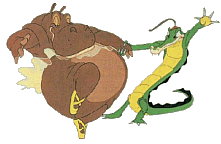 Personally,
I would rather see or participate in a dance performance done
for the sheer inspiration of an audience of strangers that is
not comprised of a conflagration of numerous dance students and
other troupes. But, that is just my preference; everyone is free
to enjoy whatever Fantasia-like hippopotami and bumbling ballerinas
to which they might wish to subject themselves. Even if that is
not a nicety for me to write, it is honestly the way I feel after
years and years of watching amateur troupes dance and trill for
each other over the most banal performances. Personally,
I would rather see or participate in a dance performance done
for the sheer inspiration of an audience of strangers that is
not comprised of a conflagration of numerous dance students and
other troupes. But, that is just my preference; everyone is free
to enjoy whatever Fantasia-like hippopotami and bumbling ballerinas
to which they might wish to subject themselves. Even if that is
not a nicety for me to write, it is honestly the way I feel after
years and years of watching amateur troupes dance and trill for
each other over the most banal performances.
I do
not advocate that out of shape dancers not dance at all—just
that they not perform in public and imagine themselves on
a par with professional dancers.
In other words,
we have to decide realistically upon which path we have actually
embarked before we become hopelessly lost in endless rhetoric
and expose ourselves to well-deserved discussions by critics about
what does, or does not, place our dance on a par with other dance
disciplines.
It always stings
a little (or a lot) to read a direct and detailed criticism of one’s
own dance. However, if you can read between the lines and remember
that the critic, through his or her criticism, has given you validation
through recognition of your efforts, you will be a winner. You
must learn to discern what constitutes a planned personal attack
about something over which you have no control (Her eyes are too
close together. She’s too tall to be a dancer.) Then you must learn
to distinguish between that attack and a statement that is a
thought provoking or knowledgeable observation of what actually
has appeared through or within your performance. (His arms remained
stiff and inflexible throughout the entire dance; I found his orange
hair is distracting).
- You can
read a negative comment and find out what went wrong with your
intentions.
- You can
build upon that which was successful.
- You can
find areas of challenge that you may not have thought about
by yourself.
- You have
been recognized for your artistic efforts whether the comments
are positive or negative, valid or invalid.
A useful and
effective art critic does not need to be able to paint in order
to be qualified to observe weakness or strength in drawing techniques
or composition (even though he or she may be able). The music
critic need not be able to play the violin to observe that your
arpeggio was less than breathtaking. The dance critic has only
to be able to observe and comment that your taqasim was coy, dry,
or lacking in humor, whatever, etc. It is ineffective
and pathetic and thoroughly unprofessional to become defensive
and retaliate against a critic to say, “Well, I bet that critic
couldn’t dance any better”, or “That critic is just jealous of
my career”. A jealous dance critic would never deign mention you
or your career in print (positive or negative) because every mention
of your name validates your existence.
A truthful
dance critic, who has danced around the block a few years
herself, is a friend—not only for you—but a friend of the
dance arts.
Artistic
judgment is not to be confused with moralistic judgment.
 Some
quote the Bible and incorrectly interpret the admonition not to
pass judgment upon others. Often they interpret it to mean a
prohibition against ever passing any judgment at all. Kindly
wake up and learn that making judgments is a daily occurrence
and necessity for human beings! We make judgments in sports,
and court cases, and we must work to learn how to hone our artistic
judgments. One would be foolish not to learn how to judge what
is aesthetically pleasing and why. The Biblical reference requests
that we not pass judgment upon the morals and souls of others
but to leave that task for The Divinity. Therefore, we need not
fear, but to develop, artistic judgment—to ground it in firm concepts
and experience of that which works and that which doesn’t. Some
quote the Bible and incorrectly interpret the admonition not to
pass judgment upon others. Often they interpret it to mean a
prohibition against ever passing any judgment at all. Kindly
wake up and learn that making judgments is a daily occurrence
and necessity for human beings! We make judgments in sports,
and court cases, and we must work to learn how to hone our artistic
judgments. One would be foolish not to learn how to judge what
is aesthetically pleasing and why. The Biblical reference requests
that we not pass judgment upon the morals and souls of others
but to leave that task for The Divinity. Therefore, we need not
fear, but to develop, artistic judgment—to ground it in firm concepts
and experience of that which works and that which doesn’t.
Additionally,
I would like to comment that, as a reviewer or critic, you are
useless if your critique is unread because it is dry, analytical
and uninteresting. Without humor, wit, descriptive language,
and even sarcasm, only the persons directly involved in the production
critiqued will read it, which is counter-productive. To be a
successful critic, one must not only be truthful, balanced, and
knowledgeable; one must also be amusing to read, even when totally
wrong. I think it is only fair to mention that critics panned
many famous works of art when they first premiered. Nobody died
from a negative critical review and many productions were subsequently
improved upon because of one (or more). Unfortunately, I believe
that because of the current emphasis on political correctness,
the Oriental Dance community is not yet mature enough to be comfortable
with critical reviews of any kind. Even positive comments are
dissected by the egotistical neediness of our “grand sisterhood”
as it currently exists.
Critical reviews
are not meant to become a marketing tool. When producers of dance
and its various dry goods are being touted and promoted for sales,
we find that critics are often “bought” with a free video (or
whatever) to review and the person who sends it, fully expects
that he/she be entitled righteously to a positive review. That
“ you scratch my back, and I’ll scratch yours” philosophy is far
from the truth in the real world of arts by reviewers who have
integrity. If you send an item to be reviewed, it doesn’t mean
that it will be reviewed and it doesn’t mean that it will receive
a positive review. Likewise, just because you have not requested
a review does not bar reviewers from writing their opinion of
your work. Also, when a critical reviewer writes up his observations,
conclusions, and suggestions it is totally unnecessary for him
to preface his commentary with “in my opinion”, “as I see it”,
or any other humble blather. If he writes it, of course it is
his opinion, even if throngs of people hold it also worldwide.
As we Oriental
dancers learn to accept specific reporting and artistic judgment
beyond the usual “Wow, Golly; that was great!” we can use critical
observations and grow from them as dancers. Critics whose opinions
are worth reading are those who include both positive and negative
comments and allow the consumer to draw their own conclusions
in the end. They will express areas of satisfaction and of disappointment.
They will report upon the performance as your second set of eyes.
Real critics don’t mince words, and the true professional, even
while sometimes cringing, cannot wait to rip open the newspaper
or magazine to read that point of view. No matter how bad or good
the criticism, we always are thankful when the critic spells our
name correctly and includes a compliment here and there.
The
worst form of criticism a professional artist can receive
is to find one’s work being ignored.
Have
a comment? Send us a
letter!
Check the "Letters to the Editor"
for other possible viewpoints!
Ready
for More?
More on Critique
The
Emperor’s New Clothes by Yasmela/ Shelley Muzzy
Until we see ourselves in the context of a larger society, no
one outside of our community will accord us the respect we desire.
Critiquing,
the “Agony & The Ecstasy” by Nisima
It’s an unnerving experience to be “critiqued”
by your peers, but my personal opinion then and now is that when
you perform in public, critiquing just goes with the territory
of performing.
8-15-06 Bellydance Journalism, Rhythm and Reason Series, Article 14 by Mary Ellen Donald
One powerful tool used to mislead is bellydance journalism.
5-13-08 The Ancient Art of Keeping Your Mouth Shut by Neon
Even one’s casual presence in the forums infested with negative-spirited discussions can instantly strip a successful artist of her magical charisma.
10-12-13 Interviews with Saida and Yamil A Five Part Video Talk with Two Stars of Argentina, Part 5: The Dance Community of Argentina, by Lynette, translation by Kalinka
In this section they discuss how well the dance community gets along in Argentina. Hopefully this will help stimulate more talk in our larger worldwide community. Part 4 discusses Critique
Articles Responding to Critique
3-27-06 The Bellydance Superstars Show In Perspective by Miles Copeland
There are many factors to balance, and ANY show can be improved. The point is to also know the limitations that one faces in doing all the things one would like to do.
3-17-01 Dunia's response to a review by Bobbie Giarratana, titled," Where's The Hook "
"My dear: some of these people have zills older than you."
6-26-06 The Spirit of the Dance: A Response to the Criticism of my Tribal Fest 2006 “Pierced Wings” Performance by Sashi
I was originally hesitant to write this article regarding my Tribal Fest 2006 “Pierced Wings” performance as I personally believe that a performance should not have to be explained by the artist,
rather it should rely on what it evokes in others.
10-4-05 Raqia's Response by Dee Dee Asad
I visited her in the Masr el Dawly Hospital, near where Raqia lives in el Dokki, the next week. Raqia was unable to travel to Sweden while sick!
8-16-09 Challenging Hypocracry: A Response to Miles Copeland's Article by Tonya
The ethical way has been to promote one’s own competition but not to degrade someone else’s.
3-12-08 Just the Facts, In Response to: "MECDA Breaks its Silence by Rachel Lazarus" by Doyne Allen
We have never accused anyone of stealing money. We have brought to the MECDA Board’s attention the waste and bad management of funds.
More
by Najia
4-9-04 Who Died and Made You Queen of Dance? by Najia Marlyz
This lack of background basic performing experience would be unheard of and un-tolerated in any other dance form.
1-11-03
Music to My Ears, How
I Learned to Hear Like a Dancer
Musical
interpretation is the single, most important skill that can elevate
the Oriental dancer from the chorus line to the spotlight.
11-21-02
The Great American Belly
Dance Veil Routine by Najia El Mouzayen
After having said all that, I must add that American style Oriental/Belly
dance is a distinctive style composed of creative elements that
are simply outstanding.
10-22-02
A Story Written
with Arabic Idioms; Why it is Difficult to Translate Arabic
songs into English, Story by Annonymous, Translations and interpretations
by Rima El-Mouzayen, Introduction by Najia El-Mouzayen
“just
try to read it in English and at the same time, think in Lebanese
Arabic…if you can! "
2-23-03
Hawaii Workshop by
Latifa
Floor Work is a moving Yoga, and as in Yoga, one must
let his/her body grow into more flexibility which develops with
practice.
2-14-03
God Belly Danced:
Biblical Accounts of Belly Dancing in the Ancient Near East,
Part 1 of 3, By Qan-Tuppim
While Yahweh is not female, the man may have given Chavah a name
similar to Yahweh because the woman and Yahweh had something vital
in common.
Letters responding in 2014
Dear Gilded Serpent,
Here's my two cents...when professional belly dancers stop taking convention appearance fees, or start turning away over weight or over age potential students in other words when professionals belly dancers put so called standards first and not their wallet then they can complain about standards. You put out the bird seed, birds come.
I started belly dancing in my mid thirties. I was overweight and out of shape. I have taken lessons with some of the top professional belly dancers in the business. I have performed in show cases hosted at well known Middle Eastern restaurant in Los Angeles. And of course there were all those conventions and competitions I performed at too. See my checks always cashed and in the end of the day that is all that mattered I suspect. None of them ever turned me away.
Professional belly dancers created the scene we call the belly dance community not housewives. It was professional belly dancers many of whom were in the twilight of their careers and were looking to extend their careers by segueing into teaching. Of course if you teach you produce students who want to perform. Students recitals, became, haflas, became conventions. The belly dance community exists for a reason it was created and supported by professional belly dancers. Who or when in the mists of belly dance history somebody began to promote belly dance as a dance of “all ages and sizes” we will never know. Was it those “how to” albums produced in the 60s, was it hippies? I can tell you that it was the norm when I became involved in the 90s and that is what attracted me to belly dance class; I wanted to get back into to shape to return to my career as a stripper. By the way a milieu that does have standards so yes I am familiar with them.
At one time at one strip club I was a supervisor. I have auditioned women and told them they were too old or too over weight to be hired because there were standards and some of these women badly needed work they had children and bills. There are no bored housewives wanting to spice up their life in strip clubs. Theses tiresome arguments about standards have existed as long as I can remember and usually end up in some circular firing squad. So to make it clear I do agree a dance that purports to be an art practiced by professionals should have standards BUT at this time the belly dance community talks a great deal about it but does not follow though.
I taught belly dance for ten years mostly through community recreational centers in a rural area in the desert of California. If I had only taught the young and the thin my teaching career would never have happened. There are few to often nonexistent employment opportunities for belly dance in my area. Why? I can speculate that the people are not interested and I suspect the strict county guidelines governing entertainment may also be an issue. Bluntly most restaurants around here think belly dancers are strippers. The irony is never lost on me. I have taught everybody from thirteen to seventy. I did not push performance because when I was a student I did not like it. The only easily obtainable performance opportunities in my area are rest homes and county fairs. I am sure the standard bearers of the belly dance community would pull their hair out at the idea of “all ages and all sizes: performing before the public denigrating their art but they are more the welcome to give it a whirl of course there is not fee for these gigs.
The reason I felt so compelled to write was the comments about turning this dance into therapy angered me. I firmly believe that I would have been taking people’s money under false pretenses if I had told my students they were going to have professional belly dance careers. I did tell anybody who was serious they needed to frankly look at their weight and age and go to certain belly dance instructors in Los Angeles. I was honest but kind. If in all my years of teaching if all I ever accomplished was to give a women more confidence in herself I believe I had a good career.
In summation this housewife belly dancer did not build this community and have only been doing what I was encouraged to do by the norms and practices of decades in the belly dance community. If the belly dance community is serious I await the day when I will see required auditions for classes and conventions. I suspect I will wait a very, very long time.
Christina “Tinah” Silva
LETTERS Regarding this article from 2003
10-18-03 re:The Critic; Real Critics Don’t Mince Words by Najia
While I agree with Najia's sentiment that no-one can grow as a dancer without criticism, I do take umbrage at her assumption that American Tribal Dance is a place for dancers with no training to dance in public and get accolades. She says:
"...However, we are unfortunate that they [ATS] have also led the public, and worse, each other to believe (falsely) that choreographed troupe dancing and follow-the-leader troupe dancing is automatically professional quality dancing-or even an art-just because it has been costumed and rehearsed."
This is so blatantly a biased statement that it can not even count as the criticism of which Najia is so fond. It is also false as well as biased -- Tribal dancing is not about "letting everyone participate". It is about growing in your dance through working with other like-minded individuals on a regular basis. Fusion dancing, which I would call a sister dance to Tribal, involves fusing classical belly dance moves with moves from other dance cultures, such as hip-hop, flamenco, or even jazz. Tribal and Fusion are very difficult and involve intense muscular control. You learn to dance in a precision group (like the Rockettes), which is much mroe difficult than it seems. This is not for everyone, and many professional Tribal or Fusion groups discourage "random" participants -- these troupes are dance companies with high expectations, not an open forum.
Najia says that we are training the public and ourselves to view someone as talented because they have the costume and some of the moves down. We are not blind. There is an enormous difference between a talented dancer, who is instantly recognizable as such, and an amateur or untalented dancer, who is also instantly recognizable. Najia's critique is of dancers who have received no criticism, and are therefore encouraged to step out on stage and "perform" as professionals. These dancers abound in any dance form. Leave tribal out of this.
Safa
www.khafif.com
5-16-03
Hi Lynette,
Interesting responses to the critiquing articles - especially about Najia's article. I knew there would be strong reaction to her statements, and I agree with the writer who expressed a high level of disappointment with Najia's view that "overweight" dancers should not perform in public! I don't however, agree with the "shame on you for publishing" comment; seems to me that Gilded Serpent is providing a valuable service to the belly dance community by allowing differing opinions to be expressed. That is the only way that change happens, we are thankfully in a free society where it is a basic premise that dissenting opinions result in healthy change and growth. To blame a journalistic venue for providing the means for this process is highly innappropriate; it is up to the dance community ourselves to be vocal and be "change agents" about issues we care about!
Yours in dance,
Nisima
P.S. You may publish this if you like or not - I just had to express it!
5-5-03
I read your article "Critic." I agree with everything you said in that article, but one thing stood out and really rang true for me.
One dancer in the troupe who stands out. Don't get attached to her, etc.
That paragraph really hit home for me. I feel it so strongly right now. It is so frustrating. You walk in, and it's like you are not there, or you are at a show, and people are crowding around to talk to or get pictures with you, and there aren't as many people talking to the others or none at all. The looks you get because of that are terrible. I sometimes feel like hiding in the back so no one will come and talk to me, or telling people to go away.
Please, tell me, how would you handle this situation? Do you just leave, and go start your own classes, etc., or do you stay, and deal with it?
Thank you so much for your time, and have a great day.
Sincerely; Ebony
4-28-03 re: a comment on all the articles about reviews and critiques.
Real Critics Don't Mince Words by Najia
The Emperor's New Clothes by Yasmela
The Agony & the Ecstasy by Nisima
No Excuse for Low Video Standards! by Shira
Isn't it just about what is popular? People have different taste in things. Ebert may give a movie a terrible review only to make the movie he reviewed very popular.All I am saying is if you must, take the "advice" of "reviewers" with a grain of salt. If you have the $$$ and you are curious buy it and see; see if a friend has it and you can watch before you buy; or sell off the offending video.
Sometimes you have to wonder what exactly motivates the reviewer and proceed at your own risk.The most trusted "authorities" on earth told the people in no uncertain terms that the earth was flat.Consider the source and motivation of any critique if you trust it (personal feelings here) go with it or go you own way.
Jessica Martinez
4-28-03 Re: Critics article
I am a truly dedicated hobbyist dancer who is not and will not ever be the size 6 dancer. According to the author, I should not dance in public, because I may be considered "out of shape" by some critics. The issue of pay, critical standards, and appropriate venue in the article suddenly become secondary to this statement made by the author.
I expect constructive comments from my teacher and from my fellow performers, and I'm used to it because of my professional business standing in my "paying" job. But... SHAME ON YOU FOR PUBLISHING THIS! The author makes it sound as if those of us who are not of the rippling abs and less than 4% body fat should not be seen.
So, as a business professional, let's do some math. How many of the students that you see in a studio setting are pro quality - probably less than 1%. Likewise, the number of students who are considered to be in excellent physical condition are less than 1%. So, the point that I make is that the critique of technique is by all means needed at all levels but be realistic on who and where your majority of devotees are. Are you going to turn down the application from a student who is wanting to learn because she is overweight? Of course not. Are you going to push her to perform in a venue where she is going to roundly booed - of course not. Insist on professional quality dancing and find venues for dancing appropriate for the level of dancer but for heavens sake don't "throw out the baby with the bathwater..." if you only have gigs that need Hollywood style starlets. If you are not serving but a sliver of the potential revenue out there, you may be elite put poor.
Zel
Ft. Worth Texas
4-16-03
Hello Gilded Serpent Editor:
I found the article by Najia overwrought -- I agreed with some of the points - not the delivery. I hope to also see some dissenting opinions (I am certain there will be a few) on this “Critique” article in your Letters to the Editor...I’m sure we would hope that the Gilded Serpent staff can accept critique as publicly and freely as the dance public should.
Thank you,
Anna G.
4-14-03
Excellent articles re the importance of honest critiquing in our dance! Sometimes I feel the true way to define categories of belly dancers is not by style, but rather (a) aware of artistic standards, and open to criticism and therefore improvement; vs. (b) if I like it, it must be good. I have not problem with the latter point of view, provided it is not put on a stage and promoted as representative of this art. These three articles and Shira's latest re video standards, should be required reading by all belly dancers. Thank you for continuing to advocate honest assessment and improvement in our art!
Carolynn
4-14-03
I have read the articles you have published with regard to critique of dancers performances, and make the following comments.
Having someone critique your dancing makes for a better dancer. One does not have to be snide or rude to say "your arms are stiff, and you need to work on those." One's teachers do that all the time.
As far as performance goes, dancers who get up on any type of stage need to expect both positive and negative responses to their performances. Most dancers who do oriental dance do it for the love of the dance and fun. Most of them will never be able to earn a living at dance, and many of them do not want to. Therefore, the dancing they do is at student nights, Hafla's and perhaps in restaurants. That being said, amatuer or professional, once you are on stage you are open to others opinions. As a dancer who wants to better her art, I welcome both the positive and negative, as I learn from both. (I have only danced at student nights, and a couple of restaurants but expect my audience to be honest with me.)
....edited for length....
In sum, those of us who perform need to expect criticism. However, I think that it can be done in a way to encourage and help a dancer. And dancers should not take offense. They need to listen to the comments (both good and bad) and learn from them. Oriental dance should be a community of people who want to bring the culture and dance to others and to assist those already in the community to improve.
Maureen K. Dixon
4-14-03
I Love the article just posted from Najia.
I have been very conflicted about the whole "criticism of fellow dancers" thing. There are ways in private to be both honest and supportive, but no matter how hard one tries to write these things publicly, many dancers take anything other than compliments as a personal attack. Therefore, I am VERY glad Najia put in a few pointers to help dancers learn how to read a critique of their work. It is helpful to understand the difference between a personal attack vs. the opions of an audience member, no matter how much it stings when the review is read.
Since I fall between the enthusiastic amateur and the professional, I'm waaaay far from perfect. As a result, I'm sure one day I'll need to rely on those pointers.
Frankly, we'll benefit if we keep taking a hard look at how we present our art. I am always reassessing what works and what doesn't before, during, and after - especially after - a performance. Though I can get frustrated trying to make something work, it's better to have the frustration along with the direction of a critique, than to think one needn't bother bailing the water from a sinking ship.
I also appreciate the pointers Najia gave to the critics. It's one thing to express discontent with a performance, it's another thing to rub salt in wounds you intend to make...
Thank you, Najia.
With Love and Magic,
Robin Ackerman-Gray
a.k.a. Shayloe
a.ka. Za'Zahn the Dragon
PS- Wow, another good article regarding the critic and the dancer. The words of wisdom expressed by her dance teacher, "learn from it and move on", are stellar. I will also keep these words in mind, because well, I am my own worst critic. Keep it up!
4-13-03
Najia;
Just a quick note to compliment you on your pithy and courageous article in the Gilded Serpent. You hit the nail on the head (multiple times)! I'd much rather receive an honest appraisal of a performance than a bunch of fluff. The latter isn't going to help me as a serious dancer!
There are a great many "troupes" out there that seem to be nothing more than mutual admiration societies. I've performed in recitals hosted by a few of them, and it's made me gun shy of invitations to perform. I will no longer perform in recitals or shows that have no dress rehearsals or other opportunities for me to see what I'll be sharing the bill with. There seems to be a great deal of confusion about what is acceptable at a private hafla and what should be inflicted upon the paying(!) public.
Don't get me wrong, the more troupes and dancers the merrier, but they need to be realistic about levels of proficiency.Thanks for sharing your thoughts,
Nabila
Stockton, CA |


