The Controversy
Learning to Love Eternal Debate
by Ozma
posted April 13, 2011
- When is it no longer Belly dance?
- What does “natural evolution of the art” mean?
- When does the past constrict the growth of the present and future?
- What do we owe to the lands of the dance?
- Is our awareness of the cultures of the origin of our dance manifesting itself as respectful, Orientalist, improper, or absurd?
- Do our cultural accents prevent us from being authentic?
- Do our cultural accents indicate that we shouldn’t even try?
- Who gets to label things as authentic?
The pertinent questions go on and on… I wanted to reduce the above questions to only one that could summarize the core issues of the constant debate that exists in our dance. I have failed! I shall call them “The Controversy”.
Anyone who spends time in the dance community via workshops, classes, Belly dance publications, and message boards, is aware of what I am trying to embrace. These are the issues that spur unending comments, raised tempers, page after page of debate, and thesis papers, too. All of this effort is exhausting, but it is essential.
My background influences how I feel about The Controversy: I studied fine arts at the Milwaukee Institute of Art and Design. In order to earn a degree of Bachelor of Fine Arts, I was required to take liberal arts classes and art history classes alongside the studio classes in which I learned techniques, and where I created and discussed my art.
My introductory art history classes started with the following idea:
The path of artistic innovation is not a forward pointing line; it is a pendulum.
Art doesn’t move foreword cleanly; it bashes against ideas and is repelled by them! Movements emerge from conflict, not despite it.
You can be an artist without studying the history of your art form.
Some artists feel that the study of art history gives them a deeper understanding of their craft, while others find it a hindrance. It is also possible to be an artist without going to an art school; school simply provides a readily available community to learn techniques, to critique, and to enter into the debates between artists.
You can be an artist without an artistic community, but it is rough.
Unchallenged growth is often soft and pathetic. A secluded artist can become unfocused, uninspired, and weak. Unchecked progress can be unwieldy and tangled as artists spend undue time in fruitless pursuits. In isolation, there is nothing to which one can react (either for or against).Being active in a community where other people react to ideas and innovations helps focus, inspire, and strengthen artists. I don’t want blind encouragement to do whatever I want, whenever I want because that doesn’t help me as an artist or as a person. I want informed guidance. I need an artistic community to provide that guidance. For me, getting intelligent feedback requires openness to the full range of what being a member of an artistic community involves, including debate and dissent.
The Controversy can be exhausting! It has no definitive answer; it has too many answers.
It cannot be solved for once and for all. It makes us sometimes sigh and say, “I can’t have this discussion again…” Sometimes, it keeps us up past 2am, screaming, “Someone is wrong on the Internet!” at our computers, cats, and loved ones.
The Controversy creates factions within our communities.
We draw lines, point fingers, and define ourselves in opposition as much as in allegiance. We brand each other as Belly dance police, feckless Fusionistas, or crazy, goddess woo-woo types. I object to such titles! They tend to chain intricately complex ways of being involved in the dance to their most zealot representatives.
Branding dismisses nuances.
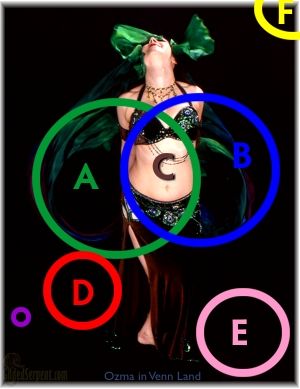
Even the zealots have their place in the discussion, although I’d rather not have them at my dinner table. They are the unalloyed areas of the Venn diagram while most of us fall into the overlapping circles. The voices of the inflexible ideologues can help us pinpoint who and where we are. We need them… but in moderation. They can infuse debates; however, they can also be the reason we walk away from the discussion. We are better served by admitting our overlapping natures than adhering to only one belief.
The Controversy forces us to examine the dance, bringing forth ideas to investigate, inform, and define our artistic path.
The Controversy is the whetting stone against which new ideas are honed and old ideas retain importance. Innovations must prove themselves against traditional opposition just as traditionalists must prove cultural and historical relevancy in times of change.
It is possible to enjoy dance without engaging The Controversy.
You can enjoy art for its own sake without constant awareness of the history, culture, and conflicts. You don’t need to engage the debate constantly to explore the dance. Relentlessly being part of the debate will consume you. There are reasons it ebbs and wanes; there needs to be time to absorb and reflect after conflict. This is why the Controversy is sometimes in full-swing in a community and at other times it remains relatively dormant.
There are points on your artistic path where you need to make your own choices, define yourself, and disengage from the discussion for a while. We need safe places in which to explore ideas. Sometimes, we need shelter from the debate when it is flaring up, lest it overwhelm us when we are too vulnerable, but when it is our time to take a break from the debate, we shouldn’t unilaterally declare it toxic to all or irrelevant to the dance. It needs to be there for others…and for us to return to it when it is “that time” again.
The Controversy also exists for a reason beyond our personal artistic growth.
Controversy exists to protect and strengthen the cultural complexity of the dance.
Belly dance is, for most of us, a cultural import. It has a history and a culture different from our own. Those we brand as “Belly dance police” are often accused of trying to tie us inexorably to the past. Yet, if many of the traditionalists and scholars are examined more closely, you’ll find that there is a complex aspect of the dance they try to bring into the table frequently:
The cultures the dance comes from don’t exist only in the past, they co-exist and cross-pollinate with the new lands of dance.
|

The dance was exported–but not in the way goods are exported: an object did not move from one place to another. This cultural export continues to exist and grow in the countries of origin as well as in its new adopted lands! Each land in which the dance exists contains unique accents and influences, just as every dancer engaged in the dance brings a personal narrative to it. The dance doesn’t live parallel lives in these separate lands and bodies: those lifelines meet, cross, and entwine.
I don’t know how to fully explain why I feel that changing the art without a willingness to grapple with the conundrum of those parallel cultures shows disrespect for many cultures and weakens the dance… The dance is ours, and it is also not ours. I suspect, like The Controversy, the issue cannot be reduced to a simple reason or two.
The trans-global nature of the dance has cancelled any one viewpoint holding reign over all, but that doesn’t mean we shouldn’t try to view it from as many vantage points as possible in order to do it the justice it deserves.
I do know that the Controversy often exposes me to a myriad of viewpoints. The Belly dance community is now international, multi-racial, multi-ethnic, and of many places on the socio-economic ladder. When other community members take time to explain how their background shapes their perspectives, it helps me grapple with my own narrative as a Caucasian American Ex-pat in Japan who primarily performs and studies Turkish-Romani influenced Turkish Oriental and American Cabaret styles. Being able to start understanding my own viewpoint helps me to better understand , although imperfectly, the cultural viewpoints of others. It guides me as I map out the trans-global complexity of the dance and how I should respond to it, engage it, respect it, and question it.
I don’t always like The Controversy, nor do I always behave my best within it. I often hate it. Sometimes, I feel that I hate other people within it unfairly. Still, it has opened me to ideas to which I would not have otherwise been exposed and critiques I needed to hear. It has spurned me to journal and blog until I have had my personal moments of clarity. It has strengthened my mind and made me question my techniques. It has helped me find like-minded and contrary friends internationally who are there for me when I need them and who disagree with me when I need it.
Controversy, thank you for being there (when I don’t want you to be) and existing when I need you. As much as you upset me, you balance me!

Have a comment? Use or comment section at the bottom of this page or Send us a letter!
Check the "Letters to the Editor" for other possible viewpoints!
Ready for more?
- 2-23-11 Shaking Up Shibuya" The Belly Dance Scene in Japan by Ozma
While belly dance in Japan originally came from American roots, it quickly grew to include Egyptian, Turkish Oriental, Turkish Roma, and various Tribal styles. - 1-3-11 I am Become Pure, Destroyer of Dreams, the Belly Dance Police by Zorba
The fact of the matter is, nothing in the universe is constant: except change. "Inauthenticity" becomes "authenticity" over space/time – and vice versa. - 12-5-06 The Ethics of Fusion by Naajidah
If the culture that you’re borrowing your moves from objects to your fusion, does it matter? Are you being respectful or exploitative if you borrow steps from a culture that doesn’t want their music and dance used that way? - 4-8-08 Divorcing Belly Dance From Burlesque by Miles Copeland
As it is traditionally understood, I do not find Burlesque, (meaning nudity-no matter how hard one pretends it does not) amusing or creative in the slightest when it comes to including Belly dance, an art that has suffered too long with such unfortunate associations. I find it completely irresponsible and detrimental. - 9-14-06 Territorialism Undermines Event Sponsor’s Efforts, Interview with Dee Dee Asad by Lynette
Open discussions of such issues will help dancers, musicians and those people who surround and support them, to recognize similar patterns in their own local environments. - 6-26-06 The Spirit of the Dance: A Response to the Criticism of my Tribal Fest 2006 “Pierced Wings” Performance by Sashi
I was originally hesitant to write this article regarding my Tribal Fest 2006 “Pierced Wings” performance as I personally believe that a performance should not have to be explained by the artist, rather it should rely on what it evokes in others. - 6-9-06 Weird Rituals and Beyond: Exploring Current Controversies in Middle Eastern Dance by Barbara Grant
If you are like me, (I know that many are not) you first responded viscerally and negatively to both situations. Then, as the shock wore off, perhaps you tried to make sense of it all. - 3-20-05 Rakkasah Democracy Skips First Amendment!
The second call, a few minutes later, warned me not to come to Rakkasah at all. - 5-13-08 The Ancient Art of Keeping Your Mouth Shut by Neon
Even one’s casual presence in the forums infested with negative-spirited discussions can instantly strip a successful artist of her magical charisma. - 4-12-03 On the Subject of Critique
The Critic; Real Critics Don’t Mince Words by Najia El-Mouzayen
Either we are a sisterhood of ego therapists and our instructors are politically correct in all they say and do—or we are tough artists in search of ways to improve our art form by ruthlessly weeding out the lame from our herd.
The Emperor’s New Clothes by Yasmela/ Shelley Muzzy
Until we see ourselves in the context of a larger society, no one outside of our community will accord us the respect we desire.
Critiquing, the “Agony & The Ecstasy” by Nisima
It’s an unnerving experience to be “critiqued”by your peers, but my personal opinion then and now is that when you perform in public, critiquing just goes with the territory of performing. - 8-15-06 Bellydance Journalism, Rhythm and Reason Series, Article 14 by Mary Ellen Donald
- One powerful tool used to mislead is bellydance journalism.
- 4-11-11 As the Music Fades, Egypt’s January 25 Revolution’s Impact on the Muscians and Dancers by Leila Farid
We can’t attain what they had in the past because we are not free. Our minds are full of work and what we should and shouldn’t do. There’s no time for good art. Politics mixed with religion does not make for an atmosphere where the arts can flourish. - 4-10-11 Sound-Byte Bellydance, Part One: Evolution of Bellydance by Najia Marlyz
Through her clear description of what she wanted to learn, I was able to look inside our recent dance evolution and see what we dance teachers in the west have done to change Bellydance here in the U.S., how we have changed and modified it into something it never was in the lands of its origins. - 4-7-11 Our Changing Dance World, a Response to Leila’s "Dance for Dancers" by Terry Del Giorno
Of course, we learn musicality and so forth, but where dance classes in some places are an hour long, teaching long choreography is not sustainable to an instructor.
Sorry, comments for this entry are closed at this time.