Gilded Serpent presents...

Heartbeat of the Dance

Review of 4+ Drum Solo CDs

by Amina Goodyear
posted July 12, 2009

Below are reviews of 4 CDs. All the drummers are extremely talented but each has a different style. Drum Attack is an American CD by Lebanese American, Tony Chamoun, and it caters to an American audience. Sabla Tolo and Sabla Tolo II are CDs by Hossam Ramzy who has been living outside of his country, Egypt, for a long time and has developed a western sensibility and knows how westerners like to count and analyze. Pulse of the Sphinx by the Henkesh Brothers is just plain Egyptian. Like the river Nile the drumming goes this way and that but it is constant and continuous. – always familiar, yet full of surprises. Here is an excerpt from each review by Amina.

Click on linked title to read each full review.

Sabla Tolo 1 & 2
Drum attack
Nourhan
Henkesh

Sabla Tolo I & II by Hossam Ramzy; Journeys in Pure Egyptian Percussion
Hossam Ramzy came to San Francisco in the early 1990’s and it was a great treat to finally meet the percussionist who had created such a stir in the San Francisco dance scene with his music and percussion cassettes (my favorite was RoHe which still has one of my favorite taqsim beledies). All his cassettes were fun and danceable and his percussion cassette was also informative with spoken explanations of the rhythms preceding each rhythm. In a way he was a pioneer in the producing of drum rhythm albums that were useable for instruction and for dance or drum practice. …more

Zil rating
3 for Hossam’s Sabla Tolo 1,
3 zil rating
3.5 for Hossam’s Sabla Tolo 2,
3.5 zil rating


Drum Attack Belly Dance Drum Solos by Tony Chamoun

This CD has 10 tracks and each track is named after a dancer.  I recognize some but not all the names and believe that these drum solos are mostly named after prominent East Coast dancers. The CD is very well mixed and recorded and all the individual percussion instruments either jump out or hold their own as background in the manner that the drummer saw fit. … more

Zil rating
2.5 for Tony’s whole Drum Attack CD
2.5 zil rating

3.5 for the 2 drum solos in the 2nd CD called Nourhan Sharif in Raqs Sharqi
3.5 zil rating


Pulse of the Sphinx, Drum Solos by the Masters Volume 1: The Henkesh Brothers
Khamis Henkesh was the first drummer of the Henkesh Brothers to be well known in America. Through dance and musician friends we heard that he was considered to be one of the top drummers in Egypt. But it was mostly through his records and later cassettes that came to us in the late 1970s and 1980s that we were able to know him and his drumming. Since stories of his drumming preceded his albums, it was a thrill to finally be able purchase and own some of his music. And great music it was and still is….more

Zil rating
3.75 for Henkesh’s Pulse of the Sphinx
3.75 zil rating

Have a comment? Use or comment section at the bottom of this page orSend us a letter!
Check the "Letters to the Editor" for other possible viewpoints!

Ready for more?


Gilded Serpent presents...

Drum Attack

Drum Attack

Belly Dance Drum Solos by Tony Chamoun (plus 2 drums solos from his Nourhan Sharif CD)

CD Review by Amina Goodyear
posted July 12, 2009

Tony Chamoun is a Lebanese American from Boston, MA. This CD has 10 tracks and each track is named after a dancer.  I recognize some but not all the names and believe that these drum solos are mostly named after prominent East Coast dancers. The CD is very well mixed and recorded and all the individual percussion instruments either jump out or hold their own as background in the manner that the drummer saw fit.

  1. Shadia – 3:22
    This piece is short with the duf or bendir acting as the ard (base) with the tabla playing over it for about a minute of it. The rhythm changes are a little too abrupt to make this a fun dance unless it is completely counted out and choreographed. To me, it doesn’t make sense. It doesn’t have good natural progressions for a dancer.
  2. Nourhan – 8:25
    This starts with the rhythm bambi which is the first underlying rhythm that keeps changing until it eventually changes to a maqsoum beat. There is one section in the middle that sounds like the galloping horse that was used for the Lebanese dancers Nadia Gamal and Amani which is followed by the undulating rolls that made these two Lebanese dancers choo choo with body waves. This is followed by the Iraqi chobi rhythm that gradually becomes another rhythm while the
    familiar, old stand-by maqsoum keeps entering into the rhythm with a tar solo that keeps answering the tabla. Throughout this piece, the tar and tabla have interesting conversations with very clear distinct sounds. I don’t find this particularly interesting as a dance piece. It is more a piece for a drummer to enjoy and think about how the percussion gently moves from one rhythm to another.
  3.  Lola – 1:24
    This very short piece is ideal for using in class. After the 15 second intro it is basically a maqsoum drum solo base with some tabla rifs thrown in. It ends with a drum roll. Good for using a class and seeing how each dancer responds to the drum.
  4. Najmat – 6:18
    A maqsoum duf floor with the tabla playing short rifs and accents turns this into a drum solo that goes nowhere. I would say this is good for a drum teacher to use as examples of different drum rifs…Or “OK class, I (the teacher) will play maqsoum on the duf and we’ll go around the room and in turn each of you students will play 4 measures of something just like you heard on this CD." I guess it would be OK to practice to dance to this, but it would be a better practice track if each rif were done 4 x and that is not the case.  The drumming seems to be random. After almost five minutes of this “going nowhere” the tempo changes ever so slightly into a maqsoum saidi but the next couple of minutes is a repeat of the first 5 minutes until finally it is maqsoum saeria and the tempo picks up enough to end.
  5. Katia – 4:25
    I really don’t understand this piece. Just when it seems to be getting into a groove, it jumps to something that just doesn’t feel like a “natural to dance to” transition.  The rhythm in this piece ultimately reminds me of when I was a kid playing cowboys and Indians and we did our Indian war dances to rhythms similar to this.
  6. Johara – 7:10
    Back in the 70’s there was record, Delta Festival,(vinyl), and in the 80’s a cassette “Addomma Wettekka” which was later re-released on CD, of music put out by the Egyptian drummer Khamis Henkesh. It was modern and it very disco-like. In fact,  one of the cuts was called “El Disco Hal Hadisco”. Besides El Disco, there were two other cuts, “Dokdok Abu Daka” aka “DoDo Abu Daah” and “Henkesh fi Belad el Ferenga”. These songs all featured a very disco, jazzy synthesizer sound with tabla.  When I heard track #6, “Johara”, I was reminded of Henkish’s music. This is not the same as Henkish’s but I wonder if Tony was influenced. Or, maybe, as a friend pointed out – Henkesh was playing tabla to disco music which was popular then, and Tony was playing tabla to club music which is popular now. After 5 minutes the synthesizer music stops and it becomes just a tabla drum solo that starts without a rhythm baseline and gradually welcomes the duf playing various versions of maqsoum saidi until the finale. This section could be danced to.
  7. Phaedra – 3:12
    This is a very nice tar/tabla/bongo piece. For me it works better as a listening piece than as a dance piece because I don’t like the abrupt end, but it does build and for the most part is pretty good for dancing.
  8. Shakira – 4:48
    Although the cymbals have been prevalent throughout this CD, this track finally features the cymbals in the opening section.  This lively track featuring the bongos definitely is a fun piece and brings to mind carnaval or Samba Brazil with the bass drum and pandeira batteria sounds. With so many Brazilian dancers loving bellydance, I am sure this cut is very popular and in a non-traditional Middle Eastern way, is very danceable.
  9. Houwaida – 8:01
    This piece has an interesting tar/tabla version of the “Standard Arabic Drum Solo” that Setrak made so famous in his early records in the 70’s.  I think that it is probably the most danceable piece in the CD. It has a beginning, a middle and an end.  Good repetitions and structure in the beginning, nice variety in the middle and a build-up with all the usual known drum rifs for the end. There are lots of  opportunities for the dancer to play with the rhythms including the Brazilian beats which seem to be an integral part of many Arabic drum solos.  Besides the familiarity of many of the drum rifs and the nice repetitions (to enable the dancer to do something), the tabla has a nice contrasting sound between the dums and the teks.
  10. DeAnna – 1:35
    This piece, to me, doesn’t have enough changes to make it useful as a performance piece, but it’s nice repetitions make it a good class practice piece.

Nourhan and Tony CDIn conclusion – I feel this is mostly a  drummer’s for drummers CD and not really a “Belly Dance Drum Solos” CD. Out of 10 tracks, I would recommend track # 9 as being the only Arabic bellydance drum solo track, with track #8 coming in second as a Brazilian bellydance drum solo piece. I would, though, recommend both drum solos in the following CD by the same artist.

Nourhan Sharif in “Raqs Sharqi” by Tony Chamoun

Includes 2 Drum Solos composed and played by Tony Chamoun that are very danceable and interesting. Various percussion instruments are played.  Although it sounds like a “percussion ensemble”,  according to the liner notes it seems that Tony Chamoun layered all the tracks himself.

Track 4 “Tabla Solo” (3:07) is a predictable and fun drum solo in the style of “Standard Arabic Drum Solo” (think Setrak)
starting with 3 repeats and an ending, followed by interesting rhythm progressions and changes with endings and finally an upbeat drum roll end.

Track 8 “Al Tabla Jamila” (8:37) is a nice medium tempo Saidi style drum solo. It has very clear riffs played on top of the rolling Saidi rhythm that just make the hips and body want to play and accent. Besides the tabla accents, about half way into the piece, bongos come in to help change the tempo and flavor and when the tabla comes back with some great rolls and little accents, the rhythm and feeling subtly changes into a driving chobi background with the tabla still playing over the rhythm. Again the background percussion rhythm changes – this time into an ayoub with the tabla still continuously playing riffs and accents until the piece crescendos to an abrupt finish.

Zil rating
2.5 for Tony’s whole Drum Attack CD
2.5 zil rating

3.5 for the 2 drum solos in the 2nd CD called Nourhan Sharif in Raqs Sharqi
3.5 zil rating


Return to intro for Heartbeat of the Dance: Review of 4+ Drum Solo CDs by Amina Goodyear

Have a comment? Use or comment section at the bottom of this page orSend us a letter!
Check the "Letters to the Editor" for other possible viewpoints!

Ready for more?


Gilded Serpent presents...

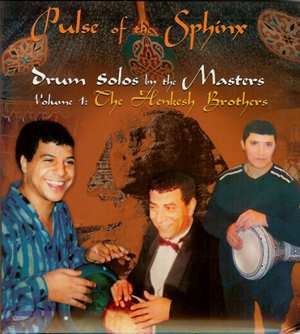
Pulse of the Sphinx, Drum Solos by the Masters

Volume 1: The Henkesh Brothers

Henkesh

CD Reviewed by Amina Goodyear
posted July 12, 2009

Khamis Henkesh was the first drummer of the Henkesh Brothers to be well known in America. Through dance and musician friends we heard that he was considered to be one of the top drummers in Egypt. But it was mostly through his records and later cassettes that came to us in the late 1970s and 1980s that we were able to know him and his drumming. Since stories of his drumming preceded his albums, it was a thrill to finally be able to purchase and own some of his music. And great music it was and still is.

His albums were not just one drum solo after another. They were not only very Egyptian in sound; they were also very Western in composition and utilized not only the finest drumming and traditional arrangements, but also some of the most innovative and original electronic sounds of the time. The ‘70s introduced the electric guitar and the electric keyboard and synthesizer to Arabic music and Khamis was right there with Omar Khorshid (electric guitar) and Hani Mahana (org) inventing new sounds to be melded in with the traditional acoustical Arabic sounds.

This was the decade of change and Khamis was a visionary.

Several years ago Yasmin, now of Washington D.C., created Sands of Time-Soul of Beled Music to share the wonderful sounds of Egypt with her students and with other lovers of Arabic music. This was the beginning of many musical collaborations with her friends Sayed and Khamis Henkesh. As I had become a fan of master drummer Khamis Henkesh, I was ready for whatever else he had to offer.  I clearly remember reading about Yasmin’s collaborations with the Henkesh family and the planned CDs and I anxiously waited for their release. I must admit that I am definitely a fan of hers and of all her CDs as they have always been more than I wished for. Pulse of the Sphinx is a fine example of this. And with Pulse of the Sphinx I was introduced to more members of the Henkesh family, producer Sayed and drummers Ramadan and Reda.

Pulse of the Sphinx is not just a drum CD, it is a lesson in Egyptian thought, mentality, reasoning, dancing, music and, of course, drumming. Yasmin is an educator who subtly uses entertaining as her vehicle.

I don’t want to write and analyze this CD track by track as I have the three preceding CDs because it is too Egyptian to analyze.

  • Tracks 1-10  – Played by Ramadan and Reda Henkesh. These are not necessarily to be used a drum solos; they are more like drum studies or exercises – use of the base underlying rhythm for each of the first 10 tracks with adequately repetitious riffs overlaying each theme or rhythm – but they do include intro riffs and some sort endings. There is lots of repetition of each rhythm introduced so that the listener/drummer/dancer has a chance to fully immerse in it and make it part of him/her. Each track demonstrates what typical riffs go with each rhythm and also how the rhythm can meander naturally into another rhythm. As if by accident, but in reality not at all by accident, but actually by Egyptian rhythmic intent. Uses various sounding tablas, dufs and bendirs, riq, cymbals and probably more.
  • Track 11 – By Khamis Henkesh. This is a live drum solo. The live recording unfortunately is not as clear and crisp as a studio recording, but it definitely has the sound and excitement of a live drum solo that is obviously interacting with the dancer and the audience.
  • Track 12 – A familiar zar-like ending that can be tagged onto and edited into your routine. Short and sweet.
  • Track 13 – Reda and Ramadan identify and demonstrate several of the most common drum rhythms, their accompanying sounds and where and how they are played in the song.  This can also be a lesson in the Arabic language. Fortunately for us, Yasmin provides translations in her accompanying encyclopedic booklet.
  • Track 14 –19 – By Reda and Ramadan. These tracks are exactly what they say they are –drill. Perfect for practicing and drilling drum or dance technique.  Also shows how and what riffs can be used.
  • Track 20 – A familiar zar-like ending that can be tagged onto and edited into your routine. Long enough to build a lot of excitement.

Yasmin’s liner notes are the most complete notes. They are actually short articles full of information and show her love of sharing. Every dancer or drummer should buy this CD for the liner notes alone as they provide so much…much needed information.

Zil rating
3.75 for Henkesh’s Pulse of the Sphinx
3.75 zil rating


Return to intro for Heartbeat of the Dance: Review of 4+ Drum Solo CDs by Amina Goodyear

Have a comment? Use or comment section at the bottom of this page orSend us a letter!
Check the "Letters to the Editor" for other possible viewpoints!

Ready for more?


Gilded Serpent presents...

Sabla Tolo I & II by Hossam Ramzy

Journeys in Pure Egyptian Percussion

Sabla Tolo 1 and 2

CD Review by Amina Goodyear
posted July 12, 2009

Hossam Ramzy came to San Francisco in the early 1990’s and it was a great treat to finally meet the percussionist who had created such a stir in the San Francisco dance scene with his music and percussion cassettes (my favorite was RoHe which still has one of my favorite beledy taqsims). All his cassettes were fun and danceable and his percussion cassette was also informative with spoken explanations of the rhythms preceding each rhythm. In a way he was a pioneer in the producing of drum rhythm albums that were useable for instruction and for dance or drum practice.

He had come to San Francisco to teach not a drum workshop, but a dance workshop.  When he arrived we quickly convinced him to also teach a drum workshop in my studio. His workshop was more informative and useful than most drum workshops I had taken. The class consisted of advanced level and professional drummers. 

Rather than going through all the basic drills that drummers already know or should know, he taught about playing – how to play and how to perform and he asked the class what they knew (this was not a test) so he could teach them what they needed to know.

However, when he taught the dance workshop he was met with some resistance. He had a dance assistant with him, Aischa of Switzerland, who was co-producer of his Stars of Egypt video series. The San Francisco dancers wanted to know why he was teaching the class and not Aischa. But this was his dance workshop, not hers. She was there to demonstrate how the movements looked on a female body – something that he could not do since he was a really a drummer in a large man’s body. He talked about the music and the phrasing, the instruments and what they said and what they asked the dancer to do and he talked about the drum rhythms. He then explained how and what to do with each.

He discussed listening, layering, interpretation, and translating movement.  Then he had Aischa demonstrate what he wanted us to do with the music. He was and is a dedicated and caring teacher.

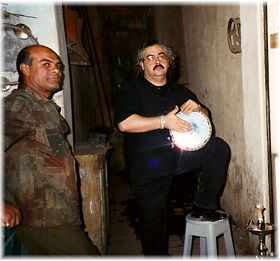
Hossam and Hassam the Drum Maker
Hassan’s drum shop on Mohammed Ali street in Cairo in 1995. Hossam chooses a drum for the author by Hassan the drum maker, who stands by.

Since then Hossam has made and produced countless other cassettes and CDs. Many of them are Egyptian in sound and many are fusion of one sort or another generally with a Latin feeling. One thing that remains constant is his drumming – his style and his musicality and the high level of sound and quality control.

I have been involved with Arabic drums and drumming almost as long as I have been dancing. I got my first drum in 1966 and learned the basic rhythms. Through the years I studied drum and riq intensively and am a professional wannabe drummer.  Besides founding and co-founding several bands including the Cairo Cats and The Arabian Knights, I am a back-up percussionist for many local San Francisco drummers and have been playing constantly – weekly – for almost 15 years for Arabic dance bands that also include open stage dancing for 6 or more dancers an evening. Although I am not proficient enough in drumming to be the main drummer, I know how and what a drum solo is and how a drummer thinks and what he/she expects from the dancer.

There are several different structures of traditional drum solos. Here are three:

  • 2/4 to 4/4 – Standard Arabic drum solo with the malfoof riffs plus endings followed by masmoudi riffs plus endings, bridge riff, rolls and ending in maqsoum based solo.
  • 4/4 to 2/4 – Maqsoum riffs plus endings into double time maqsoum or fellahi
  • rolls into 4/4 (maqsoum or saidi) then 2/4 double time maqsoum, fellahi or ayoub.

The important thing to remember is that the drummer is working with you and you need to be conscious of this. It is a give and take. Inspiration brings more inspiration.

There are many different types of drummers. Each drummer I have worked with has a different approach. Some are dancer’s drummers and some are not. The ones that are not do not repeat the drum riffs. Hossam told me that he likes to play riffs or drum pattern combinations in sets of four so the dancer can hear, memorize and follow the drum.

Hossam is a dancer’s drummer. 

Hossam conceived, wrote, directed and produced the two CDs I am reviewing.

Sabla Tolo and Sabla Tolo II.

These are not just drum CDs. They are for the dancer and the drummer and as they are made by Hossam, the caring teacher and Hossam, the inspired drummer, they include much more than most CDs. The liner notes are actually small booklets.

In the booklets he wrote of his history and inspiration and he gave small introductions to each piece to provide you with an Arabic translation and a visual image to inspire you, the dancer to create. Also he broke down and counted out how many of this or that rhythm each piece had so you can readily understand, count out and choreography each piece.

Sabla Tolo — Drum Changes for Choreographies

  1. West Naima: 3:21
    Starts with question/answer, is natural and intuitive with a medium tempo that builds to a good finale. Good for class.
  2. Kholkhal Taheyya: 3:23
    Begins with a malfoof standard drum solo and is faster than the first solo. Bambi and other rhythms provide good breaks. In the middle there is a roll that turns the solo into a zar (spins and head tosses) and it ends with a Brazilian inspired fellahi finale.
  3. Khatwet Serena: 3:50
    Intro begins with drum breaks that become masmudi, then maqsoum and repeats until it becomes samba complete with bells. The saidi section has good endings and has an accented conversation with maqsoum. This piece builds to a great rolling end.
  4. Amiret el Sahara: 3:41
    This is a very melodic piece with drum breaks and a driving beat. The bambi beat breaks it up in the middle with questions and answers until saidi and then aadani rhythms drive the piece to an exciting end.
  5. Sha-awit Katie: 4:05
    The drums call out and are answered in karatchi. This conversation goes on for awhile. There are good repetitions that make the solo easy to follow. Bongos enter with lots of mood changes and the dialog gets more and more energized until it finally reaches a full and exciting conclusion complete with crash cymbals.
  6. Samya’s Solo: 3:17
    This starts with drum breaks and continues with trades between drum and cymbals – both crash and finger variety. There are many quick drum roll spurts until finally the saidi section turns into a samaai and a wahedeh that brings to my mind Sohair, not Samya. As usual, there is a driving finale.
  7. Brazilian Pearls: 2:52
    This is not my solo of choice as it becomes too Brazilian in sound for my traditional ears. However, I am sure that it is a favorite among many, including, of course,  Brazilians.
  8. Belhadawa walla Belshaawa: 3:34
    This starts with drum breaks and slowly eases its way into malfoof.  There are a lot of breaks and other accents and a dancer could really go wild with this piece. Just be careful to not hit every beat or you might look like a mad-man.
  9. Lucy, The Magnificent: 3:20
    I had the pleasure to go to Lucy’s nightclub The Parisiana with Hossam and got to see the two in action together. This elegant drum solo that starts off rather slow and dramatic with a riq solo can be very powerful. There is a good use of drum – cymbal exchanges, question and answer and an accented ending that makes this solo as memorable as seeing Lucy and Hossam in the flesh.
  10. Dalloua: 3:47
    This flirtatious solo is so cute and animated I can almost hear the drums speaking Arabic. Some of the riffs sound like words to me. Seems like there are two people communicating. A great piece for a duet. Cute!
  11. We Baadin Ommaal: 4:04
    This solo has nice breaks and trades. The bambi in the middle with the question and answer section has a settling effect.
  12. El Genneyya: 3:56
    The drum roll announces a special solo filled with various rhythms that gently roll into each other.
  13. Ghareeb: 4:00
    This is Hossam’s special treat for himself and other drummers and can be a challenge to dancers. In this piece we too are treated to new and special rhythms created just for us!

In conclusion Sabla Tolo is a CD for dancers and teachers to listen to while reading its accompanying booklet.

Take advantage of the solo breakdowns and learn the names and time signatures of the rhythms used, then use it as a guide to make a choreography. 

Sabla Tolo II –Drum Grooves and Get Down

  1. Wana Be-ied Annak: 5:06
    This solo inspires a dancer to just dance as each section flows into the next.
  2. Harrira & Basboosa: 3:15
    This special solo starts with another of Hossam’s own rhythms. It is unique and catchy. Hossam deftly morphs the odd rhythms of Morocco and the even rhythms of Egypt into a very danceable piece.
  3. My Brazilian Pearl: 4:06
    This solo is not the same as “Brazilian Pearls” from Hossam’s first Sabla Tolo album. He composed this for his Brazilian wife, and while it has some samba in it, it is less Brazilian and more Arabic fusion in feeling.
  4. El Esma wel Ma-soom: 4:09
    A great piece for teachers to use in class.
  5. Amar el Sahara: 4:31
    I love the way the rhythms fall into each other.
  6. Wady Samba ala el Malfuf: 3:24
    This is a true marriage of the Egyptian to the Brazilian.
  7. Halloween: 4:16
    Hossam had fun composing this.
  8. Oyoun el Fallaha: 3:46
    Did Hossam’s arm break off playing back-up for his fast rolls and spurts?
  9. Ya Gama-a: 3:42
    You’ve heard of drum circles? Well in class, we have dance circles and each change challenges a different dancer to do her best.
  10. Hawary al Qahira: 4:12
    Opening with another of Hossam’s new rhythms this lively piece cleverly goes from one rhythm to another. The middle section conjures up images of groups of people talking, dancing and playing.
  11. La’ Bel Hadawa: 3:08
    This is a great piece to dance to – just flows and goes at an easy pace yet it has nice accents to keep it interesting.
  12. Ya Saha-eyya: 4:17
    Yet another drum solo for the dancer to play with – go easy on the accents as this is not just a drum solo; it is a dance that happens to have drums as the only instruments.
  13. Rakataka: 3:59
    If the drums could sing, they would be singing rakataka and more.

In conclusion Sabla Tolo II is my favorite of the two CDs reviewed. I very much like the more spontaneous feel this CD has over the overly composed original Sabla Tolo. Although it, too, has many rhythm changes, it feels like it keeps going back to the same theme. I would compare Sabla Tolo I to an Oriental dance opening song and Sabla Tolo II to a more traditional song.

Hossam is a true master of the rhythm and the instruments he uses to make it happen. The above two albums, while composed for dance and choreography, and are great lessons in learning drum rhythms and structures are Hossam’s vehicles for subconsciously training the dancers’ ears to the nuances of rhythmic progressions.

Zil rating
3 for Hossam’s Sabla Tolo 1,
3 zil rating
3.5 for Hossam’s Sabla Tolo 2,
3.5 zil rating


Return to intro for Heartbeat of the Dance: Review of 4+ Drum Solo CDs by Amina Goodyear

Have a comment? Use or comment section at the bottom of this page orSend us a letter!
Check the "Letters to the Editor" for other possible viewpoints!

Ready for more?


Gilded Serpent presents...

Certification & Contests:

BDSS auditionsin San Rafael

Are They Meaningful?

by Miles Copeland
posted July 11, 2009

There appears to be more and more people getting into the Bellydance act, advertising events, contests or whatever who promise to film the entrant/student/winner/participant, then to release them on the market via DVD/video, imagining this is a great enticement to get dancers to become involved.  What the unwitting participants who fall for this “ come-on” are failing to realize is that by adding themselves to such a DVD, they have no quality control and they may become less interesting to some entity like the BDSS or other professional organizations that can, in reality, help advance a career. 

Simply put, it takes a lot of investment to build a star, and it takes a lot of investment to do a proper job filming one.  To take on that challenge, naturally, a producer would want a dancer who is not already readily available on the market in another product so that her rarity value has become diminished already.  

One would want to invest in someone that is special, creating a situation in which one was not competing with others marketing the performance of the same dancer.  The business is tough enough as it is!  This is common business sense.  Dancers, looking for what they imagine is short-term gain from such come-ons may find that they lose opportunities in the long-term.  From my pure business standpoint (and I am certainly not the only one), a fresh dancer is 100 times more interesting than a dancer who has already had film clips out on DVDs from other companies.

Another unfortunate development is the idea that winning a contest is a short cut to developing status in the business that can be used to hype a dancer’s credits as a teacher. 

Its as if the contest win were a diploma, her ticket to teach! 

Yet, from experience, I can tell you that the worst judges of musicians are other musicians, just as the worst judges of dancers are other dancers (especially ones that cannot ever give you a job and have to pay the price of the choice they make).  

Rumors of Asian dancers paying to win a contest in Egypt add fuel, making the whole process not only seedy, but a complete joke. Those who start new contests appear to want to cash in on this thrust for a winning credit as the reason for having the contest in the first place. 

It is “the tail wagging the dog”!

In the same light, we see some dancers, whom we have chosen to solo at our BDSS auditions, now add "finalist at BDSS audition” to their resumes.  This is forcing us to take a harder look at our audition process as we sometimes ask a dancer to solo, thinking of her in the long term, knowing she is nowhere near ready right now. However, the credit "finalist" becomes a credit in her resume in the present.      

Contests have a place as a starting point for a dancer.  By definition, they are a place for amateurs and new dancers to begin the process to build a reputation. You never see the top dancers in the business entering these competitions as they are already established. 

So any win is a “win” among the “wannabies”, which is fine, and as it should be, but it is not a win in the context of all the professional dancers in the business. 

So "Bellydancer of the Universe" is really "New Amateur Dancer of the Year" and as such, it has a value and contribution to make to the world of Bellydance.  There are many competitions in other dance forms, but you will never see dancers from the well-known Ballet companies entering them.  It is understood that they are starting points, amateur affairs. 

We at the BDSS now hold teen contests at our Raqs events for ages 13-19; we pay for the winners’ lessons with the teacher of their choice for a year plus free BDSS workshops.  The idea is to encourage continued study as well as bring in a younger generation to the dance in a bigger way.  We have three winners so far this year. 

We look upon such a win as a launching platform for more study and practice,not a statement that a dancer has now arrived and ready to teach others.

certificate

When dancers take these so-called “wins" back home and stick them up like a diploma, or indeed, buy a “win” (sometimes with the purpose of outdoing a competitor in the market so their school can be top dog) it makes a mockery of the whole process and belittles Bellydance in general. 

More often lately, the BDSS organization is asked to give out certificates to students who have attended a series of BDSS workshops.  Nobody has asked us to grade the students as to whether they actually learned anything or, indeed, whether they have any talent.  Everyone expects to get the certificate.  This makes the certificate simply an additional come-on perk for the student to use as a credit.  It’s about making more money. 

 If I were to fall into this practice, I would, in short order, have thousands of students of talent, as well as students with no talent, armed with a “BDSS Certificate", inferring that they were Bellydance experts.

This might make me more money in the short term, but it would not help Bellydance overall. It would, in the long run, undermine the reputation of the BDSS.  If we ever do give out any sort of certificate, it will be to dancers who deserve a credit and “have the goods”.

I have hundreds of Bellydance resumes on my desk.  I never read them because 99% of their credits are meaningless and tell me nothing unless they are a credit from a reputable school where study happened over an extensive period of time.   What good is a certificate, saying you took 10 lessons with so and so?  What does that tell me? 

There are a few teachers out there to whom I listen, and, of course, I always listen to our BDSS teachers when they come back from a workshop and tell me about one of their students who was exceptionally talented.  Sonia, Petite Jamilla, Sabah, Adore, Kami, Zoe, Moria, Samantha and Issam know better than anyone else what it takes to be part of BDSS and what we are looking for as a company.

In addition, we hold auditions at all our Raqs events.  But in the end for me it’s “seeing is believing”!  It is not the credits on your resume; it is what you deliver on stage, or at an audition, or in a workshop that counts.  If you can’t pull it off there, fifty pages of credits are meaningless.

Have a comment? Use or comment section at the bottom of this page or Send us a letter!
Check the "Letters to the Editor" for other possible viewpoints!

Ready for more?

  • BDSS Update: New Choreographers contribute to 2009 Show
    I will admit that I have never been a big fan of the more ‘folkloric’ approach to Bellydance, but then again I have to be open to try something new with each show.
  • Divorcing Belly Dance From Burlesque
    As it is traditionally understood, I do not find Burlesque,(meaning nudity-no matter how hard one pretends it does not) amusing or creative in the slightest when it comes to including Belly dance, an art that has suffered too long with such unfortunate associations. I find it completely irresponsible and detrimental.
  • Western Dancer’s Guilt, a Response to Naajidah,
    People have occasionally suggested Arabs would be “horrified” by the inclusion of the Tribal style in our show but I can tell you that this style is extremely popular with Middle Easterners who come to our show.
  • Certifying the Certifiers, The Chicken or the Egg? Part Two
    … artists and stars are born, not schooled. You’ve either “got it, or you don’t”
  • Certifying the Certifiers
    …this has occurred because of the current need to be correct, and within certain predictable standards of competence rather than special, unique, outstanding, unusual, memorable, or even (gasp!) emotion producing…
  • My Performance Career
    I worked a variety of jobs, singing in nightclubs and bartending, before developing my next marketable act. Since I was a formally trained ballet dancer, I combined Pointe with Exotic dance. Mind you: this was not stripping—but a beautiful and suggestive dance set to piano music.
  • Faruk Sarsa ; The Life of an Artist of Mohamed Ali Street
    The best drums and riqs, however, were inlaid with mother of pearl and had fish skin heads. The best store selling these instruments was Music Center. It was owned by Mohamed Sarsa who had the fish skin monopoly and the best instruments of this kind.
  • Dyslexia and Dance: Its More Common than you think!
    If you are a dance student or teacher, chances are that around 20% of the class could be dyslexic. As a dance teacher, it is quite important to be able to identify dyslexic tendencies in students, and understand how you can help them learn.
  • The Dance Teacher: By Divine Design or Default?
    …nearly everywhere, dancers in this particular form seem to have found it necessary to “do it all” in order to earn a living by dance career alone
  • Dance Alchemy
    Dance can be the corporeal miming, shaping, and manifestation of the soul’s intent.
 

Gilded Serpent presents...

Carl Captures Character

Rakkasah Festival East 2008

Sunday Dancers A-K

Photos by Carl Sermon

October 19, 2008,
Ukrainian Cultural Center, Somerset, New Jersey
posted July 7, 2009

Caption corrections for each dancer AND musician appreciated.
Friday photos, Saturday photos A-D, E-K, L-Z, Sunday photos A-L- you are here!, M-Z- Coming!


x

Alhena Suhayla of Baltimore, MD

Alia Thabit

Alia Thabit of West Burk, VT

Amina Salah

Amina Salah of ?

Avivah

Avivah of Bethlehan, PA

Barval Ta Pani

Barval Ta Pani of Syracuse, NY, here and below

Barval

Basema and Gelsonmina

Basema and Gelsonmina of Baltimore, MD

Calixta

Calixta of East Rockaway, NY

Dena and Shazadi Dancers

Dena and the Shazadi Dancers of Pompton Lakes, NJ

Dhyanis

Dhyanis of Novato, CA

Erika

Erika of Princeton, NJ

Fringe Benefit

Fringe Benefit of Clinton, NJ, click pic for larger image

Habiba Ensemble

Habiba Dance Ensemble of Philadelphia, PA, Click for larger image

Hipnosis

Hipnosis of Huntington Valley, PA

Indra Lazul

Indra Lazul of Silver Springs, MD

Insinous of Raptor

Insinous of Raptor of New Jersey

Jaida

Jaida of New York City

Jana

Jana Scuderi of Denver, CO

Jim Boz

Jim Boz of San Diego, CA

Johonna

Johonna Gamble of Roanoke, VA

June with Chandi and the Ishtar Daughters
June with Chandi and Ishtar Daughters of Ithaca, New York

June, Chandi, Ishtar Daughters

Kala

Kala of ?

Katarina Gala

Katarina Gala of Preston, VA

Kinnari

Kinnari of Little York, NJ

Layla and Veiled Visions

Layla and Veiled Visions of Howard Beach, NY

Leila Haddad

Leila Haddad of Paris, France

Friday
photos
, Saturday photos A-D, E-K, L-Z,
Sunday photos A-L- you are here!, M-Z- Coming!


Support your photographers!

Have a comment? Use or comment section at the bottom of this page orSend us a letter!
Check the "Letters to the Editor" for other possible viewpoints!

Ready for more?

  • Bellydancer of the Universe Competition 2008,
    held in Long Beach, California, on February 18 & 19, 2008, produced by Tonya and Atlantis
  • Carl’s Raqs LA Photos, Best from the Stage on the Lower Level,
    held May 17-18, 2008 Glendale Civic Auditorium, California, produced by Miles Copeland and organized by Marta Schill
  • Carl Sermon’s Photos from the Hoover Hafla
    Event produced by The San Francisco Bay Area Chapter of MECDA on February 10, 2008, at Hoover Theatre in San Jose, CA
  • My Performance Career
    I worked a variety of jobs, singing in nightclubs and bartending, before developing my next marketable act. Since I was a formally trained ballet dancer, I combined Pointe with Exotic dance. Mind you: this was not stripping—but a beautiful and suggestive dance set to piano music.
  • Faruk Sarsa ; The Life of an Artist of Mohamed Ali Street
    The best drums and riqs, however, were inlaid with mother of pearl and had fish skin heads. The best store selling these instruments was Music Center. It was owned by Mohamed Sarsa who had the fish skin monopoly and the best instruments of this kind.
  • Dyslexia and Dance: Its More Common than you think!
    If you are a dance student or teacher, chances are that around 20% of the class could be dyslexic. As a dance teacher, it is quite important to be able to identify dyslexic tendencies in students, and understand how you can help them learn.
  • The Dance Teacher: By Divine Design or Default?
    …nearly everywhere, dancers in this particular form seem to have found it necessary to “do it all” in order to earn a living by dance career alone
  • Dance Alchemy
    Dance can be the corporeal miming, shaping, and manifestation of the soul’s intent. 
 

Gilded Serpent presents...

My Performance Career

Toni in a theatrical costume in 1950 or 51 in Chicago

Part 1:Secretary to Performer

by Toni Perrine

posted July 4, 2009
Also below is Part 2: Bellydancing & Clowning

An inspirational story by Toni Perrine – a lifelong performer
…Personally, what Life has taught me is to laugh, dance, sing and have fun any chance I might have. I should not wait for opportunities to come my way, but create them as the moment inspires me. I can cultivate my interests into inspirational meaningful experiences to share with my friends and family. Most importantly, life does not always turn out the way we expect. However, that is no reason to prevent your dreams from coming true.

I am Toni Perrine, but I was born Pamela Young on August 1, 1925 to Harry and Muriel Young. My mother was a stay at home mom who enjoyed playing piano and singing while my father was a traveling salesman. My only sister, Beryl Young, was fourteen years my senior and she taught Ballroom and Classical Greek dance in a large dancing school. All of us lived in Brighton, Sussex, England. I remember Brighton as a fun seaside town where royalty used to spend holidays.

Amongst the picturesque castles, there were many nightclubs and shops for people to visit and enjoy while on vacation. In addition to the exciting city life, there was plethora of arts and theater as well to indulge oneself.

Since Brighton was a seaside town, there were huge piers to accommodate boats and fisherman. These piers, far larger than any of the piers seen around the southern California area, provided a scenic space for afternoon dance performances, pageants, bands and dancing.

Pier in BrightonUnfortunately, I was sick and frail as a child and did not have the opportunity to start school until I was approximately seven years old. I remember being terrified (but excited) to finally get to school. On the first day of class, my mother walked with me to school, but after that, I walked alone. On my walks to school, I admired the uniforms of the high school students at Aven-Dale College. However, I never had the opportunity to attend the same high school I passed daily on the way to St. Anne’s Primary School. The school system in England is different from the school system in the United States. I remember sitting in one classroom, while the different teachers moved from class to class, teaching various subjects such as French, history, geography, English and mathematics. (I particularly enjoyed geography.) However, I found history boring because all that was required was to memorize the dates of when kings and queens lived, died and married. In addition to my classroom activities, the school also offered outside activities like tennis for us children to play.

My real passion, however, came from extracurricular activities outside of school! My true love was performance. My mother’s love of music and singing, combined with my sister’s career as a dance teacher, inspired and sparked my interest in the performance arts. I performed regularly in big pageants and shows the school produced. I was formally trained in the dramatic arts and various kinds of dance including ballet and ballroom dancing, and ultimately, I was being groomed to take my sister’s place in the dance school as an instructor. In addition to all of my activities, I would sneak away to the Brighton ice-skating rink where I would watch lessons. Eventually, I taught myself how to ice-skate with the aid of books from the library.

I was a self taught ice skater because the muscles used to ice skate are not good to develop for ballet, and dance teachers would have discouraged me from skating.Toni as Spanish dancer

Near the onset of the World War II, I was forced to leave school because of financial reasons. However, I was determined to follow my passion. During this time, father cautiously warned me that I was too focused upon one area, and he encouraged me to "place two irons in the fire".  After passing my matriculation exam to earn my degree, I enrolled in a course that taught me short hand and typing, and I paid for that course with no assistance from my parents.

bomberShortly after passing the secretary trade school course, I procured her first job utilizing my new skills in an accounting office at fifteen years of age. Even though I could take shorthand at one hundred and twenty words per minute and type at sixty-five words a minute, I did not fully understand the workings of the office, and clearly, I was miserable! My boss and I came to the conclusion that office work was not my true calling, and I moved on after a short period of time. This happened around the same time the war intruded on Brighton and changed the whole face of the city.

I recall the bombs dropping, learning first aid and being huddled up in different businesses in town to watch over things. Sadly, after the onslaught of the war, many plans in my life changed: my sister moved away with her husband, and I no longer received training at the Brighton Dance Academy to teach dance.

playbill of Lisbon StoryWith my teaching plans cut short and my distaste for office work still clearly in mind, I turned my attention to the stage. Since I was unable to get up to London to finish formal training, my mother helped me get into a touring musical production called The Lisbon Story. In this production, I worked primarily in the chorus, singing and dancing. This performance ran for approximately three months. However, I noticed that whenever I was in a musical production too long I longed to act. So when The Lisbon Story tour ended, I joined a repertory theater company in New Castle, England. This theater put on a production approximately once a week, so while one play was running, they would be rehearsing and memorizing lines for the play the following week. Not surprisingly, I found this to be superb training! I was able to indulge my passion for singing, dancing and theater easily in England because every small town and city had a large theater associated with the area. So when I would tire of one discipline, I would audition for jobs in the other. After touring the theater circuit for a while, I decided to try my hand in another one of my many interests. I found myself in Paris and auditioned for a spot in the Cirque d’Hiver.

This show was part ice show and part circus. I learned the routines and won a spot in the chorus.

Cirque d'HiverI was always in the lookout for a new exciting role or gig. One day while looking through the paper, I saw an audition for a circus performer. I tried out for the position and landed a spot in an acrobat troupe. In the meantime, while staying in a friend’s apartment that was on tour, a phone call came in for a lead role in an up and coming play. In my friend’s absence, the agent requested that I come in and audition for the part. I went to the audition and got the lead role. Since this was potentially my big break, I kindly told the circus I would not be able to perform with them. I felt if I could make a name for myself I could get to the United States. Sadly, the musical only ran for a few weeks before the financial backing fell through. Disappointed, I went back to the circus to ask for my old job back. Luckily, they still needed some performers. The Cole Brothers Circus sent another female performer and me to the United States to join the troupe in Kentucky at the Louisville Racetrack, on the Queen Mary.

Toni offers a cardWhile in the circus, I filled in wherever I was needed. Along with acrobatics, I rode the elephants and even once performed in the Spanish Web. The Spanish Web was a precarious stunt in which I was suspended from my ankle or wrist by a rope and swung around in a circle at a dizzying height with no safety net.

Spanish WebI only performed with the circus for one season, which ran from March to October. During the season they traveled all over the East coast and the Southern states, sometimes hitting up to two cities a day! All the performers were allotted one bucket of cold water a day, food, and a bunk on the train. When the season came to an end, I made the brave decision to stay in the United States on my own. I paid the owner of the circus for half of my boat ticket home and said goodbye. When the rest of the troupe headed back to England, I traveled with one of the vendors north to Chicago. He was always a gentleman, and all I had to do was help him sell his merchandise along the way. Once they reached Chicago, he brought me to the YMCA because it would be a safe place to stay while I got my bearings.

I worked a variety of jobs, singing in nightclubs and bartending, before developing my next marketable act. Since I was a formally trained ballet dancer, I combined Pointe with Exotic dance.  Mind you: this was not stripping—but a beautiful and suggestive dance set to piano music.

With my new act in place, I was able to perform and travel to various places in the United States like Boston and Florida. Eventually, my agent was able to book a five-week engagement in Panama. While in Panama, I was promoted as the “English redheaded beauty”.  I performed regularly in Kelly’s Ritz and wore beautiful costumes. In Panama, I noticed money was everywhere. I was hard pressed ever having to pay for my own meal in a diner because someone always picked up the tab for me. One night a drink was spilled on my dress, and I was handed a fifty-dollar bill for the dry cleaning. My five-week contract turned into a one-year adventure in Panama!

After I left Panama, I headed back to Europe and toured with another ice skating show in Germany and France. I did that for approximately a year before coming back to the United States. This time I moved to Las Vegas where I met my first husband, John Right. He was a card dealer, and I was a dancer. After a whirlwind engagement we were married, and I was twenty-seven then. Soon after our marriage, we had two children, a boy and a girl. After four years of marriage, John and I drifted apart, and our marriage ended. However, I continued living in Las Vegas and worked on a variety of different jobs.

One of my jobs was at The Globe Health Studio every other day, where I taught women’s exercise classes, trained people how to use the exercise equipment and ran the front desk. The days I was not working at the health club, I worked at a restaurant called The Rocking Horse. Both jobs provided me with freedom and flexibility to work and spend time with my children. While the restaurant was slow, I could picnic and swim with my children. As soon as business picked up, I would attend to the customers and then return to my picnic. Regularly, working during the day and performing in nightclubs, being afforded these luxuries was not something upon which I could rely.

Sunset Boulevard As time passed, I began traveling again, made another short trip to England and (unhappily) eventually found myself in Texas, where John Right popped back into the picture and "rescued" me. He took the children and me from Texas to California to settle by the beach. Though we did not exactly make it to the beach we did settle in California. We established residence in the San Gabriel Valley where I found work managing the Gym and Swim Health Club. I also worked as a waitress and bartender, and eventually, I became involved with the theater again. John drifted out of our lives again, but I continued living in the San Gabriel Valley. In 1968, I met and married Bill Perrine. Through the course of our marriage we moved to South El Monte, bought property, and laid down roots. The kids went to school, and I worked in a music shop and continued performing.

One of my critically acclaimed roles came during my time in South El Monte. A playwright, John Stewart, wrote a stage adaptation of Sunset Boulevard with me in mind. I played the lead role of Gloria Swanson, who was an older star living in the past. This was an excellent role, and I stole the show. A published critical review of the show touted me as “true star”! The critic stated, "Toni carries the play with high emotional gusto." and "Toni Perrine IS THE PLAY". Life happily continued until my husband, Bill, passed away in 1980. I found myself at a new crossroad of life.

bullet

Toni in bellydance costumePerformance Career Part II:

Bellydancing & Clowning

piano barAt fifty-seven years of age, at a new crossroad in life, I decided to try a new form of performing: I learned to Belly dance! Not surprisingly, I was able to again start performing in nightclubs and restaurants with my new talent. Approximately around the same time, I met the next love of my life, Richard. I had been persuaded to go to a local bar for a drink where I caught sight of a handsome man playing the piano. We became fast friends and eventually started dating. Richard and I never officially married because I would lose the Social Security benefits upon which I relied for part of my income. However, we were together for another thirteen years.

Soon I became interested in another field that would send me traveling all over the world again. The same day my grandson, Max, was born, I headed down to a “clown club” meeting at Oasis in Lakewood, California. Oasis is a center that provides different types of classes for mature adults.

After attending my first clowning meeting, my interest was sparked.

Richard SnowbergThe clowning club group performed in churches, nursing homes and hospitals. I became so involved in the group that, eventually, I became the vice president of the club. After gaining experience in the club, I decided to start clowning more professionally. In order to participate in the most optimal training, I invested in a clown camp getaway in La Crosse, Wisconsin, that was run by Richard Snowberg. I realized the training was expensive but invaluable. Eventually, the clown camp troupe went to Japan to participate in Clown Expo. After this experience, I had the training and talent to call myself a professional. My new career was born.

In 1998, while I was still living in the San Gabriel valley, I went out to dinner with my family to the El Torito Restaurant where my friend Linda was working as a clown that evening. As the evening wore on, Linda brought to my attention that there was a clowning opportunity available in Taiwan, and there was a space available for me—if I was interested. I at first did not take the offer seriously because the troupe was leaving in a couple of weeks. However, the more I listened the more interested I became. I decided to take Linda up on my offer and was off to Taiwan in less than two weeks. I already had a passport and now had another professional opportunity to work as a clown. My work in Taiwan lasted approximately three months.

Yangtze RiverAfter working in Taiwan, my interest in travel was rekindled. In 2001, a close friend, Dottie, and I decided to take a vacation to see the many sights of China. Specifically, they wanted to travel down the Yangtze River before it was permanently dammed up and the opportunity was lost forever. Unfortunately, on one day of the trip I became very ill and stayed in my hotel while the rest of the group left to tour a mosque. Upon arriving home, Dottie turned on the television and saw the airplanes fly into the World Trade center in New York. Since the newscast was all in Chinese, initially Dottie and I thought that the broadcast was a movie. Later in the evening, our group found out what we had seen was, indeed, a horrible reality! The date was September 11, 2001.

twin towersThe rest of the itinerary for our trip was changed. Our tour group was stuck in Shanghai for an additional five days trying to get home. However, the stay was not as unpleasant as it could have been. I found the Chinese people to be extremely kind, compassionate and empathetic. They viewed September 11 as a horrible sad tragedy and did all they could to comfort our tour group. The group’s tour guide took them under his wing and arranged for half price hotel rooms so they would not be stuck without somewhere to stay. He continued to stay with them until it became absolutely necessary for him to leave. During the time the group and I were waiting to leave, I decided to write a poem to lighten the mood and immortalize the people on the tour as well as the sights they had seen. The tour guide enjoyed my poem so much he decided to publish one of the verses in his promotional pamphlet. Here is my published verse:

Three gorges are beauties that nature has given,
Along the Yangtze Rivers where people are driven,
In boats so supreme—they go up and down stream,

and soon, it will be a forgotten dream.
Zoom, zoom, zam!  It’s a dam!

Finally, the group was able to fly safely home to the United States. Two years after my holiday in China, I received another job offer to work in an amusement park in China as a clown. The tour was called Window on China, and I happily accepted the job.

After spending the last thirty years in the San Gabriel valley, I was ready to make another move. The home in which I was living was in need of repairs and its furnace was broken. My daughter, son in law and grandson were all now permanently settled in the San Diego area, so I decided to move to Carlsbad, California. I packed up my life, sold my property, and settled closer to family and friends. In no time, I was involved locally in the arts again.

I still clown professionally, have taken up magic, Belly dance, recently performed in Fiddler on the Roof and made an appearance as Mrs. Claus in a local parade. Undoubtedly, I will continue to follow my dreams and aspirations wherever they may take me.

Mrs ClausI want my ability to pursue my dreams and passions to be an inspiration to others. When I become interested in something, I chase it with unbridled enthusiasm and passion. My whole-hearted commitment to develop a myriad of personal talents has opened up a lifetime of travel and unique experiences many would be hard pressed to accomplish. Instead of being discouraged by set backs, I turn the bumps in the road into opportunities to try something new. My ingenuity has allowed me to be the driving force in my life—instead of letting life roll over me.  Perhaps this is a lesson many of us need to learn in life.

Personally, what Life has taught me is to laugh, dance, sing and have fun any chance I might have.  I should not wait for opportunities to come my way, but create them as the moment inspires me.  I can cultivate my interests into inspirational meaningful experiences to share with my friends and family. Most importantly, life does not always turn out the way we expect. However, that is no reason to prevent your dreams from coming true.


Have a comment? Use or comment section at the bottom of this page orSend us a letter!
Check the "Letters to the Editor" for other possible viewpoints!

Ready for more?

  • MECDA’s First 30 Years , The Middle Eastern Culture and Dance Association’s Changing Role in our Community
    Diversity, however, often leads to dissention, and controversy flew regarding the perception of the rather strict parameters of the Egyptian style.
  • Faruk Sarsa ; The Life of an Artist of Mohamed Ali Street
    The best drums and riqs, however, were inlaid with mother of pearl and had fish skin heads. The best store selling these instruments was Music Center. It was owned by Mohamed Sarsa who had the fish skin monopoly and the best instruments of this kind.
  • Dyslexia and Dance: Its More Common than you think!
    If you are a dance student or teacher, chances are that around 20% of the class could be dyslexic. As a dance teacher, it is quite important to be able to identify dyslexic tendencies in students, and understand how you can help them learn.
  • The Dance Teacher: By Divine Design or Default?
    …nearly everywhere, dancers in this particular form seem to have found it necessary to “do it all” in order to earn a living by dance career alone
  • Dance Alchemy
    Dance can be the corporeal miming, shaping, and manifestation of the soul’s intent. 
  • Susie’s Photos from The Belly Dancer of the Year Pageant 2009
    As a fish to a shiny object, so am I drawn to a well produced event of glamorous, bedazzled and talented performers of belly dance.  
  •  

    Gilded Serpent presents...

    Faruk Sarsa

    Faruk at home

    The Life of an Artist of Mohamed Ali Street

    by Amina Goodyear
    posted June 28, 2009

    It was January 1983 and I was fulfilling my dance dreams. I was in Cairo on a dance tour led by dance teacher Morocco of New York. The dream of my life comes true. Cairo and two weeks of non-stop belly dance shows!

    Two members of my dance group, The Aswan Dancers, Telma and Eleanor, had signed up for Morocco’s dance tour, had shamed me into going also. I had always wanted to go to Egypt but was always too chicken to go alone. So, what better way to see Egypt for the first time than to see it with close friends under the guidance of the renowned Morocco who was a veteran traveler to the Middle East.

    At the time, Telma and I were working at the Bagdad Cabaret in San Francisco’s North Beach. One of the musicians, drummer Reda Darwish, a recent arrival from Egypt worked with us. We told him of our upcoming trip to Egypt. Telma and I spoke English and Reda spoke Arabic.

    Together we spoke Arablish sign language with Reda’s English improving daily, and my Arabic (I was studying conversational Egyptian) not improving at such a great pace.

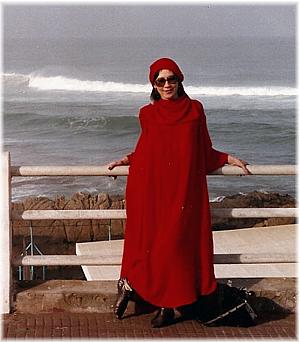
    Amina in Moroccan inspired couture
    Amina in Moroccan inspired couture

    The  Music Center on Mohammed Ali Street
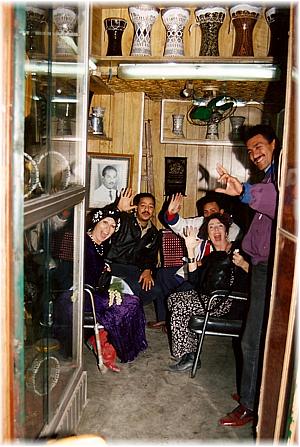
    inside the shop, notice portrait of father on wall
    Inside the shop.
    Notice their father’s photo on the wall over Sharif’s shoulder. Author Amina on right and Latifa on left and Faruk behind Latifa
    Unknown guy standing at the door.

    Telma bought beige safari outfits, beige combat boots, pith helmets and canteens for the desert and I packed “couture” Moroccan inspired pants and tops, knee-high black boots and black berets to cover myself and we were set for our trek to Egypt and the Sahara. Reda was concerned about his ailing mother in Cairo, so with a promise to look her up and give her his regards, we met Morocco in New York and flew off to the desert and the land of belly dancers.

    The second day we were in Cairo I called Reda’s mom’s home and asked “Om Reda mawgouda min fedlek? Ana Amina min Amreeka” (Reda’s mom here please? I’m Amina from America), I prayed to get an English speaker. Instead I got a man speaking broken English saying “Amina, it’s Reda. My mom is very sick, so I needed to come to Cairo to be with her.”

    And so we made plans to meet up and Reda became part of our dance tour. As much as he was able, he accompanied the tour when we went to the clubs to see the dancers and it was great to hear first-hand accounts of the dancers and the musicians as he knew and had worked with many of them. During the day his time was more limited to spending with his mom and his family but he had elected himself to be our (Eleanor, Telma and my) personal guide and made time for us.

    Since I was also a drum and riq student in San Francisco, I asked Reda to take me to a store to shop for instruments. He took me to Music Center, a drum store on Mohamed Ali Street. He said that this was the best street and best place to buy drums and riqs. At this time, there were no metal drums with plastic heads; only clay drums and wooden riqs with animal skin.

    The best drums and riqs, however, were inlaid with mother of pearl and had fish skin heads. The best store selling these instruments was Music Center. It was owned by Mohamed Sarsa who had the fish skin monopoly and the best instruments of this kind.


    Reda at the airport
    3 siblings
    Hind, Faruk and Sharif

    Amina in Hind's nightclub clothes
    Amina wears new nightclub outfit given to her by Hind


    From the first day I met this family I felt at home and experienced all the warmth and Egyptian hospitality I had always heard of. They spoke no English and I spoke laughable Arabic. Mohamed Sarsa had recently passed away and had left his shop to his wife Farida and to her children. Sharif “Sarsa” who worked at the store (but later left to buy an “Qahwa” on Feisal Street in Giza) took me in and knowing my interest in Egyptian culture took me to mulids and street weddings. Farida’s three children were Khaled (at the time a drummer in Nadia Hamdi’s band), Hind, a young girl of about 6 or 7 who was able to translate my child-like Arabic to her mom in real Arabic, and her younger brother Faruk, the little boy who could play the drum better than most of the drummers I knew in the States. Despite the fact that Morocco’s tour left us no time to sleep because it was so jam-packed with dance and cultural activities morning, day, evening, I still managed to find a few hours here and there to walk over to Mohamed Ali Street to hang out at the shop.

    This tiny shop, about 6’ by 10’, was set back about 15’to 20’ from the street. They had no phone and no need of a phone since the kiosk-with-phone on Mohamed Ali Street was kitty-corner to their shop and also in front of the Qahwa (café where musicians hang-out waiting for someone to hire them). It was “the phone” for the all neighboring shops and musicians.

    The Sarsa family only had to take one step outside their door to indicate they wanted tea or coffee or “bebsi” and immediately the waiter would walk it over with a round aluminum tray with drinks. Sometimes, it seemed, they didn’t even bother to request anything – as if by magic, a waiter would just appear with the correct beverages.

    When I would visit, we would either sit inside or outside the shop. It didn’t matter. The shop and the Qahwa and the alley seemed to merge into one  “great room” or the living room for all the shopkeepers, musicians and residents of the street.

    This was the life on this street. Everyone seemed to be an extended family and everyone seemed to know everyone’s business even before they did. I didn’t even stop to think that any of these stores had doors or kept regular hours. More likely than not, Music Center would be closed in the morning, but for sure, it would be open at midnight or later. It just seemed to be an extension of the Sarsa home which was an apartment above the Qahwa just a few steps away.

    On other trips to Egypt I always visited Farida and Music Center. I saw Faruk grow into a polite young teenager who laughed when I would bring him lollipops and give his mother chocolates. Yes, in my eyes, he was still a little boy but now he was taller than me. His mother Farida would sometimes make him accompany me to various places in the neighborhood so I wouldn’t get lost. No matter that I liked wandering around and getting lost.

    Faruk’s older brother Khaled, who lived in Giza, seemed to be always working in a club or touring with a singer (last I heard it was Ehab Tewfik), so Faruk stayed close to home and helped run the shop. Since I have such a passion for drums and drumming we would sometimes spend hours hanging out and sometimes just playing. Many times I was just content to sit and watch the street go by.

    One trip I convinced Farida to let Faruk formally give me lessons. Since I am a nervous, self-conscious student and the store did not provide much privacy (short of closing the door of the never closed shop), Faruk would hike out to my flat in Garden City to teach me. I realize now that they gave me very special treatment as I had a friend who spent several months studying with him also – but at the shop.

    The last time I went to Egypt in 2006, I learned that Farida had passed away and that the family had moved to Feisal Street. But Faruk was still at the store. By this time he had had many jobs working as a drummer, but the store was now his responsibility since his brother was usually on the road.

    Faruk and I spent many hours – days and evenings – hanging out at the store playing and talking about music and the person in his life – Maya, a French dancer. This trip I found that he had been “discovered” by the Europeans.  Often when I hung out with him, there would be a European drummer taking a lesson in the shop. It seemed that they weren’t as shy as I was when I would make him come to Garden City to teach me.

    I haven’t had a chance to visit Egypt or Faruk for a few years now, but have sent friends with chocolate – no more tootsie pops – for Faruk, who is now married to Maya.

    Life changes, but goes on.

    My friend Debbie Smith has visited Faruk and Maya at the little shop on Mohamed Ali Street. Last year Faruk had to give up the shop because his brother and sister, who had no interest in it pressured him to sell it. Now he and Maya have taken up shop in Mohandiseen and so another tale of Mohamed Ali Street becomes history. But, we hope, not for long as Faruk plans to continue the Sarsa Music Center as a virtual shop with Faruk still selling fish skin drums and giving drum lessons (if you’re in Cairo). Hmmmm, I wonder if he’ll agree to “hike” out to San Francisco to give me another much needed drum lesson!

    Faruk Sarsa was born on Mohamed Ali Street in Cairo. He is from an artist’s family. His father, Mohamed Sarsa was a drummer for Om Kalthoum and , and his aunt, Naamet Mohktar, was a famous dancer and actress of the 60’s.   He started his drumming career at a very young age and at age 16 he was the youngest musician in Dina’s orchestra. After a few months with Dina he left for 3 years in the army. Once his military service was over he worked at the cabarets on the Pyramids Road and at some hotels for various dancers including Lucy, Dandesh, Hendeya, Hanadi, Kasume and Nour. He worked and recorded a few CDs with numerous singers including Katkut el Amir and Hakim. Faruk now teaches drumming and is sought after by drummers visiting from other countries. Besides playing at Raqia Hassan’s Ahlan wa Sahlan festivals, Faruk works with his wife Maya and they both teach – drum and dance – in their studio in Mohandiseen.   Faruk is one of the last craftsmen making traditional terra cotta and fish skin drums.

    Faruk’s website- http://www.bellydancesarsa.com


    click photo for larger image
    Susu (author’s daughter) brought on stage by Nadia Hamdi and Khaled


    Have a comment? Use or comment section at the bottom of this page orSend us a letter!
    Check the "Letters to the Editor" for other possible viewpoints!

    Ready for more?


    Gilded Serpent presents...

    Dyslexia and Dance

    Keti turns

    More Common Than You Think!

    by Keti Sharif
    posted June 27, 2009

    Dyslexia and Dance

    Do you love to dance – particularly bellydance – and learn new moves and choreographies, but find that you are:

    • Usually slower to “get it” than the rest of the class?
    • Often see the teacher turn right but end up turning left?
    • Do individual moves well but forget a new sequence of moves?
    • See a dance move or floor pattern and feel you understand it – until you demonstrate the move and find you have trouble following it?
    • Have problems with directional moves, turns and particularly feeling unsure about moves that require left or right motion?

    You may have mild dyslexia. Dyslexia affects the area of the brain that deals with language, direction and ways of processing information. A huge 20% of the population has dyslexia, affecting the underlying skills not only needed for learning to read, write, and spell, but affects certain motor tasks – including learning to dance, turning and being able to follow and remember dance steps and sequences.

    If you are a dance student or teacher, chances are that around 20% of the class could be dyslexic. As a dance teacher, it is quite important to be able to identify dyslexic tendencies in students, and understand how you can help them learn.

    A Personal Approach

    It is because of my own mild dyslexia – and identifying it in others as a school teacher – that I developed the A-Z Bellydance system; a simple way of learning, linking and memorizing dance moves, direction and particularly understanding the practical concept of smooth transitions. My biggest inspiration was studying with Mahmoud Reda – Egypt’s Pioneer of dance. An inspiring choreographer, Mahmoud’s consistently clear cut approach to footwork, transitions and direction, enhanced my skills and confidence to dance with an awareness of space and understanding of direction and structure. Initially it was challenging – I remember a private class with a right and left turn – the right was fine, but I kept muddling up the left! He said to me “Let’s start left first from now on so your body learns it – because your brain is making a habit of blocking it.” There was a method in his teaching that helped me understand the structural side of the dance, despite my “dance dyslexia”.  So I have applied many of these concepts to the A-Z system. But there are many ways of dealing with dancers with dyslexia.

    Teaching Dance to Students with Dyslexia

    Dyslexics are often very bright, sometimes involved in very technical or creative careers; however in dance class, they process information differently and often need more time to comprehend a movement, sequence or distinguishing left and right.  Dyslexia can make dance students suffer from stress and anxiety in a class situation where other students seem to find it easy to learn dance moves, sequences of steps and follow the teacher with ease. Dyslexics sometimes simply cannot process information and copy sequences exactly as taught – there are often problems that make the concepts of left and right difficult, which can lead to frustration or moving to the back of the class where they fumble through the moves without grasping them fully. In fact, a dyslexic dance student will often see the teacher turn right – and understand the turn is to the right – but the way the brain processes the movement (observed at speed) the resulting turn is “mirror image”, and the student will unintentionally turn left!

    Dyslexia is not a learning disability but rather a different way of processing information, so it is important to be aware of this and look out for the signs that suggest a student may be dyslexic.

    Many trained teachers know that there are three main ways to comprehensively teach a class of students – by using a mix of visual, audio and kinesthetic techniques. This is because some people learn best through visual imagery and pattern, others respond to sound and tone, while other students need to feel or experience in order to learn. However, with dyslexic students, it may be necessary for tutors to consider alternative ways of achieving student goals.

    20 Tips for Teaching Students with Dyslexia

    Some of the following strategies may be useful to bear in mind in order to generate a supportive, inclusive learning environment for all students:

    1. Develop an understanding of dyslexia and if observed, gently talk to your student about how difficulty in directional comprehension affects them personally and what they understand about their own preferred learning style.
    2. Ensure that all students have access to any information you provide by ensuring it is in a clear, accessible format, i.e.: concise written notes, music samples, pictures of shapes and pattern in dance, video or descriptive story.  Provide articles or notes which are succinct, clearly structured and well presented to minimize reading load.
    3. Maintain some basic core “drills” and sequences that remain constant in each class. It may be a warm up or several sequences that you use in each class. Incorporating this consistent discipline will be beneficial for dyslexic students and the entire class, as it builds confidence and structural skills especially with footwork and concepts of left and right.
    4. Try to develop an atmosphere of support amongst all students and explain that everyone processes information differently and some people need more time to comprehend moves. Encourage those who “get it” to help and show others who need extra support or time. This gives students who are familiar with the moves a chance to solidify their knowledge and assist others at the same time. Sometimes interaction between students in a pair or partner situation is less threatening than being singled out in class by the teacher.
    5. Take steps to build the confidence of students so that if any students do want to disclose their learning difficulties, directional challenges, or feel they are “slower” than others – so they can be sure they will be supported and understood.
    6. Identify new vocabulary as you teach, particularly dance terms and Arabic or Turkish (or other) terminologies. Get students to repeat back or encourage the use of these terminologies in class.
    7. Offer audio-visual sources on subject matter, e.g. show dance videos, instructional or performance based clips or dance documentaries and encourage discussions – these can help with structure as well as content.
    8. In class, use a white board to show directional change with arrows or clarify floor patterns. Keep it simple. Make sure your writing is large and clear and students can read it. Use your arm to direct the move just before it occurs.
    9. When teaching a routine sequence or choreography, first explain the basic framework of the moves. Overview main points at the beginning and give markers along the way to help students distinguish important changes. Show them the big picture before looking at the composite detail.
    10. Allow time for students to process information – break class topics into chunks with pauses for taking it in and time for questions. Break up learning tasks into small steps and allow time for reinforcement and over-learning of information.
    11. Build in lots of feedback to monitor students’ understanding and develop their learning skills.
    12. Consider using different colours like veils, scarves, etc to assist troupe formation where students need to work with partners, pairs, in circles or in lines – where clarity is needed.
    13. Correct moves by slowing down and stepping through the move with your back to the student, so they can follow your left and right moves easily. Avoid starting with mirror or circular formation when teaching linear moves, stay linear (in front of the class, with your back to them, but able to observe them in the mirror) for the fastest learning.
    14. When teaching, talk less and demonstrate or repeat movements and sequences more. Discussion and over analyses with the student is probably a waste of time if they are struggling with a move or direction.
    15. Avoid overloading information and over-correcting. Take no more than five types of error that occur repeatedly, and to show, with clear, simple examples, why the errors are wrong and what would be correct. Keep it as simple as possible!
    16. Balance set steps and sequences (or choreography) with taqsim or free, improvised dance. Most dyslexics excel at taqsim, so it’s good for their confidence.
    17. When choreographing or encouraging students to create their own choreographies, make sure they balance structure with free dance.
    18. When teaching left and right, make sure symmetry is implemented.
    19. Allow clearly defined periods of rhythmic exploration versus melodic interpretation in class.
    20. Offer occasional “extended classes” that explore the same subject matter of regular classes, for those who would like more detail and focus if they feel they are learning slowly.
      You’d be surprised at how many people will take up this offer!

    Good luck – remember dyslexia often comes with extra creativity, so nurture these special students. In fact, as a teacher, once you learn to assist the challenges of dyslexia, you often develop a clearer style of teaching and become a stronger and more compassionate teacher.

    Have a comment? Use or comment section at the bottom of this page orSend us a letter!
    Check the "Letters to the Editor" for other possible viewpoints!

    Ready for more?

    • Dance – Deeper than the Moves
      A dancer who feels “safe” in the rhythm, footwork, technical movement feels grounded and secure as she dances. A grounded dancer will be less "in her head” and allow the authenticity of feeling to come through her body as a flowing, emotive movement that expresses the music and how she “feels” the music.
    • The Secret of Saiidi Song and Dance-Straight from the Horse’s Mouth
      "Saiidi". Say this word anywhere in Egypt (including El Saiid) and colloquially it implies someone who is funny, backward -a loveable, gullible character with salt-of-the-earth village simplicity.
      To call someone “Saiidi” is a local term or endearment for a likeable buffoon!
    • Opening a Bellydance Studio, Tips for Success
      She has recently retired fully from bellydancing but offers great advice on business plans for dancers wishing to expand their hobby into a career.
    • Streets of Cairo- Egyptian Rhythm, Language and Dance
      Cairo’s streets are much like its dance – streams of freestyle movement guided by intuition rather than rules. There are no ‘principles’ as such in both circumstances – it’s the organic-ness of Egyptian life that creates order in chaos.
    • The Dance Teacher: By Divine Design or Default?
      …nearly everywhere, dancers in this particular form seem to have found it necessary to “do it all” in order to earn a living by dance career alone
    • Dance Alchemy
      Dance can be the corporeal miming, shaping, and manifestation of the soul’s intent. 
    • Susie’s Photos from The Belly Dancer of the Year Pageant 2009
      As a fish to a shiny object, so am I drawn to a well produced event of glamorous, bedazzled and talented performers of belly dance.  
    • Arabic Lessons, My Introduction to Shaabi, Part 1
      She taught us that besides learning the words and their meanings, Egyptians do not stand still when singing. They dance around a bit and use their hands, body and eyes to gesture according to the songs.
     

    Gilded Serpent presents...

    The Dance Teacher

    many arms doing many things

    By Divine Design or Default?

    by Najia Marlyz
    posted June 19, 2008

    No doubt you have heard the old saying; perhaps you have even spoken or written some version of it yourself:
    "Those who can dance, do, and those who can’t, teach!"

    Facing Reality
    Usually old proverbs contain trite but indisputable wisdom, but in the case of dance, especially Bellydance, it seems that the old adage isn’t always true.  Dancers need a certain charismatic personality and those dancers who teach need charisma too, perhaps even more of it! Personal charisma is elemental to the teaching process, but all teachers do not fit all students just because they are charismatic and need to earn a living. Hobby dancers who have seldom soloed or never performed professionally need to disclose that information to their would-be dance students before accepting their new enrollments, simply because student dancers mirrorhave a wide variety of goals; they have no success in creating a good learning relationship with a particular teacher who is not oriented to that same specific goal.  We all have perceptions that differ from reality and the way in which the world sees us. The dance teacher needs to “fit” the goal expectations of the prospective student and the realities possible for each student.
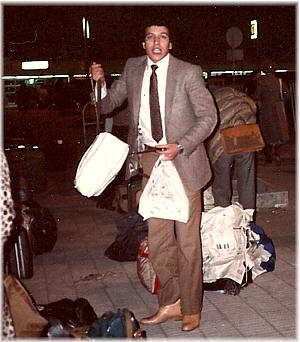
    Aging:The Inevitable Problem
    Occasionally, by whatever miracle, the most beautiful dancers also turn out to be good teachers! However, just like everyone else—including the incredible and fit movie stars in Hollywood—we humans age—eventually becoming elderly (but only if fortunate in health issues).  An aged dancer finds the stage, as well as those memorable performances that once seemed a breeze and delight to dance upon it, are no longer a joy but become a struggle of personal willpower, trying only to stay within reasonable range of her own top form. In a very real sense, sadly, the older dancer often finds that the youthful version of herself becomes her most difficult competitor…  However relentless rehearsals may be, time is even more relentless, and none of us is able, in the end, to deny the clock its due toll.
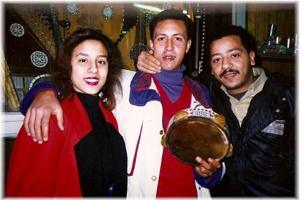
    It often seems to me that just as the dancer attains all that she needs (and aspires to be) as a performer, the time clock easily and inevitably punches her out!

    Then, what can she do about her “aging dilemma”—teach? Is the close of one’s active stage career in dance, naturally to become a dance teacher by default? Where’s the proper motivation?

    Pretty Is As Pretty Does
    Additionally, the most talented dancer, even though she may have costumed herself in a sparkling designer bedlah straight from the Internet and may appear to have been naturally blessed with a finely sculptured face and figure, even the addition of many hours of Pilates might only turn her into a most ordinary, uninspired, and wrongly motivated teacher. Like some dancers who appear to be dancing for all the wrong reasons, (i.e. competition to show someone else a thing or two, upstage others, or perhaps looking sexy to one’s “old man”) some dancers have become dance teachers for all the wrong reasons.

    “What would be a “wrong motive” for a beginning teacher?” one might wonder. Motives that might seems dubious span the distance between:

    • Needing to earn more money,
    • Indulging in one’s own self-importance,
    • Discovering that there is no other dancer available to teach anywhere in the nearby area,
    • Needing to create a bloated resume by adding “instructor” to one’s list of accomplishments, or perhaps,
    • Gaining power over others by the authority of becoming their leader and teacher.

    It is not enough to know how to do something well yourself to be able to teach it with joy, creativity, and dedication.

    Letting Go
    letting goIn most performance fields, accomplished artisans wait to teach until they, for whatever reason, are no longer stage-worthy for one reason or another. However, that may also carry with it an additional problem: an aged dancer may find it difficult or nearly impossible (due to ill health or general bodily decline) to demonstrate where and how the student has made an error and/or how to correct it. That instructor had better have a firm grip on the descriptive language of imagery to carry on with her job!  Yet, a gorgeous, youthful and accomplished dancer filled with energy may prove to be a poor verbal communicator, and she may be unreliable toward her teaching responsibilities without an agent or coach to prod her into action on behalf of her students.  Often young teachers find themselves torn between the need to travel, to be available for performances, and the need to be both present and available to groom her students.  Sometimes the life of a professional performer may be deficient in a fundamental understanding of how go about the magical process of teaching; she may not have the type of personality required to relinquish the reins of control over a dancer who has been her student for many years—once that dancer is ready to proceed on her own.

    Doling Out the Information
    Occasionally, one can listen to dance teachers discuss the rigors of juggling their teaching schedules and responsibilities for their students, and everyone who is listening becomes aware that the instructor who is speaking has been withholding important information from students or only from certain students. Of course, the motive behind withholding complete information is to ensure that the instructor will not create personal competitors in either dancing or teaching, which is privately referred to as “creating one’s own monsters”. Instructors who are still aggressively engaged in performing are sometimes tempted to keep just a few of their little secrets of success hidden in the back pocket of their vanity cases.

    However, performers who feel compelled by circumstances to become instructors (as well as performers at the same time) should fear more than our newly created, competitive, self-produced monsters!  Fear the innate shortness of the viable dance career—as you shorten it even further by teaching many students, clamoring for the few gigs available. Then begin teaching too soon because there just aren’t that many dance gigs around that can support all the newly created dancers in their own dance careers. Competition can be quite fierce and ruthless.

    What an extraordinary teacher must have (above everything else, including youthful health) is a certain "joie de vivre", as well as confidence, belief, and an unbounded joy in the subject he or she is passing along to others. Additionally, it wouldn’t hurt to have a sublime sense of the ridiculous! There is a certain mystique in training the physical body, while at the same time one strives to understand the human spirit through dance. Beyond all our ideals, a teacher must possess a willing heart for the sharing of his most cherished knowledge in his field of expertise.

    Doing It All: the Renaissance Career
    Other factors may also enter into the career choice for today’s Oriental dancers: nearly everywhere, dancers in this particular form seem to have found it necessary to “do it all” in order to earn a living by dance career alone.  “Doing it all” appears to mean becoming the consumate Renaissance dancer, whether woman or man; it implies:

    • Dancing,
    • Teaching,
    • Choreographing dances for herself,
    • Choreographing for other dancers,
    • Costuming,
    • Vending,
    • Leading a troupe,
    • Writing books and articles,
    • Self-promotion and designing advertisements, —as well as
    • Operating a talent agency that farms out dancers for hire, and
    • Becoming an organizer/producer of events and festivals.

    Lately, it appears that many newer dancers who have grown up using computer skills, also engage in forums and websites as a further means to earn a living through anything associated with Belly dance—even fusing it with gymnastics, calling it something like “Belly Gym” or other catchy and clever titles.  Some may even aggressively push themselves into opening a restaurant with a Middle Eastern name or theme in order to star her troupe dancers and students (or even herself) in order to stretch her waning career. I can think of no other field of performance that lends itself so well to this sort of “Renaissance person”.

    Understanding How Others Learn
    In addition to openness and inner joy, an extraordinary and outstanding teacher must be aware that most students are capable of learning by a number of different methods. Perhaps one method or another will work more successfully than another for a specific student; so a teacher needs to understand each learning style (at least a little) so he can redirect a student who has not yet located the teacher best suited to his style of learning.

    • Many dancers learn best by verbal analysis, counting the number of movements to the beat, repetition, or trial and error with short, or sometimes complex, transitions from one movement to another.
    • A few dance students request that movements be dismantled (“broken down”), and excruciatingly analyzed—both mechanically and verbally.
    • Some learners fear any sort of improvisational dance, preferring the relative safety of choreography and being told exactly what to do as well as how (and when) to do it by an expert.
    • Other students learn more easily using the instruction method that is often maligned by simply dubbing it "Please Follow my Lead" (minimal description with maximum demonstration while both students and teacher dance consecutively or in unison). Contrary to what that image might conjure, it is not easy to prepare for this type of teaching, nor is it easy to repeat it lesson after repetitive lesson. However, learning dance beside a moving example can be one of the most potent forms of instruction!  (Please note that this method induces kinesthetic memory, which involves the sensation and memory of the feeling of movements.)
    • Most students gain understanding of movement if they are guided by abstract concepts of dance that group them into families. Students and teachers can discuss them, then demonstrate and try them in the classroom setting.

    Choreography vs. Spontaneous Interpretive Dance
    Modern day dancers sometimes feel unskilled at relating one dance movement to another on their own, and they would prefer to learn their teacher’s choreographies so that they may perform them flawlessly (if detached from the music and the moment), insuring a constant quality (even if somewhat mediocre). However skillful, all this can produce is a poor and second-rate copy of the original. Unfortunately for the proponents of spontaneity and dancing in the moment, there are some students who do not recognize just how beautifully demanding the art of dancing in the moment is! This type of dancing is far from freeform and demands a tight rein on technique. Therefore, newly sprouted spontaneous dancers might imagine themselves free to cavort aimlessly in a swill of self-indulgence and self-discovery, expecting that hungry audiences will automatically become as enthralled as they are with their egotistical convulsions.  Audiences, out of politeness will applaud them none-the-less, and they will believe they are a grand success at improvisation even though, backstage, their disappointed teachers may cringe with embarrassment.

    Well, “You can lead a horse to water…” No matter what a highly talented dance teacher one becomes, a teacher has very little control concerning those who may enroll and who may earnestly attempt to learn, and she has even less control over the career choices made by her students and former students.

    Not everyone who wants to dance can be (or ought to be) trained to become a professional performer.

    Avoiding The Road to Failure
    pylonIn my opinion, it is not sufficient to rely solely on any one of the possible teaching approaches that I have listed here.  To be accomplished at teaching by only one instructional method may create the impression that there is "something wrong" with the student rather than the teacher.  It is quite possible that an instructor will not be aware of any deficiency on his/her part because there will always be some percentage of students with whom he may be successful, creating the erroneous self-impression that he is actually a competent instructor when he/she is not.  Needlessly, too many students become failures through not matching their proclivities in method of best and easiest learning to those of the teacher’s preferred instructional method.  They simply have chosen the wrong teacher!

    Unfortunately, too often the student will take difficulties in learning to heart, and subsequently, she believes that she has no talent or that she is somehow a dunderhead when it comes to learning to dance.  This student, rather than searching for a new teacher with a different teaching method or “style”, simply falls by the wayside, not only for Oriental dance, but also for all other forms of dance, too, because she wrongly concludes that she has no talent for this sort of activity.

    Making It “Your Own”
    Once new dancers have “made the dance their own” by personalizing it (not merely copying the style of their teacher or the style and quirks of some other dance star they adore) they will embark on a fantasy filled adventure in dance. We performers who now teach can only hope that they will still remember the teacher who showed them that it was possible to stretch beyond the ordinary.

    Blessedly, there are some dance instructors everywhere who understand and mix all the methods of teaching I have mentioned here.  Additionally, many go out of their way to encourage their students to utilize their own private resources, study what other teachers have to offer, filter, choose, and incorporate into their dance all of the steps, movements, and technique attributes that make personal sense to them. These are the teachers with a calling, not merely teachers by default, in need of the Renaissance dance career.

    Have a comment? Use or comment section at the bottom of this page orSend us a letter!
    Check the "Letters to the Editor" for other possible viewpoints!

    Ready for more?