Gilded Serpent presents...

SharQui and Injury

Oreet corrects a student

by Rachel
posted August 13, 2009

I still very clearly remember the first time I encountered bellydance. I don’t remember her name, or her face, but I remember she was wearing the most beautiful green costume with elaborate silver coins on her hip-scarf and arm cuffs. 

I remember she was beautiful and the precision and control she had over her movements was absolutely amazing. I wanted to be able to dance like that.

But even then I knew we did not have extra money for me to take any kind of lessons.  There were five kids in my family and my parents never made it a secret that we were struggling to make ends meet.  I knew better than to ask for something "frivolous" when they were already so stressed about making sure we were fed and had a place to live.  So I never asked, and tried to put it out of my mind.

Over the years, I continued to watch any performances I could catch, all while silently wishing I could do what they did.  But there was always something… time, money, lack of studios where I lived…  As I got older, I pretty much settled into the thought that I’d never be able to learn more than what I did in my school theaters and choir performances.  I focused on studying for the career I wanted and enrolled in a massage school that focused heavily on human anatomy, specific muscular therapy, and injury therapy.

Then in June of 2004, I was working as a lead therapist in a day spa when one of the receptionists thought it would be a brilliant idea to jump on me while I was stretching my low back. Twice in a row. To my complete and utter devastation, in those thirty seconds, she absolutely and quite entirely ruined my life as I knew it.

I suffered a severe injury to my spine and sacroiliac joint that left me in constant agonizing pain, and worse, fully disabled. I was 23.

What followed was a nightmare that would take pages to tell, but suffice it to say, Worker’s Compensation, lawyers, and all the programs I’d always been taught would take care of such things turned out to be more concerned with denying me treatment than trying to help me heal. And after nearly five years of fighting with them, I decided I’d had
enough of waiting for them to do what they promised.  If I was going to get better, I was going to have to do it on my own.  So with the encouragement of my friends, I started to look for ways I could start trying to regain my mobility.

Living in San Francisco gave me access to a number of gyms and I started to email instructors and trainers to ask about their classes and programs.  I was clear about my disability and about my limitations, and what I was hoping I would be able to accomplish.  I mentioned what my doctors wanted to see and asked if they thought their class would be a fit for me. Among those was a class at my local JCC that had caught my attention the instant I laid eyes on it.

SharQui Bellydance.

I wrote to the listed instructor on a lark, fully expecting her to say there was no way I’d be able to take the class.  But to be totally honest, I couldn’t quite help myself.  Even though I knew my disability would prevent me from taking it, I still sent the email because some part of my mind still wanted so very badly to be able to learn bellydance. In the end, only one of the instructors said yes: Oreet… from the SharQui Bellydance class.

I was… unbelievably astonished.  There in the email she was insisting I come in, that her class would be absolutely perfect for me, and she could help me modify the movements to my own limitations. 

All she asked me to do was come in early and see her before class started to make sure she could go over them with me. I don’t think I can adequately describe how reading that made me feel.  I cried; I’ll admit that without any hesitation.  For so, so long all I’d heard was no from everyone.  And suddenly, here I was getting a yes to learn something I’d given up on thinking I’d ever being able to do. After recovering from my shock and relatively minor emotional breakdown, I still struggled with – well, I guess the best way to say it is a feeling of inadequacy.  Before I was hurt, I’d been active and incredibly health conscious, but now?  Now I was a hundred pounds overweight, hated seeing myself in the mirror, and couldn’t even tie my own shoes.

But I finally pushed myself through that, bit the bullet, and went in for a class to meet Oreet face to face. My first impression was definitely: "Wow, she’s tiny!"  But the minute I introduced myself and she started talking, I was blown away.  She just exuded so much confidence and genuine warmth that I felt like I was talking to an old friend.  It was so comfortable that my self-consciousness and hesitation were pushed to the back of my mind before the class even started. Unlike any of the classes I’d seen or talked about with my friends, the SharQui method she created focuses on strength, endurance, and form.  The entire hour was spent learning the foundations of each movement and focusing on full isolation to get the right muscle groups firing to perform them.  We weren’t busting out with wild moves or choreography; there weren’t crazy rolls and undulations.  The moves were small, focused, and controlled. Interspersed with learning the correct postures and dance forms, Oreet told us bits of the history behind each stance and each move.  Names, origins, differences from region to region… it was absolutely fascinating, and given just how much I’ve admired it for so long, I was completely thrilled.

There I was, very slowly attempting to shimmy, activating muscles long atrophied from inactivity, and at the same time, getting a history lesson on the dance form itself.  By the end of the class, I was panting, sweating like a man, already feeling my muscles protest… I was absolutely ecstatic.

And I’ve been going back for more for three months.

With my own training in muscular therapy and injury, I’m really, really picky about the things I do.  I have to be; otherwise I’ll aggravate my injury and spend a ridiculous amount of time immobile and in a great deal more pain than normal.  Fortunately though, with my training in anatomy and body mechanics, I understand the way the body works, the way it moves.  I know all about the compensation between muscle and body and posture, especially for things like dancing and exercise.  I know the right way to do things, and the wrong way to do things, and I know how many people have no idea which one they’re doing.

Because of that, I have so much appreciation for Oreet and what she does.  Her method has not just made it possible for me to start exercising again, but it’s given me the opportunity to do something I’ve always wanted.

I’m hoping that by sharing my story, I can help out others like me who’ve admired this beautiful style of dancing but thought they’d never be able to learn it.

Oreet by Rachel
Oreet performing in August 2009 at —– in San Francisco, CA

In everything in life, you HAVE to have a strong foundation if you want to have a strong, polished product in the end.  Be it education, profession, or recreation.  You can’t immediately walk onto a plane and expect to fly, and by that same principle, you can’t walk into a studio and expect to master complicated, intricate dance styles.  SharQui is quite literally the only style I’ve ever watched or heard of that focuses on mastering the foundation of bellydance movement before attempting to move on to the "big stuff."

The SharQui method has really been just about the best thing that’s happened to me in my "quest" to get my mobility back.  It’s so focused on building the strength and stamina in all the right muscle groups for each step and move that I haven’t once felt like I was in danger of straining myself or aggravating my injury.  Oreet is absolutely amazing for keeping us on track with our posture and the appropriate way to perform each step and each move.

Oreet’s method really has given me back so many things that I thought I’d lost forever.  Little by little, I can feel the moves getting easier.  Believe it or not, I can actually shimmy!  Just a bit and not very well, but it IS there.  It’s giving me hope now that I can get to a point where I can really sustain it if I keep going to class, and keep practicing at home.

I’ve recommended SharQui to all of my friends, to my family, and even to complete strangers in the gym.  We have a fantastic class and everyone is so encouraging and so helpful that even going to work out alone, I haven’t once had a problem with losing interest.  It’s a dynamic environment with absolutely infectious energy, and you can’t help but love it.

Learning this style has made me feel like I can actually do something to help myself and my body in a way I haven’t been able to do before. 

It’s a little easier for me to "find" my muscles not just during class, but when I’m doing my physical therapy exercises and even around the house.

Sure I’m still in pain.  I’m still out of shape, overweight, and disabled, but now I feel like just maybe I can get those first two back under control.  I haven’t felt that way in five years, and I will love Oreet forever for giving me back that confidence and hope that even though it’s not ever going to be in mint condition, I can make my body my own. 

I feel alive again.

And now that I have that?

Well, maybe now I can try to work up to those really awesome flashy moves after all!

Rachel performs!
from author-"I’m really excited to tell you I participated in a little student performance event to represent Oreet’s JCCSF class.  We had two dances, a veil dance and a drum solo.  I was incredibly nervous because Oreet put me in front for both dances, but my friends said I was great and I had a lot of fun!  My roommate took a couple pictures from the veil dance and I took some of Oreet that turned out just amazing! On a personal note, since I started the class, I’m down 33 lbs and fitting into pants I had given up as a lost cause. If this keeps up, I might even be able to pull my really old pants down out of the closet in another year!"

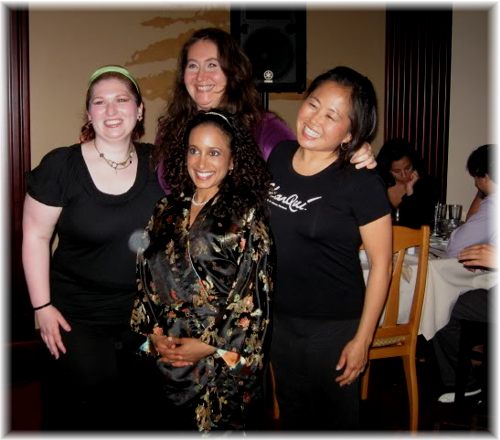
Rachel poses with fellow dancers
With Oreet below is Rachel, Diana and Arisa

Have a comment? Use or comment section at the bottom of this page orSend us a letter!
Check the "Letters to the Editor" for other possible viewpoints!

Ready for more?

  • Carl Capture Character: Rakkasah Festival East, Sunday Dancers M-Z,
    Mariyah, Metal Goddas, Nesheli, Nubian Daughters, Oasis Dream Dancers, Oreet, … Suzanna Del Vecchio, Willow
  • Belly Dancer of the Year Pageant 2007 Sunday Photos,
    May 27, 2007 Danville, California, Event produced by Leea. The competition for the Finalists. Oreet wins!
  • BDSS Auditions January 14-15, 2005, North Hollywood, CA
    -"What have I got to lose?" by Zaheea -Photos by Lynette, Oreet pictured
  • 31st Annual Belly Dancer of the Year Competition,
    photos by Susie and Lynette. Where were the spectators? Plan on coming next year! Oreet competes
  • The Skinny on Abdominal Strengthening
    You’ve probably heard the terms neutral spine and core balance being bandied about, and seen numerous class offerings for Pilates, body ball, and core workouts. You may be wondering, is this the sort of thing you should be checking out?
  • Got Strength? Buffing up for Bellydance
    Muscles are like smart-aleck teenagers. If you ask them to do something, they do just enough to get the job done—and no more.
  • Belly Dance Secrets for Fitness and Rejuvenation
    The most important factor in sustaining an exercise program is the ‘fun factor’; Belly dancing comes with great music, exciting moves, noisy coin belts and its
    own special dress code.
  • Words of Wisdom: Interview with Hadia
    Unfortunately, this hyper-saturation, along with the current international economic crisis, has led to a self-initiated devaluation of both dancers and teachers, as they compete for contracts and students in an extremely competitive market.
  • The Ghawazi: Back From the Brink of Extinction (For now)
    The really fabulous news is that Khairiyya’s sister Raja has come out of retirement and is dancing again.
  • At Home with Fifi Abdou
    In America, one of the things that especially pleased me was the inclusiveness of the dance scene there – in my classes I saw women of many different ages – and body types – enjoying dancing, and that made me happy
 

Gilded Serpent presents...

Words of Wisdom:

Hadia by Micheal Baxter

An Interview with Hadia

by Jalilah
posted August 12, 2009

Jalilah-authorMy first encounter with Hadia was when she invited me to teach at the “Festival of the Nile” which she organized in Calgary 2002. We became friends instantaneously.  I had heard about her long before while still living in Berlin, Germany. Friends came back from Belgium raving about a Canadian dancer who was living and working in Brussels.  A true globetrotter, Hadia lived and worked in Spain and Belgium before moving back to Canada.  Hadia has since established herself as one of the top Middle Eastern instructors in the international scene today.  Belonging to a generation of dancers who valued the necessity of learning the dance in it’s country of origins, Hadia, has 38 years of experience in Egyptian oriental as well as many of the folkloric forms of the Middle Eastern countries.  She is also a professional Flamenco dancer living for several years in Spain studying with many of the best "Gitano" instructors in the world.  She travels regularly to Turkey to continue her studies of authentic Rom dancing and also organizes dance tours to Turkey.  Funny, passionate, enthusiastic and honest, Hadia offers wise words to all dancers.

Changes in Our Workshops and Festivals

Jalilah: It has been almost 10 years since I first met you in Calgary. Do you feel that the Middle Eastern dance scene has changed during this time?

Hadia: Yes, there have been major changes in the world of Middle Eastern dance.  We had started gaining inroads into being accepted and recognized as a legitimate and respected dance form. We could be found teaching classes in Universities, doing some major theatre productions, and holding international Symposiums and Festivals with many gifted artists and instructors.

For example, that event to which I invited you was Canada’s very first festival of Middle Eastern dance, music and culture.  It was enthusiastically supported and attended by dancers from all over Canada and the US; in fact, 80% of the more that 100 students were pre-registered and prepaid 2 full months before the event.  

It worked well because all of the classes were organized to work as cohesive units with a central theme furthermore all registrants were able to attend all the workshops and lectures, without having to decide between competing classes held at the same time.

Jalilah: Yes, for instance, I taught a class on how to interpret the music of Om Kalthoom using the song “Lesa Fakir” and the music professor, Michael Frishkopf, taught a music theory class using the same music.  Opportunities such as these that allowed dancers to deepen their knowledge were not easily accessible to us when we first started.

Hadia:  Now we are faced with an environment of hyper-saturation as there are festivals, contests and major events running everywhere, all the time.  As such, students no longer value any particular event, because if they miss one, there will be another one (or two or four) the next weekend.  These events also tend to have more instructors, with multiple workshops (mostly lasting 2 hours) running concurrently.  This set-up tends to create conflict of interest between events as well as within the events themselves.  I have often heard festival participants express their frustration about having to choose between as many as 30 instructors, with many of their favourites teaching at the same time.

Unfortunately, this hyper-saturation, along with the current international economic crisis, has led to a self-initiated devaluation of both dancers and teachers, as they compete for contracts and students in an extremely competitive market.

Forse Fed Duck Instructors and performers are charging less and less and are creating a climate of undercutting in order to attract the relatively smaller percentage of students and contracts.  Many workshop instructors are now also paying their own transportation costs (even hefty international flight costs) and not requiring minimum remuneration fees or cancellation clauses in order to secure their contracts.

As a professional dancer who has spent decades perfecting my dance skills and gaining valuable knowledge and experience, I feel that we should demand contracts and conditions that reflect what we have to bring to the community and the art form.

Jalilah:  Many complain about this, but don’t seem to offer any suggestions to ameliorate this trend.  I know of a few places where the local dancers put on events and have managed to respect each other and not organize workshops at the same time but it does not appear to be the norm.  I always encourage my students to attend workshops that are sponsored by established local organizers who bring well-reputed instructors.

Do you have any other recommendations?

Taking Your Dance Seriously
Hadia: I do have some very positive ideas and suggestions that might interest those dancers who want to be here for a LONG time as well as a GOOD time….

Even though we may all be experiencing some difficulties in these challenging economic times, I prefer to look at this as a special opportunity for us to step back, slow down, and to think carefully about what we envision for our future in the world of Middle Eastern Dance.

I recommend that we develop the fine art of discrimination and spend time to research potential instructors in order to determine and confirm their scope and length of experience.

 It might take some time but will be well worth the effort, as it will almost certainly guarantee both legitimate and accurate information being disseminated.  This is actually how students in most dance forms select quality instruction, not on the amount of promotion that the contenders put out.  wine

Another really great concept is that you may learn more from one in-depth and comprehensive training session or workshop if you follow through the threads of the entire package and then go home, mull over the information, work with it and slowly than by dashing from one tasty bite-size 2 hour workshop to the next. Even if any of the instructors do magically manage to give you something of substance in 2 hours, it is immediately forgotten and replaced by the next instructor and their 2-hour class and so forth.

Workshops need to be savoured like a good glass of wine. And it once again comes back to the choice between quality and quantity!

Jalilah: The world is becoming increasingly commercialized and many people seem to prefer name brands over locally made, and fast food chains over quality cuisine. Do you see a parallel in the dance world?

MED Biz
Hadia: Yes, the dance world has most definitely fallen prey to this tendency over the past few years. In the words of many of the dancers themselves, we now have an INDUSTRY where we once had an ART FORM. 

The belief that “more and bigger” are better now dictates and dominates the marketplace all over the world.

As Middle Eastern Dance attempts to go “mainstream” to catch the general market and its masses of consumers, it has actually begun to loose the essence of what it is.

A homogenized, palatable and production line style of belly dance and approach have replaced innovation and individualism from the deep roots that touch the soul. 

Presentation and Expertise
Jalilah: You have also studied other dance forms like Flamenco, African, Polynesian, Brazilian and Latin dances.  The mainstream public attends performances of these ethnic dance forms in addition to ballet and contemporary dance performances.  On the other hand, outside of the Middle East, “Belly” dance shows are attended primarily by other Middle Eastern dancers.

I find this very odd. Why do you think this is?

high priced ticketHadia: I believe that the primary factor involved here is the question of quality of presentation and expertise.  With the exception of student recitals, if the general public is going to part with the price of a ticket and take the evening to attend a dance performance, they expect a well-rehearsed, professional event with an exceptionally high standard of skill and artistry in all the performers.  I am sorry to say that more often than not, Middle Eastern dance performances do not meet these standards.  This might possibly result from several factors.  All too often, our training consists of demonstration, rather that explanation and correction.  I have been very surprised at the reactions of some students when they are corrected in class.  They interpret correction as a personal insult, as opposed to the opportunity to receive guidance and thus “learn” the material.  This could easily explain that fact that many dancers are therefore not aware that what they are doing may not be what they “think” they are doing, as well as “how” they are doing it.

One very good recommendation is to video yourself or your students during rehearsal BEFORE a performance.  This is a highly effective tool that will help them to see for themselves where corrections and improvement are needed.

Because we cannot attract and maintain the general public, we rely on other dancers and their partners and family as our primary audience.  In order to attract as many dancers as possible to these shows, performers are often chosen for the number of students that they will bring as opposed to the quality of their performance.  Another tactic to attract audience members is to have an excessive number of performers.  These shows go on far beyond the appropriate 2 hour limit in order to accommodate the dancers (I have had to sit through many 4, 5 and even 6 hours shows!).

Both factors have the same result – any new non-dancers in the audience do not return to see a second show!

Learning from Other Dance Forms
Mid East mapJalilah: What do you think that we Middle Eastern dancers could learn from these other ethnic dance forms?

Hadia:

Perhaps first and foremost among the many things that we could learn from other ethnic dance forms is the golden rule of respect for cultural integrity and accurate representation of the countries and culture that they represent. 

I am very sad to see that the terms Middle Eastern and Oriental/Sharqi Dance have now been totally eclipsed by the general catch all term of “Belly Dance”.  Many new dancers do not have any idea that belly dance even relates to any particular culture.  This is not surprising, as the way that it is often performed has absolutely nothing to do with anything anyone does or ever has done in the countries of origin.  This lack of respect for culture integrity could be excused 30 or even 20 years ago (which it most definitely was) because of our very limited access to information and training in most aspects of the Middle Eastern Dance Arts – particularly the folkloric forms.  However, today with so much readily accessible information and training available these days we can not innocently plead the case of blissful ignorance.

Many argue that all art forms undergo changes, growth and development.  I completely agree with them.  Dance is by its very nature, growth, fusion and change. 

However, when these changes lose the very essence of what the dance form and the culture are, then it is time to step back and reevaluate.

Flamenco could offer us a very good role model, as it is a specific cultural, yet highly individualized art form.  It is also practised in all corners of the world.  The difference is that it is still indisputably flamenco, as practised and taught in Spain (its country of origin) no matter where you find it.

I just get so enthusiastic and inspired even thinking of the many great artists I have studied and worked with and what an honour it was to be able to be in the room with them and to absorb even an iota of their brilliance, day after day, hour after hour, in order to finally step back and have a slow deep smile spread through my whole body, as I thought to myself, ah haaa. NOW I think that I am just starting to get it….


Have a comment? Use or comment section at the bottom of this page or Send us a letter!
Check the "Letters to the Editor" for other possible viewpoints!

Hadia by SergeReady for more?


Gilded Serpent presents...

The Ghawazi:

Back From the Brink of Extinction (For now)

Samia and Faiza singing in 1985

by Habiba
posted July, 2009

In January 2009, I went to Egypt with the aim of visiting Khairiyya Mazin, the last remaining practictioner of authentic Ghawazi dance. It had been on my mind for six years since I met her in Cairo at the 2003 Ahlan Wa Sahlan Festival.  At that time things looked dire for Khairiyya and the legacy of the Ghawazi.  Most of the Mazin girls had retired and disappeared from public view.  They had sold all of their costumes;  the“Pharaonic” costumes as well as the tob abu-l-kharaz (beaded dancing dress).   As a result, Khairiyya had to rent her costume from the musicians when she worked.   Khairiyya was dependent on the musicians and was harassed by the authorities while working.  Edwina Nearing had petitioned the belly dance community to support this totally unique form of dance by going to study with Khairiyya.  The one bright spot in this grim picture was that Khairiyya was determined to continue teaching and performing.

Things had certainly changed since 1985 when I first visited Khairiyya’s cousins Samia and Faiza at the Mazin house, and we had a veritable pajama party trying on their costumes. 

 During that first visit, I was fortunate to meet Josef Mazin, the patriarch of the family and Khairiyya’s father, who passed away shortly thereafter.  I was also able to arrange a performance by Faiza and Samia with a rebaba orchestra on very short notice because they were not performing anywhere during the remainder of our stay in Luxor. 

My 2009 travel plans finally came together (after obsessing about the trip for years and driving my loved ones crazy) when one of my students, troupe member and mistress of the Philadelphia web site Phillyraqs, Fatima Bassmah, expressed a desire to travel with me.  She wanted to go to Cairo and Luxor to see the antiquities as well as to study with Khairiyya.  One of my primary concerns was that I would not be able to conduct my interview unless I had a fluent Arabic speaker to translate for me.  I wanted to find out Khairiyya’s current state of affairs as well as to ask questions about the various dances that the Mazin girls performed.  In short, I needed to be able to communicate clearly with her. 

When we began planning our trip we agreed that efficiency was top priority in getting around Cairo and Luxor for shopping, classes and sightseeing.  We wanted to make the most of our relatively short trip.  I had heard rave reviews from several sources, including Fatima, about a tour guide named Nibal
Gouda
, who ran her own company, Egypt Guest.  Fatima reported on her experiences with Nibal in 2008 when she visited Cairo, and of subsequently realizing that she is Nadia Hamdi’s daughter-in-law from an article in Gilded Serpent.  We decided to hire Nibal to ferry us around Cairo.  She specializes in personalized tours of Cairo, Luxor, Aswan, Alexandria and the Oases.  She also holds a degree in Fine Arts so her knowledge of ancient Egyptian and Islamic art history, as well as her intimate knowledge of Old Cairo (being the daughter in law of the great Nadia Hamdi), makes her a perfect guide for dancers.  I didn’t have a current phone number for Khairiyya so I asked Nibal to help me contact her before our trip.  I sent Nibal the address in English and Arabic that Edwina had published in Gilded Serpent.  Nibal wrote to Khairiyya but received no reply.  So, she asked one of her Luxor tour guides, Heba, to stop by her house. Khairiyya was home and gave Heba her current cell phone number. 

Nibal called and yes, Khairiyya would be there in January when we planned to visit.  My next problem was to find a female translator who could work with us during our dance lessons.  I wanted a female translator who would respect Khairiyya.  I thought that the typical young male tour guide would introduce discomfort, and I also did not know what the current mood was in Luxor about the dancers.  Nibal’s guide, Heba Abd El Montaleb, agreed to translate during our sessions.  Because I’d read that Khairiyya’s apartment was too small to teach more than one person, I wanted to rent a room in a hotel.  Heba turned out to be a gem.  She arranged for us to rent a disco in a hotel.  She grew up in Luxor in the guide business, and was familiar with the hotel managers and the Benat Mazin without any bad connotation.  She also took great photos and video.  The space was enormous with a lot of light, and was great for photographs and videography. 

We took two hours of class a day for three days.  January turned out to be the perfect weather for visiting Cairo and Luxor, though the room was also air conditioned should we have needed it.

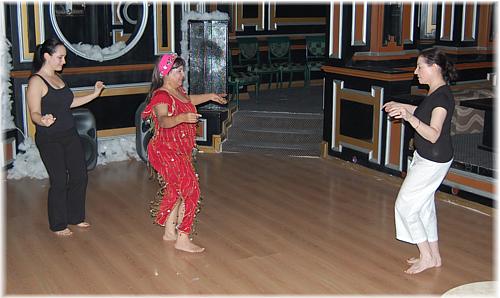
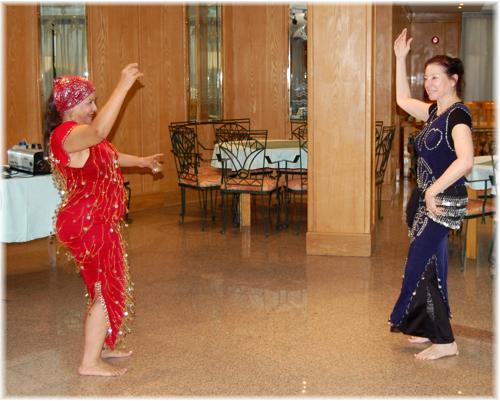
Fatima and Habiba dance with Khairiyya
Fatima Bassmah and Habiba follow along with Khairiyya

I was able, with Heba’s help, to ask Khairiyya about her situation and was totally surprised and delighted at her news.  She will, of course, be teaching at Ahlan Wa Sahlan 2009.  She is also available for lessons in Luxor.  She actually prefers working with tourists over Egyptians.  She said that in a small city it is difficult for her to perform. Khairiyya said that they are not allowed to dance in the street for weddings as they used to, but they did perform at a purification ceremony, or sub’u, for two children recently.  The staff of the hotel were very respectful, and a waiter even came to the room where we were dancing and asked to meet her.

The really fabulous news is that Khairiyya’s sister Raja has come out of retirement and is dancing again.

They were booked all last season, though. Raja currently has a pin in her knee and is recuperating from knee surgery. 

When asked about the Luxor dance climate she said that it has never been good in Luxor because everyone knows everyone else’s business.  Rais Murad, the bandleader, is Khairiyya’s cousin, and acts as her agent. He is the world famous rebabist, Metqal’s Qennawi’s brother.  When I talked with her about attitudes towards dance in Luxor, and Egypt in general, she feels that when the mind is opened through education this fosters acceptance of dance as an art form.  When asked, she said that younger members of the family will not go into the family entertainment business.  At present, all of her sisters are married and so are their children, so she can dance again without jeopardizing wedding plans for nieces and nephews. 

Khairiyya apparently keeps abreast of who is performing in Cairo, and had some interesting recommendations on nightclub entertainers.  Khairiyya’s picks: singer Sherifa Fadl at the Casino Leil, Lucy at the Parisiana and the rebaba player at the Casino Kasr al Nil.

The best part of my visit was that I got a chance to spend hours dancing with Khairiyya, and repetition is a great way to master a movement.  In spite of the many years I have been teaching workshops in Ghawazi technique, I still feel that it is important for me to back to the source.  I’ve found that even though I had the outline of a movement, I might not have developed the correct core and tone of the movement.  The steps are often much more subtle than I remembered and the changes are minute from one step to another.  We worked on Raqs al Sibs, which is performed to slower parts of the music and includes movements that literally melt into one another with gestures so subtle you might miss them.  We also did some Raks al Jihayni (stick dance) steps and, of course, Raks al Takht, the beginning element in a Ghawazi performance.

Heba is a delightful companion and was a wonderful addition because she enjoyed dancing with us.  It was a totally happy experience, like being in a time capsule, away from all conflicts.  Fatima also said that she had rarely felt as happy as she did dancing those afternoons away. 

I don’t have a lot to say about other dance in Luxor except I saw the worst folklore shows I’ve ever seen at the luxury hotels.  The shows at the Steigenberger Palace and Winter Palace were totally awful.  The dancers seemed so dispirited it appeared that they weren’t even trying to be pleasant.

Nibal Goulda and driver Sarwat
Nibal Gouda and driver Sarwat.

I did see a folkloric ballet in a theater and, although the dancers were well trained and beautiful, it was more theater dance and historical pageant than beledi.  It was a little like presenting the opera Aida as authentic Egyptian culture.  To be perfectly fair, the average tourist in Luxor on a group tour probably prefers this kind of spectacle.

I had an unexpected additional opportunity to see Khairiyya in March when my husband and I went to Esna for a trip up the Nile in a 19th Century restored dahabeyah (a sailboat) for our 30th Anniversary.  We stopped in Luxor to recover from jet lag and I contacted Nibal and Heba to see if I could visit Khaireyya.  She invited us to her house for coffee and I was able to give her some things that I had written about the family over the years, like the Habibi articles (I was unable to give them to her in January because the airline lost all of my luggage and it was not recovered until the day before I returned to the States).  We had a great time visiting, and Khaireyya shared some of her family photos with us that I hope to use in an upcoming work on the history of the Ghawazi.

Once again I am struck by the urgency of documenting the Mazin family history.  I think the Ghawazi have gotten a reprieve with the return of Raja and the persistence of Khairiyya, but make no mistake, no one else in the family is going to enter the traditional family business, so we all have a responsibility to preserve this dance form.

If You Go:

You will find that studying with Khairiyya is very reasonable ($35 for a one hour private lesson) and so was renting the room (about $35 for 2 hours in a hotel disco.)

Khairiyya’s cell: 002 0163797012

If you feel that you need more help, and/or want to hire a translator, contact Nibal Gouda and ask to hire Heba in Luxor.  Heba’s services were part of a package that included personal tours of the Valley of the Kings and other antiquities.  Nibal’s rates depend on the tour package selected. Hallmarks of her business include spotless vehicles, skilled drivers, and guides with excellent English skills.

Nibal Gouda:
Company: Egypt Guest
To call Nibal from the US: 002-0101649785
To call Nibal in Egypt: 0101649785
To reach Nibal on Facebook: search Nibal Abdel Aziz

E-mail:
nibal@egyptguest.com
info@egyptguest.com

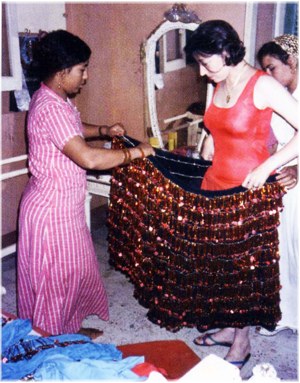
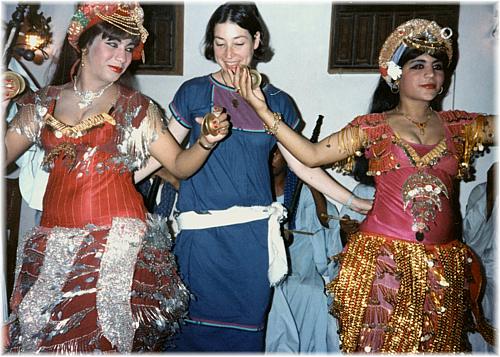
Trying on Ghawazi Costume
Faiza and Samia putting me in a costume at the home of Josef Mazin
Maazin
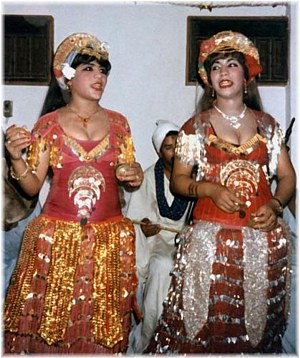
Fayza and Samia in 1985 dance with author
Maazin
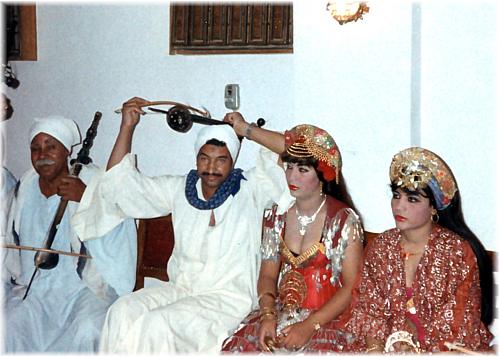
Fayza and Samia sit with the band 1985
Author dances with Khairiyya this year
Khairiyya and Habiba this year
Heba
Heba joins in
Khairiyya in street clothes
Khairiyya in her street dress

K in purple
Khairiyya in purple

Joseph Mazin, photo by Pepper
Josef Mazin
photo by Pepper Alexandria (more soon!)

Author in Costume

Have a comment? Use or comment section at the bottom of this page or Send
us a letter!

Check the "Letters to the Editor" for other possible viewpoints!

Ready for more?


Gilded Serpent presents...

At Home With

Fifi Abdou

Fifi Abdou

by Yasmina of Cairo
posted July 29, 2009

Yasmina of CairoAs befitting a living legend of Egypt, Fifi Abdous city home overlooks a six-lane highway crossing the river Nile. Perfect. For here in Cairo no one wants to be living in a quiet back street – where would be the fun in that? The view from the enormous living room window is like having a front row seat for a showing of ‘Cairo: The Movie!’, and here we are, sitting with one of its most enduring stars. Doing my fourth interview with Fifi in eight years has given me some insight into the progression of her life in the new millennium. The daughter who was just 12 when I first came to this apartment, busily doing her homework in the corner while we sat (as I recall) eating fish soup with rice is now an AUC (American University in Cairo) graduate, beautiful, highly educated and with the dress style and accent of a typical American teenager. It is she who acts as Fifi’s translator as we discuss her proposed trip to the United Kingdom, and it’s easy, seeing her, to remember Fifi’s own tall, slender shape at that age when, she once remarked, she chose dancing as an alternative to becoming a fashion model. Fifi herself, no longer svelte but looking very fit, is sportily dressed in a bright turquoise and white tracksuit, her black mane of hair glossy, her face glowing. Is the mane real? How old is she? Does it really matter?

This is my second recent visit to her apartment. Prior to this I bring her the contract for the International Bellydance Congress so she can peruse it at her leisure. In a deja-vu experience of that first interview, Fifi appears in a black galabaya and headscarf, face scrubbed clean of make-up, a non-descript baladi woman from anywhere – it’s her favourite disguise. Although she is unrecognizable, this time around she doesn’t fool me. But Ahmed Alaa, the young singer (and my nephew-by-marriage) who accompanies me, is completely dumbstruck and refuses to believe it’s Fifi until she opens her mouth and he hears the famous husky voice and its amused drawl. ‘So you’re a singer are you?’ she asks him – much more interested in a good-looking 20-year-old than in my questions – ‘so sing me something!’ He obliges and I sip my cold drink and run my eye over the apartment, which, she tells us later, has now mainly become a storage place for her vast wardrobe.

In 2001 she admitted to owning over 5,000 dresses – no wonder, by now, she’s had to buy yet another house.

‘The public always supposes that I’ve made so much money in my career,’ she says, ‘but the fact is I always re-invested back into my business; my costumes alone used to eat up much of my earnings. When I did start to make money I invested in property.’ And so she has. The palatial flat on the Maadi corniche is a just a short drive in a 4×4 from her out-of-town villa (de rigeur for the rich of Cairo these days) with a gigantic green garden and swimming pool in the leafy Sakaara valley.

She has also bought an even larger villa for her daughter, and gives me a virtual tour of it, complete with background music, on her ipod. If your image of Fifi is still set somewhere back in the 1980’s, coming down in that crane wearing Madame Abla, think again – she’s on Facebook!

It wasn’t long ago that Fifi declared the foreign dance scene irrelevant to her own life as a dancer, but since going to the United States twice to teach, her viewpoint has changed. Elaborating on her comments last time around, she once again expressed pleasure in foreigners’ appreciation of Egypt’s dance.

‘I am really proud that raqs sharki is so appreciated around the world – something that most Egyptians are not really aware of. In America, one of the things that especially pleased me was the inclusiveness of the dance scene there – in my classes I saw women of many different ages – and body types – enjoying dancing, and that made me happy. They want to learn this dance no matter what their background, age, or shape!’

She was also keen to point out that she has been an exporter of belly dance throughout her career, and indeed her home is full of awards presented to her over the years at international arts festivals, and by dignitaries of different countries – many of them within the Arab world. ‘I even danced for your Prince Phillip,’ she said, with a twinkle in her eye, ‘at the Mena House Hotel.’

Fifi dances with her bandThat twinkle is an intrinsic part of Fifi’s charm, which she can switch on like a dazzling chandelier at will. On a far-off stage it keeps her audience totally attuned to her; at close quarters it is almost hypnotic. There is something soft and kittenish in Fifi, but even as you are lulled by her apparent guilelessness, and the arch of those quizzical eyebrows, you sense the very real tiger that lives within – she is one powerful personality.

Here in Egypt, Fifi is now as much an acting star as a famous dancer.

She has made dozens of movies and TV series, often in the lead role, and gained respect as an actress – not always easy when you are coming from another field. This transition is similar in a way to one of her predecessors, Tahia Carioca, who had a terrific career playing matriarchal characters on screen for years after she hung up her costumes. (The connection between the two has lasted even after Tahia’s death, since Fifi took on the upbringing of Tahia’s adopted daughter when the girl was just three years old.) One of the proudest moments in Fifi’s life was a trip to Cannes Film Festival several years back where she took her place amongst the world’s elite actors in representing her country. It also, of course, appealed to her total love of glamour. I’ll never forget once whilst covering the Cairo Film Festival myself as a journalist, seeing the rush of the photographers when Fifi arrived outside in her limousine.

She may not have had the hit film of the festival that year, but she totally took the prize in the high glamour stakes, wearing floor length shocking pink and showing most of the other female stars how it should be done – this is a woman born for the red carpet!

In our last conversation Fifi had declared an interest in the idea of opening a school in Egypt for oriental dance, and I asked her whether she had taken any more steps towards this. Other dancers, including Dina, have already tried and failed because basically the dance is not officially recognized here as something one can go to school for or that the powers that be wish to be encouraged. Fifi addresses the topic: ‘If I want to do it, I can,’ she insists. ‘There is a problem in that there is no syndicate for oriental dancers, but I am a member of the actors’ syndicate and the dance can also come under the heading of folkloric dance. If the authorities object to calling it a school for oriental dance, then I can call it something else.’

Which is what usually happens; belly dance classes (usually folkloric based) can be found under the umbrella of ‘health clubs’ in Cairo. When I asked for her thoughts on the lack of recognition for the dance in Egypt that this indicates, she retorted:

‘I have been so busy with my own career I have not really been paying attention to the state of the dance here or the attitudes towards it. But one thing is sure: if oriental dance was not recognized and respected, I wouldn’t have got where I am today!’

Point taken. Perhaps Fifi’s recent and on-going experiences as a dance teacher may lead to real interest in making the school idea a reality, but my guess is that at present it’s a bit of a novelty for her and a change from her normal routine. She goes on to admit as much:

‘Teaching is not work for me – it’s a way to take time off from my normal hectic life and relax a little! I see it as a holiday.’ Compared to the grueling schedule of a Ramadan TV series shoot (which can be thirty episodes of an hour each, shot in a hurry because the director, crew and even the stars have a couple of other soaps to make for the same deadline), one can see her point. But what can students at the Congress actually expect from Fifi in her classes? Well, apart from the sheer thrill of being with her – and she really is a ‘people person’, using the warmth of her personality to connect – it will be a chance to see up close the mechanics of some of those unique moves we’ve all tried to emulate. Definitely a very different, and perhaps refreshing, approach to interpretation, feeling the subtleties of the music from the inside out with internal movements, rather than relying on the balletic and dramatic body flourishes we’ve come to expect from the ‘modern Cairo style’ crowd (including Randa Kamel).

Here is what one excited student has to say about what draws her to Fifi:

‘Watching her, it’s freeing to realize you can just get up there on stage and enjoy yourself; that it’s not about technique, but having the confidence and personality to do very little!’

That ‘very little’ may turn out to be harder than people think though. Deep muscle work, layering in the hips and learning mastery over weight changes in the feet are key to Fifi’s style. Then there are those shimmies: ‘from five feet away it’s a sight to behold’, was one comment by an awe-struck student after her last US workshop.

One thing is guaranteed though. Fifi is, above all things, an entertainer who knows how to work the crowd – and that includes a roomful of students. I for one can hardly wait!

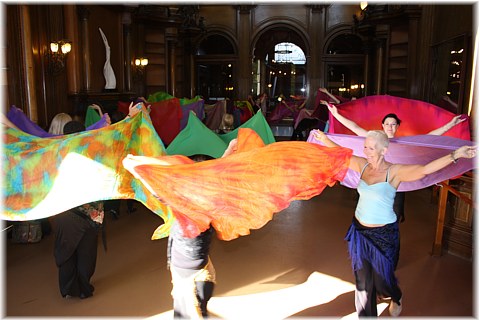
Veil class in 2008
Veil class from the International Bellydance Congress 2007 in Surrey, England.
Fifi Abdou will be teaching at this September’s event. Info: bellydancecongress.com


Have a comment? Use or comment section at the bottom of this page or Send us a letter!
Check the "Letters to the Editor" for other possible viewpoints!

Ready for more?


Gilded Serpent presents...

Carl Captures Character


Rakkasah Festival East 2008

Sunday Dancers M-Z

Photos by Carl Sermon

October 19, 2008,
Ukrainian Cultural Center, Somerset, New Jersey
posted July 7, 2009

Caption corrections for each dancer appreciated.
Friday photos, Saturday photos A-D, E-K, L-Z, Sunday photos A-L, M-Z-you are here!


Mariyah

Mariyah of New York, NY

Metal Godes

Metal Goddas of ?

Metal Goddas

Nesheli and Janim

Nesheli and Janim of Pittsburgh, PA

Nubian Daughters and Troupe Walid

Nubian Daughters and Troupe Wahad of New York, NY

Nubian Daughters

Nubian Daughters

Nubian Daughters

Nubian Daughters

Oasis Dream Dancers

Oasis Dream Dancers of Randolph,
NJ

Oreet

Oreet of San Francisco, CA

&Rakkasat El Hilwa

Rakkasat El Hilwa of Williamstown, NJ
click above photo for larger image

Rakkasat El Hilwa

Renya Alcala

Reyna Alcala’s Ensemble of New York, NY
click above photo for larger image

Rosalah

Rosalah of ?

Sahara Shimmere

Sahara Shimmer of Rochester, NY
click above photo for larger image

Sahara Shimmere

Sahari

Sahari of Groton, CT

Scherezad

Scherezad of Richmond, VA

6 Japanese Dancers

Six Dancers of Japan? [ed-help!], Click for larger image

Sonjirey

Sonjirey of Rahway, NJ

Sovreigh Rein

Sovreigh Reinl of West Warick, RI

Suzanna Del Vechio

Suzanna Del Vecchio of Denver, Co

Tananeen Meklena

Tananeen Meklena of Columbia,
MD?

The American Academy of Oriental Dance

The American Academy of Oriental Dance of Philadelphia, PA

The American Academy of Oriental Dance

The American Academy of Oriental Dance

Tribal Remix

Tribal Remix of Washington, DC

Troupe Tahya

Troupe Tahya of Bethlehem, PA, Click above photo for larger image

Willow
Willow of Honolulu, HI


Yasmine

Yasmine of Charlotte,
NC

Friday photos, Saturday photos A-D, E-K, L-Z, Sunday photos A-L, M-Z-you are here!


Support your photographers!

Have a comment? Use or comment section at the bottom of this page or Send us a letter!
Check the "Letters to the Editor" for other possible viewpoints!

Ready for more?


Gilded Serpent presents...

Dancing for Dowries:

Earning Power, Ethnology, and Happily Ever After

Coin Bra and Belt

by Andrea Deagon, Ph.D.

Part I: The Mythic History

If you spend any time online reading about belly dance (and if you’re reading this, you obviously do), you have probably encountered the “dancing for dowries” explanation of the coin-covered belly dance bra and belt.  Coin bras and belts, popular in belly dance costuming since the 1970’s, offer a mysterious, evocative alternative to the glittering beadwork that more obviously reflects mainstream glamour.  We have all seen the photographs from the 19th and early 20th centuries showing women – dancers – draped in coin jewelry, and obviously their jewelry inspired the use of coins in modern belly dance costuming.  So it’s natural to want to know the customs behind the fashion.  This article is about the ways we have constructed imaginative histories to explain this aspect of belly dance.  The ways we interpret wearing money – the juxtaposition of earning power, sex, adornment, and belly dance – say a lot about the way we see belly dance and ourselves.

Dancing for Dowries: The Mythos

The basic story is this:  We wear coin costumes because sometime in the past, young, marriageable women would dance for the coins that were thrown to them, which they would then sew onto their hip scarves, saving them for a dowry.  When a girl had earned enough, she could give up dancing and return home to a proper and happy marriage, after which she would no longer dance in public. 

The story has many manifestations.  On one of the older sites devoted to belly dance, bdancer.com, Me’ira offers this version of the story:

In classical Greece, a woman from a poor family tied a sash around her hips and went to dance for her dowry in the marketplace. Spectators threw small gold coins at her, money which she then sewed into her bodice and hip-belt as decoration, since she had no where else quite as safe to keep them.

Me’ira has written many effective and accurate commentaries on belly dance, but this is not one of them.  There is no evidence from ancient Greece of women dancing for their dowries.

All the same, this account has been repeated on any number of sites, incidentally without either attribution to the modern author or references to the primary sources (that is, sources from the original culture, here ancient Greece).  Another version of the story, repeated by a reporter in the mainstream press from an interview with the belly dance teacher Elena Griffin, shifts the emphasis to the Arab world and adds detail:

Young women would sew their dowry onto their clothes to let men know how much money they had … As they followed the caravans, men could hear the coins jingling from far away, they would know a woman of marriageable age was in the next caravan. They could see the girl’s dowry on her clothes and know whether he could afford to marry her.  (Meserve 2009)

Other variations shift the location to North Africa, and some specifically name the Ouled Nail tribe as the group practicing this “dancing for dowries,” a variation I will discuss later.

Mythic Histories

The “dancing for dowries” stories I quoted above are not supported by any evidence, which makes them “mythic histories,” or myths masquerading as historical accounts.  (I will sometimes also use the term “mythos” or “myth,” to describe them). 

Lacking evidence, why do we tell stories like this?  To fill a gap in our knowledge that is difficult to research?  Maybe.  But even when facts are thick on the ground, history can be told in many different ways, slanted to reflect one perspective or another, or to explain different things.  And history–based explanations of modern practices often have an element of fiction – or perhaps myth is a better word.  In fact, one of the purposes of all mythology, from ancient Greece to modern America, is to explain the present through reference to the heroic events of the past.

In our community, where so much knowledge is transmitted orally or on the Internet – and this applies especially to Internet “history” – there is no prerequisite that “histories” of belly dance contain any facts at all, and many belly dance histories are entirely fabricated.   

Well then, why has this particular story – “dancing for dowries” – persisted so long and in so many different forms?  A contributing factor is the misreading of the practices of the Ouled Nail, but there are other, more internal reasons for its popularity.

Mythic histories do not come into being unless they satisfy a deep need in a culture (or a sub-culture like ours).  When a mythic history is told and retold in a context like the belly dance community, you have to assume that there are strong underlying reasons for its popularity.  It must be satisfying some vision of the dance that dancers have, or satisfactorily answering internal questions about the meaning and value of our dance or ourselves as dancers. 

Sigmund Freud commented that “myths were public, collective dreams” (Scarborough 24) and whatever you think about his ideas on penis envy, he had a point about myth.  This means that just as dreams might reveal your underlying neuroses, mythic histories can be a chisel-point we can use to get to the heart of some underlying assumptions about our dance and ourselves –helpful or harmful – that do not always come out in our conscious minds. 

What underlying feelings, beliefs, anxieties, or hopes do our mythic histories reveal about our relationship to belly dance in the present world?  In this case, the “dancing for dowries” mythos contains a tangle of conflicting issues about independence, status, money, and the value of belly dance.

Let’s look at some elements of the story in turn.

“Dancing for Dowries” Unpacked

Why is the story set in ancient Greece?  Greece is a part of the “belly dance world” in the West, since Greek restaurants hire belly dancers, Greek tchiftetelli has many moves in common with social forms of belly dance, and so on.  At the same time, Greece has the reputation of being the founder of Western democracy, science, and philosophy – the key elements of civilization.  When belly dance is placed back in ancient Greece, the dance is somehow legitimized.  No [we can claim], this isn’t the dance of the harem slave – free women were doing it in Greece millennia ago! 

Putting the story into ancient Greece is a way of legitimizing our dance by associating it with the “classical” and “pure.”  Too bad there’s no evidence.  But another “too bad” is that we feel the need to look beyond the dance itself to find associations that give it legitimacy in the popular consciousness of the West.  In giving in to this desire, we may be undermining the real claims to legitimacy belly dance has in its own right.

Why is the dancer portrayed as a “poor girl”?  If we are mythologizing our dance, why not portray ancient belly dancers as aristocrats and queens whose coined necklaces reflect their wealth and status? But even if you stick to the “dancing for dowries” scenario, why insist on low status for the dancer?  Ordinary “middle class” women rather than the poor could also reasonably be portrayed as dancing for dowries. 

But poverty means you have a good reason to concede to outside necessities. The dancing girl couldn’t help dancing – she had to. 

The use of this poverty excuse reflects the ambivalent attitude the largely middle-class belly dancer has toward professional performance.  On the one hand, belly dance is art, and performance is the epitome of its expression.  On the other hand, everyone “knows” that belly dancers provide a sexy come-on an tease to their male audience members – don’t they?  Encountering this persistent expectation gives belly dancers in the West a defensive attitude.  The idea of “necessity through poverty” in the mythical dowry-dancers is a hedge against the blame that can accrue to the dancer for performing this sexy dance just because she wants to.  If she had to, it might not be so bad.  Economic necessity, by the way, was the reason given by many lower-echelon dancers in Cairo as to why they were dancing professionally in Karin van Nieuwkerk’s 1980’s interviews (van Nieuwkerk 1995).

poor little rich girlThere is another dimension to poverty, though, which anyone who has performed professionally has encountered.  The dancer may be middle class and well established in her comfortable home and day job with benefits, but when she takes a dance job, she suddenly becomes poor.  Desperately poor.  She will dance for ridiculously low sums of money, as if she needed the gig to put food on her table or buy her kids shoes.  She will accept money thrust into her costume whether she likes it or not, and take on the burdensome duty of trying to instruct her audience (smiling the whole time) as to where their dollars – and their fingers – can go. 

Belly dance is an expensive hobby, and most of the women dancing in public venues such as restaurants just plow their earnings back into their dance habits.  The money one earns from gigging is very welcome.  It may even justify the value of the hobby/profession to dubious family members.  But undercutting and other related economic practices reflect the kind of desperation that only poverty can explain – whether that poverty is monetary or another sort. 

Unfortunately, it is the desire to perform at any cost – or for any price – that aligns the modern belly dancer with the “poor girl” in the “dancing for dowries” scenario.  The acceptance of this artificial “poverty mentality” undermines professionalism in belly dance, and the “poor girl” of the “dancing for dowries” story reflects this unpleasant dynamic. 

Why do they throw her money?   There is a long tradition in the Middle East that persists into the present day, of tipping belly dancers by putting money on the body or (less commonly) in the costume.  Several 18th – 19th century travelers’ descriptions describe audience members tipping dancers by pressing small gold coins to their foreheads or elsewhere on their bodies.  This is not quite the same as throwing.  To be fair, the idea of throwing money to performers has a tradition in the West as well, though it is usually not really throwing but dropping coins (or bills) into a receptacle that either sits in plain sight or is passed around during or after the show. 

coinsPerhaps the coin-tossing is modeled on the generally enjoyable modern practice of customers showering bills on the dancer.  Of course, being pelted with coins would be less pleasant!  But a subtext of the coin-tossing scenario is – in the absence of waiters, helpful friends, or spouses – who picks up the coins from the dirt?  The dancing girl, of course.  That’s a little more solitary necessity than the average belly dancer wants, and it is diminishing to the dancer.  But it is implicit in the story.  Which brings us to the next question.

Why does she go alone to the market place?  The market place stands for an impersonal world where buying and selling is the order of the day.  In this mythic history, there is no real context for the dancer, except that she is unmarried.  Does she leave her father’s home every day to go to the market place?  Does she live on her own, away from home, while she earns her dowry?  Does she live with other dancers – or dance with them?  Any given town would presumably have a number of dancing poor girls, so did they dance together? Did each stake out a spot? 

The vagueness of the scenario allows us to read into this pseudo-historical account the “single life” that most adult women experience, for at least a few years, in the late 20th and early 21st centuries.  This dancer is a single girl!  She can overturn the standards of propriety that would apply to women that were either married or too young – she can dance professionally now, which would be frowned on at any other time in her life.  This ability to fly in the face of propriety, and to do it on one’s own and in the commercial, money-driven world, resonates with the freedom of living single away from home that has been a (usually exciting) facet of contemporary women’s lives. 

The dowry-earner’s temporary overthrowing of the bonds of propriety takes its context in part from the very modern experience of freedom our times allow us as single women. 

On the other hand, this alone-ness slides the story past two central issues in the belly dance world: both the sisterhood one ideally feels with one’s fellow dancers, and the bitchiness that can result from jealousy, competition for jobs and students, and so on – which surely puts it in the realm of fantasy!

Rich QueenWhy does she wear her coins? The mythic history comments that there is  no safer place to keep them than to wear them on her own person as jewelry.  This (for a change) is accurate to practices in several historical Middle Eastern cultures.  It also provides an interesting and inspiring model for modern women.  We are trained to display our beauty in a limited and conventional way.  Things like designer labels are subtle by comparison to a necklace or belt of clattering gold coins.  This kind of display of one’s own value – even if that value rests on patriarchal assessments of women’s worth – is inspiringly non-conformist in today’s day and age.  It fits in well with the experience of belly dancing as uninhibiting and as celebrating individual expression and beauty – at least, if you consider how wearing such adornment might make you stand out among your modern peers.  The metallically-adorned dancing girls were presumably conforming to the standards of their [fictitious] cultures.

Why is she dancing for her dowry?  That’s the crux of the matter.  The answer rests on the nature of the dowry.

Dowry is a complicated animal, and not all cultures treat it the same.  In ancient Greece, the homeland of this mythic history, a dowry was a sum of money, goods or land allotted to a woman by her father upon her marriage.  It was managed by her husband, but was meant to benefit and support her and her children, and if he divorced her for a reason other than adultery, he had to give her dowry back to her – or rather, to her male guardian.  So in ancient Greek terms, and to a lesser extent in the Western world for whom the values of ancient Greece have trickled down, “dancing for dowries” makes sense.

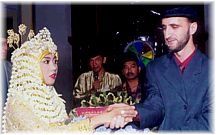
On the other hand, in the Arab world, it doesn’t.  Dowries in the Arab world (called mahr) are typically not given by the bride’s father to the bride (and by extension to her husband).  It goes the other way – the husband-to-be gives a sum of money to the father of his future bride.  The money is typically understood to be for her benefit and protection, and may go to things like purchasing a home, household goods, or clothing and jewelry for the new bride.  Like ancient Greek dowry, the Arabic mahr is meant to protect the bride financially, as well as in less tangible ways, since it establishes a solid bond of obligation between the husband and the bride’s family (see Barakat 1993: 110-111; Rashad et al. 2005).

In any case, the facts of Arabic dowry practice means that “dancing for dowries” does not make sense in the Arab world.  The girl’s family, let alone the girl herself, were not expected to provide her with her dowry – that was the job of the husband to be.  (So maybe he should be out dancing for it!) 

So the real question is, why is dancing for dowries, unlikely given Arab customs, so appealing to modern belly dancers as an explanation of not only the coin bra and belt, but the logistics behind women’s professional dancing?  mahr
One of the things about dowries that jumps out at the modern feminist is that they put a price on a woman – there is an element of “buying and selling” involved in negotiating a marriage that seems to reduce the woman to the value of the services and goods she is worth.  This (in scholarly circles) is sometimes described as “reifying” a woman (from the Latin res, “thing”), literally “making her into a thing” whose value can be measured in concrete terms.   

In the “dancing for dowries” story, the woman is in the interesting position of reifying herself: accepting and acquiescing to the idea of her material value, and doing her best to conform to the sort of value society has set for her.  Presumably the dancing brides know what the going rate is, since when they have it they stop. 

The idea of reifying women can, in our minds, easily blend into the more acceptable (to us) idea of offering service for money (which is what belly dancers do when they dance for pay).  But dancing for dowries is not only about the service-for-pay exchange that the dancer is doing to get her money, but also the “women as thing” reading that (in the Western world, anyway) the concept of dowry implies.

This reification shows up in variation that shows of men following the caravans, so that when “men could hear the coins jingling from far away, they would know a woman of marriageable age was in the next caravan. They could see the girl’s dowry on her clothes and know whether he could afford to marry her.”

The marriageable girl is clearly evaluated according to her monetary value, and marriage is portrayed as essentially an economic exchange.  But who exactly has the financial power?  Could a poor man go after a woman with lots of bling?  Or did her jingling dowry mark the woman off for only men of equal wealth?  Or maybe – in a reversal of patriarchal valuing of feminine beauty – for only the studliest?

Despite its socio-economic confusion, the image of the caravan with its jingling potential brides, and the excitement of the men as they hear their approach, manages to capture the excitement at the advent of the nightclub belly dancer, in the whirl of sound and rhythm that marks her entrance (and in anticipation of the bills that will bristle from her costume before the night is done).  The other elements of this story – who is active, who passive, who is financially in control, etc. – are muddled, as is perhaps appropriate for an art whose financial and sexual issues are so deeply contested.

Happily Ever After?

One common variations appears on several sites, for example:  “Most well respected women saved their payments until they had enough to buy a dowry, never to dance again after marriage” (Belly Dance Divas n.d.).  Women who dance for money are defined as “respected,” a position modern Western dancers want to claim, despite the poor reputation of belly dancers.  The dowry-dancers are also thrifty, a conventional Puritan value that is incorporated into the mythos.  This model of “dancing for dowries” uses the historical metaphor to affirm that belly dance, at least under certain circumstances, is a respectable thing to do.

But isn’t it interesting that the “happily ever after” of this story means “never to dance again”?  Belly dance is therefore defined as a temporary thing, something to be laid aside once its (economic) usefulness has passed.  This is directly counter to the mainstream discourse of belly dance, which emphasizes that belly dance never needs to be abandoned, and that it is always an appropriate pastime, that older women gain more emotional maturity and power to compensate for their loss of youthful energy, and so on. 

Women’s right to keep belly dancing, and the consciousness that sometimes a woman’s decision to continue dancing will cause dissent in her immediate family, are central issues in the belly dance world.  Stories of dancers forced by their husbands to give up their dancing constantly circulate, giving voice to the recreational belly dancer’s legitimate fear that outside forces may conspire to stop her.  Such stories emphasize the repression of women, and belly dance serves as both a symbol of a woman’s right to self-expression and a means by which she can claim that right.  

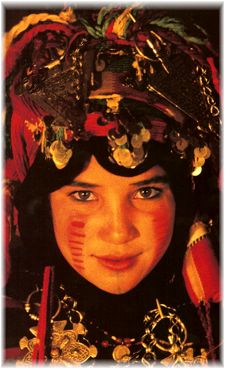
On the other hand, realistically speaking, most of the women who study belly dance do it for a while, learn and incorporate its lessons (to whatever extent), and then lay it aside.  The “never to dance again” of this mythos may reflect this reality.  Berber Girl
The mythos may also reflect the discomfort that exists on a deep level with many women in our world, that says that something as sensuous as belly dance is not appropriate for the old (or even the married), or that something as fulfilling and self-centered as belly dance is only appropriate – or perhaps only possible – in a life that is free of demanding husbands and children with multiple after-school activities.  Few recreational belly dancers are free of those things, ironically – so the idea of “belly dance abandoned” may have a bittersweet resonance for women who are obliged to put their own desires for dancing on the back burner, to attend to the needs – or selfish demands – of their families. 

The subtexts of the “dancing for dowries” mythos give us a lot to think about.  These same issues impact the ways in which we tell the story of the Nailiyat, professional dancers of Algeria whose practices probably inspired the idea of dancing for dowries in the first place, and whose coined jewelry probably did inspire the coined belly dance bra and belt.

Part II: The Nailiyat

Works Cited

Barakat, Halim.  1993.  The Arab World: Society, Culture, and State. Berkeley, CA: University of California Press.
Belly Dance Divas. n. d.  About Belly Dance.  http://www.bellydancedivas.co.za/AboutBellyDance.html. Accessed June 9 2009.
Deloncle, Pierre. 1927.  La Caravan Aux Eperons Verts.  Paris: Librarie Plon.
Dinet, Etienne, and Sliman Ben Ibrahim.  1926.  Khadra.  Paris: H. Piazza.
Fromentin, Eugene. 1857 [1981].  Un Eté dans le Sahara.  Ed. Anne-Marie Christin.  Paris:Le Sycomore.
Gautier, Théophile. 1865 [1978].  Loin de Paris.  Ed. G. Charpentier.  In Théophile Gautier, Ouvres Completes, vol. 9.  Geneva: Slatkine Reprints.
Herodotus.  n. d.  History. (Public domain.)
Hichens, Robert. 1904.  The Garden of Allah.  New York: Grosset and Dunlap.
Lazreg, Marnia. 1994.  The Eloquence of Silence: Algerian Women in Question.  New York: Routledge.
Me’ira.  n.d. The World’s Oldest Dance.  http://www.bdancer.com/history/BDhist1.html. Accessed June 14 2009.
Meserve, Casey. 2009.  Dancing For Themselves.  Kingston Reporter.  Feb 20.
Michelle.  n. d. Collecting Your Dowry.  http://www.farfesha.com/pages/dowery.html. Accessed June 1, 2009.
Morgan, Lawrence.  1956 [2001].  Flute of Sand. Bristol, UK: Cinnabar.
van Nieuwkerk, Karin.  1995.  A Trade Like Any Other.  Austin, Texas:University of Texas Press.
Rashad, Hoda, Magued Osman, and Farzaneh Roudi-Farhini.  2005.  Marriage in the Arab World.  Population Reference Bureau.  http://www.iiav.nl/epublications/2005/MarriageInArabWorld.pdf.
Accessed June 15, 2009.
Scarborough, Milton.  1994.  Myth and Modernity.  Albany, NY: State University of New York Press.

Have a comment? Use or comment section at the bottom of this page orSend us a letter!
Check the "Letters to the Editor" for other possible viewpoints!

Ready for more?


Gilded Serpent presents...

2 Balancing & Sword DVDs Reviewed

Sword DVDs

Bellydance and Balance: The Art of Sword and Shamadan by Princess Farhana DVD
& Sword and Tray Balancing for Bellydancers with Cory Zamora & Laura Sutherland

by Martha Duran
posted July 17, 2009

princess Farhana's Sword DVDBellydance and Balance: The Art of Sword and Shamadan by Princess Farhana DVD

Princess Farhana presents her DVD version of her instructional video, The Art of Sword and Shamadan, released more than 6 years ago.  Gilded Serpent reviewed the VHS format version, which appears to be the exact video but now on DVD.  The video provides clear instruction on a beginner level on dancing with the sword.

This DVD has comprehensive instruction on balancing for a beginner level bellydancer. Al though it is not suited for someone who is brand new to Bellydance, as it does not provide full instruction on dance technique. The DVD does include a warm-up stretch section, a selection of different dance steps that can be used, balancing props, and a useful section of tips and tricks on selecting your props.  Some of Princess Farhana’s experiences on performing with shamadans are shared by her in a relaxed setting. It’s like having a private class and sitting down for a one-on-one instruction in her living room. This 48 minute instructional DVD includes a quick run through routine that includes all the basic balancing postures.

This DVD includes excellent performances at the beginning and at the end. Princess Farhana opens with a entertaining sword performance and ends the DVD with one of the best performances I have ever seen on Shamadan.

It’s a shame that this DVD wasn’t a remastered version. A little editing here and there, sound improvement, and some additional performance footage of Princess Farhana would have made it worth buying again. It is one of the best instruction DVDs for performing with props out there.

Purchase information: Artist’s website

Zil Rating: 4 stars
rating-4 zils

Cory's Sword DVDSword and Tray Balancing for Bellydancers with Cory Zamora and Laura Sutherland

Several high quality performances are documented in this DVD, with some valuable instructional segments but with low quality editing, dubbing, and some poor focusing of the camera.  Almost every performance is recorded on a consumer level handy cam. The performances are held at a Renaissance faire with the main focus on the performers but sometimes the camera wonders off and focuses either on a person just watching or a distracting focus on a hand or cleavage. 

The instruction segments are filmed back in the studio in a very small space, which, by the way, is so cramped that when Laura Sutherland is performing a candle piece she almost burns the backdrop curtain.

 In spite of all the negatives of the amateur production, this DVD contains great live footage that could be revived with a little sound editing.  That and a little more organization in the technique and tips with separate chapter segments would make this DVD one of the best of its kind. Learning from Cory Zamora is like dancing besides her. She generously shares details of her dancing experiences including solutions to mistakes made.

Laura Sutherland also instructs candle dancing and sword balancing on this DVD.  She even shows some great tricks that add a little more than just plain and simple placing of the sword.  They cover 3 levels: isolated balancing, air movements and floor work.  Instructors in the “instructional archive of footage¨ describe every movement and the different ways certain body types execute them.  Very detailed information on how to purchase your trays and swords are given out by Cory & Laura frequently along the 60 minute DVD.

Balance points, transition movements, and popping movements are some of the great demonstrations given by these highly flexible and skilled floorwork performer bellydancers. Even with all the negatives in this DVD its content is high quality.

Purchase information: Artist’s website

Zil Rating: 1 star
rating- 1 zil

Have a comment? Use or comment section at the bottom of this page or Send us a letter!
Check the "Letters to the Editor" for other possible viewpoints!

Ready for more?

  • Bellydancing Fashionably
    Always remember that you’re representing a country’s culture!  Sometimes, less is more; sometimes, more is less.”
  • Its All in the Flavor! Bellydance in Mexico
    Those were tough times for us teachers. Students were very shy in the classroom but eager to learn; some of them even thought that Shakira had created Bellydance! They didn’t have much information about Oriental Dance, its origins, or different styles. Some aspiring dancers even sat through several classes just to check out what Bellydance was or if we teachers danced it as well as Shakira.
  • Training Aids or Trainer’s Ads? 3 Books Reviewed
    The E.D.A. Handbook for Middle Eastern Dance by David of Scandinavia, Tribal Vision by Paulette Rees-Denis, Belly Dance for the Versatile Dancer V. 1: Foundations by Zanbaka
  • Heartbeat of the Dance:Review of 4+ Drum Solo CDs Reviewed
    Sabla Tolo 1 & 2 by Hossam Ramzy, Drum Attack by Tony Chamoun, Pulse of the Sphinx by Henkesh Brothers
 

Gilded Serpent presents...

Little Istanbul in Japan

Japan

by Artemis Mourat
posted July 4, 2009

As I prepare for my fourth tour to teach and perform in Japan, I am always struck by the thriving interest in Turkish Oriental and Turkish Romany (Gypsy) dance that is there. Every year the demand expands exponentially so much so that I now call the island “Little Istanbul.” Belly dancing is enormously popular in Japan, the most popular areas are situated in Tokyo, Osaka and Nagoya.

For several years, belly dance has been rated as one of the top three favorite hobbies for women who are in their 20s and 30s in Tokyo.

The fitness benefits are foremost in the numerous media charged advertisements. But the other aspects of this dance that we know and love are what keep the students coming back. Japanese culture values conformity and conservatism and it requires courage for Japanese women to expand their personal repertoires by learning something as unusual as belly dance. I have seen how Japanese women find this art form to be liberating. Egyptian oriental dance has eclipsed the popularity of Turkish dance worldwide. This is true in Japan too but how can we explain the proportionately larger popularity of Turkish Oriental and Turkish Romany dance in Japan compared to other countries? I wonder if the passion and the freedom of this style of dance is what accounts for this? Turkish dance never disconnected from its Romany (Gypsy) roots. The students in Japan tell me the same thing – the music moves them, the passion inspires them and the freedom invigorates them. Turkish style was never balleticized as was Egyptian style. It had far less European influences than its Egyptian sister and it is improvised. The Turkish musical groups are usually smaller and this intimacy is more reminiscent of the Japanese music groups rather than the big orchestras that typically play for the Egyptian stars.

For thousands of years there has been cross pollinating between Asian cultures and Turkey. Anatolia is the land mass that houses the vast majority of modern day Turkey and it is nestled in a small part of the enormous area known as Central Asia. There are almost 50 countries within Central Asia and we cannot make assumptions about similarities between them. However, we can say that many Asian people have lived within the borders of the Ottoman Empire as well as in modern day Turkey. Turkey was also an important part of the 4000 mile Silk Road. More recently, in the 1990s, there was a large influx of Turkish people coming to Japan because of travel promotions and lenient visa agreements. Many of these Turkish people adapted quite well to life in Japan and some became permanent residents.

Dancers

It was not the Turkish immigrants who first brought the popularity of Turkish belly dance to Japan. I believe that it started with an excellent dancer named Mishaal who is an American woman now living in Tokyo.

Eva
Tayyar Akdeniz
Ahmet
Sema
Mishaal
Ozma
Tania
Kiki
Nourah
Sadia

She studied extensively in Turkey for years and began taking groups of Japanese students to Turkey with Eva Cernik’s wonderful yearly tours . Mishaal is a highly respected representative of Turkish style as well as other styles of Oriental dance, including her Egyptian, Tribal and her Sacred Earth Belly Dance. She moved to Japan in the early 1990s after an already successful performance career in the United States, Turkey, India and Thailand. She owns “Mishaal’s Devidasi Studio” and has sponsored many fine and famous artists from Egypt, the United States (including Eva who lived in Japan many years ago) and Turkey (including Tayyar Akdeniz, Ahmet Luleci and Sema Yildiz). She sponsored me too and will again next year. Mishaal has numerous friends and students who inherited her interest in Turkish dance and she continues to bring groups of students to Turkey to this day. I must mention another great contribution that she has made.

Mishaal has taught improvisational dance in Tokyo which is very different from the choreographed mindset which is often supported by Japanese culture.

There are other very wonderful dancers in Tokyo. Kiki now has an exciting new DVD out on Romany (Gypsy) inspired dance. Noura has gone to Turkey several times to study and perform. She now sometimes tours with the world famous Turkish Pop counterculture band BaBa Zula. Wakako Otake is another promising new dancer who thrives on Turkish style and embraces other styles as well. Ozma is another fine American dancer who lives in Tokyo and who came to Turkish dance via her belly dance connections in Japan .

Tania Luiz came to Turkey with Folk Tours along with 19 of her students years ago and her interest in Turkish style Oriental dance deepened. She continues to develop her love for Turkish dance by frequent return trips. This style of dance was a natural step for her since her Portuguese Romany roots found a place to shine through. She is now a superb Turkish style dancer and she lives and teaches in Osaka. Tania was recently featured in Gilded Serpent. She moved to Japan in 1995 after living in many countries in Europe and the Middle East. She teaches a staggering 22 belly dance classes a week in Osaka. Tania has had a huge impact on the Turkish dance scene in Japan. She too has become a big event promoter and has brought Arabic, American and also Turkish teachers to Japan. I should mention two other dancers who are or were in the Osaka area. Kumi is one of Tania’s students who studied in Turkey with Folk Tours and who is dancing Turkish style very well. She has since moved away from Osaka for work. Yukari is another artist who does very fine Turkish Romany style and is still in the Osaka area.

Musicians

There are some excellent Turkish musicians who live on the island and who promote Turkish music and culture daily.

Sefer Simsek (who is often called “Sefa”) is a Turkish musician and singer. He has played the saz since he was 5 years old. Simsek (pronounced “shim shek”) means “lightening” in Turkish and ironically this IS his real name, a nice example of how one’s name can influence one’s fate. Sefa is an Alevi from Tokat and he is now also playing the ud. He is a charming and gifted teacher, and performer who lives in Osaka. Abdurrahman Gulbeyaz (“Apo”) is a brilliant musician, folk dancer and professor from Turkey who lives in Osaka. He speaks many languages and he plays bendir and darbuka. Both of these men are married to Japanese women and now have established families there. They have formed a trio with Tania which is called “Kadife” (pronounced “ka di fe” which means “velvet” in Turkish). They have been promoting Turkish music since 1995 and have many students who share their love of the Turkish arts. There are also fine Japanese musicians who enjoy Turkish and world music. Mishaal’s significant other, Goro, is an extraordinary composer, musician and promoter of world music and Turkish arts. There is also a fine seven piece musical group that specializes in Turkish Romany as well as other styles of music called “Alladeen” in Tokyo.

Venues

Japan has lovely Turkish restaurants.  In Tokyo, the best known places are Harem (where Mishaal performs), Legend, Istanbul, Maramara and Anatolia. In Osaka, Istanbul Konak is the biggest and oldest Turkish restaurant and it is owned by Reza Alkoc. This is where Tania Luiz regularly dances. There is another nice Turkish restaurant in Osaka called Sakliev in Ashya-Gawa and the owner is Shener Konuk. These Turkish establishments have provided venues for the Turkish style dancers.

There are very popular belly dance publications in Japan too. One such magazine is “Belly Dance Japan” from Ikarus Publications, LTD. The force behind this magazine is the lovely Miyuki Obata and this quarterly magazine is sold at local newsstands. And now a first, this magazine is going to publish some information on Turkish dance, written by me in an upcoming issue. They are also listing a “hall of fame” for Turkish Romany teachers.

Another first, a well established Egyptian style dancer in Tokyo, is creating a new concept, an event that honors and compares and contrasts Turkish and Egyptian style dance. Sadia, an American woman of Lebanese descent, came from California to Japan 14 years ago. She continued her very successful performance career in Tokyo where she taught many Oriental dancers who now teach today. This fall she will bring Shareen El Safy and me to present both styles.  

In Turkey, Oriental dance is changing. Many of the professional dancers are using Arabic music and they are imitating a Pan-Arabic styling of Oriental dance. If this trend continues, it may be up to non-Turkish artists to continue the lineage of Turkish Oriental dance.

There are many fine dancers from America who are going to Turkey to study. This is true of others as well as an influx of women from Japan come to Turkey to learn from the source. Mishaal is American, Tania is from Portugal and Kiki, Nourah and Wakako are Japanese. They all live in Japan but go to Istanbul for their Turkish inspiration. They bring back true representations of this rich and varied culture to Japan and to other parts of the world. In turn, they inspire new students and artists to enjoy Turkish music, dance and culture. If it is up to outsiders to carry on the traditions of Turkish dance one day, the quality of the performers I have seen in Japan is an encouraging sign.

Note: I wish to thank Ozma for providing some of the background information for this article. I look forward to seeing her new article on the Middle Eastern dance scene in Japan in an upcoming English publication.

Be sure to check out the author’s bio

Have a comment? Use or comment section at the bottom of this page orSend us a letter!
Check the "Letters to the Editor" for other possible viewpoints!

Ready for more?

  • Tania Luiz A Romany Fusion Artist in Osaka
    At this time I think I was longing for a well-documented dance, old and structured. I was a little sad because I saw how people who were not properly trained but who just had a costume would teach Oriental dance. Plus the deep connections of Indian dance to the Divine were very interesting to me. At the end of it all, I realized that my body, my soul and my blood are meant to do Oriental.
  • Dancing with Legends: Interview of Freddie Elias Part 1: When Boston’s Golden Era Rocked to Music Orientalet
    They do not study the craft in a deep and meaningful way, and everybody’s in a hurry. They don’t get into it right. They don’t think! If you do not work hard, you cannot protect your craft.
  • Belly Dance in Japan Reaches New Heights of Popularity
    Japanese audiences are extremely receptive, supportive and interested in this form of entertainment.” Conservative elder Japanese may still disapprove of the sensual aspect of belly dance, but among the younger generation it is seen as cool and trendy.
  • Does Modern Media Kill the Organic Process?
    If they see "the same thing", instead of feeling a responsibility within themselves to try to see it in a new light/from a new perspective with a richer understanding with fresh eyes, they chalk it up to the performer failing them for not bringing them something "new and cutting edge".
  • Ask Yasmina #8: Socializing with Your Audience, Relaxing the Upper Body, Tattoos
    It may take a while but you and the owner need to train the audience to arrive on time if they want to see a performance. In the end, everyone will benefit.
  • 7-11-09 Certifications & Contests: Are They Meaningful?
    Its as if the contest win were a diploma, her ticket to teach! 
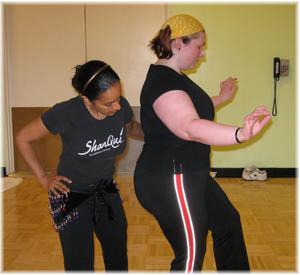
  • Ling Shien demonstrates the Accordion
    She came to the Gilded Serpent studio to tell us how she has modified a standard western made accordion to be able to play the quarter tones required in many of the Arabic modes.
 

Gilded Serpent presents...

Does Modern Media Kill the Organic Process?

Mona goes Tribal

by Sharon "Shay" Moore
posted July 16, 2009

I recently had a discussion with Read My Hips‘ director Stephanie Barto about the effect of the internet and on-demand media on the natural organic progression of art. I think performance art struggles in particular in the new millennium, victim of the "glazed over eyes after 60 seconds" and "that was so 5 minutes ago" attitudes, in a way that visual art does not.

With her permission, here is a snippet of what she shared (which is in part a discussion she was having with another dancer), and my thoughts in return:

Dancer A: "The internet has so much influence over the spread of tribal bellydance. I wonder if the internet just kills everything because it doesn’t let it grow naturally."

SB: "It’s also interesting how tribal bellydance in the days before social networking and YouTube was a much smaller world and did tend to evolve in more organic ways. (My troupe) is an example … I started with Carolenas foundation and the ways I changed it were all about making it more "me" and/or being inspired by the skills of the people I was working with. What I arrived at felt honest, even if it wasn’t anything shockingly innovative or spectacular in the big scheme of things."

A sculpture or a painting–even a piece of music or a video–is not expected to change, and is appreciated for its unchanging beauty. It is it’s solidity that is part of its appeal, in a way. We see the same piece over time and instead of expecting it to change or adapt to us, our perspective adapts and changes. We see it (hear it, experience it) from different angles, in different lights, in a different environment, our attitudes change, our perceptions change; we find that our appreciation deepens and becomes richer and more multi- faceted as we take the time to consider the piece from all these perspectives. The work to appreciate that art day-to-day is in our hands as the viewer.

Our art as performers exists in a finite amount of time and is never the same twice – no matter how we might strive for consistency, we are not carved of stone or molded metal. As a moving, living, breathing conduit of our art, we are always changing so our art is always changing. Unlike visual art, where once the piece is complete and the artist has put their stamp on it, with performance art most would agree it is up to the viewer to interpret and decide what the piece provides them in the way of entertainment or food for thought. And even more starkly in recent years, in Tribal Bellydance, the expectation to impress or entertain seems to fall squarely on the performers with the audience taking little to no responsibility for their part in the equation. Audiences expect us to deliver an emotional response to them like so much cheesy pizza, while they sit back and wait for it to fall in their laps. And if we don’t hand it to them as "promised", they find fault with us as performers. Add to that, when we take our art from one venue to another, somehow the expectation is that it should have changed and evolved significantly in the time between, however short.

If they see "the same thing", instead of feeling a responsibility within themselves to try to see it in a new light/from a new perspective with a richer understanding with fresh eyes, they chalk it up to the performer failing them for not bringing them something "new and cutting edge".

To be honest, this is part of why I love Tribal group improv. Because mot only does it demand a level of consistency and foundation, if you will, to be able to be strong and cohesive, it also embraces and is bolstered by organic change from show to show. Group improvisation is something different every time, which keeps it fresh for both the dancers and their audiences. The different nuances that you might see while watching each show could include: the different dancers from show-to-show, their chemistry and how they interact, how they use their space, how they interpret the music (even if it’s the same music, it’s interpreted differently each time). But now you hear comments from audiences like "They’re using the same moves as last time…where are the new moves?" or "They always dance to this music. Boring…"

Rather than looking to see what is new, what new levels there are to appreciate, they are expecting fast food delivery of all-new material, or else they withdraw their interest.

At their homes, these audience members can change the channel, where there options are to watch a television show, which they recognize as unchanging once it is secured on video, like sculpture; or a reality show, which is constantly changing because of the human element, and is all of-the-moment shock- and-awe. But at a performance venue, they check out and sometimes dismiss the performance or performers wholesale. I have seen this phenomenon increase exponentially each year I have been going to Tribal Fest. People won’t even show up to watch if they don’t think they are going to see something brand new. That is, with a few notable exceptions, with pioneers like FatChance and Hahbi Ru, who keep rocking their "classics", much like fans show up in droves for Kiss concerts even though they are wearing the same costumes and doing the same music as they did 30 years ago. These artists were the first and they are authentic to who they are and what they have created, and that in itself is remarkable in its timelessness. People respond to that in the long-term, not just the flash-in-the-pan fad following that schtick-users garners. But I digress…

Basically, no wonder performers these days are so hungrily seeking the next new fad to lead the pack with. The message being sent by bellydance audiences is that if it isn’t the newest, nuttiest, oddest, strangest, sexiest, most different thing on that stage, then it won’t be worth trying to focus their narrow field of attention.

But what will last? Being true to ourselves.

Frankly, I have found the best way to achieve that is to not create my art specifically for other bellydancers. This is where the whole inbred Tribal copy-of-a-copy starts and ends.

If all I am thinking about is how to impress the audiences at the next Big Festival, I am not looking inward for my inspiration, but outward. And if we’re all looking to the same people and places for that inspiration and validation, what we create will all look and feel very much the same. I saw myself going down this road a few years ago and made a conscious choice to remove myself from that endless loop for a while. I have been much happier and what we have been creating has never felt more right. Keeping my focus on audiences who have maybe never seen bellydance before or on dancers who approach performance art the same way they approach visual art, taking responsibility for viewing the art from all angles and seeing the nuance and detail that goes into a strong performance – people who will be uplifted and empowered by our joyful energies – has kept my motivation strong and my creative focus clear.

Keeping my mind and heart on my troupe sisters and what we want to say with our collective voice, is a surefire way to keep my own creative well overflowing for a long time. It ensures that what we create together will be authentic to us.

We slowed down a lot, re-focused our energies; and maybe we aren’t creating new material as quickly as we were or anything incredibly cutting-edge or monumental, but we are doing it all more thoughtfully and hopefully nurturing our own repertoire such that it will last us into the future. The pioneers I mentioned before, like Carolena and John, and many others who have followed since, gained their success through simply doing what they do. There weren’t a lot of bellydance specific festivals, online discussion groups, YouTube and the like, so they weren’t creating their art in a fish bowl. They worked small, locally, intimately, and slowly. They weren’t afraid to experiment because the world wasn’t watching and putting on the pressure to succeed at every turn.

Dancers could take more risks, and if it didn’t work out, live to dance another day.

This is what I aspire to have the courage to do, even under the microscope of today’s social media…

Sharon in duet with?
Sharon Moore and Genevieve DuPuy perform at Capitol Club


Have a comment? Use or comment section at the bottom of this page orSend us a letter!
Check the "Letters to the Editor" for other possible viewpoints!

Ready for more?


Gilded Serpent presents...

Ask Yasmina #8

bar

Socializing with Audience, Relaxing Upper Body, Tattoos

by Yasmina Ramzy
posted July 15, 2009

Question #1, Socializing with Your Audience:
I was reading your "Ask Yasmina" column on the Gilded Serpent website and you mentioned never socializing with audience members. I recently got a job dancing at a new Arabic cafe and it’s quite small. There are no back rooms for me to hide in. The owner has requested that I stay from 10pm till 2am every Friday and Saturday. I have made good friends with some of the audience members and newcomers often request that the Bellydancer sit and talk with them about what it is I do. I always make sure I am covered up and act professional. Also, I believe strongly in keeping my act magical and it’s hard when I have to stay in the cafe for so long on display. Sometimes people arrive at 2am expecting to see me dance. I’m afraid that if I continue to do this every weekend I may loose my magic. Any advice you have would be greatly appreciated.

Answer: I agree with you in your fear of losing your magic by hanging around and discussing your personal life with the audience. The owner most likely wants you there for four hours so he/she can accommodate the varied schedules of the customers. To be at the beck and call for four hours really diminishes the importance of your role as an artist and the art form itself.

It may take a while but you and the owner need to train the audience to arrive on time if they want to see a performance. In the end, everyone will benefit.

The club will be lively and full at show time which leaves a good impression and you will be inspired to perform better. If there are two set show times, then it is best to hire two dancers. If only one, that dancer should have a designated table for owners and staff where she can relax, or she can hide in an office, the kitchen or leave and get a coffee next door. Either way, the owner will be paying for two shows which should still be cheaper than four hours of on-call labour. With a set schedule, you are now free to take other gigs in between or after.

Training your audience to respect you and your art form may sometimes initially be met with resistance, but eventually everyone wins. I have run an Arab night club for over four years that features eight musicians and a dance artist who performs twice in the evening; once Raqs Sharqi and the second show is Folklore. These are at set times. There is a table designated for her and other visiting artists. Before she is introduced to the stage, the audience gets a lecture or list of rules on how to conduct themselves during the performance.

Such as: During the performance all audience members must:

  1. Stay seated
  2. Not dance with the dance artist unless invited by the artist
  3. Not talk or make noise unless it is in direct appreciation of the performance
  4. No serving staff may serve during this time

At first , many audience members thought this was a joke but now the regular patrons take it upon themselves to admonish newcomers who do not abide by the rules.

These patrons are now proud to be part of a respected event. Needless to say, Layali Arabesque is packed every week and is the most successful Arab night club in our city of Toronto, Canada.

Question #2, Relaxing Your Upper Body:
I am very new to Bellydance and would like your advice. I have a problem with letting my upper body relax and flow. What do I need to try to make it easier?

Answer: It is very difficult to help someone with a technique issue that it is not in front of me in person or at least on video. Each student’s issues are unique and there are a huge number of possible issues you could be concerned with. One common problem is holding tension in the shoulders. Letting go of this is like saying ”don’t think about pink elephants”. However, being conscious of this and making efforts to relax is a start.

Many people make the mistake of trying to move the chest with the chest or the upper back muscles. Try relaxing EVERYTHING from your ribs and up (including the shoulders of course) and move the ribcage only with your stomach muscles. Let your chest and ribcage just rest, float and enjoy the ride that the stomach muscles are creating.

Many women have psychological issues preventing them from performing a free flowing chest shimmie. Dina once told me that a chest shimmie is not correct unless it can be done with your arms above your head. In other words, the movement comes from below, not from the shoulders. It seems that if we take the focus off the breasts and put it on a ruffled blouse or bra with fringe, it can get easier. Try sitting upright and cross-legged on the floor or in a sturdy a chair. Now practice your chest and ribcage movements. You will find it easier in this position. Try to remember how this feels and then translate it to a standing position and eventually while walking.

covering a tattooQuestion #3, Tattoos:
I’d like to “Ask Yasmina” about working professionally as a Bellydancerwith a tattoo(s)…is it a liability?

Answer: Our company just completed a performance for 800 high-rollers at a large and prominent Casino last week. The management sent a special make-up team to our dressing room before the performance to cover all tattoos. This was the rule of the Casino for all performances.

When I produce our own theatrical and artistic performances, I allow tattoos (and enjoy the display of diversity) as long as they are not so large that it is a distraction to the uniformity of the costuming aesthetic. For these productions, our audience is diverse and can usually appreciate the beauty of a tattoo.

For the Middle Eastern audience, this is not always so….so far. It really depends on which generation you are dealing with. There are still some who associate tattoos with Bedouin culture and thus consider a tattoo to be uncivilized, uncultured and uneducated and even use the term “dirty”. This is in the same category as visible body hair (Arab women are often waxed or sugared – halewa – for every inch of their body including the entire arm). Obviously, living in Europe or the Americas will change their attitude after a while but the residue of this thinking is still there.


Have a comment? Use or comment section at the bottom of this page orSend us a letter!
Check the "Letters to the Editor" for other possible viewpoints!

Ready for more?

  • Ask Yasmina #7: Milaya, Tipping, Gossip
    Ask yourself "why?’ over and over again, digging deeper for the truth, until you arrive at that moment when the beauty of Bellydance had you completely inspired and elated, that moment when you wanted the whole world to experience the same joy.
  • Ask Yasmina #6 : Abhinaya, Personal Journey, What’s Missing?
     Tapping into the source will change the quality of your movement, your interpretation of the music and your emotional connection to the movement and the music.
  • My First Mid East Gig
    Once we landed in Amman, we were greeted on the tarmac by solid lines of soldiers on both sides leading to the doorway of the airport, machine guns pointed towards the passengers. I don’t recall ever seeing even one Canadian soldier in the flesh and blood, let alone a gun, let alone so many big guns and pointed at me. I don’t think I blinked during that endless walk. We were clearly not in Hawaii.
  • Saturday Gala Peformance Part 2 of the International Bellydance Conference of Canada
    Performers in Act 2 : Aisha Ali of Southern California, Bozenka of Florida, Amy Sigil & Kari Vanderzwaag of Unmata from Sacramento, California, Tito Seif of Egypt, Aida Nour of Egypt
  • Certifications & Contests: Are They Meaningful?
    Its as if the contest win were a diploma, her ticket to teach! 
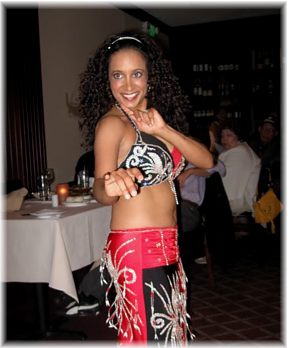
  • Ling Shien demonstrates the Accordion
    She came to the Gilded Serpent studio to tell us how she has modified a standard western made accordion to be able to play the quarter tones required in many of the Arabic modes.
  • Carl Captures Character: Rakkasah Festival East Photos A-L
    Alhena, Alia, Avivah, Basema, Calixta, Dena, Desert Moon…
  • My Performance Career
    I worked a variety of jobs, singing in nightclubs and bartending, before developing my next marketable act. Since I was a formally trained ballet dancer, I combined Pointe with Exotic dance. Mind you: this was not stripping—but a beautiful and suggestive dance set to piano music.
  • Gig Bag Check with Pepper Alexandria
  • Faruk Sarsa ; The Life of an Artist of Mohamed Ali Street
    The best drums and riqs, however, were inlaid with mother of pearl and had fish skin heads. The best store selling these instruments was Music Center. It was owned by Mohamed Sarsa who had the fish skin monopoly and the best instruments of this kind.
  • Dyslexia and Dance: Its More Common than you think!
    If you are a dance student or teacher, chances are that around 20% of the class could be dyslexic. As a dance teacher, it is quite important to be able to identify dyslexic tendencies in students, and understand how you can help them learn.