Gilded Serpent presents...

Belly Dance from Cairo to Los Angeles

hiroglyf

Personal Commentary on the Bellydance Superstars

by Roza Shahrazad
posted September 9, 2009

Egyptian and American Belly Dance: how different can they be? I lean back into my plush red velvet chair and begin to count the ways. Armed with my research, experience, numerous trips to Egypt to study dance and an Egyptian in the seat next to me, I prepare to enjoy and evaluate the American phenomenon known as The Belly Dance Superstars, in comparison to superstars on the international level, hailing from Egypt, such as Dina,Randa, and Tito.

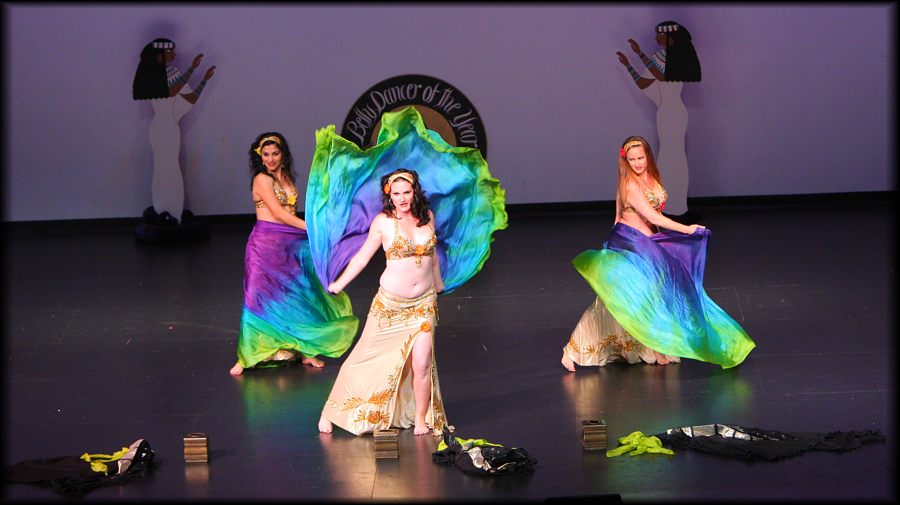
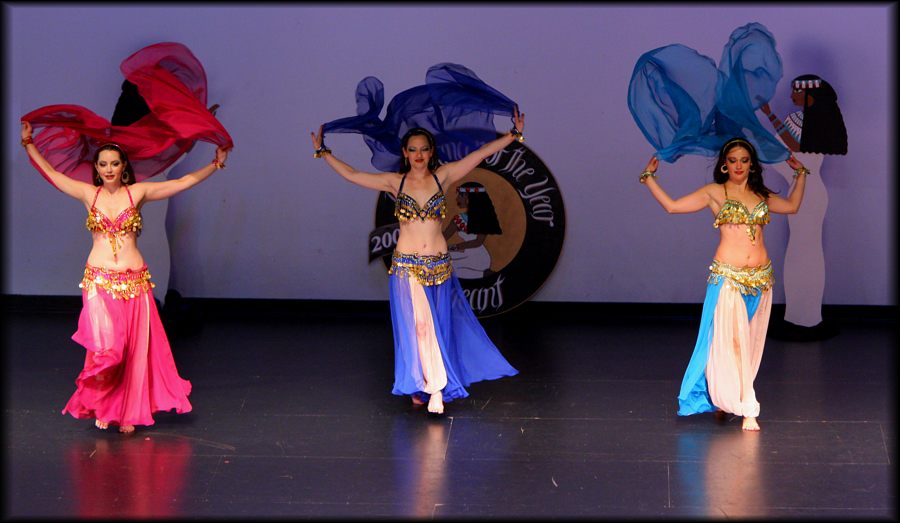
The lights dim and the curtains open, catapulting us into what is clearly a backdrop modeled on a pharonic amphitheater—cool! Luxuriously layered shades of rich bold colors are projected like a film on the stage backdrop. They oscillate and metamorphose into a number of intriguing designs, curiously, in harmony with the apparent pharonic theme.

I remember the saying "Cairo is the Hollywood of Bellydance" is for a reason, and I think the ancient Egyptian theme takes us back to where the roots are deepest.

Even The Cairo Museum contains a multitude of representations of this ancient dance, from funerary to temple, dancers on the Nile boats, and rites of passage, and other rituals are testament to how deeply this dance is entrenched in the Egyptian Culture. It existed there prominently for thousands of years before the advent of Islam, and the current paradox that exists today is a result of this coming together of two distinct cultures and the importance of religion in the region.

The BellyDance Superstars added many elements unknown in Bellydance to their performance: back handsprings and flips by gymnasts, American Tribal dancers, and ballerinas, which introduced aspects of Indian, African, and European dance. It added an element of impressive and exciting entertainment to attract an audience in the West. However, it did not impress the Egyptian in the seat next to me; in fact, it insulted his sensibilities!

By the time Middle Eastern dance reaches North America, a very small amount of it remains, like the game telephone, meaning is lost in passage, which means a limited creativity within a limited genre.

While in Cairo, I was advised that all Bellydance evolved—most recently—from Folk dancing. Each Folk dance class was extremely illuminating of the style, steps, interpretation of songs and their region, and in the case of Sufism and other types of dance, even spirituality, energy control, and distribution. It is interesting when the Egyptian dance teachers, like Dr. Mo Gedawwi, show us exactly how the move looks in Folk dancing and how it looks when used in the Oriental style (what, unfortunately, Americans call the “Cabaretstyle”).

In some countries, (notably, Brazil, Argentina, or Russia), the dancers do learn a great deal more folkdance and musical theory, and therefore, have a richer repertoire of moves and a deeper understanding of the dance. In my opinion, in North America (the United States in particular), a great interest in, or respect for, the ways of native cultures has never been a priority. However, Capitalism demands that money is a priority. Ironically, in order for art to continue to exist, money matters.

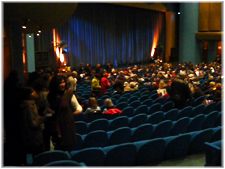
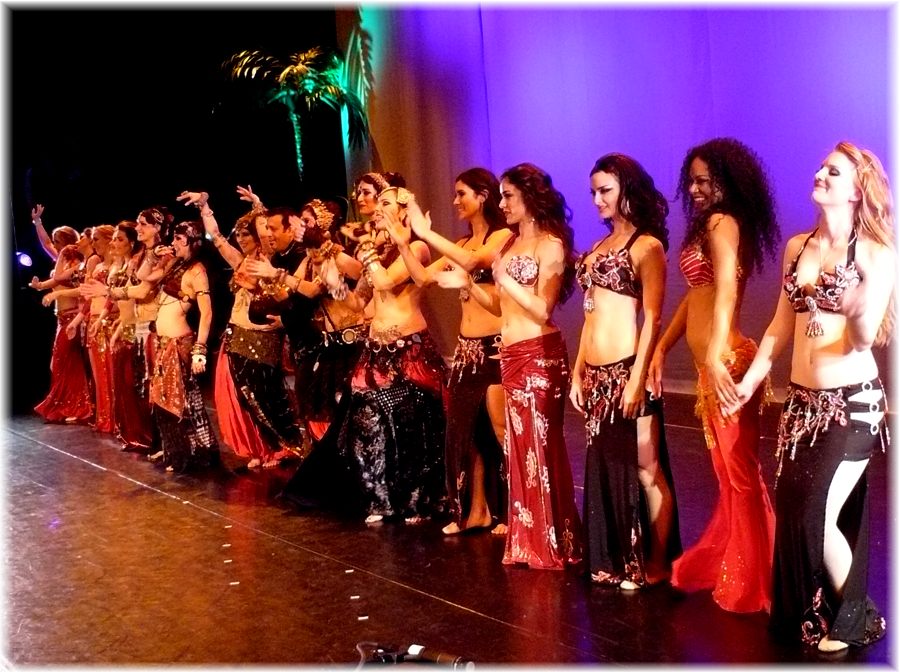
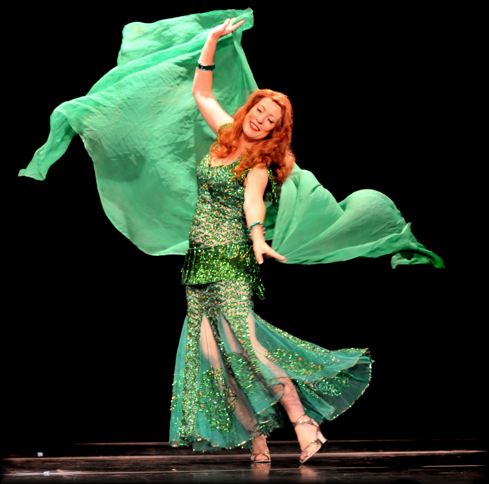
Marin Civic AuditoriumMoney enabled the costuming and grooming to be exquisite for both the top Egyptian and American dancers. Spectators dressed well to attend this show. In Egypt too, Arabic people come from all over the region to see performers and can do so in an elegant five star restaurant, a cruise ship, or a “cabaret,” which is inelegant. Egypt is the media center, known for its movies and political center throughout the Middle East. Dancers are part of that media milieu. A top Egyptian Dancer can command $15,000 dollars (plus airfare and hotel), for herself and her orchestra, which could be twenty or more people. In Phoenix, Arizona, a dancer with a CD makes $25-$100 dollars plus tips to dance in a restaurant. Dancing at parties or weddings will bring significantly more, but clearly, the way in which Egyptian performers are treated, good, bad, and ugly, is deeply rooted in their culture and not truly comparable to other regions.

Treating Bellydance with respect, in a classical theater with a polite, audience in attendance was welcome to me. However, I do enjoy seeing Bellydance in an Arabic restaurant setting because of the intense debates that can follow a performance as well as the interaction and emotion displayed by members of the audience as well as the dancers.

The narration at the beginning of the show confronted the hard questions in a correct and straightforward manner and asserted that the time had arrived in which Bellydance has earned the respect it deserves.

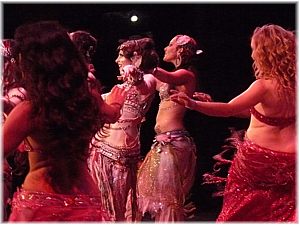
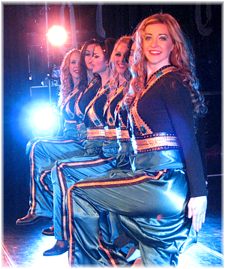
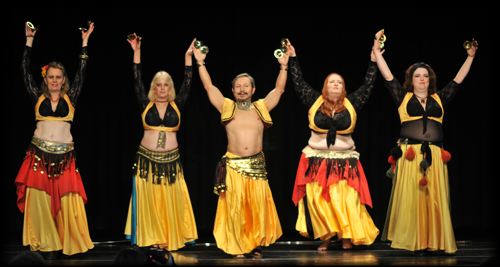
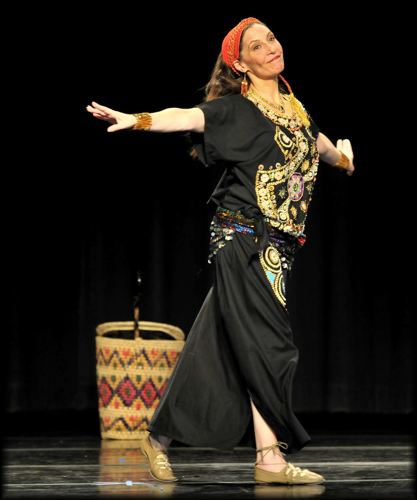
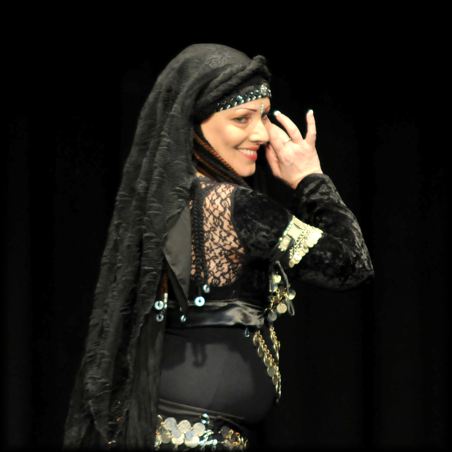
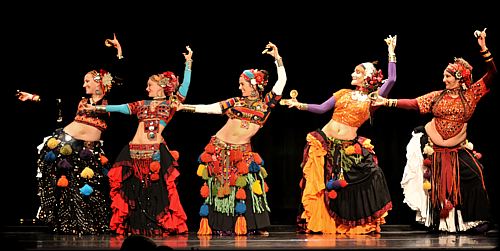
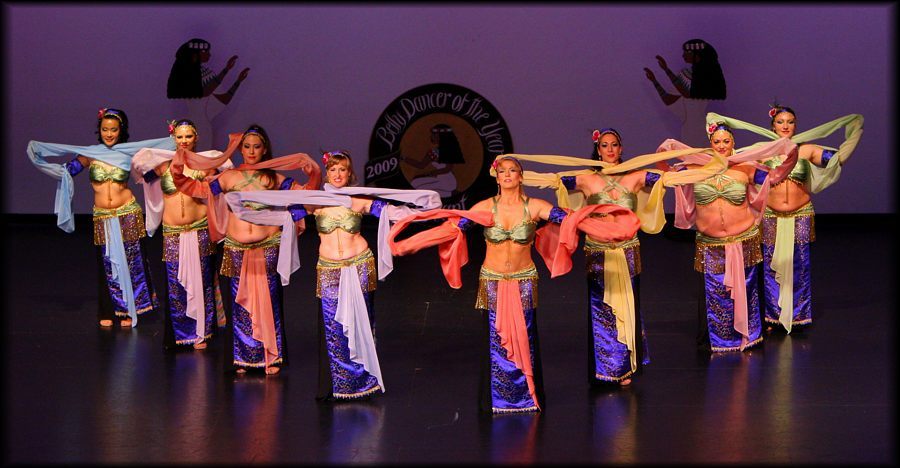
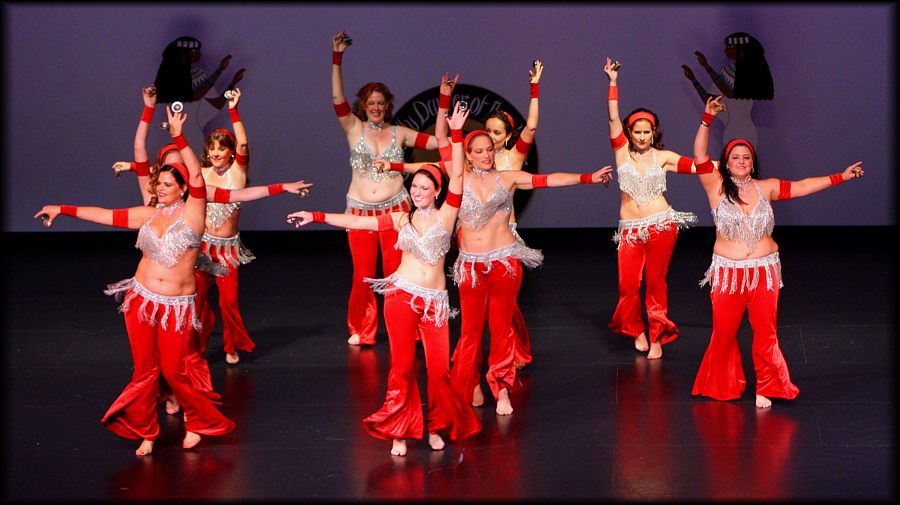
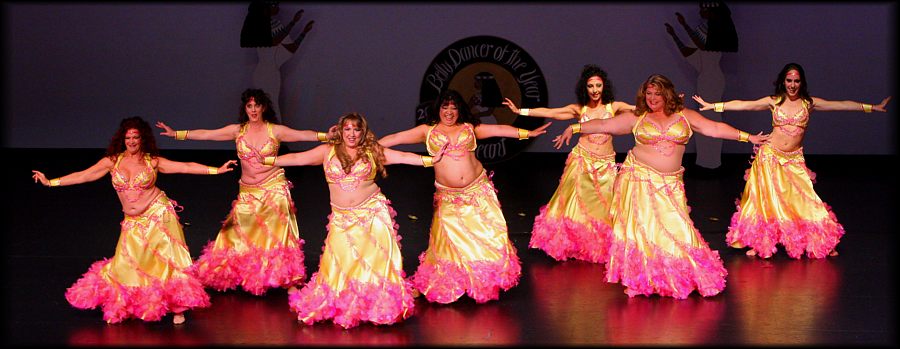
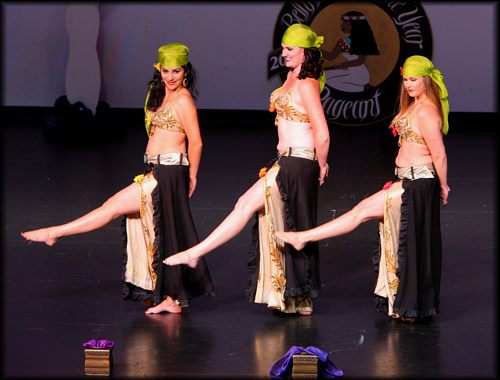
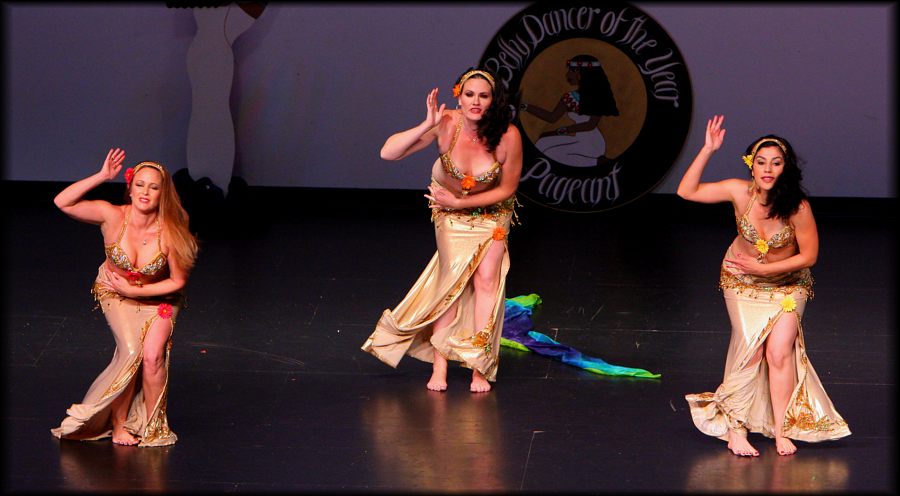
Tribal and Cab dance togetherThe choreography was very professional and sumptuously presented with a full cast, emphasizing a sense of sisterhood between the cabaret and tribal dancers. I was pleasantly surprised that all dances in the show were correct for the genre of music, i.e., Shaabi was danced in the Shaabia style, clearly, and Classical music with Classical dance, Hip-hop with American Tribal, and Bellydance, dabka with Lebanese music, etc. Too often, in America, I see beautiful Egyptian moves performed with a Turkish song or Pop/classical danced to Shaabi. I noted that the American Bellydance style was performed to any range and scope of music, thereby negating the music/dance connection. So, I concluded that The Belly Dance Superstars were aware, professional, and great fun.

Since Arabic Music is built on a natural scale, while European music is on a tempered scale, and media has allowed the West to assert its preference world wide, it is difficult to present natural Arabic music to a western audience, as they tend to find Arabic music unattractive and dissonant. The Belly Dance Superstars produce the music in a hyped-up, westernized version in order to appeal to a larger audience.

While Arabic music is hard for westerners to understand, it is equally (or more) true that “American Tribal dancing” doesn’t translate as “Bellydancing” to Middle Easterners. It is the antithesis of what Bellydance represents in Middle Eastern culture. Since the dance represents a woman’s beauty, joy, and social cohesion, in its native environs, and tattoos and piercing are considered both unattractive and “haram” (forbidden or sinful), it is easy to recognize the culture shock that ensues, based on appearance alone.

To be honest, the Egyptian in the seat next to me hissed, “I hope you don’t think this is Bellydance!” more than once. Finally, he confronted his difficulties by closing his eyes and feigning sleep while the American Tribal dancers performed.

Bellydance, especially in Egypt, could be called a cultural objective and could also be compared to a football game in the U.S., in that the game is only part of the picture. Society has created a string of events corresponding to football games such as: selling t-shirts, placing bets, and as well as having barbecues and get-togethers, there are team rivalries and debates.

In Egypt, this dance was born to tie communities together. The dancer communicates and interacts with her audience. It is the only dance that was conceived as an interactive dance, in which she expresses the words and emotions of the music or song with her hand gestures, facial expressions, and movements.

It was not meant to be simply a performance to watch. The movements all have meanings, which express the music and words of the song. It recreates personal and patriotic dramas through which people have lived—together—as a society. This aspect cannot be over-emphasized!

DebkeIn sociology, sociologists refer to Egypt as a “collective society." On the other hand, the U.S. is an “individualistic society.” Going back to the cultural objective, and keeping in mind that Egypt is a collective society, it makes sense that Egyptians and most Middle Easterners might want to participate in a dancer’s performance. They may want to get up and dance too; they will want to critique and debate. In Egypt especially, most dancers (and their good and bad qualities) are known and debated passionately. In Egyptian markets and stores Bellydance costumes are often in evidence, like t-shirts in the U.S. They have a large industry, luring the foreigner to come and learn their authentic version of this ancient art that has been passed down from pharonic and deity worshipping rituals, to Folk dance, to the performance art that it has become today.

With this in view, it is easy to see that when Tribal dancing starts with its slow, sustained poses, showcasing the dancers moves vs. movements that communicate meaning and express the music, it creates a serious sense of “disconnect” for an Arabic audience. In addition, there is little connection to the rhythms, which would, ordinarily, dictate whether the dancer should be traveling or stationary, etc.

Despite the loss of many original elements, some very important and impressive elements remain: the spinning taken from proper Sufism style was present throughout, as were tastefully added nods to moves and choreography created by Egyptian masters such as the Mahmoud Reda Troupe or Dina. They were never copied, but added sparingly, as a spice, impressing me with the level of knowledge obtained by the choreographer especially.

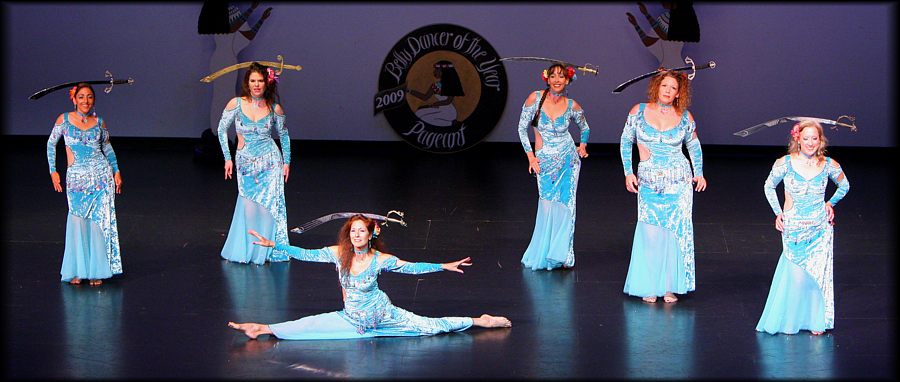
Sonia‘s drum solo was stunning! My hat is off to her. Although she was accomplished before, she is even better now! Issam was brilliant and charming, as always, and truly uplifting; in fact, he was positive and gracious. Zoë managed to infuse an incredible persona into her drum solo. Ending the show with the traditional ending song, “Layla, Layla, Layla,” was another brilliant and ingenious statement by the choreographer.

While it was true that some of the more experienced dancers weren’t present, and it was clear some of the dancers had more practice than others, I thought the show was a grand success all in all. To some degree, I felt it achieved what Um Kalthum did when she collaborated with the innovative Mohamed Ab El Wahab: her classicism and his freshness paid off in terms of some of her greatest work such as "Inta Omri." In like fashion, I have hope that more shows like this one will pay off for all of us who wish Bellydance to become the respected art I believe it can be.

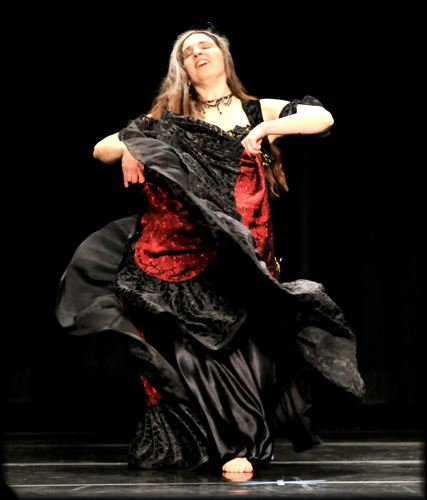
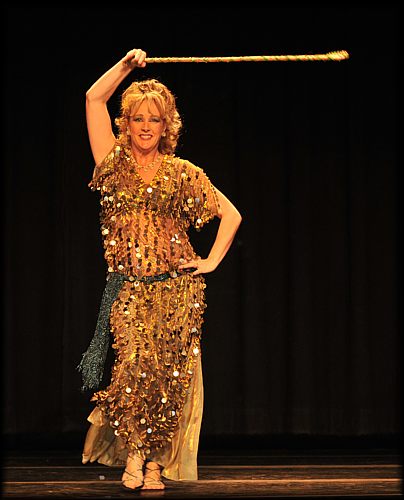
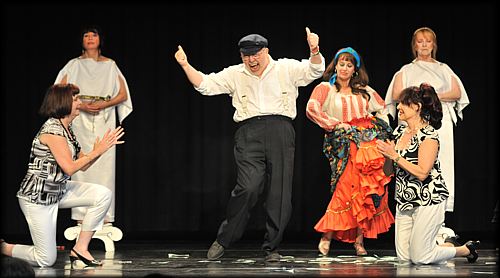
Click photo for enlargement


Have a comment? Use or comment section at the bottom of this page or Send us a letter!
Check the "Letters to the Editor" for other possible viewpoints!

Ready for more?


Gilded Serpent presents...

Ask Yasmina #9

Dina learns from Samia

Teaching Differences, Men in Bellydance, New Troupes

by Yasmina Ramzy
posted September 8, 2009

Question #1, Technique Discrepancies
I recently attended your workshop when you visited our city and found that your explanation of some of the technique was very different and, in some cases, the opposite instruction I have formerly learned. These discrepancies happen quite often between many teachers I have had the opportunity to learn from. I am now confused in deciding which explanation is correct. Any guidance?

Answer: The "correct" instruction is the one that works best for you. Perhaps even a combination would be ideal. Consider the idea that these are not different ways of explaining the same step, but rather completely different steps. Sometimes, it is a question of semantics. I often think of Bellydance as a "way of movement" where the repertoire of steps is limitless. Learning a new step is like a new finger pointing to that "way of movement." The more fingers you have pointing, the clearer your direction is. Each dance artist, from Samia Gamal to Dina, contributes her own steps that her body created as a reaction to the music.

Apart from a few formal Bellydance classes, the bulk of my learning experience came from dancers who did not speak English, nor knew how to teach. I followed and figured out much for myself. I have no role model for teaching. However, my instructional methods came about after 28 years of trying to correct common difficult habits in students who were having trouble isolating or grasping the Arab way of movement and it seems to have worked so far.

I do not believe there is a "correct" method. What makes a good teacher is the ability to demonstrate good technique and nuance and then a very strong desire to communicate this and pass it on to others. How each teacher goes about this is as unique as is each student’s learning process. In the end, I think it is most beneficial to learn and get input from many experienced and accomplished teachers.

Each different point of view will help mold you into the best dance artist you can be. Then you can create your own "correct" method.

Snake Question

Question #2, Starter Troupe Logistics
We are a newly formed troupe and are currently discussing how to go about the details of who pays for the costumes and other expenses. Could you please give us some advice?

Answer: Every ensemble is different but the answer to this question is really in your objectives or mission statement. If you are a collective, perhaps all duties are shared and thus members may be responsible for their own costumes and other costs, ultimately sharing in the revenue as well. This is often a good starter point for most amateur ensembles. However, it can get cumbersome when someone leaves or new members join. Always a good idea is to buy extra fabric and materials for future costumes as well as insist that those leaving be willing to sell their costume back to the group. More often than not, the more energetic, conscientious and hard-working members end up taking on the brunt of the work or even the creative process. If and when this happens, it is a good idea to acknowledge this when deciding how to divvy up the income and acknowledging credit.

As an ensemble becomes larger and more professional, it will find that it is more efficient and effective if it models itself like a professional company with defined roles

such as "dance artist," "artistic director," "choreographer" "wardrobe mistress," "rehearsal coach," "administrator," "manager," etc. Some members may wear a few of these hats or one of the hats may be shared by a number of people, but it is always a good idea to be clear on what the roles are and who is responsible for them.

There is a fantastic movie called "The Company" (USA), which I believe every member of every dance ensemble should watch. At the end of the movie, you realize that the star of the movie is not a person but rather "the company" itself which acts like an autonomous, living, breathing entity that has the personality and many traits and complexities of a human being. (Also, l love the movie because it features my idol, Canadian choreographer Robert Desrosiers.) And just like a human being, every now and then, you need to get your thoughts or "ensemble members" together and re assess your mission statement as you grow and evolve.

Snake Question

Question #3, Should Men Bellydance

What is your opinion of male Bellydancers? I thought this was supposed to be a feminine art form.

Answer: Interesting question. I actually became a Bellydancer because a Bhuddist Lama (whom all my productions, CDs and DVDs are dedicated to), told me to. He said that women’s spirituality has been neglected for a very long time and that Bellydance was going to play an important role in women’s spirituality in the future. He said this to me in 1980. It seems so obvious to me now, the truth in his words, but at the time, I had no idea what he was talking about. Quite frankly, I was really surprised that he was encouraging me to go off in search of a dance class instead of meditation.

A recognized powerful feminine archetype and women’s spirituality is healthy for the whole world and all of its creatures, not just women. If our mothers are happy and fulfilled then so are all of their children.

If both the feminine and masculine which reside in all of us, no matter what species we are, is allowed to flourish, we are all healthier.

The world, the universe, the cosmos, our bodies and our minds all have a dual nature or a "Ying and Yang" if you like. When this is at odds, we and all of nature suffer.

To be more practical and in a nutshell; if it is beneficial for women to become what is seen as a masculine role, say that of a soldier or a president, then why shouldn’t a man become something seen as traditionally feminine like a nurse or a child caregiver or a Bellydancer. What is defined as feminine and what is defined as masculine can change with time and point of view. We are most liberated when we loose these restrictions. Personally, I am tickled pink when any man and especially one so talented as Tito Seif expresses himself through Bellydance. I think it confirms even further how profound and special this art form is. When I watch him or other talented men Bellydance, I feel a part of my soul is healed. I feel the same thing when I watch a beautiful female dancer as well. Whether male or female or a combination thereof, each dance artist is unique but the dance remains the same as a uniting element.

Yasmina & Tito
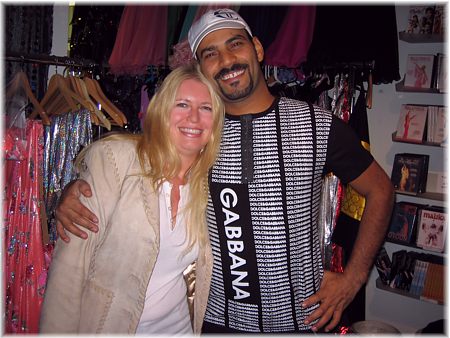
Author and Tito
at Arabesque Academy, Toronto 2006

Have a comment? Use or comment section at the bottom of this page orSend us a letter!
Check the "Letters to the Editor" for other possible viewpoints!

Ready for more?

  • Whose Dance is This, Anyway? Where Do Men Fit into the Belly Dance World?
    As soon as he was born, dancers of all stripes immediately started in with "Oh, a new little drummer for the troupe!". Excuse me? Why is there an instant assumption from birth that all little boys will be drummers and all little girls will be dancers just like mommy.
    —Added Feature! See our Gallery of Men in Middle Eastern Dance
  • Certifying the Certifiers, The Chicken or the Egg? Part Two
    … artists and stars are born, not schooled. You’ve either “got it, or you don’t”
  • Certifying the Certifiers
    …this has occurred because of the current need to be correct, and within certain predictable standards of competence rather than special, unique, outstanding, unusual, memorable, or even (gasp!) emotion producing…
  • Be Careful What You Wish For…
    A Case against Standardization in Nomenclature for Belly Dance Instruction
  • Dina: April 2008
    It was a late night as usual as we didn’t even go out until midnight to have dinner and watch Dina at around 3am . . . but who was watching the time . . . It is CAIRO!
  • Backstage with the Reda Troupe
    Seeing the company in performance six times was truly a wonderful experience, because each time I saw some new detail or subtlety in the movements, the costuming, the structure of the dances, and in individual performer’s presences on stage.
  • Maud Allen: La Femme Fatale
    For, as the trial progressed, in effect, it became a trial of female sexuality. No respectable woman, it was claimed, could possibly take on the sadistic role of Salome unless she was a sadist in real life, and sadism was regarded at the time as a practice verging on the criminal.
  • Carl’s Photos from The 2009 Gala Showcase at the SF/BA MECDA Event
    Event Presented by SF/BA MECDA (the San Francisco Bay Area Chapter of the Middle Eastern Culture and Dance Association) Held on January 17 at the Cubberley Community Quditorium in Palo Alto, California
  • You Can Take the Dance With You!
    It has been a year since we have made our big move—Sirens In Sanity has changed from being a one-beautiful-studio-in-Benicia, California, to a multi-location studio.


Gilded Serpent presents...

Maud Allan:

La Femme Fatale

Maud Allan

by Wendy Buonaventura
posted August 31, 2009

The art critic, Sir Herbert Read, remarked about the dancer: “Maud Allan was the Marilyn Monroe of my youth.” Now, that intrigued me!  Here was a woman enormously famous in her time, yet, unlike Monroe, Maud Allan has been almost entirely forgotten today, outside of dance circles. Indeed, so forgotten is she that, when I decided to write a book based on her life, most publishers I approached wrote back with the comment that nobody had heard of her, and nobody would be interested in her story.

While researching her life, I grew more and more intrigued by this dancer who effortlessly attracted one dramatic event after another. She had been attacked with ferocity, and I began to glimpse the possible creative triggers behind her enactment of the most feared female archetype of her age: namely, “La Femme Fatale”. 

Allan was a contemporary of the famous Isadora Duncan. They both performed as soloists and achieved extraordinary celebrity in the opening years of the 20th century. Canadian by birth, Allan grew up in San Francisco, and found fame in Europe—much like Duncan.  At the height of her career, picture postcards and little statuettes of Maud Allan sold by the thousand.  Both dancers performed in filmy costumes, and whereas many reviews of Allan’s work praised her, some lampooned her as being “kitsch and tasteless”. Duncan disliked Allan intensely and claimed Allan copied her. Unlike Duncan, Allan’s fame may have owed more to her notoriety than her artistry, yet there is no doubt that she was a serious artist, and a film fragment of her performing in India with her troupe reveals Allan as a graceful—and surprisingly modern—dancer.

Allan owed her fame almost entirely to her “Vision of Salome”. At the time of her greatest fame, the first decade of the 20th century, both the amateur and professional stages in Europe and America were in the grip of Salome-mania.

On makeshift platforms, and in the drawing rooms of society, women hostesses played out the fantasy of the Bible’s best-known dancing temptress, Salome, largely for the entertainment of other women.  Who knows whether they were using this archetypal figure to express their frustration at the limitations imposed on them by society? At the same time, Can-can dancers in Paris had their own gesture of defiance; they were kicking the hats off the heads of wealthy men who went to ogle them in the dancehalls of Paris. However, the Salomes went one better: they demanded not just men’s hats but their heads—on a plate!

In those days, dance was not yet a respectable profession for women. Yet, female entertainers in the West were staking out a place for themselves on the public stage as never before, and there was considerable fear of these bold women and what was regarded as their emasculating power among the men of the era. Taking on the role of Salome played into such fears and, as Allan’s contemporary, Mata Hari, was to discover, it could be a dangerous role to play!

Figuratively speaking, Allan was knocked to the ground many times in her career—either because of her unconventional private life—or because of her dancing. Every time, though, she got back on her feet, put up her fists, and came out fighting. Over the years, she endured criticism and slanderous comments in the press, and she learned that suing her detractors for libel was an effective method of disarming her opponents. Only once did she become unglued, and that was in the notorious libel case, which she bought against a right-wing member of the English Parliament (a trial that forms the centrepiece of my book about her, which I titled "Midnight Rose”).

It happened in 1918, long after the furore over her “Vision of Salome” had died down, and Allan was appearing in Oscar Wilde’s play on the same theme. Under the guise of advertising the performance, the MP (member of parliament), Noel Billing made a thinly veiled attack on Allan in his private newspaper. He hinted that she was lesbian, and Allan sued for libel. Unlike male homosexuality, lesbianism was not against the law in England. Nevertheless, it was discreetly practised, rather than flaunted.

Men overtly abhorred Lesbianism, and viewed it as a threat to the human race. If enough women came to prefer their own sex, they reasoned, then the race would die out altogether! Given that Allan was bisexual, it was foolish of her to sue, but sue she did—only this time with disastrous consequences.

By then, Allan was long past the days of her greatest fame, but the case (dubbed “the Libel Trial of the Century”) was covered extensively in the popular press and attracted crowds of onlookers from all sections of society.  It threw a searchlight on the social hypocrisies and sexual ignorance of the age, as self-confessed guardians of public morality came forward to attack Allan. To modern ears, some of the court exchanges are, frankly, hilarious. When the word “orgasm” was uttered, the Judge asked, “Is this some unnatural vice?” Then, discussing the term “clitoris”—whose meaning no respectable woman was thought to understand, although, indeed, few of either sex did understand the word at the time—a prosecution witness declared that this part of the body, when unduly excited, could have the most dreadful effect on a woman. “An exaggerated clitoris might even drive a woman to have sexual congress with an elephant,” the witness claimed.  Even if the court exchanges make us smile, something darker lay behind them.

For, as the trial progressed, in effect, it became a trial of female sexuality. No respectable woman, it was claimed, could possibly take on the sadistic role of Salome unless she was a sadist in real life, and sadism was regarded at the time as a practice verging on the criminal.

Worse was to come for Allan. During the court case, a highly damaging skeleton in her family cupboard was dragged out to shame the dancer even further. Her brother, Theo, had been hanged for the murder and violation of a young woman in what was described as San Francisco’s most sensational murder trial. In those days, criminality was thought to be hereditary; hence, Allan was thought by some to be capable of crimes, which, at the time, were compared to those of Jack the Ripper.  After Theo’s execution, Allan’s mother was reported to kiss his lifeless lips; it was a telling precursor to Maud’s kissing the papier maché mouth of the dead John the Baptist, in what was considered the most tasteless and shocking aspect of her Salome.

Her brother’s crime haunted the dancer all her life. Indeed, she changed her name, in order not to be associated with Theo. She was known as being secretive; her memoirs tell us little about her, and it’s true Allan had a lot to hide. It is interesting to speculate on her subconscious motives for taking on the role of the vengeful Salome. Of course, one can only speculate, but the more one researches her life, the more intriguing Allan becomes. She may not have been as outstanding a dancer as Isadora Duncan, but she was a true fighter, and I think her story deserves to be brought out into the light.

The few books about Allan’s life are, I think, somewhat dismissive and superior in their attitude toward the dancer’s behaviour and artistic ambitions. Like many, she was a complex character, and perhaps not always likeable, but I liked her bravery, determination and boldness, and ended up writing a work of fiction that is based on her life. No one can know what were her real thoughts, dreams and nightmares, nor what she felt about her fame and the problems it brought with it. However, I hope that my book recreates the flavour of this feisty dancer, and that it will help bring her back from obscurity.

Autographed copies of Wendy Buonaventura’s book “Midnight Rose” are available from www.cinnabarbooks.co.uk
Ed note–A review of this book will also appear shortly on Gilded Serpent.

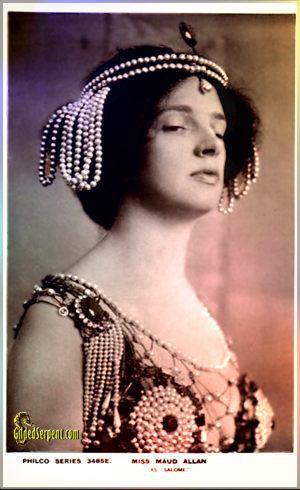
Maud Allen and the head of John the Baptist 

Wendy’s Books through Amazon are not autographed. Autographed copies of Midnight Rose can be obtained through Cinnabar Books for around $15


through Cinnabar Books for around $15

Have a comment? Use or comment section at the bottom of this page or Send us a letter!
Check the "Letters to the Editor" for other possible viewpoints!

Ready for more?


Gilded Serpent presents...

Carl’s Photos from
The 2009 Gala Showcase at the SF/BA MECDA Event

Event Presented by SF/BA MECDA
(the San Francisco Bay Area Chapter of the Middle Eastern Culture and Dance Association)
Held on January 17 at the Cubberley Community Auditorium in Palo Alto, California

Photos by Carl Sermon
posted August 28, 2009

Aisha Manar
Aisha Manar

Aisuba

Aisuba

Alcina
Alcina

Amanda
Amanda

Amira
Amira

Artemis
Artemis

Aruba Ala Nar
Aruba Ala Nar

Basinah
Basinah

Desert Heat Dancers
Desert Heat Dancers

Dunia
|Dunia

El Asaab
El Asaab

Gameela Awi Awi
Gameela Awi Awi

Genevieve
Genevieve

Ghanima
Ghanima

Goddess Force
Goddess Force

Hala Dance Company
Hala Dance Company

Hassan Deeb
Hassan Deeb

Hazar
Hazar

Jahmra
Jahmra

Jewel of Opar
Jewel of Opar

Jizan
Jizan

Kathy StahlmanTribal Moon Dancers

/Kathy StahlmanTribal Moon Dancers
Kathy StahlmanTribal Moon Dancers

Liliana
Liliana

Lulu
Lulu

Malia New Moon Ensemble

Malia New Moon Ensemble

El Ain Dance Company

Paloma
Paloma

Raja
Raja


Rashika

Rayah
Rayah

Sabiba
Sabiba

Setereh
Setareh

Tatiana
Tatiana

Tatseena
Tatseena

Troupe Nijmeh
Troupe Nijmeh


Una and Troupe Nijmeh

Vahana and Jewels of the North

Vashti
Vashti

Yolanda
Yolanda

Zeldina
Zeldina

Zelina
Zelina

Zemira
Zemira

more info on event here- www.sfbamecda.org

Have a comment? Use or comment section at the bottom of this page or Send us a letter!
Check the "Letters to the Editor" for other possible viewpoints!

Ready for more?


Gilded Serpent presents...

You Can Take the Dance With You!

Saiedeh & Yasmine

by Yasmine of Sirens In Sanity
posted August 27, 2009

It has been a year since we have made our big move—Sirens In Sanity has changed from being a one-beautiful-studio-in-Benicia, California, to a multi-location studio. Here is a little about our journey:

In 2006, my family and I decided we wanted to move out of the Greater San Francisco Bay Area. Almost our whole lives we had lived there and most of our residency was in Benicia. We had always enjoyed our summer vacations in peaceful mountains of Montana, but did not want to move that far from friends and family. My parents had moved up north to Magalia, California, a few years back, and we had started visiting them. It had everything that we were looking for and we fell in love with the area. After many long conversations (and lots of pre-planning) we decided to put our thoughts into action.

I quickly introduced my idea to my business partner, Saiedeh,and although it was a little jab in the tummy, she loved it. She knew how we longed for something different and for the mountain life. She was just as nervous as I about implementing change and expressed a million questions that flooded her brain over following weeks. We spent almost two years talking possibilities, plans, changes, exciting endeavors we would encounter, etc.

map of 2 studiosOur first order of business was our studio—our baby—our precious dance home. We brainstormed on all that we wanted to see continue in the Benicia studio and what we wanted to change. We knew that Saiedeh would continue the primary classes and that we would build on our classes by guest instructors. We also had many “SISters” (Sirens In Sanity Dance Company members) who were interested learning to teach. We instituted a teacher apprentice program and at the same time, Zyphire, one of our long time dancers, started a secondary SIS troupe and was directing that. It was a natural fit and Sister Sirens became an award-winning troupe very quickly, and sure enough, Zyphire became our third belly dance instructor and director. Several SISters stepped up and offered to help co-teach when needed. Saiedeh and I made up the new class schedules and started notifying our students, our local business contacts, and building the business plan for our second location of Sirens In Sanity.

In July of 2008, we made our move. It was nerve-wracking, making the transition and traveling back forth, moving business office, all of my personal Bellydance stuff—as well as my whole household! By the end of July, we had moved completely. The first couple months were filled with phone calls, text messages, and tons of e-mails between Saiedeh and myself and our students.

Everyone needed to be reassured that the Saiedeh and Yasmine partnership was not breaking up and that SIS was doing fine. After 13 years of dancing and teaching side-by-side, Saiedeh and I had to firmly reassure our students that this new configuration was a natural progression and relationships would not change completely.

We are thriving and enriched by this widening of our lives. Every month, I travel 2.5 hours to the Benicia studio for classes, to teach private lessons and go over any business aspects we cannot handle by telecommuting. We also include, as well, some good old-fashion sisterly bonding and giggle-fests.

Sirens In Sanity is a “production style” dance company. Each production has several elements, each delegated to we three teachers (Zyphire, Saiedeh and me). Saiedeh is the main director of the whole dance company, and she choreographs the group routines where all the dancers are on stage at one time. The co-directors (Zyphire and myself) choreograph one piece each with the dancers they choose or whom we choose for that piece or in particular location.

SIS teachers

Teacher’s names here:Top row…Zyphire, Saiedeh, Yasmine, Simone
Bottom row…Mutha, Almaza, Chenoa & Estarte

When traveling to the Benicia studio, my job is to learn the choreography for the assigned routines and then review via Youtube.com clips that Saiedeh & Zyphire post weekly for me. This is a different way of learning for me, but it is best served if I learn the choreography from Saiedeh first-hand and then use the YouTube clips to review or clarify. I have found definitely that learning routines in person is the best way for me and for most of our students, also. Learning on-line or on the television looses some of the nuances involved in our art.

We now have 18 dancers in the Sirens In Sanity Dance Company, 6 of us in the Magalia/Paradise studio and 12 in the Benicia studio. We coordinate mandatory rehearsals throughout the year in which all 18 dancers come together to finalize the production. All 18 of us communicate a great deal on e-mails, Facebook, Myspace, and the phone to keep our camaraderie high and stay in touch with each other’s lives.

Actually, I have found, we keep more contact now, than formerly. It’s funny, how that works!

Travel is another keen part of our success; I travel to Benicia frequently, Zyphire travels to Magalia almost every other month and all three of us travel to various events. Just this past year alone, Sirens In Sanity traveled to Belly Dance U.S.A. in Canyonville, Oregon, Tribal Fest in Sebastopol, California, Redwood Coast Belly Dance Festival in Arcata, California, and are heading to Jewels of the Sierra in Lake Tahoe, California, in September as well as many San Francisco Bay Area private and public performances.

We have instituted a program that we call “Lessons From Afar” for students who want to train with me more than one time a month but do not live in my area. This has become great success! I instruct via e-mail, video clips, and over the phone, and then our students send me their finished assignments weekly via e-mail or video clips. The assignments are followed up during performances we have together.

The communication through technology has been a platform to our success.

The whole dance company (as well as other performing SIS students) performs year round. Primarily, our bookings come through the Magalia home office, and then we book them via e-mails depending on who is available to perform that day. I travel to the Bay Area for some of events or they event, all together. This is another convenient way keep in touch see how everyone growing by leaps bounds.

We stand on our own, and we stand together, just the same as always!

Another important aspect of this development is the complete, open communication about our students and our performances. Saiedeh, Zyphire, and I update each other constantly on our classes, private lessons, and performances. We fill in each other on everything; this helps keep continuity between the classes and gives SIS cohesiveness. Each student receives the benefit of having three instructors focused upon her, even though she may only meet face-to-face with one. Our Benicia studio has approximately 20 students, plus its dance company members; the Magalia and Paradise classes have approximately 12 students; and the connection between all of us instructors has proven to be very beneficial.

We have continued our Sirens In Sanity creative nature, our passion for the dance, and our absolute adoration for our student dancers and our commitment to our partnerships. Circumstances have come up, that we did not anticipate and have pushed us to new levels in our business and dance. We are celebrating all that has come our way and all that will come in the future.

We are proud to say that we have lived through the phrase: "You can take the dance with you!" If you want it bad enough, if you have an awesome team and sisterhood of dancers around you, anything seems possible. We are very thankful to all our SISters and the Bellydance community in Northern California for understanding, supporting and helping us grow.


SIS troupe
Back row: Leili, Carrisa, Saiedeh, Zyphire, Amber, Mutha, Estarte
Middle row: Nadima, Salima, Yasmine, Chenoa, Simone
Bottom row: Minnet, Rae’eesah

Have a comment? Use or comment section at the bottom of this page orSend us a letter!
Check the "Letters to the Editor" for other possible viewpoints!

Ready for more?


Gilded Serpent presents...

Improvisation


Method Behind the Madness!

Choreographed doll

by Najia Marlyz
posted August 14, 2009

One of the biggest mistakes we western Bellydancers have made is presuming that the dancing to which Arabs refer as the “Eastern Dance” is a theatrical dance that ought to be choreographed as if it were a ballet, or that its steps and movements are traditional like those of the Greek Hasapiko, an Arabic Depke, or a Hawaiian Hula.

Our Dirty Little Secret:

Our reason for treating Bellydance as if it were the same as a western experience is that it is expedient to teach dances that have been choreographed, and sometimes, choreographies can turn a tidy profit for the choreographer!  Dance instructors can easily shift into automatic pilot once their notations are set on paper.  Students become either right or wrong in their adherence to the notated work. It is usually unnecessary for an instructor to call on individual dancers to think creatively or to feel the emotions that are inherent in the music arrangements when they are designated by the notations.  However, this is not to say that mental choreographing is not happening during an improvisation! If she is skillful in her dance technique, and absorbing the intent and structure of the music, an improvisational dancer is creating a coherent choreography in her head and heart without making notations on paper or on a computer while her dance is taking place.

Got it in writing?

To my way of thinking, precisely written choreographies are only necessary when troupes need coordinate their presentations or for new dancers who are learning to perform solo. However, hard copy notations should not be necessary in most fine solo performances.  Western dancers can substitute the use of several forms of a gentle, less westernized, subtler form of choreography until they get the hang of improvising. “Loose”, “Bare-bones” or “Sign-post” choreography may be an inherent part of Oriental dance that is destined for public performance, but it is generally written down only on the mind of the dancer rather than laid out formally in a notebook or computer.

Is it Dance Imperialism or Fusion? 

Ever since Oriental dance was introduced in the West decades ago, we dancers have imposed upon it our penchant for cultural takeover.  Our habitual imperialistic attitude toward dance springs from the naturalness of earnest wishing to make the entire dance form understandable for our western audiences and ourselves.  Our resulting presentations of overly complex combinations of steps, strange transitions, and inappropriate, uncomfortable choices are encouraged and made possible by the use of choreography for solos.  The resulting notated dances dull the sensibilities of those audience members who more reasonably expect the relaxed subtleties inherent in Arabic dance when performed by Arabs with Arabic music. Although Oriental dance has been flexible enough to have taken many forms suitable for varied social and theatrical uses, it rarely does well being a "mix and match" product with a little Turkish step here, a little Depke style there, a little Saidi flavor and Saudi dance tradition (thrown in for good measure), and overall—too much speed and complexity!  All of this inclusion of too much content in a short performance has the effect of creating a hodgepodge dance of divergent Middle Eastern cultures rather than the real “Danse Orientale” that makes gentle references to its roots. “Tight” choreography makes all this rapid-fire dancing feasible, but it will never succeed in making it Oriental, sensual, exotic, or meaningful.

A Proper Role for Choreography:

Rampant overuse of fusion creates a dance built like a brick ranch house with flying buttresses, supporting a thatched roof situated on a pseudo cotton plantation in Nova Scotia; it makes no artistic sense whatsoever!  Certainly, it makes no sense to the Middle Easterner who politely, (while suppressing his true feelings) says, "How flattering that you love our dance so much!" However, choreographed dances make it possible (even if nonsensical) to create such fusions and dancers can get more “bang for the buck” out of each and every little “boink!” of her sound-byte music. 

The short performance time allowances alone have tended to skew our dance form into something akin to a leopard’s dash for an antelope kill on the Savanna — it is fast, amazing, and over in mercifully short time, leaving the viewer breathless!

Proper Uses for Choreography in Bellydancing:

  • There is a definite place for choreography in the classroom when it is used to present technique, transitions, or new concepts and ideas in dance to the students, which they can integrate into their own dance language.
  • Choreography is a necessity in the presentation of group or troupe performances. 
  • Partial choreography, too, has its special uses.  It may be somewhat spontaneous, or memory-driven rather than written, and is composed while it is being danced.  It may be a rough, or a "bare-bones" outline, or even a vague scenario like a cartoon sequence made before a movie is filmed.
  • The term “Spontaneous/ Improvisational Dance” might give one the wrong impression about its definition. An Improvisation is dance that is not formally choreographed—that is, not written, not codified; yet it has a plan and a reasonable portrayal of events and a logical sequence. (Therefore, if you want to think of that planning as a method of notation, the result might be thought of as a special form of choreographed dance.)

In no way does a spontaneous dancer merely run wild, willy-nilly!  The western dancer should accomplish some sort of analysis of her music in lieu of the reality that she has not "grown up with the quarter-tones of Middle Eastern music coursing through her veins."  Once she has absorbed the music in some personalized understanding, it becomes possible to create a spontaneous dance movement or what is termed generally, an "Improvised” dance.

A good "Improv" does not materialize from the mysterious ethers; rather, it has an indelible foundation in the music.

Analysis:

If a teacher is using choreographed material in order to teach, one should not assume that this diminishes the particular items or concepts of dance that she intends to teach. In fact, it makes each subject larger and more interesting to many students because it introduces the class to new ways of combining movements or introduces a new choice of movements that dancers may not have imagined would work well in characterizing the music.  In this case, the teacher has the additional responsibility of teaching musical analysis techniques as well as dance steps and movements as tools to be used in the so-called “improvisation”. Lastly, the teacher is obliged to brand the teaching choreography as “The Kiss of Death” to perform before an audience!

signpostSign-posting:

The instructor must also teach how to plan types of dance movements that most accurately communicate whatever the dancer hears in the music that is worth highlighting (a method of loose choreography that is called “Sign-posting”. One can look for the major signposts or signals in the music that give it character and pre-plan specific movements and gestures that fit and enhance these musical characteristics without having to pre-plan or choreograph the entire selection. 

The music, once analyzed and sign-posted, becomes a roadmap for the dance, giving the presentation a sense of journey and experience for those who are the observers.

Is it a Troupe Rehearsal or a Dance Lesson?

While many instructors teach no choreography at all and others teach only their own preconceived dances to their troupes and their classes, it is sometimes the case that the troupes are the students and learning and rehearsing the choreographies are their classes or lessons!  Teachers leave would-be dancers confused about the subject of choreography, unable to use the tools of dance to create their own dances when they become the sole choreographer for the troupe. (However, they make sure to collect the class fees none-the-less, because they have to eat and pay their studio rent.)

Ready-made, One-size-fits-all Dance:

Sometimes, prominent instructors have misused videos; we dancers have collected videos since the early ’70s as a way to learn our dance from its original countries and to learn from its most famous performers.  Subsequently, the videos have been used, not only as a source of inspiration and style, but as a storehouse of ready-made dances conveniently served up for dance plagiarism.  One cannot wonder why dancers are hesitant to be videoed anymore! 

Who would want to create a dance for someone who is too unsure or uncreative to conceive of her own dance?  Students can waste their class fees for several weeks in a row, if the instructor is ruthless enough, perfecting the copied choreography of some famous dancer, step for step, and gesture for gesture.  What tragic misplacement of energy, money, and time! What total abdication of the instructor’s responsibility to give the new dancer a sense of power and personal accomplishment! 

The Step Collector:

I remember a relatively famous instructor (during the mid-1970s) who came to my old dance studio one summer.  She said she wanted criticism but was unable to perform any demonstration dance for me to critique because I did not own the correct recording of her designated “musical arrangement" and she had forgotten to bring hers.  She was an example of a skilled " step collector" rather than a real dancer even though she owned a dance studio and authored several dance books.  She attended classes to learn steps everywhere she traveled, so she was industrious.  She went to a choreographer to purchase a dance and hired a coach to perfect its over-all effect, but apparently, what she wanted from me was new steps that she hadn’t seen before on the east coast.

Zoe has very useful wings!She reminded me of a chicken; she was all colorful feathers with no useful wings. Sure, this chicken was unable to sustain flying in her dance, but she had a precise beak that was great for rooting out new steps and ideas and gulping them down very quickly like delicious bugs and insects. She refused to perfect any of my steps and movements during the lesson, preferring to regurgitate them at some later time for processing and perfecting, I imagine.  When she left, I felt drained and dissatisfied that she had not demonstrated any understanding of the concepts I had presented. Even though she paid my fee,
I felt “ripped off”. That was not my finest hour as an instructor, but it was one in which I learned a great deal.

A Major Teaching Key:

A teacher must awaken the student to structure and complexity in the musical form on more than just the percussive level that most frequently appeals to beginners. The rhythmic construction and recognition of rhythmic content of a musical arrangement is important, of course.  However, to be an outstanding dancer, one must portray the melodic content also.  The teacher does not have to be a professor of music to accomplish this feat.  She needs only an understanding of the basic elements such as sound and the absence of sound, pattern, and variation. Once the student is able to discern patterns and their variations, she becomes free to search for:

  • Tonality,
  • Color (emotional content),
  • Shading (force and style behind the movement to match the loudness or soft quality of the music), and
  • Texture (smoothness of instrumentation or roughness of percussive content)
  • Patterns (musical themes and their repeats.) 

Last, but perhaps most simply, the student may express the tonality of the melody.

  • Is the sound highly pitched?  Make a high gesture or projection. 
  • Does it cascade upward or downward?  Start low and rise up or vice versa. 
  • Does the sound wobble or vibrate quickly?  Match it with a shimmy or another movement that works by characterizing it! 

There are themes and variations, as well as layers of content in all music—Western or Middle Eastern.  Response to the percussive layer is only the beginning of the dance and though it is satisfying, it is never the whole story.

Relationship to the Instruments:

Response to tone and mood as well (as the characteristic voices of the instruments) is equally, if not more, important.  Each instrument has its own voice!  For instance, the characteristic voice of the oud is mellow. Yet, the dancer might shimmy with the vibration of its strings as well as match the musician’s strum with a strident gesture.  A violin has a voice that is more likely to sustain some notes, which calls for a sustained or elongated dance move.  The nai is breathy, which might indicate movement of the dancer’s upper torso, while the mizmar may cause one to move in a more intense full bodied and folksy manner.  Or not! 

The dancer transforms into artist and decides what means what in the music.  Teachers and professional dancers should be actively exploring music as the main content of advanced lessons and coaching sessions.

Advanced students should no longer expect their teachers to be teaching new dance steps at each lesson, and they certainly do not need a teacher to assemble little combinations or choreograph for them if they have been taught how to listen to the music, analyze it, and create for themselves.

Free dance time in class can allow the teacher to watch, comment, and troubleshoot; these moments can be the culmination and apex of the advanced dance lesson.

Author performs on cable tv showConveyance of Meaning:

One component of the dancer’s job is to make the message and intent of the music visual, but moreover, to translate that music into movement, to highlight and interpret it for the audience.  The artistic dancer causes the audience members see and feel whatever she chooses for them to experience in the music, much like a guided tour of an art gallery.  This is what clearly separates the riff from the raff in dancing. 

When a dancer becomes discerning about her music and can guide the audience to hear, through her dance movement alone, what otherwise they may have missed, she has created a powerful dance without relying on the help of program notes! 

She can consider herself a fananna (an artist, a star)!

Use of Ethnic Gestures:

A good coach and teacher will not instruct a dancer to make gestures in the dance that she does not fully understand.  Therefore, copying gestures from a foreign video or live workshop teacher can be a real hazard to believability.  If a famous foreign teacher comes to town to teach, lucky you, but beware!  His/her dance will be made charming and cute, captivating and enchanting, humorous and not altogether right for your personality by employing little gestures which are so easy to imitate and so difficult to "own"!  You will appear heavy-handed and false while he or she charms your socks off.  You will want to "do it too" (just like he did) but resist temptation and be yourself.  As hard as you may try, you will never become Egyptian or Turkish unless you go live there for twenty years, (but then you will not want to perform in public anymore).  Those little gestures are details that are not usually planned as part of a presentation but just happen because of feeling response to the music and the moment. Mimicry is not necessarily artistry.

Phony is as Phony Does!

When, for whatever reason, Middle Eastern dance soloists do need to choreograph a dance, it is rarely done in the minute detail of the Western tradition.  There is usually extra space left in to accommodate a bit of spontaneous expression.  In a quest for authenticity and correctness, we teachers have found accepted ways of shirking our obligation to actually reach out to the students and teach them the concepts of dance, preferring instead, to concentrate on trite combinations of steps and specific preplanned gestures just for the sake of expediency.  Sometimes we have acted like a governmental bureaucracy gone out of control, teaching patterns on finger cymbals that are rhythmic without being musical, steps that are irrelevant to our music, gestures we do not understand, and worst of all, we argue what to call each and every little movement.  (However, we advertise well and can produce a great resume!) 

Perhaps we need to return to Oriental basics, reviving our love and respect for the music and our belief in our own inner message.  Teachers must help students to revitalize that inspiration that compels us all to partner musical content rather than showcasing our latest dance bedla or our unbelievably disciplined technique. When all the dust settles, nobody comes to see a pretty girl do Bellydance steps; they come to see her have a good time, fusing her personality with the language of ethnic music.

Have a comment? Use or comment section at the bottom of this page orSend us a letter!
Check the "Letters to the Editor" for other possible viewpoints!

Ready for more?


Gilded Serpent presents...

Dancing for Dowries, Part 2:

Common Favorite Ouled Nail

Earning Power, Ethnology, and Happily Ever After

by Andrea Deagon, Ph.D.
graphics used with permission from
Stief of the Bellydance Museum
or from Wikimedia Commons
posted August 16, 2009
part 1 available here

Part II: The Nailiyat

I began with the “ancient Greece” story in order to look at the ways in which the themes of the “dancing for dowries” mythos relate to the concerns of modern belly dancers, for better or worse, in a story that is basically fact-free.  But there is a real case of women who danced for a while in their youth in order to earn money for their future prosperity: Algeria’s Nailiyat (singular Nailiya), the women of the Ouled Nail tribe. 

The ways in which their practices have been told and interpreted, though more solidly based on facts than some versions of the “dancing for dowries” story, also reflect the ways in which the idea of “dancing for dowry” reduces complex cultural interchanges into patterns that reflect modern concerns more than actual historical practices.  And this is a disservice both to the historical Nailiyat and to our own hopes for gaining cross-cultural wisdom.

Although the Nailiyat still exist, and still (at least under some circumstances) dance publicly, I am using the past tense here because I am describing situations that were in place and in flux in the late 19th to early 20th centuries.  During this period, the Ouled Nail tribe experienced the political and economic upheavals that ravaged Algerian traditional life during the period of the French invasion, land seizure, and relocation or extermination of native Algerians, and political domination.

the atlas mountainsThe Ouled Nail were a people of the Saharan Atlas mountains in the interior of Algeria, who consciously recognized their differences from the lowland populations and from others of their geographic area.  One of the practices that most set them apart from their neighbors was that some of their women would leave their mountain homes during a part of the year, go down to the lowland cities, and become professional dancers.  They were usually accompanied by a mother or other older female family member.  Typically, they returned home seasonally.  After a few years, most would return home for good, with enough wealth to buy a home and establish themselves as a woman of property.  They would at some point enter a marriage in which they maintained the same domestic roles and marital fidelity that were expected of women throughout Algeria.

Not all Nailiyat became dancers.  In some families, it was more common for daughters to become dancers than in others.  At times, sisters or cousins might work and live together for a few years, and during this period they might be responsible for the support of an older female relative, as well as younger family members who were in training to become professional dancers themselves. 

Because of the lack of historical records, we do not know how long or under what conditions the relationship between Ouled Nail and the other Algerians for whom they danced persisted.  But we do know that it underwent significant change in the 19th and early 20th centuries.

Nailiyat Society

Ouled NailMarnia Lazreg explains the historical practice of the Nailiyat as follows:

Women would typically leave their rural milieu and settle temporarily in one of the nearby towns, where they entertained men with dances and songs.  Often young women left with their mothers, grandmothers, or aunts, who acted as their chaperons and kept house for them.  If a Nailiya … became pregnant, she kept her child.  A baby girl was particularly appreciated.  Her aim was to find a suitable husband, and/or save enough money to help her parents out, and to return home where she usually bought a house with a garden. (30) 

To elaborate, while away from their tribal homeland, the Nailiyat lived within a community for which women provided a strong core, and into which men were admitted temporarily as friends, acquaintances, allies, business associates, admirers, and sexual partners.  This woman-centered community existed and made its mark within the urban areas in which the Nailiyat performed – areas where domestic life followed the same pattern as the rest of Algeria.  (This is not to say that women within the more traditional households did not also find ways in which to create community and exert their wills.) 

In an additional overturning of traditional power structures, among the Nailiyat the older generations took a back seat to the younger.  Young women, far from being secluded and controlled, were the center of the household’s finances and public life. 

This is not to say that more traditional generational relationships did not exist within the female-centered families; mothers or other female relatives may well have counseled, advised, or rebuked the young dancers, and might also have had a hand in managing the household finances. 

This element, admittedly, is not noted in the accounts of Nailiyat in authors such as Eugene Fromentin (1857) and, nearly a century later, Lawrence Morgan (1956); however, this absence could be because of the authors’ ignorance of intrafamiliy dynamics and/or their fascination with the young dancers to the exclusion of the rest of their households. 

Etienne Dinet and Sliman Ben Ibrahim, in their 1926 novel Khadra, do allude to the intergenerational aspect in their account of the experiences of Khadra’s mother, whose life, less thoroughly controlled, taxed, and regulated than Khadra’s, had led to a happy marriage and a triumphant return home  (Dinet and Ben Ibrahim 1926: 7-14). 

One implication of their fictionalized account is that increasingly over time, the young Nailiyat who came to urban centers were far less able to conduct their lives in the comforting environment of a “home away from home.”  Separated from their traditional multi-generational feminine support network, they became isolated as lone women in an exploitative world, perhaps relying for support on other young women, or hoping to find it from male patrons, but without the guidance of experienced elders.

Other neighboring mountain tribes also practiced seasonal travel, professional dancing, and sexual mores at odds with the mainstream tradition.  But their motivations may have been different.  Describing the practices of the more remote Azriyat (women of the Ouled Abdi and Ouled Daoud tribes), Lazreg comments: “Women who were orphaned, divorced, repudiated, widowed, or unable to marry at the appointed age became dance performers and engaged in sexual activity with their patrons until they found a husband,” emphasizing that this practice was more common in “periods of economic slump.” Typically Azriyat lived alone (Lazreg 1994: 33-4). 

In this case, the role of public dancer was a last resort by women who had no other resources.  However, the ultimate result of this period in their lives was meant to be a reincorporation into the community, as the Azriya hoped to find a husband among her patrons and return to respectable life.  Still – returning to our subject of dancing for dowries – it was not through earning a dowry that this hope was to be fulfilled, but through forming relationships with generous patrons who might ultimately desire a less-than-conventional  marriage to a soon-to-be-former dancer.

NailiyaNailiyat, Sex, and Prostitution

The Nailiyat were known and famed as dancers primarily.  They were also hostesses, and men who visited their homes – usually in the presence of the Nailiya’s mother, little sisters, and so on – knew to bring them gifts (monetary or otherwise) to acknowledge their kindness and hospitality. 

giftOf course, their value as hostesses was based to some extent on the charm and sensuality they could lavish on the man who visited them.  They would also take lovers, who would be expected to shower them with gifts, although there were many stories of Nailiyat who foolishly took poor lovers, or who fell into a hopeless love, leading to their emotional and sometimes economic disaster.

They were, in short, women who were sexually active outside of the bonds of marriage, and women whose lovers expected to have to support them and give them gifts.  They were therefore women whose presence meant that men might be squandering money on them that was owed to the upkeep of their wife’s or mother’s household, and in this way, they could be perceived as damaging to the mainstream society.  But their modus operandi was not to charge all paying customers x dollars for x sex act, nor could they be counted on to accept as a lover anyone who had enough money. 

In this way, they differed from “prostitutes” as we typically define the word.  So while the Nailiyat were one facet of extra-marital sex in their host communities, they were primarily known for the pleasurable entertainments of all sorts – certainly dance, and including conversation – they could offer men who seldom had a chance to spend time with more cosmopolitan women than their secluded female relatives. 

Eugène FromentinSome of the Nailiyat never returned home, preferring the cosmopolitan life.  Others paid the price for their public profession in a war-torn and unpredictable time, showing that wearing one’s wealth could put a woman’s life on the line.  The painter Eugene Fromentin, who spent several years in Algeria in the 1840’s and 50’s, describes the pathetic and regrettable murder of two beautiful, sweet and popular Nailiyat who were killed for their jewelry by renegade soldiers in the upheavals of the war (Fromentin 154-5).  Théophile Gautier, writing at about the same time, describes an Algerian dancer of another ethnic group who was murdered due to the risks of her profession (Gautier 1865: 126-7).  In 1904, in his bestselling novel The Garden of Allah, Robert Hichens, who had traveled in Algeria, raises this topic in an exchange between his heroine, Domini, and her Algerian guide.  The guide begins:

“Many of the dancers of Beni-Mora are murdered, each season two or three.” …

“Why do they murder the dancers?” [Domini] asked quickly.

“For their jewels.  At night … it is easy … She sleeps … You cut the throat without noise.  You take the jewels, the money from the box by the bed … You unbar the door – and there before you is … the desert.” (Hichens 1904: 114)

Perhaps there was no safer place to keep one’s “dowry” than to wear it if one wanted to prevent theft, but the fact that dancers were known to carry their wealth with them left them particularly open to victimization and crime, often fatally so.

Flute of Sand book available at Cinnabar BooksOne of the historical forces that led to the erosion of the Nailiyat’s prosperity as professional dancers was their definition as prostitutes by French officials.  Because of this, their way of life was eroded through increasing regimentation, taxation, and impoverishment through government control.  The independent Nailiyat described by Fromentin in the 1850’s were, by the 1900’s, forced to become licensed and heavily taxed prostitutes, and reduced to dancing for pay in exploitative cafes, though apparently they still had the right to be employed in whichever of these they wished.  Khadra describes the many ways in which employers gouged money from the Nailiyat, as well as their abuse by “customers” Dinet and Ben Ibrahim: 141-8).  In Flute of Sand, Lawrence Morgan describes houses to which the Nailiyat were confined, their freedom of movement inhibited and their earnings garnished exploitatively (Morgan 1956 [2001]: 43-63). 

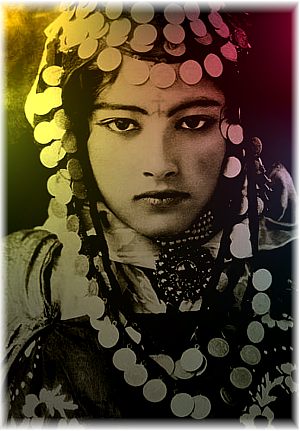
The most famous account of the Nailiyat is not so much narrative as visual: a series of photographs published in a 1914 issue of National Geographic, which showed them in their enveloping white dresses, their coin adornments hanging long and heavy, smoking cigarettes, chatting, posing in all the beauty or ugliness the photographers chose to illustrate.  These images, reproduced on postcards that circulated widely in Europe and America, gave us a visual definition of the Nailiyat, and illustrated the coin-jewelry “dowries” that emerged in American belly dance costumes at the end of the 1960’s, in the Renaissance-Faire presentation of belly dance that ultimately developed into American Tribal Style.

Interpreting the Nailiyat

From the start, the Nailiyat were not only observed but interpreted by the French and later, when the city of Bou Saada became a tourist site, by everyone else who saw them dance.  Lazreg comments, “A popular notion among colonial travelers had it that the Nailiyat engaged in what they perceived as prostitution as a part of a rite of passage before marrying.”  This “rite of passage” idea may have been the intellectual descendant of an influential but completely unsubstantiated story from the
Greek historian Herodotus, who described how Babylonian girls had once had to prostitute themselves at the temple of Aphrodite before they could marry as a “rite of passage” (Herodotus 1.199). (This story, incidentally, incited the idea of “temple prostitution” that became so popular in the late 19th and early 20th centuries.)  The ritual aspect of the “rite of passage” idea also echoed a popular 19th and early 20th century explanation of Middle Eastern dance of all sorts: that it had its origins in ancient fertility rituals.  (Obviously this origin story still thrives in the modern age.)

 “Origin myths” like these, and the “ritual” interpretations they give to dance-related practices, wrongly displace the Ouled Nail custom from its wider context as an integral aspect of a complex culture, with social and economic ramifications that cannot be simplistically explained as “ritual.”

Which brings us back to “dancing for dowries.”

Village dancerThe Nailiyat in Context

The fate of the Nailiyat is particularly sad for the modern belly dancer to contemplate, because it shows the disempowerment of a group of women who, by the standards of both our culture and theirs, were sexually and individually freer than usual.  It is a complex story and I have only touched on it here.  But in keeping with the theme of “dancing for dowries,” I want to discuss the elements of the Nailiyat’s experience that have been adopted, and adapted, in the “dancing for dowries” mythic history. 

To begin with, the modern “dancing for dowries” story either ignores the element of prostitution completely, or treats it nonchalantly. If the prostitution issue is left out, the story becomes naïve.  If prostitution is mentioned only casually, this makes it seem as if it is a minor, incidental aspect of the Nailiyat’s story.  It isn’t. The Nailiyat, as women defined as having a purchasable sexuality, were subject to abuses and dangers that women with the protection (for better or worse) of family and marriage, were not.  Glib mentions of “prostitution” are historically inaccurate, but also make the Nailiyat seem more distant from our own “real life” experience. 

If their importance to us is only as the dowry-dancers who came up with those great coin necklaces, we undo – through oversight – the path they offer toward understanding some of the complexity that has led to the underlying tensions that define the performance of belly dance both in the West and in the Middle East today.  And it is not fair to their memories, either, to mythologize them and overlook their sources of both strength and pain.

Were the women of the Ouled Nail earning dowries?  Not in a traditional sense.  They were earning money that could be used for whatever purpose they pleased, whether that was setting themselves up in better (and more permanent) situations in the lowlands, or purchasing a house and garden back at home.  What they were not doing was earning a dowry that would be turned over to a husband as a symbol of their worth to their birth family.  They were not earning something that would allow them to be chosen by a man or bestowed in marriage with their value monetarily established.  They were, in contrast, earning money with which they might buy their own house and livelihood – in other words, independence. 

house for saleOf course, it was independence in a family context, in that other family members might also profit from the retired dancer’s new house and material well-being.  And just as she was enabled to take lovers according to their appeal to her when she had been a dancer, she was later enabled to contract a more informed, and perhaps more personally meaningful, marriage than the average Algerian girl.   

It is clear that purity and fidelity to a husband were considered as vital for the married Nailiyat as for other women in the Arab (or for that matter, contemporary Western) world.  In a possibly romanticized quote reported by Morgan, an Ouled Nail man commented, “Our wives, knowing what love is, and having wealth of their own, will marry only the man they love.  And, unlike the wives of other men, will remain faithful to death,  Thanks be to Allah” (Morgan 1956: 36).  The Nailiyat, however sexually different and freer than other Arab women of their time and place, were still deeply imbedded in patriarchal family and economic realities, and would not have flourished as dancers in any other way.

Yet the differences from the traditional thought-world are pronounced.  The underlying Ouled Nail culture gives women not only (temporary) sexual freedom, but also economic power through their earnings and property.  This society recognized women’s ability to make their way through the world and gain wisdom from it, and acknowledged both the loyalty it takes to return home and the courage it takes to embark on a life lived largely in the outside world. 

It respected the intelligence, style and wisdom gained by women who had lived in the public eye and in the world beyond their native home – a world many men of the Ouled Nail never saw.

So the point of the practices of the Ouled Nail is not for a woman to come up with a reification of her own value to her husband in the form of dowry.  Instead, the practice of public dancing reveals a deeper valuation of women that encompasses economic, personal, intellectual, and moral worth.  So when we depict the Nailiyat as “dancing for their dowries,” we are trivializing the complex and valuable meanings of their own life experiences, which were not conventionally patriarchal in the sense that the “dancing for dowries” story implies.

The idea of an independent, economically empowered life aligns with the values of the belly dancer subculture – and indeed this independence often features in accounts of the Nailiyat – so why are they so often described as dancing for dowries?  One reason is that the Nailiyat were described in these terms by travelers from very early on (for example, Deloncle 1927: 14).   Still, alternate interpretations have been available in accessible scholarly work for many years as well.  So why
does the simplistic misinterpretation persist in the belly dance community?

Perhaps because the “dancing for dowries” mythos, as described in Part I, offers us something that feels right, however affirming or diminishing that “rightness” is.  But feeling right and being right are not the same thing.

Cigaret adMythos no more?

It is time for the mythos to change.  At this point, whether it is couched in terms of the historical Nailiyat or the neverland of the ancient Greek agora, the “dancing for dowries” mythos offers a view of belly dance that simplifies and diminishes it.  It defies the dance’s ultimate purpose not as attaining independence (as its modern manifestation is supposed to help the dancer do) but as submitting to traditional patriarchal expectations.  It presents the “original meaning” of the dance not as a life-long and life-enhancing art, but as a money-earning gig suitable only for the unmarried, to be given up (when sufficient value has been accrued) for the obligations of marriage and motherhood.  And its misapplication to the Nailiyat leads to a serious misreading of this fascinating culture.

Mythic histories express our tensions and limitations, and perhaps our aspirations, too.  But the problem with them is that their semblance of truth tends to backfire, perpetuating the problems that gave rise to it.  We should not let this mythos – or for that matter, any other – define our dance – and by extension, ourselves – by subtly imprinting us with the limitations it embodies.  “Dancing for dowries” is past its usefulness, and it’s time to tell other stories.

Postscript: Tribal Dowry

Interestingly, “dowry” has become a concept in Tribal belly dance, since for Tribal-style dancers the original, well, tribal illustrations of dancers are understood as a direct inspiration of the modern style.  In one online article, entitled “Collecting Your Dowry,” Michelle comments,

… to pull off a successful tribal look, your dowry must be rich. In tribal times (which still exist in some areas), women wore every bit of wealth they had to attract a husband. A strand of beads and a couple of bracelets did not make the cut when the neighbor girl had stacks of metal around her wrists and a neck-full of necklaces, not to mention earrings, rings, pendants, and pins to offer her would-be groom. How to begin your dowry? First, be patient. As tribal women collected their possessions over years, so too will you have to gain one piece at a time to achieve your perfect look…

Some elements of the “dancing for dowries” mythos remain in place, while others have shifted, for better or worse. 

The dowry is now not collected by the dancer’s public performance for men.  It is reconfigured as wealth collected over time, with a strong emphasis on the dancer’s own choice and individual wishes.

On the other hand, the mythic dowry is still meant to “attract a husband.”  This account seems to cast “tribal women” as passive creatures whose worth is naturally measured by their monetary value.  And not only are they reified, they are in competition with one another, and under-adornment seems to imply that whatever her other qualities, the undecorated tribal woman, devoid of intrinsic worth, will be left unchosen.

In addition, perhaps in alignment with the younger demographic of Tribal dance, in which youthful dancers’ self-images have a strong element of potential and becoming, the dancer is implicitly defined as young, though her adornment might eventually lead to maturity.

All the same, moving away from patriarchal notions of competing bejeweled nubile women, the story’s emphasis on how the dowry must be selected over time implies a lifelong process of self-adornment that goes well beyond the realistic time frame of young women who would be married by their mid-teens.  This scenario, in contrast to the idea of the monetarily assessable young brides-to-be, shows the tribal woman (tribal in both senses) as essentially spending money on herself, and defining herself through
adornment that marks her off as distinct.

This account shows an odd mixture of perspectives, encompassing some of the internal conflicts of Tribal style.  [And all styles have internal conflicts.]  On one side is conformity to cultural expectations of women (i.e. young, beautiful in a particular agreed-upon way, and in some ways interchangeable).  On the other is insistence on independence and attention to self.  In Michelle’s story, dowry, though defined as something reifying a woman and offered to her husband, and presented in the light of un-sisterly competition with neighbor girls, nevertheless morphs into a symbol of choices based on self-respect that lead to a lifelong process of growth.

Works Cited
Barakat, Halim.  1993.  The Arab World: Society, Culture, and State.  Berkeley, CA: University of California Press.
Belly Dance Divas.  n. d.  About Belly Dance.  http://www.bellydancedivas.co.za/AboutBellyDance.html.  Accessed June 9 2009.
Deloncle, Pierre.  1927.  La Caravan Aux Eperons Verts.  Paris: Librarie Plon.
Dinet, Etienne, and Sliman Ben Ibrahim.  1926.  Khadra.  Paris: H. Piazza.
Fromentin, Eugene.  1857 [1981].  Un Eté dans le Sahara.  Ed.Anne-Marie Christin.  Paris: Le Sycomore.
Gautier, Théophile.  1865 [1978].  Loin de Paris.  Ed. G.Charpentier.  In Théophile Gautier, Ouvres Completes, vol. 9.  Geneva: Slatkine Reprints.
Herodotus.  n. d.  History.  (Public domain.)
Hichens, Robert.  1904.  The Garden of Allah.  New York: Grosset and Dunlap.
Lazreg, Marnia.  1994.  The Eloquence of Silence: Algerian Women in Question.  New York: Routledge.
Me’ira.  n.d. The World’s Oldest Dance.  http://www.bdancer.com/history/BDhist1.html.  Accessed June 14 2009.
Meserve, Casey.  2009.  Dancing For Themselves.  Kingston Reporter.  Feb 20.
Michelle.  n. d.  Collecting Your Dowry.  http://www.farfesha.com/pages/dowery.html.  Accessed June 1, 2009.
Morgan, Lawrence.  1956 [2001].  Flute of Sand. Bristol, UK: Cinnabar.
van Nieuwkerk, Karin.  1995.  A Trade Like Any Other.  Austin, Texas: University of Texas Press.
Rashad, Hoda, Magued Osman, and Farzaneh Roudi-Farhini.  2005.  Marriage in the Arab World.  Population Reference Bureau.  http://www.iiav.nl/epublications/2005/MarriageInArabWorld.pdf.  Accessed June 15, 2009.
Scarborough, Milton.  1994.  Myth and Modernity.  Albany, NY: State University of New York Press.

Ouled Nail

is this one?

Have a comment? Use or comment section at the bottom of this page or Send us a letter!
Check the "Letters to the Editor" for other possible viewpoints!

Ready for more?


Gilded Serpent presents...

Challenging Hypocrisy

A Response to Miles Copeland‘s Article

Tonya directs the competion

by Tonya Chianis
posted August 16, 2009

Since you chose to include us in your negative and most hypocritical article published in the Gilded Serpent, we feel we must respond, although in reality dignifying a response to ego and hypocrisy is seldom worth the trouble.  However, we will do so for the sake of clarity and for the sake of all legitimate and worthwhile competitions including the Olympics.

Growth of Belly Dance Competitions
Yes more and more people are getting into the "Belly Dance Act," but isn’t that the way of the world?  Whenever anything is successful, people everywhere always jump on the bandwagon, some not knowing how incredibly expensive events can be and others with ample resources who spend it foolishly and vainly.

Ever since "Dancing with the Stars" started on TV, competitions focusing on every aspect of life have become the norm.  People who are so Hollywood conscious immediately try to emulate these events, some with success and others without.  People don’t realize how incredibly expensive and difficult it is to produce a fair and well-run competition.  When you have spent as many years creating an event such as the Belly Dancer of the Universe Competition you will know how difficult it is to keep testing your own creativity to come up with new and fair ideas – only to find someone has taken all your hard work and effort to start their own project.
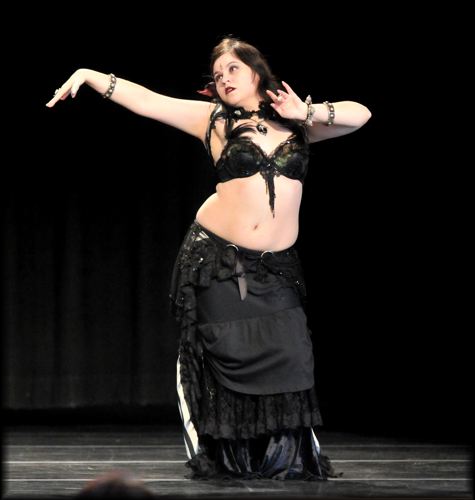
One can only look to the positive and appreciate that we are in a wonderful country that allows free enterprise.  The ethical way has been to promote one’s own competition but not to degrade someone else’s.

You, a veritable newcomer to the Belly Dance world, have completely implied that your little competition is the only fair one around, because you offer money to the teachers for further dance lessons.  Where do you think prize money to the winners of a competition goes?  At least the winner of ours and other competitions has the right to use their winnings as they see fit, and if they choose to spend it on more dance education all the more power to them.  But, if someone has a family crisis and that money is needed, how wonderful that they can do their part to help with the money coming from something they have achieved.

DVDs as a Step on a Career Path
A troupe on Stage at BDUC09Presenting the winner of a competition in a DVD or even someone who is trying to promote their own DVD is a wonderful thing. If it is poor quality and people don’t like it they won’t watch it. But if it is good, the people watching can learn great things. Some of our greatest treasures are the videos of our vintage dancers. The quality isn’t good on many but they’re worth their weight in gold and they are most always viewed as study tools or as cultural enrichment.  Also, do you really expect people to believe that you give your dancers editing rights or quality control as you say you do?  You are the quality control you speak of, and I’m sure your DVD’s are fine, but you wouldn’t stop a full production on a DVD if a dancer didn’t like the way she looked.  It wouldn’t be cost effective. DVD’s are almost always a great source of pride to dancers and help many dancers to become known, get work and provide education to other dancers.  Yes, it’s always hard financially to make a profit with so many others promoting DVD’s and competitions, but at least as you have stated, you have money.  Others are happy to make enough to keep going and it is almost always a labor of love.

You claim that trying to compete in the marketing of dancers already on DVD’s is not worthwhile. 

A popular dancer has her own following and people who love her will continue to buy her DVD’s regardless of how much exposure she has had.

Just like movie stars; however, some movie stars have more longevity and can keep going through the different stages of their lives.  For a dancer, it is quite different.  A popular dancer has a great gift to give to the marketer of her product, and it’s the gift of her ability to make people want to see her at that time in her life.

Your concept is to promote new (young) talent.  This is nothing new.  Talent shows have gone on for ever and of course the fresh (new) dancer on the scene is always exciting.  But because she is new to you doesn’t mean she hasn’t been a professional for a very long time.  You are just another stepping stone toward her evolution in dance. You do the same thing competitions do, but you have the money to take them on the performance trail (should they want to), and that is really what it is all about.

Atlantis talks with the judges of one of the categoriesThere are not a lot of great dancers that can handle the kind of life style you provide for the Super Stars.  Also not many really want to tour due to being true to their multiple responsibilities.  Many promoters feed on their talent, believing that because they are young they are also ignorant and won’t complain.  The other side of the coin is that once a dancer becomes popular, her price goes up  along with her demands, and sooner or later she evolves into the next adventure in her life and says goodbye to the old.  In many cases this is a wise thing for them to do, for many promoters of new and young talent want them in the first place because they are beautiful, young and talented and sooner or later as they grow older, and a few pounds heavier, they are let go and replaced with the new young fresh talent they got from an audition or a Competition!

Competition Participation as a Step on a Career Path
You derided winning a Competition as a way to hype a performer’s career…why should all the wonderful dancers (that are not interested or can’t be a SuperStar) not be given opportunities to do their part to bring great good to the dance community? They have this occasion to display  their talents and  sportsmanship, as well as build their self-esteem and launch themselves into another facet in their careers.  You also state that the worst judges of dancers are other dancers.  This comment is pathetic and hypocritical. The judging panel of The Belly Dancer of the Universe is comprised of many of the greatest dancers of our time. There are no dancers more qualified than Sahra Saeeda, Helena Vlahos, Aisha Ali, Angelika Nemeth, Amina Goodyear, and Marta Schill,
(each to their own style), to name a few, who are capable of having the knowledge necessary to judge.  Who would you have Judge?  Sorry, you are entitled to an opinion, but you are not judging material.  You haven’t paid your dues as a dancer. You are a promoter. Your shows are good because of the dancers in them and again so many Super Stars have been former competition winners. They were also all professional dancers at the time they competed.  I’m sure you will find all the competitors in the major categories in competitions, were and are Professional dancers.  How insulting can you be to the dance communities and your very own Super Stars. 

Most everyone that has ever won the Belly Dancer of the Universe competition has been a professional dancer, because we designed our competition to be different from others and it’s quite difficult to meet many of the requirements.  Also, for those of you who are not aware, we never judge our own competition.  That’s what our great judging panel is for.

Miles and Sahra talk while at BDUC09You complained about dancers from other countries trying to buy trophies.  We were approached in the same way and refused the offer, but we have no control over the thinking and ways of other cultures.  This is not the fault of the competition.  If one were to agree to this, then they could be faulted.  People are after all, just people.  What if another country were to offer you money to let their representative be a Super Star?  Does that make the whole Super Star thing seedy and a complete Joke?  Competitions are for dancers in the beginning, intermediate _and_ final stages of their careers.  It is their choice and I know the preparation that many of these fine dancers have given when entering a competition. It can equal the time your people spend rehearsing.  They are prepared and they are giving their personal best.  Amateur – only in your mind or the mind of a person not qualified to know the difference.

The Title of Our Competition
Yes, we are the Belly Dancer of the Universe Competition. Don’t like our title? Don’t think our champions should be called that?  Well what about Super Stars (that could actually refer to some super gaseous experience in outer space), and those wonderful dancers are certainly more than that.. And whether you think our Champions are not the greatest dancers in the world, and are mere beginners, think again.  At that given moment, they are the Best In the Universe!  This is the greatest title we felt we could bestow on these courageous, talented and beautiful men and women who give their all in the name of their art.

Our promise is to keep doing everything in our power to present a reputable, fair and respectful competition knowing that the Belly Dancer of the Universe Competition is the perfect catalyst to launch the careers of its Champions to the highest of heights. 

We feel all our contestants are champions because (they put it on the line).   May all dancers always continue to be "Wanna Be’s" and keep reaching for the brightest star in the universe.  It is always (Your Choice)! On behalf of the Belly Dancer of the Universe Competitions 20th year, 20l0 Presidents’ Day Weekend, Feb. l3 and l4th – We wish you well and we thank you for your past sponsorships, but from now on, we choose to be on a different planet.

Have a comment? Use or comment section at the bottom of this page orSend us a letter!
Check the "Letters to the Editor" for other possible viewpoints!

Ready for more?


Gilded Serpent presents...

Knowledge and Skills for Becoming an Excellent Performer

Sadie’s Complete Bellydancing Guide

Secrets of the Stage Vol. 1 With Michelle Joyce

Saidie and Michelle's DVDs

DVD Reviews by Martha Duran
posted August 14, 2009

Sadie's BD guideSadie’s Complete Bellydancing Guide

This DVD is 130 minutes long, and if you dance with the whole DVD, your hips and thighs will get a complete workout.  For a Bellydance professional like Sadie, the stage set seems like a small, cluttered space, but the DVD contains an excellent selection of music!  With very clear movements, Sadie instructs, step-by-step, all the way through the DVD—from an excellent stretch and warm-up through the mechanics of almost every single dance step in a Grade 1 Bellydance class.  

Sadie’s calm and patient personality projected on this DVD makes it very useful and perfect for staying grounded on basic elementary technique. She patiently runs through the step and she keeps the knowledge flowing.  What takes it a little beyond dance basics is the DVD’s pace. 

Steps are drilled repeatedly, and then, onto the next step—so it never feels too slow, making it a practice DVD for intermediate level dancers. As well, it is an instructional guide for beginner Bellydancers or those who have never had a technique class.

This is a video in which you are instructed how to move your body parts. Inch-by-inch, on every dance move, Sadie emphasizes muscle articulation. The video only includes a glimpse of stylization in Bellydance that I think should be one of the main courses for a beginner in order to establish solid foundations.

Sadie teaches from torso to hip movements and traveling steps but does not focus much on hand and arm placement.  

This DVD includes almost all the fundamentals for a beginning level Bellydancer, but it lacks rhythm identifications for dancers. The music that is used throughout this DVD is excellent, and for an intermediate level student, it would be easy to understand. However, Sadie does not name what rhythm she’s dancing (that detail would be necessary for a beginning student), it’s also missing an introduction for the new Bellydancer on the many styles of Bellydance that are danced regionally throughout the Middle East.

One of the dance techniques that differs from other teachers or instructional materials is that Sadie explains and does “the figure 8”, directing the hip in a way that makes it even more visible to an audience: muscle control is emphasized, which makes you achieve body awareness while executing the Figure Eight Hip in her method. Making clear and simple movements is something you achieve while perfecting the little choreography with Sadie’s perfect style of instruction. 

What I liked best about her instruction on this DVD is that she teaches every step on the right and left sides of the body—almost no video instructor takes time to do that.

Sadie’s Complete Bellydancing guide DVD (when compared with other instructional DVDs in the market) is almost a complete guide to Bellydance within a professionally recorded and graphically lovely package.

This video is available through Hollywood Music .

Zil Rating: 4 stars
Zil Rating:4 Stars

Michelle's Secrets DVDSecrets of the Stage Volume I with Michelle Joyce

This DVD is outstanding for problem solving, performer experiences, and stage elements.

Michelle Joyce starts with a brief introduction of the principals of stage presence and etiquette for a dancer to follow when she’s preparing to perform.

Bellydancers who are in her video By Dancers for Dancers DVDs (whom we have seen perform either on a stage in a competition or a gala) share personal experiences—bad ones and good ones—on this DVD.  There are several live performances in which they each had a problem, a task they had to solve on stage and still achieve a perfect performance. Some of these performance were done while filming one of their By Dancers for Dancers (Cheeky Girls Productions DVDs) in front of a live audience.

Bellydancers Adriana to ZaheeaShoshanna, and Michelle Joyce talk on a voice-over about the different tasks they have had to perform on stage and their different solutions to unexpected situations. For example: how to make your performance flawless when you’re feeling your skirt is sliding down your hips!

Common anxiety attacks that almost every dancer experiences before getting on stage are discussed, as is the big overdoing-of-your-choreography mistake that many dancers tend to do on their first year as a performer. In an effort to show how they can be the best dancer, they end up choreographing too many movements in a single combination, resulting in overly busy dances. These segments on overdoing a performance on stage are narrated by Nanna, and Sandra.

This DVD has a great chapter on choosing your music and Zaheea
shares significant knowledge, accentuating the difference between floating and heavy music.

Sandra shares advice on how to make a different choreography on a popular song. She shows how to translate an Arabic song, how to read the music, and advises staying away from a song that is considered too popular (so that many dancers end up dancing the same song on the same show). However, her advice on what to do won’t teach you the whole process when sharing a stage with other dancers when you’re in a festival or a competition.

There is a satisfying follow-along exercise section on this DVD during which the viewer can meditate along with Michelle’s voice (which is very relaxing); these meditation exercises can be done before performing, only seconds away from hitting the stage.

The DVD’s graphics, music, and stage design are professional quality. In general, it’s an advice DVD, which feels like one is having a chat with the dancer/instructors on Facebook and asking them for some free advice. (And—you  get to see the performances from By Dancers for Dancers DVD!)

This video is available through Cheeky Girls Productions

Zil Rating: 3 stars
Zil Rating: 3 Stars

Have a comment? Use or comment section at the bottom of this page or Send us a letter!
Check the "Letters to the Editor" for other possible viewpoints!

Ready for more?

  • Bellydancing Fashionably
    Always remember that you’re representing a country’s culture!  Sometimes, less is more; sometimes, more is less.”
  • Its All in the Flavor! Bellydance in Mexico
    Those were tough times for us teachers. Students were very shy in the classroom but eager to learn; some of them even thought that Shakira had created Bellydance! They didn’t have much information about Oriental Dance, its origins, or different styles. Some aspiring dancers even sat through several classes just to check out what Bellydance was or if we teachers danced it as well as Shakira.
  • Training Aids or Trainer’s Ads? 3 Books Reviewed
    The E.D.A. Handbook for Middle Eastern Dance by David of Scandinavia, Tribal Vision by Paulette Rees-Denis,Belly Dance for the Versatile Dancer V. 1: Foundations by Zanbaka
  • How to Charge What You Are Worth
    The first step to becoming an effective negotiator is to emotionally detach yourself from the outcome. If you can’t walk away from the deal, you have already lost.
  • Adventures in Turkey 2006
    I am not exaggerating when I say that Sandra actually threw herself into Bella’s arms and wept when she first laid eyes on her. 
  • The Photos of Saroya Ahlaam,
    …she was a replacement at Rakkasah for a no-show and did a great job! I was so impressed with the crystals on her costume. You could see them sparkle from the back of the auditorium. Sadie pictured.
  • Michael’s Photos of the Belly Dancer of the Year2009 Award Winners, photos by Michael Baxter
    Some photos are linked to larger images. Additional troupe member names wanted!
  • SharQui and Injury
    I suffered a severe injury to my spine and sacroiliac joint that left me in constant agonizing pain, and worse, fully disabled. I was 23.
  • Words of Wisdom: Interview with Hadias
    Unfortunately, this hyper-saturation, along with the current international economic crisis, has led to a self-initiated devaluation of both dancers and teachers, as they compete for contracts and students in an extremely competitive market.
  • The Ghawazi: Back From the Brink of Extinction (For now)
    The really fabulous news is that Khairiyya’s sister Raja has come out of retirement and is dancing again.
 

Gilded Serpent presents...

Michael’s Photos of the Award Winners
of the Belly Dancer of the Year 2009 Pageant

Maria wins Belly Dancer of the Year 2009

San Ramon High School, California, May 23 & 34, 2009,
Sponsored by Leea Aziz of Belly Dance! Studio in Walnut Creek

Photos by Michael Baxter
posted August 14, 2009

Some photos are linked to larger versions. Click on pic to see!
Providing additional caption details such as troupe member names, hometowns,and director- is always appreciated.
Thanks, Editor.


Maria wins Belly Dancer of the Year 2009
Maria
Maria
Sedona – 1st Runner Up
Sedona
Sedona
Mia Sha’uri – 2nd Runner Up
Mia
Mia
Karolina – 3rd Runner Up
Karolina
Karolina
Namira – 4th Runner Up
Namira
Namira
Magidah – Congeniality
Magidah
Magidah
Raks A’Diva– 2009 Troupe of the Year
Raks A'Diva, click for larger photo
Modern Gypsy – 1st Runner Up
Modern Gypsy, click for larger photo
Troupe Dhyanis – 2nd Runner Up
Troupe Dhyanis, click for larger photo
Tiyanna – Congeniality
Tiyanna, Click for larger photo

Aiwa She Raqa – 2009 Trio of the Year

Aiwa She Raqa, click for larger photo

Aiwa She Raqa

Aiwa She Raqa, click for larger view

Seshata – 1st Runner Up
Seshata, click for larger photo
Fiji – 2009 Grand Dancer & Congeniality

Fiji
Theresea Jade – 1st Runner Up
Theresea Jade, click for larger view
Taroob – 2nd Runner Up
Taroob


Have a comment? Use or comment section at the bottom of this page orSend us a letter!
Check the "Letters to the Editor" for other possible viewpoints!

Ready for more?

  • Susie’s Photos from The Belly Dancer of the Year Pageant 2009
    As a fish to a shiny object, so am I drawn to a well produced event of glamorous, bedazzled and talented performers of belly dance. 
  • Michael’s Spring 2009 Photo Spread
    Aazura, Adriana, Ahava, Alimah, Andrea, Claudia, Eve, Kashmir Isis, Katherina, Khalila, Maria, Meissoun, Michelle Joyce, Mychelle, Nadira, Nanna, Nicole, Sandra, Shoshanna, Summer, Surreyya, Crystal, Tabitha, Zaheea 
  • Mina’s 1001 Arabian Nights
    1001 Arabian Nights started with asking several of the community troupe directors and teachers I’ve known over the year if they would like to create a show with me. They all seemed very excited about the prospect of doing something "different" in the dance community.
  • The North Valley Belly Dance Competition- 2007
    Held on November 10, 2007, in Oroville, California, event produced by Carolee and David Tamori. It was an exciting contest, covering five categories: Novices, Intermediates, Troupe dancers, Solos and Live Solos. Live music was provided by Doug Adam’s amazing Light Rain.
  • Belly Dancer of the Year Pageant 2007 Sunday Photos May 27, 2007 Danville, California, Event produced by Leea. The competition for the Finalists.
  • Belly Dancer of the Year Pageant 2007 Saturday Photos May 26, 2007 Danville, California, Produced by Leea, Saturday’s contest includes Troupes, Duo/Trios, Grand Dancer, and Preliminaries for Solo’s, Finals will be on the Sunday Photo spread
  • Certifications& Contests: Are They Meaningful?
    Its as if the contest win were a diploma, her ticket to teach! 
  • Carl Captures Character: Rakkasah Festival East Photos A-L
    Alhena, Alia, Avivah, Basema, Calixta, Dena, Desert Moon…
  • Carl Capture Character: Rakkasah Festival East, Saturday Dancers L-Z
    Latifa, Banat Al Beled, Leena, Lotus Niraja, Mahira Tribe, Mahrabesh, Majestic Hip, Malweh, MaShuqa, Mayumi, Nabila, Naheda, Natica, Nixies….
  • SharQui and Injury
    I suffered a severe injury to my spine and sacroiliac joint that left me in constant agonizing pain, and worse, fully disabled. I was 23.
  • Words of Wisdom: Interview with Hadia
    Unfortunately, this hyper-saturation, along with the current international economic crisis, has led to a self-initiated devaluation of both dancers and teachers, as they compete for contracts and students in an extremely competitive market.
  • The Ghawazi: Back From the Brink of Extinction (For now)
    The really fabulous news is that Khairiyya’s sister Raja has come out of retirement and is dancing again.
  • At Home with Fifi Abdou
    In America, one of the things that especially pleased me was the inclusiveness of the dance scene there – in my classes I saw women of many different ages – and body types – enjoying dancing, and that made me happy