Gilded Serpent presents...

Give Credit where Credit is Due!

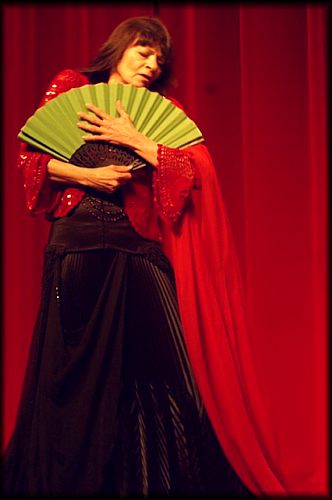
GS captures Dondi playing Marilyn in 2004

by Dondi Simone Dahlin
posted September 28, 2009

While most people agree that bellydance is one of the world’s oldest dance forms, it has been the relatively recent advancement in technology (YouTube and the mass marketing of DVDs for example) that have made it easier than ever to see, experience and learn from other dancers. Most of these performances and lessons were publicized to educate and inspire. However, some dancers are using the same music, costumes and choreography in their performances that they first see elsewhere. This begs the question: at what point does copying someone’s original concept or choreography cross over from homage to stealing? It is considered poor form as a comedian to use jokes written and used by another comic, and criminal to use the work of a songwriter without permission. I believe the original creations and choreographies of bellydance artists deserve the same respect.

I recently received an email from my good friend Beata in Germany. She wrote to me that a dancer, Natalya Becker from Russia had copied one of her choreographies and my “Marilyn Monroe” routine and was using both on a DVD being sold for profit. I was immediately curious. I wondered, is it copying if someone uses the same music and many of the same movements but not ALL the movements? The answer inside my head was “yes”. If a person watches videos or live performances of a dancer and uses obvious parts of their routine (especially with the same music) they need to give credit to the choreographer/creator of the dance. The dancer copying the music and movement needs to publicly give notice of one of two things:

  1. Inspired by dancer X and her original choreography;
    OR
  2. Dancer X’s choreography.

When I finally watched Becker perform the routine that Beata had choreographed, I was shocked. This wasn’t just parts of a routine; I estimated it was 90% of Beata’s original choreography danced to the same music.

YouTube “split screen” clip of Beata and Becker.
Copyrights in Oriental Dance by Beata & Horacio

As an artist I felt puzzled and angry. I know about the hard work that Beata and her husband Horacio Cifuentes undergo in order to generate Middle-Eastern dance masterpieces. Not only do they have a very long history of training and teaching dancers all over the world but they take annual trips to Cairo to produce some of the finest choreographies in bellydance. When they travel to Cairo, they hand-pick musicians to help compose the vision they have for their CDs. They then spend thousands of dollars laying down tracks in professional Cairo recording studios and return home to run their dance school in Berlin, craft high quality DVDs and work on original choreographies. Many of their choreographies take several months to complete. To have someone like Becker come along and copy Beata’s choreography with not one ounce of credit given to Beata has to feel like a punch in the stomach.

Horacio is a master dancer who was a member of many prestigious dance companies including the San Francisco Ballet. He remains as surprised as I do about Becker. He informed me that she stages big shows twice a year and is a highly trained dancer in Russian Folklore, ballet and oriental dance. Watching her dance on YouTube, she is obviously talented. After I viewed Becker’s clips, I searched for her website. She does reference Beata and Horacio and their school on her website. She also notes that she was one of their students and gives them high praise. I had a subsequent email conversation with Horacio after I became more familiar with Becker. He wrote me the following,

“What some of the dancers in our scene do not understand, for lack of education, is that in the professional world it is very easy to obtain choreographies from other artists. You just have to ask permission, pay a fee and give credit…….we are prepared to give our music for a very low fee, and actually would be prepared to permit choreography use for next to nothing, we just want respect. Many ballet companies perform choreographies by international choreographers, Balanchine, Jerome Robbins, Jiry Killian, etc… all the time. The choreographies are considered properties, and respected as such.”

At the time I viewed the clips of Becker I was informed that there were two other dancers on YouTube copying my Marilyn concept…what Marilyn Monroe would have been like as a belly dancer. In short, Marilyn Monroe Belly Dancing to one of her songs followed by a drum solo. In my Marilyn segment on the BDSS “Live in Paris” DVD there is a different female singer than Marilyn Monroe singing, “I Wanna be Loved by You.” In my opinion, the performance was much better with Marilyn’s Monroe’s original recording, which I used before Bellydance SuperStars and on tour with BDSS. But, ironically (and wisely) Miles Copeland chose not to use Marilyn’s original recording when it went to DVD because of copyright infringement.

YouTube clip of Dondi performing her original concept/creation of “Marilyn” with BDSS

In Becker’s clip she is portraying Marilyn Monroe Belly Dancing to “I Wanna Be Loved by You” followed by a drum solo. She is performing my original concept exactly.

Clip of Becker copying Dondi’s original “Marilyn” concept/creation:


In another performance there is a woman Belly Dancing as Marilyn Monroe with an original Marilyn Monroe recording followed by a drum solo (my original concept)

YouTube clip of dancer copying Dondi’s original “Marilyn” concept/creation:


And finally there is another performer bellydancing as Marilyn Monroe at a Halloween show.

YouTube clip of “Halloween” dancer copying Dondi’s original “Marilyn” concept/creation:

I created the Marilyn concept back in the late 90’s after performing Marilyn Monroe impersonations and working as a Belly Dancer for years. I wanted to do something comedic, as I had done before with my “Little Egypt” routine which I have been told paved the way for fusion dancers to wear bloomers, thigh high stockings, bustles and clothing of the 1800’s. In 1990 I was performing singing telegrams in South Florida. My acting agent knew I was a belly dancer and that I also did Marilyn Monroe singing telegrams…he wanted me to belly dance as Marilyn Monroe. At the time I thought it was a bizarre (even stupid) idea and I didn’t want to mix the two.  But, almost a decade later I remember thinking that my agent had been on to something and I began to think about combining both acts. 

The first time I performed Marilyn was in January, 2000, though the fascination started in 7th grade when a boy in school walked up to me and said, “You look like Norma Jean Baker.” When I discovered that he meant Marilyn Monroe (before she became “Marilyn Monroe”) my whole life opened up and I was now a Marilyn fan at the ripe old age of 11 years old. So, in 1999 when I created Marilyn Monroe as a belly dancer it was a labor of love. I had already studied her for 20 years and now I spent many long hours analyzing her facial expressions and body language all in relation to Belly Dancing. In 2004, Miles Copeland asked me to join the first touring company of “Belly Dance Superstars”. As we toured around Europe, America, Canada and Spain reviews came pouring in and while one newspaper would be heralding me as a “comedic genius”, others would say my routine was “freakish”.

Still others said that I had no respect for Marilyn Monroe and she was probably rolling over in her grave. It was at those times that Miles had heart-to-heart talks with me and assured me that I should continue performing Marilyn every night and to concentrate on the people who “got it.”

Getting a pep talk from Miles Copeland was like getting a pep talk from your Father who you have always wanted to be proud of you. Those were simply some of the best moments on tour and he encouraged me to combine my Marilyn skit with Issam Houshan’s drumming, and to dig deeper into the comedy…to turn it up a notch every night for hundreds of performances, even if some people didn’t get it. It was a long, amazing, evolving and complex journey with Marilyn.

Today I almost always dance improvisational without choreography. For me improvisation is the heart of Middle Eastern Dance. But, when I travel around the world teaching workshops I use the stylings of other dancers and I always give credit. In the early 90’s I learned extensively about rhythms and how to play zils from Delilah’s videos. When I had a career in the Middle East I picked up Raks Asaya tricks from Liza LaZiza and Khaleegi tips from Yasmina of Cairo. I learned about blocking choreography and group pieces from Jillina when I worked with her during the years with “Bellydance Superstars.” Sahra Saida and Shareen El Safy taught me how to tap into the “Egyptian feeling”. And, I often quote Morocco when I speak of history and culture in my classes. These and other dancers have helped make me who I am and I always give credit where credit is due. When I do choreograph a piece in class I inform my students that they are welcome to use the choreography but that I would like to be credited. Shouldn’t all dancers give credit where credit is due? How can a dancer feel proud about stealing original routines from other dancers and sell them or post them up on YouTube for all to see? In the past few years there have been an increasing amount of disturbing aspects in the Belly Dance world, this is just one of them.

I have tried to recall Belly Dancers who have given someone else the credit for their ‘borrowed’ choreography, and I could think of hardly any. I even sat in a gala show in which a dancer performed my entire drum solo choreography, with my chosen music move for move. Before she entered the stage, a two minute biography of her was read into the microphone and yet she never even mentioned that it was my choreography. I sat in the front row and melted into a surreal world of watching another dancer dance my creation completely, all 100% of it. And, yet she presented it as if it were her own.

Contrast this with an experience I had in spring of 2008. I was one of the teachers at Rakassah West. At this renowned festival there is one who always draws what I would guess to be the biggest crowd. As we all packed in like sardines to watch Suhaila and her dance company, the crowd was all a buzz that Suhaila had purchased the choreography we were about to watch from Amy Sigil of I heard $1,000, then $2,000, someone else said, “No, she paid $3,000.” I was smack dab in the middle of an active rumor mill! It was weirdly exciting. It never was clear about how much Suhaila paid and that didn’t really matter to me. What mattered was the high regard and respect she showed to another dance company. Here was one of the top choreographers in our business whose own choreographies are what legends are made of! Suhaila gave Unmata the ultimate “tipping of the hat” by buying the rights to their choreography so her company could perform it. Following her dancer’s performance of the Unmata piece (one of the most fabulous dances I had ever seen), Suhaila came out on stage and gave a bow to the audience. She also held her arm out to Amy Sigil, whom was in the front row crying out of joy, blew her a kiss and thanked her in front of the audience.

I later learned, from Suhaila, that the performance I saw at Rakassah had started to blossom a couple of years earlier. Suhaila was at Tribal Fest in Oregon and Unmata was also there. She saw Amy Sigil’s (Unmata) choreography to a drum line piece of music and she decided to highlight Amy’s work. She approached Amy to teach her dancers that specific choreography. Amy went to Suhaila’s studio many times and was indeed paid for her choreography and instruction. She also knew from the beginning that Suhaila was going to present her piece at Rakkasah. She always gives credit to Amy for her work and has since worked with Vashti and Tanja. Suhaila credits and compensates choreographers and dancers she works with and because of that keeps the professionalism of Belly Dance at a very high level. Unfortunately, this is not always the case in our business. I asked Suhaila for some of her thoughts on the subject of copyrights. She said,

“In the Belly Dance World we are so far removed from ’the real dance world’ at times that things like the issue you are writing about can get confused. I think that if we conduct and model ourselves from the dance world (not the belly dance world) we will have a better chance of being accepted in time.”

Obviously Belly Dance has been evolving for hundreds if not thousands of years and we all have borrowed movements from other dancers and performances of the past. There are only so many moves a body can make and similarities will always be present. Musicians, dancers, composers and all performing artists will continue to glean their inspiration from other artists along the way. However, to intentionally steal and copy someone’s choreography, concept or artistic creation for their own personal gain and not give any credit is a practice that has nothing to do with artistry, principles, or integrity. And, until Belly Dance has those three aspects as a firm, solid foundation, this dance will never be raised to a legitimate dance form.

Have a comment? Use or comment section at the bottom of this page or Send us a letter!
Check the "Letters to the Editor" for other possible viewpoints!

Ready for more?


Gilded Serpent presents...

Wiggles of the West

Sonja and friend in Las Vegas

One Dancer’s Foray into Competition

by Sonja
posted September 27. 2009

In the world of belly dancing lately, dance competitions seem to be the big thing. Love them or hate them, they are popping up all over the country, leaving one to wonder what benefit they add to our art form. In an art form as varied as Middle Eastern Dance, incorporating cultures crossing multiple borders and continents, to what standards do these competitions adhere?

Belly dance communities struggle to define what constitutes a professional dancer, yet still we as dancers surge forward into yet another, even more subjective realm—that of judges and score sheets.

Competitive dance has been around for centuries. Irish step dance competitions flourished in the 1800s; Africans transplanted the competitive “Juba” to the American south and the Caribbean in the 18th century as a challenge of skill and agility.  Perhaps our earliest ancestors incorporated competitive dance into their rituals to assert their strength and flexibility. Time, it seems, is all that is required to turn art into competition. Why not? Humans seem to thrive on challenges to better themselves.

I took my first step into the competitive dance arena this year. After doing a little searching around, I ran across the Wiggles of the West competition in Las Vegas on a website. I read comments from previous participants who indicated that “Wiggles” was considered to be a pretty laid back, kind competition for dancers who had never competed before. (The name alone seemed pretty relaxed!)   

I signed myself up for the Wiggles of the West competition, and quickly talked my friend and dance partner, Kimberly, into signing up with me. She’s been dancing for 30 years—mostly ballet and jazz—and had competed in other dance forms before, so she was interested to see what a Bellydance competition would be like.

Wiggles hosts competitions in 8 categories:

  • Headliner (mature dancers),
  • Rising Stars (intermediate dancers who have never received money to perform),
  • Hobbyist (those just dancing for fun),
  • Alternative (themed solos dancing to non-bellydance music),
  • Mini Ensemble (duets),
  • Ensembles (more than 2 people),
  • Tribal Ensemble, and the big guns,
  • Entertainer of the Year (pro, semi-pro, or advanced performers).

I signed up for Entertainer of the Year as well as Mini Ensemble with Kimberly, and she also signed up for Alternative.

Right off the bat, (before either of us even began preparing for the competition) neither Kimberly nor I could figure out how the judges would be able to objectively compare contestants in the Entertainer of the Year or Rising Stars categories!  How can proponents of different styles go head-to-head in one competition and have any hope of being judged objectively?

July rolled around; both Kimberly and I (and our husbands) loaded up all our stuff and headed to ‘Vegas. The competition venue was located about a 20-minute cab ride off “The Strip” at Sam’s Town Casino. The venue location was pretty nice for the price! The indoor atrium display with its fake animals was a little hokey, but cute enough, especially for families. When I checked into the competition, I was a little put off by the lack of organization. I’m routinely early, which means I usually catch people at their worst while they are struggling to get set up, so that may have been my fault partially. However, I felt that I was almost expected to already know where to be and what to do that first morning. Indeed, it seemed like some people did have apriori knowledge, but later, I came to understand that some dancers compete almost as frequently as I do laundry.

Despite my initial confusion, I managed to check in and caught up with a handful of other dancers with whom I was acquainted already. It was Thursday, and the competition categories didn’t start until Friday, so Thursday was filled with workshops primarily and, later, with a small dinner hafla.

By Friday morning, I began to realize something that hadn’t occurred to me beforehand. I noticed that many (if not most) of my fellow competitors were not in the workshops I was taking. At least, the competitors in the Entertainer of the Year category didn’t seem to be in the workshops. Perhaps my impressions were partially colored by the fact that there were multiple workshops taking place simultaneously, so people were in different rooms. However, I’m fairly certain a good number of competitors just came for the competition without the workshops. At first I was surprised, but then I came to the realization that nowhere in the rules did it specify that anyone was required to register for the workshops in order to compete. I was left wondering if that is the case at most competitions.

Friday’s competitions began at 3 in the afternoon. When I checked-in that morning and handed my music CD to the person at the desk, I failed to ask if everyone had to be there at 3 p.m. or if check-in time differed for everyone. Assuming that check-in time for the competition was universal, and that the competition would move along at a rapid pace with no more than a few seconds between numbers, Kimberly and I showed up promptly at 3 p.m., fully costumed, with 18 contestants in the category in front of us.

Four hours later, we were still waiting, fully costumed, for our competition category to begin. In those four hours, we discovered that each contestant received 5 minutes of dance time, followed by 15 minutes of oratory by the contest organizer (or at least it felt that way to our bead-indented backsides).

Kimberly and I took the stage as the first contestants in our category at around 7 p.m. By that time, we had waited in costume so long that we were no longer nervous, and we earnestly wanted our performance finished so that we could change out of our dance costumes and eat dinner. Unfortunately, Kimberly still had to compete in the alternative category later that evening!

Sonja competesWe watched one other duet following ours (The two dancers turned out to be the winners.) and immediately recognized that our style was different. Isis and Yvonne, both beautiful and highly skilled dancers, performed as a duet and were far more technical in terms of “pops and locks” than Kimberly and I. It felt like contrasting ballet against hip-hop or jazz—you could almost tell we were dancing the same genre—sort of…  Precisely at that moment, I had a sinking feeling that the way I danced was not going to be at all similar to the way anyone else at the competition danced!

After a quick dinner, we hurried back so Kimberly could perform in the Alternative category. I’m not sure how to describe that category, other than to say that if nothing else, it was definitely entertaining. In fact, I enjoyed it more than any other category in the show. The category description specified that dancers should incorporate at least 50 percent Bellydance movements, dancing to non-Bellydance music. In the end, though, it was an odd conglomeration of mixed styles, mostly humorous. Friday’s competition ended right around midnight.

Saturday brought the beginning of the Entertainer of the Year preliminaries. Having been educated the day before, I didn’t get dressed or check in until immediately before the category began, and I was thrilled that I had requested to be the first performer so I could then be free to relax and enjoy Las Vegas afterwards. As I prepared backstage, I was struck by my observations of how kind and supportive all of the other competitors were. Nearly every dancer I encountered was encouraging and friendly, willing to share costume tape, eyelash glue, safety pins, or other forgotten necessities. The same was true after I finished my performance and rushed backstage, out of breath and full of adrenaline.

There, helping hands were ready to hug me, calm me down, and offer words of congratulations and encouragement, even through their own pressing nerves. If I express nothing else about the individual performers at Wiggles, I found nearly all of them to be very gracious, professional, kind, and extraordinary women.

I stayed and watched many of the competitors after my performance. I knew almost immediately that I would not make the finalist list. I felt that way less because of a lack of confidence in my dance ability than in a realization that there is a sort of standard format and expectation in competitions of which I had been unaware.  Therefore, I hadn’t followed the normal procedures. At least, from the performances I saw at Wiggles, there appeared to be normal protocol. Admittedly, I did not see everyone perform. However, of the dancers whom I did see perform, I noticed that each performance seemed to present a “mini-show” of the sort you might find at a nightclub or restaurant complete with veil entrance, balady or sagat segment, drum solo, and finale. I felt it would have been beneficial to have those expectations or standards stated up-front, if those are indeed standard.

On Sunday, I checked in and, sure enough, I had not made the finals list. I was a bit disappointed, but at the same time, I was glad to be able to watch and not worry about another performance. On that day, I watched most of the finalists and the Rising Stars categories. It was during the announcement of the winners of the Rising Stars category that something leapt out at me, taking me off guard, and raising the initial questions that I had not asked myself previously. I realized, as I sat and rifled through the competition program, that there were a few things that were difficult to overlook.

Most notably, was the fact that several competitors (both those that won and those that didn’t) were intimately involved in the competition planning process, either as volunteers, workshop instructors, sponsors, or vendors, or who had instructors who functioned as judges of other categories. Just briefly scanning the program, with no prior knowledge of affiliations, I counted at least 5 potential conflicts-of-interest.

Having not participated in any other competition, I have no basis of comparison on which to gauge Wiggles. However, the potential for conflicts of interest does beg these questions:

  • Should workshop instructors be offered the opportunity to compete at the competitive event at which they are teaching?
  • Should competitors be encouraged or allowed to volunteer at the events in which they compete? Should sponsors be granted competitive spots?
  • What are newcomers to competitive dancing to make of those relationships?
  • Many of the women who won at Wiggles were not connected to the competition in any way, and all of the women who won or placed that I was able to observe were skilled dancers and beautiful performers. However, even the possibility of bias or conflicts of interest at competitive events can serve to cheapen the experience for everyone involved, and to tarnish the sparkle of the trophies that result.

So then, I return to the questions I raised at the beginning of this article and have yet to answer:

  • What purposes do competitions in Bellydance serve?
  • How will we, as a dance community, continue to promote and support a wide and wonderfully diverse cultural art form within the context of competitive dance?
  • What standards should be met, and how will competition organizers protect those standards?

The Wiggles of the West Competition was a fun experience for me, but I don’t know if I will ever enter another competition. Maybe I will, but if I do, it will be somewhere on the East Coast where I feel that I am more stylistically centered. More importantly, I left the competition, feeling proud of myself and of the other dancers I met in Las Vegas, and I will have continued interested in watching the progression and evolution of competitions in this particular dance genre.

Have a comment? Use or comment section at the bottom of this page or Send us a letter!
Check the "Letters to the Editor" for other possible viewpoints!

Ready for more?


Gilded Serpent presents...

Belly Dance Novels, Light and Dark

Wendy and DeAnna's Books

The Belly Dancer by DeAnna Cameron &
Midnight Rose by Wendy Buonaventura

Reviewed by Bonita Oteri
posted September22, 2009

"The Belly Dancer"  by DeAnna Cameron
Berkley Books, ISBN# 978-0425227787

The Belly Dancer"The Belly Dancer" is a delightful, light, entertaining romance novel with unusual twists.The book also affords readers an educational, historical background. This novel, like most historical fictional novels, does make minor "poetic license" leaps in character traits to bridge the gap between their time and ours and to afford us empathy with their situations. However, author DeAnna Cameron deftly peels back the layers of Gay Nineties society and affords a richly descriptive and fascinating glimpse into the life, times and giddy excitement of the 1893 Chicago World’s Fair.  DeAnna has researched turn of the century Chicago and paints a believable atmosphere of this momentous, historical event where Belly Dancing reportedly was first introduced into the United States.  While I am no academic, historical expert on the era, I found only one minor editorial oversight that places Ouled Nail Dancers in the Turkish Pavilion/Tent.

The overall carnival excitement, curiosity and wonder of the Chicago Fair visitors is infectious.The pages teem with the unbridled enthusiasm and hope of our still young, shiny and new pioneer nation.

Any fictional heroine such as our intrepid leading lady must also traverse the dark, murkier side of 1890s Chicago. She experiences dilemmas and choices that are relevant in any era – racism, exclusive "members only type" societal cliques and the age old question of "What if you get everything you wished for, and it’s not what you really wanted?"  I will not spoil the book by revealing too much… but suffice to say that the conventions of the time and culture are as tight and constricting emotionally and spiritually, as are her corset stays physically. How does she overcome these inhibitions and set herself free?  By learning and channeling the power of belly dance to launch all that suppressed inner passion and fire.

My favorite exchange in the book is when the scandalized, gently reared heroine comes upon a choice between a "fun" liaison and the serious marriage choices she has been taught are vital all her life long.  She asks her saucy, adorable but rock-steady Egyptian belly dance mentor,  "But what if HE meets someone else?" The Egyptian Ghawazee teacher laughs and replies confidently, "What if I meet someone else? "Wow, consider the hours of mutual girlfriend counseling we could avoid if we all shared this positive, self-esteem building, light-hearted attitude.

This book makes for great end-of-summer beach reading or a unique Christmas gift for moms, sisters, adult daughters or girlfriends who might not be dancers themselves but would like a glimpse into what motivates some to study belly dance.  Perhaps the tiniest, tantalizing taste…will overcome and seduce them into the next belly dance class opening in your neighborhood….. The cover art is lovely and DeAnna Cameron the author will be glad to send you some bookmarks as supplies last to distribute to your students.

You can contact her at  deanna@deannacameron.com.

Zil Ratings: 3 zills
Zil Ratings

“Midnight Rose” by Wendy Buonaventura
Cinnabar Books, www.cinnabarbooks.co.uk, ISBN 978-1-898495-07-9

Midnight Rose"Midnight Rose" is a historical fiction novel based on the life of Maud Allan.  A British gentleman quips, “She was the Marilyn Monroe of my times.”  Maud was an American born dancer who gained notoriety in Europe for performing on stage as Salome, The “evil” biblical temptress. 
Her dancing career and her adventurous youth occurred at the dawn of the bohemian lifestyle era, which allowed women to toss their corsets and become flappers of the Roaring Twenties.

She was a contemporary of Isadora Duncan and Mata Hari; and while never as famous as these two women, her dancing appears to have incorporated some of the elements for which these dancers were best known.  Her character seems more similar to that of Mata Hari, for whom dancing was a means to an end, than that of Isadora, who was a true pioneer in the modern dance field.

This book blends historical court record transcripts, actual reviews and media articles of the era with fictional dreams and diaries to provide the author’s insight into how this fearless woman might have felt and what might have motivated her behavior, which was scandalous by Edwardian era standards. 

Maud definitely walked on the wild side even by today’s societal mores; this fictional account suggests she might have dabbled in threesomes and lesbian relationships.  Nonetheless, she is a hypnotic character brought to bold life on the pages by Wendy’s seamless fusion of fact and fiction.

Zil Ratings: 3 zills
Zil Ratings

The Gilded Serpent Editor asked me to compare and contrast these two novels, which may appeal to totally different audiences.

“The Belly Dancer” has mass marketing appeal to many women as a light, entertaining romance novel; it is a good introduction to the art form which, I believe, will even entice more than a few ladies into our classes. In contrast, “Midnight Rose” has a darker side and is not for the faint hearted who want to read a happily ever after type novel.

 Wendy has done a great service to the dance world in painting an unabashedly brazen portrait of this fascinating, incorrigible and yet in some ways vulnerable woman.  This more serious, semi-biographical literature will appeal to those interested in the Edwardian era, the dance style emerging at the time and a fascinating tale of the “liberated” woman from the early days of the twentieth century.

See Bonita’s GS bio page here.

This is not the correct price. Check Amazon UK or get direct and authographed from Cinnabar linked above

Buying through this Amazon link does help support Gilded Serpent!

Have a comment? Use or comment section at the bottom of this page or Send us a letter!
Check the "Letters to the Editor" for other possible viewpoints!

Ready for more?


Gilded Serpent presents...

Photos of


Caravan of Secrets

Co-produced Theatre Production by Zahra Zuhair and Carolyn Krueger

August 15th and 16th, 2009
Electric Lodge Theatre, Venice, California

Photos by Alvin and Fransisca Sugianto
Text by producers Carolyn Krueger and Zahra Zuhair.
posted September 17, 2009

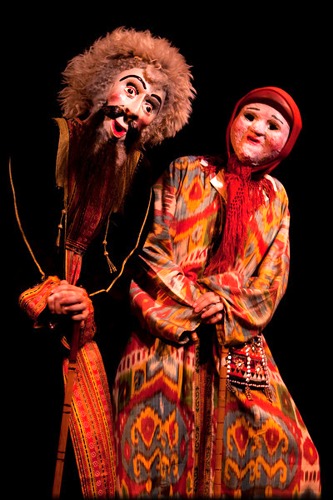
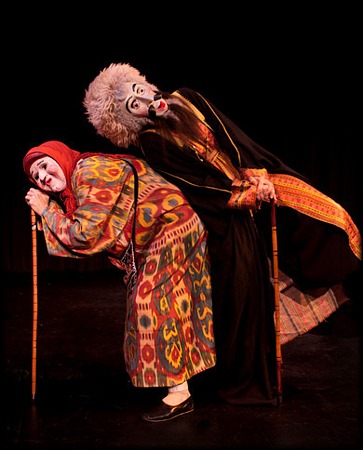
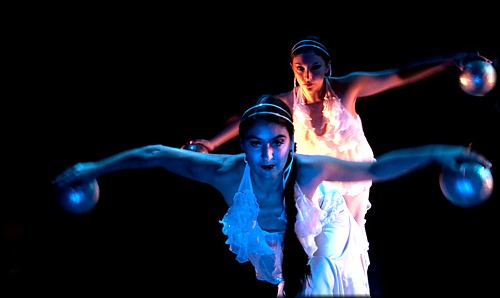
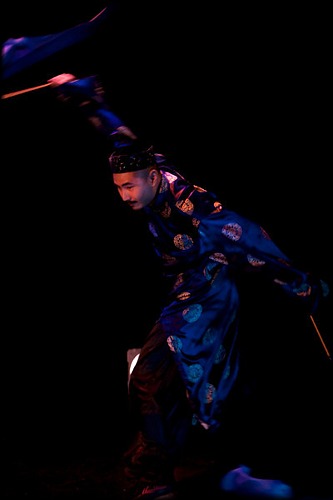
Caravan of Secrets is a co-production featuring two original dance theater works by choreographers Carolyn Krueger and Zahra Zuhair. Caravan of Secrets navigates imaginary landscapes inspired by the cultures and contradictions found among the ancient Silk Roads, Sea Routes and Gypsy Trails of the Middle East and Central Asia.

Carolyn Krueger and I first began working together in 1994 when I was recruiting dancers for a concert with the renowned Egyptian composer, Said Makawi. After the concert, Carolyn asked me to participate in her educational program performing for the Los Angeles Unified School District. The show was titled “Silk and Sand,” featuring traditional dances from the Silk Road and the Arab World.

Carolyn and I have each produced our own theater shows, as well as performed in each other’s productions, but “Caravan of Secrets” was our first collaboration on a full-length theater show. We were happy with the success of the show and look forward to many more years of working together.


Zahra’s "Tapestry"

Zahra Zuhiar’s "TAPESTRY" weaving through the fabric of rare Arabian tales,
a perfumed potion unveils and whimsical array of dance fantasy.

Purfumes

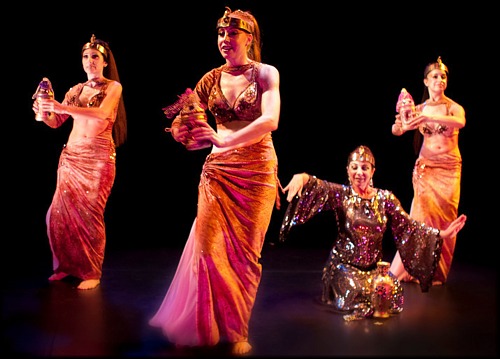
Dance: "The Sorceress and Magical Perfumes,"
Myrna, Nar, Zahra Zuhair (kneeling), Shaunti

Fairies

Dance: "Fairies Dance,"
Nasila, Myrna, Nar, Farrah, Lailah

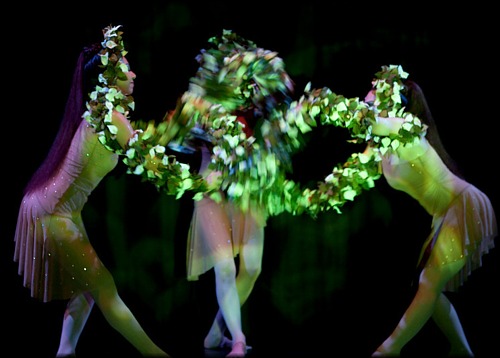
Trees

Dance: "Tree Melodies,"
Akiko, De Villa, Oceana

Birds

Dance: "Birds of a Feather,"
Lailah, Shaunti, Nar, Myrna, Nasila

Madman

Dance: "Majnun (Madman),"
Michael Lee

Butterflies

Dance: "Transcendence,"
De Villa, Oceana, Akiko

Spirits of the Garden

Dance: "Spirits of the Garden,"

Zahra Zuhair (front), Shaunti, Lailah, Myrna,
Nar, Farrah (right corner)

Sea Girls

Dance: "Sea Dwellers,"
Akiko, De Villa, Oceana

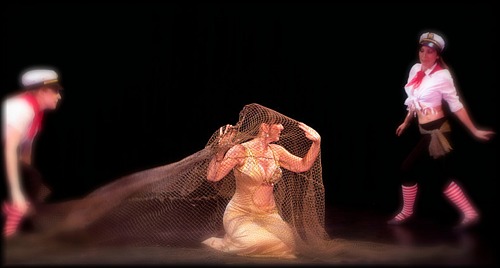
Fisherman

Dance: "Fishermen,"
Nar, Zahra Zuhair, Myrna

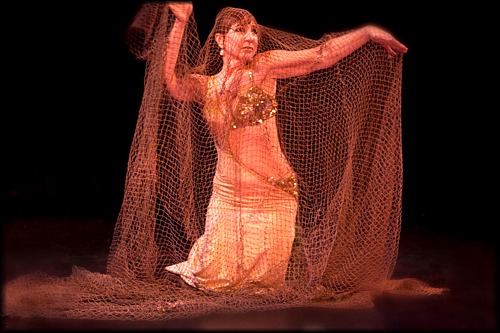
Nets

Dance: "Lonely Shores,"
Zahra Zuhair


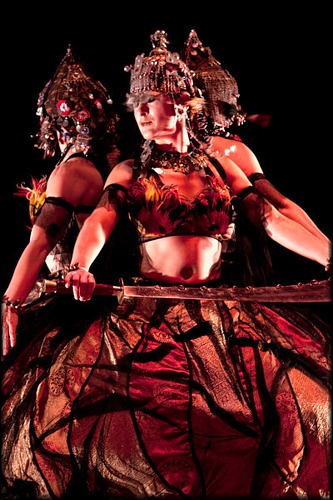
Carolyn Krueger’s "Crossings"
Carolyn Krueger’s "CROSSINGS" mythical beings journey through the seasons
and across dimensions in a kinetic collage of alchemy and ornament.

Enchanted Dune

Dance: "Enchanted Dune,"
Nikii Henry, Michael Lee

Enchanted Dance

Dance: "Enchanted Dune,"
Nikii Henry, Donna Speckman, Monica Ramos

Bamboo

Dance: "Bamboo I,"
Carolyn Krueger, Sina

Bamboo

Dance: "Bamboo I,"
Carolyn Krueger, Sina

Bamboo

Dance:"Bamboo II,"
Nikii Henry, Monica Ramos, Alexandra Rozo, Donna Speckman

Jane Glaser
Dance: "Missing,"
Jane Glaser

Mountain Ancestors

Dance: "Mountain Ancestors,"
Nikii Henry, Alexandra Rozo

BlueSky

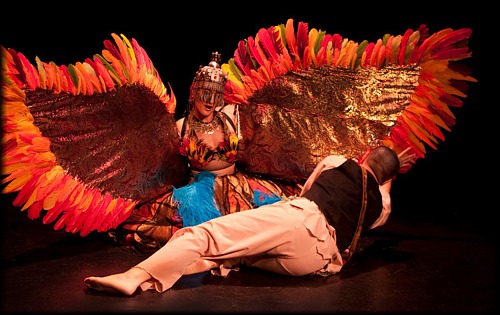
Dance: "Blue Sky,White Wing,"
Michael Lee as Father Blue Sky

Blue Sky

Dance: "Blue Sky, White Wing,"
Nikii Henry as one of the First Flowers

Blue Sky

Dance: "Blue Sky, White Wing,"
Alexandra Rozo as one of the First Flowers


Have a comment? Use or comment section at the bottom of this page orSend us a letter!
Check the "Letters to the Editor" for other possible viewpoints!

Ready for more?


Gilded Serpent presents...

Sex, Belly Dance and the Afterlife

Ancient porn customer

by Yasmin Henkesh
posted September 17, 2009

Who saw the History Channel program last month about the “hidden Egyptian sex papyrus?” Apparently, a lot of people. Sex in the Ancient World is a hot topic for the channel. The series is a hit, R rating and all. This particular episode focused on a little discussed and badly disintegrating papyrus owned by an Italian museum. The artwork in question, the “Forbidden Papyrus of Turin,” is along the lines of the Kama Sutra – except that it was created 1800 years before India’s definitive sex manual.

Participating in the program was Lise Manniche, a well-known archeologist and specialist in the field of plants, perfumes, sex and musical instruments of the ancient Egyptians. She has written four widely published books on these subjects and is highly respected, even by Zahi Hawwas, head of Egypt’s Supreme Council of Antiquities. Given the explosive nature of the subject matter, the channel was wise to bring in such a distinguished talking head.

The “secret” scroll was found at the beginning of the 19th century in the ancient workers quarters of Deir al-Medina, across the Nile from Luxor. It dates from the New Kingdom, probably the reign of Ramsses II (1278 BC to 1213 BC). But once discovered, the papyrus was quietly hidden away for over 150 years – because its Playboy-like erotic illustrations offended Victorian sensibilities.

With a deft hand, the original artist had sketched Hathorian musicians, in 12 different positions, fornicating with hairy, and often old, men. Perhaps these customers were disreputable priests of Amun, or even the old pharaoh himself. No one is quite sure. The women,on the other hand, appear bored. Some have a lyre and sistrum. Others make fun of the performance issues of their partners. All wear a wig, elaborate jewelry and a dancer’s belt. None wear clothes.

HathorThe History Channel program implied that these women could have been ancient belly dancers. After all, their mistress, Hathor, was the goddess of both music and dance. She was also the Lady of the Vulva and the Lady of Drunkenness. She was the Celestial Cow, the Golden One and the Mistress of Life, Love and Death. Her adepts trained in the art of stimulating the life force of creation. To them, sexual arousal was a matter of life or death, literally. Ancient Egyptians firmly believed that without a strong desire to procreate, i.e. sexual energy, the dead would not be reborn into the next plane of existence. Since the ultimate goal of the gods, pharaoh and later, anyone who could afford a proper burial, was life after death, and the only way to get there was to excite their regenerative forces, the priestesses’ movements had to inspire desire.
To these people, sex was not dirty, shameful, frightening or forbidden. It was a natural part of daily life and the essential prerequisite for birth – on earth or in the Afterlife.

Hence, banquet scenes on tomb walls included coded details of sexual behavior. By the New Kingdom (and Moses’ departure from depraved pharaonic society) images of diaphanous linen gowns, perfume cones, blue lotus flowers with their mind-altering scent, music, alcohol, and erotic gestures occupied a place of honor inside a deceased’s final resting place. These earthly pleasures were to re-ignite the departed soul’s fire of desire, with the help of Heka, or magic. Heka brought the pictures to life – for eternity. The jiggling clay rattles or shells on the perennial dancers’ belts (no, they were not referring to coin hip scarves in the program) supplemented the sounds of sistra, tambourines, clappers and finger snapping to keep
away malevolent spirits during this precarious time of transition.

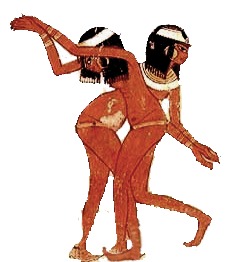
ancient dancersDancers and musicians played an important role during pharaonic festivities honoring the dead, in the same way they are called on today to awaken the life force of newly-weds. Before conservatism replaced ancient customs, the modern belly dancer would move between the new couple, take a hand from each and place them on her womb as a fertility gesture. Hathorian priestesses once embodied the goddess’ attributes of love, music, dance, family, childbirth and rebirth after death. Today her adepts are few and far between. Paganism has been replaced by monotheistic righteousness. Public sexuality is now taboo.
It is true that not all ancient dances were meant to arouse the senses. As archeological evidence proves, there were many types; all-male war dances, the Muu Ancester dance, paired and troupe acrobatic performances (complete with choreography), dwarf numbers, funeral dirges and religious processions.

But the performances I am referring to, and those that most resemble present day belly dancers, are the solo improvisations done by one or two young women, sometimes playing an instrument, sometimes not.

They appear in New Kingdom art as wearing only jewelry and a belt. Sometimes these women are labeled as slaves; sometimes they have a tattoo of the household god Bes on their upper thigh. More often than not they are shown with an object that links them to Hathor; a sistrum, a menat collar, a musical instrument or alcohol. They were after all servants to the Lady of Drunkenness, and it was their role to help guests enter an altered state of consciousness, through alcohol, musical ecstasy and/or incense-induced trance.

I read a while back on a belly dance chat-board, during one of many heated discussions on sexuality – or lack thereof – in the dance, that one skeptic questioned the dance’s erotic roots.

“I question what they say. And I’d question that as the dance’s root. If you go farther back, you see less “sexuality”, and much more like the social dance aspects of raqs, people getting together and having fun dancing. I think that’s more likely the root of our dance form than the public performances…”

With programs such as the History Channel’s Ancient Sex series and regular new archeological discoveries, it is time to re-examine our beliefs (andfantasies) about the origins of our art form. It is time to accept the facts – that belly dance’s precursor was designed to stimulate and reawaken vital reproductive forces, during life or after death. It was meant to open the senses of the dead and increase the blood flow of the living. What is shameful about that?

The program will be available for purchase on DVD in October 2009 here: The A&E Shop

Turin papyrus link: http://www.geocities.com/zoser8/turin.html

Further reading:
  1. Ruth Schumann Antelm, Les Secrets d�Hathor / Sacred Sexuality in Ancient Egypt, 1999 Editions du Rocher, Paris.
  2. Lise Manniche, Sexual Life in Ancient Egypt, 1987, KPI London
  3. ” Music and Musicians in Ancient Egypt, 1991, British Museum Press, London
  4. Hans Hickman, Catalogue des Instruments de Musique au Musee de Caire, 1949, Cairo
  5. Curt Sachs, The Rise of Music in the Ancient World, 1943, W Norton, NYC
  6. ” , World History of the Dance, 1937, WW Norton, NYC
  7. Sir Gardiner Wilkinson, The Manners and Customs of the Ancient Egyptians, 1837-41, London
  8. Irena Lexova, Ancient Egyptian Dances, 1935, reprint 1999 Dover Publications

Have a comment? Use or comment section at the bottom of this page orSend us a letter!
Check the “Letters to the Editor” for other possible viewpoints!

Ready for more?


Gilded Serpent presents...

Pop, Locks and Shimmy x 2

Pop lock x 2

2 DVDs with Almost the Same Name

Reviewed by Martha Duran
posted September 17, 2009

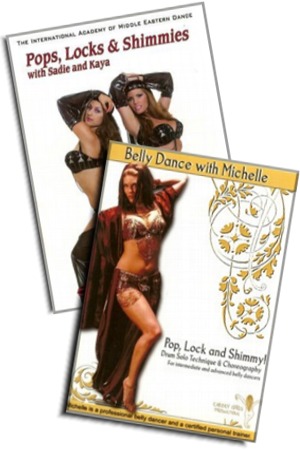
Michelle's popPop, Lock & Shimmy: Drum Solo Technique & Choreography
(Intermediate / Advanced Belly Dance) by Michelle Joyce

This is a practice DVD for intermediate and advanced dancers that helps sharpen the moves. I would call it more of a drills DVD to improve your abilities to perform a drum solo with clear movements and exercises to keep your dancing strong, young, and crisp.

This DVD starts with a dance movement warm-ups; it includes not only a stretch but also a small section of dance movements to follow along and warm up the body. Then, immediately jump starts to the practice steps that are used in the drills that are done for most of the 90 minute duration of this DVD.

This DVD has a great drill section; it takes your breath away – literally, every movement is done enough times to improve your muscle tone or at least your ability to make that move stronger.

From hip lifts to hip drops, hip twists and shimmy’s to layered movements of the torso and hip that are challenging for an intermediate dancer and just a dance along for an advanced experienced dancer.

The title of DVD contains DRUM SOLO TECHNIQUE which is more than just strong nice movements. An intermediate dancer knows the moves and most of them know about rhythms and the appropriate steps for each one. An advanced experienced dancer knows all of the above so this DVD is not an educational DVD for advanced dancers, it’s more of a practice along dance program to improve your dancing, BUT, for an intermediate dancer, this DVD lacks the main technique to drum solo dancing and that rhythm technique is an important element that goes hand in hand with movements.  For the intermediate dancer, it’s a follow along torso focused kind of practice DVD.  The format is great – it has nice music, great editing and staging making it a professional production.
This video is available through Cheeky Girls Productions

Zil Ratings: 3 zills
Zil Ratings

Pop, Lock, & Shimmies with Sadie and Kaya

This DVD is similarly named but has a totally different perspectives of the pop, lock, and shimmy title.

This DVD starts with an introduction that explains the difference of a pop versus a lock and the definition of a shimmy; it’s very educational on the background of the pops and locks.

It continues with teaching you moves on upper body isolation, pelvic isolation, horizontal hip isolations, vertical hip isolations, vertical single hip isolations, downs shimmies, and even more… It teaches you each move from breathing to muscle articulation then does a section of drills to practice those steps just taught. The drills include the variations of these steps with the pops then the locks and then another drill section with shimmy’s and layers of movements.

A very well explained and easy to follow DVD for every level. A beginner can learn a lot from it; an intermediate dancer can achieve a lot on her performance skills practicing along with this DVD; an advanced dancer can get lots of practice from it.

Sadie and Kaya explain every single move the body makes when doing a hip twist, a walkman drop and they repeat the explanation enough times so you are consciously able to do the step and get the coordination of the mind and body. It’s like going to a Sadie and Kaya seminar where you’re the only student and they are explaining what you’re feeling along with the steps and movements.

This DVD has an excellent format, great music, and the title is very appropriate for it.
This video is available through IAMED

Zil Ratings: 4 zills
4 zil ratings

So what’s with the title dilemma? who deserves the crown for the first pop, lock, and shimmy DVD, or who did the best one? After dancing along several times to each DVD, what matters most to answer the question who did it right – the appropriate title to the appropriate production: Sadie and Kayas DVD on pops, locks, and shimmies really is about pops, locks and shimmies. Michelle Joyce’s DVD did come out first and is a great DVD but with the wrong title.


Have a comment? Use or comment section at the bottom of this page or Send us a letter!
Check the "Letters to the Editor" for other possible viewpoints!

Ready for more?


Gilded Serpent presents...

Yousry Sharif

Yousry

Makes a Stop in Tennessee

by Sonja Oswalt
Article posted September 16, 2009
Workshop held in June 6 and 7, 2009

Yousry Sharif drew dancers to Knoxville from as far away as Chicago, Miami, Atlanta, North Carolina, and South Carolina to experience his unique combination of traditional Raqs Sharki and Jazz-influenced choreography when Oriental dance artist Alexia Smith hosted a workshop and theatrical show dedicated to the renowned instructor and choreographer.

mikehandTV Interview
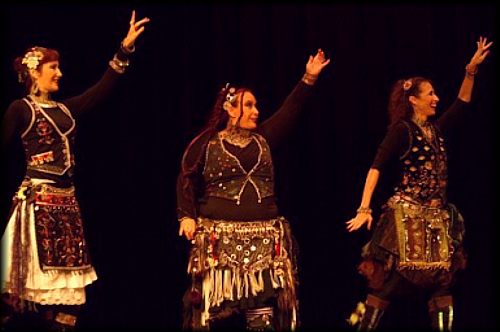
A live television interview on a local news station began the weekend with the internationally recognized dancer, Virginia,who is Mr. Sharif’s long-time student and protégé. Virginia and Alexia shared their reasons for pursuing Middle Eastern dance as an art form that is a “very empowering dance for women,” and members of Alexia’s Alexandria Dancers ensemble performed live a choreography featuring sagat for television viewers.  I was part of the performance as a member of the Alexandria Dancers, which was a new and bizarre experience for me. 

Dancing for television is neither as easy nor as fun as dancing for a live audience, I discovered.  The sterility of television cameras is startling; there is no give-and-take between an inanimate object and a performer!  Surprisingly, the end result turned out to be satisfactory, and as a result, we received several calls and emails about Middle Eastern dance.

The Workshop
Yousry taught a 2-day workshop covering Saturday and Sunday. We weren’t quite certain what to expect, since we had been told that he could be quite harsh with his classes. (Some of us students may have a tendency to goof off a little in dance class.)  He turned out to be a likable person, in addition to being an amusing teacher.  You could have heard a pin drop when he first came into the class on Saturday.  I think those of us who had never enrolled in his class before were either a little intimidated or fearful that we might be thrown out before the class even started—if we spoke up. He didn’t waste any time getting down to business; I think he had barely entered the room before he began our warm-up exercises.  I thought this was refreshing, as I’ve spent a lot of time standing around in other workshops and classes while the students waste time chatting, which I find personally frustrating.

The room was packed, a condition that was both a blessing and a curse.  Yousry teaches by jumping right into the first combination in the choreography he intends to teach.

He often composes choreographies on the spot, but this particular choreography was one he had taught before.  That turned out to be a good thing!  Since he had taught the choreography before, Virginia knew it already and was able to position herself midway between the front and back of the room—so that those in back could follow her to avoid “getting lost”. 

Yousry’s teaching style is advanced, as is his choreography.  Both days, I noticed that several people gave up, choosing to sit out or take notes rather than try to learn the steps.  I wouldn’t recommend that beginners try his workshops as their first attempt at learning in a workshop!  However, for intermediate and advanced students, his material is refreshing and challenging.  His combinations are heavily influenced by jazz and ballet, and they cover a lot of floor space—something to which I am accustomed, and that I like. 

opening of show

The Show
click for larger imageOver 200 guests attended the Saturday night theatrical showing of “Egyptian Nights 2009: a Tribute to Yousry Sharif.”  The opening scene was designed to mimic the inner sanctum of a Pharaoh. Servants fanned Pharaoh on his golden throne to the thrum of an ancient rhythm stroking the air. As the scene progressed, dancing girls paraded gifts to him amidst flickering candelabra and glittering wings. The smoldering scene ended as Pharaoh passed his golden staff to Alexia, in her role as an Egyptian goddess.

Additional scenes in the show included a breathtaking guest performance of folkloric Saidi and classical Oriental by American Academy of Middle Eastern Dance Hall of Fame inductee and off-Broadway producer and choreographer, Samara
There was a stunning appearance in exquisite costumes by guest artist Virginia, and a playfully exciting, authentic Maleya Luff performed by guest artist Erika from Chicago. Guest dancers from Atlanta, Knoxville, and Chattanooga contributed performances in classical Oriental, Folkloric, and even Hungarian “Gypsy” dance. Alexia and her Alexandria Dancers rounded out the show with group performances of sagat, Saidi, and a redux of Adam Basma’s Debke choreography. 

Yousry sat on the front row during the performance, and is rumored to have remarked “that is me dancing up there!” when Virginia made her appearance. 

As a performer, I expected to be intimidated by Yousry’s presence in the audience.  In reality, though, when I stepped out on stage and spotted him in the audience, he became “just another smiling face”.  At the beginning of his workshop on Sunday, he complimented all of the performers on the quality of our show—a compliment that sincerely touched our hearts.

Yousry is Cairo-born and began his career in Egypt, but continued dazzling audiences after his move to New York in 1981. He has commanded a large following throughout his career in Oriental Dance, and has taught workshops and lessons throughout the world. Knoxville was his first visit to Tennessee, and was made possible through his long-standing relationship with Alexia Smith, who has studied with him since his introduction to the U.S. in the early 1980s. When asked to comment, Alexia remarked, “Yousry is an inspiration and a talented artist who keeps me grounded in the Egyptian style of dance!”


Alexia


Yousry class photo
Click image for enlargement
Front row: Debbie Dill, Masha Kamishkova, Debbie Ashton, Mary Butcher, Sonja Oswalt, Rachel Wright, Rachel Smith, Unknown, Unknown
Second Row beginning with Virginia in blue (and dipping in front of Yousry): Virginia, Cindy, Holly Prince, Gina, Yousry, Alexis Smith, unknown, Anne, Kimberly Palatinus, Kristy Becker
Back Row left to right: Jennifer Vogel, unknown, Jessica Bachman, unknown, unknown, Laura Bradley, Dee Aslandis, unknown, Linda, unknwon, unknown, Nancy, Samara, Erika, Tiffany  

Have a comment? Use or comment section at the bottom of this page or Send us a letter!
Check the "Letters to the Editor" for other possible viewpoints!

Ready for more?


Gilded Serpent presents...

Photos from Spirit of the Tribes 9


A Multicultural Journey
Fort Lauderdale, Florida, May 2009

Photos by Zizi Zabaneh
posted Sepetember 15, 2009

Zizi’s photos are from the Spirit of the Tribes festival which is in its ninth year. It is produced by Maja a long established teacher in Florida. The festival includes 4 days of workshops, vending, competition and performances by troupes and soloists from around the world.


Tribeca

First Spirit Star Winner: Tribatica, directed by Arishlam of Puerto Rico

Fleur De Lotus
Second Star Spirit Winner: Fleur de Lotus, directed by Daniela of Florida

Ahatti
Third Star Spirit Winner: Ahatti, directed by Myra Krien of New Mexico

Gypsy Tribe
Maja’s Gypsy Tribe
of Florida

Bellycraft
Alicia and Bellycraft
of Florida

Goddesses
Goddesses Carmen, Tuari, and Yadira
of Florida

Virginia
Virginia and Wa Nour El Ein
of Florida

Masala
Masala
of Florida

Elena Lentini
Elena Lentini
of New York

Shakra
Shakra
of Washington DC

Ayshe
Ayshe
of New York

Sashar Zarif
Sashar Zarif
of Iran and Canada

Kaya
Kaya
of Colorado

Kiki Kuan
Kiki Kuan
of Taiwan

Zafira
Zafira
of Pennsylvania

Queen Harish
Queen Harish
of India

Troupe Miracula
Arishlam’s Troupe Miacula
of Puerto Rico

Gitana De La Noche
Gitanas de la Noche
of Florida

Echan & Milla
Echan and Milla
of Japan

Nanda Najla
Nanda Najla
of Brazil

Unmata
Unmata
of Sacramento, California

Soltice
Sera and Soltice
of New York

Mosaic
Myra Krien and Mosaic
of New Mexico

Scarlett Moon
Scarlett Moon
of Florida

Lotus Studio
Lotus Studio
of Florida

Sahara Silk
Sahara Silk
of Florida


Next year’s Spirit of the Tribe #10 Festival will be
MAY 28, 29, 30, 31 IN 2010 – MEMORIAL DAY WEEK END

Have a comment? Use or comment section at the bottom of this page orSend us a letter!
Check the "Letters to the Editor" for other possible viewpoints!

Ready for more?


Gilded Serpent presents...

Are You Breaking the Law?

Cuffs ansd Paper

Dance Workshops with Foreign Nationals

by Miles Copeland
posted September 11, 2009

With the added sensitivity of more Americans unemployed and the ongoing furor over illegal aliens, it stands to reason that the US immigration authorities, not to mention the Internal Revenue Service, are becoming increasingly active in spotting people coming into the country saying they are only visiting and then actually working.   In the world of Bellydance there have been a number of foreign teachers who have entered under the guise of tourists but then teach.  Others have quite rightly taken the time or their sponsors have taken the time to get proper work permits.   

Then there is the issue of tax.  United States law states that unless you have a U.S. Taxpayer ID number or a Social Security Number the employer (sponsor) is obligated to deduct 30% withholding tax from the teachers fee PLUS local state withholding if there is one.  In California this is an additional 7% withholding. 

It is the sponsor’s obligation to deduct this; if it is not deducted and the full fee paid to the foreign teacher and discovered several years later in an audit or investigation, the sponsor will be forced to pay the taxes then and may even be fined.

In speaking to a foreign teacher recently who was planning a US workshop tour for which I would promote a Los Angeles engagement, when work permit and tax were mentioned it came as complete news to the teacher as something that had never come up before.  The teacher in question had entered the country previously declaring that it was a personal visit and promotional only, then given paid workshops.  In other words she had lied to immigration, breaking US Law AND presumably no tax was paid so both she and the sponsor put themselves at risk.  If discovered the teacher would have been deported immediately and very likely have had great difficulty EVER getting back into the U.S. 

U.S. immigration can take a real attitude when they want to.  Just ask the many would-be models who were stopped by New York immigration authorities who suspectied they were not tourists but were seeking work as models and sent back on the next plane.  Of course a 6-foot beautiful young girl who looks like a model is easy to spot for an immigration officer but these days they are all getting tougher on everyone remotely suspicious.  We have all heard about the laws against employers employing illegal aliens.  These would apply to employing a foreign national teacher who is here teaching without a work permit, or green card. 

 When the BDSS employs a foreign national we always take the time to get work permits.  We cannot take the risk either for ourselves or for the dancer to not do this.  Interestingly, Saphira, the person who does this for us, is herself a bellydancer who runs a successful bellydance school in the Washington, D.C. area. The cost runs $3,000-$3,500 for each application.

I would advise any foreign teacher to make sure her U.S. sponsor secures a work permit AND deals with the tax.

 A contract should state that "any and all taxes local and Federal are the sole responsibility of the sponsor".  Of course the fees charged by the teacher must take into consideration the cost of the visa and the withholding tax that the sponsor will have to pay.  It is a dangerous option for both teacher and sponsor for a teacher to come into the United States, especially now, to teach workshops and lie to US immigration saying that you are just a tourist.  You may have gotten away with it in the past but the timing now is not in your favor and the risk is just too great.

more info: Saphira@saffrondance.com for anyone interested. 

Have a comment? Use or comment section at the bottom of this page or Send us a letter!
Check the "Letters to the Editor" for other possible viewpoints!

Ready for more?


Gilded Serpent presents...

A Quest for Beauty

Zorba the Veiled Male

Part II: Damn the Torpedoes and Full Speed Ahead!

by Zorba
posted September 10, 2009
part 1 here

No sooner had I discovered the beauty of Belly Dancing and started my exploration of this wondrous and exotic world, than I became aware of rulebooks, limitations, and restrictions about what a male dancer could; and entirely more to the point could NOT, or should NOT, do.

The big surprise to me was not that these rulebooks existed, it was where they were originating from. Not so much from the vast female majority – oh no! These rulebooks mostly were created by other MEN! "We’ve met the enemy, and it’s us."

These rules ranged from the ridiculous: "Men shouldn’t dance on the diagonal"; to the dangerous: "Men will injure themselves if they attempt side-to-side hip movements with a tucked pelvis"; to the nonsensical: "Men shouldn’t wear fringe over bare skin."

There was a lot more: "Men should have more angle to their arms," "Men should be fierce and warlike," "Men should minimize hipwork and concentrate more on footwork," "Men shouldn’t elevate their arms above shoulder level," "Men shouldn’t expose the belly, but wear shirts instead," "Men shouldn’t wear coins or other tinkly/jingly bits," "Men shouldn’t do floorwork" and my very favorite of all: "Men should NEVER do veilwork"!

Leaving aside the biggest one of all, "Men shouldn’t Belly Dance period";if I were to take all these admonitions to heart, there wouldn’t be any dancing, or beauty, left for me!

From the female side came far fewer restrictions. Although there is the occasional female who detests male dancers and thinks we shouldn’t exist,
they are in a tiny minority – I’ve been warmly welcomed by virtually all my sisters in dance. Most of the gals say pretty much the same thing: "I
want a male dancer to dance like a MAN, not a woman."

I’ve thought long and hard over this latter concept over a period of years. My first thought was "Would someone give me a definitive answer as to what this means?" I slowly came to the realization that there is a difference between what I call "femininity/masculinity" (with quotes), versus femininity/masculinity (no quotes). Semantics aside (I detest semantic arguments)…

I recognized that "femininity/masculinity" was an entirely artificial construct, and femininity/masculinity was based on reality, i.e. biology.

Zorba in skirtSo what does this mean to me as a dancer? I feel that it pretty much means that I am free to develop my own interpretation of the dance, and costuming- just like any female dancer is! I shouldn’t wear a bra, as that’s feminine (no quotes) being based in biology – but I can wear a skirt if I desire; as that’s "feminine" (with quotes) being based on cultural norms for part of the, but certainly not the entire, world.

The entire movement vocabulary is available to me, as I’m a human being with the same muscles and bones as anyone else – if I’m capable of a given movement, why then it’s a masculine movement as I’m a guy and I’m doing it!

Our dance is powerful, yet soft and flowing – the very things that attracted me to it in the first place. Attempts to "adapt" the dance to a so-called "’masculine’ form" causes the loss of the very essence of our artform. The all too frequently seen "stupid male tricks" (which have little to nothing to do with actual dancing), employed by some male Belly Dancers, make the performer look like a parody of "masculinity" – NOT a beautiful dancer!

As I continue to grow in the dance, my audiences, as well as my sisters in dance, all tell me one thing over and over and over again. They tell me that "despite all the pretty costuming, the flowing veilwork, the (occasional) skirt, the glittery earrings and jewelry, that I came across as totally masculine." Yet I ignore all the rulebooks!

I can only conclude it’s because I’m a guy, and I let the "real Zorba" show in my performances, instead of trying to hide behind artificial and very much relativistic culture.

My masculinity, my soul, my quest for beauty, is there for all to see.

This belies a cute bit of nonsense I once encountered. Something about "when a male is Belly Dancing, he is considered a female for the duration of his dance!" Fascinating, I haven’t spontaneously sprouted breasts onstage yet! If I had, no doubt every male to female transsexual on the planet would be flocking to Belly Dancing to save the costs of hormone therapy and surgery!

All this is really nothing more than common sense. I’m frequently asked by males, interested in our art, questions about the how, what, why and where they should approach the dance. My advice is simple: Find your own road, ignore the rulebooks, forge your own place according to YOUR inner soul, YOUR definition of self and ignore those who would attempt to place limitations on you or force their version of "masculinity" upon you. By and large, the audiences will accept you when you come across as the genuine YOU. Just like any female dancer.

The audience wants REALITY, not a parody of so-called "masculinity," or "femininity".

Stay tuned for part III: A bit of humor helps!


Have a comment? Use or comment section at the bottom of this page or Send us a letter!
Check the "Letters to the Editor" for other possible viewpoints!

Ready for more?

  • A Quest for Beauty, Part 1: Beauty is Discovered
    My wife of 17 years asked, "You’re going to do…. what?"when I told her of my desire to take Bellydance lessons. Also on this page is a "Gigbag Check" video with Zorba
  • Whose Dance is This, Anyway? Where Do Men Fit into the Belly Dance World?
    As soon as he was born, dancers of all stripes immediately started in with "Oh, a new little drummer for the troupe!". Excuse me? Why is there an instant assumption from birth that all little boys will be drummers and all little girls will be dancers just like mommy. Added Feature! See our Gallery of Men in Middle Eastern Dance
  • Tito Seif: The Moment of Eternal Shimmy
    Tito is now an international phenomenon. And how wonderful that a man from Egypt has taken to the West’s belly dance stages establishing himself as one of the greatest belly dancers and showmen today. Such development flies in the face of those American belly dance instructors, students, and performers who have long considered this art defunct in Egypt and dependent upon their kind support and cultivation
  • "Just feel the music when you’re on stage!”Interview with Ozgen, Male Turkish Belly Dancer,
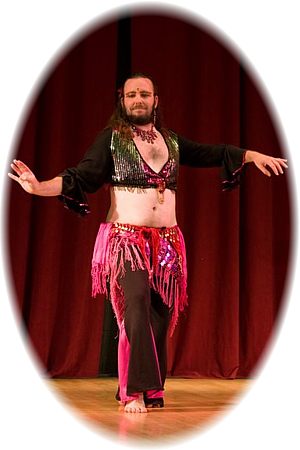
    Well, I think my heart still beats for big shows and productions, as much as I know how stressful and difficult that show-life can be. I seem to not be able to live without it.
  • Professional vs. Amateur: What is the Difference?
    There are dancers of every gradation in between the two labels of “professional” and “amateur”:dancers who work at dance jobs intermittently, or have part time jobs in addition to regular performances.
  • Ask Yasmina #9: Teaching Differences, New Troupes, Men in Bellydance
    As an ensemble becomes larger and more professional, it will find that it is more efficient and effective if it models itself like a professional company with defined roles
  • Bellydance from Cairo to Los Angeles: Personal Commentary on the Bellydance Superstars
    I remember the saying "Cairo is the Hollywood of Bellydance" is for a reason, and I think the ancient Egyptian theme takes us back to where the roots are deepest.
  • Maud Allen: La Femme Fatale
    For, as the trial progressed, in effect, it became a trial of female sexuality. No respectable woman, it was claimed, could possibly take on the sadistic role of Salome unless she was a sadist in real life, and sadism was regarded at the time as a practice verging on the criminal.
  • Carl’s Photos from The 2009 Gala Showcase at the SF/BA MECDA Event
    Event Presented by SF/BA MECDA (the San Francisco Bay Area Chapter of the Middle Eastern Culture and Dance Association) Held on January 17 at the Cubberley Community Quditorium in Palo Alto, California