Gilded Serpent presents...

The Bellybutton Revolution

Yasmina gives a speech

Feminism & Bellydance

by Yasmina Ramzy
based on a talk given at the Faculty Club, University of Toronto, in April 2009
posted to this site on October 19, 2009

This the second speech I gave at a Toastmasters meeting at the Faculty Club of the University of Toronto. The audience were engineers, university professors, lawyers etc. of varying ages and cultural backgrounds, all of whom had no knowledge of Bellydance whatsoever. I was practicing my speaking technique in front of my scariest crowd: non-Bellydancers.

My mother was a devout member of the feminist revolution. She burned her bra at marches and generally raised havoc for my father and our neighbors. She instilled in me the ideas of famous activists and authors such as Betty Freidan, Germaine Greer, and Gloria Steinem. At 11 years of age, I was not aware of the importance of this political movement and the profound affect it would have on the future of young girls like myself.

When I grew up and became a bellydancer, needless to say, my Mom was perplexed and wondered where she had gone wrong.

To her, bellydance was objectifying and exploiting the female body and in a part of the world where women’s rights were held in little regard. To her, I was sabotaging and against everything she had struggled for. To me, I was part of a new feminist revolution which I call the Bellybutton Revolution.

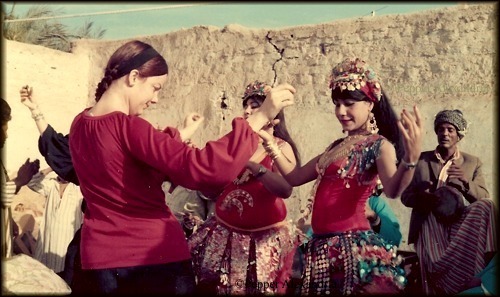
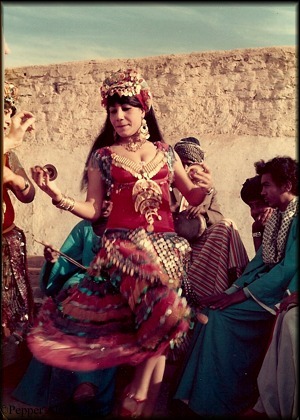
When I visited the Middle East, I witnessed elaborate 2-hour dance performances featuring solo female artists in all their feminine, sensual and glittering glory with fifty piece orchestras supporting them. Now these were powerful women who were having a lot of fun and enjoying their femininity, and they were who I wanted to be.

When invited to dinner in Arab homes, I would always end up eating way too much; and after dinner the men would go to one room to smoke cigars and play backgammon, and I would join the women as we bellydanced for each other. I was always in awe of how the 5 year old girl, the pregnant mom, and the 85 year old grandma would each shake her hips and strut her stuff with a proud glint in her eyes and with her chin held high. I often wished I could share this feminine pride and power with my friends and other women back in Canada.

During visits home in the 80s, when I told people I was performing in the Middle East as a bellydancer, people had no idea what I was talking about or why I was working….where? Syria? The usual response was to change the subject or make some inane comment about a ruby in the bellybutton. So I often just said I was an accountant – less explaining to do.

Nowadays, most women and some men are either taking bellydance class or know someone who is – everywhere in small towns and cities from Indonesia to Russia, and Argentina to the Yukon.  In fact, today I teach in over 60 cities around the globe.

Why is this ancient dance making such a huge impact with women all over the world and why NOW?

In the wedding march or Zaffah, the bellydancer leads the bride and groom in a procession. Along the way, she uses her movements to teach the newlyweds about the birds and bees and to inspire them for their first night together. The Zaffah is often performed at anniversaries as well.

Once, while performing at a large family gathering to celebrate the 50th anniversary of a Syrian couple, I witnessed the enduring power of bellydance. In the middle of my performance, I went over to the couple to pull them up to dance a Zaffah. As I was approaching, the family stopped me and asked me not to embarrass the wife as she was crippled and could not walk. But before I could return to the dance floor, she had grabbed my arm with a formidable grip. She then firmly placed her other hand on the table and used the strength in both arms to help herself rise. Everyone around protested, but she gave them a scolding and got herself almost to a standing position. Using all her strength to support herself on the table and my arm, she beamed a huge smile at me and slowly swayed her hips from side to side.

The room was silent until she sat down, then it erupted with applause and roars of appreciation as she looked proudly into the wide and bedazzled eyes of her husband of 50 years. With the simple act of swaying her hips, she was in her full glory.

During my 28 years of teaching bellydancing to countless numbers of women, I have listened to the many reasons students take up the dance. There is no typical type of woman, no particular age and no particular background.A woman will tell you that she persists because bellydancing enhances self-esteem; or often, women will tell how they’ve found the courage to stand up to a difficult boss, an abusive husband, or other equally difficult situations. Eating disorders have been alleviated, entrepreneurs born, and all have experienced a new awareness and comfort with their bodies regardless of shape and size. They will always tell you it was because of bellydance.

One of my mother’s idols, Gloria Steinem, wrote a book in the early 90s called "Revolution from Within". The premise was that as the result of the Feminist Revolution, women could now vote freely, hold management and public office positions, and receive better pay — although still not equal pay. There was still discrimination when it came to important and powerful job positions. She said that women would never be completely equal to men until deep down, there was a revolution from within; until women themselves truly believed they deserved it, and in particular believed that they deserved equality as women, and not as women emulating men.

There is a new revolution going on. I call it the Bellybutton Revolution. It is contributing greatly to the Revolution from Within that Gloria Steinem wrote about. Bellydancing seems to be opening a new and yet ancient door on how to view femininity, the female body, what can be expressed through it, and the empowerment that feminine sensuality holds.

Have a comment? Use or comment section at the bottom of this page orSend us a letter!
Check the "Letters to the Editor" for other possible viewpoints!

Ready for more?

  • Ask Yasmina #7: Milaya, Tipping, Gossip
    Ask yourself "why?’ over and over again, digging deeper for the truth, until you arrive at that moment when the beauty of Bellydance had you completely inspired and elated, that moment when you wanted the whole world to experience the same joy.
  • Ask Yasmina #6 : Abhinaya, Personal Journey, What’s Missing?
     Tapping into the source will change the quality of your movement, your interpretation of the music and your emotional connection to the movement and the music.
  • Ask Yasmina #5, Where is the Goddess in a Vertical Drop and a Shimmy? Or How Can the Practice of Bellydance Lead the Dancer to a State of Grace or Enlightenment?
    The most important practice of almost all mystical paths is meditation. It is universal and does not need a frame of reference from any particular theology.
  • Ramadan in Cairo
    This idea of renewed religious commitment and the character of Ramadan to involve self-deprivation makes many of us westerners think that this is a somber time, but in fact there is another side to the month of Ramadan that is quite lively and exciting.
  • Researching Dance Origins with the Mazin Family, Photo from Pepper’s Archives Part 2
    Yusuf, Khairiyya and Raja looked a Pepper’s hopeful face with the tears standing in her eyes and caved in. A private performance was arranged to take place on the flat roof of the Mazin’s home in full costume with live musicians.
  • Gig Bag Check with Surreyya and Sultana
    What does a dancer need to carry in her gig bag? Surreyya has a very special friend she carries in hers! Sultana, a leopard spotted boa constrictor enjoys being displayed for us and having a dance with her partner. Footage was filmed at Carnival of Stars in November 2008.
  • Tajikistan Part II: Land of Dance
    After a performance of daf soz (songs with frame drum accompaniment), the musicians played maddoh, followed by raqs-i aspak (“horse dance”), in which a man dances wearing a costume which makes it look like he is riding a horse.
  • Give Credit where Credit is Due!
    However, some dancers are using the same music, costumes and choreography in their performances that they first see elsewhere. This begs the question: at what point does copying someone’s original concept or choreography cross over from homage to stealing?
 

Gilded Serpent presents...

Tasting Cairo Stars in Your Home: Randa, Diana, Leila

Natasha's videos

Natasha’s Video Package-
"Masters of Egyptian Choreography
"

Reviewed by Hana Ali
posted October 15, 2009

Volumes One, Two and Three
All three DVD’s are extremely navigable, with a refreshingly uncluttered interface consisting of a simple black font on a papyrus background. In each case, the DVD contents include a section on technique and/or exercises, a full-length choreography broken into chapters (Diana teaches two choreographies), performance of the choreography in costume and a bonus section boasting an interview with the dancer and almost an hours-worth of live performance footage.

Further, the choreographies in all 3 DVDs are also structured in an identical format, where successive chapters build upon previous ones.

Each chapter begins with the very first dance combination taught and culminates with the introduction of a new one, such that by the time you reach the last combination, you should be fairly well-versed in the first few at the very least, having presumably benefitted from the ample repetition.

The instructional portions of all 3 DVDs were filmed at the same dance studio – an impeccably clean room with light wood flooring and a full wall mirror. The decor is oriental in feel but pleasantly, and appropriately, minimalistic. All three DVD’s appear to have been filmed from the same general angles, such that the shots attempt to encompass the dancer as well as her image in the mirror. However, each dancer took advantage of the space and wall mirror in a rather different way. It worked for Randa, but not for Diana or Leila (More on this in the individual reviews).

As mentioned above, each dancer was interviewed by the producer, Natasha Senkovich. Their narratives give us an insight into their dance philosophy and approach. All three dancers have devoted their lives to dancing and training and it would not be amiss to get to know them as people first.

Begin with the interviews and you will benefit from an understanding of their individual teaching methods.

All the dancers delved right in and started instruction sans any mention or performance of warm-up exercises. There are no warnings or recommendations to ‘consult your local physician should you have special problems or needs’. Therefore, it is up to your own good sense to start with a few warm-up exercises and stretches beforehand and to listen to your body as you proceed.

Volume One – Randa Kamel (click titles for more detail)

Randa is a relatively new Oriental dancer, but is no newcomer to the world of dance, with years of prior training in ballet under her belt. An Egyptian, Randa has danced all her life and currently works as a dancer and teacher in Cairo. She is a driven, determined, hard-worker with a very strong personality and it is evident in everything she does, including her very distinct, self-developed style of dancing. She credits watching and admiring other dancers such as Samia Gamal, but claims that her style is ultimately her own. No arguments there, though it does carry some unmistakable traces of Raqia Hassan and Dina.

4 zill rating
Zill Rating: 4 Zills

Volume Two – Diana Tarkhan

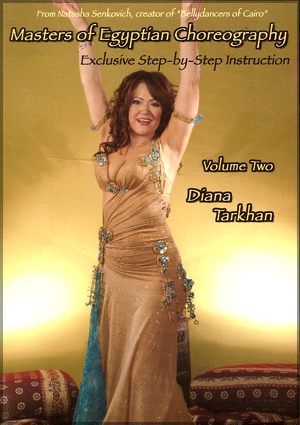
Diana is French Algerian and has a long history of performing all over the world, including Europe, the Arab world and North Africa including Egypt. She moved to Egypt to train with Raqia Hassan, and after a few years of performing in Egypt, decided to stay on. Diana has been living and teaching in Egypt for over a decade now. She claims one must live in the culture in order to understand how to perform this dance. Although retired as a dancer, she continues to choreograph and coach other dancers. She muses how this dance has a way of overwhelming one’s life and discusses the particular challenges of a professional belly-dancer in Egypt. Her dance style is more intuitive than technical, and reminiscent of so-called ‘old-style’ belly dance.

2.5 Zills
Zill Rating: 2.5 Zills

Volume Three – Leila of Cairo

Leila is relatively new to the dance scene and started her dance career in Seattle, Washington. A foreigner in Egypt, Leila has been living there and working as a dancer, model and actress since 2002. She is a very recent mother and at the time of her interview in this DVD (2008?), her baby was a mere 3 weeks old. She is in prime physical condition and seems to be back to her old dancing form. Leila has an incredibly sweet personality and her dance style is rather soft. I would venture to say that she is probably still finding herself as a dancer.

2 zills
Zill Rating: 2 Zills

Producer’s website for purchase

Have a comment? Use or comment section at the bottom of this page or Send us a letter!
Check the "Letters to the Editor" for other possible viewpoints!

Ready for more?


Gilded Serpent presents...

Volumne One:Randa Kamel

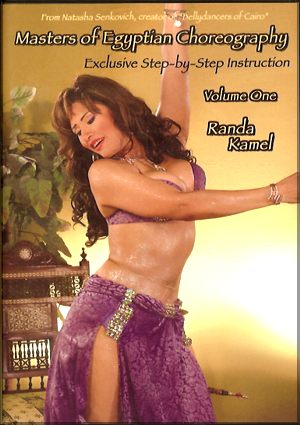
Randa DVD cover

Natasha’s Video Package-
Masters of Egyptian Choreography

by Hana Ali
posted October 15, 2009

Randa was in prime physical condition and taught in a glittery, black lycra cat suit with a strategic cutout that neatly separated her upper and lower torso, distinctly showing off her hips, midriff and legs. Her choice of teaching attire allowed for unambiguous movement visibility.

The video angle encompassed the dancer as well as her image in the mirror. Randa chose to conduct much of the instruction facing her audience at close range, with her backside visible in the mirror.

She spoke in Arabic, with an English voice-over by Natasha – a rather agreeable combination. Randa’s voice, her inflections and stresses can be heard and the English translation makes everything comprehensible to a non-Arabic speaker.

In fact, if you opt to pay closer attention, you might well learn a little Arabic as part of the bargain – at least how to count to eight. Her use of English words was limited to technical terms such as position, stomach, shimmy, and French ballet terms such as plie and pirouette.

Randa was accompanied by her tabla player on this DVD, his seated image visible in the wall mirror throughout the instruction. The live drum accents, apart from being an elemental component of Randa’s style of dancing, also served to lend an added measure of vitality to the studio setting. The tabla player remained in the background for the most part, only moving up directly into the frame for the sections Tabla Technique and Tabla Rhythms Demonstrated.

Technique exercises began the DVD.

Technique

Exercises – 6 chapters – 4 – beginner 2 – intermediate

Randa’s teaching is at once exhaustive and concise, precise without being soulless. From her carriage and explanations, it is very evident that she is a well-trained classic dancer, her mind and body well versed in balletic movements and terminology. The consummate artiste, there is nothing accidental about her dancing. Every nuance has a purpose.

Chapters 1-4 – beginner
Without much ado, Randa launched into technique instruction, explaining and demonstrating the subtleties of difference between Folkloric and Oriental styling. As a way of providing some insight into the origins of her dance steps, she said that these were beginning Folkloric steps that then evolved into distinctly Oriental movements. In the first four technique chapters, Randa proceeded slowly, stressing posture, energy, focus and how the dance encompasses the entire body and mind. Employing ample repetition and meticulous descriptions, she explained each movement and which part of the body to initiate it from. She emphasized the importance of an erect posture, every component of the body working, lifted, stretched and proud, eyes, eyebrows, hands and even fingers talking.

Chapters 5-6 – intermediate
In the two intermediate chapters, Randa introduced a couple of movement combinations that she used in her choreographies. She clarified that these combinations were intended for the intermediate dancer and accordingly taught at a quicker pace.

Tabla Technique

With the tabla player now next to her and squarely in frame, Randa discussed that most fundamental of Oriental rhythms – the maqsoum. At this point, she started to teach in the follow-the-bouncing-butt style. She ceased to break down the movements, but instead focused on demonstrating each combination repeatedly and unvaryingly, including every last nuance.

This consistent exactness made it possible to learn her drum and dance combinations with some practice, but indicated that the choreography would not be for the beginner dancer requiring mathematical break-down of each move. As before, Randa paid attention to detail – posture, expression, face, neck, arms, fingers, legs, feet.

Tabla Rhythms Demonstrated

In this section, Randa’s tabla player introduced and demonstrated the six rhythms relevant to Randa’s choreography – karachi, maqsoum, jerk, samba, rhumba and masmudi.

Choreography Instruction – 8 Sections

Randa’s powerful choreography to the song El Touba (originally for Abdul Halim Hafiz) was divided into 8 sections or DVD chapters. Each section was thoroughly explained and demonstrated. Randa omitted nothing, covering every moment from the beginning (when and how to enter) to the end (how to end and take the bow). Successive chapters build upon previous ones, such that by the time you reach the last combination, you should certainly be well-acquainted with the first few at the very least, thanks to the numerous iterations.

Though this choreography is for the advanced dancer, Randa explained everything in meticulous detail, including attitude.

Therefore, it is possible for a beginner dancer to learn the skeletal version of the dance and subsequently learn to master all the nuances through painstaking practice. However, the apparent simplicity of this choreography is rather deceptive, with a tremendous amount of information packed into these 4 1/2 minutes. Yes, there is much repetition, but there are just as many quick changes and ‘change your mind’ movements that keep this dance from looking ‘square’ or predictable. So while all levels of dancers may be able to quickly learn the basic choreography, it is a tad more difficult to exercise the entire dance correctly with feeling and all the intricate details. Having prior dance training in ballet is a definite asset when it comes to learning Randa’s style of dancing and would be an aid in executing the movements as accurately & powerfully as she does.

Performance of Choreography (4 1/2 minutes)

Randa performs the entire choreography to El Touba, bedecked in a gorgeous lavender costume designed by Eman Zaki.

Bonus Features

Interview

Natasha interviewed Randa and queried her about her background and dance philosophy. Randa talked about her love of dancing since childhood, her subsequent training in ballet and her passion for Oriental dance. She credits watching and admiring other dancers such as Samia Gamal, but claims that her style is ultimately her own. No arguments there, though I do think it carries some unmistakable traces of Raqia Hassan and Dina. She talks about her preference for a strong, powerful dance style that forces people to acknowledge her as an artiste, eschewing the ‘softer, sensual’ styles that appear to reinforce societal and male fantasies of femininity. She admits to being a driven, determined, hard-worker with a very strong personality and claims she is happiest when she feels that she is managing her life well – dancing, creating, practicing and home-making.

Live Shows
This section showed live coverage of Randa’s performances at two Cairo locations, the Cairo Marriott (30 minutes) and the Nile Maxim (24 minutes).

This was a perfect opportunity to observe the choreography combinations executed in a live setting to completely different music. Randa’s dancing and her interaction with the audience can be described as powerful, strong, proud, energetic and infinitely engaging.

I must add though, that wonderful as Randa’s dancing is, her chest and choice of costuming (yes, those bondage-type bras) is just far too distracting. It is not an easy visual distraction to overlook and I find the whole thing a little ironic given her stated reasons for her opposition to ‘sensual’ styles of dancing!

She did a Folkloric section in each of her shows – Randa style. Her Folkloric costumes were modern, semi-two-piece garments, with the lower sections being bell-bottomed pants. Befittingly, her dance style was also Modern-Folkloric. The posture, as always, was erect, strong, uplifted but also grounded. She used many of the same combinations that she used in her Oriental dance pieces, but the mood and flavor was distinctly Folkloric, sans any hint of Oriental.

Also Available:

  • ads for other Natasha produced DVDs
  • Eman Zaki – ad for costumes. (Designer for the stars including Randa, Diana and Leila)
  • Charity – Women for Women International – video clip
  • Credits

4 zill rating
Zill Rating: 4 Zills

Back to introduction of Hana’s reviews

Have a comment? Use or comment section at the bottom of this page or Send us a letter!
Check the "Letters to the Editor" for other possible viewpoints!

Ready for more?

  • Randa Kamal
    "Then the film roles that I’ve been offered have unfortunately been frivolous, or portrayed the dancer in the stereotypical way they always do. The cinema has done enough to spoil the reputation of dancers, without me adding to it by taking such a role."
  • A Report on the First International Bellydance Conference of Canada Part 2 – Sunday Club Party
    Live orchestra, Randa, Amir, a packed house and very festive mood. How could it be any better?
  • A Report on the First International Bellydance Conference of Canada Part 2 – Saturday Gala Performance Held at the Ryerson Theatre in Toronto Canada on April 21, 2007. Featuring international stars including Amir Thaleb and Randa Kamal
  • Randa Kamal in Cairo
    I was fortunate to travel to Cairo on business in April ’06, and managed to take some time to see a few sights and, at least, one dance performance: Randa Kamal at the Marriot Zamelek’s Empress Nightclub
  • My Moment with Nagwa
    While dancing I kept eye contact with the judges and guests of honor. I still remember their mannerisms and what I perceived to be their glares. Randa and Dr. Mo were conversing and smiling contently, Faten and Zahra were clapping. Also, there sat Nagwa Fouad, “Queen of Cairo!”
 

Gilded Serpent presents...

Volumne Three: Leila

Volumne 3- Leila

Natasha’s Video Package-
Masters of Egyptian Choreography

by Hana Ali
posted October 15, 2009

Leila was in superb shape and looked her stunningly beautiful self throughout the DVD. She chose to teach in a simple black tank top and yoga pants, with a scarlet hip scarf, and stood out extremely well against the light-colored background. Her hip scarf created a nice separation between her torso and hips and allowed for clear movement visibility. 

Not so with the camera-work. Leila faced the camera while addressing her viewers and demonstrating movements and gestures. However, once she began teaching the choreography, she turned around and conducted the lesson facing the mirror, with her back to the camera and the audience.

Her front was visible in the wall mirror, but unfortunately her image was mostly a long shot, so it was no small feat trying to detect all the intricate movements, let alone any facial expressions.

There was what appeared to be a tragically underused second camera, the existence of which did little to enhance the teaching. It was sparingly used for some ‘teaser’ close-up shots, the long-distance on a tripod camera prematurely taking over each time. The DVDs all have a disclaimer stating that all footage was shot on location in Egypt under less than satisfactory conditions. Maybe most of Leila’s close-up footage proved to be unusable.

Meaning of the Song

Leila taught a beautiful choreography to the song Esma’ooni, originally written for Warda. The version used by Leila may be found on her CD Sukkara.

Being a foreigner herself, Leila seems cognizant of the dancers’ need to understand the lyrics of their music and consequently devoted an entire section to the translation, explanation and interpretation of the song.

She faced the camera as she addressed the audience, sharing some key Arabic words and phrases from the song, giving a rough translation of the lyrics and demonstrating movements and gestures as they related to the music and her choreography.

Choreography Instruction –

  • Part One – 13 sections + review
  • Part Two – 11 sections + complete choreography

The entire choreography was split into two main parts, each part further subdivided into 13 and 11 sections respectively. Each part concluded with a review of the entire dance up to that point, performed by Leila in the same black teaching outfit.

Rather than spend time explaining or breaking down technique, Leila delved straight into teaching her choreography. There was little to no explanation of the movements. The underlying presumption likely being that the target audience already possesses an intermediate-level Oriental dance vocabulary, a presumption not entirely unfounded. She does offer some details on her footwork, but not on the execution of the hip-work. It was a gorgeous choreography, but lacked any signature ‘Leila’ movements or expressions. She is still a new dancer and maybe there are no ‘Leila’ movements yet.

Performance of Choreography 

Leila performed her choreography in a lovely black costume with silver accents, designed for her by Eman Zaki. She looked exquisite and fit but the dance seemed to lack vitality. This was a very beautiful choreography with lots of juicy slaps and teks for hip and body accents, yet the overall dance was executed in a very soft, and somewhat lackluster, manner. Leila talked about the meaning of the song, but the dance is filmed from such a distance that her expressions are unfathomable for the most part, the energy impalpable and the intricate dance movements lost in the void between the camera and the dancer.

The instrumentation, musical arrangement and percussion in this song are excellent. It is a very danceable, exciting version and someone can definitely take Leila’s choreography and make it alive, passionate, dynamic and forceful. With the right combination of passion and personality, it can be a very strong and memorable dance.

Bonus Features

Interview
Natasha interviewed Leila and asked her about her experience as a working professional Oriental dancer in Cairo. Leila moved to Egypt about five years ago and expected to continue living and working in Cairo for at least ‘a little longer’. At the time of this interview, Leila had recently embarked on motherhood, her baby boy Yousef having been born just 3 weeks prior. Leila spoke of the licensing obstacles faced by foreign dancers and of the need to stay focused, committed and resilient. She also talked about the Egyptians’ love-hate relationship with this art form and the particular challenges of working as an Oriental dancer in that culture. She seemed to be a very genial and gracious person. Despite her acquired proficiency in Arabic, she insisted that she was still learning and had a long way to go.

Live Shows – a little over an hour
This section showed live footage of Leila’s show at the Nile Maxim, during the course of which she underwent a few costume changes, looking invariably gorgeous in each sparkling outfit. Her show sometimes suffered from the hazards of filming on a dinner boat, with people bustling by or positioned squarely in the way of the camera.

Leila’s choreographies were fabulous, her body expertly accentuating each tek and slap of the percussion. However, to be a great performer one needs to be more than just a lovely dancer and her first couple of performances lacked fire and vivacity. In one of the numbers the Nubian boys dancing with her upstaged her. Leila is undoubtedly ravishing and an extremely congenial person, but it seems to me that she needs to develop a bigger stage personality and engage in more confident interactions with her audience. Her second show possessed more energy and dynamics and was far more engaging. Maybe it just takes her a little longer to get warmed up. She is young still and fortunately has time to cultivate the magnetism that is the hallmark of all great performance stars.

Also Available:

  • ads for other Natasha produced DVDs
  • Eman Zaki – ad for costumes. (Designer for the stars including Randa, Diana and Leila)
  • Charity – Women for Women International – video clip
  • Credits

2 zills
Zill Rating: 2 Zills

Back to introduction of Hana’s reviews

Have a comment? Use or comment section at the bottom of this page orSend us a letter!
Check the "Letters to the Editor" for other possible viewpoints!

Ready for more?

  • InsidePeek at Making Music Videos: Hakim, Khalid Selim, Walid Toufic, Aliel Hagar, Elam, & Samira Said
    I was either crying or yelling at Hakim for most of the shoot and went home each day with a headache from it.
  • Egyptian Wedding Stories
    All the guests were staring at us. The father of the bride demanded to know who ordered the bellydancer and it seemed a fight was going to break out between representatives of the brides’ family and the hotel organizer.
  • I Dance; You Follow
    As Westerners interested in an Eastern dance form, we might want to ask ourselves if we are missing certain critical aspects of Raqs Sharki because we are not open to Eastern teaching methods.
  • What Middle Eastern Audiences Expect from a Belly Dancer
    Audiences in the Middle East, especially Egyptians, see bellydancing as something to be participated in, critiqued, and loved (or hated) with
    gusto.
  • An interview with Leila
    "Turning tricks," or sleeping with nightclub or hotel owners, is not required to make it as a dancer in Egypt, but it
    is a complicated and questionable industry and there are many pressures.
  • Leila, An American Dancer in Cairo
    She would walk into these huge ballrooms filled with thousands of people with a huge stage in the middle of the room while television
    cameras on cranes are taking note of everything.
 

Gilded Serpent presents...

Volumne Two: Diana Tarkhan

Volumne 2- Diana Tarkhan

Natasha’s Video Package-
Masters of Egyptian Choreography

by Hana Ali
posted October 15, 2009

Diana seemed like a very pleasant person, and greeted her audience with a charming smile. She wore capri length black tights and a long, light pink dance shirt on top. The frilly sleeves were a little distracting and the light pink outfit failed to contrast well with the light sand-colored background. The result was an unfortunate camouflaging of some of her movements.  Diana did not appear to be in dancing shape and neither her physical appearance, nor her posture, carried the mien of a credible well-trained dancer or dance teacher.

The video angle encompassed the dancer as well as her image in the mirror. Diana conducted some of the technique instruction facing her audience, but chose to teach the choreographies facing the mirror, with her back to the camera and the audience.

Her front was visible in the wall mirror, but I found the overall effect less than satisfying.

Diana greeted her audience in English and continued to instruct in the same. I had to exercise some willpower in an attempt to acclimatize to her voice because it seemed distorted and was therefore not the most euphonious auditory experience.

I suspect this might be a technical glitch as there is also some video glare.

Technique exercises began the DVD.

Technique

Exercises – 5 chapters
Diana started her teaching with technique instruction, demonstrating some very basic steps such as circle step combinations.  Exercise 5 was particularly nice, encompassing upper body arm and shoulder exercises and incorporating visualization techniques to encourage fluid movement, such as using the hands and fingers to paint the wall with music.

Choreography Instruction

Diana taught two choreographies – one to the song En Rah Minek Ya Ain by Shadya and the other to the song Samia Dance (Leila) originally by Farid el Atrache.

En Rah Minek Ya Ain
This song, also known to many as ‘Shadya’s song’, seems to be one of Shadya’s more popular songs, particularly among dancers. It is however, difficult to find in the original recording. Shadya was a singer and actress who appeared in many movies with, and during, Abdul Halim‘s time.

Diana’s choreography to the song En Rah Minek Ya Ain was divided into 3 chapters with various sections within the DVD chapters. Each additional combination or section was explained and demonstrated. Successive chapters build upon previous ones, such that by the time you reach the last combination, you should certainly be well-acquainted with those prior, thanks to the many repetitions.

Diana’s dance is folkloric in style, though she does not explain these particularities herself. 

This choreography is well-suited to a beginner dancer. The song is beautiful, the movements elementary and repetitious. Despite the potential however, the choreography lacked dynamics and therefore, impact. Diana chose to dance through the pauses in the music, rendering the dance busy – it lacked breath. Although she incorporated turns in her choreography, she neither mentioned spotting nor seemed to practice it much herself. Among other things, spotting helps to make turns appear sharp and powerful. Diana did not have much force in her dance and outside of teaching the steps there was no talk, or demonstration, of energy. In general, she did not seem to use her head much – as in looking towards a movement or to emphasize an accent. Although there was percussion in the music, Diana did not seem to pay much heed to it and was frequently off-rhythm, thus somewhat undermining my faith in her as a credible dance instructor.

Samia Dance:
The Samia Dance is actually a song called Leila, composed and originally performed by Farid el Atrache. Diana donned a blue ‘practice’ costume to teach her second choreography in. The outfit might have been fine for performance but was a hindrance during teaching as the long skirt precluded a clear view of her legs or feet.

This choreography, dedicated to Samia Gamal, was perfectly aligned with the mood of the song. Diana explained that this was ‘old style’ choreography and did a careful, wonderful job teaching the choreography and movements, emphasizing feeling and emotions. Her dance went well with the melody, but once again failed to pay much more than a perfunctory nod of acknowledgement to the percussion. Granted that in the ‘old days’ drums were not given the importance that they are today, and not everyone needs to be a ‘percussive dancer’, but even a melodic dancer needs to have the heart beat of the music inside her body. She needs to be cognizant of and in tune with the rhythmic elements, including the ‘and’ count (one and two and three etc.).

Ultimately, this is a beautiful choreography that holds much potential in a more rhythmically-mindful body.

Diana concluded each of the choreography instruction sections with a performance of the complete dance, done in the same outfits that she taught in.

Performance of Choreography 

En Rah Minek Ya Ain:
The dance is nice if one does not know the song. Though the gestures of the unsung lyrics were there, the sensitivity was not too evident. The dance suffered from insufficient mood changes and her unfortunate proclivity for following the melody at the expense of rhythm. Diana’s core did not seem strong and there were moments where gravity threatened to overcome her. Also, I would have preferred to have her perform facing the camera rather than the mirror.

Samia Dance:
This dance was very old school and extremely well-matched to the mood of the music. As afore-mentioned, Diana is a lyrical dancer, and in this dance, flowed mellifluously with the melody. She was resplendent in an elegant champagne gown with flashes of emerald color gently hinting of times past, of the days of Samia Gamal and Casino Opera. It is unfortunate that the gown was almost the same color as the walls. Oh well.

Bonus Features

Interview
Natasha interviewed Diana and asked about her experiences as a professional dancer. Diana spoke of the dedication, hardships and sacrifices, which are required of a dancer wanting to perform the ‘circuit’. In her case, besides Egypt, she worked and toured throughout Europe, North Africa and the Arabian Peninsula.

She also talked of the inevitable loneliness and isolation that comes with being a professional dancer – the nocturnal schedule, the pressures of working daily on choreographies, costumes, make-up, etc. with no breaks and rarely a day off.

She also spoke of her experience coaching dancers and the essence or definition of an Oriental dancer, describing the ease of training dancers with a classic ballet background. She said that these dancers are extremely well-trained and it is a simple matter for them to learn and be able to perform an Oriental choreography after a single day of intensive training, but that feat alone did not make them Oriental dancers. She stresses that in order to be an Oriental dancer one must be enmeshed in the culture. Diana spoke of creating dances from feelings first, with technique and structure being of secondary importance and that it is not possible to accomplish that without first being in the culture and understanding the music and the dance.

Live Shows – 40 minutes
When one critiques a dancer, one should take into account the full package, including the body, the costume, the LOOK. It should certainly not be the primary focus, since the ultimate importance should be placed on the dance itself. However, in Diana’s case, I was reminded of the import of attention to detail. To make a show memorable, good dancing needs to be accompanied by personality and stage-presence.

Diana’s Live Shows section consists of some splendid vintage footage of her performances. She shines with star magnetism and a strong confident presence. She carries herself like Nagwa. She is self-assured, she is gorgeous and she knows it!

Her dance style was very modern compared to video clips of other dancers of that era. She appeared comfortably familiar with the music, the lyrics and the Arabic language and seemed to effortlessly establish wonderful rapport with her audience.

However, as with her choreographies in the DVD, she tended to saunter in and out of the music, not overly concerned with the percussion.

As with her performances, her costumes were also ahead of their time. They were couture, memorable and befitting of the type of dance performed. In the folkloric pieces, the costumes are folkloric in feeling, but still very stylish and cabaret in look. Most importantly, the costumes fit impeccably and show off Diana’s body to the max. I will refrain from detailing every costume -you should get the DVD to see – but will indulge in an honorable and gushing mention of the engineering and structural masterpieces that were her costume bras. One must recall what Egyptian costume bras looked like ‘back in the day’! (Heck, one merely need take a look at 90% of the pyramidal costume bras out there right now!). This was a woman who paid attention to detail. This is vintage footage and the costumes are not present-day, yet they are today’s and tomorrow’s styles, the only give-away being the metal zippers up the backs of the midriff net sections. She was far ahead of her time in dance and she was far ahead of her time in costume-design.

This section alone is reason enough to buy this DVD!

Also Available:

  • ads for other Natasha produced DVDs
  • Eman Zaki – ad for costumes. (Designer for the stars including Randa, Diana and Leila)
  • Charity – Women for Women International – video clip
  • Credits

2.5 Zills
Zill Rating: 2.5 Zills

Back to introduction
of Hana’s reviews

Have a comment? Use or comment section at the bottom of this page orSend us a letter!
Check the "Letters to the Editor" for other possible viewpoints!

Ready for more?


Gilded Serpent presents...

Ramadan in Cairo

Streets decorated for Ramadan

by Nicole
posted October 14, 2009

Ramadan in Egypt means many different things, from fasting and religious reflection to parties in the streets with children lighting off firecrackers. Either way is a unique time to be living here in Cairo.  Things become completely different during the month of Ramadan than the usual lifestyle of this bustling metropolis, and as a result I was thrown from my normal schedule along with everyone else into the spirit of the holiday season.

The most obvious component of Ramadan is the food aspect, because this is the time when Muslims will fast from dawn until dusk.  This includes no water, even in the Egyptian heat! 

It also means most Cairenes won’t be smoking like fiends as per usual, so between the lack of food, caffeine, and nicotine everyone becomes a bit on edge by the time Iftar (breakfast) rolls around at sunset.

Policemen glare sullenly from their stations, cab drivers honk and scream at each other more than usual, and everyone seems generally more quiet and grumpy during the day.  This year seemed especially tough as the Muslim calendar is based on the lunar cycle, thus the month of Ramadan moves up a couple weeks each year and it happened to fall in the middle of August this time around, ouch!

Just before sunset Cairo streets become completely clogged as people rush home to prepare to eat and socialize for the evening.  Then abruptly the rush hour ends, and everything gets very quiet as everyone digs into the first meal of the day.  Most stores close during the Iftar and everyone is off the streets, so everywhere is almost completely silent and deserted in one of Cairo’s more unusual displays.  I’ve grown used to the loudness of the city here, because Cairenes like their lives big and loud, so walking the streets in my neighborhood during the first Iftar of the month was actually eerie for the complete lack of noise and humanity.  Even the policemen stopped patrolling and left their posts to gather in groups for Iftar in the gardens and green belts in my neighborhood.

Fasting reflects the obvious religious character of the holiday here of course.  This is a time for Muslims to be particularly devoted and pious, and traditionally as I understand it a lot of people read a chapter of the Qur’an each day to reconnect themselves to their religion and moral principles. 

This idea of renewed religious commitment and the character of Ramadan to involve self-deprivation makes many of us westerners think that this is a somber time, but in fact there is another side to the month of Ramadan that is quite lively and exciting.

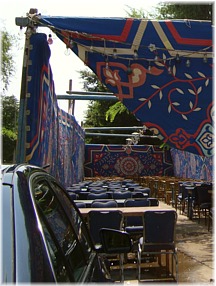
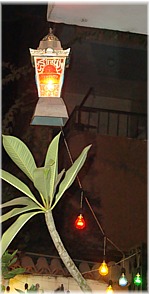
For a few weeks up until the actual event I started to notice more and more swaths of the special tent fabric that is famous here going up around town as everywhere from restaurants to grocery stores started to decorate.  Soon lanterns (singular in Arabic is fanoose) engraved with saying such as “Ramadan Kareem”(Happy Ramadan) and “Allah Akbar” (God is good) were going up all around town along with strings of lights, and each apartment building seemed to have a fanoose dangling above the doorway to cast cheerful colored light on visitors.  My friend brought me my own adorable fanoose in fact, which stands at a comparatively short 1 foot high, compared to the 5 footers you can see around town in the lobbies of companies and hotels! 

Ramadan latternThe display around town was beautiful and festive, similar to how people like to decorate during Christmas in the US but with a unique Egyptian flair such as throwing huge ropes of lights or tinsel off balconies so that apartment blocks were faced with twinkling colored lights dripping down over five stories.  Alleyways were striped with tinsel garlands and little holographic flags stretching between balconies in a random pattern extending several floors up to form a mosaic of color and light that kids ran around under setting off fireworks and firecrackers to tease each other and torment drivers.  A fun and entertaining but somewhat dangerous activity as my friend and I almost ran over a lit firework!  We all got used to hearing bangs and pops like cars backfiring during the evenings in Ramadan because the children on my street are particularly celebratory, but one night I thought the sounds seemed particularly nearby and went out on the balcony to investigate.  What did I see? 

My middle-aged saiidii bawwabs (doormen) laughing and running around with their galabeyas hiked up as their kids threw lit fireworks in their direction in the street out front!

Ramadan fabricLet’s face it though, everyone feels like partying and stuffing their face by the time the sun goes down, not just children.  Everywhere I went during Ramadan at night was packed to the rafters with happy people out celebrating and shopping.  The cafes were crammed to the bursting point, to the extent that I couldn’t even get served for half an hour in my favorite one behind Al-Azhar mosque, which is one of the more popular places to be at night during Ramadan.  It is also a time to buy children gifts of clothes and toys, and give charity as well as presents and so forth so there was a big upswing in the amount of shopping going on, to the point where an Egyptian friend advised me to just wait until after Ramadan because it was almost dangerous to go during for the rush of people and he was worried about me getting hurt.

On a dance and music note, there are many concerts to attend during Ramadan, some of which are free.  This is a great time to attend regular music events, because the belly dance
industry all but comes to a standstill as dancers, musicians, and costumers take a much-needed vacation. 

There simply isn’t much to see on the belly dance front, but lots to experience when it comes to popular Egyptian music that doesn’t get exported for the belly dance crowd.

  I got to see a very famous Egyptian band, Wust el Balad (“Downtown”, lit. “Center of the Country”), who are now some of my favorites without
paying a dime!  The best part was that we were at the most beautiful and ancient of venues:  The citadel itself!  It was amazing strolling up the switch-backing ramps to the outdoor stage, because half the time you turned a sharp corner and were suddenly confronted with the imposingly beautiful and ancient façade of the main castle itself.  I am definitely going back during the day when the weather improves to explore the grounds and historic buildings there after this one-time teaser.

All in all the spirit of Ramadan seems to be cleansing, renewing, and most of all sharing.  Egyptians are some of the most hospitable people ever during normal times, but during Ramadan it seems like everyone is giving each other things, congregating to celebrate and eat together whether for Iftar or So7or/Suhhur* (the second meal, eaten at about 1-3am), and sharing what they have.

  I went out on the my street several times to give the policemen, bawwabs, guards, and people hanging around sweets and dates just after sunset, and followed the normal custom of giving my doormen food and extra money as a gift just before the Eid al-Fitr (the small feast at the end of Ramadan—there will be a big feast in November, which marks the end of the pilgrimage season to Mecca) which made me feel like part of the celebration and seemed appreciated, particularly coming from an American not observing Ramadan.  It’s normal to invite guests to Iftar, but due to various circumstances I only got to have Iftar at an Egyptian home once. However it was delicious and there was still food to spare even after we were stuffed!  I did decide to host my own Iftar during the last week of the month on a whim, and although it was crazy to cook for 11 people (I wrote more about this evening on my own blog) I found it to be rewarding and heartwarming to get friends together in the spirit of Ramadan; Egyptians, Muslims, and American study abroad students alike!

*Please note Arabic transliterates horribly!  For example, there are 3 letters that could be expressed with “h” but the 7 stands for an aspirated H coming from the throat.Ramadan lights

Have a comment? Use or comment section at the bottom of this page orSend us a letter!
Check the "Letters to the Editor" for other possible viewpoints!

Ready for more?

  • Researching Dance Origins with the Mazin Family, Photo from Pepper’s Archives Part 2
    Yusuf, Khairiyya and Raja looked a Pepper’s hopeful face with the tears standing in her eyes and caved in. A private performance was arranged to take place on the flat roof of the Mazin’s home in full costume with live musicians.
  • Gig Bag Check with Surreyya and Sultana
    What does a dancer need to carry in her gig bag? Surreyya has a very special friend she carries in hers! Sultana, a leopard spotted boa constrictor enjoys being displayed for us and having a dance with her partner. Footage was filmed at Carnival of Stars in November 2008.
  • Tajikistan Part II: Land of Dance
    After a performance of daf soz (songs with frame drum accompaniment), the musicians played maddoh, followed by raqs-i aspak (“horse dance”), in which a man dances wearing a costume which makes it look like he is riding a horse.
  • Give Credit where Credit is Due!
    However, some dancers are using the same music, costumes and choreography in their performances that they first see elsewhere. This begs the question: at what point does copying someone’s original concept or choreography cross over from homage to stealing?

  • Wiggles of the West: One Dancer’s Foray into Competition
    In the world of belly dancing lately, dance competitions seem to be the big thing. Love them or hate them, they are popping up all over the country, leaving one to wonder what benefit they
    add to our art form. In an art form as varied as Middle Eastern Dance, incorporating cultures crossing multiple borders and continents, to what standards do these competitions adhere?
  • Photos of Caravan of Secrets, Co-produced Theatre Production by Zahra Zuhair and Carolyn Krueger
    held August 15th and 16th, 2009, at the Electric Lodge Theatre, Venice, California. Caravan of Secrets navigates imaginary landscapes inspired by the cultures and contradictions found among the ancient Silk Roads, Sea Routes and Gypsy Trails of the Middle East and Central Asia.
 

Gilded Serpent presents...

“Habibi, You are My What?..”

Leyla's Arabic DVD

DVD- Essential Arabic for Dancers, Vol 1

reviewed by Bonita
posted October 9, 2009

I was thoroughly charmed by this low-key Arabic lesson for dancers, produced on a shoestring budget. Leyla is adorable in her presentation, with an earthy sense of a humor. She is a truly intelligent, self-professed "language geek" as well! Leyla has the rare gift for interpreting complex layers and levels of cultural meaning to her western students.

The DVD presents basic core vocabulary found in Arabic Bellydance music. Leyla begins with a short coverage of the Arabic alphabet, including the pronunciation of Arabic "quirky" letters that are so very difficult for English speakers who are learning Arabic. She discusses the gist meaning of three popular songs, using repetitive chorus phrases to demonstrate word meaning. These songs are Zey Al Hawa, Habibi Ya Eini, and Habibi Ya Nour Al Ayn. These are standard songs that beginning professionals can always request with the expectation that a band will know them. In fact, Habibi Ya Eini is a great song for training beginners in the basic Arabic style. The Sultans’ version presented on the DVD is one of my favorite pieces to use in teaching beginners how to play zills (with its breaks and mostly slow and steady beats).

However, I have never had such insight into the words as this DVD taught me! Now, thanks to Leyla, I have an added dimension to teach my students. The credits list where to find these exact recordings and Leyla also provides web sites for finding Arabic song translations.

Interspersed within the lesson are gestures one can use with many words and phrases prevalent in the typical Arabic Bellydance repertoire of live bands and classic songs. Leyla also provides the bonus of cultural explanations and some quite useful and handy phrases at the end of the DVD such as: "You should be ashamed of yourself!” "Get lost!" "Hands off!" or "Don’t touch the Bellydancer!"

As a currently struggling student, enrolled in an Intermediate Arabic language course (that is way over my head), I was fascinated by this DVD. I knew perhaps 80% of the words already, but I had not heard previously many of the cultural tips and insights. Leyla’s eyes are simply sparkling with mischief, and to borrow one lyrical, enchanting phrase from the DVD, her eyes "light up the night." Her playful interpretation of the words, phrases and meaning will bring dancers to another level in their interpretation of the music for Arabic audiences.

The DVD might have been more helpful if she had included some notes such as provided to her in-studio class. Additionally, if you are overly enamored with the slick, institutional, and perfect “Barbie Doll-type” of DVD, this presentation is not for you! However, if you are a beginner through professional level dancer who wants to learn more about the truly rich, dreamy beauty of the Arabic language as it is used in song, this DVD provides a perfect place to start.

3 zil rating
Rating: Three Zills

Purchase information

Have a comment? Use or comment section at the bottom of this page orSend us a letter!
Check the "Letters to the Editor" for other possible viewpoints!

Ready for more?


Gilded Serpent presents...

Zills: “Voice” of Bellydance

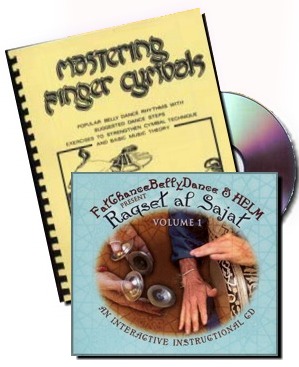
2 zil collage

2 CDs of Finger Cymbal Instruction:
-Mastering Finger Cymbals By Mary Ellen Donald
-Raqset al Sajat, An interactive CD

A Review by Bonita
posted October 9, 2009

I have reviewed two zill CDs in a "compare and contrast" format at the request of our tough task mistress, Gilded Serpent Editor, Lynette. Please note, that on the newly implemented “zill rating system", what may be two or three zills to me, might be four zills to you, because you and your students may be more interested in Tribal, Turkish, American Cabaret styles, etc.  A special thanks to the artists and producers who made these CDs possible, and may they individually and collectively preserve and re vitalize an aspect of the dance, playing finger cymbals, that, sadly, has been withering on the vine in the community of late.

Ling CDRaqset al Sajat, An Interactive Instructional CD

 I am not a tribal dancer, but it seems to me that this zill CD is specifically tailored to our tribal community and has some mesmerizing, hypnotic cuts perfectly suited to the sinuous, magnetic style of Tribal at its best! There are references and examples of fascinating Afghan and Indian rhythms, such as “Dadreh” of which I (as a trained Egyptian style Bellydancer) have never heard before.

The CD includes basic Egyptian rhythms mostly found on other zill training CDs of this genre but does not include Turkish 9/8 for those students who are interested in learning the Karsilamas rhythm. 

In a truly international appealing CD,  the instruction book is translated into into English, French, Italian, and Spanish.

  Additionally, a French song as well as two other musical pieces that are included on the CD with only instrumentation, sans zill playing,  in order to test the student’s ability to learn improvisation, inserting the finger cymbal patterns she has learned into the music.  Although the CD book is not very comprehensive, the CD clearly explains the rhythms in a succinct, easy to follow manner for any beginning student.

To order, visit:  www.helmusic.com and www.fcbd.com

3 zill rating
Rating: THREE ZILLS

MaryEllenMastering Finger Cymbals by Mary Ellen Donald

 Mary Ellen is recognized in our community as a master percussionist teacher and this set is an excellent tool for those wishing to understand music theory as well as zill playing at a beginner through advanced level.  The set of two CDs, including extensive drills and an accompanying text book, is truly an intensive course on the zills.  It stands alone as one of the most comprehensive, specific works on zill playing (with drills) that I have ever seen.  If this level of detail is what you are seeking, all competitors are left in the dust! This work is for serious students only, but teachers can use it to supplement lessons.  The set was originally published in 1976, when our society was, perhaps, not so concerned about compacting everything to tiny sizes and formats, as well as slick, living-color, cleverly marketed products.  Today this happens even with ideas and teaching while core truths, sadly, are lost or buried. 

However, Mary Ellen’s work is a traditional rock steady classic that does not rush in haste over musical theory or specific zill drills.  The book is the equivalent of a text book that would be provided to a student learning any musical instrument at the beginner’s level. 

 Over 10 years ago, I used this series (with its cassette tape format) as a belly dance student in Germany to get a jump-start on my zills.  At that time, there were simply not many teachers offering zill instruction in Frankfurt.  It was effective for me to get some initial grounding and background, but I really didn’t learn to play (even at a basic level) until I studied with a real live teacher in the States.  If you are strong on music theory, already a musician, in a remote situation, or without access to a good zill teacher, than this series would be invaluable to you.

 For some students, this series may be too intimidating and might discourage them.  Also, it would have been nice to see an update in the back pages where recording artists from the ’70s are given as practice reference.  Although George Abdo has made the transfer to CDs that are available, sadly, many of the other fabulous recording artists of the time, did not make the leap from vinyl record albums to the modern CD format.

To order, visit: www.MaryEllenDonald.com

3.5 zill rating
Rating: THREE AND A HALF ZILLS

Compare and Contrast Summary:

For serious students who want to delve into music theory and extremely meticulous detail, there is no better reference book and zill drill compilation than the Mary Ellen MacDonald Series.

For students with a tribal focus who are beginners at playing finger cymbals, “Raqset al Sajat” is a solid choice.  The CD will also serve adequately for beginning-level students who require an initial overview, providing a safe beginning–perhaps for those students who want to “wet their feet” cautiously in the tumultuous waters of the zill-playing ocean.

See bio for the author of this review, Bonita Oteri.


Have a comment? Use or comment section at the bottom of this page or Send us a letter!
Check the "Letters to the Editor" for other possible viewpoints!

Ready for more?


Gilded Serpent presents...

Researching Dance Origins with the Mazin Family


Photos from Pepper’s Archives

January 1979, The Maazin home in Luxor, Egypt
captions by Pepper Alexandria and Edwina Nearing
posted October 6, 2009

The Maazin's welcome you to their home!
The Maazin sisters welcome you to their home!

Mazin Dudes
Yusuf Mazin, father of Khairriyya and Raja, and their 3 older sisters. The five girls who make up the famous Banat Mazin dance group. Sitting next to Yusuf is husband of one of the Mazin girls who defied his family to marry a dancer. The man at far left is John Burnham, a Berkeley artist and drummer.

Edwina dances with Mazins
Edwina Nearing and Khairriyya dancing on the roof of the Mazins house at the private party that Edwina arranged for Pepper.

KhairriyyaKhairiyya
Khairriyya dancing on the roof at the private party

Sisters sing and dance

Khairriyya and sister Raja singing, dancing, and playing finger cymbals in roof party

Mazin daughter 2
Raja

Sisters sewing
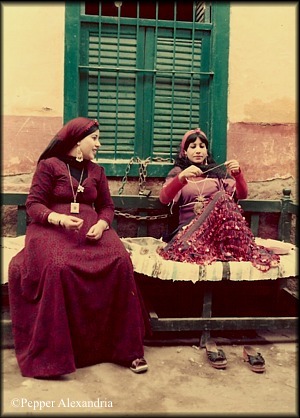
Khairiyya sewing a costume while sitting in front of the Mazin House with her sister Raja.

Edwina sits with Mazins
Edwina sitting between Khairiyya, who is wearing a typical house dress with her father, Yusuf, in the salon of their home.

Khairiyya
Khairriyya dancing in the salon with Pepper.
Pepper in a qhawazi costume that Pepper had made a couple of years previously based on photographs.


Pepper taking a dance lesson with Khairriyya in the salon. Edwina and Pepper were the first to have set up classes with the Mazins.  At the time of the roof party, Pepper arranged for 5 days of personal lessons after the rest of the tour had gone home. The Mazin sisters gave Pepper a taj  (ghawazi head piece) to wear while she performs the dance. The Mazins had never taught an actual class before and even became upset when she tried to pay for the lessons.  However, Pepper insisted on paying, and that was the start of a long friendship that continues to this day.


Pepper showing Khairryya a photo album of Pepper’s dance troupe. Raja and Yusuf are also present.

Musicians
The rababa musicians who played for the roof party..


Pepper between Raja (in maroon) and Khairriyya


Pepper dancing in the ruins of Karnak

More photos coming soon…

Have a comment? Use or comment section at the bottom of this page or Send us a letter!
Check the "Letters to the Editor" for other possible viewpoints!

Ready for more?

Related Coming Events!

Pepper’s Carnival of Stars Festival

this weekend!

See her Ghawazi troupe perform plus many more dancers and musicians at the fabulous
Richmond Auditorium, October 10 & 11, 09.
Come visit the Serpent Lounge for free sample classes and live music!

Next Giza Awards is November 1, 2010

RSVP required to attend.

Edwina Nearing won the Lifetime Achievement Award last year for her research on the Ghawazi.

Khairiyya Mazin will be teaching and performing in April 2010 in Toronto, Ontario, Canada at the International BellyDance Convention of Canada


Gilded Serpent presents...

Tajikistan

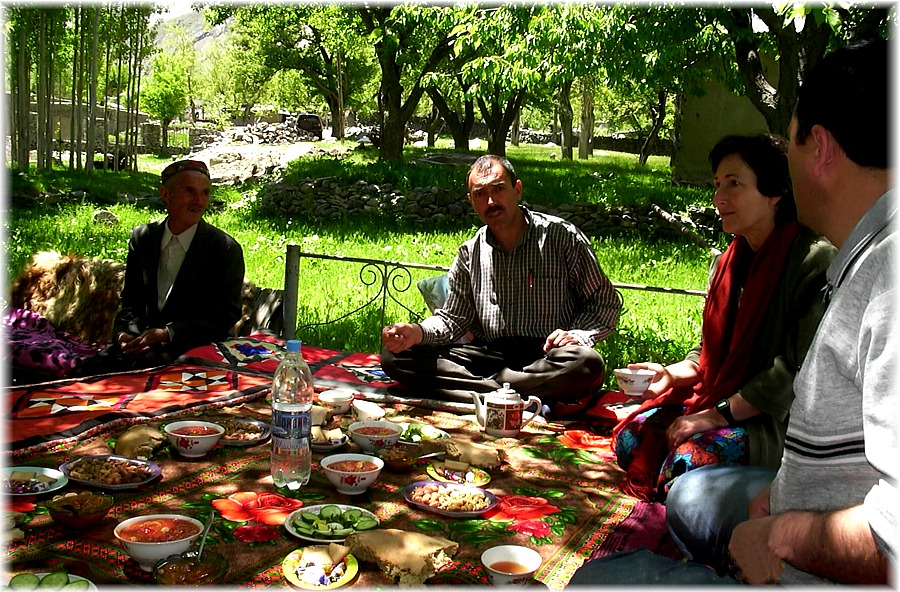
Sofra spread with delicious food

Part II: Land of Dance

by Robyn C. Friend, Ph.D.
photos by author,
many photos are linked to larger images- click!
posted September 30, 2009

In part I, Robyn talked about Tajikistan and its dance, about her Tajik dance teacher Makhingul Nazarshoeva, and about the challenge and rewards of travel in Tajikistan.  In part II, Robyn takes us to the Pamir mountains of Badakhshan.

Time seems to have a different meaning in Badakhshan – the rural, eastern portion of Tajikistan – than it does here in the States. Vehicles break down, roads become impassable, everything takes longer than you plan for.  So, punctuality and advance arrangements are not always necessary, or even possible.  There are usually no phones in the villages of the river valleys, so you just go, and make arrangements as best you can, expect the unexpected, and always be flexible.

Soon Sharlyn and I were on our way with Dawlatnazar – driver, dancer, and musician – and Samandar – our guide and friend – to the valley of the Bartang River, looking for local musicians and dancers who would perform for us.  Our first stop was at the village of Shujand, where Musarwal, a musician known all over Tajikistan, was uphill working on his fields. Eventually he was located and brought down to the road where we waited to make arrangements for a performance the next day.  He had known of our arrival in Badakhshan and our wish for a music and dance session with him, as we had given him a lift for a few miles on our way to Khorog when we first arrived in Badakhshan.  We made our arrangements, and then continued on up the valley for another couple of hours, arriving around dusk at the village of Siponj and the house of Jonboz, another well-known musician and an acquaintance of Samandar’s.  

Jonboz had no idea that we were coming, but upon our arrival seated us in the guest room of his house, and entertained us with music and stories until a hastily-prepared supper could be brought to us.

Central Asian hospitality is legendary:  though poor in material goods, these warm-hearted mountain people will offer their last piece of bread or bite of chicken to a guest.  We had to remember not to eat everything served; our host’s family could well have put everything they had on the sofra (dining cloth), and if we consumed it all, they might have little for themselves.

Jonboz is renowned for his piety and the deep spirituality of his music.  In addition to playing all the musical instruments of Badakhshan, Jonboz also creates small, beautifully hand-bound books of traditional poetry and excerpts from the Koran, folk remedies, and amulets of Koranic verses.

The sparse population of Badakhshan can be roughly divided into two main ethnic-religious groups: the Kirghiz, who are Turkic tribal nomads (found in Kirghizstan and China, as well as in Tajikistan) who practice Sunni Islam, and the Ismailis, who form the majority in the province, and speak languages of the Iranian family.  Religious practice among the Ismailis of Badakhshan is a fascinating combination of Ismaili “Sevener” Shia’ Islam, Zoroastrianism, and pre-Zoroastrian paganism.  

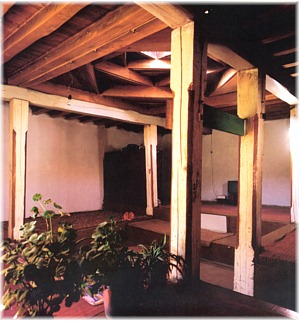
The faithful meet in one another’s homes, not in a mosque.  The construction of their homes displays elements from all of these different belief systems; in fact, the same element is often explained concurrently in terms of both Islam and pre-Islamic symbolism. 

Cheed CeilingThough every Ismaili Pamirian home is a little different, they all represent variations on a theme, incorporating the following elements:

  • The entrance to the square family room is through a door that leads to two floor-to-ceiling pillars, which are called the “Hassan and Hossein” pillars (named for the children of the martyred Shia’ imam, Ali), and, alternatively, the “Sun and Moon” pillars.
  • At the top of this pair of pillars is a crosspiece which joins them.  This crosspiece has images of Sun and Moon on it.
  • The three walls without doors have platforms built along their entire length, two low ones and one higher.  The platform to the right of the entrance is for the eldest men present.  The platform to the left of the entrance is the higher one; this is where the women sit during meetings, and where the husband and wife sleep.  In pagan reckoning, the platforms are named, beginning from the right, for the three ancient pre-Islamic “kingdoms” of the natural world:  Mineral, Plant, and Animal.
  • Across the facing platform are three pillars, named for “Muhammad, Ali, and Fatima”, respectively the prophet of Islam, his nephew,and his daughter.
  • The crossbeams in the ceiling are named for the Zoroastrian angels.
  • In the center of the ceiling (called a “cheed” ceiling) is a skylight, similar in function to the smoke hole in a yurt (a Central Asian tent), but formed in this case by four concentric squares stacked one atop the other.  These squares are named, respectively, for the four ancient pre-Islamic “elements” of the natural world,  Earth, Air, Fire, and Water.

JonBoz, Shirinnazar, and other musiciansThe next morning we had breakfast in the interior of the house, as musicians and a dancer began to gather.  Soon everyone was assembled, but Jonboz took time to re-tune carefully the various instruments.  “The instruments are crying”, he told us.  “They have no masters to play them”. Finally the instruments were tuned, and the men began to play maddoh, the traditional Badakhshani musical sequence of mystical poems, played in a variety of rhythms.  The men took turns as lead singer, giving each a chance to lead and then to rest.  It went on for a very long time; later, we were told that for special occasions when maddoh is played, the music and singing can go on all night.

A young man named Shirinnazar (“Sweet Looks”) came to the center of the floor, and began to dance Rapo (see Part
I
of this article for some information about the dance “Rapo”).  He was smiling as he whirled slowly and smoothly, arms and hands carefully placed.  He did the dance similar to the way my own teacher, Makhingul Nazarshoeva, did it – evidently, there is little difference between the way men and women dance the Rapo.  When it was all over, we thanked them all and headed off to Shujand for lunch and another performance by Musarwal.

Musarwal presented us with another massive outlay of food, including home-brewed liquor.  Afterwards, Musarwal lead us to a grassy spot by the river, where the musicians laid down a carpet and sat down to begin tuning their instruments.  Across the river a row of ladies collected and sat, watching us watching them, and enjoying the music. 

After a performance of daf soz (songs with frame drum accompaniment), the musicians played maddoh, followed by raqs-i aspak (“horse dance”), in which a man dances wearing a costume which makes it look like he is riding a horse.  Soon we were all dancing rapo, inviting the ladies across the river to dance with us, but, laughing, they declined.


Lunch

Men play


Horse dance

Pagan RockOn the way back to Khorog, we stopped at a sacred site devoted to Mushgela Gosha, the “Remover of Difficulties”.  The interplay between the Islamic and the pagan in this shrine is fascinating: phallic-shaped stones at the entrance (pagan); Koranic verses (Islamic), and a photo of the Agha Khan (Islamic) hanging near the Hassan and Hossein (Islamic) – or Sun and Moon (pagan) – pillars ; inside the shrine, a stack of nearly perfectly-round black meteorites, washed smooth by the pounding flow of the river (pagan).  We left a small amount of money for the caretaker, and continued our journey back to Khorog.  I was reminded of Christian churches I had seen in Central America, where Mayan and Christian iconography and practices are completely intermixed.

Khorog is a town of around 25,000 people; small, yet it is the capital of the Gorno-Badakhshan Autonomous Region, and by far the largest town in the area; most of the rest of the population of Badakhshan live in small villages of at most of few hundred people.  In Khorog, there is a university, a theater, a bazaar, and goods from China and Russia available for purchase in the marketplace. 

Khorog

From the center of  Khorog, you can see Afghanistan; in fact, the major portion of the drive from Dushanbe to Khorog runs along the river separating Tajikistan from Afghanistan.  There are places along the road up from Dushanbe where you could toss a stone across the river from the Tajik side and hit a goat in Afghanistan.

The river, however, is deep and fast, and we never saw a single boat of any sort. The governments of both nations have collaborated on the opening of three bridges across the river, at Darvaz, Ishkoshim, and Khorog. At the bridge near Khorog, once a week on Saturdays the Afghans are allowed to come across the bridge into an enclosed bazaar, to buy or to barter their cheap goods from India for the Tajiks’ cheap goods from China.  Families whose various branches were severed once the Soviets took over Central Asia also try to find their now-distant cousins from among the Afghan visitors.

Bazaar

I’ve since my first visit made several more trips to Tajikistan, and I hope to continue to visit regularly.  It’s not easy or luxurious, but the scenery is beautiful, the people are friendly and wonderful, and the culture is unique.  The intrepid Samandar is even starting to conduct small-scale tours, so you can go and visit this unknown jewel of beauty and culture for yourself. If you fancy some safe but adventurous travel, and the opportunity to see high mountains, green valleys, and dance among people who love and respect dance, then come away with me to Badakhshan!

Dancing in Home


Have a comment? Use or comment section at the bottom of this page or Send us a letter!
Check the "Letters to the Editor" for other possible viewpoints!

Ready for more?

  • Tajikistan: The Land of Dance, Part One
    Video features: #1-Introduction by author, #2- A Map Tour on an ancient and modern map.
    "Communication with the outside world is difficult and expensive, and nearly impossible during the winter."
  • Ballet Afsaneh and Carmen Carnes Dance Ensemble Reviewed
    Full Circle Little Theater Marin Civic Center, San Rafael, CA February 16, 2007 And since when was Rumi associated with Mother Earth?
  • The Ethnic Dance Festival 2006, Weekend One
    "Time" June 10, 2006, Palace of Fine Arts, San Fransico, CA
  • The San Francisco Ethnic Dance Festival, Weekend Two,
    Afro-Cuban, Chinese, Peru, Korean, Appalachian, Bolivian, Mexico, Tajikistan, Cambodian, South Indian, Tahitian
  • Give Credit where Credit is Due!
    However, some dancers are using the same music, costumes and choreography in their performances that they first see elsewhere. This begs the question: at what point does copying someone’s original concept or choreography cross over from homage to stealing?
  • Wiggles of the West: One Dancer’s Foray into Competition
    In the world of belly dancing lately, dance competitions seem to be the big thing. Love them or hate them, they are popping up all over the country, leaving one to wonder what benefit they add to our art form. In an art form as varied as Middle Eastern Dance, incorporating cultures crossing multiple borders and continents, to what standards do these competitions adhere?
  • Photos of Caravan of Secrets, Co-produced Theatre Production by Zahra Zuhair and Carolyn Krueger,
    held August 15th and 16th, 2009, at the Electric Lodge Theatre, Venice, California. Caravan of Secrets navigates imaginary landscapes inspired by the cultures and contradictions found among the ancient Silk Roads, Sea Routes and Gypsy Trails of the Middle East and Central Asia.