Gilded Serpent presents...

Naked Belly Dance in Ancient Egypt
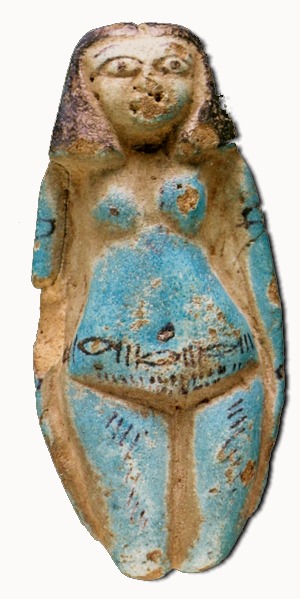
fertility figure

Part 2: Are They Really Naked?

by Andrea Deagon Ph.D.
posted November 10, 2009
Part 1: Are they Really Belly Dancing?

It may seem ridiculous to ask, “Are the dancers really naked,” because anyone can see that they are.  On the other hand, different cultural meanings for nudity and subtle iconographic conventions make this a serious question.  It really has two parts:

What does nudity mean in a dance scene like this?  And does this nudity reflect an actual practice of naked dancing as banquet entertainment?

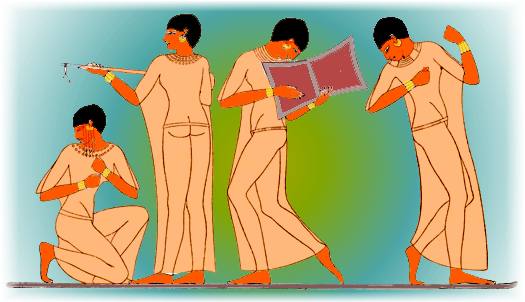
While the late 18th dynasty – the time period in which the Nebamun dancers were painted – offers most of the representations of naked dancers and musicians in Egyptian art, dancers from other time periods also appear scantily clad.  For example, some early representations of the female dancers of the kheners associated with funerary and other rituals show them wearing a short kilt, short hair, and only crossed bands at the breast.  This was apparently appropriate even for elite girls, such as Bendjet, who is portrayed as dancing in this costume at the funeral of her father, the nobleman Idu.(Other representations, though, show the women in funerary kheners in ordinary feminine clothing.)

The female dancers who are performing the athletic or gymnastic dances that characterize grand religious celebrations wear a “loincloth” that looks like a triangular cloth tied in front.  Acrobatic dancers, whether in sacred or secular contexts, are so consistently depicted in loincloths and nothing else that we have to assume that is really what they wore. 

In any case, the nudity or near-nudity of the dancers in some depictions of rituals and festivals (and male dancers may appear nude or nearly nude) suggests that this level of nudity was not in any way offensive in a sacred context – on the contrary, on certain specific occasions, it was the most appropriate garb for the sacred work these dancers accomplished.  (At other times or for other types of celebrant, formal clothing was appropriate.)

Clearly, this view of what is “holy” is wildly different from that of the modern Judeo-Christian or Islamic worlds.  We have to wrap our minds around that.  On the other hand, the relative undress of dancers in some religious rituals doesn’t mean that “anything goes.”  There were specific rules about when and where and to what degree nudity was appropriate in religious practice, in art, and in daily life, even if it is hard to reconstruct them from our distance.

There is also the matter of “practical nudity.”  Typical Egyptian clothing (it varied over time, but the basic form was a long caftan-like kalasiris for women, a somewhat Old Kingdom Dancersshorter one for men) would not have been very practical for the high kicks or back walkovers we see in the acrobatic dancing that was done both at grand festivals and in secular contexts.  A loincloth makes better sense.  Practical nudity also occurs in Egyptian art (and we assume, in Egyptian culture) in workers whose jobs involve getting muddy or wet for example, the servants who retrieve fowl from swamps in hunting scenes. 
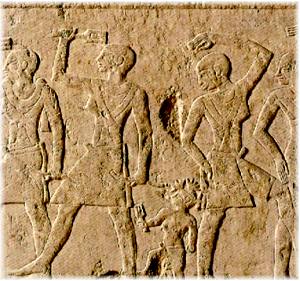
Nudity in art is also related to status.  Elite men and women are rarely shown nude, whereas nudity can represent poverty or other abject and low status (like a prisoner about to be beaten, or someone who has to slog through a swamp to collect dead birds).  Thus, nudity has a symbolic role in Egyptian art, and is not simply documentary.

There are some places where artistic conventions do not represent what really happened in the culture, though.  Children, for example, were usually portrayed as nude in art, whereas in life, they wore clothes, some of which have survived in Egypt’s hot, dry climate to be excavated in the 20th century.

Clearly, nudity had meaning for the Egyptians that it does not necessarily for us. For example, no one today would represent the non-elite status of construction workers by depicting them as nude (though come to think of it, that might not be a bad idea).  And we tend to recoil in horror from images of naked children as kiddie porn rather than as a conventional way to symbolically represent childhood innocence.  And while for the Egyptians nudity or relative undress could represent the particular purified or unworldly states appropriate for some celebrants in sacred occasions, our gods (at least the mainstream ones) appear to want us to keep our clothing on while worshipping them, and represent our purity in other ways.

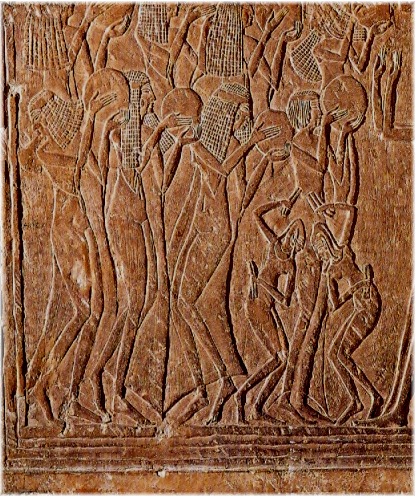
But this does not mean that nudity was the only or even the ordinary “dance costume.”  The great majority of dancers and musicians in Egyptian art are shown fully clothed.  For example, in a New Kingdom Frieze depicting women playing frame drums and dancing, the dancers wear ordinary women’s dress.  Yet they may look nude at first glance, because their dresses are only outlined, emphasizing the body underneath.  (This is typical for the New Kingdom, when women are painted as idealized and sensual regardless of age or status.) There are other depictions of dancers and musicians in which the body is carved in relief but the clothing only painted on, and in some instances the paint has deteriorated, leaving the impression that the women are nude.  A series of paintings from several tombs of the Amarna period shows groups of female drummers and dancers wearing ordinary women’s clothing at homecoming celebrations. 

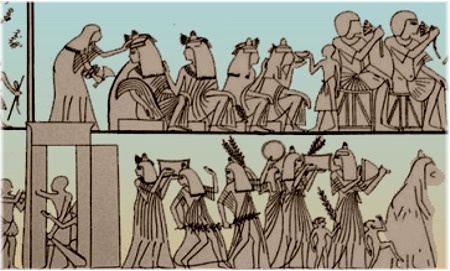
from the tomb of NakhtIn fact, it’s not till near the end of the 18th dynasty, very late in Egyptian history, that the bejeweled nudity of the Nebamun girls begins to appear on servants, musicians and dancers at the banquets on tomb walls.  Because these images are so beautiful and sensuous, we use them disproportionately to illustrate ancient Egyptian dance, giving the impression that nudity in banquet entertainers was common in all periods. 

In fact, the portrayal of nearly-nude dancers at banquets is a fairly limited artistic phenomenon.  It’s just that we enjoy it so much we choose to use those images in our depictions of Egyptian dance.

Even in the New Kingdom tombs that do feature some nearly-naked dancers, most dancers and musicians, as well as other servants in attendance at the banquets, are usually shown clothed in form-fitting, full-length dresses similar to those of the elite women diners.  But sometimes clothed musicians and dancers are shown side by side with performers who are nearly nude.  A famous example is from the tomb of Nakht – it’s one of the most popular scenes recreated by the papyrus artists who supply the Egyptian tourist market. 

It seems obvious to us that these figures are meant to be erotic.  That’s reasonable enough.  For the ancient Egyptians as well as for us, nudity or semi-nudity had a sensual and erotic element.  In one of my favorite passages in Egyptian literature, in the Westcar Papyrus, a virile young pharaoh orders that twenty women from his household come out to entertain him on his boat, dressed in beaded net over-dresses but without their regular dresses underneath.  This implies that while elaborate dress was the norm in the king’s household, there might be occasions where the rich and powerful could dispense with it in those meant to entertain them. 

Perhaps the banquet dancers’ “costume,” nudity plus a few items of jewelry, is simply a cross-cultural turn-on, reflecting real erotic practices.  I wouldn’t be surprised to learn that, from time to time, an ancient Egyptian woman might have decided to appear before someone she wanted to impress wearing jewelry and not much else. Could that eroticism have translated into banquet entertainment?  Could “bejeweled nakedness” be the standard performing costume for female dancers at elite entertainments?  The New Kingdom tombs raise that possibility.

On the other hand, the tomb paintings are not photographs of real events.  They express an ideal.  And that ideal might be elusive when we try to define it.  But one thing is certain: we cannot assume that the ancient Egyptians share all of our attitudes about nudity, or all of our automatic assumptions about what it means. 

Now, in the 21st century West, we come from a long artistic tradition in which female nudes, in everything from Renaissance paintings to Playboy magazines, are offered up for the voyeuristic pleasure of the viewer.  Nudes have different contexts and different meanings – the Playboy centerfold may cause mild arousal, while the naked women in Manet’s The Picnic (1862) may call into question your assumptions about manners and reality. But they all put us the viewers, into a stance where we are gazing on an objectified woman.MANET, THE PICNIC, 1862

The Egyptians had nothing against voyeuristic appreciation of the female form, but nudity did have other meanings – meanings specific to the function of these banquet scenes painted on tomb walls.  Rather than real dance-wear (or lack of it), the occasional nudity in the dancers and servants in New Kingdom tomb paintings might be an artistic convention meant to highlight
the level of pleasure available in the afterlife by creating an intriguingly sensuous atmosphere.  In other words, afterlife dancers might be undressed in a way that real dancers weren’t.  Asher-Greve and Sweeney comment that very little of the clothing in tomb painting is true to life – there were other factors at work than being “true to life.” [1]

To resolve the costume questions, we must first consider the fact that these banquets were events that took place in the afterlife, and next, step back for a moment into the realm of interwoven sex, birth, and regeneration that is such a powerful element of Egyptian funerary art.

While in our world the idea of a blessed eternity has been spiritualized and sterilized into a sexless existence in a snow-white heaven, the ancient Egyptians had an earthier idea of the pleasures of eternity.  And while we tend to separate sex and motherhood into two separate states with completely different social and spiritual meanings, the Egyptians saw them as part of the same process.  Sex led to fertility, to the blessed children that perpetuated the household and pleased the hearts of their parents.  Sex, pleasure in the song, dance, food and drink, beloved children, and material prosperity all went hand in hand.  The transition of the soul to the afterlife was also part of the process.  Transition into the next world is sometimes described in terms of birth.  Awakening in the afterlife may be expressed in terms of regaining sexual potency. 

At the same time that semi-naked banquet dancers begin to appear in tomb paintings, a closely related motif of naked or semi-naked young girls appears in other contexts in Egyptian art, such as in mirror handles and cosmetics spoons.  Egyptologist Gay Robins interprets this beautiful young female image as an New Kingdom manifestation  of a kind of figurine that appears again and again in Egyptian culture from pre-dynastic times to the Christian era, embodying these ideas of sex, prosperity, birth and rebirth. [2]

These long-lasting naked female figurines are often painted with the kinds of jewelry the Nebamun dancers wear.  They were called “concubine figurines” by the archeologists of the Victorian era and were thought to be a variation on ushabti figurines.  (Ushabti were tiny models of workers that were placed in elite tombs, and they were imagined as coming to life to serve the needs of the deceased for eternity.)  The Victorians – possibly impressed by the Islamic idea of numerous virgins awaiting the faithful in heaven – could not imagine any use for these naked yet adorned figurines but that they would sexually serve the deceased in his happy afterlife.

Fertility FigureBut there were some problems with this identification.  First of all, rather than being perfectly proportioned, realistic miniatures, like the ushabti, these “concubine figurines” could take the form of nearly abstract figures whose breasts and pubis were emphasized, but whose arms and legs tapered to nothing.  You’d think this absence of fully formed arms and legs in his concubine would be a serious drawback for the deceased.  Sometimes the “concubine” figurines were modeled together with small children, not usually the most desirable accoutrement for one’s eternal sex kitten.  And one might also wonder about the fact that the “concubines” were found in women’s tombs, in homes, and in shrines.

Now these items are called “fertility figurines,” because that most accurately describes their uses in all the contexts where they have been found.  They could be kept in the home, at the small shrine that all ancient Egyptian houses had, to encourage the continuing abundance of the household.  They could be given as an offering at shrines to Hathor, the woman’s helper in both sexual and birth-related matters.  Scholars speculate that some figurines were offerings meant to ensure conception and safe childbirth.  When included in the burial goods of a tomb, they could work to assure the resurrection of the deceased into a prosperous and blessed eternity. 

These sensuously decorated but schematic figurines, far from having the purely sexual intent the prurient Victorians ascribed to them, represented the natural (to the Egyptians) integration of prosperity, pleasure, sexuality, childbirth, and eternal life.[3]

So perhaps the ornamented nudity of the dancers in New Kingdom tombs such as Nebamun’s is meant to serve the same function for the deceased and his family as did the fertility figurines of tradition.  Their beautiful, bejeweled nudity and their sensuous young bodies invoke the sex/birth/pleasure/resurrection connection that the schematic figurines also invoke.  They may be, essentially, fertility figurines in action.[4] Rather than reflecting the actual banquet practices of the living, the naked and bejeweled dancers (as well as the naked and bejeweled serving girls who also appear) are a sign that this banquet is held in the hereafter.  The performance of these nude, elaborately adorned, otherworldly is a sensual, physical, and liminal activity that represents and evokes the sexual underpinnings of the metaphysics of rebirth.

Given this network of symbolic ideals, there is a good possibility that the nudity of banquet musicians and dancers in these New Kingdom tombs expresses symbolic afterlife revival, not worldly practice. 

Of course, nothing can be proven, and there are other possibilities.  Maybe, for example, there were special dances performed at funeral banquets that actually did involve nudity, and the Nebamun paintings and others accurately represent that event.  But even if this is the case, it is still a different thing from the average domestic banquet being entertained by nearly-naked performers. Musician Breasts

Given the balance of other depictions of dance in Egypt, and the symbolic network of ideas behind the nudity of the painted banquet dancers, my own feeling is that the Nebamun dancers and others are afterlife projections, rather than accurately-depicted entertainers.

On the other hand, boudoirs and whorehouses may have featured naked belly dancing every day of the year since, as in many cultures of the ancient and modern world, ancient Egyptian prostitutes made music and danced to entertain and arouse their customers.  Such scenes may be depicted in the Turin Erotic Papyrus, found in the workmen’s village at Deir el Medina, and on potsherds on which bored workmen sketched out some of their fantasies of naked women, their musical instruments only that moment laid aside.[5] So if the Nebamun dancers are projections of afterlife blessings rather than realistic representations of gigging dancers, what did real-life dancers wear?  In particular the professional (or at least specialist) dancers at banquets, who may (or may not) be belly dancing? 

When the New Kingdom banquet dancers are shown clothed, it is in long, form-fitting dresses similar to those worn by the women they are entertaining, and this is true of most other representations of dance in social situations. 

Our society expects dancers to wear a kind of costume that makes them stand out as different, whether they’re belly dancers in a nightclub or ballet dancers on stage.  But our expectations might not apply to ancient Egypt. 

In many of the world’s societies, professional entertainers, including dancers, wear clothing as close to the richness and quality of aristocratic dress as they can manage.   Professional dance – especially if it is a form that like belly dance arose from a social dance – is often best costumed in a “party dress” that makes the dancer look like she belongs among the elite.  Given that a proportion of the entertainers at elite banquets are depicted as wearing such clothing in Egyptian art, I propose that in general, it is with this sort of elegance that ancient Egypt’s professional musicians and dancers really dressed, not in the hereafter but in the here and now.

Given the importance of dance and music in the afterlife, it’s possible that the real women, whether professionals or household members, who entertained as dancers, had somewhere in their subconscious minds an appreciation of their sensual art as life-giving, beautiful, and capable of inspiring the kind of desire that transcends worlds.  Egypt’s rich imagery of sensual pleasure and spiritual transformation might have created, for them and for their audiences, their own delightful experience of enchantment.

Tomb paintings like the banquet scene of the tomb of Nebamun, or the entertainers of the tomb of Nakht, were not public art, produced for the entertainment of the masses.  They were private scenes, visited by family members as tombs were constructed, and later for offerings to be left and respects paid.  The dancers who actually entertained at banquets may or may not have been aware of the stylized images of dancers that elite tombs have left us, and that the Internet has made so familiar to those of us with an interest in Egyptian dance.  If they were aware of these images – say, from household altar scenes such as those in the workmen’s homes at Deir el Amarna – they may or may not have identified with them. 

Their own experience of their dancing was not in the frozen images of eternity but in the here and now: in the pleasure, magic, enjoyment, giddiness, delight, and of course, the little annoyances and troubles (Drunken patrons? Cheap employers?  Bitchy competitors?  Long walks to venues that turned out a little less nice than they were made out to be?) that make dancing real and not a thing of fantasy after all.  So perhaps we should remember ancient Egyptian dancers not by the perfection with which they were painted, but as the women (and men) they undoubtedly were, whose lives contained triumphs, annoyances, connections, pleasures, headaches, torn skirts, chipped fingernails, good nights, bad nights, long walks home, goodbyes at the door, and settlings down in hot nights into beds strung with cotton netting, with the remnants of the evening’s music, dust and noise finally drifting into silence.

Footnotes

  1. Asher-Greve and Sweeney 2006: 157-8.
  2. Robins 1996: 30-34.
  3. See Asher-Greve and Sweeny 2006: 163-4.
  4. Robins 1996: 30-34.
  5. Scenes that may reflect this are seen in the explicitly erotic scenes of the Turin Erotic Papyrus, found in the workmen’s village at Deir el Medina; some of the women are holding (or have recently set down) their musical instruments.  Manniche 1992: 108-119.
Resources
  • Dance Resource Journal, 1987, 10(2): 6-17.
  • Asher-Greve, Julia, and Deborah Sweeney.  2006.   On Nakedness, Nudity, and Gender in Egyptian and Mesopotamian  Art  In: Schroer, Silvia, ed.    Images and Gender: Contributions to the Hermeneutics of Reading Ancient Art  Fribourg: Academic: 125–76.
  • Assante, Julia.  2006.  Undressing the Nude: Problems in Analyzing Nudity in Ancient Art, with an Old Babylonian Case Study. In: Schroer, Silvia, ed.    Images and Gender: Contributions to the Hermeneutics of Reading Ancient Art  Fribourg: Academic:  177–208
  • Boyle, Alan.  Sex and Booze Figured in Egyptian Rites.  msnbc Technology & Science.  http://www.msnbc.msn.com/id/15475319/  Accessed Sept. 12, 2009.
  • Der Tanz im Alten Ägypten nach Bildlichen und Inschriftlichen Zeugnissen.  Glückstadt: Verlag J. J. Augustin.
  • Davies, N. de G.  1908.  The Rock Tombs of El Amarna Part VI: Tombs of Parennefer, Tutu, and Ay.  London: Offices of the Egypt Exploration Fund.
  • The Tomb of Nefer-Hotep at Thebes.  New York: The Metropolitan Museum of Art Egyptian Expedition.
  • Fear, A. T.  The Dancing Girls of Cadiz.  Greece and Rome, Second Series. 38.1 (April 1991) 75-9.
  • Goelet, Ogden.  Nudity in Ancient Egypt.  Source: Notes in the History of Art.  12.2 (Winter 1993): 20-31.
  • Kemp, J. 1979.  Wall Paintings from the Workmen’s Village at el-Amarna.  The Journal of Egyptian Archaeology 65: 47-53.
  • Lexova, Irena.  2000 (1935).  Ancient Egyptian Dances.  Trans. K. Haltmar.  Mineola, NY: Dover Publications Inc.
  • Manniche, Lisa. 1992. Music and Musicians in Ancient Egypt. London: Dover.
  • 1981.  The term hnr: “harem” or “musical performers”?  In: William Kelly Simpson and Whitney M. Davis, eds.  Studies in Ancient Egypt, the Aegean, an the Sudan: Essays in Honor of Dows Dunham.  Boston, Mass: Museum of Fine Arts: 137-145.
  • Robins, Gay.  1996.  Dress, Undress, and the Representation of Fertility and Potency in New Kingdom Egyptian Art.  In: Natalie Boymel Kampen, Ed. Sexuality in Ancient Art.  Cambridge: Cambridge University Press.
  • Shay, Anthony.  1999.  Choreophobia.  Costa Mesa, CA: Mazda Publishing Co.
  • Simpson, William Kelly.  1976.  The Mastbas of Qar and Idu.  Boston: Museum of Fine Arts.
  • Spencer, Patricia. 2003. Dance in Ancient Egypt.  Near Eastern Archaeology 66.3: 111-121.
  • Teeter, Emily.  1993.  Female Musicians in Pharaonic Egypt.  In Kimberly Marshall, Ed.  Rediscovering the Muses: Women’s Musical Traditions.  Boston, Mass.: Northeastern University Press: 68-91.
  • Der Tanz in der Antike.  Dornach: W. Keller.
  • Williams, Craig A.  1999.  Roman Homosexuality: Ideologies of Masculinity in Classical Antiquity.  Oxford: Oxford University Press
  • Simpson 1976:  p. 25, fig. 24, pl. 24.
  • On nudity in Egyptian culture: Goelet 1993: 20-26;  Robins 1996: 36-9; Asher-Greve and Sweeny 2006: 135-6,47-50, 53-64.
  • Manniche 1992: 42.
  • Assante 2006.

Abbildung

Have a comment? Use or comment section at the bottom of this page orSend us a letter!
Check the "Letters to the Editor" for other possible viewpoints!

Ready for more?


Gilded Serpent presents...

Ahlan Wa Sahlan Festival 2009

Raqia & Dr Mo present awards with Raqia's picture in the center, click for larger view

Page 3:Competition Winners, & Closing Gala

Photos by Denise Marino
text by Leyla Lanty
posted November 11, 2009
Page 1: Opening Gala, Page 2: Teachers

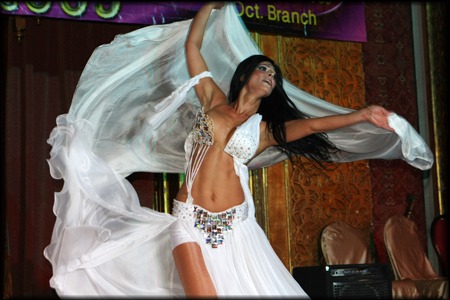
It’s June 27, 2009, in Cairo, Egypt, which can mean only one thing – the Opening Gala of Raqia Hassan‘s Ahlan Wa Sahlan Festival! At the Mena House hotel the excitement in the air is palpable, not only because of the highly anticipated evening show where dancers from all over the world gather to see the top dancers, musicians, and singers in Egypt, but the next week of classes with Egyptian stars and teachers from all over the world, nightly parties, and the Closing Gala, a spectacular evening of top dancers, AWS competition winners, musicians, and singers.

One feature of the nightly parties is the dance competition.  Although it’s one competition, it is spread over 2 or 3 nightly parties, with only some of the competitors performing each night until all have had a chance to perform once.  Judges for the AWS 2009 competition included Mo Geddawi, Mona El Said, Nabil Mabrouk, and Katia.

Winners are chosen from the whole field of competitors with no semi-finals or finals.  The 2009 Winner of the Ahlan Wa Sahlan Competition was Dariya Mitskevich from the Ukraine, who received a gold ankh trophy, a performance slot in the Closing Gala and the opportunity to teach at AWS 2010. This year there were several teenage or younger competitors and Maria Litovka, Russian, won first place among them.  Both winners were outstanding dancers whose performances showed their artistry, musicality and talent.

Denise-"Not all the judges are there because evey night there were different judges except Katia & Mo Geddawi were there every night"
Judges
Zaza Hassan on left & Nabil Mabrouk
judges
left to right: Mo Geddawi, Mona El Said, Nabil Mabrouk, and Katia
Dariya Mitskevich
Dariya Mitskevich of the Ukraine wins
First Place Winner Ahlan Wa Sahlan 2009

Dariya Mitskevich
Dariya Mitskevich

Daria Miskevich
Dariya Miskevich with her trophy

Closing Night Gala

Some of the entertainers and dancers in the Closing Gala were guest artist Jillina from California, Katia from Russia living in Egypt, Dalia from France living in Egypt, and the famous singer Saad el Soghayer."
Leyla and Roland
Leyla Jouvana and Roland


Sayed El Artist of Egypt
Said El Artist

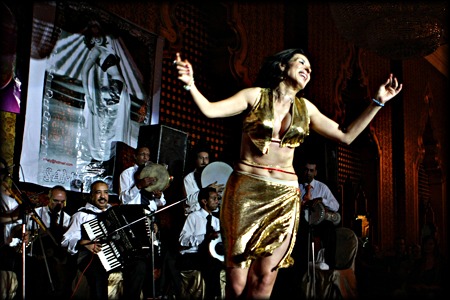
Said el Artist – He and his highly talented and extremely well rehearsed percussion ensemble wowed the audience with percussion as no one had ever heard before.  The show included some Nubian dancers and drummers along with some fine drum, tambourine, and cymbal soloists.  Featured in the show were drum solos by some of the young boys in the El Artist family ranging in age from about 6 to 12 years.  In the next photo, the accordionist on the right is Houda El Artist and the accordionist on the left is Sallah, two of Said’s brothers.  Behind Houda was another brother, Dede who in the past has been head drummer for Dina and Dandash. Houda and Said own a recording/rehearsal studio in Giza just off Haram Street, where my CD “Golden Days, Enchanting Nights” was conceived and put together. 

Sayed El Artist
Said El Artist

Katia of RussiaKatia of Russia
Katia of Russia living in Egypt

Dalia of Egypt
Dalia is a French dancer living in Egypt
Jillina of CaliforniaJillina of California
Jillina of California, guest artist

Jillina – Oh yes Jillina!!  She knocked my socks off!  As far as I know, she’s had only one opportunity to rehearse with the band before being the final dancer at the Closing Gala.  She looked as if she’d been dancing with them for months if not years.  She sparkled and shone throughout her performance – what a great way to end the dance performances at AWS 2009. [Ed note- article by Jillina on her experience coming soon!} 

Saad el Soghair
Saad el Soghayer

Saad el Soghayer – He and his wonderful orchestra and team of about 40 young male dancer -drummers lit up the night, energizing the whole room even though it was already 2:30 in the morning and it had been a long, long show already.  He and his dance team moved out into the audience early on then to keep the excitement going, ended the show on stage with a number of the audience members dancing on stage with him. 

Saad el Soghair
Saad el Soghayer

Maria
Maria Litovka, winner of the children’s division gets to dance with Saad on closing night.
I saw her during the competitions during the week and her technique and musicality were both impressive. 
Maria Litovka and Saad
Dariya Mitskevich with Saad el Soghair
As winner of the competition, Daria Miskevich gets to dance again on closing night with Saad el Soghayer

party
Amir Thaleb is the man in the center

party
Angelika, Princess Farhana and Fahtiem

Just a few more photos from the Opening Night Gala…

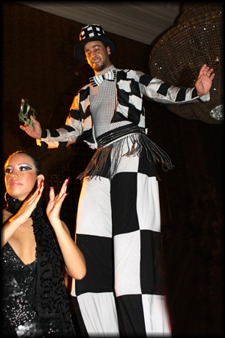
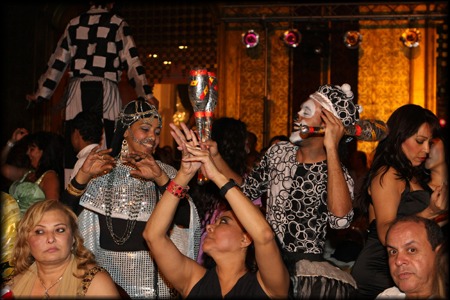
Essam Karika is a very popular Egyptian singer who closed the Opening Night Gala.  His show includes a number of circus acts circulating among the audience while he sings, sometimes from atop a dining table.  There
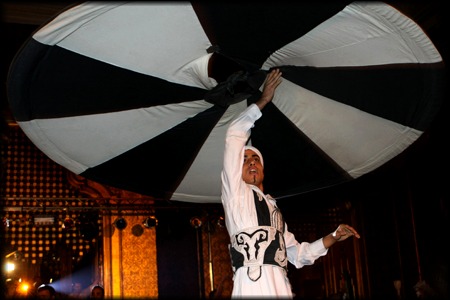
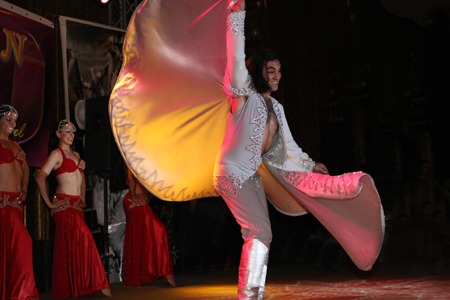
were stilt dancers who danced shaabi style up on top of their stilts, along with an assortment of characters: clowns, a man in a gorilla suit, raqs tannoura dancers twirling the big skirts above their heads, duff (hand drum) players in shirt, ties, and dress slacks.  Note from my diary "General pandemonium".

Stiltwalker Little Entertainer
Essam Karika
Essam Karika

Essam Karika clown
party
Mona Said is the woman in middle snapping her fingers.

dervish


Denise Marino, world traveling professional photographer, who has been a featured photographer at the festival for several years, contributed these magnificent photos from AWS 2009 to the Gilded Serpent.
See Denise’s bio page for a list of more of her photos posted on Gilded Serpent and for links to her websites

Have a comment? Use or comment section at the bottom of this page orSend us a letter!
Check the "Letters to the Editor" for other possible viewpoints!

Ready for more?


Gilded Serpent presents...

Roads Less Traveled: 3 Unusual Audio CDs

Collage of 3 CDs

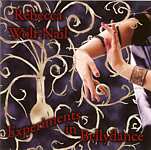
Experiments in Bellydance by Rebecca Wolf-Nail
Passages by Middle-Earth Ensemble
Desert Winds by Transition

Review by Tracy Benton
posted November 6, 2009

Here’s a collection of music for those searching for something off the beaten path! It can be difficult for a dancer to decide to spend money on dance music by lesser-known bands, particularly while trying to avoid adding the eighteenth cover of "Zeina" to a personal collection. If the band and the music are utterly unknown to you, how can you open your wallet? Perhaps these reviews will help you make up your mind. The 3 audio CDs reviewed here range from the traditional to the cutting edge.

TransitionsCDTransition is a small ensemble featuring three musicians–Souren Baronian, Haig Manoukian, and Cornelia Kraft–performing on a range of instruments from clarinet to kaval, oud to saxophone. Although the ensemble is billed mainly as a Middle Eastern jazz ensemble, its "Desert Winds" album feels steeped in Armenian and Turkish traditional influences. This CD is well-recorded and is full of virtuoso playing, from complicated runs and riffs to soulful taxim. Sometimes I thought the sound was a bit spare, but three musicians are three musicians, after all. I found the album particularly notable in that it offers tracks in less common time signatures: 10/8, 9/8, 7/8, even 5/4. (Trust the jazz musicians to challenge you rhythmically; the track listing kindly shows this information.)

My favorite tracks on this CD included the 8-minute "Karshlama Medley", a lively mix of melodies and taxim over a steady, moderate 9/8 beat, perfect for the dancer wanting to explore theTurkish style. The clarinet and the oud trade the lead lines, offering a lot of variety for a dancer wishing to experiment. Another was the more jazzy-feeling "Seasoning", an original by drummer/vocalist Cornelia Kraft. Kraft scat-sings the melody over the top of the instruments; the end result is akin to Enya turning her hand to Middle Eastern music, producing a fusion track complete with a fast introduction, an ethereal slow section, and an exciting finish. On some tracks the musicians clearly want to hang out in their jazz mode; the last song, "New Dawn," is a good example of this. If you like both jazz and Armenian music, and are intrigued by the idea of putting them together, you will definitely enjoy this album.
Available for purchase here on CDBaby
See
Souren on our Musical Instrument Tour page here

3 Zil Rating
Rating: Three Zils

Middle EarthThe Middle-Earth Ensemble is a five-piece band whose sound I would classify as "renaissance faire." I don’t mean this in a disparaging way; I think they are an excellent example of the types of versatile musical groups one hears at ren faires. They have a wide repertoire of music that pulls from many different ethnic influences. Their album Passages displays their voyages into many different sounds: Arabic, jazz, Turkish, Balkan… luckily, not all in one track! At first, I found listening to their instrumentation a little startling. Oud, violin, and traditional percussion were not surprising, but the electric bass seemed out of place to my ear, and doubling the violin melody lines on flute sounded like too much on the top end. However, I have no doubt that this band would be a fun dance experience in a live show or hafla. Their sound is upbeat and pulls you in; it’s "in your face" and delightful.

More than half the tracks on Passages are originals. The drum solo, "Cairo Beats," is a well-varied solo, with several rhythmic changes, but it avoids the cut-and-paste structure that makes so many drum solos sound alike. I have to admit that while I found pieces like "Galiciana" to be breezy and entertaining, their fusion with Middle Eastern music is very loose. A dancer looking for ren-faire-like fusion will like these original tracks, but not one seeking a strong Middle Eastern feel to the music.  However, the cover tracks on Passages are well worth a listen if more traditional music is to your taste. "El Helwa Di," in particular, is arranged to great effect with tempo changes and a lyrical flute solo. If the idea of a less traditional ensemble’s take on
Middle Eastern dance music intrigues you, you might check out Passages.

Available for purchase here on CDBaby
Frank’s GS Bio Page with his GS articles listed

3 zil rating

Rating: Three zils

Rebecca WolfRebecca Wolf-Nail’s Experiments in Bellydance goes much further into fusion territory than the previous two albums. At first, I was disappointed to see no musician credits printed on the liner notes… then realized that she is apparently supplying all the instrumentation herself. Most of this CD sounds synthesized, so if "unreal" instruments bother you, this album won’t be your favorite. The entirely original tracks vary in flavor from Native American to Zambra Mora stylings. Several tunes, such as the "Nocturne Suite", are quite Western and orchestral in nature, but they are limited by the synthesizer. They sound as if they’ve been recorded inside a small box, and this lack of resonance detracts from the music.

Most successful are the tracks in which the composer explored themes far away from traditional music for Bellydance. Her "Sol Bloom Jam" is perfectly designed to appeal to fusion dancers exploring the vaudeville and circus themes now becoming popular, complete with a nod to the "Snake Charmer" tune, circus calliope, and music box dancer. (In fact, I can’t wait to see this in a performance somewhere.) "When Clowns Attack" is a more pared-down composition along this line, featuring a sound like a toy piano. Dancers in search of the truly unusual are those who will most appreciate Experiments in Bellydance.

Available for purchase on artist’s site here

2 zil rating
Rating: Two zils

When you’re ready to take the plunge and investigate some music that’s not your everyday baladi, keep all three of these CDs in mind. Depending on what you’re searching for, one of them just might be the perfect fit.


Have a comment? Use or comment section at the bottom of this page orSend us a letter!
Check the "Letters to the Editor" for other possible viewpoints!

Ready for more?


Gilded Serpent presents...

Ahlan Wa Sahlan Festival 2009

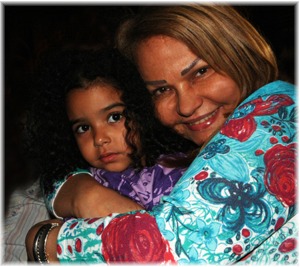
Raqia and her granddaughter

Page 2:Teachers from Around the World

Photos by Denise Marino
text by Leyla Lanty
posted November 4, 2009

It’s June 27, 2009, in Cairo, Egypt, which can mean only one thing – the Opening Gala of Raqia Hassan‘s Ahlan Wa Sahlan Festival! At the Mena House hotel the excitement in the air is palpable, not only because of the highly anticipated evening show where dancers from all over the world gather to see the top dancers, musicians, and singers in Egypt, but the next week of classes with Egyptian stars and teachers from all over the world, nightly parties, and the Closing Gala, a spectacular evening of top dancers, AWS competition winners, musicians, and singers.

Raqia hires a large staff of teachers from all over the world.  They range in fame from the top stars of Cairo to those who may only be known to Raqia and in their own home localities as top notch teachers and performers. 

On Teachers’ Night, held on the night after the Opening Gala, AWS teachers who wish to perform have the opportunity to show their special talents to festival attendees The next day many people go to the registration desk and register for additional classes with teachers they saw in the show.

On days one through six, classes are held from 10 a.m. to 7 p.m. in the Mena House hotel.  Raqia hires a number of professional drummers on a stand-by basis so that any teacher who needs a live drummer only has to ask and a drummer appears in the class ready to accompany the instruction and practice.  Classes taught by superstar performers and teachers such as Dina, Randa Kamel, Dandash, Raqia herself, Dr. Mo Geddawy and more are held in the large ballrooms, while the smaller classes, from about 10 to 60 people, are held in the conference rooms, dining rooms and other spaces.  Over the four years I’ve taught cymbals at AWS, my class has been in the nightclub, two conference rooms, and the basement disco. Heard in the lobby after the Teachers’ Night show "So many teachers, so hard to choose!"


Teachers at AWS Fest 2009

Abir & Magdy of Egypt

Alba Hayal of Barcelona, Spain

Amara Saadeh of Brazil
Amir Thaleb of Argentina

Angelika Nemeth of California

Antonia Canal of Columbia
Antonia Canal of Colombia

Aziza of Italy
Aziza Abdul Ridha of Italy
Bella of Taiwan
Bella of Taiwan

Dana Amar of Chile
Dana Amar of Chile

Dina of Egypt
Dina of Egypt – performed on teachers’ night rather than the opening gala because she had been in China and just arrived back in Cairo hours after the opening gala had finished.  She did her full show, about an hour, with all the costume and mood changes, her singer, full band.  I heard many say after her show “NOW, I can die happy, after seeing a show like this!” 

Dina of Egypt
Dina

Dina of Egypt
Dina of Egypt

Fahtiem of California

Farida Seidi of Algeria

Fatima Serin of Turkey

Giselle Castro of?
Giselle Castro of Brazil

Guo Wei of Beijing
Guo Wei of Beijing

Julia of Russia
Julia of Russia

Leyla Jouvana of Germany

Leyla Lanty of California
Rome
Maryem
from Rome, Italy
Meera of California
Meera of California

Mohammed el Sayed
Mohammed el Sayed of Egypt

Monika of Italy
Monika of Italy

Munique Neith of Spain
Nabila of Germany
Nabila of Germany

Nadja of Sweden
Nadja of Sweden
Nancy Kua of Taiwan
Nancy Kua of Taiwan

Nazharit of Venezuala

Princess Farhana of California

Raja of Algeria
Raja of Algeria

Rosadela of Spain
Rosadela of Spain

Samarah Salah of Morocco

Samara Haya of Spain
Seiya of Germany
Seiya of Germany

Shabanna of Venezuela

Shahinaz of Italy
Shahinaz of Italy dances with the singer (name
unknown
)

Simone of Italy
Simona Minisini of Italy

Sujee Choi of Korea
Sujee Choi of Korea

Yael of Paris, France

Yasmina of Cairo & the UK


Denise Marino, world traveling professional photographer, who has been a featured photographer at the festival for several years, contributed these magnificent photos from AWS 2009 to the Gilded Serpent.


Have a comment? Use or comment section at the bottom of this page orSend us a letter!
Check the "Letters to the Editor" for other possible viewpoints!

Ready for more?

  • Traveling with the Touareg
    This was my 5th trip to Algeria since 2000 and I have been amazed at the rapid economic development. The government is working very hard to make Algeria a very popular tourist destination once again.
  • Dancing again in Afghanistan
    As I had suspected, Afghan women belly dance.
  • Belly Dance in Brazi
    …they are trying to organize a Code of Ethics
  • Troupe Tabu goes to China!
    .It should be noted that somewhere between passing the audition and performing, it was announced that three out of four dancers in the group not including myself) were pregnant.
  • The International Belly Dance Congress
    September 28-30, 2007, in Bogner Regis, England Gala photos provided by Josephine Wise, others by author.
    Not being able to prepare my planned choreography properly for the Oum Kalthoum song, which is not easy to interpret to begin with, I quickly turned to emotions in order to fill up the space.
  • Belly Dancing in Estonia
    As in the rest of the world, the Egyptian style of belly dance is the most popular one in Estonia. Most of the instructors and dancers are specialized in that style. The American Tribal Style Belly Dance is also becoming more known each day. The general impression of belly dance in Estonia is glamorous, feminine, luxurious, modern and elegant. It’s a time where Estonian dancers can truly say that they can be proud to be a Middle Eastern dance artist in Estonia.
  • Bellydance in Iceland
    Recently, I was able to witness first hand how truly global the world of bellydance has become. Dances of the Middle East and North Africa are no longer a mystery and unknown “exotic”style of dance.
  • The Grand International Bellydance Tour or How We Fled India at Midnight, Eluding Our Captors and Evading our Go-Go-Dance Responsibilities. or What Would Fifi Do?
    It may not have been such a problem for us had the prostitutes not been posing as bellydancers!
  • Indonesia’s Introduction to Belly Dance: The Mainstream Media’s Influence
    Extensive mainstream media attention has been a mixed bag of blessings and, well, “somewhat less than blessings,” as most Indonesians would diplomatically say.
  • Undercover Belly Dancer in Iraq
    My name is Meena. Until a month ago, I was a professional belly dancer in Phoenix, Arizona.
  • Belly Dance in Israel
    Belly dancers are the hottest trend at the moment, unlike the totally frozen attitudes towards the Arab culture in Israel.
  • Belly Dance in Japan Reaches New Heights of Popularity
    Japanese audiences are extremely receptive, supportive and interested in this form of entertainment.” Conservative elder Japanese may still disapprove of the sensual aspect of belly dance, but among the younger generation it is seen as cool and trendy.
  • Roots Raqs – An International Belly Dancer Goes Home to Macedonia
    The musical folklore of this region deserves full debut in the World Music scene, and those of us in the MED community worldwide are ripe for the breath of fresh air that Chochek and Gypsy Brass Music can bring us. It is an original, organic and time-honored fusion, brought about by history, geography, and most importantly, tolerance and mutual cultural celebration.
  • Its All in the Flavor! Bellydance in Mexico
    Those were tough times for us teachers. Students were very shy in the classroom but eager to learn; some of them even thought that Shakira had created Bellydance! They didn’t have much information about Oriental Dance, its origins, or different styles. Some aspiring dancers even sat through several classes just to check out what Bellydance was or if we teachers danced it as well as Shakira.
  • The Birth of a Dance Scene, The History of Oriental Dance in Switzerland
    Please allow me to introduce some of these groundbreakers so that you will appreciate what it was like to be an Oriental dancer in Switzerland in the early 1980s.
  • The Bellydance Scene in Taiwan Toss Hair Dance
    The women were much more skillful than I expected: just 3 years ago, nobody in Taiwan really knew anything about Bellydance.
  • Tajikistan: The Land of Dance Part One
    Video features: #1-Introduction by author, #2- A Map Tour on an ancient and modern map.
    " Communication with the outside world is difficult and expensive, and nearly impossible during the winter."
  • DANCING IN YEMEN
    I had been to many Middle Eastern weddings before, but none were as visually impressive as the ones I attended in Sanaa, Yemen.
  • When the Hip Hits the Fan
    Though fan dancing is not considered traditional in raqs sharqi, due to the increasing popularity of fusion, many Oriental dancers are exploring fusing the many styles of fan dancing and Belly dance with stunning results. When used onstage, fans are FAN-ciful, conveying various emotions to an audience, as well as being a spectacular visual treat. They can be dramatic and stately, or coy and flirtatious and are always a crowd pleaser!
  • Belly Dance, Burlesque and Beyond: Confessions of a Post Modern Showgirl
    “BUT WAIT!!!” I can hear you screaming, “ BURLESQUE IS STRIPPING!”
  • At Home with Fifi Abdou
    In America, one of the things that especially pleased me was the inclusiveness of the dance scene there – in my classes I saw women of many different ages – and body types – enjoying dancing, and that made me happy
  • Randa Kamal
    "Then the film roles that I’ve been offered have unfortunately been frivolous, or portrayed the dancer in the stereotypical way they always do. The cinema has done enough to spoil the reputation of dancers, without me adding to it by taking such a role."
 

Gilded Serpent presents...

Bellydance Biz, Finding Musicians, Certification

Yasmina dreams

Ask Yasmina, #10

by Yasmina Ramzy
posted November 3, 2009

Question #1:What do you find is the most profitable part of the business of Bellydance? Selling merchandise? The academy? Teaching workshops? Performing? What is the most rewarding for you?

Answer:I am not sure I am the best person to answer these kinds of questions. I am REALLY bad at business and embarrassed to attempt answering as I have a very small grasp of what it is about. I am sure if you look closely at my record, you will conclude that it is a miracle that Arabesque and I are still around. But I guess I am lucky as I have made all of my income solely as a Bellydancer for 28 years. The most rewarding part of my career is creating choreography for Arabesque, my beloved baby, as well as other dance ensembles, amateur or pro, Bellydance or otherwise. I absolutely adore creating choreography and the fountain of ideas and inspiration never stops – even at 4am. I had a wonderful experience setting choreography for the Bellydance Superstars earlier this year. However, considering the number of hours that I put in for the choreography process, which includes rehearsing, it is probably the least return financially unless I am commissioned. (Miles Copeland paid me a good mainstream industry rate). That being said, I would even give up all my assets and savings (which I have done) in order to have good dancers to set choreography on because I enjoy it so much.

Concerning ventures such as selling merchandise, the academy, teaching workshops abroad and performing, each have had their turn at being the most profitable aspect of my business.

When I first started in 1981, I made all the money I needed and then some extra for fancy cars and designer clothes just by dancing in Arab night clubs and weddings (in Canada and Middle East). The only overhead I had was keeping a good collection of costumes – approximately 20 at any given time which were sold and traded in for new ones every 6 months. Those days are over for me. I am too old for this kind of commercial career that demands a young and shapely aesthetic and where there was once only a handful, there are now thousands of awesome dancers all over the globe. The competition would be fierce

Teaching became the next source of income. For a while, I could not keep up with the demand – that was when Arabesque was almost the only Bellydance school in town. Eventually competition landed on the doorstep and is still here and always in a flux of growing and waning. This demands much of the profits to be used for marketing which was never an issue previously so teaching workshops abroad became the major source of income and, in fact, paid the rent for the academy and company. Part of this income was merchandise revenue at the workshops. Just when I figured out video, DVD and CD sales were our most profitable venture because of the mark up and decided to rely on this, then the market was flooded with DVDs and CDs and many times were sold at a third of the price they were originally. Similarly the same can be said for workshops as well to a certain extent. Teaching workshops can be a good venture as it does not demand any overhead. However, in my case, I have had to make a choice between staying at home and building Arabesque or being on the road. It is very lonely on the road. One of the original reasons I created a dance company was so I did not have to perform alone anymore. That is where it is at for me in the “business of Bellydance”. I have no idea what to do next.

I’m very sorry that I have no great business advice except to advise you to keep doing whatever aspect it is that you love because it makes you happy. You are usually good at what you love and if you are good, then others will want to be part of your world and they might actually pay to do so in one way or another….and then you can pay the bills while being happy. If you want to make money, I highly recommend asking someone else for advice.

Village musiciansQuestion #2: Do you have any advice for finding musicians to work with in a smaller city? Would you attempt, as a dancer, to "train" musicians who play the appropriate instruments but have never played with dancers? I find musicians can have a hard time accepting that they are not completely running the show and that it can be a partnership. 

Answer: It is a partnership in terms of sharing artistic talent while working together. However, I am not a musician and would therefore never assume to tell a musician how to do his or her job just as I would never listen to a musician explain to me how to demonstrate a hip kick or create choreography. Only a more accomplished musician can “train” another musician. Perhaps you are referring to the cues dancers and musicians give each other in an improvised performance format. You may have learned some of these methods and wish to share them with the local musician(s) in question.

All I can say in this case is that a student searches for a teacher. Teachers can only teach those who are looking to learn.

It sounds like you may not have great resources for musicians but all you can do is respect and work with what is offered to you and hope the musician(s) is inspired to learn more one day. That being said, I am sure you could inspire the musician(s) to seek out the approriate teacher or lessons and/or ask you for advice. You can drop hints about the exciting things to learn out there perhaps by showing a video clip.

Try never to let an artist feel they are inadequate.

Instead, get them excited about other possibilties and new horizons and all the cool stuff you can do together if… In other words, it is all in the approach.

Question #3: Certification, it is everywhere lately. Do you believe this is a good path for the art form?

Badia Star of CanadaAnswer: This seems to be the question of the year. I am thinking the subject of certification would be a great panel discussion for the upcoming conference (IBCC). It makes me remember that fabulous Australian movie I adore called “Strictly Ballroom” where the point of contention was “proper steps” versus “new steps”. The movie was more about standardization as opposed certification but I do believe there is a relationship as one can lead to the other.

One day back in the late 80’s a “dancer” turned up on my doorstep looking for work with a letter from the night club in the Hyatt Regency in Cairo signed by the manager stating that she had performed there. (In the 80’s, almost all the hotels in Cairo had a major full time working nightclub featuring every night a well-known Bellydancer and a singer each with their own orchestras – at one point that included my Canadian Bellydance idol Badia Star). She called this letter a certificate and gave the impression it was very important and really meant something. I thought it was kind of strange that such a letter was ever created but not listening to my gut and in my naivety, I believed she had actually performed with the usual 20 piece band to a discerning Egyptian audience after being auditioned and approved by the signing manager. It also never occurred to me it might have been a one time show. I had assumed the letter meant something like a 3 month contract at least, much like I used to work under in the Middle East. So without auditioning her myself, I sent “the dancer” off to perform in an Arab Night Club with live musicians.

Wow, what a disaster. Quite strong and derogatory language was used when the club owner yelled at me. Turns out, this letter practice was a way to get money out of Bellydance tourists back in late 80’s. This experience has made me very wary ever since of people with certificates.

I think there is a huge difference between a certificate for simply attending a course or workshop and a certificate for passing a thorough testing and exam process. As for the first, think of it this way; if your neurosurgeon was given his or her credentials based on enrolling in a university instead of demonstrating proven capabilities in major surgery, then you would be in pretty dangerous hands. It seems though, that a certification process based on comprehensive testing and auditioning would help further the quality and general caliber of the art form and the effectiveness of its teachers. I am wholeheartedly for this obviously. However, there is a part of me that cringes at such a prospect only because of the nature of our art form and indeed all Arab art. For example, standardized Ballroom Samba and Salsa is a far cry from the real thing.

I personally have always been the kind of teacher who believed it was detrimental and stunting to the growth of a student to teach them a completed choreography let alone an identifiable curriculum. Needless to say, I have had many irritated and disappointed students. However, I do believe that for the many students who managed to bare the irritation, I have helped speed up the process for them to become their own artist without need of a teacher or someone else’s choreography.

Perhaps certification is a double edged sword. I do insist on an audition in the application process to attend my Pro Course. So many times it is the ones who tell me they have studied with so and so and taken such and such a course who are the ones I have to turn away as they are not ready for the course. Then another girl will be a perfect candidate for the course after having learned Bellydance from Youtube and of course some kind of previous dance training not necessarily Bellydance.

In other words, the proof is in the pudding, not in the certificate.

Many students keep asking me these days for certificates. I will sign a letter for them stating that they attended the course if they need it and ask. My opinion about whether they passed the course or what grade I should award them will be revealed to them at their next performance when the audience reacts or when they start getting requested more and more for great gigs or not. Obviously, one type of validation is if and when I ask them to join the company or the agency or teach for the school. The senior teachers at Arabesque and myself are currently undergoing a renovation of our curriculum that has not changed in 10 years. We call it the Arabesque Black Book and only Arabesque teachers who trained at Arabesque have access to this book. It helps the teachers stay the course and keep within the same frame of difficulty for each designated level. That way any teacher can replace another teacher at any time and the student will feel nothing except a personality change. We keep this book very secret because we believe that it is detrimental to the development of an artist to have a check list of steps.

There are some teachers out there that I highly respect and if someone were to say to me that they passed some kind of exam to get a certificate of some kind from one of these teachers, I would believe that they have received and absorbed some great training. However, before I send them out to perform in an Arab Night Club, I would still audition them. In conclusion, I am on the fence about this one. I see pros and cons and can not wait for the debate at the conference in April.

Have a comment? Use or comment section at the bottom of this page or Send us a letter!
Check the "Letters to the Editor" for other possible viewpoints!

Ready for more?


Gilded Serpent presents...

Ahlan Wa Sahlan Festival 2009

Raqia Hassa,  granddaughter and Daria

Page 1 of 3: Opening Gala

Photos by Denise Marino
text by Leyla Lanty and Denise
posted November 2, 2009

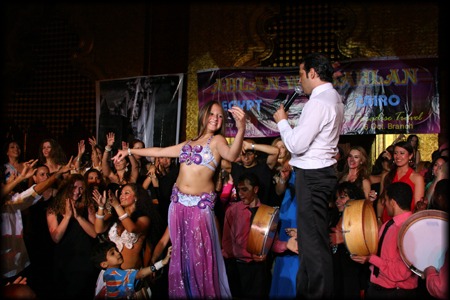
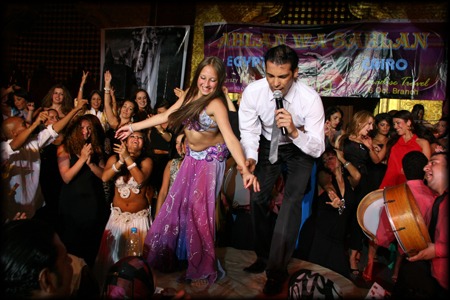
It’s June 27, 2009, in Cairo, Egypt, which can mean only one thing – the Opening Gala of Raqia Hassan‘s Ahlan Wa Sahlan Festival!  At the Mena House hotel the excitement in the air is palpable, not only because of the highly anticipated evening show where dancers from all over the world gather to see the top dancers, musicians, and singers in Egypt, but the next week of classes with Egyptian stars and teachers from all over the world, nightly parties, and the Closing Gala, a spectacular evening of top dancers, AWS competition winners, musicians, and singers.

Denise Marino, world traveling professional photographer, who has been a featured photographer at the festival for several years, contributed these magnificent photos from AWS 2009 to the Gilded Serpent.  See her website for more about her and to see more examples of her wonderful art.  www.denisemarinophotos.com


Opening Gala

Whirling Dervish

Whirling Dervish

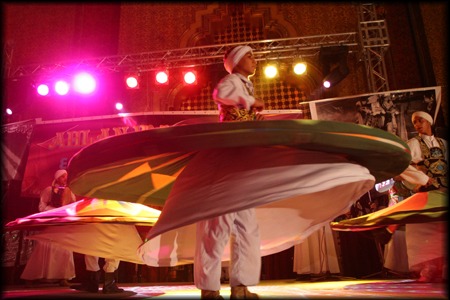
Dervish dancers from the Raqs Tannoura show.  About half of the performers from the full company gave us a sample of their full show by performing the secular whirling dervish dance called “Raqs Tannoura” or “Dance of the Skirt”.  The full company performs twice each week near the Khan el Khalili, free admission. 

Whirling Dervish
Whirling Dervish

Amir Thaleb
Amir Thaleb

Amir Thaleb and his troupe opened the evening with their show of oriental, folkloric, and debki dance, which is pictured here.  The debki number was high energy excitement from start to finish!

Soraia Zaied
Soraya Zaied

Soraya is Brazilian and has been performing in Cairo since the 90s and is one of Cairo’s favorites. Her show included oriental, folkloric, and highly Brazilian style oriental (see 3rd photo).

Soraia Zaied
Soraya Zaied

Soraia Zaied
Soraya Zaied

Randa Kamel
Randa Kamel in some of her signature moves or poses.  Famous for her fabulous shimmies and her beautiful smile, her shows are always high energy, innovative but truly oriental.  Second photo is her oriental saidi number – a bedlah inspired by the Saidi style of balady dress, dance which is a blend of oriental and Saidi folk style.
Randa Kamel
Randa Kamel

Randa Kamel
Randa Kamel


Page 2: The AWS09 Teachers, coming soon!


Have a comment? Use or comment section at the bottom of this page orSend us a letter!
Check the "Letters to the Editor" for other possible viewpoints!

Ready for more?


Gilded Serpent presents...

Interview with
Jacqueline Lombard

Jacqueline Lombard for the Gilded Serpent

Queen of the Dancers in the Golden Era of Tinseltown

by Kamala Almanzar
posted October 29, 2009

The late 1970’s and early 1980’s were the best of times and the worst of times for Belly Dancers in the Los Angeles area. The large influx of people from the Middle East brought with it a burgeoning Arabic club and restaurant scene, and most of the large clubs were centered in the gritty neighborhoods of Hollywood. There were a handful of dancers who did the circuit, and I think we believed it would never end – working 7 nights a week with live orchestras and a minimum of three Raqs Sharki dancers a night. The downside was the long nights, poor pay and a general lack of respect.

Attempting to track down dancers from this era has proven challenging, but I am determined to find as many as possible to interview about their memories of this unique time and place in American Belly Dance. This first of these interviews is with Jacqueline Lombard – the former reigning queen of Hollywood Belly Dance. Jacqueline was the first to leave LA for the Middle East, to return with a one hour, one woman, large orchestra show. A friend once described her as being chi chi, and I thought that was the perfect description, in the best possible way. Jacqueline quit dance cold turkey at the top of her game, and became a sort of "Greta Garbo" figure – living on a ranch far away from the Arabic stage. I tracked Jacqueline down for this interview:

Kamala: When did you begin Middle Eastern Dance, and who was your teacher (teachers)?
Jacqueline: I started dancing at 5 years old in ballet & jazz and I continued until I discovered Belly dancing. I had 2 classes my sister paid for in a bribe to drive and take the classes with her, don’t remember who that teacher was. That was in the seventies. Much later I saw Belly dancing at the Renaissance Faire in Agoura [near Malibu, CA], and started to teach myself.

Kamala: What was the 1st club you worked in & what clubs were happening at that time?
Alice Cooper with his snakeJacqueline: I entered a contest at the Seventh Veil on Sunset Strip in 1973. I won first place, and the prize was $25 & a one night a week job for $25 a night. I became one of their top dancers before they closed down. During that time I was a struggling actress. My first dance job outside of the Seventh Veil was with AGVA (American Guild of Variety Artist Union).

I was hired to dance at a press conference for Alice Cooper. He loved snakes so he decided to hire a belly dancer, me, and a gorilla who carried me off at the end.

It was on all the news channels and teen magazines! Boy, I thought I really chose the right career! I then went to the Greek Village on Hollywood Blvd. That’s where I learned how to "entertain". After that I soon realized I needed the real deal, Arabic music. I got lucky, Ali Baba’s opened on Sunset and La Brea in Hollywood. It was a very beautiful club, great stage and Arabic music, but things were not grand… the musicians were abusive.

They refused to play dance music or anything you asked for…got to admit, that really taught how to pull off a show & think quick on my feet. You never knew where they were going with the music, & they tried to make you look bad.

Mish Mish, Kamala, Giant,and Jacque

Nahed Sabri

Kamala: Do you remember the Egyptian group that came to Omar Khayam’s and changed the face of dance in LA?
Nahed SabriJacqueline: The first time I got to dance and relax was when the Egyptian musicians came to LA. Omar Khayams was a hole in the wall club on Vermont Ave with a tiny stage. I really hated that, but the music was hypnotic. I had to retrain myself how to move, the music was so different. It was then that I got to see and meet Nahed Sabri. This was a big turning point in my dance. She was wild, exciting and did movements that had phrasing with feelings attached to those specific movements. I knew all that I had been exposed to before was an interpretation of jazz or something western, and that’s why I remained self taught.

Now here in front of me was Nahed – packaged, professional and over the top creative. She chewed gum during her show! I loved her, and when she saw me dance she said "you’re the best I’ve seen in America".

Armed with that information, I now knew I was on the right track, my confidence grew. I watched the Arabic people everywhere – at other clubs, weddings, anywhere they would get up and dance. They taught me how to move with the music, how to speak their language. That is how I learned this dance.

Up until this time those were the only clubs I remember being open. I went back to Ali Baba’s and got a whopping $50 a night (Ha!) I only agreed with a concession that the musicians had to rehearse and play the music we wanted. This was for all the dancers. I got a lot of flack from, of all people, some of the dancers! They just wanted to model on stage and get paid, or so I remember. The majority, though, were professionals who wanted what I wanted – to put on a show of quality and enjoy the experience. The smaller clubs made the dancers do 3 shows a night, no choice of music and low pay. There was a protest against the clubs at that time. No one spoke to me or asked my opinion. It was sad for me as I knew I could start the change with myself, for all dancers, and when the customers came for the professional show, the other clubs would follow suite. In the end we (Belly Dancers) got a lot of publicity, and it helped the industry I feel.

Kamala: I met you on the set of "The Man with Bogart’s Face". Did you know that scene has a sort of cult status? I still get fan mail! What do you remember about the filming of that movie?
Jacqueline: The Man with Bogart’s Face – what a blast! The director was very appreciative of us. I will always remember you, Kamala. I was very proud to be in it with you. We all looked good and were able to be who we were, not some circus act Hollywood thought we should be. I got more of those auditions than not. That was a memory for all time. I didn’t know it was a cult scene! I still have lots of pics with the giant and Bogart!

Kamala: Do you remember who the dancers and musicians were in those days, and what music was played for you?

Jacqueline: It’s so long ago, alas, I can’t remember musicians’ names now. I guess most were unmemorable, except the end of my career when I hired my own bands and ran the clubs I was in! (something about having to pay them helps the memory!) The dancers, that will take time to remember those who deserve their names remembered. As for the music, well that depends. I had my own music written for me and other pieces arranged for me. That part of my life was so fulfilling that now, that’s all I remember. It was all about competing with my last show. If you try to compete with other dancers you’re doomed, because you can’t copy an expression, it comes from inside. Being real, that’s what makes one unique and then successful.

That’s not to say we don’t all look at favorite dancers and try to learn the steps, expression and heart. You have to make it your own, get inspiration where ever you can find it.

Chapter two to come later….. Rebirth


Have a comment? Use or comment section at the bottom of this page orSend us a letter!
Check the "Letters to the Editor" for other possible viewpoints!

Ready for more?

  • MECDA’s First 30 Years , The Middle Eastern Culture and Dance Association’s Changing Role in our Community
    Diversity, however, often leads to dissention, and controversy flew regarding the perception of the rather strict parameters of the Egyptian style.
  • Unionizing Belly Dance:MECDA’s Beginnings, Part 3:Tying Up Loose Ends
    The problem was that after the first strike, where the issues were so clear cut – no one had been paid since the owner gambled away our money, tip-sharing had just been instituted — people were unwilling to continue with strikes for getting contracts all over town.
  • How MECDA Began Part II, To Whom It May Concern
    I was very curious to hear what Fairuz had to say about how M.E.C.D.A. began, as I was one of the original dancers to organize it.
  • How MECDA Began
    M.E.C.D.A., (Middle Eastern Culture and Dance Association) is a nationwide organization which began in 1977 for the purpose of organizing working dancers, sharing information between teachers….
  • Chelum, a Transcendent State
    They call it chelum, another Turkish term in the Eastern Macedonian dialect. It refers to a transcendent state of dance and music enjoyment fueled by tapanje, zurli, darabouki, tamburi, and of course the ubiquitous Rakija.
  • Naked Belly Dance in Ancient Egypt, Part 1: Are They Really Belly Dancing?
    The real first question is, “What is belly dance?” Many elements of the modern practice of belly dance emerged in the 20th century. Our emphasis on the female soloist, the structure of the typical show in both the East and the West, the style of music we dance to, our costuming, our specific styles of relationship with the audience, and so on, are modern developments.
  • The Bellybutton Revolution, Feminism & Bellydance
    When I grew up and became a bellydancer, needless to say, my Mom was perplexed and wondered where she had gone wrong.
  • Ramadan in Cairo
    This idea of renewed religious commitment and the character of Ramadan to involve self-deprivation makes many of us westerners think that this is a somber time, but in fact there is another side to the month of Ramadan that is quite lively and exciting.
 

Gilded Serpent presents...

Astryd de Michele

Astryd posed with Amina Goodyear

A Workshop in Modern Egyptian Style

held August 30 – San Francisco, CA

Workshop review by Rebecca Firestone
posted October 25, 2009

"Here we go again… this time I’m going to stay out on the floor the entire time if it kills me," I thought to myself.

I gritted my teeth and forced myself to rest the day before Astryd de Micheles annual Egyptian dance seminar at Dance Mission Theater. This workshop, sponsored by Amina Goodyear, a local dance teacher, is now in its sixth year, bringing the latest Egyptian moves from Cairo to our humble doorstep.

This workshop went from 12:30 pm until 5pm and had two parts: the first part was mostly technique, steps, and short combinations; and the second part was choreography featuring what was taught in the former. I actually preferred the technique portion because I am a bit impatient with workshop choreographies these days. They are usually five times longer than I can remember, leaving me feeling vaguely inadequate afterwards.

If I compare Astryd to a Barbie doll that will sound like a put-down, so I will just say that she is very pretty; huge doe-like eyes, girlish features, smooth toned figure, a soft and gentle voice and a friendly, calm demeanor.

There is something highly unsullied about her, despite having spent 11 years in a country that is not always kind to women, to foreign women, or to belly dancers. She was more focused on the class than on herself, and she didn’t assume that the rest of the class was inferior to her in skill or experience.

What Makes Astryd Worthwhile?

There are other American teachers with perhaps an equal grasp of Egyptian dance and equally nuanced technique, but the pressures of the American business climate forces them to spend a lot more time on self-promotion and merchandising just to create a name for themselves. Astryd lives in Egypt half the year and spends her time primarily researching, and showing small tour groups the inside of the Cairo dance scene.

She had some rather sad news about the state of the dance scene in Cairo. Many of the old venues have closed down and there’s not much performance work. So on one hand you have people like Raqia Hassan sponsoring dance festivals like Ahlan wa Sahlan. On the other hand, there are the sharia (Islamic law) police.

Of course, Bay Area dancers can elect to study with the native Egyptian teachers who come to town, if they can find a small and intimate class size. I have been to those giant classes with Mahmoud Reda et al, and they’re great. However, they are more expensive, more choreography-based, and less personalized. Sometimes the language barrier can be a problem. For those with lots of experience with Egyptian-style dance, maybe this seminar would have been too basic. I guess I don’t have enough experience yet!

Who Would Have Liked This Class?

Who should go to Astryd’s classes? If you like Jim Boz, or even Amir Thaleb– both of whom have exquisite but strong technique and nuanced musicality, you might like Astryd too. She is a student of Raqia Hassan, so if you’ve tried Raqia or any of the other Egyptian ladies (or Sahra Sa’eeda who is practically Egyptian), it is nice to see Raqia’s technique on a different body.

If you are into heavy Goth and Dark Fusion Bellydance, you might find Astryd too sweet, too "cabaret" and not extreme enough. There’s nothing dark about Astryd, although Egyptian urban sensibility can be very earthy and crass. In a way, it is a shame that there’s not more overlap among the bellydance communities, because I would like to see how Astryd’s technique would work on a really good Tribal Fusion dancer.

In comparing with other teachers I have worked with, or whose studios I have attended, here are a few of  my notes on Astryd:

 She is nuanced, surprising and indecisive like Mahmoud Reda; she has powerful hips like Soheir Zaki; she usesa few jazz movements but not many; and places less emphasis on fitness and conditioning during the class itself.  Astryd’s background as a fitness instructor was helpful, though.

Comparison to Tribal Techinque

If you are used to Tribal formats, Astryd’s movement shapes seem less limited to a single horizontal or vertical plane, and the movements themselves were looser, less isolated, and with more obvious weight shifts. Egyptian chest pops can be more like chest heaves, like the sea, and there is a watery rather than a snake-like quality to the movements. There is a lot less conscious effort in the arms than in Tribal, but a lot of effort goes into making those arms exquisitely casual as in "What framing? What arms? Oh… THESE arms? … Why, they just happened to be here by pure coincidence!"

It is possible that Tribal puts more emphasis on shaping the arms because the dancers’ heads and arms are often the only thing you can see at a club. Astryd’s Egyptian choreography is best appreciated as whole-body movements.

Astryd’s Technique

Astryd’s technique is, in its own way, very elusive and as equally demanding as the Tribal Fusion serpentine arms, pops and locks, and luscious layering. There is less emphasis on absolute isolations and the choreography that she taught was more lyrical and much less regimented ,almost too much so. I would say American bellydance in general is more about staying on the beat and less about having a conversation than Egyptian bellydance (she did show one layering that absolutely NO ONE in the room could do).

Astryd studies with Raqia Hassan, one of the grande dames of contemporary Egyptian dance. If you have ever taken a class with Raqia, you will know how she drives her forward pelvic tilts by straightening the back knee and coming straight up from the floor. Most other teachers will tell you to “NEVER do that!" and all I can say is, it felt like getting kicked by a mule, but my back felt pretty good the next day. There is some precedent for getting power from the floor – most sports and martial arts applications teach "floor power" in one form or another.

The movements themselves, while seemingly similar to the same old figure 8’s you can find at every Bellydance 101 class worldwide, seemed more complex to me than your average "draw a figure 8 on the wall in front of you." For example, the "Cairo 8" is a combination of a vertical hip 8, a hip twist, and a horizontal hip 8. There’s probably some Latin-sounding geometry term for it.

Stance, Arms, and Posture

The "home" stance was also different from the shoulder-width, parallel stance that is emphasized in some other bellydance methods like Tribal Fusion and the Suhaila Salimpour technique. Astryd seems to favor the diagonal or side three-quarter bellydance stance, weighted back foot slightly turned out, ball of front foot touching floor in line with arch of back foot. This causes even ordinary movements to develop a slight asymmetry, and that makes them more interesting.

Arms and hands are another area of great challenge, especially for the aspiring Egyptian dancer. There are a lot of arguments about where arms should be, and every style has its distortions, including cabaret bellydance. All I remember from Astryd’s seminar last year was something I dubbed the "Astryd Foam Pinch" because it looked exactly like she was pinching a piece of foam in her hands. It was so artificial that it looked like a Barbie doll, but at the same time it was so beautifully placed that you would never notice the invisible foam unless you were looking for it.

She works a lot on demi-pointe, and the movements are more delicate when you are on the balls of your feet. The same movement flat-footed was very earthy, particularly those floor-driven pelvic tilts.

Translating Egyptian Songs

She is very familiar with Egyptian music and culture. Not so much perhaps as someone from there, and yet much better at explaining it to Americans by finding ways that we could relate to. She talked about the difficulties in translating songs meaningfully, and in fact I have never been that satisfied with the "translations" handed out in these workshops, because the awkward wording of the literal English translations. It sounds like someone ran it through a Korean version of Babelfish. There’s no gestalt, no overall sense of WHY someone would sing that song, or why I would want to dance to it.

To get an idea of the importance of gestalt, imagine a translation of the Rolling Stones’ classic rock ‘n’ roll anthem "I Can’t Get No Satisfaction" as "I Am Not Able To Achieve Fulfillment".

Suddenly the angst of a frustrated musician becomes a customer complaint at some government bureaucracy, and people wonder why those crazy Americans liked that song so much. Or try translating the Lynyrd Skynyrd song title "Tied To the Whipping Post" as "Securely Fastened To The Location of Punishment".

I wish the translations could preserve more of the rhythm and lyricism instead of taking each word literally and separately-"Night after sleepless night I pine for you/I’m burning with fever and I can’t get free" -we’ve all been there. 

The Workshop Choreography

The part I did not like as much was the choreography itself. This year’s choreography was to an Amir Diab popular tune called "Kulu Illa Habibi", roughly translated meaning "Everything Except My Sweetheart" or maybe "My Life Is So Empty Without Him". I like a lot of Egyptian pop for its liveliness, but this song was a bit too monotonously disco-like, and it was fast. The choreography, however, was too busy, too clever, and too changeable to follow or remember easily. I would have preferred a choreography that used more repetitive movements that morphed gradually into other variants, and then punctuated by stops or accents. That conversational quality is actually – for me at any rate – a major characteristic of Egyptian improvisational bellydance.

And can we please ask all workshop instructors to show their feet? Maybe even knees?

It is so important to know how someone’s feet are placed and with bell bottoms on, not a chance. And show your belly button too, because that is such an important clue to pelvic movements. What I would like to see Astryd do next is teach for a week at Middle East Camp in Mendocino, and produce a few DVDs of her own. I think she has a lot to offer.

Class Photo with Astryd after workshop
Click photo for larger view


Back rowsL-R: Christie, 2, Alnisa, Terry
Del Giorno
, Betsey Flood
,
6, Mary Anne, Zelina, Kim, 10, 11, 12, Lulu, Jhermanie
Standing Front row:Marrianne, Rebecca, 3, Maria, 5, Hana, Mera, Latifa, Astryd,
Yolanda
, 11, Dannhae , Adriana, Farah, 15
Low front row: Heather, Shabnam, Zulya, Andrea

Ahava dances at the after party
Ahava dances with band member:
Angela on violin, Hasain on oud, Amina on duf, and Feisal on dumbek

Have a comment? Use or comment section at the bottom of this page orSend us a letter!
Check the "Letters to the Editor" for other possible viewpoints!

Ready for more?

  • So, If You Cut up a Rose, is it still a Flower? Fusing Bellydance With Other Dance Forms
    A reader’s position at this point will depend on whether you think that bellydance and Middle Eastern dance are one and the same, and whether you feel any particular sense of ownership over
    either one of those terms.
  • Getting in Shape: Three Core Training DVDs and One Special Treat
    Core Training for Bellydancers Bellydance, Yoga Conditioning with Ariellah, Industrial Strength Dance Workout with Shakra, Bellydance Arms & Posture with Rachel Brice
  • Bellydancing With Fire with Leslie Rosen Reviewed

    Leslie gets an "A" on fire safety. Her safety section is a great overview, covers just about everything, and has clear visual demonstrations of fuel handling, dipping, and shaking out the excess fuel.
  • Welcome to the Gothla! Dancing Along the Sulk Road Review of 3 DVDs
    The costumes are fabulous. It’s almost like—who needs all that dance technique if you’re wearing an enormous leather headdress that makes you look like an alien refugee from Star Wars? Tempest’s approach in particular is a painterly one, not surprising from a student of the Rhode Island School of Design.
  • Academics and Belly Dance, Two Books Review
    Belly Dance: Orientalism, Transnationalism & Harem Fantasy rdited by Anthony Shay and Barbara Sellers-Young & Choreographic Politics: State Folk Dance Companies, Representation, and Power by Anthony Shay
  • Love Stories…The Choreographies of Raqia Hassan,
    A new feeling emerged about how the music truly is the dance, it creates the dance… the feelings behind Egyptian music, the soul of the music, are that which we experience as artists and dance to;
    for performers, so that it can be visually displayed.
  • Fresh off the Plane from Cairo, A Workshop Review of Astryd Farah deMichele
    So how does Astryd select the signature moves she wants to teach? What she looks for first and foremost is being entertained.
  • Chelum, a Transcendent State
    They call it chelum, another Turkish term in the Eastern Macedonian dialect. It refers to a transcendent state of dance and music enjoyment fueled by tapanje, zurli, darabouki, tamburi, and of course the ubiquitous Rakija.
  • Naked Belly Dance in Ancient Egypt, Part 1: Are They Really Belly Dancing?
    The real first question is, “What is belly dance?” Many elements of the modern practice of belly dance emerged in the 20th century. Our emphasis on the female soloist, the structure of the typical show in both the East and the West, the style of music we dance to, our costuming, our specific styles of relationship with the audience, and so on, are modern developments.
  • The Bellybutton Revolution, Feminism & Bellydance
    When I grew up and became a bellydancer, needless to say, my Mom was perplexed and wondered where she had gone wrong.
  • Ramadan in Cairo
    This idea of renewed religious commitment and the character of Ramadan to involve self-deprivation makes many of us westerners think that this is a somber time, but in fact there is another side to the month of Ramadan that is quite lively and exciting.
  • Researching Dance Origins with the Mazin Family, Photo from Pepper’s Archives Part 2,
    Yusuf, Khairiyya and Raja looked a Pepper’s hopeful face with the tears standing in her eyes and caved in. A private performance was arranged to take place on the flat roof of the Mazin’s home in full costume with live musicians.
 

Gilded Serpent presents...

Chelum

Author dances to Tamburi

a Transcendent State

by Paola
posted October 22, 2009

They call it chelum, another Turkish term in the Eastern Macedonian dialect.  It refers to a transcendent state of dance and music enjoyment fueled by tapanje, zurli, darabouki, tamburi, and of course the ubiquitous Rakija.

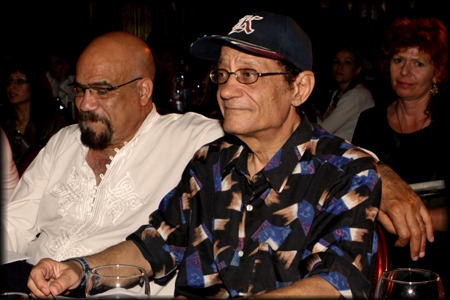
rakijaI was to meet this word a lot during my now-annual August festival season in Macedonia. For six sunny weeks I danced, and I danced, and then I danced some more. For the past three years I had returned four times, to support the Ethno Camp festival, to research and learn the traditional dances, to perform, to enrich my musical knowledge, and to build my Balkan-Oriental fusion style. This season held amazing surprises and offered rich rewards.

For starters, I was a guest at quite a few Roma weddings, raucous street affairs attended in the hundreds, constantly running out of beer and food but never ever short on amazing music. Roma weddings overflow with chelum. It is not hard; their music’s brassy, in-your-face spice has a way of setting fire to the body, invoking motion in ways that can’t be described.  It must be felt, experienced directly, lived in the moment: pure chelum.
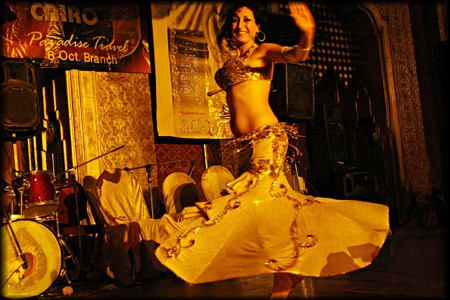
We would start in the circles.  I learned spicy new step combinations that just beg the hips to play along.  Rhythmic circles of fifty, sixty people dancing together, spiraling in and out to rich music spiked with a generous dose of Oriental flavor.  There is something about a circle dance; you are part of a larger organism, you lose yourself in the bigger picture, you are connected to every other dancer in the circle, vital to the whole but not on the spot.

zurliUntil that mischievous trumpet or darabouka player decides to step into the middle of the circle and begin calling individual dancers out, stepping things up a notch. Or two. Or three. They themselves are moved by chelum, and it’s hard (and unseemly) to ignore their beckoning because they play, essentially, for you. I was constantly called out into the middle of the circles to dance with the musicians, and I would soon find myself ensconced in a swarm of Roma women and girls stepping and gyrating along with me, clapping their hands, twirling their wrists and shouting "Mashallah!"  Rakija poured down my throat, burning through whatever vestiges of inhibition I may have felt, and before I knew it, the surging crowd would lift me onto a table and let the drummers have their way. Money would somehow start to fly, hoots and shouts filling the air as the circle, now a distant memory, dissolves into a hot cauldron of energetic chelum. For hours on end, till the sun came up and the head began to throb.

I had no time for the merciless Rakija hangovers as I was fully engaged in the preparations for the Ethno Square Festival, the current incarnation of Ethno Camp, which started as a cultural exchange program for teens and has now grown into a World Fusion festival cross-pollinating Balkan music and dance with various other forms.  This year, we had Jazz delegates from Slovenia and Austria, who worked with our local Roma musicians in a weeklong fusion workshop. We had a massive percussion exchange, uniting local tapanje with djembes, tablas, flamenco boxes, even Caribbean steel drums for extended jams that made my hair stand on end. Groups from all over the Balkans turned out to represent their respective styles of folkloric dance, but this year in Berovo I was offered a unique opportunity to showcase all three of my areas of dance training: Duncan, Folkloric, and Oriental.

Since the festival coincides with the annual pilgrimage to the Virgin Shrine, which draws thousands of visitors, the Town Hall planning committee asked me if I could present a dance in tribute to the Virgin Mary. Nothing could have thrilled me more, since I had just finished my fourth intensive season of Isadora Duncan training, and felt ready to choreograph something in the spirit and technique of Isadora.

The call of the Muse was heeded. Three lovely girls joined me, all incoming high school seniors and members of the local folkloric troupes: Dragana Mladenovska, Angela Zdravkovska and Aleksandra Gerinska. We worked intensively for eight days on my original choreography to Schubert’s "Ave Maria", which we presented the opening night of the festival.  I must admit, part of me didn’t know if sleepy little Berovo in its mountainous corner of Macedonia was ready for something like Duncan dance, but our "molitvena igra" or "prayer dance" was a complete hit.  In simple white tunics, we danced to a beautiful rendition of the song by Sarah Brightman. I arranged the choreography with Duncan elements such as the Universal Gesture, the Adagio, the "caroling" attitude from the Dance of the Blessed Spirits, and movements learnt from "mother" dances such as the Brahms Lullaby and Ave Maria itself. Not only did we receive deafening applause and astounding compliments, but Macedonian Channel 5 did a segment on me and the "molitvena igra", which I performed solo for them at the monastery.

I was also able to cross-breed the lyricism of Duncan with the earthiness of local folklore. "Vai Dudule" is a traditional prayer for rain which is sung through the streets of the town by a young woman dressed in green clothing accented with green leaves.

People sprinkle water after her as she dances her way through the streets, singing "Vai Dudule, dai Boze dos.." (please, God, send rain!)  The song is highly evocative and mystical, sung in the high-pitched drone peculiar to Balkan female choirs. We presented the song live, with young Zora singing and Dragi on the flute. Here I was able to fuse earthy steps from Balkan dance to lyrical arm shapes gesturing from Sky to Earth, as if to draw down the rain. Since the Vai Dudule tradition involves sprinkling, I incorporated sprinkling hand gestures into the bigger arm shapes, miming the falling of rain from a cloud and the landing of raindrops on thirsty leaves.

But for my solo on closing night, I broke out "Ciganka Sam Mala" (I’m a Little Gypsy Girl), in which I mix Balkan footwork with Oriental hips, lyrical arms, and recently added sassy skirtwork. The crowd went wild, and I have to admit, I felt my cup brimming over with chelum if I do say so myself, and we’ve all been there.

You’re on, the crowd’s feeling you, feeding you energy, and you’re spinning it all back. They began to chant "Ayshe! Ayshe!", which in Roma is a name meaning "beautiful gypsy girl", and so the town nicknamed me this year. Aw, shucks!

DaraboukaBut shucks or no shucks, this year the media paid mad attention; reporters from all over the country came to write features on our festival and specials on the various artists involved. I was featured in six national papers and 1E Magazine, which is equivalent to a "Look" or "Ok"-type celebrity tabloid. I was largely presented as a “World Macedonian”, with focus on my world travels and work in various dance fields, with no small measure of pride in the fact that I strive to integrate my ethnic roots into my work around the world.  I was labeled a “Svetska Tanzerka” – “World Dancer”, which to me rings quite
true as I find my dance identity evolving into a hybrid of my three main areas. It was an amazing payoff for the past three trips I have taken to Macedonia to work on the Ethno Camp festival, now EthnoSquare Festival.  A new mayor this year also cleared the way for us, giving us much better financial support, equipment, sponsorship, and amazing help in City Hall in the person of Marin Demirovski, project manager for the town of Berovo.

The rest of the time, I picked raspberries, barbecued peppers for ajvar, (a rich, smoky pepper/eggplant spread), hiked the hills, did yoga in sunny meadows, and traveled the region with my adopted Roma family. Milo and Destan on Zurli (local Mizmars), Jaffer and Nehru on tapanje, Ice on wind instruments, and Lato on Darabouka. They played and I danced for parties, weddings, and parades. For me, it was a big experiment and a fantastic, constructive learning experience. Even though the music is highly Oriental in character, its indelible Balkan-ness demands stepping footwork and arm/hand gestures that invoke chelum, along with the peculiar little locking and whipping pelvic movements that Roma girls dance at weddings, which I happily picked up.

True to Roma form, these gigs were almost always spontaneous, with me essentially being highjacked from a street cafe, packed into a van, and spirited off to some restaurant or hunting lodge somewhere to dance, often not even in proper costume, but in jeans and a t-shirt. But what the heck, it was unforgettable, and I even made a few euros here and there.

An unforgettable season in the Mother Country.  Doors opening, progress being made, hands clapping.  Having wrapped up the festival, I attended one more wedding before leaving the country. Dancing till my hair hung in wet strands, a grandmother grabbed me and kissed me. “Ti si chelumdjia bre!” (you dance with such chelum) she shouted as she squeezed my cheeks and patted my behind.  I stopped for a moment to savor the compliment, then a flock of dancing girls swept me away into the night, into the heart of the music and back into that trance, not thinking, not caring about tomorrow, just dancing.


Have a comment? Use or comment section at the bottom of this page or Send us a letter!
Check the "Letters to the Editor" for other possible viewpoints!

Ready for more?

  • Dance Alchemy
    Dance can be the corporeal miming, shaping, and manifestation of the soul’s intent.
  • The Broken Vessel
    We, too, must believe in our movements, believe in their purpose and message, and we must deploy them with the array of human faculties that begin to evolve when the Art of the Dance is taken up.
  • Visiting Cairo: You live a whole lifetime in one week!
    Laughter builds bridges, and in today’s world, bridges – between individuals and between cultures, are becoming more and more of an imperative.
  • Roots Raqs – An International Belly Dancer Goes Home to Macedonia
    The musical folklore of this region deserves full debut in the World Music scene, and those of us in the MED community worldwide are ripe for the breath of fresh air that Chochek and Gypsy Brass Music can bring us. It is an original, organic and time-honored fusion, brought about by history, geography, and most importantly, tolerance and mutual cultural celebration
  • 10-19-09 Naked Belly Dance in Ancient Egypt, Part 1: Are They Really Belly Dancing? by Andrea Deagon Ph.D.
    The real first question is, “What is belly dance?” Many elements of the modern practice of belly dance emerged in the 20th century. Our emphasis on the female soloist, the structure of the typical show in both the East and the West, the style of music we dance to, our costuming, our specific styles of relationship with the audience, and so on, are modern developments.
  • 10-19-09 The Bellybutton Revolution, Feminism & Bellydance by Yasmina Ramzy
    When I grew up and became a bellydancer, needless to say, my Mom was perplexed and wondered where she had gone wrong.
  • 10-14-09 Ramadan in Cairo by Nicole
    This idea of renewed religious commitment and the character of Ramadan to involve self-deprivation makes many of us westerners think that this is a somber time, but in fact there is another side to the month of Ramadan that is quite lively and exciting.
  • 10-6-09 Researching Dance Origins with the Mazin Family, Photo from Pepper’s Archives Part 2, Text by Pepper Alexandria with additions by Edwina Nearing

    Yusuf, Khairiyya and Raja looked a Pepper’s hopeful face with the tears standing in her eyes and caved in. A private performance was arranged to take place on the flat roof of the Mazin’s home in full costume with live musicians.
 

Gilded Serpent presents...

Naked Belly Dance in Ancient Egypt

Banquet scene from the tomb of Nebamun

Part 1: Are They Really Belly Dancing?

by Andrea Deagon Ph.D.
posted October 19, 2009

One of the most popular illustrations of ancient Egyptian dance in any medium is a painted fresco from the tomb of Nebamun, a nobleman who died sometime around 1400 BCE.  The scene is a banquet in which Nebamun, his family and friends are entertained with endless cups of drink amidst tables piled high with food, enjoying good companionship, and, of course, music and dance.  In its position on his tomb’s wall, this scene of pleasure and celebration was what we might think of as a “magical” representation. 

It invoked the interconnected powers of prosperity, abundance, sensuality, and life force that ensured the rebirth of Nebamun and his family into eternal comfort and pleasure.

In the register below the banquet itself, four musicians, all women, play for Nebamun and his family.  One plays an aulos, a double-reed instrument that would have sounded something like an oboe with a drone.  One appears to sing, while the other two clap for rhythmic accompaniment – Egyptian hand-clapping was a musical form in itself and was capable of providing complex rhythms.  To their right, before a table of offerings, there are two dancing figures. Superimposed on one another and facing in opposite directions, seemingly lost in their own movement, these lovely young women both lean slightly forward as they dance.  One has her hands raised over her head, her fingers entwined in the two-handed finger snap illustrated in the art of several ancient cultures and still common throughout the Middle East today.  The other’s hands reach evocatively forward.

muscians and dancers

Musicians and dancers from the tomb of Nebamun

Like the girls who serve the banqueters in the upper register, both dancers are nude except for their jewelry: a wide necklace, bracelets, a headband worn over an ornamental beaded wig, and a hip belt. 

This same “bejeweled nakedness” is seen in other dancers in Egyptian art of the same period, but jewelry of this sort was worn over clothing by elite women.  In various elite tombs (and now on display in many of the world’s major  museums), archeologists have unearthed wide, beaded collars, bracelets originally worn several at a time, and beaded hip belts that would have rustled gently as the wearer walked (or danced) along. 

Who were these dancers?  Since they and the serving girls are dressed alike, could they be household servants, one of whose duties is dancing?  Or are they professional entertainers?  Are they prostitutes?  Or, given their youth – daughters?  And what is the significance of their dance at this otherworldly banquet?

dancers close up

Dancers from the tomb of Nebamun

The Nebamun dancers are probably already familiar to most belly dancers who spend any time online, because they are used to illustrate the “ancient history” segment of any number of belly dance web sites.  They also feature prominently a s illustrations in more general discussions of ancient Egyptian dance.  Though these dancing figures are unusual in Egyptian art in many ways, they are the iconic representation of ancient “belly dance” for the modern world.  These two nearly-naked dancers subtly shape our ideas about the nature of ancient Egyptian dance, and by projection, modern belly dance. 

So what impressions do the Nebamun dancers create of our (as it is often described) “ancient art”? 

On one hand, a voyeuristic reading of the Nebamun dancers as “belly dancers” contributes to the idea of belly dancing as only or essentially sexy seduction, done for the pleasure of the elite at their banquets, and done in the nude, no less. 

On the other hand, the nudity of the Nebamun dancers can be understood as expressing an honest sexuality that is different from the kind of sensuality exuded by the odalisques and harems that so often feature in orientalizing visions of historical belly dance.  This honesty can serve as an exemplar to the modern belly dancer, who must often struggle through layers of self-repression to find her own sensual self. 

But these are just impressions.  The more important question is what is the reality behind the image of sensual, even sexual belly dance the Nebamun dancers seem to display?  Given that they are used so freely to illustrate ancient belly dance, what can the Nebamun dancers actually tell us about the history of belly dance?

Two very significant questions about them remain:

  • Are they really belly dancing?
  • And are they really naked?

Are They Really Belly Dancing?

The real first question is, “What is belly dance?”  Many elements of the modern practice of belly dance emerged in the 20th century. 

Our emphasis on the female soloist, the structure of the typical show in both the East and the West, the style of music we dance to, our costuming, our specific styles of relationship with the audience, and so on, are modern developments.

 Obviously they are still evolving, or we wouldn’t be rushing off to workshops in Egypt or to Tribal festivals or wherever else we go for our favored brand of the modern phenomenon.  We can’t assume that the ideals that define modern belly dance existed in antiquity.  The past is not the place to look (for example) for the personification of dela’a to music or the snaky archetypes of the Tribe.

For the purpose of ancient history, you have to look for a much broader phenomenon.  Its central elements are:

  1. location in the Middle East and North Africa,
  2. solo-improvisation (dances improvised to music by the individual dancer), and
  3. a focus on hip articulation and hand and arm movement. 

This style of dancing has its roots in social dances done throughout the Middle East by both men and women.  Although it has many specific forms in different periods, its recent forms reflect aesthetics common in the Middle East:

  • attention to detail,
  • subtlety,
  • emotional or expressive content,
  • serial structure,
  • circular energy,
  • the dancer’s ability to “play” around a theme until she is ready to move on, and so on. 

We tend to associate these ideas with Islamic culture, but they predate Islam, as the visual art of Middle Eastern cultures reveals.  So it is possible that these aethetics also appeared in pre-Islamic dance as well. The dance is non-narrative – that is, it doesn’t primarily tell a story (though in some manifestations it might). [1] When I speak of “belly dance” in history, as in ancient Egypt here, this broader phenomenon is what I mean.

Funerary Dance

Funerary Dance

Since dance leaves nothing physical behind, it’s very difficult to prove anything about any dance form in the ancient world, and when you can, it’s only in a broad and general way.  This is certainly true of ancient Egypt.  In contrast to other cultures of the ancient Middle East and North Africa, there are many, many illustrations of dance in ancient Egypt in situations that range from banquets to family celebrations to festivals to religious and funerary rituals. 

Egyptian art is very stylized, however, and definitely not oriented toward depicting a straightforward reality.

The convention of portraying the human figure with feet, legs, and face in profile, but chest and eye straight-on, that Egyptian artists are not good “witnesses” for the details of the dances of their time.  In addition, Egyptian art was conservative, in that many of its conventions persisted for millennia virtually unchanged.  This might obscure actual changes in dance (and other practices).[2]

Given these limitations in the art, we might despair of ever finding anything that could be considered evidence of belly dance in ancient Egypt. 

acrobat on a pot shardAnd there’s more.  Most of the dancing illustrated in Egypt seems to be either acrobatic, or oriented toward leg movement.  The most common hieroglyph for “dance” includes a pictogram of a foot.  A quick scan of Egyptian art for something like belly dance could come up dry.[3]


Roman Relief Sculpture depicting the Apis Bull Festival

On the other hand, while Egyptian art might not give us much unequivocal evidence of belly dance, one piece of Roman art does: a relief sculpture of the 2nd century CE found in Italy, now in the Terme Museum, and illustrated in Fritz Weege’s Der Tanz in der Antike and in other later sources.[4] It represents the popular Egyptian festival of the Apis bull. Many elements are meant to make it obvious to Roman viewers that the scene is set in Egypt, from the statues in the Egyptian style that stand at its borders, to its use of  baboons and ibis (both associated with the Egyptian god Thoth) as decorative elements.  In the center section, a group of women dance while men lean forward, clapping in rhythm.  The Roman artists are showing a form of music and dance that is typically Egyptian. Close up of women dancing Presumably Romans were aware of Egyptian rhythmic clapping as a musical form, and it is carefully illustrated here.  Also, the artists have taken great care to illustrate the women’s hips as protruding, and their hands in unusual positions. 

In other words, they are clearly indicating a form of dance in which the hips, hands and arms are used in ways that were foreign to Rome.  The dancers are all in different positions, suggesting solo-improvisation. 

Roman ZilsThis relief sculpture confirms the evidence for belly dance we find in Roman literature of the time.  Several Roman authors of the first century CE describe the hip articulations, shimmies, languid arm movements, and zil-playing of female dancers from Syria and other points east as well as the Syrian settlement of Gades in Spain.  Other literary clues suggest that the average Roman was quite aware of this different style of dancing. [5] As in 19th century accounts of belly dance, the most detailed descriptions come from outsiders who comment on its difference from their own styles of dance. 

So we have strong evidence that “belly dance” was recognized as typical of Egyptian celebrations (and other Eastern practices) by the Romans by the 2nd century CE.  It is likely that belly dance was a widespread folk dance form in Egypt and other parts of the Middle East before then as well.  There’s every reason to believe that ancient Egyptians belly danced – why wouldn’t they?  Just as we wouldn’t expect my Celtic ancestors to belly dance, based on their later dances, we don’t have any reason to think the ancient Egyptians didn’t, based on what we know of their dances from the second century CE to the present day.

Then where is belly dance in Egyptian art?

The techniques of belly dance, which involve hip articulation and hand movements, are not as easy to portray as acrobatics or leaping in a conservative medium like Egyptian art.  The Roman frieze portrays them deliberately by highlighting their strange (to the Romans) action. if Egyptian artists were to incorporate belly dance into appropriate scenes, they wouldn’t necessarily try to replicate its physical appearance.  Instead, they would rely on iconographical elements that their audiences would recognize.

“Iconography” simply means a traditional way of depicting something or someone in art.  It is a way of conveying complex meanings through visual images to “readers” within the culture.

Musicians and Dancers from the Tomb of Nakht, For example, in the Western world, if you see a woman wrapped in a blue cloak holding a baby in her arms, both with halos, you can be completely sure that you have the Virgin Mary and the baby Jesus, with all the complex meanings about motherhood and salvation and so on that the story evokes.  On another level, if you see an image of a man in a suit striding down a city street, clutching a briefcase and talking into his cell phone, then you probably have a businessmen on his way to an important meeting.  A simple image can carry a great deal of meaning – if you are a cultural insider who knows instinctively what halos, briefcases and cell phones imply. 

I suggest that the ancient Egyptian iconography of belly dance (at least in the New Kingdom) is very subtle, but can be found in many scenes of female musical troupes.  Kheners are usually understood to be “troupes of musicians and dancers” – that is, the expectation is that their entertainment will involve both music and dance. [6] Obviously, musicianship is implied by the playing of instruments, or by the hands held in a clapping position. 

Dance – and I believe, belly dance – is shown iconographically when one or more of the women has the heel of her back foot raised from the ground, especially if her arms are raised, or she is looking over her shoulder.

The “heel up” iconography is very common in groups of women musicians.  It could simply mean that the women are moving around as they play, but usually, when walking motion is implied in Egyptian art, it’s conveyed by the legs apart in a stride.  I suggest that the “heel up” iconography shows that dancing is (or at least appropriately would be) in the scene – and that most likely it represents a form of dance, like belly dance, that does not involve obvious (and easily depicted) leg movement.  I don’t think it always means that the heel-up figure herself is dancing – for example, in instances where a lute-player has her heel up, I suggest the implication is that dancing is going on, not that that one figure is dancing while playing her lute. 

If this reading of Egyptian dance iconography is correct, then belly dance shows up in a number of different situations.  It appears in household celebrations welcoming a triumphant head of household back home.  It appears in banquets.  It appears as the recreation of elite women as they relax at home.  It occurs among professional musicians at many festive occasions.  It appears at festivals, performed by groups of women who also play frame drums.  It appears in scenes of musicians and dancers that decorate the altars of “middle class” households, symbolizing the protection, joy and wealth (material, spiritual, and emotional) that the deities Hathor and Bes bring to the home.[7]

A homecoming celebration, Tomb of Ay, c. 1300 BCE
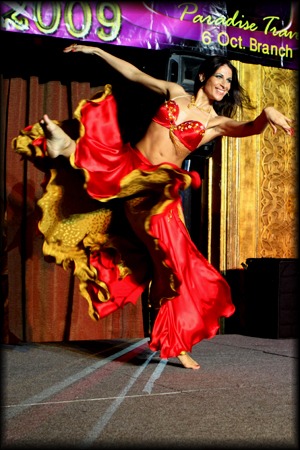
In the royal apartments at Amarna; from the tomb of Ay

In fact, it appears in many of the contexts where we would expect to find belly dance in the modern or recent Middle East.

So, while there is no proof that there was belly dance in ancient Egypt, there is every reason to think that there was, and that in some aspects, at least, it played roles similar to those it plays today.

So back to the Nebamun dancers. Are they belly dancing?  Maybe, and maybe not.  There are no other scenes in which the dancers are positioned exactly like the Nebamun dancers.  They don’t fit the iconography I propose for belly dance.  They don’t fit the standard for any other kind of dance or movement. There’s nothing exactly like them.  Why not? 

Perhaps because the artist of the Nebamun paintings, whose work has been identified in other tombs of the same time period, was that rarity in Egyptian tradition: an innovator. 

This can be seen, for example, in how he portrays some of the musicians in full face rather than in profile.  So if the Nebamun artist wanted to depict belly dance, he might not have followed the conventional iconography anyway. 

But there are other factors to consider, however.  These dancers are not just performing at any old party.  “The event,” says Egyptologist Gay Robins, “may refer to a meal eaten at the tomb at the time of burial, but it also represents the meal shared by family members at the tomb once a year during the Beautiful Festival of the Valley … it has been suggested that these scenes encode references to sexuality and rebirth.”[8]  Now, the dead enjoy the same sorts of things the living do, so belly dancing may be appropriate at parties in their honor, but we can’t assume that this banquet is one more in the procession of homecoming and festival scenes offered in which a khener included belly dance in its celebratory offerings – assuming that of the iconography is correct and that is what they were doing in the first place.

The elite context also has to be taken into account.  It’s possible that the average Egyptian man or woman, partying at the local Hathor festival or celebrating the birth of a child or just relaxing at the end of the day might have done something we would recognize as “belly dance” (defined broadly), and that the professionals they could have afforded to employ would have danced in much the same style. 

But for many elite women, musical training was a significant element of their education, and there were professional acrobatic dancers, employed by temples and performing for the general public who reached a high level of technical expertise and clearly must have rehearsed to dance in close unison.  In other dance styles, a very high standard had been set among elite audiences at least.

Perhaps the positions of the Nebamun dancers do suggest solo improvisation and torso-oriented movement, the foundation of “belly dance.” Yet it is also possible that the dances performed for the elite classes, even those that were based traditions of solo improvisation and hip and arm movement, had evolved into something quite different from the social dancing based on the same techniques.   After all, modern Egyptian raqs sharqi has distinguished itself from the folk dances that are still practiced alongside it by adopting modern elements that differ in many ways from traditional practice.  So while the dance of the performers at elite ancient Egyptian banquets and raqs sharqi might have similar origins, they might have evolved in very different directions as they developed to meet the aesthetic expectations of the elite audiences they served in their own times and places. 

So if the Nebamun dancers were “real girls” – and of course, if they invested in some rather less revealing costumes and ditched their wigs, which would strike us as just bizarre – would they be hired on as belly dancers in any nightclub from Cairo to Istanbul to San Francisco, even including Tribal coffee houses, dancing as they did?  Probably not.  At the same time, the roots of their movement style and dance aesthetics may well have come from the dance traditions of solo-improvisation and hip, torso and arm movement that arose in the milieu of the ancient Middle East. 

So, the answer to the question, “Are they belly dancing,” really depends on how you define the term.  Define “belly dancing” broadly enough – and that may mean, really, really broadly – and you’re probably entitled to answer “Yes.”

Part 2 of this article- "Are They Really Naked?" Coming soon!

Saqqara Frieze, Dancing at a Festival
Saqqara Frieze
Dancing at a Festival; New Kingdom
click image for detail

Hathor Festival
Hathor Festival

Resources

  • Al-Faruqi, Louis Ibsen. "Dance as an Expression of Islamic Culture," Dance Resource Journal, 1987, 10(2): 6-17.
  • Asher-Greve, Julia, and Deborah Sweeney.  2006.   On Nakedness, Nudity, and Gender in Egyptian and Mesopotamian  Art  In: Schroer, Silvia, ed.    Images and Gender: Contributions to the Hermeneutics of Reading Ancient Art  Fribourg: Academic: 125–76.
  • Assante, Julia.  2006.  Undressing the Nude: Problems in Analyzing Nudity in Ancient Art, with an Old Babylonian Case Study. In: Schroer, Silvia, ed.    Images and Gender: Contributions to the Hermeneutics of Reading Ancient Art  Fribourg: Academic:  177–208
  • Boyle, Alan.  Sex and Booze Figured in Egyptian Rites.  msnbc Technology & Science.  http://www.msnbc.msn.com/id/15475319/ Accessed Sept. 12, 2009.
  • Der Tanz im Alten Ägypten nach Bildlichen und Inschriftlichen Zeugnissen.  Glückstadt: Verlag J. J. Augustin.
  • Davies, N. de G.  1908.  The Rock Tombs of El Amarna Part VI: Tombs of Parennefer, Tutu, and Ay.  London: Offices of the Egypt Exploration Fund.
  • The Tomb of Nefer-Hotep at Thebes.  New York: The Metropolitan Museum of Art Egyptian Expedition.
  • Fear, A. T.  The Dancing Girls of Cadiz.  Greece and Rome, Second Series. 38.1 (April 1991) 75-9.
  • Goelet, Ogden.  Nudity in Ancient Egypt.  Source: Notes in the History of Art.  12.2 (Winter 1993): 20-31.
  • Kemp, J. 1979.  Wall Paintings from the Workmen’s Village at el-Amarna.  The Journal of Egyptian Archaeology 65: 47-53.
  • Lexova, Irena.  2000 1935).  Ancient Egyptian Dances.  Trans. K. Haltmar.  Mineola, NY: Dover Publications Inc.
  • Manniche, Lisa. 1992. Music and Musicians in Ancient Egypt. London: Dover.
  • 1981.  The term hnr: “harem” or “musical performers”?  In: William Kelly Simpson and Whitney M. Davis, eds.  Studies in Ancient Egypt, the Aegean, an the Sudan: Essays in Honor of Dows Dunham.  Boston, Mass: Museum of Fine Arts: 137-145.
  • Robins, Gay.  1996.  Dress, Undress, and the Representation of Fertility and Potency in New Kingdom Egyptian Art.  In: Natalie Boymel Kampen, Ed. Sexuality in Ancient Art.  Cambridge: Cambridge University Press.
  • Shay, Anthony.  1999.  Choreophobia.  Costa Mesa, CA: Mazda Publishing Co.
  • Simpson, William Kelly.  1976.  The Mastbas of Qar and Idu.  Boston: Museum of Fine Arts.
  • Spencer, Patricia. 2003. Dance in Ancient Egypt.  Near Eastern Archaeology 66.3: 111-121.
  • Teeter, Emily.  1993.  Female Musicians in Pharaonic Egypt.  In Kimberly Marshall, Ed.  Rediscovering the Muses: Women’s Musical Traditions.  Boston, Mass.: Northeastern University Press: 68-91.
  • Der Tanz in der Antike.  Dornach: W. Keller.
  • Williams, Craig A.  1999.  Roman Homosexuality: Ideologies of Masculinity in Classical Antiquity.  Oxford: Oxford University Press

Footnotes

  1. On aesthetics of dance in Islam: Al-Faruqi 1976.  Anthony Shay describes this phenomenon and its aesthetics, with special reference to Persian dancing, and introduces the term “solo-improvised dance” to describe it: Shay 1999: 16-55.
  2. On the limitations of style in depicting dance and recording change, see Manniche 1992: 9, 40-55, Spencer 2003: 112-114.
  3. On the hieroglyphic terms: Brunner-Traut 76-82.  This leads to assumptions like Irina Lexova’s, that belly dance could not be an element of the dance traditions of the noble ancient Egyptians: Lexova 1935 [2000]: 71-2
  4. Weege 1926: Pl. 19.
  5. Authors include Juvenal, Martial, “Virgil,” and the Greek author Automedon; for a complete discussion, see Fear 1991.  On the possibility of Eastern male belly dancing as part of the “cultural literacy” of the average Roman, see Williams 1999: 175-81.
  6. See Teeter 1993, Nord 1981.
  7. For example: welcoming celebrations: The tomb of Nefer-Hotep, Davies 1933, pl. 17, 18.  Recreation of elite women: the dancing women at the court of Akhenaton depictedin the tomb of Ay, Davies 1908, pl. 28, pp. 20-21 .   Professional musicians: the three dancers at the tomb of Nakht.   Festivals: At a drinking festival in honor of Hathor/Sekhmet: Boyle; at an unnamed festival, the Saqqara frieze.  In middle-class households at El Amarna :  Kemp 47-53, fig 2.  All examples are New Kingdom.
  8. Robins 2002: 31.

Have a comment? Use or comment section at the bottom of this page orSend us a letter!
Check the "Letters to the Editor" for other possible viewpoints!

Ready for more?

  • Dancing for Dowries, Part 2: The Nailiyat
    It respected the intelligence, style and wisdom gained by women who had lived in the public eye and in the world beyond their native home – a world many men of the Ouled Nail never saw.
  • Dancing for Dowries: Earning Power, Ethnology, and Happily Ever Afte
    When a mythic history is told and retold in a context like the belly dance community, you have to assume that there are strong underlying reasons for its popularity. 
  • Sex, Belly Dance and the Afterlife
    To these people, sex was not dirty, shameful, frightening or forbidden. It was a natural part of daily life and the essential prerequisite for birth – on earth or in the Afterlife.
  • The Bellybutton Revolution, Feminism & Bellydance
    When I grew up and became a bellydancer, needless to say, my Mom was perplexed and wondered where she had gone wrong.
  • Ramadan in Cairo
    This idea of renewed religious commitment and the character of Ramadan to involve self-deprivation makes many of us westerners think that this is a somber time, but in fact there is another side to the month of Ramadan that is quite lively and exciting.
  • Researching Dance Origins with the Mazin Family, Photo from Pepper’s Archives Part 2
    Yusuf, Khairiyya and Raja looked a Pepper’s hopeful face with the tears standing in her eyes and caved in. A private performance was arranged to take place on the flat roof of the Mazin’s home in full costume with live musicians.
  • Gig Bag Check with Surreyya and Sultana
    What does a dancer need to carry in her gig bag? Surreyya has a very special friend she carries in hers! Sultana, a leopard spotted boa constrictor enjoys being displayed for us and having a dance with her partner. Footage was filmed at Carnival of Stars in November 2008.
  • Tajikistan Part II: Land of Dance
    After a performance of daf soz (songs with frame drum accompaniment), the musicians played maddoh, followed by raqs-i aspak (“horse dance”), in which a man dances wearing a costume which makes it look like he is riding a horse.
  • Give Credit where Credit is Due!
    However, some dancers are using the same music, costumes and choreography in their performances that they first see elsewhere. This begs the question: at what point does copying someone’s original concept or choreography cross over from homage to stealing?