Gilded Serpent presents...

I Believe in Gypsies!

(But Not as a Style of Belly Dance)

Sara in the snow!
“Gypsy Dancer?”
Photo Credit: K Shrapnell

by Sara Shrapnell
posted November 24, 2014

Anyone who has surfed the Internet, joined discussion groups, or researched belly dance in any depth, will have seen the horror and fury that can be induced by posting a video of “Gypsy belly dancing”,  asking for the best vendors for “Gypsy skirts” or (deep breath) offering to teach a “Gypsy workshop.” I have read many times that “Gypsy” is a bad word because they prefer to be called “Rom.” Therefore, it is disrespectful to use the word in any form. I beg to differ.

You see, Gypsies do exist! I have seen them. I have Gypsy blood. I just think that some belly dancers are confused about who they are defending.

Let me first clear up the bit about Gypsy blood I have just claimed: the man who contributed it to my family, sadly, or maybe not so sadly, didn’t stick around to add any culture, history, or parenting skills to his DNA. That was not a Gypsy thing, or a man thing, or a British thing. It was just “a thing.” Short term relationships, resulting in babies happen all over the world, and have happened throughout history. I won’t pretend to have any understanding of Gypsy culture beyond that which everyone in the UK has, although I did get to go to the fair in Somerset a few times and was introduced to a huge number of “Aunties” and “Uncles” in my childhood. I don’t remember now which part of the family they came from. It hardly counts.

However, what I do know is that in 2011, about 58,000 people self-identified their ethnicity as Gypsy/Irish Travellers in the UK Census.

Despite estimating that their people had been in the country for more than 500 years, before 2011 there was no official box to tick that recognized this group as an ethnicity. In the run up to the 2011 census there was much discussion about what name could be used as an umbrella term for the many groups of British people who wanted to be included in this identification. They use a huge number of terms to self-identify; some are Rom, but others aren’t. In the end they chose the term “Gypsy/Irish Traveller”, and it was added to the census alongside the designation “Arab,” which was  considered also to be a culture that was not previously represented on the form.

What this means for the Gypsy/Irish traveler community is that the UK government can now use these statistics to build a much clearer understanding of life expectancy (very low) education levels (also low) and average age (26), enabling it to provide the facilities needed to serve the people. Bureaucrats can look at the birth rates and subsequently build new schools and hospitals as needed. They can look at the population clusters and provide housing, counselling and support where it is appropriate. The Gypsy/Irish Traveller community is finally going to count!

What this also means is that there is an official term for this group of people: “Gypsy/Irish Traveller”.  It might not be the way that every person in that group wishes to self-identity, (Each ethnic group has blurred lines, where parents of different cultures have come together, or where children have grown up in a place a long way from their parents homeland.) but we should respect the name that they have chosen for themselves. Just as the people from many diverse countries and cultures now have the option to list themselves as “Arab,” so can the many people who identify with “Gypsy/Irish Traveller.”

How does this relate to Belly Dance? Fundamentally, it doesn’t–except where we make it an issue. Gypsy should not be a derogatory term unless it is used with hatred.

Sadly, it has been used in hatred,  anger, and as an excuse to persecute throughout history, but if a group of people want to claim it as their name, to own it and to gather under the banner, then it is not our place, as outsiders, to limit its use. We should not call the Rom “Gypsies”, but we should also not presume to call the Gypsies “Rom”. 

That does not imply that the British Traveller community has made any major contribution to belly dance as we see it today. In fact, the Travelers community is very private and not known for sharing their dance and culture with outsiders. 

Calling a multi layered skirt a “Gypsy skirt” is lazy! It is inaccurate, and it should probably stop. (How about substituting: full, multi-tiered, gathered, dance skirt in mixed fabrics?) Nonetheless, arguing that there is no such thing as “Gypsies” is also wrong, uninformed, and insulting to those who gather their family under the title with pride. As a community, we dancers should move away from using the word “Gypsy”, but in doing so, we should respect those who own the term and are finally being recognized as a culture in the UK.

Further information:

Resources:

use the comment box

Have a comment? Use or comment section at the bottom of this page or Send us a letter!
Check the "Letters to the Editor" for other possible viewpoints!

Ready for more?


Gilded Serpent presents...

Color

Graphic Design for Dancers, Part 2

Placeholder

by Lida
posted November 16, 2014
Part 1 available here

This is the second in a series of articles on graphic design for dancers. In the first article we considered the impact of design on the public’s perception of the dance and on the success of bellydance as a business, then explored crucial typography guidelines. Now we’ll delve into applying colors in marketing materials, returning to the ever-present concepts of hierarchy and legibility introduced previously.

In design, color is used to:

  • Convey a mood or feeling
  • Draw attention to certain elements
  • Group and structure related elements
  • Enhance the message
  • Establish brand identity

While color can be a great asset to your work, its improper use can thwart your efforts to present professional, polished, and sophisticated pieces. It can be easy to give enthusiasm free reign and go a bit overboard but, in design as in dance, it pays to exercise restraint. That’s why the following essential points, gleaned from my years of design work, focus on subtlety to allow colors and patterns to support your content instead of stealing focus. I’ve included examples, as well as links to additional resources at the end of the article. This guide applies to both print and web.

Choosing Colors

  • Select colors that support your message and audience. If you’re designing a flier for an autumn-themed event, earth and jewel tones are a better fit than pastels. Light colors might work better for a daytime event than a nighttime event. A webpage for children’s classes would need upbeat colors instead of slick and moody colors.
  • Use colors as your viewers expect them to be used. Some colors are already established in user design and subconsciously inform user behavior. For example, bright red and yellow are associated with errors and caution, while bright green is associated with successful actions and confirmation. Using bright red for a positive message can be confusing and jarring when users are accustomed to seeing green.
  • Get ideas for color combinations from sites like Adobe’s Kuler (see link below).

Creating Hierarchy

  • Draw attention to important information with saturated colors, while keeping other colors more desaturated. A flier headline might be brighter than the other elements, or maybe you need to emphasize a deadline date.
  • Be consistent with your use of color by using it to relate items with similar content. For example, on an event flier the headline and date might be presented in one color, while the address and ticket price are presented in another color.
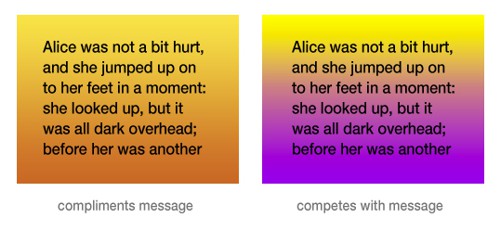
  • Keep your color palette limited. A couple of accent colors are enough to draw attention to the most important parts of your message, while too many can be messy and confusing. [Figure 1]
  • Keep the colors in your gradients analogous to prevent them from competing with more important elements. [Figure 2]
Figure 1

Figure 2
Figure 1 and 2

Ensuring Legibility

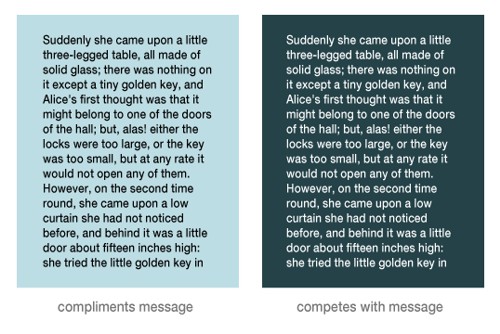
  • Avoid bright, saturated backgrounds, as they make text difficult to read and distract from images. Desaturated colors are more refined and easy on the eyes. [Figure 3]
  • Make sure there is ample contrast between your background and text. Not enough contrast makes the text hard to read. [Figure 4]
  • When presenting large amounts of text, use dark text on a light background. Light text on a dark background is hard on the eyes for prolonged reading, especially online. [Figure 5]
  • Mute your background patterns to keep text legible and avoid distracting from your content. [Figure 6]
Figure 3
Figure 3

Figure 4
Figure 4
Figure 5
Figure 5
Figure 6
Figure 6

Putting It Together

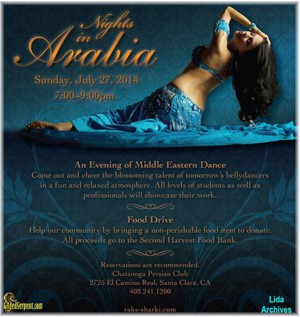
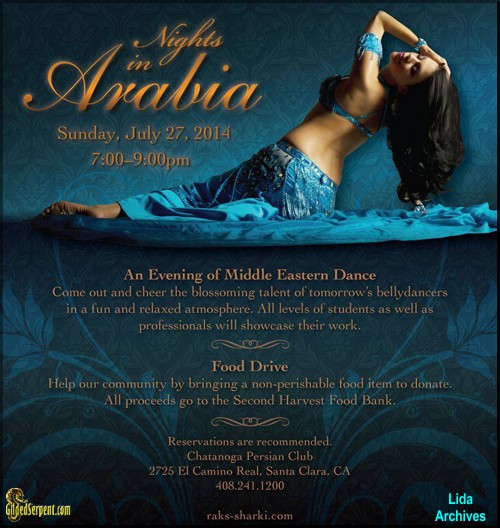
This flier uses deep blues with accents of medium yellows, a limited palette that retains simplicity and makes sense for a nighttime restaurant event. Saturation and brightness direct the viewer to what they should see first — the headline, date, and image — while the other colors take a secondary role. The background gradient is kept in the same color family and patterns are subdued, letting the information take the spotlight. There is enough contrast between the dark background and the light text for easy reading, and there is not so much text to make it difficult to read in a light-on-dark combination.
[Figure 7]

Figure 7
Figure 7

Learn the basics of color theory:

Resources:


use the comment box

Have a comment? Use or comment section at the bottom of this page or Send us a letter!
Check the "Letters to the Editor" for other possible viewpoints!

Ready for more?

  • Typography, Graphic Design for Dancers, Part 1
    As artists of an often misunderstood dance, we dancers understand that everything we present publicly reflects back upon us as individuals, upon bellydance as an art form, and by extension, the Middle Eastern culture. When presenting these facets in the most favorable light to other dancers or the general public, good design becomes paramount because it is the most unmistakable way to demonstrate our worth.
  • Alive – Inside and Out! Tai Chi Can Enhance Your Dance
    Exploring and blending these disciplines has long been my “secret sauce.” Centering and breathing, conscious transitions, body and soul awareness–from footfall to fingertip and beyond–nourish and replenish my dance.
  • Retirement, Is There Life After Dance?
    Perhaps this was my mistake; I had a plan for my dance career, and I was not shy to tell it to everyone who would listen.
  • An Evening of Egyptian Music and Dance, a Report from El Leil
    Amina and the Aswan Dancers did it again! The sold out show at the Mission Cultural Center for Latino Arts was another stellar example of the kinds of show their fans have grown to expect and they have not yet been disappointed.
  • The Best of the British! The South of England Belly Dance Scene.
    Like every area, the UK has seen an ebb and flow in the popularity of belly dance, the economic impact and the rise in popularity of fusions styles has changed the dance from when I first started twenty years ago. Yet I see a strong, healthy and supporting scene posed to expand when disposable income in the general population increases.
  • Don’t Come Whining to Me! An Open Letter to Aspiring Young Belly Dancer
    If you audition for a Greek restaurant – do NOT come to an audition with anything other than Greek music.
  • A Journey to the West Bank, A Lone Dancer Visits Palestine
    The refugee children were dressed in sweatpants and T-shirts, like school kids anywhere in the world. The coach was in a tracksuit, and his stern voice echoed over the young crowd. It could easily have been a basketball game, or perhaps a rehearsal for a play, that was about to begin in this gymnastics hall. But this was a dance rehearsal
  • Patient is a Bellydancer, Part 2:The New Normal & the Boring Reason I’ll Never Stop Dancing
    What was once an exercise in insanity is now how I hip drop and down walk.
  • Crossing the Chasm, Cultural Sensitivity and Bellydancing
    So how do we start to change the consciousness of people who see our profession as base, both inside and outside of the Middle East? I think it must start with a good understanding of the culture behind the dance, by condemning the culture or completely disregarding it in our art form, we have lost touch with our artistic role in society and thus have lost the ability to alter it.
  • A Refuge for Innovation, Tribal Fest 2014
    Although Tribal Fest is a live on stage, face-to-face event, it is the danced realization of a world in which the technological flows of transportation and communication bring images and bodies into correspondence with each other, and through the form create new images that move a global popular culture dialogue forward.
  • Colorful Maghreb in Los Angeles, A Celebration of Music and Dance,
    “Dancing In The Sunset ~ A Celebration of Maghreb Music and Dance” held February 1, 2014 at the Live Arts LA Theater in Los Angeles, California
 

Gilded Serpent presents...

Alive – Inside and Out!

Tai Chi Can Enhance Your Dance

Placeholder

by Melina of Daughters of Rhea (Melinda Pavlata, Ph.D.)
posted October 24, 2014

Tai Chi and other internal martial arts have long fascinated me and contributed to my belly dance practice.  I grew up, moving between my mother’s belly dancing and my father, doing his standing meditation and slow movement sequences. I loved both practices, never tiring of my audiences in Greece respond with surprise and delight to my mother’s sizzling energy! I felt myself filled with peace as I watched my dad’s stillness unfold whenever he practiced Tai Chi on our fire escape outside our NYC apartment. 

Exploring and blending these disciplines has long been my “secret sauce.”  Centering and breathing, conscious transitions, body and soul awareness–from footfall to fingertip and beyond–nourish and replenish my dance.

Even when my hips reach their wild and most ecstatic essence, I try to flow out of my central equilibrium and be aware of the ways in which my energy is stretching simultaneously skyward and down to the center of the earth.

We all want to feel at home and at peace in our bodies. You’ve heard it before: “Your body is your temple.” Your body is your temple, and you are a goddess who dances with dignity and grace. On every possible level, I take this idea seriously: Your body is your temple–nutritionally, spiritually, kinesthetically! Tai Chi’s postural awareness practice is key in helping a dancer be centered, rooted, yet agile, moving from a place of balance and well-being; alive inside and out. That sounds good to me!

Here’s a wonderful image that was imparted to me by the great circus equestrian, Katja Schumann:  “Imagine that your body is covered with eyes… You must know how to control them, how to point the eyes of your hips in the right direction in order to let the horse know which way to go.” When Katja casually dropped this gem on me outside the horse stalls at Circus Flora, I was floored.  I’m sure you horse people know all about this, but I had never heard this idea, and I loved imagining all those eyes blinking on my body.  Instant full-body awareness!  By the same token, internal martial arts-influenced dance practice helps you get in touch with all the eyes nestled on the inside of your body, helps you become aware of whether they are open or closed, and know in what direction they are looking with every movement.  Constantly communicating with these interior sensations, the dancer becomes the ultimate energy priestess as she explores and awakens every unconscious piece of herself, delighting in herself, and creating the sacred space that she moves through. 

By consciously tuning into your center, your breathing, and the profound process of your smooth shift of weight, you start to feel as if you are moving as part of one long, beautifully unbroken poem rather than dancing a series of technical movements packed together in chunks. 

Inner awareness is a keystone idea for the Chinese internal martial arts. It feels increasingly important that a performance artist dance with this idea that movement must be generated from inner awareness, not just an external “how we should look.” I love it when I sense that a dancer is palpably in touch with her inner awareness, not just “going through the motions.”  The pleasure a dancer can experience when her body, mind, and soul are joined through breath as she uncovers her dance and expresses beautiful music is a gift that can be enhanced by practicing Tai Chi.  We all acknowledge the power of stillness and allowing for pauses in our dance — mystical moments in which we and the audience (when there is one) are transported by simply not doing for a beat or two…or three…  I was particularly struck by a passage from Sifu Jan Diepersloot’s trilogy “Warriors of Stillness,” in which he talks about stillness as the state of being fully alive, stillness as a state of being pregnant with possibilities for movement.  This kind of stillness practice can only help dancers improve awareness and feel more at ease as we improvise to live music. Tai Chi practice can help us get into, as Aszmara would say, “The trance of the dance.”

“Though posture is often thought of as stillness opposed to movement, actually our posture must be considered a type of movement also.  In other words, the stillness we are talking about is not the stillness of death as opposed to the movement of life. It is not the comparative stillness of plants as opposed to the movements of animals.  It is not the stillness of sleep, not the stillness of a couch potato TV-watching, not the stillness of paralysis, not the stillness of passed-out stupor, nor any other stillness in which the machinery for movement and its controlling mechanism have been fully or partially shut down.  No, the stillness we cultivate in our standing (postural) meditation entails readiness, a stillness that is pregnant with possibilities for movement. […] The stillness we are talking about, in other words, is movement not yet released. It is the stillness of potential movement as opposed to actual movement.  In this stillness, awareness enables us to respond to our environment rather than react to it.” * 

Belly dance is a performance art in which, yes, we must externalize as entertainers and think about how we look, but it should also be an internal martial art, a meditation to music.  It is about integrating isolated movements into the seamless whole of your entire body while maintaining a peaceful awareness of your central equilibrium.  Posture and the shift of weight are major components of dance that must be undertaken consciously and ideally without involuntary movement or hiccups. Tai Chi can help foster this inner awareness and help the belly dancer craft or improvise a movement poem that is rooted and agile as well as smooth, supple, and seamless. 

*Jan Diepersloot Masters of Perception: Sensory-Motor Intergration in the Internal Martial Arts, Qi Works, Walnut Creek, CA, 2013, p. 24.


Melina

Resources:

use the comment box

Have a comment? Use or comment section at the bottom of this page or Send us a letter!
Check the "Letters to the Editor" for other possible viewpoints!

Ready for more?

  • Successful Art Entrepreneur or Belly Dance Dummy?
    Here it was, the pivotal moment, the moment where what you say determines what happens, or what doesn’t happen, the moment of which you are either proud in retrospect or in which you feel defeated and ashamed, covering it up with the sands of time and silence and try to forget about it.
  • The Hippie Connection: Robert Altman’s 1969 In Utero Belly Dance Portrait of ME
    There it was, the second of a series of black and white hippy portraits –people raving, a woman blissfully breastfeeding, couples hugging, dogs leaping – THE SEMINAL PHOTO OF MY LIFE – only, I was cut out!
  • Finger Cymbals
    Above all this cross-cultural cacophony soared my mom’s perfectly paced zills, right left right, right left right, right left right left right left right. If you put me in a room blindfolded, I could distinguish her playing from any other dancer on earth.
  • Circle Dance
    The circle is a perfect, democratic & unending shape, the shape of an energized community, the shape of this lovely round planet.
  • Retirement, Is There Life After Dance?
    Perhaps this was my mistake; I had a plan for my dance career, and I was not shy to tell it to everyone who would listen.
  • An Evening of Egyptian Music and Dance, a Report from El Leil
    Amina and the Aswan Dancers did it again! The sold out show at the Mission Cultural Center for Latino Arts was another stellar example of the kinds of show their fans have grown to expect and they have not yet been disappointed.
  • The Best of the British! The South of England Belly Dance Scene.
    Like every area, the UK has seen an ebb and flow in the popularity of belly dance, the economic impact and the rise in popularity of fusions styles has changed the dance from when I first started twenty years ago. Yet I see a strong, healthy and supporting scene posed to expand when disposable income in the general population increases.
  • Don’t Come Whining to Me! An Open Letter to Aspiring Young Belly Dancer
    If you audition for a Greek restaurant – do NOT come to an audition with anything other than Greek music.
  • A Journey to the West Bank, A Lone Dancer Visits Palestine
    The refugee children were dressed in sweatpants and T-shirts, like school kids anywhere in the world. The coach was in a tracksuit, and his stern voice echoed over the young crowd. It could easily have been a basketball game, or perhaps a rehearsal for a play, that was about to begin in this gymnastics hall. But this was a dance rehearsal
  • Patient is a Bellydancer, Part 2:The New Normal & the Boring Reason I’ll Never Stop Dancing
    What was once an exercise in insanity is now how I hip drop and down walk.
 

Gilded Serpent presents...

Retirement

Is There Life After Dance?

Najia as student

by Najia Marlyz
posted October 17, 2014

A Yiddish proverb says: “Men tracht, und Gott lacht.”
A rough translation of this proverb into English is: “Men plan and God laughs.”…or:
“If you want to hear God laugh, tell Him you have a plan!”–quotation derived by Woody Allen

Perhaps this was my mistake; I had a plan for my dance career, and I was not shy to tell it to everyone who would listen. My goal was to dance as long or longer than my dance heroine, Martha Graham, who performed until she was 92 (when she proceeded to drink herself into toxic alcoholism, which was definitely not part of my plan). At some point in the mid-1980s, a close friend and dance student of one of my own dance students actually expired while performing onstage at a hafla! Her death fomented a great many comments among the bellydancers of the day about how heroic that would be to die, doing what you love—dancing. However, I found the idea repulsive and still find it abhorrent because dying onstage would shatter the foundational trust between a performer and the audience: that is, people attend a performance to be entertained, inspired, and distracted from reality; not to be confronted by death itself! It is an unspoken contract between performer and audience so to aspire to croak while onstage would violate that trust in my eyes, unless you (as a member of an audience) have come to the Roman Coliseum to witness the death of the Christians in the teeth of wild beasts! Then, I suppose, death becomes the dancer.

Having said this brings me to the question that is the elephant in the dance studio: Is there life after dance? The dancer spends her career perfecting her technique, building her knowledge of the culture and music, assembling and reassembling her costume wardrobe and collecting her accolades until all of it interacts together inside her being like a life sustaining and seductive drug. How can there be a life after dance that would be as satisfying? Would you settle for “sort of” satisfying or maybe just “okay?” If we had to diagram the dilemma like diagramming an English sentence, we might find dancing in the center of everything with peripheral activities such as teaching, coaching, writing about dance, designing and vending  sparkling items as offshoots from the central interest—the doing of it.

Martha Graham at 54Nevertheless, I had been outspoken about my plan, seldom pausing to think that I could be thwarted by fate quite easily. I discovered, after an insightful walk on the beach five years ago, that a small blemish on my right foot could be skin cancer and realized I should have it examined by a specialist. Oh, yes! It proved to be the most dangerous type of skin cancer—the one that has no cure as of this date: Melanoma. I quickly had the tiny thing removed from the top of my foot and paid little heed to the surgeon’s warning that the operation would leave a scar (Who cares? There is stage makeup to cover it.) and my surgery could possibly result in nerve damage and a weakness in the foot structure. “Not mine; dancers are athletes, accustomed to dealing with and healing injuries,” I reasoned.

My plan remained intact; the site would heal, I would strengthen my foot, and I would continue to dance.

During the last phone call that I received from my dance partner, Bert Balladine, he asked me if my foot had fully healed and if I were able to dance again. “ Yes!” I answered confidently, so he advised: “Good! Continue to dance and teach as long as you can, Najia, because both you and I have stayed too long at the fair. It is too late to start over in something new, and you have become really phenomenal at what you do and how you teach it.” When we finished our phone conversation, I had the niggling feeling that I would be thinking about this whole subject again, but I had no idea how soon it would be. Six months later, only one month after Bert, my friend and mentor died, and after I had struggled with all my might to regain my dance, I underwent another terrifying operation accompanied by six weeks of daily radiation to remove an embryonic stage of breast cancer!

“Don’t give up,” everyone encouraged. “You did it before. You are a cancer survivor and you can do it again.”

I believed them and believed in myself and my dance. However, it was a lot harder to heal the wounds of radiation treatment than it was for me to come to terms with the odd shape the dimpled scar left in my breast. “Never mind,” I told myself. “Lovely breasts are not crucial in the dance—there is always costuming that can make them appear as if they were…” I returned to dance, egged on by the memory of Bert having told me about his learning ballet movements from aged ballerinas who could only sit on a chair with their gnarly legs askew, thumping the dance floor with a hefty cane to punctuate the Russian commands they wanted obeyed. If the crone divas could do it, I could do it, and after all, Martha Graham had danced until she was 92 years old…

My semi-restored condition lasted only a few months until I tore the meniscus of my left knee from dancing on the wonky foot that had been injured by the cancer operation and subsequent infection and death of the skin graft it took to repair it. An orthopedic surgeon repaired it, and I went to six months of physical therapy.

Once again I returned to dance—albeit less sure of myself.

By that time, I had become accustomed to waiting for the other shoe to drop, and sure enough, it did. I threw away nearly all of my shoes because all of them hurt my foot and made it sore and red on top. Then, one day, out of the redness of the top of my foot emerged a sharp and pointed, blue plastic thread. I went back to the surgeon who pulled on it with a pair of tweezers. Yank! Yank! “Humm,” he mused, “It won’t come out. I guess it has grown into your flesh,” and he deftly snipped off the blue plastic he had pulled out. The remainder slipped back inside as he said, “Sometimes we just have to leave it there.” I went home and waited for my foot to heal again so that I could return to dance, but my foot did not heal. I found it difficult just to walk. I found another surgeon who was willing to open my foot another time and take out the tangle of blue plastic thread that had been used to sew my original melanoma site closed. Two inches of thread—knotted about every quarter inch. It had been a “purse closure suture” he told me in the operating room as he walked around showing it to everyone present.

Finally, I began to walk for exercise and began to attempt to dance once again!

Evidently, “Gott lacht.” Two months later, I found myself back in the hospital for pneumonia. Even though I had taken the pneumonia shot at the appropriate year, I developed pneumonia anyway due to a lowered immune system brought on by the radiation treatments I had had for the breast cancer. Additionally, that illness served to murder my gallbladder. I went home wearing a large bile bag on about three feet of flexible plastic tubing that collected bile for the next two months and had to be measured and emptied twice per day. When I was deemed well enough, I returned to the hospital O.R. to have the offending gallbladder removed along with the bag and its tubing that had been inserted through my side into my now damaged liver.

Finally, I was free of the collection bag and ugly tubing, and I could return to dance!

I had lost much of my student dance clientele and worst of all, could barely walk, let alone dance. “Don’t give up! You can do it!” everyone agreed. However, I was tired of repeated struggle and my students were even more tired of seeing it. I was gradually “dying onstage,” so to speak. Nonetheless, I had stayed too long at the fair, and in order to remain part of the dance, I retired and took up coaching dance like Bert’s little old crone ballerinas, perched on a chair and barking my orders—but without a cane. I found that the method works if you make it work, and if your students believe in your hard-won expertise. Still, there are many young dancers who cannot believe that an old woman could ever have been a young leith dancer. They find it inconceivable to commit their dance egos to the trial and error that must take place in order to mold the dancer into her strongest version of her own body and her creative vision. I believe that the dancer who does have the ability to see beyond what her reality is now, into what she could become as a unique dancer with her own body type and her own responses to music, is actually helped along by not having my body demonstrate my dance, causing her to attempt copying what I had been able perform.

Like my late instructor, Bert, my career has filled me full of stories of gigs and colorful events surrounding the dance that have served to inspire me and bring more meaning into dance movements. Life and misfortune have forced me to retire from performing, and I have been periodically relegated to a chair, vocalizing my vision of the possibility for moving an audience’s emotions that resides in our music. All I have to do really, is teach confidence by coaching my clients to explore unique ways to listen analytically, with imagination, creativity, and a sense of humor. I encourage my clients to conjure mind images and foster adaptation of them into movement. As long as there are young dancers who aspire to become more than mere replicas of other dancers, there will always be “a life after dance” for me whether I can walk or not.

“I am and always will be a dancer; listen to my cane thump on the dance room floor!”

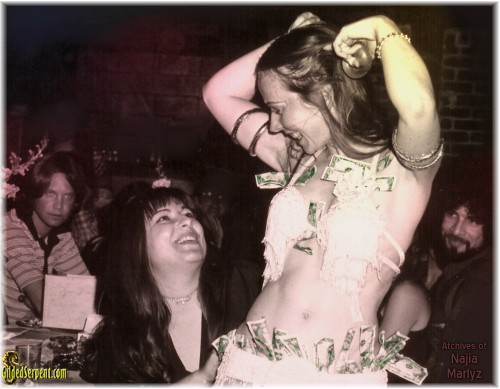
Najia receives tips at Athena Taverna

Resources:

use the comment box

Have a comment? Use or comment section at the bottom of this page or Send us a letter!
Check the "Letters to the Editor" for other possible viewpoints!

Ready for more?

  • Beata Zadou in 1988, Winter Visit to Berlin’s Snow Princess
    It is rare that reality matches one’s fantasy, but in this case, in 1988, my expectations were surpassed by the reality of wish-fulfillment.
  • O Aitos Berkeley in the ’70s
    Truthfully, I had never laid eyes on an authentic belly dancer, live or on film at that point, so I hardly knew what to expect.
  • "Der Schnerkle" Its Proper Uses and Functions
    Therefore, I reasoned, the use of ones extremities for dancing (beyond transporting one across the stage or making a movement appear finished) was to gather and distribute performance energy from the stage rather than simply wave arms about in the air with artistry and grace.
  • Costuming Trends of 1987, At the Rakkasah Festival
    Although the trend at Rakkasah ‘87 was definitely toward better dancing than we have seen in the past; the costuming I saw would be high on anyone’s list of worn-out ideas.  Nowadays, we have more and more of almost everything; it is immediately apparent that there is more material in the skirts—such as double skirts, ruffles, tatters, tiers, beads, and even elaborate sequined patterns, and embroidery.
  • Tale of the Rat, Beginning to Teach, Part One
    He warned me! My German speaking mentor and dance partner, Bert Balladine, told me one day that teaching would change my dance—not necessarily for the better.
  • The One-of-a-kind Costume Still Fascinates:Re-envision, Recycle, Renew, and Remember
    Sometimes, perhaps more often than not, those people whom we love, and those things that we enjoy doing, introduce new facets into our lives that change our perspective of what becomes important to us in the long run.
  • Cairo Revisited: Dancing into the ‘90s
    Originally written for Caravan Magazine 1992- The one thing on which you depend about dance in Egypt from year to year is that everything slowly changes. I’ve returned to Cairo each year now for nine consecutive years, and last year my visit was just before the short war we had with Iraq in which Egypt was our US ally. Cairenes seemed sad last year, because Cairo had lost most of its income from tourism, and many Egyptian nationals were returning from Iraq and Kuwait, where they no longer had employment. I did not know what to expect this year, except the inevitable fact of surprising, yet subtle, change.
  • An Evening of Egyptian Music and Dance, a Report from El Leil
    Amina and the Aswan Dancers did it again! The sold out show at the Mission Cultural Center for Latino Arts was another stellar example of the kinds of show their fans have grown to expect and they have not yet been disappointed.
  • The Best of the British! The South of England Belly Dance Scene.
    Like every area, the UK has seen an ebb and flow in the popularity of belly dance, the economic impact and the rise in popularity of fusions styles has changed the dance from when I first started twenty years ago. Yet I see a strong, healthy and supporting scene posed to expand when disposable income in the general population increases.
  • Don’t Come Whining to Me! An Open Letter to Aspiring Young Belly Dancer
    If you audition for a Greek restaurant – do NOT come to an audition with anything other than Greek music.
  • A Journey to the West Bank, A Lone Dancer Visits Palestine
    The refugee children were dressed in sweatpants and T-shirts, like school kids anywhere in the world. The coach was in a tracksuit, and his stern voice echoed over the young crowd. It could easily have been a basketball game, or perhaps a rehearsal for a play, that was about to begin in this gymnastics hall. But this was a dance rehearsal
  • Patient is a Bellydancer, Part 2:The New Normal & the Boring Reason I’ll Never Stop Dancing
    What was once an exercise in insanity is now how I hip drop and down walk.
  • Crossing the Chasm, Cultural Sensitivity and Bellydancing
    So how do we start to change the consciousness of people who see our profession as base, both inside and outside of the Middle East? I think it must start with a good understanding of the culture behind the dance, by condemning the culture or completely disregarding it in our art form, we have lost touch with our artistic role in society and thus have lost the ability to alter it.
  • A Refuge for Innovation, Tribal Fest 2014
    Although Tribal Fest is a live on stage, face-to-face event, it is the danced realization of a world in which the technological flows of transportation and communication bring images and bodies into correspondence with each other, and through the form create new images that move a global popular culture dialogue forward.
 

Gilded Serpent presents...

An Evening of Egyptian Music and Dance

A Report from El Leil

Andalusian

by Terry Del Giorno
posted September 30, 2014

Saturday, May 3, 2014, San Francisco, CA. Mission Cultural Center for Latino Arts Theatre,
produced by Amina and the Aswan dancers

Amina and the Aswan Dancers did it again! The sold out show at the Mission Cultural Center for Latino Arts was another stellar example of the kinds of show their fans have grown to expect and they have not yet been disappointed.

I really had to restrain myself from immediately reviewing this show. It would have been too gushy, too emotional, too biased. Driving home from the event, listening at top volume to Susu’s new CD “Nostalgia”, I was feeling a little, well a lot, nostalgic! I realized it was over 30 years ago, that I first saw one of Amina’s productions.  That evening show was held at the now closed Pasha Restaurant in San Francisco. I was a baby dancer, performing with the legendary Deann and Dream Dancers at a gala show for Mahmoud Reda and Amina and the Aswan Dancers were the featured group. While the stars of the show were upstairs changing, I along with other troupe members, were allotted the public bathroom to the right of the performing area. I remember fondly, every time the restroom door opened, catching a glimpse of Amina and her group performing!

It was with a smile on my face and music blasting that I drove home, reminiscing about that night many years ago, other past shows and recalling the gems of this one. It’s been several days, my wistful nostalgia for times past has lifted but my enthusiasm for the show has not waned.

Amina and the Aswan Dancers and their accompanying musicians have been a part of the landscape of dance in the SF Bay Area since 1976!

The venues for their performances have ranged from the small cabaret setting, lounges with no real stage to large-scale productions on a proscenium stage like this one last Saturday night. In each of those instances, the audience is always treated to a glimpse of Egyptian culture, accompanied by great music, and the ever-present humor of the Aswan Dancers.

The “Pasha Band” is comprised of band captain and director Hussan Resan on oud, violin and vocals. He also displays his talent in composition in this show as one of his songs, Leili Ya Leil, was featured in the program and which I think deserves a formal recording!

Jalal Takesh on kanun brings an obvious love and virtuosity to his playing that was obvious as I was not the only audience member who was feeling the music as was evidenced by the head swaying, toe tapping response in the seated audience. Younes al Makboul on violin, oud and vocals, rounded out the string section with heartfelt violin solos and a mawal that added an authentic dimension to the show.

Hana in
Hana in Ya Hawanem.

TerriAnne Gutierrez on deff and riq displays her musical skills that match her dance expertise  while playing the back beat to star drummer Susu Pampanin. Susu a well-known drummer locally has proven her skill in the bigger arena of percussionists with a following through multiple music genres and with a simultaneous release of her newest recording "Nostalgia" it made the event for me celebratory and a bit epic.

Amina Goodyear is the artistic director of the Aswan Dancers and the brainchild behind the evening’s show, completed the trio of percussionists. All of the strong and accomplished musicians, joined their talent and artistry to form an elaborate tapestry for a backdrop to the Aswan Dancers performances.

In the first dance, performed to an original gramophone version of the song, El Gheira Ya Nar El Gheira sung by Badia Masabni, dancers Hana, Irina, Kerima, Lylia, Maya, Susan and Aswan Dancer veteran Shara brought each of their own dance personality and trademark Aswan Dancers playfulness to the recorded piece. With the Latin inspired costumes they immediately invoked Taheya Cariaco for which the piece was dedicated and transported the audience to the Badia Masabni’s Cabaret.

The Reda inspired Andalusian vignette danced to well-known Lamma Bada Yetathana, sometimes called "The Aziza of Samais", brought to the stage an important historical element to the show which Irina, Maya and Shara danced beautifully.

In Ma Biyesalalsh Aaleya, all of the dancers had it! Though I thought Hana nailed it in her subtle, but unmistakable upper torso carriage reminiscent of “Golden Age” dancers as Kerima, Lyla and Susan sang in response to Younes’ mawal and oud playing.

Part two of the show opened with Ya Hawanem, also known as “The Ladies Dance”(which also is a cut on Susu’s CD Nostalgia).  From the program: “Egyptians enjoy fantasy and although they may enjoy looking European, they never lose their Egyptian goofiness and sense of humor” is apt.

Irena Eshta

This piece is the kind of dance I adore watching the Aswan Dancers do. In character, fun costumes, with their own personas thrown into the mix, bringing fused Egyptian dance to the stage.  It was cute, it was silly, it was dahlal, it was the Aswan Dancers! This piece was one of my favorites in the program.

Other memorable mentions include Shara playing the “lady” accompanied by Ayman Kozman waltzing across the stage as singer, Rana Mroue, treated us to her vocals in Albi Dalili.

Shara, Ayman, Rana
Shara, Ayman, and Rana singing

Ya Msafer Wahedek sung by Husain Resan and danced beautifully by Dannhae as well as Amal Hayati were two pieces that I enjoyed as both songs and dances really showcased how Egyptian composers and dancers of the past fused other traditions into their art. Singers Rana and Ayman (members of the San Francisco based Aswat) also joined us again in the 2nd half singing Farid al Atrache‘s Zeina ya Zeina with a stage full of beautiful dancing to bring a beautiful visual to the music.

The program for the event included the show’s set with descriptions, and bios of the full cast, but also was actually a beautifully paper bound booklet that included a fotonovela written and produced by Amina and Hana Ali.  Along with my reminiscing, the book is a tangible reminder for me of a lovely evening of music and dance!

Ya Hawanem backstage
Pasha Band
Younes, Jalal, Hussan, Amina, TerriAnne, Susu

Resources:
  • Author’s bio page

    For more info about  Susu’s CD “Nostalgia” which features a”The Pasha band” from the show El Leil, susudrummer.com.
    For more information about Amina and her productions aswandancers.org  

use the comment box

Have a comment? Use or comment section at the bottom of this page or Send us a letter!
Check the "Letters to the Editor" for other possible viewpoints!

Ready for more?

  • Undercutting the Competition, A Problem of Ethics or Practicality?
    The Internet presence has created a whole new style of “elitism” in the dance world.
  • 2011 Eliat Festival with T and A!
    Eilat is a bustling attraction for many tourists, boasting world class beaches, diving, and great weather, which was one reason that we picked this destination in January!
  • Our Changing Dance World, a Response to Leila’s "Dance for Dancers"
    Of course, we learn musicality and so forth, but where dance classes in some places are an hour long, teaching long choreography is not sustainable to an instructor.
  • Glimpses Into the Past:On DVD at Last!
    Some current dancers may find that the sentiment of the 70’s feels alien and therefore unable to relate to it. However, I believe many dancers will be thrilled to see faces attached to the names of some of our dance legends like Bert Balladine in Gameel Gamal.
  • Chapter 1: One Ad Changed My Life
    I was very desperate and determined to get back to my old self.
  • Chapter 2: "I’d Rather Stay Home with my Kids"
    I asked her how to take it off, and she told me to figure it out when I was on stage. Then I heard – "Our "guest" dancer, Amina, all the way from upstairs!"
  • The Best of the British! The South of England Belly Dance Scene.
    Like every area, the UK has seen an ebb and flow in the popularity of belly dance, the economic impact and the rise in popularity of fusions styles has changed the dance from when I first started twenty years ago. Yet I see a strong, healthy and supporting scene posed to expand when disposable income in the general population increases.
  • Don’t Come Whining to Me! An Open Letter to Aspiring Young Belly Dancer
    If you audition for a Greek restaurant – do NOT come to an audition with anything other than Greek music.
  • A Journey to the West Bank, A Lone Dancer Visits Palestine
    The refugee children were dressed in sweatpants and T-shirts, like school kids anywhere in the world. The coach was in a tracksuit, and his stern voice echoed over the young crowd. It could easily have been a basketball game, or perhaps a rehearsal for a play, that was about to begin in this gymnastics hall. But this was a dance rehearsal
  • Patient is a Bellydancer, Part 2:The New Normal & the Boring Reason I’ll Never Stop Dancing
    What was once an exercise in insanity is now how I hip drop and down walk.
  • Crossing the Chasm, Cultural Sensitivity and Bellydancing
    So how do we start to change the consciousness of people who see our profession as base, both inside and outside of the Middle East? I think it must start with a good understanding of the culture behind the dance, by condemning the culture or completely disregarding it in our art form, we have lost touch with our artistic role in society and thus have lost the ability to alter it.
  • A Refuge for Innovation, Tribal Fest 2014
    Although Tribal Fest is a live on stage, face-to-face event, it is the danced realization of a world in which the technological flows of transportation and communication bring images and bodies into correspondence with each other, and through the form create new images that move a global popular culture dialogue forward.
  • Colorful Maghreb in Los Angeles, A Celebration of Music and Dance,
    “Dancing In The Sunset ~ A Celebration of Maghreb Music and Dance” held February 1, 2014 at the Live Arts LA Theater in Los Angeles, California
 

Gilded Serpent presents...

The Best of British!

The South of England Belly Dance Scene

Map of Southern England

by Sara Shrapnell
posted September 12, 2014

I recently had the opportunity to return to the United Kingdom as part of my book tour.  Having been away for three years,  I was interested in looking at the UK belly dance scene as an outsider for the first time.  I met some stunning new dancers and enjoyed catching up with old friends; it was all the same and yet different.  Like every area, the UK has seen an ebb and flow in the popularity of belly dance, the economic impact and the rise in popularity of fusions styles has changed the dance from when I first started twenty years ago. 

Yet I see a strong, healthy and supporting scene posed to expand when disposable income in the general population increases.

While Thomas Cook, the travel agent, may have been taking tourists to Egypt from the 1870’s, travelling there didn’t come within reach of the majority of the UK’s middle class until the post war tourist boom of the 1950’s.  While not in the same price bracket as holiday packages to Spain or France, trips to Turkey and Egypt were aspirational for the well off or adventurous.  For those with a smaller budget, Middle Eastern themed restaurants and clubs were beginning to appear up and down the country, where patrons could enjoy the food, music, dance and meet people from all around the world. 

Rebekah

Rebekah is a teacher, performer and event host based on the Isle of Wight:

“I had always been fascinated with Egypt.  I saved (money) for 3 years to go. To stand in places I’d only read about was unbelievable.  I got to dance down the Nile and in the desert under the stars.  It was unbelievable. I even called my son Nile.  He loves learning about the country and the culture, he is even grasping the language. I can’t wait to take him.”

This easy access to Egypt, Turkey and people who grew up there continues to influence the UK belly dance scene today.  Many of my students over the years would come to class because they fell in love with the dance while on holiday, or because they had fallen in love with someone from the Middle East.  It was not unusual to start a new term or semester with a “suitcase party”, where a trader who had made a trip over the break would bring back treasure to share: coin belts and galabaya, CDs and finger cymbals.  With easy access to the market places of Egypt and Turkey, professional dancers could find costumes to suit their style of dancing, and student dancers could find belts in all shapes and colors.  This in turn paid for those traders to make another trip.

Emma Chapman

Emma Chapman is a teacher and performer who recently moved from the UK to live in Salt Lake City:

“We’ve had so many amazing dancers (from Egypt) here to teach, including regular visits from our own Cairo stars Yasmina and Lorna, and for a long time it was easy for us to visit in return for dance adventures (and cheap costumes!).”

Shams of Wiltshire

Shams is a performer, teacher and event host based in Wiltshire:

“As Emma points out, proximity to Egypt and the Middle East helps in our learning choices. We celebrate diversity in this country and we like our different styles. We like new things, we like fun things and we like fusing things. Here you will see every style, every prop, stories being told, fantasy dances interwoven with mystery. On the other side of the coin I think the proximity to Egypt and Turkey gives us a very healthy respect of the cultures and in interpreting the music correctly and we are especially fond of Egyptian Bellydance.  I would say that the UK belly dance scene is as diverse as our UK population,and really quite accepting.”

With costumes and music arriving from far and wide and people from the cultures willing to share their knowledge the UK belly dance scene has long had a reputation for embracing many styles.  It is not uncommon to be able to take workshops in a huge variety of styles all in one weekend.

This in turn has led to the UK dancers expecting to see a wide variety of styles performed at even the most local hafla, with dancers returning from their studies with beautiful traditional dances, or by adding their new skills to form their own styles of fusion.  To help educate the dancers and general public it is usual to see a detailed programme available on each seat with not only the name of the dancer and their music, but also a few words about the style of dance and perhaps the costuming.

Sacha of Bristol

Sacha is a teacher, performer and event host based in and around Bristol:

“Variety of the show is important for me, especially as we are lucky to have such a unique and eclectic mix of styles in Bristol. Too much of the same style is just boring I’m afraid. A mix of a number of dancers as well works best for me because you get interesting stage formations and it’s something different. solos and troupes and duets – different styles, some dances with props. I always like it when a programme is provided with details of the dancers, the style and music. When you’re starting out that can really help and it can also help you add to your music collection!”

It seems to be becoming more common to see a halfa include a mini workshop, just a ten minute taster, which also acts as a wonderful way to get even the most shy beginner dancer on to the floor.  Audiences in the UK like their performances short and snappy, just four or five minutes of one performer, and then four or five minutes of something completely different.  This reflects the lack of opportunities for a long restaurant style set.  UK dancers need to highlight their range of skills, maybe a prop, or a drum solo, all within their five minute time limit.  Performers seem to like this style too, being able to highlight the best of a style of dance without having to prepare a long number with months of preparation.  It is also more accessible for beginners, who can transfer a class choreography, or their own work to a stage setting. 

Saras

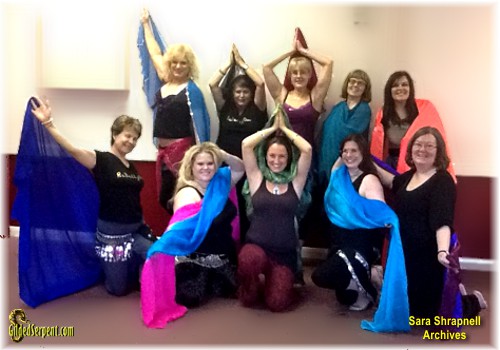
The group shot is Katie Holland teaching a veil workshop in Oxford hosted by Hannah Newton.
Standing up from l-r is Layla Smith, Lesley Newton, Sheila Tofts,Elizabeth Wyatt, Kim Anderson.
Kneeling down from l-r is Lesley Turner, Hannah Newton, Katie Holland Karen Hancox and Janet Proudman

Originally from Leicester, Katie Holland has taught and performed in India for the last eight years:

“I remember very well what it was like to be a newbie (new belly dance student) and I always remind myself of that. If I see someone looking lost I will go out of my way to talk to them or try and help settle last minute nerves. I often wish I had that look of wonder again of seeing the bling and glitz of a hafla for the first time when a whole new world was opening up before me! I love the haflas when anyone can dance and seeing student groups performing. I find it really exciting and I’m always finding new inspirations.”

Jesse Stanbridge

Jesse Stanbridge is a New York native who lived in the UK for 7 years.  She now teaches and performs in the San Francisco Bay area :

“British haflas are always the best.  I liked that there was always drink and people brought food to share and there was a scheduled free dance, so everyone could dance together”

Beginner dancers get a lot of support from the established dance scene and are encouraged to attend workshops, appear in group numbers and join the community.  The average hafla organizer sets aside time at the end of the evening for free dancing, and most teachers prepare their students to be ready to get up and dance with everyone else.

Hannah is a teacher and event host based in Kidlington :

“With regards to social dancing I love that element after a hafla, especially when inspired by the guest star, you just want to get up again. It’s so enjoyable and the sense of inspired freedom is exhilarating. The pressure of ‘performing’ is off and you can simply dance in its purist form and get caught up in the music. Now to ensure that my ladies feel comfortable with it, I try to include a general bopping session (free dancing for fun) in a few of our rehearsals interspersing western and Arabic pop and getting them as familiar and at ease dancing socially to both kinds.”

Hannah of Kidlington

The feeling of community starts with the sharing of food and drink and expands to a willingness to promote each others events.  It is usual to see a “flyers table” at even the smallest of workshops and teachers collect these up at the end of the night to take back to their classes. 

Sasha added:

“I love the free dance element and I remember how disappointed myself and my students were when we went to a big event with a live band which promised free dancing at the end of the show only to run out of time! We’d been so inspired by all the great music and dancing of the evening that it was such a shame not to let loose on the dance floor afterwards – I think we decided to shimmy and sashay to the train station in the centre of Bath instead!”

The biggest problem that seems to be affecting the UK scene at the moment is an abundance of events and clashes of dates, where organizers find it difficult to plan their events on an empty weekend, or new events are appearing that clash with the established.  However this is good for the consumer, offering them a huge choice in how to spend their money and who to learn from.

Shams agrees:

“There are many more haflas that can be attended, ranging in style and level. Some are more commercial than others; some are used to raise money for charities.  There is competition to try and find space in the busy calendar for running events and these events compete for our attendance, but for the consumer this means value for money and choice. All in all, and for the most part, the UK scene is quite supportive of its dancers and teachers and most people get on with what they want to do with a healthy respect for each other. This means for most people learning belly dance now in the UK is that whatever their level or style preference or budget, there is something to suit everyone.”

Katie notices the difference between the number of events in the UK and India:

“When I’m in the UK it’s a never ending jump and a shimmy across the country to events, having several to choose from in one night, whereas in India haflas are a new experience often attracting high media attention from the TV and newspapers because it’s such a unique idea and women are just starting to find out about belly dance and all it has to offer!  I think most people will agree that there has been an overload of events in the last few years and no proper system of checking clashing dates. Then there are larger events which dwarf any local events if there is no communication or belly-love between the organizers. It’s a shame because so many events have to be cancelled and many dancers who only like traveling locally miss out.”

Uk dancers are known for their interest, passion and hard work.  Students are very attentive, often taking notes, asking great questions and being happy to run through things “one more time”.  However they also like to get dressed up, party and perform for each other.  The dress code for an evening hafla may have no limits, from comfy workout clothes to tiaras and glamorous evening gowns, anything goes.  Ever ready to make new friends, share food and learn from each other, weekend residentials are becoming more and more popular with the UK dancers.

Artemisia of Belgium

Artemisia is a very popular UK workshop teacher who lives in Belgium:

“I love the residential – holiday and dance classes in one – a lot of UK organizers offer. You don’t get that so much elsewhere. I also like the attitude of the students I encounter at festivals. They stick with it! They ask for my patience when something is new or tough… but they don’t give up easily. I like the delegate shows at events and how even beginners show and share all their creativity. I love the shamelessness of British women let loose for the weekend, but although they come to have a good time after class, they will be there and work hard in class as well. “

It was a delight to visit the UK, to dance, teach and chat and I am confident that the UK belly dance scene is set to continue to grow, evolve and support the talented dancers who make their home in the UK.

Shams commented:

“What I like best about the UK dance scene is that it isn’t just for budding professionals. It’s enjoyed, celebrated and performed by all kinds of women, size, shape and age really doesn’t matter to us Brits, in fact we champion people who will get up and have a go.”

Hafla in Southhampton

Author dancing at a Hafla in Southampton.
Resources:

use the comment box

Have a comment? Use or comment section at the bottom of this page or Send us a letter!
Check the "Letters to the Editor" for other possible viewpoints!

Ready for more?


Gilded Serpent presents...

Don’t Come Whining to Me!

An Open Letter to Aspiring Young Belly Dancer

Placeholder

by Naajidah and Ashiya
of Lincoln, Nebraska
posted September 6, 2014

We’ve been the house dancers in a Greek restaurant for a number of years and have also done more than our share of family parties, corporate parties, etc.  We’ve truly been blessed and have enjoyed every opportunity to dance.  During that time, we have gotten numerous calls from local up and coming dancers wanting to know about how to get professional gigs or even asking about auditioning for an opportunity to dance.  We’ve been to a lot of performances, haflas, and workshop shows over the years and have seen a lot of promising up and coming ladies who have asked for input on how to get the gigs.  So, you won’t like it but here’s our two cents.

A Restaurant is a FAMILY Situation. 

It’s not a nightclub, it’s not a hafla, and it’s not a workshop.  Recently, a workshop was held here and we happened to catch some of the video posted on Youtube.  I won’t name names, as it has nothing to do with the dancer, but with a trend I see happening. 

The young lady has bought into that idea that it’s possible to combine burlesque and bellydance.   WRONG – at least not if you want to be hired for a family gig.

Screenshot collage from Athenian video
Screenshot collage from the promo video of the
Parthenon Greek Restaurant in Lincoln NE

If you come out dancing to Hidey Ho, your choreography consists of very little dancing but a great deal of shaking and grinding, and your costume is an actual lingerie bra with some coins, a cheap skirt and no belt; well I have news for you – that doesn’t fly in a family restaurant. It doesn’t matter if all of your friends were screaming from the audience and telling you how great you are, unless you’re looking for gig that involves a pole, it doesn’t fly.  We can’t think of a single restaurant owner that we know that is going to hire you – no matter how pretty you are – if that is your idea of belly dancing.  AND – when the general public sees that type of dancing represented as belly dancing, we can promise you that short of bachelor parties, you’re not going to get hired for many private functions either.  Don’t come whining to me when you discover that the local gigs have all but dried up for you and every other dancer in town.  You brought it on yourself.

A restaurant is a FAMILY situation (did we already mention that?)  It’s also an ethnic one. 

If you audition for a Greek restaurant – do NOT come to an audition with anything other than Greek music.

Don’t bring your dubstep, don’t bring your jazz, or your Gobsmack.  Heck, don’t even bring your Lebanese (assuming here that you know not to bring your Turkish!). The same goes for dancing at a Lebanese restaurants (its not the time for anything but Lebanese music). Restaurant customers have expectations.  They come to an ethnic restaurant expecting to see something representative of the culture.  Again, if you perform in public to modern American music and the general public sees what you doing, they will decide that if that’s what belly dancing is, they don’t want to hire it.  You have ruined it for yourself and all of the other up and coming dancers in your area because you couldn’t be bothered to learn about the culture (such as: costuming, music and dance style) of the dance you claim to love.

Not only is a restaurant a family situation, It’s also a business.  A Greek, Turkish, Lebanese restaurant can all do a very good business without ever hiring a single dancer.  In fact, given the way the dance community is dragging the good name of bellydance down into the gutter, they are realistically better off NOT hiring dancers.  Parents don’t want their little girls seeing you bending over and doing HUGE hip circles to the back while they are eating or over-shaking your chest, doing back bends with your hips in someone’s face while they eat.  They don’t want to see you doing a dance consisting of nothing but chest pops to “Chicky” and they certainly don’t want to spend $50.00 a person for dinner and have some group of dancers come out in pants, choli’s and tattoos all over their face dancing to “I Don’t Give A Damn”.  Don’t come complaining to me when you call other restaurants and they are ADAMANT that they will never again have a dancer in their establishment.  Again – you brought it on yourselves!

 Every year we see more and more opportunities to perform disappear.

Frankly we blame this on the dance community at large.  When you as teachers don’t hold your students to a high performance standard, when you as dancers go to shows and see dancers performing the way we described and cheering them on, screaming, yelling, and zaghareeting your approval, you only encourage it.  When up and coming dancers see things like that in shows, videos, and haflas, they think “oh, it must be okay to do that” and the downward spiral continues.  When the downward spiral continues, the jobs dry up even more. 

At the risk of generalizing, it seems that the new batch of dancers coming up in the last several years are only interested in having people look at them.  They don’t care about the culture, they hate the music, and can’t be bothered to learn anything above basic moves, pops/locks and shaking their “assets” above and below the waist. 

Yes, there are a lot of dancers who do care, who do study and work at it, but it’s the lazy one’s I’m talking to at this point.

Because ladies, you are dragging the genre down.  If you want to stand around in jeans, a coin scarf and roll up your cami into your bra to display your stomach and shake your chest to “Chicky”, fine.  Just please don’t call it bellydance. Because at that point it most certainly is not. 

It makes no difference how pretty you are.

If you use your looks simply to turn this artform into something salacious, preening and posing as if you are doing a photo shoot for a girlie magazine, you’re not exactly family entertainment and you are most definitely not dancing. 

While I’m on the subject, ladies, if you host your hafla or workshop show at a nightclub that has wet t-shirt contests, bull riding and pole dancing contests – what are you thinking?  If you’re thinking you’ll make a great name for yourself – well you will make a name for yourself, but it’s not a polite one.  Once you make that kind of name for yourself, you can’t get any respect and you can’t find any decent gigs that pay anything.

Those of you hosting workshops

When you have events and allow burlesque to be taught and performed in your show along with the bellydance, we don’t care how tame it is, the general public sees that. Heck they are seeing it and they have a very poor idea of what bellydance really is.  They are NOT hiring – not any more.  Until the majority of teachers, performers, and event hosts are willing to put their feet down and insist on standards of behavior and dance they won’t hire.  The sad part is it takes a lot longer (if ever) to re-establish our artform as legitimate after the few have spoiled it.  I am hopeful bellydance will survive, but it will be in spite of what the classless dancers are doing.  Tacky comes and goes and hopefully the few tasteful dancers left will be able to outlast this.  If it doesn’t?  Well, betcha know what I’d say about that!

Resources:

use the comment box

Have a comment? Use or comment section at the bottom of this page or Send us a letter!
Check the "Letters to the Editor" for other possible viewpoints!

Ready for more?

  • There’s More to Being a Professional?
    Many are the times we have heard belly dancers bemoaning the fact that there are so few venues, especially paying ones, for our art form. They long to be professional dancers, and are understandably frustrated at the lack of opportunities afforded us for acceptable venues for performances. But, does the lack of venues keep dancers from being professional, or does being unprofessional create the lack of venues?
  • She’s Got the Look! Establishing Yourself as a Professional, Part 2
    Right or wrong, the average person hiring dancers has certain expectations.
  • Where Have All The Cover-ups Gone?
    What happened to professionalism? Mystery? Decorum and good taste?
  • The Ethics of Fusion
    If the culture that you’re borrowing your moves from objects to your fusion, does it matter? Are you being respectful or exploitative if you borrow steps from a culture that doesn’t want their music and dance used that way?
  • Divorcing Belly Dance From Burlesque
    As it is traditionally understood, I do not find Burlesque, (meaning nudity-no matter how hard one pretends it does not) amusing or creative in the slightest when it comes to including Belly dance, an art that has suffered too long with such unfortunate associations. I find it completely irresponsible and detrimental.
  • Western Dancer’s Guilt, a Response to Naajidah,
    People have occasionally suggested Arabs would be “horrified” by the inclusion of the Tribal style in our show but I can tell you that this style is extremely popular with Middle Easterners who come to our show.
  • A Journey to the West Bank, A Lone Dancer Visits Palestine
    The refugee children were dressed in sweatpants and T-shirts, like school kids anywhere in the world. The coach was in a tracksuit, and his stern voice echoed over the young crowd. It could easily have been a basketball game, or perhaps a rehearsal for a play, that was about to begin in this gymnastics hall. But this was a dance rehearsal
  • Patient is a Bellydancer, Part 2:The New Normal & the Boring Reason I’ll Never Stop Dancing
    What was once an exercise in insanity is now how I hip drop and down walk.
  • Crossing the Chasm, Cultural Sensitivity and Bellydancing
    So how do we start to change the consciousness of people who see our profession as base, both inside and outside of the Middle East? I think it must start with a good understanding of the culture behind the dance, by condemning the culture or completely disregarding it in our art form, we have lost touch with our artistic role in society and thus have lost the ability to alter it.
  • A Refuge for Innovation, Tribal Fest 2014
    Although Tribal Fest is a live on stage, face-to-face event, it is the danced realization of a world in which the technological flows of transportation and communication bring images and bodies into correspondence with each other, and through the form create new images that move a global popular culture dialogue forward.
  • Colorful Maghreb in Los Angeles, A Celebration of Music and Dance,
    “Dancing In The Sunset ~ A Celebration of Maghreb Music and Dance” held February 1, 2014 at the Live Arts LA Theater in Los Angeles, California
  • Colorful Moments in Spain, 2014 International Oriental Dance Festival of Gijon,
    The International Oriental Dance Festival of Gijón, held every year in March, is organized by Fusión Oriental Group and Vanesa Moreno. Gijón is a small town on the north coast of Spain. Since its inception, the number of students was increasing and  improved their attitudes about Oriental dance. That is the main reason why Fusión Oriental group decided to do something special to provide an outlet for all of these emotions and ideas. Many ideas emerged, but finally we decided that a festival was the best of them. 
  • Zar: Trance Dancing with Yasmin, 2014 Workshop at Amina’s in San Francisco
    Here in the Bay Area, so many excellent instructors make appearances that I always feel I need to choose carefully to make the most of my workshop budget. But when I heard that Yasmin Henkesh was coming to give a daylong workshop on zar, I knew right off that this was one I wouldn’t want to miss – how often do most of us get a chance for an in-depth look at this fascinating ritual?
 

Gilded Serpent presents...

A Journey to the West Bank

A Lone Dancer Visits Palestine

by Zaina Brown
posted September 1, 2014

The refugee children were dressed in sweatpants and T-shirts, like school kids anywhere in the world. The coach was in a tracksuit, and his stern voice echoed over the young crowd. It could easily have been a basketball game, or perhaps a rehearsal for a play, that was about to begin in this gymnastics hall. But this was a dance rehearsal. The children were Dabke dancers!

Jesus born here.
The exact spot where Jesus is believed to be born

Dabke, the Levantine line dance, has spread across the globe. The Lebanese diaspora packed it in their suitcases, importing it wherever they set foot. Jordanians, Syrians, and Palestinians dance Dabke as well, all with slightly different rhythms and steps. I have seen Dabke groups in the United States, and spontaneous dancing in Arab clubs and restaurants in more countries than I can count. To see it in the native lands is especially exciting. Being performed by children, it’s all the more rewarding. Inside a West Bank refugee camp, it’s also thought-provoking.

Bethlehem

If you passed by the Dheisheh camp, right outside of Bethlehem, you may not even realize it’s not just a scruffy neighborhood. Decades ago it was a tent city, hastily put up for the newly homeless, now permanent housing has been built. Once you know to look for the UN signs on the roadside, you will spot refugee camps all around the West Bank. The United Nations runs the schools and hospitals, and the World Food Program sustains the residents, if at a very basic level. The living conditions are extremely cramped, employment is hard to come by. It is no Christmas card scenario. For most camp residents, life is just survival from day to day, and few can break the cycle of poverty. The future prospects of the young Dabke dancers look pretty bleak.

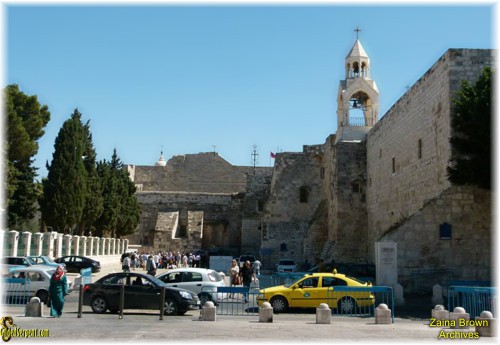
West Bank packs some of the most significant Christian landmarks. The Church of the Nativity in Bethlehem (Beyt Laham in Arabic) is probably the biggest of them all. To see the spot where Jesus is believed to have been born, you have to get in the back of a long line. It felt a little bit unreal to be in THE Bethlehem. It must be among the first far-flung places I ever heard of as a child, listening to those Christmas stories. I never could have imagined one day being there.

Despite Bethlehem’s popularity, and several big tourist buses parked in front of the church, the nearby souq was empty of visitors when I went there. Even the souvenir shops, lining the Manger Square next to the church, were deserted. The inviting cafes were only busy with locals and a few foreigners who seemed not to be on a day trip. How could this be? Most visitors make their trip with an Israeli tour company.

The tourists’ itinerary is planned so that they spend little to no shekels at all in the West Bank.

They simply see the Biblical sights, then head back to Jerusalem on the Israeli side for some souvenir shopping, dinner, and a night in a hotel. Therefore only a fraction of the tourism income goes into the West Bank economy, while the Israeli tour companies make a profit off Palestinian sights.

Souq
Bethlehem souq right near the Church of the Nativity.
Nativity Church
The Church of the Nativity is the star attraction in Bethlehem. Most tourists don’t venture beyond the parking lot
aweseom grafiti
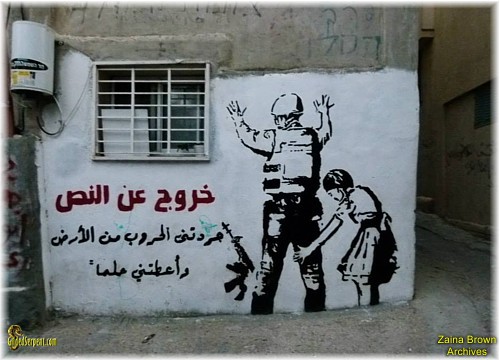
Graffiti in Dheisheh refugee camp. The original residents fled fighting or were expelled from their villages upon the foundation of Israel.

Ramallah

My next stop was Ramallah ("God’s mountain"). A pocket size city, it is the administrative capital of the West Bank – East Jerusalem is considered the real, if unachievable, capital. I set out to roam the lively streets, with camera in hand. A roundabout with a lion statue marks the center, and busy commercial streets spread out in all directions. I took pictures of just about anything I liked, asking for permission here and there. Soon I realized that this wasn’t necessary in Palestine – the people are so friendly and easygoing. The answer was always the same. "Itfaddali!" Go ahead! This was true even of the mausoleum of Yasser Arafat, right near the center of Ramallah. Not only was I allowed to take a photo, but the guards encouraged me to take one WITH THEM. I was grinning in disbelief. Now, Arafat left a mixed legacy, and visiting his tomb was not any kind of pilgrimage from my part. However, Ramallah is tiny, and the tomb of Arafat, a historical figure, is one of the few standout sights.

Arafat Tomb
The tomb of Yasser Arafat
Ramallah school girls
School girls in Ramallah

Nablus

Nablus is just about an hour by bus from Ramallah. This city has history reaching all the way to the Roman times. Thanks to the short distances, traveling around the West Bank is not tiresome at all. You could base yourself in the central Ramallah, for example, and just make day trips to other towns. I didn’t mind moving around, and spent the night in Nablus. I took quite some time to exploring the huge souq, and then decided to call it a night early. Just as I was getting ready for bed, the sound of drumming in the next building got my attention. That could only be one thing: a wedding Zaffa! I went out with my camera, and asked if I could go inside and watch. (By now you know the answer: "Itfaddali!")

Mount Gerizim overlooks Nablus, and is quite a unique place. This is the home to the Samaritan community. Who are the Samaritans? It’s an offshoot of Judaism, but an independent religion. They consider the mountain to be holy – and not the Temple Mount in Jerusalem, Judaism’s holy place. There is a visitor center, where you can get a guided tour and learn a lot about the Samaritans. Nobody beat me up while on the mountain, so I cannot verify if the Samaritans live up to their reputation, but I’m assuming that they are just as good as they were in the old days.

Nabluls street
Market streets in central Nablus
Mt G
View from Mount Gerizim, the home of the Samaritan community.
According to tradition, it was here that God ordered Abraham to sacrifice his son, and swapped him for a sheep instead. 
Jabos well
These Russian Orthodox women came to see Jacob’s well, a Biblical landmark.
They got out of the tour bus, went inside the monastery, and got back on the bus immediately afterwards.
Balata
Balata refugee camp, right across the street from Jacob’s well
Kids
Karim and his sister live in Balata. 

Taybeh

The village of Taybeh near Ramallah is unique in that it is the only completely Christian village in the West Bank. Built on a mountain top, there are beautiful views all around the picturesque village. I visited some old churches and Taybeh Brewery – yes, a beer factory!  They also produce wine and olive oil. Maria, a Greek woman who owns and operates it with her husband, gave me a tour. She described the hardships of running a business under occupation. Exporting goods was very difficult because of the red tape and the restrictions of movement imposed by Israel. The brewery didn’t have access to a port. Additionally, Taybeh only had running water twice a week. (Meanwhile, the surrounding Jewish settlements had running water all the time.) Israel controls the taps, and water shortages are common throughout the West Bank. Some Palestinian villages go for weeks without water. To get by, people collect water into tanks to use as a backup system. It is not sanitary, and for this reason travelers in the West Bank are not advised to drink tap water, while in Israel it’s perfectly safe. 

view
View from the mountain top village of Taybeh
watchtower
Israeli watchtowers are all around, a constant reminder of the military occupation
settlement
An Israeli settlement. All settlements are illegal under international law. 

Jericho

My last stop was Jericho (Ariha in Arabic), by the Jordanian border. The name echoes a grand walled city, but in reality it’s a dusty little town. There are several Biblical tourist draws. A cable car takes you up to the Mount of Temptations. Although the price is a little steep, the view is worth it. Right next to it lie the ruins of ancient Jericho. It’s more like the ruins of the ruins! I stayed my last night in Palestine in another youth hostel, located in another refugee camp, before crossing back into Jordan. I wished I’d had more time, but even in one week I was able to see so much, learn a lot about the daily life in the West Bank, and met many good people. It’s a trip I’ll never forget.

mt of temptations
Mount of Temptations, where according to the Bible Jesus was tempted by the Devil. The views down are dreamy
HIsham Palace
Hisham’s Palace in Jericho
Jerico
Quiet camels on the outskirts of Jericho

The West Bank sees very few independent travelers, which is a pity. Whether arriving by land from Jordan or flying into Tel Aviv, the biggest hurdle is the Israeli border crossing. Security is tight, and the procedure can be anything from a few straight-forward questions to a full-on interrogation. However, once inside, a foreign traveler can (normally) cross through the checkpoints, and that thick gray concrete wall, between Israel and the West Bank, without hassle. Within the West Bank, you can freely move between towns. Gaza on the other hand is under siege and tourists have no way of entering.

red sign
By Israeli law, it’s illegal for Israeli citizens to enter Palestinian Authority controlled areas.
They are only supposed to be in the settlements or on the roads leading up to them.
However, Israelis from Jerusalem sometimes come to hang out in Ramallah cafes at night. Nobody minds
 
wall
Near Qalandia checkpoint. Known as the security wall, as well as the Apartheid wall,
it separates not only the West Bank from Israel, but also encloses some Israeli settlements.
It splits many Palestinian communities in half, cutting people off their families, workplaces,
and farmland, causing major difficulties in everyday life. 

Palestine turned out to be a very welcoming, affordable, easy place to be a female solo traveler! I’ve been to a dozen Arab countries, by myself, and have seen the good, the bad, and the ugly. In Palestine I didn’t encounter any harassment on the streets, suspicious looks checking into hotels, or rip-off mentality among shopkeepers and taxi drivers. I can wholeheartedly recommend travel to the West Bank.

sweets!
These sweets are sold everywhere for one Shekel each. They were an essential part of my Palestine diet
Resources:

use the comment box

Have a comment? Use or comment section at the bottom of this page or Send us a letter!
Check the "Letters to the Editor" for other possible viewpoints!

Ready for more?

  • Touching the Clouds: Impossible Bridge in Yemen
    I needed a place where I felt safe, had some friends, and knew my way around: a place like Yemen! Besides, there was a bridge there that I wanted to check out.
  • What Lies Beneath, Part 1, The Morocco & Western Sahara Tourists Don’t See
    When you say you are going to travel around in Morocco, usually, the response you get can be summarized with one word: "Marrakech". Sure, Marrakech might be the "best of Morocco", but it also wasn’t going anywhere.Some other places, however, may not always remain as accessible, and I had a few questions on my mind.
  • What Lies Beneath Part 2, The Morocco Tourists Don’t See, Suspicion, Lifestyle, Wedding, & Rescue
    What’s depressing about Laayoune is the idea of it: what it represents, not the city itself. Buildings, painted in salmon color like Marrakech, palm trees planted in pretty town squares, clean streets, restaurants and cafes, busy market places and a gorgeous plaza where people stroll at night. If you didn’t know any better, you would love this place! In reality, you are inside an enormous military base, while the city is a mere facade.
  • Changes in the Island Kingdom, The Bahrain Bellydance Scene
    Returning to Bahrain to work after four years felt like going back to my roots. This little island kingdom is where I did my first Middle East contract, busted my bra on New Year’s Eve, and returned several times in the following year. Those were the days. Now it had been a while. Had Bahrain changed? You betcha.
  • Patient is a Bellydancer, Part 2:The New Normal & the Boring Reason I’ll Never Stop Dancing
    What was once an exercise in insanity is now how I hip drop and down walk.
  • Crossing the Chasm, Cultural Sensitivity and Bellydancing
    So how do we start to change the consciousness of people who see our profession as base, both inside and outside of the Middle East? I think it must start with a good understanding of the culture behind the dance, by condemning the culture or completely disregarding it in our art form, we have lost touch with our artistic role in society and thus have lost the ability to alter it.
  • A Refuge for Innovation, Tribal Fest 2014
    Although Tribal Fest is a live on stage, face-to-face event, it is the danced realization of a world in which the technological flows of transportation and communication bring images and bodies into correspondence with each other, and through the form create new images that move a global popular culture dialogue forward.
  • Colorful Maghreb in Los Angeles, A Celebration of Music and Dance,
    “Dancing In The Sunset ~ A Celebration of Maghreb Music and Dance” held February 1, 2014 at the Live Arts LA Theater in Los Angeles, California
  • Colorful Moments in Spain, 2014 International Oriental Dance Festival of Gijon,
    The International Oriental Dance Festival of Gijón, held every year in March, is organized by Fusión Oriental Group and Vanesa Moreno. Gijón is a small town on the north coast of Spain. Since its inception, the number of students was increasing and  improved their attitudes about Oriental dance. That is the main reason why Fusión Oriental group decided to do something special to provide an outlet for all of these emotions and ideas. Many ideas emerged, but finally we decided that a festival was the best of them. 
  • Zar: Trance Dancing with Yasmin, 2014 Workshop at Amina’s in San Francisco
    Here in the Bay Area, so many excellent instructors make appearances that I always feel I need to choose carefully to make the most of my workshop budget. But when I heard that Yasmin Henkesh was coming to give a daylong workshop on zar, I knew right off that this was one I wouldn’t want to miss – how often do most of us get a chance for an in-depth look at this fascinating ritual?
 

Gilded Serpent presents...

The New Normal & the Boring Reason I’ll Never Stop Dancing

Patient is a Bellydancer: Part Two

Abdomen diagram

by Margaret Anne
posted July 31, 2014
Part 1 here

In November 2013, a few weeks after my surgery, my mother and I sat in the surgeon’s office to read the pathologist’s report on my colon which they had removed a few weeks previous.

I hadn’t had my morning coffee yet so the good news didn’t hit me until I was back at my parents’ home with a cup in my hands.

After weeks trying to accept the terror of Crohn’s Disease, the pathologist conclusively found that I had until recently been a sufferer of Ulcerative Colitis (UC). This confused me. What did he mean ‘until recently’? He then informed me that while Crohn’s is a full body, lifetime struggle, UC only manifests in the large colon. Now that mine had been removed, carted away, examined and incinerated (good riddance!) I would no longer exhibit the symptoms.

With the diagnoses of colitis, I was eligible for a "j-pouch," a reservoir of sorts fashioned out of part of my small intestine to mimic the function of my external ostomy appliance, giving me a fist-sized reservoir and the ability to use the bathroom "normally". J-Pouches aren’t as convenient as a functioning colon – I’d have to be aware of bathroom locations for the rest of my life. As a colectomy patient I was given (and at the time of this writing, still have) a loop ileostomy, where my small intestine was drawn through my abdominal muscles allowing for waste to exit my body. My colon was gone but I was left with several inches of stapled-up plumbing in the back end. If I had walked out of the surgeon’s office with Crohn’s, my temporary arrangement would’ve likely been permanent and I would schedule an easier surgery to close the back door for good. But now, I would wait to see the surgeon who would perform my miracle and schedule for a fall 2014 reconstruction.The surgery isn’t without risk even at the best of hands on a healthy patient. As the young lady that I am, the main warning I was given concerned fertility issues. I haven’t spent much time weighing whether it might be selfish to choose my desire to have a "normal" looking stomach again over what seems like a far-away concern.

On a touching note, an older male GI doctor wanted me to know that in terms of partners, that if an ostomy – my lifesaving ostomy – proved to be am issue in a relationship, then I would find that he just isn’t worth my time anyway.

It was nice to hear a "You Go, Girl!" from a voice with experience. Personal relationships of all kinds are so much odder now. Eating a few bites of the wrong thing could put me on my side with cramps for few hours with my intestines making a loud racket. I’m still testing my tolerances to different foods, and I’m constantly testing the edges of my new social comfort zone.

Socially, I’ve kept up with the bellydance community because they’re my friends regardless, even though I’ve stepped away from bellydance lessons. At the end of January 2014, I stage managed Arcana, the Serpentine Studios production featuring live music. It was difficult to see that my spot in the choreography could be patched so seamlessly, but I appreciated that I could still have a role on the sidelines.

Arcana, the Serpentine Studios production featuring live music

After I was released from the hospital I began to tie up the loose ends on my independent lifestyle, including breaking my lease and moving back in with my parents. I didn’t have much energy to leave the house and needed chaperoning around, but I visited the dance studio for hugs and to pick up the pink and leopard-print costumes delivered there. My first few weeks at home were mainly dedicated to putting weight back on to my unhealthy frame with a high fat, high protein diet that will be remembered as the salad days of bacon and cheese.

During that first week home, it was settled after a long discussion that our family pet, the best dog in the world and my best friend for almost 17 years, should be put down. He had been falling apart for years and we couldn’t let him continue on his downward spiral.

I had to let go of a lot. I lost my health, my independence, my pretty tummy, belly dance – but nothing was harder than letting go of my friend.

I’ll always regret that I wasn’t able to take him for one last walk in the park.  I couldn’t dwell on my doggy however, because crying hurt my stapled incision too much. Within a few days of getting home I could walk up the stairs by myself, but he kept falling down them.

So I went about my recovery, including selling off costumes to some local dancers. I kept some veils and props as well as my troupe costuming even though I would be out of active duty for a while. But what about dancing at home? My ileostomy’s stoma protrudes through a layer of muscle putting me at a bit of a hernia risk. Contracting my abdominal muscles felt bizarre. The veils are packed away while I work on my lost flexibility. My surgeon joked later after clearing me for physical activity that I could bend over backwards if I wanted to – I told her that I can! Or, at least I could. We’ll see how long a real back bend takes again. The scar tissue runs deep.

On a visit to my family doctor in December, she reviewed the report sent from the regular surgeon to my J-Pouch specialist surgeon and smiled when she read out loud that "the patient is a bellydancer". I was always so calm and collected when speaking to my herd of specialists.

However when they’d then ask how I was holding up mentally and I’d say that I’m fine except that I used to be a bellydancer. Or that I am a bellydancer, but I can’t do it because of this. Bellydance is normalcy along with beauty and not having the ostomy.

A week later I went in for my usual blood work. The lady recognized me from previous visits (I was a regular) but since my hair was up, she didn’t realize that it was me right away. "You have such beautiful hair, but you’re not wearing it down!" I normally wear my curly shoulder-length burnette mop down, but I had started wearing it up recently. The stress, steroids, surgery and malnutrition caused all of my hair in the growth cycle to telophase and fall out. I used hairspray and eyeshadow on my scalp to fill in the missing parts.

I tried to style it, but chunks came out in my hands. My curls stopped holding. Grimly, the constant sweeping and swiffering wasn’t necessary because we didn’t have the dog anymore, but, now, I was shedding enough to bring the broom back. Overall I would estimate I had lost 90% of my hair. At least it’s growing back.

I hated looking ill and am very conscious of it, especially since my illness is not often understood and I was at an extreme end of the spectrum. "Temporary me" isn’t someone I want to know very well or even acknowledge (she’s the worst kind of unwanted guest), and since I had promised myself that I would spend my time away from dancing growing my tresses to khaleegy lengths I was devastated. Other messy health issues sprang up, but the hair was the missing cherry on the sundae and "appearing healthy" was something I had clung to.

Life gave me lemons but the sugar wasn’t free. I decided to see my hairstylist and go for a bleach blonde. Blondes have more fun, right? I have more fun now that I don’t look like I’m balding because my hair colour now blends in with my scalp. Sweeping up near-invisible blonde hair from the floor is a lot easier on my psyche. I bought clip-in hair extensions, too, and I got really good at unclogging the hair in shower drains.

I mind looking ill. The hair extensions make me feel silly but not because, yuck, whose head is this from, but because I’m ashamed that I couldn’t accept my hair loss. I prefer the lie. My hair is growing back but until it does, I’ll lie to myself. I will not accept that I lost so much of it. I knew I had accepted my big ol’ round-the-navel scar and my stoma when I had them even in my dreams, but I point-blank refuse to not have pretty hair.It wasn’t just hair loss itself that upset me, but it was the last straw in what I could handle.

I lost my pretty, unmarked tummy. I have a rough time sleeping, exercising and especially eating around weird dietary restrictions. I couldn’t dress like I used to because I have This Thing to work around. I will need medical attention for the rest of my life. Personal relationships will forever be complicated and potentially embarrassing. I hate swimming, but I still panic about swim suits. Pressing against counter-tops and seat-belts is nerve-wracking due to my stoma, positioned just to the right of my bellybutton. A big dog jumping up to greet me could ruin my day.

So I found myself falling into a particular trap that effects us when we don’t physically look like a bellydancer. Physical glamour is necessary for marketing, but that’s not what makes a dancer.

I didn’t start dancing because of my hair, or because of unmarked tummies. I heard the music and wanted to do whatever it was that went along with the music. I accepted that that even though I wouldn’t look like a dancer for a long time, I could still dance like a dancer. I had started taking lessons when I was 18 and became ill at 26. I will start dancing again at 27 if my next surgery is successful. Most people don’t start until that age or older. I have some physical demerits but I still have experience. Plus, there are always baladi dresses, or Suheir-style tummy covers, makeup, and fake hair. Also, it wasn’t as if I was the best dancer in town, so I didn’t suffer the loss of top billing. I didn’t teach or dance for pay often, so I didn’t lose an income stream. There were some dreams to cut loose, however. Before the surgery,I had wanted to take the Arabesque Pro Course in Toronto with Yasmina Ramzy, but I’ll never be a real pro now. It’s too late for that.

I’m still getting my hips back under me. I took a workshop with Aubre Hill several years ago in Bridgetown, Nova Scotia where she had us using our back muscles to produce movement in the front.

What was once an exercise in insanity is now how I hip drop and down walk.

Interestingly, my illness solved at least one mystery for me. When I was in the hospital I was subject to more x-rays than a shady package at the airport, and someone mentioned offhand that I had an abnormally high diaphragm. They had no idea why I was excited to hear it – finally, a real answer to why I had such a hard time fluttering!

I don’t consider myself a survivor, or particularly brave. I was hospitalized on a Thursday and three weeks later I was released on a Thursday. My Thursday was just a lot worse than average, but we all pulled through it. I could have died in the process but without any of the sweeping drama I would’ve imagined for myself.  As a Catholic who took philosophy in university, I’ve spent quite a bit of time weighing popular notions of life and death, but faced with the straightforward reality that my bowel could perforate and kill me, I was overwhelmed with a single thought: How boring.

How absolutely boring it would be to die like this in some hospital bed. I had no fear of death or dying, but I didn’t want to miss out on my life. How boring it would be to miss an entire life! How boring it would be to be missed.

How boring it would be to stop dancing.

So now, I’m waiting to see the next surgeon in early April. The patient is a bellydancer and wants her belly back!

Next article: Patient is a bellydancer, Part Three. Coin-flip Prognosis


Author at sci fi convention

Author volunteering at Hal-con in Halifax, Nova Scotia, last October
about a month post op,
with Garrett Wang. Hal-Con is a Sci-Fi & Gaming convention.

Resources:

use the comment box

Have a comment? Use or comment section at the bottom of this page or Send us a letter!
Check the "Letters to the Editor" for other possible viewpoints!

Ready for more?

  • Can a Non-Arab Dancer Really Belly Dance?
    Belly dance is seen as an Arab art form, and has gained considerable popularity outside of that circle. But can a non-Arab belly dancer really belly dance? Should a non-Arab represent a cultural art form when she is not a part of that culture? This article is an attempt to arm a non-Arab belly dancer against the inevitable questions leveled about whether her ethnicity or cultural background should prohibit her from dancing.
  • Patient is a Bellydancer, Part 1, Irritable Bowel vs. the Dancer
    Weeks later my doctor told me she had never seen it that high in anyone before. Something was very wrong.
  • The Skinny on Abdominal Strengthening
    You’ve probably heard the terms neutral spine and core balance being bandied about, and seen numerous class offerings for Pilates, body ball, and core workouts. You may be wondering, is this the sort of thing you should be checking out?
  • Journey into Womanhood
    Our mission, as women, is to encourage others to joyfully anticipate all the decades of their lives. Those who have gone before us have always and will always help us on our paths.
  • Improving Breathing for Better Dance Performance
  • We also hold our breath when we concentrate or get nervous. This brings tension into our bodies. The more tension we have, the more shallow we breathe. It can become a vicious circle!
  • The Constant Grind
    Today, the bitter truth is that the curvaceous and fleshy female figure is constantly disrespected by the media and pop culture.
  • Got Strength? Buffing up for Bellydance
    Muscles are like smart-aleck teenagers. If you ask them to do something, they do just enough to get the job done—and no more.
  • Belly Dance Secrets for Fitness and Rejuvenation
    The most important factor in sustaining an exercise program is the ‘fun factor’; Belly dancing comes with great music, exciting moves, noisy coin belts and its own special dress code.
  • NIA: A JOURNEY IN MIND and BODY FITNESS
    I believe that I am on a fascinating journey and that on of the destinations is the path, itself.
  • Crossing the Chasm, Cultural Sensitivity and Bellydancing
    So how do we start to change the consciousness of people who see our profession as base, both inside and outside of the Middle East? I think it must start with a good understanding of the culture behind the dance, by condemning the culture or completely disregarding it in our art form, we have lost touch with our artistic role in society and thus have lost the ability to alter it.
  • A Refuge for Innovation, Tribal Fest 2014
    Although Tribal Fest is a live on stage, face-to-face event, it is the danced realization of a world in which the technological flows of transportation and communication bring images and bodies into correspondence with each other, and through the form create new images that move a global popular culture dialogue forward.
  • Colorful Maghreb in Los Angeles, A Celebration of Music and Dance,
    “Dancing In The Sunset ~ A Celebration of Maghreb Music and Dance” held February 1, 2014 at the Live Arts LA Theater in Los Angeles, California
  • Colorful Moments in Spain, 2014 International Oriental Dance Festival of Gijon,
    The International Oriental Dance Festival of Gijón, held every year in March, is organized by Fusión Oriental Group and Vanesa Moreno. Gijón is a small town on the north coast of Spain. Since its inception, the number of students was increasing and  improved their attitudes about Oriental dance. That is the main reason why Fusión Oriental group decided to do something special to provide an outlet for all of these emotions and ideas. Many ideas emerged, but finally we decided that a festival was the best of them. 
  • Zar: Trance Dancing with Yasmin, 2014 Workshop at Amina’s in San Francisco
    Here in the Bay Area, so many excellent instructors make appearances that I always feel I need to choose carefully to make the most of my workshop budget. But when I heard that Yasmin Henkesh was coming to give a daylong workshop on zar, I knew right off that this was one I wouldn’t want to miss – how often do most of us get a chance for an in-depth look at this fascinating ritual?
  • Typography, Graphic Design for Dancers, Part 1
    As artists of an often misunderstood dance, we dancers understand that everything we present publicly reflects back upon us as individuals, upon bellydance as an art form, and by extension, the Middle Eastern culture. When presenting these facets in the most favorable light to other dancers or the general public, good design becomes paramount because it is the most unmistakable way to demonstrate our worth.
 

Gilded Serpent presents...

Crossing the Chasm

Cultural Sensitivity and Bellydancing

Leila Farid

by Leila Farid
posted July 16, 2014

In my family there is a cocktail of culture: Native American (various tribes to varying degrees), Samoan, Mexican, God knows what kind of European, English and now Egyptian.  Racial jokes fly around the table at our family gatherings – we are impossible to offend.  My cousin’s blond, blue-eyed kids get dirty looks at the Indian Health Center and my sister’s family blend when they go on vacation in Hawaii.  People speak Spanish to my half Egyptian kids when we visit my mom on the reservation where I grew up and the most exotic thing in our family is the Englishman that my sister married.  None of us can understand his accent.  In short, we are mutts.   Culture was something to be lived.  White and brown made fun of equally – if it was funny, it was fair game. 

I think I have always "taken" the things I like about Egyptian culture and the things I didn’t like, I made off-color jokes about them.   Given that, I may not be the best person to talk about dance and culture.  I am not an anthropologist.  But lately I had been rolling this subject around in my head.

How do we as dancers feel about the culture behind our dance?

There is no cultural deterrent from taking a belly dance class.  Anyone can use any dance form for fitness.  The issue comes when dancers start to perform.  As performers, whether we like it or not, we are representatives of the dance and the culture it sprang from.

I wasn’t drawn to the cultural side of belly dancing when I first started.  I liked the costumes, the exoticness, and the challenge of learning the movements.  I liked being around other women and dressing up.  It wasn’t until I started performing in Arab clubs that I wanted to try and understand more about the culture.  I felt like I was in a bit of a fog, as I, the performer, knew so much less than the guests about the music and culture of my dance.  It made me want to find out what I was missing. 

The first thing that struck me about the people I met at the clubs was how generous and welcoming they were.  Dinners and drinks were always offered.  People would always come up and talk to you after the show.  Guests at the club would invite me for lunch with their family the next day!   There was an openness that seemed different than the typical American experience. 

I quickly learned that the dancers who danced for the Arab community and those that didn’t separated themselves. The, rest of the dance community called us the "club girls" and an invisible line was drawn.  They indicated the Arabs thought less of us because we were dancers – that they didn’t respect us (the friendliness of the patrons was just a come-on when offered by men).  I always figured it was no worse than when my red neck cousins who snickered every time the subject of my belly dancing was brought up at family gatherings.   I also thought it was interesting that the same dancers who condemned us for dancing in the Arab clubs always reserved the VIP seats in the front row at haflas and shows for Arab guests. It felt that we as foreign dancers needed to be accepted by the Arab community in respectable, non-Arab venues.

It was dancing in the Arab clubs that I started to learn about Arab culture and start to appreciate it.  I began to form the idea of going to Egypt to continue learning and the club patrons encouraged me.  I had started belly dancing by watching videos of Fifi Abdo and Lucy.

Now I wanted to see where they came from as dancers, the culture that produced the dance, and not just the pyramids and the sphinx. 

It was in my newbie dancer phase, obsessed with all things about dance in Egypt, that I came across an old article in a dance magazine.  It talked about Egyptian weddings and a foreign dancer in Cairo wrote it. I was instantly struck by the tone of the article. The author seemed condescending when talking about the culture of weddings and the guests attending, suggesting that weddings were monotonous and boring and going on to describes one bride as a "horse".  I was shocked. I wondered how someone who felt so superior to her audience could have any real connection with them. It seemed that there might be similar predicaments in Egypt within the foreign dance community as in the states.  Even the people who had gone to Egypt to perform separated themselves, at least in attitude, from the locals.

After arriving in Egypt I found that to be true in many cases  Most foreign dancers had contact only with each other or with costumers or choreographers in the industry. They performed for Egyptians but kept their distance. Now in the day and age of blogs, it is easy to find out how a foreigner dancer feels about Egyptian culture, they write about it daily.  

I have read a few blogs and they seem to have 2 main topics:

  1. Dancers write about their skill in fitting into or succeeding within the Egyptian dance scene. They write about shows where they are mistaken for being an Egyptian or where they receive approval from Egyptian audiences, as the highlight of their performances.
  2. Dancers also write about how they see themselves as  "taking-on" (or at least pointing out) what they see as the pitfalls of Egyptian society.  Describing Egypt as full of animal abusers, sexist men with pubescent minds and entertainment people who see dancers as something only to be used and abused.

It seems the ultimate goal is to pass as Egyptian in the dance but view the culture as lacking in terms of western standards. There is a kind of schizophrenia: to crave to be accepted in the art by Arabs but to constantly point out what is seen as negative aspects of Arab culture and to impose what is believed to be proper behavior on that culture.

Some critics of the second theme of these blogs have offered the advice: "If you don’t like Egypt, then go home." I think it is a bit more complicated than that.  Working in Egypt as a dancer is not easy and may turn even the most optimistic performer into a guarded and suspicious person. Dancing itself may tend to alienate foreigners from Egyptians leaving dancers with very few Egyptian friends. All dancers in Egypt suffer from a certain stigma as performers. Our role as dancers in the society is complex. We fulfill a need that has many levels.  It involves artistry, sexuality, immorality, sweetness, wantonness, and the ability to be reformed.   Dancers are risk takers. They risk their reputations for the money and accolades of performance.

The idea of dancers being admired and despised at the same time is woven into Arab culture and difficult for Westerners to understand. It may create disappointment and resentment as a foreign performer discovers this. 

So how do we start to change the consciousness of people who see our profession as base, both inside and outside of the Middle East? I think it must start with a good understanding of the culture behind the dance, by condemning the culture or completely disregarding it in our art form, we have lost touch with our artistic role in society and thus have lost the ability to alter it.

In our dance community as a whole, there is a chasm between appreciating the dance and appreciating the culture that it comes from. The dance community has started on a journey, without conscious malice, to attempt to make the dance better than the culture it springs from, to lift it above the society that created it, and to gain respect for dancers by Un-Arabizing the dance.  I think that if this journey is successful, the results may not be appealing.

While I was considering this point, a friend pointed out to me that our first duties as performers are to our audience and if there are no Arabs in the audience, then we have no responsibility to the culture. I believe that even without Arab audience members, belly dance will suffer if the cultural aspects of it are ignored.  Take for instance, Salsa and Tango after they were initiated into Ballroom Dance sport. They are now seen by a huge non-Latin audience and to suit the tastes of the sport and it’s followers, they have become athletic and impressive. They have also become, in my opinion, strange and soulless. There seems little of the passion and romance, lost in leaps and lifts in this new "Latin" dance, of the dances when you see them performed in clubs. Belly dancing is already traveling this route.

Gone are the Arab clubs in the West and dance has become big business in festivals around the world and in the Middle East making belly dance easy prey to Westernization, even by Arabs. Want to teach more: make it palatable to westerners.  It is easy to teach a choreography based on a complicated movement. It is difficult to teach someone to understand the words of a song, understand the cultural context behind the words and interpret the song as it speaks to them on the spot.

I have spoken with quite a few of the Egyptian dance superstars of the past.  When the subject of foreign dancers comes up, they shake their heads and say, "They have so much desire to learn our dance, but when they dance it, it says nothing to me." Azza Sherif took it a step further. She went up on stage during one of the exuberant performances of the participants at our dance event here in Egypt, and told her to "Stop!" What she was doing had nothing to do with raqs sharki. She was doing acrobatics. She told the girl to start over but to dance this time."

There is something missing in Belly dance today. This may be what some people of Arab descent are taking offence to, (such as the "Why I Hate White Belly Dancers" article), the lack of acknowledgement of the culture behind the dance.  As foreign dancers we tend to copy what we see as "Arab style" without really understanding the reason for it. To imitate and to understand are two different things. Of course we must add our own personal touches to our own dance; we are entertainers in the end. We will have something to say that is unique to ourselves, as foreigners and we should embrace it. But we also must acknowledge the culture that produced the dance and have enough understanding of it to make our own choices within this context.

To illustrate this point, here are some examples of three different dancers performing to the same song. 

Egyptian Superstar Tahia Karaoka:


Egyptian Dancer Dina:


Ukrainian Dancer Alla Kushnir:


It is really not fair to put this foreign dancer next to Tahia Karaoka and Dina but her performance illustrates what happens to dance when it becomes purely movement based. She is a gorgeous woman and her technique is masterful, but where is the feeling behind the technique?  It is such a far cry from the subtle performance of Tahia Karaoka  (not even in a costume) and the smooth coyness of Dina. The dance has become athletic and technical but is completely disconnected from the soul of the song and void of the "Beledi" persona that links this song to the culture.

How do we address this trend? I tend to think, that maybe, the main prerequisite to performing raqs sharki is that you actually like or be willing to explore at least, some aspects of Arabic culture. Liking or having an interest in something means you will dig deeper into it.  You will want to understand it from the cultural side in order to bring a deeper level to your dance.

I love weddings in Egypt. They are loud, formal, late night and full of entertainment. You can hire the biggest star in Cairo to dance at your wedding and while he is singing, throw your arm around him, grab the microphone and help him finish his song. In fact, it is expected.  I like that things are personal.  That people get close to one another. I like that when I dance people talk to me, women hug me, people spontaneously jump up and dance with me. This personal side of Arab culture draws me to the culture and to the dance. It has drawn me in from the beginning of my club days.
I also really like Arabic music. My car radio is always on the classic Arab station, to the chagrin of my 6 year old, who begs me to put on English pop. 

Of course, I grumble about things I dislike in Egypt but I think most of my grievances have to do with the fact that I live in a huge, overcrowded, polluted city (I would complain in much the same way if I lived in LA) and that I am in the arts where anyone will find an overabundance of "interesting characters" in any country. There are some aspects of Arab cultural that I just don’t agree with but there are also some aspects of my own culture I don’t like either. 

Here are some very positive things I can now appreciate from Egyptian/Arabic culture:

  • Patience:  when the people in line at the bank in the states start to grumble after waiting 1 or 2 minutes, I have to smile now.  I met a woman who waited 2 days in line to get her passport in Egypt.  She brought food and camped out.  Patience are all important when dancing in Egypt as nothing happens on the time schedule it is supposed to.  Patience also have helped me to explore a song as it unfolds instead of dancing over the top of it.
  • Skinny is not better: when you lose weight in the Middle East people don’t compliment you, they ask you if you are sick.  I constantly struggle with being too thin and it is kind of nice to eat pretty much whatever I want to keep my weight up.
  • Insha Allah: if God wills it to happen, it will.  And if God does not, it will not. This phrase is almost torture to foreign dancers who tend to expect that things will happen as managers and impresarios say they will, only to find that God has intervened.  It leaves room for a higher power. 
  • Al Hamdulila: To be okay with what you have or for what has happened, even if it is not very much or not the outcome you hoped for. At least I had tonight’s show!
  • And my favorite, because it reminds me of my childhood and that I had forgotten somewhere along the road before I came to Egypt: The ability to laugh at oneself or ones culture and make fun of just about anything (religion excluded).   If you can’t have fun on stage, then what is the point?

I think that I can apply these to my dance and my life in general. I am grateful that belly dance allowed me to explore this with Egyptians. It has helped me to become a better dancer, to be able to enjoy things alongside people and not just as an observer: culture lived.

It must be possible to use our art form to understand the culture that created it and see that culture from the inside.  If belly dancing can give just one person (like myself), even a small bit of appreciation of Arab culture, isn’t it worth it?  Just putting on the costume is not enough.  Figure out what kind of place belly dancing holds inside the culture.  Explore what makes Egyptians and Arabs laugh, passionate, or cynical. Watch Arabic films and listen to Arabic music.   Experiencing culture doesn’t have to be dry like an anthropological thesis, go out and meet people, and you don’t have to live in Egypt to do it.   Arab culture can be fun, raqs sharki is definitely meant to be.  And if you are sincere in your endeavor, Arab people will help you.  If you don’t feel comfortable imposing yourself in the Arab community, there are dancer who try to help bridge the cultural gap with events.

I am ok with being a ra’asa. I like Arab (at least Egyptian) culture just about as much as like I like my own crazy, mixed up culture.  Personally, I think that matters.    

*raqs sharki-A transliteration for the Arabic word for belly dance
*ra’asa-A transliteration for the Arabic word for dancer
*In this article I am referring to belly dance as raqs sharki.  (Not tribal, fusion or folkloric dance).
 
Resources:
  • Author’s bio page
  • ed note: The Randa Jarrar article she references is not titled “Why I Hate White Belly Dancers” but “Why I Can’t Stand White Belly Dancers”

use the comment box

Have a comment? Use or comment section at the bottom of this page or Send us a letter!
Check the "Letters to the Editor" for other possible viewpoints!

Ready for more?

  • Egyptian Wedding Stories
    All the guests were staring at us. The father of the bride demanded to know who ordered the bellydancer and it seemed a fight was going to break out between representatives of the brides’ family and the hotel organizer.
  • Cairo Now, The Post Revolution Entertainment Scene in Egypt
    As I watched the gorgeous rendition of the old folk tale “Ayoub wa Nassa” by the Opera’s Forsen el Shar’a Ensemble, I couldn’t help but think of how close Egypt came to going down a road where dance, secular literature and film may have become dinosaurs of the past.
  • Exploring the Essence, Dancing to Live Music,
    All the great dancers worked with live music because orchestras helped them reveal their deep-seated artistry.
  • Planting Flowers and Dodging Riots, Dancing in Cairo After the Revolution
    I left Cairo on September 9th, 2012, after a three-week visit to research the zar. I wrote the following article on my flight home – two days before the Libyan tragedy* and the violence outside Cairo’s US Embassy. As my plane circled the pyramids I had no idea Egypt would once again become the center of world attention.
  • Facing the Truth, Working as a Dancer in Egypt
    Sometimes the dirty facts of dancing in Cairo can be more interesting than the pristine Oriental fantasy… at least, it is when you tell the story later! PHOTOS!
  • As the Music Fades, Egypt’s January 25 Revolution’s Impact on the Muscians and Dancers
    We can’t attain what they had in the past because we are not free. Our minds are full of work and what we should and shouldn’t do. There’s no time for good art. Politics mixed with religion does not make for an atmosphere where the arts can flourish
  • Inside Peek at Making Music Videos: Hakim, Khalid Selim, Walid Toufic, Ali el Hagar, Elam, & Samira Said
    I was either crying or yelling at Hakim for most of the shoot and went home each day with a headache from it.
  • A Refuge for Innovation, Tribal Fest 2014
    Although Tribal Fest is a live on stage, face-to-face event, it is the danced realization of a world in which the technological flows of transportation and communication bring images and bodies into correspondence with each other, and through the form create new images that move a global popular culture dialogue forward.
  • Colorful Maghreb in Los Angeles, A Celebration of Music and Dance,
    “Dancing In The Sunset ~ A Celebration of Maghreb Music and Dance” held February 1, 2014 at the Live Arts LA Theater in Los Angeles, California
  • Colorful Moments in Spain, 2014 International Oriental Dance Festival of Gijon,
    The International Oriental Dance Festival of Gijón, held every year in March, is organized by Fusión Oriental Group and Vanesa Moreno. Gijón is a small town on the north coast of Spain. Since its inception, the number of students was increasing and  improved their attitudes about Oriental dance. That is the main reason why Fusión Oriental group decided to do something special to provide an outlet for all of these emotions and ideas. Many ideas emerged, but finally we decided that a festival was the best of them. 
  • Zar: Trance Dancing with Yasmin, 2014 Workshop at Amina’s in San Francisco
    Here in the Bay Area, so many excellent instructors make appearances that I always feel I need to choose carefully to make the most of my workshop budget. But when I heard that Yasmin Henkesh was coming to give a daylong workshop on zar, I knew right off that this was one I wouldn’t want to miss – how often do most of us get a chance for an in-depth look at this fascinating ritual?
  • Typography, Graphic Design for Dancers, Part 1
    As artists of an often misunderstood dance, we dancers understand that everything we present publicly reflects back upon us as individuals, upon bellydance as an art form, and by extension, the Middle Eastern culture. When presenting these facets in the most favorable light to other dancers or the general public, good design becomes paramount because it is the most unmistakable way to demonstrate our worth.