Gilded Serpent presents...

A Refuge for Innovation

Tribal Fest 2014
Placeholder

by Barbara Sellers-Young Ph.D
photos by Lynette Harris
posted July 14, 2014

Sitting in the main auditorium watching three days of performances at Tribal Fest 14: From the Root to the Fruit, I was reminded of the history of belly dance in the twentieth century from its arrival at the Chicago World’s Faire in 1893 to the evolution of the form as it exists today in global popular culture. Visually and aurally, the festival is a convergence of images of bright colors, flowers, heavy jewelry, tattoos, electronic music with its pulsing rhythms, and testaments to the impact of the dance, specifically Tribal Fest, on individual lives. The individual dance performances seem to span the history of the dance itself with a nod to the dances from North Africa and the Middle East to those that tie their roots to the movement vocabulary and choreographic style of American Tribal Style’s founder Carolena Nericcio-Bohlman, as well as extensions of this movement vocabulary into Fusion and Dark Fusion performances.

As someone whose personal dance roots go back to belly dance in the 1970s, it was fascinating to reflect on how the history of belly dance since the Chicago World’s Faire was reflected in these performances. The 1970s was evident in the incorporation of the rituals and the calling on of the earth’s forces that started and ended the performances. This was also reframed in dances that called up the spirit of the dance to the mother goddess of Jamila Salimpour, or to other ancient goddesses as Daniella Gioseffi did with her 1970s performances for feminist groups across the United States, documented in her book, Earth Dancing. This celebration of the earth and our life on it was reflected in costumes that included earth elements of feathers, flowers, antlers, leather, and natural fibers.

Africa, India, Bollywood, Urban Dance, Modern Dance, Ballet are just some of the many movement vocabularies and related moving images incorporated into Tribal Fest performances. In watching them, I was reminded of Ruth St. Denis whose company, Denishawn, traveled the globe and integrated the movement styles of India and elsewhere into their performances. The new twist is that the world’s dancers come to Tribal Fest from Japan, Italy, India, Latin America, and elsewhere. They bring with them new versions of Tribal, Fusion and Dark Fusion that are a consequence of the cultural contexts and aesthetics of their distinctive communities.

More than any other dance form I am aware of, belly dance and its related community, has served as a place of refuge and transformation for personal life challenges and a place, through improvisation, for movement experimentation and creativity; with specific reference to forms from popular culture.

I would argue that this is because its underlying movement philosophy is improvisation. This improvisational mode is found in the versions of the form that take place in ethnic communities in North Africa and the Middle East and related diaspora. A version of improvisation is encouraged in belly dance classes when a dancer is given the opportunity to take the movement vocabulary and make it their own. Another version takes place in the hig hly visual and kinesthetic reliant improvisational stage choreography developed by Carolena Nericcio-Bohlman and incorporated into dance companies that are its derivative. And, there is the improvisation that takes place when a dancer plays with the integration of the belly dance vocabulary and other movement forms.

Although Tribal Fest is a live on stage, face-to-face event, it is the danced realization of a world in which the technological flows of transportation and communication bring images and bodies into correspondence with each other, and through the form create new images that move a global popular culture dialogue forward.

Within the framework of history, Tribal Fest is 14 years old, having started in 2000. The moving global dialogue that it represents is over a hundred years old and somewhere in the process, belly dance, of which the belly features so predominantly in the movement and the costuming, is no longer a dance of North Africa and the Middle East but a dance of popular culture shared by men and women across the globe. As such, it is an example of the potential and impact of dance in popular culture. People who have found joy, creativity, meaning and identity within the improvising possibilities of belly dance have followed it on a personal integration of self and dancing body to evolve new movement images. Sitting in the audience I wondered what new integrations of movement will evolve in the rest of the twenty-first century.


Pirate of Reno
Kraken Hunters Bound by Ship Ahoy of Nevada
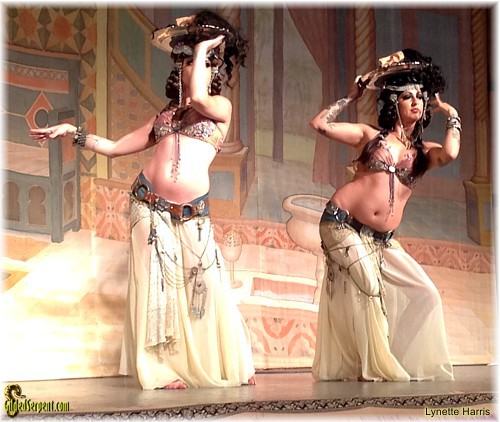
Salome Duet

A Salome Duet by Yvonne Michelle and Marci Ann of CA

Unknown

Red Moon Dance Company of CA

Jamila Honeybear

Jamila Honeybear performs her dance to a poem she wrote and spoke.

Unknown

Lynette Day of Hawaii

Unknown

Liora of Texas

Hannah R

Hannah Romanowsky of CA

Kim of the UK

Kimberly Mackay of CA and UK

Peacock

Mayuri of CA

Tree of the UK

Tree Russel of UK

Paige reads his future

Paige Lawrence of Oregon


Artemis

Artemis Mourat of Maryland

hooded

Who is this hooded troupe? This dancer has a snake dancer tattoo!
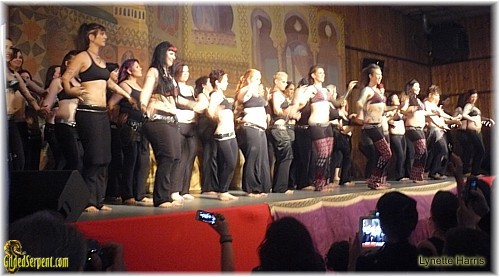
Hot pot

Amy Sigil, Unmata and Hot Pot Studios fill the stage.

Moria

Apsara of Oregon, Moria Chappell in back.


Steve Eggers and April Rose

Steven Eggers of Mexico and April Rose of Texas
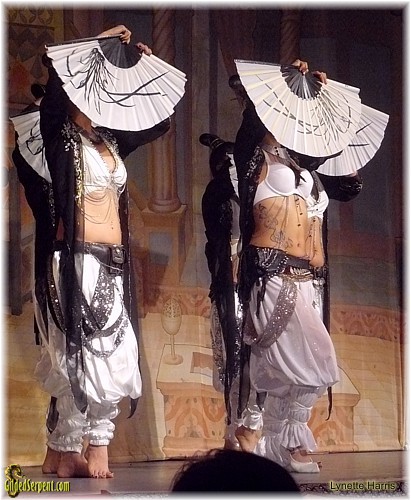
Korean Troupe

Jewelry Movement of South Korea

Korean troupe packstage

Jewelry Movement backstage

Ginger dreads

Michelle Sorensen of Salt Lake City, UT

Alaska Healing the world

Alaska sends healing energy to the world!
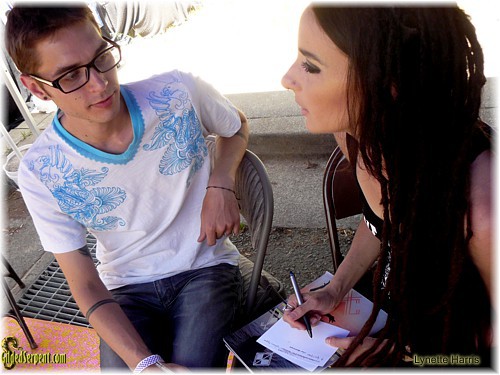
April and Steve

Steven and April discuss their introduction for the MC

Barbara and Karen

Author Barbara Sellers-Young PhD and Karen Proehl

Geisha Balloon Toss

Geisha Moth leads a water balloon game outside, including: Amy, Mher, Frank, Raven, among others.

Ling SIngs

Ling sings

Men Compare Equipment

Men compare equipment,
Emil of Diamond Pyramid and customer.
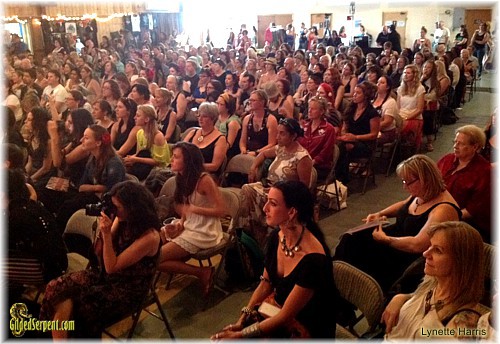
Rapt Audience

A Rapt Audience. Lower right: Colleen, Karen, Barbara.


Resources:

use the comment box

Have a comment? Use or comment section at the bottom of this page or Send us a letter!
Check the "Letters to the Editor" for other possible viewpoints!

Ready for more?

  • Delilah, Women, Nature and the Body
    This belief in the force of the earth is central to Delilah’s approach to teaching belly dance.
  • Serena Wilson (1933-2007) A Student of Ruth St. Denis, Part 1: Childhood
    Serene Blake was born in the Bronx on Aug. 8, 1933 into a Vaudeville family of performers called Blake & Blake. Her mother sang and her father played the banjo. Her childhood and adolescent years intersected with the Vaudeville stage, on which she often appeared with her parents in the 1930s.
  • Serena Wilson (1933-2007) A Student of Ruth St Denis, Part 2: Salome and Her Impact
    When suited to the context, she also had no hesitation in using the term belly dance as she considered the dance as evolving as an Americanized version based on primarily Middle Eastern as opposed to North African influences.
  • Serena Wilson (1933-2007) A Student of Ruth St Denis, Part 3: Serena’s Books
    Serena’s approach saw women as joyful, soft, and feminine. They were responsible for and in control of their sensuality and by extension their sexuality. The dancers were not encouraged to challenge men by their physical presence, but neither was their physical presence and personal desire controlled by men.
  • Tamalyn Dallal’s DVD- 40 Days and 1001 Nights,
    Thus, the film did expand my visual awareness. Now, did it deepen or extend my understanding of what that diversity implied? My response would have to be no.
  • Academics and Belly Dance, Two Books Review
    Belly Dance: Orientalism, Transnationalism & Harem Fantasy edited by Anthony Shay and Barbara Sellers-Young & Choreographic Politics: State Folk Dance Companies, Representation, and Power by Anthony Shay
  • Kajira and Chuck Interview, Cultural Appropriation or Artistic Freedom? Part 6: Separate Community? Burlesque?
    Kajira believes that the Tribal community is bigger and more successful than the rest of the belly dance community. "We wish we could be accepted as a sister dancer form… As Artemis said, if you don’t like it, you don’t have to look." Burlesque is a separate art form.
  • Colorful Maghreb in Los Angeles, A Celebration of Music and Dance,
    “Dancing In The Sunset ~ A Celebration of Maghreb Music and Dance” held February 1, 2014 at the Live Arts LA Theater in Los Angeles, California
  • Colorful Moments in Spain, 2014 International Oriental Dance Festival of Gijon,
    The International Oriental Dance Festival of Gijón, held every year in March, is organized by Fusión Oriental Group and Vanesa Moreno. Gijón is a small town on the north coast of Spain. Since its inception, the number of students was increasing and  improved their attitudes about Oriental dance. That is the main reason why Fusión Oriental group decided to do something special to provide an outlet for all of these emotions and ideas. Many ideas emerged, but finally we decided that a festival was the best of them. 
  • Zar: Trance Dancing with Yasmin, 2014 Workshop at Amina’s in San Francisco
    Here in the Bay Area, so many excellent instructors make appearances that I always feel I need to choose carefully to make the most of my workshop budget. But when I heard that Yasmin Henkesh was coming to give a daylong workshop on zar, I knew right off that this was one I wouldn’t want to miss – how often do most of us get a chance for an in-depth look at this fascinating ritual?
  • Typography, Graphic Design for Dancers, Part 1
    As artists of an often misunderstood dance, we dancers understand that everything we present publicly reflects back upon us as individuals, upon bellydance as an art form, and by extension, the Middle Eastern culture. When presenting these facets in the most favorable light to other dancers or the general public, good design becomes paramount because it is the most unmistakable way to demonstrate our worth.
  • Beata Zadou in 1988, Winter Visit to Berlin’s Snow Princess
    It is rare that reality matches one’s fantasy, but in this case, in 1988, my expectations were surpassed by the reality of wish-fulfillment.
  • Music Copyright Law for Belly Dancers (or for any Performing Artist) (commenting now available on this article)
    You are not going to like what you are about to read. But if you are performing publicly to music you do not own, for your own protection, please keep reading. Every professional dancer should know at least the basics of music publishing law, particularly if she wants to appear in an audio-visual production destined for commercial distribution.
  • Patient is a Bellydancer, Part 1, Irritable Bowel vs. the Dancer
    Weeks later my doctor told me she had never seen it that high in anyone before. Something was very wrong.
  • by Samira Shuruk
    Every day we go to places where we are surrounded by strangers!
 

Gilded Serpent presents...

Colorful Maghreb in Los Angeles

A Celebration of Music and Dance

Aubre Hill

Aubre Hill, producer

Report by Heather Shoopman

Photos by Joe Foley and Kimia
posted April 21, 2014

“Dancing In The Sunset ~ A Celebration of Maghreb Music and Dance” held February 1, 2014 at the Live Arts LA Theater in Los Angeles, California

Aubre Hill is known for her involvement in dance education; she is passionate about world dance in particular, and is a resource for the belly dance family tree. I was excited to learn that she had put together a show featuring dances of the Maghreb, the region of Northwest Africa west of Egypt known more generally as Morocco, Algeria, and Tunisia. The show was held at Los Angeles Live Arts, which is a beautiful, yet simple and elegant space in the Eagle Rock neighborhood of LA. It boasts floor to ceiling black velvet curtains and a big, beautiful black wooden dance floor that places the audience on the same level as the dancers.

The show opened with Qabila Folk Dance Company, directed by Aubre, performing a Moroccan Shikhat piece.

The Shikhat women are a dichotomy; although they are known for performing at various public festivities such as weddings and births in Western Algeria and Morocco, they are socially marginalized because they do not hide that they are dancers in their private lives.

This particular performance presented ten dancers in vibrant orange and red dresses, floating along the floor, performing various pelvic circles and tilts. They moved gracefully along through sassy lines and pleasing angular formations. Their hypnotic hair swinging, much color and smiles lit up faces in the audience!

Qabila

Qabila

Next, Olu performed a dance originated by the Ouled Nail people of the mountains of Algeria. It was enchanting, authentic, and fun! Keeping the energy up with staccato hip and chest accents, quick hand movements and engaging smiles; she also charmed the audience with the flirty use of her scarf.

Olu
Olu

Marque Bissell and Esteban Vega did a traditional dance of the Haha, a tribe of Berber people in northwest Morocco. This is traditionally a 6/8 rhythm drum solo performed with the feet. Their stomping, clapping and smiling had a strongly captivating effect and was quite adorable. I was all smiles about this show! Its lineup had an easy balance of soloists and groups, and male dancers.

Haha Men
Marque Bissell and Esteban Vega

Devilla and Isis Siren Sekhmet rocked an extremely impressive “Tunisian Shaba Dance” (“Water Pot Dance”). The Pot Dance is from southern Tunisia, and celebrates the main industry of the area: pottery. It depicts women gracefully returning from the well, balancing the water pots on their heads.

I was able to talk with Devilla after the show to gain a bit of insight to this special piece. Apparently, she searched high and low for the water pots, all the while rehearsing, using juice bottles filled with pennies and sand. In the end, they used the juice bottles painted gold. They made their own traditional Milaya, which is a large piece of fabric draped around the body to form a dress, out of a bolt of fabric that Devilla had been gifted years ago. They even made the khlal pins that traditionally hold the Milaya in place from pieces found at a local craft store. These ladies dance together often, and their happiness shows!

Rosa Rojas and Company performed a captivating “Guedra Dance” using their own voices and bodies to create the sound. There is something hauntingly personal in a performance with voice. “The Guedra Dance” is a joyful trance dance also known as the “Tuareg Blessing Dance”. The person in trance uses her hands to translate the energy of the sounds, moving her body to-and-fro in a rhythmic motion. The supporters chant and clap, seated around her as she sways and flicks her hands. The intense movements of the dancer represent the many emotions associated with a ritual of blessing to family, the community and God.

Rosa
Rosa does guedra

Aubre Hill gave a dynamic solo performance to “Lamma Badda”, a Sama’i 10/8 rhythm reminiscent of the Andalusian time period in early medieval Spain.

She wore a costume that symbolized every day clothing.

Dancing and twirling about the stage passionately, she embodied the poetry of the song quite beautifully. (Because I am a tribal fusion nerd, I really enjoyed this next number, and I squealed when I saw their costumes.) They wore big pantaloons of gold lace with a maroon under-color. Their custom bras and belts (some created by the members themselves and a few Medina Maitreya pieces) were the perfect blend of glitter and metal. They were the quintessential gold sparkly goddess belly dancers with decorated faces and heads.

Red Moon Bellydance, directed by Jenn Aguilar and choreographed by Meryl Jensen, performed an exciting number with an American Tribal Style (ATS) base and elements of Tunisian and Egyptian bellydance. Aubre included them in the show because of their ATS based aesthetic, as the form itself is a fusion of dance from across the so-called gypsy trail, including the Maghreb.

Red Moon
Red Moon

Marque Bissell performed a traditional Moroccan Tray Dance. The tray holds a tea set, as tea is an art form and tradition in Morocco.

In the U.S. this dance was made famous by the late well-loved dancer, John Compton.

Marque’s piece was happy and playful. He included the exciting (and difficult) floor turnovers and ended with spins. I think I may have held my breath. How did he do that?

Lumina, under the direction of Aubre Hill, gave a devotional piece to a traditional Berber Sufi song re-composed by a local modern artist. Their costumes were simple black dresses and their message was finding spirituality in everyday lives. They started with movements reminiscent of everyday tasks into dancing not characterized by hip work. This strong group allowed solo time for each artist while the others formed a supporting chorus. They moved and spun around each other creating a little scene, infusing bliss into familiar movements.

Amel
Amel Tafsout and Fela

In the the grand finale, Amel Tafsout was enchanting. She entered dressed in red and floated across the floor with quick hand and foot movements. Amel’s piece, called “TawHeed” (Oneness), was about reconnecting with oneself and finding one’s own strength. Her piece was an interpretation of the beauty and strength of her female ancestors and of women in general. Her style is based in dance of the Maghreb, yet is infused with personal and unique experience. She used two emotional pieces of Algerian music, and to end her set, her friend, Fela, played the drum for her dance. The camaraderie between the two of them was enchanting.


This show had the most amazing curtain call I have ever seen! Live drummers from studio IQAAT were on hand to serenade the dancers as they took their bows. The entire evening ended on a high note: they basked in community as their audience came forward to partake in an open dance floor. The entire evening was a breath of fresh air–an evening that oozed with Middle Eastern artistic culture.

Open Floor
Open Floor

Resources:

use the comment box

Have a comment? Use or comment section at the bottom of this page or Send us a letter!
Check the "Letters to the Editor" for other possible viewpoints!

Ready for more?

  • Entering the Sufi Spiritual World of North Africa, Sufi Brotherhoods and Trance Ceremonies in the Maghreb
    …the Maghreb consists of many Sufi-brotherhoods, often recognized and set through their Zawiyas and initiations. Sufis have always worked toward reform through advice and education of the individual and internal purification through providing a model and example of tolerance, solidarity, brotherhood and selflessness removed from anything that would give a bad image of Islam.
  • The Passage of Time
    Her performance brought tears to my eyes; not only was she technically outstanding, but she had a whole persona, stage presence and her aura… no younger dancer could be compared to her. Many times I went to see the show to watch her again and again!
  • A True Arabic Experience, November 2010 Arab Dance Seminar in New York City
    His seminar emphasizes the cultural roots and context of this dance form; it is a form that is experiencing a disconnect as more dancers are entering the community through fusion and often not developing an understanding of its historical origins. Each seminar is themed to focus on a variety of elements within the culture, dance, and music of the Arab world.
  • Aubre Hill, New Fussion Energy in Taiwan
    As time has passed, the local community has found itself on a changing path. The heavily choreographed (written notation) dance trend remains the staple of the main stream while increasingly, local dancers (and instructors as well) have begun to realize that there is something else in addition to set notations of dance movements to learn.
  • A Journey to Fuse the World, Aubre Hill’s Second Asia Tour and Great China Visit
    Aubre Hill earned respect for her teaching and dancing styles at the 2011 events in Taiwan. But when Kelli Li, the event sponsor, told me that she would sponsor Aubre Hill again in 2012 and with longer hours, I had my doubts about the feasibility of the project.
  • Photos from Zulu Lounge, May 3rd 2013 at the famous El Rey Theater in Los Angeles, California
    Below are a few highlight photos by Rawtography.com from the Zulu Lounge show held May 3, 2013 in Los Angles, California. The show was produced by dancer Khani Zulu and her husband, tattoo artist Zulu, at the swanky El Rey theater. The show’s theme was "La Nuit d’Absinthe" which inspired artists to be creative with their pieces.
  • The Evolution of Jillina, An Interview Regarding Change, Flexibility and Lessons Learned
    Working with Jillina for the last six years or so, I’ve been a fly on the wall for a lot of this transition. I’ve been there for marathon rehearsal weeks, brainstorming sessions, the stress of taking a show on the road, the flops, and the standing ovations. Español!
  • My Dream: Dancing in Cairo!
    To be asked to teach at Ahlan Wa Sahlan is an amazing honor, but to be performing, in the biggest show of the year? It was unbelievable! This was the most significant phone call I have ever received in my entire career.
  • Competition Strategies, A Judge’s Suggestions
    Choosing a costume that fits and flatters your choreography is equally important. If you want to highlight your amazing hip work, be sure to choose a costume with lots of fringe and tassels on the hips so the judges cannot fail to see that hip work.
  • Colorful Moments in Spain, 2014 International Oriental Dance Festival of Gijon,
    The International Oriental Dance Festival of Gijón, held every year in March, is organized by Fusión Oriental Group and Vanesa Moreno. Gijón is a small town on the north coast of Spain. Since its inception, the number of students was increasing and  improved their attitudes about Oriental dance. That is the main reason why Fusión Oriental group decided to do something special to provide an outlet for all of these emotions and ideas. Many ideas emerged, but finally we decided that a festival was the best of them. 
  • Zar: Trance Dancing with Yasmin, 2014 Workshop at Amina’s in San Francisco
    Here in the Bay Area, so many excellent instructors make appearances that I always feel I need to choose carefully to make the most of my workshop budget. But when I heard that Yasmin Henkesh was coming to give a daylong workshop on zar, I knew right off that this was one I wouldn’t want to miss – how often do most of us get a chance for an in-depth look at this fascinating ritual?
  • Typography, Graphic Design for Dancers, Part 1
    As artists of an often misunderstood dance, we dancers understand that everything we present publicly reflects back upon us as individuals, upon bellydance as an art form, and by extension, the Middle Eastern culture. When presenting these facets in the most favorable light to other dancers or the general public, good design becomes paramount because it is the most unmistakable way to demonstrate our worth.
  • Beata Zadou in 1988, Winter Visit to Berlin’s Snow Princess
    It is rare that reality matches one’s fantasy, but in this case, in 1988, my expectations were surpassed by the reality of wish-fulfillment.
  • Music Copyright Law for Belly Dancers (or for any Performing Artist) (commenting now available on this article)
    You are not going to like what you are about to read. But if you are performing publicly to music you do not own, for your own protection, please keep reading. Every professional dancer should know at least the basics of music publishing law, particularly if she wants to appear in an audio-visual production destined for commercial distribution.
  • Patient is a Bellydancer, Part 1, Irritable Bowel vs. the Dancer
    Weeks later my doctor told me she had never seen it that high in anyone before. Something was very wrong.
  • by Samira Shuruk
    Every day we go to places where we are surrounded by strangers!
 

Gilded Serpent presents...

Colorful Moments in Spain

2014 International Oriental Dance Festival of Gijón

Photos by Gabriel Monserrat
Intro text by event producer-Vanesa Moreno
posted April 18, 2014

The International Oriental Dance Festival of Gijón, held every year in March, is organized by Fusión Oriental Group and Vanesa Moreno. Gijón is a small town on the north coast of Spain. Since its inception, the number of students was increasing and  improved their attitudes about Oriental dance. That is the main reason why Fusión Oriental group decided to do something special to provide an outlet for all of these emotions and ideas. Many ideas emerged, but finally we decided that a festival was the best of them. 

Our first effort was small, and we only invited two teachers: Munique Neith (Brazil/Barcelona) and Mohamed El Sayed (Egypt/Madrid). It was a complete success and the students were delighted with the idea!  That infused all of us with the energy and strength to continue organizing the Festival again, even though it meant a lot of effort on various levels. This year was the sixth edition of the festival, and it has been a great success once again.  This year’s list of outstanding teachers and dancers shows how this festival has grown:

  • Teachers
    Virginia Méndez (USA)
    Samara Hayat (Argentina/Madrid)
    Aziza Abdul Ridha (Italy)
    Nelly (Greece/Vienna)
    Simona Guzmán (Israel)
    Helena Russo (Italy)
    Naima Bakkali (Morocco/Cádiz)
    Antonia Azahara (Brazil/Zaragoza)
    Amaru Sabat (Barcelona-Spain)
    Jelila (Barcelona-Spain)
  • Dancers
    Ann-Marie (Ireland)
    Pharaon (Egypt/Dublin)
    Alejandra Oliveira (Brazil/Bilbao)
    Angelina (Colombia/Coruña)
    Naima Nez (Menorca-Spain)

We are fortunate to have had Gabriel Monserrat as our official photographer at our festival.  He has been with us for the last two years, and he is coming back again, for certain.  He does an incredible job during the weekend with a noticeably professional touch.

This festival does not want to lose its “familiar context” so it is limited to a maximum of 25 students per workshop. Students have all three meals of the day with the teachers so they can learn more than just dancing from them.  All the activities during the weekend are at the same hotel, which means that all students, teachers, dancers as well as the members of the audience do not have to worry about going to different places in town, loosing precious time. Every dancer at the competition receives a prize, so the backstage is really relaxed, and it is great to see participants helping each other before and after their performances. There is even a special event for students on Sunday evening.  They can perform on stage, no matter what their level may be, in front of the invited teachers and the audience.  After the show, teachers may talk with them about their dance and how they might improve. There is no Oriental shop in town  so the students are delighted to have the chance to try on and look at all the costumes and Oriental dance accessories that are brought into the festival from shops in Egypt, India, and different cities of Spain.

Both teachers and students always leave our festival with a with a feeling of warmth, hospitality, and friendly atmosphere. All of the difficulties experienced by the Fusión Oriental Group and Vanesa Moreno during the year are forgotten when we hear participants saying, “I want to come back next year!”

6th International Oriental Dance Festival of Gijón 2014

Simona Guzmán – Israel
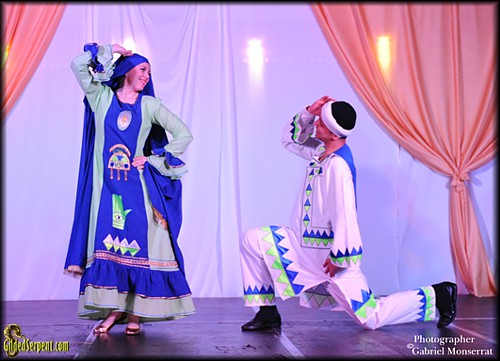
Simona makes a dramatic entrance to Zay El Asal wearing a silver mermaid costume designed by Asi Haskal, renewed by Ilil First.

placeholder

Aziza Abdul Ridha – Italia
"Presenting Oriental Classic"

placeholder

Virginia Méndes – USA
"The veil flows lively in her hands in an Oriental routine"

placeholder

Nelly – Greece
"Ruffles and veils flowing around the space with much style on Classic Oriental Music "

placeholder

Vanesa Moreno – Gijón
"The organizer welcomes all the guests with one of the most feminine dances, Khalegee"

placeholder

Antonia Azahara – Brasil
"An Arabian romantic Pop Tune danced to feel in love in oriental way."

placeholder

Naima Bakkali – Morocco
"
The happy Shaabi style"

placeholder

Samara Hayat – Argentina
"Always Show Time with her unique style on oriental dance."

placeholder

Vanesa Moreno – Gijón
"Always energetic Lebanese Pop music"

placeholder

Vaimarama Group – Asturias, Spain
"
The audience amazed with Polynesian dance of this group. Much rhythm and energy on hips and hands"

placeholder

Kamra Azrak  Group- Bilbao, Spain
"An elegant and graceful and elegant routine."

placeholder

Fusión Oriental – Gijón, Spain
"Yalla! Yalla! The Shaabi dance made everybody move."

placeholder

Final Gala
"
From the left side: Simona Guzman (Israel) , Nelly (Greece) , Aziza (Italy), Vanesa Moreno (organizer , Spain),
Virginia Mendez (USA) , Samara Hayat (Argentina) , Naima Bakkali (Morroco), Antonia Azahara (Brazil)"

placeholder

Group Photo- Gala International
"Top row, from left side: Antonia Azahara (Brazil), Jennifer Santiago (Luxembourg), Simona Guzman(Israel), Samara Hayat (Argentina), Vanessa Morena (organizer, Spain),
Aziza (Italy), Virginia Mendez (USA) , Nelly, (Greece) , Kamra Azrak Group (Bilbao) sitting on the floor And Oriental Fusion Group ( ijón , Spain) "

placeholder

Angelina – Colombia/ Spain
"Saidi, the happiest rhythm for a lively performance from Upper Egypt"

placeholder

Ann-Marie – Ireland
"A surprising and amazing show by a female performer – tanoura"

placeholder

Pharaon – Egypt
"Tanoura – Always a big show of color and now … a show of light"

placeholder

Amaru Sabat – Barcelona, Spain
"Enigmatic Tribal Fusion Dance"

placeholder

Jelila – Barcelona, Spain
"All the passion of Oriental Spanish dance"

placeholder

Ann-Marie – Ireland / Pharaon – Egypt
"The graceful Nubian Dance full of joy"

placeholder

Final Gala National

Final Gala National
(From left to right)Amaru Sabat(Spain), Pharaon(Egypt), Ann-Marie(Ireland), 2 members of Vainarama Group Polynesian Dance and the leader Ariadna Martín(in orange)- Spain, Jelila (Spain), a member of Angelina Oriental Troupe (Spain),Vanesa Moreno (The organizer),   2 members more of Angelina Oriental Group and the leader Angelina(Spain), Alejandra de Oliveira (Spain), Helena Russo (Italy) and Naima Nez (Spain)

placeholder

Group Photo National  Gala
(From the left side standing up) 2 members of AngelinaOriental Troupe (Spain), Helena Russo (Italia), Vanesa Moreno ( The organizer), Jelila(Spain), Angelina(Colombia/Spain), 2 members of Vainarama Polynesian Dance and the leader Ariadna Martín (Spain), Amaru Sabat (Spain), Alessandra de Oliveira (Brasil/Spain), Naima Nez (Spain)-(siiting) 2 members of Angelina Oriental Troupe (Spain),Pharaon (Egipt), Ann-Marie (Ireland) and 1 member of Angelina Oriental Troupe

placeholder

Cristina Calzón
"1st prize winner of Amateur Individual cathegory"


placeholder

Angelina Oriental Troupe – Coruña
"Winners of the contest Amateur Group cathegory"

placeholder

Emanuela Marocco – Italia
" 1st prize Individual Professional"


placeholder

Mohamed Alí – Egypt
  "The Sale Costumer manager of the Oriental Bazaar Fashion Show Parade and much dancing and having fun with the audience at the end of it"

placeholder

Final group photo of the contest  on  Saturday 8th of March
From left side: Angelina Oriental Group (La Coruna , Spain), Fernanda Larrama (Spain ), Carmen Fanjul -on casual wear ( Spain), Vanesa Moreno (the organizer) ; Zahir Group- East Fusion Spanish (Spain); Cristina Briefs (Gijón , Spain 1st Prize – Amateur) ; Layalyna Duo (Gijón , Spain Group Amateur -2nd prize ) and Emanuela Maroco (Italy, 1st prize Professional)


placeholder


use the comment box

Have a comment? Use or comment section at the bottom of this page or Send us a letter!
Check the "Letters to the Editor" for other possible viewpoints!

Ready for more?


Gilded Serpent presents...

Zar: Trance Dancing with Yasmin

2014 Workshop at Amina’s in San Francisco

Placeholder

Report by Janan (Jeanne Fogler)
posted April 17, 2014

Here in the Bay Area, so many excellent instructors make appearances that I always feel I need to choose carefully to make the most of my workshop budget. But when I heard that Yasmin Henkesh was coming to give a daylong workshop on zar, I knew right off that this was one I wouldn’t want to miss – how often do most of us get a chance for an in-depth look at this fascinating ritual?

Yasmin, whose career has included time as a performer in Europe and in Egypt and who is now based in the Washington, D.C. area, is the producer of the CD “Zar – Trance Music for Women.” She was on hand on February 23, 2014, at Amina Goodyear’s studio in San Francisco to share with a limited group of students her expertise on the zar ritual and trance dancing.

Her extensive presentation, filling an entire afternoon and part of an evening, touched on a wealth of topics – everything from ritual origins in Ethiopia and elsewhere, to the types of musicians who perform for the ritual, to relevant points in Islamic history.

But the day began with a detailed discussion of a subject not found in a typical dance workshop: brain science. In the context of explaining what a person experiences during trance dance. Yasmin talked at length about the various types of brain waves – beta waves for normal waking consciousness, alpha waves for when we go into a resting state, etc. – and what goes on in the brain when a person goes into trance.

Later she related that information to the process of inducing trance state through dance. She gave an overview of devotional practices of the Sufis and showed some video clips of zikr ceremonies in which groups of men aspire to a mystical state through chanting, repetitive movements, and sometimes the familiar spinning moves.

Only men can participate in the zikr, however, which brings us to the subject at hand. The zar is women’s trance dance outlet. But rather than being a prayer ritual, the zar has to do with interaction with the jinn. These are spirit entities that are believed to sometimes inhabit a person.

As Yasmin explained it, a jinn can enter a person and make its presence known by causing trouble such as physical pain. A woman might then take part in a zar ritual in which she enters a trance state and an attempt is made to contact the spirit and find out what it wants. Each of the many possible spirits is associated with a specific rhythm, so the musicians may play one rhythm after another until the identity of the spirit becomes known.

Besides this big-picture overview, we had a look at some specific details. One thing I found interesting was sagat, the finger cymbals of Egypt. To put it briefly, the Egyptian sagat are made in a different shape and have a different tone and ringtime than the Turkish zills more familiar to most American belly dancers (you can read a piece on this by Yasmin here). We got to test out a little of the playing style of the sagat, quite different from what most of us are accustomed to, and try a few rhythms.

Venturing farther into unfamiliar territory, Yasmin demonstrated use of the goat-hoof belt. She showed us a large, heavy belt (her smaller one for use during travel, she says) hung all over with goat hooves that rattle loudly with hip movements. This is used by a dance leader to create part of the soundscape during the zar ritual. (I was among those who ventured to try it out during the break – an amazing and very loud sound!)

To finish up the whole package, we adjourned to nearby Mobu Studio for some immersion experience. Yasmin started by teaching some of the movements common in trance dancing, including both some from zikr (I’m particularly remembering the “zikr twists” of twisting the upper body back and forth and letting the arms follow freely) and some that are more specific to zar. She also gave us some basic instruction in spinning technique. After we had our own session of trance dancing, Yasmin brought us back to ordinary reality with a calming guided meditation.

After taking all this in, I realized that much of what I’d heard in the past about the zar had been extremely superficial and largely inaccurate. For years I hadn’t much questioned the original description I had first heard: that the zar is an exorcism ceremony in which the women expel the unwanted spirits through movements of flinging their hair and flicking their fingertips. “Exorcism” is incorrect, since the aim of the process is to contact the spirit rather than to expel it, and that depiction of the movements isn’t quite right either. The moral: Trust that an unfamiliar subject is more complex than it may at first be painted, and get as much information about it as you can.

Yasmin's Zar Class by Amina

Resources:

use the comment box

Have a comment? Use or comment section at the bottom of this page or Send us a letter!
Check the "Letters to the Editor" for other possible viewpoints!

Ready for more?

  • Off the Beaten Path Cory Zamora's "Belly Dancing for Seniors" & "Learn the Art of Male Belly Dancing"
    However, I have a couple of issues with this DVD. One of my issues is that, other than stating the ages of the students (60, 63, 75) and making a fleeting mention of a few physical issues they have (problems with feet, back, etc.), there is not a great deal of material specific to senior dancers.
  • Saturday Gala Performance at the IBCC 2010, Photos and Video Collage,
    The Saturday Night Gala Performance of the International Bellydance Conference of Canada was held April 24, 2010 at the Ryerson Theatre in Toronto, Ontario, Canada.
    Video report consists of a collage of random clips caught of performances. Including: including:Arabesque Dance Company including Yasmina Ramzy, Delilah, Amel Tafsout, Zikrayat, Sera Solstice, Hadia, Ranya Renee & Co, Jillina, Sema Yildiz, Habeeba Hobeika Egyptian Dance Ensemble, and the Righteous Rogues.
  • The Zar
    We do know that today thousands of women in Africa and the Middle East use this music to cure all kinds of illnesses. They literally dance until they drop.
  • Recreating the Live Sounds of Egypt, Yasmin’s "Dancing with Genies-Hafla al Afareet"
    Upon first hearing this CD, I liked, no, I loved, the way it sounded like a live show. Exciting! Nevertheless, I question why some tracks sounded like they were recorded in a sterile studio.
  • Creating and Listening to Musical Ecstacy, CD Review-Yasmin’s "Cry to the Moon, Taqsim lil Qamar"
    Taqsim traditionally follows a certain melodic progression… Following the introduction, the improviser is free to move anywhere in the maqam and even modulate to other "maqams" as long as he returns to the original. Taqsim is considered by many to be a connection to the spritual world.
  • The Zar, Trance Music for Women,
    produced by Yasmin of Serpentine.org. “Once a spirit is called, it must be appeased. Then it will always be there.” And it will have to be periodically dealt with.
  • Its Not Your Grandmamma’s Zar
    Luckily at some point we hear the distinct rhythm for a Zar and follow the drumming right to the front door of an apartment house.
  • You Say Zills, I say Sagat, So What’s the Difference?
    Nevertheless, many dancers outside the Middle East still think the only difference between zills and sagat is semantics – “two words for the same instrument.” If you’ve played both – correctly – I doubt you would agree.
  • Typography, Graphic Design for Dancers, Part 1
    As artists of an often misunderstood dance, we dancers understand that everything we present publicly reflects back upon us as individuals, upon bellydance as an art form, and by extension, the Middle Eastern culture. When presenting these facets in the most favorable light to other dancers or the general public, good design becomes paramount because it is the most unmistakable way to demonstrate our worth.
  • Beata Zadou in 1988, Winter Visit to Berlin’s Snow Princess
    It is rare that reality matches one’s fantasy, but in this case, in 1988, my expectations were surpassed by the reality of wish-fulfillment.
  • Music Copyright Law for Belly Dancers (or for any Performing Artist) (commenting now available on this article)
    You are not going to like what you are about to read. But if you are performing publicly to music you do not own, for your own protection, please keep reading. Every professional dancer should know at least the basics of music publishing law, particularly if she wants to appear in an audio-visual production destined for commercial distribution.
  • Patient is a Bellydancer, Part 1, Irritable Bowel vs. the Dancer
    Weeks later my doctor told me she had never seen it that high in anyone before. Something was very wrong.
  • by Samira Shuruk
    Every day we go to places where we are surrounded by strangers!
 

Gilded Serpent presents...

Typography

Graphic Design for Dancers, Part 1

Placeholder

by Lida
Graphics used are created by the author and link to enlargements
Posted April 9, 2014

As artists of an often misunderstood dance, we dancers understand that everything we present publicly reflects back upon us as individuals, upon bellydance as an art form, and by extension, the Middle Eastern culture. When presenting these facets in the most favorable light to other dancers or the general public, good design becomes paramount because it is the most unmistakable way to demonstrate our worth.

Our culture’s increased emphasis on visual media has turned most of us into constant consumers of design, subconsciously honing our ability to differentiate between poor and great design – even if we aren’t aware of the formal principles that separate them. This differentiation is why utilizing basic design principles is imperative for those of us who create our own marketing materials, want to present ourselves as professionals, and are hoping to market bellydance to the general public.

Design helps us:

  • create a unique presence,
  • build a brand,
  • position ourselves as high quality,
  • and send the right message about our dance.

As a graphic designer, everyday I see the impact of good design. After achieving a Bachelors in design, working for several well respected design firms, and building a career at a technology company whose sole focus is design and user experience, it is impossible to ignore the importance of this field. Although design takes years to learn and decades to perfect, applying even a few basics can make a huge positive change. These basics are the foundation of design and cover all genres, from a bellydance workshop poster to corporate stationery.

Since text is usually the starting point of a design, we will start here with an introduction to practical typography concepts and how to apply them to your marketing materials. I have included images of real world examples that I have made and links to additional resources at the end of this article. Typography is the technique of arranging and formatting type, and its successful use is vital in creating clean, polished pieces. These guidelines apply to both print and web.

Choosing Typefaces

  • Avoid easily identifiable, overused typefaces like Papyrus, Comic Sans, and Curlz. Audiences are tired of seeing them and their kitsch factor decreases the professionalism of your designs.
  • While thousands of free creative typefaces exist, many of them are practically illegible, even when sized for a large headline. Typefaces that are difficult to read not only confuse audiences, they create a negative impression and bring your professionalism into question. Instead, try versatile classics like Garamond, Bodoni, Minion, Futura, Helvetica, and Avant Garde. Their creators obsessed over every proportion, angle, and curve. Many typefaces, even ones you pay for, have not been blessed with this level of detail.
  • Remember that simple is elegant, not boring. Your personality and message will still come through with a classic typeface.
  • Instead of using a slew of different typefaces, use two at most: one for large text and another for small text. Simplicity allows audiences to focus on the message instead of on all the typefaces competing for their attention. For example, on a flier you might use Garamond for the headline, date, and time, and Futura for the description and address.

The poster at the top of this article uses two simple typefaces. The result is refined yet engaging.

Illustrations

Creating Hierarchy

  • Audiences can’t absorb everything at once, so create levels by choosing what you want them to see first, second, third, and fourth. The text you want them to see first should draw the most attention as the largest piece of text on the page, and your other hierarchy levels should decrease in size accordingly.
  • Use bold, italics, and special effects only to enhance the hierarchy of your message. For example, you might use a bold weight and a soft shine on a headline to make it stand out a bit more. However, if all of the text vies for attention, none of it will receive attention.

The flier at the right side of this page provides hierarchy by varying the weight, size, and contrast of the text.

Ensuring Legibility

  • Make sure the text is large enough to read, especially on business cards. Remember that typefaces read differently even if they are the same size; while Futura may be readable at 7 points, Garamond is not.
  • Go light on the special effects, as heavy effects can make text harder to read. Try to use effects in a way that will increase legibility. For example, you might use a drop shadow on small text to help audiences read the words on a textured background.
  • Do not torture the type. Manipulating the shape of the letters in any way, such as squeezing them together or stretching them apart, destroys the integrity of the typeface and decreases readability.
  • Left justify for optimal readability. In most western countries, our eyes are trained to move left to right. Blocks of text that are centered or right justified are usually hard to read and look messy. Fully justified text is also troublesome, as it becomes riddled either with uneven white space or with hyphens.
  • Keep line lengths short. Text is easier to read when it doesn’t span the entire page, so let go of the need to fill the whole space. Our eyes need room to breathe.
  • When formatting blocks of text, ensure there is enough space between each line by using the default spacing or increasing it by a couple of points. Do not decrease the spacing from the default, as it makes the text much harder to read.
  • When using script typefaces, keep it mixed case and large. Scripts in all caps are hard to read, as are scripts in small sizes.
  • Ask friends to check for legibility before you print the flier or go live with your website. Make sure they can easily read it all.
  • Always get a sample before ordering printed materials, as printed text looks and feels different than what you see on the screen.

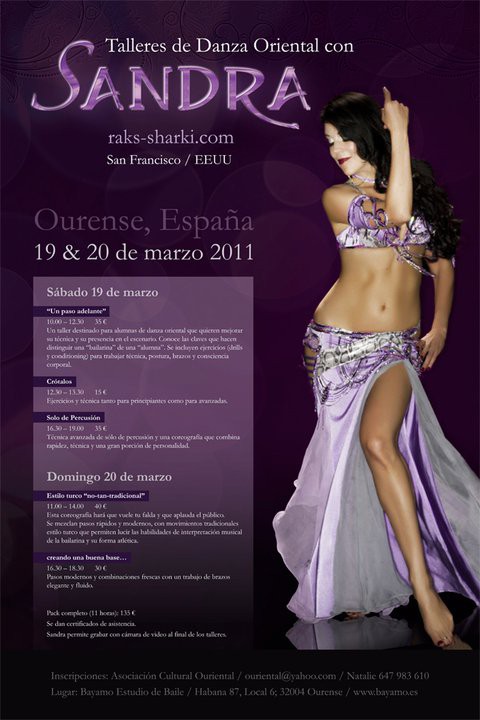
illustrationThis poster contains lots of content, but is easy to read because the text is left justified, line lengths are short, effects are minimal, the hierarchy is clear, and there’s plenty of breathing room so the audience can relax and focus on the message.

These basic concepts will help refine your print and web materials, lending positivity and class not only to you as a dancer, but also to belly dance as a whole. However, typography is just one facet of graphic design, and there are other aspects that have the power to help or hinder you. Stay tuned for future articles on using colors, patterns, and images. In the meantime, use the links below to gain an even better understanding of the robust and effective tool that is typography.

Learn more about how to use type in your designs.

Download well designed typefaces.

Resources

use the comment box

Have a comment? Use or comment section at the bottom of this page or Send us a letter!
Check the "Letters to the Editor" for other possible viewpoints!

Ready for more?


Gilded Serpent presents...

Beata Zadou in 1988

Winter Visit to Berlin’s Snow Princess

A collage of photos taken of Beata Zadou at the 1988 Rakkasaha Festival

by Najia Marlyz
Caravan Magazine June 10, 1988 (now out of print). Re-written for GS March 17, 2013
posted March 31, 2014

It is rare that reality matches one’s fantasy, but in this case, in 1988, my expectations were surpassed by the reality of wish-fulfillment. I thought I was prepared for my winter trip to Germany; it would be picturesque and snowy. What I got, in addition to deep snow and cold air, was an opportunity to meet with one of Germany’s top Middle Eastern dancers, Beata Zadou, on a more personal level than our previous brief meetings at the Rakkasah Festival in California. 

The role of visitor and traveler, though exciting and even at times edifying, can also be a pain in neck, but instead, this trip was a pleasure of color, sparkle, and excitement for me.

Graciously, Beata had invited me to teach the master class in her studio in Berlin and that gave me a clear focus for my visit to that history-laden city. When we arrived, snow was already fluttering down, and although I had brought along a coat, boots, and long socks, all of my clothing was California clothing and was inadequate. Did I say inadequate? It was shockingly inadequate! It took me a couple of days of suffering with my cold red knees, nose, and ears to remember that lurking back in my suitcase were leotards and tights that could double for long underwear and a veil that could be used for a scarf! However, once I borrowed a heavier coat and woolen scarf, I was set for a non-California winter adventure.

Najia by LynetteBeata was participating in the three-day International Tourism Festival 1988 in Berlin, representing Abu Dhabi. I enjoyed the festival and watched her dance; she was looking every inch a snow princess.  She was costumed all in white silver and rhinestones with a little crown of white flowers in her long blonde hair. The Germans made an appreciative audience, standing spellbound as she danced.

Even more appreciative were the Middle Easterners who crowded around for a glimpse of the wonderful sight she made lured by the live music provided by white galabeya-clad musicians. Afterward, several admirers followed her to her dressing room door where they were thanked – and firmly shut out.

Beata hurried, changed into street clothing, donned her floor-length blue-dyed mink coat, and we were off in her car to the studio where her dance students were gathered, standing on the sidewalk, waiting patiently for the studio to open. Beata commented that although we were late in arriving, her students expected that circumstance because she is habitually tardy. Beata is a talkative young woman who is at ease and fluent in English and pleasingly candid in her opinions. I was impressed with the love and concern her students displayed for her!

Beata’s studio was squeaky clean; even though “the cleaning lady had not been in yet”, she whispered to me. It was well lighted and warm. (The walls were decorated with many pictures of our mutual friend and instructor, Bert Balladine—once also a Berliner.) It was a delight for me to teach her students who were quick to respond to instruction and polite in the extreme as are most German classes I experienced. They were so appreciative of the instruction that my fears about communication and language problems disappeared quickly. Those who did not speak much English were aided by someone dancing nearby. I taught some American-style veil air sculptures they had not seen before, and then worked with concepts of musical interpretation appropriate to use with Egyptian music. The two-hour class passed by quickly, ended with the students applauding as is often customary in Germany for a guest instructor, and we were soon headed back home, where Beata dropped me at my doorstep. I expect that I will see Berlin again but now believe I would rather visit there during a warmer season so that I could enjoy the shopping and historical sites. If you go to Berlin, you should definitely call Beata and arrange to join one of her classes. She has an encouraging, welcoming personality and is a professional dancer of quality.

Just two weeks after my visit to Berlin, Beata spent a couple of evenings with me in California while she was featured as a guest teacher at the 1988 Rakkasah Festival’s weeklong workshop. I was charmed by her openness and frank views of life both here and in Germany. She made me laugh many times, showing her ease in demanding what other dancer teachers are often shy to expect: respect, adequate remuneration, and affection. I said goodbye to Beata, feeling that she had given me far more than the gift of earrings she placed in my hand as we parted. She reminded me throughout my stay that I must uphold the value of my dance by commanding respect as an instructor and a performer—not through being temperamental—but through living the confident star attitude she understands so well.

Resources:

use the comment box

Have a comment? Use or comment section at the bottom of this page or Send us a letter!
Check the "Letters to the Editor" for other possible viewpoints!

Ready for more?

  • Teaching Down Under in 1988, A Bert Balladine Reminiscence: Australia & New Zealand
  • International seminars make you do more than you think you can when you see the dedication and sacrifices people make just to attend.
  • Costuming Trends of 1987, At the Rakkasah Festival
    Although the trend at Rakkasah ‘87 was definitely toward better dancing than we have seen in the past; the costuming I saw would be high on anyone’s list of worn-out ideas.  Nowadays, we have more and more of almost everything; it is immediately apparent that there is more material in the skirts—such as double skirts, ruffles, tatters, tiers, beads, and even elaborate sequined patterns, and embroidery.
  • Bert & Me: Vignettes From Our Partnership
    Though Bert might like to think of himself as a simple man, in fact, he is a very complex and private person whose lifetime is filled with famous and colorful characters and experiences.
  • The Great American Belly Dance Veil Routine
    After having said all that, I must add that American style Oriental/Belly dance is a distinctive style composed of creative elements that are simply outstanding.
  • The Taxim from a Dancer’s Perspective:Tarab or Tyranny?
    Sometimes, these improvisations can be quite elaborate. The effect is somewhat like modern jazz and stays within the framework of the traditional maqam or maqamat.
  • Dance Emotion, Part 2
    The audience is not going to care, or even notice, that a dancer did a high-stepping Fandango Walking Step with an over-lay of a Soheir Zaki Head Tilt and a really fine
  • Dance Emotion, Part 1
    "The place of dance is within the heart."
  • BE CAREFUL WHAT YOU WISH FOR…
    A Case against Standardization in Nomenclature for Belly Dance Instruction
  • The Critic; Real Critics Don’t Mince Words
    Either we are a sisterhood of ego therapists and our instructors are politically correct in all they say and do—or we are tough artists in search of ways to improve our art form by ruthlessly weeding out the lame from our herd.
  • Certifying the Certifiers, The Chicken or the Egg? Part Two
    …artists and stars are born, not schooled. You’ve either “got it, or you don’t”
  • Certifying the Certifiers
    …this has occurred because of the current need to be correct, and within certain predictable standards of competence rather than special, unique, outstanding, unusual, memorable, or even (gasp!) emotion producing…
  • Sharpening Your Dancer’s Edge: Performing Without Choreography
    The idea of dance governed by choreography is more a western notion that was not inherent originally a part of the Middle Eastern dance solo
  • Music Copyright Law for Belly Dancers (or for any Performing Artist) (commenting now available on this article)
    You are not going to like what you are about to read. But if you are performing publicly to music you do not own, for your own protection, please keep reading. Every professional dancer should know at least the basics of music publishing law, particularly if she wants to appear in an audio-visual production destined for commercial distribution.
  • Patient is a Bellydancer, Part 1, Irritable Bowel vs. the Dancer
    Weeks later my doctor told me she had never seen it that high in anyone before. Something was very wrong.
  • by Samira Shuruk
    Every day we go to places where we are surrounded by strangers!
  • Samrah’s Legacy, Revisiting MECDA’s First Fundraiser in Los Angeles, May 1978
    However, THIS event was different due to the overwhelming support and participation from our dance community. The community I mention was primarily working nightclub dancers and musicians, and a few vendors. In fact, I had not seen so many musicians’ come together for a common cause before and certainly ever since.
  • Harnessing the Light Within, Outdoor Photography
    Outdoors, the dancer can more easily release uncertainty by conjuring the feeling of limitlessness, pulling energy from the sky, swirling visualization, curiosity. She can come up and out of herself and become part of her surroundings, harnessing sunlight, a delicious breeze.
 

Gilded Serpent presents...

Music Copyright Law for Belly Dancers


(or for any Performing Artist)


The musicians are the Henkesh family; drummer Reda Henkesh,
accordion Sayed Henkesh, violin Karim Henkesh in Symphony
Studio with sound engineer Hatim Mounir. The author is in the
center of the collage.

by Yasmin Henkesh
posted 7-16-07, formatting update 3-25-14
Illustrations also by the author

You are not going to like what you are about to read.

But if you are performing publicly to music you do not own, for your own protection, please keep reading. Every professional dancer should know at least the basics of music publishing law, particularly if she wants to appear in an audio-visual production destined for commercial distribution.

From Hollywood blockbuster movies down to clips on YouTube the law is the same and it applies to anyone
who uses someone else’s music for their own purposes.

Copyright issues can be confusing to a newcomer or to anyone who cannot read legalese.  Many subtleties of the laws take professionals years to understand. But some things are very straightforward. If you did not compose a piece of music, write the lyrics to it and pay for it to be recorded you can not play that music publicly without asking the people who did these things for their permission. More likely than not the rights holders will want to be paid for the commercial use of their property. Yes that is exactly what a piece of music is, intellectual property.  In the United States and all the countries that signed the Berne Convention (1886 and 1971), intellectual property is protected by copyright laws that must be respected if you want to copy or perform to someone else’s work.

So what are the basics of music copyright?

Any piece of music you hear has up to seven copyrights associated with it. That’s right seven.

The Basic Rights:

  • The music – composition
  • The words – lyrics

A song copyright is composed of  the lyrics and music copyrights and is indicated on copies of the work by a (c) or "Copyright" or "Copr." (year, Name of Owner). It is usually managed by a publisher – an entity (person or corporation) who has been assigned or has acquired the right to manage the reproduction of the music and collect royalties.

  • The sound recording – (indicated on copies of the work by the letter "P" in a circle) protects the sounds on the record and usually belongs to a record company
    or the entity that paid for the recording.

Subsidiary Rights:

  • Performance – the right to receive royalties when a song is sung or played, recorded or live, on radio and television, on the Internet, during live concerts and in programmed music services. Royalties are either paid directly to both the composer and the publisher or to their performing rights organizations. This payment allows the licensee to perform the music in public places (broadcasting stations, hotels, clubs, colleges, restaurants, stores, etc.) according to the terms of their contract.
  • Mechanical – the right to make physical copies of a particular recording of music. For 2006 and later, the mechanical rate is the greater of 9.1¢ per song or 1.75¢ per minute for each copy of a record or tape made and distributed (this includes DVDs). A DVD producer may be able to arrange different terms and conditions with an independent artist, particularly if publicity for the music is involved.  But a written contract still must be signed that grants permission.
  • Synchronization – the right to synchronize an original song or sound recording to visual images as part of the soundtrack of a film or any other audiovisual production.
    This is a separate right from the mechanical rights described above.
  • Adaptation – the right to change or adapt the music or lyrics to a song.

That’s a lot of rights to worry about.

Actually it’s not too difficult and you may not need to worry about all of the rights. The composer and lyricist of a song usually assign or sell their rights to a music publisher. Often these publishers turn around and use large clearinghouses, called performing rights societies, as agents. The societies are the ones who charge fixed fees for the music, according to its use, grant mechanical licenses and collect royalties. The web sites of the major organizations are listed at the end of this article. Therefore a dancer (or her video production company) can contact the publisher or the publisher’s agent to acquire the rights she needs.

Nevertheless in our insular industry, when you are dealing with a small local artist, it is better to go straight to the source. That way you insure the real
author of the music profits and not the staff of a large clearing house.

The smaller artist or publisher will usually be more reasonable than the big professionals, providing you credit them and offer free publicity for their work. Look for the names after the P and the C on your CDs (one of many reasons why it is best to work with original recordings and not copies). Contact information for the rights holders is generally listed directly on the CD or its packaging.

The long and short of it is that a dancer can not use a piece of music for a DVD without the copyright holder’s permission. Usually mechanical royalties, performance rights and synchronization fees must be paid and a written contract signed before a dancer has the right to use any piece of music. It is not a good idea to try to use “fair use” as an excuse not to contact the rights holders either. The law is extremely complicated and does not apply to instructional or performance belly dance DVDs. 

“There is no special number of "free" measures that can be used without authorization. The factors that determine whether the use is fair include the purpose and character of
the use, the nature of the copyrighted work, the amount and substantiality of the portion used in relationship to the copyrighted work as a whole, and the effect of the use on the potential market for or value of the copyrighted work. In addition, the U.S. Supreme Court has stated that, in analyzing these factors, courts should focus on whether and to what extent the new work is "transformative," that is, it alters the original work with new expression, meaning, or message. The more transformative the new work, the less will be the significance of other factors that may weigh against a finding of fair use.”  www.bmi.com

Public Domain

The only reason a dancer would not have to contact the copyright owner of her music is if it falls in the public domain. Once a song has become part of the public domain, it can be used for any purpose by anyone without the need to pay compensation to the composer or previous owner. But that means ALL THE COPYRIGHTS of the song and the sound recording meet the public domain requirements. The following is from the Library of Congress web site. These rules apply to everything, from music, to images to books.

  • Works published or registered in the U.S. before 1923 are now in the public domain.
  • Works published with notice or registered in the U.S. from and including 1923 through 1963 are now in the public domain unless the copyright was renewed, in which case they are protected for 95 years from the copyright or publication date. A copyright search is required to establish if the item was copyrighted and that the copyright was renewed.
  • Works published with notice or registered between January 1, 1964 and December 31, 1977 are protected for 95 years.
  • Beginning January 1, 1978, a statutory copyright automatically attaches to the work for the author’s life plus 70 years, unless a piece is considered a "work
    made for hire." “Then the employer is considered the author, and the copyright, which the employer owns, runs for either 95 years from the time the work was first published
    or 120 years from when it was created, whichever is shorter. (That is the same copyright term for an anonymous or pseudonymous work.) In order for a work to be considered "made for
    hire," it must be prepared by an employee in the scope of his employment under a traditional employee-employer relationship, or else it must be commissioned as one of several special
    categories of works (such as part of a motion picture or other audio/visual work) with there being a written agreement between the parties that it is to be for hire.” bmi.com

Copyright Law in Egypt

This past summer I made a pilgrimage to the library of the American University in Cairo to find an English copy of Egypt’s copyright laws. The translation I found states that in 1952 Nasser passed a clear copyright law that established protection for all intellectual property until 50 years after the death of the author. Fifty, not seventy as in the rest of the world, but a law does exist on their books.  Actual practice is a whole different ball game however. We have all seen the pirated copies of copies for sale in the streets or by vendors at shows; images we know belong to someone else sold for a dollar in Egypt or in poorly packaged but expensive compilations in the West. Egyptians themselves don’t respect their own laws.

But that doesn’t make it OK to copy them, so to speak. You may ask, “Why should I abide by unused laws?” The answer is because Western distributors of these products, if they have legally acquired the rights, can enforce those rights using Western laws and judicial systems. Being sued in a court of law can cost thousands in legal fees alone, not to mention the fine for damages if the offense is ongoing, lucrative and widely publicized. 

"The penalties for an infringement of copyright for each work a defendant is found to have infringed, the plaintiff copyright owner is entitled to receive its choice of a) the actual damages suffered plus the infringer’s profits that were attributable to the infringement, or b) "statutory damages" in an amount between $750 and $30,000 (or up to $150,000 if willful infringement is found), as the court considers just. The U.S. Supreme Court has ruled that the amount of statutory damages is to be decided by a jury.” www.bmi.com

That’s scary stuff.

A Dancer’s Responsibility …

… is to know where her music comes from and who owns the rights to it. The live show producer or restaurant owner’s responsibility is to pay the public performance royalties for that music. Sometimes payment is not enforced in small restaurants and nightclubs. But it is always required on Broadway, in the large Las Vegas casinos or for any other high profile show. It’s generally a question of visibility, money and publicity. DVDs, television and film are different however. Even the smallest run or broadcast requires a contract and payment. The more visible the distribution, the more copies sold or the more viewers a station has, the more important it is for a dancer to be legal. The only proof required in order to sue a broadcaster or a distributor is a copy of the broadcast, or a DVD with a receipt.

READ THE FINE PRINT IN YOUR CONTRACTS
Has the theater owner, show manager or video producer put the onus of liability for the music on you, the dancer? When the event happens or the DVD is released will the copyright holders knock on your door for payment or the producer’s? Know what you are signing and what responsibilities you are taking on before you put pen to paper. It is wonderful to have your art preserved for posterity, but at what cost?

Knowing these laws is important for more than just protection.  We as artists have a duty to respect the other artists we work with. Think of the musicians and their families. If the musicians and their producers can’t make a living from their creativity, how can they continue to publish more? We all love good music. Abiding by copyright law ensures that the artists who make it can continue to create.

Bibliography

  • Bertrand, Andre. La Musique et le Droit – De Bach a l’Internet. Paris: Litec Groupe LexisNexis,2002
  • Choisy, Stephanie. Le Domaine Public en Droit d’Auteur. Paris: Litec Groupe LexisNexis, 2002
  • Creech, Kenneth C. Electronic Media Law and Regulation. 3rd ed. Boston: Focal Press, 2000.
  • Donaldson, Michael C. Clearance & Copyright. Los Angeles: Silman-James Press, 1996.
  • Hallorand, Mark. The Musician’s Business and Legal Guide. 3rd ed. New York : Prentice Hall, 2001
  • Miller, Philip. Media Law for Producers. 3rd ed. Boston: Focal Press, 1998.
  • Performing Rights Societies – organizations that monitor public performance of music and collect royalties for their use :
  • Other resources on the web : www.copyright.gov
Resources:

use the comment box

Have a comment? Use or comment section at the bottom of this page or Send us a letter!
Check the "Letters to the Editor" for other possible viewpoints!

Ready for more?

  • The Devil’s Details, Show Ethics for Professionals, Part 1- Booking a Party
    When a dancer looks good, she, or another, will get called back to perform again. When she looks bad, customers might be turned off to our lovely art form forever. Therefore, a bad dancer not only ruins things for herself, but for all of us
  • Om Kalthoum, The Voice of Egypt
    She was without contest the most well-known singer of the Arab world. She was also the most influential woman of her time in the Middle East.
  • The Zar
    We do know that today thousands of women in Africa and the Middle East use this music to cure all kinds of illnesses. They literally dance until they drop.
  • 5-6-07 The first step to becoming an effective negotiator is to emotionally detach yourself from the outcome. If you can’t walk away from the deal, you have already lost.
  • Easter in Cairo
    She is so strong and powerful and beautiful and intense. Even the not-so-stylish costumes she used to wear didn’t take anything away from her.
  • Belly Dance:Time for Personal Assessment or How old are your Shoes?
    >What do you personally want from the dance? In order to answer this honestly, you must make a personal assessment of your goals and include your achievements.
  • Behind the Scenes, 3rd Coast Tribal Festival
    I had never been to a tribal dance convention before, even though I have been a professional (Egyptian style) belly dancer for 40 years. From my “glitz and tits” perspective, this belly dance offshoot wasn’t something I recognized as mine.
  • Planting Flowers and Dodging Riots, Dancing in Cairo After the Revolution
    I left Cairo on September 9th, 2012, after a three-week visit to research the zar. I wrote the following article on my flight home – two days before the Libyan tragedy* and the violence outside Cairo’s US Embassy. As my plane circled the pyramids I had no idea Egypt would once again become the center of world attention.
  • A Bust to Be Proud of…
    When she introduces me to her dance friends, it’s the first story out of her mouth – eighteen years after the fact. We still laugh about it.
  • Shoo Shoo Amin, A Forgotten Treasure of the 80s
    Twenty years ago when I told people I had worked with Shoo Shoo Amin in Cairo, the response was “Wow!” Now, people go “Who?” Today no one seems to know who she is. For belly dance purists, this is a tragedy. Every so often, someone my age or older will wax lyrical about her on-line, but for the most part, she’s an enigma – even to young Egyptians.
  • Sex,
    Belly Dance and the Afterlife

    To these people, sex was not dirty, shameful, frightening or forbidden. It was a natural part of daily life and the essential prerequisite for birth – on earth
    or in the Afterlife.
  • Ahlan Wa Sahlan 2008,
    Not So Welcoming this Year

    Prices have gone up everywhere, and Egypt is no exception. The reality hit me as soon as I walked into the Mena House. Bottled water was $4.00, where out in the street the same bottle was $.50. A bottle of beer was $10.00. Internet connection was $30.00 / hour. At those prices, life’s little pleasures didn’t seem important anymore.
  • To Buy or Not to Buy – A Guide to Mass Market Belly Dance Instructional DVDs
    Most producers ask or hire others to write glowing reviews. You will often see the same people reviewing a producer’s entire line of product. Those are suspect. Look for the one-off comments. They will give a better overview, along with anything less than 5 stars.
 

Gilded Serpent presents...

Patient is a Bellydancer, Part 1

Irritable Bowel vs. the Dancer

Cabaret Serpentine
Cabaret Serpentine Egyptian Dance Company
Laura Selenzi, Margaret Anne (author), Tonya, Tina Afsana,
Missing from photo: LeeAnne and Cheryl

by Margaret Anne
posted 3-25-14

A few days after being admitted to the hospital, the delusion that I would be back on my feet in no time had worn away. I would have to cancel that restaurant gig next Saturday.  …and drop out of the stage show in January.

This is the story about my relationship with bellydance after illness took away my belly.

In late September of 2013, a small bout of strep blew up, and I landed in the emergency room  of the hospital after days of being unable to keep food or water down. I took more bathroom trips than I would admit in polite company, causing an initial precautionary assessment of C. Difficile. I had just moved into a new apartment but packed a bag to stay with my parents for a few days after I was sent home from work for looking so ill. After a few days, I was deliriously ill with a fever of 104 degrees so my mother took me to the emergency room. My bloodwork was a mess! Where my hemoglobin should have been at least 12.0g/dL, I hovered at 8.5g/dL, which could indicate blood loss or a systematic inability to absorb iron. I had never heard of C-Reactive Protein until the results showed a level of near 240 instead of the ideal level of zero. C-R.P. indicates the level of inflammation in the body.

Weeks later my doctor told me she had never seen it that high in anyone before. Something was very wrong.

I knew something was wrong, but my concerns were focused much narrower, much simpler than survival. I was missing work. I didn’t have a cell phone charger. I rarely gigged and wanted to finalize my playlist for next week.

Most importantly, I was missing troupe practices. Four months until the first show of its kind in our region, where the American Tribal Style, fusion and Egyptian companies would dance almost entirely to a live band. The costumes were ordered and the venue was booked, and I was concerned that I would fall behind.

The next few days are a blur in my memory, but I’m the talkative type; so play-by-play Facebook statuses logged my experience.

September 27, 2013: “I’m being treated for some kind of ridiculous infection they haven’t figured out, so I can’t even beg for visits unless you want to suit up in some barrier smocks and help me throw up.”

Nova ScotiaMy mother, an R.N., was the notekeeper in all of this. Two days into my stay, I was hooked up to a forest of I.V.s and monitoring equipment. After a colonoscopy (“Can I be sedated for that?”) I was given a working diagnosis of Crohn’s disease. My colon was dangerously and visibly swollen and ulcerated, and while the doctors would attempt to placate my angry gastrointestinal tract through the medicinal route of steroid therapy before sending me off to the operating room, I was seen by the surgery team almost daily. (I guess I was a popular patient to visit because Crohn’s disease is under-researched and has an abnormally high prevalence in my home province of Nova Scotia.)

Being that I was staying at a university-affiliated teaching hospital, my poor tummy was being treated like the Pillsbury Dough Boy starting at 6:30am every day!

September 29th, 2013: “Hooked up to lots of machines and IVs but feeling better (none of my machines go ‘ping’, sadly). Was sedated a lot yesterday, so I’m trying to catch up on what’s going on. Dinner and a movie: Enter the Dragon and pre-measured glasses of watered-down apple juice.“

No, I wasn’t going to be able to make that restaurant gig, and it would be a while before I could get any use out of the new costumes coming in the mail from Egypt. One was shiny-pink and would be debuted in all of its leggy glory by another dancer for the show, and another was a leopard-print that I had ordered for myself.

October 2, 2013: “Still too exhausted for visitors or correspondence, but I really do appreciate the notes. Also I have sausage legs from the prednisone they’re giving me, so I look too hilarious to be in public. XO”

I was stabilized, given a painfully expensive medication and moved to a less intense floor. A family friend in pharmacy let my mother know that the drug they infused me with, Remicade, cost $4,000 a pop. Being Canadian, in-hospital drug costs are covered and patients are not privy to expense lists.

October 6, 2013: “Oct 6, 2013 “Prednisone pants, for all of my ten pound weight fluctuation needs. Here for a few days more, gettin’ roided up, eating soft foods and making BFFs with the x-ray techs in between naps.”

It would take a few days to know whether the Remicade had worked. I could barely eat and had lost a lot of blood, so I was hooked up to nutrition, a variety of steroids and antibiotics as well as a few blood transfusions.

October 7, 2013: “P.S. everyone who donates blood is awesome. I grow strong from the pints you trade for cookies and juice.”

Ballot boxBefore I was ill, I was volunteering furiously for an upcoming provincial election. When I asked about how to vote in hospital, I was told that I would not be able to vote because I had missed the early ballot last week, even though I was half-dead and unconscious when they came around with the ballot box. I begged, and I begged, and was eventually given a two-hour pass. My IVs were removed. My semi-permanent IVs were taped-up and tucked under my sweater so I wouldn’t look like the escaped patient that I was. My parents drove my sweaty self back home so I could see my dog and collect some books before they took me to the polling station. I hobbled in, marked my X and hobbled out. The fresh autumn air was lovely, but I felt miserable and was taken back right after.

October 8, 2013: “Watching the election in a patient lounge at the hospital with two crackheads muttering about their drug addictions in the corner.”

But gumption isn’t a cure. I kept deteriorating. I was having such a hard time moving around without help that I started to look forward to the daily field trips to the x-ray department.

I had been hospitalized for two weeks, and after an honest talk with the head of gastroenterology, I agreed that the best option was to have my colon removed. Funny how I can spend all afternoon trying to decide what to have for supper but can agree to life-changing surgery in thirty minutes.

I had the option to refuse, but surgery was rapidly turning into the only option. I signed the consent papers and asked to be left alone.

October 10, 2013: “The drugs didn’t work, and I’m scheduled to have my colon removed on Tuesday. I can handle so much, but I have to quit dancing, and it’s so overwhelming I can’t breathe.”

My constant companion had been my laptop where I kept sane by watching “Star Trek” and “Doctor Who,” but after signing off on the surgery, I opened a word document and wrote two scenarios for myself.

My surgery was soon moved up to October 11, 2014. I knew now that by the next afternoon I would be out of surgery and would wake up with a huge scar on my stomach…  …and an ileostomy.

This is what I wrote to myself that night:

“I have to quit dancing. I’ll sell my costumes and keep a veil, hip scarf and cymbals for when I want to dance alone for myself. Even if I keep dancing at home, I have to quit my troupe. Even if I keep dancing, if I wore a Saidi dress at a hafla they’d still stare at my midsection looking for the ruffle of an ostomy. Every compliment  ‘…even with the bag!’ ‘…especially after your surgery!’ will end differently and useful criticism will dry up out of pity.”

Then I wrote:

“I can’t quit dancing! I’ll never quit dancing! This is an adjustment. A very unusual, ironic adjustment for a belly dancer, but until they tie me down and chop out my soul it’s impossible to stop dancing. Is this supposed to stop me? I could’ve died and I’d like to celebrate daily by dancing like a maniac about how well I’m going to recover. I don’t know when I’ll have the courage to dance in public next, but that’s my own issue to work through. My dance friends have overwhelmed me with support and want to see me back in the saddle. I’m not the first dancer to deal with this, and I’ll never be the only dancer who still chooses to dance through the rough times. Yeah, there’s going to be some changes. I can’t continue with the troupe right now and I will definitely lose my edge by dropping out of lessons for a while. But I’ll still tag along to all the social scenes and there’s always new music to explore. I should still probably sell a few costumes because I won’t be needing them for a while. Not the new leopard-print from Egypt, though. That’s mine.”

The next day, October 11, I had my 11.5lb colon removed with no complications. They told me that a full recovery would take at least five months. A week after surgery, I was so happy to be finally leaving the hospital! Having spent three weeks in a Johnny Shirt, I saw myself in a mirror for the first time wearing my old clothes, now loose. My best friend came to visit and she helped keep me standing steady while my father went for the car. It was chilly. Autumn was almost over and the leaves were on the ground. I’d have to deal with a winter of recovery, and by next spring, I’d be back on my feet. But would I be dancing again?

Stay Tuned for Part 2: How Insanity Became “The New Norma.”

Resources:

use the comment box

Have a comment? Use or comment section at the bottom of this page or Send us a letter!
Check the "Letters to the Editor" for other possible viewpoints!

Ready for more?

  • Can a Non-Arab Dancer Really Belly Dance?
    Belly dance is seen as an Arab art form, and has gained considerable popularity outside of that circle. But can a non-Arab belly dancer really belly dance? Should a non-Arab represent a cultural art form when she is not a part of that culture? This article is an attempt to arm a non-Arab belly dancer against the inevitable questions leveled about whether her ethnicity or cultural background should prohibit her from dancing.
  • Dancer Cancer, Part Two: Who? Me?
    Still, the human heart is woven with threads of hope, and mine did not doubt that if I could make it through the onslaught of doctors, surgeries, pain, and gymnastic therapy, I would, someday dance again.
  • Dancer Cancer, Part One: Hopping on One Foot
    Still, I was confident that there would be no further problem and that I was letting my vanity get the best of me. By wanting to look good, I had caused all my own discomfort, I reassured myself. He said I would have the biopsy report in a few days and to call my referral doctor to hear what the UC San Francisco laboratory report said.
  • The Skinny on Abdominal Strengthening
    You’ve probably heard the terms neutral spine and core balance being bandied about,and seen numerous class offerings for Pilates, body ball, and core workouts. You may be wondering, is this the sort of thing you should be checking out?
  • Journey into Womanhood
    Our mission,as women, is to encourage others to joyfully anticipate all the decades of their lives. Those who have gone before us have always and will always help us on our paths.
  • Improving Breathing for Better Dance Performance
    We also hold our breath when we concentrate or get nervous. This brings tension into our bodies. The more tension we have, the more shallow we breathe. It can become a vicious circle!
  • The Constant Grind
    Today, the bitter truth is that the curvaceous and fleshy female figure is constantly disrespected by the media and pop culture.
  • Got Strength? Buffing up for Bellydance
    Muscles are like smart-aleck teenagers. If you ask them to do something, they do just enough to get the job done—and no more.
  • Belly Dance Secrets for Fitness and Rejuvenation
    The most important factor in sustaining an exercise program is the ‘fun factor’; Belly dancing comes with great music, exciting
    moves, noisy coin belts and its own special dress code.
  • NIA: A Journey in Mind and Body Fitness
    I believe that I am on a fascinating journey and that on of the destinations is the path, itself.

  • Every day we go to places where we are surrounded by strangers!
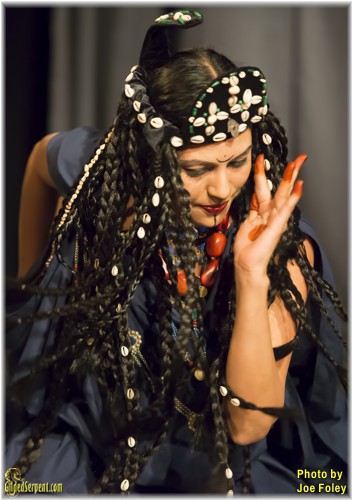
  • Samrah’s Legacy, Revisiting MECDA’s First Fundraiser in Los Angeles, May 1978
    However, THIS event was different due to the overwhelming support and participation from our dance community. The community I mention was primarily working nightclub dancers and musicians, and a few vendors. In fact, I had not seen so many musicians’ come together for a common cause before and certainly ever since.
  • Harnessing the Light Within, Outdoor Photography
    Outdoors, the dancer can more easily release uncertainty by conjuring the feeling of limitlessness, pulling energy from the sky, swirling visualization, curiosity. She can come up and out of herself and become part of her surroundings, harnessing sunlight, a delicious breeze
  • O Aitos Berkeley in the ’70s
    Truthfully, I had never laid eyes on an authentic belly dancer, live or on film at that point, so I hardly knew what to expect.
  • Red Flags Before the Green Light, My Experience as a Club Bellydance Sponsor
    For some reason I assumed my problem was an oddity. It was not.
  • From Obscurity to Mainstream The American Journey of the Afghani Dress
    Interest in Afghani folk clothing and designs began in the late 1960s due to the influence of the hippie generation.  As this fascination with folk arts developed, mainstream America took notice.  Along with the granny dress, maxi dress, and peasant dress, the Afghani dress was a perfect addition to our wardrobes.
  • Bellydance & Baklava in Ohio, A Family Business Devoted to Great Food and Belly Dance for Over 40 Years!
    “We have the longest-running weekly belly dance show in Canton”
 

Gilded Serpent presents...

Dangerous, Dirty and Dastardly

17 Ways to Avoid It

Author Samira Shuruk

by Samira Shuruk
posted March 17, 2014

Every day we go to places where we are surrounded by strangers!
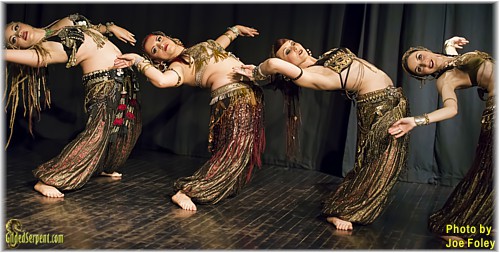
In every day life we get into elevators without bodyguards. We go into buildings, unfamiliar workplaces, appointments, and parties (by only one invitation sometimes, not knowing everyone). Women talk to strangers at bars all the time and sometimes let them walk them to their car… Women are bartenders, working late at night; women go into parking garages at night. This is our world.

A woman can work in a financial firm and have something bad happen to her. A student is not  safe even in a school sometimes. Beware of the broom closet, the teacher’s office, and the locker room; right? Beware of your own driveway and even in your own bed.

The possibilities are everywhere. To many women, these realities can seem quite scary, especially when they begin to discover the prospect of beginning gigging. As someone who has been gigging full time over 10 years (and before I started I had the guidance of two women with over 25 years each) I implore all dancers to have a mentor guide them on careful screening and gig safety. The reality is, however, that not everyone has that type of resource available.

In our business, we also find ourselves surrounded by men. Some are not dangerous, so much as they are creepy. Learning to set boundaries with this type of individual is essential. They do not have the right to make you feel like you need to take a shower after talking with them.

Also important is dealing with potential threats in a way that maintains our own dignity and integrity. Typically, there is no reason to be rude in setting boundaries or inquiring for information to assure our safety. Cool, calm and collected is the best way to portray self-assurance and awareness of your surroundings.

We all want to stay safe.

Here is the common-sense guide I typically share with my students: Mini parked under a streetlight

  1. Screen your gigs by asking positively worded, open ended questions. “Yes, I can be available on that date. What kind of event are you having?” Most of the time, the answer is an obvious family affair; birthday party, wedding, anniversary, etc. At least 90 percent of these gigs are booked by women anyway, this question is the polite way to affirm that it’s not an all male party.
  2. Know the neighborhood. If you feel it might be sketchy, look into it. You don’t have to take the gig. If you feel you need to bring someone with you, charge extra for your assistant. Allow extra time to find parking near light. These are all common sense things. I will repeat, however, turn the gig down if you look it up and you see it is in “Drug and Prostitute Town.”
  3. If, when speaking with the potential client, you feel little red flags go up, mention that you plan to bring an assistant. Someone with bad intentions will not want you to bring anyone and they will most likely change their mind or try to dissuade you from bringing someone. Obviously, you will not let this happen.

    Here is an example from my own career: A female security guard of a Saudi princess was being pushy in wanting to hire me that very night, but I didn’t want to do it. I more than quadrupled my price, and she said that was no problem. They were so insistent on me being the dancer requested that I felt a little uncomfortable so I said I would bring my own security. Her declaration that I would feel incredibly safe and did not need to bring one, of course, did the opposite of reassuring me. I brought a male friend as my escort and everything was fine. The moral, however, is always err on the side of caution!

  4. Exchange an email or contract. Create a paper trail. Most people with nefarious intentions do not want a paper trail.
  5. If you think a gig is going to be the next "Craig’s List Killer" (because those nut jobs leave a paper trail)… don’t go anywhere where you will be alone with one person (Duh! No "private parties" of that nature.) or a small, small group. As I mentioned in number 1, it’s almost always women booking us, for obvious family parties.
  6. The most paranoid amongst us will then respond “but how do you know it’s a family party?” Simple. When you arrive at a family party, there are lots of cars, and lights are ablaze. You can see people in the windows, you can hear voices and music. Sometimes there are balloons on the mailbox. There might be a catering truck in the driveway. These are all highly visible signs. If you get to a party and the house is not lit up, you do not go in. Call their number and say you think you have the wrong address. If they try to convince you to go in, what is your answer? Again, remember that this is your safety and you have the right to say “no.” In over a decade of heavy gigging this has never happened to me. It happened to Artemis Mourat just once in all her years dancing. So, don’t worry, just keep your wits about you.
  7. “I see lights and hear voices, but they’re all crazy drunk.” This is a simple thing to prevent with forethought and it goes back to when you first take the call for your gig. “What time does your event start?” “Oh, 9 p.m.? Wonderful! The best time for me to dance will be 10 O’clock. That way, everyone has arrived, and my show will be a wonderful conversation starter for the rest of the party.” After the first half hour, but before hour two starts is the magic time to dance. People have arrived and had one or two drinks, but no one is out of hand, yet. This is your responsibility to arrange this time frame. Drunk people will be drunk people. We are best served by simply planning to avoid them.
  8. Read The Gift of Fear by Gavin deBecker. It’s a wonderful book for all women but imperative for dancers. It teaches you to listen to your instincts, no matter how subtle. 
  9. When arranging your gig, tell them you need a private place to change and secure place to leave your possessions. Usually they will provide you with an out of the way bedroom or

    bathroom. Use the lock on the door. Also, have a small lock on your bag. As part of your show preparation, stash your valuables inside your bigger bag, I use a rolling suitcase, and lock it. Keep honest people honest. Sometimes the best way to do this is to eliminate temptation and convenience.

  10. Do not hesitate to ask someone to walk you out to your car if you feel it’s necessary. As you leave the party, make sure other guests know who is walking you. This can be done casually and easily, but it still has the effect of people feeling accountable. “Thank you so much Mrs. Host, your event was lovely. Your nephew is walking me out to my car.”
  11. On gig nights, let people know where you will be going. You can have a significant other or buddy serve as your “check in person” before and after gigs. This is kind of above and beyond for most people, but a good idea nonetheless.

We’re almost there! Let’s move on to dealing with individuals and setting boundaries without creating unnecessary conflict.Security Camera

  1. First there are the obvious ones, they’d never be mistaken for Prince Charming. If there is an owner or manager who is creepy and inappropriate, tell other dancers immediately. “The owner of Kabob Castle, D’ AlGrumpy, I thought he was nice, and he didn’t seem threatening because he’s small, but in the back room he just tried to touch my magic apples.”
  2. “No, I will not date your son.” No nonsense and polite! It is okay to lie, and say you’re married or engaged. These claims usually work better than “I have a boyfriend.” However, if you carry yourself with professionalism and dignity, “boyfriend” can work.
  3. If you’re changing in an office or other back room, for goodness sakes check for security cameras. Put a scarf over it, unplug it or hide around a corner. Cameras are attached to recording equipment. While I mention this, also be sure to hide your undergarments in your bag. There is no reason for wandering staff to see your unmentionables. Act with dignity and they will be more likely to treat you with the respect you deserve.
  4. Keep work separate from your dating life. This goes without saying for all professions, for the most part. We have the added responsibility of fighting dancer stereotypes and presenting a respectable image. In addition, remember he was raised on the greats of Arab love poetry and the lyrics of Oum Kolthoum. He knows all the words to capture your heart and to charm your pants right on to the floor. Be prepared for charm.
  5. Don’t stay after closing time. In most situations, you should dance and leave soon after. If the owner wants to pay you at the end, or the band wants you to stay after to split tips, do not stay after the rest of the staff has gone home! Arrange to not be alone with any individual. If they’re insistent, tell them you have to get home to let your puppy out or something. It doesn’t matter. Don’t let people push you into alone time. Period.
  6. Beware the Passive-Aggressive Pusher. I’ll call him PAPy. PAPy will try to befriend you. PAPy is the guy who will compliment you a lot and will get more and will creep more and more forward with his words. As soon as you express discomfort, he will turn it around and blame it on you. You can’t take a joke. You misunderstood. You are too uptight. PAPy might even go so far as to blame feminism. Where did that come from; right? PAPy feels he has the right to objectify you. How dare you object! Turning it around and blaming you is a form of “gas-lighting” in which he is trying to make you doubt your own perceptions. It’s also a very mild form of victim blaming. PAPy is trying to make you feel bad for something he did. Don’t fall for it! If someone like this makes you uncomfortable, set boundaries, avoid the individual and share information honestly with others whom it might help. 

These simple tips can help you stay safe and teach you what to look for in your surroundings. Use your common sense. Listen to your instincts. Always park under the light, and sometimes, carry a big sword.

Resources:

use the comment box

Have a comment? Use or comment section at the bottom of this page or Send us a letter!
Check the "Letters to the Editor" for other possible viewpoints!
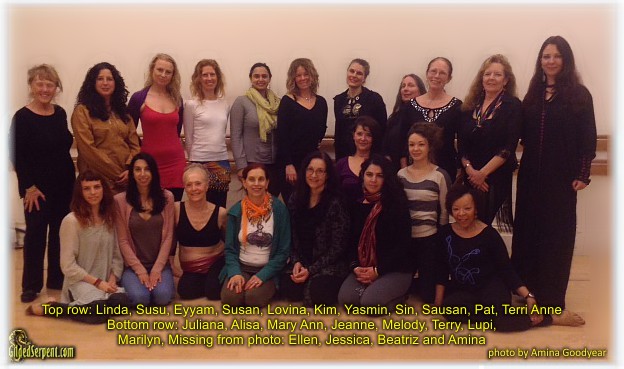
Ready for more?


Gilded Serpent presents...

Samrah’s Legacy

Aradia
This is Aradia dancing to show off her designs in the fashion show
she did with my mother Samira at this event.

Revisiting MECDA’s First Fundraiser
in Los Angeles, May 1978

by Suzanne McNeil
posted February 7, 2014

Created in 1977, the Middle Eastern Culture and Dance Association (MECDA) is an organization dedicated to serving the community as a source of education, communication, promotion, and inspiration for the near and middle east music, dance, and arts community worldwide. Members include dancers, musicians, artists, and other persons interested in Near East and Middle Eastern culture, music, dance, and arts.

There had been some confusion between my mother, Samira, and myself as to when MECDA’s actual first event began. Thus, my mother wrote an earlier article about the outdoor festival she hosted for MECDA in the early summer of 1978. That article can still be read on the MECDA website among its archives.

Recently, my friend and past MECDA president, Ilia Wilken (then known as Ilia Bergman) sent me the flyer and pictures from the very first fundraiser for MECDA that occurred in May of 1978. I had totally forgotten about this event, even though my mother and I had participated.

The name of this event was simply “MECDA presents a Middle Eastern Festival” and it was held at the Pasadena YMCA. This event had the usual format we are accustomed to today; classes and entertainment during the day and an evening show.

However, THIS event was different due to the overwhelming support and participation from our dance community. The community I mention was primarily working nightclub dancers and musicians, and a few vendors. In fact, I had not seen so many musicians’ come together for a common cause before and certainly ever since.

Brand new MECDA had just started in October 1977, led by the outspoken and popular Samrah Masoud who became its president. It was mainly due to her driving force and the dancers who rallied around her that this event was so effective. MECDA was in need of funds and this event was the answer to that need.

Jenza, Author

Jenza (author) performing during the day at this event.

I performed during the day as one of many who did not get mentioned on the printed program. However, we have a copy of that program and many pictures for you to enjoy. The program was a “who’s who” of the dancer and musician world at the time. Check out the program pictured at the bottom of the page!

One of my favorite parts of the day was a comedy skit called “Toximia” with Stella, Ilia Bergman, Julie Mishkin, Marta Shill, Ben, Charlotte Bocage, and Natasha. We were rolling on the floor with laughter!

Recently, Ilia said the following about the Toximia skit:

“Toximia, I remember and smile when I think of it! My character was the club owner: Abu Lecherelian el Wretched; Julie was my wife (don’t know if she had a name); Marta was the drummer; Stella was Toximia. The whole idea was, of course, dancers’ rights. Stella was as tacky as possible. I was wearing my father’s tomato soup red golf pants and a flaming printed shirt and a pillow in my pants to fit it all in. I had everyone’s watches on one wrist, as one of my lines was an aside where I rolled up my sleeve: ("Wanna buy a watch?").”

Amal-MECDA Fundraiser
This is Amal who performed during the day at
this event. She was a well-known dancer and costume designer.

The character Toximia was a hit and was used in numerous skits over the years at MECDA functions to lampoon the tackiest habits a dancer could possibly ever have.

After Toximia, the great magician, Dean Shipcott mesmerized us, followed by the musician’s from Delila’s Restaurant: Manoucher Fadeqi on santour, Parvis Ramanian on tar, Mahdi Afshar on drums, and from Persia, Firuze.

One of the highlights that day was Samrah, Feiruz Aram, Mish-Mish, Ixchel, and Pearl who performed a five-part dance together to live music with Hassan Khalil on oud, George Mouysatti on organ, and Mark Bell on dumbec. (These dedicated musicians played twice that day).

There was so much more going on! Fascinating classes and events were organized during the day by local talent to include Rico Orell (drums), Rozyana (stage makeup), Stella (head-wraps), Samira and Aradia (costume workshop and fashion show), Linda Hithe (yoga), Aradia (Taksim), Marta Shill (Veil), Feiruz Aram (Arms, Hands, Sagats, and Torso), and Kevin Kidwell, who presented a self-defense demonstration

The Evening Entertainment had such greats as John Bilezikjian on oud and Louis Sayeh on dumbec, Laura Shaheen, Adel on violin, Abdullah Kdough on oud, Ali Darwish on dumbec and Fatih on dumbec. Nabil Labenenah and Samrah performed.

Aisha Ali’s Ghawazee Dancers were amazing (my personal favorite), the Troupe Koroyar performed an Armenian dance suite, and the Gypsy Folk Ensemble wowed us. A 3-part dance with Marie Silva, Marta Shill and Feiruz Aram topped off this stellar show. Hundreds of people attended! It was a magnificent first festival for our new organization!

In the following years, MECDA fused the original indoor fundraiser festival at the Pasadena YMCA and the outdoor Summer festival together in one event that became Cairo Carnavale.

This year, MECDA continues its legacy bringing the Cairo Caravan (previously Cairo Carnavale) back to the Glendale Civic Auditorium. The theme is “Welcome Back” and will include some wonderful instructors we have not seen for many years.

Ilia Bergman
Ilia Bergman dancing in this event, she became President of Mecda at the end of 1979.
Stella, Ilia, Julie
Stella, Ilia, Julie in the skit "Toximia".
Stella Ilia
Stella and Ilia in Toximia
Toximia
Another scene from Toximia.
Linda Hithe
Linda Hithe performing during the day at this event.  She was our Cymbal Editor at the time.
Samrah
Samrah Masoud performing at this event.  She is Mecda’s founder and 1st President.
MECDA Program
click for full program

Resources:

use the comment box

Have a comment? Use or comment section at the bottom of this page or Send us a letter!
Check the "Letters to the Editor" for other possible viewpoints!

Ready for more?