Gilded Serpent presents...

Harnessing the Light Within

Outdoor Photography

Ludmilla

by Pixie Vision
posted January 20, 2014

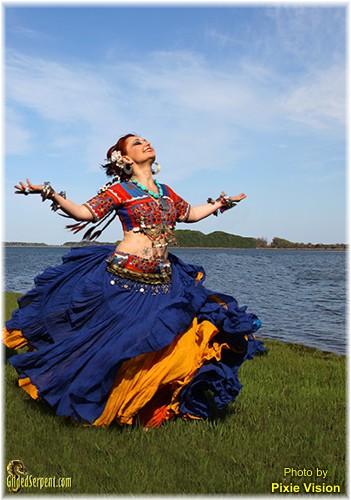
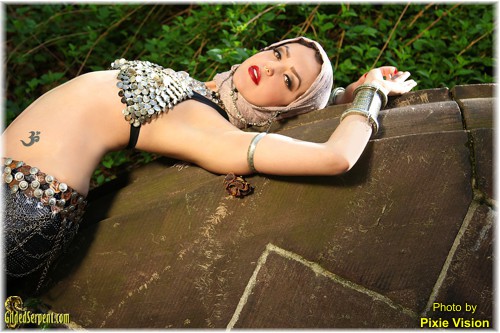
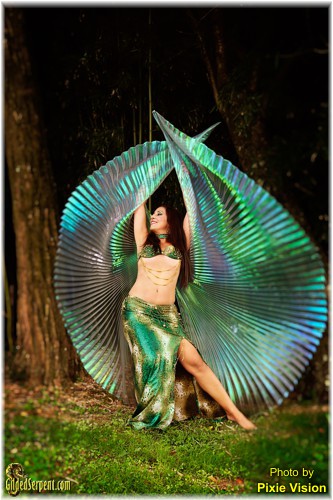
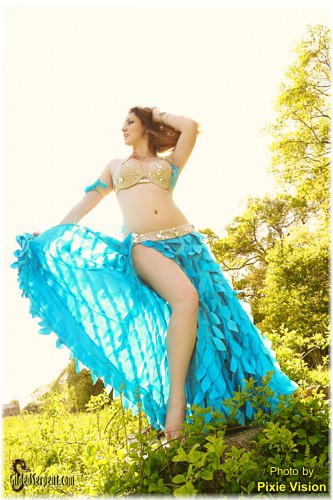
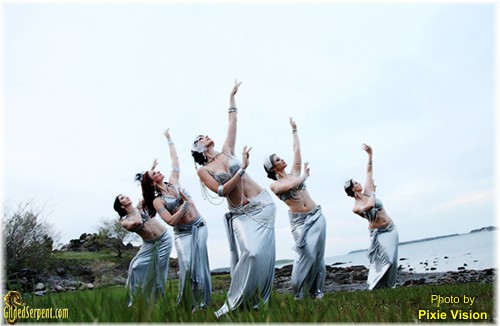
Capturing the essence of a dancer in nature is a different experience than a studio session. In the studio, it’s a more intimate experience, confined by the backdrop. It’s a distinct trust, born of music and confidence.

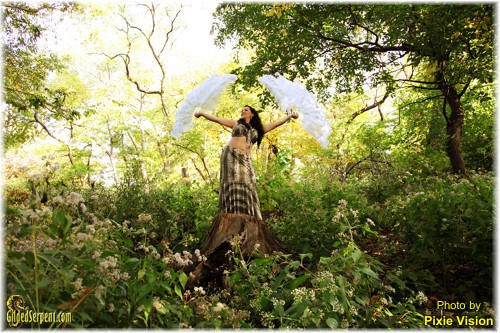
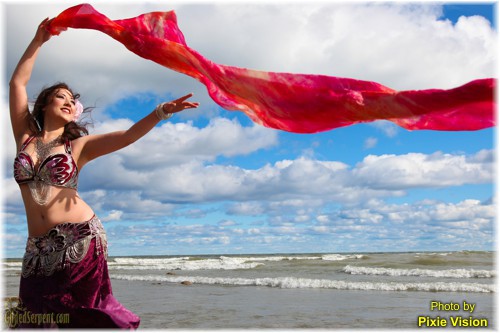
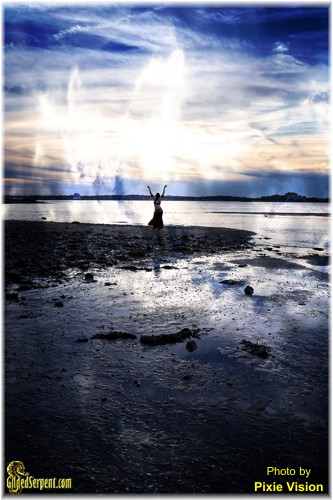
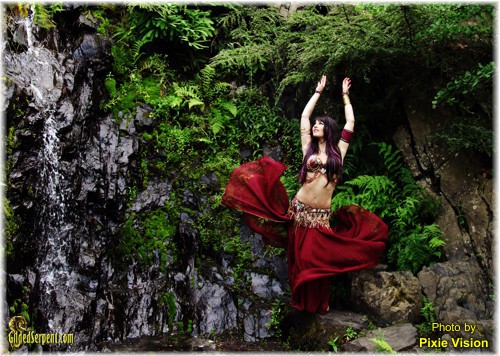
Outdoors, the dancer can more easily release uncertainty by conjuring the feeling of limitlessness, pulling energy from the sky, swirling visualization, curiosity. She can come up and out of herself and become part of her surroundings, harnessing sunlight, a delicious breeze.

Behind the scenes

I’ve been blessed to travel for the past ten years, photographing over 11,000 belly dancers from all over the world. Some days I find myself at dawn in a Nevada desert willing the sun to crest over red rocks in a way I dreamt about the night before. Some days I am driving along the backroads of my neighborhood living in wonder & possibilities. It’s an intuitive process, a renegade experience.

I make impulsive decisions based on light and energy. It’s nearly impossible to predict exactly how the light will fall for outdoor shoots. Likewise how a dancer will feel over the course of a shoot. My job as a photographer is to instigate moments, to sift through fear and draw out the pearls of who is in front of me, who they truly are, or strive to be. I am sparked by light, both in nature and within people… and when these elements come together, art happens.

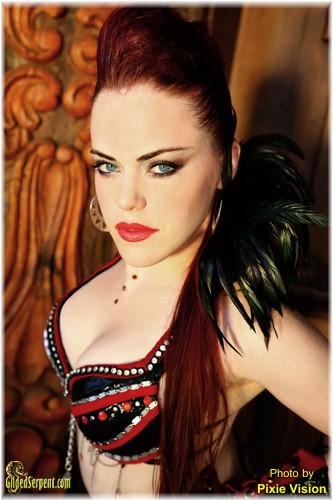
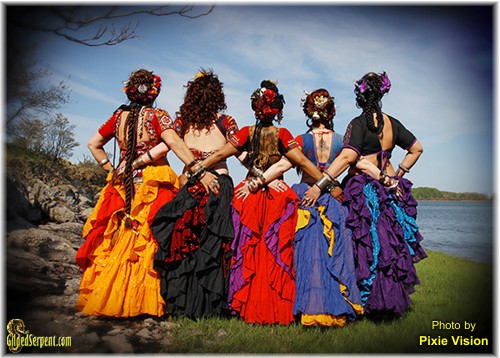
This collection of photos is the result of this merging of light and energy, faith and movement…

Amanda
Amanda


Ali
Ali Luminescent


ELena
Elena


Anastassiya Le Fay


Aslahan
Aslahan


Aradia
Aradia Julia Sunseri 


ennifer Bak
Jennifer Bak


Brenna
Brenna


JOhanna
Johanna Xenobia


 Cecile
Cécile Carr of OmBellyCo


Relativity
Relativity BellyDance


Darshan
Darshan


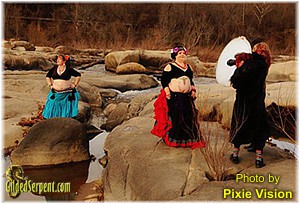
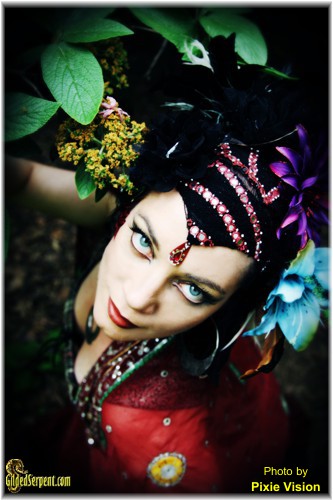
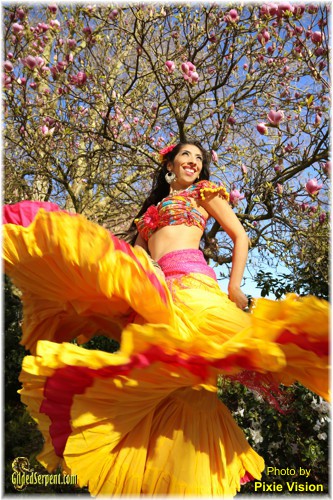
Ludmilla

Ludmila
(also at top of page)


Donna
Donna


Jennifer
Jennifer of Black Thorn


Elise
 Elise Morris, producer of JamBallah NW 


Malia
Malia of Pied Peacock Belly Dance


Marilyn
Marilyn


OmBellyCo
OmBellyCo


Sarah
Sarah


Rahel
Rahel


Shaell
Shaell


Silkmoon
SilkMoon 


Stephanie
Stephanie of Miami


Stephanie
Stephanie 


Victoria
Victoria Raqs Sharqi 


Valdalna
Vadalna Tribal Dance Company

Resources:

use the comment box

Have a comment? Use or comment section at the bottom of this page or Send us a letter!
Check the "Letters to the Editor" for other possible viewpoints!

Ready for more?

  • Authenticity in Dance Photography
    There are three things that make a dance photograph great: authenticity, detail and connection.
  • Michael’s Spring 2009 Photo Spread
    Aazura, Adriana, Ahava, Alimah, Andrea, Claudia, Eve, Kashmir Isis, Katherina, Khalila, Maria, Meissoun, Michelle Joyce, Mychelle, Nadira, Nanna, Nicole, Sandra, Shoshanna, Summer, Surreyya, Crystal, Tabitha, Zaheea
  • A Big Picture Book Review: Martha Burns’ "Belly Dance, Celebrating the Sacred Feminine"
    Every page is a work of art, a truly astonishing array of images. The content is very inclusive and features all age ranges, body types and styles. You will see yourself, your best self, in these pages.
  • Photos from Spirit of the Tribes 9 A Multicultural Journey Fort Lauderdale, Florida, May 2009
    Zizi’s photos are from the Spirit of the Tribes festival which is in its ninth year. It is produced by Maja a long established teacher in Florida. The festival includes 4 days of workshops, vending, competition and performances by troupes and soloists from around the world.
  • Randa Kamal in Cairo The Photos of Susie Poulelis
    I was fortunate to travel to Cairo on business in April ’06, and managed to take some time to see a few sights and, at least, one dance performance: Randa Kamal at the Marriot Zamelek’s Empress Nightclub
  • The Bellydance Museum: An Accident of Fate?
    Soon, I found out my collection of Arabic instruments, ancient jewelry, and our shared bank account were all gone along with my ex-wife. The only thing I could find was a small part of my picture collection, which I now had to sell in order to stay alive.
  • Making Superstars out of Top Dancers, BDSS Tour 2012
    From the beginning, the Bellydance Superstars troupe has had the great fortune to attract the top dancers in the field even though, at first, we were criticized within the bellydance community for “having no stars”; so how dare we call the troupe the Bellydance Superstars?
  • When Two Doors Close Two Doors Open, New Venues in New York City,
    Scott was thrilled with the new place and said it reminds him of the late night clubs in Istanbul, Turkey. At the end of the night I walked out into the hot summer air feeling invigorated and inspired.
  • Tito Seif: The Moment of Eternal Shimmy
    Tito is now an international phenomenon. And how wonderful that a man from Egypt has taken to the West’s belly dance stages establishing himself as one of the greatest belly dancers and showmen today. Such development flies in the face of those American belly dance instructors, students, and performers who have long considered this art defunct in Egypt and dependent upon their kind support and cultivation.
  • Part 2 of 2: The Performances, The New York Theatrical Belly Dance Conference 2010, A Five Day Exploration of Dance Styles, Intention, and Content
    Some of these "theatrical" works focused more on staging and aesthetics; some used narrative; others focused overtly on intention and meaning; and, a minority stayed true to traditional cabaret or folkloric modes.
  • Dreaming in Massachusetts, Photos from MassRaqs 2011
    The celebration of those traditions, along with the fervor of Boston’s intellectual culture, the talent of our local community of dancers and musicians, and a desire to connect that beautiful history to the global present and future of our dance drives the work we do in our event.
  • Photos from Carnival of Stars 2007- A-Z Page 1- A through K photos
    Novemenber 10 & 11, 2007, produced by Alexandria and Latifa Centennial Hall in Hayward, California
  • Welcome to the 2nd Miami Bellydance Convention, A Selection of Photos
    Intercontinental Hotel in Miami, Florida, on September 4- 6, 2009, Winners,Teachers, Performers
  • The Photos & Poetry of David Ludwig
    There is a time each year, when dancers and musicians gather, in a magic forest, to reconnect , with their creative source…

  • A week long immersion into Middle Eastern music and dance while camping in the Mendocino redwood forest. Expect live music every night and classes with many music and dance teachers each day. Many of the names are linked to video interviews we have conducted with individuals or to their bio pages here on Gilded Serpent.
  • 8th Annual Blood Moon Regale: Disease 101
    the interpretations ranging from comic to poignant, dancers portrayed a gamut of disorders from Scarlet Fever to Head Lice, Elephantiasis to Anorexia. Many of the performances were touchingly powerful, while others such as Origin’s depiction of Crabs had the capacity audience at the grand old Colonial Theatre laughing out loud (and scratching themselves
    subconsciously).
  • Tarazade Brings the Bellydance World to Istanbul, Tarazade 2013, Intercontinental Dance Festival
    The five workshops I attended over four days were challenging and fun, which is what I had hoped. I love workshopping. It’s so much fun to dance to someone else’s rhythm and it’s hard to walk away not feeling inspired.
 

Gilded Serpent presents...

All the World’s A Stage!


Reviews of Three Theatrical Shows and Technique DVDs
“Fantasy Bellydance-Desire”, “Outi Wa Bas”, “Bellyqueen: Ultimate Fusion”

Elianae reviews 3 DVDS


by Elianae Stone
posted January 17, 2014

This segment of three DVDs was fascinating to research. I am comparing Fantasy Bellydance-Desire, Outi Wa Bas, and Bellyqueen, Bellydance NYC-the Ultimate Fusion Experience. Although each DVD was very different from the other, all had an aspect of theatrics or stage performance to them. It is safe to say that there is a style of Bellydance for everyone.

Fantasy Bellydance- Desire


Fantasy Bellydance-Desire

Fantasy Bellydance-Desire from World Dance New York is Part two in a 3 part choreography series for Intermediate/Advanced dancers. This DVD features the talents of 3 dancers, Blanca, Naraya, and Darshan. Blanca teaches a Cabaret-Fusion Choreography, and  Naraya and Darshan teach tribal fusion pieces.  All are talented dancers, with beautiful costuming, masterful choreography, and great lighting and sound. The DVD is very well-produced, with a main menu featuring each dancer and performances and credits. If you click on each dancer, however, you are directed to a separate menu where the dancer describes the “character” you will be playing, thoughts or tips for your practice, or rituals to prepare yourself spiritually for the dancing. Each dancer then launches into a full performance of the dance, then a thorough breakdown. In short, there are about 35 buttons that you can click on for different features of the DVD.

I think this DVD is definitely geared towards more advanced dancers, as it claims, but it also is very fusion and tribal-orientated, which could encourage or discourage some dancers.

Also, in each dancer’s section, much of the intricate choreography is learned without repetition and without music, although there is a music practice segment at the end. There is a separate music menu in the credits section, as well, so that one learning the choreography could purchase the music.

I think that this is a very creative offering, and that fans of World Dance New York will appreciate the talent of the Instructors. However, this DVD encompasses so many styles of bellydance and western dance, it would take a strong, patient dancer to get the most out of this DVD. A great study-buddy for the advanced dancer wanting some fusion choreographies.

Rating: 3 Zills
3 zil rating

Outi


Outi Wa Bas

This DVD was a live full Egyptian bellydance show by Outi in Cairo. Outi is a popular Egyptian-style bellydancer, and this DVD was very well-produced. This show, by comparison, was a live full Egyptian cabaret show, and the theatrics presented were traditional to Egyptian culture and dance.

The show had excellent sound and video quality and featured a live 9-piece band and several singers, as well as Outi and two male dancers. There were 8 songs performed and I liked how each was introduced on the screen by name, and even the style was designated, such as Shaabi, Saidi, or Khalegy.

Outi has always included musical and historical knowledge to her dance DVDs, which I think is a boon for anyone who appreciate the art of Oriental dance.

Outi  achieved an astounding 8 costume changes during the show, one for each song, and had very professional costuming for the modern Egyptian style, which typically is a lycra skirt/bra combo. She performed two songs with male dancers, and it was interesting to see them work together and to see their differing styles of movement, and the play-acting and costuming.

Outi is very experienced and talented at Modern Egyptian style bellydance, and I would like to see more offerings by her defining the modern Egyptian style to Western audiences.  Her loose style, combined with gestures that coorespond to the song and singing along with the band demonstate her knowledge of Egyptian music and culture. I think for any affectionado of Egyptian-style bellydance, they would enjoy Outi’s friendly, organic style.

Rating: 3 Zills
3 zil rating

Bellyqueen

Bellyqueen: Bellydance NYC The Ultimate Fusion Experience

I watched the performance DVD, Bellyqueen, Bellydance NYC the Ultimate Fusion Experience, and it is all that it claims to be. The show, which was wonderfully produced, featured a lot of fun, funky New York flair, and more fusion than I can imagine packed into almost every number.

The video and sound quality were fantastic, and the DVD had a great title and chapter menu. As far as the dancing goes, Bellyqueen has a very strong, synched-together troupe.

The dancers were very physically fit and well-versed in not only bellydance, but modern dance, hip-hop dance, theatrical dance, African dance, and many other modalities. Each piece was very different from the last, and the dancers were given chances to express themselves as individuals as well as part of a group.

There were several more traditional pieces, such as Rakset Al Asaya, and Betwannes Beek, intersperced with very fusion-styled pieces, such as Afro Funk and the Drum Battle. Many theatrical techniques were used, such as dance fighting, mime, usage of dancers in the background as props,etc. One huge highlight of the show was having the live band Djinn come out and perform, as well.

The finale Drum Battle was a bit much for me personally, as the dancers were doing a “dance-off” in Hip Hop gear, bellydancing, breakdancing, fight-dancing, using Modern dance, Grande Battement kicks, handstands, splits, acrobatics, etc. It was truly fusion! But, throughout, the energy was great, the dancers worked very well together, and I think this would be a really fun and uplifting live show. In the end after bows, the dancers even run into the audience and start dancing! There was definitely a global party atmosphere.

Rating:  3.5 zills
3.5 zil rating

It is obvious that much has changed in belly dance over the decades, and now fusion is everywhere. Anything and almost everything can be incorporated and integrated into belly dance, and productions and tutorial choreographies like the ones in "Desire" and "Bellyqueen" make that point apparent. But there is also still a demand for the more traditional styles of belly dance done well, also, and productions like "Outi Wa Bas" offer these as well to the belly dance aficionado. Whatever your taste may be at any given time, there will be a show or choreography to suit your taste.

$18.98
Fantasy Bellydance-Desire
Product page on producer’s website
Outi Wa Bas
Product page
on artist’s website


Resources:

use the comment box

Have a comment? Use or comment section at the bottom of this page or Send us a letter!
Check the "Letters to the Editor" for other possible viewpoints!

Ready for more?


Gilded Serpent presents...

Grace and Sass!


3 videos!


"The Veil with Hilary Thacker",
"Arabic Jazz Fusion with Galit Mersand", and
"Ballet for Bellydancers with Brianna"

DVD review by Elianae Stone
posted January 12, 2014

This grouping of DVDs was enjoyable to review, as it dealt with many things that I personally enjoy and find graceful and useful, such as veil work, and Western dance technique, such as Ballet and Jazz.

The Veil with Hilary Thacker

The Veil With Hilary Thacker

I was pleasantly surprised by this offering by Hilary Thacker, The Veil. Having seen several of her other Instructional and performance videos, I was expecting a more homespun production quality.

This DVD surpassed my expectations.

 It started out with a visually appealing main menu, with neat live video boxes to click on each skill of study. There was no warm-up. The entire video was shot outside on a rooftop in Turkey and the sunny atmosphere, combined with Hilary’s traditional Cabaret costuming and props such as an Oriental rug, oud, and derbake made for a friendly, Oriental flavor. It was obvious to me that a lot of care had gone into the production, though it was a bit disconcerting how Hilary overdubbed her voice over the lessons, while her mouth was moving in the frames as well, and didn’t always match up. This being said, however, I could see how much effort was taken to make sure the sound quality was better than in previous videos. 

The music was traditional Egyptian Bellydance music, which I found soothing, and the skills taught had creative names, such as “Bullfights”, the “Magic Sandwich” and the “Egyptian Postbox”. In the end, she performs in front of a traditional Turkish building, and even has footage of her students  in Edinburough performing. Although I would not consider this dvd challenging for an advanced student, I think it captures the feel of traditional Cabaret Bellydance and could introduce students to some creative veil work and a beautiful culture. I liked it.

Rating: 4 Zills
4 zil rating


Galit does Jazz Fusion

Arabic Jazz Fusion- Technique and Choreography with Galit Mersand

Galit Mersand’s DVD was very well put-together, and accessible. There was a Main Menu, with technique and drilling divided into separate sections. Dancers were introduced to basic jazz technique, such as step-ball-change and kick-ball change, as well as pivot turns, and Jazzy arm stylizations.

The Jazz technique was simple to follow, yet when combined with bellydance combos made for a fun, definite stylization. One bonus that I thought was very nice about this dvd was that it came with notes to refer to about the choreography.

The choreography was then performed to a sassy song by Balkan Beat Box. Throughout, the song, instruction, and production quality were consistant. It was interesting that Galit chose to perform the choreography in costume in the middle of the DVD menu, after teaching technique and before teaching the choreography, instead of at the end like many DVDs do.  However, when watching from start to finish, it makes sense to inspire the dancer with the finished product before they start learning it. The drills are supplemented by fun, funky fusion music, as well.  This is a great DVD for the beginner/intermediate dancer who wants to add fun stylizations to their repertoire or dabble in Jazz dance without being intimidated. It has a Jazz flair while still being accessible to everyone.

Rating: 3 Zills
3 zil rating

Ballet for BDR by Brianna

Ballet For Bellydancers with Brianna

Ballet for Bellydancers with Brianna is a Cheeky Girls Productions DVD, and like many DVDs from that company I have reviewed and viewed, it has a very high production quality. The DVD opens with a standard menu, and a viewer can jump to different skills.

The technique is ballet modified to be more suited to Oriental Dance, and Brianna is a patient, graceful Instructor.

I found the warmup a bit slow-moving, as I did the opening plie and releve segments. However, I have studied ballet in the past and perhaps had a better grasp of posture and beginning technique. As the DVD progressed, however, through chasses, pas de bouree, arabesques, and combinations, I found it more challenging. My favorite part of the DVD was how once a combination was learned, there was a separate drilling section for constant repetition. By the end, a lot of useful technique and traveling moves for the Oriental dancer were available. Brianna used great form to demonstrate how the movements should look, and spent a lot of time on port de bras, or graceful arms, which are a must to the Oriental dancer’s technique. I would recommend this DVD highly to a dancer who is new to ballet, or a more experienced dancer wishing to brush up on technique. Both will find something to work on, and be inspired by the lovely studio Brianna teaches in, and the costumed performance at the end.

Rating: 4 Zills
4 zil rating

Veil technique has long been considered part of the classical belly dancer’s repertoire, and in recent years many cabaret dancers have found taking classes in other dance disciplines, such as jazz or ballet, to be invaluable in improving technique and offering variety in the dance. DVDs like the ones above help give a dancer interesting combinations and technique in the disciplines they’re designed for. It is great that so many valuable study and practice DVDs are available to the modern dancer.

Arabic Jazz Fusion
Technique and Choreography

with Galit Mersand,
£9.99 + P&P


Resources:

use the comment box

Have a comment? Use or comment section at the bottom of this page or Send us a letter!
Check the "Letters to the Editor" for other possible viewpoints!

Ready for more?


Gilded Serpent presents...

From Evolution to Revolution

A Review of “Dark Side of the Crown”

Placeholder

by Valerick
Photos by Lynette Harris
posted January 9, 2014

Finally the day came; Bellydance Evolution opened the Miami Bellydance Convention 2013 at the Colony Theater, in Miami Beach. I sat down with Alicia from BellyCraft and our whole conversation was about how excited we were for the show. I didn’t have a clue of what I was going to see and what to expect from a show that recently added 12 cast members from an online competition. Suddenly the lights were turned down and I soon realize that the audience was infected with the same enthusiasm that Alicia and I had. Almost everyone in the audience was a dancer; something very rare these days, since the dancers are usually backstage, and the audience is full of family members that most of the time tend to be annoyingly quiet.

“Dark Side of the Crown” is an ahistorical story that could be defined even as a fairy tale. In a faraway Kingdom with a matriarchal political system, Queen Rahyan (Heather Aued), was celebrating the ceremony where she will pass her crown to one of her three daughters, played by Louchia, Sharon Kihara and Kaeshi. Suddenly in the middle of this celebration, the Queen is mysteriously assassinated. The intrigue of the show is driven by the question of who murdered the Queen. Until the assassin gets solved, Jillina (advisor to the queen), is chosen by the character, Priestess Elaleh (Zoe Jakes), to rule.

Jillina’s character is mean and abusive which makes us think that she may be the killer!

The first act started with a very busy and colorful entrance. I was impressed with how many dancers were on stage, when one of the most memorable scenes took place: the assassination of Queen Rahyan. The lighting and sound work very well for creating a thriller scene. Zoe Jakes was the guest artist and she interpreted Priestess Elaleh. Zoe Jakes oneiric image and her eternal pauses created a mystical atmosphere every time she was on stage. Her use of different props, such as feather fans and the Tunisian jar were very effective with her Priestess character. But that spiritual aura is a distinctive of Zoe. In the case of Jillina that we probably think of as a “happy dancer” it was very interesting to see her as the villain. Her body language was very clear and readable. In this show Jillina executes and master different styles of dancing, such as Hip Hop and Tribal. Sharon Kihara (Princess) and Kaeshi (Princess) are also known for doing fusion. These two artists even though they have a notorious height difference, their facial similarities and dance styles work to manifest their sisterhood in the story. Louchia provided a contrast and her elegant Oriental technique projected freshness. Some of the princesses’ choreographies had compilations of moves that were the perfect boundary between Tribal and Oriental Dance. It is visually interesting to see how the show plays with these two styles. For certain choreographies establishing the exact definition of the styles is difficult, sometimes Oriental is used to fill the stage and Tribal become more narrative in terms of the story.

Dead qUEEN
Assassination of the Queen.
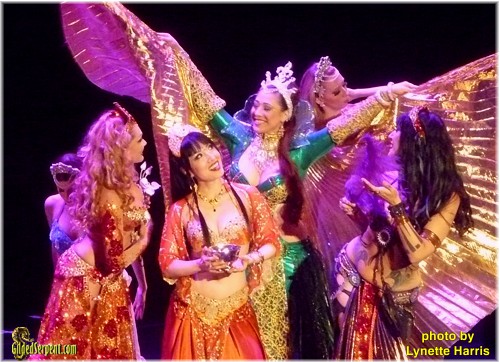
Photo at top of page- Louchia and Danielo Mendes

The incorporation of two male Hip Hop dancers to play the imperial guards not only add diversity, but make “Dark Side of the Crown” a great fusion show. DanieIo Mendes (Imperial Guard) ability for physical comedy is a great asset for the story. Heather, as the Queen was the most outstanding character of the show. Her performance was a great combination of good acting and soulful dancing. She has a telepathy with the audience that makes us experience her character’s intimacy. Her Egyptian technique was very well combined with her lyrical and modern dance training. Her hips were clear and heavy and her footwork was as light as her spiritual character. Her solo with classical Chinese sleeves is one of the most powerful pieces of the show.

The ending of the first act was hilarious, a fantastic fusion piece. Ozzy Ashkenazi, Pete List and Brad Macdonald played an interested composition that combined military marching beat, Hip Hop and Middle Eastern rhythms. The sound was perfect and the synchronization of the three musicians was outstanding.

Musicians
Musicians play for Sharon doing a bellyroll!
Sharon, Ozzy, Pete List, Brad Macdonald, and Don Leighton

The costumes were a mix of glamour and military fashion. The female dancers were wearing a beret with fancy gloves and a “typical” belly dance costume. Because Hip Hop is a genre usually dominated by male figures, and Belly Dance so attached to the concept of femininity, the dialogue between these two art forms was very effective. The glamorous army costume makes me consider how avant guard these two dance styles are in reality.

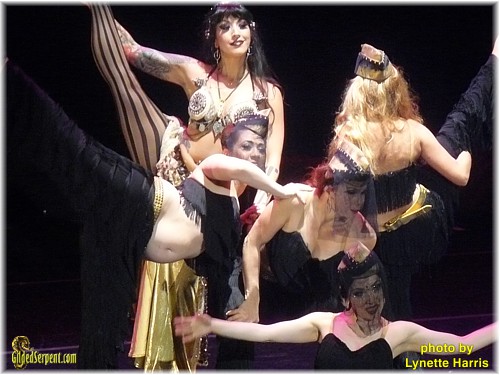
Man Shred
Man Shred
Sebastien, Danielo, Camilia, Yesenia, Megumi, Alisa and Jenna

Most of the music of “Dark Side of the Crown” is composed by Paul Dilenter. The show includes “Enta Omri” a piece by Oum Koulthoum and a Shaabi Egyptian song.

The use of these two songs took away the suspense created by Dilenter’s music. The social associations eliminated the sense of fantasy especially when it comes to tarab. For a more educated audience in Middle Eastern music will be difficult to connect the profoundness of “Enta Omri” with a fiction story.

In the second act we follow the imperial guards in their investigation of the murder. However during the process of interrogating the Queen’s daughters, it is difficult to follow the story and to understand the characters. Even at the end, when we realize who the killer is, it still is a little confusing to understand the motives of the characters. The show starts to lose some coherence in the second act. However the dancing and rhythm of the show keep us entertained at all times.

In a literary aspect the story or the concepts of “Queen” and “Princess” are not something new. The structure and ending is typical of the fairy tale genre. But a fairy tale “can be describe as fable that teaches an important moral” and I think “Dark Side of the Crown” may seem like is missing that key message. For being such a great production in terms of technique, lighting and music they lost the opportunity to tell a story never heard. Like the great playwriter Bertolt Brecht said, “Art is not a mirror held up to reality but a hammer with which to shape it.”

The show finished and an entire theater full of dancers stood up to give a well -deserved standing ovation to this amazing cast of artists. The winners from the BDE Online Competition did an incredible job and they look like an entire ballet that has been training for years. The challenging part about Theater Dance is that you need to have a full artistic formation.The competitors need it to prepare and understand their characters in function with the story. They have an important role in the show because they established the context and the energy of the scene.The repertoire of choreographies require dancers well trained in Oriental dance and in acting. No wonder why so many outstanding dancers like Yvonne Pereira (Florida), Camilia (Poland) and Paula Saneoux (Dominican Republic) have decided to do it and a couple of them have done it more than once. It’s the perfect symbiotic relationship between the show and the dancers. As a spectator you can feel the excitement of the competitors and the show nurtures itself with it.

Locals
Alice Giampieri, Paula, Rin Ajna and Michelle Chehardy(BDE Tribal winners)

“Dark Side of the Crown” is making a revolution and I was happy to witness this new chapter of our art form. The discipline, the dedication and the audacity that require doing a production like this one makes me think that Bellydance Evolution is probably making the pathway to get to Broadway.


three sisters
3 sister princesses – Louchia, Sharon Kihara and Kaeshi
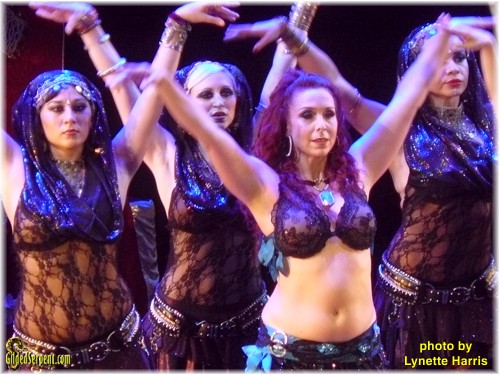
black lace
Black lace with Jillina leading, Alice, Michelle, Paula
Core dancers
Core Dancers – Louchia, Kaeshi, Heather, Camilia, and Sharon Kihara
 
Face Veils
Face Veils – Sharon Kihara, Heather, Jillina, Kaeshi, Louchia
PinWheel
BDE Miami cast in a Pin Wheel formation led by Rin Ajna, Alice Giampieri
Sharon
Sharon leads, Yvonne to left behind, Alysa over Sharon’s right. Zoe in upper right.
Stage
Full Stage View
Warm up
Early number in show featuring?
Zoe
Zoe as priestess with Paula behind.
Resources:

use the comment box

Have a comment? Use or comment section at the bottom of this page or Send us a letter!
Check the "Letters to the Editor" for other possible viewpoints!

Ready for more?


Gilded Serpent presents...

O Aitos


Berkeley in the ‘70s

Placeholder

by Najia Marlyz
Most photos by Jules Kliot
posted 1-8-14

The Greek Eagle (O Aitos) flew over Berkeley in the early ‘70s, as did a good many other things, and it landed at the far end of University Avenue straight down the hill from the University of California campus.  O Aitos Taverna was a dream child of Ted Sofios and his brothers, John and Keith.  They set up their tavern in a former U.S. post office that had a huge skylight and a hardwood floor that had been worn smooth as silk.  The brothers were from a Greek American family and Ted’s dream was to teach ethnic dance, a different type, every day and night of the week.  What he could not teach he found teachers who could conduct classes while he and his brothers served Greek food with a beer and wine bar for the dancers.

At the time, I was floundering on an ocean of confusion about what to do with myself that would be creative and would not constitute what my husband du jour would consider “a real job” because he “did not want his wife working”. (Those were still the sentiments of the sixties and early seventies, people!  The feminists had not yet revolutionized our way of life into what you might consider acceptable today.) In the Fall of 1970, there appeared in the Berkeley Gazette a notice and a photograph that a Wednesday afternoon (happy-hour) belly dancing class was being organized, to be taught by Roman Bert Balladine, at a new folk dancing establishment located in Berkeley near University Avenue at Hearst called O Aitos, which meant “the eagle” in the Greek language.  That seemed to me to be a more interesting prospect than the boring ballet class for adults that I had been attending up on College Avenue on Saturdays that was eating into our precious social weekends, so I became determined to go to O Aitos the very next Wednesday and get started.

Our dance lesson with Bert was two hours long and was taught in a circle of about twenty or twenty-five young women while people sat at the bar drinking happy hour beer, watching us bumble about the dance floor.

Truthfully, I had never laid eyes on an authentic belly dancer, live or on film at that point, so I hardly knew what to expect.  However, I had nothing else to do; it was happening in Berkeley, and I was ready for just about anything!  The entire atmosphere was non-threatening for me, and I followed along with the group, some were in costume and some in bizarre quasi-dance outfits but all were barefooted and laughing at Bert’s wild stories. I fell in love with the atmosphere of the Aitos from the first hour.  Owner Ted Sofios was in the bright sunlit kitchen with his mother preparing food for the evening dinner, and during the class break, Bert suggested that I order a glass of Sangria from Ted and try to “loosen up” a little and stop struggling to be so perfect.  That did it for me; so loosen up, I did!  I found that all the yoga and women’s exercise classes I had been involved in for the past few years might pay off in a new and unexpected way for me.  My movements were becoming smooth as silk–so much so that Bert whispered to me, “If you stick with me, I will make you into a star!”

John Sofios

Ted Sofios

About 8 months later, I came to the Aitos with a friend on a Friday afternoon for lunch because Ted, the Greek owner who openly “hated the Belly dance”, had decided to feature a belly dancer for his Friday lunch crowd who thought that belly dancing was Greek and had been asking him “Where is your Bellydancer?”.  She was Shiamara, one of the more beautiful and experienced dancers from our Wednesday afternoon class with Bert, and she had a dream of going to Bangladesh with her boyfriend to help the starving children with distended bellies. I had not heard how soon she had planned to leave however.  After lunch, I said to my friend boastfully, “Well, I really think that if I had a costume, I could dance that well right now!”  What I hadn’t realized was that Ted Sofios was standing directly behind me. He had overheard me, and he patted me on the shoulder, saying, “Okay, then, I heard that!  You will be our dancer next Friday!”  I am not one to back down so I made it happen, although I was wracked with stage fright.  I had, after all, opened up my own Pandora’s box! Ted hired me after that first terrifying performance, and I danced every Friday afternoon, and then eventually, added in every Saturday night also for five years. 

The gig was a bit strange because the Meraklithes Greek band that played at the O Aitos every week had been hired to play the folkdance songs for the patrons of the taverna and Ted wanted me to dance the Belly dance with recorded music during their half-hour break to keep the interest of his customers.  This meant that usually I did not dance with the live music; I was expected to dance with pre-recorded Turkish, Egyptian, or Lebanese music arranged in dance sets because they did not want the belly dance to be considered of Greek origin.  Fortunately, during an era when it was difficult to access good recordings, I had access to unusual equipment for recording dance sets that seemed to fit together in reasonable fidelity in a time when recorded music for dance sets was extremely rare to unavailable. When I traveled to Greece many years later, the tour guides explained how that prejudice against belly dance and all things considered Turkish came about and what the history of the region was that caused the attitude against belly dancers.

At one point after I had been working for Ted for several years, and he had learned more about the belly dance and the skills involved, he ashamedly admitted to me that once he had ignorantly thrown a loaded ashtray at a performing dancer in another taverna!

I couldn’t believe it; he was such a nice person, good employer, and loyal man who absolutely loved dancing and admired those dancers who could perform well! He admitted that he was ashamed of what he had done, and he made a point of apologizing to her eventually.  That dancer became a close friend of mine and still is until this day. (Unfortunately, Ted is no longer living.) 

It was acceptable to me that I did not usually get to perform with live Greek music of the Meraklithes Band because it meant that I had free reign to find whatever music I wanted for my sets and to develop my dance along with the music to fit it precisely and to change it each week rather than to repeat the same set for five years.  I became musically oriented and fixated on creativity and variety within the dance because my audience was approximately the same people every week—so they kept me on my toes, finding unusual music and creating unexpected costuming and unique things to surprise and fascinate them each week. Because I noticed that the Greeks were more than appreciative of “daring-do” in their own performances, I began to make certain that there was an element of body strength, balance, and danger associated with many of the dance movements and show business “shtick” that I incorporated into my sets. This shtick was far beyond anything I had learned in Bert’s belly dance class, except that all things were fair game in “show biz”.  Fortunately though, it all began to make sense to me when I began to travel to the Middle East, and I saw that the well-known stars of the dance in the Middle East were not only different from country to country, they were all different from each other within a country and responded differently to their music.

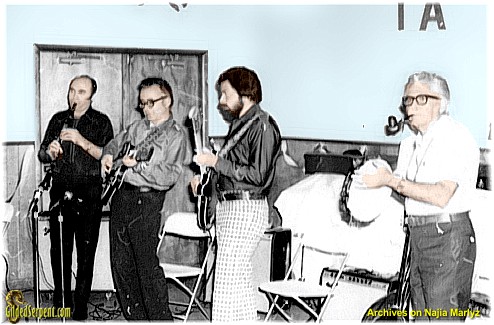
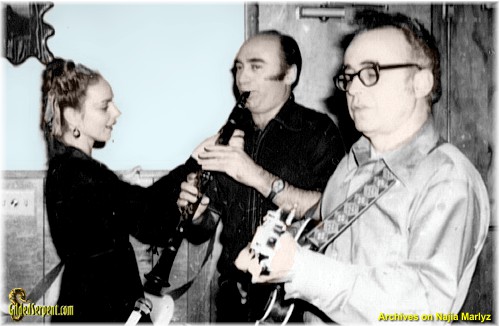
Going on private gigs to Shaver Lake, Fresno, Reno, Elko (Nevada) Big Sky (Montana), and some Greek Orthodox Church festivals and picnics with the Meraklithes Band and the O Aitos Dancers were the most exciting things I had ever done as a dancer. I miss those days and I miss those adventures.  When I looked back through my photographs for illustrations for this article, I realized how many innovative, warm and talented performers we have lost. So here are a few my photos of the day.  Perhaps they look dark and brooding but we were happy and we laughed and had fun with the music, the dance, and the changing times.

The OAitos band

Oaitos band

Najia and band

Resources:

use the comment box

Have a comment? Use or comment section at the bottom of this page or Send us a letter!
Check the "Letters to the Editor" for other possible viewpoints!

Ready for more?


Gilded Serpent presents...

Red Flags Before The Green Light

My Experience as a Club Bellydance Sponsor
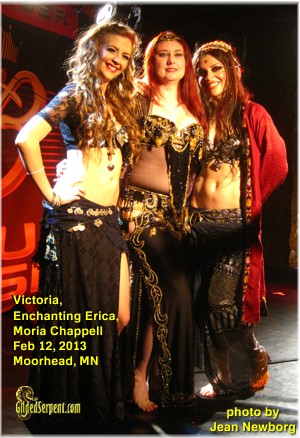
Placeholder

by Enchanting Erica
posted 1-3-14

I am a bellydancer and teacher in Fargo, North Dakota. We have a relatively small but very talented, diverse and enthusiastic regional community. I solo a couple times a month with different variety shows and I am working on a repertoire with my dance troupe. We have haflas every few months. It is a fun but quiet existence for us bellydancers up in the Northland.

So it was a bit of a shock, and thrill, when on December 4, 2012 I received an email out of the blue from Stevo Glendinning asking if I would be interested in sponsoring a local show for Club Bellydance. They happen to be traveling from Minneapolis to Winnipeg, and Fargo seemed like an obvious stop, logistically speaking.

Stevo proposed this deal to me: Club Bellydance would be responsible for contacting the venue and paying any rental cost. The sponsor would be responsible for recommending an appropriate local venue, lining up talent and organizing music for the first 45 minute segment of the show (Act 1),  finding one volunteer to work the door and one to help with Club Bellydance merchandise, and provide a small fruit plate and bottled water for the dancers in Act 2. The local sponsor would be paid twenty percent of the ticket sales. If the date fell on a weekend, the sponsor would also get ten percent of the admission if they were able to hold a workshop.

There was no monetary investment on my part, except for the snacks. Easily within my budget.

At first this seemed like a crazy idea, because Bellydance Superstars is a pretty big deal. But then realizing that the actual scope of the show was not as large an affair as their previous tours, and that I had helped with production of several shows for the variety show troupes of which I am a member, it seemed more possible. After consulting with my dance partner Ezma (I knew I would need help), I decided to take Stevo up on his offer and we began work trying to nail down a venue. This was decidedly harder than I had anticipated. The local universities’ theatre departments did not return our calls. Other local theatre groups either had venues that were too large, too small, too expensive, or just not available. Luckily one of my variety show friends recommended The Garage Bar just across the river in Moorhead, MN. It turned out to be an excellent venue! I only regret that we were not able to have an all-ages show. That would have boosted our ticket sales significantly.

Having secured the venue I now had to reach out to the local dance community to fill Act 1, and consider how to pay participants. I determined the fairest approach would be to offer an even split of all funds amongst all dancers, regardless if they were in a troupe or solo. I was upfront that this depended on ticket sales, so they may each walk away with a minimal amount for all I could tell at that time. The response was overwhelmingly positive and by the time it was all said and done I had 18 total dancers to fill 45 minutes!

We had wonderful ladies driving from ten minutes away to three hours away to participate. We have a widespread community, and I am so grateful to know all these fabulous dancers!

My promotional contact at CB was Roxanne, who was helpful and responsive, and just a genuine pleasure to work with. I provided the necessary info to her for posters and other event promotion. Stevo was able to provide me with a list of songs that the touring dancers would be using so that we did not reuse songs in the local acts.

Then we got our first red flag. As many long-time dancers know, we make friends far and wide across the country. One of the dancers in our show has a daughter who is a dancer in Florida. She reported to us that when Club Bellydance toured in their area the local dancers had been asked to pay half-price admission to stay for the second half of the show and see the Club Bellydance dancers. Obviously it created a lot of friction at that venue, so I inquired with Roxanne if that was still the policy. Apparently due to the conflicts it had caused they retired that policy. I could not imagine how a curtain call would go if members of the first half of the show weren’t allowed to stay!

Satisfied with this answer we continued on promoting, practicing, planning. As February 12, the day of the show, approached we had only sold twenty tickets. Stevo was concerned, but I know from experience that for shows at bars, especially in the winter months, people often wait and pay at the door. We had sixty-seven additional paid admissions at the door. We were hoping for around two-hundred patrons, and to be honest we were a tiny bit disappointed because of all the work we had put into promoting. However, all together it wasn’t bad for a cold Tuesday night. There had been a rather bad snowstorm the day before so we were worried that they wouldn’t make it from Minneapolis! Some of the California ladies had fun playing on the large piles of snow in the parking lot when they arrived.

The Club Bellydance performers were very friendly and gracious. Unfortunately we did not have much of a chance to visit with them, but having a show every-other day and continually being on the road has to be pretty grueling.

Their small road team got everything set up for tech rehearsal. I was interested to see that they brought their own floor covering, probably a bit jealous too. Set-up went quickly and smoothly, merchandise was displayed, and we were set to go about an hour before showtime.

The show was amazing! As the producer I took advantage and put myself and my partner on first so we could watch the rest of the show and be available if any issues arose. I was so proud of our community! We have so many great dancers of so many different styles: Egyptian and American Cabaret, Turkish, ATS®, Persian Ballet, Bollywood Fusion, and more I am probably missing. I would have been satisfied with that half of the show alone. But then it was a rare treat to see the pros from Bellydance Superstars perform up close and in person. They also represented various styles of bellydance, and had a wonderful sense of theatricality. I loved how they fused their duets and group numbers together seamlessly. I learned quite a lot from watching their segment of the show.

Once the show was over we had a curtain call and photo ops. We chatted a bit and changed back into our civilian clothes. It was all very exhilarating and I felt a little high from the excitement of the evening. Unfortunately the CB ladies had to get a good night sleep because they had to hit the road again in the morning. Some of us locals got together for drinks and congratulations on a job well done. I don’t have any regrets about doing the show, and I would probably consider doing it again. However, I would have done some things differently.
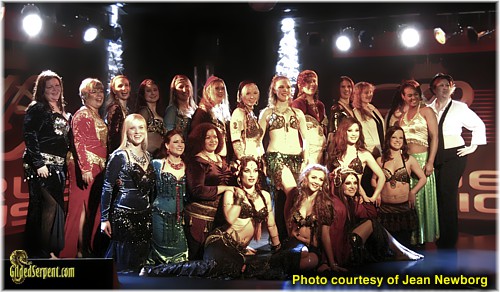
Curtain Call
Curtain call (photo courtesy of Jean Newborg) linked to larger image
Back row: Iana, Ella Za Beth, Kelebek Aslan, Enchanting Erica, Ezma Siddiqah, Cherish, Ashley Throw, Sabah, Gaia Sophia, Ana Ari, Briste Aen, Aremi, Thura
Front Row: Annakiaya Sehar, Mystique, Ezra, Sabrina, Victoria, Moria, Nathalie, Saphira

The second red flag popped up when my door volunteer, Jarica, mentioned to me that Stevo had asked for the door proceeds and tickets, then wadded up the cash and stuck it in his pocket without counting it.

I was very lucky that Jarica was careful to keep track of how much money was collected and put all of the tickets in order to make sure there were no duplicates. I realized later that I had not specified with Stevo when or how I would receive payment. Bellydance Superstars carries a lot of weight in the international community. They have a reputation and have done a great deal to promote the art form. I am sure many of us have seen the documentary American Bellydancer or at least some of Bellydance Superstars’ performance and instructional videos. I took it for granted that they had a streamlined system for taking care of business. This was an incorrect assumption. I am accustomed to my troupes being paid the night of an event. I knew this was probably a different situation since I was dealing with a corporate entity. I gave it a couple of weeks, and then I emailed Stevo inquiring about when I would be paid. I heard no reply. I understood that he was still on tour so I gave him a little leeway. But eventually the US tour was over and they were headed to Europe. On April 24, I emailed Roxanne for assistance and she said she was forwarding my inquiry to the appropriate person. I waited some more, and nothing showed up in my mailbox. So on May 22 I emailed her yet again, having given up on Stevo at this point. I felt bad about this because it really wasn’t her job, she was just the one person who got back to me. She apologized wholeheartedly, said she was advising John, who is responsible for paying CB sponsors, and that he would send me an image of the check right before he mailed it. Again, nothing. This was getting ridiculous.

I was not sure where to go from here. I am a member of a few bellydance forums on Facebook so I decided to ask my colleagues if they had any ideas, trying very hard not to name names. For some reason I assumed my problem was an oddity. It was not.

I had no idea that I was about to unleash a firestorm. By the time things settled down there were well over 140 comments on my post, and most of them were negative toward Bellydance Superstars’ business dealings. I don’t like to speak for others or propagate hearsay, but I cannot omit the fact that a number of people revealed they had either not been paid or had to threaten litigation in order to get their money. This was not exclusive to Club Bellydance sponsors but also musicians and vendors.

I dislike the idea of having to resort to litigation, but Ezma happens to have a friend who is a lawyer, and we were planning to ask for her assistance when I decided to make one last effort to collect. I wrote a rather heartfelt email directly to Miles Copeland, including Stevo and Roxanne in the cc. I told him about the issues I was having and that I was deeply disappointed that an institution such as Bellydance Superstars was damaging its own reputation so badly. I hoped that they could turn things around. Roxanne forwarded this email to John in accounting. He replied back to me very quickly, apologizing for the delay, saying he thought everything had been paid, and offering to issue a PayPal payment immediately, which he did. This payment was finally received on June 24, over four months after the show.

Case closed. Well, not for me. After the lack of initial response from BDSS, and hearing from others who had such difficulty, I am not sure I can take John’s mea culpa at face value. I heard from so many people that felt BDSS had poor business practices, but then I did hear from another sponsor who was paid quickly without needing to ask. So I am left a bit confused. One way or another, I can tell you that BDSS needs to fix their damaged reputation. I know that at least one of the CB dancers had found out about what was going on and expressed that she was very sorry for the bad experiences people had related. But none of the CB dancers are to blame, and I can’t stress that enough. I can’t say enough good things about the dancers and about Roxanne.

This is a problem at the top. I should mention that as of the time I write this I have not received a reply from Miles Copeland or Stevo Glendinning.

As for me, would I do it again? Probably. Especially since I know more now than I did then. First, I would have insisted on a signed contract. Second, I would have asked for specifics on how and when payment would be made, and who I should contact in case of issues. Third, I would have insisted on receipts for transfer of cash at the door. Ultimately each dancer made $21, and we all knew that was a possibility going into it that we wouldn’t make much money.

It was very rewarding seeing our community come together for this one big event, and it has led to deeper and lasting friendships. Having the opportunity to experience some Bellydance Superstars up close and personal was amazing! If anyone reading this article is considering being a local sponsor for Club Bellydance, please keep these things in mind before you give the green light.

 
Lovely Dozen
The Lovely Dozen (Courtesy Josh Marzolf)
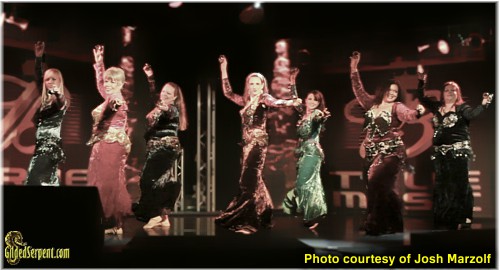
Shimmy Sisters
Shimmy Sisters (Courtesy Josh Marzolf)


Resources:

use the comment box

Have a comment? Use or comment section at the bottom of this page or Send us a letter!
Check the "Letters to the Editor" for other possible viewpoints!

Ready for more?


Gilded Serpent presents...

From Obscurity to Mainstream

The American Journey of the Afghani Dress

Afghan dress

by Suzanne McNeil
posted December 19, 2013

Since the 1970s (and still today), I have always had an intense fascination with the Afghani dress.  Its brilliant colors, intricate embroidery, and lush fabric combinations made it one of the icons of the 1970s . If the number of vintage Afghani dresses available on eBay today is any indication, there seems to be a resurgence of interest in collecting these gorgeous dresses.

My first exposure to the Afghani dress came as an indirect result of studying belly dance.  There were no stores for belly dance costumes, and therefore we made everything ourselves.  This was not a foreign idea due to the huge interest in handcrafted clothing at the time.  Thus, we found ourselves pouring over books about the traditional clothing of the Middle East for inspiration.

A traditional Afghani dress is made of mostly rectangles consisting of a highly decorated raised bodice, long gathered skirt, and elaborate wide sleeves.  Dresses are usually pieced together as patchwork using various fabrics like printed cotton, silk, challis, and velvets.  Embellishments are embroidery with silk or cotton threads, beading, coins, beaded tassels, and ribbon trims. 

Afghani hand embroidery is famous for its intricacy and vibrant hues.

None-the-less, there was a huge number of variations available based upon different region’s ethnic styles and the uses for which a dress was made.  Some were specifically for weddings and celebrations, and others were created for everyday use.

Hand-made dresses for personal use were rarely sold.  They were passed down from generation to generation, repaired and embellished as time passed.   Families only sold dresses like these if there were hard times and money was needed.  Vintage hand-made Afghani dresses are very expensive and are sought out by collectors of fine vintage clothing.

As demand grew, machine embroidery began to replace some of the hand embroidered designs.  There was a distinct difference between the hand-made dresses made for personal use and the dresses made by sewing machine for export. 

Because machine made Afghani dresses became more and more prevalent and available, they began to be used by the people of Afghanistan, and not just for export.   Dresses that combined both hand worked embroidery and patchwork with machine embroidery became common in the 1970s and continue to be available today.

Interest in Afghani folk clothing and designs began in the late 1960s due to the influence of the hippie generation.  As this fascination with folk arts developed, mainstream America took notice.  Along with the granny dress, maxi dress, and peasant dress, the Afghani dress was a perfect addition to our wardrobes.

By the 1970s, and some historians say even earlier, dressmakers and manufacturers of clothing in Afghanistan and other Middle Eastern countries took notice of America’s interest in all things folkloric.  Suppliers began to commission dresses to be made especially for export or for tourists.  In the US, even small boutiques commissioned these dresses.

Once the Folkwear Pattern Company introduced the Afghan Nomad Dress pattern during the mid-1970s, Americans started to create their own versions. My mother, Samira (Sarah Munro), a very well known vendor of belly dance costumes, made the Afghani Nomad Dress one of her main items for sale.  Her designs became a favorite of dancers across the US, and dresses with the Samira Costume Maker label are considered very valuable today by vintage collectors.

Photo 1: (top of page) Dress for Annella

Photo courtesy of Sarah Munro.  Model:  Annella Frantz.   My mother considers this one of her best Afghani dresses.  This dress was custom made for Annella Frantz in 1982.  Its rich patchwork colors, pyramid designs, embroidery and trims shows off her talent as a designer. The scooped neckline was an American adaptation used both by my mother and other designers and manufacturers of the dress to appeal more to American tastes.

Afghan dress

Label

Photo 2 and 3: The Balouch

Dress made for a boutique in Hollywood, California, in the late 1970s called “Balouch“. Balouch is a variation of the name “Balochistan”, a province in Pakistan on the border of Afghanistan.

Afghan

detail


Photo 4-5: Old Dress

This Afghani dress is from the city of Quetta, Pakistan.  The seller stated that this dress was at least 80 years old.  Upon inspection, I suspect that parts of it are original and additions were made over the years, as is the custom.  Dresses like these were for weddings, celebrations, and dance performance.  This dress is a fine example of a type that has both machine and hand embroidery.  This dress is extremely heavy with lots of metal coin across the bodice. This variation has a pocket on one side of the velvet skirt embellished and framed by beads and embroidery.

Quetta is located in northern Balochistan province near the Durand Line border with Afghanistan and close to the province of Kandahar. Quetta has served as a trade and communication center between Pakistan and Afghanistan for a very long time.During the Soviet invasion of Afghanistan from 1979 through 1989, many refugees fled into Pakistan by way of the mountains into the city of Quetta, which may be the reason why many vintage Afghani dresses found today come from this region.

Everyday Dress

Photo 6: Everyday Dress

Vintage ‘70s dress made in Afghanistan with lots of patchwork.  The patches are squares, diamond, and triangle shapes embellished by machine embroidery.  Lovely hand embroidery decorates the front of the bodice. This dress was made for everyday use.  The seller told me a woman from the US who worked and traveled throughout the Middle East for 40 years originally purchased the dress.  The dress is estimated to be at least 40 years old.

As with most fashion influences that become mainstream,  the interest  in folk clothing faded after about 10 years.  The Afghani designs were adapted into dresses made here in the US, then re-designed again, and finally so diluted as to be almost unrecognizable to the observer in the dresses that followed in the early 1980s.

As for today, the interest in the beautiful Afghani dress is on the rise again.  There are many opportunities to buy a vintage dress on eBay, Etsy and other websites.  The cost of one of these can range from $59 up to many thousands for a museum-quality piece.  These dresses usually come “as is”, needing repair and difficult cleaning.  One of my own recent purchases shown in Photo 4 and 5 came to me reeking of perfume, smoke, and sweat.

There is a deep and satisfying feeling from creating hand made embellishments. If you are interested in making your own, a lot of books from the 1970s and beyond are available to inspire your creativity and many include instructions on sewing and making your own patterns.

My book recommendations:

  1. Exotic Needlework with Ethnic Patterns, Techniques, Inspirations by Donna Z. Meilach and Dee Menagh.  C. 1988
  2. Embroidery from Afghanistan (Fabric Folios) by Sheila Paine.  C. 2007
  3. Ethnic Costume – Clothing Designs and Techniques with an International  Inspiration by Lois Ericson and Diane Ericson.  C. 1979.
  4. The Afghani Nomad Dress pattern itself has lots of suggestions for embellishments that come with the pattern.  In addition, there is a “recommendations” section on the website with hints to make your experience go smoother.  See Folkwear.com.


Resources:

use the comment box

Have a comment? Use or comment section at the bottom of this page or Send us a letter!
Check the "Letters to the Editor" for other possible viewpoints!

Ready for more?


Gilded Serpent presents...

Bellydance & Baklava in Ohio

A Family Business Devoted to Great Food and Belly Dance for Over 40 Years!

Sherena and her boss

by Elianae Stone
posted December 18, 2013

Young SherenaI had unexpected fun visiting the Desert Inn in Canton, Ohio, recently and enjoyed watching Sherena, the professional belly dancer, dance. The Desert Inn is a family operated business that opened in 1970, specializing in exceptional food with an Arabic flair in a comfortable atmosphere. The owner, Mark Shaheen, has been a fan of the art form of belly dance, and the Desert Inn has a long tradition of featuring live belly dancing at the restaurant every week. Mr. Shaheen, a kind, welcoming fellow, spoke to me briefly about the Desert Inn.

“We have the longest-running weekly belly dance show in Canton”, he mentioned, and pointed out that other notables in the business, like Tanya Papovich of Project Belly Dance fame, danced there. Sherena had a splendid start as a bellydancer, with her mother also being a professional dancer, and starting her early in restaurant entertainment. When I asked Sherena (who was on a brief hiatus between sets) how long she had danced there, I could not help but be impressed by her answer: 21 years! It says a lot for a business to have such loyalty to their talented dancers, and a lot about Sherena’s experience and tenacity in the art form.

“Dancing at the Desert Inn has brought so many experiences that have been valuable to my performing career!” said Sherena, “everything from interacting with customers, to how to handle costume or prop glitches, and also making beautiful memories with families who continue to return during the holidays, anniversaries , birthdays, etc.. I have been told that they have been continuing to attend my performances and have photos from each year from when I was twelve years old until now! Although stage performances and restaurant performances are two different ‘animals’, I will say that the weekly performing experience really helped my career to grow, and the memories I have made growing up with this unique restaurant are priceless!”

Indeed, many have captured pictures of Sherena performing as a young girl and still look forward to her shows every week. It is a rare treat to be able to see live shows on a weekly basis, and the Desert Inn has carried on this tradition in a beautiful way. Anyone stopping by the Canton area on a Friday night should come enjoy the ethnic atmosphere, tasty food, and live dancing!

Resources:

use the comment box

Have a comment? Use or comment section at the bottom of this page or Send us a letter!
Check the "Letters to the Editor" for other possible viewpoints!

Ready for more?


Gilded Serpent presents...

Deep Study of Dance with Culture for 20 Hours!

Yasmina Ramzy’s Crash Course, August 2013

Yasmina Ramzy by Nomad Baker

Workshop Review by Diana Diane Adams
posted December 11, 2013

Workshop held August 16 – 19, 2013
If you have never studied on an in depth level with Yasmina Ramzy of Arabesque Dance Academy in Toronto, Canada, you are in for a real treat! Yasmina offers two 4-day, 20 hr. dance intensives yearly, one for Beginning/Intermediate level, and one for Intermediate/Advanced level.  I opted for the latter and was not disappointed.

Yasmina has the largest school for Middle Eastern dance in Canada.  It’s located in the trendy Church St. village, just a 10 minute walk from the heart of downtown Toronto.  Hotels and eateries abound in this lively area.  The studio is in a compact space that houses two dance studios, a main reception and boutique area, costume storage and changing room. Her administrative staff is friendly and helpful. In addition to herself, Yasmina employs 12 teachers that drill students in every phase of the dance, from the foundation level on up to advanced professional.  She has several different troupes which showcase each skill level plus her pro dancers that perform in major productions.  She has a dedicated world-class Middle Eastern orchestra that is unsurpassed.


The intensive is 4 days, 5 hours per day, with one of those hours being devoted to studying the culture and viewing videos of famous Egyptian dancers. Um Kalthoum was featured, and it was interesting to learn why the Egyptian people view her as such an icon.  She was not only involved musically, but politically in trying to shape Egypt, and was respected by rulers.  After her music was banned at one point, the head of Egypt had her music immediately reinstated on national radio. Yasmina is a wealth of information having danced and lived in Egypt from an early age.  There were nine of us and each received individual attention and correction on everything from basic to advanced moves.  Yasmina said her pro dancers regularly take foundation and beginning classes to perfect technique. 

Check your ego at the door and be prepared to learn true Egyptian technique and correct what you’ve been doing incorrectly for years.

Each day consisted of a different program that consisted of warm-ups, classic moves with a twist or different way of presenting them, folkloric dance, finger cymbals, and work on a choreography.  The choreography we learned was from one of her recent shows to a song by Farid Al Attrache that had the interesting addition of a trumpet in the score.  It was a beautiful piece, and I wish I could have seen her troupe perform it in the September gala. Yasmina’s classical interpretation followed the trumpet notes and was engaging. It had a twist of modern moves and directional changes and the piece was mesmerizing to the audience.

Yasmina Ramzy includes video study of Cairo dancers. Photo by Angelica JordanParticular attention is paid to executing certain moves Egyptian-style, such as shimmies generated from the knees instead of the butt.  One class offered 11 different ways of steps walking backwards, different versions of arabesques and interesting arch and contraction combos.  On another of the days students have the option of taking 3 classes of their choice from one of her instructors.  Even though I’ve been dancing for close to 30 years, I chose a Beginning Level Movement class from Krista who gave gentle corrections on the most basic of moves such as hip circles, etc.; a Beginner Level II drum solo choreography taught by Deb, with moves geared exactly to that level; and an advanced combo and choreography session with pro troupe dancer Melissa.  The class was challenging with many directional changes and turns.  Both Deb and Melissa kindly sent us what was taught on You Tube.  Each day we studied culture which featured the famous Egyptian singer Um Kalthoum, her life and work, and viewed videos of famous dancers such as Soheir Zaki, for styling and technique.  On the last day, participants are asked to improvise to two different pieces of music chosen by Yasmina.  Those watching anonymously describe their impression of the dancer on a piece of paper which is folded and put into an envelope for each dancer.  This gives one a birdseye view of how your dance appears to an audience which was unique and helpful.

I would advise anyone who decides to take these intensives to prepare your muscles for hard work prior to taking the classes.  Bring aspirin and muscle rub if you aren’t used to training that long each day.  I was whipped after the first 2 days, but by the 3rd day, I started gaining more stamina and my muscles felt more limber giving me more flexibility.

This is an excellent experience for anyone who wants to brush up on and perfect technique and take their dance in a new direction.  As Yasmina said, at a certain point there are no “new” moves.  But you can give them a different twist and presentation.  She delivered high quality instruction and we all came away with a new perspective on the dance and culture.  Who could ask for more? 

Resources:

use the comment box

Have a comment? Use or comment section at the bottom of this page or Send us a letter!
Check the "Letters to the Editor" for other possible viewpoints!

Ready for more?


Gilded Serpent presents...

Part 2: From Abu Dhabi to Sulimaniya to Stockholm

In Search Of The Iraqi Kawleeya

Map of Iraq

by Amani Jabril
posted December 5, 2013
Part 1 of this series here

The flight from Abu Dhabi (1) to Erbil is just around two hours. Now headed towards Iraq, I find myself back on the path in search of the Kawleeya. Most dancers I know call this dance of exuberant hair tossing and rhythmic, jumping steps “Kawleeya”, after the people from which the dance comes. I find the term a bit problematic. Though our intentions are to reference a specific dance style, we generalize in our use of the language. Using it in this way, by simply saying “Kawleeya”, could either refer to the dance or to the people. It can become difficult to differentiate who or what one may be talking about. In addition to this potential confusion, and while it may not seem particularly noteworthy, but in using a generalized term, we also inadvertently essentialize the subject matter. In doing, we aid the reduction of an entire culture. I have heard many terms used for this particular dance. These include the Kawleeya, Ghajar and Haja’a. Hopefully my time in Iraq, will allow me an opportunity to gain greater insight into this and other aspects of the dance.

Flying east towards Iran and then north along the eastern coastline of the Arabian Gulf, the short flight feels like an epic journey taking me far away from anything I’ve ever known before. Situated in the far northeastern part of Iraq, Erbil is the fourth largest city and the bustling, concrete and glass capital of the Kurdistan Region of Iraq. Though we will spend some time here, Erbil is not our final stop. Once my husband, Meriwan, and I land, we will make our way by car through the mountains to his hometown of Sulimaniya. “Suli” is also one of the four largest cities of Northern Iraq and a major regional nexus for the arts. The city sits nestled in the palm of the Gyoza mountains, just around two hours away from the Iranian border. Not only is the city of Sulimaniya a world away from my home in Atlanta, Georgia, but anyone with a map in front of them can see that it sits in the far northeastern region of Iraq where ethnically Kurdish people form a prominent majority population.

Where is the “Kawleeya” rooted? With which people? What country or city?

To most, Suli must seem like an ill-suited place to research the dance or the Kawleeya people since Kurdistan is quite different both culturally and geographically from the southern coastline of Iraq and cities like Basra that have long been associated centers of the Kawleeya. Throughout their history, Dom(2) groups in the Middle East have been mostly nomadic, moving widely throughout the region. Though difficult to pinpoint in history, the Dom have become increasingly sedentary in modern times, often settling temporarily or more permanently in urban centers and their surrounding areas. Within Iraq, groups of Dom have generally been found, though not limited to the areas of Basra, Baghdad, Erbil and Dohuk(3). Well-known for their work as entertainers and reputed as alcohol sellers and prostitutes, the Dom became an associated symbol of the decadence and corruption of the Baath party under Saddam Hussein (4). After the collapse of the regime, many Kawleeya have come under attack, forcing most to flee to the North of Iraq as well as to neighboring Arab countries (5).

“Throughout their travels in Iraq, El Kawliya incorporated and fused elements from various music and dance forms they encountered in the different areas of Iraq.” says Assala Ibrahim-Amani (5)

Locating the Kawleeya within a specific geographical area is helpful in that it does give us some insights into the catalogue of movement styles from which a dancer could draw inspiration. Yet at the same time, it is important to recognize the critical role that the migration of peoples has played, how it has impacted the culture of the Kawleeya and, in turn, how it has impacted the dance. Assala Ibrahim explains, “Throughout their travels in Iraq, El Kawliya incorporated and fused elements from various music and dance forms they encountered in the different areas of Iraq.” Assala, a dance ethnologist and native of Basra goes on to say that, “…they adopt the Hajaa dance when they go to the south of Iraq, or the Chobi dance when they go to the west.”(5)

You may remember that my first encounter with the dance was not in Iraq at all, it was in Abu Dhabi in the United Arab Emirates. Today, Kawleeya is being performed around the Khalij (7) and elsewhere in the Middle East including Syria. I personally have encountered Iraqi dance and the Kawleeya in a number of surprising places like the cabarets in Beirut, Lebanon; a hookah lounge in Dallas, Texas; not even to mention the growing presence on the Internet. The Kawleeya is now here in Sulimaniya, in the nightclubs alongside the Raq Sharqi. It’s places like this that attract my interest more so than any other. Some scholars focus their attention on the history of a dance or perhaps its musical traditions. For me, contemporary constructions of ethnic identity and negotiations of the expressions of those identities are truly fascinating.

As such, it is my belief that engaging the process of negotiation and looking at the variety of steps individuals and groups take to adapt and express culture yields a great deal of information. This information can be incorporated into the way we construct, teach and perform dance.

In this line of thought, if it is the case that the Kawleeya incorporate elements from the musical and dance traditions of other cultures it encounters, one has to wonder how the dance might adapt as it moves in to the cabarets of Northern Iraq and points beyond like Europe and the United States. Even as we speak, we are witnessing the Kawleeya, as a popular dance form, extend its reach far beyond its origins with the Dom, beyond Iraq and the Gulf, even beyond the bounds of the Middle East.

“In Russia and the Ukraine,” notes Lauren Zehara of Bellydancestuff.com, “Iraqi Kawleeya has become a popular competition and performance style. Ukrainian dancers on YouTube have been the ones to bring this dance style into public awareness. But their Kawleeya style differs from what is done in Iraq.”(6)

While it seems that the Kawleeya incorporate outside influences into the dance, I look forward to seeing what dancers, like myself, with no ethnic roots or geographic ties to the Middle East or to the Kawleeya will, in turn, add to the dance. As exemplified by the performances of Ukrainian and Russian dancers, you see a great deal of traveling, emphasis on acrobatic backbends, and a Western dance influence in the arms and posture(8). In similar fashion to the ways in which the Raqs Sharqi was incorporated and diffused around the world, it remains to be seen how this highly proliferated form of the Kawleeya may impact the look and feel of the dance as a whole.

In the forthcoming third part of this article, let’s take a look at YouTube and its impact on the teaching and learning of the Kawleeya. I will share how and why I got started trying to learn to dance the Kawleeya as well as some of the pitfalls I have encountered in doing so. Further, I’d like to discuss some of my challenges moving into the realm of teaching the dance. Hopefully, dear reader, you will recognize some of these same success and challenges in your own experiences, and together, we can help each other develop our collective understanding of the Kawleeya. Until then, goodnight from Sulimaniya!


Resources and Footnotes:
  1. 1 – Abu Dhabi, United Arab Emirates
  2. 2 – Dom – While many Gypsy communities began referring to themselves as Rom or Lom, particularly in Europe and North America, the word Dom is still used by the Gypsy populations of the Middle East and North Africa. Because of the diversity of location and cultural integration, over the years the Gypsies have taken on many other names, including Barake, Nawar, Kaloro, Koli, Kurbat, Ghorbati, Zott, and Zargari, for tribal references and derogatory usage. Today, Dom communities reside in Cyprus, Iran, Iraq/Kurdistan, Afghanistan, Uzbekistan, Syria, Lebanon, Jordan, Israel/West Bank/Gaza, and Turkey. – From “The Domari Society of Gypsies in Jerusalem” http://domarisociety.wix.com/domari-society-website#!
  3. 3 – Field notes, Amani Jabril, August 1, 2013
  4. 4 – “In Now Religious Iraq, no Tolerance for Gypsies”, philly.com http://articles.philly.com/2005-06-06/news/25437182_1_sadr-muslim-koran
  5. 5 – Assala Ibrahim “Iraqi Gypsy Dance: A Journey In Search of El Kawliya” http://www.youtube.com/watch?v=YWOZcdJwOXM&feature=share&list=UUsxkRvwoOqPzz6qLN3v8O1Q [embedded in page above]
  6. 6 – Lauren Zehara, “Bellydance Styles: Iraqi Kawleeya (Gypsy) Dance”, bellydancestuff.com http://www.bellydancestuff.com/styles-kawleeya.html
  7. 7 – Khalij – An Arabic word meaning a "gulf". In this case, I am referring specifically to the Arabian, or Persian Gulf.
  8. 8 – Lauren Zehara, “Bellydance Styles: Iraqi Kawleeya (Gypsy) Dance”, bellydancestuff.com http://www.bellydancestuff.com/styles-kawleeya.html

use the comment box

Have a comment? Use or comment section at the bottom of this page or Send us a letter!
Check the "Letters to the Editor" for other possible viewpoints!

Ready for more?