Gilded Serpent presents...

Cairo Now

The Post Revolution Entertainment Scene in Egypt

Protest at the Cairo Opera house

by Leila Farid
posted 11-20-13

As I sat in the Gomhoreya Theater the other day waiting for the ballet to start, I felt happy just to be there. Only a few short months ago, the dancers and staff had been on strike. They were demonstrating against a statement by the former Islamic Minister of Culture, calling the ballet “nudity” and “indecent” and proposing to eradicate it all together.

As I watched the gorgeous rendition of the old folk tale “Ayoub wa Nassa” by the Opera’s Forsen el Shar’a Ensemble, I couldn’t help but think of how close Egypt came to going down a road where dance, secular literature and film may have become dinosaurs of the past.

Since the massive demonstrations that lead to the ousting of Islamic president Mohamed Morsi, Egypt breathed a short sigh of relief. The two kilometer long gas lines are gone, the cost of electricity has been cut by at least half (and it actually works-no more day long power cuts), and water comes out of the tap when you turn it on. Essentials have been restored which make daily life easier. The sense of lawlessness that permeated the streets during Morsi’s presidency is gone. The police are back and the military is a presence again with the majority support of the people.

Now starts the long and grueling rebuilding of the country. Writing a new constitution, managing effectively the countries resources, establishing social programs and minimum wage, addressing the gas crisis, organizing a new and fair presidential election are just a few of the problems facing the interim government. Also the followers of ex-president Morsi did not go quietly. There are incidents every few days where Morsi’s followers retaliate for what they saw as a coup. The universities are hot beds for clashes between students who supported Morsi and the students who support his ousting.

For artists, we lived a very long year under Morsi’s presidency, wondering when and where the axe would fall and would it be our art form that was next on the chopping block. Tax cases were brought against most working dancers in Egypt and even those who had retired or returned to their own countries. The Islamists did not stop us from working but they made us pay for being dancers, literally.

It would have been hard to find a dancer in Egypt who didn’t celebrate the exit of Morsi and his government.

Just as the threat to our art form from the Islamists is gone, we face another one, economics. For dancers in particular, the elation at having a secular government has been replaced with the numbness of the dry spell that is already upon us.

Lynette had asked me when I was in the States over Ramadan last Summer, to update the Cairo clubs page, which was originally added in 2007, and updated in 2009, investment and industry has given people hope that this summer things will start to turn around. But the winter we are facing is long and cold.

Hopefully some of the restaurants and nightclubs that featured dancers will reopen or new ones will take their place. It is hard to imagine an Egypt where dance is not a big part of Egyptian entertainment. Personally, I don’t think Oriental dance in Egypt will die. I think it just has to sleep for a while before being awakened by the handsome prince of tourism and a stimulated economy. Maybe in the months ahead there will be a new beginning for raqs sharki; I have hope!

Leila performing in a Cairo Club

Current Clubs and Dance Venues in Cairo

Amoun Cabaret Shakira
Aquarius Cabaret Aziza, Shakira
Grand Hyatt Boat – Folklore Show only
Intercontinental/City Stars Fairooz Restaurant – Thursday nights only, Soroya
Memphis BoatLuna
Marriott Zamalek Outdoor Tent and Nightclub – Worked on and off after the revolution. Closed since early 2013
Meridian Haram Outdoor – Closed after the revolution
Merryland Outdoor – Closed from 2010
Mena House Nightclub/Restaurant – Closed after the revolution
Nile Pharoan Boat – Working one cruise a night if they have reservations Magda Monti, Mona Ghazi
Nile Maxim Boat – Working one cruise a night (the dancer you see is based on the number of reservation for that night) Leila Farid, Nesma, Noura (dancer on CD)
Parisiana Nightclub – Working, Lucy (by special request)
Pyamesa Nightclub – Closed
Semiramis Intercontinental Haroun al Rashid Nightclub – Worked on and off after the revolution. Closed in early 2013
Sheraton Cairo Aladdin Restaurant – Closed in 2010
Sunset Cabaret – Working Aziza, Shakira, Shams
VIP Cabaret, Nabila Cairo – Working, Safinez

Some more Cabarets that are working in Harem Street – Lido, Hormoheb, Tivoli, Aish al Bolbol, El Leil.
*Cabarets now have house bands. The dancer does not bring her own band with her.

Licensed dancers working in Restaurants, Boats or Cabarets in Cairo:

Aziza (Egyptian) – Sunset, other Cabarets
Kariman (Egyptian) – Haram
Leila Farid (American/Egyptian) – Nile Maxim
Lucy (Egyptian) – Parisiansa (by special request)
Luna (American) – Memphis Boat
Magda Monti (Argentina) – Nile Pharoan
Mona Ghazi (Hungary) – Nile Pharoan
Nagwan (Egyptian) – Cabaret
Nesma (Egyptian) – Nile Maxim
Noura (Egyptian) – Nile Maxim
Safinaz (Russian) – VIP Nabila Cairo
Shams (Egyptian) – Sunset, other Cabarets
Shakira (Egyptian) – Sunset, other Cabarets
Soroya (Brazilian, Egyptian) – City Stars Fairooz Restaurant

Resources:

use the comment box

Have a comment? Use or comment section at the bottom of this page or Send us a letter!
Check the "Letters to the Editor" for other possible viewpoints!

Ready for more?


Gilded Serpent presents...

Tarazade Brings the Bellydance World to Istanbul

Tarazade 2013, Intercontinental Dance Festival

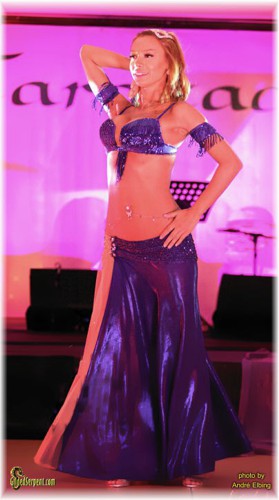
Author Courtney performs

by Courtney
Photos and video by Andre Elbing
posted November 19, 2013

With the rise of YouTube, dancers can learn from master belly dancers from the comfort of their living rooms. The ability to watch and absorb the unique variations and styles of bellydance from all over the world is only a mouse click away. However, in spite of technology bringing the world to us, there is nothing like studying with dancers in person. Festivals provide an opportunity to bring belly dancers together, not only to meet other dancers from different communities, but also to see what styles are popular in different parts of the world and to study with master instructors.

I was fortunate to attend Tarazade Festival in Istanbul, Turkey this September. It was the first festival I had attended outside of the United States and I am pleased to have had the experience of traveling to a festival where dozens of dancers had gathered with, in some cases, only the dance in common. On the opening night, promoter Tara told a well attended room that there were dancers present from 24 countries. The dancer who had come the farthest was from Alaska, but there were dancers from India, Japan, Morocco, France, Germany, Brazil – I could go on.

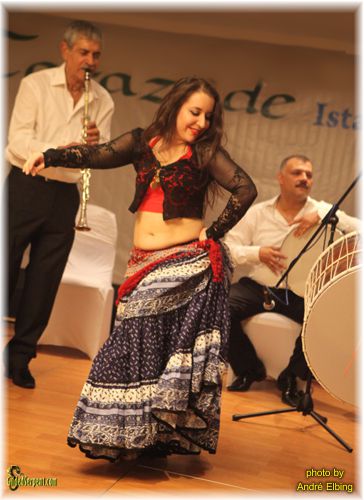
Dancer

Zafirah of Canada performs Turkish Roma at the Welcome Party

I first became aware of the Tarazade Festival from Aziza of Canada, who had attended Tarazade in 2012. I had been to Istanbul before and was excited to have a great reason to go back. After I saw the list of instructors who would be offering workshops, I had all the reason I needed to commit to going: Sema Yildiz, Didem, Azad Kaan, Aziza & Issam Houshan, Jillina, Lulu Sabongi and so many more.

From a participant’s point of view, the set-up was the following: for a flat fee dancers got a hotel room, ten hours of workshops, and entrance into three shows (one of which served dinner). One of the shows was an open stage, where dancers who were attending the festival could sign up to dance in an evening show. Any of the individual elements could be purchased a la carte, including additional hours of workshop time. My husband traveled with me and Tara offered a package for travel companions. There were two hotel options: dancers could stay at the Barcelo Eresin Topkapi, which was where the shows and workshops were held or they could stay at a hotel in Sultanahmet if they wanted to be closer to the old city and tourist attractions. In total, 60 hours of workshops were offered, including topics from Turkish folklore, Oriental, Egyptian to fusion.

I chose to sign up for 10 hours of workshops, opting to do 5 workshops that were 2 hours each to maximize the number of teachers with whom I could dance. I left the rest of my schedule free so that I could have some down time and go see the city. At any point during the festival, I could have visited the registration table to purchase more workshop hours if I had wanted.

The five workshops I attended over four days were challenging and fun, which is what I had hoped. I love workshopping. It’s so much fun to dance to someone else’s rhythm and it’s hard to walk away not feeling inspired.

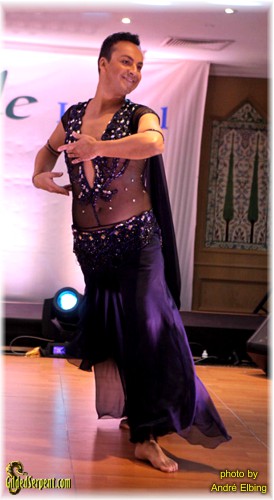
Male dancer

Azad Kaan performs at the Turkish Night Gala

My workshop assortment was with Lulu Sabongi, Azad Kaan, Aziza & Issam, Didem, and Jillina. The workshop menu included a description of the topic as well as a level indication, so that dancers could choose their challenge level. The instructors kept the level of dancing high and in line with the advertised level.

The focus at this festival was not only the joy of dancing, but also learning and growing as an artist! Tarazade offered an opportunity to get performance feedback without the added pressure of competition through the “Train With the Stars” option, which I wish I had done. Dancers who signed up and paid the extra fee would perform for Aziza, Jillina, and Azad Kaan for detailed and personalized performance feedback and critique. As a student dancer or really any level of dancer, the feedback from world-renowned artists is invaluable, and it’s a unique feature of Tarazade to give student dancers close access to established dancers and a vehicle to improve in a personalized setting. In addition to this specific workshop, other instructors offered in-depth feedback to attendees of their workshops.

The evening shows were great and well balanced in terms of content. Although they sometimes ran a bit late into the evening given the long days and early mornings, the level of dancing was high. The opening night gala and Turkish night show featured performances from many of the instructors who had come to Istanbul from all over the world. Every performance, from the elegant style of Lulu Sabongi of Brazil to the energetic bravado of Luxor of Russia, was a reflection of each dancer’s art and individual influence. At the Turkish Night Gala, Tara honored Sema Yildiz and Didem with the “Belly” award, which was to show gratitude for their contributions to the art form of belly dance.

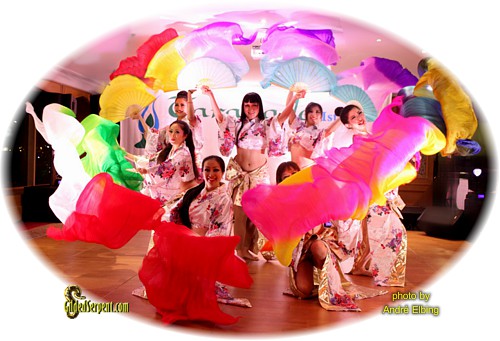
Fan Troupe

Nicole Group from Japan performs at the Opening Gala

Tara also organized an optional dinner cruise down the Bosphorus on the evening that there was not a show. I did not attend, but the feedback from the other dancers was that it was a memorable evening with folkloric dance and, of course, belly dancing.

No belly dance festival would be complete without shopping! Several Istanbul-based designers came to the festival to sell their costumes and many dancers took the opportunity to try on and buy something sparkly.

Not to be overlooked was the inclusion of Turkish music and folklore in all of the shows. At the welcome event, the opening gala and the Turkish night gala, spectacular musicians and Turkish dancers entertained the audience. Seeing such fantastic Turkish Roma dancing was truly inspiring and my biggest regret from attending this festival was that I didn’t attend a Turkish folklore workshop.

In addition to the amazing instructors, the energy amongst the other dancers was welcoming, energetic and inspiring and I felt that I left the festival with many new friends. I enjoyed watching the other dancers and troupes who came from around the world to learn and perform. The open stage is a great aspect of Tarazade. Any dancer who wanted to perform while in Istanbul had the opportunity to sign up to dance on the open stage. Many dancers wanted to dance and I understand that there was a waiting list. While it may be tempting to add more open stage dancing during the day in future festivals, as a performer in this show, it was quite nice that the open stage was an evening show where attention was not taken away from the performances by other workshops or vending. All levels of dancer performed from experienced professionals to one lovely woman who performed her first solo on the open stage.

My experience at Tarazade was overwhelmingly positive – I found the level of organization and the high level of instruction and performance to be extremely appealing to me. As a teacher, I would recommend Tarazade to any level of dancer because of the wide variety of stylistic offerings and also the inclusion of leveling information in the workshop descriptions, allowing for dancers to study at his or her appropriate pace.


unknown dancer
Oya Isboga sings at the Opening Gala

MC

Promoter and Festival Organizer Tara MCs at the Turkish Night Gala

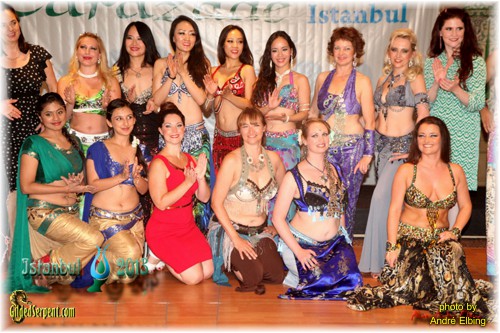
Group pose

Performers at the Open Stage:
 back row: 1-Tarazade Promoter Tara, 2-Milka, 3-Nini, 4&5-duo Lee and Kim, 6-Meena, 7-Katherina, 8-Elmira, 9-Courtney;
front row: 1&2-duo Sama and Sara, 3-Helene of Norway, 4-Audrey, 5-Nahid Safija, 6-Perle.
Jillina
Jillina performs at the Turkish Night Gala

Tribal assiut costume

Patricia Zarnovican performs at the Turkish Night Gala

Rainbow Veil

Lulu Sabongi performs at the Opening Gala

Dude 2

Nikolas Kazakos performs at the Opening Gala

Pink dancer

Didem performs at the Turkish Night Gala

Sema Yildiz

Sema Yildiz performs at the Turkish Night Gala

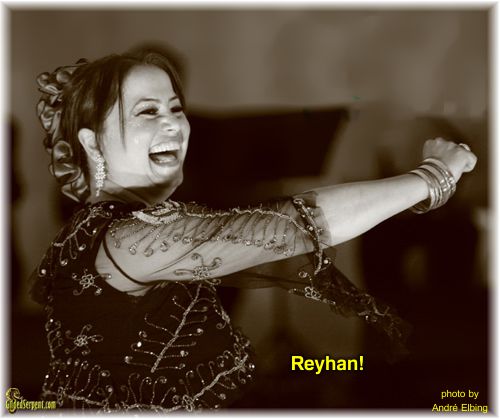
Reyhan

Reyhan performs at the Turkish Night Gala

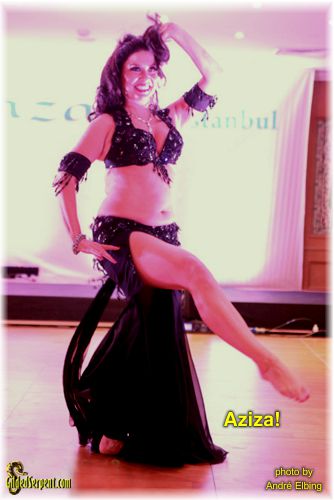
Aziza

Aziza performs at the Opening Gala

Issam

Issam Houshan performs at the Opening Gal

Andre Elbing‘s video collage from event
Resources:

use the comment box

Have a comment? Use or comment section at the bottom of this page or Send us a letter!
Check the "Letters to the Editor" for other possible viewpoints!

Ready for more?

  • Gigbag Check #44 with Courtney
    Courtney is an award-winning bellydancer based in the San Francisco Bay Area. She dances solo, in a duet and a troupe. She participates in many of the bellydance competitions in the community. She is also a musician! Don’t miss the bonus footage at the end with Courtney and her teacher Sandra!.
  • Soloists, Belly Dancer of the Year 2013 Photos
    The goal of BDOY is to give qualified dancers a fair and equal opportunity to exhibit their skills, as well as promote and elevate the art of belly dance and support its amazing community. Khalilah wins!
  • My Favorite Oriental Festival in Turkey, Rakkas Istanbul 2013
    I immediately made new friends and was surprised to find the multi-national composure of our 200+ people crowd – I befriended a dancer from Holland and another from Columbia, although the majority of the dancers were from Japan and other far-east countries.
  • Dancing for Tourists in Istanbul, A Personal Impression
    Additionally, their friendly and respectful relationship was highlighted when she finished her show, dancing to each instrument separately, and in this way she introduced each of the musicians. Such a relationship between dancer and musicians is not widely seen in today’s restaurant atmosphere… unfortunately
  • Turkish Dance DVDs: For the Birds? Danceuse by Asena" and "Sema Yildiz: Turkish Belly and Gypsy Dance"
    I enjoyed her Roma dancing the most and felt that it would be amazing to watch Sema in person to experience all the facial and tiny pelvic movements.
  • Sema Yildiz, A Star of Turkish Dance
    She was fortunate, she says, to grow up in a Roma (Gypsy) community rich in dance and music – the Fatih district, which houses the Sulukule, famous for its entertainment and considered the oldest Roma settlement in the world.
  • How I Met the Tuzsuz Family in Istanbul
    As for taking lessons with her – her teaching has improved over the years and her repertoire has expanded (although her large movement base was what attracted me to her as a teacher in the first place, so it has always been extensive).
  • Turkish Shop ’til you Drop
    The Grand Bazaar in Istanbul is the Mother of all shopping malls and covers over fifteen acres.
  • Of Hamams and Bathing
    The attendants giggle while dumping scalding hot water on the screaming, howling clients.
  • Orient House Istanbul
    Despite fears about our security from friends, everywhere we went in Turkey, we met with nothing but perfect friendliness and assistance.
  • Helm Istanbul’da Making Music in Turkey
    We discovered Turkish classical music through our friend Sinan Erdemsel. To the dellight of many music lovers, he has been coming to teach at Lark Camp in Mendocino, California, for the past 10 years.
  • Adventures in Turkey 2006
    I am not exaggerating when I say that Sandra actually threw herself into Bella’s arms and wept when she first laid eyes on her.
  • Turkish Bath House (Hamam 1)
  • Turkish Bath/Hamam 2
  • Kayla’s Travel Journal Continues–Hamam III
    At that point the steward says "now" and you jump off.
  • Turkish “Roman Gypsy Dans”, Melting Any Heart!
    This dance of the Gypsies is about becoming a life-like character. It contains a wide range of moods and feelings for the dancer to express: The gray quality of everyday tasks turns into colorful dance that does not distinguish between the relative value of one color over another.
  • “Relax! Listen to the Music” Ahmet Ogren, Istanbul May 2012: Study at the Source,
    Aside from Ahmet’s satisfying performance and the professional live music, the local Romany festival-goers were quite proud and eager to show off their own dancing skills. Their enthusiasm was contagious so the locals invited one of our dancers to dance with them in front of the stage, a highlight for any dancer.
  • Whirling, Meditation in Motion or Spectacular Show?
    A dance could not be any more contradictory. The Whirling dance lingers between spectacular showmanship and meditation in motion; it combines trance and technique. It is a surprising paradox, unified like lovers within the dance.
 

Gilded Serpent presents...

Exploring the Essence


Dancing to Live Music

Zizi Mustafa joining us on the Camp Negum Cruise 2013 from Luxor to Aswan Egypt. Jan 23-28

by Safaa Farid
Translation by Leila Farid
posted November 4, 2013

When I was young and first started to sing, I was afraid to work with a band. It took months before I felt comfortable sharing my feelings, my interpretation of the song, with an audience. I had only heard the great singers like Abdel Halim and Om Kaltoum on TV or the radio. It was hard to recreate their renditions, much less relay the essence of what the songs made me feel! In front of a band I discovered I wasn’t as great a singer as I thought I was. I was fine singing for my friends in the street, but with a band I was lost. Luckily, I met a great oud player here in Egypt who helped me out. He said my voice was good but without feeling. He told me, among other things, that I should listen to the great songs and feel the words before I sang them. I should listen to the original recordings, then make them my own. He also taught me the following:

  • Find your own tonality – which is not necessarily what the original singer used. Make the song fit your voice. You shouldn’t have to strain to reach a note.
  • Develop a good rapport with the band. They must want to make you sound good.
  • You set the tempo, with your audience in mind, according to your interpretation of the song. If the guests are classic and expecting a song from Abdel Wahab, I will give them something close to the original version. But if the guests are young and dancing, I will push the tempo to make it more accessible for them.
  • Most importantly, convey a message or a story. The Greats share a life story – of the love who still loves them, the love who left them, the love they’re awaiting, or the one who took their love from them. They share this story with the people who witnessed their relationship, or to those who only knew them after the relationship ended. The story is also specific to the listener. Singing a song to your beloved is different than singing to a third party and asking them what they think about the situation. It will evoke different emotions as the audience compares it to their own lives. The Greats sang about common experiences, but not everyone could express them with such eloquence. This is the challenge: Enable the audience to deeply experience these all too common emotions.

Everyone knows what it feels like to be separated from a loved one. In 1940 So3ad Mohamed sang in the song “Wahastini” (I miss you), “As much as there are stars in the sky.” In the 1950’s Om Kalthoum sang “Ana Fintizarak” (I wait for you) describing the malaze she fell into while waiting forever for her lover. Still today, when a singer sings these songs, we flash to the time when we missed someone so much that waiting one more minute for their return was torture. It is not the words that matter, but the feelings they inspire.

The process I went through as a singer also applies to dancers. Watching a dancer perform to pre-recorded music does not evoke the same feelings as watching the same dancer perform with a live band.

CDs are only practice tools to prepare for performing with a band. Pre-recorded music is a first step. However, when a dancer jumps to performing with musicians, she must alter her technique and feeling. Working with musicians is different.

All the great dancers worked with live music because orchestras helped them reveal their deep-seated artistry.

Dancing to a CD only reveals maybe 50% of what a dancer can really do.

I want to thank all those who use CDs to teach, as they are the first step. Nevertheless, they should try to give their students opportunities to perform with a band. Then, like me, the student will find that what she learned with a CD will have to be adapted for a live band. She will be afraid and make many mistakes in the beginning. Then she will start to feel the music and become one with the musicians, singer and guests.

Leila dances to her band who watches her intently
Leila and the Band!

A dancer is like a doctor who learns from books – for many years – but then must spend many more years DOING what she learned on (or for) real patients. A good doctor not only has book knowledge, but experience in the field handling a myriad of situations. A dancer must do the same.

First of all, a dancer must respect the band and the band must respect her. Then she must project her personality on stage.

You must have your own style. You can copy steps from another dancer, but not her emotional interpretation. You must have your own. Do not copy the same movements for the same song. You don’t know what she was feeling or her circumstances when the performance was recorded. A dancer must start with her own style, then add things. She must understand what she is doing through good technique and knowledge of the music, culture and audience. When the musicians feel you understand all these things, they will respect you and will try to make you look good.

Just like a singer, the dancer must make the song suit her.

She can set the tempo – to match her mood, her style and the audience. I will never forget the one time I saw Tahiya Carioca dance live. It was the end of the 1990s (Tahia died in 1999 at age 80). I was singing with Zizi Mustafa and we were performing for Warda’s birthday party. As Zizi was dancing, we discovered Taheya Carioca was at the party. She was very fat at the time but everyone was happy to see her. Zizi told me to sing a song for Tahiya to dance to, as a gift for Warda. She requested “Walla ya Walla” (Boy my Boy) from Abdel Gani Sayeed. At this time, all the dancers were performing to this song, so we knew it. Taheya stood up, the guests began to clap and Zizi stepped aside. Tayeha stopped the band maybe 5 times during the song’s introduction to say we were playing too fast. When she finally began to dance, we were playing about ½ the tempo of when we started. She said she wanted to HEAR the music without the tabla making noise. She might have been old and out of shape, but when she danced she imparted her own emotions to the guests. She made the song her own and she was perfect.

A dancer must be free when she dances with live music. Many dancers come to me during festivals and ask me to play their music exactly like it is on the CD. But if the dancer would allow the band to improvise, maybe the tabla might add something better than what’s on the CD. The singer might repeat a verse or a chorus because the audience is happy with her performance. This is better than the CD. I do not agree with dancers who come to me with a beledi progression and want the band to play it exactly like it is on the CD. Why? Because the dancer should inspire the musicians to play what matches her style. Each musician has his own feeling for beledi. When the musician’s style meshes with the dancer’s, the beledi will succeed. She should not be rigid, that is not raqs sharki.

The singer and the band both try to bring the emotional content of a song to life. It is the dancer’s job to do the same. She will succeed if she incorporates her feelings into her performance. When Abd al Motereb sang for Naima Akef “Amel Maroof” (Make Something Good), they played back and forth off each other to convey the song’s message. “You are a gazzel, very good, your dancing eclipses Hollywood, your sweetness is the sweetest sugar.” You feel the words through their performances. This tableau succeeded. We still watch it today.

Abd al Motereb singing for Naima Akef “Amel Maroof” (Make Something Good)

As a dancer you must know what the words mean. That’s the key to understanding the song. I know this is hard for foreign dancers and I take my hat off to them for their technique and style. However, they must understand the words. You do not have to learn Arabic, but obtain a translation and interpret the general idea. Each song has a story, but you won’t be able to tell it until you know what it’s about. Your movements must match the song’s atmosphere. When I watch a dancer twirling, kicking and jumping while Om Kathoum laments “you were the best story of my entire life” it makes me sad. The song’s emotions are completely lost. The song in question, “Ansak” (To Forget You), is more than beautiful, but this frenetic dancer failed to project its power. Some songs may call for twirling, but not all! Raqs Sharki is not about making X number of movements at the same time. It’s about making a movement that translates the dancer’s feelings about the lyrics, the story. In fact, some songs do not require much movement at all. But they do require emotional engagement and facial expressions.

Live music is the foundation of raqs sharki. If a dancer has technique but cannot dance with a live band, she is only 50%. Put a dancer in front of a band and we will make her 100%. Remember Dina performing to “Hyart Elbi” (My Heart is Confused) in the stage play “Ala Banda” (Blah, Blah, Blah)? There was only an oud player and she didn’t travel more than 2 steps. She projected her emotions with simple movements; she acted the song with her body. The tabla followed her and the oud sang. I must say, this is raqs sharki.

Dina performing to “Hyart Elbi” (My Heart is Confused) in the stage play “Ala Banda” (Blah, Blah, Blah)

It took time for me to be able to stand on the stage with a live band without being afraid. It is the same for dancers. It takes time to learn to dance with live music. We are all artists. Throughout my artistic life, when I perform I listen to my audience and learn from them. I am constantly learning. It is a process I have great respect and awe for. It is an enormous honor to give people such a fleeting thing of beauty (with all our different instruments; the musicians, the singer with his voice and the dancer with her body). A song can stir the depths of our emotions, bring tears or warm the heart. This is our charge as artists, and our duty.

Camp Negum

Resources:

use the comment box

Have a comment? Use or comment section at the bottom of this page or Send us a letter!
Check the "Letters to the Editor" for other possible viewpoints!

Ready for more?


Gilded Serpent presents...

Is Love the Drug?

Queen of Denial, Chapter 14

Queen Rebaba on stage, insecure girl peeking out

by Rebaba
posted October 31, 2013

I will tell you a story about a young, talented dancer who was a pretty good entertainer and extremely popular in her particular world of professional belly dancing.  On stage she was a princess, a sensual and sweet Marilyn Monroe-like STAR.  The strong, happy woman she portrayed on stage combined a grace, a sensual vulnerability and an elegant persona that had everyone fooled.  In her world off stage, she was a frightened little girl, emotionally stunted, insecure, who felt lonely and unloved most of the time.  She longe for true love like the kind she saw in the movies.  She wanted this “true love” to be all consuming and passionate, lasting a lifetime, through thick and thin, and much more.  That “no matter what life throws at you we’ll be together Baby” kind of love she swooned over in her perfectly romantic dreams and exactly the kind of romance promised to us via books, magazines and of course the media.  All we needed was the right chemistry and this Hollywood-style type of love would magically appear with a man in tow and we would both instantly know it was perfect and we were meant for each other.  Our young belly dancer believed she viewed this romantic notion of love from the audience as a spectator,  seemingly close but never close enough to grab and hold on to for her own.  Fortunately for her, she was able to capture an illusion of love another way, while on stage where it was given to her unconditionally by her audience.  However, the problem was she believed she only deserved this love as long as she was portraying “Rebaba”.  Therefore, that fleeting onslaught of unconditional love she experienced nightly on stage wasn’t enough to sustain her for very long.  Off stage, as she changed back into her jeans and t-shirt, she also transformed back into a “regular person”, and the power given to her by her audience quickly dissipated leaving her scared and lonely once more.

Every so often a knight in shining armor would appear for this maladjusted princess of the belly dance world.  Her knights usually came into her life courtesy of the venues where she performed.  This circumstance alone should have been a very good reason to steer clear, shining armor or not.  However, this princess didn’t really believe she was special and therefore she had no will power to refuse a knight in shining armor’s attentions!

I lived as that imaginary princess on stage for many years during my young adult life.  She was the “best of me” persona I could imagine and I loved her dearly as she really kept me sane and happy whenever I was performing in her skin.  Too bad I couldn’t have learned a few things from my characterization that might have helped me during my early quest for romantic love.  I know now after many years of mistakes, heart breaks and more life-lessons than I can count that the love I received while performing was enabled by my imagined self-awareness and confidence as Rebaba.  However, off stage, my self-image was completely lacking in confidence, extremely insecure and totally incapable of recognizing and accepting romantic love.  Thank goodness I was able to experience the love my audiences so willingly gave me during the many years of my professional career.  Had I not experienced this love (along with the love of my family and friends to be sure, but, who were far away for much of the time I was dancing professionally), I’m afraid I might have ventured into the bottomless pit of drug dependency much sooner than I did.

My complete drug dependency didn’t begin until I stopped dancing professionally and moved back to my hometown to begin a second career after graduating from university.  As I’m not yet there in my story, I’d rather continue with a joyful moment while dancing professionally in Los Angeles.  To me, the funny and usually one of a kind shows stand up to time far longer than most others.  Therefore, I’d like to recount one of the funniest along with being possibly the best entrance dance I performed at Ali Baba’s in Hollywood.

It was a Saturday night, standing room only in this rather small and low-ceilinged nightclub built to look like Ali Baba’s cave.  Ali Baba’s was one of those incredibly successful Middle Eastern supper clubs that dotted the Los Angeles area during the 60s, 70s, and into the mid-1980s.  I worked the weekends and a couple weeknights which were equally busy at this time.  The band members were all good friends of mine and excellent musicians who played like angels for me during every show regardless of the number of people in attendance. 

However, the truly magical shows happened with lots of help from a loving, generous and ecstatic audience that fueled our individual talents and inspired us to higher levels of performance as a group.

This particular Saturday night housed just such an audience.  I entered to my favorite Egyptian “entrance” music and to an already cheering audience who also loved this music as well as my dancing.  It was hot, smoky and there was a constant din of talking and yelling, glasses clinking and breaking, loud laughter and enthusiastic clapping that blended together to become part of the music and my show.  I danced with all my heart and soul supported by the flow of energy that felt like warm light and love being projected by the standing room only audience.  The musicians played like mighty lions giving off their own roar of delight behind me so that I was enveloped by this wondrous energy of happiness and love.  It doesn’t happen all that often that every musical note, beat of the drum and physical movement seem to merge together to become one.   When it happens a magical and unforgettable show is created; and this particular performance was definitely beginning to feel like one of those special shows.  As the music came to a whirling crescendo I spun myself around the stage ending dead center in a perfectly timed and executed bow.  As the music ended with a thunderous drum beat, the lights went out as I threw my upper body forward and down towards the floor in a simultaneous bow.  My head went speeding downward to touch my knees when something else slammed into my face that wasn’t me.  Yikes, I realized with dread that what had just banged me on the nose was my bra! 

I was wearing one of my favorite Egyptian costumes that was heavily encrusted with beading.  The combination of my extremely fast and furious bow and the weight of the bra obviously unhooked it at the center of my back.  Thank goodness the bra also hooked at the back of my neck as that was the only thing holding it to my body.  As the lights came up I slowly rose and the beautiful melody of a violin solo fill the room.  I realized that I was the only one in the club who knew my bra was unhooked because it all took place in the blackout.  I couldn’t help but giggle at the thought as I began to move to the music and also position myself in front of the oud player who was strumming his instrument happily and completely lost in his own world.  I smiled and called out his name keeping my back to him as I repeatedly asked him to “ re-hook my bra please”.  With cabarets open all over the Los Angeles basin featuring live music and dancers every night, this type of costume malfunction happened every so often and most musicians can tell you quite a few funny stories involving missing and broken pieces of a belly dancer’s costume.  So, I knew if I could get my musician’s attention he would know what to do…I finally did and he began trying to re-hook my bra and finally blurted out that there wasn’t a hook only a loop.  Well, by this time the audience was starting to get curious and was realizing something was going on beyond the obvious music and dance.  Therefore, being the ham that I am, I quickly spun around doing a little dance and showing the audience exactly what was wrong. 

They loved it, clapping, laughing and encouraging me to keep dancing that way! 

I let the audience know that I’d be right back, bowed to my band as I asked them to keep playing and then I ran down the stairs and off the stage towards the dressing room.  I was followed by my good friends: the other dancer and singer who were both yelling at me and asking what happened to my costume?  Breathless in the dressing room I immediately turned around and asked the dancer to fasten my bra.  She repeated what I was told on stage that there wasn’t a hook on the bra.  By throwing my upper body into the bow with such force I evidently exploded the hook off the strap, so now on to safety pins.  Trying to get a safety pin, no matter how big, through thick beading while I was hyperventilating and laughing at my situation was impossible.  Just as I was insisting that the singer must go on stage and start his number, another friend squeezed into the dressing room.  It was the waitress this time, and she had something in her hand that she lifted towards me asking if it was mine.  She said she took it from the middle of the stage floor as she thought it was a piece of pita bread.  Well, it wasn’t a piece of pita bread at all, it was the foam rubber push-up padding from the inside of my bra which must have fallen to the stage floor when I executed that perfect bow!

Rebaba dances in a club
Dancing at Sahara where my second show was a pseudo folkloric number. 
Pseudo in that I tried to keep my costume more cabaret than traditional then added something to balance and danced to great Egyptian folkloric music.

Resources:

use the comment box

Have a comment? Use or comment section at the bottom of this page or Send us a letter!
Check the "Letters to the Editor" for other possible viewpoints!

Ready for more?


Gilded Serpent presents...

Entering the Sufi Spiritual World of North Africa

Sufi Brotherhoods and Trance Ceremonies in the Maghreb
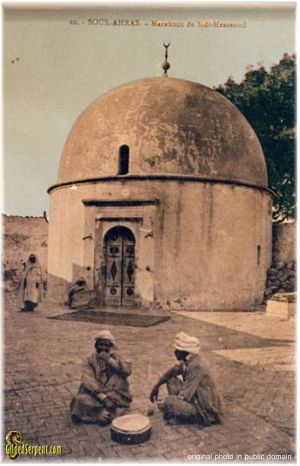
Zawiya in Souk Ahras in East Algeria
This zawiya is in Souk Ahras in East of Algeria, sometimes
people call the zawiya a marabout – they really mean the
saint. It happens that meals are offered to the poor
every Friday of the week, here we see in the middle of
the picture people sitting and eating bread, on the left
of the picture a man is standing, he is the caretaker.

by Amel Tafsout
posted October 20, 2013

Since antiquity the Maghreb has been a crossroad for people, ideas, movements, humanity and spirituality, where Africa meets the Orient. Although Sufism began to be recognized as a distinctive spiritual path in the 9th Century, separate orders or Tariqat didn’t begin to emerge until the end of the 11th Century, and flourished in the region in the 13th Century. Each Tariqa, usually named after its founder, created its own doctrine, traditions and social conventions. Thus the Shadhiliyya is named after Abu al-Hasan al-Shadhili, the Qadiriyya after ‘Abd al-Qadir al-Jilani, and the Jazuliyya after Muhammad ibn Sulayman al-Jazuli, whose influence of North African Sufism began on the wider Islamic world in the 15th-17th centuries. Special attention is given to Jazuli’s attachment to two traditions of international Sufism, the Shadhiliyya of North Africa and the Qadiriyya. These networks extended throughout the Islamic world from Afghanistan to Morocco.

Furthermore, the Maghreb consists of many Sufi-brotherhoods, often recognized and set through their Zawiyas and initiations. Sufis have always worked toward reform through advice and education of the individual and internal purification through providing a model and example of tolerance, solidarity, brotherhood and selflessness removed from anything that would give a bad image of Islam.

Zawiya
This zawiya is also a mosque in the center of Algiers, called Sidi Abd Ar- Rahmane
mosque, it is the name of the saint, people come from everywhere to pay their
respect and have a pilgrimage, as the Saint or Marabout was known for healing
diseases)
Zawiya
This is a typical zawiya located in the cemetary in Monastir in Tunisia.It is common
that people pay their respect to their deceased loved ones and also to the saint of
this zawiya)

However, the zawiya is an Islamic religious school, monastery or a religious site, which groups Sufi followers around a particular sheikh. Sufism is based on the Qur’an and the practice of the Prophet. Sufi teaching stresses mysticism and love of God. Sufism purifies hearts and directs intentions towards God. All Sufi orders have certain specific rules and regulations to achieve this realization, and there are particular spiritual states and stations in Sufism that may be obtained by performing certain practices and rituals. At the initiation ceremony, the sheikh who has experienced union with God and annihilation of self, in addition to giving the disciple the special garment, also gives him a secret word or prayer to help him in his meditation.

Sufis also believe in spiritual guides who reveal themselves to the Sufi in visions or dreams and help him on his path. The initiate has to learn spiritual poverty (faqr), which means emptying the soul of self in order to make room for God. The illusion of the individual ego must be erased by humility and love of one’s neighbor. This is attained by a rigid self-discipline that removes all obstacles to the revelation of the Divine Presence.

The struggle of Sufis for the purification of intention towards God leads them to formulate specific practices, and over time these become an indispensable part of Sufi teachings. The saints are not calling for anyone to believe in them despite their visions and blessings. The initiation into a Sufi order is a necessary ritual that transmits the spiritual blessing (Baraka, spiritual power) of the guide (murshid) to the disciple (murid).  

Sufi Brotherhoods in the Maghreb

In the Maghreb, most Muslims follow the Sunni Maliki School. A strong tradition of venerating marabouts and saints’ tombs is found throughout the Maghreb and therefore in many places. Rhythms and music styles are named after the marabouts. A network of zawiyas traditionally helped proliferate basic literacy and knowledge of Islam in rural regions. Each Sufi order or a Tarīqa has a silsila that means a chain or a lineage of a specific sheikh of a Sufi brotherhood. The Maghreb consists of various Sufi brotherhoods which are as follows:
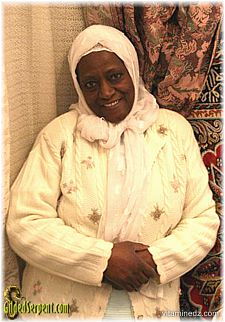
Lady Shamman

This lady is the muqadma or the shawwafa, which
means the medium or the shamman who can
communicate with the spirits and give messages.
She is also in charge of the tomb or the shrine of
the saint. She is here standing next to the shrine
and will make sure that the shrine is respectedby
the visitors. This shrine is located in Tlemcen(In
the west of Algeria and belongs to the Qadiriya
Sufi Brotherhood)
Photo courtesy of VitamineDZ.com

1. Al Qadiriya:

It is the oldest and most widespread order. It has branches all over the world that tie to its center in Baghdad. It was founded in Baghdad by ‘Abd al Qadir Jilani (d.1166) who is considered to be the greatest saint in Islam. It later became established in Yemen, Egypt, Sudan, the Maghreb, Central Asia and India. The Qadiriya stresses piety, humility, moderation and philanthropy and appeals to all classes of society. It is governed by a descendant of al Jilani who is also the keeper of his tomb in Baghdad which is a pilgrimage center for his followers from all over the world.

2. Ash Shadiliya:

It was started by al Shadili (d.1258) in Tunis. It flourished especially in Egypt under ibn ‘Ata Allah (d.1309) but also spread to North Africa, Saudi Arabia and Syria. It is the strongest order in the Maghreb where it was organized by al Jazuli (d. 1465) and has sub-orders under other names. The Tariqa Ash Shadiliya stress the intellectual basis of Sufism and allows its members to remain involved in the secular world. Their disciples are not allowed to beg and are always neatly dressed. They appealed mainly to the middle class in Egypt and are still active there. It is said that the Shadiliya were the first to discover the value of coffee as a means of staying awake during nights of prayer!

3. Al Jilaliya:

This order is a Qadiri branch in the Maghreb who worship al Jilani as a supernatural being, combining Sufism with pre-Islamic ideas and practices.

4. Ad Daraquiya:

It was founded in the early 19th century by Mulay ‘Arabi Darqawi (d. 1823) in Fez, Morocco. It was the driving force behind the Jihad movement that achieved mass conversions to Islam in the mixed Amazigh (Berber), Arab, and Sub-Saharian African lands of the Sahel. It is influential today in Mali, Niger and Chad and still widespread in Morocco.

Book Cover with Sain Sidi Tijani
This is a book cover representating the
Saint Sidi Tijani with his animal-
here the deer – as each saint/marabour
can be represented by an animal,
the mosque behind him is his zawiya.

5.Tijaniyya:

It is the largest tariqa in West Africa whose founder, Ahmed al-Tijani (d.1815), lived and was buried in Fez. Indeed it was a Tijani who was responsible for propagating the Khalwatiyya order, which he had encountered in Cairo on his way to Mecca to perform the Hajj. In a further example of the inter-connectedness of the brotherhoods’ histories, Tijani had also been an initiate of the Wazzaniyya and the Qadiriyya.

6. Al Aïssawa

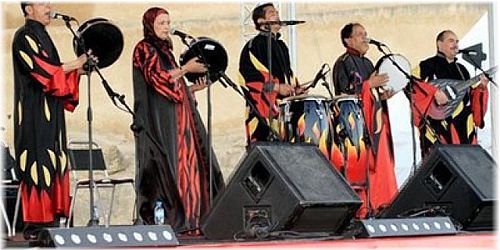
This tariqa is a religious and mystical brotherhood founded in Meknès, Morocco, by Muhammad Ben Aïssâ (1465–1526), best known as the Shaykh Al-Kâmil, or "Perfect Sufi Master". The terms Aïssâwa (`Isâwa) is derive from the name of the founder, and respectively designate the brotherhood and its disciples (fuqarâ, sing. to fakir, literally: "poor"). The Aïssawa followers are known for their spiritual music, which generally comprises songs of religious psalms, characterized by the use of the oboe-ghaita (similar to the mizmar or zurna) accompanied by percussion using polyrhythm.

Aissawa

This picture shows the Aïssawa brotherhoods with the leader Said Guissi’s 
Ensemble from the holy city of Fes, Morocco. They are considered the most
accomplished groups to emerge from the centuries old Aïssawa Tariqa.
Here they use trumpets and pipes creating a trance – inducing wall of sound.
I met them in London many times at the Music Village festival in 1998 and
also at the Sufi Festival in London in 2000.This picture was taken at the Muslim
Voice festival in 2009 in New York City. They are bringing to life the Sufi
musical tradition of connecting with the Divine.

Complex ceremonies, which use symbolic dances to bring the participants to ecstatic trance, are held by the Aissawa in private during domestic ritual nights (lîlat), and in public during celebrations of national festivals (the moussem, which are also pilgrimages) as well as during folk performances or religious festivities, such as Ramadan, or mawlid, the "birth of the Prophet." The Moroccan and Algerian States organize these festivities.

In Morocco, the ceremonies of the Aïssâwa brotherhood take the form of nightly rituals (known simply as "night", lila), organized mainly by Imam Sheikh Boulila (Master of the Night) at the request of women sympathizers. Women are currently the principal customers of the orchestras of the brotherhood in Morocco.

As the Aïssâwa is supposed to bring to people blessings (baraka), reasons for organizing a ceremony are varied and include celebration of a Muslim festivity, wedding, birth, circumcision, or exorcism, the search for a cure for illness, or to make contact with the divine through the extase. Rituals have standardized phases among all the Aïssâwa musin ensemble. These include mystical recitations of Sufi litanies and the singing of spiritual poems along with exorcism, and collective dances.

A moussem is a religious festival celebrating here the Saint Sidi Ali, known for healing people, therefore this sacred site became a gathering for people to dance and get into trance in order to get healed.

According to Aïssawa lore, this ceremony was not established nor even practiced at the time of Chaykh Al-Kâmil. Some members of the brotherhood believe that it emerged in the 17th century at the instigation of Aïssâwî disciple Sîdî `Abderrahmân Tarî Chentrî. Alternatively, it may have appeared in the 18th century under the influence of Moroccan Sufi masters Sidî `Ali Ben Hamdûch or Sidî Al-Darqâwî, who were both well known for their ecstatic practices.

More broadly, the actual trance ritual of the Aïssâwa brotherhood seems to have been established progressively through the centuries under the three influences of Sufism, pre-Islamic animist beliefs, and urban Arab melodic poetry such as the Malhun.

7. Al Wazzaniyya:

Like the Charqawiyya, it is are an offshoot of the Jazuliyya-Shadhiliyya. The tariqa was founded by Moulay (saint) ‘Abd Allah al-Sharif (d.1678), who had been a member of the Jazuliyya order and, unlike the others, takes its name not from their master or founder but from the town in which they are based, Wazzan. This town is located in the southwestern Morocco and founded by al Sharif in the first half of the 17th Century. It is known by many Moroccans as “Dar Dmana” (The Abode of Protection).

8. Al Siqiliyya:

Al Siqiliyya are an annex of the Khalwatiyya. Based in Morocco since the 18th Century, it has also been suggested that they may have some link to Sicily, which had a sizeable Muslim population until the mid 13th Century, and in fact was ruled as an Islamic emirate (called Siqlliyya) from the mid-10th Century to the end of the 11th. The connection between Sicily and Morocco, and Fez in particular, seems to be the role played by Jawhar al-Siqilli (d.992) in the Fatimid conquests of the Maghreb.

The M’alma (master) Zaida Gania is here performing a Sufi song with the female ensemble singing and
playing percussion at the Gnawa festival of Essaouira, Morocco.
Chrib Attay 2009

9. Al Gnawa:

The Gnawa Brotherhood exists under the names of Gnaoua, Ouled Sidi Blel, L’Aabid, Stambali, Zar, etc…

The Gnawa (sing. Gnawi) refers to an ethnic Sufi religious order. The name may originate from the Saharan Amazigh (Berber) dialect word  aguinaw or agenou, meaning “black men”. This word in turn is possibly derived from the name of the city significant in the 11th century, in what is now Western Mali, called Gana in Arabic Ghana .The term “Gnawa” has two meanings: It refers on one hand to an ethnic minority of former black slaves brought from Sub-Saharan Africa  (especially West Africa: Ghana, Guinea, Burkina Faso and Mali) more than 900 years ago to the Maghreb (Morocco, Algeria, Tunisia, Libya, and Mauritana); and on the other hand to an even smaller group of people within this ethnic minority who take part in the Lila or Derdeba ritual ceremony of spirit possession. The members of this group have preserved their traditions through the centuries.  While they have retained many of the customs, rituals and beliefs of their ancestors, their music and dance are the most preserved traits. After their conversion to Islam they adopted the first black person to convert to Islam and become the first muezzin, Bilel, as their ancestor and saint patron.

The female Gnawa master M’alma Hasna al Bacharia is
performing here with an electric guitar a Sufi song praising the
prophet Muhammad and the saints. Her ensemble is playing
traditional gnawa 6/8 rhythms.She was featured on the
Algerian National Television channel ENTV.
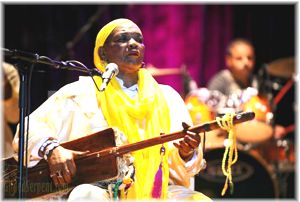
Malma Hasna el Bacharia

This picture shows the Master Ma’alma Hasna playing
Gimbri and singing  on stage.

The Gnawa of Morocco

During the last few decades, Gnawa music of Morocco has been modernized and therefore became more profane. However there are still many lilat organized privately, which conserves the sacred, spiritual status of the music.

Today Gnawa musicians do not consist of only men; women are becoming respected musicians and still are muquadmat or Shawwafa who are communicating with the spirits. However, they also decided to play the religious instrument, called the gembri.  The Haddarat Zaida Gania  is a group of women who have learned the female art of oral tradition of the Hadra (zikr) from their mothers and female ancestors. I met them in the Moroccan city of Eassaouira while I was working at the Oasis Dance Camp in Morocco in 2011. They perform Sufi and Gnawa music. I was blown away by their performance and I hope I will find the opportunity to bring them to the United States.

The first ever master female gembri player is called Hasna al Bacharia. Hasna El Bacharia has an artistic career of over thirty years. She mixes the sacred and the profane; she also plays electric guitar, ‘ud , banjo and especially Guembri (a spiritual instrument that is not supposed to be touched or played by a woman).

Amel and friends
This picture was taken in Essaouira during the Oasis Dance
Camp, Nov.2011 at the Haddarat Gania’s home. After they
cooked for all of us, they perform for us. Here I am with them as
they insisted that we should take a picture together and there
is another member of ADC present. They are all related and
they are starting to enjoy their success). 
click for enlargement
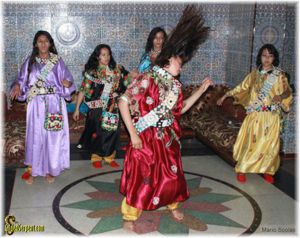
Young Haddarat in performance
Here are the younger Haddarat in performance
Photo courtesy of Mario Scolas. click for enlargement

She is the daughter of one of the masters of the Diwan in the South Western Algerian city of Bechar. In 1972 she founded her first music band with four other female musicians. The band started performing in weddings for only women. In 1976, Hasna and her female ensemble were featured in a huge concert in Bechar by the Union of Algerian Women. In January 1999, Hasna arrives in Paris after being invited by the Cabaret Sauvage at the festival of Algerian Women. After her first successful album, Hasna is invited at many concerts and music festivals around the world. I personally saw her perform many times in London, U.K. We became friends through interesting circumstances and I am always happy to hear that she is rewarded and respected for her art.

While adopting Islam, Gnawa continued to celebrate ritual possession during rites where they are devoted to the practice of the dances of possession, called jedba, and proceed the lila ceremony that is animated by a master musician (M’aalem) accompanied by his troupe. Gnawa music mixes classical Islamic Sufism with pre-Islamic African traditions, whether local or sub-Saharan. The Gnawa use their music and dance to heal the pain of captivity. They perform trance ceremonies called Derdeba (possession rite) which generally takes place at  nighttime, for this reason it is called a lila.

The Gnawa believe that many misfortunes that happen to people are not just accidental but Djinns could cause them. That is why some people are under the affliction of some illness, infertility or depression; therefore they come to seek the help of the Gnawa.

Many modern Western scholars see parallels between African American music such as the blues, that is rooted in Black American slave songs, and Gnawa music as well as a Sufi Tariqa.

This influence resonates from other black groups such as the Bori in Nigeria, the Stambouli in Tunisia, the Sambani in Lybia, the Bilali in Algeria and those outside Africa such as the Voodoo religion, the Candomble in Brazil and the Santeria in Cuba.

Sidi Blel

Sidi Blel is a Sufi brotherhood in Algeria that is also related to the Gnawa. The ceremony takes place during a Waâda at a zawiya often led by a sheikh but the Zikr is often recited by scholars called Tolba.  The dances Kouyou, the Tbal (a bass drum) and Karkabou (North African castanets) as well as the music called Dîwan are performed by music Gnawa or Sidi Blel troupes. The ritual Tabyette consists of bringing a bull who will be taken with the Sidi Blel musicians around the city with a flag of the Sufi brotherhood before it will be offered as a sacrifice to the Djinns.

There might be that many other animals such as a sheep, a ram or a rooster will also be sacrificed after a prayer. Following this ritual, the dance called Dendoune is performed by the same musicians or sometimes if the celebration is part of a Di\wan festival other music ensembles will perform and end the festival with a dance performance of a Kouyou.

The brotherhood Sidi Blel is named after the first slave freed at the beginning of Islam who became the first Muezzin during the prophet Muhammad’s time.

The  Karkabou, the Gumbri and the Tbol (or Tam Tam) are the traditional instruments that represent this brotherhood. The ceremony is called Dîwan or Dîwan Gnawa. It starts with the Tbol and the Karkabou, accompanied by the chanting and the dance. The duration of this performance is around one hour, then the musicians sit down in a semicircle around the M’aalem who is playing the Gumbri and invoking a chant in a choir that is praising Allah and his prophets as well as the saints. The dancers, who are dancing barefoot, are the followers. The Dîwan ceremony starts at the sunset and can end at the sunrise. Many festivals in the year exist in Algeria as a tribute to the sacrifice of the bull, also called Derba. The repertoires of the traditional dances are: Koyou, Bania, M’Bara, Megzaoua, Sergou, Jaiba, Marou.
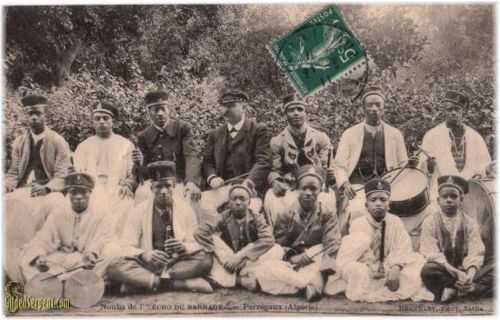
Gnawa/Sidi Blel musicians

This picture shows a colonial postcard where the Gnawa/Sidi Blel musicians were used in an ensemble for
street music even if they are playing their traditional instrument and in the middle of the picture sits a
French Colonial who is their leader. Note that they are in the same time soldiers for the French Army as
they are all wearing a kind of the French Kepi hats
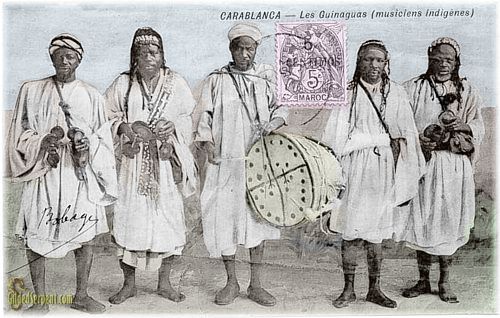
Colonial postcard shwoing gnawa musicians

This is another typical Colonial postcard showing the Gnawa musicians from Casablanca with their traditional
instruments. It is interesting that they are called Indigenous musicians, because every person who was
not French was called Indigenous at that time.
Karkabou Castanet and bass drum called T'bol

The instruments The Karkabou castanet and the bass drum called T’bol

Ga’ada Diwan Béchar with the ensemble Ferda “Benbouziane”,
Algerian Television.
PR poster for Gnawa Fest in Algeria

This a poster for the Gnawa Festival in Algeria called Diwan,
It is taking place every year from Sept. 27th to Oct 3rd in Algiers
This is a unique video of two amazing music ensembles of the Algerian Southern city of Bechar performing together a Sufi song calling
the saint for healing. It is a typical North African trance music where the rhythm (6/8) get faster at the end of the piece. Here we can see
that the music instruments are traditional as well as Western using North African drums such as the Bendir and karkabou castanets and
also a drumkit. The second music piece is based on Andalusian Algerian music but the song is also about having faith.
Diwan Fest
Musicians from the Ga’ada group performing at the Diwan festival. Note that a female singer and musician is part
of the band. This is the same band Ga’ada performing at the Diwan festival.

As Stambali or Stambouli

Stambali is a ritual of possession in Tunisia, using music as a healing form. This ritual came from Sub-Saharan Africa where music, chanting and dance enable people to get into a trance and embody supernatural entities. The term designates generally a series of practices where the Stambali is the last phase, with a healing vocation or a conspiracy of the Evil Eye. Stambali gathers elements originating from Africa and the Maghreb

It is a ceremony where mostly Black Tunisians (former slaves) take part and where dance and instrumental sounds are associated to African rhythms. This ceremony is very similar to the Haitian Vaudou or the Brazilian Candomblé.
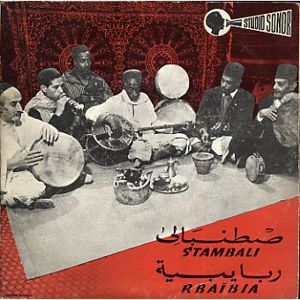
Stambali
This LP cover shows the Tunisian Stambali musicians with
the whole ritual setting of the Derdeba  with incense and instruments.

This video from the Tunisian Television shows a Hadra/Zikr by a Sufi Brotherhood.
That is the reason why one musician is holding the flag. The song is a welcoming
to all saints and spirits. Notice that all musicians are good singers and play the
frame drums.


Hadra

Haḍra means “presence” in Arabic. It is a collective ritual performed by Sufi orders in a zawiya, a mosque or at home. It is often held on Thursday evenings after the night prayer. The hadra features various forms of dhikr or zikr (remembrance). These include the recitation of Qur’an and devotional texts particular to the Sufi order in question, called hizb in the Maghreb, as well as religious poetic chanting, centering on praise and supplication to Allah, praise of the Prophet and rhythmic invocations of God. One or more of the divine names used are: AllahHayy, Qayyum or simply Hu ("He"), as well as the testimony of faith and tawhid, “la ilaha illa Allah” (there is no god but God).

Rhythmic recitation of names and chanting of religious poetry are frequently performed together. In conservative Sufi orders no instruments are used, only the daf (frame drum); other orders use a range of instrumentation.

female Harda
The female Hadra performer of the little famous town of Chauen/ Chafchauen who always had a tradition
of reciting the zikr and playing themselves the instruments. They are very well respected as performers.
See the video clip below.

Lila/Derdeba
Here we can see the Muqadma at the Lila or Derdeba, starting the ritual in dancing with a bowl of milk
that will be given to every one present starting with the master and the musicians,
This photo has the colors of the spirits
This is a very important pix where there is an interaction between the master- M’aalam Mahmoud Guinea
playing the Gimbri and the moqadma Malika (also his wife) dancing into the trance. They are
both from Essaouira, Morocco. Notice the colors of the saints are all here. I know these people.
Photo courtesy of Olivia Rivet


The Lila Ceremony

Terms
  • Baraka – Spiritual power, spiritual blessing and also protection
  • Djinn – The Djinn (in Arabic al-jinn) are spiritual beings mentioned in the Qu’ran, who inhabit an unseenworld. They are invisible to humans. Together, the djinn, humans and angels belong to the three sapient of God. In the Qu’ran they are mentioned to be made of fire but they are able to interact physically with people and objects. Like humans, they can be good, bad or neutrally benevolent. They are mentioned in the Qur’an in the 72nd surah (verse), titled surat el Jinn.
    Muslim people try to avoid to tell their real name, therefore they give them various names. Also referred to as mluk.
  • Faqr – Poverty, in this context it is spiritual poverty, which means emptying the soul of self in order to make room for God
  • Marabout – A saint, often a Sufi saint who has been deceased. It could also mean the shrine of a saint.
  • Murid – A disciple or student
  • Murshid – A guide or teacher
  • Sheikh – An elderly man, a leader who wins the respect by his action, or a Sufi leader
  • Silsila – A chain or a lineage of a specific sheikh of a Sufi brotherhood
  • Tariqat – A Sufi order but can also mean, the ‘way or the path’
  • Zawiya – A n Islamic religious school, monastery or a religious site which groups Sufi followers around a particular sheikh

It is important to mention that all Sufi brotherhoods use music and dance in their ceremonies. Often a sacrifice of an animal needs to be performed. In every ceremony, everyone will be fed as eating the food of the ceremony is a baraka.

All Sufi brotherhoods in the Maghreb, such as the Quadiriya, the Aissawa, relate their spiritual authority to a saint. The ceremonies begin with reciting the Saint’s written works or Hizb (or spiritual prescriptions). In this way they give themselves the authority to perform the ritual. This article is focusing on the Gnawa or Sidi Blel or Sambali ritual.

The Gnawa ceremony, called lila or derdeba is performed all night long. Usually it takes place inside a house or in a zawiya. The first part is mundane, often a kind of procession when the musicians and the M’allem arrive playing music.  The music ensemble consists of the M’allem (a lead musician and Sufi master) who plays the guembri (a three string bass) and many musicians who play the T’bol (a bass drum) and the Karkabou (metallic castanets). All musicians are also dancers, as dance is not separated from music.

The Gnawa perform a complex liturgy (lila, derdeba) that recreates the first sacrifice of the genesis of the universe by the evocation of the seven main manifestations of the Divine, the seven saints and the seven mluk or djins (supernatural entities), represented by the seven colors. Therefore the lila ceremony includes seven sections, representing seven saints or ancestral spirits or djinns or Mluk. Each section is associated with a particular color representing the male and female elements or spirits (mixed colors – Sidi Bouderbal, white, green – all saints, red – Sidi Hamou, black – Aicha Kandisha, yellow – Lalla Mira) and each color symbolizes a particular function in nature and beyond.

The mluk are evoked by the seven musical patterns, seven melodic and rhythmic cells (Um) which are repeated and varied, set up the seven suites that form the repertoire of dance and music of the Gnawa ritual. During these seven suites are burned seven different incense and veils or shawls of seven different colors are used to cover the dancers. Each of the seven mluk is accompanied by many characters (mluk or Djins) recognized by the music and by the footsteps of the dance. These entities are treated like “presence” (Hadra) that the consciousness meets in the altered state of consciousness (Hal), are related with mental complexes, human characters or behaviors. Some of the most known spirits amongst the Gnawa group are: Lalla Mira, Lalla Aicha, and Sidi Mimoun are usually related to places like rivers or seas.

The Gnawa’s traditions and beliefs go through a process of cultural assimilation of the new spirit beliefs that originated from animistic pre-Islamic beliefs.

In her article, “Spirits in Morocco”, Anas Farrah explains that,

“In the Islamic tradition the spirits or “ginns” are creatures that lived in earth before the creation of humans, they are also judged based on their actions and some of them will be sent to heaven, others to hell. The Islamic beliefs reinforce the belief of Moroccans in spirits in two other ways directly driven from the Coran texts; the first one is that the spirits or “ginns” are created from fire and the second one is that they burned by comets when they try to reach heaven”(Farrah, page 4)

The aim of the ritual is to reintegrate and to balance the main powers of the human body, made by the same energy that supports the divine creative energy.

The ceremony is performed through a well-established ritual. Fundamental in the ceremony are: the sacrifice of a sheep or a goat, bringing cloths of different colors, eating dates and drinking milk, the burning of incense, playing music and the chant in call and response as well as the dance. Some participants go into a trance where the spirit may come through responding to a typical rhythm or a color. The Derdeba is animated by the M’aalem (the master) and the Moqadma also called Shawwafa (a medium) who is in charge of the accessories and clothing necessary for the ritual.  The M’aalam, using his spiritual instrument, the Guembri, calls the saints and the mluk to intorduce them in order to take possession of the followers, who devote themselves to the trance.

This video from the 1980s is performed by the Moroccan Guembri player Paco, with his song, he is calling
a spirit “Baba Hamou” to come for help and bring healing. Here we can see women getting into trance,
some of them standing others already sitting letting their hair loose. I believe this is a video clip as there
are here only women dancing, normally men and women dance together and I don’t see the Muqadma who
takes care of the people getting into trance. There is only at the end a man who bring the orange flower holder.

This video is with the master M’alem Bakbou ( he used to be the bass player and guembri player of the
Moroccan music band Jil Jillala) I met him in London when he was doing a recording and I interpreted for
him. He stayed in my home and we became friend. He is from Marrakech. Here we see the beginning of the
real lila, first the musicians dance and stamp on the ground to call the spirits of the Earth, then people get
fed. After that the bass drums are played and the young girls are holding the candles and some the incense
who are given to the instruments and musicians. The 2 Muqadmaat/mediums enter the courtyard. The
musicians dance. In the dark of the night the Muqadma starts the dance and get into the trance bringing
the messages of the spirits.The colors of the spirits of the dead are used ( black, bue, red, green). The comes
the spirit of the color yellow, the spirit of rthe sun and the sky, called Mira, where everybody dances, it is the
return to Life.

This is a video in English language about the Gnawa festival of Essaouira, Morocco.

The Mluk (sing. Melk) are abstract entities that gather a number of djinn. In the Maghreb, people avoid to call them Djinn. Djinns are known as the “invisible” people. People call them different names in the Maghreb, such as doûk en nâs (these people), Nâs el okrin (the other people), Rjâl Allah or Aït Rebbi (God’s people), mouâl al Ardh (the master of the ground), Rjâl al khafiya (the hidden people) or rouhaniyin (the spirits).

Each Gnawa group gets together with a moqadma, the priestess that leads the trance (Jedba) after feeding the instruments and the various colors brought by her in a bundle with incense. When she gets into a trance, she starts channeling a spirit and may give messages to the community. The Lila ceremony then continues where everyone is dancing until the goal is achieved and the trance is over when the participants have been cleansed from their affliction. The participants negotiate their relationship with the mluk either by placating them if they have been offended or strengthening an existing relationship. Each melk is accompanied by its specific color, incense, rhythm and dance.

In the Maghreb, people do not talk about trance; they just find themselves doing it and it is part of their upbringing, culture and spirituality. Stories about the Mluk were part of any other kind of story. People are aware of their presence and are careful not to harm them. All the tales and stories are based on them and people will avoid their names and places where they might be located. As far as the trance is concerned, it is not limited to a zawiya or to the ceremony such as the Derdeba. People, mostly women, are very sensitive to drums or one kind of music. It is common in the Maghreb that a woman gets into a trance in a wedding or in a concert. People are aware of that and they will take care of that person as she is bringing the baraka to everyone in falling into trance, this shows how Maghrebi people are sensitive to energies.

Furthermore, the French writer Demerghem in  "le Culte des Saint"  (1954) gives a complete picture of the Sufi Brotherhoods and their rituals in Algeria as he watched them for many years. Not surprisingly, the rituals did not change and the people are still worshiping the saints and their followers. Despite the development of orthodox medicine, people call the Sufi brotherhoods for help.

During the dark years of the Algerian civil war in the 1990’s, women visited each other and played drums, sang and danced until they fell into and trance in order to heal themselves from the stress and sadness. They went back home relieved from their worries and pains. 

A young couple carries on the traditions
The picture is showing a young couple where the young woman is playing the gimbri, an instrument that
was supposed to be played only by men, and the young man is playing the karkabou castanet,
This is the picture of the future where both genders are involved in performing side by side.


Bibliography
  • Ibrahim Boye, Sayyidi Andal Qadr Djilani, Publisud, Paris 1990
  • E. Demerghem, Le Culte des Saints, Gallimard, Paris 1954
  • Mohammed Ennaji, Soldats, Domestiques et Comcubines. L’esclavage au Maroc au XIXe siecle, Casablanca: Editions Eddif, 1994
  • Viviana Pâques, Religion des esclaves: Recherche de la Confrerie marocaine des Gnawa, Bergamo  Italy, Moretti &  Vitali, 1991
  • U. Topper, Sufis und Heilige im Maghreb, Diederichs Gelbe Reihe, Muenchen 1994

Resources:

Have a comment? Use or comment section at the bottom of this page or Send us a letter!
Check the "Letters to the Editor" for other possible viewpoints!

Ready for more?

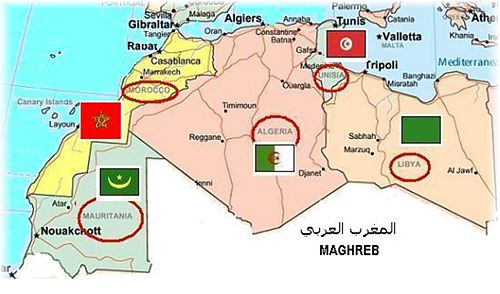
Map of the Mahgreb

  • The Passage of Time
    Her performance brought tears to my eyes; not only was she technically outstanding, but she had a whole persona, stage presence and her aura… no younger dancer could be compared to her. Many times I went to see the show to watch her again and again!
  • In a New England Snowstorm, Hopes of Spring…Amel Tafsout
    At some point, one collapses into a dream, but this dream world is the most real of realities.
  • A Metmorphosis Before My Eyes
    "I know I never could have danced and studied eight hours a day for 4 days straight without the energy and passion for the dance which surrounded me each day."
  • The Middle Eastern Music and Dance Camp in Mendocino
    There is nothing like immersing yourself in study and in the strange and unique culture of the Middle Eastern music and dance “scene”.
  • The Zar
    We do know that today thousands of women in Africa and the Middle East use this music to cure all kinds of illnesses. They literally dance until they drop.
  • Its Not Your Grandmamma’s Zar
    Luckily at some point we hear the distinct rhythm for a Zar and follow the drumming right to the front door of an apartment house.
  • Egyptian Percussion Instruments
    From the medieval era to our own time, Arabic music has been predominantly rhythmic. For this reason, much effort has been spent to write a theory of Arabic rhythms.
  • The Zar, Trance Music for Women,
    produced by Yasmin of Serpentine.org. “Once a spirit is called, it must be appeased. Then it will always be there.” And it will have to be periodically dealt with.
  • The End of the Banat Mazin? Struggles with Religious Fanatics, Real Estate Management , and Other Ghawazi
    Yusuf Mazin, a Nawari Gypsy, had wandered the land dealing in livestock, entertaining the villagers with stories, delivering messages and generally making himself useful until his non-Gypsy wife blessed him with five beautiful daughters. Beautiful, talented daughters who could master singing and dancing — the arts of the ghawazi, as such women were traditionally called in the countryside — were the best hope for the prosperity of a Nawari family in Egypt.
  • Whirling, Meditation in Motion or Spectacular Show?
    A dance could not be any more contradictory. The Whirling dance lingers between spectacular showmanship and meditation in motion; it combines trance and technique. It is a surprising paradox, unified like lovers within the dance.
  • Belly Dance and Feminism: Different Issues, Different Perspectives
    Feminism embraces more than one point of view, and feminist perspectives lead to many different decisions and courses of action. Feminism is a tool for thinking - for understanding and putting a name to issues you may be wrestling with in your own dance life, and for seeing belly dance in the light of broader economic, social and political realities.
  • Our Rules: Beauty & Professionalism, Elena Ramazanova Speaks About the League of Bellydance Masters
    We had the pleasure to meet with Elena Ramazanova, president of The League of Bellydance Masters in Russia, artistic director of “Ramiza Dance Group”, and a successful dancer and teacher at the open beach party of the Seventh International Belly Dance Festival titled “Expression of the East” in Berdyansk, Ukraine.
  • Defining Belly Dance Today, Definition by Presentation
    For me, the bottom line is that there is no wrong way to present belly dance because what an individual loves in the dance is easy to find. Everything is so global today! The dance has morphed into so many forms that if you cannot find a belly dance teacher that makes you happy, perhaps you need to look for another dance.
  • Interviews with Saida and Yamil A Five Part Video Talk with Two Stars of Argentina, Part 5: The Dance Community of Argentina,
    In this section they discuss how well the dance community gets along in Argentina. Hopefully this will help stimulate more talk in our larger worldwide community.
  • Desperately Seeking Shafiqa The Search for the Historical Shafiqa el Qibtiyya
    Shafiqa el Qibtiyya (Shafiqa the Copt) is known to many practitioners and historians of Egyptian music and dance. She rose to fame as an entertainer in the salat (entertainment halls) of Cairo around the turn of the century. Popular dance lore posits that Shafiqa was an early pioneer (or perhaps the originator) of raqs shamadan, the candelabrum dance.
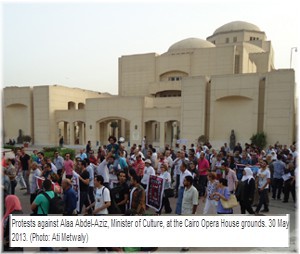
 

Gilded Serpent presents...

Our Rules: Beauty & Professionalism

Elena Ramazanova Speaks About the League of Bellydance Masters

Elena!

An Interview by Iana Komarnytska
posted October 17, 2013

We had the pleasure to meet with Elena Ramazanova, president of The League of Bellydance Masters in Russia, artistic director of “Ramiza Dance Group”, and a successful dancer and teacher at the open beach party of the Seventh International Belly Dance Festival titled “Expression of the East” in Berdyansk, Ukraine.

Iana: You are the president, Elena, of the League of Bellydance Masters (LBDM) that annually hosts more than forty different events (1).  At the same time, you have your own soloist dance career as well as the dance group known as “Ramiza”. Is it difficult to combine all these activities? 

Elena: Of course, it is a little bit difficult, Iana, since different hemispheres of the brain should work to resolve different tasks. When you are a creative person, you worry about different aspects of an event than you would as an organizer. However, I should say that LBDM consists of people who are self-sufficient; they give me suggestions and advice. Without them, I would not be able to manage everything. I really adore them! Otherwise, I would not have invited these teachers to join LBDM.

Iana: When you decided to create LBDM, did any similar organizations already exist in Russia? Did they share their experiences with you? How is LBDM different from these organizations?
Elena: Of course, such organizations already existed, but nobody was willing to share their experience. The only exception was Natalia Kuzmina (2) who ran the belly dance organization in Yekaterinburg and now has a big organization in Cyprus as well. She was (and still is) my friend. She helped with some ideas about organizing LBDM.

LBDM was created because I saw that the future development of the field of belly dance differed from what there was at that time in Russia.  I think that people’s desire to earn money is absolutely normal, but it should not override everything else!

When we started LBDM, it consisted of famous dancers such as Aida Hassan, Natalia Fadda, Maria Shashkova, and other stars of belly dance. Since above all, I wish to be an artist, I wanted to do everything for the art and the artists. Of course, I also hoped for financial success! For instance, we were the first group who invited Dina and her orchestra to our country, but the audience was not ready for that event at the time. It was a financial failure! However, I do not regret this attempt.

mapThe main focus always was, and still is, upon the artist at our events.  For instance, I don’t want people to perform at the competitions under numbers; unfortunately, a common practice in Russia. I don’t want them to be introduced as, “Number 143 on stage”. The dancer should enter the stage under her or his name and surname. The dance floor should be in appropriate condition, as well as the security, changing rooms, etc. Everything should be under control! I will give you another example: since we started running children’s competitions, we always have a doctor nearby, and our assistant is always in the audience near the stage to prevent a child from falling off the edge of the stage. We care about people who are involved in our events.

Also, as I mentioned before, at first, LBDM consisted mostly of performers. However, now it mainly consists of teachers. This is the main emphasis because we believe that we need teachers who can teach; their star status doesn’t matter. The quality of teaching, and the understanding of the material, does matter! People who work  at LBDM now are saturated with this philosophy. They always research the material deeply. In fact, a lot of folklore styles were introduced by LDBM to our region. We try to persuade our belly dance community that the Arab world is not only Egypt and that dancing is not only limited to Egyptian style. This is my personal point of view as well. I am interested in folklore dances of any country. Perhaps this is because when I was a child, I studied the dances of the Caucasus and other folklore dances of the world. History and the heritage of folklore can teach you to project personality and help to create depth in your stage character!

Iana: As any other organization, LBDM probably faces some difficulties in its everyday activities now as it did at the beginning of its existence. Are these difficulties still the same, or has "the kid grown up", and have the difficulties changed?
Elena: The initial problem was a bureaucratic one. It was complicated to open such an organization with an eastern focus since nobody wanted to help or support us. Another difficulty were the contacts and sponsors because, of course, we want to have beautiful prizes at our competitions, along with other motivations for our community members.

I have been dreaming for a long time about a pension fund for belly dancers. There are so many people who have committed themselves to this art, and when they retire, unfortunately, they are often forgotten. However, it would be so wonderful to encourage them, and to create a little “Belly Land”, where we could feel secure and supported.

Unfortunately, in reality, sponsors are rarely willing to invest money in a foreign culture. Moreover, a lot of people still believe that belly dance is a striptease, even though many organizations are trying to prove the opposite. However, the person who is not involved in this sphere won’t even discuss it. They see a girl in a restaurant, who does a shimmy and allows a guest to put money in her bra or belt, and that’s the end of it! For most people, that is belly dance, and their opinion is based on that limited experience! In contrast, LBDM tries to bring belly dance on a big stage and to develop love for folklore, from which all roots of the dance take place. In contrast to the sometimes disrespectful restaurant format, we also emphasize the importance of the stage culture and ethics for both performers and audience.

Iana: Belly dance events, especially, competitions are quite popular in the Ukraine and Russia. Almost every weekend there is a belly dance event somewhere. In your opinion, why did competitions become so popular in these countries, and how did competition influence the belly dance development?
Elena: I think the reason is our spirit. Eastern Europeans are accustomed to setting up goals and reaching them. Think about our history (former Soviet Union ideology). Competition, especially in sports, was a sense of life for the people: you must, whatever is happening, get successful results, and approved (government) expectations. We were brought up hearing that we had the best figure skating, the best ballet, the best, the best, the best…  It formed our mentality, that only through competition can we develop.

Students
The group photo is from the last year training course in Berdyansk, photo credit to Elena Fionova.

I agree that it might be better for belly dance to have festivals, to share the experience.
On the other hand, the popularization of the competition is good for LBDM.  We offer our rules: if you want to become a star–become one, but work hard and do it professionally, please! Work, work, and work! Study history, culture, and research all details. Futility is not welcomed.

Without competitions in our region, the belly dance would have been mostly associated with the entertainment sphere.

In this case, the education would not have been so serious. Look at our junior division dancers (6) for instance. We have extremely strong dancers in Russia, Ukraine, and Kazakhstan. If they work, they work hard, and they are ready to compete; they like it! For whose who don’t like it, there are festivals, and this is the individual choice of everybody.  No problem! However, our experience shows that we do like to compete, and we do like contests. Moreover, mostly people who criticize competitions are just afraid they will lose!

The main importance of competitions is not only the desire to win; the importance is in the aesthetics as well. We demand that the dancer look beautiful; the appearance is evaluated also. Not every mother can teach her daughter about proper make-up for dance, or hairstyle because of the lack of her own knowledge. However, for the stage, and especially for our competitions, the girls must find out this information. They must accept our rules, must look great, and dance well! Girls and women start blooming! We have participants in our Grand-seniors division (7) that are about seventy years old who, with the help of dance, gained a zest for life! For many people it becomes an escape from loneliness, everyday routine and drabness.

Iana: In some way, the connecting link between competitions and education is the training of judges, which LBDM also organizes regularly. When do you think the person is ready to be a judge and to evaluate others on the competitions? Does she or he need to have a successful career of a professional performer?
Elena: No, the judge doesn’t need to be a current or former performer. However, the person needs to have a solid fundamental knowledge. It is not necessary to be a good dancer or performer, but she or he is required to be a knowledgeable person and a good teacher. Tastes are different, but the knowledge is the one truly objective criterion! The panel of judges must be able to understand and evaluate what they see, but the dance skills of individual members of the judging panel doesn’t matter at all. However, the level of a judge’s students is an important indicator.

Elena with Safaa Farid and the Negum Orchestra at the 9th International Bellidance Cup
held on May 4, 2013 in Moscow.
Photo by Andrey Shishkov

Iana: 2013 is the seventh year when the LBDM organizes the teachers’ courses in Berdyansk. Why did you chose the Ukrainian town Berdyansk? How do you usually choose the themes of the workshops (3)?
Elena: Ooo! (Elena is excited and intrigued!) I was born in Siberia, Taimyr (North-Eastern part of Russia). Every year, our mother took us to the sea to visit our relatives not far from Berdyansk – on the shore near Podsporie. It was essential to be near the water and surrounded by nature, since in Taimyr, we didn’t have any trees, nothing at all! Our town is quite a bleak place. However, here in Berdyansk, I was dizzy with excitement. I was thrilled because of the lovely smells, and the site of everything green around me. It was so different from what we used to see in our everyday life in Siberia. It happens that the best years of my childhood took place in Berdyansk, even my first love was here.

I still keep the tradition of coming to Berdyansk every year. When we started LBDM I thought: “I’m coming here every year, so what if I combine work and pleasure, and try to organize some event here? ” I started searching for people who work in Berdyansk to join our effort. Then Olga Rudakova(4) gave me the phone number for Victoria Berest (5), and that is how everything started: “Victoria took a risk of dealing with me!”  (Elena laughs, and then adds) …”and she has not made a mistake!”

Concerning the workshop themes, of course, we are constantly looking for something new! For instance, there are some new, modern trends. We should include them, and use them. Nevertheless, at the same time, we combine them with our view and experience, with our influence on this or that dance style. 30-40% of the material in our workshops are always our own interpretation of the trends.

Iana: I know that this year on the Ukrainian forum (8), a guest from Spain was wondering about attending your courses in Berdyansk. Do you have plans to make your events more accessible to non-Russian speakers by providing information and workshops in English? Or maybe, do you have plans to develop your activities outside Russia and nearby countries?
Elena: I do hope very much that someone will help us with this task. However, until now we have not been thinking about it–but we should!

However, we do have events in other countries than Russia: we collaborate with Natalia Kuzmina who organizes an event on Cyprus.  We used to have a lot of events in Baltic countries in the past, as well as had events in Great Britain, Poland, Tunisia, Kazakhstan, and, of course, Ukraine. There will be an event in Belorussia (Belarus) soon. We are thinking about Morocco for the nearest future projects, as well as have some plans for the U. S., possibly in Miami.

For sure, we want to develop and grow because there is an interest to our organization; moreover, our teachers have already given the workshops all over the world!

This video was recorded at the Gala Show Primorye Cup’13, Berdyansk
by Mr. and Mrs. Fionovu, who kindly support LBDM by photo and video materials..
Primorye Cup is the name of the competition which followed after the training courses in Berdyansk, also, organised by LBDM and Elena Ramazanova.

Footnotes

  1. According to the official LBDM website,http://bellydanceliga.ru.
  2. Natalia Kuzmina is the President of the Federation of the Eastern Dance Amira in Yekaterinburg, Russia.
  3. For instance, these year workshops were spread over four days (eight hours of dancing and lectures per day), andeach day highlighted a specific topic: Egyptian style, beledi/shaabi culture, fusion & show belly dance, ritual dances and dances of Maghreb.
  4. Olga Rudakova is the President of Ukrainian Association of the Middle-Easter Dance Performers.
  5. Victoria Berest is the Director of the Centre for Dance “Victory Dance” in Berdyansk.
  6. According to the LBDM competition rules (http://www.bellydanceliga.ru/index.php/2011-06-11-18-18-42), children of the age between  twelve-fourteen years old are consider to be Juniors.
  7. Grand-seniors are contest participants of the age of fifty years old or elder (according to the LBDM competition rules,
  8. Ukrainian forum- raqs.com.ua
Resources:

Have a comment? Use or comment section at the bottom of this page or Send us a letter!
Check the "Letters to the Editor" for other possible viewpoints!

Ready for more?

Elena

  • Dancing for Tourists in Istanbul, A Personal Impression
    Additionally, their friendly and respectful relationship was highlighted when she finished her show, dancing to each instrument separately, and in this way she introduced each of the musicians. Such a relationship between dancer and musicians is not widely seen in today’s restaurant atmosphere… unfortunately.
  • Dreaming of the East, Orientalism in Early Modern Dance
    As a belly dancer and a modern dance student at York University, my attention was captured by the fact that a number of early modern dancers performed variations on Oriental themes. I became interested in how they interpreted the Orient through their modern dance technique, and how they represented the Orient in their choreographies, since their performances could have been loosely associated with actual Middle-Eastern dances.
  • Nour: A Biography
    This dance, having its own rules, was like the flight of a soul, especially for one who sees dance as art and not just personal exhibitionism.
  • Belly Dancing in Estonia
    As in the rest of the world, the Egyptian style of belly dance is the most popular one in Estonia. Most of the instructors and dancers are specialized in that style. The American Tribal Style Belly Dance is also becoming more known each day. The general impression of belly dance in Estonia is glamorous, feminine, luxurious, modern and elegant. It’s a time where Estonian dancers can truly say that they can be proud to be a Middle Eastern dance artist in Estonia.
  • Belly Dance Costuming Evolves, Photos and Commentary from a Rising Star of Costume Design
    Video interview with author. "Because our colorful dance form is still living, changing, and evolving day-by-day, the costume designers will inspire us endlessly. This movement is a never-ending energy flow full of elegance and ferocity, sensuality and femininity. I hope that I will be a part of this wonderful Oriental dance life for a long time."
  • Roots Raqs – An International Belly Dancer Goes Home to Macedonia
    The musical folklore of this region deserves full debut in the World Music scene, and those of us in the MED community worldwide are ripe for the breath of fresh air that Chochek and Gypsy Brass Music can bring us. It is an original, organic and time-honored fusion, brought about by history, geography, and most importantly, tolerance and mutual cultural celebration.
  • Europe- Helm Musical Adventures, Part 3
    Last winter my husband, Mark Bell, and I were hosted in Paris and Slovenia to teach Middle Eastern rhythms and present Tribal Belly Dance with live music. The following are photos from our adventures.
  • From Town to Goat Track, A Tour of the Pamir Mountains of Tajikistan
    One lithe young girl twisted her way through this crack and into the tiny cave, and brought back some mineral crystals, said to have healing powers.
  • Dancing on the Roof of the World, Community Festival in Tajikistan .
    After all my many travels to Tajikistan, filled with the frantic bustle of dance lessons, rehearsals, teaching, doing trip logistics, hunting for traditional bits and bobs for costuming, and getting fitted for stage costumes, I finally decided to try being a more-or-less normal tourist in one of my favorite places on Earth, the Pamir mountains of Badakhshan, eastern Tajikistan.
  • Tajikistan: The Land of Dance Part One
    Video features: #1-Introduction by author, #2- A Map Tour on an ancient and modern map. " Communication with the outside world is difficult and expensive, and nearly impossible during the winter."
  • Defining Belly Dance Today, Definition by Presentation
    For me, the bottom line is that there is no wrong way to present belly dance because what an individual loves in the dance is easy to find. Everything is so global today! The dance has morphed into so many forms that if you cannot find a belly dance teacher that makes you happy, perhaps you need to look for another dance..
  • Interviews with Saida and Yamil A Five Part Video Talk with Two Stars of Argentina, Part 5: The Dance Community of Argentina,
    In this section they discuss how well the dance community gets along in Argentina. Hopefully this will help stimulate more talk in our larger worldwide community.
  • Desperately Seeking Shafiqa The Search for the Historical Shafiqa el Qibtiyya
    Shafiqa el Qibtiyya (Shafiqa the Copt) is known to many practitioners and historians of Egyptian music and dance. She rose to fame as an entertainer in the salat (entertainment halls) of Cairo around the turn of the century. Popular dance lore posits that Shafiqa was an early pioneer (or perhaps the originator) of raqs shamadan, the candelabrum dance.
  • Interviews with Saida and Yamil A Five Part Video Talk with Two Stars of Argentina, Part 4: Receiving Critique,
    Beyond giving critique to your students, how does a professional respond to feedback?
  • Video Interview with Nathalie of Miami, Part 2: Dancing in Miami
    Part 2: She tells us of how she began to dance again after her move to Miami. She studied at the Middle Eastern Music Exchange with Tamalyn Dala, Bozenka, Jihan Jamal and a little with Virginia.
  • Video Interview with Virginia of Miami, Part 2: RakStar and More Teachers
    On August 31, 2013 we interview Virginia at the Alexander Hotel on Miami Beach. In this section of the interview she tells us about her RakStar festival and more of the the teachers they will have this year- Amir Thaleb, Mohamed Shahin, Issam, Aziza, Virginia.
 

Gilded Serpent presents...

Defining Belly Dance Today

Definition by Presentation

Port Said LPs by El-Bakkar

by Tasha Banat
posted October 15, 2013

Author’s Note: Before we even discuss styles like Egyptian, Lebanese, Turkish, Greek, Armenian, Persian, Tribal, Fusion, and everything else that is currently out there, let’s just assume that all movement between the knees to top of your head defines Belly Dance, just for the sake of this article and within this genre.

I believe firmly still that belly dance is comprised of movements such as Figure 8s (rib and hips) as well as all vertical and horizontal directions, etc. that define the foundation of the dance; everything else–such as choreography, steps, props, costuming, etc. is what makes the dance an exciting and ever-expanding visual artform, but of course, there is the traditional style belly dancer like myself who worked predominantly in Arabic, Persian, Armenian, and Turkish night clubs. (I’ve danced since 1966.) As a matter of fact, my only belly dance teacher was Yasmena, an Iraqi, who in the early ‘70s taught me about dancing with veils as well as floor work used by American dancers. That training, along with the Debke, defined my style of Arabic belly dance. Until that time, I performed pretty much only Debke, wearing a baladi and cabaret combined style of belly dance costume. 

Sayed MekkawiThat costuming and style actually worked for me because the musicians were mainly from Asian/Arab countries anyway and everyone belly danced to those songs. As a matter of fact, the most popular albums in those days were the “Port Said” by Mohamed El Bakker (Asian/Arab Debkes) and the Eddie the Sheik and George Abdo collections, which were also Asian or Arab Debkes. There was also Aram Araklian (playing the oud), Armenian; the Ozel albums, Turkish; and the Café Feenjan” from New York City, whose songs came from all Mediterranean countries and beyond.  The list of albums from that era goes on and on. 

There were many highly orchestrated classical albums such as those of  Oum Kathoum, Farid Al Atrash, Abboud Abdul Aal,Sayed Mekkawi, etc. that were also played for our dancing. These recordings were simple, featuring as little as two extremely talented musicians, playing two instruments. These musicians almost always played the oud and durbekee (tabla) as the main instruments; and if the club owner could afford it, we would have a violin, accordion, kanoun, and much later, the keyboards.  However, it was the oud and durbekee players who became accomplished in playing and singing the most famous songs from various Arab countries beyond where they lived. (In those days, this was not always so in the Middle East, especially Egypt, and North Africa.)

Again, if and when we worked in other nightclubs (such as the Persian clubs) the musicians and instruments changed. 

The only reason I bring this up is because anyone who was a belly dancer prior to the late ‘80s and early ‘90s did not, in actuality, perform the mainly choreographed Egyptian Style now popular.  We danced to Asian and Arabic music and presented what I will now define as “The Lebanese Style”.  

Why was all of that necessary for me even to write about?  Well, there are so many musicians out there who do not get any credit for their contribution to belly dance; even though many of those same songs are still recorded today by newer, and sometimes, more creative artists.

Egyptian and Lebanese Styles

I am constantly asked “What is the difference between the two?”  My answer is so simple: it is the presentation; how each one is performed in front of an audience.  I believe this is the common denominator in all belly dances today, but I am still a traditional style Arabic dancer; so I will continue to use those presentations to help explain the definition of the dance for 2013.

Rhea performs at Taverna Athena in Oakland, early 90s

Lebanese, and some Turkish dancers, almost always wear high-heeled shoes, and in Lebanon (for example) a more traditional style of belly dance cabaret two-piece costume.  Dancers perform  in and around their audiences a lot more, in a classic style nightclub setting much like we did in Arab American nightclubs of the past. 

We dancers in America actually created and developed the go-go dancer style of one dancer after another, performing with a live band in the late ‘60s and early ‘70s as well.  (For the most part, this was the pre-tipping era.)

What I mean is: the audience surrounded the dancer.  The stage was small or nonexistent, and the people were a lot more involved in the action of the dance.  In my opinion, this presentation always felt much warmer to me, personally, and even today, the belly dance Lebanese style feels much more personal, and not so highly choreographed or staged. I do not mean to disparage that type of belly dancing, but rather to define and validate the presentation of belly dance in those days.Soheir Zaki and Lynette

Egyptian dancers usually do not wear high-heeled shoes or traditional cabaret costumes anymore, and they perform more often upon a stage in front of an audience.  They may invite a person up to dance with them, a practice that I see as an entirely different presentation that became more popular in the late ‘80s and the ‘90s.

Please let me reiterate here that tipping the dancer (touching the dancer anywhere on her body) was taboo in both settings and is strictly another American belly dance invention. 

Even now, I feel that I am still not a dancer as accomplished as many that I see today; so when I am asked what made me so popular for so long, I reply that it was because my presentation of the dance was more familiar to the audiences at that time.  There were always those Debke steps that added to my belly dance movement, and my inexplicable feeling for the songs (rather than using choreography) that my audiences enjoyed.  I believe firmly that it was simply because Debke steps and belly dance movement were from the same regions.  Until this day, I do not believe that it was because I was such a great dancer, but that I was successful only because of my style.

For me, the bottom line is that there is no wrong way to present belly dance because what an individual loves in the dance is easy to find.  Everything is so global today!  The dance has morphed into so many forms that if you cannot find a belly dance teacher that makes you happy, perhaps you need to look for another dance.

Having said that, we also must recognize that the core of the belly dance movement does go back to those slides, circles, figure 8s and all the movements between the knees and top of the head.

Steps, especially Debke steps, get me from point A to point B, according to the size of the stage, the music, costuming, etc. This is what presentation of belly dance is all about for me.

Therefore, present yourself with the knowledge that the belly dance movement is just that; but culture, (especially Arab culture) is part of my love of belly dance. As a dancer, the more one learns about the Arab world in relation to belly dance, is the greatest compliment you can pay to a misunderstood, ill-defined and under-appreciated culture.

Just keep in mind that when you dance, whether it is Tribal, Steampunk, Cabaret, Fusion, Andalusian, Asian Arab Debke, North African, Egyptian, Turkish, Persian, Armenian, Saudi, Kuwaiti, Emirate, Weagar, Greek, or Central Asia etc. on a formal stage, picnic area, whatever or wherever, it is your presentation that defines authentic “Belly Dance Movement”.

You are the total package of what you do, and if it is respectful and respectable, then go for it…

Resources:

use the comment box

Have a comment? Use or comment section at the bottom of this page or Send us a letter!
Check the "Letters to the Editor" for other possible viewpoints!

Ready for more?


Gilded Serpent presents...

Egypt through a Rear-View Mirror


Middle East Journal: A Woman’s Journey into the Heart of the Arab World by Laila Abou-Saif

Middle East Journal by Laila Abou-Saif

Book Review by Barbara Grant
posted October 6, 2013

Introduction

It is easy to recommend this book with a four-zill rating and I do. I applaud ground truth data–here, in the form of interviews–diligently gathered by someone qualified to interpret it. Through a series of interviews conducted primarily in Cairo between July, 1986 and August, 1987, Laila Abou-Saif, an Egyptian-born Coptic Christian feminist with a PhD in theater from the University of Illinois has recorded as broad an array of Egyptian (and other Arab) opinion as possible on issues including the future of Egypt, the Israeli-Egyptian peace accords, and the Israeli-Palestinian conflict. Interwoven with her interviews are snippets from her journal allowing readers to glimpse her daily life in Cairo.

What is not easy in the post 9-11 world is to agree with the author’s primary conclusion: that there will be no peace in the Middle East absent a resolution of the Israeli-Palestinian conflict—and I don’t. 

Today, the dynamics of the Egyptian Revolution, begun in 2011 along with those of the broader Arab Spring, have yet to fully unfold. The Iraq War, with its “nation-building” goal, has yet to build anything in the region other than instability and factionalism. Libya has undergone regime change as Moammar Qaddafi was swept from power after he’d ceased to oppose United Staes’s policies; many Americans still wonder why. While the U. S. has recently backed down on its threat to hit Syrian army targets with an itty-bitty missile strike, officials have not excluded the possibility of doing so. In short, the region has changed dramatically since the late 1980s.

This work is valuable primarily as a record of how Egyptians see Egypt. The interviews provide threads we can follow to see how the situation of decades past has evolved into what we see today.

A Political Tapestry

Western consumers of media outlets who believe the propaganda that Egyptians come in only two political stripes—Islamic fundamentalists and strongman-worshipers — will find their perceptions challenged by the diversity of political opinion reflected in these pages. In 1986, Anwar Sadat had been dead five years, his assassination by Islamic fundamentalists mourned widely in the West but not in Egypt, where a majority of citizens considered the last several years of his reign to be tyrannical.  Hosni Mubarak, his successor, was not the hated autocrat who would be deposed 25 years later. Interview subjects include fundamentalists,  secular leftists both socialist and Marxist, internationalists–a highly-privileged few like Boutros Boutros-Ghalli (Minister of State for Foreign Affairs; he became the United Pope Shenouda IIINation’s Secretary-General in 1992) and those who might best be described as listening to the beat of a different drummer, like famed novelist and (subsequently, in 1988) Nobel laureate Naguib Mahfouz.

What impresses is how many—absent the Brotherhood fundamentalists—believe that the best course for Egypt to take is democracy…a quarter-century before the Arab Spring, and long before the United States decided that this was the best solution for the Middle East.

Here is Ahmed Ismail, a thirty-something journalist with anti-American views who writes for a Marxist newspaper:

“The great catastrophes in Egypt are caused by the military regime….Egypt is ruled by despotic, tyrannical, undemocratic military men… we need a multiparty system and parliamentary democracy.” (p. 61).

And here is Mustapha Amin, former owner of Akhbar al-Yom, one of Egypt’s two most important daily publications, and at the interview, its Editor-in-Chief:

“All our troubles stem from the lack of democracy and the prevalence of dictatorship,” he said. Unlike Ahmed Ismail, Amin is pro-American and will not place blame on Americans for Egypt’s troubles. “What I like about America is democracy and freedom,” he says. “I wish we could learn that from them.” (p. 122).

Opposition to the ruling authority was also voiced by Pope Shenoudah III, Coptic Patriarch and spiritual leader to Egyptian Christians. The Pope had been incarcerated by Sadat in a desert monastery for three years; upon the latter’s assassination, many Copts celebrated by “drinking sharbat, a fruit syrup used on festive occasions” (p. 149). The Pope also voiced his concern in the event that shariah were ever to become law in Egypt: “The entire Coptic community would have either to segregate itself or become servants,” he said (p. 151).

Not your mother’s feminist icon…

“What do you think of the woman with the veil?” Abou-Saif asks Mahfouz. “She is being pulled back,” the novelist replies, “and she thinks she is going forward.”(p. 113). Zainab Al Ghazli

Muslim and Western feminism meet face to face when the author interviews Zeinab al-Ghazali, Supreme Guide of the Muslim Sisterhood. She is dressed in white from head to toe and wears no makeup, and speaks of the necessity of the veil and loose clothing that conceals the contours of the female body.

The name, “Muslim Sisterhood,” prompted me initially to think of the group as a kind of “Ladies’ Auxiliary” to the Brotherhood—but it is not. Al-Ghazzali and her three million female followers are on the front lines with the Brothers in their efforts to restore the Caliphate. “I am a soldier of Islam,” she declares (p.41) and she not only talks the talk: she has walked the walk, having served years in prison where she endured solitary confinement and torture, released only after then-Saudi King Faisal appealed to Nasser and Sadat on her behalf. Her publications “have become the manifestos of the Muslim ‘feminists’” (p.37).

…but an equal partner on the path to shariah.

“Those who suggest torture as a way of making people give up their beliefs were ignorant,” al-Ghazali says, “because they did not realize that people who have beliefs are ready to sacrifice their lives for these beliefs.” (p. 47).  Do we in the West understand that mindset, I wonder?

While Sadat’s assassins were affiliated with the Muslim Brotherhood*, al-Ghazali states that she opposes assassination because “our cause cannot be solved with the assassination of any individual or any people.” (p. 44). “The one responsible for the assassination of Sadat is Sadat himself because he angered the people and made them rebel,” she said, also noting that “[t]hose who established terrorism in the Middle East are the world Zionists.” (p. 43).

Conclusion

At the time this book was written, few in Egypt except perhaps the Islamists might have envisioned a government with someone like Mohamed Morsi at the helm; odder still would have been the degree to which the U. S. and other western democracies have supported the Muslim Brotherhood. Yet as revealed by the diversity of opinion seen in these pages, Egypt is not an extremist country.

One can only hope that Egypt will right itself, and the present turmoil give way to a brighter future. “[t]he Nile,” writes the author, “like my people, is a gentle river, which flows slowly and serenely.”

Resources:

Rating: 4 zils
Zil Rating- 4

use the comment box

Have a comment? Use or comment section at the bottom of this page or Send us a letter!
Check the "Letters to the Editor" for other possible viewpoints!

Ready for more?


Gilded Serpent presents...

Desperately Seeking Shafiqa

The Search for the Historical Shafiqa el Qibtiyya

Shafiqa

by Heather D. Ward “Nisaa of St. Louis”
posted October 3, 2013

shamadanShafiqa el Qibtiyya (Shafiqa the Copt) is known to many practitioners and historians of Egyptian music and dance.  As her name indicates, she was born into a Coptic Christian family – probably sometime in the latter half of the nineteenth century.  She rose to fame as an entertainer in the salat (entertainment halls) of Cairo around the turn of the century.  Popular dance lore posits that Shafiqa was an early pioneer (or perhaps the originator) of raqs shamadan, the candelabrum dance.  However, few historical resources have come to light which could inform us regarding the reality of her life and career.  This article attempts to remedy the dearth of historically verifiable information about Shafiqa by offering new insights from sources contemporary with this famed late nineteenth/early twentieth century almeh, as well as from traditional entertainers currently living and working in Cairo.
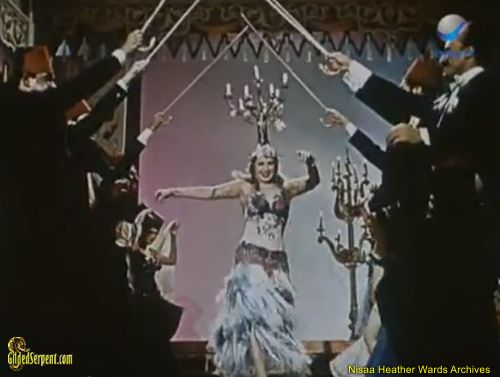
Much of our knowledge of Shafiqa el Qibtiyya is based on stories of her life that were published long after her death – one source being a biopic published in the entertainment-focused magazine El Kawakeb in 1955 1, and the other being the 1963 Hassan el Imam film, based on a story by Jalil el Bindari.  Both the Kawakeb article and the 1963 film portray a famous and beloved figure who experienced a tragic decline toward the end of her life.  Shafiqa is depicted as an extraordinarily talented dancer and a woman of exceptional wealth and influence during the prime of her life.

The historical accuracy of either of these sources is questionable, though neither should be entirely dismissed.  For example, the Kawakeb article uses a portrait of Mata Hari to represent Shafiqa, suggesting that the writer(s) of the piece had no access to actual photographs of Shafiqa and raising questions about the veracity of the rest of the article.  On the other hand, the Kawakeb piece mentions that Shafiqa performed at two prominent salat El Dorado and Alf Layla wa Layla – both documented venues that would certainly have featured entertainers like Shafiqa.  El Dorado was located near Ezbekiyah Gardens in central Cairo (Ward 2013), and Alf Layla wa Layla was located in the Rod el Farag entertainment district, close to the Nile (Lagrange 1994: 88, 134).  Alf Layla wa Layla was owned by Tawhida, a rather famous almeh in her own right, who published a book of her songs in 1924 (Lagrange 1994: 88, 134; Tawhida 1924).  In similar fashion, the Hassan el Imam film mixes fact with fiction; it is replete with historical anachronisms, such as dance costumes, hairstyles, and clothing that often appear more consistent with 1960s style and fashion than with that of the 1910s.  Yet, like the Kawakeb article, the film indicates that Shafiqa was a star entertainer at El Dorado.

Hind Rostom portraying Shafiqa el Qibtiyya in the Hassan el Imam biopic. Note her costume, which is more consistent with costuming styles of the 1960s than with those of the 1910s.
Hind Rostom portraying Shafiqa el Qibtiyya in the Hassan el Imam biopic.
Note her costume, which is more consistent with costuming styles of the 1960s than with those of the 1910s.


Contemporary sources with firsthand knowledge of Shafiqa do exist, though they are extraordinarily rare.  These contemporary sources paint a less than flattering portrait of this famed entertainer.  Nevertheless, they make it possible to begin constructing a more accurate and historically-based portrayal of this elusive woman.

One source of particular interest is a circa 1908 Odéon recording of Baheyya el Mahallawiyya 2 , a well-known almeh and prolific recording artist in the early 1900s.  The title of the recording is “Raq Shafiqa” – i.e. “Shafiqa’s Dance.”  In this piece, Baheyya imitates the style and mannerisms of Shafiqa el Qibtiyya – and not in a flattering manner.  Baheyya plays a giggling flirt who is so drunk that she can barely sing and dance.  The piece begins with a dialogue between “Shafiqa” and a man named Mohammed – possibly the owner of the establishment where the scene takes places.  Their dialogue proceeds as follows:

Mohammad: Please, Miss Shafiqa el Qibtiyya, could you stay at the side for a minute?
Shafiqa [Baheyya el Mahallawiyya]: [giggles] Ya Mohammad, I’m saying hello to your eyes, ya habibi!
Mohammad: And greetings to you, ya habibti.
Shafiqa: I’m so drunk! [giggles] Please send me a sultaniya [type of container] of beer, whatever you like.
Mohammad: Waiter!
Rageb [the waiter]: Yes?
Mohammad: Put a beer on her tab…
Shafiqa: [interrupts Mohammed] Ya Rageb!
Mohammed: …a big sultaniya.
Shafiqa: Ya Rageb!
Rageb: Yes?
Shafiqa: Make me happy! Curse whoever makes me sad tonight! [giggles]

At this point, a dance melody familiar to dancers even today, “Raqs el Hawanem,” begins to play, and it is clear that “Shafiqa” is attempting to dance, though her frequent exclamations (“Oh, I can’t!  I’m so drunk!  I’m sorry!”) make it clear that she is nearly too drunk to stay on her feet.  She goes on to sing a comic and nonsensical tune.

Although some may be tempted to argue that this is a representation of Shafiqa in her decline, and that it does not contradict the Kawakeb or Hassan el Imam depictions, there is nothing tragic about this scene.  “Shafiqa’s” drunkenness is enacted comically for the amusement of the listener, who would not have been entirely shocked by the concept of a drunken entertainer.  The practice of fath, wherein female sala employees – often the entertainers themselves – would sit and drink with customers in order to encourage spending, was an established activity in the salat of Cairo by the end of the nineteenth century.  Various sources describe situations wherein entertainers were so intoxicated after an evening of sitting and drinking with patrons that they were unable to perform (Van Nieuwkerk 1995).  Baheyya’s recording evokes such a scene.

Another contemporary source of interest is a brief mention of Shafiqa in S.H. Leeder’s Modern Sons of the Pharaohs, published in 1918:

As far as the Copts are affected, a great many misleading statements have been made. It is equally untrue to say, as Lane did in those cruel libels on the Copts which are the sole defect of a book which has so deservedly become a great classic, that the Copts are “abandoned to indulgence in sensual pleasure”; as it is to make a statement so absurd as that of a recent writer, who, quoting it as something she had heard, says: “It should not be forgotten that there is not a Coptic woman of public bad character in all Egypt. … A fallen woman hides her shame by becoming a Moslem.”…This absurdly untruthful statement has been quoted by every subsequent writer, especially those with a Christian bias, regardless of the fact that for years the most scandalous of the public singing women in Cairo bears a name which she has made so famous that I have never met an intelligent person anywhere in Lower Egypt who was not most familiar with it—Shafika el Coptieh, or Shafika the Copt. (Leeder 1918: 107)

Notably, this account would seem to indicate that Shafiqa was still at the height of her popularity some ten years after Baheyya el Mahallawiyya recorded her parody.  That Shafiqa was known to a Western observer speaks volumes regarding her notoriety, since only rarely are Egyptian entertainers referred to by name in Western travelogues and guide books from this period.

Note that Leeder describes Shafiqa as a singer, rather than as a dancer.  Presumably, if Shafiqa was so well-known as a singer, she would turn up in the catalogs of Egypt’s nascent recording industry, which was booming by the time Leeder wrote this observation.  Recorded music, known in Egypt as early as the 1890s, became widely accessible and affordable for the Egyptian public as major recoding labels began mass-producing records with Egyptian artists beginning in 1903 (Fahmy 2007: 143-146; Lagrange 1994, 2009). 

Female singers – generally current or former awalem – dominated the early recording industry with their light songs, or taqatiq (Lagrange 1994, 2009).  Taqatiq (singular taqtuqa) were originally multi-strophic songs performed by awalem in private, gender-segregated settings (especially weddings).  With the advent of the recording industry, the taqtuqa was standardized to a quadric-strophic format to better suit the length limitations of recording discs.  By World Ward I, taqatiq were well-established as Egypt’s first commercial “pop” music.

In spite of her fame as a singer, no recordings of Shafiqa el Qibtiyya have ever come to light.  Was her repertoire so scandalous that recording labels refused to press recordings of it?  This seems unlikely, given the content of many of the popular taqatiq of her day.  The early taqatiq, essentially consisting of the traditional repertoire of the awalem, often incorporated coarse and sexually suggestive language (Lagrange 2009).  Further, Baheyya el Mahallawiyya’s parody leaves little to the imagination, yet it seems to have done no damage to Baheyya’s career.  Thus it seems unlikely that the content of her songs can adequately explain Shafiqa’s conspicuous absence from all of the major recording labels.

Ultimately, what do we know of the real Shafiqa?  The Baheyya el Mahallawiyya recording and Leeder’s brief description of Shafiqa paint a portrait of a singer/dancer who probably performed a rather bawdy repertoire in Cairo’s turn-of-the-century salat and who most likely engaged in fath after her performances.  Certainly, other awalem of Shafiqa’s day sang scandalous tunes yet went on to be successful recording artists, sala owners, and even cinema stars.  Frederic Lagrange writes:

Former ‘awalim, traditionally trained in Egypt and in the Levant, acquired a new status when they became recording artists for the booming 78rpm disk industry, and sometimes bought concert halls (salat) in central Cairo (‘Imad al-Din street) or leisure districts (Rod al-Farag).  They erased traces of their past as mere ‘awalim of ill-repute, and promoted an intricate image of sophistication and gentle debauchery.  (Lagrange 2009: 228)

Yet by the 1920s, Shafiqa appears to have disappeared from the Cairo entertainment scene.  Perhaps it was Shafiqa’s active engagement in fath that hampered her success in new arenas.

In a January 2013 interview with Sayed Henkesh of the Henkesh family, a famous family of musicians from Shari’ Mohammed Ali, I questioned Mr. Henkesh in order to learn what the oral history of Cairo’s traditional entertainers may reveal regarding this famous almeh.  While stressing that his knowledge of Shafiqa is obviously not firsthand, he stated that his understanding is that Shafiqa first worked on Shari’ Clot Bey, then moved to the Rod el Farag district, where her fame increased.  He also suggested that she opened a sala of her own in Rod el Farag, though he did not indicate what it may have been called.  During Shafiqa’s day, Shari’ Clot Bey was part of the “red-light district” known as the Wasa’a (meaning “wide area,” but known to English-speaking tourists as the “Fishmarket” because this was the area’s original function) (Dunn 2011).  The Wasa’a housed a motley array of brothels, coffeehouses, and low-class entertainment halls that were themselves often fronts for prostitution (see Guerville 1906: 78-79 and Sladen 1911: 22-23, 61,114-115, 118-119 for particularly vivid descriptions).  Moving from this area to Rod el Farag and the more reputable establishments around Ezbekiyah would certainly have been a step up for Shafiqa.

Interestingly, Mr. Henkesh stated more than once that Shafiqa was not a great dancer.  Rather, he suggested that she was intelligent and charismatic, and able to manipulate wealthy patrons, and that this was the basis for her celebrity.  This both affirms and contradicts the depictions of Shafiqa in the 1955 Kawakeb article and the 1963 Hassan el Imam film, since in both she is portrayed as both an excellent dancer and as a woman admired by an array of rich men.  Notably, Sayed Henkesh, while encouraging viewing of Hassan el Imam’s film, mentioned that the movie was to some degree a product of the director’s own imagination.  If anything, the Kawakeb article and the 1963 film reveal the degree to which Shafiqa el Qibtiyya had become embedded in the Egyptian consciousness by the middle of the twentieth century.

Clearly, there is more to learn about Shafiqa el Qibtiyya.  The Baheyya el Mahallawiyya recording and Leeder’s description, combined with the oral history of Cairo’s traditional entertainers, offer tantalizing new insights regarding this legendary figure.  However, further research into sources contemporary with this famed entertainer will be necessary to round out an objective, historically accurate picture of who she really was.

Postcard showing Shari’ Clot Bey
Postcard showing a scene in the Fishmarket (Cairo’s "red light district" at the end of the nineteenth century)
Postcard showing the Rod el Farag entertainment district
Top Photo- Black and white photo purported to be Shafiqa el Qibtiyya. This photo has been widely circulated on the Internet, but I have never encountered a source or a date for it. 
Nevertheless, the style of the dress she is wearing is consistent with what I have seen in other photos and postcards of turn-of-the-century awalem.

Footnotes – References

  • Baheyya el Mahallawiyya
    Raqs Shafiqa.  Odéon 45032.  Odéon , circa 1908.  78 rpm disc. Thank you to Frederic Lagrange for providing me with access to this recording. Thank you to Mousa Salameh for translating the lyrics from Arabic to English.
  • Chafika el Kepteya
    Directed by Hassan el Imam.  Orient Films, 1963.  Film.
  • Dunn, Michael Collins
    Historical Discursus for April 2: The First Battle of the Wasa’a or Wozzer.”  Middle East Institute Editor’s Blog: A Blog by the Editor of the Middle East Journal.  1 April 2011.
  • El Kawakeb
    “Shafiqah el Qibtiyyah: The Dancer Whose Horses Drank Champagne.”  El Kawakeb 2 December 1955: 28. A translation of this article is available at http://www.shira.net/about/shafiqa-horses.htm
  • Fahmy, Ziad
    “Popularizing Egyptian Nationalism: Colloquial Culture and Media Capitalism, 1870-1919.”  PhD Dissertation, University of Arizona, 2007.
  • Guerville, A.B. de
    New EgyptLondon, New York: E.P. Dutton & Company, William Heinemann, 1906.  From Travelers in the Middle East Archive (TIMEA).
  • Lagrange, Frederic
    “Musiciens et Poetes en Egypte au Temps de la Nahda.”  PhD Dissertation, Universite de Paris VIII a Saint-Denis, 1994.
  • Lagrange, Frederic
    “Women in the Singing Business, Women in Songs.”  History Compass  7/1 (2009): 226–250.
  • Leeder, S.H.
    Modern Sons of the Pharaohs.  London, New York: Hodder and Stoughton, 1918.  From Travelers in the Middle East Archive (TIMEA).  <http://hdl.handle.net/1911/9178>.
  • Sladen, Douglas
    Oriental Cairo: The City of the "Arabian Nights.Philadelphia: J. B. Lippincott Company, 1911.  From Travelers in the Middle East Archive (TIMEA).
  • Tawhida
    Ṭaqaṭiq al-Sitt Tawḥidah al-Mughanniyah al-Shahirah fi Alf Laylah wa-Laylah.  Miṣr: Manṣur ʻAbd al-Mutaʻal Saḥib Maktabat Suq ʻAkkaz al-Misriyah,1924.  From Digital Assets Repository of the Library of Alexandria.
  • Van Nieuwkerk, Karin
    A Trade Like Any Other: Female Singers and Dancers in Egypt.  Austin: University of Texas Press, 1995.
  • Ward, Heather D.
    The Search for El Dorado…in Cairo.”  The Gilded Serpent.  3 March 2013

use the comment box

Have a comment? Use or comment section at the bottom of this page or Send us a letter!
Check the "Letters to the Editor" for other possible viewpoints!

Ready for more?


Gilded Serpent presents...

2013 Interviews with Nathalie

A Five Part Video Talk with a Star of Florida

Nathalie of MBC 2013 by Lynette

by Lynette,
posts starting September 19, 2013

On September 1, 2013, we interviewed Nathalie of Miami and Argentina during her Miami Belly Dance Conference.  She tells us of her move to Miami and the start of her dance career.  More parts to this interview will follow including Nathalie’s take on various community issues.

Part 1: Moving to Miami

Part 2: She tells us of how she began to dance again after her move to Miami. She danced at Taverna Opa and studied at the Middle Eastern Dance Exchange with Tamalyn Dalal, Bozenka, Jihan Jamal and a little with Virginia.

Part 3: Working with BDSS and Jillina

Part 4: Creating The Miami Bellydance Convention.

Part 5: Community Issues:

competition, support, festival, teachers, Tamalyn Dallal, Mid Eastern Dance Exchange,
Virginia, territorial, encouraging students to take from a variety of teachers, abundance,

Part 6: Future Projects

In this segment she tells about plans she has for the future: improving MBC,
adding another festival, touring, facebook,

Resources:

use the comment box

Have a comment? Use or comment section at the bottom of this page or Send us a letter!
Check the "Letters to the Editor" for other possible viewpoints!

Ready for more?

  • Welcome to the 2nd Miami Bellydance Convention, A Selection of Photos
    Intercontinental Hotel in Miami, Florida, on September 4- 6, 2009, Winners,Teachers, Performers
  • My Belly Dance Dream, Studying with Saida in Argentina
    I looked at different options to satisfy this need to improve my dance. I decided to travel to Argentina and train with someone whom I considered the best modern belly dancer, Saida Helou.
  • Interview with Yamil Annun, An Argentinian Belly Dancer
    Yamil Annum has created his own dance style and has evolved his specific style of Oriental dance by using the well established foundations of classical Ballet, Ukrainian dance, Ballroom dancing, Celtic dances, Jewish folk-dance, Bhangra, Armenian and Argentinian Tango. His elegance on the stage has revolutionized stages all over Argentina and Latin America.
  • The Critic; Real Critics Don’t Mince Words
    Either we are a sisterhood of ego therapists and our instructors are politically correct in all they say and do—or we are tough artists in search of ways to improve our art form by ruthlessly weeding out the lame from our herd.
  • The Emperor’s New Clothes
    Until we see ourselves in the context of a larger society, no one outside of our community will accord us the respect we desire.
  • Critiquing, the “Agony & The Ecstasy”
    It’s an unnerving experience to be “critiqued”by your peers, but my personal opinion then and now is that when you perform in public, critiquing just goes with the territory of performing.
  • Bellydance Journalism, Rhythm and Reason Series, Article 14
    One powerful tool used to mislead is bellydance journalism.
  • Argentine-Arab Dance and Music Charm Taiwan, Gina Chen promotes Live Music for Local Dancers
    I have to say it is quite different from any other American or Egyptian style choreography I learned before; you almost always keep your feet into ballet position and body weight is relatively higher. The physical dynamic is much exaggerated. I guess this is the Argentine style bellydance and I could see why local dancers are fond of it, owing to the quality of fluidness and lightness, very outward gestures and wonderful live music.
  • A Report on the First International Bellydance Conference of Canada Part 2 – Sunday Club Party
    Live orchestra, Randa, Amir, a packed house and very festive mood. How could it be any better?
  • Gigbag Check #48 with Mesmera on the CK
    We catch Mesmera and a student backstage at the Cairo Carnival 2013 on the Queen Mary in Long Beach, California. She is getting ready to perform at the "World of Tomorrow" gala show. She hams it up showing us her Isis wings and her lipstick.
  • Dancing for Tourists in Istanbul, A Personal Impression
    Additionally, their friendly and respectful relationship was highlighted when she finished her show, dancing to each instrument separately, and in this way she introduced each of the musicians. Such a relationship between dancer and musicians is not widely seen in today’s restaurant atmosphere… unfortunately.
  • Gigbag Check #47 with Rosa Noreen on the CK
    Rosa Noreen is a belly dancer from Portland Maine. We caught her backstage at the gala show at Cairo Caravan 2013 held on the Queen Mary in Long Beach, CA. She is the newly elected secretary for MECDA- the Middle Eastern Culture and Dance Association. She tells us about her costume-"FrankinHoda" and her MAC lipstick.
  • My Favorite Oriental Festival in Turkey, Rakkas Istanbul 2013
    I immediately made new friends and was surprised to find the multi-national composure of our 200+ people crowd – I befriended a dancer from Holland and another from Columbia, although the majority of the dancers were from Japan and other far-east countries.
  • Because I’m Worth It! The Perils of Pricing
    There is a difference between "daring" and "working for free, undercutting other dancers, and misunderstanding the economics of pricing whilst mindlessly genuflecting to celebrity culture."