A Glimpse of Life in the Middle East
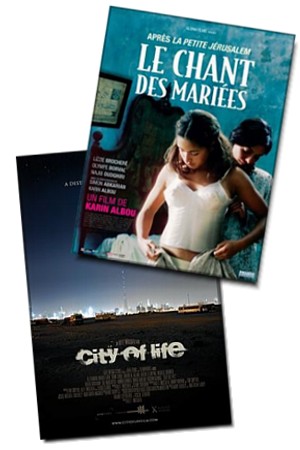
Arab Film Fest Features: "The City of Life" and "The Wedding Song"
Films reviewed by Gregory Burke
posted October 9, 2010
The San Francisco Arab Film Festival now in its fourteenth year takes place between October 14 and October 24, this year. Films will be shown in San Francisco, San Jose, Berkeley and Los Angeles. This year over forty feature films, shorts and documentaries about the Middle East will be shown. The entries are from the United States, Canada, Italy, France, Germany and Greece as well as North Africa – Morocco, Algeria and Tunisia, Egypt, Palestine Lebanon, Syria, Jordan, Saudi Arabia and the United Arab Emirates. Many of the entries are feature films that will be shown in local movie theaters here and abroad or may eventually be offered in Amazon.com or Netflix. Two such films in this year’s festival have been reviewed below.
- The City of Life – United Arab Emirates – directed by Ali Mostafa – feature film 2009, 97 min.
- Wedding Song – France/Tunisia – directed by Karin Albou – feature film 2008, 100 min.
The City of Life
Dubai 2009
As the first major motion picture to ever be made in Dubai, this film had huge expectations, a certain leverage of fear and the financial disaster factor hanging over its head. No one would know that better than the director, Ali Mostafa, age 28, a native Dubai Emirati. Mostafa, a recent graduate from film school in England knew that it was going to be tough, he just didn’t know how tough. First, to get the multimillion dollar budget together and then to get the film approved by the censors.
Dubai has lots of extra money, but it is known for placing money in safe investments. Motion pictures are not safe investments. It has been noted that the script had to be taken to the hereditary ruler of Dubai for a go-ahead on the production. Most films made in Dubai have been damning documentaries on a country that is run more like Enron than a nation.
We note Dubai is the key to the seven UAE Emirates. In Dubai about 11-17% is Emirati, most from the founding tribes. They have the big slice of the pie. The other 83% of the population are workers from other countries. Selected groups of highly skilled technical people like the English team that shot much of this film, and the architects that were chosen and brought in to build Dubai’s amazing Palm Islands and great skyscrapers. These skilled workers are highly paid and privileged. The other 81% are simply workers doing the jobs the average Emirati would not choose to do. It is among this diverse group, primarily from India, the Eastern European nations and Asia that this story is crafted. Alas, these folks have a much smaller slice of the pie, in fact, barely a crumb. They are dispensable, like tissues after one use. One of criticisms of this film is that the workers are portrayed living in apartments when in reality they live in much lower dwellings.
The leading players are an Indian taxi driver who lusts after a career in Bollywood films, a Romanian flight attendant looking for love and security, and an Emirati upper-class young man whose love of slumming is an embarrassment to his family. In reality, that seems to be the big family problem throughout the newly-rich Arabian nations, that certain young people would rather jump into their Ferrari and go the Mall or a Night Club and party, than select a career.
This story is woven with multiple threads as these people and others like them meet, exploit each other and cross paths again. It is a world in which 17% of the people are human, a few are visitors with a visa for a project, and all the rest are robots with interchangeable muscles and orifices that are easily replaced.
What is not touched upon in the film are the private lives of the Emirati themselves. How do these people live within the pressures of a simultaneously expanding and an eerie collapsing world? Dubai has dwindling oil reserves. It’s going to run dry in your lifetime, depending how old you are and who you choose to believe. They have selected to be a country with no taxes, attracting money and industry, lax rules on bank accounts, with no accounting on money deposits. It is a paradise for the storage of Blood Diamonds and gold, mountains of gold that has no legal reported origin. To the US, it is a major friend. To Iran, it is also a major friend.
It is the template of the new age in digital bookkeeping law: everything is permitted, as long as it is not admitted. Frankly speaking, there can be no corruption when you dwell in heaven.
We know the true lives of ancient Rome through the eyes of its slaves, and this is the eye-opener value of this film. It is a first-time film, a clumsy film, shallow in places, but it exhibits a brilliant vision that hints at the cruel truth.
Dubai is known for a glamorous yearly film festival which showcases Arabic films. It is the place to be and the place to be seen at this corner of our world. At this event, the film was a big hit and for good reason, the Middle Eastern audience is very aware of the concept of Dubai and is watching carefully the good and bad unfold. Among the 81% of the resident population who live in squalor outside of glittering city of light, there have been rumbling of unrest and riots. Crime is rampant. Hatreds between Indians and among the Arab sub-groups that have existed for hundreds of years are resurfacing among the workers and alarming the ruling caste, and that is the actual setting in which the film unfolds.
Against great odds, one has to appreciate what Mr. Mostafa has created and the questions to be asked by the implications of the film. Mark it to be seen, as it will give you days of thought. Sometimes ideas are much more powerful than entertainment.
Gregory’s Segway- World’s first gold vending machine unveiled in a hotel in Abu Dhabi
The Wedding Song
France/Tunisia 2008.
If it is catharsis you crave deep in your soul, this is the film for you. Director Karin Albou has crafted an arty tale from the dark days of World War II, when North Africa was under the polished heel of the German Army. Much has been written about this film.
If written by a man it seems to have a deconstructionist methodology, that is, to distance one’s self from attacking it and to seek refuge in effusive praise. If the review was generated by a woman, it mostly zeros in on the lesbian aspects of the principal relationship of the two leading characters.
I’m writing this review because I’d like you to see the film and to think about these people and the time in which they lived. In addition, also because no woman could be found on short notice who would touch this job from any perspective.
The French virtually pushed the art of cinema to greatness and along the way, wasted a lot of celluloid. However, there has never been a film anywhere close to "Wedding Song," so let us sing of it now. It is a bit complicated in as it is historically set in Algeria, but Algeria said "non," to the filming, so that brings us to Tunisia as a stand-in. As the camera rarely leaves a medium close-up, it could have been shot in the alleys of Marseille.
Briefly, this is a story of two mopey adolescents; one is Muslim, Nour (Olmpe Bonval) and one is Jewish, Myriam (Lizzie Brochere). They grow up together in an ultra-low budget, lower East Side type of tenement. They are typical pre-iPod young girls speculating on what the future may hold. Their mothers are hugging-close friends also. The director, Karin Albou plays Myriam’s mother.
Early on, the basics are established. The French are the colonial whipping dogs of German conquerors, who have promised the countries of North Africa their freedom, as declared by The Grand Mufti in Cairo. There really was a Grand Mufti who maintained he spoke for all true Muslims. Adolf Hitler made him an honorary Aryan so that he would not be picked up and sent off to a soap rendering factory.
Because both young girls confide in each other, place their heads on each other shoulders and occasionally have sleep-overs, some reviewers have maintained that they have lesbian tendencies. In the big picture of what is happening around them that should not be anyone’s concern. Both girls have been promised to be married. The Muslim girl to an unemployed young man who in addition to lacking a shirt lacks any moral judgment whatsoever. The Jewish girl has been bargained off to an older yet compassionate Jewish doctor. Both girls are far too young to marry, but it’s another culture and another time.
The Germans are the good guys, as they are polite and blonde. The American are bad guys because they are bombing the hell out of Tunis. Apparently we as a nation are extremely good at bombing the hell out of foreign lands, especially Muslim lands.
The Jews are bad because they started the war by trying to take over the world with help of their friends, The Allies. The girls and their families have no way in which a rational discussion of politics can be heard out. Life is simpler; it is a struggle to stay fed and alive.
There are tasty scenes which offer key insights to the world in which the girls live. In the opening premise, the bacheorette party for Nour, the testicles are cut off a sheep and worn in the Dancer-Performers costume as she mimes the stupidity of men.
Nour who is shy naturally declines to play with them, perhaps saving them for another day. There are delicious scenes in the hammam in which girls and women alike mingle, cleanse themselves and gossip. And yes, the woman are fairly naked. My suggestion that the film be premiered in Tunis was turned down by the film’s distributors.
Myriam’s wide eyed gaze carries us through the film. If it seems I’m talking around the film rather than plunging into a synopsis, that is correct. The reason is this is not a film in the normal sense, but a slice of life carried by the strength of each individual actor, all of which are excellent. Perhaps the acting is a bit overdone, like my Grandmother’s pot-roast, but excellent.
I believe when a film hinges on so little story to tell it is a shame to give it away in a sentence or two. I believe the director does have genitals on her mind, if not laced into her belt. Much has been written about the preparation of Myriam for her wedding as her husband-to-be requests she be prepared in the in the "Oriental" style: the meaning of which sinks in as a mass of goo is used to graphically rip her short and curly from her body bringing her into the world of womanhood. Curiously enough this will have unforeseen but easily guessed results later in the film.
Nour’s husband, needing a shirt even to qualify to be married, finds a job with the Germans turning in all the Jews in the neighborhood. Myiam’s husband is rounded up and sent off to a labor camp. There are disagreements and a falling out between the two friends over cultural differences only to reconcile when they realize that in a world gone mad, they do perhaps have only themselves to rely upon. I’d say it was the prophecy of the ram’s balls that came true.
In closing, if possible, make the San Francisco premier. The audiences’ reaction to certain scenes will be priceless. In a nutshell, this film has wonderful actors pushed into an impossible wedge of history. The Tunisian colonial flag could as easily have been a towel with a bloodstain on it.
If there really were people like this, acting in real life as they do in this film, it would have been an honor to have known them. The soundtrack is wonderful; hear it and weep.
The film wins the Gaspar Noe Prize for throwing caution to the wind. See it and whether you are a Muslim, a Jew or a lapsed Christian, and then clean up your act because the goo of sacred love may come for you.
Resources:
-
For further information: http://www.arabfilmfestival.org;
The Wedding Song will be shown at the Embarcadero Theatre in San Francisco on Ocotober 16 at 5pm, in Los Angeles at the Writers Guild of America Theater on October 23, at 3:30pm
The City of Light will be shown at the Embaracadero Theare in San Francisco on October 17 at 7 pm, in San Jose at the Camera 12 Cinemas on October 16 at 9:15 pm

Have a comment? Use or comment section at the bottom of this page or Send us a letter!
Check the "Letters to the Editor" for other possible viewpoints!
Ready for more?
- 11-17-09 Welcome to the Eleventh Giza Awards, Honoring the Dancers and Videographers of Middle Eastern Dance
Ever since the dark ages of 1997, the Giza Academy of Music and Legends of Dance has honored dancers and videographers who have explored the art of Middle Eastern dance through film and video. Documenting and sharing our dance provides opportunities for preservation, teaching and furthering our art. The following report was created from the notes for that night - 11-23-07 Danza Del Vientre by Devorah Korek Book Review
Book is in Spanish. Once in a while an object of desire comes along, which is deemed important by its obscurity. Such could be the case with this hardcover, difficult to acquire tabletop adornment from Devorah Korek, an American-born Belly Dance teacher living and thriving in Spain - 12-10-05 Articulating the Collective Dream: The Giza Awards, and why the legacy-making process is important to you
"We embrace change however roughly it appears. With video we feel secure in the knowledge that the legacy of the past will never abandon us." - 2-4-05 Comments On American Bellydancer
A documentary film or video is made up of "real" images constructed in such a way to reflect the point of view of its maker. So a documentary film is a fiction, especially when financed by its key subject.. - 9-27-10 Master Zilling with Movement,The Art of Playing Finger Cymbals with Momo Kadous, DVD Review by Zumarrad
Things start to get really interesting when he introduces variations of tone, and I wish he had devoted more of the DVD to this technique. - 9-9-10 Listen and Learn Musical Expertise! Dr. George Sawa: Egyptian Music Appreciation & Practice for Bellydancers CD Review by Zumarrad
The idea is to listen, learn, and use the clips to get the rhythms, in particular, into your body through free dance practice. If used to the fullest, this resource will give you a wonderful grounding in Egyptian music. - 8-17-10 And I thought I Knew Him, Horacio Cifuentes: Confessions of a Male Belly Dancer Book Review by Amina Goodyear
Yes, I thought I knew Horacio Cifuentes, a San Francisco dancer who moved to Berlin to be with and wed Beata Zadou. After reading his book, I realized I really did not know him. The book, “Confessions of a Male Belly Dancer”, is exactly that. It is a self-produced autobiography written in a very sincere, almost shockingly honest way. It is personal and personable. - 8-17-10 Tribal Videos Today, Tribal Fusions, Volume 2 from Bellydance Superstars
Tales of Desire from Hollywood Music Reviewed by Davina
It’s my belief, that as dancers, it’s good to keep up with what’s happening within the greater dance community, even if it doesn’t suit our taste or style. It’s especially important for dance instructors to recognize who the industry leaders are. It doesn’t matter if it’s Egyptian Raks Sharki or Flamenco/Gypsy/Zambra Mora or in this case, Tribal Fusion–knowing who is the current crème-de-la-crème will give you a stronger knowledge base from which to teach your students. Investing in one or two high-quality professionally made Tribal DVDs will add breadth to a dancers video collection.



 A few years ago, one of my Argentine Boas became very sick: would not eat, and became dangerously dehydrated. I took him to what I thought was an exotic vet. The veterinarian was actual an aviary veterinarian. Here is the funny part: he wanted me to assist him because he was afraid! If you think that is bad, you never want to go to a emergency animal clinic with an injured snake. My baby Seiti, is a 6 ½ foot Albino Green Burmese Python, and he got hurt at his show. He got hit in the mouth, and I saw some blood. So, being the good snake-mother, I took him to the hospital. It was a Saturday night, of course (nothing happens during normal hours) so I took him to an emergency 24-hour veterinary hospital. I called ahead to the hospital, so they would know I was bring him in, and I was assured they could handle the situation. Not!

 Gamal Abdel Nasser

 Answer: I personally had very little in the way of formal training but this was not by my choice. Thirty years ago, my opportunities were extremely limited compared to today’s Bellydance student. However, I searched and dug deep for the little tidbits I could get my hands on. Seven days a week for 15 years, I was either in an Arab night club asking questions and studying dancers, or I was performing and receiving constant critical feedback after every performance. I cornered every Arab female (whether pro-dancer or not) and begged her to show me steps — usually without English explanation. Whenever I was in front of a TV in my home, hotel room or an Arab family home, I was watching a video of
  Question #3: Can you please tell me the origins of this Khaleegy song, Rawih Wi Rooh? Which country; Kuwait, Dubai, Bahrain etc.?


 Dancer’s Dressing Room: Each dressing room was hosted by one of Isis’s volunteers, wearing a red T-shirt and a halo headband so you couldn’t miss them. Every dancer had mirrors, cold water, and trays of safety pins, hard candy, chocolate, rubber bands, tape, band-aids, sewing thread, etc. The Yaa Halla volunteers were extremely well prepared, and able to get answers to any question.




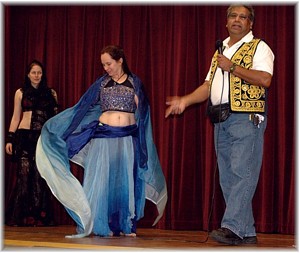
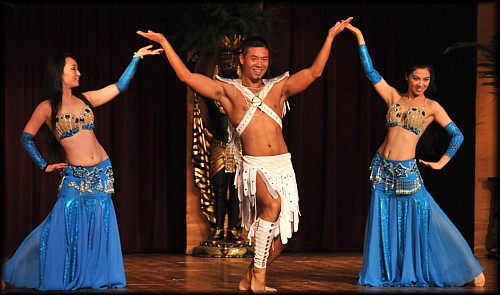





 However, Zadiel showed me that these difficulties could be overcome. He himself had been an outcast in many situations. Being male, gay, and a belly dancer isn’t something that is welcomed warmly in the Turkish culture. Zadiel was fortunate in that his parents were always very supportive, but it was also his drive and determination to perfect his craft and embrace who he was that made him successful. He challenged the "pretty, voluptuous woman" sterotype of the belly dancer, and proved that belly dance was so much more than costumes and looking sexy. His rigorous training and instruction resulted in perfect technique. When Zadiel performs, the skill involved with belly dancing becomes apparent.
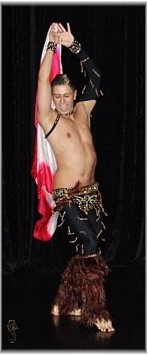
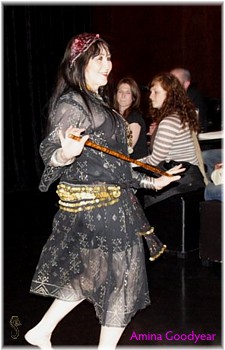 However, our host for the weekend- the Turkish dancer, Dilek- ensured that we still had a good time in San Diego. Not only did she open up her home to us, but she also took us on a tour of San Diego, made us a delicious Turkish breakfast, and hosted a workshop for Zadiel at her studio, free of charge.

 With its fabulous nightlife, this small Arab nation has a reputation for being the “party capital” of the Middle East. Lebanon is also known for its extraordinary cuisine and the country’s cultural riches including the Roman ruins of Baalbeck
 Another acute difference from 2005 is the amount of construction. There are cranes all over Beirut erecting high-rise apartments. Many Beirutis are saddened by the loss of historic and traditional buildings in the name of progress. The housing boom in Beirut is catering to overseas Lebanese and Gulf Arabs who have the money to buy properties. However, there is still beauty to be had including Sanayyeh Park, Beirut’s (only) famous public garden with its gorgeous oleander trees in full bloom and old neighborhoods like Gemmayze, which has retained that old Beirut flavor that was almost completely obliterated during the country’s 15-year civil war. Still, all I heard from many people was about how “Beirut is becoming ugly”. However, there is an organization called “Save Beirut Heritage” that is working to save historic buildings for future generations.
 There are even vacation packages for those who want to visit Lebanon and go under the knife. The Ethiopian maid at my hotel had her eyebrows tattooed in that drag queen-esque style that is prevalent among stylish Arab women because her Lebanese boyfriend likes it. Lebanese men are also known to get work done: liposuction and hair restoration being the most popular procedures.
 Fortunately, I had the opportunity to see Suha Deeb perform. Currently, she is the featured dancer at Al Dar restaurant, Al Rouche, on the coast of West Beirut near the natural rock formations called “Pidgeon Rocks”. Suha was amazing! Her show was a delight to watch since she is the antithesis of the current Lebanese style. Her costumes are to die for. She has them all made by Rony Eid, who designs for many of the dancers in Beirut. The band was also wonderful, playing old school songs like Yama El Amar 3al Bab by Fayza A7med.


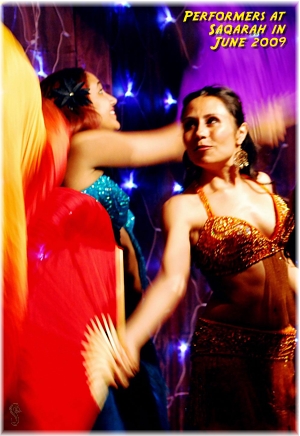 Bellyworld
 The following resources are available also: