Gilded Serpent presents...

The Dumb and the Restless: FIRE!

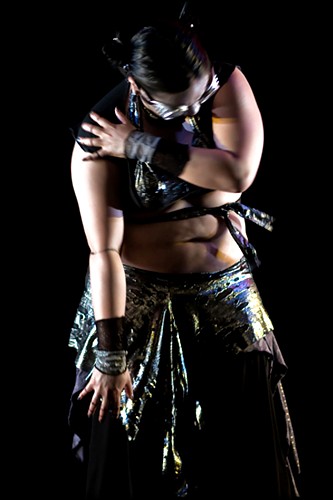
Tasha in Chain Male

A Lighter Outlook on Belly Dance

by Tasha Banat
posted November 10, 2010
Originally published in my “Arabic Guide to Bellydance“ 1983

Since most of the time we read only glowing reports of great accomplishments made by our peers and ourselves in the Art of Belly Dance, I decided to reveal some of those less than stellar moments of my (then) 23 year career as a performer.  Yes, some of those absolutely stupid  things that I have done in order to stand out in a crowd–or because I was restless.
I hope that by writing this article, it will help you to  be aware, at least, of some of the things you may face when you dance with:

FIRE!

Not once, but twice I caught myself on fire and the second time was serious enough for me to have to enter the Denver Burn Center, but let’s go to the first time, which was sort of funny–and ridiculous!

In the late ‘70s early ‘80s, burning candles started to became a popular prop with Belly Dancers.  So, needless to say, I taught and performed with them all the time, but candles dripped, went out,  and generally produced a very tiny flame; so I began to use cotton, soaked in lamp oil, along with “flash papers” for dramatic effect.  I must say that drama was definitely something for which we all strove  in that endless quest for standing out in a crowd.

The first incident was in a hotel and my prop was a hand-made, home-made candelabra, along with my new (just got it that day) Afro-looking permanent wave.  Looking back, I think I resembled Shirley Temple’s older sister, but I felt ravishing and exotic. The room darkened during a slow, sensuous song from Babylon Mood. (Oh, the drama of it all!) My seven flames were shooting a good 10” from each receptacle of that candelabra. 

Yes, the audience was eating out of my hand when someone from the back of the room yelled “Hey lady! Your hair is on fire!”

“The fool!” I thought, “Hair doesn’t burn.”  Well, my hair did burn, and though the hotel sprinklers never went on, the fire department showed up, complete with extinguishers, ladders, hoses, and outfits that made the place look more like an outer space masquerade ball. A fireman actually patted my hair to make sure the fire was out.  Believe me! You cannot make this stuff up. As a humiliated, but a true professional, I took my bow with the fireman in hand and left the dance floor.

Needless to say, I no longer looked like Shirley’s big sister, but more like “The Shaggy Dog”.  The manager even offered me extra money to get my hair cut at the hotel beauty salon because I had a second show to do later that night.  It was certainly less eventful, but I had learned my lesson–or so I thought…

The second time I caught myself on fire was at the renaissance faire in Larkspur, Colorado, where Randolph “The Chain-mail Maker” built a fantastic pharaonic style head piece, a chain-mail bra, and hip band that was to be worn over a beautiful chiffon polyester Beledi-style costume.

When Randolph began to design my headdress, it consisted of an elephant bell built into the headpiece which would hold cotton soaked in lamp oil (just like I used in my candelabra and other flame adorned props).

At any rate, when he was working with my props, I quickly related the story of the fire on my head, and thus, claimed, “No one ever handles my props but me!”

He laughed and then reassured me that The Fire Eater would be the only one who touched my headpiece, and that if anyone knew about fire and props, he did.  Since I couldn’t argue with that logic, I agreed.

Armed with the fire eater’s knowledge and my trust, Randolph took great care of the headdress and even reinforced it with a leather base because when the metal chain male got hot it could burn my head.  In addition, he used a similar method of creating a great flame, which was steel-wool soaked in kerosene–a method still used today by many fire eaters. Therefore, I was prepared for a spectacular show, performing with my burning pharaoh headpiece.

The crowd gathered with more and more people and as the excitement built, and the flames went higher and higher, I felt my head getting hotter in the sun and under the leather base built into the chain male. So I turned gracefully to Randolph in a very slow spin and said in my most sensuous quiet whisper, “Get this damned thing off my head; it’s beginning to get hot!”  

Since I was (and still am) very aware of the audience, I had my back to them, doing a lovely submissive bow as I was making my exclamation.  Then, Randolph, with Renaissance grandeur, began gently to lift the headpiece off of my head.  –Did I mention that he was wearing leather gloves?  As he lifted the headpiece off, the steel-wool that had been soaked in kerosene spilled and one sleeve of my beautiful dress burst into flames that were instantly (and completely) higher than my head and (Oh, no!) my hair. The flames shot incredibly high and people were screaming as I continued to turn, realizing that I was locked in that chain-mail.

While looking for an escape, I actually thought of 3 things:
1. Flammable and inflammable mean the same thing.  Material is not immune to flames, so ignore the instructions on inflammable items.  You will burn.
2. With cotton balls and lamp oil, you must wring out the excess oil.  With steel-wool and kerosene, that does not happen.
3. Oh, yes!–Renaissance Faire stages were surrounded with hay (lots of fire-burning hay), and there were no fire extinguishers, firemen, or fire anything (as if that could prevent a burning Belly dancer from “going up in smoke”).  I have heard since that fire is not permitted at Renaissance Faires anymore.

I continued to spin slowly as I thought “Oh God, I am going to burn to death in front of these children?” when Randolph (by the grace of a higher power) tugged at the burning sleeve of my dress and managed to pull most of the burning fabric away from me. 

Literally, I still shake when I think about what could have happened that day and that just the fact that I am alive, with only a few scars on my arm, is nothing short of a personal miracle.

Anyway, I finished the show, not because of professionalism, but because people were so scared, and I believe I must have been in shock.  They actually relaxed, maybe convincing themselves it was an act, and we made a lot of well-earned tip money.  (I should mention that burning skin does not begin to hurt until about 5 minutes later, so completing the show was not that great a feat.)

From the stage, I went to the back where a vendor grabbed me and threw my arm into a tub of ice.  By that time, the pain really began to set in, and huge blisters were forming where the fabric melted to my arm.  Immediately, I was taken to the Denver Burn Center, still in costume, and more or less, I  drifted drama for more than six weeks, on Demerol and burn treatments consisting of many applications of “New Skin” a type of dissolving bandage used for serious burn victims.  By the way, I never danced with fire again–ever!

Moral: Don’t light up your life!


(Next Chapter:  SWORDS)

use the comment box

Have a comment? Use or comment section at the bottom of this page or Send us a letter!
Check the "Letters to the Editor" for other possible viewpoints!

Ready for more?

  • The French Connection
    Remember that the cabaret style of Belly Dance itself was considered a western cultural event and the night clubs of those days were only there to entertain invaders and their families, not the local people.
  • 6-10-10 Debke, A Brief History by Tasha Banat
    How does one combine Debke with Bellydance? What does that mean? In order to combine two beautiful dances, we have to first separate them and understand the different types of Arabic music
  • 7-12-07 Belly Dance:Time for Personal
    Assessment or How old are your Shoes?
    by Tasha Banat
    What do you personally want from the dance? In order to answer this honestly, you must make a personal assessment of your goals and include your achievements.
  • 1-25-07 One Banat: An Exploration of Some Belly Dance Costuming Origins by Tasha Banat
    Since the establishment of Israel, the definition of the term “Middle East” seems to have changed and now has come to refer to a conglomeration of a number of unrelated countries in the Asian and African parts of the hemisphere.
  • 8-18-05 Re-defining Belly Dance and Middle Eastern Dance by Tasha Banat
    The fact is that “Middle Eastern Dance” is not an acceptable definition for Belly Dance and let me explain why.
  • 11-8-10 The Physiological Effects of Oriental Dance, Excerpt from Health and The Oriental Dance, Chapter 1, by Aziza of Hungary
    There was no information subject available like "the technique of Belly dancing". I had to construct it myself. It took a lot of research in regards to both its theoretical and its practical sides.
  • 11-7-10 Ergun Tamer on Saz, Musical Instrument Tour Video
    Ergun is one of the organizers of the Middle Eastern Music and Dance Camp held in Mendocino, California, each year in August. Ergun plays many instruments. In this video he tells us about the Turkish saz. The saz has many names depending on the country, such as bazouk or bazouki. This instrument also comes in many sizes.
  • 11-3-10 An Intro to Tribal Fusion by Jasmine June
    Since Tribal Fusion Belly Dance is a relatively new dance form, it is especially important to treat the genre with a level of professionalism, or else one runs the risk of discrediting the work of dancers who have dedicated their lives to creating and elevating Tribal Fusion Belly Dance.
  • 10-27-10 Gigbag Check #22 with Cory Zamora!
    Cory talks with us after her performance at the Carnival of Stars Festival in Richmond, California, in August 2010. She shows us what she carries for her performance.Including an old style 2 piece cabaret belt, Egyptian style bra with no fringe and more. The performance clip includes beautiful floorwork done as only Cory Zamora can do!
  • 10-26-10 Queen of Denial, Chapter 3: Hooray for Hollywood! by Rebaba
    As for Khayam’s, it was the extremely popular nightclub and restaurant that was known for having the best live music show in town, with good dancers, good food; a constant supply of good drugs, and in particular the more and more fashionable cocaine.
  • 10-18-10 Karim Naji, Interview with an Egyptian Dance Master by Nicole Beckerman
    I think that Egyptian and Arabic culture as a whole entity should never be extracted from this dance. I do not believe in de-ethnicizing it, and I do not believe the culture is optional! Nobody ever allowed Latino culture to become an optional part of Salsa or Samba. Additionally, Indian culture is inextricable from Bharatnatyam and Bhangra. I believe that Raqs Sharqi, a.k.a. “Belly dance” is available to anyone from any culture. I am not xenophobic, nor an exclusivist. I am thrilled to see people all over the world enjoy and promote this art form. However, I will argue for the importance of the Arab connection until the day I die.
 

Gilded Serpent presents...

Be Amazed and Dedicated in Your Dance!

Said and Aziza's DVDs

Hands, Arms & Poses by Aziza
AND Turn In, Turn Out & Turn Around – Vol. 1 by Said El Amir

Comparison DVD Review by Tammi “Yasmine” Fabris
posted November 9, 2010

When Lynette asked me to review two DVDs and assigned me these titles and artists, I was excited at the prospect. After watching both of the DVDs in depth, I would describe Aziza & Said El Amir as amazing and dedicated instructors.

Hands, Arms & Poses by Aziza starts off with a brief introduction, an all body warm-up, drilling exercises (introducing and drilling ballet arm positions, foot patterns, and hand/arm isolations), combinations, and a thorough cool down. This DVD also includes bonus performances,  career spanning photographs, and an intimate interview with Aziza.

Turn In, Turn Out & Turn Around, Volume 1 by Said El Amir starts similarly with helpful details as warm-ups (brief instruction on classic ballet positioning and moves: port de bra, arabesque, promenade,  pencil, pivot and tipp turns (tipp turns are explained in the DVD) combinations, full choreography and ends with credits and messages.

Both DVDs are geared towards ballet fundamentals, adding them to the art of Belly dance. The fusing of these classic forms seems easily accomplished by the instructor’s strong posture, controlled movements, complete intention in every move, and graceful extensions from the head to the toe.

Aziza speaks live or in real time, with a clear and crisp voice, whereas Said’s voice is recorded over the instruction and seems, therefore, a little detached. The video angles and views are complimentary to the body positions and movement. Aziza brings you in for a closer view many times throughout the instruction, and Said keeps a full-length view primarily. Said adds the element of instrumentation with a live drummer, infusing depth and culture. Aziza’s music is softly faded into the drills after the initial verbal instruction has finished. Aziza’s video takes place in a ballroom and Said’s is recorded in a studio. The studio and the grand ballroom settings are both well suited for their instruction. Absolutely, Aziza’s performance section (set in different portions of what appears to be a grand hotel) is striking and compliments the mood perfectly. The instructors’ attire, used as a visual aid, in the instruction portion of their DVDs are classic and geared towards showing the movement, and does not detract from the dance. Aziza wears brown dance pants and a blue bra top that subtly match the the room décor. Said wears active-wear and the strips on the pants are a great visual focal point for his leg work, foot work, and rotations of his hips.

A highlight difference in these works was Aziza’s format, comprised of bringing it full circle, showing the performance aspects of her moves as she teaches in full costume.  I would liked to have seen a short performance of some sort from Said to bring his work all together.

The combination sections of both instructors are friendly and easily brought into your body. They both use a conscious amount of time drilling the combinations before moving onto the next, without loosing your attention. They allow your body to adopt the movements thoroughly . Aziza’s combinations are very feminine, graceful, and diverse in visual focus and affects. The movements are inviting and speak to you. Said’s combis (as labeled in his DVD) are detailed, use a lot of preparation, and progress from one to another very evenly. I appreciated both combination sections of these artists and feasibly, could add them to my dance education. However, Aziza brought it more to a performing level; whereas, Said brought it to an instructing level for me. It was difficult to visualize the full choreography of Said’s work in front of an intimate audience incorporated into a performance or stand alone, on a stage. Aziza’s addition of the “posing in your dance” section was top-notch for me, as it can add such a full body essence to the dance.

These two DVDs have similarities but also have wonderful differences. Aziza impresses upon her students greatly, her “Be Amazed” motto throughout her journey in Hands, Arms & Poses. She shares the concept of being amazed with every move, every pose, every muscle you engage;  therefore, this will express greatness through your dance. Aziza says, “If you practice with amazement and intensity, you will perform with amazement and intensity”. The concept that every ounce matters is a precious one. Said shows, through his work in Turn In, Turn Out & Turn Around, that dedication to executing and practicing the movements from the core or the root of their beginning is extremely valuable. Simply teaching a combination is not Said’s way; he is precise and persistent in the building blocks of making every movement excellent.

These are both thoughtful master instructors portrayed on these DVDs. I recommend them to all levels in the dance.

Hands, Arms & Poses by Aziza 
Rating 4 zils
Rating: 4 zils
purchase information


Turn In, Turn Out & Turn Around – Vol. 1 by Said El Amir

Rating 2.5 zils

Rating: 2.5 zils
purchase information


use the comment box

Have a comment? Use or comment section at the bottom of this page or Send us a letter!
Check the "Letters to the Editor" for other possible viewpoints!

Ready for more?


Gilded Serpent presents...

The Physiological Effects of Oriental Dance

Author

Excerpt from Health and The Oriental Dance, Chapter 1

by Aziza of Hungary
posted November 8, 2010

In early 2000, there were no comprehensive instructional writings about Oriental dance written in Hungarian, so I had to obtain the necessary information in English. Also, in order to be able to teach Oriental dance as a movement system (from the point of view of movement and training theory), I earned a recreational sport and a Hungarian folklore dance instructor degree to complement my basic teacher’s degree. There was no information subject available like "the technique of Belly dancing". I had to construct it myself. It took a lot of research in regards to both its theoretical and its practical sides.

Dance helped me a lot, just as it has helped many other women, and has numerous aspects. Because of my family background, I thought that the stage would not be my main profile, but rather, teaching girls and women on their hobby-dance path as well as training, coaching, mentoring dance trainers (who had no pedagogical degrees) but want to teach dance throughout our country — even in the smallest villages. I share with them the teaching method I have developed over the years, the tricks I figured out, and whatever makes the learning process easier. I worked out, organized and lead an instructor training program that has received the accreditation of the Adult Education Accreditation Board of the National Institute of Vocational and Adult Education of Hungary (NIVE).

Besides teaching Oriental dance, regularly, I give oral lectures and special female training throughout the country. Additionally, I dance at different programs my articles have been published in magazines. In 2003, I published the first Hungarian Oriental dance book, "Belly Dancing: Harmony, Vitality, Body Shaping, Eroticism".


“Exercise substitutes lots of medicine, but there is no medicine that substitutes exercise.”

Oriental Dance as a Recreational Activity

It is the goal of human beings to feel good in their skin, to reach an ideal physical, emotional, mental state, aspire for a perfect general health. Optimal physical condition, proper nutrition, and a balanced emotional life are all conditions of health. The latter one is the actual, daily state of a person, which is associated with every-day, general productivity.

According to the definition of the World Health Association:

“Being healthy is not identical with the absence of illnesses; it is the state of physical, mental, and social well-being.”

According to the Universal Lexicon:

“Physical, emotional, and mental well-being in the objective sense, great productivity and good general condition.”

How can Oriental dance help preserve physical, emotional, and mental health?
As opposed to the popular name of this dance (Belly dance) it does not only make the belly work, but the entire body. Its ancient, natural moves are perfectly suitable for obtaining and preserving fitness. The word "bellyfit", which is a contracted form of belly dance and fitness, would tend to demonstrate that correlation.

  • As regards its physical effects: the many small repetitive moves and the larger, more energetic moves make almost all the muscles work.
  • As regards it emotional side: Physical exercise in a good mood does not only charge us with energy for the time of the training, but is able to produce reserves that can increase our resistance towards the outside world.
  • Mentally: Learning new, unusual things, approaching dance moves from a cognitive point of view, the new way of concentration also develops our thinking.

Dance CampLet us have a look at the advantages of a “perfect general condition” based on the experiences of Dr. Kenneth Cooper, one of the most well-known recreational experts:

  • Greater individual energy
  • More enjoyable, active free time
  • Increased ability to deal with stress at home and at work
  • Less depression and unjustified worrying
  • Decreased physical symptoms
  • Better digestion and less frequent constipation
  • Greater self-esteem and self-confidence
  • Effective regulation of body weight
  • More attractive, slimmer figure
  • Stronger bone structure
  • Slower aging process
  • Easier pregnancy and childbirth
  • Increased ability to concentrate
  • Greater will power, self-control, endurance in solving every-day tasks
  • Less frequent pain, especially headaches and back pain
  • Uninterrupted, deeper sleep

How can this perfect health be obtained?
We have to satisfy three fundamental human needs:

  • Emotional balance
  • Proper nutrition
  • Aerobic exercise

These three aspects are strongly connected to each other. Let us have a closer look at them:

Emotional Balance

Esoteric literature, holistic courses, emotional guides, and the support of friends are tremendous help in establishing emotional balance and a harmonious life. In the chapter on training theory analysis we can read about the stress-releasing, community-building function of dancing as well. We also deal with the effects of oriental dance on spirituality and creativity in a separate chapter. We can find tips about how to make our love life more harmonious in the “Scented Garden” chapter.

Proper Nutritional Plan

Accept your body and live in it in happiness!” Seika

We can find information about positive eating habits, matching foods, proper frequency and times of meals, fasting diets, special diets, and nutrition complements in magazines and from nutrition advisors.

If we are overweight, we shouldn’t believe the miracle diets and pills that are based on an unvaried diet and promise us fast weight loss. The models in the advertisements of these products may never have had weight problems in their lives, or were made slim with a pair of scissors. The perfect figure of the models on the front pages of magazines may also be a result of an eating disorder, such as anorexia or bulimia (or even perhaps unhappiness).

Unfortunately, fashion and the supposed or real expectations from women make us lose our sober judgment and cause a distortion of body image. Plastic body corrections might help some women who can easily accept their new selves after the surgery. The mentioned eating disorders, however, deeply undermine self-esteem due to the constant self-punishment and ensuing guilt. Sadly enough, teenagers and young women have been suffering from these disorders more and more often recently. In such cases, the help of an expert is necessary.

If we are looking for a front page ideal, why not Shakira, Jennifer Lopez, or Madonna, instead of Winona Ryder or Twiggy?
Proper nutrition plan means consciously planning our eating habits in the following way: Open Air

  • What do we eat?
  • How do we eat it?
  • When do we eat it?
  • How long do we eat it for?
  • What do we eat it with?
  • With whom do we eat it? In case of a private dinner for two.

We should pay attention to the distribution of the three main nutriments, which, according to doctor and sport physiologist Kenneth H. Cooper, is the following:

  • 50% carbo-hydrate,
  • 20% protein,
  • 30% fat

The distribution of daily energy intake:

  • Breakfast: 25%
  • Lunch: 50%
  • Dinner: 25%

One more help for regulating weight: If we do aerobic exercises in the evening, we can reduce our appetite. This way we primarily burn fat and not the muscles, which are much more difficult to obtain and they are the ones that start deteriorating first if we are on a starving diet.

Aerobic exercises

It was Cooper who introduced the term "aerobic exercises". The term means:
A physical activity which requires oxygen for a longer period of time, therefore puts the body into circumstances in which it must improve its own oxygen-utilizing capacity.

“During aerobic training, positive changes take place in breathing and blood flow. The aim of exercising is to increase the body’s ability to take air into the lungs and draw it out: blood volume increases, blood becomes more suitable for transporting oxygen. Physical activity improves blood supply in all parts of the body, including the brain. That is why we can suppose that aerobic exercise increases mental productivity as well.”

(Dobozy-Jakabházy: Sport Recreation 1992. p67. Translated by Emese Filus)

Physiological Effects of Oriental Dance/Bellyfit

(Disclaimer: Following the guidelines mentioned below does not substitute medical treatment!)
If you have any of the health problems mentioned in this section, you should see a specialist.

The following are individual experiences of women who practice Oriental dancing and were not recorded as part of a medical research.

Oriental dance can be categorized under aerobic activities. Its regularly performed moves have the same effects on the human system as regular jogging or swimming. Its content and structure, and their space-time and dynamic features, render it suitable for anybody regardless of age or initial fitness. According to Nádori László, one primarily needs to do aerobic exercises in order to obtain fitness, in other words we first have to improve staying power. Once we have improved our staying power, the following changes occur:

  • Growth of heart volume. After 6-8 weeks, increase of cardiac output, i.e. increase of blood pumped into the bloodstream by the heart in a minute. These changes result in the decrease of at-rest pulse from an average of 60-70 to 40-50 (in the case of professional athletes, it might be around 30-35, which is a sign of extraordinary fitness).
  • Maximum oxygen uptake increases, which increases energy intake ability.
  • Capillary function improves, arterial-venal difference increases, oxygen supply of the muscles improves
  • Maximum oxygen pulse rises, which is the amount of oxygen taken in during one cardiac contraction.
  • Myoglobin, the red pigment of muscle tissues rises, which takes in and releases oxygen.
  • The number of mitochondriums in muscle cells rises, in which energy generation occurs due to oxidation.
  • Glycogen content rises, i.e. the ability to store glucose; the functioning of enzymes with aerobic effect strengthens.
  • Rise of ATP (adenosine tri-phosphate) and b-phosphate.
  • The working of the heart changes, diastolic and systolic periods lengthen, the oxygen requirement of the heart muscle is reduced.
  • Breathing becomes more economical, the volume of blood circulation and hemoglobin increases.

(Nádori László: Fitness Training 1992. Translated by Filus Emese)

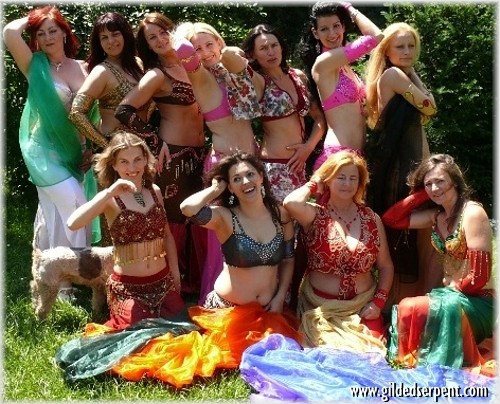
My Students after their exams

From left,
Back line: Melinda, Gyorgyi, Judit, Lina, Aziza, Bea, Mariann
Front line:  (our dog: Dori –her speciality is the modern Egyptian knee shimmy, ) 
Ibolya, Barbara, Krisztina, Katalin


use the comment box

Have a comment? Use or comment section at the bottom of this page or Send us a letter!
Check the "Letters to the Editor" for other possible viewpoints!

Ready for more?

  • Belly Dance Secrets for Fitness and Rejuvenation
    The most important factor in sustaining an exercise program is the ‘fun factor’; Belly dancing comes with great music, exciting moves, noisy coin belts and its own special dress code.
  • 10-9-07 Working the Core, Bellydance Core Fitness DVD review by Erica
    What I found instead was a not-very-flashy production of a good workout that is filled with unexpected and unusual (for bellydance) moves accompanied by sound anatomy and posture advice and coaching.
  • 3-2-10 Latest Craze- Egyptian Oriental Dance, The Fitness Benefits of Our Dance by Hadia
    This is a fabulous idea, except for the very important and primary fact that the majority of efforts in this direction have attempted to fit this archetype of feminine activity into the current prevailing masculine model of linear strengthening and tightening, complete with fitness speak, crunches, squats and sweat!
  • 11-7-10 Ergun Tamer on Saz, Musical Instrument Tour Video
    Ergun is one of the organizers of the Middle Eastern Music and Dance Camp held in Mendocino, California, each year in August. Ergun plays many instruments. In this video he tells us about the Turkish saz. The saz has many names depending on the country, such as bazouk or bazouki. This instrument also comes in many sizes.
  • 11-3-10 An Intro to Tribal Fusion by Jasmine June
    Since Tribal Fusion Belly Dance is a relatively new dance form, it is especially important to treat the genre with a level of professionalism, or else one runs the risk of discrediting the work of dancers who have dedicated their lives to creating and elevating Tribal Fusion Belly Dance.
  • 10-27-10 Gigbag Check #22 with Cory Zamora!
    Cory talks with us after her performance at the Carnival of Stars Festival in Richmond, California, in August 2010. She shows us what she carries for her performance.Including an old style 2 piece cabaret belt, Egyptian style bra with no fringe and more. The performance clip includes beautiful floorwork done as only Cory Zamora can do!
  • 10-26-10 Queen of Denial, Chapter 3: Hooray for Hollywood! by Rebaba
    As for Khayam’s, it was the extremely popular nightclub and restaurant that was known for having the best live music show in town, with good dancers, good food; a constant supply of good drugs, and in particular the more and more fashionable cocaine.
  • 10-18-10 Karim Naji, Interview with an Egyptian Dance Master by Nicole Beckerman
    I think that Egyptian and Arabic culture as a whole entity should never be extracted from this dance. I do not believe in de-ethnicizing it, and I do not believe the culture is optional! Nobody ever allowed Latino culture to become an optional part of Salsa or Samba. Additionally, Indian culture is inextricable from Bharatnatyam and Bhangra. I believe that Raqs Sharqi, a.k.a. “Belly dance” is available to anyone from any culture. I am not xenophobic, nor an exclusivist. I am thrilled to see people all over the world enjoy and promote this art form. However, I will argue for the importance of the Arab connection until the day I die.
 

Gilded Serpent presents...

In the Land of Big Sound

Placeholder

The Masters of Bellydance Music, Vol 2
The Farha Tour, Sydney 2008
The Essence of Bellydance

CD by Tracy Benton
posted November 4, 2010

All three of these CDs I am reviewing here are for the fans of big, full, sound, with lots of variation in instrumentation, changes in volume and tempo, and plenty of drama–in short, the music you might want for your big show! When you want to fill the room with music, these CDs are exceptional choices.

MastersThe Masters of Bellydance Music, Volume 2  by many of today’s major players in Belly dance music has a little something for everyone. From “Set Al Hosen” to “Shik Shak Shok” and from Gizira Band to Mosavo, it covers the bases. Need a drum solo? How about the classic “Sahra Saidi” by Gamal Goma? If you desire a fun sha’abi number, try the slightly naughty “Shokolata” by Sami Ali. If you were buying a CD as a gift for a dancer and you weren’t quite sure what she liked or what she already owned, this would be the one CD to buy for its sheer variety. With 14 tracks from three to six minutes, it’s a great show builder… if you can settle on your favorites, which might be difficult!

The most successful tracks on this album for me included the drummer Said el Artist’s “Afrah al Tabla”, which I understand roughly to mean joy of the drum. I’m not generally a drum solo fan, but I very much enjoyed this percussion piece with multiple rhythms, unusual finger cymbal patterns, and a lot of exuberance. I also enjoyed the Ahmed Abdel Fattah version of “Daret Al Ayam”; it’s lyrical and short without excessive complications.

The liner notes on this CD should also be given special praise for including brief bios of most of the included artists, a great jumping-off point for the dancer who wants to hear more.

Product purchase information:
Hollywood Music Center

Rating: 4 Zils
Rating: four zills

Amira CDFarha Tour – Sydney 2008 is a quite different collection. Recorded at a Sydney performance of dancers and musicians from the Farha festival in Egypt, it’s an album full of absolutely faithful live music, not a prepackaged or remastered promotional item. If you were lucky enough to be at the performance, featuring Randa Kamel,  I can only imagine that this would be a wonderful keepsake to have. While the Fer’et El Negoum Orchestra seems to have been small (keyboards, violin, nai, accordion, percussion, and two singers), it certainly sounds like they filled the auditorium without a problem. This CD would also be a good choice for someone who wants to reminisce about seeing Belly dance in Cairo, because the flow from song to song, from vocalist to soloist and back, certainly gives the feel of the professional shows in Egypt. As a set or choreography builder, this album might not have the sound clarity you want, but it’s undeniably authentic. When I first listened to it, I wasn’t too sure what to make of it, but it’s turned into something I appreciate listening to. “Kareat el Fengan” with themes from Scheherazade insinuated into the Abdel Halim Hafiz song, is very pleasant indeed.

Product purchase information: Amera’s Palace

Rating:3 zils
Rating: three zills 

EssenceThe Essence of Bellydance by the Al-Ahram Orchestra is a great find for those who want a mix of old and new in modern orchestrated music. Their slinky and sinuous take on “Tamr-Henna” is the cure for someone tired of the grandiose; “Sahrawi Ya Wad” is the answer for the dancer who wants weight and languor in a beladi. The fun “Soublil Alashra” is included for your khaliji collection.

The Al-Ahram Orchestra has been popping up on compilations here and there for some time (including the first volume of Masters of Bellydance Music, in fact), spreading their musical reputation through the dance community. Their own albums are generally well-recorded and feature a wide range of music, and also do the dancer the service of marking the type of music for each track on the liner notes (“Classical Egyptian,” “Modern Egyptian Balady”, et cetera). Any one of their albums would be a good addition to a collection, and Essence is a fine choice.

My attention was instantly drawn to the opening track, “Leylet Al Naseeb”, a seven and a half minute track marked as a “routine” but which is, I believe, actually a majensi. It has a wonderful flowing introduction for veil and arabesque work, then a fun bouncy theme for some saucy hips; a slow section with some gooey accordion changes the pace before giving way to a bouncy Beladi beat and a violin solo. Then there’s an interlude of waltz rhythm before returning to the opening theme for a sweeping finale. This tune would make a great class exercise in changing moods as well as a fine restaurant song. While I ought to point out weak spots in this album, it’s so much to my taste that I regret that I am unable to do so.

Product purchase information:
Hollywood Music Center

Rating: 4 Zils
Rating: four zills

When you consider your collection of Middle Eastern music, a lot has to do with your mood.  Some days you want to hear an intimate little ensemble with a handful of virtuoso musicians, but some days you want to wrap yourself in a rich, warm, room-filling sound. Let these albums envelop you and keep you warm this winter!

Available for purchase also through Amazon.com

use the comment box

Have a comment? Use or comment section at the bottom of this page or Send us a letter!
Check the "Letters to the Editor" for other possible viewpoints!

Ready for more?


Gilded Serpent presents...

An Intro to Tribal Fusion Belly Dance

Jill Parker and Tobias, photo by Bob Giles

by Jasmine June
posted October 28, 2010
Note: Due to increasing content theft, our graphics are now marked with our mark and the photographer’s credit.
Photos property of photographers and GS – You are not authorized to use without express written permission.

The “fusion” in Tribal Fusion Belly Dance makes this dance genre elusive and tricky to define. Two dancers could have nothing in common except a few core movements and a couple costuming pieces, and yet both could define themselves as Tribal Fusion dancers. While this can be confusing, both to outsiders and to Tribal Fusion belly dancers, the freedom that fusion grants is exactly what makes the genre so attractive.

Jamila in 1969The other side of the coin is that sometimes Tribal Fusion Belly Dance is interpreted to be completely open-ended. This can lead to dancers changing or ignoring technique, musicality, and proper training.

Since Tribal Fusion Belly Dance is a relatively new dance form, it is especially important to treat the genre with a level of professionalism, or else one runs the risk of discrediting the work of dancers who have dedicated their lives to creating and elevating Tribal Fusion Belly Dance.

When one thinks of dance, history is not a subject that typically comes to mind. Dance is physical, immediate, energetic, and personal. History is academic, long-term, and based on a collection of facts. However, in understanding a dance genre, it is important to know and comprehend its roots. Tribal Fusion Belly Dance did not suddenly appear out of thin air. Even in advanced classes, people have credited the origin of Tribal Fusion Belly Dance with the wrong person.

Most people can agree that the poster girl of Tribal Fusion Belly Dance is Rachel Brice. Yet she herself writes, “The real dance heroes that created and fed my personal dance lineage: Jamila Salimpour taught John Compton and Masha Archer, who taught Carolena Nericcio, who taught Jill Parker, who taught Heather Stants, who taught Mardi Love, who all taught me.”

It is this lineage of teachers that has created Tribal Fusion Belly Dance. In the 1960s, the belly dancer Jamila Salimpour created the company “Bal Anat” and performed with her dancers at California Renaissance fairs. The need to fit belly dance into a renaissance style led to a show that drew from the tribal dances and costuming of North Africa and the Eastern Mediterranean. Props such as masks, snakes, and swords added a theatrical element to the dancing.

Jamila Salimpour taught Masha Archer, who formed the “San Francisco Classic Dance Troupe”. As a trained painter and sculptor, a core part of Masha’s teachings was the goal of creating art through dance. One of her students, Carolena Nericcio, took this goal to a new level by creating an original dance form, which is called “American Tribal Style” belly dance or “ATS”. It is from ATS that Tribal Fusion set its foundation.

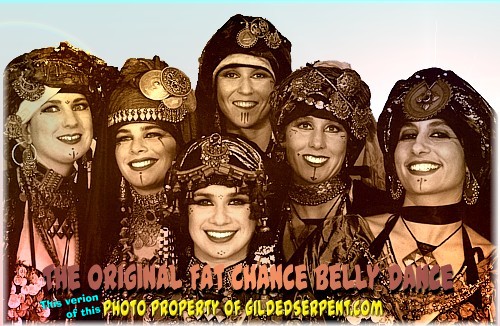
The central element of ATS, according to Carolena, is “a method of improvisational choreography, using a vocabulary of natural movements and cues allowing the dancers to communicate via gesture when dancing together.” Carolena’s company, Fat Chance Belly Dance, demonstrates this concept by dancing in a chorus line, from which dancers can come in and out of as duos, trios, and quartets.

The Original Fat Chance Belly Dance
Theresa, Jill Parker, Rina Rall, Beth Frue, Suzanne Elliot, Carolena, (Paulette not pictured)

Saint MashaATS also draws from the earthy, grounded movements of folkloric dance, as pioneered by Jamila Salimpour. Tribal elements derive from textile costuming, elaborate jewelry, tattoos, body paint, hair pieces, folkloric music, and the “tribe” of dancers created through group improvisation. ATS costuming mainly consists of a long, flowing skirt (reminiscent of the types of skirts worn by Flamenco dancers and certain Gypsy cultures), choli, coin bra, and tassel belt. Pantaloons, hip scarves, and turbans are also incorporated. This type of costuming is very different from the sequined costume traditionally associated with belly dance. ATS dancers tend to have more of their body covered, and use heavier fabrics and textiles. The combination of tribal influenced costuming, music, and movement is what sets ATS apart from other styles of belly dance.

Tribal Fusion Belly Dance draws from two components: “tribal” and “fusion”. Jamila Salimpour, Masha Archer, and Carolena Nerricio are the keys to understanding the tribal element, but where does the fusion come from? It was the collaborative nature of Ultra Gypsy, under the guidance of Jill Parker, that nurtured the desire to personalize ATS by creating unique fusions.


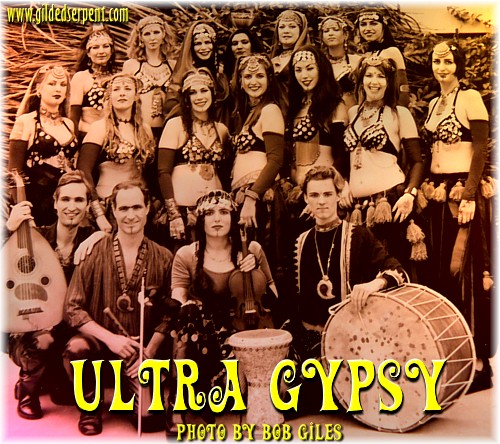
Jill Parker was one of the founding members of Fat Chance Belly Dance and has been referred to as the “mama of tribal fusion”. She formed the Ultra Gypsy Dance Theater company in 1996 and expanded on the ATS repertoire of movement, costuming, and music. Jill Parker maintained certain elements of ATS while integrating other dance genres into her style.

Ultra Gypsy, photo by Bob Giles

How many faces do you recognize?
back row: 1-Janice Solimeno, 2- Deborah Campbell, 3-Jill Parker, 4-?, 5-Carrie Arata, 6-Molly, 7-Lee Kobus
second row: 1-Keri Langwell , 2-Shaina , 3-Rose Harden, 4-Jo Dankosky (Braden) , 5-Sharon Kihara, 6-Kyrsten Mate, 7-?,
Musicians: 1-Elliot, 2-Hector, 3-Lila Sklar, 4-Tobias Roberson

She fused ATS technique with burlesque, cabaret, flamenco, and other forms of dance. As well, she welcomed the input of her company members, which led to choreographed pieces that featured tribal elements along with a myriad of other influences.

Many of the big names in the Tribal Fusion Belly Dance scene were members of Ultra Gypsy. These names include Rachel Brice, Rose Harden, Sarah White, and Sharon Kihara, along with other prominent dancers who are shaping the face of Tribal Fusion today.

Another dancer who has influenced the Tribal Fusion genre is Suhaila Salimpour. She is the daughter of Jamila Salimpour, and while she was not a member of Fat Chance Belly Dance or Ultra Gypsy, she did pull from similar influences as Carolena Nericcio and is often referred to as a Tribal Fusion belly dancer. Her unique technique and training style has influenced many belly dancers, including those who classify themselves as Tribal Fusion.Heather Stants by Brad of TabooMedia.com

At this point, Tribal Fusion Belly Dance has undergone a pyramid affect, in which teachers have trained students, who have branched out and trained more students, and so forth. As fusion is a staple of the genre, with each new teacher has come a new version of Tribal Fusion Belly Dance. Tribal Fusion is like an umbrella, with little sub-genres huddling underneath. There is tribal fused with hip hop, tribal fused with flamenco, tribal fused with goth, and the list goes on.

Music is another important feature that puts the "fusion" in Tribal Fusion. Being an American creation, Tribal Fusion Belly Dance allows for the influence of American music.

It is not uncommon to see Tribal Fusion belly dancers performing to folkloric music, jazz, hip hop, electronic music, and even rock and roll. Of course, a Tribal Fusion dancer can also choose to perform to music traditionally associated with belly dance. The differences in musicality can cause Tribal Fusion belly dancers to appear very dissimilar from one another, even if their dance technique is the same. Again, this is the beauty of Tribal Fusion Belly Dance and the individuality it gives to the dancer.

What this means is that the current popular Tribal Fusion Belly Dance companies can vary quite a bit from one another. For example, the minimalist costuming and modern dance influences in “Urban Tribal Dance Company”, directed by Heather Stants, is a stark contrast to the ornate costuming and vaudeville influences in “The Indigo”, whose members are Rachel Brice, Mardi Love, and Zoe Jakes. Yet all of those dancers can trace their training back to Jamilia Salimpour, and similar dance technique shows up in their choreography. .

This wide variety of Tribal Fusion Belly Dance styles is why it is crucial to understand the history of the dance. If not, there is a danger of becoming lost amidst the numerous branches of Tribal Fusion and not fully comprehending the dance as an art form. There is no simple definition of Tribal Fusion Belly Dance, just as there is no simple definition of belly dance in general. However, this should be seen as a good thing. The very fact that Tribal Fusion Belly Dance is a complicated genre to dissect is what makes it so unique in the first place.

Furthermore, the encouraging nudge the genre gives towards individuality and uniqueness empowers the dancer to express herself in a way that is right for her. There is something beautiful and scary about truly owning your dance style. Tribal Fusion Belly Dance combines ATS with a bit of this and a bit of that, and a whole lot of the personality of the woman who is dancing.

Rachel talks to us about her love and connection to the North Beach disctrict of San Francisco and her coming tour.
This interview was done in February of 2009 while she was touring with the Bellydance Superstars.
She is touring now with Serpent Rouge along the left coast. See her website for schedule


use the comment box

Have a comment? Use or comment section at the bottom of this page or Send us a letter!
Check the "Letters to the Editor" for other possible viewpoints!

Ready for more?


Gilded Serpent presents...

Hooray for Hollywood!

Rebaba on stage at Khayam's

Queen of Denial, Chapter 3

by Rebaba
posted October 14, 2010
Chapter 1: The Safety of the Stage
Chapter 2: Paris, The City of Lights

In 2005, with the support and love of my immediate family, and my extended “Hahbi’Ru” family, I entered into a drug & behavior rehabilitation program. While there, I started the long and difficult process of freeing myself from a life of addictions – of food, drugs and love (yes, you can be addicted to the wrong kind of love). Together these addictions had all but ruined my life, and in the 3 years before rehab, I came very close to ending it altogether! The stories that follow are about my love affair with Belly Dancing, and how this art form literally helped save my life. However, we all know love affairs begin by soaring very high and then sinking lower than we can imagine. For me, it was dancing and then not dancing… It is my sincere hope that my stories will entertain you as well as help you understand a little about the illness of addiction. The success statistics are staggeringly low, with a rate of less than 5% of those who seek treatment. I am one of the lucky ones. I have beaten the odds, to dance again and tell you my tale…

I pulled into the first gas station I could find on Sunset Boulevard, popped my hood, and looked down to see my radiator cap explode off and up, just missing my head!  A mixture of boiling water and anti-freeze sprayed my face and ran down my neck, chest and on to my thighs at which point I stripped to my underwear regardless of the garage attendant at my side!  Hooray for Hollywood, that’s how I arrived in “Tinsel Town”, with a blast, literally!

The memory of my first days in Hollywood was of intense pain, during which I was in and out of lucidity only resurfacing enough to reapply vitamin E oil and aloe juice over the massive burns on my legs, chest and face.  After a week or so, I had to start performing or risk losing my job!

My first performances at Khayam’s were done with a very red sunburned face (NOT! It was a water and acid laced radiator fluid burned face!), and two blisters the size of grapefruits on my upper thighs so big I could feel the water moving like waves crashing on my legs when I danced!  What a glamorous Hollywood debut!  As if dancing like this wasn’t bad enough, the knowledge that my new boss thought I was too fat and consented to hire me at my girlfriend’s insistence, (as we were best friends, and more importantly she didn’t drive and relied upon me to chauffeur her to work), all of this weighted heavily on my mind. Even though my employer admitted that he thought I was a good dancer but too “voluptuous” for his taste. Great, I was a glorified chauffeur and Belly Dancer with throbbing burns over 30% of my body! As you can imagine what little self-esteem I possessed was at minus zero and dropping.  Thank GOD for stage lights, clever costuming, loyal best friends, pain killers, fantastic Egyptian music and most of all, an audience that enjoyed my performances in spite of my employer’s taste in women! The regular customers, who immediately befriended us along with our friends already living in Los Angeles, helped to make those first very difficult weeks of performing a joy. Even the excruciatingly painful burns couldn’t dampen my spirits that I was performing and living in Hollywood!

As for Khayam’s, it was the extremely popular nightclub and restaurant that was known for having the best live music show in town, with good dancers, good food; a constant supply of good drugs, and in particular the more and more fashionable cocaine.

Musicians
Khayam Musicians- Abdulah on Oud, Abdel Halik on dumbek,
Galal (standing behind Abdulah) singer, tamborine

The place was a one-time steak house complete with red vinyl booths encircling rows of Formica tables, and faux-wood paneling to complete the “look”.  It was in appearance, as far from a Middle Eastern restaurant as you could imagine!  However, when the music started, and the singers sang with the dancers dancing you were as close to Egypt as one could get in the middle of Los Angeles. According to the many who called Khayam’s their “hangout”, once the show started and you added some alcohol, a couple of lines and a puff or two off a joint, you weren’t just “home” you were in Heaven “Made in America”! The parking lot at Khayam’s was almost as famous as the nightclub, for one reason only – drugs.  During the musicians break each evening at about 10:30 pm, the place literally emptied out and the cars in the parking lot became the “lounge” and a regular drug emporium.  Cocaine and pot for the most part, though I’m sure there were pills as well; however, smoking pot and doing lines were the “break” of choice by the majority of the clientele and entertainers.  The drugs were a sign of the times in every major city on both coasts of our country, and prevalent in every type of entertainment establishment in Hollywood, not exclusive to Middle Eastern nightclubs by any means! The year was 1978, and Los Angeles was the new Mecca of Middle Eastern music and dance on the West Coast.  With the largest population of Middle Eastern immigrants,  the number of live entertainment venues was unsurpassed.  In Hollywood alone there were at least five good nightclubs featuring live music and dancers.  For us San Franciscan Belly Dancers, it was nothing short of “heaven on earth”! 

In addition to the staggering amount of work available to us, we were paid more than twice as much as the clubs on Broadway in San Francisco. We performed two shows instead of three, each lasting approximately 15 to 20 minutes as opposed to 45 minutes in SF, and floor work of any length was not acceptable! After dancing in Paris, France, this was the best music I had ever performed to, and most certainly the best audience, packed to standing room only six nights a week.

It was a wonderful time for me, I was surrounded by my best friends, dancing full time, and finally single, having left the “crazy” boyfriend in San Francisco.  In fact, our move to Hollywood was in part the result of my wanting to escape a very bad relationship I was in at the time.  Fleeing seemed the better option rather than staying and trying to deal with the paranoid neurotic my current boyfriend had become due to the massive quantities of cocaine he was ingesting.  I was just beginning to experience the residual problems of drug addiction and the behaviors that resulted from long-term daily drug use.  I myself was still a “recreational” user.  My drug use hadn’t yet escalated to the point of taking over my life.  I still associated doing drugs with “partying” and used cocaine occasionally when someone else bought it for us, as it was expensive even back then.  We partied often, and probably more than most, as our work was a kind of “party” in itself, but, drugs weren’t yet a necessity to being able to enjoy myself.  I was able to control my consumption, and in fact I really disliked the feeling cocaine induced when I was performing.  It hindered my ability to enjoy dancing and performing.  The fact that I was able to realize this and abstain from using when I was on stage is a testament to my love of dancing and how much it controlled my behavior in a good way.  My serious problems with drugs came years later in life, and after I had retired from professional dancing.  In 1978, my major struggles were with my perceived weight problem, and the insecurities my obsessive compulsive behavior created that resulted in very bad anxiety attacks, along with the binging and purging that had plagued me for years already.  So, like I said this was a relatively good time in my life, to everyone who knew and loved me, I was doing exactly what I dreamed of accomplishing, dancing professionally, and I was doing it in Hollywood!

Best friends!

San Francisco Belly Dancers and BBFs, Yasmine, Rebaba, Katarina, Paula.
We dubbed ourselves the "Glamals". This picture was taken at Disneyland as we definately played toursit on our occasional days off.

My dancer buddies and I quickly passed on our new found source of performance opportunities to our dancer friends still in San Francisco.  As a result, we were soon joined by two more girlfriends, increasing our household numbers and turning our very small Hollywood apartment into a Belly Dancer dormitory!

We rented a tiny one-bedroom apartment to save money, and gave beds to 3 and then 4 dancers, along with our visiting boyfriends, family members and their pets and their friends! Our living room/bedroom was filled with fabric covered pieces of foam that we used as couches and beds; we made low tables of bricks topped with planks of wood, the walls were covered with tapestries and posters, and finally a “boom box” and a black and white T.V. completed our little “home away from home”.  The place was constantly filled with the sounds of laughter, music, our sewing machine, the smell of Mexican pot, food cooking, incense burning and the perfume we used nightly on our costumes.  Our floor was habitually covered with bodies in the process of eating, drinking and smoking; putting on make-up and sewing costumes. If you were anywhere near our little dormitory, day or night, you could always hear the constant chatter of happy women doing what they loved most.

The "So Wrong" sisters! Paula, Rebaba, Yasmine

Summer without air conditioning in the middle of LA is about as hot as you can get!  There’s no relief from the heat, you just sort of become one with the sweat except for an occasional escape to Venice Beach or a movie theater, and if you were really lucky perhaps a little further up the coast to Santa Barbara (hopefully courtesy of a boyfriend).  We were very young and hot weather wasn’t something that could dampen our spirits…In fact the summer heat inspired us to create a portable show that we could take to the beach!

Having observed many street artists along the Boardwalk in Venice Beach, some good, and many that were not so good, watching them gave us the idea to try our hand at street dancing.  We put together choreography for several group dances with the four members of our household.  Between the three of us who lived together in Hollywood and a fourth friend who was visiting from home, we had two pot dancers and two sword dancers and all of us did a little Kashlamar and Egyptian Folkloric style dancing from our “Bal-Anat” days.  Together we had plenty of material for a 30 minute show.  Our idea was to do two performances and then do lunch with our earnings!

In downtown LA we found a roll of off white cotton gauze for practically pennies!  It took us about two days to dye and sew four costumes of harem pants with little vest tops in four different colors.  Then we each decorated our “color” with fringe, sequins, and the occasional rhinestone, gluing everything together with Sobo (the best material glue around at that time).

On a hot Sunday afternoon, we trotted out to Venice Beach with our “Boom box” stereo, to make a little spending money! Just minutes after turning on our music, we were immediately surrounded by an audience of at least 200 people maybe more.  After our very well received 30 minute show, we counted up an amazing $300!

  We couldn’t believe how much and how fast we made all that money, and in 1978 that was mega bucks!  No need for a second show, we went and had ourselves a fabulous seafood lunch with champagne at the fanciest place we could find on the Venice Boardwalk.  We had enough money left after eating and drinking ourselves silly to go shopping. Our beach boardwalk reception was so fantastic and our little costumes so fetching that we were inspired to perform our group show at Khayam’s the following weekend.  Our Venice Beach collaboration (the costumes and choreography that we put together in just a few days with lots of glue and sweat), received standing ovations at Khayam’s, and became a regular part of our show for several months.

Now that’s the way you beat the heat Hollywood style!

Such was our carefree lifestyle in the late 1970’s.  The economy was stable and low enough to provide us gypsies with the simple pleasures of life, doing what we loved most and surviving on a couple hundred a week!  They really were the “good old days”!

use the comment box

Have a comment? Use or comment section at the bottom of this page or Send us a letter!
Check the "Letters to the Editor" for other possible viewpoints!

Ready for more?

  • Karim Naji, Interview with an Egyptian Dance Master
    I think that Egyptian and Arabic culture as a whole entity should never be extracted from this dance. I do not believe in de-ethnicizing it, and I do not believe the culture is optional! Nobody ever allowed Latino culture to become an optional part of Salsa or Samba. Additionally, Indian culture is inextricable from Bharatnatyam and Bhangra. I believe that Raqs Sharqi, a.k.a. “Belly dance” is available to anyone from any culture. I am not xenophobic, nor an exclusivist. I am thrilled to see people all over the world enjoy and promote this art form. However, I will argue for the importance of the Arab connection until the day I die.
  • 10-16-10 Murat Tekbilek Demos the Darbuka, Musical Instrument Tour
    Murat Tekbilek is the son of Omar Faruk and Susie who are from Turkey. He shows us the different sounds this drum can make and his obvious talent. Also included is footage of Murat performing on stage with his father and Dror Sinai, Hasan Isakkut and others. More fun clips from camp are included of drum sessions and classes and the kitchen staff’s dance.
  • 10-13-10 Part 3 of 2, More Performance Photos by Sal Romano, Stacey and Clement Lespinasse, Brian Feister and Brian Lin
    Our stage shows took place Thursday, Friday and Saturday nights at Dance New Amsterdam, a beautiful studio and performance space just north of City Hall. Performers included featured soloists and troupes selected by a panel of teachers, as well as all of the conference teachers themselves. A diversity of styles and approaches were represented onstage, from traditional to fusion to fantasy.
  • 10-12-10 Part 2 of 2: The Performances, The New York Theatrical Belly Dance Conference 2010, A Five Day Exploration of Dance Styles, Intention, and Content. Review by Thalia, Photos by Sal Romano, Stacey and Clement Lespinasse, Brian Feister and Brian Lin
    Some of these "theatrical" works focused more on staging and aesthetics; some used narrative; others focused overtly on intention and meaning; and, a minority stayed true to traditional cabaret or folkloric modes.
  • 10-6-10 Overcoming Public Assumptions, The Birth of Bellydance in Jakarta by Christine
    One thing I often encounter is the public’s assumption that ‘bellydance’ will tone your stomach and muscles and that it is for weight loss. Another is that bellydance is a vulgar, erotic dance used for seducing men. I am still trying to get the message to the public that both are untrue.
  • 10-5-10 Reptile Illness, What is Wrong with My Snake? by Neferteri Baiddou
    Reptiles are good at hiding their illness because in the wild they would be easy prey. This makes it challenging for those of us who have them in our homes.
 

Gilded Serpent presents...

Tough to Choose What’s Best from Ranya!

Ranya's 2 DVDs

Belly Dance Egyptian Style: The Baladi
Belly Dance Egyptian Style: Modern Oriental

by Zumarrad
posted October 18, 2010

Ranya's Baladi DVDThe Baladi, the first of two Ranya Renee‘s teaching DVDs that I viewed for this review, had been hyped to the max online, so I was determined to find something wrong with it. I failed. It really is as good as people say it is.

A dance friend described it aptly as something you can “geek out” on. It is jam-packed with information about the music, different styles of baladi, and the movements to use in this improvisational style.

There are three full length costumed performances – a nightclub style, men’s style in galabeya with stick, and a “cocktail” of baladi songs. From there, Ranya takes you through body alignment and core technique, which will be useful for any student of Egyptian style dance whether they particularly lean towards baladi style or not. But the DVD begins with an in-depth examination of baladi music and feeling, and this is one of its greatest strengths.

Ranya uses terminology I had not heard before to describe the parts of the baladi progression, drawn from her musical studies. She also brings in guests: Nawaby, an accordionist from Mohammed Ali Street, talks about the men’s (tet) and ladies’ (awadi) styles and the different music for each, and also plays little demonstrations of baladi phrases associated with different places and peoples. After Ranya has talked us through the differences between the two styles, oudist Maurice Chedid sings the two songs found in the tet (with translations shown on screen). This is excellent stuff but it also serves to make you want such experienced and knowledgeable musicians of your own, all the time, to teach you more and more.

Baladi music plays throughout some of the talking sections in this DVD and if you are hard of hearing or easily distractible this might be a problem for you; however, I think the intention is to further reinforce the sounds of baladi music, and I liked it.

The Baladi is a two DVD set. The second is full of drills, or more accurately, repeated sections of baladi music to which Ranya improvises over and over, designed to help you learn how to hear the musical changes and respond to them. You can watch, emulate and hear all at the same time, and they are very useful (particularly when the voiceover is enabled) but quite different to what most people think of as drills.

Ranya's Modern OrientalOn Modern Oriental, the focus is on learning a choreography, though there is still plenty of attention paid to technique, alignment and musicality. Ranya’s breakdown of the way Egyptian music has changed in recent years and how that impacts on modern oriental dance is excellent. She gives an extensive posture and alignment breakdown (though not as exhaustive or as funny as the one she gives on the baladi DVD), and a gentle but thorough warmup and technique “review”, which is really a runthrough of much of the technique to be used in the choreography later. The movements are not broken down in great detail here – it is like being in a class.

Then there are two versions of Ranya’s appealing choreography to Layalina, one aimed at beginners and one at more advanced dancers. There’s also an option to add veil.

Each is broken down into short sections, followed by a demonstration of that section, repeated. There are also great drilling sections, in which step combinations are repeated over and over. The “beginners” choreography is pretty challenging for absolute beginners, however, and I wouldn’t recommend the DVD to someone who has not done any belly dance before.

Overall you definitely get the feeling you’re watching a quality product when viewing either of these DVDs. Both are well shot largely in a light, mirrored studio space, with attractively lit performance footage. They both have an attractively presented root menu so it’s easy to return to individual sections. Ranya presents technical breakdowns and performances in several practice outfits and costumes, which adds some nice variety and inspiration. She makes a point of thanking her mentor Yousry Sharif on both DVDs, which is another nice touch. Ranya is a talky teacher – which I like – and cutaways to footage of her performing or demonstrating body movement work well to break up the “talking head,” but sometimes the editor has chosen shots from the side as she addresses the main camera, which feels odd.

One additional benefit for me is related to body type. Ranya and I are built very differently, but like me – and unlike most of my dance heroes – she has a comparatively short waist. Being able to see how belly dance movements can look on a torso that is more like my own is a real bonus.

She also appears refreshingly lacking in vanity; the body alignment/muscle awareness sequence on the Baladi DVD is worth the purchase price for the entertainment factor alone, never mind the excellent breakdown.

The musical focus is very strong in both DVDs but the Baladi, with talks by the musicians and Ranya talking us through the baladi structure, is by far the most in-depth and well worth having. Both DVDs are a good buy and will keep you busy both in body and in brain, but if you need to select just one I would recommend the Baladi over the Modern Oriental without hesitation. Ranya may have done herself a disservice by producing something this good, especially given it’s a double DVD, to compare to any later offerings.

Ranya has a real knack for producing effective visual metaphors and creative descriptions for the ways that movements work in the body. Her DVDs are an excellent advertisement for her as a teacher and should I ever happen to drop by New York City, I’ll be checking out her classes!

Rating:
Baladi: 4 zills
Rating 4 zils
Modern Oriental: 3 and a half zills.
Rating: 3 1/2 zils

OR– directly from the artist

use the comment box

Have a comment? Use or comment section at the bottom of this page or Send us a letter!
Check the "Letters to the Editor" for other possible viewpoints!

Ready for more?


Gilded Serpent presents...

Karim Nagi

Karem plays for dancer at Mendocino MED camp

Interview with an Egyptian Dance Master

by Nicole
Photos by GS Staff, taken at the Mendocino Music & Dance Camp 2008
posted September 30, 2010

This last summer of 2010, I had the chance to meet up and have a casual dance lesson with the wonderful and talented musician and dancer, Karim Nagi, while he was in Cairo to teach and perform at Ahlan Wa Sahlan.  We ended up talking for a very long time about the dance industry and global community as well as in Egypt. Karim and I both have slightly unusual identities within Egyptian and American dance cultures, him being a native Egyptian gone global and me being an American (at the time) reaching the tail end of a life-changing year spent living and studying in Cairo.  We found ourselves with an overflow of things to chat about, and I wanted to share some shadow of our conversations in writing for Gilded Serpent through an interview because I was struck by Karim’s great insight into our community from his extensive travels, and his unique perspective as well as his eloquence.

What qualities do you think make for excellent Belly dancing? What do you look for when watching dancers?
I believe that musicality is the quintessential goal for any dancer. I want to see the dancers interpret music with their body, and with their affectation. I know that any person can master movements, and develop bodily dexterity, but musicality takes intelligence and the ability to emote. It’s the soul, inside the moving flesh. It is like buying a car: anyone can learn to drive, but not everyone knows how to go on an adventure.

What kind of music do you enjoy Belly Dance performed to, and why?
If by “Belly dance” we mean traditional Raqs Sharqi, then my favorite is when they dance to Arabic vocal music. I like to see a dancer become intoxicated with the lyrics, and the tarab (enchantment) of the song. If it is a fusion dancer, then I like the song to still have Arabic themes and melodies, even if it is a hybrid with a different style like House or Hip Hop. Whether Sharqi or fusion dance, the music I least like to hear is that which has no association nor combination with Arabic or Eastern music, such as when girls dance to Michael Jackson (his original songs, not remixes). I don’t see much point in Belly dancing to music that is utterly out-of-category. (There should at least be a tabla in the mix.)

What makes a dancer or musician a true “artist” in your opinion?
A dancer or a musician is a true artist when they have something to say. They need a message, or an emotive statement. For drumming, many people judge drummers based on speed, volume, hand tricks, and things related to “impressiveness”. This to me is like claiming that a Belly dancer who can flip in the air, is the “best” dancer; thus, the dancer who can flip the most, would be the most talented! However, I believe that acrobatics and artistry are different categories. We certainly must master our technique, but a performance cannot be the demonstration of said technique. It must be a message or story that the technique allows you to deliver.

When teaching Belly dancers as a musician and dancer, upon what do you try to focus with your students?
In my workshops, I focus on the alignment and symmetry between sound and movement. My biggest challenge is be vigilant about communication with the students. Although this symmetry feels obvious to me, I must remember that this is foreign to the student. Not everyone in the class has the exposure to music, or the settings of traditional dance. So I love to create comprehensible parallels between music and dance. This can be seen in the way I align body parts with the notes in the Maqam scale, in the way I have them spin the Assaya to the Mizmar melody, perhaps the way we get 8 sounds from the finger cymbals, or in the way they learn to signal the drummer with their body during a drum solo. I want to leave them with a system that de-mystifies the magic of sound/body expression.

You’ve traveled all over the world, and seen many forms of Belly dance, so how do find yourself reacting to what you’ve seen as an Egyptian and also as a global artist?
I think at this point, I have seen almost every approach and version of this art form possible, but as I become more experienced, I find that I am less judgmental, as long as the student is sincere about learning. When I have Tribal, Cabaret, Folkloric, and Fusion dancers in my classes all at the same time, then I know that they all see some primordial strand within the art form. So therefore I am pleased. I am more interested in the student’s intention to learn, than their current incarnation. As long as they respect my Arab culture, and the primordial strand that precedes the categories, then, I am pleased with their effort.

How was your experience and how did you feel coming to Egypt this summer and dancing at Ahlan Wa Sahlan?
My personal experience at Ahlan wa Sahlan is not replicable. I am Egyptian, so I hear all the opinions of the native Egyptian teachers, vendors and organizers. I know and understand what pleases them, but I am also western enough to have full familiarity with the non-Arab way of teaching and the non-Egyptians’ expectations. There is a very interesting dynamic that I observe: The non-Egyptians want to prove to the natives that they care about the tradition, and that they do things “the right way”. The Egyptians, despite basing the entire teaching effort on attracting students to the “primary source” material, are also hungry to see innovation, imagination, and unique approach to that tradition. As a result, I teach traditional “primary source material” in my class. However when I perform there, I do my Turbo Tabla innovative drum dance. Thus, I earn the respect from both the Egyptians and the foreign students. I feel that by being bi-cultural, I was able to decipher the duality in expectation, and arrive at this balance.

Around the world there are different ways of approaching what is being called Egyptian-style Belly dance, but how important do you consider Egyptian culture to be in the modern, global dance community? Is there real relationship, or is understanding Egyptian culture becoming an optional part of being a Belly dancer?
I think that Egyptian and Arabic culture as a whole entity should never be extracted from this dance. I do not believe in de-ethnicizing it, and I do not believe the culture is optional! Nobody ever allowed Latino culture to become an optional part of Salsa or Samba. Additionally, Indian culture is inextricable from Bharatnatyam and Bhangra. I believe that Raqs Sharqi, a.k.a. “Belly dance” is available to anyone from any culture. I am not xenophobic, nor an exclusivist. I am thrilled to see people all over the world enjoy and promote this art form. However, I will argue for the importance of the Arab connection until the day I die.


Do you see Egyptian culture evolving, being transformed, changed, and so on, through the context of Belly dance?
No. I feel that this is an ingrained part of the culture. We dance, and Raqs Sharqi and Raqs Beledi are endemic, primal, and default activities. I feel that the culture, and its expressions of dance and music, are utterly intertwined. I do believe that the international popularity of the dance may affect the Egyptian economy, as well as its cultural proliferation. I am quite happy when dancers come to Egypt, but also take time to go sightseeing and shopping, and not just take the dance and leave. I know many cases where the dance is like a “gateway drug” that inspires people to become infatuated with other things about us, such as language or religion. I also feel that when other countries invite or import teachers from Egypt to their communities, it is a great opportunity for that teacher to share many things beyond the art. I always try and include cultural information, spiritual perspectives, and the Arab style of humor and fun wherever I go. I hope they appreciate it.

What are you working on right now?
2010 has already been very productive. Amidst international and American touring, I still managed to release Turbo Tabla “Unregulated”, my finest TT CD to date! I also finished a DVD on Musicality (with Suhaila International) and a DVD on Arab Folk Dance (with Hollywood Music Center), both to be released later this year. Up next, I want to record a CD–all of drum solos and melodic Taqasim. I also hope to keep working on the Turbo Theater, a type of musical dance theater that I have been developing for about 15 years.

Just for fun, where have you traveled so far in 2010, and which destination was your
favorite?
Whether it is the thrilling savory metropolis of Hong Kong with Klub Raks, or the quiet natural composted habitat Nova Scotia with Velvet Burnout, I have loved them all. I am always so grateful that a school or sponsor will bring me to their city (or village) and share me with their community. What a perfect job Allah has given me!

Karem and others play for dancer
Rachid-violin, Scott Marcus-nay, Miles-bass, Faisal-tamborine, Karim-dumbek

use the comment box

Have a comment? Use or comment section at the bottom of this page or Send us a letter!
Check the "Letters to the Editor" for other possible viewpoints!

Ready for more?

  • Hallah Moustapha, My Costume and Dance Mentor in Cairo
    I wish I had called her sooner, because what came out of my finally overcoming my shyness was a unique friendship, and a type of mentoring I had been wanting for quite some time.

  • The beauty of Cairo is often in the every day things, the small things that we wouldn’t consider so worthwhile, but in fact, make up the real substance of what it’s like to live here. I don’t go to museums or monuments or see famous Belly dancers every day, but I am here in Cairo every day and that is special in and of itself.
  • 4-28-10 Nights Out in Cairo, Part 2: Sunday Through Tues day by Nicole
    I realized that I’m more at home on a felucca sounded by Egyptians with Shabii music blasting than in a hip hop club, with girls in short skirts rubbing up against guys. In my life in San Francisco, my friends and I were living a combination of both, but we had to have Arabic music at the end of the day, because that was what moved us.
  • Here Comes the Aroosa! Cairo Weddings
    Frankly, the Egyptian girls can get away with being a bit raunchier, and I do try to be more modest with my movements so as not to look like a saucy little American number straight off the plane.
  • 10-14-09 Ramadan in Cairo by Nicole
    This idea of renewed religious commitment and the character of Ramadan to involve self-deprivation makes many of us westerners think that this is a somber time, but in fact there is another side to the month of Ramadan that is quite lively and exciting.
  • 1-6-09 2008 Drum, Dance, & Music Festival Raqs Taiwan with Karim Nagi! by Lisa Chen
    She wishes to find the bridge between dancers and musicians, performers and audiences while still keeping its cultural roots alive. DDM is the platform for dancers and musicians working together and exchanging their professional experiences.
  • 2-15-10 Drumming for Bellydancers and Bellydance Drumming Wannabes: 3 Drumming DVDs reviewed by Amina Goodyear
    However, the three "how to play the drum" DVDs I am reviewing really do introduce the beginning drummer to the drum and, if used as a three unit package, these three DVDs can take the drummer or dancer/drummer from absolute beginning level to the stage.
  • 3-23-05 Turbo Tabla Arabic music re-imagined Review by Sadira
    Traditional Arabic and Turkish with House, Hip Hop and Techno. "Mostly, the Techno style appeared in the tabla solos. I loved this CD because it has a mix of songs that are traditional, old Arabic, and Turkish."
  • 10-16-10 Murat Tekbilek Demos the Darbuka, Musical Instrument Tour
    Murat Tekbilek is the son of Omar Faruk and Susie who are from Turkey. He shows us the different sounds this drum can make and his obvious talent. Also included is footage of Murat performing on stage with his father and Dror Sinai, Hasan Isakkut and others. More fun clips from camp are included of drum sessions and classes and the kitchen staff’s dance.
  • 10-13-10 Part 3 of 2, More Performance Photos by Sal Romano, Stacey and Clement Lespinasse, Brian Feister and Brian Lin
    Our stage shows took place Thursday, Friday and Saturday nights at Dance New Amsterdam, a beautiful studio and performance space just north of City Hall. Performers included featured soloists and troupes selected by a panel of teachers, as well as all of the conference teachers themselves. A diversity of styles and approaches were represented onstage, from traditional to fusion to fantasy.
  • 10-12-10 Part 2 of 2: The Performances, The New York Theatrical Belly Dance Conference 2010, A Five Day Exploration of Dance Styles, Intention, and Content. Review by Thalia, Photos by Sal Romano, Stacey and Clement Lespinasse, Brian Feister and Brian Lin
    Some of these "theatrical" works focused more on staging and aesthetics; some used narrative; others focused overtly on intention and meaning; and, a minority stayed true to traditional cabaret or folkloric modes.
  • 10-6-10 Overcoming Public Assumptions, The Birth of Bellydance in Jakarta by Christine
    One thing I often encounter is the public’s assumption that ‘bellydance’ will tone your stomach and muscles and that it is for weight loss. Another is that bellydance is a vulgar, erotic dance used for seducing men. I am still trying to get the message to the public that both are untrue.
 

Gilded Serpent presents...

Part 3 of 2: More Performance Photos

The NY Theatrical Belly Dance Conference 2010

Photos by Sal Romano, Stacey and Clement Lespinasse, Brian Feister and Brian Lin
posted October 13, 2010

Our stage shows took place Thursday, Friday and Saturday nights at Dance New Amsterdam, a beautiful studio and performance space just north of City Hall. Performers included featured soloists and troupes selected by a panel of teachers, as well as all of the conference teachers themselves. A diversity of styles and approaches were represented onstage, from traditional to fusion to fantasy. The shows were stage-managed by Sophia Ma and Kai-Ti Kao.

-Page 1 of this group of photos from the DNA shows appeared with Thalia’s review here,
More photos coming of the dinner shows, workshops, the shopping trip-

Alchemy by Brian L
The Alchemy Tribal Collective perform "Durga," inspired by the Hindu goddess Durga, an embodiment of creative feminine force.
From left: Sarah Johansson Locke, Irina Kom, Abby Harley, Janina Ferbinteanu, Megan Fitzgerald, and Sophia Ma.
photo by Brian Lin
Angelika
Angelika Nemeth of Southern California performs "Smile at Your Fate" to the music of Tarkan.
Photo by Stacey and Clement Lespinasse
Alexia by Sal
Lisa Botalico and Kim Leary (Alexia) in "Felag Mengu," a piece about Moorish influence on Spanish culture.
Photo by Sal Romano.

Blanca by Brian L

Blanca performs "Conjurer of Tricks," about an abandoned child who becomes the victim of a magician.
photo by Brian L
Anasma in Love Letter
Anasma performs "The Love Letter."
Photo by Sal Romano.
Anasma and Ranya in Hip Hop Fusion
Ranya and Anasma perform hip hop/bellydance fusion in a spoof. They opened each DNA show with different "shtick."
Photo by Stacey and Clement Lespinasse.
Anasma by Brian L
Aszmara of New York City in "I Am Here," inspired by the resilience of the oppresed Rom people in Turkey.
photo by Brian Lin
Dalia Carella Dance Company
The Dalia Carella Dance Collective performs "Shakti," bringing the feeling of an Indian temple to the DNA stage.

From front: Alanah, Mariyah, Layla Isis, Diane Hutchinson, Gretchen Ludwig, Melissa Hall, Amantha May, Stephanie Vartanian, and Kaitlin Hines.
Photo by Sal Romano.
Dalia by Brian L
Dalia Carella of NYC performs "To Souren" to a taqsim by Souren Baronian.
photo by Brian Lin
Eugenia

Eugenia Hu from Boston performs 00101101…2, in which a battered and abused robot learns to express itself.
Photo by Stacey and Clement Lespinasse.
Groove Merchant

Groove Merchant Drum & Dance Ensemble from New Jersey perform "Barefoot Baile." Choreography by Alexia (Kim Leary) Bottom: Danielle Goldovitz, Marie Temple, Lisa Dragoset Middle: Donna Manalo, Naylon Larane, Suzanne Onesti, Back: Donna Sullivan, Kirsten Mascioli.
Photo by Brian Feister.
Jeniviva
JeniViva giving great face in "Flapper Fatale."
Photo by Stacey and Clement Lespinasse.
Light Charmers
Andrea the Enchantress of Bioluminosity and Sparks in the Dark perform "Light Charmers." From left: Amantha, Andrea Anwar, and Tava.
Photo by Sal Romano.
Lotus Niraja
Lotus Niraja of Washington, DC performs "Splendor."
Photo by Stacey and Clement Lespinasse.
Nadia Group
Nadia Maria Michaels and Dancers perform "Tumbao," fusing elements of percussion, Indian, African,
Middle Eastern and modern dance. From left: Caron Eule, Erin Jennings, Nadia Maria Michaels, Faith Kimberling.

Photo by ?
NDC Never Sleeps
Makeda and Ameenah of the Niraja Dance Company take bellydance out on the town in "A City that Never Sleeps."
Photo by Stacey and Clement Lespinasse.
Puela
Puela Lunaris performs Zambra: La Niña de Fuego. The piece is inspired by Puela Lunaris childhood memories, growing up by the ruins of a Morisco castle in Spain.
Photo by Brian Feister.
PURE

Yael Becker and members of P.U.R.E. New York tell the story of a woman battling an eating disorder. From front: Yael Becker, Maria Vaz and Kaeshi Chai.
Photo by Brian Feister.
Ranya Mermaid
Ranya the Mermaid gets flirty on the "shell" phone in "Under the Sea." Also pictured: Flounder.
Photo by Sal Romano.
Samara
New York’s Samara dances to "Leyali Rouqash."
Photo by Sal Romano.
Tara
Tara from San Francisco in "Longing for Love," a dance about a woman who drives away her lover.
Photo by Sal Romano.
NOT the Jamal Twins
Not the Jamal Twins: Roula Said and Ranya Renee shoot ’em up in "Rhapsody on Death," to the music of Mohammed Abdel Waahab’s "Amar 14."
Photo by Clement and Stacey Lespinasse.
Thurs DNA duet
Yasmine and Sira in "Dionysian Mysteries," a piece exploring the duality of human nature and inspired by ancient Greek ritual.

Photo by Sal Romano.
Uyum
NYC duo Uyum Dans perform "The Bats." From front: Elisheva and Kittarina.
Photo by Brian Lin.
Yael Becker
After emerging from a giant suitcase, Yael Becker (Israel) tells the story of her discovery of Oriental Dance.
Photo by Sal Romano.
Zahavah
Zahava of NYC.
Photo by Brian Lin.

Part 1: The Panel Discussions
Part 2: The Performances – Review by Thalia and Part 1 of the photos from the DNA shows

-More photos coming of the dinner shows, workshops, the shopping trip-

use the comment box

Have a comment? Use or comment section at the bottom of this page or Send us a letter!
Check the "Letters to the Editor" for other possible viewpoints!

Ready for more?


Gilded Serpent presents...

Part 2 of 2: The Performances

Aepril

The NY Theatrical Belly Dance Conference 2010
A Five Day Exploration of Dance Styles, Intention, and Content

Review by Thalia
Photos by Sal Romano, Stacey and Clement Lespinasse, Brian Feister and Brian Lin
posted October 12, 2010

For the past three years, dancers Anasma and Ranya Renee have been developing the New York Theatrical Bellydance Conference. This July, the Conference evolved into a five-day event featuring instructors and speakers from across the United States, Canada, Spain, and Sweden, a full schedule of workshops, panel discussions, three curated programs at the Dance New Amsterdam (DNA) Theater, and less formal shows in local nightclubs featuring live music. The programs at DNA featured solo and company performances aimed to demonstrate a variety of theatrical treatments of belly dance. Performers included Dalia Carella and the Dalia Carella Dance Collective, Alchemy Dance Collective, Kaeshi Chai with Bellyqueen and PURE, Samara and her Mosaic Dance Theater Company, Dunya and the Core Alembic, the Not the Jamal Twins: Ranya and Roula, Fahtiem, and Angelika Nemeth.

Theatrical Belly Dance in Performance

I attended shows on Friday and Saturday night inspired by the lens of these two panel discussions.

Some of these "theatrical" works focused more on staging and aesthetics; some used narrative; others focused overtly on intention and meaning; and, a minority stayed true to traditional cabaret or folkloric modes.

Both programs benefited from the experimental pieces. As an audience member, I enjoyed having no idea what type of piece might come next. There was no danger of the evening turning into the exhausting "hafla" experience that churns out one solo dancer after another.

Mystic Hips

New York Gothic bellydance group JeniViva and Mystical Hips perform "The Broken Branch of Aeon." From front: JeniViva, Erica Joan and Karen X.
Photo by Brian Lin.

Among performances that effectively drew on aesthetics was a melancholy Goth presentation, "The Broken Branch of Acon" by JeniViva with her ensemble The Mystical Hips. They didn’t move much. Statuesque lines and facial drama (with the help of brightly colored contacts) drove this effective piece. (A side note: Our local public radio station reviewed JenViva’s weekenend workshop: “Silent Film Starlet: How to Give Great Face while Dancing.”) Andrea the Enchantress of Bioluminosity expanded her ethereal, light imbued solo act into a skittish and animal-like group choreography, "Light Charmers." Ayshe, master of the full-stage tableaus, offered the hypnotic "Flowing as One" with her group, Cult of Isis.

Ayshe and the Cult of Isis
Ayshe and the Cult of Isis perform "Flowing as One." From left: Nana Masuda, Brenna, Giselle (front), Masae, Ayshe and Miyoko (back).
Photo by Sal Romano.

Saturday’s solo piece " 00101101…2" presented by Boston’s Eugenia featured detached, robotic isolations synced to an electronic sound track and zany costuming: eye goggles and a hairstyle complete with chopsticks. Aepril Schaile, whose workshops presenting a “metaphysical approach” to theatrical belly dance were frequently mentioned as favorites by participants, performed the spare and dramatic "Gaia.” Her intricate make up made her appear half beautiful woman and half human skull. Blanca‘s group choreography and romantic costuming in "Escalate" resulted in quietly ethereal formations.

Blanca's group does Escalate
Blanca and dancers perform "Escalate." Dancers from left: Kaitlin Hines, Elisheva, Ayshe, Zobeida and Blanca. Yasmine with wand veil.
Choreography and concept: Blanca. Music: ‘Escalate’ by Richard ‘Moontan’ Jay. Costumes by Ayshe.
Photo by Sal Romano.

Kaeshi Chai explored a more narrative approach with both PURE (Pure Urban Ritual Experiment) and Bellyqueen Dance Theatre. The former presented "Relapse," an excerpt from the company’s full length production exploring the challenges women face in popular society regarding the body, personal addiction, and self acceptance. Bellyqueen Dance Theatre investigated the opposite side of the body love spectrum with "Mastika," a successfully humorous, alcohol-infused romp among Gypsy-styled women.

Bellyqueen Dance Theatre does Mastika
Bellyqueen members Christina, Bina and Kaeshi Chai in "Mastika," a piece dedicated to the Eastern European liquor of the same name.
Photo by Sal Romano.

The narrative approach was incorporated interiorly with Zoe Anwar’s melancholy flamenco styling in "Amar Rasgado" and not-so-interiorly on Saturday in a work by the Not-the-Jamal Twins: Ranya and Roula. Their "Rhapsody on Death” incorporated clowning and miming of traditional lyrics of "Amar 14" by Mohammed Abdel Wahab and won the loudest laughs from both evenings’ programs. Their unique, comic approach offered reflection on the macabre seriousness of the traditional song, which is one of the valuable aspects of an experimental approach, the opportunity to take a new look at the old.

Elishiva in military camo
Elisheva in "Peace, Love and Understanding," about the experience of serving in the Armed Forces.
Photo by Stacey and Clement Lespinasse.

Among works that delved into an underlying meaning or intention, two works on Friday evening incorporated text and voice. Elisheva, wearing military camouflage, based her movements on the rhythmic repetition of the military’s basic training exercises, ending with a shout: "Freedom isn’t free."

This is brave as the American belly dance scene, and our artistic culture at large, typically avoids such obvious mix of politics and art.

However, this piece exemplified well Morocco‘s earlier reference to the concept of "meaning" in traditional dances that relied on communal knowledge and context. Despite possible varied reactions, we all understood Elisheva’s piece without needing to be told more.

Dunya and the Core Alembic
New York’s Dunya and the Alembic perform dance/poetry piece "Dirty Pockets." 
Photo by Sal Romano.

One of the most engaging and deeply considered pieces was "Dirty Pockets" presented by Dunya and the Core Alembic. More site-specific than the others, this choreography organically expanded viewer’s awareness of the shadowed stage. Three dancers crawled toward and away from the floor-level audience. Sharp hand movements and a desperate search through "pockets" lent an experience of not just loss but exposure. Dancers spoke various texts, adding a vocal element to the energetically charged piece, which evoked the feeling of both a 1970s style "happening" and the traditional aspect of folkloric dances that push the boundaries between performers and audience.

Hanan
Hanan dances Egyptian style to "Enta Omri."
Photo by Stacey and Clement Lespinasse.

Alongside the best of the exploratory pieces, the traditionally presented solo and group choreographies felt one dimensional. Obvious skill and prowess brought illuminating moments–Hanan‘s sensual joy, Pierre Khoury’s haunting spin, Mosaic Dance Theater Company’s impressive, stage- packed "Raqs al Said," Fahtiem’s amazing belly contortions–but these works had less of the vitality and freshness that made the rest of the program more satisfying.

Pierre
Pierre Khoury, Identity Number 2!
Photo by Brian Feister.
Mosaic Dance Theatre
Samara and Mosaic Dance Theater Company get folkloric in "Raks al Said."
From left: Samara; Standing: Morgiana Celeste Varricchio, Dianna Dwyer, Nahoko Sugiyama, Rie Sueyoshi; Seated: Ayana Alexis, Nina Brewton.
Photo by Sal Romano.

My preference for the experimental works presented should be juxtaposed with a different audience member’s less enthusiastic summary of this approach. She dryly observed "theatrical" belly dance appeared to mean less emphasis on physical dancing and left longing for the traditional hafla. A more technical complaint I encountered was that in some pieces, the acting skills were not at the level of the dancing skills.

This comment does bring to mind Friday’s panelists’ agreement that successful fusion relies on grounding and experience in all forms. If theatrical belly dance aims to fuse belly dance with theater-based concepts, more advanced study in acting techniques and staging skills should perhaps be considered. However, the development of these skills is the very point of this Conference.

As the field of belly dance evolves and continues to reach for audiences of wider numbers and cultures, more overt theatrical techniques and technology seem an inevitable shift to ensure the form’s future. This conference offers the possibility for theatrical techniques including staging, special effects, acting techniques, and or story line to infuse traditional pieces with more of the immediacy and "aliveness" that make exploratory pieces so refreshing. Balancing this, the more experimental pieces must retain the grounding and technique that can be gleaned only through the study of traditional dance and music and the naturally theatrical context this work comes from. The strongest experimental pieces in the shows I saw incorporated folkloric or traditional elements such as cultural context, audience involvement, and interpretation of lyrics or text.

Ranya Renee and Anasma’s collaborative project, the New York Theatrical Bellydance Conference, big in aim and still in the stages of defining itself, has much to offer all levels of dancers who wish to develop and deepen their performance abilities as well as their dance.

Fahtiem

Los Angeles legend Fahtiem in "Oriental Fantasy."
Photo by Brian Lin

Part 1: The Panel Discussions

More photos coming of the DNA Shows, dinner shows, workshops, the shopping trip.

use the comment box

Have a comment? Use or comment section at the bottom of this page or Send us a letter!
Check the "Letters to the Editor" for other possible viewpoints!

Ready for more?

  • The Muwashahat with Mohamed Shahin and Karim Nagi
    The Muwashahat genre is inspired by tenth century court poetry of Arab-Andalusia, developed when Arab intellectual and artistic culture flourished in Spain. The rhythms are complex.
  • Review: "Allure of the East:Orientalism in New York, 1850-1930" at the New York Historical Society
    This small one-room exhibit with its narrow geographic focus–the city O. Henry dubbed “Baghdad-on-the-Subway”–presents much for dancers to consider. As belly dance continues to gain popularity, what is this continuing "allure" of the Orientalist inspired arts? When is attraction to this aesthetic drawn from a desire to understand other cultures and when is it driven by desire to market ourselves?
  • Tarot:A Fantasy Belly Dance Concert
    The large, well rehearsed cast–musicians, temple maidens, acolytes, and servants with a variety of props–deftly played up the campy quality of the piece, contrasting the work’s darker messages about the fickle cycles of gain, loss, and impermanence
  • 9-1-10 Expanding Traditional and Innovative Approaches, Report from the Theatrical Belly Dance Conference, Part 1: The Panel Discussions, by Thalia
    As with any new label applied to the genre, a question of definition consistently arises from fans and skeptics of the burgeoning theatrical belly dance category. Wisely, the organizers have incorporated panel discussions in the Conference’s roster of events since its formation.
  • 10-6-10 Overcoming Public Assumptions, The Birth of Bellydance in Jakarta by Christine
    One thing I often encounter is the public’s assumption that ‘bellydance’ will tone your stomach and muscles and that it is for weight loss. Another is that bellydance is a vulgar, erotic dance used for seducing men. I am still trying to get the message to the public that both are untrue.
  • 10-5-10 Reptile Illness, What is Wrong with My Snake? by Neferteri Baiddou
    Reptiles are good at hiding their illness because in the wild they would be easy prey. This makes it challenging for those of us who have them in our homes.
  • 10-4-10 From the Street to the Virtual Cafe, The History of Shaabi by Amina Goodyear
    There were several movements throughout the world that seemed to simultaneously create music in the genre called "cassette culture". Most notably this type of music was evident in England and the U.S. with punk music, in Jamaica with Reggae, in Algeria with Rai and in Egypt with Shaabi music.
  • 10-1-10 Ask Yasmina #14: Pro Dancer vs Religion, Importance of Training, Khaleegy Music by Yasmina Ramzy
    Then, I would speak to them about being authentic. If Bellydance was chosen with conviction, love and integrity, then their relationship with God would remain real and honest and maybe one day they might win back the respect of her family. It was still a huge risk, but at least, they could have comfort in living an authentic life.
  • 9-26-10 A Dancer’s Perspecitive: 2010 Yaa Halla Y’all Belly Dance Competition by Iman, Photos by Carl Sermon and MsShuqa
    Yaa Halla Y’all is an action-packed, four-day event for all styles of
    Belly dance: Tribal, Alternative, and Cabaret.
  • 9-16-10 To Berlin and Back, Bridging Cultures Through Belly Dance by Jasmine June
    In this way, he demonstrated that belly dance isn’t something that is defined by culture. Rather, it is an art form that can be perfected by anyone who puts their mind to it, and it’s an art form that can be used to bridge cultures rather than divide them.
  • 9-15-10 Sausan’s Birthday Party Video report on the Community Kaleidoscope
    On August 22, 2010, Sausan held a show featureing "fellow vintage dancers" including herself. She cooked a huge buffet. Enjoy the clips of these dancers: Asia, Alana, Una, Stasha, Amina Goodyear, Nisima, Neyehma and Zelina. We missed the others, Sorry!
  • 9-13-10 Visit Beirut! Peace Brings Prosperity and New Dancers by Mark Balahadia
    However, it was now finally peaceful in Beirut this year. The Lebanese resiliency and ability to rebound from crises is what encourages many of its citizens to live life to the fullest extent, and this passion is what lures tourists and expatriates every year.
  • 9-10-10 Our London Scene: A Guide, Clubs, Events, and Resources by Anne White
    Hi to all our state-side friends over “The Pond” and elsewhere! For those intending to visit London, I thought you would like a “What’s on in London?” guide to spice up any intended visit–whether now or future.
  • 9-7-10 Cult or Bellydance Class? Cartoon by R Mut
    "Pity those who do not study on our path, for they know not what they do not know!"