Gilded Serpent presents...

A Dancer’s Dancer in 1980’s Hollywood

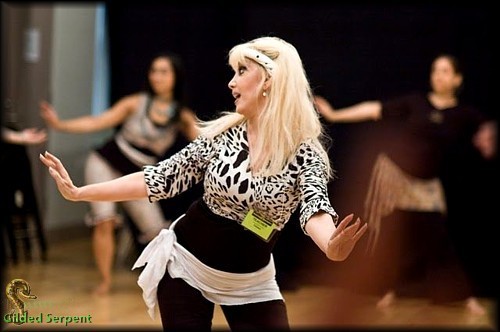
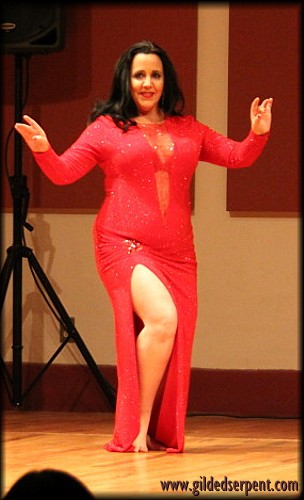
Yasmin in her Flame Costume

An Interview with Yasmin

by Kamala Almanzar
as part of the Golden Era of Tinseltown Series
posted November 27, 2010

Kamala, authorThis interview is the third in a series on the Hollywood Arabic nightclub scene in the late 1970s, early 1980s. Gale Sequeira, a.k.a. Yasmin, is up there at the top of my list of favorite dancers of all time. Beloved by the Arabic audiences who patronized the clubs, and respected by the musicians who appreciated her musicality, she was one of the most sought-after dancers in Hollywood. Her photos paint a picture of a forgotten time in California Belly dance history. These clubs closely resembled their counterparts in London, Paris & Cairo: funky little cabarets with beautiful music, multiple dancers and not a westerner to be seen. I hope you enjoy this memoir from one of America’s forgotten dance treasures.

Kamala: I have to say: I loved watching you on stage! You had this ethereal quality and an amazing musicality. What got you involved in Middle Eastern dance?

Yasmin: Thank you, Kamala for the lovely compliment! I have always loved dance and movement and the music that the Egyptian musicians played for us in Hollywood was inspiring and wonderfully different than anything I’d heard before.

I began taking Middle Eastern dance lessons around 1975 with a teacher named Sophia, who was one of Jamila Salimpour’s progeny here in the San Francisco Bay Area. From the first moment I heard the music, which was “Dances of Port Said”, I was hooked! The sound was mesmerizing, and I loved the rhythms.

I decided to change teachers after a few months and began taking classes with Rhea. This is where it all began. Rhea was wonderfully wild and exotic and she asked me to become involved in her troupe, Nar El Nisaa. With Rhea, I attended my very first West Coast Belly Dancers Convention in Las Vegas in 1976 where Fadil Shahin and Salah Takesh, of the Casbah, provided our music. Fadil started calling me to fill in at the Casbah and after a short while, I became a regular dancer there.

The atmosphere at the Casbah could be dicey at times as personalities clashed and some of the women were very territorial. I also worked at the Greek Taverna and other venues, but the Casbah was like home base where I would return after traveling to dance in other states.

In December 1977, I was asked by the owners, brothers Ardi and Arsi, to be one of the dancers for the grand opening of their new restaurant, the Marrakech in Honolulu, Hawaii. I worked there for four months. When I returned to San Francisco later that year, one of the dancers I worked with at the Casbah, Cassandra, asked me to come to Minnesota to dance at a restaurant and nightclub, in a suburb of Minneapolis, that had a complete floor show including a Greek band, an Israeli singer, folk dancers and a Belly dancer. I worked there from January until April of 1980 and met many wonderful people. Once the contract was finished, I came back to San Francisco.

Kamala: When did you first dance in Hollywood, and what clubs did you work in?

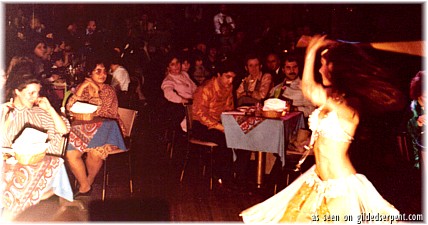
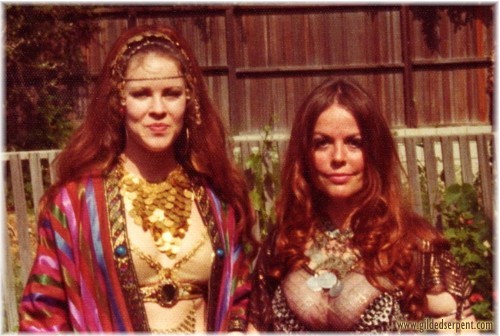
Yasmin: Paula, Rebaba, Majid, Turki, YasminI first came to Hollywood in June of 1980 and lived with my friends and fellow dancers, Paula and Rebaba, who were already working at Khayam. I auditioned, and Majed, the owner, offered me a job as well. The night club itself was nothing to write home about. It had a tiny stage with coffee shop décor and the ceiling was comprised of those acoustic white tiles. The dressing room was the size of a coat closet (remember?) but the place rocked! This was my first experience with the Egyptian musicians and the incredible music they played. I worked at Khayam until it closed its doors in 1981.

(Kamala reminisces: Ah yes, the famous closet where we hid whenever one of the frequent fights broke out!)

Gary and George DebahI worked at the Sahara, on Sunset Boulvard, which had a much larger stage, and it was more elevated than Khayam’s. The owner, Susie, was a sharp Iranian lady who used to be a dancer herself and she ran a tight operation.

At Ali Baba I worked for George Debah. He was a nice man and had the respect of his clientele. His son, Gary, worked the bar, and I remember one of the waitresses there named Sherry. The stage at Ali Baba was small, and the ceiling was low, but the décor of the night club was nice, with murals and art work on the walls.

Aladdin was the last club I worked at in Hollywood. Tony and Walid, Iraqi cousins, opened up the Aladdin after Khayam closed its doors. It was the largest and nicest of the clubs at that time; sometimes it seemed too large on a slow night. They had a nice sized dressing room, and they inherited much of Khayam’s clientele as did Ali Baba.

Kamala: Do you remember which musicians played for you, and what songs you danced to?

Yasmin: The musicians at Khayam were Abdel Khalik on dumbek, Yousri Ishmael on accordion, Megdi on nye, Galal sang and played def, and Aziz Khadra on oud. Periodically Adel Asfour would play organ and Aziz would leave and be replaced with Abdullah Kdough on oud.

Later at Sahara, another set of Egyptian musicians came on the scene from London; Menem, who played organ, Ibrahim on dumbek, Shariff on guitar, and the rest of the names escape me.

At Ali Baba I worked with Abdullah Kdough on oud, Henri on kanoon, Fatiah on dumbek, Yousef Mustafa on dumbek, and later Ibrahim on dumbek.

Aladdin was fortunate for Khayam’s closing as they gained the wonderful musicians from there. A few changes came with Megdi and Galal leaving. Ramzi took over on nye, and Samir took over on def. I remember missing Galal’s playful Egyptian songs, but I went crazy for Yousri’s accordion solos and Abdel Khalik’s drum solos.

Some of the popular songs played were El Arousa, also known as Meschaal, Saharet el Soubar, Sahara and Hani.

Yasmin arguing with MajidYasmin, Abu Osta and PaulaKamala: I wish there were videos of some of those nightclubs. Can you give us an idea of what a typical night was like? I remember some of the characters who used to hang out then. We used to sit with Abosta, who looked possibly like a very large woman dressed as a man.

Yasmin: We generally arrived at the club in the evening around 8:00 p.m. and did two shows a night. We were always welcomed to eat at the various establishments and Khayam’s cook, Hafif, made the most delicious chicken kebabs! Ali Baba’s cook, Dawoud, also had a wonderful menu.

Majed, the owner of Khayam was pretty temperamental and we argued sometimes about show times or other things. Khayam would sometimes get pretty raucous but most of the clientele I met while working there followed me from club to club, especially once Khayam closed its doors.

I remember Mike and Sarkis, a couple of Lebanese gentlemen who always asked me to sit with them and chat. When I worked at Aladdin, they surprised me and flew my mom in for my 27th birthday. I was so touched by their kindness.
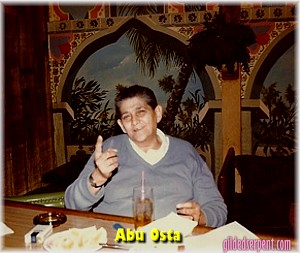
Abu OstaOne of my favorite people was the man you mentioned, Abu Osta. He didn’t speak a lot of English, but he loved all of us girls. He was like an uncle who welcomed us at his table, shared his bizir (pumpkin seeds), bought us drinks, danced with us, and kept us tucked under his protective wing. We always thought that perhaps he was a hermaphrodite because of his appearance, but he was a sweet, sweet man.

Kamala: I remember we had to make a lot of our costumes, because there weren’t many costume vendors around. Sobo glue was our best friend!

Yasmin: There were not any costume vendors that I recall, but I purchased some costumes from other dancers in San Francisco as well as making many of my own. Working six nights a week until the wee hours of the morning left days for costume design and sewing. It occupied my winter months in Minnesota too. I remember making my large seed bead/rhinestone silver costume while living in Hollywood, and it turned out so heavy! My flame costume had the Sobo trademark, made with appliqués, ready made fringe, and wire but it turned out to be one of the prettiest costumes I remember wearing. Marie Silva helped me finish the bugle bead fringe on my green and gold costume, belt design copied from an old Erte’ book, but alas! it never saw the stage. Badir

L.A. was heaven for fabrics though. You could find anything you wanted, and if they didn’t have it, you could have it made, like the beautiful gold lame’ sunburst skirt and veil I had pressed for a costume.

Kamala: Who were the dancers you worked with, and was who were your influences? You were such an inspiration to me, since I came to the clubs with little experience dancing to live Egyptian music. You always seemed so at ease on stage, with a vast knowledge of music!

Yasmin: At Khayam I worked with Paula, Rebaba, Sophia (Safi), Badri, Nabila, and of course, you. There were others whose names I don’t remember. At Sahara, I worked with Rebaba, Shirin and Jacqueline among others. When the Egyptian musicians came to Sahara, there was a dancer named Marty that accompanied them. She was a little bit heavy and a bit trashy but boy, when she was in the right mood, could she move! I also worked with Shirin, Jacqueline, Rowia, Marie, and you at Ali Baba and when Aladdin opened, it was myself, Jacqueline, Shirin, Nabila and others whose names escape me.

Kamala: What did you do after you left the Hollywood nightclub scene? What are you doing now?

Yasmin: When I left Hollywood, I returned to San Francisco; I danced locally at the Baghdad, Pasha, and Sheherazad but the Middle Eastern scene in San Francisco was on its way out and most of these clubs and restaurants closed down by 1984. I joined a troupe that Samra put together and did some performances at the Oz Nightclub, the California Club, and elsewhere. About ten of us went up to Tahoe for a few years in a row to dance at the Camel Classic Golf Tournament.

I married in 1985 and have two beautiful children, Cori and Antonio. I’ve worked for a well known construction company in the Bay Area for over twenty years, and I am very fortunate to have maintained friendships with my dearest friends from my days as a Middle Eastern dancer, Katerina, Paula, Rebaba, Sophia (Safi), and Mish-Mish.

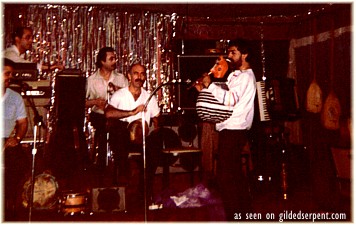
Ali Baba's with Abdullah and Henri
Ali Baba’s with Abdullah and Henri, (ed- Yousef on drum?)
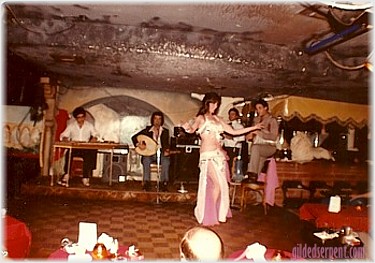
Ali Baba's w Aziz and Henri
Ali Baba’s with Aziz and Henri

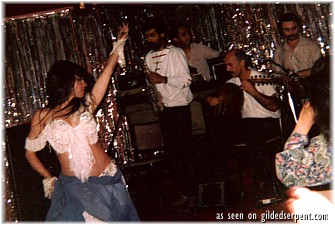
Adel Asfour plays, Yasmin dances

Promo ad for Khayam Restaurant
Promotional advertisement for Khayam Restaurant

Promo ad for Alladin's
Promo ad for Aladdin’s
Shirin top right, next row down Jacqueline Lombard bottom left & Yasmin bottom right.


use the comment box

Have a comment? Use or comment section at the bottom of this page or Send us a letter!
Check the "Letters to the Editor" for other possible viewpoints!

Ready for more?

  • 1-2-10 The Original Mish Mish, The Golden Age of Tinseltown, Interview by Kamala
    I was working one evening at Khyams and still doing my old style of dance. I came out for my entrance covered with a veil and right at the beginning of my show, she came up on stage and started peeling my veil off me and threw it on the floor. She shook her finger at me and said in broken English "Lah, this isn’t Egyptian!" I was so embarrassed and humiliated I could barely finish. Talk about being intimidated!
  • 10-29-09 Interview with Jacqueline Lombard, Queen of the Dancers in the Golden Era of Tinseltown by
    Kamala Almanzar

    They refused to play dance music or anything you asked for…got to admit, that really taught how to pull off a show & think quick on my feet. You never knew where they were going with the music, & they tried to make you look bad.
  • 10-26-10 Queen of Denial, Chapter 3: Hooray for Hollywood! by Rebaba
    As for Khayam’s, it was the extremely popular nightclub and restaurant that was known for having the best live music show in town, with good dancers, good food; a constant supply of good drugs, and in particular the more and more fashionable cocaine.
  • Flying Saucers
    They tended to talk more than to act and, by this time, I was hooked on the street theater of it all.
  • My Belly Dance Baptism, or A Tale of Armpit Hairs
    There was a rumor (that was the truth) that I didn’t shave under my arms.
  • 3-3-06 How MECDA Began Part II, To Whom It May Concern by Mish Mish El-Atrash
    I was very curious to hear what Fairuz had to say about how M.E.C.D.A. began, as I was one of the original dancers to organize it.
  • 10-17-05 How MECDA Began by Feiruz Aram
    M.E.C.D.A., (Middle Eastern Culture and Dance Association) is a nationwide organization which began in 1977 for the purpose of organizing working dancers, sharing information between teachers…
  • 6-20-06 Unionizing Belly Dance:MECDA’s Beginnings, Part 3:Tying Up Loose Ends, by Samra /Sherifa,
    The problem was that after the first strike, where the issues were so clear cut – no one had been paid since the owner gambled away our money, tip-sharing had just been instituted — people were unwilling to continue with strikes for getting contracts all over town.
  • 11-26-10 Struggle for Legitimacy, History of Belly Dance in Quebec, an Overview by Marthyna
    They were not always accepted by the general public because of the revealing costumes but also because sometimes dancers performed between two strippers. This created a taboo around bellydancing. No one wanted to be caught learning it or performing on stage.
  • 11-22-10 Part 5: The Dinner Shows, More Photos from the New York Theatrical Belly Dance Conference 2010, Photos by Photos by Sal Romano, Stacey and Clement Lespinasse, Eric Troudt
    We held the dinner shows at two of the most supportive environments in New York for bellydance: Je’bon Noodle House on St. Marks Place in the East Village and the Lafayette Grill in Tribeca. We made it our goal to give every conference participant the chance to perform, either to recorded or live music from one of our great local bands.
  • 11-21-10 Part 4: More Photos from the New York Theatrical Belly Dance Conference 2010, Workshops, Garmet District Shopping Tour Photos by Lena Helt, Smita Kadam, and Eric Troudt
    Offstage, we browsed the fabric-and-accessory mecca that is Manhattan’s garment district; embodied animals, clowns, and archetypes; learned to enhance our stage presence; shared experiences in panel discussions; and much more.
  • 11-17-10 Personal Impressions, Fantasy Belly Dance in New York City by Ayshe
    Looking back on it all, I can now only assume that, from the very beginning, I was already damaged goods. A “purest” I would never be!
  • 11-17-10 We Will Rak You! My Dance Experience with Queen by Stasha Vlasuk
    I’ll admit I wasn’t too familiar with the music of the British rock group Queen. The year was 1977, the month of December, in Los Angeles. I was invited to perform at a dinner party where Queen, in Los Angeles for several concerts, was the guest of honor. The job came to me through Dianne Webber.
 

Gilded Serpent presents...

Struggle for Legitimacy

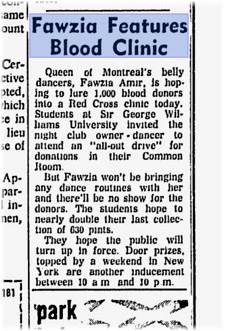
Fawzia News Clip

History of Belly Dance in Quebec – An Overview

by Marthyna
photos supplied by author
posted November 26, 2010

This is an overview of a presentation I made during the 2010 International Bellydance Conference of Canada in Toronto. This is not an article, but different historical points to illustrate the history of belly dance in Quebec and how the french language impact the development of the dance form. I hope you will enjoy it! 

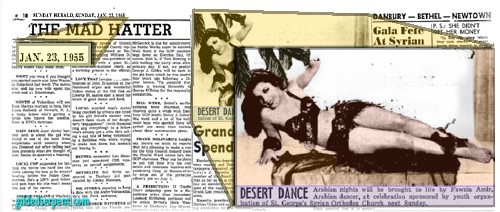
The first bellydance in Quebec was Fawzia Amir – so our Quebec history begins in the late 1950.

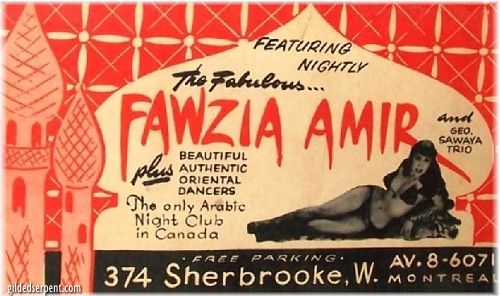
Fawzia ad
scan of an actual menu from her night club

Fawzia opened the first Middle Eastern night club “Sahara” in 1957. She was a strong business woman and a great bellydancer. She deplored the term “bellydancing” – preferred “native folk dance” to avoid sexual references about her dance or her costume. She was acquitted in 1960 of presenting an immoral dance after being arrested for indecent exposure and called to court. She actually danced in the court room to show the judge what this was really about. Her last engagement as a dancer was in 1970.  She trained Gamila Asfour which will be one of the most influential Belly Dance Tearchers in Montreal.

The Second Generation include three wonderful women : Gamila Asfour, Lala Hakim and Helen Smolens

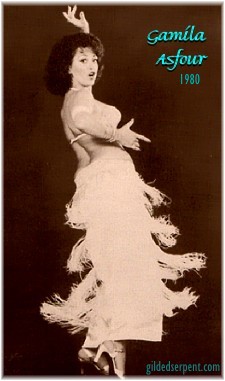
Gamila Asfour, courtesy of Papyrus Magazine from an article supplied by authorGamila Asfour

Gamila met Fawzia in the early 1960s.  Trained in ballet, flamenco and social dances, she learned by observing Fawzia at the Club.  Another influence on Gamila was the last Ahmad Jarjour who taught her his passion for bellydance.  Gamila worked for years at the Sahara Night Club.  She taught most of the actual teachers in Montreal and now she still teaches workshops and is a part of AQDO, a Middle Eastern association for Quebec.

Lala Hakim-courtesy of Papyrus Magazine from an article- modification by GSLala Hakim

Lala arrived in Montreal in the mid 1970’s.  She was a soloist for the Egyptian Folkloric Ensemble Kaymea.  Lala began her career in Quebec in a restaurant, Le Beyrouth, in Montreal.  She is still very active and has her own school in Montreal.

Helen Smolens

Helen debuted in movies; she danced with Samia Gamal, Tahia Carioca and Naima Akef.  She trained with Mahmoud Reda from 1956 to 1968.  She arrived in Montreal in 1968 and created her own troupe, Les princesses du Nil (Princesses of the Nile), which is still active today.

From 1960 to 1980, bellydancers performed in cabaret night clubs and restaurants. 

They were not always accepted by the general public because of the revealing costumes but also because sometimes dancers performed between two strippers.  This created a taboo around bellydancing.  No one wanted to be caught learning it or performing on stage.


Helen with Naima Akef
Helen dances with Naima Akef in a movie

This is where the language barrier changed this…In French "Belly Dance" = "Danse du ventre". Let me explain.

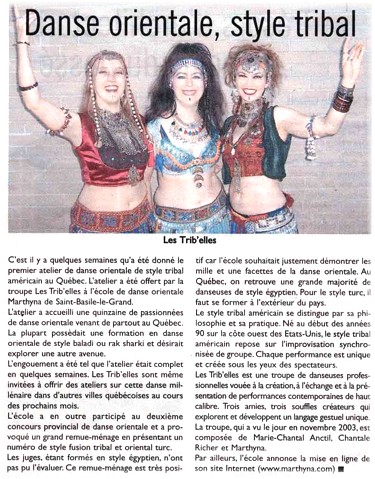
First Tribal Style Troupe in QuebecAt this point and even now “danse du ventre” is associated with a sexy dance. Someone took the opportunity to create a new french word for it – baladi.  This change occurred because of a book – Le Baladi, Apprendre la danse du ventre pour s’amuser, maigrir, etre en forme.  Edition de l’Homme in 1980. Even if the name change helped the reputation of the dance form putting the general public in the state "what is baladi" instead of "woohoo, do a nice little dance for me", we’ve been working on changing it back to Danse Orientale (Dance from the Orient or Oriental Dance) because Baladi is not accurate.

Important Dates – A Timeline

  • 1955 Fawzia Amir
  • 1960 Gamila Asfour
  • 1968 Helen Smolens
  • 1970 Lala Hakim
  • 1980 the term "Baladi" replaces "bellydance" – publication of the book Belly Dance: Le Baladi, Apprendre la danse du ventre pour s’amuser, maigrir, etre en forme
  • 1981 Second generation of dancers in Montreal trained by Egyptian born teachers: Nagwa, Alia, Shams
  • 1990 Bellydance fusion (Fusion Orientale) begins with Dominique Favreau (DO)
  • 1999 First bellydance fusion performance presented in the bellydance community during a bellydance contest organized by Gamila and Nagwa
  • 2005 First tribal bellydance troupe Les Trib’elles

Conclusion

Bellydance began in Quebec with the arrival of Fawzia Amir who had a big impact.  Gamila, Lala and Helen took over and trained most of the teachers in Montreal, creating strong Egyptial style Bellydance – Cabaret as well as folkloric.

In 1980, THE book came out – Baladi is the new designation for danse du ventre for french speaking people. Grand American Bellydance began in Quebec around 1990 – we don’t know who initiated it.  The term “baladi” does not apply anymore because teachers and dancers feel this is no longer only Egyptian.

2005 Tribal Fusion begins. In 2008, there is an explosion of styles and creativity.  Bellydance is no longer just Egyptian; dancers are discovering Moroccan, Turkish, Lebanese, fusion… The different communities are very active and bellydance is more and more refined. In fact, people are just more well informed and learn different facets on the art form.

2010 – Lots still to come!

Fawzia in the news
Fawzia in the news in 1955
?
Golden Gamila

picture from a student of Lala
Author's Troupe- Les Tribelles
Author’s troupe- Les Trib’elles
Chanty, Marthyna, Dominique Senécal and Marie-Chantal Anctil

Author-"A special thank you note to Papyrus Magazine, she actually gave me a few pictures."

use the comment box

Have a comment? Use or comment section at the bottom of this page or Send us a letter!
Check the "Letters to the Editor" for other possible viewpoints!

Ready for more?

  • Gigbag Check with Dominique of Montreal
  • 11-3-10 An Intro to Tribal Fusion by Jasmine June
    Since Tribal Fusion Belly Dance is a relatively new dance form, it is especially important to treat the genre with a level of professionalism, or else one runs the risk of discrediting the work of dancers who have dedicated their lives to creating and elevating Tribal Fusion Belly Dance.
  • Saturday Gala Performance at the IBCC 2010, Photos and Video Collage,
    The Saturday Night Gala Performance of the International Bellydance Conference of Canada was held April 24, 2010 at the Ryerson Theatre in Toronto, Ontario, Canada.
    Video report consists of a collage of random clips caught of performances. Including: including:Arabesque Dance Company including Yasmina Ramzy, Delilah, Amel Tafsout, Zikrayat, Sera Solstice, Hadia, Ranya Renee & Co, Jillina, Sema Yildiz, Habeeba Hobeika Egyptian Dance Ensemble, and the Righteous Rogues.
  • 7-23-2010 Friday Night Performances at IBCC 2010, photos by Samira, video collage by GS staff
    International Bellydance Conference of Canada April 23, 2010 at the Hungarian Canadian Cultural Centre in Toronto,Ontario, Canada. Performers include:
    Raks Sahara, Ashira, Maryfar, Laura Bellydance, Daluah, Tribe Maya Fire, Sa’Diyya, Monique Ryan, Sabaya, A La Nar, Sarah Skinner, Akimi, Earth Shakers, Roshana Nofret, Sofia & Chanty, Ebony Qualls, Danza Della Luna.
  • 6-16-10 IBCC 2010: Thursday Main Stage Performance Photos and Video, Photos by Samira, Video by GS staff
    The Thursday Night Main Stage Performance of the International Bellydance Conference of Canada was held April 22, 2010 at the Hungarian Canadian Cultural Centre in Toronto, Ontario, Canada.
    Video report consists of a collage of clips caught of performances. IBCC is produced by Yasmina Ramzy and company.
  • 6-4-10 IBCC 2010- Wednesday Stage, Opening Night Gala Performance Photos by Samira
    The Opening Night Gala Performance was held April 21, 2010 at the Hungarian Canadian Cultural Centre. Video report reposted here as an introduction to the photos.
  • 11-22-10 Part 5: The Dinner Shows, More Photos from the New York Theatrical Belly Dance Conference 2010, Photos by Photos by Sal Romano, Stacey and Clement Lespinasse, Eric Troudt
    We held the dinner shows at two of the most supportive environments in New York for bellydance: Je’bon Noodle House on St. Marks Place in the East Village and the Lafayette Grill in Tribeca. We made it our goal to give every conference participant the chance to perform, either to recorded or live music from one of our great local bands.
  • 1-21-10 Part 4: More Photos from the New York Theatrical Belly Dance Conference 2010, Workshops, Garmet District Shopping Tour Photos by Lena Helt, Smita Kadam, and Eric Troudt
    Offstage, we browsed the fabric-and-accessory mecca that is Manhattan’s garment district; embodied animals, clowns, and archetypes; learned to enhance our stage presence; shared experiences in panel discussions; and much more.
  • 11-17-10 Personal Impressions, Fantasy Belly Dance in New York City by Ayshe
    Looking back on it all, I can now only assume that, from the very beginning, I was already damaged goods. A “purest” I would never be!
  • 11-17-10 We Will Rak You! My Dance Experience with Queen by Stasha Vlasuk
    I’ll admit I wasn’t too familiar with the music of the British rock group Queen. The year was 1977, the month of December, in Los Angeles. I was invited to perform at a dinner party where Queen, in Los Angeles for several concerts, was the guest of honor. The job came to me through Dianne Webber.
  • 11-15-10 She’s Got the Look! Establishing Yourself as a Professional, Part 2 by Naajidah and Ashiya
    Right or wrong, the average person hiring dancers has certain expectations..
 

Gilded Serpent presents...

Part 5: Dinner shows

More Photos from the New York Theatrical Belly Dance Conference 2010

Photos by Sal Romano, Stacey and Clement Lespinasse, Eric Troudt
posted October 13, 2010
previously posted parts to this serious
part 1: review of panel discussions by thalia
part 2: review of performance at DNA theatre with photos by Thalia
part 3: More photos from DNA performances
part 4: Garmet District Shopping and Workshops

We held the dinner shows at two of the most supportive environments in New York for bellydance: Je’bon Noodle House on St. Marks Place in the East Village and the Lafayette Grill in Tribeca. We made it our goal to give every conference participant the chance to perform, either to recorded or live music from one of our great local bands. How lucky we were to have some of the best and most beloved musicians on the New York Middle Eastern scene accompany us at each of our dinner shows! At Je’bon Noodle House on Friday night we featured Scott Wilson on his multi-necked oud/guitar/saz hybrid with Leni Cohen and Rami El-Aasser on percussion, and on Saturday beatboxer Pete List and guitarist Rob Mastrianni of Beatbox Guitar entertained. For our closing Sunday night party at the more traditional setting of the Lafayette, Souren Baronian played clarinet with a complete ensemble: Haig Manoukian on oud, Mal Stein on drums, and Chris Marashlian on bass guitar. Friday and Saturday were open stage nights and on Sunday a mix of featured troupes, open stage performers and teachers wrapped up the conference with style.

Regina
Regina Hardatt from Queens, New York dances at Je’bon Noodle House.
Photo by Stacey Lespinasse.
Samra
Samra from Queens, New York at Je’bon.
Rita
Rita Pensa from Chicago at Je’bon.
Photo by Stacey and Clement Lespinasse.
Scott
New York’s beloved Scott Wilson playing the "Baglama Hydra": the top is an electric guitar, the middle is an Arabic oud and the bottom is a Turkish saz.

Photo taken at Je’bon Noodle House by Stacey Lespinasse.
Raqsie
From Right: Raqsie and Taylor as Miss Nypmh and Mister Satyr in an original piece inspired by Greek mythology.
Photo by Stacey Lespinasse.
Kyomi
Kyomi Gregory performing to the live music of Beatbox Guitar, with beatboxer Pete List in background, at Je’bon Noodle House.
Photo by Stacey and Clement Lespinasse.
Rivka
Rivka Isskandreyya from Brooklyn, New York gets low at Je’bon.

Photo by Stacey and Clement Lespinasse.

New York’s Pete List of Beatbox Guitar beatboxes for Daniela Adriaenssens from St. Petersburg, Florida.
Photo by Stacey and Clement Lespinasse.
Bina
Bina of Bellyqueen at Je’bon.
Photo by Stacey and Clement Lespinasse.

Tandava from NYC (left) was our graceful and witty emcee at the Lafayette Grill closing show. With Anasma and Robert Boghosian on oud.
Photo by Sal Romano.
Alisha
Alisha Lee of Goddess Belly Company in Seoul, Korea, dancing at the Lafayette Grill.
Photo by Sal Romano.
Jessina and Hip Freaks
Jessenia and the Hip Freaks from New York City in a comedic choreography at Sunday’s closing night show at Lafayete Grill. From left: Evelyn, Jessenia, Sianna, Amira and José at front.
Photo by Sal Romano.
Lena
Lena Helt of Stockholm, Sweden, at the Lafayette Grill, with Robert Boghosian on oud.
Photo by Sal Romano.
Unveiled
Unveiled Dance Company (NYC) dances to Mozart’s Thirteenth Symphony remixed to doumbek beats by Karim Nagi. From left: Athallia, Raqsie, Hillary Litwin, Marjorie Vera and Sola (Erel Pilo). Choreography by Crystal Esteves.
Photo by Sal Romano.
Roula and Souren
Roula Said of Toronto, Canada with Souren Baronian on clarinet.
Photo by Sal Romano.

Brooklyn-based troupe Bastet fuses elements of Indian and African dance styles with bellydance in an original choreography about a girl who becomes possessed by a temple diety. From left: Coko, Lasha Nazira, Elisabeth Wilhelm, and Olga El.
Photo by Sal Romano.
Zoe
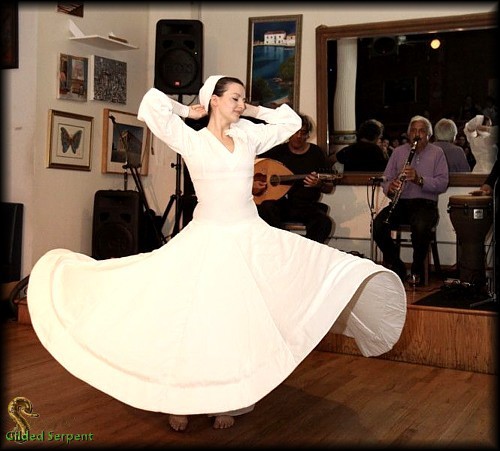
Zoe Anwar of Spain performs a spinning Dervish dance accompanied by Souren Baronian on clarinet and ensemble.
Photo by Sal Romano.

use the comment box

Have a comment? Use or comment section at the bottom of this page or Send us a letter!
Check the "Letters to the Editor" for other possible viewpoints!

Ready for more?


Gilded Serpent presents...

Part 4 : More Photos from the
New York Theatrical Belly Dance Conference 2010

Workshops, Garmet District Shopping Tour

Photos by Lena Helt, Smita Kadam, and Eric Troudt
posted November 21, 2010
previously posted parts to this serious
part 1: review of panel discussions by thalia
part 2: review of performance at DNA theatre with photos by Thalia
part 3: More photos from DNA performances
part 4: Garmet District Shopping and Workshops- you are here!
part 5: The Dinner Shows- comings soon!

For the past three years, dancers Anasma and Ranya Renee have been developing the New York Theatrical Bellydance Conference. This July, the Conference evolved into a five-day event featuring instructors and speakers from across the United States, Canada, Spain, and Sweden, a full schedule of workshops, panel discussions, three curated programs at the Dance New Amsterdam (DNA) Theater, and less formal shows in local nightclubs featuring live music.

Offstage, we browsed the fabric-and-accessory mecca that is Manhattan’s garment district; embodied animals, clowns, and archetypes; learned to enhance our stage presence; shared experiences in panel discussions; and much more. Shopping tour photos by Lena Helt and Smita Kadam.
Workshop photos by Eric Troudt.

Please contact these photographers through Ranya if you want copies of these photos. Please do not copy any photos from this site. Thanks- Ed@GS

Shopping Tour
On your marks, get set, SHOP! Hospitality Coordinator Nabila Nazem and conference instructor Lotus Niraja took some of our out-of-town visitors on a bellydance-oriented shopping tour the day before the workshops began. Front: Yagna Chheda and Smita Kadam (India), Kristen Ross (Australia), Alisha Lee (Korea), Lena Helt (Sweden), Beatrice Nicholas (France), Janet Felton (New Jersey), Sarah Oxidine (Miami), Rita Pensa (Chicago), and Armineh Keshishian (Toronto). Rear: Nabila Nazem (NYC) and Lotus Niraja (Washington, DC).
Makeda, Jahzaal, and Lotus
Lotus Niraja with some of her company members: Makeda, Jahzaal, and Lotus, from Washington DC. Photo by Smita Kadam
boas!
Some of the many treasures to be found in Manhattan’s Garment District. Photo by Lena Helt.
Bellydance America
Kristen checks out the goods at Bellydance America in Midtown. Lena said "This is place was like a candy store for us all." Photo by Lena Helt.
 
Public Transpo
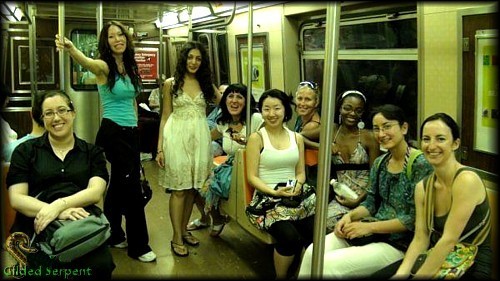
Nabila and the shoppers on the New York subway. From left: Rita Pensa (Chicago), Nabila Nazem (NYC), Yagna Chheda (Mumbai, India), Armineh Keshishian (Toronto, Canada), Alisha Lee (Seoul, Korea), Lena Helt (Stockholm, Sweden), Sarah Oxidine (Maimi), Béatrice Nicholas (Bordeaux, France) and Kristen Ross (Melbourne, Australia).
Fan street dance
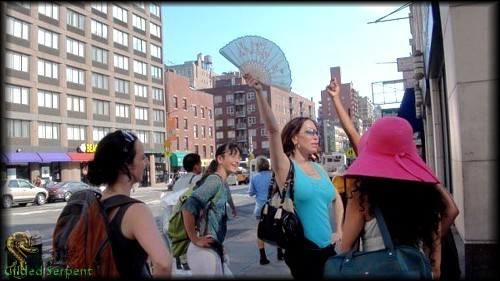
Tour guide/ hostess-with-the-mostest Nabila Nazem strikes a pose on the streets of Midtown Manhattan while guidees look on. Photo by Smita Kadam.
Lunch after five hours of shopping
Lunch after five hours of shopping. From back left: Rita Pensa (Chicago), Yagna Chheda and Smita Kadam (Mumbai, India), Béatrice Nicholas (France), Armineh Keshishian (Toronto, Candada), Kristen Ross (Melbourne, Australia). At far right: Nabila Nazem (NYC) facing camera and Lotus Niraja (Washington, DC) facing away. Photo by Lena Helt.
Sophia Ma
Conference manager extraordinaire Sophia Ma sports a snazzy TBC tank top. Photo by Eric Troudt.
Hanan
Hanan of Miami gets the dancers pumped up during her workshop "Empowered Bellydance." Photo by Eric Troudt.
 
Zoe Anwar (Spain) and Zahava (NYC)
Zoe Anwar (Spain) and Zahava (NYC) embody mythical archetypes in Aepril Schaele’s workshop of the same name. Photo by Eric Troudt.
 
Francesca Ferrando
Conference volunteer Francesca Ferrando performs the archetype of "the Artist" in Aepril Schaile’s workshop "Embodying Mythical Archetypes." Emeline Nandrot at back and Armineh Keshishian at right. Photo by Eric Troudt.
Yvonne Brunot (Vermont), Emeline Nandrot (France) and Isabel Villarreal Elizondo (Mexico)
Yvonne Brunot (Vermont), Emeline Nandrot (France) and Isabel Villarreal Elizondo (Mexico) in Aepril Schaele’s workshop "Embodying Mythical Archetypes." Emeline portrays the unfaithful lover. Photo by Eric Troudt.
Anasma's workshop
In a guided exercise, participants in Anasma’s workshop "Character Embodiment and Character Development" walk toward the selves who they want to become. Photo by Eric Troudt.
Aszmara teaches
New York dance dynamo Aszmara teaches "Dynamic Staging to Enhance Stage Presence." Photo by Eric Troudt.
Fahtiem during a warm-up
Fahtiem during a warm-up for her workshop "Using Imagery in the Dance." Photo by Eric Troudt.
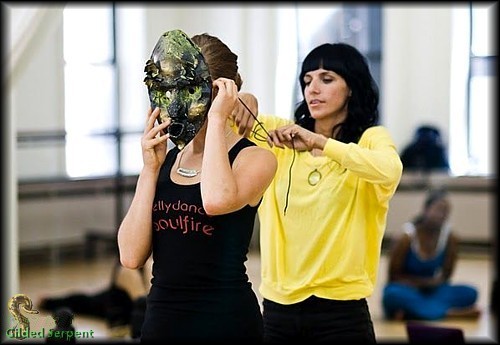
Co-teacher Dixie Rose of P.U.R.E. puts a mask on conference attendee Karolina
Co-teacher Dixie Rose of P.U.R.E. puts a mask on conference attendee Karolina in the workshop "Bodylove" with Kaeshi Chai


Part 1: The Panel Discussions
Part 2: The Performances – Review by Thalia and Part 1 of the photos from the DNA shows

-More photos coming of the dinner shows, workshops, the shopping trip-

use the comment box

Have a comment? Use or comment section at the bottom of this page or Send us a letter!
Check the "Letters to the Editor" for other possible viewpoints!

Ready for more?

  • 11-17-10 Personal Impressions, Fantasy Belly Dance in New York City by Ayshe
    Looking back on it all, I can now only assume that, from the very beginning, I was already damaged goods. A “purest” I would never be!
  • 11-17-10 We Will Rak You! My Dance Experience with Queen by Stasha Vlasuk
    I’ll admit I wasn’t too familiar with the music of the British rock group Queen. The year was 1977, the month of December, in Los Angeles. I was invited to perform at a dinner party where Queen, in Los Angeles for several concerts, was the guest of honor. The job came to me through Dianne Webber.
  • 11-15-10 She’s Got the Look! Establishing Yourself as a Professional, Part 2 by Naajidah and Ashiya
    Right or wrong, the average person hiring dancers has certain expectations.
  • 11-12-10 "That’s a little risque for you to be doing as a momie!" Belly Dancing and Resistance to Cultural Discourse by Angie Moe PhD.
    Thus, while the pregnant woman symbolizes maternal potential, she also becomes aesthetically problematic. She is both an admired subject and a physically unappealing object, according to contemporary standards of beauty. As such, the postpartum torso is to be modestly clothed and/or masked according to culturally appropriate standards.
  • 11-11-10 Our Desert Roses, Photos from the Floralia Festival 2010, Photos, video interview, and text by Surreyya, photos are also by Nyla Crystal and Bob Lindbloom
    Held April 29-May 2, 2010 in Truth or Consequences, New Mexico, Produced by gleaming ray of light Selena Kareena, the Floralia Festival is held annually in TorC, (Truth or Consequences) New Mexico, and features a wide spectrum of dance and dancers from throughout the southwest, South America, and beyond.
  • 11-10-10 The Dumb and the Restless: Fire! A Lighter Outlook on Belly Dance by Tasha Banat
    Yes, the audience was eating out of my hand when someone from the back of the room yelled “Hey lady! Your hair is on fire!”

    Gigbag Check #22 with Cory Zamora!
    Cory talks with us after her performance at the Carnival of Stars Festival in Richmond, California, in August 2010. She shows us what she carries for her performance.Including an old style 2 piece cabaret belt, Egyptian style bra with no fringe and more. The performance clip includes beautiful floorwork done as only Cory Zamora can do!

  • Queen of Denial, Chapter 3: Hooray for Hollywood!
    As for Khayam’s, it was the extremely popular nightclub and restaurant that was known for having the best live music show in town, with good dancers, good food; a constant supply of good drugs, and in particular the more and more fashionable cocaine.
  • Karim Naji, Interview with an Egyptian Dance Master
    I think that Egyptian and Arabic culture as a whole entity should never be extracted from this dance. I do not believe in de-ethnicizing it, and I do not believe the culture is optional! Nobody ever allowed Latino culture to become an optional part of Salsa or Samba. Additionally, Indian culture is inextricable from Bharatnatyam and Bhangra. I believe that Raqs Sharqi, a.k.a. “Belly dance” is available to anyone from any culture. I am not xenophobic, nor an exclusivist. I am thrilled to see people all over the world enjoy and promote this art form. However, I will argue for the importance of the Arab connection until the day I die.
  • Murat Tekbilek Demos the Darbuka,
    Murat Tekbilek is the son of Omar Faruk and Susie who are from Turkey. He shows us the different sounds this drum can make and his obvious talent. Also included is footage of Murat performing on stage with his father and Dror Sinai, Hasan Isakkut and others. More fun clips from camp are included of drum sessions and classes and the kitchen staff’s dance.
  • Part 3 of 2, More Performance Photos
    Our stage shows took place Thursday, Friday and Saturday nights at Dance New Amsterdam, a beautiful studio and performance space just north of City Hall. Performers included featured soloists and troupes selected by a panel of teachers, as well as all of the conference teachers themselves. A diversity of styles and approaches were represented onstage, from traditional to fusion to fantasy.
  • Part 2 of 2: The Performances, The New York Theatrical Belly Dance Conference 2010, A Five Day Exploration of Dance Styles, Intention, and Content.
    Some of these "theatrical" works focused more on staging and aesthetics; some used narrative; others focused overtly on intention and meaning; and, a minority stayed true to traditional cabaret or folkloric modes.
 

Gilded Serpent presents...

Personal Impressions

Bellet Russe

Fantasy Belly Dance in New York City

by Ayshe
posted November 17, 2010

It wasn’t that long ago that video was a new medium, the Internet and globalization unheard of, and for Belly dancers and lovers of Oriental dance, there was just not that much actual Egyptian performance (meaning Egyptian dance by Egyptians) one could view, without actually going to the Middle East proper. I think I am correct in saying that Morocco of New York City  was one of the first pioneers actively to pursue travel to the Middle East and North Africa in the 1960s, for purposes of learning the dances from the authentic practitioners and collecting archival footage and data on them. 

In the clubs on 8th ave in the 1960s, the hub of New York City Dance Oriental at the time, there existed a motley mix of Greeks and Armenians, descendants of refugees from the old Ottoman empire, plus a smattering of Turks, Rom, Arabs, and Israelis.  With no Belly dance schools available, NYC’s American Belly dancers of this era would have had to figure out the dance on their own; by watching the ethnic ladies in the audience dance, as well as the Belly dancer "imports" from the ghettos of the old Ottoman cities, where Oriental dance was  performed for survival–and not so much with artistry in mind.

Fantasy Oriental dances were also available in the film spectaculars of Hollywood, which would have provided additional fuel for creative energies. Orientalist passions were manifested on film in cinematic wonders such as Cleopatra, Samson and Delilah, etc. that included renditions of Orientalist dances by American dancer/actresses.  As well, there were even earlier glimmers of Orientalist fantasy upon the American psyche.  In the early 20th century, the great impresario, Sol Hurok, introduced the first Orientalist ballets and operas of Europe and Russia into the Americas.  Sergei Diaghilev‘s "Ballet Russe" and the "Ballet Russe de Monte Carlo", along with great creative geniuses such as  Michael Fokine, Salvador Dali, and Leonid Bakst, mounted elaborate Orientalist ballets with lavish costumes and sets, and incorporating snaking arms, undulating moves and veils into sensual dances.  These were called “Character Ballets”, as the technique included both ballet and the movements and character of the cultural dances they were depicting.  Even the pioneers of the Modern Dance movement, such as Ruth St. Dennis, Isadora Duncan, and Louie Fuller dabbled in the richness of Orientalist dances, costuming, and themes. 

From hearing their personal stories and by learning the cultural history, I have concluded that the (American) Belly dancers of NYC in the ‘60s and ‘70s were some of our first Fantasy Belly dancers.  They had a love and a vision, fueled by the transplanted ethnic community, theatre and Hollywood, and unless, or until, they were able to spend time in the Middle East, they created their dance as they went along–veil dances, sword dances, Pharaonic dances, etc.  You won’t see any of these in the old Egyptian, Lebanese movie footage you can now watch on DVDs or YouTube; however, there they are, in the renditions performed by NYC’s American Belly dancers of the period.

Well, by the 1980s things had shifted.  Video made access to Egyptian dancers (Egyptian dance done by Egyptians) possible, more dancers started to visit and study dance in Egypt, and Saudi oil money made the existence of the famous Club Ibis possible, where Egyptian born dancer/owner, Samiha, stressed her version of "pure" Egyptian dance as the "in-style".  New York City dancers became more interested in deeply immersing themselves in the dance style of Egypt.  Even so, many still loved to add, to a greater or lesser extent, other dance elements that they learned in the multi-cultural dance schools of the "Dance Capitol of the World” (NYC); a little Fosse here, a little African there, and of course plenty of Latin fire.  

So now we come to my small part in this story of NYC Belly dance.  As a child, I grew up in a farming community outside the city.  I decided from early on that I wanted to be a Ballet dancer, because my aunts had been dancers, and from an early age I was captivated by their photos and by their collections of dance magazines featuring all the famous ballerinas of the period.   It was during this time that I developed a whole fantasy life about the world of dance.  My dance teacher, who lived down the road from my home, was a dance anthropologist with books upon books of dance and art.  She encouraged, as part of our training, creative movement and choreography–little dances we would make up and perform at our recitals and, later on, in schools. Marta Zorina By the time I started venturing down into the city for classes, I met and started studying ballet with an elegant, eccentric Hungarian woman named Marta Zorina.  She had studied Vaganova (Soviet) Ballet technique, as well as Character Ballet technique and gymnastics in Hungary.  Once in the US, she also performed Belly dance and partnered with Ibrahim Farrah.  I would peek into her Belly dance and Pharaonic classes and wonder at the exotic movements.  I had been exposed to Belly dancers due to my Greek background, but her classes were a whole different ballgame!  She combined Character Ballet, Classical Ballet, Modern "Graham" technique and Belly dance (more the Turkish-Greek style of 8th Avenue). 

She felt spiritually connected to the ancient Egyptians and had developed a whole vocabulary of movements to perform the dances of ancient Egypt.  Her entire approach was very theatrical, and she had many creative ideas for dance

Thus, through Marta, began my journey into the world of ancient, Oriental fantasy.

By the time I was older and started to pursue Middle Eastern dance as a profession, my first stop landed me in Fazil’s Nite Club, a surreal trip into a bohemian nether-land of dance and music.  On weekends what was usually a rehearsal studio, opened up its second floor and became a nightclub of sorts.  Musicians and dancers congregated from many places after their gigs had finished, and sometime during the wee hours of the morning, Elena would appear.  The music and musicians were of her choosing. There was a relatively large dance floor and simple theatrical lighting that was manned by family members.  In this environment, a complete mystery and mystique was created that had a mesmerizing affect–further feeding my hunger for fantasy and drama–

and when Elena danced at Fazil’s, it wasn’t as a party motivator: it was a theatre piece!  Sometimes she would dance as long as an hour.  She would separate the dance into parts, be it veil, zils, cane, fan, floor work, skirt dance, drum solo, whirling, or 9/8 rhythm.  Each part fed into and built upon the next.  It was totally exhilarating for me and I thought Belly dance was just the most creative dance in the world!

Then came my reality check: I saw authentic Egyptian Belly dancers from Egypt on a video!  I was shocked. What Elena was doing seemed nothing like what these Egyptian dancers did; sure, she did shimmies and hip drops and played zils, but overall, the effect was "two different animals".  It was then that I realized she had synthesized so much more into her dance, and created a whole unique vocabulary, borrowing from Belly dance, Flamenco, Theater dance, Mime, African, Indian Gypsy, and later, Butoh.  She wore a Belly dance costume, so at first glance one might say Belly dancer, but the execution was atypical when compared to an Egyptian dancer from Egypt.

Looking back on it all, I can now only assume that, from the very beginning, I was already damaged goods.  A “purest” I would never be!

  I had this concept of Belly dance being this whole big world of creative endeavors–a sort of new "modern dance" where womankind could freely experience and discover their feminine identity.  I felt very free and uninhibited to learn many different interpretations of Middle Eastern dance from many different teachers, and then to try to adapt and blend what I learned with other dance forms in order to create innovative shows filled with fantasy for the various work opportunities that came along.  Well, anyway, whatever the view was back then, at this point in time, it no longer matters. With so many blends of Belly dance out there today, the genie is totally out of the bottle.   Women the world over have taken the dance completely over for themselves, and in all its forms this “new” Belly dance continues to free women to define themselves and to experience more totally than ever their sensuality and sexuality.  I am so continually delighted and thrilled to see all the many new creations that continue to sprout forth from our community!  At the same time, more than ever, I am enjoying and valuing the authentic ethnic styles, and the styles of our recent predecessors.  What a thrilling time to be a dancer.

Author’s photos of Fazil’s, including musicians and Elena in her pearl costume
Joe Zetunian Kenon HagiHagi's Tulum band
Joe Zetunian, Kenon, Nedim, Hagi on Tulum (bagpipe), and Hagi’s band.
Author finds it humorous that in this photo the Tulum wears a white and black sock knitted by the musicians wife to keep it warm.
Elena and bandFazil scene
Elena in pearls at left and on right a unknown dancer performs for an appreciative audience.
Elena's pearl costumeClose up of Elena
More of Elena dancing in pearls, with a close up. Notice art on the wall by Abdul Hakim. He was the club’s resident Sufi and was a real character..


use the comment box

Have a comment? Use or comment section at the bottom of this page or Send us a letter!
Check the "Letters to the Editor" for other possible viewpoints!

Ready for more?

  • Who Died and Made You Queen of Dance?
    This lack of background basic performing experience would be unheard of and un-tolerated in any other dance form.
  • 3-11-05 Wings, The Complete Technique, a private lesson with Ayshe a review by Mara al-Nil
    Well, I have to say that I must take a bit of an issue with the title of this DVD. “A private lesson” with Ayshe? More like an intensive, private seminar! This 2-hour “workshop” is one of the most comprehensive instructional DVDs for dancers I’ve seen.
  • 5-13-02 Aisha Ali & The Birth of the Ghawazee by Sadira
    " This could not possibly be a dance to take seriously", people whispered
  • 10-6-09 Researching Dance Origins with the Mazin Family, Photo from Pepper’s Archives Part 2, Text by Pepper Alexandria with additions by Edwina Nearing
    Yusuf, Khairiyya and Raja looked a Pepper’s hopeful face with the tears standing in her eyes and caved in. A private performance was arranged to take place on the flat roof of the Mazin’s home in full costume with live musicians.
  • 2-11-04 Sirat Al-Ghawazi, Part 1 by Edwina Nearing
    Begun in the mid-1970’s , the early sections of "Sirat Al-Ghawazi" were first published under the title "The Mystery of the Ghawazi." We are happy to be able to respond to the continued demand for these articles by making them available to our readers worldwide.
  • 5-20-03 Loving Remembrance & Requiem: the Best “School” That Ever Was, Part 1 by Morocco/ Carolina Varga Dinicu
    I looked at her & said, “If I can’t do better than that, I’ll hand in my feet!” A case of having more guts than brains.
  • 3-17-08 From Cabaret to DJ Bellydance in New York: An Overview, 1988 – 2007 by Nina Costanza (Amar)
    But the primary forums for dancers, the major New York nightclubs, have closed their doors. Cabaret is gone; it is the era of the DJ. And the new dancer has to have anotherjob.
  • 4-3-08 Dances along the Nile, Part 1: Raks Al Asaya by Gamila El Masri, Reprinted with permission, from Bennu, Issue Vol.6 #3
    There is strength in the cane twirl but not aggression, extreme rapid twirling should be held as an additional sensational feat, less is more. Have your body of twirling be moderate so that you can vary from slow to climatic; always reflecting the music, it’s mood and tempo. Get down without getting
    crazy.
  • 1-17-10 Serena Wilson (1933-2007) A Student of Ruth St. Denis, Part 1: Childhood by Barbara Sellers-Young PhD
    Serene Blake was born in the Bronx on Aug. 8, 1933 into a Vaudeville family of performers called Blake & Blake. Her mother sang and her father played the banjo. Her childhood and adolescent years intersected with the Vaudeville stage, on which she often appeared with her parents in the 1930s.
  • 10-17-02 Music and Style by Yasmela / Shelley Muzzy
    ATS seems to be pushing Middle Eastern dance, at least in the U.S., back into that safe and sexless area, sans the real knowledge of true folk movement
  • 11-17-10 We Will Rak You! My Dance Experience with Queen by Stasha Vlasuk
    I’ll admit I wasn’t too familiar with the music of the British rock group Queen. The year was 1977, the month of December, in Los Angeles. I was invited to perform at a dinner party where Queen, in Los Angeles for several concerts, was the guest of honor. The job came to me through Dianne Webber.
  • 11-15-10 She’s Got the Look! Establishing Yourself as a Professional, Part 2 by Naajidah and Ashiya
    Right or wrong, the average person hiring dancers has certain expectations.
 

Gilded Serpent presents...

We Will Rak You

publicity

My Dance Experience with Queen

by Stasha Vlasuk
Original concert photos by Barry Levine
Some photos link to enlargements
posted November 17, 2010

Cover

I’ll admit I wasn’t too familiar with the music of the British rock group Queen.  The year was 1977, the month of December, in Los Angeles.  I was invited to perform at a dinner party where Queen, in Los Angeles for several concerts, was the guest of honor.  The job came to me through Dianne Webber: my teacher since 1974 and the director of the dance company I performed with, the Perfumes of Araby.


Perfumes of Araby

The Perfumes repertoire included specialties like candle dance, snake and sword dances as well as folk dances of North Africa, Turkey, Armenia, Syria and Lebanon, with a cabaret style solo dance at the end (from late 1977 through ‘79, that was me).  This job offer was for a six girl dance team including myself , Jane Padgett and Denise Russo.

Dianne Webber
Denise and Jane

Clockwise- #1-Stasha and Dianne Webber in 1974, #2-One of Dianne Webber’s promo photos
#3-Denise Russo left, and Jane Padgett right, #4- Stasha

Dianne encouraged Jane, one of our snake dancers, in this: her first private party booking experience.  Jane selected the Armenian folk dance Sebastia Var, a Turkish 9/8, a Lebanese Debke, a snake dance, and my solo.  One of Jane’s recollections of the musicians is charmingly hilarious: 

"I hired Arshag (Chookoorian, drums) and Jeff (Hovsepian, oud) from Haji Babas (Armenian Restaurant Los Angeles, CA).  …I had a problem because I was doing a snake dance in that show, and Jeff is scared of snakes!  I had to beg him to do that show for us! And he made me promise to tip him off before that number, so he could turn his head away during that song and not look at the snake!  He did turn away and look backstage the entire time I was on with the snake.  But I spent the entire dance trying to get Jeff to look, without anybody in the audience realizing what I was doing!  I remember that Arshag was trying not to laugh!"

Although I don’t remember the venue location, I do remember the spacious banquet room: it had a dark wood bar on the far side and over by the dining tables it even featured a small raised stage that we happily used.  After the performance as I was getting a drink of water at the bar, one of the British guests left the group and approached me to chat.  As we exchanged pleasantries, I remarked that the party was for the rock group Queen.  Smiling, he pointed out several of the guests: “Well that’s the singer, and that guy’s the bass player.  The tall guy’s the guitar player – and I’m the drummer!”  (Freddie Mercury, John Deacon, Brian May, and Roger Taylor)

An invitation to the next evening’s concert included a pass for myself and a guest.  I brought my younger brother, an excited fan.  It was an spellbinding performance, including all their popular songs in a large stage production with special effects. [top of page]

We were kindly included in an after concert dinner.  The French restaurant wasn’t exactly happy about entertaining the late and rowdy crowd of about fifteen.  When Roger Taylor sent the wine back as unacceptable, the waiter grumbled audibly in French and was surprised by my replying in French that his less-than-delicate remark was overheard and understood.

I sat across from Freddie Mercury and enjoyed studying his face.  With his narrow eyes, high cheek bones and prominent front teeth, he looked very much like many young men in my Persian audience at Kolbeh and Andre’s.  I also performed at several Armenian supper clubs: Michael’s, Haji Baba’s and Sayat Nova.  Like many belly dancers, I had picked up small talk in the languages of the people with whom I worked so I initiated Persian small talk with Freddie.  Impressed, he told me that although born in Zanzibar to Persian parents, he grew up in London and didn’t speak Farsi fluently (good thing since neither did I!)  Freddie asked if I’d be interested in performing with Queen the next evening (the last show of a long tour) during the encore.  As it was almost Christmas, they were planning to have several characters (dancing reindeer and gingerbread-men, Santa, etc.) and I’d fit right in!  I extended the opportunity to Jane and Denise, of my dance team from the dinner party, who were happily available.


review
Freddie on SantaOn Dec 22, 1977, Jane, Denise and myself met at the concert venue: the Los Angeles Forum.  David Brown, Queen’s manager, carefully explained when we’d appear and how to get up on the stage, introducing us to the gentleman who would alert us to our show time then lead us to the stage.  We relaxed in our own dressing room and waited for our cue.  We could hear all the superb music and the wild response of the sold-out crowd; reviews called it one of the best concerts of the year.

As the encore began, Santa brought a large sack on stage and opened it: no, not toys, it was Freddie!

He crawled from the sack onto Santa’s shoulders and sang the iconic “We Will Rock You”. 


The final song was “Sheer Heart Attack” and that was our cue!  About a dozen entertainers piled on the stage: clowns, reindeer, and ginger-bread men, while balloons and blow up dolls dropped from the sky onto the audience. 

Stasha on a tshirtAs we took to the stage the roar was deafening.  It was a thrilling experience to project to an audience of over sixteen thousand.  I extended large movements up to the people in the “nose bleed” section, and brought my focus down to the front row – where I saw someone I knew!  He was wearing my publicity T shirt, screaming and pointing at me! 

After dancing around the stage parameter with the other band members, I joined Freddie front and center and we danced joyfully through the end of the song.

Freddie gets friendly with StashaFreddie and Stasha

 At one point I remember Freddie reaching out to grab me; all you working dancers reading this know: this is not unknown in a live dance performance!  Just like my show in a supper club: I did a back-bend flip spin, cleverly eluding his grasp while not losing a beat or my smile.  I remember the final chord lasted a long time and I began to spin.  That long last chord continued and I continued to spin, tanoura style: losing myself in the experience; this seemed to go on for quite a while!  Suddenly it occurred to me that since all the other characters had stopped yet I was still spinning I may be garnering too much attention in a show that wasn’t mine!   I stopped and bowed to the band … then acknowledged the band to the audience, just like I do at the end of my show in a supper club!  

My performance space had always been intimate Middle Eastern supper clubs, weddings and private parties: where the soulful, subtle and articulate movements could be easily seen and a oneness space could be achieved and shared.  In this performance for over sixteen thousand, perhaps it was boldness to believe I could reach such a large audience.  Yet in that moment, I felt that boldness had power and magic in it.

PS: We Will Rak You

My Dance Experience with Queen: 30 years later a mystery is solved!

by Stasha Vlasuk

Who knew that Gilded Serpent’s publishing of this article in November of 2010 would solve a mystery of over 30 years? At that same time, the finishing touches were being placed on an exhibit for 2011 in London commemorating the 40th anniversary of the band Queen, containing extensive art, audio files, visual files, and memorabilia. The exhibit, called “Stormtroopers in Stilettos” was scheduled to run in London February 25 until March 12 before it tours the world. No stone was left unturned to amass the most comprehensive and complete story of Queen’s early years.


What made the finding of “We Will Rak You” exciting to Nino Trovato, the Queen researcher who discovered the Gilded Serpent article then emailed me, was that the images of that evening Jane, Denise and I performed with the band during the finale are well known – and mysterious, because the dancers were uncredited. As he described it to me, these images represented the only time other performers shared their stage. Therefore, these images have become iconic – yet mysterious. The images were subsequently used in the program for the 1978 European tour.

Well thanks to Gilded Serpent: Mystery Solved!

Gary Taylor, associated with the creation of this exhibit, will be following it with a book called “Queen Live”, chronicling the entire history of Queen’s live performances. It will contain these fun images (hey is that Freddie trying to take a bite of me??) , the dancers finally known at last.

Commemorative program

Blue pages

use the comment box

Have a comment? Use or comment section at the bottom of this page or Send us a letter!
Check the "Letters to the Editor" for other possible viewpoints!

Ready for more?

  • A Big Picture Book Review: Martha Burns’ "Belly Dance, Celebrating the Sacred Feminine"
    Every page is a work of art, a truly astonishing array of images. The content is very inclusive and features all age ranges, body types and styles. You will see yourself, your best self, in these pages.
  • Adventures In Belly Dance Costuming
    This is a good book for both sewing veterans and beginners alike.
  • 11-15-10 She’s Got the Look! Establishing Yourself as a Professional, Part 2 by Naajidah and Ashiya
    Right or wrong, the average person hiring dancers has certain expectations.
  • 11-12-10 "That’s a little risque for you to be doing as a momie!" Belly Dancing and Resistance to Cultural Discourse by Angie Moe PhD.
    Thus, while the pregnant woman symbolizes maternal potential, she also becomes aesthetically problematic. She is both an admired subject and a physically unappealing object, according to contemporary standards of beauty. As such, the postpartum torso is to be modestly clothed and/or masked according to culturally appropriate standards.
  • 11-11-10 Our Desert Roses, Photos from the Floralia Festival 2010, Photos, video interview, and text by Surreyya, photos are also by Nyla Crystal and Bob Lindbloom
    Held April 29-May 2, 2010 in Truth or Consequences, New Mexico, Produced by gleaming ray of light Selena Kareena, the Floralia Festival is held annually in TorC, (Truth or Consequences) New Mexico, and features a wide spectrum of dance and dancers from throughout the southwest, South America, and beyond.
  • 11-10-10 The Dumb and the Restless: Fire! A Lighter Outlook on Belly Dance by Tasha Banat
    Yes, the audience was eating out of my hand when someone from the back of the room yelled “Hey lady! Your hair is on fire!”
  • 11-8-10 The Physiological Effects of Oriental Dance, Excerpt from Health and The Oriental Dance, Chapter 1, by Aziza of Hungary
    There was no information subject available like "the technique of Belly dancing". I had to construct it myself. It took a lot of research in regards to both its theoretical and its practical sides.
  • 11-7-10 Ergun Tamer on Saz, Musical Instrument Tour Video
    Ergun is one of the organizers of the Middle Eastern Music and Dance Camp held in Mendocino, California, each year in August. Ergun plays many instruments. In this video he tells us about the Turkish saz. The saz has many names depending on the country, such as bazouk or bazouki. This instrument also comes in many sizes.
  • 11-3-10 An Intro to Tribal Fusion by Jasmine June
    Since Tribal Fusion Belly Dance is a relatively new dance form, it is especially important to treat the genre with a level of professionalism, or else one runs the risk of discrediting the work of dancers who have dedicated their lives to creating and elevating Tribal Fusion Belly Dance.
 

Gilded Serpent presents...

Strong and Sweet: Neon Serves Up a Dance Fitness Video

DVD cover

Hard Candy, The Bellydance Workout by World Dance New York

DVD Review by Surreyya
posted November 15, 2010

There are not enough words to describe how much I love Neon’s videos!  I still access Neon’s "Curves" video when looking for a great practice companion and early morning coffee warm-up.  As a dancer, teacher, Pilates instructor, and fitness professional, I was uniquely curious how Neon would incorporate the aspect of fitness into her newest release "Hard Candy–A Belly Dance Workout."

Behind the scenes in the fitness industry, there are all kinds of interesting challenges we instructors face, keeping our classes challenged, entertained, interested and maintaining integrity and safety as well as adhering to our own moral compasses.  Fitness managers also fill our heads with all kinds of contradictory statements such as, "Wow! That’s a great class! Can you make it more like Zumba?"  or "The ladies think your class is great, but they are intimidated by your need to review technique." or "…too much cardio; they want more Zen and relaxation"  or even my favorite "They don’t want to show up and have to think!"

Regardless of your particular fitness poison, I am not surprised that Neon has managed to challenge the viewer and integrate useful and challenging movements that are actually helpful to your skill as a dancer.

While there is a place for Zumba, belly pop, cardio shimmy, and any number of the latest dance-craze classes, this video actually replaces the fist pumps, dangerous deep grinding movements and awkward high stepping and replaces them with useful arm movements and level changes that we dancers could actually stand to see more of in our performances.   What’s more: Neon and her team have constructed combinations that are challenging and fun, not only for your dance vocabulary, but for creating muscle recruitment patterns that you can call upon to improve your overall movement, strength, and technique.

What you get in this DVD:
*55 minute Basic Tutorial–a very detailed demo of the movements used in the program,
*45 minute Beginner’s Practice–a continuous practice to utilize once you understand the movements in the prior program,
* Breakdowns of every step and movement used in the video,
* Detailed instruction of every swirl, step, and shimmy including postural adjustments to correct common mistakes,
* The option to practice with or without music and cues,
* A challenging but highly do-able workout including a healthy vocabulary of solid movements to add to your repertoire.

This video is not marketed as strictly a "beginner’s" DVD.  I believe that the mixture of routines makes it appropriate for a few different levels.  It is ambitious for a complete beginner but still quite beneficial for someone who is intermediate/advanced.  The costuming is appropriate and fun, and makes it easy to see the instruction and detailed movements clearly.  Neon, as always, is well spoken, and gives clear and detailed instruction and description of technique.  Her cues are spot-on, and I could listen to her lovely positive tone for hours!  Elisheva and Sarah Skinner also take turns instructing and follow Neon’s fine example of cueing.

At under $20 at the WDNY website, this DVD is a value considering the wealth of dance instruction contained within, let alone the fitness aspect.  I certainly broke a sweat and was challenged!

use the comment box

Have a comment? Use or comment section at the bottom of this page or Send us a letter!
Check the "Letters to the Editor" for other possible viewpoints!

Ready for more?


Gilded Serpent presents...

She’s Got the Look!

Placeholder

Establishing Yourself as a Professional, Part 2

by Naajidah and Ashiya
posted November 10, 2010

In our last article we discussed some of the aspects of professionalism.  We promised more do’s and don’ts.   Before we get started, there are a few things anyone aspiring to becoming a professional should know.

  1. Success doesn’t happen overnight, it’s earned.  It can take YEARS of working in freebies and low paying jobs to get anywhere.  There’s no promise of success, just lots and lots of hard work.  You need to understand that you have to give before you receive as good paying jobs are few and far between and you must be willing to spend the time necessary to achieve your goals.  Where you live in the United States plays a big hand in how successful you are going to be.  If you really want to be a top dancer, you may have to consider relocating.
  2. Even being a professional is an expensive hobby.  If you want to keep being a professional, be prepared to put all of your earnings back into costumes, music, accessories, props and marketing materials.  Be prepared to – if you are lucky – break even.  You’ll continue to need new and different costumes, replacements for props, more and new music.  The expenditures never cease.
  3. Take as many classes and workshops from as many teachers and instructors as possible.  Expand your knowledge and repertoire.  The more you know, the better you will be.  Network with dancers, not only locally, but regionally and nationally as well.  Attend events where other dancers are performing.  Be supportive of them.  You will gain immensely from the experience. 
  4. Always remember to treat other dancers fairly and the way you want to be treated.  No matter how much you want to dance, you cannot infringe on other dancer’s gigs. (There will be a future article “The Myth of the Sisterhood of Dance” to address this and other problems)

As a caveat – we didn’t come up with these arbitrarily.  As professional dancers we have, between the two of us, over 40 years of experience dancing professionally in night clubs, restaurants, stage productions, and festivals.  We have gleaned these rules over the years by observing what does and doesn’t work, both for ourselves and by watching other dancers.

Learn to be patient.  When you think you’ve waited long enough, wait some more.

Jobs don’t just fall into your lap.  They need to be earned.  Paying gigs don’t come knocking at your door.  Simply because you are a belly dancer, are cute and adorable and have one or two costumes doesn’t mean calls are going to start coming in.  Just because you’ve taken a year or two of lessons doesn’t make you marketable.  You need to establish yourself, make a name for yourself, market yourself and put yourself into positions where you might get noticed for better jobs.  There is no shame in starting out with non-paying gigs at such venues as ethnic festivals, nursing homes, schools, etc.  But, if you want to be taken seriously, you MUST treat these freebies as you would a professional job. 

If you want to get noticed, then every job you do, whether paying or not must include your best music, your best choreography, your best costume up to and including makeup, cover-ups etc.

There are several reasons for this.  First you establish your unique look, you earn people’s respect, and you meet people in the audience who might recommend you or pass your name on for better opportunities.  Remember there will be people who might be taking pictures of you when you dance.  We can’t even begin to tell you about the number of gigs we have been to where people have their cell phones out taking pictures and video.  We have no idea where those pictures and/or videos ended up. YouTube?  Facebook?  Shared with friends?  You must treat every job as if your dance career depended on it, because it very well might!  And while we’re on the subject, be careful of how far you reach when you are first starting out.  Those non-paying or low paying gigs at nursing homes are a great way to learn what works.  You need to polish your act, learn how to work with an audience, and discover what works and what doesn’t.  It’s better to learn on smaller gigs than to get yourself a big job right off the bat and fall flat on your face due to lack of experience.  Even if you have other forms of dance and performance experience, don’t be in such a rush!  Take your time to get it right, hone your skills before reaching for the stars.  Remember, the mega movie stars of today didn’t get there overnight.  They all started off as bit players and worked their way up.  They didn’t just suddenly spring onto the big screen.  That dancer in the restaurant where you want to be, paid her dues long before she got the “dream” job, so don’t expect to just walk in and have it handed to you.  It’s never ok to butt into someone else’s “job”. 

Choose your costuming carefully.  Like it or not, the general public has some very strong ideas of what a belly dancer is supposed to be.

  She is a glamorous creature, with beautiful sparkly costumes, beautiful hair, who looks like a movie star.  If you want a professional paying gig you are not going to get it wearing a cute coin scarf, a cheesy choli and some cute harem pants you whipped up out of a remnant on the sale table at your local fabric store.  If you have to save for months, learn to bead for yourself, and spend hours putting it together, you must have a professional, cabaret costume.  It must always be in good condition and it must flatter you and fit well.  

On the flip side, if you are primarily interested in doing ethnic festivals, renaissance fairs and the like, then this cabaret look isn’t going to work.  Harem pants, cotton skirts, coin belts etc will be the norm for these events.  Know your venues and dress accordingly.  But no matter the venue, you still need to present a professional appearance.

Always check out your costume before a gig to make sure everything is right.

We went to see a dancer perform at a Greek restaurant not too long ago, and it was obvious she was new to this kind of performance.  While she had on a beautiful professional cabaret costume that would have been great on stage, it wasn’t fitted correctly for up close table dancing in the restaurant.  No place is it more important to have the top fit well than when you are dancing in a restaurant.  Unfortunately the cups were a bit larger than she was – and she shifted slightly as she moved.  She didn’t expose herself, thank goodness, but it was sheer luck.  The day before a gig always try on your costume.  Make sure that the belt fits correctly, and doesn’t ride too low.  Look in the mirror, stand with your feet apart.  Is the skirt so sheer that you can see your legs?  While that might be ok in a nightclub, it probably wouldn’t work in a family oriented restaurant.  Be very careful about not offending families.  Do a turn in your skirt.  Does the skirt open up too much during a turn?  Lean forward slightly and make sure that your top continues to cover you.  You will be standing and your audience will be sitting.  Will they be getting too much of a view if you lean over to speak to someone?  What you don’t see at a distance on stage is very apparent when you are table dancing.

Is your costume in good repair?  We once attended a hafla where a dancer new to the area was hoping to make a good impression and perhaps become a substitute dancer at a local venue.  She knew that people would be there that could help her in her career, and she knew this was in essence a bit of an audition.  Her costume was terrible.  The skirt was torn in a couple of places, the bra and belt didn’t fit her correctly and there were sequins and beading missing.  She frankly looked tacky.  Not a good impression to make.underwear

Without the extras you just don’t look professional.  Your look needs to be from the top of your head to the tips of your toes.

So many times we have seen very attractive women in beautiful costumes that must have cost hundreds of dollars and……..that’s it!  No makeup, hair flying around, no shoes, no jewelry.  A beautiful cabaret costume is just the beginning of your polished glamorous look.  Your audience will be looking at and judging you as an entire package. 

Makeup is a must.  And not the kind of makeup you would wear to go to the office or even on a date.  Depending on the gig, stage makeup is needed if you want people to see you from the back of the room.  You can’t just throw on some blush and eye shadow and call it good.  If you don’t know how to apply makeup, invest in yourself by going to a salon or makeup counter and having someone show you how to do this.    We also strongly recommend that you learn to apply eyelashes.  They enhance your eyes and let the audience see your expressions. 
It doesn’t stop there!  Look at pictures of top dancers, the really glamorous ones.  Their hair is beautifully coiffed.  Can’t do your own hair?  (Believe us; we empathize because we are horrible at doing our own hair).  Invest in yourself!  There are many beautiful hair pieces that can be put on to polish your look.  On the day of a gig run down to your local cheap haircutters place and have them wash/style your hair for you.  Even if it’s just blown dry and curled, flat ironed or styled and hair spayed, it will give you a much more professional look for not a lot of money.  And what about an outdoor event?  You can still look professional with the hairpiece or with your hair in a ponytail “I dream of Jeanne” style. 

You’re still not done!  You need jewelry, and not a cute necklace in the back of an Avon catalog that would look great on a date.  We’re talking major bling!  Necklace, earrings, bracelets, a headpiece if you can.  You need jewelry that can be seen and sparkle clear at the back of the room.  A little chain from the sale table at Wal-Mart may look great with your sparkly top on date night, but it’s not going to match the rest of your glamorous outfit.

And don’t forget your feet.  You have no idea where you will be dancing at some gigs, so you’ll need a good pair of dancing shoes.  If you are in a restaurant or nightclub, they are a must!  From flat sandals to higher heels, you’ll need good shoes.  Not the Capizeo dance sandals for class, not the flip flops you wear to the beach, or (gag!) ballet slippers, but good, quality, nice looking shoes.  Imagine a lawyer arguing a case in a courtroom.  She’s wearing a high powered executive suit, her hair is perfect, she has tasteful jewelry on, nice makeup, hose and nice pumps.  Now, picture the same lawyer but instead of the pumps imagine her in tennis shoes.  Does it look professional?  Of course not.  Too many dancers skimp on footwear thinking nobody will see their feet.  And they probably won’t, but wear ugly or inappropriate footwear and they WILL notice.  Watch Dancing with the Stars and look at those ladies.  Stunning blingy shoes, blingy costume, blingy accessories.  They bling from head to toe and everything in between.  That is what you need.  You can’t cut corners in any of these areas – not even the shoes! 

One last thing.  Gloves and arm covers.  Some dancers love them and some don’t, but they are not only a glamorous accessory, they help hide a number of arm flaws. 

Getting the idea?  Every gig you do you must consider that the public is seeing you, and judging you, and evaluating you based on your look.  Dress your absolute best! Dress as if your dance career depended upon it – because it just very well might.  You need to be the professional dancer from head to toe and everything in between.

Right or wrong, the average person hiring dancers has certain expectations. 

I’m sure that this next part will cause a lot of controversy.  And believe us when we say we hate being judged for the way we look.  We didn’t make up these observations; we have discovered them over the years.  It may not be fair, it may not be right but it’s the truth.  You can be a little overweight, a little older, a little short, tall, etc.  But you aren’t going to get good, recurring jobs unless you are attractive.  Is it fair?  Of course not, but the person paying the bill gets to call the shots, and the general public has very, very strong opinions about what they want.  They want someone pretty, they want someone glamorous, and in addition they want someone who is a good dancer. 

If you are older, kind of a plain jane or obese you simply are not professional material.

  If you really want to be a professional dancer and you fall into any of those categories, then we strongly urge you into considering a good diet, a good gym and a good image consultant to help you. Almost any woman can learn to look more attractive.  Through diet and exercise, hair and makeup, whatever it takes.  If you are truly serious about wanting to dance professionally, then you absolutely need to work to make yourself look the best that you can.  Unfortunately that’s the way the world works.  We’re sorry but it’s true.  We are living examples of this bias.  As we have gotten older we have been passed on for any number of gigs for the younger, newer versions.  We don’t like it, but it’s a fact of life. 

Now, there is also an additional point to this.  Just because you are young, beautiful and have a great costume doesn’t make you a professional either. 

The look is a huge part of this.  You can’t get by without it, but you can’t get by just on looks alone.  Your looks will get you noticed, but what will get you hired and recommended is a solid dance ability.  You can’t have one without the other – and get professional gigs.  Some of the gigs we were initially passed on we wound up getting.  Why?  Because even if we were “older” we had the dance skills necessary for the gig.

Another controversial item, but we’ve found over the years that it’s true. 

If you want to dance professionally, you must dance cabaret.  You must learn zills, and veil, and using props such as cane, sword, candle, tray, etc.

We love to watch good tribal dancing.  It’s definitely a beautiful art form.  But it ain’t gonna get you professional gigs.   We have had guest dancers at our regular restaurant gig in the past, and have invited tribal dancers to perform with us.  The reaction?  The customers didn’t like the music or the costumes.  The general public doesn’t understand.  Like it or not, if you want to get hired for certain jobs you aren’t going to as a tribal dancer.  If your passion is tribal dance, then be prepared for not dancing at certain venues.

In our next installment we’ll discuss choosing music, picking dances, and other fine tuning for turning yourself into a professional

use the comment box

Have a comment? Use or comment section at the bottom of this page or Send us a letter!
Check the "Letters to the Editor" for other possible viewpoints!

Ready for more?

  • Where Have All The Cover-ups Gone?
    What happened to professionalism? Mystery? Decorum and good taste?
  • The Ethics of Fusion
    If the culture that you’re borrowing your moves from objects to your fusion, does it matter? Are you being respectful or exploitative if you borrow steps from a culture that doesn’t want their music and dance used that way?
    • Part 1- Booking a Party
      When a dancer looks good, she, or another, will get called back to perform again. When she looks bad, customers might be turned off to our lovely art form forever. Therefore, a bad dancer not only ruins things for herself, but for all of us
    • Part 2- The Cross Cultural Factor
      Warning. There is a great deal of passive aggressive face-saving behavior in this profession. It is not always woman friendly either. Respect is not a given…
    • Part 3- Separating the Girls from the Women
      If a performer conducts herself as a professional she is much more likely to obtain repeat engagements and referrals. No one wants to be seen knowingly hiring an amateur. It is bad for business and a customer’s image.
    • Part 4 – What NOT To Do
      Show up drunk or stoned. No more needs to be said
    • Part 5 – Beauty
      For new dancers, mastering the art of glamour can be daunting. But take heart, while internal sensuality requires character work, external beauty is easier to fix
  • "That’s a little risque for you to be doing as a momie!" Belly Dancing and Resistance to Cultural Discourse
    Thus, while the pregnant woman symbolizes maternal potential, she also becomes aesthetically problematic. She is both an admired subject and a physically unappealing object, according to contemporary standards of beauty. As such, the postpartum torso is to be modestly clothed and/or masked according to culturally appropriate standards.
  • Our Desert Roses, Photos from the Floralia Festival 2010
    Held April 29-May 2, 2010 in Truth or Consequences, New Mexico, Produced by gleaming ray of light Selena Kareena, the Floralia Festival is held annually in TorC, (Truth or Consequences) New Mexico, and features a wide spectrum of dance and dancers from throughout the southwest, South America, and beyond.
  • The Dumb and the Restless: Fire! A Lighter Outlook on Belly Dance
    Yes, the audience was eating out of my hand when someone from the back of the room yelled “Hey lady! Your hair is on fire!”
  • The Physiological Effects of Oriental Dance, Excerpt from Health and The Oriental Dance, Chapter 1
    There was no information subject available like "the technique of Belly dancing". I had to construct it myself. It took a lot of research in regards to both its theoretical and its practical sides.
  • Ergun Tamer on Saz,
    Ergun is one of the organizers of the Middle Eastern Music and Dance Camp held in Mendocino, California, each year in August. Ergun plays many instruments. In this video he tells us about the Turkish saz. The saz has many names depending on the country, such as bazouk or bazouki. This instrument also comes in many sizes.
  • An Intro to Tribal Fusion
    Since Tribal Fusion Belly Dance is a relatively new dance form, it is especially important to treat the genre with a level of professionalism, or else one runs the risk of discrediting the work of dancers who have dedicated their lives to creating and elevating Tribal Fusion Belly Dance.
 

Gilded Serpent presents...

"That’s a little risqué for you to be doing as a mommy…”

Author's 8 month pregnant belly!

Belly Dancing and Resistance to Cultural Discourse

by Angela M. Moe, Ph.D.
posted November 12, 2010

Pregnancy and early motherhood in the United States are subject to a dominant cultural discourse that position them as central to normative femininity — a cultural rite of passage Letherby 1994). Within this guise, women face a host of gendered expectations regarding selfless devotion to (impending) motherhood. The pregnant and postpartum body becomes a subject of distinct patriarchal critique, with a range of activities and behaviors related to diet, exercise, and appearance deemed necessary for healthy pregnancy, birth, and postpartum recovery (Bailey 1999). Such critique sometimes poses contradictory expectations on women’s gendered performances (Bordo 1993; Butler 1990; Dyer 1992). For example, women may be expected to suspend certain normative practices related to their non-motherhood identities (e.g., being thin, acting sexually alluring) and prioritize, even if only temporarily, others (e.g., gaining weight, honing one’s “maternal instinct”, becoming asexual) (Bailey 1999; Dworkin and Wachs 2004).

Thus, while the pregnant woman symbolizes maternal potential, she also becomes aesthetically problematic. She is both an admired subject and a physically unappealing object, according to contemporary standards of beauty. As such, the postpartum torso is to be modestly clothed and/or masked according to culturally appropriate standards.

Given the common public view of belly dance as erotic and seductive, it may seem quite inappropriate for a pregnant woman or new mother to be engaging in belly dance. In this article, I examine the ways in which belly dance during and after pregnancy may subvert the cultural discourse surrounding maternity. To do this, I present the thematic findings of 24 semi-structured qualitatively-based interviews with women who belly danced while pregnant/postpartum. The interviews focused on: 1) why the women belly danced, 2) how belly dancing affected their views of their bodies, and 3) how their experiences challenged the cultural discourse surrounding pregnancy and motherhood. The women ranged in age from 24 to 58 and their belly dance experience varied from 1.5 to 35 years. They averaged two children each and five were pregnant at the time of the interviews. These women shared many thoughts, perceptions and experiences that suggested their awareness of the dominant discourse surrounding pregnancy and motherhood, the first of which related to physical displays of the body.

Appearance: Masking vs. Revealing

Jordana bint Zweena, 8 months The women were quite cognizant of the fact that the pregnant and postpartum body is not typically seen as physically or sexually appealing in our society, recognizing that certain social expectations drive the ways in which they are to physically appear as pregnant women and as new mothers. These expectations were specifically targeted at the torso, as a part of the body that ought to be covered in the name of modesty and social appropriateness. As Jaiye (belly dance hobbyist, mother of four) explained, “I think people want you to try to keep that belly covered. I think it embarrasses people who see your bare stomach when you are so long into your pregnancy as far as actually showing.” Julia (hobbyist, mother of two) indicated how this expectation to mask the torso extends into the postpartum period as well: “You have to stay covered. That’s a big thing. It’s forever.”
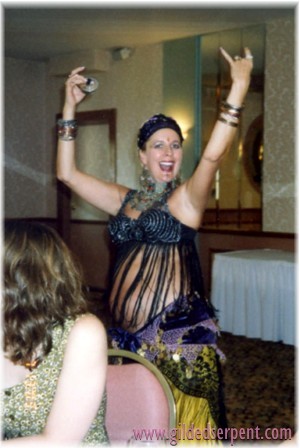
While cognizant of such expectations, the women were frank about explaining how belly dancing specifically provided them a direct means of subverting expectations of hiding their pregnant and postpartum torsos. In particular, there was a strong sense that exposing their bodies on their own terms in this way was liberating regardless of the reactions by others.

For instance, Naia (semi-professional, mother of a toddler) described her experience of having maternity photos taken in a belly dance costume: “Somebody asked me, ‘Did you show your belly?’ Like that would be an awful thing to do! I was like, ‘Oh yeah, I showed more than my belly!’”


Such emboldened resistance extended to the postpartum period as well. It was specifically during this time that the women dealt with social expectations to hide the physical consequences of pregnancy, namely weight gain and stretch marks. Dana (hobbyist, pregnant with fifth child) asserted, “It’s like you’re supposed to be dissatisfied with your (postpartum) belly pooch. You’re supposed to want to get rid of it. As a belly dancer you embrace that part of your body.” Indeed, embracing one’s body engendered a sense of greater self-acceptance for many women. This point is quite salient, as it is during the postpartum period that women face extreme social pressure to re-conform to the social standards of beauty to which they were subjected prior to pregnancy. Through belly dance the women were able to accept and appreciate their bodies just as they were. Bella (professional, mother of two) vividly recalled her experience of viewing her dancing body soon after birth: “I went down to my studio, turned the music on and I stood there and looked at my body. I watched that belly roll. It was one of the most beautiful things I have ever seen in my life, and I was 30 to 35 pounds heavier…”


The same held true for the women’s handling of stretch marks. Often a source of embarrassment and shame, belly dancing again proved a means through which women could reclaim their physicality, in all of its manifestations, and resist social scripts that would have them mask their midsections.

Sarah (professional, mother of two) recalled, “It was tough. I can’t count the times that people have made comments about my stretch marks.” Such experiences actually prompted Sarah to take her dance business in a new direction, one that celebrated the totality of women’s shapes, sizes and markings: “I decided to form my own troupe and all of my women were mothers and they all had stretch marks…”

In short, the women’s recognition of and resistance to social standards regarding the appearance of the pregnant and postpartum body informed their consciousness about how and why they belly danced. The ways in which this particular genre of movement challenged public perceptions of how women’s bodies are supposed to be presented during and after pregnancy fueled their commitment to the dance, as well as enhanced the benefits they derived from it.  Such was also true in terms of the juxtaposition in the behavior deemed appropriate for pregnant and postpartum women compared to that allowed under the guise of belly dancing.

Gabrielle DeschaineBehavior: Modesty vs. Reclamation

Belly dancing provided an avenue through which the women balanced their identities as both mothers who were dedicated to their families and autonomous women who yearned to reconnect to their individuality. In recognizing the discourse surrounding appropriate behavior for expectant mothers, Jaiye shared, “Everyone wants you to be this sweet new mom, docile and temperate woman, not making any waves…just sit down and take it easy until you have that baby.” In explaining how such expectations continue well into motherhood, Genevieve (professional, mother of three) also highlighted the suspension of autonomy: “New moms are expected to do certain things, behave certain ways…. It seems like everything is censored…there is this feeling of you disappearing…” Allie echoed such sentiments, and hinted at an aspect of infantilization: “People treat you differently when you’re pregnant. They’ll act like you can’t do things for yourself. Everyone thinks you’re fragile.” Moreover, pregnant and postpartum women are often not thought of as being sensual or sexual beings. As Naia commented, “Nobody ever wants to think about a pregnant woman doing anything sexual.”


However, doing something sensually or sexually provocative was often what the women found attractive about belly dance during and after pregnancy, which elicited predictable responses by others. Dana noted, “I had people who kind of gave me looks, like, ‘Wow, that’s a little risqué for you to be doing as a mommy.’ To be a mom of an infant and to be sensual and appreciate your body is not allowed.”

More to the point, unlike common stereotypes about the dance, which would suggest women are drawn to it for titillating and seductive purposes, the women in this study yearned for the opportunity to reconnect with their physicality via a form of movement that honors a woman’s body and life course.

Their experiences in this regard were tied more to their need to reconnect to their bodies in self-affirming ways, which encompassed empowering aspects of sensuality and sexuality, as opposed to pleasing or meeting others’ expectations. Lynne (pregnant with first child) noted, “The freedom, just being able to go and just move. I really still appreciate being able to do that…. It’s not about the aesthetic. It’s what feels good for you.”

In particular, women who viewed themselves to be fuller figured before pregnancy, and who maintained such physiques after pregnancy, found a particular sense of physical acceptance through belly dance that remained salient throughout their pregnancies. Jordana explained: “Society tells you what beautiful is and what attractive is…. The community of belly dance says ‘It doesn’t matter how big or how small you are.

’ When I first started dancing and I was heavy, I used to wear fabric that would cover my belly. And then I started to dance more and become more confident with my body and then I completely took the cover away. The entire time I was pregnant I never wore a belly cover.”

Indeed, belly dancing providing an overt means by which to challenge the status quo regarding the activities of expectant and new mothers. Moreover, central to reconnecting to their bodies, the women also found the dance to be a means through which to balance their old (pre-pregnant) and new (pregnant-motherhood) identities. Julia (hobbyist, mother of two) commented on the responses she received for taking one night a week away from her family to belly dance: “Tuesday nights are ‘mom’s on strike’ night. I get some horrified looks sometimes.” She, and others in this study, directly countered the social expectation that women suspend their pre-pregnancy activities in lieu of their family responsibilities. While belly dancing is not unique in this way, as various activities may be used by women as an outlet for individual expression and exercise, the fact that these women chose an activity that so directly challenges the discourses surrounding their maternal-familial status was intriguing. As Gail (professional, mother of two) noted, “Seeing pregnant women dance is a whole, kind of a mind altering thing… It’s very sensual and very pretty and so the whole viewing a maternal body in a sensual way is really, really alien to the Western mind.”

Indeed, part of the draw to belly dance was that it uniquely subverted the social scripts that manage women’s behavior during pregnancy and early motherhood. In this way, belly dance allowed a means through which women may reclaim and balance their public behavior in lieu of social standards that dictate otherwise.

Conclusion

AuthorFor a woman to belly dance at any point in her life may result in stereotyping and prejudice. To do so during pregnancy and early motherhood challenges the dominant cultural discourses about what are and are not acceptable activities and displays of the female body. The women in this study were well aware of these discourses and referenced them when expressing their own embodied experiences.

That they continue to engage in and defend belly dance, despite its contradictory positioning within socially acceptable behavior, speaks to the lure of this genre of movement.

The findings here offer some insights as to why belly dance is so appealing during pregnancy and early motherhood.

First, women may struggle with accepting their changing physical shape during and after pregnancy. Such struggles are aided by the ways in which our culture enforces somewhat contradictory messages regarding the appearance and behavior of (expectant) mothers (Bailey 1999; Dworkin and Wachs 2004). For example, while it is acceptable for women to gain weight (to a certain extent) during pregnancy, it is incumbent upon them to lose it as quickly as possible afterwards. We often see this presented under the guise of “getting your body back” (Dworkin and Wachs 2004, 610), as if one’s true body is somewhere else, certainly not part of one’s postpartum physique. Belly dance, as it was experienced by the women in this study, allows creative space for women of all shapes and sizes. Of course, individual women’s reasons for belly dancing vary, and it would be inappropriate to assume that a purely aesthetic rationale (i.e., to prevent excessive weight gain during pregnancy and to more quickly lose weight after) is not at play. However, the point made by the women in this study is that the dance helps them to feel good about their bodies, in whatever shape or form they are in.


Second, women seem to be confronted with a disjuncture between identities during pregnancy and early motherhood. Again, this is related to the dominant discourses surrounding these life events (Bailey 1999; Dworkin and Wachs 2004). As the women attested, being and acting sensual or sexual during and after pregnancy is not readily accepted by our culture. They shared ways in which belly dancing helped them to challenge, overcome, ignore, and otherwise disregard such social messages.

Through belly dance, women may find a safe and creative outlet for exploring and reconnecting with their sensual and sexual selves. Such (re)discovery and the (re)balancing of identity can be central to a healthy personal state.

It is indeed interesting that a dance so often dismissed as being overly/inappropriately erotic actually holds value to women on these same grounds. Part of the draw to the dance indeed seems to be the permission it extends to women to claim a sense of sensuality and sexuality on their own terms. Certainly when it comes to the pressure, strain, and adjustment required during pregnancy and early motherhood, an activity that helps women feel good about themselves and retain a sense of individuality, by challenging social scripts and cultural discourses, is worth exploring.

NoteAn extended version of this article will be published in the summer of 2011 as a chapter titled “Belly Dancing Mommas: Challenging the Cultural Discourse of Maternity,” in the anthology, Embodied Resistance: Challenging the Norms, Breaking the Rules, edited by Christine Bobel and Samantha Kwan (Vanderbilt University Press, Nashville, TN).

References

  • Bailey, Lucy. 1999. Refracted Selves: A Study of Changes in Self-Identity in the Transition to Motherhood. Sociology 33, no. 2:335-352.
  • Bordo, Susan R. 1993. Unbearable weight: Feminism, western culture, and the body. Berkeley, CA: University of California Press.
  • Butler, Judith. 1990. Gender trouble: Feminism and the subversion of identity. New York: Routledge.
  • Dworkin, Shari L. and Faye Linda Wachs. 2004. ‘Getting your body back’: Postindustrial fit motherhood in Shape Fit Pregnancy magazine. Gender & Society 18, no. 5: 610-624.
  • Dyer, Richard. 1992. Only entertainment. New York: Routledge.
  • Letherby, Gayle. 1994. Mother or not, mother or what? Problems of definition and identity.Women’s Studies International Forum 17: 525-532.

Ja’Niesa bint Asya, 8 months


use the comment box

Have a comment? Use or comment section at the bottom of this page or Send us a letter!
Check the "Letters to the Editor" for other possible viewpoints!

Ready for more?

  • 5-5-10 Bellydance in Utero by Keti Sharif
    When pregnant, I practiced Belly dance moves each day in preparation for giving birth, mainly focusing on the circular, soothing and stretching movements but avoiding shimmies and moves that were contra-indicated by midwives and sports professionals.
  • 12-14-00 Troupe Tabu goes to China! by Nanna
    .It should be noted that somewhere between passing the audition and performing, it was announced
    that three out of four dancers in the group (not including myself) were pregnant.
  • 12-15-08 Kaleila’s Belly Dance Baby DVD, Dancing While Pregnant Review by Merika
    In this touchingly personal video, Kaleila sets out to “inspire other pregnant women to feel beautiful."
  • 9-14-07 Dancing the Big Belly, Bellydance Prenatal Fitness and Dance Instruction Program DVD review by Erica
    The slow pace may seem agonizing for a fit, nonpregnant dancer and may seem slow during earlier stages of pregnancy, but as that weight starts adding up and the fatigue returns in the third trimester, I have a feeling the pace does not seem so slow.
  • 6-14-10 Got Baby? Two Prenatal DVDs: Amira’s Bellydance & Yoga for Pregnancy, Prenatal Bellydance with Naia, Reviewed by a very pregnant Sonja Oswalt
    For students who are looking for a quick but easy workout with some light and simple bellydance movements, Prenatal Bellydance with Naia may provide a slightly more satisfying pace. However, new beginners may be overwhelmed, and would do better to select Amira’s Bellydance & Yoga for Pregnancy. Neither DVD offered a challenge for advanced dancers, while both DVDs are more suitable for a dancer in her second or third trimester, as they may be too easy for a dancer in her first trimester.
  • 11-11-10 Our Desert Roses, Photos from the Floralia Festival 2010, Photos, video interview, and text by Surreyya, photos are also by Nyla Crystal and Bob Lindbloom
    Held April 29-May 2, 2010 in Truth or Consequences, New Mexico, Produced by gleaming ray of light Selena Kareena, the Floralia Festival is held annually in TorC, (Truth or Consequences) New Mexico, and features a wide spectrum of dance and dancers from throughout the southwest, South America, and beyond.
  • 11-10-10 The Dumb and the Restless: Fire! A Lighter Outlook on Belly Dance by Tasha Banat
    Yes, the audience was eating out of my hand when someone from the back of the room yelled “Hey lady! Your hair is on fire!”
  • 11-8-10 The Physiological Effects of Oriental Dance, Excerpt from Health and The Oriental Dance, Chapter 1, by Aziza of Hungary
    There was no information subject available like "the technique of Belly dancing". I had to construct it myself. It took a lot of research in regards to both its theoretical and its practical sides.
  • 11-7-10 Ergun Tamer on Saz, Musical Instrument Tour Video
    Ergun is one of the organizers of the Middle Eastern Music and Dance Camp held in Mendocino, California, each year in August. Ergun plays many instruments. In this video he tells us about the Turkish saz. The saz has many names depending on the country, such as bazouk or bazouki. This instrument also comes in many sizes.
  • 11-3-10 An Intro to Tribal Fusion by Jasmine June
    Since Tribal Fusion Belly Dance is a relatively new dance form, it is especially important to treat the genre with a level of professionalism, or else one runs the risk of discrediting the work of dancers who have dedicated their lives to creating and elevating Tribal Fusion Belly Dance.
 

Gilded Serpent presents...

Our Desert Roses


Photos from the Floralia Festival 2010
Held April 29-May 2, 2010 in
Truth or Consequences, New Mexico

Photos, video interview, and text by Surreyya
photos are also by Nyla Crystal and Bob Lindbloom
posted November 11, 2010

Produced by gleaming ray of light Selena Kareena, the Floralia Festival is held annually in TorC, (Truth or Consequences) New Mexico, and features a wide spectrum of dance and dancers from throughout the southwest, South America, and beyond.  TorC is a little piece of southwestern history located betwixt a famous hot springs and Elephant Butte Reservoir. About 150 miles south of Albuquerque, and a famed stop on the old Butterfield Stagecoach line, TorC is rich with culture of southern New Mexico. Formerly called "Hot Springs", in 1950 TorC  named itself after the famous TV game show of the same moniker after the host announced the first broadcast of the year would be held from the first city to change it’s name to "Truth or Consequences." Host Ralph Edwards visited the town in May for the next 50 years. Surreyya Hada and Nyla Crystal traveled to teach workshops and perform at this wonderful festival in sunny New Mexico.

As stated by Seleena:

"Floralia , commemorates Flora, the (goddess of flowers). Flora is the patron of all women as we embody her qualities of beauty, and youthfulness (no matter what our chronological age!). Beauty is a manisfestation of “The Divine”. The blossoming flowers of spring remind us of the blossoming of our human potential on our long dark road to higher levels of consciousness."

Below are photos from this event. Please also watch the interview with Selena Kareena below, and take a moment to read the adjoining article about Nyla and Surreyya’s experience in the Land of Enchantment.

Latiffa Layali of Chihuahua, MexicoNyla Adani

Latiffa Layali of Chihuahua, Mexico and Nyla Adani

 
Susi and Renee
Suzie and Renee

Baraka and Zeidy

Ahlam Dance Company

Ahlam Dance Company

Katia Mariposa Azul

Katia and Mariposa Azul

Faresha
Faresha

Helena Vlahos

Donna Lindbloom of Wichita, KS and Helena Vlahos

Romantasy
Romantasy

Farasha of Las Vegas, NV

Farasha of Las Vegas, NV and Zakia

Troupe Rakkasat
Troupe Rakkasat al Dahab

Shazadi Cecilia Rinn of Boise, ID

Shazadi and Cecilia Rinn of Boise, ID

Mahsati Dance Troupe

Mashati Dance Troupe

ZahiraAzadeh

Zahira and Azadeh

Tasha Banat
Tasha Banat

Leyla Najma of Albuquerque, NMMichelle Morrison

Leyla Najma of Albuquerque, NM and Michelle Morrison

Snake Charmer Bellydancer
Snake Charmer Belly dancer
 

Read more regarding this festival:

http://www.myspace.com/FloraliaBellydance#ixzz150h17dzu


use the comment box

Have a comment? Use or comment section at the bottom of this page or Send us a letter!
Check the "Letters to the Editor" for other possible viewpoints!

Ready for more?

  • Personal Truths in Truth or Consequences New Mexico’s Floralia Festival 2010
    Many times a turn of events will bring us to another place to make a new beginning–a deep and sudden loss inspired my original journey to California, and two recent losses inspired my return back to the desert, opening wounds I nearly forgot existed. It was fortunate to have Floralia to attend; it served as a focus on something I enjoy with all my heart–dance.
  • 10-1-09 Gig Bag Check with Surreyya and Sultana, video on the CK
    What does a dancer need to carry in her gig bag? Surreyya has a very special friend she carries in hers! Sultana, a leopard spotted boa constrictor enjoys being displayed for us and having a dance with her partner. Footage was filmed at Carnival of Stars in November 2008.
  • 6-4-09 Michael’s Spring 2009 Photo Spread, photos and text by Michael Baxter
    Aazura, Adriana, Ahava, Alimah, Andrea, Claudia, Eve, Kashmir Isis, Katherina, Khalila, Maria, Meissoun, Michelle Joyce, Mychelle, Nadira, Nanna, Nicole, Sandra, Shoshanna, Summer, Surreyya, Crystal, Tabitha, Zaheea
  • 12-3-07 Bellyqueen vs. Barbary Coast: It’s an east coast west coast showdown! Gina Grandi puts on a show of astronomical proportions. Review and photos by Surreyya
    Comedic timing, clever costuming and an endless supply of mojo bring about the wonderment of the early settlers of the California gold rush, with a taste of burlesque, and a taunt of influences from around the globe.
  • 3-14-07 Morgana’s Animal Magnetism, Interview with Morgana of Madrid by Surreyya
    After seeing Morgana’s Serpent Dance, where she embodies the personality of the serpent, I was hooked. Any snake lovers or snake dancers will have a special appreciation for this piece
  • 11-10-10 The Dumb and the Restless: Fire! A Lighter Outlook on Belly Dance by Tasha Banat
    Yes, the audience was eating out of my hand when someone from the back of the room yelled “Hey lady! Your hair is on fire!”
  • 11-8-10 The Physiological Effects of Oriental Dance, Excerpt from Health and The Oriental Dance, Chapter 1, by Aziza of Hungary
    There was no information subject available like "the technique of Belly dancing". I had to construct it myself. It took a lot of research in regards to both its theoretical and its practical sides.
  • 11-7-10 Ergun Tamer on Saz, Musical Instrument Tour Video
    Ergun is one of the organizers of the Middle Eastern Music and Dance Camp held in Mendocino, California, each year in August. Ergun plays many instruments. In this video he tells us about the Turkish saz. The saz has many names depending on the country, such as bazouk or bazouki. This instrument also comes in many sizes.
  • 11-3-10 An Intro to Tribal Fusion by Jasmine June
    Since Tribal Fusion Belly Dance is a relatively new dance form, it is especially important to treat the genre with a level of professionalism, or else one runs the risk of discrediting the work of dancers who have dedicated their lives to creating and elevating Tribal Fusion Belly Dance.
  • 10-27-10 Gigbag Check #22 with Cory Zamora!
    Cory talks with us after her performance at the Carnival of Stars Festival in Richmond, California, in August 2010. She shows us what she carries for her performance.Including an old style 2 piece cabaret belt, Egyptian style bra with no fringe and more. The performance clip includes beautiful floorwork done as only Cory Zamora can do!