Gilded Serpent presents...

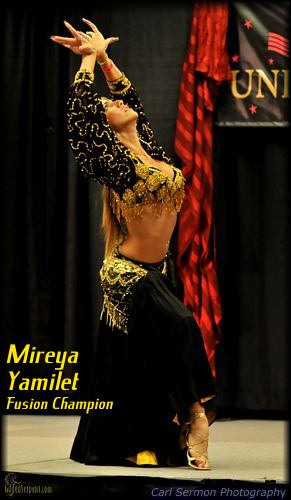
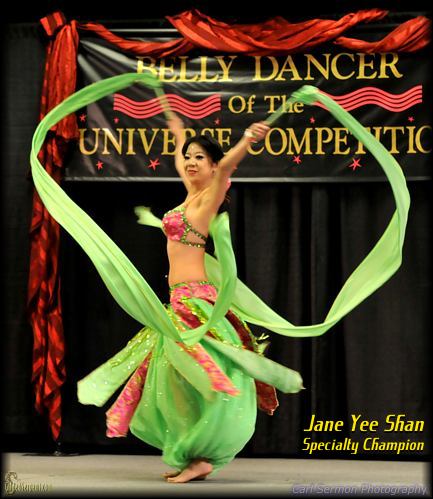
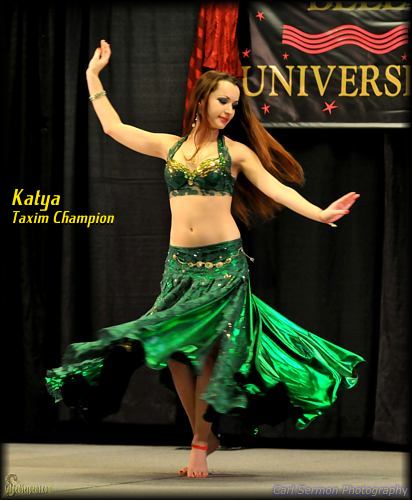
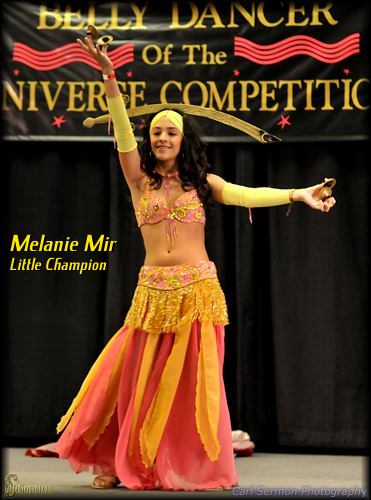
20th Annual BDUC 2010 Photos: Category Winners!


Photos by Carl Sermon
posted December 25, 2010

The Belly Dancer of the Universe Competition is produced by Tonya and Atlantis in mid February each year. This is the 20th year (2010) and was held in the Long Beach Convention Center.

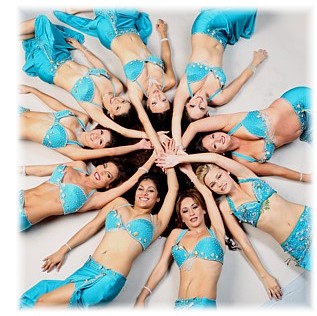
Here are the champions of each category from the various contests held throughout the weekend.

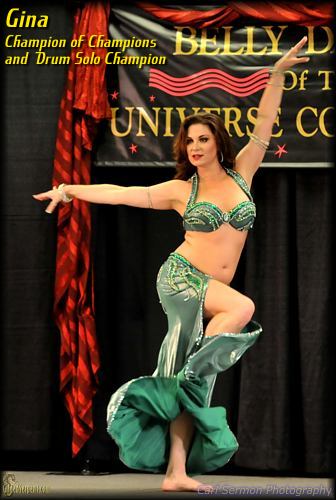
Gina
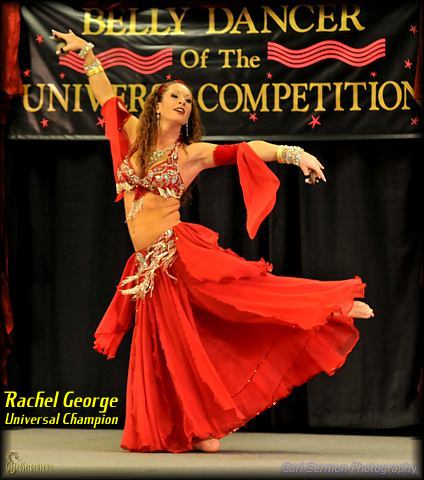
Rachael
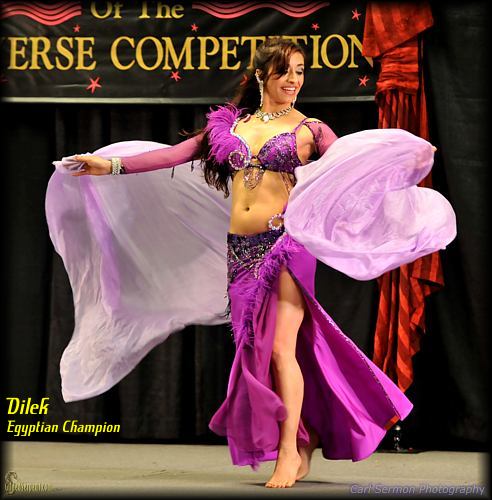
Dilek
Mieya
Jane
katya
Melanie
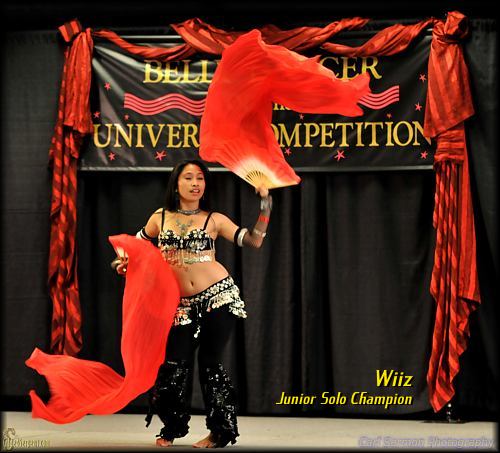
Wiiz

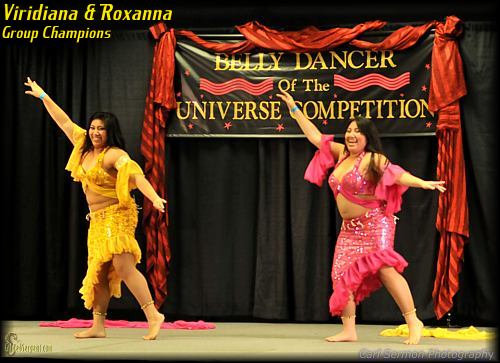
Viridian and Roxxanne


Belly Dancer of the Universe Competition

Belly Dancer of the Universe #21 is coming soon!
February 18-21, 2011 in Long Beach, California

Witness this year’s event with Gilded Serpent as Amir Sofi tests the
Universal and Egyptian category contestants with a live drum solo!

use the comment box

Have a comment? Use or comment section at the bottom of this page or Send us a letter!
Check the "Letters to the Editor" for other possible viewpoints!

Ready for more?

  • 12-7-10 Photos from the 20th Annual BDUC 2010 Saturday Night’s Judges Celebrity Show, Photos by Carl Sermon
    This is the 20th year and was held in the Long Beach Convention Center. Saturday night’s show featured all the workshop teachers and the judges for the many competions. More of Carl’s lovely photos from the competitions are yet to come!
  • 12-16-10 Dance for Dancers by Leila Farid
    Art created for other artists will evolve differently from art created for the masses.
  • 12-14-10 Tribal Fusion: An Evolving Dance Form by Jasmine June
    The biggest contrast between ATS and Tribal Fusion was that improvisation was the basis for ATS while Tribal Fusion, at least in its earliest phase, had a strong emphasis in choreography. This allowed Jill Parker to play around with musicality and to explore musical genres that were appealing to her.
  • 12-8-10 Cecilia of the Bellydance Superstars, Gigbag Check #25
    Cecilia of Argentina shows us her makeup kits and talks about how dancing with BDSS is fulfilling her dream. Brief glimpses of Cecilia dancing with the company. Filmed February 2009 at Marin Civic Auditoriu
  • 12-3-09 Division Champs of the Belly Dancer of the Universe Competition 2009, photos by Carl Sermon
    This contest is one of the first in the Belly Dance community and includes many categories covering different age groups, various styles and specialties.
  • 11-26-08 Bellydancer of the Universe Competition 2008, photos by Carl Sermon
    held in Long Beach, California, on February 18 & 19, 2008, produced by Tonya and Atlantis
  • 1-8-2010 Jillina Advances Dance Theatre, A Review of Jillina’s Bellydance Evolution,
    by Kristina Nekyia, photos by Carl Sermon

    Bellydance Evolution is a full-length theatrical event directed by dancer and choreographer Jillina, ushering belly dance into the world of dance theater. The production is a melding of narrative with a wide variety of traditional and cutting-edge Middle Eastern dance and music. I saw the dress rehearsal of Bellydance Evolution when it debuted in Glendale, California in August, 2009.
  • 7-5-10-Carnival of Stars, Performers L – Z Photos by Carl Sermon
    Latifa, Leyla Lanty, Lulu, Mahsati, Maila, MaShuqa, Monica, Monifa, Naiya Halal, Nera Brent, Pepper, Raks Al Khalil, Raska a Diva, Raks Hakohaveen, Robyn Lovejoy, Safiyah, Sarah Horbeein, Shadha, Shaunte, Sister Sirens, Sukara, Surreyya, Tanja, Tatseena, Tera Lynda, Trish …
  • 6-27-10 Carnival of Stars, Performers A – J Photos by Carl Sermon
    Adriana, Ahava, April, Alexandria’s Ghawazee, Aruba, Asia, Asura Noor, Becca, Birute, Cathy Guthrie, Cheryl, John Stanley, Crystal, Dahlena, Dancers of the Crescent Moon, Danse Maghreb, Daughters of the Pharoah, Dunia, Elizabther, Ena, Esperanza, Evil Eye, Ghanima, Hala, Heather, Jamara, Jawahare, Jewels
  • 12-6-10 Moria of BDSS and her Silver Jewelry, Gigbag Video
    Moria the dancing nomad, shows us her precious silver bracelets that she handpicked in India herself. She tells of almost losing them at the airport because they counted them as weapons! Zoe and Samantha also visible in this collage. Also included are parts of Moria’s drum solo with Hassam. Filmed February 2009 at Marin Civic Auditorium
 

Gilded Serpent presents...

Dance for Dancers

Placeholder

by Leila
posted December 16, 2010

When you look into the audience during a belly dance performance, who do you see? If you’re in the West, more often than not, you see other dancers. Let’s face it; outside the Middle East, belly dancing has never enjoyed a large general audience. There were havens of course, the Arab clubs, where audiences were accustomed to, and expected to see, a belly dancer in the show. Most of the American dancers I admired when I started began their careers in these Arab clubs. Bassma of Seattle, Aziza of Portland, Yasmin in DC and Suhaila in LA were among my favorites. Some of these women struck out in new and bold directions once they left the clubs. But all of them acquired their fundamentals outside the dance community. Back then, non-Arab women who taught belly dance started in Arab clubs and then transferred their knowledge to the classroom.  Sadly, after September 11, everything changed. Most of the clubs folded and dancers were left dancing for other dancers. 

This lack of a Western public isn’t for lack of trying. Miles Copeland’s Bellydance Superstars has tried to take belly dance main stream. The Oriental Fantasy shows by Beata and Horracio Cifuentes from Germany are another example (although when I saw their show in the USA, the majority of the audience was dancers). Both cater to Western tastes, yet neither has broken through on a large scale. In the end, belly dance performances in the West are still mainly patronized by dancers.

The only general public that exists for belly dance is in the Middle East.  Egypt, Lebanon, Turkey, and to a slightly lesser degree Jordan, Syria and Morocco all have a public that watches belly dance.

When a dancer performs in one of these countries her audience has expectations – just as an audience of belly dancers has expectations.  What I have noticed, however, is that these expectations are now quite different. For example, most dancers will be disappointed if a performer does not do an innovative choreography with impressive moves. But if she does do the choreography, Arabs may ask, “What is she doing?” I know many Egyptians who have attended belly dance performances outside Egypt who are confused by what they saw.

Art created for other artists will evolve differently from art created for the masses.

Audience This is not to say the second lacks creativity or the first will eventually become unrecognizable, but the gap between what belly dancers find interesting and what the Arab general public finds interesting is widening. 

How can Western dancers understand the differences between dance for dancers and dance for the Arab general public? YouTube is one resource.  Literally, thousands of dance performances are at your fingertips. Unfortunately, these clips often lack audience feedback. In the Arab world, people can be extremely private, and their reaction to a dancer, even in a public nightclub, is not something they want on display. Many clips also lack context. Is the dancer at a wedding, nightclub, festival?  Each venue requires different audience interaction skills. And clips from Egyptian films lack plot information so their performance context is lost as well.

There is also a language barrier. The language used to search for a clip can indicate cultural biases and preferences.  For example, type in “men’s Khaligi dance” in English and pornographic clips of women “dancing” with Khaligi music will appear.  Now type in “raqs Khaligi ragali” with Arabic script (this is a direct translation) and you will get men doing traditional Khaligi dances.  “Raqs sharki” written in Arabic text will get vastly different results than “belly dance” written in English.  Type in “Egyptian Dance” and you could spend years sorting through the results. 

Another way to compare different expectations is to attend dance festivals within Middle Eastern Countries. This can foster cultural understanding. But a word of caution – Egyptian festivals, with their huge attendance, have become big businesses.

The Egyptian public is kept out of these festivals. So even when a dancer comes to Egypt and performs at one, her audience is mainly other dancers.

AudienceAny Egyptians present are either connected to the dance industry or are wait staff for the hotels.  Also, Egypt’s most well known dancers are not necessarily the ones performing or teaching at these festivals – just as some of the festival stars are not well known in Egypt.  Consider this, the first group of dancers make their living from performing and have little contact with the formal dance industry. The second group most likely has the skills to perform for the general public but has allied themselves with the aesthetics of the dance community. Of course there are dancers who both perform and teach in Egypt. Nevertheless, the festival shows may not necessarily represent what the Arab general public looks for. 

As for the festival classes, some Egyptian and foreign teachers have discovered that teaching foreigners what they want, steps and choreographies, brings more students – even though it is far from what they would have danced as performers.  Overall, attending dance festivals is one way to gain insight – but a dancer may have to dig deeper.

Another way to bridge the gap is to perform in an Arab country.  There are many places, but the largest Arab audience is in Egypt. In the last few years a huge number of foreign dancers have come to Cairo looking for work, even though the decline in tourism has made the market extremely competitive. Some well-known dancers in their own countries could not find jobs in Egypt and returned home wondering why they didn’t appeal to Egyptians. Greek audience

Of those who do find jobs, many have no desire to make a name in Egypt. They only seek to raise their profile among other dancers.

Note: their dance doesn’t have to reflect Egyptian esthetics if they work in western tourist venues – a lost opportunity, in my opinion. Other dancers may work for a few months at a single Egyptian venue (sometimes only once), or do a wedding now and then, upload it on YouTube, and then push their names on the workshop circuit.

In the past, dancers came to Egypt to discover what made Egyptian dance quintessentially Egyptian – and succeeded. Time on stage with an Egyptian audience and immersion into the culture is invaluable.

Now, dancers come to Egypt to market themselves to other dancers. Strange, when not long ago, foreign dancer Sahra Saeeda dedicated her career to understanding Egyptian dance, Samassen became the Egyptian nightclub darling, and Asmahan, with her tableaux as a springboard, made a huge name for herself.  

Outside of Egypt, the Lebanese public is, arguably, the second largest dance consumer in the Middle East. The Lebanese TV show “Hiz ya Nawam” brings foreign and Arabic dancers together to compete.  The winner is usually from an Arab country. Foreign dancers argue that the contest is biased and that the foreigners were better dancers.  Yet besides a judging panel, the general public also calls in to vote.  This can be a great learning experience for those with open minds, but difficult within the time constraints of one short TV series.

Dancers may ask, “Why do we care what the Arab public wants?” I have seen comments like this on YouTube.  Enthusiasts of this point of view raise many arguments;

  1. they are elevating the dance by moving it from the nightclub to the stage,
  2. they are removing the negative stereotype held by the Arab public,
  3. they are standardizing the movements and adopting systematic Western teaching methods. 

But aren’t they just taking the Arabness out of it? 

Orientalists generally pick the shiny parts of whatever Arab object catches their eye, and leave the rest in the cultural muck.

What dancers have left in the muck are the parts most tied to culture, the parts most Westerners have difficulty understanding:

  1. humor
  2. a sense of the community over the individual
  3. the power and brazenness of those who exist on the fringes of society
  4. “Dela3” along with a complex idea of femininity
  5. a close contact with the audience

These things are hard to discover at a dance festival, on YouTube or in a TV show. It takes deeper exploration and a willingness to go beyond the glitzy “Oriental Dance” industry we have created. 

It is one thing to understand these cultural connections and choose to ignore or change them. It is another thing entirely not to grasp their place as part of the art form.

Ultimately, the question is – What will become of an art practiced only for other artists? Will it continue to spark a new era in dance and point it in new directions?  Will it grow and flower into something Western publics will appreciate – and create a new general public? Will the Arab public appreciate this “new belly dance” or, because it lacks anything recognizable to them, retreat completely from it? I don’t know. What do you think?

use the comment box

Have a comment? Use or comment section at the bottom of this page or Send us a letter!
Check the "Letters to the Editor" for other possible viewpoints!

Ready for more?

  • 8-16-07 What Middle Eastern Audiences Expect from a Belly Dancer by Leila
    Audiences in the Middle East, especially Egyptians, see bellydancing as something to be participated in, critiqued, and loved (or hated) with gusto.
  • 12-30-06 I Dance; You Follow by Leila
    As Westerners interested in an Eastern dance form, we might want to ask ourselves if we are missing certain critical aspects of Raqs Sharki because we are not open to Eastern teaching methods.
  • 7-15-08 Egyptian Wedding Stories by Leila of Cairo
    All the guests were staring at us. The father of the bride demanded to know who ordered the bellydancer and it seemed a fight was going to break out between representatives of the brides’ family and the hotel organizer.
  • 9-17-07 Changes: Egyptian Dance – Has it crossed the line? by Amina Goodyear
    Both festivals, held in Giza were isolated and insulated from the people and the Cairo that I know and love.
  • 1-27-10 Shoo Shoo Amin, A Forgotten Treasure of the 80s by Yasmin
    Twenty years ago when I told people I had worked with Shoo Shoo Amin in Cairo, the response was “Wow!” Now, people go “Who?” Today no one seems to know who she is. For belly dance purists, this is a tragedy. Every so often, someone my age or older will wax lyrical about her on-line, but for the most part, she’s an enigma – even to young Egyptians.
  • 7-30-08 Ahlan Wa Sahlan 2008, Not So Welcoming this Year by Yasmin
    Prices have gone up everywhere, and Egypt is no exception. The reality hit me as soon as I walked into the Mena House. Bottled water was $4.00, where out in the street the same bottle was $.50. A bottle of beer was $10.00. Internet connection was $30.00 / hour. At those prices, life’s little pleasures didn’t seem important anymore.
  • BE CAREFUL WHAT YOU WISH FOR…
    A Case against Standardization in Nomenclature for Belly Dance Instruction
  • Dance Emotion, Part 2
    The audience is not going to care, or even notice, that a dancer did a high-stepping Fandango Walking Step with an over-lay of a Soheir Zaki Head Tilt and a really fine
  • Dance Emotion, Part 1
    "The place of dance is within the heart."
  • 10-8-08 Dance – Deeper than the Moves by Keti Sharif
    A dancer who feels “safe” in the rhythm, footwork, technical movement feels grounded and secure as she dances. A grounded dancer will be less "in her head” and allow the authenticity of feeling to come through her body as a flowing, emotive movement that expresses the music and how she “feels” the music.
  • 3-7-06 Streets of Cairo- Egyptian Rhythm, Language and Dance by Keti Sharif
    Cairo’s streets are much like its dance – streams of freestyle movement guided by intuition rather than rules. There are no ‘principles’ as such in both circumstances – it’s the organic-ness of Egyptian life that creates order in chaos.
  • Dance Alchemy
    Dance can be the corporeal miming, shaping, and manifestation of the soul’s intent.
  • The Broken Vessel
    We, too, must believe in our movements, believe in their purpose and message, and we must deploy them with the array of human faculties that begin to evolve when the Art of the Dance is taken up.
  • Visiting Cairo: You live a whole lifetime in one week!
    Laughter builds bridges, and in today’s world, bridges – between individuals and between cultures, are becoming more and more of an imperative.
 

Gilded Serpent presents...

Where There is Music, There is Dance.

Placeholder

Ahla Andalusi
40 Days & 1001 Nights

Review by Amina Goodyear
posted December 15, 2010

Music is my drug of choice.
It’s my addiction.
Dance is my high.
It’s a result of my habit.
Dance takes me places. Music is my vehicle.
I’ve read of people, especially modern dance choreographers, who transcend the music and are able to envision dance and forms without it.
I cannot.
I cannot envision dance without music. The two require each other.
I can play music and dance in my head.
And I can dance and play music in my head.
If there is music, there is dance
and if there is dance, there is music.

Whenever I play music I really do see "visions of sugar plums dancing in my head". The music will transport me to far-off places including entering the time-machine and it will instill various types of emotion. I think I have ADD or ADHD. If I need to concentrate on a task or read, I don’t like to have music travelling through my veins. If music is playing, I need to dance.

Of course some music brings on a greater degree of high than others. And some music is more danceable in my head than in my body. In this case, I am speaking of two albums of music that both encourage my addiction and enable me to lose my mind in my body.

These two albums, Ahla Andalusi and 40 Days & 1001 Nights,  really do transport me as in a time machine to other times, other lands and other ecstasies. They both seem to have been composed in another time and another place. There seems to be no modern crossover influence in that the music is acoustic and takes advantage of the musicianship and instrumentation of yesterday with no globalization of today.

They are islands of beauty and as the two albums dance in my head, I am lost in a dream of visions – colors, light and dark, pure and hazy, and smells of incense and flowers wafting in the breeze of temperate temperature which encircle me and the choreographies of my mind.

Now to the reality of the albums:

Ahla AndalusiAhla Andalusi by Maher Kamal

Nesma of Spain has done it again. She has produced a wonderful spellbinding album featuring Egyptian composer, musician and vocalist Maher Kamal in Ahla Andalusi. The stringed instruments are violin, viola, cello, contrebass and kanun. The nay and kawala along with the voices provide the spiritualism of the heavens and the riq, tabla, duf and dahola give us the heartbeat. I thought I heard an oud also, but it is not listed.

Initially when I heard this album I was first struck with the beauty of the stringed section and then I heard the magic of the voice of Maher Kamal.

In San Francisco we are privileged to have a wonderful musician and singer, Elias Lammam,  whose velvet voice brings to mind Abdel Halim. At times I wonder whose voice I enjoy more – Elias’ or Abdel Halim’s. That’s a hard decision for me to make. Well – then I heard Maher Kamal’s. He doesn’t sound as much like Abdel Halim as he does Elias Lammam. To me this is a plus.

Besides the musical compositions in this album, this haunting, heavenly voice alone which is speaking, as if to me alone, is reason enough to own this album.

Since albums are a vehicle to convey the musical message, in this case, that is a good thing. Although the sepia-toned Moorish artwork and thought behind the also sepia-toned booklet- sized multi-lingual (Spanish, French, English and Arabic calligraphy) 32 paged liner notes are very artfully done and well-thought out, there seems to have been no thought behind the phrase "Can the reader see or read the written material?"

Even with reading glasses perched on nose, while squinting and holding a magnifying glass in hand in the daylight and under a bright light, I had enough trouble reading the lyrics and translations that I did not even want to bother to do so.

In the case with Nesma’s liner notes – maybe "less is more" should be the case. However the liner notes are important and very informative and I hope your eyes are better than mine.

Ahla Andalusi is an album that moves and dances in the genre of the muwasha (muwahshahat pl.) – poetry with music and vocalisation. Originated in Moorish Spain (about the time of the crusades -around the tenth century) the muwashahat to me is poetry in motion. I belong to an Arabic choir, Aswat (Voices), that strives to preserve and present all types of classical Arabic music and song. Our favorite pieces and probably the most difficult to perform are the muwashahat. The poetry is incredibly beautiful, allegorical and visual. It is interwoven and interconnected with the musical phrasing and rhythms. I play in the percussion section and many of the rhythms are odd time signatures that change. In playing the muwashahat it can become easy to groove into the rhythm but then just as easily the flow will take a gentle turn that takes you on another path.

In listening to Ahla Andalusi you will experience this gentle flow nudging you from one phrase, rhythm or mode to another in a complex uncomplicated manner. You will be transported from one time and place to another – but all will be timeless and without a specific place in mind.

You will ask yourself, "Is this music Arabic? Is it Egyptian? Is it Spanish? I hear the rumba rhythm, I hear maqsoum." Well, it is Andalusian and it is all of the above. It is tradition and it is a blend of the historical and contemporary music and poetry from the 10th, the 11th, the 12th centuries and even a bit of the 21st century.

"al andalus, the Eternal Paradise"
Poem by Ibn Jafaya de Alzira (1058-1139)
Maqam (mode): Ajam
Rhythm cycle: Rumba

"Oh Andalusian, what fortune!
Water, shade, river and trees
The paradise is just yours
If I must choose. I’ll choose it.
Don’t be afraid to go to hell.
Nobody goes to hell after heaven."

Rating: 4 zils

Zil Rating- 4

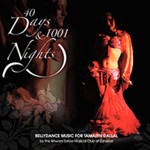
Tamalyn's 40 Days CD40 Days & 1001 Nights Bellydance Music for Tamalyn Dallal by the Ikhwani Safaa Musical Club of Zanzibar

A short time ago my friend Dr. Barb fulfilled a dream to climb Mount Kilimanjaro in Tanzania.  When she returned with stories and photos, she also returned with some fabulous music she found. It was music from Zanzibar. Zanzibar is an island just east of Tanzania which is situated in the southeastern portion of Africa. Dr. Barb, who used to be known as Bahia, was a dancer from New York. We worked together at the Bagdad and the Casbah in San Francisco during North Beach’s heyday in the 70’s. We’ve maintained a friendship fueled by our love of all types of music and dance but especially Arabic music.

During this time at an informal music practice, nay player Hector Bezanis mentioned hearing some incredibly beautiful and sweet music from Zanzibar. We compared music and all comparisons led to the Ikhwani Safaa Musical Club of Zanzibar. This friend was also a member of Aswat (Arabic classic music ensemble and choir based in San Francisco) and eventually Aswat added a piece from Zanzibar to its repertoire. This piece was Ifkar and we’ve used it to open at least two of our concerts.Location of Zanzibar

Meanwhile, dancer Tamalyn Dallal was undergoing a project called 40 Days and 1001 NightsThis project was to become a book, a musical documentary DVD, a dance performance, and a CD. In the DVD, she visits 5 Islamic countries and spends 40 nights in each country between 2005 and 2006. The island of Zanzibar in the Indian Ocean was one of countries she visited.

Zanzibar, known as the Spice Island, has been home to many foreign traders. The earliest settlers seem to have been the Arabs including the Egyptians, with many visiting and moving there since the 8th century.  Being an island and isolated from many distractions, these settlers brought their culture and music which soon melted into their African culture and music and became part of the inherent music and culture of Zanzibar.

Tarab, which can involve both musician, dancer and audience, comes from the emotions involved and memories evoked from the music.

Tamalyn Dallal says,
"Taarab is a synthesis of classical Egyptian and East African music. Using elaborate orchestrations and sung in Swahili, Zanzibaris relax while listening to the lyrics about love… Ikhwani Safaa was the first musical "Taarab" club in Zanzibar. Established in 1905 their musical style derives it’s name from the Arabic word "Tariba", meaning to be moved, or enchanted by song. "

Listening to – and dancing to – 40 Days & 1001 Nights will certainly take you to other places and times. You will be moved and enchanted and memories that you never had will appear in your mind and body.

The instruments played are the violin, kanun, ney (flute), double bass, accordion, rika (tambourine), dumbek and bongos and all are memorable especially when playing the taqaseem (musical improvisation). This simple, sweet, pure group of amateur (someone who takes part in something for pleasure rather than pay) musicians is capable of transporting you and your dreams to the land of magic.

Their musical style is simple, hypnotic, to the point as well as repetitious and enables the listener to dance fantasies of sugarplums and love. Whether you close your eyes or not, when you listen to this music, you will immediately be taken to a tropical evening paradise where all is comfortable and warm with breezes bringing in scents of flowers and love.

Rating: 4 zils

Zil Rating- 4
Artist’s site for purchase info

 
Both albums, Ahla Andalusi – Maher Kamal produced by Nesma and 40 Days & 1001 Nights produced by Tamalyn Dallal, are music CDs that are danceable in certain situations. Due to the traditional and historical nature of the music they may not be the music of choice in a club or party type environment. Ahla Andalusi would be more conducive to a theatrical setting or troupe dancing ala the muwashahat of the Reda Troupe or a Feiruz concert. 40 Days & 1001 Nights might be used in a theatrical setting or perhaps at a dance festival showing off period dancing of the ‘70s, ‘60s or earlier. Both pieces are beautiful enough to share with your non-dancing friends. They too will then start dancing in their heads.

Enjoy!


use the comment box

Have a comment? Use or comment section at the bottom of this page or Send us a letter!
Check the "Letters to the Editor" for other possible viewpoints!

Ready for more?


Gilded Serpent presents...

Tribal Fusion: An Evolving Dance Form

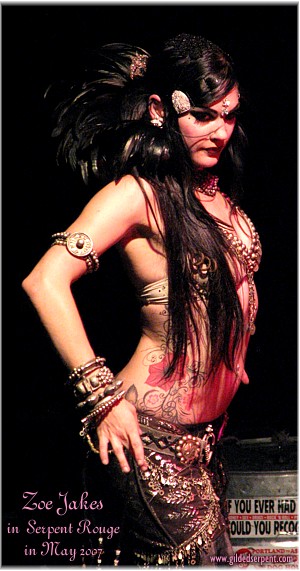
Zoe Jakes by Lynette Harris

by Jasmine June

When Jill Parker founded Ultra Gypsy in the early 1990s, Tribal Fusion Belly Dance was in its first evolutionary phase. It was a brand new genre, incorporating influences from the modern primitive movement and queer alternative lifestyle, along with Jill’s dance training and experience with American Tribal Style (ATS) belly dance.  With a foundation of ATS, Jill expanded upon her training and fused different styles to form what is today called Tribal Fusion belly dance.

The biggest contrast between ATS and Tribal Fusion was that improvisation was the basis for ATS while Tribal Fusion, at least in its earliest phase, had a strong emphasis in choreography. This allowed Jill to play around with musicality and to explore musical genres that were appealing to her.

Another original deviation was that Jill’s dance partner and original Ultra Gypsy member was a man. Her friend, Michael, while training and sometimes performing with Fat Chance Belly Dance, was slightly out of place in a form that focused on the celebration of women. However, he and Jill were kindred spirits, and even performed together as go-go belly dancers at a night club that emphasized the queer alternative lifestyle. The importance behind this is that it conveys the openness and acceptance that has defined Tribal Fusion since its conception.

Several prominent dance figures came out of Ultra Gypsy and added their own pieces to the Tribal Fusion evolutionary game. For example, Rachel Brice has been credited as the first Tribal Fusion soloist. This is not to say that Jill or anyone before Rachel didn’t perform solos. What is meant, is that Rachel was the first to really run with performing as a solo Tribal Fusion dancer, and in doing so paved the way for future Tribal Fusion soloists. According to Heather Stants, Rachel’s “approach to isolations and yoga-infused dance training has crossed stylistic boundaries and expanded the number of Tribal Fusion enthusiasts worldwide”. As such, Rachel was a pioneer of sorts, even though the genre of Tribal Fusion already existed.

Heather Stants by TabooMedia.comHeather Stants herself played an important role in Tribal Fusion’s evolutionary history. She founded the Urban Tribal Dance Company in the early 2000s, with an intent of “emphasizing flexibility and athleticism with a more streamlined costume to highlight movement”. This was a sharp contrast to the elaborate costuming that had typically characterised Tribal Fusion.

As fusion is a core element of Tribal Fusion, it is in the nature of the genre to change and evolve. Tribal Fusion dance companies, like UNMATA, have taken the improvising techniques of ATS and fused them with Jill Parker’s love of choreography to create performances that use cues to sync a string of choreographed combinations. Dancers, like Zoe Jakes, have become poster girls for specific music groups and have created a trend of dancers aligning themselves with a “signature” musician. For example, when one thinks of the group “Beats Antique”, Zoe Jakes is the dancer who comes to mind.

There have been countless fusions and adaptations involving the Tribal Fusion genre, perhaps to the point where things have become a bit muddled. This became apparent for me after attending Tribal Fest 2009. While most of the festival showcased amazing dancers that were true to the tribal spirit, a few acts had me scratching my head. Where was the belly dance? Heck, where was the tribal?

If neither tribal nor belly dance are a key component, I wondered, then how can it be called Tribal Fusion belly dance?

I had the good fortune of meeting up with the Tribal Fusion mama herself the other week and got the low down on what is crucial for the dance genre’s continuing evolution. Of all people, Jill Parker is the one you’d want to listen to if you are a Tribal Fusion belly dancer or if you are thinking about taking up Tribal Fusion belly dance.

First of all, let me just say that Jill not only encourages people to develop their own Tribal Fusion style, she thinks it’s an essential component if you are going to be performing or teaching on your own.

If not, then you are simply stealing the style of someone else. As well, if you are not able to develop your own style, then you are not ready to go it alone.

Until a dancer has received a diverse amount of training, he or she should focus on performing or teaching under the umbrella of an instructor’s dance company. The only leeway with this is if a dancer completes a teaching certification program, and even then, the dancer should be clear when teaching the technique that it is the technique of so-and-so and not her own.Tobias and Jill

The reason why the above is so important to the evolution of the Tribal Fusion genre, is that it forces a dancer to be properly trained before performing for people who may not know much about belly dance. A level of professionalism is key if people want Tribal Fusion to be taken seriously as a dance form, and a problem arises when new Tribal Fusion dancers think they can perform on their own after only studying from one teacher.

This brings me to Jill’s next big piece of advice: when thinking of Tribal Fusion, the “belly dance” is always in parenthesis. Meaning that you ought to know how to belly dance if you are going to call yourself a belly dancer. The big names in the Tribal Fusion scene have done a lot of legwork, so if their students are only performing with them, then the students have mastered enough belly dance to be part of that particular company (although they can certainly benefit from training with other teachers). However, if a dancer is going to perform or teach outside of a company, then there is more belly dance technique that first needs to be learned.

Tribal Fusion belly dance has its roots in traditional forms of belly dance and the influence of these styles are not to be underestimated.

For example, a hip hop dancer can’t take a few Tribal Fusion classes, fuse some technique with hip hop and then call it Tribal Fusion, because there isn’t enough belly dance in that equation. It would be hip hop fused with Tribal Fusion, but that’s a distinct difference.

Another key point Jill touched on was to learn traditional musical rhythms.

Tribal Fusion is a dance form that allows for a diverse use of music and musicality. However, if a dancer is going to belly dance to rock music, for example, it would be helpful for her to know how to keep rhythm with the percussion. A skill like that can be learned in drum solo workshops or by training with Middle Eastern drummers. Musicality is such a crucial component of the Tribal Fusion genre, and it is therefore essential that a dancer be well versed in how to belly dance to different types of music- much like the Egyptian belly dancer who knows the difference between a saidi and a baladi.

Jill spoke a lot about integrity- of staying true to yourself and what you want to express, of not stealing a style from another dancer, of giving credit to your mentors, of taking good care of your body, of knowing the history and lineage of your dance genres. These are all important points in ensuring that Tribal Fusion will continue to evolve in a way that celebrates not only the fusions that are being incorporated, but also belly dance itself.

Note:
(1)-Author wishes to acknowledge Heather Stant’s article- "Tribal Fusion" for several quotes included with the “Evolution” DVD put out by Hollywood Music.

Rose-Rachel-Jill

use the comment box

Have a comment? Use or comment section at the bottom of this page or Send us a letter!
Check the "Letters to the Editor" for other possible viewpoints!

Ready for more?

  • 11-3-10 An Intro to Tribal Fusion by Jasmine June
    Since Tribal Fusion Belly Dance is a relatively new dance form, it is especially important to treat the genre with a level of professionalism, or else one runs the risk of discrediting the work of dancers who have dedicated their lives to creating and elevating Tribal Fusion Belly Dance.
  • 9-16-10 To Berlin and Back, Bridging Cultures Through Belly Dance by Jasmine June
    In this way, he demonstrated that belly dance isn’t something that is defined by culture. Rather, it is an art form that can be perfected by anyone who puts their mind to it, and it’s an art form that can be used to bridge cultures rather than divide them.
  • 6-13-07 Le Serpent Rouge Reviewed by Yasmela
    The blending of theater and dance was really outstanding with broad comedy moving seamlessly into dance.
  • Tribal Belly Dance Matures into its Prime, It All Unfolds at L’Amour de la Danse
    Although the show was not intended to be a Tribal show, because the Bay Area is the cradle of Tribal style, the line-up did a marvelous job of presenting this genre’s rich variety.
  • 12-8-10 Cecilia of the Bellydance Superstars, Gigbag Check #25
    Cecilia of Argentina shows us her makeup kits and talks about how dancing with BDSS is fulfilling her dream. Brief glimpses of Cecilia dancing with the company. Filmed February 2009 at Marin Civic Auditoriu
  • 12-7-10 Photos from the 20th Annual BDUC 2010 Saturday Night’s Judges Celebrity Show, Photos by Carl Sermon
    This is the 20th year and was held in the Long Beach Convention Center. Saturday night’s show featured all the workshop teachers and the judges for the many competions. More of Carl’s lovely photos from the competitions are yet to come!
  • 12-6-10 Moria of BDSS and her Silver Jewelry, Gigbag Video
    Moria the dancing nomad, shows us her precious silver bracelets that she handpicked in India herself. She tells of almost losing them at the airport because they counted them as weapons! Zoe and Samantha also visible in this collage. Also included are parts of Moria’s drum solo with Hassam. Filmed February 2009 at Marin Civic Auditorium
  • 12-5-10 Colleen of BDSS- Backstage at Marin Civic Auitorium, Feb 2009 Gigbag Video
    Colleen talks about her 5-6 years of of touring with BDSS 7 months out of the year, including her slipped disks from riding the bus.
    Colleen is from Marin County, CA. She wraps up her borrowed curling iron that has plastic burned onto it. We see her Polynesian skirt. A short clip of the BDSS Polynesian fusion dance is included.
  • 12-3-10 Magana Baptiste, Dancing for a Queen by Amina Goodyear
    I became a "Princess" from Siam. None of my classmates knew anything about Siam except that it was exotic; so I was accepted because I was "exotic".
 

Gilded Serpent presents...

Ready, Set, Go!

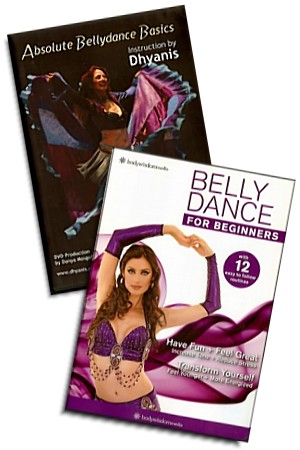
Leila and Dhyanis's DVDs

Leila’s "Belly Dance for Beginners" &
Dhyanis’s "Absolute Bellydance Basics: Fundamentals for All Styles

Review by Zumarrad/Brigid Kelly
December 13, 2010

Leila's DVDBelly Dance for Beginners by Leila of Cairo

I would never have selected this DVD based on its cover because it gives the impression that it’s mostly for feel-good fitness and seems to emphasise sensuality a little too much for my comfort. That’s a shame, because this DVD is a great learning tool.

I stopped being the target market for beginner DVDs a long time ago, though, and I’d be happy if somebody purchased this DVD aiming for a gentle, sexy-feeling workout and fell in love with Belly dance through its influence.

Leila of Cairo’s DVD begins with welcome instructions regarding the safe and sensible use of the lessons (both written on the screen and presented verbally by Leila herself). Her spoken cautions are excellent. The DVD is filmed in a large, well-lit, and attractively decorated space without visible mirrors. (It could be a home studio or spacious living area.) Leila’s teaching outfit is perfectly colour-coordinated with the soft brown walls of the studio, which could be a little tricky to deal with if your eyesight is not very good. There’s also an annoying tendency to change angles on her mid-movement. Nonetheless, Leila gives a lot of detailed verbal instructions, which I like, and the audio is very clear and clean.

Leila also talks about the possible origins of the dance, but is cautious, referring to childbirth and fertility associations as things “some people think” and they “might be true”. She talks about the different styles of Belly dance and the benefits she perceives in the dance. She is also not afraid to talk about some movements being sexy.

Leila introduces, first, basic dance moves, then, “integrated” movements (ones that involve travelling). She emphasises an upright, stacked, slightly forward, neutral-pelvis posture and spends a lot of time talking about safe technique and stylistic variations.

In fact, she talks a great deal, but this is just the kind of teaching I like; so, it’s fine with me. She breaks movements down to their foundational building blocks. I like the way she encourages students to start slowly and keep movements smaller and more controlled.

Some teachers would frown on her use of  the term “stomach muscles” but this is really a semantic quibble. I love the way she breaks down shoulder shimmies, for instance, in the “traditional” shoulder-push way, then shows you how you can create a more modern Egyptian feeling by taking the movement into the ribcage. Her description of using the inner thigh muscles to drive straight-leg Egyptian shimmies is new to me and really helps.

In addition to the meticulous breakdowns, there are some “follow the bouncing butt” sections to copy, in “relaxation”, “sensual” and “energising” modes – a little cheesy –  and an additional (lovely) performance. to watch.

There is a lot of material on this DVD. It’s a real course, and even an experienced dancer will benefit from some of the technique breakdowns. I do not recommend anybody try to learn Belly dance from scratch without a teacher, but this is a pretty comprehensive and well put together alternative. The only downside might be that there is simply such a lot on this DVD that an average student might give up half-way through. I recommend this for isolated groups of dancers, with no available teacher, who want to give themselves a weekly class.  However, be aware that there is no warm-up or cool-down section on this DVD.

Rating: 4 zils
Zil Rating- 4


Dhyanis's DVDAbsolute Bellydance Basics: Fundamentals for All Styles by Dhyanis.

This DVD offers basic dance techniques from long-time California-based dancer, Dhyanis, and it includes some performance footage.

Unfortunately, Dhyanis pushes one of my biggest buttons right at the start by launching into a “historical” description of Belly dance being “older than the written word, stemming from ancient rituals, by women, for women”, etc. (You know the drill. No, no, no!)

She continues with some quite valid observations about the health and emotional benefits of Belly dance, including a sad personal anecdote about how the dance helped her through bereavement. (I feel mean now.) Dhyanis has a pleasant soothing voice, but a disconcerting habit of dancing around while speaking, and during her teaching sections, the balance of volume between background music and Dhyanis’ voice is not good, making it difficult to hear.

The postural alignment and warm-up section involve a lot of squatting, followed by a series of vigorous stretches that look neither fun nor safe. Many of the stretches are familiar as cool-down moves, but  Dhyanis performs them with alarming bounces that make me fear for her hamstrings and, especially, her neck. In my opinion, these are not safe stretches.  Additionally, the shoulder isolations that she demonstrates are a little jerky and large for my taste.

The first move Dhyanis teaches is a vigorous Pelvic Tilt, facing front to camera unfortunately, though it looks much better when she faces the side. Dhyanis teaches all movements on this DVD in a very deep squat, and they are large and look a little uncontrolled, particularly the hip shimmy. Her Ribcage Isolations are positively violent! However, many of the isolations and movements she teaches resemble things my teacher taught me years ago, and when done in a less extreme manner, they are useful exercises and movements.

Similarly, apart from the deep knee bend, bouncing stretches and jerky presentation, the information that Dhyanis gives (about using the abdominals and glutes to support the movements) is not bad. She also breaks down Snake Arms in a manner similar to the way my teacher did, which I have never seen on a DVD before (though her execution is quite different).

I found her Veil Section underwhelming, and not especially helpful in terms of technique.

In a lot of ways, I feel as if I am watching a 1970s instructional booklet come-to-life. An astute dancer, trained in a different style, could, perhaps, use this DVD to give their dance an old-fashioned American Cabaret style flavour, but I think there are better examples of the dance style out there. Dhyanis seems like a fun and pleasant teacher, but I would not recommend this DVD to anybody wanting to study Belly dance from scratch. The DVD blurb suggesting that the movements on it are basic to all Belly dance styles including tribal is misleading, too – not taught this way, they’re not.

Rating: 1 zill
Zil Rating- 2

Absolute Bellydance Basics: Fundamentals for All Styles by Dhyanis
Available on
artists Site

$25

use the comment box

Have a comment? Use or comment section at the bottom of this page or Send us a letter!
Check the "Letters to the Editor" for other possible viewpoints!

Ready for more?


Gilded Serpent presents...

Photos from the 20th Annual BDUC 2010

Saturday Night’s Judges Celebrity Show

Photos by Carl Sermon
posted December 7, 2010

The Belly Dancer of the Universe Competion is produced by Tonya and Atlantis in mid February each year. This is the 20th year and was held in the Long Beach Convention Center. Saturday night’s show featured all the workshop teachers and the judges for the many competions. More of Carl’s lovely photos from the competitions are yet to come!

Aisha Ali
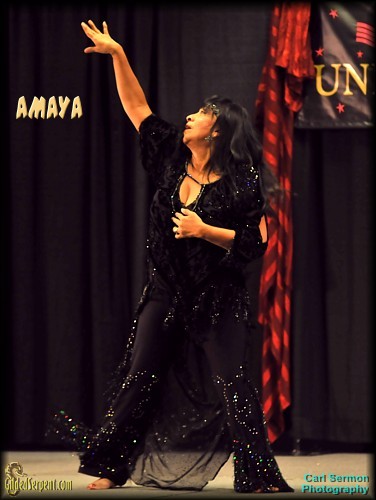
Amaya
Anglelika Nemeth
Anisa
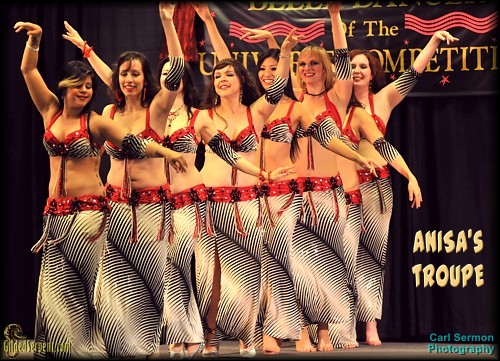
Anisa's Troupe
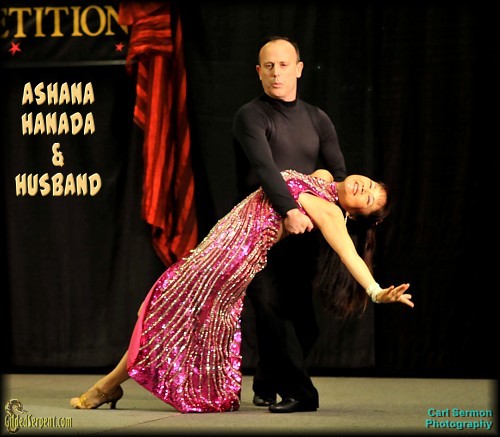
Ashana and hubby
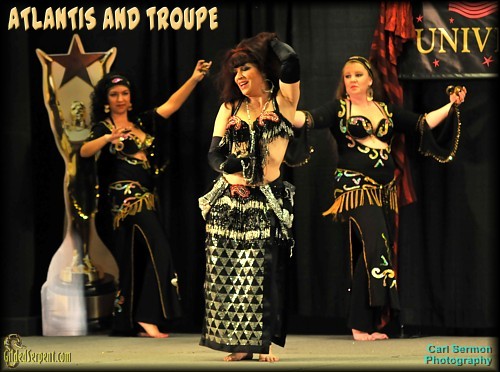
Atlantis and troupe
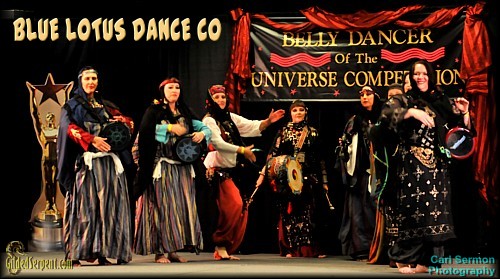
Blue Lotus dance Company
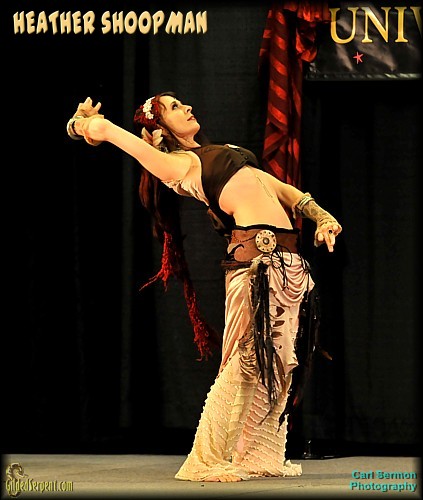
Heather Shoopman
Helena Vlahos
Isabella
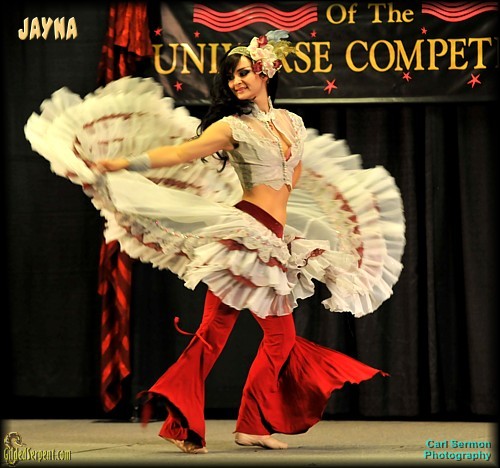
Jayna
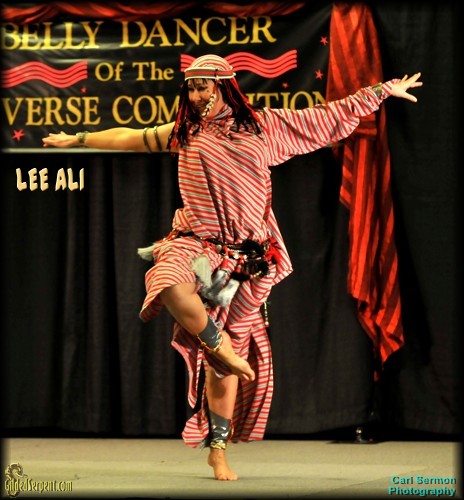
Lee Ali
Marushka
Mashuqa
Mashua receives the Lifetime Achievement Award
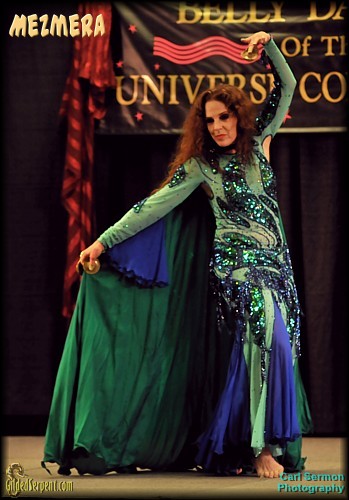
Mesmera
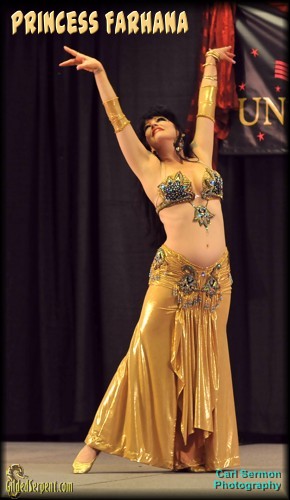
Z Princess!
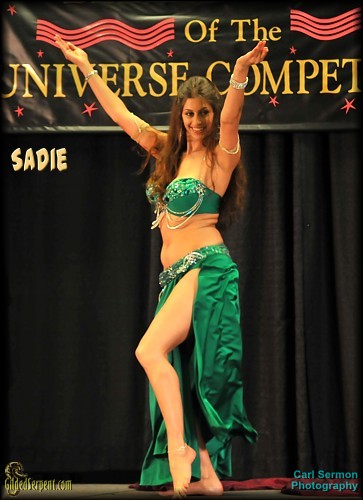
Sadie
Suhaila

use the comment box

Have a comment? Use or comment section at the bottom of this page or Send us a letter!
Check the "Letters to the Editor" for other possible viewpoints!

Ready for more?

  • 12-3-09 Division Champs of the Belly Dancer of the Universe Competition 2009, photos by Carl Sermon
    This contest is one of the first in the Belly Dance community and includes many categories covering different age groups, various styles and specialties.
  • 11-26-08 Bellydancer of the Universe Competition 2008, photos by Carl Sermon
    held in Long Beach, California, on February 18 & 19, 2008, produced by Tonya and Atlantis
  • 1-8-2010 Jillina Advances Dance Theatre, A Review of Jillina’s Bellydance Evolution, by Kristina Nekyia, photos by Carl Sermon
    Bellydance Evolution is a full-length theatrical event directed by dancer and choreographer Jillina, ushering belly dance into the world of dance theater. The production is a melding of narrative with a wide variety of traditional and cutting-edge Middle Eastern dance and music. I saw the dress rehearsal of Bellydance Evolution when it debuted in Glendale, California in August, 2009.
  • 7-5-10-Carnival of Stars, Performers L – Z Photos by Carl Sermon
    Latifa, Leyla Lanty, Lulu, Mahsati, Maila, MaShuqa, Monica, Monifa, Naiya Halal, Nera Brent, Pepper, Raks Al Khalil, Raska a Diva, Raks Hakohaveen, Robyn Lovejoy, Safiyah, Sarah Horbeein, Shadha, Shaunte, Sister Sirens, Sukara, Surreyya, Tanja, Tatseena, Tera Lynda, Trish …
  • 6-27-10 Carnival of Stars, Performers A – J Photos by Carl Sermon
    Adriana, Ahava, April, Alexandria’s Ghawazee, Aruba, Asia, Asura Noor, Becca, Birute, Cathy Guthrie, Cheryl, John Stanley, Crystal, Dahlena, Dancers of the Crescent Moon, Danse Maghreb, Daughters of the Pharoah, Dunia, Elizabther, Ena, Esperanza, Evil Eye, Ghanima, Hala, Heather, Jamara, Jawahare, Jewels
  • 12-6-10 Moria of BDSS and her Silver Jewelry, Gigbag Video
    Moria the dancing nomad, shows us her precious silver bracelets that she handpicked in India herself. She tells of almost losing them at the airport because they counted them as weapons! Zoe and Samantha also visible in this collage. Also included are parts of Moria’s drum solo with Hassam. Filmed February 2009 at Marin Civic Auditorium
  • 12-5-10 Colleen of BDSS- Backstage at Marin Civic Auitorium, Feb 2009 Gigbag Video
    Colleen talks about her 5-6 years of of touring with BDSS 7 months out of the year, including her slipped disks from riding the bus.
    Colleen is from Marin County, CA. She wraps up her borrowed curling iron that has plastic burned onto it. We see her Polynesian skirt. A short clip of the BDSS Polynesian fusion dance is included.
  • 12-3-10 Magana Baptiste, Dancing for a Queen by Amina Goodyear
    I became a "Princess" from Siam. None of my classmates knew anything about Siam except that it was exotic; so I was accepted because I was "exotic".
  • 12-2-10 Long Distance Bellydance Relationship by Dahab
    I am very grateful technology allowed us to have this very special kind of troupe, one whose members live thousand of miles away.
 

Gilded Serpent presents...

Magana Baptiste

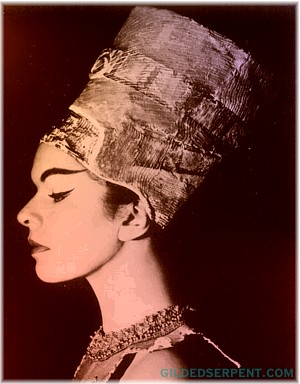
Magana Baptiste as NefertitiMagana as Nefertiti

Dancing for a Queen

by Amina Goodyear
posted December 3, 2010

The United States in the 1950s was still a racially segregated country.
It wasn’t until the mid 1950s that nonviolent protests such as "sit-ins" and boycotts produced situations and conditions that forced the government and businesses to change their segregationist policies.

Happily, I can say that the San Francisco Bay Area took part in helping to change the rules on segregation and social and racial tolerance in all ways. San Francisco was considered a liberal city. San Francisco in the 1950s was a city that tolerated differences with a bit of curiosity. San Francisco is a port town, and although it welcomed newcomers from all over the map, most immigrants chose to live in neighborhoods with their own kind.

We had immigrated to San Francisco at the close of World War II from the Philippines and, deciding that they were of Spanish extraction rather than of Filipino extraction, my parents chose a neighborhood that was predominantly Caucasian. Maybe this was a smart move in that we were in a "correct" school district, but it meant that I did not fit in comfortably with my classmates, because I didn’t look like them.

In the mid 1950s, Yul Brynner starred in a hit movie called "The King and I". It was a movie about Siam, the country we now call Thailand. After being ridiculed one time too many because I looked different, I decided to cash in on the difference.

I became a "Princess" from Siam. None of my classmates knew anything about Siam except that it was exotic; so I was accepted because I was "exotic".

I had taken dance lessons since the age of 4, and my new-found identity opened the doors for me to embrace being different and exotic. Already, I had studied the requisite tap, ballet, acrobatics, ballroom, and jazz. The "King and I" led me to new journeys and adventures in music, and I became quite drawn to the exotic sounds. This became the era of "primitiva" and "exotica" music. However, the best I could find was Zack Thompson teaching Afro Cuban and Afro Haitian with more conga drummers than students in cellars and attics in San Francisco’s Black neighborhoods. Again, I was different, but finally, I “passed for white." Thanks to Zack, though, I wasn’t bothered: "Leave her alone, she’s jail-bait." Studying with Zack was probably the most imprinting experience in my dance life. I didn’t know his dance background at that time; however, he was in Katherine Dunham‘s dance company, but his style provided a very strong base for my later dance career and his drummers introduced me to the heartbeat of the dance (all the styles of dance that I would ultimately embrace).

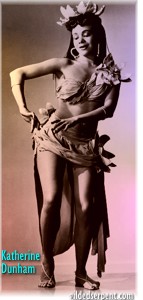
Katherine DunhamIn high school, I became the entertainment for all the school assemblies and rallies.
With my jazz dance and Afro dance background, I enjoyed performing to Ken Nordine‘s "Word Jazz", Les Baxter‘s "Exotica" music and to my favorite record of all-time–Katherine Dunham‘s "Drum Rhythms of Haiti, Cuba, and Brazil: The Singing Gods".

My new-found me, exotic, different, even slightly "beat", led me on a quest to find even more exotic music for enjoyment and also for performance. I found a new LP, featuring one of the most compelling voices I ever heard. It was "Voice of the Xtabay" sung by a supposed Incan Princess, Yma Sumac.

When I think of six degrees of separation, I think of Magana Baptiste.

My aunt worked for her husband Walt Baptiste. A former Mr. America (1949), Walt was a body builder and yoga instructor and owned a health and fitness club in downtown San Francisco. My teacher, Zack, had left for Europe, and I was suffering from dance withdrawal. Thanks to my aunt who assisted in Walt’s office, I heard that Walt’s wife taught African dance. So, this high school girl was off to find a new dance master.

This dance studio was in the heart of San Francisco’s shopping district. I remember looking for the studio and finding it above a smoke shop on Powell Street–the street of the noisy clanging cable cars. I remember two rooms. One room was crammed with gym equipment (weights and machinery), and the other was an empty space; it was a real dance studio, unlike Zack’s dark attics in condemned buildings.

I met Magana. She was one of the most beautiful and exotic looking women I had ever met. She was young, and her dark hair was pulled up in a ponytail; except the ponytail was pulled to one side. She told me that she had studied with the legendary Ruth St. Denis and that she had toured with Yma Sumac! I couldn’t believe my ears. Yay! My “princess dreams” were coming full circle. Maybe I could be dancing with princesses also.

I studied African dance with Magana but soon discovered that her real passion was East Indian Dance. So, continuing my exotic dance training, I became an East Indian dancer. I don’t know if I was any good, but I got to perform in a few shows with her and her other dancers. I particularly remember when we danced for the San Francisco Press Club. The performance wasn’t that memorable to me, but I remember that, after the show, we were treated like royalty. They set us up in a banquet room and each of us got big, fat, tender, juicy, delicious steaks.

What was memorable was that Walt and Magana were vegetarians.  (I had never known a vegetarian before this.) They were trying to decide what to do with all that meat! Well, Walt and Magana looked at each other and said, “Why not?” and they just dug in like the rest of us! Later, I  wondered if they were being polite to the extreme or if they actually enjoyed the meal. I remember I did!

As Walt and Magana became more successful, their clientele grew too big for their tiny studio, and they moved to a larger one. This studio was quite large and was in another part of San Francisco, but still part of the downtown area. (This was not the building that they eventually bought.) The dance studio attracted a number of students, including a woman named Violet Mahsoud. Her Turkish husband, Leo, had been raised in a Turkish harem where he learned to play the oud. Violet later became a dance and yoga instructor thanks to Walt and Magana.

Magana had another young high school girl in her dance class. This one was a writer. She wrote a play about King Tut. I remember Magana, her friends, and all the other more experienced dancers, rehearsing for the play. It was quite exciting to stay after class and watch the rehearsals. Magana was cast as Queen Nefertiti, and I don’t believe I ever saw a more beautiful or believable Queen than Magana. She eventually used a publicity shot from that play to promote her dance school. To me, she was Queen Nefertiti!

I don’t know if you could imagine my joy and excitement when she asked me if I would like to be in the play and perform a short solo dance. Me? Yikes! Could I do it? She said she’d train me. I couldn’t believe that–not only would I get to be in this prestigious play–but I’d also get personal attention from Magana! So, after school, Magana would train me to be a dancing girl.

That is how I got to be an exotic dancing girl in a play about King Tut and Queen Nefertiti. I was the only exotic dancing girl. I didn’t dance with princesses, I got to dance for a queen. Many years later, I realized that what I performed was a Belly dance.

Thanks to Magana, I got my start in a career that has become my life.

use the comment box

Have a comment? Use or comment section at the bottom of this page or Send us a letter!
Check the "Letters to the Editor" for other possible viewpoints!

Ready for more?

  • 3-16-05 About my teacher Magana Baptiste by Horacio Cifuentes
    At the time when her husband placed second in the Mr. America body building contest, and mind you, these were the days when body builders took no steroids and were true examples of healthy humans, Magana placed first runner up in the Miss USA beauty competition held in Los Angeles in 1951.
  • 1-25-04 Chapter 1: One Ad Changed My Life by Amina Goodyear
    I was very desperate and determined to get back to my old self.
  • 3-24-04 Chapter 2: "I’d Rather Stay Home with my Kids" by Amina Goodyear
    I asked her how to take it off, and she told me to figure it out when I was on stage. Then I heard – "Our "guest" dancer, Amina, all the way from upstairs!"
  • 4-17-07 Chapter 3: A Marriage Made in North Beach by Amina Goodyear
    The stage was alight with the flames of the candelabrum’s candles and the eerie glow of her costume. Fatma’s costumes were always comprised of material that glowed in the dark as her show began with no light—except for “black light”.
  • 6-6-07 Chapter 4: Smokin’ by Amina Goodyear
    Now that I was legitimately part of the Bagdad family and on the payroll, Yousef told me that all the dancers had to split their tips 50/50 with the band. This meant that I was making less money than when I wasn’t getting paid at all.
  • 6-30-07 Chapter 5: Listen to the Music by Amina Goodyear
    Yousef wanted us to look exotic, like we were from the Middle East, so he made us stay downstairs, look available and wear sexy, skimpy pantaloon outfits or diaphanous caftans when we were not dancing.
  • 8-15-07 Chapter 6: Bert, by Amina Goodyear
    On my first Monday at the Casa Madrid, Bert came to support the place and me. Well, what he saw was equivalent to a San Francisco earthquake.
  • 2-8-08 Chapter 7: Yousef – Black Lights and Veils by Amina Goodyear
    It was kind of hard to compete with this kind of action when we kept our clothes on.
  • 12-2-10 Long Distance Bellydance Relationship by Dahab
    I am very grateful technology allowed us to have this very special kind of troupe, one whose members live thousand of miles away.
  • 12-1-10 Practice Makes Perfect, or Does it? by Adriane
    It is because mediocre or non-existent practice makes for a mediocre performer and perfectly consistent practice makes for a perfect performer.
  • 11-30-10 More is More, Mohamed El Hosseny by Thalia
    Some might find El Hosseny’s creations busy. The popular approach is to slow down to interpret the music whereas El Hosseny’s approach is just the opposite.
  • 11-27-10 A Dancer’s Dancer in 1980s Hollywood, Interview with Yasmin by Kamala
    L.A. was heaven for fabrics though. You could find anything you wanted, and if they didn’t have it, you could have it made, like the beautiful gold lame’ sunburst skirt and veil I had pressed for a costume.
  • 11-26-10 Struggle for Legitimacy, History of Belly Dance in Quebec, an Overview by Marthyna
    They were not always accepted by the general public because of the revealing costumes but also because sometimes dancers performed between two strippers. This created a taboo around bellydancing. No one wanted to be caught learning it or performing on stage.
 

Gilded Serpent presents...

My Long Distance Bellydance Relationship

Aradia and Dahab's Troupe
Aradia, Dahab, Amarilis, Zhanna, Britt, Kricket, Marisa, Cidgem, Estela

by Dahab
posted December 2, 2010

I am an expert when it comes to long distance relationships. I have had four of them in my life, the last one being with my husband! My father lived in a different country for ten years and my mother for five. I grew up in Colombia and have lived in at least 3 other cities in America, so most of my friendships are also long distance.

Let’s just say that my family and friends are spread around the world.

I have always put a lot of time and effort on making them work: letters, e-mails, Skype, phone calls, texts….anything!. So when I moved from Las Vegas to Canada, my mentor Aradia and I were confident about continuing with our Belly dance relationship, long distance.

Let me tell you a little more about us. On 2007, the year I moved to Las Vegas, Aradia created the professional dance troupe “Aradia and the Ra Dancers”. My friend Britt and I were part of the original cast of the company, and we have remained by Aradia’s side since the beginning of this adventure. In 2010, both Britt and I decided it was time to leave Vegas and look for our happiness elsewhere. I suspect we both have a little bit of nomad blood in us. Britt moved to L.A., and I married a fabulous Canadian man who took me to Thunder Bay which is close to Duluth in the Canadian side of the border. Being the most committed troupe members, we were determined to continue with the company somehow. So, with the complicity and hard work of amazing Aradia, we came up with a plan.

Aradia spent countless hours recording and posting choreography on YouTube. She first recorded the instructional portions and then posted performance clips.

All of that while choreographing and performing regularly in a myriad of events. On our end, Britt and I learned and rehearsed the content of the videos individually while the rest of the troupe was getting a lot of practice in Vegas. We knew formations would be a challenge once we joined the other members, and we would only have a couple days to deal with that. The least we could do was learn the routine and be able to perform it as a solo in our sleep. That way, learning the formations would be our only concern before the big day: the Friday night show at the Las Vegas Bellydance Intensive.

I had never rehearsed so hard and the final result was great, and it had to be, since we could not disappoint Aradia! We had to honor her efforts. We performed confidently, looked like a professional dance troupe, without major mistakes and with great knowledge of the choreography and technique. We performed a great show. Our next performance (for the Port Jervis Humane Society) the week after was also amazing, specially because this time, it was only the three of us. It was a great feeling to know we had managed to keep our group together thanks to our effort, our commitment, our love for the dance and the troupe and, of course, YouTube.

I am very grateful technology allowed us to have this very special kind of troupe, one whose members live thousand of miles away.

In a world where people migrate more and more for work or personal reasons, this could be a new way to keep our Belly dance relationships alive. One or two trips for performances might be necessary but not for rehearsals. Of course it is not ideal: I do not get to laugh with my Bellydance friends or share those valuable hours working together, but this in the next best thing. I value Aradia’s knowledge and personality, and I have always been honored to be around her. This way, I feel like I still am.

use the comment box

Have a comment? Use or comment section at the bottom of this page or Send us a letter!
Check the "Letters to the Editor" for other possible viewpoints!

Ready for more?


Gilded Serpent presents...

Practice Makes Perfect- Or Does It?

Author

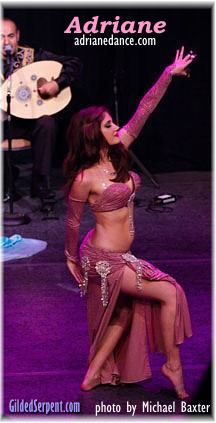
by Adriane
posted December 1, 2010

“Why does my teacher have us practice figure eights year after year if I already learned how to do them on my first day of belly dance class?” “Can’t I move on from those slow boring drills and just dance?” “Why do I need to practice technique at home when I’ve dancing for over __ years?” It is because mediocre or non-existent practice makes for a mediocre performer and perfectly consistent practice makes for a perfect performer.

That Girl’s Got Skills!

“Skill equals knowledge plus 10,000 times,” said Dr. Suzuki, founder of the internationally renowned Suzuki method for learning how to play musical instruments. This concept is crucial for musicians and dancers alike. It means that once a belly dancer has learned how to do a move, they need to practice it 10,000 more times in order to be skilled at it. Belly dance drills that repeat one move through a series of variations are necessary for belly dancers to do, no matter what level they are that. It is akin to a musician practicing their scales every time they rehearse, even if they have played them 10,000 times before.

"Practicing basic technique is for beginner dancers- I don’t need to practice that anymore! I want to learn choreography!" some experienced dancers may say. Well, you’ve got to do it all as you get more advanced: drill old technique, practice new technique, practice improv and practice choreography. This requires a much more substantial regular time commitment to practice than many dancers realize.

AuthorHigh level mastery of any skill requires 10,000 hours of practice. Malcolm Gladwell proves this fact in example after example in his mind-opening book Outliers. Whether you are Bill Gates or Aziza, the talents of extraordinary people can be directly correlated to the number of hours that they practiced their skill (in addition to being in the right place at the right time after they clocked in their hours of practice).

Slow Down, You Move Too Fast

To practice perfectly, you need to start practicing your technique slowly every time. The slower you go, the more you can engage your muscles and train them accordingly. Once you start slow and are able to maintain correct posture, you can build up in speed and add variations such as shimmies.

Keeping your isolations and technique alive in your muscle memory will create the foundation for your perfect practice.

Hours upon hours of perfect practice will yield a perfect performance down the road that appears effortless. On the other hand, dancers who take shortcuts in their practice because of a “been there, done that” attitude will often perform in a way that leaves their audiences thinking the same thing.

From Techy to Arty

Through methodical repetition and practice, you may find nuances in the dance that you have never realized before. Perhaps after practicing variations of the omi – clockwise, counter clockwise, on releve, with a walk, facing diagonals, with a twist, with a dip, with a turn – you discover that changing the direction of your omi every four counts while doing a slow turn on releve would work perfectly for that drum solo you were working on. It is at that moment that you transcend being a belly dance “technician” to becoming a belly dance “artist.”

Spending quality time with your own body in repetitive movement is one of the best ways to ignite your creativity and originality in your dance.

In Conclusion…Practice!

The understanding that focused practice of belly dance technique (as well as improv and choreography) will make you a better dancer seems obvious. But the implications of this concept are empowering. It means that through your own hard work and dedication, you can improve your own dancing. If you simply put in the hours of focused practice, year after year, you will grow tremendously as a dancer. It’s not a matter of “Oh, that dancer is so naturally gifted and I’m not,” or “I don’t have what it takes to be a good dancer.” You have what it takes if you practice with precision over and over again.

Thus, practice does not make perfect- perfect practice makes perfect.

After years of perfect practice, you will exude a sense of self-confidence and ease in your performance that only comes to the polished performer.

use the comment box

Have a comment? Use or comment section at the bottom of this page or Send us a letter!
Check the "Letters to the Editor" for other possible viewpoints!

Ready for more?


Gilded Serpent presents...

More is More

Placeholder

Mohamed El Hosseny

by Thalia
posted November 30, 2010

For Mohamed El Hosseny, more is…more.  Any dancer who has worked with this instructor knows his signature choreographies and "El Hosseny Technique" feature intricate footwork and isolations.   His intensity directs the classroom.  Engaged with all of his students from start to finish, he frequently comments that a teacher should never sit down.  Not only does this teacher not sit down, during the entire weekend he remained "on" from the moment he stepped into the classroom.  He believes deeply in his craft and abilities and invests his attention in his students, seeing they grasp what he has to offer.

This was my first time studying with El Hosseny, an energetic and lively teacher from the Suez in Egypt, making a sweeping tour across the United States, Canada, and into South America with sponsor Nourhan Sharif.  I attended three of his workshops during his five day workshop in New York during July, 2010.

The first workshop I attended presented an advanced level choreography "Fakarouni: Ulm Kalsoum." As with many choreographers, his tastes turn toward movements that complement his own body type, in this case lithe and angular.  He encourages a slightly turned-out position of the thighs akin to ballet, unusual for the belly dance field but central to his exacting hip work.  His choreographies incorporate a multitude of tiny isolations, layered accents and locks at all angles in the hip and abdomen. 

During his 2009 tour, El Hosseny earned a reputation for moving through his choreographies at top speed.

 While this assessment is generally true, he does pause to break down and drill individual movements.  For example, during "Fakarouni," he introduced us to a thirty-two level hip drop.  He returned to the thirty-two level hip drop in each class I attended over the weekend.  Here is the movement in detail: Starting at the top of a hip lift, the dancer hits 32 specific accented points before reaching the lowest level of the hip drop.

"See?  Easy!"  El Hosseny claimed as he demonstrated the move for us.  Breaking up a single drop into 32 levels certainly isn’t easy, but his enthusiasm made us all try it again.

At the end of class, after insisting that part of his teaching philosophy is that he must sweat more than his students, El Hosseny presented the last part of the choreography to .”Fakarouni.”  There are certainly artistic tastes. 

Some might find El Hosseny’s creations busy.  The popular approach is to slow down to interpret  the music whereas El Hosseny’s approach is just the opposite.

His constant insistence that each dancer work to be "the best!" seemed to evolve from her being able to articulate a movement for every note–every string pulled  in the kanoun, every strike of the tabla, or in the case of the evening’s forthcoming Saidi dance workshop, every note sounded from the mizmar.

A good dancer hits most of the accents he informed us.   A great dancer hits them all. 

"Imagine Saidi" 

Mohamed El Hosseny’s style puts an unusual slant on the weighty movements I usually associate with Saidi dance.  Not surprisingly, his Saidi choregraphy moved faster than is typical, and we plunged into the routine at full speed.  As we worked, El Hosseny spoke his observations on Egyptian folkloric dance.  In his opinion, dance styles should reflect the weather in the various parts of Egypt.  Movement patterns should indicate an urban setting or a desert setting or a Nile setting.  Movements from Alexandria should incorporate the feel of the busy waterway. 

He kept reiterating that in traditional Saidi culture, women do not typically dance.  The Saidi stage adaption has become so common in the field of Middle Eastern dance, many mistakenly believe the women native to this area are dancers.

El Hosseny teaches through expressive absolutes.  He frequently makes a correction and implores the dancer to remember the correction– "Forever!"   These exclamations were saved for those habits common to many starting out.

Bent elbows?  Straighten them …forever!

Arched tailbone?  Release it…forever!

Tight shoulders?  Relax them…forever!

Forgotten wrists and fingers?   Open them….forever!

Outside of our eighth floor studio not far from Times Square, a tornado warning was in effect.  Lightening flashed.  "American Idol" auditions were going on in adjacent rooms (or so I was told).  The heat never broke in the humid studio.   At the end, we stood back in exhaustion as Mohamed El Hosseny blazed through the choreography we didn’t complete, just as he’d done in the earlier session. He loves his dance and watching him certainly inspires.  

The concentration in his work, his drive, and his constant commands to be "the best!"–and perhaps a bare-chested press photo I’ve seen–made me think of him as the Michael Flatley of Egyptian dance.

The discussion of folklore styles continued later in a coffee shop where several of us recuperated before going on our separate ways that Friday night.   I asked El Hosseny to define the Shaabi style dance, a label frequently used in the United States of late.  He explained that Shaabi dance is the everyday dance style of the urban centers.  Shaabi means the folklore of Cairo and Alexandra.  There is music considered specifically Shaabi.  He smiled and said the microbus drivers listen to this music very loudly.  Shaabi lyrics are earthy, but he loves it.  Shaabi dance is the folkloric dance of the big towns.

"I love baladi," he said as we wrapped up our talk.  "I love shaabi.  I love them both."

"Follow Mohamed El Hosseny: Learn How to Be a Better Choreographer"

Sunday’s choreography workshop focused on a choreographed baladi taksim, an unusual choice as that part of a solo dance typically draws on skilled improvisation from both musician and dancer.  The musical track we worked with reflected his favor for modern techno styling.  However, his goal in choosing the piece was to train us again in listening and to try to listen as he would.

We watched a selection from his 2009 show with his company in Finland, a montage of different styles of belly dance: shaabi, baladi, and Oriental.  He told us he became a choreographer while still working in Cairo when he was hired to make a program featuring dances from the Suez.  (His dramatic career trajectory is told in detail in Zsusi‘s article in The Gilded Serpent.)

In his view, a good choreographer makes dances for the classroom or videos or the learning environment.  A great choreographer makes works for the stage.

Returning to the dance floor, we again moved at his signature, El Hosseny pace, filling every moment with precise movement.  Again we did the thirty-two level hip drop and this time also did pelvic isolations in the same divided manner. We broke the horizontal figure eight into thirty-two breaks.  Then we applied the technique to the vertical figure eight.

A dancer has to be better than the drummer’s fingers, he said.

Because he was teaching choreography skills, his comments that day were directed toward teachers in the room.  During the previous evening’s discussion, he had also talked about his own teaching and the process of breaking down a piece of music. Feeling is first, he said.  A song must be imagined. Secondly, a dancer must analyze her own emotions.  The third step is to translate the imagination and emotion into movement.  Then, a dancer must learn through a teacher first about the rhythm and what the song is addressing (in class, he used clapping and verbal syllables) and what the song is addressing.  Sometimes translation of the words is necessary.  Regarding style, El Hosseny said he studied the expressions from old movies for his baladi pieces. 

Successful fusion must involve both Western and Eastern movements in his opinion.  Applying Western movements alone to Middle Eastern music doesn’t qualify.

Mohamed El Hosseny believes in his students.  He frequently called on students to take responsibility for honing their craft, as he does.  Near the end of Sunday’s session he said, "Maybe in this room, there is a great choreographer and she doesn’t know it yet." 

Youthful and energetic, he believes in possibility.

use the comment box

Have a comment? Use or comment section at the bottom of this page or Send us a letter!
Check the "Letters to the Editor" for other possible viewpoints!

Ready for more?

  • The Muwashahat with Mohamed Shahin and Karim Nagi
    The Muwashahat genre is inspired by tenth century court poetry of Arab-Andalusia, developed when Arab intellectual and artistic culture flourished in Spain. The rhythms are complex.
  • Review: "Allure of the East: Orientalism in New York, 1850-1930" at the New York Historical Society
    This small one-room exhibit with its narrow geographic focus–the city O. Henry dubbed “Baghdad-on-the-Subway”–presents much for dancers to consider. As belly dance continues to gain popularity, what is this continuing "allure" of the Orientalist inspired arts? When is attraction to this aesthetic drawn from a desire to understand other cultures and when is it driven by desire to market ourselves?
  • 2-13-09 Tarot:A Fantasy Belly Dance Concert by Thalia
    The large, well rehearsed cast–musicians, temple maidens, acolytes, and servants with a variety of props–deftly played up the campy quality of the piece, contrasting
    the work’s darker messages about the fickle cycles of gain, loss, and impermanence
  • Mohamed El Hosseny: His Dancing Journey from Suez to Cairo, Helsinki, and Beyond
    My advice which I tell all of my students is to study ballet at a beginner level for a few months. It will help your lines very much, so you have a nice bodyline without worrying about it and you can focus on learning the choreography and Oriental movements of the teacher in front of you.
  • 10-4-10 From the Street to the Virtual Cafe, The History of Shaabi by Amina Goodyear
    There were several movements throughout the world that seemed to simultaneously create music in the genre called "cassette culture". Most notably this type of music was evident in England and the U.S. with punk music, in Jamaica with Reggae, in Algeria with Rai and in Egypt with Shaabi music.
  • 11-27-10 A Dancer’s Dancer in 19802 Hollywood, Interview with Yasmin by Kamala
    L.A. was heaven for fabrics though. You could find anything you wanted, and if they didn’t have it, you could have it made, like the beautiful gold lame’ sunburst skirt and veil I had pressed for a costume.
  • 11-26-10 Struggle for Legitimacy, History of Belly Dance in Quebec, an Overview by Marthyna
    They were not always accepted by the general public because of the revealing costumes but also because sometimes dancers performed between two strippers. This created a taboo around bellydancing. No one wanted to be caught learning it or performing on stage.
  • 11-22-10 Part 5: The Dinner Shows, More Photos from the New York Theatrical Belly Dance Conference 2010, Photos by Photos by Sal Romano, Stacey and Clement Lespinasse, Eric Troudt
    We held the dinner shows at two of the most supportive environments in New York for bellydance: Je’bon Noodle House on St. Marks Place in the East Village and the Lafayette Grill in Tribeca. We made it our goal to give every conference participant the chance to perform, either to recorded or live music from one of our great local bands.
  • 11-21-10 Part 4: More Photos from the New York Theatrical Belly Dance Conference 2010, Workshops, Garmet District Shopping Tour Photos by Lena Helt, Smita Kadam, and Eric Troudt
    Offstage, we browsed the fabric-and-accessory mecca that is Manhattan’s garment district; embodied animals, clowns, and archetypes; learned to enhance our stage presence; shared experiences in panel discussions; and much more.
  • 11-17-10 Personal Impressions, Fantasy Belly Dance in New York City by Ayshe
    Looking back on it all, I can now only assume that, from the very beginning, I was already damaged goods. A “purest” I would never be!
  • 11-17-10 We Will Rak You! My Dance Experience with Queen by Stasha Vlasuk
    I’ll admit I wasn’t too familiar with the music of the British rock group Queen. The year was 1977, the month of December, in Los Angeles. I was invited to perform at a dinner party where Queen, in Los Angeles for several concerts, was the guest of honor. The job came to me through Dianne Webber.