Gilded Serpent presents...

Listen and Learn Musical Expertise!

Momo's Zil DVD

Dr. George Sawa:Egyptian Music Appreciation & Practice for Bellydancers

CD Review by Zumarrad
posted September 9, 2010

Many Belly dancers are lucky to live in areas with vibrant Arabic music scenes, where they can experience first-hand the instruments and musical forms that shape our dancing. However, many more of us are not. George Sawa’s CD set is an ideal resource for anyone in this situation, and should become a favourite of dance teachers and serious students.

This is not going to become your favourite listening or dancing CD set, but that is not the point. The selections are there to put theory into practice; they’re simple, short, and straightforward and their purpose seems to be to train your ear, not to induce tarab!

The idea is to listen, learn, and use the clips to get the rhythms, in particular, into your body through free dance practice. If used to the fullest, this resource will give you a wonderful grounding in Egyptian music.

It contains examples of 21 rhythms and eight maqams: short clips demonstrating the sounds of the non-Western percussive and melodic instruments that we can expect to hear on our Egyptian musical journeys, and musical excerpts, incorporating all of these things. The CDs are packaged in a sturdy, attractive and usable booklet – this is a resource you can carry easily to class with you.

The booklet really makes the resource valuable because it’s extensively and meticulously cross-referenced. The rhythms are written out in Western-style notation, which is very useful if you have that kind of musical training, syllabic notation (dum rest takk takk) and in traditional Arabic circle form. This last type of notation is really helpful. The idea is to listen to the rhythm track and tap the rhythm around the circle. It’s a very different way to learn and a lot of fun. The maqams are written as letter scales and in Western-style notation, which makes it very easy to determine which ones might work on Western instruments and which are impossible without retuning. (Ajam is C major. Who knew?) This approach is very good for someone like me who learns best with a combination of audio and visual information.

A chapter on musical instruments, which includes colour photographic illustrations, is also invaluable to the more isolated dancer. Many of these instruments are ones we will never see played in real life locally. I feel a bit like an eight year old using it, but it’s really helpful looking at the picture of the instrument as it plays!

Because almost all of CD1 is comfortably set out with straight rhythm clips followed by examples of the rhythm being used in a song – excellent for drilling, though it would be even better if they were all roughly the same length; the lack of similar examples following each maqam on CD2 feels a little disconcerting. However, each maqam is represented in song on the set; you just have to find it, usually on the other CD.

I like spoon-feeding, and in an ideal world, I’d love to hear the maqam also played as a scale, followed by the song clip. I figure the ear connection would be made more quickly that way, but I can also see that this would not be practical. In fact, it is best not to think of this as a two-CD set but rather a singular musical study course that (unfortunately) doesn’t fit on one CD. It seems pretty clear that the only reason this resource comes on two CDs is because you can’t get a single CD readily that will fit 110 minutes of music.

I would also have liked it if the maqam descriptions were a little deeper because there’s no information about how they traditionally connect to particular emotions, or why they are named the way they are.

Dr. Sawa was classically trained in Egypt, but I’m also sure there are musicians who will follow other naming conventions, and some Belly dancers may not like his assertion that dancers should stick with two simple zill patterns and leave the rhythmic flash to the drummer. I like the way Dr. Sawa recommends other CDs, DVDs, and websites where you can learn more, and these sources are not all his own output, either.

Rating: 3 1/2 zils
Zil Rating- 3

Product purchase info:
www.georgedimitrisawa.com/buy_music.html

use the comment box

Have a comment? Use or comment section at the bottom of this page or Send us a letter!
Check the "Letters to the Editor" for other possible viewpoints!

Ready for more?


Gilded Serpent presents...

Bellydance Class or Cult?

by Leela Corman
posted September 7, 2010

Please do not reproduce or copy this lovely artwork. Rather, link to this page if you want others to see it.
Click panels, they are linked to enlargements.

Thank you!

Cult Characteristics of our Community

Pity those who study not on our path, for they know not what they do not know. I'm teaching the real thing. Get out Apostate! If I ever hear that you want to her studio again don't bother coming back! You don't need them! Men are useless! Cult or Class? You decide!


use the comment box

Have a comment? Use or comment section at the bottom of this page or Send us a letter!
Check the "Letters to the Editor" for other possible viewpoints!

Ready for more?


Gilded Serpent presents...

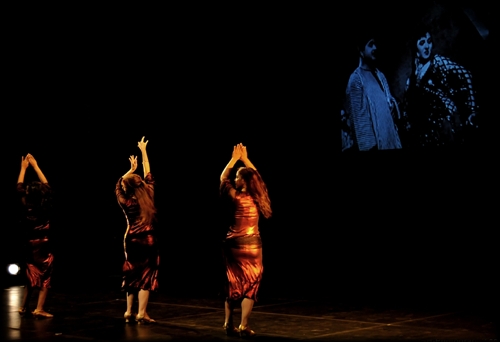
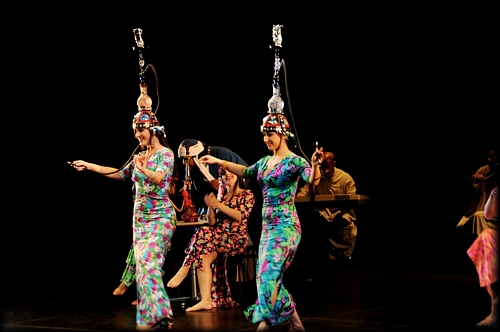
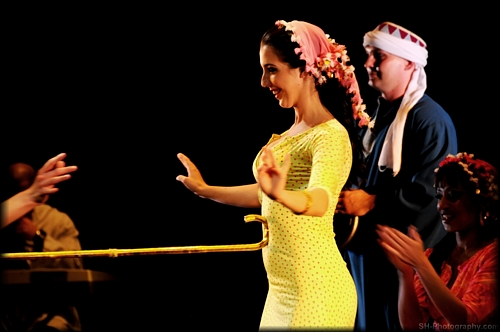
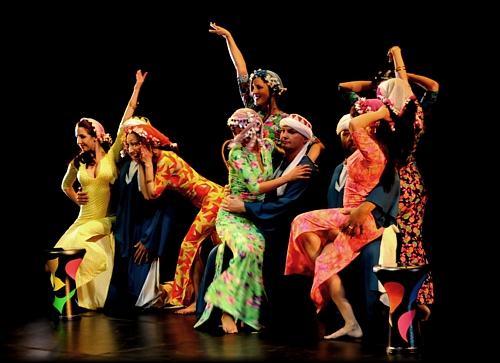
Saturday Gala Performance at the IBCC 2010

Photos and Video Collage

Photos by Samira, Video by GS Staff.
posted September 6, 2010

The Saturday Night Gala Performance of the International Bellydance Conference of Canada was held April 24, 2010 at the Ryerson Theatre in Toronto, Ontario, Canada.

Video report consists of a collage of random clips caught of performances. IBCC is produced by Yasmina Ramzy and company.
Readers sending the names of individual troupe members to the editor is always appreciated.

Amel Tafsout

of Algeria and Oregon

Amel

Amel

Amel

Cassandra

of Mineapolis, Minnesota

Cassandra

Cassandra

Delilah

of Seattle, Washington

Delilah

Delilah

Delilah

&

Habeeba Hobeika

of Ontario, Canada

Habeeba Hobeika

Habeeba Hobeika

Habeeba Hobeika

Hadia

of Nova Scotia, Canada

Hadia

Hadia

Hadia

Jillina

of Los Angeles, California

Jillina

Jillina

Jillina

Ranya Renee & Co

of New York City

Ranya Renee & Co

Ranya Renee

Righteous Rogues

of Ontario, Canada

Righteous Rogues

Righteous Rogues

Righteous Rogues

Sema Yildez

of Istanbul, Turkey

Sema

Sema

Sema

Sera Solstice

of New York City

Sera Solstice

Sera Solstice

Zikrayat

of New York

Zikrayat

ZikrayatZikrayat

Zikrayat

Zikrayat

Arabesque Dance Company

of Ontario, directed by Yasmina Ramzy

Yasmina

Zar Ritual

Zar

Zar

Cafe

Cafe

ADC Cafe

Cafe scene

Smoke

Drums

cane

ADC Cafe

More IBCC photos and videos coming soon!

use the comment box

Have a comment? Use or comment section at the bottom of this page orSend us a letter!
Check the "Letters to the Editor" for other possible viewpoints!

Ready for more?

  • Friday Night Performances at IBCC 2010
    International Bellydance Conference of Canada April 23, 2010 at the Hungarian Canadian Cultural Centre in Toronto,Ontario, Canada. Performers include:
    Raks Sahara, Ashira, Maryfar, Laura Bellydance, Daluah, Tribe Maya Fire, Sa’Diyya, Monique Ryan, Sabaya, A La Nar, Sarah Skinner, Akimi, Earth Shakers, Roshana Nofret, Sofia & Chanty, Ebony Qualls, Danza Della Luna.
  • 6-16-10 IBCC 2010: Thursday Main Stage Performance Photos and Video, Photos by Samira, Video by GS staff
    The Thursday Night Main Stage Performance of the International Bellydance Conference of Canada was held April 22, 2010 at the Hungarian Canadian Cultural Centre in Toronto, Ontario, Canada.
    Video report consists of a collage of clips caught of performances. IBCC is produced by Yasmina Ramzy and company.
  • IBCC 2010- Video Reports
    The Opening Night Gala Performance was held April 21, 2010 at the Hungarian Canadian Cultural Centre. Video report reposted here as an introduction to the photos.
  • IBCC 2010, Wednesday April 21, Opening Gala Report From The International Bellydance Conference of Canada
    Because Gilded Serpent didn’t quite make it to the hall until the show was over, we are very grateful that Brigid Kelly consented to give us her report from the Wednesday evening performancec. The dance photos overlayed on this video are by Samira Hafezi.
  • IBCC 2010, Thursday Activities Report From The International Bellydance Conference of Canada
    We begin our video reports with the Thursday Activities: dance workshops by Amel Tafsout, Sema Yildiz, Delilah, and Aurora Ongaro lectures on The Anatomy of Bellydance, Dr Sawa on Rhythmic Notation for Bellydancers, Shira on Mass Media, Mass Stereotypes and a Panel on Feminism & BD led by Andrea Deagon,
  • Ask Yasmina #12: The Importance of Oum Kalthoum, Undercutting, and Kid Bellydancers
    When a client hiring a performer or a student looking for a teacher is at a point where they want quality, they know they have to pay a fair price.
  • Sticky Situations: Ask Yasmina #11- Inappropriate Audience Members, Competitive Teachers, Fickle Students
    Trying to please and appease those who already disrespect you leads to a miserable dead end. My advice is to say "NO" and give the inappropriately behaved person a good wack across the face.
  • Ask Yasmina #10: Bellydance Business, Finding Musicians, Certification
    This experience has made me very wary ever since of people with certificates.
  • 7-18-10 Belly Dance in Patriarchy, Escaping the Switzerland of the Soul by Andrea Deagon PhD
    However, I do believe that belly dance is able to attain such vitality and complexity in the modern world precisely because it’s embroiled in serious cultural and personal contestations. It is precisely clashes of aesthetic values, conflicting paradigms of sexuality and gender, and economic as well as political inequities that strike the dance’s most beautiful notes.
  • 7-15-10 Sema Yildiz, A Star of Turkish Dance by Zumarrad/ Brigid Kelly
    She was fortunate, she says, to grow up in a Roma (Gypsy) community rich in dance and music – the Fatih district, which houses the Sulukule, famous for its entertainment and considered the oldest Roma settlement in the world.
  • 9-1-10 Expanding Traditional and Innovative Approaches, Report from the Theatrical Belly Dance Conference, Part 1: The Panel Discussions, by Thalia
    As with any new label applied to the genre, a question of definition consistently arises from fans and skeptics of the burgeoning theatrical belly dance category. Wisely, the organizers have incorporated panel discussions in the Conference’s roster of events since its formation.
  • 8-30-10 SF Mecca Immersion 2009 Video report part 2: Glimpsesof Dances on the Community Kaleidoscope
    On August 1, 2009 The SF Mecca Immersion held their Saturday Night Review at Broadway Studios in North Beach, San Francisco, CA. Performers include: Carolena Nericcio and FCBD, Jill Parker, Deb Rubin, Zoe Jakes, Kami Liddle, Fredrique, Cera Buyer, Kristina, Sister Kate.
  • 8-27-10 Identity Through Bellydance:An Arab Descendant’s Viewpoint by Lynette Harper PhD
    While some Arab women turn instead to ballet and western contemporary dance, others, like me, have embraced belly dance genres as a way to connect with our cultural heritage–only to disappear behind another veil, because Arab women dance artists in Canada are obscured within a huge belly dance community.
  • 8-26-10 Musical Instrument Tour Video with Tina Chancey
    Director of Hesperus.org, Tina takes a moment from the camp’s busy schedule to tell us the difference characteristics of this style violin from one we normally see. She touches on the different posture used to play and also why she, a professional player of “Early music” is interested in how Arab music and style relates to what she normally plays.
    Footage captured in August 2008, at the Mendocino Woodlands, Middle Eastern Music and Dance Camp.
  • 8-25-10 Letting Go of the Towline, Surviving Dance Conflict! by Najia Marlyz
    Still, even though our dance puts us into contact with beloved friends and creative people who bring us continual joy and renewal, Belly dance is also a powerful magnet for some people with serious mental and emotional problems beyond the scope of dance
  • 8-24-10 The Festival That Never Sleeps, The Costumers at the 2010 Ahlan Wa Sahlan Festival by Roza
    There was one thing they all had in common: the most creative, cutting edge, couture related costumes! Egyptians have been making costumes for (possibly) thousands of years, and since Belly dance goes back 5,000 years; why not? They know how it should fit the body, move with the lines and motion, and creative geographic designs are, of course, a Middle Eastern staple. Here in Egypt, all costumes are handmade, one of a kind. The majority of these businesses are family owned, and it’s nice to know costume purchases are helping people in Egypt maintain both this craft and artistic skill and their families.
 

Gilded Serpent presents...

Expanding Traditional and Innovative Approaches

Report from NY Theatrical Belly Dance Conference
Part 1: The Panel Discussions

by Thalia
posted September ?, 2010

For the past three years, dancers Anasma and Ranya Renee have been developing the New York Theatrical Bellydance Conference. This July, the Conference evolved into a five-day event featuring instructors and speakers from across the United States, Canada, Spain, and Sweden, a full schedule of workshops, panel discussions, three curated programs at the Dance New Amsterdam (DNA) Theater, and less formal shows in local nightclubs featuring live music. The programs at DNA featured solo and company performances aimed to demonstrate a variety of theatrical treatments of belly dance. Performers included Dalia Carella and the Dalia Carella Dance Collective, Alchemy Dance Collective, Kaeshi Chai with Bellyqueen and PURE, Samara and her Mosaic Dance Theater Company, Dunya and the Core Alembic, the Not the Jamal Twins: Ranya and Roula, Fahtiem, and Angelika Nemeth.

What is Theatrical Belly Dance?
As with any new label applied to the genre, a question of definition consistently arises from fans and skeptics of the burgeoning theatrical belly dance category. Wisely, the organizers have incorporated panel discussions in the Conference’s roster of events since its formation. Questions engaged have included:

  • Does belly dance presented as “theater” require story line or scene?
  • Is it defined by the physical performance space as the name “theatrical” denotes?
  • Does the label imply more pronounced acting technique or charisma?
  • Is choreography required?
  • Aren’t all belly dance performances theatrical?
  • And finally, does theatrical belly dance have to be fusion and contemporary, or are traditional folkloric styles also ‘theatrical’?

According to their stated mission, Ranya Renee and Anasma do not aim to present a single definition for theatrical belly dance but to offer more formal theatrical techniques on a wider scale to those working in the field of belly dance and to open conversation about the evolving classification.

Coining a new label often results in reconsidering the terms of "traditional" belly dance.

Friday’s panel discussion, "Theatrical Bellydance: Tradition versus Fusion," featuring dancers Aepril Schaile, Elisheva, Hanan, Dalia Carella and Morocco opened this debate. Responding to a question about the use of narration or story line, Elisheva linked her story-oriented approach in response to a human need to find meaning in experience. She added that her use of story became more overt when she consciously committed to dance as her professional medium. Morocco responded by offering a wider, historical context, observing that traditional Middle Eastern dances emerged largely from group dances in communal settings. The rituals or events being recognized provided the meaning, reason, or story behind the dance. The community provided a specific audience, that understood the context and also provided the physical setting or "performance space."

In a sense, communal context provided some the “theatrical” elements that must be applied by the dancer in contemporary dances.

Le MeriAfter the eventual rise in popularity of solo dancing in Middle Eastern settings, Morocco continued, “meaning” was evoked primarily through a dancer’s interpretation and interaction with a song’s lyrics, meaning that was shared between the performer and audience. This context and connection is often absent if the dancer doesn’t speak the language. Another panelist responded that, as a dancer in that very position, creating and implanting her own story or external meaning offers the potential to add a layer of personal authenticity to her work.

To segue into a deeper discussion of fusion, panelists paid tribute to figures who moved traditional dances from communal to more formal stage settings and provided access to folkloric material previously unavailable. Dalia Carella referenced contributions of American dancer La Meri, who traveled to India extensively in the early 20th century and brought the classical Indian dance form to stages in the United States. Another panelist spoke of Mahmoud Reda’s treatment and re-envisioning of Egyptian folkloric dances in Egypt during the second half of the 20th century. Validating or elevating the status of belly dance by transferring it onto a formal stage is a goal that often appears in discussions of contemporary styles. This aim is also to reach a wider audience. One must ask……

Regarding fusion, all presenters agreed a strong background in both dance styles being fused was necessary to present a grounded and valid fusion. Morocco referred to what might be her coinage, "fusion versus confusion."

Audience members challenged the panelists by asking how a less experienced dancer can be sure he or she has mastered that second form enough to put it onto the stage. Interestingly, this question revisited the idea of community. Elisheva stated that learning a new dance form does not always have to result in performance of that form. Studying a different form helps a dancer see what void needs to be filled in belly dance; seeing what is in the void can initiate creativity or a fusion of ideas. Panelists agreed that meeting other dancers in different dance communities is one of the most valuable aspects of studying and mastering other forms. Dance has always drawn people together, in many cases women, to create.

Dalia talks to panel
Panelists (left to right) Dalia Carella, Hanan, Aepril Schaile, Morocco and Elisheva

and moderator Raqsie (Andrea Muraskin) discuss the topic "Theatrical Bellydance: Tradition vs. Fusion."

caption for top photo:Morocco relates her experience pioneering bellydance
and rock n’ roll "fusion" in NYC in the 1970s while
contemporary bellydance fusion artist Elisheva looks on. Moderator Raqsie at right. Photo by Eric Troudt.

The Body as Theatrical Medium

Friday’s panel, "In Your Own Skin: Presentations of the Body" featured Blanca, Kaeshi Chai, Roula Said, Sarah Johanssen Locke, Zoe Anwar, and Zahava and was moderated by Raqsi (Andrea Muraskin). After a series of technically oriented questions regarding the importance of posture, body placement, internal awareness, and gender issues (does traditional cabaret dancing get too "feminine"?).

The conversation took a more inquiring turn when the panelists were asked about the complication of dancing for audiences that have cultural or erotic assumptions about a dancer’s physical appearance.

Kaeshi Chai addressed the thorny issue of performing for audiences who prefer their dancers have a “Middle Eastern” look. Chai stated that when she receives such requests, she sends someone who fits the description though surprising an audience that doubts her ability due to her ethnic identity does have some gratification. Roula Said, who is Palestinian-Canadian, suggested the reverse situation also has drawbacks; some audiences have higher or different standards for dancers who not only have the desired look but are of Middle Eastern descent.

All dance forms experience some form of audience bias, ranging from cultural, aesthetic, and age-related expectations. What was at issue here, however, was whether or not “theatrical belly dance” techniques can address these difficulties. A move from the traditional nightclub setting and audience to a more formal stage could relieve some of these expectations. In addition, panelists agreed, a dancer’s intention and personal vision should ideally outweigh expectations from any audience. Johanssen Locke said that finding a performance venue where a dancer can express her vision authentically is crucial. Panelists agreed that a dancer’s confidence is ultimately crafted through her time spent in the studio, faith in her art, and her abilities will ideally override her concerns regarding the expectations from he audience.

Conference attendees were not finished discussing cultural dilemmas.

As this panel was wrapping up, an attendee who performs frequently in New York and has traveled in the Middle East, asked the panelists to discuss their experience of dancing for cultures that have a reputation for disregarding a dancer’s reputation as well as her body. The participant stated that she is not certain she feels comfortable dancing cabaret style for Arab audiences anymore. This provocative topic, potentially fueled by our own culture’s stereotypes and judgments, was cut off due to time constraint; however, Roula Said pointed out that avoiding Middle Eastern audiences would also rule out a population that can potentially understand the musicality and the subtle nuances a dancer has developed in her dance whether working in traditional or experimental styles.

Part 2: The Performances
Coming soon!

use the comment box

Have a comment? Use or comment section at the bottom of this page or Send us a letter!
Check the "Letters to the Editor" for other possible viewpoints!

Ready for more?

  • The Muwashahat with Mohamed Shahin and Karim Nagi
    The Muwashahat genre is inspired by tenth century court poetry of Arab-Andalusia, developed when Arab intellectual and artistic culture flourished in Spain. The rhythms are complex.
  • Review: "Allure of the East:Orientalism in New York, 1850-1930" at the New York Historical Society
    This small one-room exhibit with its narrow geographic focus–the city O. Henry dubbed “Baghdad-on-the-Subway”–presents much for dancers to consider. As belly dance continues to gain popularity, what is this continuing "allure" of the Orientalist inspired arts? When is attraction to this aesthetic drawn from a desire to understand other cultures and when is it driven by desire to market ourselves?
  • Tarot:A Fantasy Belly Dance Concert
    The large, well rehearsed cast–musicians, temple maidens, acolytes, and servants with a variety of props–deftly played up the campy quality of the piece, contrasting the work’s darker messages about the fickle cycles of gain, loss, and impermanence
  • 5-29-06 P.U.R.E. Dance
    A collective of dancers and drummers plan to take music and dance out into the streets this summer on July 15 in cities across the nation and globe.
  • 9-17-08 Belly Dance in Japan Reaches New Heights of Popularity by Ranya Renee Fleysher
    Japanese audiences are extremely receptive, supportive and interested in this form of entertainment.” Conservative elder Japanese may still disapprove of the sensual aspect of belly dance, but among the younger generation it is seen as cool and trendy.
  • 7-12-10 Fusion: How much is too much?
    In America, and evidently elsewhere, we dancers seem to have a voracious appetite for new steps and movements, so like hungry chipmunks, we have grabbed all we could stuff into our cheeks of Turkish and Arabic steps and gestures, resorting to incorporating and mixing of Saidi, Kaleedgi, Blue Guedra, Ghawazi, etc. We’ve chewed all of them up together and spit them out and found that they have not sufficiently nourished us.
  • Know Your Venue, Style & the Savvy Performance Artist
    Personally, I believe that to pull off something dangerously edgy and thoughtfully shocking (while still providing entertainment) you might need to offer them something as well. Something like, oh, say…skill!
  • 5-5-05 Initiating Dance Dialogue: Current Trends, The Panel Discussion at Carnivals of Stars Festival,
    Panel members included: Heather as moderator, Monica Berini, Shira, Barbara Bolan, Amina Goodyear, Debbie Lammam.
  • 6-21-01 Alice is Alive and Well in Oakland, California! by Bobbie Giarratana
    During the auditions, there was an ongoing dialogue among the panelists concerning guidelines for
    festival performances; cultural accuracy vs. artistic expression became an issue.
  • A Report on the First International Bellydance Conference of Canada Part One- Lectures, Workshops, Panel Discussions
    April 18-22, 2007 Toronto, Ontario. Hosted by Yasmina Ramzy of Arabesque Academy in Toronto, Ontario, Canada, this International Bellydance Conference of Canada, the first ever on the Canadian dance scene, proved to be one of the top dance experiences in this reviewer’s 30-year career.
  • Sunday Morning Panel Discussion at Carnival of Stars, November 11, 2007
    Panel members discussed Fusion in Belly Dance. Members included: Jihan Jamal, Shareen El Safy, Dahlena, Debbie Lammam, Amina Goodyear, and Edwina Nearing
  • SF Mecca Immersion 2009 Video report part 2: Glimpsesof Dances
    On August 1, 2009 The SF Mecca Immersion held their Saturday Night Review at Broadway Studios in North Beach, San Francisco, CA. Performers include: Carolena Nericcio and FCBD, Jill Parker, Deb Rubin, Zoe Jakes, Kami Liddle, Fredrique, Cera Buyer, Kristina, Sister Kate.
  • Identity Through Bellydance:An Arab Descendant’s Viewpoint
    While some Arab women turn instead to ballet and western contemporary dance, others, like me, have embraced belly dance genres as a way to connect with our cultural heritage–only to disappear behind another veil, because Arab women dance artists in Canada are obscured within a huge belly dance community.
  • Musical Instrument Tour Video with Tina Chancey
    Director of Hesperus.org, Tina takes a moment from the camp’s busy schedule to tell us the difference characteristics of this style violin from one we normally see. She touches on the different posture used to play and also why she, a professional player of “Early music” is interested in how Arab music and style relates to what she normally plays. Footage captured in August 2008, at the Mendocino Woodlands, Middle Eastern Music and Dance Camp.
  • Letting Go of the Towline, Surviving Dance Conflict!
    Still, even though our dance puts us into contact with beloved friends and creative people who bring us continual joy and renewal, Belly dance is also a powerful magnet for some people with serious mental and emotional problems beyond the scope of dance
  • The Festival That Never Sleeps, The Costumers at the 2010 Ahlan Wa Sahlan Festival
    There was one thing they all had in common: the most creative, cutting edge, couture related costumes! Egyptians have been making costumes for (possibly) thousands of years, and since Belly dance goes back 5,000 years; why not? They know how it should fit the body, move with the lines and motion, and creative geographic designs are, of course, a Middle Eastern staple. Here in Egypt, all costumes are handmade, one of a kind. The majority of these businesses are family owned, and it’s nice to know costume purchases are helping people in Egypt maintain both this craft and artistic skill and their families.
 

Gilded Serpent presents...

Identity Through Bellydance:

Lynette Harper performing in Victoria

An Arab Descendant’s Viewpoint

by Lynette Harper
posted August 27, 2010

Writer Lynette Harper presented these ideas at “Dancing Through Cultures,”a recent conference in Ottawa, Canada that addressed culture, identity, racism and belonging among contemporary dance professionals in Canada. The conference theme arose from discussions within the Canadian contemporary dance community about whether artists coming from diverse cultural backgrounds feel that they are being treated fairly by the dominant dance culture. Speakers explored the realities facing artists of colour who participate in Canadian culture, and questioned whether there is really respect and admiration for all people who contribute to the collective notion of Canadian contemporary art.  

I’m a grandchild of immigrants, which means I’m a second generation Canadian, and I strongly identify with my Arab grandparents. Some of the themes at this conference resonate with my own experience as a longtime independent dance artist in British Columbia:

  • essential differences
  • involuntary cultural ambassadorship
  • song and dance as “instant pudding” culture
  • exclusion
  • containment 
  • media reductionism

I’d like to share some of my thoughts about Arab dance and dancers in Canada.

“Arab dance.” There’s a phrase you don’t hear very often on the west coast! Just as you seldom see a sign for an “Arab restaurant.” 

More often these days, new restaurants operated by Arabs are promoted as “Mediterranean”.  In dance, the softer, less politicized gloss is “Middle Eastern”. This is just one of the veils that complicate Arab presence amidst multicultural idealism.

So what is Arab (a.k.a. Middle Eastern) dance?

There are many answers, of course. Perhaps most easily identified are folkloric troupes, shaped by a history of constructed post colonial nationalism.  They are clearly labeled as Lebanese, Egyptian, Moroccan, or by other nationalities.  Each troupe is burdened by the expectation that it represents an Arab nation and culture to non-Arabs, an educational imperative that has been described by others at this conference.  

Folkloric performers are trapped between demands of “authenticity” from non-Arabs, and demands to feed the nostalgia of Arab diaspora communities who crave their beloved homeland dances of celebration and happiness.

A second domain of Arab dance is barely visible in North America, but can be found in Middle Eastern countries: ballet and contemporary dance, which is presented on stages around the Middle East, and in festivals in Dubai, Beirut, Amsterdam, and elsewhere.  Yet another is the highly visible form also known as “belly dance”.  It’s now part of North American mainstream popular culture. In the 1970s it involved tens of thousands of students, and today, it is a transnational phenomenon involving millions of students and professional dancers.

Belly dance is not just one form, but a complex of urban and rural genres, and multiple communities of performance practices.  Belly dance is laden with baggage from its colonial and post-colonial history. In North America it has been highly coloured by fantasy and Orientalist assumptions of exoticism and hyper-sexuality.

 In the last 50 years it has been transformed through lenses of feminist empowerment and new age spirituality, and subject to western processes of co-modification. (Belly dance in North America has been explored by many scholars, including Andrea Deagon, Stavros Karayanni, Sunaina Maira, Barbara Sellers-Young, Anthony Shay, and others.)

Since 2001, the War on Terror and Islamophobia have magnified race, gender, and politics of the dance. This has not stopped the momentum of Orientalist fantasy, nor the peculiar phenomenon of groups of women of various ethnicity (mostly northern European) performing Bellydance at multicultural events in Canada and the USA.

The folkloric troupes and belly dancers dominate representations of Arab dance in North American popular culture, and complicate the usual categorization and containment in Canadian dance discourse.  Rather than fitting into the binary of “Art” or “Culture” described by conference presenters, Arab dance is labelled “Entertainment” in popular discourse – “just a craft, not an art form”. This attitude makes it all the easier to dismiss when discussing quality and excellence in dance.

The Entertainment label nicely complements ethnocentric assumptions of a single linear evolution in dance, which culminates in western classical and contemporary forms.  It makes it easy to disregard arguments for multiple dynamic cultural evolutions, for the idea of parallel traditions with layered authenticity, hybrids, and the classical attributes of the Arab “Raqs Sharqi” genre.

All of this heightens a dilemma for dancers of Arab descent, like me: 

Middle Eastern dance forms – and belly dance in particular – provide a contradictory stage to perform Arab/Canadian identity.

Because it’s already charged with questions of race, ethnicity, authority, cultural appropriation, and concerns about class position and ethnic authenticity. 

While some Arab women turn instead to ballet and western contemporary dance, others, like me, have embraced belly dance genres as a way to connect with our cultural heritage–only to disappear behind another veil, because Arab women dance artists in Canada are obscured within a huge belly dance community. 

In three decades of performance and creation, I’ve struggled with how and where to produce and perform my dance, and my Arab decent. I have established a place for myself as a dance artist, who is only sometimes acknowledged as Arabic, at the centre of a Bellydance community.  When performing within that community of dancers, students, and aficionados, or in Arab/Turkish/Persian ethnic communities,  my choreographies are recognized as “innovative”, “unexpected”, and a "challenge to audience expectations and stereotypes”.   In theatres with mainstream audiences, the same works have been contained by media interpretations, which do not consider the meanings of the work.  Instead, the rare newspaper reviews are framed by discourses of Entertainment and Orientalism, such as: “This attractive dancer shed her jewel-colored veils very prettily as she spun, whirled and undulated” (1980); “Lynette Harper… gyrated in a stunning outfit of burgundy, orange, green, and gold in this sexy, powerful solo… all the boldness and sensuality of a pro" (2000).

During three decades of dance performance, I skirted these predictable responses by participating in the more comfortable, and knowledgeable, Bellydance and Arab communities. It is only now, after completing a doctorate and affiliating with an academic institution, that I feel ready to undertake social activism through scholarly research and a dance creation project with the working title: “Unveiled: Choreographing Arab Identities in the Diaspora”.

While attending this Canada Dance Festival for the first time, I am located at the periphery of Canada’s contemporary dance community, one that holds a relatively high social status and respectability.   I’ve perched on this edge, figuratively, for some time now – quietly framing and re-framing my questions and aspirations. 

Author Lynette Harper welcomes responses from readers, and your own stories of engagement with Western and contemporary dance communities!  [ed note- Use the comment box below!]

Lynette Harper and Pete
With visual artist Pete Kohut in a multidisciplinary “Brief Encounter” at the Nanaimo InFrinGinG Festival.
Lynette's Favorite Photo
The text in Arabic says "If I was a singer", the first line in a choreography titled "If".  

use the comment box

Have a comment? Use or comment section at the bottom of this page or Send us a letter!
Check the "Letters to the Editor" for other possible viewpoints!

Ready for more?

  • 6-4-07 Dance is in their blood by Kevin Potvin
    Arabic dancing served as a way for women to share emotional experiences with each other. It is a part of everyday life for ordinary folks, and so worthy of attention by me, even, the pretend-to-be working class snob.
  • 8-15-10 Inverting the Gaze, Medusa Dualities in Female Bellydance Performance and How the Gaze Continues to be Relevant Today by Shema
    This is not so hard to understand when we consider that the representation of female sexuality has been so over-developed as to become almost a parody of itself.
  • 7-18-10 Belly Dance in Patriarchy, Escaping the Switzerland of the Soul by Andrea Deagon PhD
    However, I do believe that belly dance is able to attain such vitality and complexity in the modern world precisely because it’s embroiled in serious cultural and personal contestations. It is precisely clashes of aesthetic values, conflicting paradigms of sexuality and gender, and economic as well as political inequities that strike the dance’s most beautiful notes.
  • 7-15-10 Sema Yildiz, A Star of Turkish Dance by Zumarrad/ Brigid Kelly
    She was fortunate, she says, to grow up in a Roma (Gypsy) community rich in dance and music – the Fatih district, which houses the Sulukule, famous for its entertainment and considered the oldest Roma settlement in the world.
  • 7-12-10 Fusion: How much is too much? by Najia Marlyz
    In America, and evidently elsewhere, we dancers seem to have a voracious appetite for new steps and movements, so like hungry chipmunks, we have grabbed all we could stuff into our cheeks of Turkish and Arabic steps and gestures, resorting to incorporating and mixing of Saidi, Kaleedgi, Blue Guedra, Ghawazi, etc. We’ve chewed all of them up together and spit them out and found that they have not sufficiently nourished us.
  • 4-16-10 Belly Dance and Feminism: Different Issues, Different Perspectives Introduction to IBCC Panel on Bellydance and Feminism
    Feminism embraces more than one point of view, and feminist perspectives lead to many different decisions and courses of action. Feminism is a tool for thinking – for understanding and putting a name to issues you may be wrestling with in your own dance life, and for seeing belly dance in the light of broader economic, social and political realities.
  • 3-18-10 Not Last Year’s Saiidi by Zumarrad/Brigid Kelly
    Recently, a belly dance community newsletter here in New Zealand ran an editorial in which the author remarked that the current generation of dancers still perform “traditional styles – Ghwazee, Khaleegy, Saiidi” but innovate with poi, fan veils and Isis wings in a sort of dance evolution that retains respect for the value of the old.
  • 2-16-10 Digital Dancer! Belly Dancing in Second Life by Caitlin McDonald
    In Second Life, the dancing is done digitally by applying a computer program that causes one’s avatar, the digital representation of the self online, to move in a prescribed manner. Instead of learning movements and needing time to practice them, they are loaded onto the avatar just like Nero learns Kung Fu in the “Matrix” films.
  • 1-17-10 Serena Wilson (1933-2007) A Student of Ruth St. Denis, Part 1: Childhood by Barbara Sellers-Young PhD
    Serene Blake was born in the Bronx on Aug. 8, 1933 into a Vaudeville family of performers called Blake & Blake. Her mother sang and her father played the banjo. Her childhood and adolescent years intersected with the Vaudeville stage, on which she often appeared with her parents in the 1930s.
  • 8-26-10 Musical Instrument Tour Video with Tina Chancey
    Director of Hesperus.org, Tina takes a moment from the camp’s busy schedule to tell us the difference characteristics of this style violin from one we normally see. She touches on the different posture used to play and also why she, a professional player of “Early music” is interested in how Arab music and style relates to what she normally plays.
    Footage captured in August 2008, at the Mendocino Woodlands, Middle Eastern Music and Dance Camp.
  • 8-25-10 Letting Go of the Towline, Surviving Dance Conflict! by Najia Marlyz
    Still, even though our dance puts us into contact with beloved friends and creative people who bring us continual joy and renewal, Belly dance is also a powerful magnet for some people with serious mental and emotional problems beyond the scope of dance
  • 8-24-10 The Festival That Never Sleeps, The Costumers at the 2010 Ahlan Wa Sahlan Festival by Roza
    There was one thing they all had in common: the most creative, cutting edge, couture related costumes! Egyptians have been making costumes for (possibly) thousands of years, and since Belly dance goes back 5,000 years; why not? They know how it should fit the body, move with the lines and motion, and creative geographic designs are, of course, a Middle Eastern staple. Here in Egypt, all costumes are handmade, one of a kind. The majority of these businesses are family owned, and it’s nice to know costume purchases are helping people in Egypt maintain both this craft and artistic skill and their families.
 

Gilded Serpent presents...

Letting Go of the Towline:

Boat full O students

Surviving Dance Conflict!

by Najia Marlyz
posted August 25, 2010

Repeatedly, I have seen instructors and troupe leaders become involved in the worst of in-house arguments and social battles that would be, for the most part, easily avoidable if the instructors would just learn to let go of the notion that they are in control when, in fact, it is the chemistry between students that is pulling them off course. 

It is terribly seductive to become entangled in the vortex of hear-say and innuendo between dance students who many times have come into the world of dance—not so much for its artistic expression but for its therapeutic effects. 

If you assemble into a class or a troupe, an assortment of dancers who have come to the dance world for diverse reasons—many of them dysfunctional personal reasons—you (as an instructor) are destined to deal with emotions and reasoning that is far outside of your limited personal and dance oriented understanding.  What a frightening thought!

In the teaching role, wise instructors try to “set the dancer free” to create on her own merits, but conflict among your students can feel like you (as instructor and leader) are being towed like a water skier behind a wild speedboat commandeered by members of your battling student clientele.  You need to learn when to let go of that towline and get back in control of the boat!

In my role as a dance instructor, I have had to learn that sometimes you have to know not only when to let go of the towline but how to let of it go without guilt in order to cut your losses (or maintain your personal reputation and dignity). It is easy; just let go of the tow-rope! You already know you must resist being involved in studio or troupe squabbles—but there are times in your teaching career when you become inadvertently a party to a student drama because you are kind, you believe you are responsible and that your intervention can avert further trouble.  Even a kind word of sympathy can sometimes seal your doom; it would be so much simpler to not listen to the tale of discontent in the first place, but that is not always possible.

However, as soon as you realize you are water skiing rather than steering the boat, let go! Sure, you will fall and everyone may laugh, but you will be able to recover with more dignity than a long session of out-of-control balancing maneuvers.

Najia says stop!My own mentor and friend, the late Bert Balladine, often laughingly accused me of doing stand-up therapy while I thought I was simply teaching dance.  “Stand-up Therapist” is a title that I might even accept (in some circumstances) because I believe in the self-healing powers of dance and because I know that the healing is by and for the self.  However, obviously, I am not a qualified therapist for anyone but myself, and sometimes I wonder about that! 

Still, even though our dance puts us into contact with beloved friends and creative people who bring us continual joy and renewal, Belly dance is also a powerful magnet for some people with serious mental and emotional problems beyond the scope of dance. 

The looming pitfall occurs when dance instructors and troupe directors, some of whom are natural healers and self-help facilitators, bite off more than they can politely chew, and start to think that they are responsible to support and accept every disruptive, rude dance student who happens along.  I came close to being swept in to some of those situations from time to time during my long teaching career in Belly dance.  During the decade when my first dance studio in Albany, California, was open to the public in the ‘70s, initially I felt responsible to encourage and accept all comers.  I accepted even the truly manic/depressive person, who had to be accompanied everywhere by her younger sister to keep her out of serious trouble, as well as a couple of suicide-prone ladies who silently screamed for help to anyone who would take the time to listen on the street corner after class.

The seduction is that the manifestations of emotional disturbances are complex as well as interesting, and those who, at first, may seem to be a merely intriguing (yet overzealous) student, begins to emerge as a nagging problem in a weekly or biweekly assembly of students. The phenomenon is known to teachers as “the chemistry between the students”.  Placement of blame or guilt on others who are perceived to be blocking one’s own recognition for progress, or accusations of jealousy on the part of those who are attempting to help, are an important tipoff to the existence of serious problems. If a student is motivated enough to enter the world of dance, learn and perform it, then it only stands to reason that when not receiving the expected recognition, he or she may become fiercely competitive and disruptive in order to make something happen. Furthermore, emotional problems may exist in one or perhaps, several of the people involved. 

Additionally, unwarranted but forceful claims of being gifted in dance or having unrecognized special qualities can be a warning flag, and the instructor should be wary of the many manipulative ways that students may struggle for personal recognition.

Even small amounts of personal recognition can be a driving and compelling force to students who have something missing in their lives at home! It behooves the dance teacher to infuse her classes with many small moments of quiet, personal (but public!) recognition for as many students as possible—even to the detriment of not making it through her lesson-plan agenda. These moments may be as simple as dancing alongside a student or a pat on the shoulder or eye contact accompanied by a facial expression. It is easy, costs the teacher nothing, and can stave off many potential interpersonal problems in the dance studio.

Those who have that "something special" or "a charismatic personality" generally don’t have to point it out to others—as long as they actually have it and know how to build their friendships from it.  Therefore, the teacher must embrace her leadership and inspiration; she must rely upon her own charisma to manifest itself at some appropriate time.  Then, by the mysterious process of even-handed leadership, she can inspire others to trust that their own “special little light” will be recognized by its own merit without unnecessary struggle between personalities. Even those dancers who are buoyed up by the drama of conflict will generally become more stable in the studio or workshop classroom.

Somehow, the Universe has protected me from anything except favorable encounters with a few unfortunate people who became involved with the world of dance mainly to search for solace or healing. My mentor and dance partner during the 1970s, Bert Balladine, eased my conscience by just placing it all into perspective for me with a few words: 

He said, "Your responsibility is only to show your support by accepting your student’s behavior, but you must let go of that situation if it begins to interfere with your ability to be sensitive to the needs of your other students or your fellow dancers and teachers."

What a release his words were for me!  I realized in an instant, what the implications of his statement were for me.  It meant that I would recognize exactly when to let go of my towline. Any connection in dance can be severed at will; I do not have to sacrifice my own well-being nor that of my students in order to provide the disturbed or dysfunctional dancer with an arena in which to display negative behavior at the expense of others–no matter how "mature and grounded" those others may seem at the time! We dancers are not bound by the edict, “The customer is always right.” Our clients should not be considered customers in the way that merchants have customers. I prefer to see them as clients (rather than apprentices or pupils) and want to give them the respect that they deserve for having chosen me as a role model, mentor, or coach.

We dance instructors can believe in the lovely magical healing qualities of music, dance, and related arts without anointing ourselves with the title "Therapist in Residence”.  Think about it: do you know when and how to let go of your towline?


use the comment box

Have a comment? Use or comment section at the bottom of this page or Send us a letter!
Check the "Letters to the Editor" for other possible viewpoints!

Ready for more?

  • The Quintessential Performer: Attitudes for the Stage
    What can you rightfully expect of an audience of persons who are not, themselves, involved in performing (or related to you)?
  • The Taxim from a Dancer’s Perspective:Tarab or Tyranny?
    Sometimes, these improvisations can be quite elaborate. The effect is somewhat like modern jazz and stays within the framework of the traditional maqam or maqamat.
  • Back to Basics
    Belly Dance is most meaningful when we define it as a communication of mutually held emotional response and truths between people
  • Dancing Inside Out
  • The Great American Belly Dance Veil Routine
    After having said all that, I must add that American style Oriental/Belly dance is a distinctive style composed of creative elements that are simply outstanding.
  • "Does Learning Constitute Copying? My Musings about Sharing Dance"
    I could still feel her pain as she spoke…
  • 8-24-10 The Festival That Never Sleeps, The Vendors at the 2010 Ahlan Wa Sahlan Festival by Roza
    There was one thing they all had in common: the most creative, cutting edge, couture related costumes! Egyptians have been making costumes for (possibly) thousands of years, and since Belly dance goes back 5,000 years; why not? They know how it should fit the body, move with the lines and motion, and creative geographic designs are, of course, a Middle Eastern staple. Here in Egypt, all costumes are handmade, one of a kind. The majority of these businesses are family owned, and it’s nice to know costume purchases are helping people in Egypt maintain both this craft and artistic skill and their families.
  • 8-18-10 Nesma, Dancer of Passion Interview by Nina Poethen, Originally version published in “TANZ Oriental“, December 2006 in German
    To manage the orchestra is quite complicated. They are all men and the dancer must always keep her distance from them. You have to use the service of a manager who is the intermediary between you and the other persons involved in the business. It is very important to have a good manager, a good professional and good person as well. And it is not so easy to find, I can tell you.
  • 8-17-10 Personal Truths in Truth or Consequences New Mexico’s Floralia Festival 2010 by Surreyya
    Many times a turn of events will bring us to another place to make a new beginning–a deep and sudden loss inspired my original journey to California, and two recent losses inspired my return back to the desert, opening wounds I nearly forgot existed. It was fortunate to have Floralia to attend; it served as a focus on something I enjoy with all my heart–dance.
  • 8-16-10 A Weekend in the City of Riches, Las Vegas Bellydance Intensive 2009 Photos by Ben Zimmerman
    The 7th Annual Las Vegas Bellydance Intensive & Festival took place on September 10-13, 2009 at the Palace Station Hotel & Casino. The event featured workshops & performances from Amaya, Jim Boz, Sharon Kihara, Suzanna Del Vecchio, Aubre, and Frederique. The event is produced by Samira Tu’Ala and her team.
 

Gilded Serpent presents...

The Festival That Never Sleeps

Kind soul

The Costumers at 2010 Ahlan Wa Sahlan

by Roza
posted August 24, 2010

Named “Ahlan Wa Sahlan” (meaning welcome in Arabic) the 2010 International Belly Dance Festival in Cairo Egypt, produced by Raqia Hassan, charged ahead for a sleep-starved week. Many of the promoters, organizers, and even the vendors didn’t have time to sleep if they intended to accomplish their goals.

In 2007, 1,200 women from around the globe descended on this palace, according to appearances, or more accurately, a hunting lodge as the plaque in the lobby states, of the late King Faruq in 1889, and more recently converted to a 5-star Hotel by the Oberoi Group. 

However, in response to the recession of the world economy, the 2010 crowd thinned to approximately 580 dancers and the teacher roster dwindled from around 90 to 50. Still this represented an enormous achievement, considering it was all started by one woman, Raqia Hassan, with 9 teachers, just 11 years ago.
In economically struggling Egypt, the large numbers of tourists represent an incredible opportunity to initiate business. It is no accident that President Obama’s speech in Cairo encouraged Americans to engage in business exchange with Egyptians. There is evidence on every street corner of the exquisite artistry and business entrepreneurship of the Egyptian architecture and citizens.

As the true behavior of any species or culture can only be viewed in full force within its native environment, so too can an artist wishing to discover the magic in Egyptian Belly Dance or Raqs Sharqi, only succeed in observing the art in its full force here in Egypt.

  This dance permeates the culture and everything from the sense of humor, to the despair at the lack of privilege, and even basic necessity, plays a part in the spirit of the art. As Leonardo Da Vinci said, “Where the spirit does not move the hand, there is no art.”

I came from Arizona, as I have every year since 2007.  I’ve made friends here in Egypt with dancers from all over the world, dance teachers, college professors, lawyers who have a dance hobby, and Egyptians from every walk of life.  It is not unusual for me to talk about economics or politics with vendors, Arabic language teachers, poets, and seamstresses.

I accompanied my friend Sabouschka on a costume hunting mission where I saw my fellow American, Jillina, dance the final show of the closing Gala, discovered new dancers such as Aziza of Cairo, Joanna of Portugal, and loved seeing old favorites like Dina and Sorraya.

There was one thing they all had in common: the most creative, cutting edge, couture related costumes!

Egyptians have been making costumes for (possibly) thousands of years, and since Belly dance goes back 5,000 years; why not? They know how it should fit the body, move with the lines and motion, and creative geographic designs are, of course, a Middle Eastern staple.

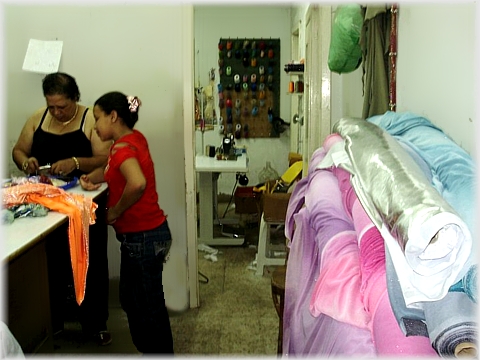
Here in Egypt, all costumes are handmade, one of a kind.  The majority of these businesses are family owned, and it’s nice to know costume purchases are helping people in Egypt maintain both this craft and artistic skill and their families.

The vendors at Ahlan Wa Sahlan pay a premium price to rent a space inside the festival. The pressure to earn that money back is intense and most stay there in their vending stall 24 hours a day for the whole 7 days of the festival. In order to sleep they find a corner and nap for an hour or two. 2007 found them dancing in the aisles and singing and joking with the women who visit from over 20 countries. 2010 tells a more somber story–with far fewer vendors in a far more serious state of mind.  They still joke (Telling jokes is a traditional Egyptian pastime.) and try to make the girls laugh, but the dread is there. The pinch of the economy can be felt.

One attribute all vendors must possess is the ability to speak at least 4 languages, just well enough to tell a few jokes and sell a costume or two.  What they don’t know, they try to learn.

For example: one perplexed vendor didn’t know what it meant when trying to sell a costume, being told to “hold his breath.”  However, by the next day, their determination to do business was impressive, and with luck and cooperation, they will succeed.   In a very real way, it is interesting that this festival is doing exactly what President Obama mentioned: encouraging business between two countries that have such an amazing and unexpected connection.

Photos taken by author on July 1, 2010 at the Ahlan Wa Sahlan Festival, in Cairo Egypt.  
The photos in the ‘factory’ are in Giza. 
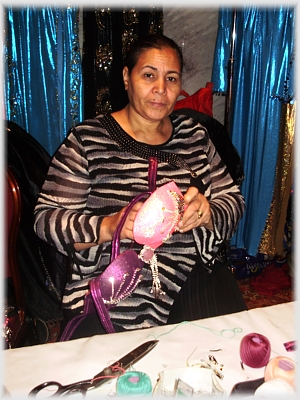
Caption for photo at top of page: A kind sould at her vending table inside
the Mena House Hotel, Ahlan Wa Sahlan, Cairo, Egypt, July 2010
Fitting
Designer measuring a dancer in his costume, (Mamdouh Morisse, designer, and Saboushka, dancer)

Seamstress 1
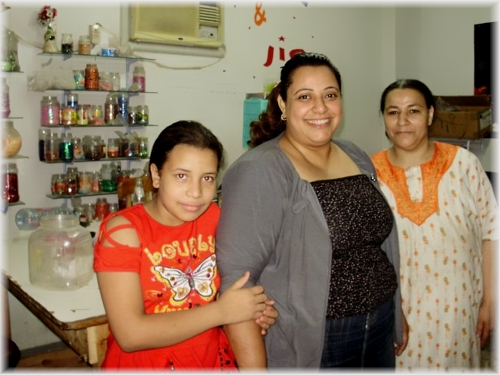
Mother and Daughter and Grandmother in the supply room.

Seamstress 1
Mamdouh’s "factory" Grandmother, Daughter and Daughter’s Daughter
Seamstress 2
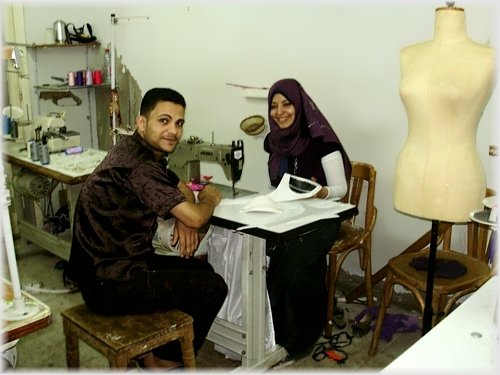
Friendly Seamstress and her Husband
Roza with ?
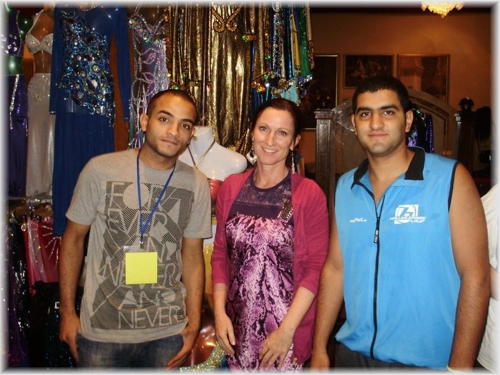
Roza between two young vendors from the designer house Crazy Move.,, Amad, Roza, Ahmad

Resources:
Sabouschka www.buikdans-yoga.nl
Raqia Hassan, www.RaqiaHassan.net
Oberoi Groupwww.oberoihotels.com

use the comment box

Have a comment? Use or comment section at the bottom of this page or Send us a letter!
Check the "Letters to the Editor" for other possible viewpoints!

Ready for more?


Gilded Serpent presents...

Nesma

Nesma

Dancer of Passion

Interview by Nina Poethen
posted August 18, 2010
Originally version published in “TANZ Oriental“, December 2006 in German

Born in Spain, Nesma resided in Cairo from 1993  to 1998, where she studied Oriental dance and Egyptian folklore. During that time she performed as a soloist with her own orchestra in over 3,500 shows on the most prestigious stages in Cairo. She broadened her artistic career in the National Egyptian Folkloric Reda Ballet, as the only non-Egyptian dancer to form part of the company. Since 1998 she has danced and taught around the world, and founded her own school and dance company in Madrid: Al-Andalus Danza. Nesma will be performing this weekend in Minneapolis as part of the 2 week annual show produced by Cassandra Shore and the Jawaahir Dance Company. “The Dark NIghtingale” will feature the music of Abdel Halim Hafez performed by the Georges Lammam Ensemble.

Nesma, do you miss Cairo?

Of course I miss Cairo. Though I never really left completely and I’ve kept my apartment there and I visit frequently. When I am in Europe, I have a deep longing for Egypt. I’ve lived there a very long time. There is a saying in Egypt that says: Who drinks water from the Nile will never forget Egypt, and he will always come back. That is the case with me.

How has it been, to live there?

For a foreign woman, alone, and a dancer, life is not easy in Egypt. At first I was completely lost; I couldn’t understand either Arabic or the culture. I had to trust people and I had quite a lot of bad experiences. Unfortunately dancers are not well considered in Egypt; the dance scene is scary and not a pretty world. I had to learn how to manage it and it took me quite a while. On the other hand I felt isolated. I used to spend all my time working, all night, 7 days a week. I had very few friends, and not much contact with my family. My life there was dance. But with all the difficulties, it has been a great experience. I learned a lot, and not only about dance. It gave me more self confidence in life. Now I know much better what I like.

When was your very first contact with bellydance, and when did you decide to make it your profession?

Shokry MohamedMy first contact was in 1990. My brothers created a comedy show for television and my sister and I were to be part of it. We created a humorous sketch representing a Middle East scene and we had to dance imitating Oriental dancers. Actually we didn’t know anything about Oriental dance and at that time it was unknown in Spain. There was just one teacher, Shokry Mohamed, and we starting taking lessons with him. Immediately we fell in love with this dance, but for us it was just a hobby. I never thought I would become a professional dancer and dedicate my life to it. It was only a simple passion. During the Summer holidays of 1993 I decided to travel to Egypt with the idea of taking lessons and to discover Cairo. I didn’t know anybody there. I took a round-trip plane ticket, my bag, and just enough money to spend 2 months. I never used the return ticket; I stayed there for 5 years.

Did you have to convince your parents, especially to go to a place like Cairo?

I went to Cairo for a short stay, just to take lessons, so my parents understood. After those two months when I was about to leave, I presented myself for an audition to work in the nightclub of an important hotel in Cairo. After the audition the hotel wanted me to sign a contract for year and a half. It was a total surprise. The same day I had to decide: go back home and to university, or become a professional Oriental dancer in Cairo. I was so excited that I decided to stay: the following day I was dancing in an Egyptian wedding. Everything was succeeding very quickly. My parents couldn’t understand my decision, especially when I had only a few subjects to pass to get my degree. They were worried for me and wanted me to come back. But the music, the dance and the breeze of the Nile were stronger than anything.

You were still pretty young when you began to work in Cairo- at that age girls normally go out to discos.

I was only 24 years old when I started to work there. The work was pretty hard. The dance level is very high – not only the dancer’s technique but the whole show, and the music in particular. I needed to find a good orchestra, to have my own music, to dress in beautiful and expensive costumes, to dance new choreographies: it represents a lot of work. It’s right that I spent a large part of my twenties dancing in Egyptian Night clubs instead of having fun with friends going to discos, but I never regret it. Now I can go to discos and I have a lot of fun with friends and family.
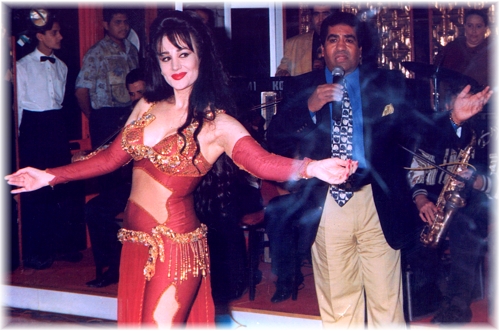
Nesma and her band in Cairo!

Here some of the Oriental people say: nobody ever would work as a dancer, if she had the chance to study- and other people say: "Dinah was studying- Why not?"

I was in the last year of agriculture engineering when I left university to dance in Cairo. Just like a lot of young people I know, I was studying to get a degree but I didn’t have a real objective. Actually, learning a profession is more like insurance for your life. I decided to become a dancer when I got my first and unexpected opportunity, and I haven’t ever regretted my choice. I am so happy I changed my direction. I cannot imagine being an engineer; it wouldn’t be natural. I feel like I was born to be a dancer. On the other hand, the life of an artist can be really sad if he does not have any success. The risk is higher than to study at university for sure. I am grateful I succeeded in my dance career. It cost me my full dedication, an amount of time and effort I wouldn’t have invested in any other career.

In Cairo you have worked with the biggest names of choreography. Can you tell me something about that? Is there difficult training like ballet or Flamenco in our countries?

Map of Madrid to CairoBallet is different; it associates at the highest level of art, technical knowledge and fitness. If you don’t start as a young child, you will never dance ballet. Oriental dance is more about art and feeling. But to express your feelings you need to integrate all the technical background, to understand the music, and to be fit. Then to make a great show, you work on choreographies. I spent a lot of time working on choreographies with great artists such as Raqia Hassan when she was not so famous yet, Ibrahim Aakeef, … and the master Mahmoud Reda. They were all very demanding. I have learned so much from them; it was the complement to the scene experience.

Was it harder for you as a non-Egyptian to work there and to get accepted- and to work in such good places?

I guess it is also difficult for a Japanese person to be a flamenco dancer. When you dance in night clubs in Cairo the audience is purely Egyptian and Middle Eastern people who understand a lot about music and dance. You must feel the music to communicate with the musicians and the public. You have to represent an Arabic princess, the beauty in Arabic culture. It takes a lot of time being immersed in this world to get all that knowledge and the feeling. And you have to work a lot to get a nice show. You need all that to open the doors of the best places. Then you should add your own special features, and I think to be successful, all you need is one opportunity.

How did you find your orchestra? Was it hard to be a chief of the Egyptian musicians? (Are these the musicians on your CDs?)

I was very excited to work with live music. It is one of the things that makes it different to dance in Cairo rather than in any other place. Where can you find a ensemble of 25 great musicians who know about dance? It allows you to feel the music going though your blood and to improvise on the stage.

I formed my orchestra when I started dancing and then I made it bigger and better step by step. During Ramadan, the only time when you are not dancing, I had to train with my orchestra to prepare new themes and choreographies. Once you have the orchestra working for you, you cannot stop working even one day; if they don’t work enough they leave you.Nesma
To manage the orchestra is quite complicated. They are all men and the dancer must always keep her distance from them. You have to use the service of a manager who is the intermediary between you and the other persons involved in the business. It is very important to have a good manager, a good professional and good person as well. And it is not so easy to find, I can tell you. You can imagine that is not easy to work like that when you have an occidental mind, but it is the way it works in Egypt. As a dancer you cannot speak to any man but your manager. You represent both the most attractive woman and the worst person in popular society.

You are serious in your work and taste. The music you dance to is not the "American belly dance- disco-style"; it never sounds superficial. Sometimes it has the flair of Egyptian dance music of the 30´s/ 40´s and is quiet and romantic. Do you feel it´s typical Egyptian, or is there some of the pride and passion, and depth people feel and show in Flamenco?

I get to dance because I fell in love with Oriental Middle Eastern music. I have tried to learn from everybody I have met including musicians. Then I developed my style from the classical Egyptian “raks sharki” to express my feelings of the music I like. I always thought this dance is sentimental, elegant and certainly sensual. The dancer must be relaxed, move gently even in fast or intensive parts. For instance, I enjoy a lot the style of Naima Aakeef, or Fifi Abdou and Mona Said in her early years, although every dancer has something particular I admire. Also I appreciate other styles and fusion when it is performed with feeling and elegance. Myself, I have created and danced choreographies of Flamenco-Arabic fusion. I like new creations but I think we should always differentiate the fantasies from the traditional dance. We must not change or lose the meaning of the terminology.

Is it possible, that you as a successful dancer in Cairo also did influence the bellydance scene there?

I hope I have but I am not able to judge. There are so many good dancers In Egypt. It was already major recognition for me to dance in so many great places and to get the public coming to see my show. For example when I got the contract to perform on my own in the Balloon Theatre, or when I was contracted in the Reda troupe, they were prizes I couldn’t even dream about.

Now I am working to create new works as a teacher, choreographer and director of my troupe, and as a producer of music: I hope my work can benefit the image of Oriental dance and Middle Eastern culture in the western countries. No matter how successful I’ll be, I cannot think I will influence this art. I just expect to help to open this dance and music to theatres and to a wider audience because it is worth it.

Nesma and band in Cairo

Your CDs have been surely very big work. Was it all your idea- which pieces you took and how you arranged them for dance?

When I decided to quit the dance scene in Cairo, I wanted to record my music as a souvenir of all the years I spent on the stage. That’s why I recorded the music of my first CD “Memories of Cairo” in 1998. I wanted this music to be arranged exactly as I like to dance it. I was so pleased with the result that I started thinking it could interest other dancers. Two years later I created a show for my troupe with Egyptian and Andalus music, “From the Nile to the Guadalquivir.” So I recorded other pieces including folklore themes, classical music and new compositions. It was a new experience for me to produce this music, and long and fascinating work. I especially care about the arrangement to adapt the music to the dance and I looked for the best musicians to record the music. Then it took a lot of work before I could get it into a real CD. I had to create my label and I wanted the CDs to be as nice as the music sounds to me. I created all these works with my heart: I really hope people enjoy them.

Can you tell me something about your favorite pieces on your CDs? The accompanying booklet is wonderful and the texts are very informative and helpful- but can you explain your concept to the readers?

I chose or ordered (I mean the new compositions) personally every piece I recorded so I cannot really specify favourites. Certainly I feel something special for the pieces created for me like the one which has my name.

When I finally decided to produced the music on CDs and distribute them in the market I wanted not only the offer a CD but to give the listeners information about the pieces, their meanings. I wanted to be a complete product, not only tracks of music – an object people like to have in their disc collection. Also I created my music to be danced to. When a dancer asks me if she can use my music to teach or to dance in her show, I feel grateful.

Why did you go back to Madrid? How is the life with Oriental dance there?

On one hand I have to admit I was tired of the night life. It was so much work and I couldn’t even see my family once a year. I wanted to think a little bit about my life in the margins of the dance. On the other hand, I felt I had reached the top of my career in Cairo and I wanted to open my own school and develop other projects.

It’s clear that the best place for Oriental dancers is Cairo. But I see that many people in Europe and in Spain feel passion for this art. I am very happy to teach what I’ve learned in Egypt.
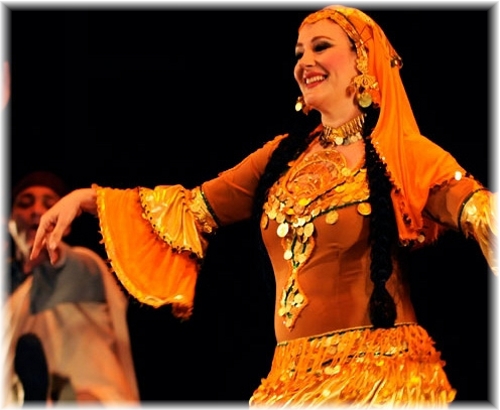
 

Nesma

To see Nesma perform with Cassandra and Jawaahir Company in Minneapolis see here

This edited version of this interview, text and photos belongs to Gilded Serpent©.
For use of this material please contact the author for the original text and Nesma for the original photos.

use the comment box

Have a comment? Use or comment section at the bottom of this page or Send us a letter!
Check the "Letters to the Editor" for other possible viewpoints!

Ready for more?


Gilded Serpent presents...

And I Thought I Knew Him

Horacio's Book

Horacio Cifuentes:Confessions of a Male Belly Dancer

Book Review by Amina Goodyear
posted August 17, 2010

Horacio Cifuentes is an internationally-known dancer who began his Belly dance career in San Francisco.

World-renowned San Francisco is a small city. Its population is less than 1 million, less than 900,000, even less than 800,000; currently, it’s about 775,000. However, it is a big city in ways other than numbers. It is big in liberalism, leadership, and innovation and it guides the communities around it called the San Francisco Bay Area. When traveling, we often say that we are from San Francisco. We don’t usually say we’re from the Bay Area, and we rarely even mention California. We’re a proud city and proud of our worldwide fame, infamy, and notoriety.

We are trendsetters and our list of “firsts” is astonishing:
Beatniks, Hippies, Love-ins, Computers and Silicon Valley, Alice Waters
creation of California Cuisine are among some of our firsts. In the United States, we San Francisco Bay Area Belly dancers were first with:
Isis–a non-denominational, bipartisan Belly Dance Convention,
Bellydancer Magazine–an early (1970s) Belly dance publication,
Rakassah–an international annual Belly dance festival,
Belly Dancer of the Year–a Belly dance competition/pageant,
● The birthplace of Tribal Dance, and
● The Blue Naked Belly Dancer!

Horacio in class
Horacio’s class in SF
Horcasio performs at Rakkasah in '89
Performing at Rakkasah in ’89
horacio as a snake
Snake dance-
this time not in blue paint

Sometime during the early 1980s, I was in a local Arabic music store, Samiramis, and I met a very tall man–a dancer of whom I had only previously heard. His name was Horacio Cifuentes and his reputation had preceded him. In the dance community we had all heard of the male dancer who had appeared in a Belly dance show given by Magaña Baptiste. In this show, wearing no clothing, painted entirely in blue (Okay, he wore a painted blue loin cloth.), he performed a Belly dance snake dance.

He was the snake and his blue snake dance made him the talk of the town!

Well, at Samiramis, he was clothed–rather GQ-like–and although he wasn’t wearing blue paint, nevertheless, he commanded a very powerful and memorable presence. I am rather short in stature, and I felt even shorter because of his towering presence. nevertheless We managed to have a conversation about dance and dance teachers and discovered together that his teacher, Magana Baptiste, had been my teacher when I was a teenager. Through this common bond, we parted ways with an appointment for him to begin studying with me. As I left, I wondered how he would fit in my tiny dance studio. After all, he was imposingly tall!

The Chapters:
1. Childhood
2. Spain
3. Poland
4. Family Fiasco
5. Exploring Drugs
6. New York
7. San Francisco
8. Meeting My Guru
9. Discovering Belly Dance
10. The Magic of Partnering
11. Breaking My Vows
12. My Final Season at The San Francisco Ballet
13. Initiation
14. New Beginning
15. Healing the Scar
16. The Pharaoh
17. Ibrahim Farrah
18. Meeting Beata
19. Love and Marriage
20. Egypt
21. Weird Adventures
22. Freedom and Self-Acceptance

Horacio was (and is) an exceptionally talented dancer and his years of studying and working as a dancer gave him an incredible mnemonic memory. I soon realized that although I could help him learn to analyze, understand, and dance to the music, I was doing him a disservice in class because he was picking up too many female dance details. This feminine baggage certainly did not suit his large personality or his dance. We decided that he needed to go to a local Arabic restaurant, The Pasha, to study and imitate how Arabic men dance. As a result, he began his Belly dance career at the Pasha; the rest is history and in his book.

Before reading this book, Horacio Cifuentes – Confessions of a Male Belly Dancer, I thought I knew Horacio since he had studied with me for a short time. During that time, I had listened to him planning his King Tut costume with real gold and gemstones, and I saw the San Francisco Ballet "Beatles" number that he had choreographed. I listened to him tell me that he needed money and was working as a male model, and I knew that often-times he went without–in order to support his dance obsessions. I had had mixed emotions when he told me he had to sell his car so that he could finance his first musical endeavor, producing Reda’s Flower, featuring Reda Darwish. *

We San Francisco dancers got to know Horacio and enjoy his performances at the Pasha and the ballet. We danced alongside him at joint productions, dance shows and at workshops. We also partied with him at Magana’s and ultimately listened to him tell us about the new love in his life, Beata Zadou, a dancer who lived in Berlin.

Yes, I thought I knew Horacio Cifuentes, a San Francisco dancer who moved to Berlin to be with and wed Beata Zadou. After reading his book, I realized I really did not know him.

The book, “Confessions of a Male Belly Dancer”, is exactly that. It is a self-produced autobiography written in a very sincere, almost shockingly honest way. It is personal and personable.

It is coffee-table-book sized and is very generous with the photos that range from blown up snapshots to professional publicity shots, both action and stills–in color and black and white. There is a forward by Magana Baptiste, an introduction by Horacio, and there are twenty-two chapters. This slick-paged book is action packed. Horacio takes the reader from his early childhood in Cartagena, Colombia, to Spain and Poland in Europe–back to Colombia, to the U.S. (New York and San Francisco) and finally, to Berlin. In the 222 pages of the book, we get to know the real Horacio and understand how and why he is who he is today.

Sometimes tall people can be intimidating, especially if they carry themselves in a very self-assured confident manner. This may be how many perceive Horacio, but this is not the Horacio we get to know in his book. Here, Horacio is a geek, a nerd, insecure, and vulnerable but always a dancer. All of us keep secrets and skeletons in the closet, and we usually leave them there. Horacio, on the other hand, openly shares his secrets with us.

He takes us on his life’s journey as he suffers from a dysfunctional family life while trying to make his dreams of dance a reality. Since the age of 4, he seems to have been very focused and obsessed about dance and fashion and consequently, suffered many obstacles and hardships for his dance. His sheer persistence and talent took him many places–not all of them pretty. However, he persevered, and all his adventures and misfortunes made him the Horacio he is today. His closing paragraph says it all:

"I treasure each moment, on and off stage, as a precious opportunity to express my artistry, and continually rediscover life for all it has to offer. I hope that this book, in revealing what life has meant for me, will inspire others to awaken the divine dancer within."Reda's Flower

Each chapter in the book shows how sweet little moments (as well as unpleasant, painful or disastrous encounters) helped to mold Horacio into the dancer we know. He introduces us to the many people who helped to form his life, personality and art. We come to love and want to meet some of them and others we don’t like, but they all were a part of the whole and ultimately helped to bring him to the free and self-accepting Horacio of today.

I enjoyed reading his book and finally getting to know Horacio, about whom previously, I had thought I knew. He has already lived a full, rich life, and undoubtedly, he has many more years ahead as an artist, dancer, choreographer, teacher, friend, and husband.

Rather than tell you what’s inside the pages of this sweet, truly delightful book, I’d rather have Horacio tell you. He’s a better storyteller. Buy his book and read it. You’ll love it!

*”Reda’s Flower”, composed and/or arranged by Reda Darwish is a must-have album. I wonder if it is still in distribution? If it isn’t, it should be!

Book and Reda’s Flower Purchase information- http://www.oriental-fantasy.com/
[ed note- rumor has it that Beata & Horacios will be teaching this fall to the US!]

use the comment box

Have a comment? Use or comment section at the bottom of this page or Send us a letter!
Check the "Letters to the Editor" for other possible viewpoints!

Ready for more?


Gilded Serpent presents...

Tribal Videos Today

2 Tribal Fusion DVDs

Tribal Fusions, Volume 2 from Bellydance Superstars
Tales of Desire from Hollywood Music

Review by Davina
posted August 17, 2010

Inspired by my recent experiences at Tribal Fest 10 in May, I pulled a pair of Tribal videos off my shelf to share.  The world of Tribal dance has produced some of the most innovative, creative and artistic performances on the dance stage today.  Inspired by hip urban clothing, modern contemporary dance music and moves pulled from the clubs, Tribal today is fresh and exciting. These elements are grafted onto classic belly dance moves, and I adore the myriad of new directions that Tribal performers are exploring. 

The new Tribal is an art form infused with it’s own sense of mystery. The latest trends are sultry and sophisticated, a dance of dichotomies, pairing the supple and the severe, slow flow with quick staccato, playfulness and intensity.  When performed by a master, the Tribal style is compelling, thought provoking, and inspiring. Experienced dancers, regardless of their own personal style, can appreciate the skills.

It’s my belief, that as dancers, it’s good to keep up with what’s happening within the greater dance community, even if it doesn’t suit our taste or style.  It’s especially important for dance instructors to recognize who the industry leaders are.  It doesn’t matter if it’s Egyptian Raks Sharki or Flamenco/Gypsy/Zambra Mora or in this case, Tribal Fusion–knowing who is the current crème-de-la-crème will give you a stronger knowledge base from which to teach your students.  Investing in one or two high-quality professionally made Tribal DVDs will add breadth to a dancers video collection.

When it comes to DVDs, I look for products that are well-produced and yet are about the cost of an admission ticket for a quality show.  I want a selection of well crafted dances, with well recorded music and costuming that support excellent choreography and high levels of execution.  More than anything, I look for quality content, (with at least three performances) that I want to watch again and share with friends. If there are three outstanding performances – I recommend that my friends buy it!   To this end, I would like to share two excellent Tribal-themed performance DVDs. Tribal Fusions, Volume 2 and Tales of Desire.


BDSS Tribal Fusion Vol 2

Tribal Fusions,  Volume 2

from Bellydance Superstars– 68 minutes

Not as good as Tribal Fusions, Vol 1 – but still quite enjoyable, this DVD has a few stand-out performances that make this video well worth the price (under $20).   This production captures the most cutting-edge Vaudvillian style that is currently sweeping through the world of Tribal dance.  This trend walks the line between Belly dance and Burlesque, acting as a bridge between the two worlds.  There’s an apparent vintage kitsch to the clothing styles that are a little bit Goth, a little bit ‘20s French, a little Moulin Rouge, a little Steam Punk. It’s lace and lace-up boots, a tad naughty, grungy, and always viewed through sepia toned goggles.  This is the style of the moment in Tribal dance, and will certainly give way to experimentation in other directions, but for now, my inner Victorian costumer loves the richly diverse and complexly layered allusions to the past.  This style is especially embodied within the performances of Zoe Jakes, Moira Chappell and Elizabeth Strong.  Like all BDSS productions, this video features exceptional dancers, well produced music and professional DVD quality.  If you are only going to buy one Tribal video this year, you should consider this one.

Sonia and Colleen
Kami
Sherri
Mira

Sonia & Colleen
My personal favorite performance on this DVD is Sonia & Colleen’s amazing duet. This is a fascinating piece that pairs the classic Belly dance movement vocabulary with the Tribal, clearly illustrating through juxtaposition that tribal is rooted in traditional Belly dance movement vocabulary.  Seeing these two lovely performers dancing together, yet embracing their individual stylistic point of view, clearly illustrates that the real difference between Belly dance and Tribal dance is the superficial “styling” layer, the shape of the arm, the characteristic attitude of the hand, the intensity of a vibration as well as choice in costume, make-up, and music.  This piece is brilliantly conceived and performed by two masters of their craft. 

I think anyone who says, “Tribal isn’t Belly Dance” needs to see this performance for a head-to-head comparison.

Fat Chance Bellydance
It’s been an age since I’ve seen such a compelling ATS* performance! However, on this video there are two dances performed by the original innovators, reminding us of why this technique was so universally admired when it first hit the scene nearly two decades ago.  Their exceptional control of each combination is exquisitely executed within the context of simpatico call-and-repeat improvisation, the Fat Chance signature technique.

Kami Liddle
With all the mega-watt talent on this video, choosing one soloist to mention by name was daunting.  But I was struck by the contrast between Kami’s two pieces.   In her first piece, her choreography demonstrates her extreme musicality with strong supple arms and controlled sinuous torso work.  The music, costuming and movement combined to create a graceful and elegant dance piece. This contrasted with her second piece that featured all the staccato energy and sharp isolations and contractions that are the hallmark of tribal.  Between Kami’s two pieces, the viewer gains an appreciation of her power, control and versatility.


Tales of Desire DVDTales of Desire

Hollywood Music – 57 minutes – Filmed on Sat. Dec. 6, 2008 at the Beyond the Stars Theater in Glendale, CA.

Unfortunately, this video was a bit hit and miss for me.  There are some stellar performances with some fusions that just didn’t work (for my taste).  The video is well shot, with a really high production value; good lighting ensured that you could see the dancer, and the sound was excellent. There were three cameras filming, and frankly, the top camera angle is not one that I prefer because it simply  is not an angle from which Belly dance is generally viewed.  Simply put, details of the dance movement are lost from this eagle-eye vantage.  However, I do like a production with multiple camera angles, so I really appreciate the mixing of front and side views, close up and distant.

The performances in this video covered a great deal of fusion territory, but unlike other videos, the performances are more varied and eclectic in their fusions. There’s a dash of jazz worked into Aubre and Lumina Bellydance Company’s piece “Fosse Fusion” and a taste of Tunisian hip work in Unmata’s piece “Flaco 81”.  There is more than a mere dollop of interpretive dance in Damage Control Dance Company’s “The Hunt” and a blast of warm Caribbean attitude fused with Saudi style in Troupe Nekyia’s number entitled “Kalypso”.

While I’ve enjoyed performances by many of the performers on this DVD in the past, I found this production was a bit uneven. A few performances left me wondering why those acts were selected, and perhaps a little more conscious editing could have produced a better overall product.  However, if you think about it, in almost every dance show there are always one or two performances that might not be your cup of tea.  As an aside – I had seen a promo for this video and was dissapointed to find out that Princess Farhana – one of my personal favorites – is appearing on Volume 2! 

Overall, I recommend this DVD, especially if you are looking for a wide variety of fusion acts.  My three personal favorites were:

Sherri/Cherchez la Femme: “The Alchemy of Salvation” She is beautiful, with a supple, flexible body topped with an amazing headdress. I found her costume to be completely over-the-top: it was dripping with metal and chain richly layered over her yoga enhanced physique and model-worthy face. Her style seems infused with the techniques of pioneer Tribal dance artist, Rachael Brice with an intimate knowledge of yoga. From her dramatic opening on the floor of the stage, I simply couldn’t stop looking at her until her performance ended.  In this piece, she found that perfect balance between the slink and the staccato. 

Mira Betz: “Not Without”  This is a gorgeous retro-inspired performance that achieves something I look for in top dancers–a total design package.  Mira’s music choice, movement technique, and costume style all come together brilliantly to create a unified performance experience, evoking 1920s France.  Her style is informed by superb isolation technique with graceful transitions and smooth flowing arms. There was a simple quiet elegance about this piece that makes it compelling to watch and happy to own this DVD.

Elizabeth Strong: “Afghani Song”  A bit more classically inspired than other pieces on this video, Elizabeth opens her dance with a lovely quiet moment of traditional storytelling. She’s a girl, preening in front of her mirror and dreamily applying her makeup.  Throughout the dance, she integrates traditional Persian moves with Tribal belly dance. Her movement vocabulary combined with her simple rose-colored costume and acoustic music create a lovely ambiance and a refreshing break from the heavy synthetic beats featured throughout the rest of the program.  Even though this is a DVD, I was totally sucked into the moment, writing a narrative in my mind of the young girl dancing with joy of being in love.  Fantastic!

These two videos present a melange of diverse Tribal flavors.  They are both high-quality professionally shot productions that offer the viewer a wide variety of styles, tastes and techniques. They both capture the essence of what’s happening in the world of Tribal today.  Either or both would make a great addition a library in need of a taste of Tribal.

*ATS= American Tribal Style


Have a comment? Use or comment section at the bottom of this page or Send us a letter!
Check the "Letters to the Editor" for other possible viewpoints!

Ready for more?use the comment box

  • Producing "Tales of Desire" a Tribal Fusion Bellydance Experience
    We felt that the buzz in the community was that people were getting tired of seeing the same performers on every performance DVD that came out, so we really tried to mix it up and offer a more varied line up.
  • Nonprofits for Middle Eastern Belly Dancers, Is a 501c3 Right for You?
    By understanding the nature of non-profits, how they are organized and run, you can see their potential for developing successful arts organization, performance space, dance company or troupe.
  • By Dancers, For Dancers DVD reviewed
    As working professionals, these dancers present the style of performance you would see in an intimate restaurant or at a house party.
  • Kohl: Drawing the Line
    Along with henna, kohl has been part of the beauty regimens of women since the dawn of history, and an unbroken line connects the eyes of today with those of the ancients.
  • 4-21-08 Strained Relations Comic by Pepper Alexandria
    Hi! Remember me? I’m your long lost cousin!
  • 2-26-09 The Girlz Got Skilz: DVD review of Asharah’s Modern Tribal Bellydance by Tracey Farmer
    Those who are interested in tribal fusion, I would definitely recommend this DVD to get a feel for the specific moves that are popular among tribal artists. If you’re already a tribal enthusiast, then this is a must have in your DVD library.
  • 2-15-09 Academia? Like it or Trash it! 2 Books Reviewed: Dancing Communities & Dancing Fear and Desire by Joette Sawall
    One thing that I have found within our community is the general lack of scholarship and a feminine voice within the research.
  • 2-13-09 Tarot:A Fantasy Belly Dance Concert by Thalia
    The large, well rehearsed cast–musicians, temple maidens, acolytes, and servants with a variety of props–deftly played up the campy quality of the piece, contrasting the work’s darker messages about the fickle cycles of gain, loss, and impermanence
  • 4-7-09 Middle Eastern Dance Theater:Erotic Chantal and Mythogical Ishtar 2 DVDs Reviewed by Joette
    This is where I had to stop and get a drink of water. Thrusting pelvises on the pyramids was wild and not at all the way had I remembered the pyramids!
  • 3-27-09 ASWAT: Arabic Music Concert by Rebecca Firestone, held Saturday, January 25, 2009 Skyline College, San Francisco, California
    They’d hired a different director this time, all the way from Cairo, Dr. Sari Dowidar. Dr. Dowidar got professional results even out of amateur performers – probably by pushing them hard. That kind of pressure isn’t always fun, but it really pays off. Maqams (maqamaat) are hard enough for the uneducated ear to distinguish without muddying the waters further with inaccurate pitch
    and tone.
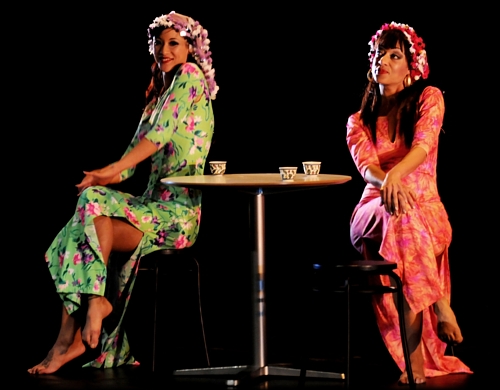
  • 3-14-09 So, If You Cut up a Rose, is it still a Flower? Fusing Bellydance With Other Dance Forms by Rebecca Firestone
    A reader’s position at this point will depend on whether you think that bellydance and Middle Eastern dance are one and the same, and whether you feel any particular sense of ownership over either one of those terms.