Gilded Serpent presents...

Facing Truth

Working as a Dancer in Egypt

Leila performs at a wedding at the Semiramis Hotel in Cairo
2012
Saidi Tableaux at a wedding at the Semeramese Hotel.  
Costume: Leila Farid, Photo: Mohab Magdy

by Leila Farid
all photos are from author’s archives
posted January 19, 2012

Most of the documentaries, videos, and blogs I have seen that have been written by foreign dancers in Cairo about their life here inspire feelings of an Oriental fantasy–as opposed to the real, the gritty truth of life as a dancer.  There is a certain amount of glamor and mystery that surrounds dancing in Cairo, and no dancer wants to shatter that illusion with the dirty facts.  It is easy to romanticize dancing in Egypt.

What is not so easy, is to admit that rejection, harassment, and discouragement usually precede even the smallest achievements.

Dancers usually have faced this with silence and perseverance–qualities essential to negotiating pre-revolutionary Egypt. The truth is that dancing in Cairo is hard!  Honestly; had I know how difficult it was going to be, I most likely would not have come.  There are many reasons in my life why I am still in Cairo but dancing is only one of them; there were numerous times that I thought of giving up.  The industry as seen from the outside is nothing like it looks on the inside.  Dancing with a four-member tahkt in a hotel lobby for little money is possibly not what a dancer envisioned when she thought of performing in Cairo, but even this job could have been gained at great expense.  In print, this job can be a “nightly contract in a glamorous five-star hotel”, giving little indication of the reality of the situation.   In Cairo, the physical, emotional, and psychological stresses to which a dancer is subjected can be high.  It is not easy to  negotiate an industry that she (most likely) does not fully comprehend due to foreign language complications, culture barriers, and governmental restrictions and to maintain an image of success in the dance community. 

With the Egyptian Revolution of January 25th this year, a veil of silence has been lifted and Egyptians have become free to voice their grievances, divulge old wrongs, and speculate on the future.  Perhaps it is time to discuss some of the hardships that dancers have faced when dancing in Cairo.  From sleazy nightclub managers to vengeful government officials, to hate-mail on the Internet, I am sure that my own stories reflect similar experiences faced by many dancers in Cairo. 

Sometimes the dirty facts of dancing in Cairo can be more interesting than the pristine Oriental fantasy… at least, it is when you tell the story later!

Even before the Egyptian Revolution, the amount of work available to dancers had started to decline.  When I first arrived in Cairo, the industry was still thriving, and work was plentiful.  In the past, one of the hardest things with which one had to deal as a dancer in Cairo is exhaustion.   The toll that daily performance can take is high.  At the beginning of my career, I was dancing from 2 to 4 shows every day.  I remember times in the dressing room at 5 a.m. when I was wondering how I was going to do show #4 of the night because my feet wouldn’t move any more. Once, I started working additionally as an actress; the only time I would take off from dancing was to shoot a film project.  I can recall being on the set at 4 a.m., then shooting all day, and leaving the shoot to dance a show on the boat and at a wedding and then returning to the shoot to continue the rest of the night.

Looking back, I’m not sure how I did it! (or why…)  I do know that I was exhausted most of the time.
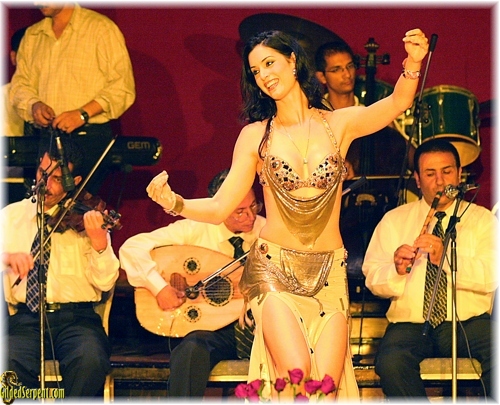
Leila

2005
Back to work after the 2004 ban of foreign dancers performing at the Haroun il Rashid Nightclub in Semeramese.
 Costume: Eman Zaki

When you are exhausted you get sick.  Like most performers, I have danced with many kinds of illness: fevers, intestinal problems, and bronchial infections.  When you are exhausted you also get injured.  I have performed with a dislocated knee, dislocated hip, and a concussion (suffered on the set when a cash from on top of the camera fell on my head).  Why would I perform sick or injured?  Sometimes the place I worked put pressure on me, saying they couldn’t find a replacement.  Sometimes I feared that they would find a replacement.  Keeping your job in Cairo, early in your career, is a constant worry–especially for a foreigner who needs a contract to make her work visa.  There is always another dancer willing to take your job; so, if it is all you can do to drag yourself out of bed to make it to the show (even if it means turning out a dire performance) you usually do it.

In all the arts, in all countries, the casting couch exists, but in Egypt, the idea of it seems interconnected with the dance profession and can cause a dancer no end of frustration.

In Egypt, a club  or hotel owner may try to form a relationship with a dancer he is hiring.   Sometimes his hints are subtle and sometimes he just states what he wants.   Sometimes he will hire you and let his affections be known over a period of months and if he realizes you are not interested, you will find yourself replaced.   Saying “yes” to a manager’s affections can lead to a job–but not always.  I have known of dancers who dated managers and never found their way to the stage.  Saying “no!” does not always mean you won’t get the job.  A dancer develops a reputation in the industry here and if the manager knows he will not get anywhere with her from the start (and if she has large enough fan base) then negotiating the job becomes purely about business–because her name brings in guests.  

It is when a dancer is new to Egypt that she faces the most harassment.  Finding and keeping that first contract is difficult. 

I would wager to say that most dancers who have danced, or tried to dance, in Cairo have faced harassment like this.  I have lost jobs because I wasn’t interested in being the manager’s girlfriend.  It is one of the most difficult situations to accept because you have no recourse.  You can report the manager, but I have never heard of a manager being reprimanded.   By reporting someone in our industry you are labeled a “trouble maker” and even respectable bosses become wary of you.   So you quietly move on to the next audition and hopefully the next job while trying to establish your name.
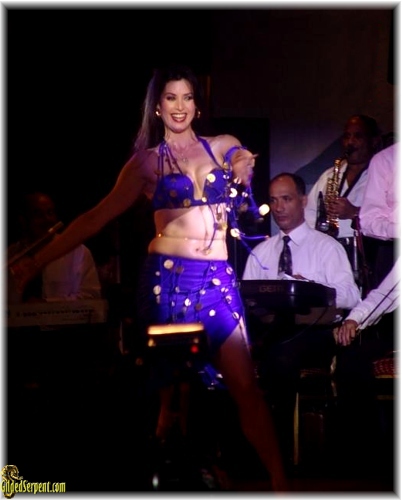
Leila

2009
Party at the Pyramisa Hotel.  
Costume: Eman Zaki

Hotels usually have an impresario who handles their artist.  This is not a manager but the go-between for the hotel and artist’s management or the person who brings the entertainment to weddings.  This is a very competitive and dirty business.   Sometimes a performer must ally herself with an impresario to get or keep a job, and he can take as much or more money than the performer–just for booking her into the venue.  Some dancers choose to work with only one impresario and others will work with many.  I have known of dancers who lost their jobs because their particular impresario lost the hotel contract and all his artists had to leave with him.  If you choose to work with many impresarios, then you have more options for work, but they have no real stake in finding you a job unless you tip them more than the other dancers do.  My first contract in Cairo was with a very powerful impresario in a restaurant with it’s own band.   If I called in sick, the impresario would send his own doctor to verify that I was actually ill and not working somewhere else.  If the doctor said I could work, then I would work no matter how sick I was.  There were constant fights with the band who worked for him, not me, and who took tips to play whatever song the guests requested, whether I knew the song or not. 

It is always risky to try not to pay the impresario’s commission and to go direct to the hotel.

Their hold on the industry is strong and they usually find a way to punish you by ruining future jobs, especially if they have a score to settle.  Over the years, I have worked with almost every impresario in Cairo.    Some are honest and some are thieves.  For two years, I worked exclusively with one impresario for weddings in Alexandria.   I worked a lot, but I was not happy with the price.  He claimed that if I increased my price, I would lose the work.  It happened that a guest called me direct to ask me to give them a discount.  I was confused as I felt my price was more than fair.   The guest told me how much the impresario was charging for me and it turned out that he was adding another 70% to the money he was giving me and my price was one of the highest in the market!   I called all the other impresarios in Alex that same day. 

Dealing with impresarios is like walking in a minefield until you establish yourself.  It is a battle you must face if you want to work.

For the last 15 or so years, the old regime had not been friendly to dance.   They informally banned dance performances from television and although shows about dance would surface now and then, they never lasted very long.  (Since the Revolution, at least 3 TV channels are running programs with dancers-one 24 hours a day!)  Performers ran the constant risk of upsetting the wrong government person and finding themselves finished as a dancer.  There is the famous story of the Syrian dancer who was dancing at a party with the ex-president’s son.  She asked him to dance with her, and when he refused, she chided, “Are you afraid of daddy?”  She found herself on a plane back to Syria that evening!  My own experience was less dramatic–most likely because I am American.  I unknowingly took the job of the girlfriend of a top government official.  The next night, the nightclub manager showed up at my door begging for the contract I had signed.  Over the next month, it became apparent that my work visa had disappeared!  For three months, I sat without working because my paperwork had been lost.  Finally, I appealed to someone in the National Security and told him my story.  He called the next day to tell me to go back to work, but strangely, two of the hotels where I had been working had taken me off their schedules.  It was only after the Revolution, years later, that the hotels called asking me to come back to work.  They told me that a government official, now safely in jail, had blacklisted me.  The only reason I still work in Egypt is because the National Security agent had warned the official that loosing an Americans’ work visa would result in an investigation. 

Until recently I didn’t know who was behind this.  I had falsely blamed an impresario with whom I’d had a dispute over tips.  After an amir’s birthday party, where tips were flying, I was called into his office; with two big body guards present, he demanded 2/3 of the tips instead of the half I had given him.  He threatened that I would never work in Egypt again if I didn’t give him my tips.  I refused–and a few weeks later, my work visa disappeared.   It is nice to know that the person actually responsible is in jail, and I have since worked with this same impresario in many weddings. 

For this same reason, dancing at the top military or government weddings was always full of stress.  I have danced at the wedding hall across the road from the ex-president’s old residence. (I am the only foreigner and Dina is the only Egyptian to dance there in the 8 years it has existed.)

The amount of security and rules pertaining to how the show proceeds is staggering! 

As a foreigner, I couldn’t recognize top officials by sight; so I was assigned a secretary to follow me to and from the stage and tell me which tables I could go near and which ones were off limits.  In a banquet hall that seats more than 1,000 guests, this could become confusing quickly.  At one point during a wedding an “off limits” minister was motioning me toward his table and my secretary was shaking his head “no.”  It was comic and unnerving at the same time! Also, when Mama Suzan, as they called her, would decide to make her entrance to the wedding, my show would be brought to an end; she did not watch dancers publicly.  We were apparently not on her list of approved entertainment.

Early in my career in Egypt, I learned not to mix art and politics.  I was dancing at a live TV show for the Eid holiday and the presenter, knowing I was American, asked me about my opinion of our then president Bush.  I commented that I did not agree with his domestic or foreign policies, especially pertaining to the Middle East (Axis of Evil and all).  When we went to break, the people in the studio looked worried and expressed concern that I voiced such a strong opinion.  In fact, the next day, Al Akbar Newspaper ran a short blurb that I had bashed my president on television.  I got calls from everyone who had seen the show and a few journalists telling me I should be careful.   I was on edge for weeks.  Until the revolution of January 25th, I never again talked about politics in a public arena.

Leila

2010
Performing on Nile Maxim.  Costume: Leila Farid

The whole idea of working in Egypt, at least for me, was to become known to the Egyptian public.  I had a great bit of luck in that I acted and danced in a comedy early in my career that was banned from the theaters the day after it was released.  The court case was eventually settled, but it left everyone wanting to see the film.  The film was picked up by every major cinema channel in the Middle East and became a cult classic.  It was a huge boost to my career!  In fact, every well-known dancer in Egypt has danced in a film or on television.  It puts her name out to a wider audience.  It also helps her build fans.  Fans are what you hope for as an artist, but they can also be overwhelming.  Some of the weddings in which I have danced have gotten out of control with people wanting photos and rushing the stage.  I have been pushed, my feet trampled, my hair tangled in the string of a lens cap of a video camera.  I’ve almost had my arm pulled off by an old man, with a surprising strong grip, who would not let go until he had taken a photo with me.  (The problem was my bodyguard who was trying to pull me through the crowd was unaware of the grip the old fellow had on my arm.) 

Recently, my car was surrounded on 6th October Bridge by cars of guests coming out of a wedding at the same time I did.  They were shooting off firecrackers through the sunroofs and yelling funny things to me on a megaphone; unfortunately, they didn’t see the guy on the motorcycle.  They hit him, he went down, my car crashed into the cars in front of me, and the rest piled into the back of me.  Although the father of the bride apologized profusely, it did quite a bit of damage to my car.   Gratefully, the guy on the motorcycle was able to walk away.

On the flip side of the coin are the anti-fans.  Anti-fans use YouTube as their platform for voicing their opinion.

Dancing in Egypt brings a particular kind of scrutiny from the dance community.   Dancers outside of Egypt generally have very strong ideas about what makes a dancer’s style  ”Egyptian” or not, and you must fulfill these notions to pass board.   In Russia they have a name for it: “Arabism”–gestures and facial expressions that signify you are dancing like an Egyptian.  In the past few years, there have been one or two fellow dancers who have taken it upon themselves to visit every YouTube clip of me and leave scathing comments about my dance.   I don’t fit into their idea of what a dancer should be in Egypt.  They accuse me of things like not having Egyptian feeling, to being too tall and thin to be a Belly dancer.  Then there are the more personal comments about what I must have done to become successful in Egypt (Surely, it wasn’t my dancing!) even going as far to bring my family into it. 

Everyone is free to like or dislike a performer, but there is something about the anonymity of the Internet that seems to bring out the worst in some members of our community.

 Many times, dancers criticize the Egyptian view of Belly dance, saying dancers are not respected here. However, sometimes I feel that we don’t respect each other within our own community.  I have never had an Egyptian attack me verbally or criticize my dance; on the contrary, people are generally respectful and excited that an American is succeeding at their dance.  If they don’t want to watch the show, usually based on religious reasons, they just leave and do not stalk me later on the Internet.  Belly dancing is extremely personal; so I understand that dancers become passionate about other performers but such negativity is rarely constructive.   Since I most likely will not become shorter (and it remains to be seen if I will become more fat) hopefully, my anti-fans can accept that it takes all types.

Leila

2010
Posing with the guests at a wedding in Meridian Heliopolis Hotel.  
Costume: Leila Farid

One of the important struggles facing every dancer in Cairo is the same that faces a dancer around the world: finding her own style.  In Cairo, the parameters for dance may be more rigid in that the Egyptian public expects certain things from a dancer that foreign audiences may not.  The dance usually follows a traditional format, but dancers are expected to have their own, individual style and personality.  Fusing nontraditional elements into the show can make you stand out, but if you deviate too far from the expected–very strange costuming, non-Arabic music, too many non-Arabic or aggressive movements–you will lose your audience and your chances of success.  Dancing in touristic venues does give more freedom of style, but for Egyptian audiences, developing a style is subtler inside Egypt than outside.  

The path to discovering your own voice in the dance is sometimes the most frustrating and difficult challenge.

When I first arrived, the trend for new dancers was to copy Dina.  She was, and still is, the only major Egyptian star to work consistently. (Lucy could still be seen at The Parisiana, but she has been focusing on her acting for the last few years.)  Although Dina is one of my favorite dancers, I made a decision to try not to copy her although her influence on the dance has been so strong that was hard to avoid. 

In my first year, I studied with Mdm. Raqia Hassan and Mdm. Aida Noor, both powerhouses of Egyptian technique and choreography in very different ways.  In my first year in Egypt, they choreographed everything I put on stage.   My manager, Safaa Farid, was also helpful, having worked with dancers for 25 years.  His advice was usually in the form of song suggestions and admonitions such as “Don’t do that again!” whenever I did something incomprehensible to Egyptian audiences.  I was lucky to see both Dandesh and Safwa perform a couple of times before they retired.  Dandesh had a profound influence on my dance because she was so subtle and funny.  Safwa was tall and thin (plus, she wore very high heels!) with a stoic grace that drove the guests nuts.  Neither of them used choreography. 

After a few years, I started to leave choreographed dance behind in order to improvise more.  I put new numbers in the show every few weeks.  My band would freak out when I would request a song on stage that we had not rehearsed.  At times, it went well, but sometimes it was horrible.  This was probably the most inconsistent dancing I have done in my life, but I learned so much from that time!  I paid attention constantly to the feedback from the audiences.

I was working continually: sick, tired, inspired at times by my progress, and sometimes, completely depressed by my lack of understanding.  

I took a year off, and when I came back to work, with a good bit of experience under my belt and much better Arabic, I decided to do everything myself-to make the show more “me.”  I choose all the music for the show and designed my own costumes.  My choreography was simple and left room for improvisation and interaction.  I discovered a stronger connection to the music and the guests.   My feedback from Egyptian audiences was extremely positive.  The number of weddings at which I danced increased exponentially. It was shortly after this that the nasty comments on the Internet started. 

Unfortunately, if you gain one audience you may lose another. 

All I can hope is that I continue to develop.  It was this psychological process of artistic self-discovery that was probably the most difficult part of my Cairo dance experience.  I hope it may also be the most rewarding.

The months following the Revolution of Jan 25th, there was essentially no work, but as the summer approached, things started to pick up.  I had one of the best wedding seasons I’ve ever had.  There was a sense of euphoria and freedom and the Egyptian people were in the mood to party.  Even before the curfew was lifted, I was dancing weddings at 5 p.m.  Before the revolution, it had become trendy to have only a DJ at your wedding, but now, everyone seems to want live entertainment.

Unfortunately, as the political and economic uncertainty continues, weddings have started to drop off.  Even with the decline in weddings, I am lucky that they have always been my bread and butter because the work that relied on tourism is suffering.  On the Nile Maxim, we went from working three cruises a day to one, usually at half capacity.  I have heard similar stories from other boats and hotel nightclubs.  Harem Street, which has been restored close to its former glory, is working but definitely feeling the absence of Arab tourists.  The huge parties for tourist and investors that were held at the pyramids and in Luxor and Sharm el Sheik have disappeared.  As for the dance festivals here in Egypt, the attendance numbers are low. I will continue with the live music dance camp that I run (The first two camps in 2010 and early 2011 were sold out, but the event in September 2011, after the Revolution, ran at 1/3 capacity.) Hopefully, Egypt will secure a stable government that will inspire confidence in the country for it’s own people–as well as tourists.  Optimistically, our next Camp Negum is scheduled for April 2012. 

Since the Revolution, I have been part of a team working on a large-scale fundraiser for children’s music and art programs, inspired (in part) by Amina of San Francisco and with the support of Debbie Smith of Cairo.  However, with the tragic clashes between the demonstrators and police this November in Tahrir Square, our corporate sponsors have been discouraged, and it has become next to impossible to secure permits from the Egyptian army for a large event. 

We will try to find a way, through art, to help kids who live in the poorest sections of Cairo, but we will have to postpone everything until after the presidential elections.  

With the Parlamentary elections complete, a majority Islamic government has been elected.  We can only speculate as to what effect this could have on the dance industry here in Egypt.  We may have jumped out of the flying pan and into the fire.  For the moment, we are free to reflect and discuss and to hope for change for the better for all people, even dancers. 

What are my plans in Egypt?  I suppose that as long as there is work as a dancer, I’ll dance, and as long as I feel like a contributing part of the society here and the society accepts me and my profession, I’ll stay. 

One thing I have learned from dancing in Egypt is that things never come easy, but when they finally happen, it is usually worth the effort.

Leila performs
click for enlargement

2012
Wedding at the Sonesta Hotel.  
Costume: Leila Farid


More Photos!

Photos 2002-2004, 2005-2008, 2009-2012
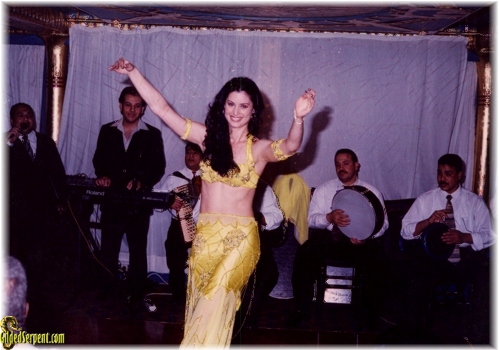
Leila

2003
My first job with my own band on Nile Pharoan and Golden Pharoan Boats.
Costume: Eman Zaki.
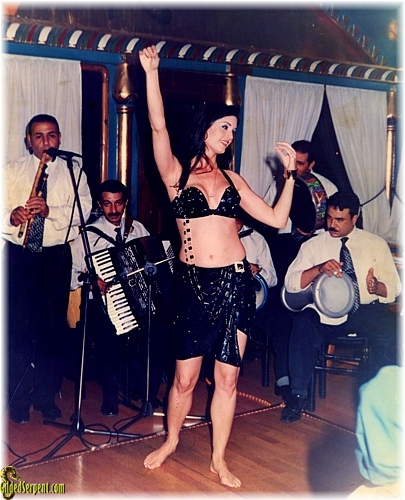
Leila

2004
Dancing on Nile Pharoan Boat.  
Costume: Nousa

Leila

2002
My first job in Shereton Cairo Aladdin Restaurant.  The band was hired by the hotel.  
Costume: Hekmet, Photo: Kay Taylor
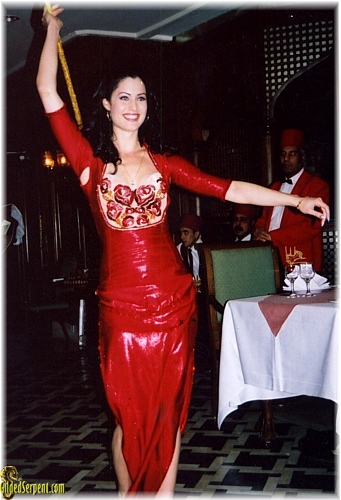
Leila

2002
Dancing 7 days a week in Aladdin in Shereton Cairo.  
Costume: Eman Zaki (one of her first costumes), Photo: Kay Taylor
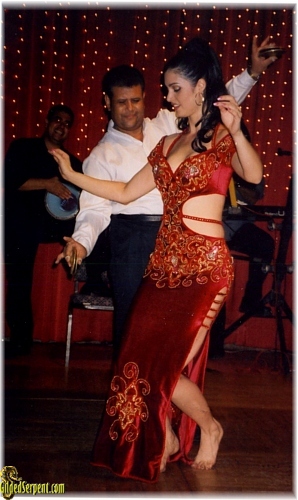
 

Leila

2002
Performing in Candles Bar in Shereton Cairo.  Pictured with Sayed Lacky, Sagat.  
My show time was daily at 4am.  Costume: Hannan, Photo: Kay Taylor

Leila

2003
Posing on Golden Pharon Boat with Saed Amr the tanoura.  
Costume: Amira Kattan

2005-2008
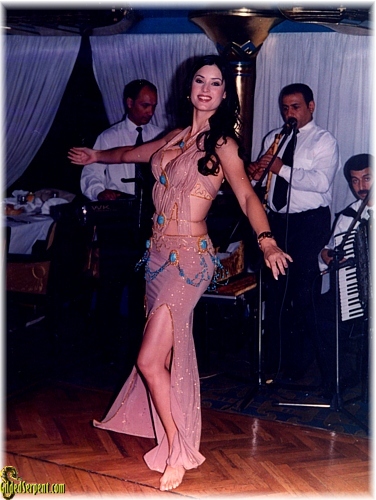
Leila

2005
Back to work on the Golden Pharon.  Costume: Eman Zaki


Leila

2005
Opening of the first Nile Group Festival in Movempick Harem.  
Costume: Nousa

Leila
2006
In 2006 I started working on Nile Maxim.  
Costumes: Eman Zaki

Leila
2006
In 2006 I started working on Nile Maxim.  
Costumes: Eman Zaki

Leila

2008
Party at the Kolkel Restaurant.  
Costume: Eman Zaki, Photo: Wagdi
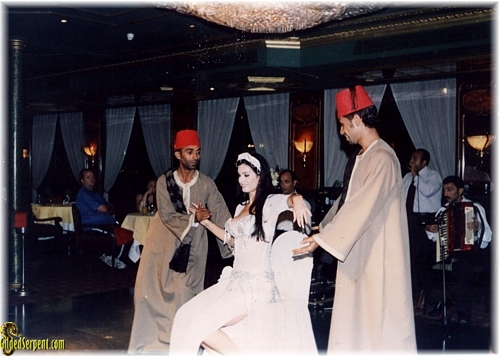
Leila

2007
Beledi Tableaux at the Nile Maxim.  
Costume: Aida Nour
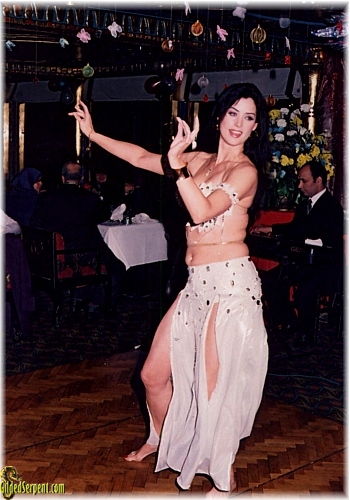
Leila

2008
New Year’s Eve Party 2008.
 Costume: Eman Zaki


2009 -2012

Leila

2009
Dancing on Nile Maxim with a blondish wig (gotta try it once).
Costume: Eman Zaki

Leila

2009
Wedding at Quat il Gaweya (Airforce House).
Costume: Eman Zaki
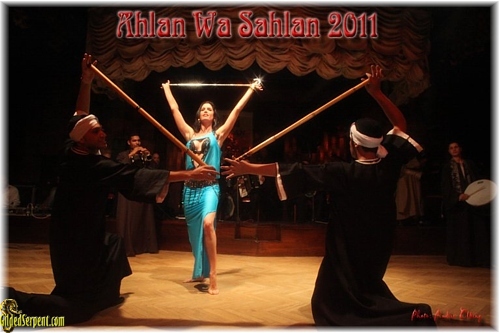
Leila

2011
Dancing at Ahlan Wa Sahlan Festival.  
Costume: Leila Farid, Photos Andre’ Elbing


Leila

2010
Ahlan Wa Sahlan Festival.
Costume: Leila Farid

Leila

2010
Dancing with the Groom at a wedding in the Hilton Green Plaza Alexandria
(the bride was Nacab and had her own wedding downstairs).  
Costume: Leila Farid

Leila

2011
Wedding at the Fairmont Heleopolis Hotel.  
Costume: Leila Farid, Photo: Amer


Leila

2012
Dancing with the guests at a wedding Sonesta Hotel.  
Costume: Leila Farid
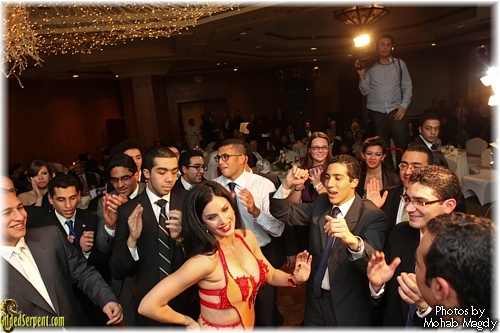
 

Leila

2012
Wedding at the Semeramese Hotel.  
Costume: Leila Farid, Photo: Mohab Magdy

Leila

2012
Wedding at the Semeramese Hotel.
 Costume: Leila Farid, Photo: Mohab Magdy


use the comment box

Have a comment? Use or comment section at the bottom of this page or Send us a letter!
Check the "Letters to the Editor" for other possible viewpoints!

Ready for more?

  • As the Music Fades, Egypt’s January 25 Revolution’s Impact on the Muscians and Dancers
    We can’t attain what they had in the past because we are not free. Our minds are full of work and what we should and shouldn’t do. There’s no time for good art. Politics mixed with religion does not make for an atmosphere where the arts can flourish.
  • Getting Home, Report from Cairo
    As a new Egyptian national, I am proud that people are demanding their basic human rights, and at the same time, sorry for the economic hard times that have already begun here.
  • Leila Delivers Live Music Under the Stars, Camp Negum 2010
    Camp Negum did indeed happen May 4-8, 2010. It was everything Leila promised and more – 5 days and nights of music and dance classes, almost all to live music.
  • Dance for Dancers
    Art created for other artists will evolve differently from art created for the masses.
  • Journey of Desire: A Foreign Dancer in Cairo, 2006, Review
    I believe that any dancer who has the desire to go to Cairo to work will benefit from the experiences of Yasmina and the other working dancers whom she asked to contribute. One will come away having a better understanding of the Arabic culture and how the dance is viewed within that culture.
  • Foreign Dancers in Cairo – a timeline and list of non-native dancers who have worked in the clubs in Cairo.
  • Permits, IDs, Licensing, Foreign Dancers in Cairo,
    It dawned on me that some dodgy nightclub manager, whom I didn’t know personally, had complete control over my passport and my freedom to leave! So, I had no alternative other than to end my contract in order to get my passport back which also meant halting the lengthy paper process.
  • The Golden Era of the Arabic Nightclubs in London Part 1: Making the Move from San Francisco to London
    The ten o’clock dinner show featured music, three dancers, and one singer. The real show started at midnight. In the audience were mostly Arabs, dressed in the most expensive designer clothes with diamond watches and jewelry flashing in the stage light. There was a scent of expensive perfume mixed with cigarette smoke. The tables were covered with flower arrangements and lavish silver platters of fruit.
  • Nightclub and Restaurant Gigs, Paid Auditons or Justified Entitlement
    Belly dancing in any public venue, like a nightclub or a restaurant, for compensation is a privilege.
  • Gigbag Check #32- Emma of Japan at the BDUC 2011
    She shares with use her favorite music to help her calm down before the contest. She also shows us her favorite costume that she bought in Cairo. 
  • The Many Faces of "Baladi"
    Baladi is an Arabic word that literally means “my country” or “of the country”. However, it has come to mean, refer to, and imply, many different things, depending on the context in which it is used. Below we discuss the most common uses of the word…
  • Susu shows us her Tomtoms!
    We caught Susu, Terrianne and Amina between gigs at their house in Petaluma. Susu had just gotten out of the shower. They demonstrated the tomtom, bendir, and darbukah for us in their beautiful studio. Rocky and the other dog, Mochi, were there to help. Sorry about cutting the heads out of the shots. Are not the tom toms beautiful?
  • Queen of Denial, Chapter 7: More Gorgeous Georges and on to Damascus
    He kept reassuring me that everything was okay, and finally, the second time that I made for the exit, he pinned me against the wall in the darkened hallway and gave me a long, luscious kiss that made my head spin!
  • Ask Yasmina #17: Practice and Rehearsal
    The key point to solo study and practice is to remember that if you are enjoying yourself, you are most likely not growing or progressing!

  • But what is “culture,” and how (if at all) have we appropriated it? Who is the implied speaker here, and what makes us believe that there is disapproval being voiced?

 

Gilded Serpent presents...

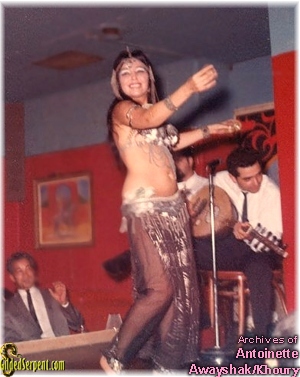
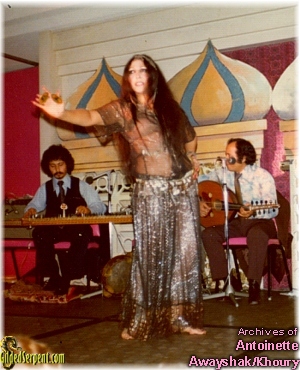
A New Dancer Emerges

Antoinette in her first costume
This is my first costume. The skirt was given to me by Kanza Omar

A Dancer’s Destiny, Part 2:

by Antoinette Awayshak
Original photos, author’s archives,
restoration by Gilded Serpent
posted January 17, 2012

See part 1 here.

I was both excited and nervous at the same time; I had no costume! The costumes I had worn in Delal’s group belonged to her, and I didn’t even know where to find one. Then, I remembered the skirt Kanza had given me! It was black and it had a gold border, so quickly, I ran out and bought a black bra, some gold sequins and gold braid, and I constructed a bra and belt to match Kanza’s skirt.

My first costume

Lou Shelby had told me to begin that Friday night. (The Fez only had entertainment on the weekends at that time.)   An Egyptian dancer, Maya, and a Las Vegas dancer, Cozette, were working there; so I was the third dancer on the program.  I came in early for a rehearsal; Lou’s idea was to have a real Hollywood-like production: I was to emerge in a flood of colored lights amidst smoke from a smoke machine and open his show.  

He announced me as the casting director’s dream, but I remember dancing for about five minutes, ending my dance and running off the stage, crying from embarrassment.  Thus, my first night as a solo professional dancer began.

Star Duet

Star Duet

Cozette is on the right. This photo was taken at the Fez in 1963.
She was a ballet and Las Vegas dancer who injured her back and then
became an Arabic dancer.I loved her legs!

I was in awe of Maya Medwar, because she had the same air about her that Kanza had had. Her costumes were beautiful, and she oozed self-confidence when she danced. She was temperamental and demanding.  She danced like the dancers I had seen in the Arabic movies, and she also sang as part of her act.  I couldn’t believe I was dancing in the same show with her!  On the other hand, Cozette was a very friendly girl from Oklahoma who used to dance in Vegas until she hurt her back; she had a ballet background and was very fluent and smooth in her movements.  Cozette was a great help to me: she introduced me to a man who was the designer for the “Jewel Box Review” (a transvestite show in Hollywood), and he helped make my next costume.

Each weekend, dancing became more and more easy for me, and I was actually starting to enjoy myself.  Lou Shelby often said to me, “Move your hips more!” and I’d go out there and move my hips (with my arms remaining at a stand-still). Then, he would tell me to move my arms more and I would become all arms. However, finally, I was able to put the two together. Khamis

Within my first two months as a dancer, all of us were invited to be part of a television show. It was highly exciting! As part of the plot, Cozette and I had to attack a certain woman in a dank, smoky nightclub.  An Egyptian oud player, Khamis El Fino, who also worked at the Fez, always wore an Egyptian costume no matter where he was. We had a scene in which all of us had to run down the stairs and everybody kept tripping over his “dress”. At the time, it was hilariously funny…

The musicians (to whose music I danced) were: Lou Shelby (one of the owners) on the violin, Adel Sirhan on the oud, Dick Barham on the drums and Lemi Pasha on the Kanoon. Others came in and out of the band such as Toufic Barham on the oud, and Yousef Kyoumjian on the violin. It was wonderful to be able to dance to live musicians.

When I first started dancing, I neither used a veil nor played finger cymbals. I was too focused on just dancing. We only had weekend shows, and I think I was making five dollars a night. I longed for the day that I could make twenty dollars a night like Maya Medwar!

 Then, Lou decided to open an upstairs room and called it “Sinbad’s Cave”.  During the week, I would dance upstairs between the tables and the cushions on the floor. Adel Sirhan took over the upstairs and Toufic Barham played downstairs, and soon, both place were open six days a week, and we danced both upstairs and down. The Fez became a popular and famous place. Many actors and actresses came, lining up outside to get in to see our show. It was a thrilling time for us!

Club photo

Club promo photo 2—Antoinette, Shuckr, Lou Shelby (Roxxanne’s dad), unknown guy in fez,
Najeeb on oud.

San Francisco

It was in Sinbad’s Cave that I met Jamila Salimpour, and Leona Woods; they were doing some group dancing, and along with them was a young girl named Aisha Ali. Jamila was complimentary to me, and soon after that, Yousef and Jamila went to San Francisco and opened a small club they called 12 Adler Place, located right in the middle of North Beach. They asked me if I would like to dance there (The amount they offered was too good to resist.) and they also invited Adel Sirhan to play the oud. So, both of us went to San Francisco. Jamila put me up in the New Rex Hotel. (I think it was above the club.)

In San Francisco, I started dancing with a veil and also began using finger cymbals.  My dancing improved immensely. During the taxim portion of my set, they played the chiftetelli beat instead of 1 ½ and it suited me perfectly! Vince Delgado was the drummer and Yousef played the violin, Adel knew the classical pieces I loved, and adding cymbals and a veil also enhanced my dancing.

Yousef wasn’t the slave-driver I surmise that he became later. He was very respectful towards me, and Jamila was wonderful. They never required me to leave the stage for tips or do floor-work because it was against my perception of the Arabic dance.  I had to overcome the stigma of being a dancer in the beginning, and I didn’t allow people to call me a Belly dancer; I was a “Beladi” dancer, and wanted to keep my image intact.

At the time, North Beach had strippers: Carol Doda was a stripper (who boasted the biggest breasts in San Francisco) and she was working at the corner. There were Jazz clubs, Finocchio’s (a club featuring female impersonation shows) and other various clubs. I didn’t want the audience to think I was a stripper! I remember Tahia, who was like a caged animal on stage; she had a dagger in her belt, and she would stare at the customers and pick her toes. I wondered where her style originated? (I came across her some years ago, and she was a quiet, little homemaker) . Tabora Najim was an east coast dancer who would jump in the air and land on her back. I hadn’t seen dancing like this in the Arab world and wondered if I were in the right place. It turned out that I was one that was different!

I enjoyed my time in San Francisco but was anxious to get back to Hollywood and show off my new dance acquisitions.       

AndresAntwain
Left: Andre‘s dad, Najeeb, is on the oud. We are performing at Shaker’s in Hollywood.
Right: Antoinette in a beledi dress, in Las Vegas with Jalal Takesh and Fadil. This is at one of Marlisa Pon‘s festivals.

c1

This is at
Shaker’s in Hollywood. Najeeb is behind the post. Sakour, is a Persian accordion player

c2

Toukic Barhan on oud. This is at an Arabic convention for the Arab community in Hollywood somewhere.
Antoinette photos session 1963 or 64
reclining pose1
reclining pose !

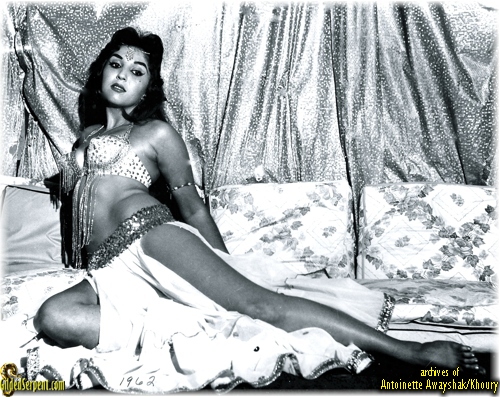
This is a photo of me in my second costume reclining at the Fez. Because I didn’t yet know how to make a circle skirt, this one ballooned out when I turned. I had made it straight up and down with gathers at the waist. This beaded and sequined bra was made by the man that worked at the Jewel Box review. I thought it was beautiful. The belt was just a wide band of sequins. Being one of the first dancers in Hollywood it was hard to find someone to emulate.

Antoinette
Left:This photo is from the movie Alexander the Great. It has a real old fashion Hollywood mood. I used to wear three pairs of false eyelashes.
Right:I also worked with this photographer doing advertising photos for Maidenform bras and cigarette ads.
You can’t see it but my arms are chained to the wall.

Antoinette

This is also from the movie Alexander the Great.

Antoinette

Left:The Fez had a very Middle Eastern decor. The leather covered seats are gold in color. There was also a tented ceiling.
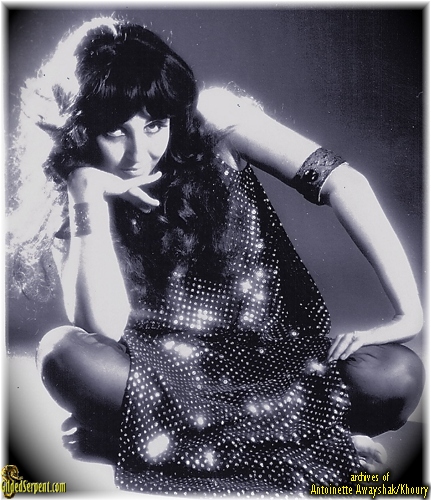
Right: I made this one too and put the dots on the skirt. 1961 or 2 (My beaded costumes are my early ones: I used coins later)

Antoinette

This is one of my favorite pictures. This is another beledi dress that I had made. I always wore pantaloons under my skirts. I wore this kind of outfit between shows. Though, I have danced in this too. The 3rd show of the night when only 3 people are there, I did a lot of stange things. Each show was about an hour. Sometimes I took my scarves and tied them into a halter top. By the third show I was so tired of dancing. This was 6 nights a week, 3 shows a night. I only had Mondays off.


use the comment box

Have a comment? Use or comment section at the bottom of this page or Send us a letter!
Check the "Letters to the Editor" for other possible viewpoints!

Ready for more?

  • Inspiration and a Push from the Stars, A Dancer’s Destiny, Part 1
    Around this time, my mother was singing at Mahrajan’s when they held Arabic functions and there was a dancer by the name of Kanza Omar, who was my idol
  • Arabian Nights at 12 Adler Place, North Beach Memories, Part 1:1961
    Leona had introduced me to her friend Josephine, whom she described as a lovely Sicilian American woman who had recently taken the stage name of Jamila.
  • Chapter 1: One Ad Changed My Life
    I was very desperate and determined to get back to my old self.
  • The Beginning
    When she came out to dance in the audience, I thought to myself, "She better not get too near to my husband!"
  • A Month In Cairo, Report #5: Weddings, Visiting Raqia Hassan, Some Thoughts about Egypt’s Future
    It was stimulating to talk about a wide range of topics, Egyptian politics and societal issues included, such as the continuing trend for Muslim women and girls to wear scarves – many, if not most, to make a fashion statement, others because of family, husband, or peer pressure, and some to make a political statement.
  • The Golden Era of the Arabic Nightclubs in London Part 1: Making the Move from San Francisco to London
    The ten o’clock dinner show featured music, three dancers, and one singer. The real show started at midnight. In the audience were mostly Arabs, dressed in the most expensive designer clothes with diamond watches and jewelry flashing in the stage light. There was a scent of expensive perfume mixed with cigarette smoke. The tables were covered with flower arrangements and lavish silver platters of fruit.
  • Nightclub and Restaurant Gigs, Paid Auditons or Justified Entitlement
    Belly dancing in any public venue, like a nightclub or a restaurant, for compensation is a privilege.
  • Gigbag Check #32- Emma of Japan at the BDUC 2011
    She shares with use her favorite music to help her calm down before the contest. She also shows us her favorite costume that she bought in Cairo. 
  • The Many Faces of "Baladi"
    Baladi is an Arabic word that literally means “my country” or “of the country”. However, it has come to mean, refer to, and imply, many different things, depending on the context in which it is used. Below we discuss the most common uses of the word…
  • Susu shows us her Tomtoms!
    We caught Susu, Terrianne and Amina between gigs at their house in Petaluma. Susu had just gotten out of the shower. They demonstrated the tomtom, bendir, and darbukah for us in their beautiful studio. Rocky and the other dog, Mochi, were there to help. Sorry about cutting the heads out of the shots. Are not the tom toms beautiful?
  • Queen of Denial, Chapter 7: More Gorgeous Georges and on to Damascus
    He kept reassuring me that everything was okay, and finally, the second time that I made for the exit, he pinned me against the wall in the darkened hallway and gave me a long, luscious kiss that made my head spin!
  • Ask Yasmina #17: Practice and Rehearsal
    The key point to solo study and practice is to remember that if you are enjoying yourself, you are most likely not growing or progressing!
 

Gilded Serpent presents...

A Month in Cairo- Report #5

Weddings, Visiting Raqia Hassan, Some Thoughts About Egypt’s Future

by Leyla Lanty
posted January 16, 2011

Wedding at a club (NOT a night club):

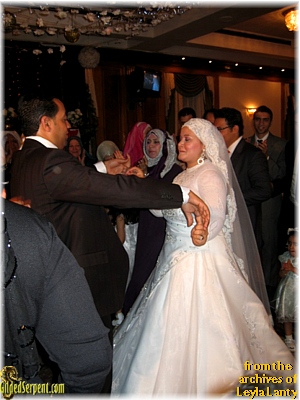
On the evening following the closing night of the Ahlan Wa Sahlan Festival, I attended a wedding at an engineer’s club in Nasr City, one of Cairo’s suburbs. There are many such clubs all over greater Cairo, places where members of various organizations can meet or have weddings, anniversary and birthday parties as well as other celebrations. I went as a guest with Ahmed and his son Osama. Once inside, I sat with some women I’d met earlier in my stay here while Ahmed and Osama sat at a table full of men nearby. Many if not most of the tables were mixed with both men and women sitting at them. Later, Ahmed and Osama joined us. One of the ladies took me by the arm to go congratulate the newlyweds at the beginning of the party, after the zeffa. At our table, our conversations “hobbled along” in broken Arabic and English.

As the evening progressed, there were the usual wedding traditions, such the first dance by the newlyweds as husband and wife, dances of the husband with his friends and family, dances of the wife with her friends and family and so on. This was all done to Arabic disco music spun by a D.J.. Later a sha3aby singer and his band arrived. If I thought the D.J.’s music was loud, this singer’s music was LOUDER! We left after the singer had sung for less than half an hour. All we could hear were the 5 large duffs (hand drums) – not the 2 keyboards, not the trombone or other melody instruments. Probably just what the young couple wanted! Kids these days!

Kids dancing at the wedding
In the photos – first dance as a married couple
and two little girls celebrating while a little boy looks on, dreaming of their own weddings?

Street Wedding and Henna Party:

A few days after the club wedding, Karim took me to join his family at a street wedding in central Cairo. His brother, Mohammed, was waiting at the entrance of the side street that had been decorated for the wedding. He took me through the area where the men were seated to the women’s area, the short leg of the L-shaped enclosure, where I sat with his mother and his fiance. Mohammed’s mother and fiance explained to me that this was the henna party and that tomorrow the wedding party (farah) will take place. The more extravagant Arab weddings have three nights of celebrations. On the first night is the family party for close members of both the bride and groom’s families. The much larger henna party for extended family and friends, held on the second night, is when the bride and groom get their palms painted with red henna. Often the bride’s hands are elaborately decorated with intricate henna designs. On the third day, after the marriage papers are signed, the wedding party is held with family and friends as well as many invited guests.

The men sat in the long section of the enclosure which was set up in the street. The wall drapes, hung on a pipe structure, were red and white satiny cloth, made to look like drapes hung at floor to ceiling windows. The women’s section had draped walls of satin-like blue fabric with appliquéd oriental designs of many celestial shapes and colors. The ladies sat at the side of the band, which was set up in the corner of the “L” shaped space, so we couldn’t see the stage well. No problem, they supplied a large flat screen monitor so we could see everything the men could see from their vantage point. Of course, there was NO problem hearing the band! The band included tabla, duffs, sagat, mazhar, keyboard. Walking through the men’s area, the sound was painfully loud. One advantage of sitting with the women on the side was that the speakers were aimed at the men so the sound level was just loud, not LOUD!

Women's section
In the photo – view from the women’s section, band on the platform to the right, flat screen TV monitor on the left.

The men had tables supplied with fruit baskets in the shape of ancient reed boats wrapped in aluminum foil. The women didn’t have tables but were served wrapped fruit trays to be shared by people sitting together, same contents as served to the men. All were served bottled water and sodas.

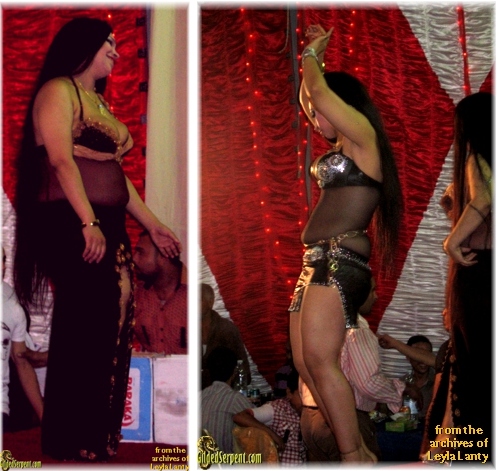
The music was mainly sha3abi with two “street wedding” dancers on stage throughout. The dancers both wore dark brown costumes,The first dancer wore a bedlah (bra, belt, skirt) with an over-flowing bra and a long skirt with a high slit over her left leg. The second dancer wore a bedlah with a revealing bra and mini skirt with an attached waist band. Each of them wore a shebaka (net or tulle midriff cover). The mini skirted dancer could shimmy well and actually danced to the changes in the music but the other one just flounced around, “phoning it in” – both were what I call “street wedding dancers” who are in it mostly for the money, not necessarily the art. They were obviously there to entertain the men. They rarely looked at the women.

Street Wedding dancers

As usual, there was an emcee calling for money gifts by rapping about the couple and those who already gave money. Many men came to the stage to throw money over the emcee, dancers and singer. As far as I know, all of that was destined for the newlyweds.

Karim’s mom kept telling me to get up and dance for the ladies and I declined for a while, but finally said “O.K.” and danced. Almost all of the ladies smiled and danced in their chairs and seemed to enjoy watching me more than they did the hired dancers on the stage. I did special hip moves and shoulder shimmies with several of them, leaning back and forth with them, even though they remained seated, dancing in their chairs. It was hard to dance on the lumpy compressed dirt surface, but after a couple of minutes I got my footing and danced to one song. Later, after his mom called him to say “let’s go,” Karim escorted us through the men’s section, out to the street and to the car.

Gunfire in the streets! No, nothing to worry about, read on.

One evening, while I was watching TV at home, there was a lot of “BEEP, BEEP, BEEP-BEEP-BEEP”, celebratory honking and what sounded like a lot of gun shots outside. I did NOT go out on the balcony to check! I called Karim about it and he said “Yes it really was gunshots. Don’t worry, ya Leyla, only a wedding!” Whew!

Get-together at Raqia’s:

Party time at Raqia’s! At the AWS Closing Gala, Raqia invited me to come see her a few days later and of course I accepted her invitation. It was a parade of stars, teachers, students dropping in from all afternoon into early evening. To name a few: Khalid Mahmoud, Nourhan Sharif, Do’aa Sallam, Soraya, Ahmed el Khatib, then Nelly Fu’ad, Mohammed Shaheen, Loli, and Lorena from Spain, who won 2nd place in the AWS competition this year. Also present were: Dana from Chile, Katia Sherbakova, who performs regularly in Cairo, and three of her Russian friends including Darya Mitskevich who won the AWS competition in 2010, Abdo from France, and Tamer Yehya. Later when we were all leaving, Katia hugged me and told her Russian friends “She is really Egyptian lady, the Egyptian sagat lady!”

More about Egypt’s future:

I went to see my close friend Shadia again. It was stimulating to talk about a wide range of topics, Egyptian politics and societal issues included, such as the continuing trend for Muslim women and girls to wear scarves – many, if not most, to make a fashion statement, others because of family, husband, or peer pressure, and some to make a political statement. The factors behind the current scarf-wearing trend are many and varied. She also remarked that many, many facets of society, law, procedures, etc., have to change in Egypt to make the new-found freedom work for everyone. It’s going to be a long haul but I think, along with all my Egyptian friends, that the result will be good for Egypt and Egyptians in the long run.

Next up: Report #6: A family dinner, farewell visits, wrap-up.

use the comment box

Have a comment? Use or comment section at the bottom of this page or Send us a letter!
Check the "Letters to the Editor" for other possible viewpoints!

Ready for more?


Gilded Serpent presents...

The Golden Era of the Arabic Nightclubs in London

Part 1: Making the Move from San Francisco to London

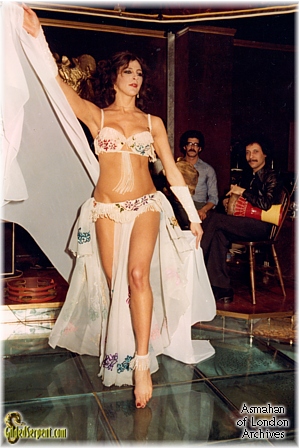
Asmahan dances at Sultan's Palace
Asmahan at Sultan’s Palace, performing on a stage that was a
giant aquarium, with fish swimming beneath her feet.
Dancing on water! Ali on dumbek, and Joseph Alexander on def

by Asmahan of London
posted January 15, 2012

Lynette contacted me with the idea of a video tour of the famous London Arabic nightclubs. We would go to the premises and film where the clubs previously existed. I would describe the clubs as they were in the glory days. I was a California dancer, who had come to London to dance in the Arabic night clubs. It was my privilege to be a part of that wonderful time. The following is my article about these fabulous clubs, the dancers, musicians, and singers who made this time sensational.

San Francisco 1972

It was my great good fortune to experience Middle Eastern Dance for the first time at the Renaissance Pleasure Faire in Marin County, near San Francisco. The dance troupe Bal Anat was performing to live music. The sound was exotic and enchanting, and I was totally captivated. The instruments played were santour, darbucka, def, dehola, mismar, miswige, nai, sagat, and sistrums. It was punctuated by zagareets – which I had heard in the film, Lawrence of Arabia. The dancers were performing to choreographed and improvised formats. The interaction between the dancers and the musicians was enthralling, the drums pounded into my heart. The finale dancer was Galya, her beauty and superb dancing left a life long impression. Rhea performed a sword dance which I wanted to emulate. This show inspired me so much, I wanted to become a dancer and perform to live music.

Jamila Salimpour presented a show that she described as “pre Napoleonic” (before western influence in the Middle East). She researched history books, using the photos of dancers from the Orientalists to inform her about the costumes. These ideas were a mixture from the cultures of the Bedouins, Ghawazee and Ouled Nail. No sequins, beaded fringe, lamé, or sparkle was allowed, the dancer’s bodies were covered using Assuit fabric, silk route fabrics, ethnic jewelry, embroideries, and Middle Eastern coins. Ghawazee means “invaders of the heart” in Arabic.

The first Arabic night club show I saw was at the Casbah on Broadway in San Francisco. The club was owned by Fadil Shahin, a talented singer who played oud. He was accompanied by Jalal Takesh, who played kanoon, and Salah Takesh who played darbucka.  Also in the band were two musicians who played violin and nai. Rhea, performed her sword dance show, and two other dancers did the traditional show format of a veil dance, taksim, song, floorwork, balady and a drum solo.

After training with Jamila Salimpour, I began dancing professionally at the Casbah, starting a life time of learning about the music and dances of the Middle East. Her teaching featured the style of the dancers from the Classic Egyptian Films; Samia Gamal, Naima Akef, and Taheya Karioka. Fadil performed music from Farid Al Atrash, Om Kalthoum and Abdul Halim Hafez. I was listening to Abdul Halim Hafez live from the Royal Albert Hall in London,” and was so impressed by the beauty of the music from his orchestra and the interaction with the audience.

There was one Arabic dancer performing at the Casbah, called Princess Samia Nasser. She was from Iraq and had bright red hair and pale white skin. She wore glamorous beaded costumes and was sweet to me. She gave me beauty advice telling me not to wear coin costumes. “You are not making the most of your looks” was her constant comment to me.

Our best customer at that time was the son of the King of Saudi Arabia. He bought me my first drink and used to give me hundred dollar bills as tips which I saved for my future. 

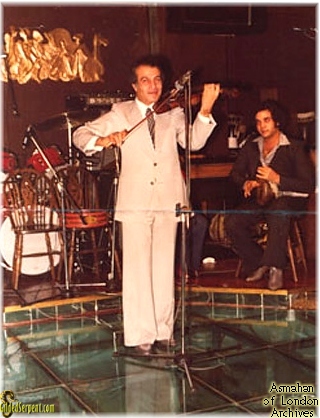
Violin
Famous violinst Aboud Abdel Al playing
his violin solo at Sultan’s (became L’Auberge).

A Lebanese violinist, Aboud Abdel Al, who had been performing in London and was on a concert tour, came to San Francisco with some musicians from his orchestra. He produced an album of music for belly dance with Fadil Shahin. The musicians were Bashir Adbel Al, Mohammad El Berjway, George Basil, and Chazi Darwish. The entrance music on this recording was a piece called “Siqa”. I did not know how to dance to this music, as it was in modern Egyptian style of which I had no knowledge. It was based on a step called arabesque, from the ballet influence of the Bolshoi in Cairo. These were the days before videos – and we had never seen the dancers from Cairo or Beirut.  Saudi Arabian students from Stanford University used to come in and tell us things about Egyptian dancers. Saying, for instance, that they did not do floor work and all wore beaded costumes. Aida, a dancer at the Casbah, invited several dancers to her house to see a home movie she had received of an Egyptian dancer called Samiha. She wore a dramatic orange fringe beaded costume with an orange sequin skirt, showed a lot of her legs, and was dancing in a style we had never seen, to music we had never heard. We were amazed and wondered about the dance world “out there”.

The Showroom at Omar Khayyam
click on photos for a larger view

The Bar at Omar Khayyam

Aboud Abdel Al advised me to go to London to dance at Omar Khayyam. My heart was flying! I had always wanted to lead an adventurous life, and this seemed like the beginning of a great adventure.  I would follow my dreams and dance for the Arabs in their night clubs, restaurants, hotel shows, cabarets, and weddings. My life work would be to perform to authentic Arabic music within the context of Arabic culture.  It was my plan to dance in London, Paris, Vienna, Beirut, Dubai, Bahrain, and Cairo.

Arrival in London- 1977

My timing, arriving in London in 1977, could not have been more perfect. Beirut and Cairo were the two cities showcasing the most famous and prestigious singers, musicians and dancers in the Middle East. Beirut was then still known as “the Paris of the Middle East”, and when civil war broke out in 1975, the night club business began moving to London.

The most famous night club in London was Omar Khayyam – originally located in Cannon Street and operated by Turkish owners, mostly showcasing dancers from Turkey. Then Jack Ahmet moved the club to Regent Street and brought in Egyptian management, musicians and entertainers. It now had a classic Arabian Nights décor, with beautiful laterns, carved screens, wall paintings, and Arabic furniture in lovely rooms and booths.

My introduction to Modern Egyptian Dance at Omar Khayyam was a night that would again change my life. I had met the show manager, Wadia Jossie, the chef d’orchestre who played nai and oud. I was given a seat at the staff table to enjoy the traditional Arabic hospitality that compliments the artists with dinner and a drink.

The ten o’clock dinner show featured music, three dancers, and one singer. The real show started at midnight. In the audience were mostly Arabs, dressed in the most expensive designer clothes with diamond watches and jewelry flashing in the stage light. There was a scent of expensive perfume mixed with cigarette smoke. The tables were covered with flower arrangements and lavish silver platters of fruit.

The show included twelve dancers and four singers, and the orchestra consisted of fifteen musicians – two darbuckas, deff, dehola, two mazar, kanoon, accordion, nai, three violins, saxophone, oud and organ. I had never heard such a dreamy sound. The music was complicated, powerful, and with such precise and dramatic rhythms. I watched the first dancer, Latifa (a Tunisian) do a pretty show in a purple and black sequin embroidered costume. Then I saw something I had never seen, three different customers threw money on the stage over the dancer. The stage assistant picked the money up and placed it in a large tambourine, and took it off the stage after her show. He also picked up her veil as soon as she released it for the hip drop. Latifa then came out of the dressing room during the next dancer’s show and sat at a table with customers, a bottle of champagne appeared immediately. After three dancers performed their dance and went to sit at a table with champagne, I began to see a pattern.

Mona Said

Photo from publicity promoting Mona Said
when she was dancing at Omar Khayyam

The sixth dancer was Mona Said, and this was her first night. She is Egyptian, but had been performing in Beirut. Mona was sensational! She looked like a pharaonic queen, tall and dark, with a fabulous body, very dramatic and very skillful. She did a drum solo “to die for”! 

Five more dancers performed – and then, the star of the show, Azza  Sharif, made her entrance. She danced to the music, “Ranet el Khol Khal”. She was out of this world! I had never seen such dancing technique. The choreography and drama of the musicians working with the dancer demonstrated a supreme level of expertise. She changed her costume three times. The costumes were so expensive and impressive, the musical knowledge and level of technique was something I had never ever seen before. I went back to my hotel at dawn in a state of shock, totally unprepared for this level of dancing. I did not sleep a wink.

The next day I had an appointment with Mr. Wadia. We met in a restaurant and he looked at my portfolio. He said that my photos were lovely. However the one in my coin costume, Assuit fabric, and ethnic jewelry, he said that “no dancer has looked like this for a hundred years.” 

However he offered me a job dancing at Omar Khayyam. He also said that I had a great body for dance, I was educated, and could learn new techniques. He would get me six new Egyptian costumes, and I would study with the tabla player for music lessons. I knew I was not prepared for this level of show business yet, and I graciously declined.

First contract

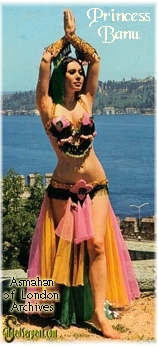
There was another night club that I had read about in Habibi Magazine. It was the Gallipoli, an elegant Turkish restaurant with a dinner show that was owned by Mr. Mourat. It had previously been a Turkish bath in Queen Victoria’s time and was declared a monument, thus protecting it from renovation. This was a beautiful jewel of a building with authentic materials imported from Turkey, located in a church park at Bishops Gate. It had been showcasing dancers from Turkey like Soroya, Nesrin Topkapi, and Princess Banu. I had a very good audition there wearing a solid rhinestone bedla in peacock colors with a sequin skirt, which I had sewn during my departure. My costumes from now on would all be very glamorous. The musicians were excellent. This show was exactly my style. I played great sagat, did a death defying Turkish Drop, performed acrobatic floor work, and knew all the music. I was using Azziza for my veil entrance. Our training in San Francisco had really been Classic Arabic-Turkish, so I was well prepared for this style.

Princess Banu of Turkey

Princess Banu,
a famous Turkish dancer

I was given a one-year contract and "Star" billing. First I had to obtain a work permit. This meant an agent would prepare documents for the club and have these documents sent somewhere abroad. I would then travel there to collect them and come into the United Kingdom through immigration to get a “special entry” visa. I had the documents sent to the Mamounia Hotel in Marrakesh. The Marrakesh Folklore Festival, which King Hassan arranged once a year, was taking place at that time. Performing in the festival were the Guedra, Berbers, and Moroccan folklore troupes from all over the country. It was really exotic and wild- the Zar was totally enthralling and they just played forever in hypnotic rhythms with the dancer throwing her head and long hair from side to side, putting herself and everyone in a trance. This dance was meant as an exorcism to drive out the evil spirits. They were wearing ethnic jewelry, headdresses, embroidery dresses, jeweled belts and face tattoos; it was a real and authentic display of tribal dancing.

Back in London, I started performing at the Gallipoli on my birthday which is February 27th. There was a good Turkish band that included Erol Grochen on darbucka, Emine Zihn on saz, and Bahri Karaduman on kanoon. This was a beautiful and enchanting environment, providing a classy dinner show to an elite clientele. The dancer went to the table for tips, and the customers were always polite and I was often given twenty pound notes. At that time, twenty pounds equaled fifty dollars. Gallipoli

I ironed my veil and skirts for work and used to iron my money at the same time because it was wrinkled and tacky looking after being in my dancing costume. It looked like new after this process.

Everyone was friendly and professional, the club was run like a family business.  On Fridays, they had a special lunch show which attracted rich bankers working in the financial district. English business protocol at this time included really lavish lunch dates. I was the only dancer in this show. Often I made as much money in this one show as I made all week. But I found it really hard to be on the stage at one o’clock in the afternoon. When I arrived home I went back to sleep and got up in a daze to prepare for the Friday night show.

The Gallipoli was also a favorite place for the motor racing world. James Hunt was a regular customer. By now, I felt that I was really on my way – living in Chelsea one block from the Boltons (an expensive neighborhood), working six nights as the star dancer and making good money. I invested in costumes – expensive fabric, rhinestones, sequins, and beads. My expertise as a costume designer would be an important element of my success. Original costumes that had an amazing fit would be my specialty.

Map of London


Pars

My first night performing at
Pars Persian – 1001 Nights

Modern Egyptian Style- 1978

I had my heart set on performing in the Modern Egyptian Style, and went to Omar Khayyam after my shows at the Gallipoli to learn from the famous dancers and secretly record the music from a tape recorder in my purse. I had to learn pieces like “Lelit Hob”, “Nebtidi Minum el Hekia”, “Fatid Gambina”, and all the magencies like “Hanni”, “Saharaand Tamera Henna. Learning this music was essential for me to progress. Then it was up to me to observe how the dancers performed to these pieces. I had always studied with teachers and choreographers, but my greatest teachers were the famous dancers I worked with in the clubs and the musicians who played for me every night. Together, we formed an artistic pursuit.

As a dancer you become at "one" with the orchestra. Musicians play differently for every dancer, they follow and develop the style of the dancer. The dancer is like the conductor, creating movement while being the inspiration that directs the music.

Mona Said had now become the star dancer. She had gone to Cairo and came back with a new style of dance, fabulous costumes, and wonderful original music she had composed. She had trained with Raqia Hassan, though no one yet knew it at the time. All the dancers kept everything a secret. She only performed with her own tabla player, Ali Ahmed Ali. The drum is called a darbucka in Arabic, but for the some reason, it is called a tabla by the dance world in Egypt. So it was called in London.

After a year dancing at the Gallipoli, learning new Egyptian music and practicing new dance steps, it was time to move on. I was ready to dance in the Modern Egyptian Style. My next night club was Pars Persian 1001 Nights. They had a twelve piece orchestra with six dancers and six singers. The club was owned by Mr. Asdulla. He was Persian and much loved by all the artists. He was like a father figure, and he helped me to get started as a dancer. I never had to “open champagne” with customers, and I was even starting to make friends with the other dancers. The clubs made a lot of money from selling champagne, at one hundred pounds a bottle, and the dancers got commission from each bottle they sold.

The customers would send bottles to the stage for singers, and sometimes there would be ten or twenty bottles on the stage.

The first night I danced, Ahmed Shanowy announced me on the microphone (in Arabic) “Ladies and gentlemen we present the Oriental dancer Asmahan”.  I asked him to translate it for me. It was then that I learned that the Arabs call this style of dance Raks Sharqi.  I ceased calling myself a belly dancer from that point on. I used the term “Egyptian Dancer” as the Arabic term, “Raks Sharki”, was too hard for Western people to understand and “Oriental” dancer alluded to Asians for most people.

The stars dancing at the Pars nightclub during this time, included Jamila, (Persian), Soroya Giseria, (Algerian), and Safa Yusri, (Egyptian). The famous Lebanese singers Wadia Safie, Hallah Safie, Adnan Ahlen and Yasmine an Egyptian, were featured. The musicians who played in the orchestra were: Mustafa el Arab on tabla, Mohamad Abdulla Rageb on def, Mounir el Khatib on violin, Said Ali on nai,  Mustafa al Araby on accordion, and Mohamad Adbel Al on mazar. The Lebanese singers have this amazing style of singing called a mawal, which is dramatic prologue which then tranforms into a powerful debke with a drum downbeat.  It was a pleasure and a privilege to be in the presence of these artists, this music was like an Arabic opera. The songs are so poetic, romantic, and dramatic.

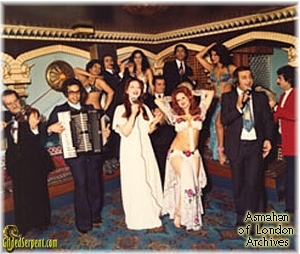
Soroya Pars
The show at Pars 1001 Nights.
Since I am the new girl, I am in the very back.
Soroya G’Algeria is the dancer in front in white,
Woman singer with mic- Hallah Safie,
who is the sister of Wadia Safie
Suhair Nagi is behind the accordian player,
Naziha the Tunisian is in the blue costume

For a few months, I was the first dancer in the program opening the show.  It would take time to get more prestige. I danced to the music “Siqa, for my magency, played sagat for the Sabah song “Ya Della” – which impressed everyone.

None of the other dancers played sagat; in fact throughout my career none of the Arabic dancers ever played sagat.  We called the entrance music an overture, then orientale, and then later in Cairo it became know as a magency.

I always brought my sewing to work to do in the changing room while we had to wait. Sometimes we had to be in the club at eleven and did not dance until one or two o’clock in the morning. The singers were always going over their time, extending their show when they were making money, and since I didn’t want to waste time just waiting, I sewed my costumes.

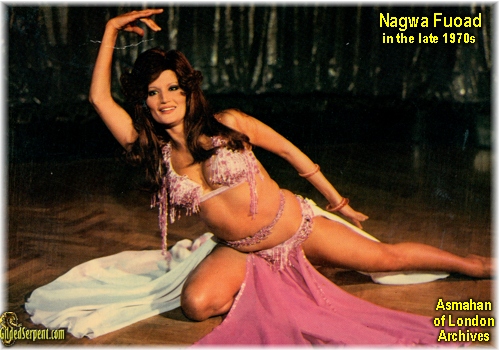
There were six dancers and everyone had a different show. When a dancer left, you could take over a piece of her music. Soroya was dancing to “Ranat el Khol Khal”, and when she left she gave me this music for my magency. For my second piece I used the music of “Fatid Gambina”.  She gave me dancing lessons and told me to use the choreography that she had taken from Nagwa Fuoad – who had this music written for her. This show format put me in a different league altogether. I was now making enough money to buy some costumes from Egypt. The costume style at this time was massive circle skirts cut on the bias, with cut outs in hand beaded trim. The costume designer was Madame Tawhida. She would bring from Cairo the most amazing embroidered skirts with a beaded bra and belt, cuffs, anklets, sequin panties and head dresses for each costume. I bought ten costumes from her. Even though I had twelve of my own, we were dancing six nights a week and some of the star dancers would come with twenty or thirty costumes. Pars was open on Sunday nights when all the other clubs were closed, so the artists from the other shows would all come to our club. One night, Mr. Wadia came and introduced me to Jack Ahmet and Mona Said. This was a memorable night for me. Jack asked me to come to dance at Omar Khayyam. I could have died and gone to heaven that moment. This was Kismet. However, I never did dance there, but it was my favorite club to go to. I knew and loved all the staff, and they always gave me a lovely little table with free dinner and a beer.


Nagwa Fuoad in the 1970s
Nagwa Fuoad in her prime, dancing at the Cairo Sheraton.
She had so many magencies written for her that then became public domain for other dancers, such as "Ranat el Khol Khal" and "Hanni".

More Clubs

More new clubs were starting to open. I wanted to experience a new luxury venue called Sultan’s Palace. It was located on Berkeley Street in Mayfair and attracted an exclusive clientele. It had a glass stage with gold fish swimming in it. The star dancer there was Hairitum. She was really overweight but had a following and I even saw her in some films a few years later. Most of the dancers coming to dance were Egyptians and a lot of them wore a Danskin fishnet stocking over their stomachs, it had two seams on the side and a zipper in the back, it held the stomach in.

Most of the dancers wore wigs and were in serious competition with one another. They would put their perfume into plain plastic spray bottles so no one would know what fragrance they were wearing. One night an unknown scent filled the air and all the dancers went nuts trying to ascertain what it was.

It turned out to be Opium, and it became the scent of choice. I always wore Shalimar in those days.

Samsonite bagThe dancers were making serious money now. The customers were from Saudi Arabia, Iraq, the Gulf States and Libya; they came with their petrol dollars with money to burn. The Egyptians and Lebanese were there as well but they did not throw their money as easily. The dancers would all bring Samsonite cosmetic bags which locked securely. The Arabic dancers all had expensive jewelry and locked it up in their bags, along with their money. Some of them would leave it with the musicians while they were on stage. One night a dancer called Amira took ill and we had to retrieve her cosmetic bag, in which she had twenty thousand pounds, along with gold, diamond, and turquoise jewelry.

Between all the dancers there was a hierarchy. A dancer would not speak first to someone that was “below her” in ranking.

As an American, I could avoid all that. I just said hello first, was immediately friendly, and that put me in a more powerful situation because I was in control. Everyone was my friend from the beginning. I was very popular with the staff. The musicians were so entertaining. Egyptians have a fantastic sense of humor and we had great fun. They were like my family.

The famous singers performing there were Mouharem Fouad, Souad Mohammed, Layla Afrom, and Naga Salem. The Saidi group Les Musicians du Nil, with Metqal Qenawi Metqal produced a folklore show from Upper Egypt. Aboud Abdel Al played his solo violin show, and the band leader was the famous composer Hassan Aboud Soud. The organist was Sayed Fahim el Sayed, Ibrahim el Akhad played tabla and Joseph Alexander played def. The comedian Ahmed Shanowi introduced the artists.

I asked Metqal to help me with my sword dance music. He was a Saidi master and I spoke with him about the history of the sword dance and he thought that the origins of the sword dance were from the Saidi Tahtib. This is the men’s stick dance that is done in the martial arts style. This suited the character of the sword perfectly. He gave me music to use and we discussed the choreography. One day, I wanted to be able to do a costume change and have a tableau. It was going to be the sword dance.

Show aat Sheherezad

Orchestra and unknown singer performs
in the show at the Sherezade Club.

Another chic and glamorous night club was opened by a group of Persian brothers. It was located near Piccadilly Circus and was a private member’s club called Shererzade, it was very modern, minimal, on a grand scale with an elegant showroom and an amazing changing room. The musicians were the most accomplished group that had ever come to London. There was one group that played for the singers and another that played for the dancers. (This is how it is in Cairo. Some musicians would never play for a dancer, and the singer’s musicians consider themselves in a higher class than the dancer’s musicians.) They even had a hotel for all the artists from Cairo to stay in for free. Sahar HamdiI really wanted to perform in such a prestigious venue. They contacted me to dance, and I was delighted to accept. The star dancer was Amira Fouad. The famous singers performing were Fahed Bahlen, Mohammad Rhushdie, Samir Adaweya, and Walid Tawfic. The composer and accordionist, Farouk Salama was the Chef d’Orchestre, Maher Chairi played flute, violin was Fouad Rahaim and Nasser Khaseb, Mohamad Afifi on kanoon, and the famous composer for Om Kalthoum, Ramadan el Subati played organ. I was very happy working there for about three months and then I had the shock of my life when an American dancer named Nancy showed up. She was the girlfriend of one of the bosses and had me fired immediately. I was distraught. Fortunately, Sultan’s Palace had been redesigned and had new owners and managers. I went straight over that night and got a job immediately. It was now called L’Auberge.

L’Auberge featured Mona Said as the star. I danced there for six months and learned so much from her on the stage. This was the best possible dancing lesson, to watch every night, under different circumstances, a great dancer produce her technique and show choreography. The singers there were Adel Mamoun, Naga Salem, Faten Farid, Katcut el Amir, Mouharem Fouad, Ahmed Adaweya, Talal el Mada, Faiza Ahmed, and ShadiaMagdi Housaini, who worked with Abdel Halim Hafez, performed his solo organ show. Hany Mehanna who composed for Nagwa Fouad was the chef d’orchestra. Sahar Hamdi was another star dancer who performed there during this time. She had the most beautiful face and performed a little comedy routine in her show. She was a bit tipsy sometimes and was very unpredictable.

Later Sahar Hamdi would dance at the Cairo Sheraton when I was dancing at the Meridian in Cairo. The Sheraton had the summer show outside around the swimming pool, the entrance to the stage had a bridge covered with flowers over the pool. The dancer would come over the bridge under a spotlight to make her entrance. It was very dramatic.

One night Sahar was quite drunk and fell into the swimming pool coming over the bridge. She was not a good swimmer and was screaming to be saved. Her wig came off and was floating in the water. It was a big embarrassment for the hotel and they fired her. They gave me her contract to finish and I had to carefully come over the bridge to make my entrance for three months.

In London, the customers started coming to the clubs later as they were in the casinos gambling, and there were many places competing for business. When a star singer or dancer arrived to headline a venue, the reservations went for a premium. None of the dancers worked more than one club, and you had to decide which was the best venue to work. The dancers who worked early did not make good money. When I started dancing, the first Arabic I learned after “Shukran” (thank you) was “Ma Feesh Fluse,” (there’s no money). It was tradition to split our tips with the musicians. The customers would throw the money on the stage, so you depended on the stage hand who attended the dancers and musicians to bring you the money. All the Arabic dancers seemed to know exactly how much money they had on the stage – they must have counted it as it fell to the floor. He would count in front of you and take half for the musicians. I never minded giving this money to the orchestra.  They worked really hard, often leaving the club at daybreak. They were the heart of the show, the dancer was the soul.

30 minute video: June 2011-Asmahan takes Lynette on a taxi and walking tour of London.
We visit the sites of many of the famous Arabic, Turkish and Greek clubs.

Part 2: A New Era

use the comment box

Have a comment? Use or comment section at the bottom of this page or Send us a letter!
Check the "Letters to the Editor" for other possible viewpoints!

Ready for more?

  • My Adventure Begins!
    At last,another North Beach Memory! "I was creating my life as an adventure, I was making my own destiny; this was Kismet
  • The London Belly Beat!
    They have nothing against tribal or fusion styles and seem to enjoy all belly dance.
  • Our London Scene: A Guide, Clubs, Events, and Resources
    Hi to all our state-side friends over "The Pond" and elsewhere! For those intending to visit London, I thought you would like a "What’s on in London?" guide to spice up any intended visit–whether now or future.
  • Serpent Tour 2011 Journal- London, Madrid and Marrakech! NEW VIDEO UPDATE-7-8-11
    An experimental travel blog. Let see how it goes! The plan is to update this page frequently.
  • Festival Fantasia: A New Direction
    I had a vision of the whole dance scene becoming one and being aware of one another.

  • However, no. Instead, Prince X sent a drink to everyone at my table, except me, just to underscore his apparent disapproval of my offensive behavior…
  • Nightclub and Restaurant Gigs, Paid Auditons or Justified Entitlement
    Belly dancing in any public venue, like a nightclub or a restaurant, for compensation is a privilege.
  • Gigbag Check #32- Emma of Japan at the BDUC 2011
    She shares with use her favorite music to help her calm down before the contest. She also shows us her favorite costume that she bought in Cairo. 
  • The Many Faces of "Baladi"
    Baladi is an Arabic word that literally means “my country” or “of the country”. However, it has come to mean, refer to, and imply, many different things, depending on the context in which it is used. Below we discuss the most common uses of the word…
  • Susu shows us her Tomtoms!
    We caught Susu, Terrianne and Amina between gigs at their house in Petaluma. Susu had just gotten out of the shower. They demonstrated the tomtom, bendir, and darbukah for us in their beautiful studio. Rocky and the other dog, Mochi, were there to help. Sorry about cutting the heads out of the shots. Are not the tom toms beautiful?
  • Queen of Denial, Chapter 7: More Gorgeous Georges and on to Damascus
    He kept reassuring me that everything was okay, and finally, the second time that I made for the exit, he pinned me against the wall in the darkened hallway and gave me a long, luscious kiss that made my head spin!
  • Ask Yasmina #17: Practice and Rehearsal
    The key point to solo study and practice is to remember that if you are enjoying yourself, you are most likely not growing or progressing!

  • But what is “culture,” and how (if at all) have we appropriated it? Who is the implied speaker here, and what makes us believe that there is disapproval being voiced?
  • Inspiration and a Push from the Stars, A Dancer’s Destiny part 1
    Around this time, my mother was singing at Mahrajan’s when they held Arabic functions and there was a dancer by the name of Kanza Omar, who was my idol
 

Gilded Serpent presents...

Nightclub and Restaurant Gigs

Paid Auditions or Justified Entitlement

Placeholder

by Sausan
posted January 12, 2012

I’m a belly dancer – have been for 40 plus years. I’ve done the gamut – danced in every nightclub and restaurant I could get my hands on, took my costume to every place I traveled in hopes of dancing there, traveled around the world and added countries to my dance resume (including Antarctica), worked for entertainment agencies, and promoted myself on my own to my friends, family and co-workers.

Pay is an interesting subject.

All well-known and celebrated entertainers have traveled the same road that the up-and-coming “wannabe” entertainers are now traveling. Some hit the big lights, others stay for the fun and involvement, and the rest go on with their lives better for their experience. Singers, musicians, actors, and dancers alike, all start their career paths with one thing in mind – to become well-known at what they do and to be sought after enough to demand the kind of compensation they feel they deserve.

Entertainment is subjective.

Belly dance entertainment is no different. What’s good entertainment to one person may be nothing more than an eyesore to another. So, we seek out that one person who deems our form of entertainment worthy enough to get the kind of compensation we feel we deserve, or at least some form of compensation.

There’s a little restaurant called Le Bel Canto in London, England, where the waiters not only wait on tables, but also sing for their supper. At Le Bel Canto, the pay is £12 (roughly $18) an hour for waiting tables as opposed to the regular £6 (roughly $9) an hour that other restaurant owners pay. But the pay isn’t just for waiting tables. The pay also includes one hour’s rehearsal, plus four hours of table-waiting and aria-singing. Google up “Sing for Your Supper Restaurant” and you’ll find that Le Bel Canto is not the only one where waiters are singing for their supper. Don’t Tell Mama in New York City offers something similar. And these waiters are good at what they do – singing – or they wouldn’t be waiting tables at Le Bel Canto.

I’m also a restaurant owner – have been for over 12 years.

Al Masri StageTo coin a proverbial phrase, the shoe is now on the other foot. Having donned my chef’s coat and hat in place of my belly dance bedlah, I look at restaurant and nightclub entertainment from a whole different perspective. Like other restaurants in the city of San Francisco who offer live entertainment, I too must pay an annual license fee to the City to keep live entertainment in my restaurant. The fee is not small, so to feel justified in paying it, I insist on good and accomplished entertainment.

There used to be a time back about 20 years ago when Middle Eastern and Greek restaurants with performing belly dancers proliferated in and around the San Francisco Bay Area. Many of them don’t exist anymore, and only a few of the ones that do exist, and offer belly dance entertainment, often come under the scrutiny of the current reigning belly dance performers. How much do they pay? How much should they pay? Can we ask for more? Do they pay more for an extra show? I know; I get asked these same questions by curious non-affiliated dancers looking to make a little extra cash.

Belly dancing in any public venue, like a nightclub or a restaurant, for compensation is a privilege.

It should be treated as a privilege along with the respect due to any regular sought-after employment position. Being hired to dance in one of these establishments regularly, is even better. What greater reinforcement to one’s ego as a “good enough” dancer than to be asked to dance regularly in an establishment for compensation?

Let’s examine this pay issue. Compensation comes in two forms; money or trade. A nightclub or restaurant does not have to nor does it need to hire a dancer; it wants to hire a dancer with the hope that such entertainment will bring in more customers.

But it is not solely up to the restaurant owner to provide an audience for the dancer. It is a two-way street, which often leans more toward the performing dancer.

Always keep in mind that, while both may lose in the end for not supporting each other, the restaurant owner never stands to lose as much from not providing entertainment as the dancer does. This is where pay becomes an interesting subject.

You are looking to get hired. What exactly is “experience” worth to you? Are you looking for hard cash or are you looking for more? Are you willing to work with the owner? Will you "dance for your supper" in the beginning to prove yourself worthy as a competent dancer if it means having a place in which to dance regularly? Are you then open to re-negotiating terms after several months have passed and perhaps adding some trade allowances, such as complimentary dinners for your friends and family on a base-by-base pre-approved agreement as part of your compensation? During the time you’ve danced at this establishment, will you have brought in enough loyal customers – a following – say after several more months to warrant asking for an amount of money? Will that also include your already negotiated trade terms?

As in any employment opportunity, long term or short, these negotiations are strictly between you and your employer and should not ever be discussed with anyone, least of all with colleagues and co-workers, outside the office or dance floor.

As I did years ago in traveling around with my belly dance costume, asking of restaurant and nightclub owners to do a show in their establishment, I now get requests from time to time from belly dancers traveling to the Bay Area who want the opportunity to dance in a San Francisco restaurant. I fully understand that doing so adds to a dancer’s resume and experience. For the most part, I will agree to showcase a guest dancer along with my regularly featured house dancer at Al-Masri Egyptian Restaurant; and more often than not, I would not have heard of the guest dancer. Pay is a subject that always comes up.

Unless the name of the dancer is someone who can draw in customers, pay comes – as I had earned mine years ago – only in the form of “dancing for your supper”.

I can almost hear the gasps and guffaws of speechless and surprised breaths coming out of the mouths of those who are reading this article. How dare I, the restaurant owner, not pay the traveling guest belly dancer?! How dare the traveling guest dancer not receive the demand of $100 – or more – for her performance at my restaurant?! Don’t I know how much has gone into lessons, costumes, time, energy, and other feats related to the dancer’s plight? The problem with these questions is that, indeed I do. And the answer is still the same. Unless someone has made a name for herself and can guarantee a draw to my restaurant in the form of at least a half a house with paying customers, dinner – along with priceless experience – is still all I offer.

Dancing in a restaurant or nightclub for some form of compensation may be your ultimate goal. But these performances should be thought of only as paid auditions because that is what they are.

Forget about dancing regularly in these kinds of venues with the intention of making a living.

In fact, I have my own thoughts, opinions and conclusions as to why some restaurant owners don’t offer belly dance entertainment any longer. And, personally, I can’t blame them. So, where is the big money to be made in belly dancing? From the private engagements or events negotiated between you and the customers who come to watch your performance at the restaurant or nightclub.

Securing dance employment with more than one establishment only provides you with more paid auditions and more opportunities for the big money in private engagements and events.

The singers who wait tables at Le Bel Canto may be singing for their supper, but they also know that there’s a better chance at catching the eye of a producer who might venture in for some relaxing dinner looking for a specific voice for his new opera. These professionally trained singing waiters don’t demand anything more of their employer for their participation other than an hourly wage of roughly $18 an hour – on their feet for four hours waiting tables and singing. Belly dancers should take note of these professional entertainers. At least belly dancers aren’t made to wait tables between performances.

Resources:

use the comment box

Have a comment? Use or comment section at the bottom of this page or Send us a letter!
Check the "Letters to the Editor" for other possible viewpoints!

Ready for more?

  • Egypt’s Golden Age, Timeline and Synopsis
    From around 1850 to 2000, Egypt saw the birth, rise, and transformation of its cultural expression through dance. With each period, a new energy in the dance was introduced and, with it, new dancers with new dance movements and new costumes.
  • Ballet-ification of Belly Dance
    When did Ballet become a requisite for Belly dance, and why is it stated that it should be an essential part of a Belly dancer’s daily regimen?
  • The Magic of "The Grapleaf", 1976-1997
    Back in the early ’80s when I was performing at the Bagdad Cabaret on Broadway, a customer strolled into the Northbeach nightclub and told me about a little known restaurant
  • Jodette: Undeniably Authentic
    “ Why do students go against their own teacher,” Jodette continued, “and spread ugly rumors?” I looked at her a shook my head. It’s a lament that I, too, have experienced from time to time as teacher of this dance.
  • Calling all professional dancers! How much do you charge?
    Over the years, we dancers have unwittingly kept the general rate ridiculously low in restaurants and nightclubs.
  • How to Charge What You Are Worth
    The first step to becoming an effective negotiator is to emotionally detach yourself from the outcome. If you can’t walk away from the deal, you have already lost.
  • Gigbag Check #32- Emma of Japan at the BDUC 2011
    She shares with use her favorite music to help her calm down before the contest. She also shows us her favorite costume that she bought in Cairo. 
  • The Many Faces of "Baladi"
    Baladi is an Arabic word that literally means “my country” or “of the country”. However, it has come to mean, refer to, and imply, many different things, depending on the context in which it is used. Below we discuss the most common uses of the word…
  • Susu shows us her Tomtoms!
    We caught Susu, Terrianne and Amina between gigs at their house in Petaluma. Susu had just gotten out of the shower. They demonstrated the tomtom, bendir, and darbukah for us in their beautiful studio. Rocky and the other dog, Mochi, were there to help. Sorry about cutting the heads out of the shots. Are not the tom toms beautiful?
  • Queen of Denial, Chapter 7: More Gorgeous Georges and on to Damascus
    He kept reassuring me that everything was okay, and finally, the second time that I made for the exit, he pinned me against the wall in the darkened hallway and gave me a long, luscious kiss that made my head spin!
  • Ask Yasmina #17: Practice and Rehearsal
    The key point to solo study and practice is to remember that if you are enjoying yourself, you are most likely not growing or progressing!

  • But what is “culture,” and how (if at all) have we appropriated it? Who is the implied speaker here, and what makes us believe that there is disapproval being voiced?
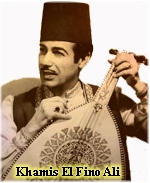
 

Gilded Serpent presents...

The Many Faces of "Baladi"

Tiffany dances the Melaya in 2007

by Hala Fauzi
Originally presented on Nov 4, 2011,
in San Francisco, CA
as a lecture in Karim Nagi‘s “Raqs Egypt”
posted on GildedSerpent.com January 9, 2012

Baladi is an Arabic word that literally means “my country” or “of the country”. However, it has come to mean, refer to, and imply, many different things, depending on the context in which it is used. Below we discuss the most common uses of the word:

Raqs Baladi: Literally–County Dance
In Egypt, this term refers to how people move to the music when they celebrate any festive occasion. It is the generic way Egyptians refer to what is known in the west as “Belly Dance”. More specifically, it is the non-stylized and less sparkly version of “Oriental Dance”.

Oriental Dance: or “Raks Sharki” is the more stylized, fancy version of “Raks Baladi”. Typically it is performed by a paid solo dancer, possibly with a group of backup dancers, in shiny costumes. Oriental dance shows in Egypt are customarily accompanied by a music band.

Robaire plays tabla baladiTabl Baladi: Literally–Country Drums
Even though there is an Arabic rhythm called “Baladi” (see below), the term “tabl baladi” does not refer to the rhythm per se, but to the general use of the Arabic drums: Tabla, Dohol, Tar, Daf, etc. The various Arabic drums are essential instruments in Arabic music, as they provide the heartbeat for the music. They are also known as loud noisemakers used to alert and announce. The common expression “ma yetla’ wala bel tabl el baladi” which translates to “wouldn’t get out even with country drums” refers to something or someone being too sticky or clingy that even loud noise wouldn’t scare it or them away.

Ikaa’ Baladi: Literally–“Baladi” rhythm
This is a common drumming rhythm in Arabic music. It’s a 4/4 rhythm and is considered a slower version of the “Maqsum” rhythm. The basic version is played on the Tabla as “dum-dum te-ke-tek, dum te-ke-tak” and most Egyptian music, especially pop music, uses a variation of this rhythm. It is also known as “wahda w nos”. “Ra’s ala wahda w nos” is a common expression in dance meaning “Raks Balad”i or simply Egyptian dance. The term “wahda we nos” (means: one and a half) may be referring to the dance move typically performed to this beat: a heavy hip drop (one) followed by a lighter hip drop with a foot flick (a half).

Lebs Baladi: Literally–Country clothes
That typically refers to wearing a “galabeyya” (a long flowing dress worn by men and women). For men, it may be accessorized with a ‘takeyya’ (a small skull cap, a little bigger than the Jewish yarmulke), an “abaya” (a long over coat open in the front) or a vest. For formal occasions, they may wrap a piece of cloth around the takeyya similar to a Sikh’s headdress but less elaborate and doesn’t wrap up as high. For women, the galabeyya is typically more colorful, often with flowery patterns. They also wear a headdress consisting of a small “mandeel” (head kerchief) tied underneath the hairline and a long veil on top of it attached at the top of the head. On cold days, people typically wear pants underneath the galabeyya. In hot weather, the galabeyya is a blessing as it allows for air to flow around the body cooling it down in the heat.

Baladi: Literally–country style
In the context of describing someone or something (non-dance related), the word ‘baladi’ is often used in Egypt to mean unsophisticated, crass, poor taste or vulgar (such as, a "hick"). On the other hand, sometimes when used among friends, “bel baladi” (in country-style) can mean honestly, truthfully or bluntly (as is ”bel baladi keda”, here is what I mean). Another non-dance related use of the word is the literal meaning of country style. For example, when describing a farm-like outdoor setting, one might say “a’da baladi” referring to a setting from the countryside as opposed to a city setting. “Aish baladi” refers to the Egyptian brown pita bread that is the most common type of bread in Egypt because the government heavily subsidizes it. “Farah baladi” is a country style wedding where people may be sitting on the floor and wearing galabeyyas as opposed to a city style wedding, which has more of a western feel.

Hala's troupe
Author’s troupe pose backstage at the San Francisco Ethnic Dance Festival
names: Vicky, Baha, Diane, Leticia, Mike Fair, Hala, Isami and Tarek.

What makes a dance “baladi”?

The best way to answer that question is to take a trip to Egypt and experience life in Cairo for a few months; then you will be able to recognize a dance as baladi–even though you may not necessarily be able to explain why.
Here is an attempt. A”baladi routine” may contain one or more of the following:

  1. Baladi music, more often than not, has lyrics. The lyrics are in the Egyptian dialect and often describe simple common emotions, though they can be very poetic.
  2. It starts with the typical accordion taksim tune that has become a signature beginning of baladi music (for an example, please contact me).
  3. There are no big rhythmical changes. Typically, it uses no more than 2 or 3 rhythms; at least one of them is the baladi rhythm or its relatives, Maqsum and Saidi.
  4. A giveaway would be if the singer is a well known Shaabi singer. Examples are: Mohamed Roushdy, Hassan el Asmar, Amina, etc.
  5. The song is no longer than 5-6 minutes.
  6. It may be a catchy tune with a refrain and 2 or 3 verses maximum.
  7. Baladi dance movements tend to have an earthy feel to them as opposed to ballet-like or westernized movements that are often seen in Oriental dance performances.
  8. The emotions expressed in “Baladi” dance are simple and straightforward (typically: happiness, playing "hard to get" or complaining about a loved one’s treatment).

As you can see, the characteristics above (except for #2) are somewhat generic which is both good and bad. The good news is that it allows for flexibility in interpreting the song. One person may choose to dance oriental style while another may choose to dance baladi style to the same piece. Both interpretations are valid. The difference will be in their costuming, choice of dance movements, and emoting. The bad news is for academics–as they have a hard time drawing the lines between what is ‘Baladi’ vs. “Oriental”, since there are no hard rules.

Using guideline #4 above can be tricky as there are many singers who sing “Shaabi” style as well as “Ttarab” style. Again, my recommendation would be to visit Egypt and immerse yourself in the culture.

How is that different from “Shaabi”?

It is not different; the terms “Baladi” and “Shaabi” in dance are interchangeable.
As explained, Baladi means “of the country”. Shaabi means “pop” or “of the people” (“Shaab” means “people”). In Egypt, they often mean the same thing. The difference is mostly contextual. Because of the possible negative connotations of the word “Baladi”, we don’t use it to describe singers or art. If you say ‘“she or he is a Baladi singer”, it may mean that she or he sings Baladi songs, but it can also mean that the person is a country hick or crass. So we say “Shaabi” singer. Similarly, “fann shaabi”’ (folk art) is better than saying “fann baladi” because it may be interpreted as simple art or perhaps art that is in poor taste. So whenever mis-interpretation is a possibility, the word “Shaabi” is used instead of “Baladi”.

A different look on stage:

While the Baladi dress or costuming almost always refers to the traditional “galabeyya”, the Shaabi-look may or may not be a galabeyya. A Shaabi costume may be any folk dance costume. For men, it can be casual pants and shirt or tee shirt (such as , representing Cairo street dancing), Alexandrian sailor costume or any local regional costume. Similarly for women, it may be a more fitted galabeyya without any head covers, an Alexandrian dress or any other regional costume.

What is a Melaya?

The melaya (literally means sheet) is a large rectangular piece of opaque cloth, black in color, used by country women and blue collar female workers like a coat. They wrap it around their bodies on top of what they are wearing for warmth and modesty. Since it does not have any stitching (other than the seams) one has to hold it in place with the hands and arms rendering it impractical to do any useful labor while wearing it. It is typically used like a coat; one would wear it to go out then take it off when arriving at their destination or needing to do any physical work.

What is the Melaya dance?

Unlike many regional dances in Egypt (such as Saidi, Haggala, Siwan, …etc), the Melaya dance is not a regional dance as much as it is a character dance. In the early 1960s, Mahmoud Reda and the Reda Troupe created dances using the melaya as a prop to portray the character of a playful woman from Alexandria. In Egypt, Alexandrian women have a reputation of being daring and more outgoing than their Cairo sisters. There is a common saying in Egypt about Alexandria: “Mayya malha we weshoosh kalha” (salt water and daring/weathered faces). Which refers to the non-shy style of Alexandrian people in general.

When Mahmoud Reda did his research in the 1950s-1960s to present the different regional styles of dance on stage, he found that some regions didn’t have any specific stylization or regional dialects in their dance. In a sense, they simply do generic “Raks Baladi”. For stage purposes, Mahmoud Reda improvised and used artistic license to create some of these regional dance styles. He created them for the dramatic and theatrical effects.

However, since he was a pioneer, these dances came to represent their regions in pop culture. Egyptians are not big travelers. For most people, the only regional dances they saw were the dances created and performed by Mahmoud Reda and his troupe then later by other folk dance troupes that borrowed and built on Reda’s original work.  Hence, the “Melaya Dance” was born.

Many Egyptian women all over Egypt use the melaya in their daily life; it’s not an Alexandria-only phenomenon. Yet, in the dance world, it has come to be associated with Alexandria for the reasons explained above. While in real life the melaya is used for modesty, on stage, it’s used to accentuate the curves and highlight physical abilities. The character is typically a sought-after woman who is using her beauty to coax and tease. However, in today’s dance scene, since that character has been overused, people use the melaya as a prop to portray a much wider spectrum of meanings and emotions.

Author’s bio page on Gilded Serpent

use the comment box

Have a comment? Use or comment section at the bottom of this page or Send us a letter!
Check the "Letters to the Editor" for other possible viewpoints!

Ready for more?

  • Middle Eastern Dance, a Beautiful, Ancient, yet Misunderstood Art
    Why are all the books about this dance written by Westerners?
  • Dances along the Nile, Part 1: Raks Al Asaya
    There is strength in the cane twirl but not aggression, extreme rapid twirling should be held as an additional sensational feat, less is more. Have your body of twirling be moderate so that you can vary from slow to climatic; always reflecting the music, it’s mood and tempo. Get down without getting crazy.
  • Dances along the Nile, Part 2: Raks Al Balas
    Ah, the poor balas (water jug). This is one of the most underestimated and ignored of the dances along the Nile.
  • Dance of the Nile part 3: Meleya
    The erk sous seller spies a pretty young thing in a melaya (and pink bloomers). He coaxes her to have a cup; they flirt. He chases her, she runs away.
  • Shamadan or Candelabra: Dances Along the Nile Part 4
    The style is very earthy and includes great “tricks” like the splits, stomach work while on the floor, rolling over full length on the floor and posturing — complete with quivering buttocks, and various other individual talents.
  • Arabic Lessons, My Introduction to Shaabi, Part 1
    She taught us that besides learning the words and their meanings, Egyptians do not stand still when singing. They dance around a bit and use their hands, body and eyes to gesture according to the songs.
  • Ahmed Adaweya My Introduction to Shaabi
    Where once he was known as a master plumber, he had now become a master of Saltana.
  • Susu shows us her Tomtoms!
    We caught Susu, Terrianne and Amina between gigs at their house in Petaluma. Susu had just gotten out of the shower. They demonstrated the tomtom, bendir, and darbukah for us in their beautiful studio. Rocky and the other dog, Mochi, were there to help. Sorry about cutting the heads out of the shots. Are not the tom toms beautiful?
  • Queen of Denial, Chapter 7: More Gorgeous Georges and on to Damascus
    He kept reassuring me that everything was okay, and finally, the second time that I made for the exit, he pinned me against the wall in the darkened hallway and gave me a long, luscious kiss that made my head spin!
  • Ask Yasmina #17: Practice and Rehearsal
    The key point to solo study and practice is to remember that if you are enjoying yourself, you are most likely not growing or progressing!

  • But what is “culture,” and how (if at all) have we appropriated it? Who is the implied speaker here, and what makes us believe that there is disapproval being voiced?
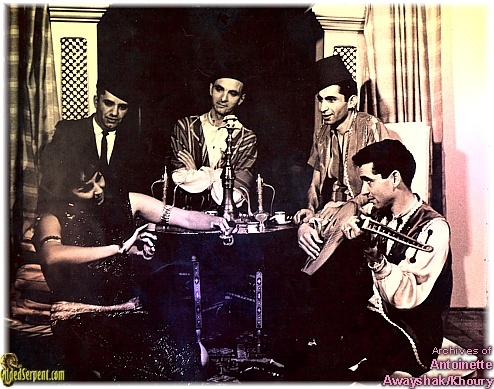
  • Inspiration and a Push from the Stars, A Dancer’s Destiny part 1
    Around this time, my mother was singing at Mahrajan’s when they held Arabic functions and there was a dancer by the name of Kanza Omar, who was my idol
  • Photos from Cifuentes’ Sommer Festival in Berlin
    The idea of presenting a dance festival together with a contest is to promote talent, encourage excellence, and motivate dance artists from all over the world to come to Berlin and participate and results in this special and amazing event of learning and performance.

  • However, no. Instead, Prince X sent a drink to everyone at my table, except me, just to underscore his apparent disapproval of my offensive behavior…
 

Gilded Serpent presents...

More of Gorgeous Georges and on to Damascus

Queen of Denial, Part VII:

Gorgeous Georges
Gorgeous Georges all dressed up to go out to an early dinner
with me on one of his visits!

by Rebaba
posted January 4, 2012

So, how do two consenting adults have sex in a small Syrian city where one of them is known to all (because he is a popular, single, hometown boy), and the other is the featured Belly dancer at the most popular restaurant in town? Well, I’ll tell you, it wasn’t as difficult as you might imagine, or it was more difficult than you might imagine; take your pick! Actually, the hardest part was Georges getting me to agree to have sex at all (if and when we could figure out a way to discreetly do so). I was very concerned about my reputation (and Georges’ too, of course) and worried about “getting caught” by anyone, but, especially, by my boss: Abu Jamal

We had caused enough of a stir–just being seen together on a daily basis! We had lunch together almost daily and spent afternoons going swimming at the public pool when the weather permitted. Of course, we also went to the weekly tea dance where we were introduced (as I described previously in Part I). When Georges had to work afternoons at the hotel, I frequently hung out in the lobby living room so we could look at each other. Besides stealing kisses and “copping a feel” now and then at lunch or at the pool, I wouldn’t let him touch me in public (although the entire town suspected what we were up to, especially Abu Jamal)!

After a few pretty frustrating weeks of self-imposed celibacy, I agreed to meet Georges at a surprise destination. He told me we were going to visit his cousin, but, I had a sneaking suspicion that, whatever his “surprise” was, it was going to have something to do with our finally having sex! He asked me to meet him there myself (which confirmed my suspicions even more as the only reason to go separately was to appear not to be going together).

He wrote out the address in Arabic for me to give to the taxi driver on the designated day. I arrived in a part of town with which I was completely unfamiliar and that looked rather shabby to me, old, spooky and deserted.

Georges was waiting outside a building that appeared to be condemned by my standards. When we entered the place, I really got the “heebee-geebees”! I was sure we were unlawfully entering a vacant building scheduled to be torn down. There were no lights in the narrow hallways leading upstairs, and the place looked as if it was crumbling away along with the peeling, ugly green paint coming off the walls! I turned back several times, telling Georges I didn’t want to go any further inside this decrepit old building–no matter what his “surprise” was going to be.

He kept reassuring me that everything was okay, and finally, the second time that I made for the exit, he pinned me against the wall in the darkened hallway and gave me a long, luscious kiss that made my head spin!

After that, I rallied up my courage, and we finally arrived on the 4th floor at a door that Georges had keys to open! Obviously there was no cousin, friend, or anyone else inside the little apartment, but, at least there was electricity! Taking a good look around the place, I knew no cousin of his could be living there; in fact, the only person I could imagine living there was someone with no other choices! At this point, my dreamy, dizziness from the lovely kiss I had just received disappeared, and I started to get angry, forcing him to tell me what the Hell was really going on–and why wasn’t there any furniture (apart from two un-made beds) in the entire flat! I was completely convinced that we were squatting in a condemned building to have sex, and as much as I wanted to be with Georges, I did have my pride! Having sex in a condemned building was about as far from my idea of what our “first time” together should be like as I could imagine!

Finally, Georges confessed that he and a couple of his good friends (one was, in fact, his cousin) had rented the little dump for the sole purpose of bringing their girlfriends there to have sex! Georges and his friends couldn’t afford to spend any more money on the place, and the two little beds were really all we needed. All three friends had jobs, mind you, but they were still university students, living at home, and contributing what they earned to help pay their family’s monthly expenses. As dumpy as the little place was, it was a huge expenditure for them to undertake (and all for the sake of youthful lust)! I laughed and sighed with relief, and could finally relax and enjoy our first love-making in this dumpy little “love nest” that Georges had provided for us!

Georges and I had managed to sneak away to that run-down love nest at least once a week. When my three-month contract came to an end, I was offered an extension for another three months by Abu Jamal because the clientele of the Mogambo (made up from most of the middle-to-upper class families in Aleppo), really liked me–even if I was “debauching” one of their own)! Although I knew that Abu Jamal didn’t approve of Georges and I seeing each other, nonetheless, he seemed to like the fact that I appeared to also be in love with his little town of Aleppo! So, I stayed on for another three months, and most of the acts with whom I appeared were also extended, including my friends Jon and Sam, giving us the additional time to become like a close-knit family. Abu Jamal was sweet–even though he was a bit possessive with me and wouldn’t let Georges come to the restaurant, except with his family. “Rules are rules,” he said!

Sheraton show
Performing in the supper club every night for 2 months to ‘Canned
music, wasn’t one of my favorite dance jobs for sure! But, easy and
it paid fantastically well and in American dollars being that the
Sheraton is an American company. The only down side besides
no musicians was that for the very first time in my life to date,
I had to PAY US TAXES!

Soon after our extension, and unbeknownst to Abu Jamal, Sam started seeing his son, Jamal. The four of us started taking little trips together on our one day off a week. We would travel by night, after work, arriving at daybreak, get coffee, and then try to find a little hotel so we could check-in early in the day; then the fun would begin and continue through to the next morning when we would pile into a taxi and head back to Aleppo!

Sam was much freer sexually than I and if Abu Jamal had ever found out what went on in his restaurant after he left, he would have had a stroke–I’m sure! (That’s where Sam and Jamal had sex–on a much more regular basis than George and I.) She would come home and into my room in the wee hours of the morning, covered with bruises on her knees and back, from having had sex on the hard cement floor!

We would laugh and giggle as she described what she and Jamal did and where they did it!

The thought of Abu Jamal coming back to the restaurant in the morning for deliveries after Sam and Jamal had “mopped the floor” (as she put it), made us laugh hysterically! It strikes me now as so funny: here I was–the Belly dancer–considered by Syrian society as less than a virtuous woman–working extremely hard to keep my perceived “good girl” reputation untarnished by any sexual exploits. On the other hand, Sam, an English dancer from a classical background, didn’t care at all about her reputation or how the public perceived her; dancing was her job; that’s all. She was only worried by the possibility of our “Dad” (a title which our boss had come to represent), finding out and Sam losing her job as a result!

magazine collageLife went on pretty much as I’ve described it until my contract ended for the second time, and I was due to start work at the Sheraton in Damascus; so, no more extensions were possible. Georges and I said our sad farewells–with him promising to come down and visit me as much as he could. I guess I really didn’t think he would be able to come to Damascus, even though he said he loved me when we said goodbye. However, lo and behold! he showed up just two weeks later, and I felt kind of angry at first because he hadn’t called ahead–only contacting me once he was in town.

Manager and me
The Damascus Sheraton General
Manager and myself standing at the
doorway to the fancy restaurant &
supper club where I performed.

The Sheraton Damascus is a beautiful hotel and resort, with an upscale guest-roster, and managed at this time, by a Syrian/American gentleman. He had taken a fancy to me because I was the first American Belly dancer he had ever hired to work there, and I was proving to be talented, reliable, and posing no problems when it came to his customers (men that is). The thought of my small town boyfriend showing up wouldn’t do at all and especially not in the sophisticated world in which I was now living and performing.

We weren’t allowed to have visitors in our rooms, and I knew Georges couldn’t afford the nightly rates to stay at the Sheraton. Our life together was very different in Aleppo as compared to the high society I was now entertaining each evening in Damascus. However, Georges was very smart and had rented himself a room in a clean, inexpensive pension not far from the Sheraton. (He knew he wouldn’t be able to stay there with me.) Since I was performing seven nights a week, we only had afternoons together that ended up being only a handful of times during my two-month run. Each time though, he seemed more and more sad when he left, telling me that he loved me all the time and that he wanted to marry me. Georges has to be one of the nicest men with whom I have ever been involved, and under much different circumstances, who knows where our relationship might have gone?

However, I was a professional dancer, at the peak of my career, traveling the world making my way, doing what I loved most and above all things (or people) at that time in my life.

In fact, I was living out one of my earliest dreams of being a stage-show dancer (a June Taylor dancer to be exact) in Damascus. I had befriended the dancers and owners of the small Italian owned jazz and ballet company performing at the Sheraton who were part of the variety show in which I was appearing each night. I had started working out with the owner and choreographers of the ballet in the afternoons when Georges wasn’t in town; so, when one of their dancers injured herself, I was asked to step-in for her temporarily and fill her place in two dances. I danced in two numbers from the musical “Cats”, for three nights in a row. Also, I hung-out with the other dancers during the day when I was alone, going to the Souk and visiting different tourist sites in Damascus. Every night after our show, there were several dancers with whom I would hang-out: eating, and laughing. On occasion, we would go to the other ritzy hotel disco and dance for a few more hours! Therefore, the thought of settling down with anyone was an alien notion to me, and especially with a young man from Syria who now talked incessantly about coming to live in the United States! The only reason I could think of was the “green card”, and that this was what his affections were really all about. I remember just hinting at this during one of his visits, and he exploded, saying he could never, ever be with someone just to live in another country!

Ballet kisses!
(top) The Ballet in one of my favorite costumes for my favorite
number that they performed. (bottom)The Italian/French Ballet I
worked and played with while in Damascus, toasting me "Farewell"
on my last night. My last night, covered with kisses and
saying "good-bye".
Subbing in Cats

The dance I stepped into for an ailing dancer, the arrow points
me out as I was pretty unrecognizable! (It was so fun and really
my "dream come true", ensemble show dancing that
I dreamed about becoming since I was very young and watching
the "Jackie Gleeson Show"! The number was from
"CATS".

When I explained that this was common practice in the USA, especially when it came to Middle Eastern men marrying American women, he became further offended, and I never brought it up again. However, in truth, the thought never really left my mind, and the real fact of the matter was that I wasn’t ready for that kind of commitment at that particular point in time; so, when my contract ended in Damascus, and I was scheduled to leave for Beirut, it was with relief–even though I knew I would miss Georges. I also knew that I didn’t love him the way he loved me, and so my leaving town for work was an easy exit out of our relationship.

Exactly one year later, I was back in Paris performing at the Palmyr Nightclub when I received an unexpected phone call from Georges!

During our time together in Syria, Georges was finishing up his last year of university studies in engineering. At the time, the Syrian government required a minimum of two years in the military at the age of 18 for both men and women. If a student was accepted to a university, it was paid for by the government, and the military obligation was delayed until graduation. I was scared to death for Georges because he was a kind, sweet young man without an aggressive, mean bone in his body! Therefore, one of my main topics of discussion with him was how he could possibly avoid his military service obligation. He had an uncle living in Argentina and even his family was considering how to send him overseas without someone, landing in jail or worse as a result. I kept on about him maybe leaving on “vacation” prior to graduation, and then, making his way as a tourist through Lebanon, Greece, and finally, Europe as a possible way to get out of the country. Of course this would mean that he could never return to Syria, because if he did, it would mean certain jail-time or worse; so I never thought he would really consider it.

To my utter surprise, eventually, Georges had done just as I had suggested, and was calling me from Lyon, France. He sounded happy, and told me that it was because of meeting me and my insistence that he couldn’t and shouldn’t have to endure Syrian military service, he finally chose to flee–with his family’s blessing. He was in Lyon waiting for his visa for travel to Argentina where his uncle lived and owned a business. His uncle had come through with an offer of a job for Georges, if he could find a way to get there! I was so surprised and extremely happy to hear this news! I wished him well, safety, and much happiness in his future life in South America. We cried together saying “Goodbye…” on the telephone, and that was the last time I ever heard from Georges, my Syrian lover.

Tourist in Damascus, Syria, in 1981

>

The main strip leading from the Sheraton Hotel towards the largest mosque in Syria and one of the oldest mosques in the world.
These smaller buildings lead up to the main Mosque that is located in the center of the huge souk.

More of the same

More of the same

The courtyard entrance to the main Mosque which was built on an ancient pagan temple to Jupiter,
that became Jewish temple, then a Christian cathedral and finally the mosque that is there today.
(Yes the gold you see in all these pictures is 24 karat gold and only a fraction of what was originally
inlaid on almost all the surfaces of the mosque and the ancient depositories in the courtyard.

Tome of the head of John the Baptist (actually the real head is not there but used to beand that was many years ago), located in the first section of the interior of the mosque.

My beautiful dancer fooling around in the courtyard of the ‘mosque.

Ancient Depository, old fashion bank, gold was inserted below through a trapdoor.
The entire surface of the depository was covered in gold encrusted mosaic Islamic art,
there were four of these in the large courtyard and they were each unique and very beautiful.

Getting "artseyfartsey" with my new camera!

More of the beautiful courtyard.

These pillars and arches are all that’s left of the ancient temple to Jupiter that originally sat on
this same site. The site has always been a place of worship and I found that kind of funny and pretty ironic
that most of the area is covered in commerce now being the site of one of the Middle East’s largest souks!

Another "art" shot, they were too cute to pass up while I was walking around the souk one day.
This souk was so large that I went there about 4 days a week in 7 (during my two month stay)
and every time I visited this market I would find a street and stalls that I had never been to before!

Shopping, and haggling over the obligatory mint tea!

Canals encircle the souk and old houses built along them
are some of the oldest dwellings in Damascus.

I loved the light and reflection of the canals and old homes!

Find Chapters 1-6 linked on Rebaba’s GS Bio Page!

use the comment box

Have a comment? Use or comment section at the bottom of this page or Send us a letter!
Check the "Letters to the Editor" for other possible viewpoints!

Ready for more?


Gilded Serpent presents...

Hossam Ramzy Plays Fast and Loose

Two CDs for Classical Egyptian Dance

Ruby and El Sultaan

Review by Alia Thabit
posted December 29, 2011

“Ruby, Classical Egyptian Bellydance”
“El Sultaan, Classical Egyptian Dance”

Ruby“Ruby” is a collection of ten fairly short (5-6 minute) instrumentals composed by Hossam Ramzy and Ossama el Hendy, each named for a precious or semiprecious stone (the liner notes explain the composers’ intentions for each selection). The album is designed as a follow-up to the CD “Faddah” and presents the same big, complex sound. The pieces are in the style of the great classic dance songs of the ‘70s and ‘80s (“Princess of Cairo”, etc); however, they strike me as modern. I’m not sure why—but there is a busy, clockwork undercurrent to the pieces—and I find the same feel to a lot of dance I see these days; so maybe that’s it. I like it, though; I like music with a lot of detail, because it gives you plenty with which to play. 

All ten songs are frothy, tightly constructed, highly orchestral, and full of fun-to-articulate lazima (orchestral flourishes), that seem unexpected, but are nicely predictable, once you know where they are. The songs are all connected by maqam, which means they mix and match well, and feature glamorous openings, splashy endings, and dramatic shifts of emotional timbre, energy, tempo, and rhythm. There is a great Saidi section here, some mysterious darkness there, all interspersed with dashes of 6/8 or 7/8 rhythms to spice things up. Every time I listened I liked something different, and though no one song emerged as my favorite (well, maybe The Pearl in My Heart), all are engaging and suitable for the intermediate to advanced dancer.

jewel

El Sultaan

On the other hand, “El Sultaan” features more old-style baladi music with a far looser structure, allowing much more room for taqasim, and indeed, lots of room for what I can only call “noodling”, during which the whole ensemble is happily improvising away,  with no apparent particular structure. Indeed, a few of the songs just drift off into the sunset as the volume fades out. (Although others have clear, dramatic endings.)

There are some beautiful taqasim, including a delicious accordion opening for a wonderfully lazy “Ya Bent el-Sultaan” that shimmers in the heat and includes melodic interplay between a kawala (an end-blown cane flute, similar to, but breathier than, a nay) and a trumpet, and it works. Sadly, this is one of the songs that trail off, but it is over nine minutes long, so I am willing to accept the compromise.

Purchase from Artist’s site:

The music is upbeat, joyful and relaxed even when fast. I found while dancing that it inspired an expression of delirious, kittenish, open-mouthed joy; I felt like a dancer in an old Egyptian movie (Samia Gamal, or even more, Katy, a dancer from The Great Unknowns Collection with that same over-the-top sense of joy, comes to mind). Even the beautiful kawala is sensual in a happy, flirtatious way. There is nothing sad on this album. There are lots of fun accents and lazima, and there are little percussion breaks (but only the final piece has a drum solo per se—and it trails off).

Honestly, I hadn’t expected to like this album (noodling has not been to my taste in the past), but I found it refreshing and rather healing, as the relaxation and delight shifted my state of mind every time I danced to it.

Jewel

Because these are Hossam Ramzy enterprises, the musical and recording quality of both albums are excellent, the instruments are mostly real. (There is a keyboard, but it’s not noticeable.)

Both recordings were made with dancers in mind. However, the similarities stop there!

While “Ruby” is a bit busy, “El Sultaan” takes its time and happily wanders around. “Ruby” features interlocking songs that are easily adapted for seminar shows and contests, dense with textured layers and little doodads to articulate, while “El Sultaan” is laid back and juicier, with some longer pieces, suitable for more relaxed settings.

Zil Rating
3.5 zills each.
Zil Rating- 3


use the comment box

Have a comment? Use or comment section at the bottom of this page or Send us a letter!
Check the "Letters to the Editor" for other possible viewpoints!

Ready for more?


Gilded Serpent presents...

Practice and Rehearsal

"Ask Yasmina" #17

Yasmina teaches

by Yasmina Ramzy
All photos by Samira Hafezi
posted Decemnber 28, 2011

This column answers one comprehensive question: How can a serious student, solo dance artist, or ensemble, rehearse and practice with efficiency and progressive results?  

Solo Practice

The key point to solo study and practice is to remember that if you are enjoying yourself, you are most likely not growing or progressing!

When I say something of this nature to a student, I often get looks of horror, but when I say it to accomplished dance artists, they know exactly what I am talking about. The accomplished dancer will also tell you the hard work was well worth it, because rewards can be received in all kinds of areas of life, even beyond one’s dance performance.

  1. Seek out competant teachers, not the ones that make you feel warm and fuzzy, but the ones that challenge you and instill fear in you. Of course, you do not want an abusive teacher. An experienced and knowledgeable teacher will offer encouragement when it is truly earned, not given out like candy. A good teacher will challenge the student to  be dissatisfied with the current level of adequacy, inspiring new horizons of growth.
  2. Practice alone as much as possible. If time is limited, at least try to go through everything you learned in class within 24 hours of the class. If you wait ‘til the night before the next class, you will have forgotten most of the more subtle details of what you have learned. This will waste your time in class and your money, as you will have to learn it all over again.
  3. When practicing, make sure that every time you repeat a technique or a sequence of steps, it is with a new goal or a new accomplishment in mind.

    Repeating yourself over and over without discernible growth is a waste of your time.

  4. Practice 50% of the time with a mirror and 50% without. Remember to spend time exploring how movement makes you feel and how part of your body connects internally without the visual. When using a mirror, be sure to examine the entire body, every finger, every toe (even any tenseness in your face or mouth) and how it is reacting to any given movement.
  5. Seek out honest feedback. It is a good idea to receive feedback from your teachers, colleagues, friends, family, and strangers; all kinds of feedback are valuable. Sometimes, conflicting feedback can be the most valuable. It will give you a chance to examine an issue on a deeper level, looking beyond the conflicting opinions. Seek out feedback from your teacher(s) on a regular basis in one-to-one format. This may mean booking a private session so the teacher has time and space to really examine your capabilities and offer you meaningful and helpful feedback. Seek out feedback when you are having difficulty as well as when you believe you have made progress.
  6. Dance is an art, which means it is much more than physical execution. It is also much more than expressing oneself without full purpose. Note that study and practice of all aspects of your art form must be implemented to see substantial growth. Music, history, cultural context, muscle-strength training, performance skills and creative expression are just as important as physical practice. All of these subjects of study directly inform your movement.
  7. You are only cheating yourself when you look for shortcuts. It is through the details and thorough comprehension that makes your growth stand on solid and reliable ground. It is better to be an expert in the basics than half-baked at what you may perceive to be “advanced”. With a solid foundation, you have the tools to grow. Without it, you just fly around in the wind and eventually get blown away.

    Note: I have been studying and practicing Belly dance as a full-time job for over 30 years, and I feel that I have not even begun to scratch the surface of even fundamental areas of growth that I want to explore in this beautiful art form. Even after performing over 10,000 performances, creating 100s of choreographed dances, teaching in more than 60 cities on five continents, I have always felt like a beginner (and even more so as time goes by). In my experience as a teacher, it is nearly always the student who is much more interested in hearing criticism than a compliment who becomes the accomplished and respected professional. The great dancers know that while compliments may be nice from time to time, it is with criticism, and acting on it, that she/he is able to grow.
Rehearsal
L – R: Tatiana Kaptchinskaia, Melissa Gamal, Claudia Rios, Amy Leung, Karima, Yzza Hassna, Amy Leung, Mary Cabral, Shari, Shadia Saad, Nikki Gentles

Ensemble Rehearsal

 The more members of an ensemble understand that each is accountable to every member of the group and that each performance is only as good as the least adept dancer in the group, then they will realize the importance of applying themselves 110%. Each member must be responsible for himself in doing what is necessary to make the artistic vision come to life.

  1. Learn the choreography. This is the first step, but it takes the least amount of effort and time. Work-shopping a choreography with an ensemble is a creative process and can take anywhere from a few minutes to years, depending upon length and creative process. Step #1 is referring to already established choreography that may still be tweaked during rehearsals.
  2. Repetition in executing the choreography is necessary to establish it in body memory. This can be done outside of group rehearsal, in each member’s own time. Blocking the movements, establishing position changes that can be done in group rehearsal and secured in memory in individual practice as well.  The invention of the video camera and uploading to the various Internet venues has revolutionized the rehearsal process. So much time can be saved now by relying on video instead of notes and memory.
  3. Once the choreography is memorized and can be executed while asleep or carrying on a conversation (in other words, committed to body memory), then the real rehearsal work begins. This is where the choreographer, rehearsal coach, a dramaturg, and any outside-eyes are brought in to take notes every time the choreography (or parts thereof) are performed. The notes are used to give feedback so corrections can be made to address issues with timing, angles, directions, speed, quality and execution of movement, character portrayal, emotional expression etc.
  4. There is always room for improvement. Step # 3 can go on forever. It really depends upon the level of excellence your ensemble wants to attain. However, when several eyes have given notes and the list is getting smaller after each run, you are nearing a good level of quality. Time permitting, it is a great idea to have each member step out for a run- through and note-taking. Each time is another set of eyes with a new perspective, and it is very beneficial for the dancer stepping out who may then realize and note discrepancies in their own performance in comparison to the rest of the group that had not been spotted previously. The dancer will also be able to note some subtleties in the choreography they may have previously missed as well.
  5. Two more important kinds of rehearsal must take place before performance. One is dress rehearsal, in which all possible issues with costuming and movement are vetted.  (Note: efficient and speedy costume changes need to be choreographed and rehearsed as well especially with dressers.) Another is working out the correct spacing for the upcoming venue. This may entail taping off the right dimensions or renting a larger space to accommodate the dimensions of your stage on which you will perform Issues such the existence of a crossover, how many legs there are in the wings, proximity to dressing rooms or space for quick costume changes in the wings can also be addressed at this time. Note that choreography may have to be adjusted to allow for different sizes of stages and the existence of wings or not, as well as lighting capabilities.
  6. When returning to an old choreography, the fastest way to remount, especially with different dancers, is to establish the position changes first, then dance through with the music – of course, assuming they have learned or re-acquainted themselves with the choreography from archival video first.
  7. Technical rehearsals are for the benefit of the stage manager to establish and learn cues and for the lighting designer. There is so much more to a ”tech”,  depending up venue and the complexity of the performance. It is assumed the ensemble and/or soloist have worked out everything and are in performance shape in order to have a smooth “tech”. If there is a chance to actually make a complete run or a dress rehearsal in the venue, then it is a great opportunity to videotape so each member can watch themselves and how they conform within the rest of the ensemble.

    Note to directors of ensembles: Always aspire to bring the all the members up to the level of excellence of your best* member; not to appease the least adept. It is better to have frustrated members leave the ensemble because they cannot keep up than it is to lose great dancers because they feel they are wasting their time by practicing so hard when others aren’t.

    *”Best member” can refer to several people, i.e.: best in technique, best in stage presence, best in timing, best in nuance, best in character portrayal, etc.

In conclusion to part one, I recommend a comprehensive book that speaks to this issue.  It is called “Talent Is Overrated – What REALLY Separates World-Class Performers from Everyone Else” by Geoff Colvin.


Arabesque Dance Company spacing choreography for NOOR March March 3-6, 2011 at National Ballet School of Canada
Rehearsal
L – R: Anjelica Scannura, Tatiana Kaptchinskaia, Melissa Gamal, Shari, Claudia Rios, Yzza Hassna, Shadia Saad, Mary Cabral, Amy Leung, Nikki Gentles, Yasmina Ramzy

Lying on floor – Yzza Hassna, L – R: Nikki Gentles, Anjelica Scannura, Shaida Saad, Claudia Rios, Amy Leung, Valeria Scannura, Shari, Katrina Kukurs, Karima, Tatiana Kaptchinskaia, Yasmina Ramzy, Mary Cabral, Melissa Gamal,


use the comment box

Have a comment? Use or comment section at the bottom of this page or Send us a letter!
Check the "Letters to the Editor" for other possible viewpoints!

Ready for more?


Gilded Serpent presents...

Ramzy’s Take on Egyptian Classics for Dancers

“Best of Om Kolthoum and Mohammed Abdul Wahab”

“Best of Abdul Halim Hafiz, Hossam Ramzy and his Egyptian Ensemble”

Best of Classics

CD Reviews by Alima
posted December 19, 2011

If you are adding to your music library or one of your New Years Resolution is to learn more about Egyptian Dance, either or both of these music selections are an excellent place to start. Our zills are ringing out for Hossam Ramzy once again as he exhibits his versatile knowledge of Classical Egyptian Music. Lets Dance!

Cd cover“Best of Om Kolthoum and Mohammed Abdul Wahab”

The two-CD set, EUCD 2259 produced by ARC Music, and arranged by Hossam Ramzy is a splendid offering of two of Egypt’s great singers. The compositions were arranged by Hossam and performed by his Egyptian Ensemble. The music is beautiful and lyrical, suitable for the dancer and the lover of classical Arab music.  

A small booklet written in English, Dutch, French, and Spanish is an added bonus. It contains historical information and lyrics of each song.

Om Kolthoum, from the village of Tammay Al-Zahayra, rose to stardom in the 1930s and died in 1975. Over four million mourners filled the streets in Cairo to honor her passing. Her greatest rival was Mohammad Adul Wahab, born in 1897 and died in 1990. His long career was not only as a singer, actor, and composer; he wrote music for other artists, such as Om Kolthoum and Abdul Halim Hafiz. In 1967 Om Kolthoum and Mohammed Abdul Wahab received an honor from Egypt’s President Nasser; so, it is fitting that the two of them share this melodic and vivid CD set.

Each CD is comprised of seven esteemed selections and range from shortest, “Ghannili Sheway Sheway”, (4:13) to ”Yamsahharny”, (13:05).

I find this to be the best of all possible worlds, if you have a short workshop performance or an Arab event there is a selection suitable for you.

“Enta Omri” (You are My Life), originally sung by Kolthoum, with music written by Wahab, generally was performed for 40 min. We often find this difficult to cut to shorter, more appropriate performance times. Hossam has solved our dilemma; on CD 1, “Enta Omri” has been masterfully divided into three strong sections! Each track can be performed as one selection or used together for a masterful comment on the true expression of the piece.  

On CD 2, the familiar “Zeina” (Delightfully Pleasant Lady), brings back melancholy memories of Samia Gamal. An excellent baladi, with a zaar selection (featuring the ayyoub rhythm) is still buzzing in my head. Track 2, “Set Elhabayib Ya Habiba” ( Lady of all the Beloved) is a tribute to mothers, for Mothers Day. It very touching that Hossam dedicates it to his mother.

One of my personal favorites is Track 6 “Aziza”, composed by Wahab for Naaima Aakif, from the film of the same name.  This selection is an upbeat, good paced dance with an accordion solo at the end.

I heartily recommend this CD to the seasoned performer and the new student of Egyptian dance.  

I am hopeful that more historical pieces will be presented in the future; it is important for us to learn and experience the classical format of our dance form.

Rating: 4 zils
Zil Rating- 4


CD cover“Best of Abdul Halim Hafiz, Hossam Ramzy and his Egyptian Ensemble”

Abdul Halim Hafiz, one of the four most famous Egyptian Singers in the 20th century, was born in 1929 El-Halawat in Ash Sharqiyah, north of Cairo, Egypt.  He died at age 48, due to parasitic liver failure on March 30, 1977.  He was the fourth child of Sheikh Ali Ismail Shagan and was orphaned as a young boy and sent to a poor orphanage for a short time.  Later he was raised by his aunt and uncle in Cairo.

Often in life, due to hardship, many of us seek an avenue in art or music to escape or express our innermost feelings.  

Hafiz’ musical abilites were the vehicle that allowed him to abandon his life of sadness and poverty. His brother, Ismail Shaban, first assisted him in music during primary school, and at age 11, he joined the Arabic Music Institute in Cairo, becoming known for singing the songs of Mohammed Abdel Wahab.  He graduated from the Higher Theatrical Music Institute as an oboe player. He worked as a singer in Cairo nightclubs and sang on the radio. At that time, Mohammed Abdel Wahab was the supervisor of musical programming for Egyptian National Radio.  Trivia buffs will be delighted to learn that in recognition of Wahab, Abdul  Halim changed his name to add the first name of “Wahab” to his name (Hafiz).    

During his career, he played many different instruments and was known as the “King of Arabic Music”, “The Voice Of The People”, “The Son Of The Revolution”, and “King of Emotions”.  In viewing his pictures, it is apparent that he was a pale, handsome man and was noted for his good looks.  He was never married, even though rumor was he was secretly married to actress Soad Hosny.  

Due to the death of the woman he wished to wed in his youth, he was left with great sadness, and it is reported she was his only love.  Many of his songs are dedicated to her memory.

This CD has 6 tracks, all over 6.50 minutes in length.  If your time is limited in a workshop performance, you will have to edit a track to use it for your performance.

I have a few criticisms about this CD:  One involves Track 2, “Oqbalal Yom Miladak” (May You Attain the Same Happiness) (13.08). Overall, it is energetic dance music, with a jazzy opening and full percussion of drums and zills.  I find the taxim section a little long for my taste.  Track 3, “Olulu” (Please Tell Her the Truth), (7:53) is from the film, “Sharre El Hob” (The Street of Love”). This film holds a special footnote–Nagwa Fouad made her debut in the film. This track opens with hand clapping which is lagging and awkward, but otherwise, it is stable rhythmically and danceable–with beautiful phrasing.

On the favorable side, I particularly enjoyed these two tracks: Track 5 and 6.  Track 5, “Khusara Khusara” (What a Loss) (6:47) has good clarity of changes of tempo and opportunities for dripping undulations and flowing movements.  It is my favorite track of this album.  Track 6, “Asmar Yasmarani” (My Beloved Dark One.) (11:12) has a dramatic opening and outstanding use of the Quanoon.

In conclusion, Hossam Ramzy truly understands the voice of the violin. It is the closest to the human voice, and even though no human sings, I hear the joyous and soulful voice of the heart on this CD. I do regret that the memorable song “Ahwak” (I love you) is not on this CD! Perhaps, we can look forward to this and other songs of Hafiz in the future from Hossam Ramzy.

3 zil rating
Rating:  3 zils

Over the years Hossam Ramzy’s talents and passion for music have presented mufti-faceted offerings for the novice and professional dancer. It is exhilarating to experience the heartfelt and inspiring evolution of Bedouin, Baladi, Classical and Contemporary music carpet ride. As we proceed to the future, let us also pay homage to our past shining stars of Classical Egyptian Music. Thank you, Hossam for bringing our history to us in music and translations of the love songs of Egyptian and Arabic music.


Product Purchase Information

Artist site


use the comment box

Have a comment? Use or comment section at the bottom of this page or Send us a letter!
Check the "Letters to the Editor" for other possible viewpoints!

Ready for more?