Gilded Serpent presents...

Are These the Droids You’ve Been Looking For?

Two Pop & Lock Fusion DVDs Reviewed

Android DVDs

by Sarah Schneider Koning
posted December 19, 2011

I’d like to preface this review with my thoughts on good fusion. I’m no stranger to Tribal and so many of its varied "fusions", as I’ve watched the style change, grow and define itself for the past 17 years. I’ve seen some very groundbreaking, mindblowing blends of belly dance with modern, hip hop and world dances. But more often than not, I see dancers in an easily definable costume, dancing to easily definable music, without stylized movement. I believe it takes a balance of all three elements to achieve good fusion, with stylized movement being the strongest ingredient in any form of dance. With this in mind, I think both DVDs subject to this review cover two sides of the same coin and are valuable to the student looking to fuse Belly Dance with Pop and Lock, depending on their level of training.

Side one of the coin: You are looking for a BELLY DANCE style with Pop and Lock undertones…

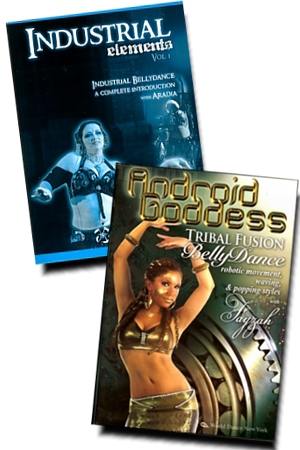
Aradia's Industrial DVDIndustrial Elements Vol. 1: Industrial BellyDance
– A Complete Introduction with Aradia

Run Time: 90 minutes

This instructional DVD focuses primarily on teaching Pop and Lock technique layered into Belly Dance, though does not specifically label itself as Tribal style. It begins by breaking down popping, ticking and locking and proceeds to demonstrate combos utilizing these foundational moves. There are ample sections of practice for each move and combo, allowing the student to grasp the material before moving on. The DVD culminates in a performance by Aradia, demonstrating strong belly dance style with the harder edges of Pop and Lock blending in nicely. This DVD encourages the viewer to warm up prior to participating, as there is not a warm up or conditioning segment. Warning: If you are purely attracted to this DVD by the title, prepare to be disappointed. This recovering Goth kid didn’t sense even a touch of the edgy, abrasive aesthetic of Industrial. However, if you are a beginning-intermediate belly dancer, looking for a smooth introduction to Belly Dance/Pop and Lock fusion, this is a great place to start!

Production Quality: Fair. Studio background is cluttered with advertising banners and performance content is shot on equipment of lesser quality. As an added bonus, there is an insert listing and explaining each move, which I found pretty handy.

Music: Great music choices, easy on dark ears, though not Industrial.

Overall Rating: Three Zils
3 zil rating

 The other side of the coin: You are looking for a POP AND LOCK style with Belly Dance undertones…

Fayzah does AndroidAndroid Goddess: Tribal Fusion Belly Dance;
Robotic movement, waving and popping styles with Fayzah

Run Time: 140 minutes

This DVD definitely covers a lot of ground within its two hours and twenty minutes. It begins with a thorough warm up and intense yoga/pilates workout for conditioning. Most of the content of this DVD focuses on break down of robot style Pop and Lock, demonstrating and explaining isolation, separation, hits, pauses, stops and myriad other moves. Talk-throughs are not rushed; Fayzah takes her time demonstrating each concept clearly and expertly. It did take over an hour to actually touch on any sort of belly dance and the segment focusing on Tribal stylization is short compared to the Pop and Lock content. If the student already has a strong background in Tribal style belly dance, this video could be the next step forward in expanding their fusion repertoire.

Production Quality: very clean and professional, with strong attention to detail in instruction, performance and costuming.

Music: Funky retro style for ‘botting, not much belly dance influence until the later chapters.

Overall Rating: 4 Zils
Zil Rating- 4

Product Purchase Information

Artists sites


use the comment box

Have a comment? Use or comment section at the bottom of this page or Send us a letter!
Check the "Letters to the Editor" for other possible viewpoints!

Ready for more?


Gilded Serpent presents...

Learning To Belly Dance The U.K. Way!

2 beginner DVDs

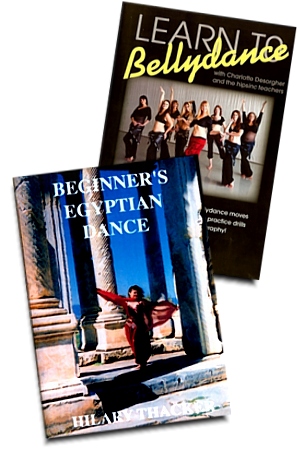
Hilary’s "Beginners’ Egyptian Dance" and
Charlotte’s "Learn to Bellydance"
by Sadira/Sierra
posted December 19, 2011

Hillary's DVD

“Beginners’ Egyptian Dance” by Hilary Thacker

Hilary’s biography states that she is a renowned professional Egyptian-style Belly dancer who performs and teaches throughout the U.K. and in the Middle East.

After watching her Beginner’s DVD, I can tell that she is an accomplished teacher, but I would not characterize her dance style as Egyptian.  Although most students who are wanting to learn dance at a beginner’s level may not distinguish the difference between Egyptian, Egyptian Classical, Egyptian Modern, or Egyptian Folkloric; there is a difference in styling between an authentic Egyptian style and the basic Arabic style mixture originating from the United States. If you are labeling your DVD with a specific style, it is important to differentiate what you are teaching.  Though there are some crossover movements on this DVD, it cannot be classified as beginning Egyptian dancing.

The DVD was recorded at the Temple of Aphrodite, used as the backdrop throughout the entire session. This background was a huge detraction for the teacher and a detriment for the student wanting to learn the movements she was describing. While a beautiful tableau, it was not conducive to learning by allowing the break downs of the steps to be seen, nor the intricacies of movements either. Producers sacrificed a beautiful photo opportunity for the more important reason for this DVD, and that would be to show close up and detailed video presentation of the dance movements.

While Hilary used a great variety of descriptive wording to break down the mechanisms of the core beginner movements, they were not visibly shown in the video presentation. Especially during the hands and arms section, the hands are diminished in size and were a total waste in including in the DVD as it is almost impossible to view.  The teaching breakdown of the video would have been sufficient–if movements were repeated enough to be seen–along with the body mechanics used to create the movements.

While Hilary uses amazing verbiage and mechanical parallels to describe techniques, many times the wording became over-whelming and not understandable for a beginner to break down on the level of body mechanics.

At times it seemed quite confusing, as she would use complex terms to describe a particular movement, and then, as she would continue to develop the step, she would stop breaking it down in a sequential pattern. The instruction is too “wordy” and left me feeling like the old dilemma of “trying to rub your stomach with your right hand while you pat your head with the other”.

It would help if the anatomical and placement areas of the body were more clearly defined than to align your hips or foot movements with “the edge of your hip scarf”.
Personally, I was thrown off by the use of Thacker’s terms for movements; however, that is just a case of semantics, because–I noted in the other introduction DVD–the same terms seem to be common names used by instructors in the U.K.  It’s different terminology than is familiar in the U.S. 

Strange names for movements used in the U.K. such as “snaky arms”, and the most repeated “wobbly walk” and “wobbly movement” in describing shimmies, as well as “quiver in your bellybutton” are off-putting. 

(I know if I were a novice, trying to imagine what that meant along with the undefined visual I was seeing, it would become a mess!) There were no counts to the rhythms or the steps, and it’s basically a DVD in which you follow along as the instructor demonstrates, instead of learning solidly correct basic posture and core positions.

I will say that, in this video, Hilary uses a well spoken and modulated voice in describing the steps.

She is very good at showing all angles of the body during the movement phrasing. The video is of good quality; except that you can’t define the movements by the placement of her body so far away from the camera. Each section that she teaches is stopped and clearly labeled such as: Hip Pivots, Isolated Movements, Hip Circles, all of which makes it easy for the viewer to connect the movement–its name and its appearance. If the breakdown of the steps were a bit more simplified, and we could see her whole body close-up, I feel Hilary would definitely offer an adequate beginner’s DVD from which to learn basics. Unfortunately, this DVD missed the mark by a long shot!

One of my pet peeves is introducing the art-form of Middle Eastern dance as a “therapeutic, healing, sacred art that has existed for 100s of years”. There is no real corroboration historically for this statement, and Thacker shows no reference as to why she believes that it is so.  I would hope for a bit of understanding about the simple 4/4 rhythm with which the dance is usually paired and how to count out the rhythms with the movements.

It’s always great to see a teacher show a complete dance routine at the end of the instruction, using the exact steps taught in the DVD. Instead, we see on this recording various montages of free form or class routine dances of her own students, interspersed. The first montage is totally Turkish music and the American Turkish/Arabic styling (as well as costuming) along with poor non-professional video footage of performances and shows with students and dance troupe.

I will say that unlike Egyptian style which Hilary believes she is teaching, I did see a lot of influence of styling from Rhea of Athens, Greece, who was my teacher back in the ‘70s and ‘80s and that viewing this DVD was a fine opportunity to see that core style continuing.

Rating: 2 ½ Zills
2.5 zil rating


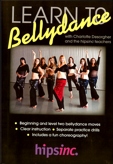
Charlotte's DVD“Learn To Bellydance” With Charlotte Desorgher and The Hipsinc Teachers

If you want to feel like you have stepped through your television screen and entered an actual class, this is exactly what Charlotte’s DVD creates as an experience for her viewer.  I found this to be an extremely exceptional dance instruction DVD–well polished and taught!

In the beginning, while Charlotte  introduces herself and some of her hipsinc teachers, she intersperses that with what she believes Belly dancing offers on many levels beyond a simple dance modality or experience. She used the words “therapeutic and healing”; yet, her words are followed up with the reasons this is found in this particular dance form–from developing self-esteem and self-confidence–no matter what age or body shape you are, to actually giving help with posture, core postural alignments that help with the muscles and body wellness in general. That was a big plus!

This DVD was handled professionally from start to finish. It was obviously developed and coordinated to create a cohesive recording–start to finish. Charlotte is front and center in the video, with a clear view of her entire body length showing the fineness of movements.  I found her to be a master at breaking down each movement to its finest and finite levels of degree so that the student would not only perform the movement correctly but see the interplay of correct alignment of the body and use of the body mechanics.

First and foremost, Charlotte began with a warm-up technique that the viewer starts with along with her. Instead of telling a student to warm up before starting the DVD, she starts the DVD with a guided warm-up that includes the muscles and stretching that facilitates getting the particular muscles involved that may be new to first-time students. Foremost,
Charlotte teaches the core postures needed throughout all of dance training: a straight back, tucked pelvis, relaxed, with slightly bent knees. Without addressing these first major posture points, not only do injuries take place by doing movements incorrectly, it immediately sets the dancer into her prime resting space to which one returns during and between movement and transitions. Bravo! She consistently repeats throughout the video these baseline postures and reminders.

Desourgher’s teaching style is warm, supportive, and repetitive for each movement on both sides of the body; it is re-examined from it’s basic breakdown to added-on and refined movements. I can’t speak enough about her excellent body mechanics and understanding of the physical and muscle individualization. To give a student a firm and solid base, she is able to deconstruct in a excellent manner.

Once she breaks down each movement, she then uses a medium, quickly paced 4/4 tune and shows it to you as if in a class setting–with the background of her other teachers repeating the movements along with her.

She ends each portion with “Well done” and you feel you are a part of the class and her encouragement.

Another important point is: she shows the difference in how a step should be executed along with the wrong way of executing it–how it affects the body line and the movement itself. Dancers can see how a slight movement made too largely or not executed as shown can appear ungainly. She then shows each individual movement from all four angles of the body and it how it should be defined.

Charlotte’s instruction is warm, personal, and well disected. I would highly recommend this DVD for beginners to intermediates.

Another important aspect is that she counts out the steps with the rhythm as you are learning the steps and gently incorporates the use of arm movements when you are ready to add them.

Again, I was struck with the terms used in the U.K. for their steps which would be confusing for an American dancer to interpret. Charlotte explains that in the U.K. what is known as an “Egyptian Walk”, is called a “Three-quarter Shimmy” in the U.S.; that information helped clear up some of my confusion in the earlier DVD that I mentioned. Again, the old “wobble” term is used during shimmies and “let it just go free” seem to me not to be a constructive way to teach technically correct shimmies, but perhaps that is a matter of semantics.

At the end, she puts together a lively and fun choreographed routine that employs all the movements you have just learned, and you can actualize them into a entertaining dance. She also mentions the name of the song and the artist of all music used in the recording.

Charlotte is a dancer’s teacher; she ends with an appropriately pleasant cool-down stretch and focuses on the dynamics of proper body mechanics with a twist of fun and joy! So many beginner (and especially advanced teaching DVDs) assume the viewer knows what a good warm-up and cool down ought to be–when they have no idea. She incorporates the whole package so that you have an experience tantamount to being in an actual live class.

My only complaint is that the video qualities of this DVD are not first rate, her voice at times comes out with an echo and the room can, at times, cast shadows. In regards to her montage of students speaking (while I first thought it was unnecessary as I listened to their personal stories) I realized how much they all truly embodied what the terms “healing”, “therapeutic” and “sacred” mean as they pertain to this dance through student experiences.

 
Rating: 3 ½ zills

Zil Rating- 3

Comparison of both DVDs:

Both these videos show a similar structure of what is considered basic core beginner movements and steps. Except for the quality of videos and the different styles of teaching, they are similar in what steps they consider to be beginner core movements. They include: isolated movements, hip sequences, pivots, shimmies, hand and arm movements.

While Hilary’s Beginners’ Egyptian Dance was well thought out; it did not deliver–due to  inconsistency and wordiness in describing how to break down each step, as well as lack of quality in making it possible to see the movements being performed for a newly beginning level dancer. You get a wonderful sense of the difference but commonality in U.K. with the standardized wording they use for the varieties of  movements they teach, but remember they are not the same as the names used for the same steps and movements in the U.S. Using words such as wobbly, letting your navel free, etc. is, to me, a problem that encourages a student to just shake everything she has without control or precision.

While Charlotte may have had a bare-bones studio in which to tape; her enthusiasm, excellent verbiage and control of understanding how to  break down moves incrementally makes up for that slight quality standard. Her enthusiasm, repetition of steps, and showing both sides of the body (as well as all angles) will make you a more observant and enabled beginner. You will also have fun and feel a part of the larger movement of all of us dancers who love this dance.

Therefore, my advise is to definitely pick up “Learn To Bellydance” by Charlotte Desorgher and know what it’s like to learn your beginning basics correctly and enjoyably so that when you decide to take a real class in person, you will be far ahead of–if not equal to–regular class attendees. Have fun!

Product Purchase Information

Artists sites

use the comment box

Have a comment? Use or comment section at the bottom of this page or Send us a letter!
Check the "Letters to the Editor" for other possible viewpoints!

Ready for more?


Gilded Serpent presents...

Edward and Tahia:

Breaking Down Cultural Appropriation Myths


by Shema/ EmmaLucy Cole
posted December 18, 2011

Paper originally given as part of the Panel discussion “Globalization and the Cultural Appropriation of Bellydance” at MassRaqs 2011.

In this article, a paper originally presented at MassRaqs 2011, Shema (EmmaLucy Cole) discusses cultural appropriation with respect to two articles authored by the late scholar Edward Said. Exploring the meaning of the term “culture,” she notes that Westerners are particularly prone to placing value judgments on what should, and should not exist in Arab dance arts “and this is where imperialism exists.”

Discussing Said’s views of the contrast between ballet and the Eastern dance as represented by Tahia Carioca, Shema notes that the author saw “no relation between Western dance forms, and ‘Eastern’ belly dance or even in the ability of artists from other cultures to appropriate the dance form.”

Shema does not intend her work to be the last word on the subject of cultural appropriation. “I do not expect to provide answers,” she writes, “but instead to lay out and consider some of the difficulties.”

“Cultural Appropriation” has been loosely defined as the use of a group’s culture in ways that they do not approve of’. 1

But what is “culture,” and how (if at all) have we appropriated it? Who is the implied speaker here, and what makes us believe that there is disapproval being voiced?

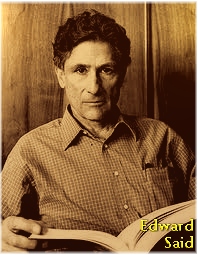
I intend to explore this concept in relation to two particular texts which I came across recently, written by Edward Said, the author of "Orientalism", a revolutionary thesis which exposed the West’s relationship to the “Orient.” Entitled “Homage to a belly dancer” and “Farewell to Tahia,” they both focus on the author’s evident awe for Tahia Carioca and expose some very interesting revelations about Said’s personal opinions on both the dance, and the woman. I do not expect to provide answers but instead to lay out and consider some of the difficulties. I should also point out that I am not a dance ethnologist, but a literary and cultural researcher; the statements herein are simply my exploration of this subject and I welcome comments and further discussion. Although the use of the word “bellydance” is itself problematic, I have chosen to retain it for the purposes of this article, since the title of the original panel included it (although I will discuss this later in the paper) and when I refer to “Western” ideologies, I am predominantly referring to British viewpoints, but many of these are of course applicable to America and Europe also.

What is culture then and why is an understanding of it relevant to our discussion of twenty-first century bellydance? “Culture” is used to refer to any number of elements of how a group of people live their lives. It may include their arts, laws, customs, knowledge, beliefs, capabilities or habits. It is a “generic concept” which when used in theoretical discussion essentially becomes meaningless due to its impractical catch-all nature.2 In his book entitled Cultural Imperialism, John Tomlinson says that:

“What we need to understand is not what culture is, but how people use the term in contemporary discourses.” 3

In Western bellydance communities, we speak in terms of dance, but of course, music, language, dialect, fashion, politics, religion, magic, and many relics of colonialism are not only to be found within this but are what holds the dance together- its “glue,” as it were.

Problems often arise because Western thought processes have placed a judgment on how life – and, thus, “culture”- is lived and this is where imperialism exists–in the West’s presiding over what should, or should not, exist within an Arabic art.

TahiaWhen non-Arab dancers choose not to comprehend the language, politics and lifestyle differences which are inherent in the dance, they are inevitably placing their own viewpoint onto not only the dance produced outside of the countries of origin, but also the dance produced within those countries themselves.
There is an historical and contemporary interplay between both culture and economics in the process of domination and consequent cultural appropriation. In our own dance community, is our use of foreign cultures enabling economic imperialism, or is economic imperialism itself being used to underpin the impressing of our own culture onto that of a subjugated group?

By this I mean that it is possible that by using an “Oriental” (and I use that term deliberately), or perhaps “Orientalised” art to earn money, our distinctive Western values are directly altering the dance, despite often being geographically and culturally removed.

So, is the motivation here financial, or cultural? As dancers, do we consider enough the consequences of portraying a dance as “authentic” when it has in many ways been shaped by our own Western values, habits and cultures? As Marilyn Adler Papayanis says:

“I have been forced to confront my own careless appropriations, my own cultural thefts: committing acts of cultural voyeurism, exploiting the Other’s difference to enhance my own desirability.”4

Said’s comments in the two articles claim a distinct difference between the two cultures (and it is interesting to note that he buys into the notion of “bellydance,” using the American Orientalised word despite many years spent theorising against the use of such terms which essentially alienate the original Arabic culture by refusing to use its language):

“Belly-dancing in many ways is the opposite of ballet, its western equivalent as an art form. Ballet is all about elevation, lightness, the defiance of the body’s weight. Eastern dancing as Tahia practiced it shows the dancer planting herself more and more solidly in the earth, digging into it almost, scarcely moving…Tahia’s dancing vertically suggested a sequence of horizontal pleasures, but also paradoxically conveyed the kind of elusiveness and grace that cannot be pinned down on a flat surface…She belonged to the tradition of the alema…that is, a courtesan who was extremely literate as well as lithe and profligate with her bodily charms…You couldn’t take Tahia out of a Cairo night-club, stage, or wedding feast…. She is entirely local, untranslatable, commercially unviable, except in those places…Every culture has its closed off areas, and…Tahia Carioca…was, one of them.”5

Said makes it evident that he sees no relation between Western dance forms, and “Eastern” belly dance or even in the ability of artists from other cultures to appropriate the dance form:

“As in bullfighting, the essence of the classic Arab belly-dancer’s art is not how much but how little the artist moves: only the novices, or the deplorable Greek and American imitators, go in for the appalling wiggling and jumping around that passes for ‘sexiness’ and harem hootchy-kootch.”6

There is a sense of ‘purity’ to his description both of Tahia and the dance, both, in his mind, having been apparently untouched as yet by outside influences; something which he clearly indicates would carry negative connotations. Of course, one cannot avoid the fact that at the time Tahia was dancing, Egyptian Baladi musicians were incorporating Western instruments such as saxophone, accordion and trumpet into their compositions and therefore it is unrealistic of Said to hope that the same was not happening in the dance.7  Toward the end of her life, Said finally met Tahia and even his words here belie a respect bordering on religious awe:

“About 10 years ago I made a special pilgrimage to Cairo to interview and meet her” (my italics).8

Purity of culture is clearly important to Said here; indeed, following his train of thought, without the influence of bellydancers from Western countries, would Tahia’s successors have begun wearing mini-skirts or thongs to perform in?9

Edward SaidHowever, the point must be made that any hegemonic [dominant] influence requires the consent of the majority, in order to take hold. Which brings us to the question of voice; who is really speaking when it is implied that there is disapproval? And if hegemony requires the majority to consent, then is it a minority who are disapproving and should they be listened to? As Tomlinson suggests, often diasporic nations indulge in “nostalgic cultural imaginings” in order to define themselves and their heritage –they no longer experience the reality of everyday life which they have left behind, and may idealise and simplify their own culture, resulting in the rarefaction of these elements of combined cultural memory.10 Yet, as Karim Nagi comments, on Arab presence in the dance world:
“Many Americans, or non-natives, are participating in a huge industry, for better or for worse…What has happened to our dance because we haven’t represented it? Many positive things; some things that we would not approve of…the cause is our lack of participation.”11  

Indeed, there is far more judgment from British women towards bellydance, because it does not fit into our own “culture,” our way of behaving, or what we traditionally perceive of as “art,” yet it is still becoming one of the most popular dance forms, with its classic Orientalist fantasies being confirmed regularly by an ill-informed media. Said states that:

“Tahia seems to me to embody that beyond-the-boundary life for Arabs today. Our history is mostly written by foreigners, visiting scholars, intelligence agents while we do the living, relying on personal and disorganised collective memory, gossip almost…to carry us forward in time.”12

In the course of writing this paper, I have wandered frequently back and forth between being inspired by forward-thinking and talented artists (from both the East and the West) and the urge to just give up completely for fear of perpetuating damaging and Orientalist myths! Yet through researching some of the more significant issues surrounding appropriation, I have definitely grown as an artist and it has effected some changes in my own practice.

The most positive thing which should come out of discussions such as these is the element of education; if we can continue the process of discussion and conversations around the subject, maybe there can be less cultural appropriation and more cultural collaboration.

I end with a quote by Robert Young:

“As an intellectual, an artist, a consumer or producer of culture, you either collude with the aestheticized structure that enforces apartness, or you contest it…”13

‘Shema’s attendance at MassRaqs was supported by The University of Bristol Graduate School and Alumni Foundation

Footnotes:

  1. 1-Meiver De La Cruz – from her preliminary notes for the Panel Discussion ‘Globalization and the Cultural Appropriation of Bellydance’ at MassRaqs 2011
  2. 2-John Tomlinson, Cultural Imperialism: A Critical Introduction (London, Pinter Publishers, 1991), pp. 2-3. Tomlinson is quoting Mattelart and his exploration of how to approach the ‘problem’ of imperialism and thus ‘cultural imperialism’. Tomlinson goes on to state that in his own discussion, he will avoid using one single definition (since this does not allow a full understanding of the subject) but will instead use the concept of cultural imperialism ‘which must be assembled out of its discourse’.
  3. 3-Ibid, p. 5.
  4. 4-Marilyn Adler Papayanis, Writing in the Margins: The Ethics of Expatriation from Lawrence to Ondaatje (Nashville, Vanderbilt University Press, 2005), p. ix.
  5. 5-Edward Said, Farewell to Tahia at Al Ahram Weekly Online accessed 22.6.11
  6. 6-Edward Said, Homage to a Belly-Dancer at http//:www.lrb.co.uk accessed 22.6.11
  7. 7-More information on the history of Baladi music, including how the presence of British, French and American military bands in Cairo influenced the development of Egyptian music, can be found in the articles by Guy Schalom (with Sheikh Taha) at www.guyschalom.com
  8. 8-Edward Said Farewell to Tahia at Al Ahram Weekly Online accessed 22.6.11
  9. 9-Here I am referring to Dina’s infamous costume (of around 2009) which featured a thong clearly visible above the top of her skirt, and the numerous dancers working currently in Egypt who dance in high heels and mini-skirts.
  10. 10-Robert J C Young, A Very Short Introduction: Postcolonialism (Oxford, Oxford University Press, 2003), p. 63
  11. 11-Karim Nagi Lauren of Arabia:Lecture by Karim Nagi accessed 3.9.11
  12. 12-Edward Said Farewell to Tahia at Al Ahram Weekly Online accessed 22.6.11
  13. 13-Robert J C Young, A Very Short Introduction: Postcolonialism (Oxford, Oxford University Press, 2003), p. 58.

use the comment box

Have a comment? Use or comment section at the bottom of this page or Send us a letter!
Check the "Letters to the Editor" for other possible viewpoints!

Ready for more?


Gilded Serpent presents...

A Whole Lot of Sax Going On!

Sax CDs

A Review of 2 CDs from Hossam Ramzy Featuring Saxophone Music
Afrah Baladi with Mostafa Sax

CD Reviews by Catherine Barros
posted December 14, 2011

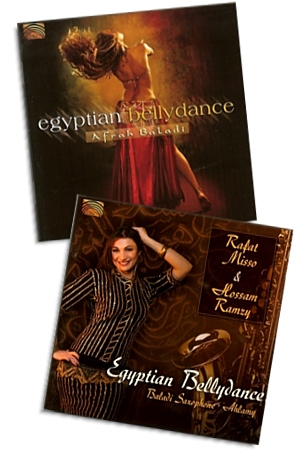
The saxophone was popularized in beledi music starting in the 1970s. Although I wasn’t introduced to Middle Eastern music until the ‘80s, I believe the first recordings I happened upon featured Samir Sourour.   In the 1990s,  Hossam Ramzy had the opportunity to work with 2 other Egyptian sax players and has produced these 2 CDs with original compositions  and classical/traditional folkloric pieces.

“Ahlamy – Baladi Saxophone with Rafat Misso and Hossam Ramzy”
(Copyright 2008) -Originally released in 1996.

The first CD, "Ahlamy", has been available for purchase for 15 years and has probably garnered many fans during that time.  When I first started listening to this, I did think it was a new release  and then found the date from the CD information was 1996 and that this recording is a re-release with a new cover.  My first take on this was that no new ground had been covered. However, after re-considering this,  it might warrant a first or second look for many dancers.  

Some of the keyboard instrumental segments might sound a bit dated to some ears but the selections cover an inclusive range. (However, I am not a keyboard fan myself.) Due to my love of accordion music, I am most likely going to be attracted to the pieces that have accordion sections.  "El Hanim" along with "El Sama Billey l" (both composed by Rafat) are my 2 favorites because I like the use of the accordion along with the saxophone.   The versions of "Sallam Allay" and "Ya Tamr Henna" that have been included are quite satisfactory.  "Ala Rimsh Oyounha Abilt Hawa" was a bit too fast for my taste but probably will appeal to another dancer–as will the other selections available ("Lamma Ramtna El Eyin", "El Shouma", and "El Baladi Youkal").

Rating:  3 zils
3 zil rating

“Afrah Baladi with Mostafa Sax”
(Copyright 2010) – originally released in 1994 as "Hayati – Best of Egyptian Belly Dance Music"

The 2nd CD, "Afrah Baladi", likewise, has been available for quite awhile. This is also a re-release under a new cover.  

Although I didn’t find anything on this CD that excited me enough to get up to dance and start planning a performance,  I do feel that the longer selections on this CD would be motivating for practice.  In particular, "Eddalla ya Rashidi" (9:20), "Henneya" (9:43) and "Raqs el-Khail" (8:28) are all long enough for use in a class.  Each has its drum rhythm coming through clearly, which I think is quite helpful for any student.  Also, the longer pieces could be used for a troupe performance that  would need extra time (for managing several dancers’ movements around the stage).

"Sunset in the Sahara" might inspire a dancer to bring out her sword because it is played at a pleasantly slow and sensuous tempo that calls for floor-work or sword.  "Afrah Baladi" is a bit more versatile as it has an unusually slow start with a 2 minute taxim, progressing into a medium tempo that speeds up and then finishes off with 1 1/2 minute drum section.    "Farah Amira" is similar to "Afrah Baladi" without the drum section at the end–and they both are approximately 7 minutes in play time.

Rating: 2 zills
Zil Rating- 2

In Conclusion:
I feel that both of these CDs have music that is usable for performance or classroom work, depending on your personal musical tastes.  They are definitely worth a listen–if saxophone music  appeals to you. I spent extra time this weekend wandering around the Internet and Amazon Plus E-music, searching and listening to some other recorded saxophone music.

Perhaps one of the best ways to use a review is to allow it to stimulate and motivate dancers to listen to other music!  

use the comment box

Have a comment? Use or comment section at the bottom of this page or Send us a letter!
Check the "Letters to the Editor" for other possible viewpoints!

Ready for more?

  • "Aheb Masr, Music and Songs for Oriental Dance"
    produced by Nader Zakaria, at Merryland Studio Heliopolis, Artistic direction by Yasmina. Depending on your mood and tastes, there should be something for just about everyone on this CD.
  • Dina: April 2008
    It was a late night as usual as we didn’t even go out until midnight to have dinner and watch Dina at around 3am . . . but who was watching the time . . . It is CAIRO!
  • Journey of Desire: A Foreign Dancer in Cairo, 2006, Review
    I believe that any dancer who has the desire to go to Cairo to work will benefit from the experiences of Yasmina and the other working dancers whom she asked to contribute. One will come away having a better understanding of the Arabic culture and how the dance is viewed within that culture.
  • A Conversation with Dr. Mohamed Geddawi
    Dr. Mo is attentive to the workshop participants, giving a breakdown on each combination, and provides individual attention when someone has a difficulty. His no-nonsense style of teaching is informative, making you think about why you dance, how to dance, how to be a better dancer, and making you laugh.
  • Farida Dance presents Cairo Nights: 2005 and 2006 DVDs
    There are so many nuggets packed into these 3 DVDs other than the 3 dancers for which I purchased them. I keep finding things that I really enjoy as I go back to watch them time after time.
  • Fifi Reloaded! Review of Fifi Abdo Workshop and Show
    Sponsored by Little Egypt Holiday Inn Select, Dallas, Texas May 18-20, 2007
  • Dance Combinations – Uneven, Misnamed Productions Still Worthwhile, “Cool Combos ‘a La Galit” and “Combin-Ography by Bahaia"
    Through the process of comparing and contrasting these two DVDs, I learned that in our technical age, although there are many people out there that have knowledge that can and should be shared, production value really does count for something.
  • Metamorphosis of a Latin Belly Dancer, DVD review of Bozenka’s ¨Journey of a Dancer¨
    This caused me wonder: she states she improvises 99.9% of the time she performs, but how does she improvise her work while she performs on stage (if she likes it, she memorizes it?) and teaches it later in her workshops?
  • And Here’s a Work from…the Lovely Jenna DVD: "Bellydance, The Next Level"
    When I’ve gone to Jenna’s classes, I noticed she had a knack for making the students comfortable with themselves while learning new steps. This persona still comes across on DVD.
  • Bottoms up! Two Belly Dance Starters, Bottoms Up! Two Belly Dance Starters Cory’s "Learn Belly Dancing" & Said’s "Get Ready to Dance"
    Reviewers of Cory’s other DVDs have often complained that the quality of filming and lighting were not good. I didn’t find this to be a problem with Learn Belly Dancing. Although it’s not a slick production, you can see and hear everything you need to perfectly well. Cory has a clear, pleasant manner of speaking that is easy on the ear.
  • Listening with the Arabs, ASWAT’s February 2011 Concert
    The concert consolidated a much needed expression of hope, excitement, and pride. I felt lucky to be in the audience, to share solidarity, and to be exposed to songs novel to me.
  • A True Arabic Experience, November 2010 Arab Dance Seminar in New York City
    His seminar emphasizes the cultural roots and context of this dance form; it is a form that is experiencing a disconnect as more dancers are entering the community through fusion and often not developing an understanding of its historical origins. Each seminar is themed to focus on a variety of elements within the culture, dance, and music of the Arab world.
 

Gilded Serpent presents...

Inspiration and a Push From the Stars

click for enlargement

A Dancer’s Destiny Part 1

by Antoinette Awayshak
posted December 16, 2011

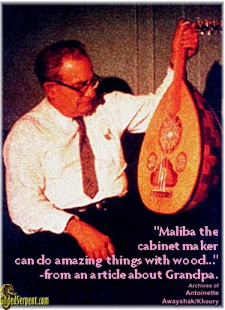
Grandpa the oud makerIt is unusual for an Arab girl (bint Arab) to become a dancer. My parents and grandparents were Syrian and migrated to America in the early 1900s  I lived in Brooklyn with an extended family that included my mother, two aunts, three uncles, grandmother and grandfather. My grandfather was a cabinetmaker, and he specialized in making ouds and inlaid backgammon tables (talwas). I grew up with the Arabic culture deeply ingrained in me.  I ate Arabic food, listened to Arabic music, and spoke only the Arabic language until I went to school. My mother sang, accompanied by live music at the Arabic parties (haflas).  Like many little girls, I would dance to the Middle-Eastern rhythms. My mother and grandmother would take me to the movies to see the famous dancers and singers.

Dancers Tahia Carioca and Samia Gamal fascinated me as they glided like gazelles in their gorgeous costumes.  At home, I often amused myself by watching myself in the mirror as I imitated the dancers I had seen in the movies.

Out of this background grew my love for dancing. Desperately, I wanted  to be a ballerina, but my mother wouldn’t let me take ballet lessons for fear it would build ugly muscles in my legs. I was so determined to learn that I secretly checked out books about ballet from the library and practiced the steps on my own. Of course, I couldn’t really learn much that way!

Finally, after graduating from high school in Southern California, I could make my own choices. One of the first jobs I had was teaching for Arthur Murray Dance Studios. I reasoned that I would have to learn all of the dances in order to teach them. The more I taught, the more I learned, and the more I found myself drawn to the Latin rhythms.  I found a dance partner and started doing exhibition dancing at Latin concerts at the Palladium and other venues in Hollywood where I met a young man who was a Flamenco dancer, Roberto Lorca who became my partner for some of the exhibitions. He had been dancing with the Jose Greco Flamenco Dance Company.  Kanza OmarHe aroused my interest in Flamenco dancing, and I discovered that I could relate to the emotions and the expressive nature of the Flamenco music and dance. It was almost the same intensity of emotions and expressiveness contained in Arabic music and dance.Roberto Lorca Roberto Lorca went on to become a successful Flamenco dancer. I married, had a son and decided to go to college, but all I could concentrate on was dancing; I took modern dance in college and then enrolled in workshops taught by  choreographer Lester Horton, who headed a successful dance company.
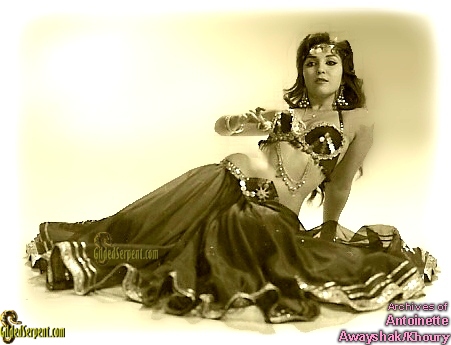
Around this time, my mother was singing at Mahrajan’s  when they held Arabic functions and there was a dancer by the name of Kanza Omar, who was my idol.

She came to the affairs dressed in mink coats and looking like a movie star; her costumes were dazzling! She appeared in several films in the Middle East and also in a few American films.  I aspired to look like her when I danced.  I begged my mother (They were friends.) to ask Kanza to teach me how to dance in the Arabic way. Unfortunately, Kanza died an untimely death-but before that she had given my mother one of her dancing skirts to pass on to me.

Kanza Skirt
Here I am in the skirt that Kanza gave to me.
This was just a bra I bought and sewed some sequins on. We didn’t have the costume resources like today. We picked up stones off the ground and glued them on (just kidding!). The gas stations had a promotion where they gave away presidential memoritive coins. I gathered about 100 and had someone drill holes in them and made a costume out of them as a joke. I made my own belts and bras using authentic coins. I like the weight and sound. I had a gold and a silver one and just changed the skirts.

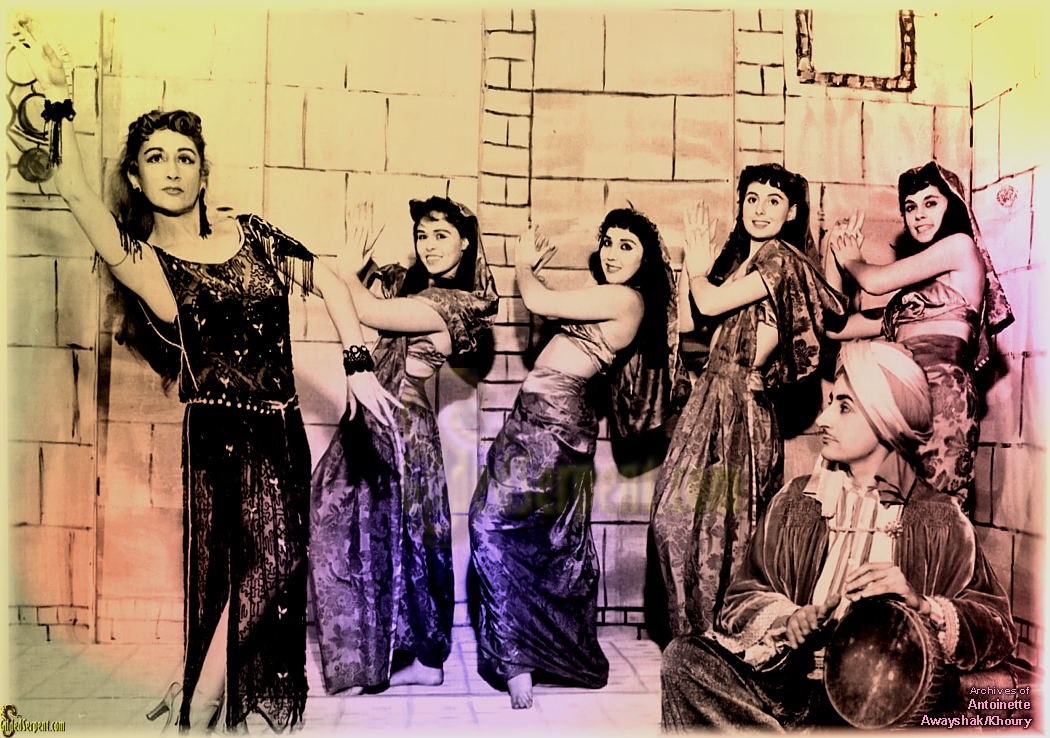
I had some Arabic girlfriends who were dancing in a small company that was headed by an Arabic woman named Delal Muir. Delal created Arabic shows around town and entertained soldiers on army bases with her dancing. Her brother, Antoon, wore a turban and played the drums and her other brother played the oud.  I joined her troupe at the urging of my friends. It consisted of Delal, four girls, and me. We traveled around in a big bus, sometimes hundreds of miles away, to the shows.  Delal was the star of our show, and her performances included snakes slithering out of wicker baskets! This type of dancing did not live up to my perception of how Arabic dancing should have been performed…


Delal
 Delal Muir  (I’m 3rd from the left) and Antoon on the drums. This is before I started working in the clubs. We would go to the military bases on a bus. She was Arabic. Dancers, left to right: Delal, ?, Antoinette, Martha Karam, Teresa Karam (twin sisters) The twins were my friends and got me into this. The guy on the floor is Delal brother- Antoon. Another brother played the oud. I don’t remember the 4th girl’s name.

During one of our performances at the Wilshire Ebell Theatre, a woman who had a Flamenco troupe performing that evening approached me. She was Rita Lupino, and I believe she was the sister of Ida Lupino, an actress who was popular at the time. Rita asked me If I wanted to join her troupe, but I explained to her my limited Flamenco dance experience and that the little movements that Roberto had taught me was not enough to perform professionally.  She said I had “the perfect look for a Flamenco dancer” and promised that she would train me.  I was delighted, of course, and went to her rehearsals and studied her routines, heel-work and castanets, but the experience was short lived.

When one of the girls in Delal’s group went to audition for a dance job in a Hollywood nightclub called the Fez Supper Club, she asked me to accompany her. The Fez featured an Arabic show (the only one of it’s kind at the time). I had been to the Fez before. They brought in Arabic musicians, and dancers from the Middle East. The food was Arabic and the décor was right out of a scene from “A Thousand and One Nights”! The owners were two brothers, Lou and Fred Shelby.  Lou was the violinist who played at the Mahrajan’s where my mother sang and Kanza danced.  My girlfriend auditioned–but I was hired.  Lou Shelby said I had just the right look for a Belly dancer.  My Arabic looks, olive skin and long black hair helped. I told him I had never danced in a nightclub nor had I ever danced solo, but he said, “Don’t worry about it; we’ll teach you.” He asked me to start the coming Friday night.

The only other time I had ever dance solo in front of others was at The Peacock Alley, a Jazz club that held a weekly “Arabic Night”, featuring live music.  My mother and some of her friends taunted me into dancing, so dance I did, in street clothes, feeling totally mortified!  Little did my mother realize that night she had launched a career, which initially, she had been against.


Club PR 2
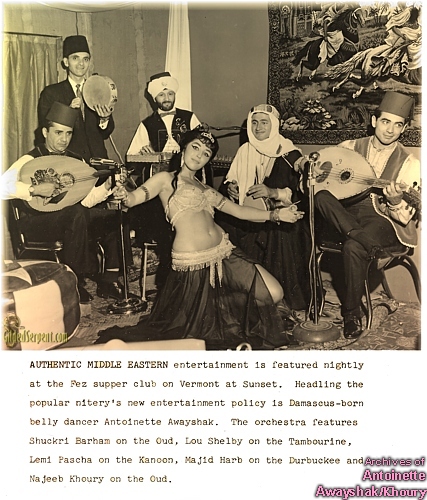
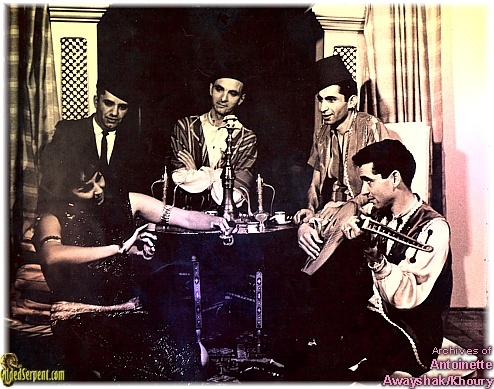
Club promo photo 2—Antoinette, Shuckr, Lou Shelby (Roxxanne’s dad), unknown guy in fez, Najeeb on oud. I have a beledi dress on so this is a different photo session from the top photo.
Club promo photo 1 at top of page. This is a press release. Lou Shelby is Roxxanne’s dad. Lemi Pasha is a Los Angeles resident. On oud is (Dick) Barham who is an Arab. Majib Harab is on drum and is not as young as he looks.

Part 2 of Antoinette’s "Dancer’s Destiny" coming soon.


use the comment box

Have a comment? Use or comment section at the bottom of this page or Send us a letter!
Check the "Letters to the Editor" for other possible viewpoints!

Ready for more?

  • Its Not Your Grandmamma’s Zar
    Luckily at some point we hear the distinct rhythm for a Zar and follow the drumming right to the front door of an apartment house.
  • A Dancer's Dancer in 1980s Hollywood, Interview with Yasmin
    L.A. was heaven for fabrics though. You could find anything you wanted, and if they didn't have it, you could have it made, like the beautiful gold lame' sunburst skirt and veil I had pressed for a costume.
  • The Original Mish Mish, The Golden Age of Tinseltown
    I was working one evening at Khyams and still doing my old style of dance. I came out for my entrance covered with a veil and right at the beginning of my show, she came up on stage and started peeling my veil off me and threw it on the floor. She shook her finger at me and said in broken English "Lah, this isn't Egyptian!" I was so embarrassed and humiliated I could barely finish. Talk about being intimidated!
  • Interview with Jacqueline Lombard, Queen of the Dancers in the Golden Era of Tinseltown
    They refused to play dance music or anything you asked for…got to admit, that really taught how to pull off a show & think quick on my feet. You never knew where they were going with the music, & they tried to make you look bad.
  • How MECDA Began
    M.E.C.D.A., (Middle Eastern Culture and Dance Association) is a nationwide organization which began in 1977 for the purpose of organizing working dancers, sharing information between teachers…
  • Photos from Cifuentes’ Sommer Festival in Berlin
    The idea of presenting a dance festival together with a contest is to promote talent, encourage excellence, and motivate dance artists from all over the world to come to Berlin and participate and results in this special and amazing event of learning and performance.

  • However, no. Instead, Prince X sent a drink to everyone at my table, except me, just to underscore his apparent disapproval of my offensive behavior…

  • "She is a professional singer and dancer, being taught by her mother from her earliest youth, and with the menfolk beating the taboor (drum) and twanging the kamanga (zither) she gives turns at the Beduin encampments for which the "hat" is passed round afterwards.
  • Egypt’s Golden Age, Timeline and Synopsis
    From around 1850 to 2000, Egypt saw the birth, rise, and transformation of its cultural expression through dance. With each period, a new energy in the dance was introduced and, with it, new dancers with new dance movements and new costumes.
 

Gilded Serpent presents...

Photos from
Cifuentes’ Sommer Festival in Berlin

Report and photos by
Ma*Shuqa Mira Murjanand Carl Sermon
posted December 14, 2011

This year, Carl Sermon and I were fortunate to be invited to participate in the 8th Annual Sommer-Festival in Berlin, Germany. Horacio Cifuentes recalled my early performances with Isis Wings in the ‘80s with a pair of wings that I designed and first used at the Rosicrucian Museum in San Jose, CA, USA. Therefore, he invited me to teach a workshop utilizing Isis Wings (which, interestingly enough, are pronounced as “Ee-sis Wings” by Europeans). Carl and I were the photographers of the Oriental Dance and Tribal Dance (wettbewerb) competitions, as well as the Matinee Show and Gala Show held at the historic Russisches Haus Theatre in the former East Berlin.

The Sommer Festival in Berlin is presented by Beata and Horacio Cifuentes as an intensive offering of Oriental dance encouraging professional development for dancers through the opportunity to participate in the finest quality of instruction, competition, and performance. It is a well-organized long weekend in Berlin filled with workshops in Oriental dance and tribal dance held in four dance studios and two show venues.

The idea of presenting a dance festival together with a contest is to promote talent, encourage excellence, and motivate dance artists from all over the world to come to Berlin and participate and results in this special and amazing event of learning and performance.

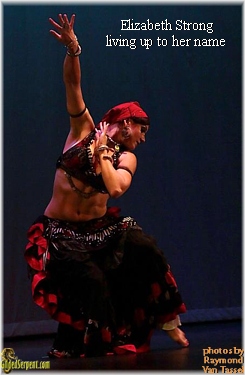
This year, the Gala show was graced by international stars such as: Yasmina of Cairo, Mohammed El Hosseny of Finland/Egypt, Rachel Brice, Elisabeth Strong, and (myself) Ma*Shuqa Mira Murjan, Patricia of Hannover, Germany, Guzel of Korea, Jamilah and Anna Redlin of Poland, Maki of Japan, and Illan of France.

The contests provide the opportunity to display talent and skills, attracting talented professional dancers from around the world. The winners of the raks sharqi contest and the tribal competition experience great benefits gaining international recognition to support professional dance careers. Former competition winners have been featured on the cover of dance publications such as, Tanzoriental magazine of Nurnberg, Germany; and receive invitations to return to this annual Berlin dance festival the following year as workshop teachers, performers, and judges.

Carl and I enjoyed the event, sampling Turkish and German food and touring museums. We enthusiastically recommend the event as a chance for intensive professional development and opportunity to see high quality accomplished performances by European dancers who commit to serious study of Oriental dance as participants in the CATT training program.

If you attend this festival, plan to bring walking shoes to get to the dance studio venues and prepare yourself for an all-inclusive weekend!

This weekend is a uniquely challenging intensive study that includes a fascinating cross-section of both Oriental and Tribal dance workshops, competition, and two performances. We hope to see more American dancers participate in this event, sharing top-quality performances with Europeans in the future. We invite you to enjoy these images of beautiful performances from the Sommer-Festival 2011 shows.


[12-27-11 ed note: Photos have been juggled since original posting to refect the winners by category]

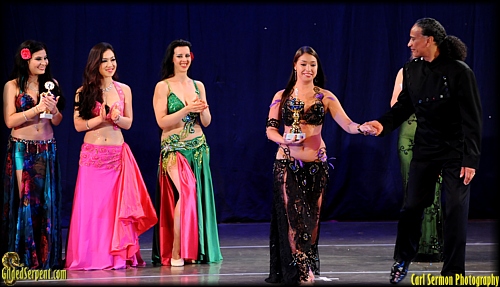
2011 Contest Winners the Berlin Sommer Festival by Category

Preliminnaries in all categories were held on Thursday evening , September 1, 2011.
Finals for all categories then competed on Saturday, September 3.
Oriental Solo Pros in the Gala show in the evening and all other categories were settles in Saturday afternoon in the Matinee show.


Raks Sharqi Solo Professional

1st prize – Valeria – Russia

1st place

Valerie wins!

Valerie of Russia wins!
Valerie of Russia
Valerie of Russia

2nd prize – Agata of Poland

2nd Place

Agata Zakrezewska of Poland

3rd prize- Ranya of Slovakia

3rd place

Ranya of Slovakia
Ranya of Slovakia


Other contestants:

Alexandra of Switzerland

Alexandra of Switzerland


Carol of Venezuela

Carol of Venezuela

Chucha Cukrowska of Poland

Anna Chucha Cukrowska of Poland


Yoon Ha Kim of Korea

Yoon Ha Kim of Korea


Raks Sharqi Semi Professional

1st prize – Varda of Poland

1st place

Varda of Poland
Varda of Poland

2nd prize- Agata Zakrezewska – Poland (pictured above)
2nd Place


3rd prize- Alexandra – Switzerland (pictured above)

3rd place


Other contestants:

Celine of Germany

Celine of Germany

Inara of Germany

Inara of Germany

Lea Elcagu of Switzerland

Lea Elcagu of Switzerland

Nashita of Czech Republic

Nashita of Czech Republic

Nichole McLaren of Switzerland

Nichole McLaren of Switzerland

Selena of Poland

Selena of Poland


Oriental Dance Duo and Oriental Dance Trio

1st prize – Bellyious Duo of Poland

1st place

Bellyious Duo Poland

Bellyious Duo of Poland


2nd prize – Inspirit The Newage Bellydancers of Germany
2nd Place

Inspirit The Newage Bellydancers of Germany

Inspirit The Newage Bellydancers of Germany


3rd prize- Shareefa & Nashita – Czech Republic

3rd place

Shareefa and Nashita of Czech Republic

Shareefa and Nashita of Czech Republic

Other contestants:
none


Tribal Dance Solo

1st prize – Michaela Sladeckova of Czech Republic

1st place

Michaela Sladeckova of Czech Republic

Michaela Sladeckova of Czech Republic
Michaela Sladeckova Czech Repubic


2nd prize –Jeka Tribellydancer of Venezula
2nd Place

Jeka Tribellydancer of Venezula

Jeka Tribellydancer of Venezula


3rd prize – Alhazar of Spain

3rd place

Alhazar of Spain


Other contestants:

Izabella Logonowicz of Poland

Izabella Logonowicz of Poland


Tribal Dance Duo and Tribal Dance Trio

1st prize – Bellycious Tribal Duo

1st place

Bellycious Tribal Duo

Bellycious Tribal Duo


Other contestants:
none


Oriental Dance Group/Formation and Tribal Dance Group/Formation

1st prize – Garam Masala of Czech Republic

1st place

Garam Masala of Czech Republic

Garam Masala of Czech Republic

2nd prize – InFusion – Germany
2nd Place

InFusion of Germany


3rd prize – Shirazia of Switzerland

3rd place

Shiarzia of Switzerland

Shirazia of Switzerland


Other contestants:

Caravan Dancers of Czech Repubic

Caravana Dancers of Czech Repubic

El Sahara of Switzerland

El Sahara of Switzerland

Nour Al Ainy of Switzerland

Shareefa Group of Switzerland
Shareefa Group
– Switzerland

Sintis of France

Sintis of France


Groups pose together with Beata on mic
Groups pose together on stage with Beata, center stage, talking on a microphone
click photo for enlargement


Saturday Matinee

Theater Russishes Haus

  • Overture Beata and Horacio
    Beata

Overture Horacio

Horacio

Overture with Beata and horse

Beata and horse
Mohamed El Hosseny of Finaland and Egypt
Mohamed El Hosseny of Finland and Egypt

Liz Strong

Elizabeth Strong of USA
Ma Shuqa
MaShuqa of USA
Illan of France
Illan of France
(A high school student, self taught with Rachel Brice videos!)

Anna Redlin of Poland

Anna Redlin of Poland (winner in 2010)

Maki  of Japan

Maki of Japan


Saturday Evening Gala Show

Theater Russishes Haus

  • teachers again
  • CATT group
  • 8 finalists of mixed tribal and oriental
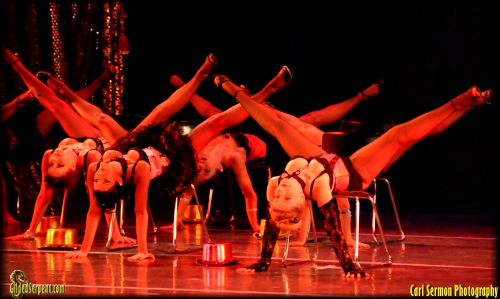
To get the audience into the proper frame of reference for this section of the show, Rosa, the emcee, announced this showpiece with a “singing operatic announcement of this part of the show – in the style of the emcee Joel Gray in the movie “Cabaret”. Fourteen of the most capable dancers were invited to join the CATT company and debuted at the festival with an extremely challenging twenty-minute tableaux entitled “Burlesque Dance Theatre”, a suite of ten dances, lead by Beata and Horacio with story line and high energy dancing in Broadway’s exciting “Bob Fosse” style. Although, one may say, “What does Burlesque have to do with Oriental Dance?” This rendition of Burlesque was a tribute to the finest showmanship of the 1920s-era Burlesque shows in the USA.
CATT Company deos burlesque
Cifuentes’ CATT Company does burlesque.

Horacio takes part

Beata and Horacio do burlesque
Beata and Horacio

This year, the Gala show was graced by international stars such as: Yasmina of Cairo, Mohammed El Hosseny of Finland/Egypt, Rachel Brice, Elisabeth Strong, and (myself) Ma*Shuqa Mira Murjan, Patricia of Hannover, Germany, Guzel of Korea, Jamilah and Anna Redlin of Poland, Maki of Japan, and Illan of France.

Beata
Beata Cifuentes
Horacio Cifuentes
Horacio
Rachel Brice of USA
Rachel Brice of USA
Yasmina of Cairo
Yasmina of Cairo
Liz Strong
Liz Strong
Jamileh of Poland
Jamileh of Poland ( a winner in 2010)

Patricia of Germany

Patricia of Germany (her tribal troupe toured in US with Beata and Horacio last year)

Guzel of South Korea

Guzel of South Korea (won contest in 2009)


Valeria of Russia

Valeria of Russia- 1st place Solo Pro


Next year’s event will be held August 30th to September 2, 2012


use the comment box

Have a comment? Use or comment section at the bottom of this page or Send us a letter!
Check the "Letters to the Editor" for other possible viewpoints!

Ready for more?

  • SFBA MECDA Gala Show & Festival 2010
    Produced by the San Francisco Bay Area chapter of the Middle Eastern Culture and Dance Association, held on November 15, 2010, in the Hillview Community Center in Los Altos, CA
  • Sunday Photos from Rakkasah East- October 2010
    Barakat, Basema, Dena Shazadi, Fatima, Fire Blossoms, Ghada Girls, Habiba, Laura, Leila, Rega, Saiedah, Shadia, Tempest, Willow, Yuliya, Zenaiede

  • Amity, Anka Kusu, Belly Mystic, Bliss, Calixta, Desert Moon, Dorothea, Eddie Kochak, Scott Wilson, Serpent Secrets, Fantasha Dancers, Isis, Jamileh, Kelebek, Latifa, Lily…
  • Friday Night Photos from Rakkasah East- October 2010
    Desert Embers, Dharma, Fahtiem, Leila Haddad, Mystic Wiles, Nadia Layla, Najma, NightShade, Phoenis, Raks Shiva, Troupe Shahibat
  • Your Stage Name, Choosing the Right One
    Beware of letting others name you! Years ago, dancers were often surprised before going on stage to dance as they were announced by musicians or club owners by a name unknown to them that they hadn’t selected.
  • Carnival of Stars, Page 4: O-Z Photos
    The Carnival of Stars Festival is produced by Pepper Alexandria and Latifa at the Richmond Auditorium each year at the beginning of August. The stage at this facility is hard to beat. The wonderful lighting and the large stage make every dancer feel like a diva! Once again, Carl has done an amazing job catching the character of each dancer.
  • Carnival of Stars, Page 3: I-O Photos
    The Carnival of Stars Festival is produced by Pepper Alexandria and Latifa at the Richmond Auditorium each year at the beginning of August. The stage at this facility is hard to beat. The wonderful lighting and the large stage make every dancer feel like a diva! Once again, Carl has done an amazing job catching the character of each dancer.
  • Carnival of Stars, Page 2: D-H Photos
    The Carnival of Stars Festival is produced by Pepper Alexandria and Latifa at the Richmond Auditorium each year at the beginning of August. The stage at this facility is hard to beat. The wonderful lighting and the large stage make every dancer feel like a diva! Once again, Carl has done an amazing job catching the character of each dancer.
  • Carnival of Stars, Page 1: A-C Photos
    The Carnival of Stars Festival is produced by Pepper Alexandria and Latifa at the Richmond Auditorium each year at the beginning of August. The stage at this facility is hard to beat. The wonderful lighting and the large stage make every dancer feel like a diva! Once again, Carl has done an amazing job catching the character of each dancer.
  • Loyalty, A Virtue Out of Fashion?
    Some do not stop to think that it is a matter of basic manners to express your gratitude to an individual who has made an effort to provide well-being and knowledge. They just go and move on to their aerobics classes, horseback riding sessions, judo drills, or other, while the teacher is left behind wondering if any aspect of their lesson caused the pupil to go.
  • Give Credit where Credit is Due!
    However, some dancers are using the same music, costumes and choreography in their performances that they first see elsewhere. This begs the question: at what point does copying someone’s original concept or choreography cross over from homage to stealing?
  • A Weekend with Horacio & Beata Cifuentes, Part 2
    For me, if I am still thinking about it and what I gained from it as a dancer, months or years after I took it, then that is a “golden” workshop. Making it “golden” takes the effort of a lot of people involved.
  • A Weekend with Horacio & Beata Cifuentes, Part 1
    What is it about certain workshops in which the profundity and joy of the workshop stays with you long after it is over?
  • "But others do it too!" Pirating Recorded Music
    I figured we were investing in our future. "One day", I thought, "we can retire from dance and collect the fruits of our efforts as music producers." For a while we were able to retrieve our investment and go into profit. Unfortunately, this has changed now.
  • About my teacher Magana Baptiste
    At the time when her husband placed second in the Mr. America body building contest, and mind you, these were the days when body builders took no steroids and were true examples of healthy humans, Magana placed first runner up in the Miss USA beauty competition held in Los Angeles in 1951.
  • At Home with Fifi Abdou
    In America, one of the things that especially pleased me was the inclusiveness of the dance scene there – in my classes I saw women of many different ages – and body types – enjoying dancing, and that made me happy
  • Journey of Desire: A Foreign Dancer in Cairo, 2006, Video Review
    I believe that any dancer who has the desire to go to Cairo to work will benefit from the experiences of Yasmina and the other working dancers whom she asked to contribute. One will come away having a better understanding of the Arabic culture and how the dance is viewed within that culture.
  • Rachel Brice Goes Balkan: Pogonometric Revue
    Sunday, March 12, 2006, CELLspace, 2050 Bryant St., San Francisco, Cost: $15 and worth every penny
  • Belly Dance, Burlesque and Beyond: Confessions of a Post Modern Showgirl
    “BUT WAIT!!!” I can hear you screaming, “ BURLESQUE IS STRIPPING”
  • Divorcing Belly Dance From Burlesque
    As it is traditionally understood, I do not find Burlesque, (meaning nudity-no matter how hard one pretends it does not) amusing or creative in the slightest when it comes to including Belly dance, an art that has suffered too long with such unfortunate associations. I find it completely irresponsible and detrimental.
 

Gilded Serpent presents...

Saudis in America

Encounters of a Dancing Kind

Beer-money-cleavage

by Najia Marlyz
posted December, 13, 2011
Previously published November 24 1987 in Habibi, Vol. 10, no. 4. 
Revised and expanded for Gilded Serpent December 12, 2011

Where have all the Saudi princes gone? As an observer looking back in time, it seems to me that once we dancers in San Francisco began to see less of the fabulously wealthy Saudi youths who were studying in the United States during the late ‘70s and early ‘80s. We also began seeing many of our common music and dance watering-holes here in the United States dry up because of the loss of their generous support.  I had heard also, via the grapevine, that because of the Saudis, significantly more songs and dances were played upon the heartstrings of our dancers, happening behind the scenes (back in the day) than happening onstage or in public.  I was privy to some of those minor stories and incidents; perhaps you would like to share the wealth…

My first encounter with a Saudi prince happened back in the mid ‘70s when I went to Broadway, San Francisco, to enjoy a cabaret evening, watching professional Belly dancers dance to live Arabic music.  That particular evening, the nightclub’s waitress approached me and said in serious tones, "The Prince wants you to go sit with him."  I looked at my students, rolled my eyes and snickered, disbelieving what I had just heard, thinking that it was some kind of standard cabaret joke.  I answered, "Oh, certainly!  Well, tell Mr. Prince, if he wants to speak with me, he’ll just have to come here and ask me in person!"  I fully expected her to laugh and that would be the end of the story. 

However, no. Instead, Prince X sent a drink to everyone at my table, except me, just to underscore his apparent disapproval of my offensive behavior…

Many months later, I had occasion to encounter the same person and he engaged me in polite small-talk while I waited for my dancer-friend to return from the club’s dressing room.  I was hard-pressed for anything relevant to say to him and did not remember him from our former encounter. Not knowing that he was a member of the Saudi royal family, but appreciating that he was a foreign visitor to the USA, I asked, "Are you enjoying your stay in the United States?"  and for lack of inspiration, I followed up with, "Do you have any brothers and sisters back home?"  (Yes, it would have been a stupid question, if I had known that I was speaking with one of the many Saudi princes that existed at that time.)  He answered, "Yes. I have 17 brothers and 13 sisters." 

I am embarrassed to admit that I giggled, and commented in my California carefree style, "No.  I mean, really!"  He patiently explained that his father had had several wives and that this was quite common in his situation.  Oh…

As time went by, I was able to recognize him and I kept my distance, but it was my habit to accompany a group of my students to the San Francisco nightclubs for an evening of live Arabic music once a month in a place that he frequented when he was in town.  On one of those evenings, one of my students who was particularly attractive (and quite buxom), passed by the prince on her way to say good-bye to me.  As she passed him, he quickly wadded-up a $100 bill and stuffed it into her ample cleavage.  I think that one of the funniest silent communications I have ever witnessed in a nightclub was her seamless reaction:  She stopped walking and an annoyed expression crossed her face.  She looked down into her cleavage, retrieved the hundred dollar bill, opened it, and holding it as if it were a dead mouse tail held between her index finger and her thumb, she swung around, dropping it directly into his mug of beer without any comment, and continued on her way. (Yes, the prince had been drinking alcohol…)

My next encounter with anything related to the Saudi Arabian culture was in 1977, when my first husband was preparing to go there on business.  I became quite miffed because he said I could not go along on the trip with him. He explained that he couldn’t take me with him, because the Saudis did not, at that time, give out any tourists visas, and he showed me the handbook of comportment that was required reading for his three-week stay.  I quickly read it and decided that he was correct.  It seemed to me that an American woman like me would have a difficult time adapting properly to the requirements of the Saudi society, and the result would certainly be no delightful movie-like fantasy of Oriental culture. 

When I viewed the slides he brought back, showing the huts provided for foreign workers and the huge block-compounds of the Saudis, I felt satisfied that I had not pressed him any further to go with him.

However, approximately two years later, I met through a musician friend of mine, a young Saudi family that was visiting the United States for the first of what became their annual, and sometimes, semi-annual visits to San Francisco.  My first husband had become part of my history by that time, but my second husband and I hosted the little family frequently, and we were invited many times in return.

It was interesting to see their family as it changed over the years.  The children grew and matured, and I shared continuing love of music and dance with them.  They brought me videotapes of Saudi dance, and their teenaged daughter exchanged dance lessons with me at my home: I taught her to dance the Egyptian style, and she taught me the Saudi dance done at women’s parties. One year, the girl gifted me with a fabulous black, sheer thobe (dance gown) heavily embroidered with gold thread that I still treasure. I have been pleased to dance in it many times, especially for teaching the Khaleedge dance in workshops. 

Several times, they brought us dates from their own date-palms that grew around their home, which I was surprised to learn grow in as many varieties as peaches or plums.  One year, the Saudi mother exclaimed that I must be the dancer to dance at her daughter’s wedding. (They had not, at that point, even designated a groom for that event.)  Perhaps I will, I thought to myself, if it happens in Egypt or America, but I seriously doubted that Saudi Arabia had changed enough for me to want to go there for any reason–including what was sure to be an unforgettable event. However, the issue became a moot point because, by the time their daughter had her wedding, I had retired from public performances of my dancing.

Here is another irony from my stories of my dance life mixing with my personal life:  A few years later, my first husband, (wily character that he was) decided to combine business with pleasure.  When he was marrying for the third time and thought he could “kill two birds with one stone”, he secured visas for himself and his new bride (No. 3), for their honeymoon and business trip to Saudi Arabia! (Apparently, he had forgotten that once he had refused to take me there–or perhaps, Saudi rules for visa granting had changed.) The newly weds’ visas were written in Arabic and were each valid for a two month stay. He took his bride to Damam and left her there (with my family of Saudi friends to whom I had introduced him in San Francisco) while he went overnight to Kuwait to complete his business transaction.  However, upon his return to bride number three in Saudi Arabia, he was not allowed entrance for a second time, because his visa, although allowing a two month stay, was valid for one entry only.  It said so, right there on the visa, in clear Arabic writing–that my ex-husband could not read. So, that is the delightful explanation of why my first husband, spent his third honeymoon–alone–in Greece, while his third bride spent a solo week as a guest of my friends, the Saudi family, at their home in Damam!

If you are interested in learning more about one of the exotic Arabian countries, I would recommend a book written by Sandra Mackey, titled "The Saudis, Inside the Desert Kingdom".  In it, you will discover where all the Saudi princes have gone and why. You will learn, (probably more than you ever needed to know) about the royal family of Saudi Arabia.  The book was published by the Houghton Mifflin Company, Boston, 1987.  It was written secretly by the wife of a foreign worker inside Saudi Arabia and smuggled out piece by piece.  It discusses what it means to be a foreigner and a woman inside a society that, to this day, strictly controls both.  It has chapters on the Bedouin people, Islam, sex, the Royals, and the press.  You may want to skim over much of the dated explanations of Saudi politics, unless you are a true history and political bluff.  At any rate, it is a fascinating read and will enhance your understanding of part of the Middle East just a little more than you might expect.

Aziza! performs with Yousef on violin and Manny Petros on guitar- ~late 60s?
use the comment box

Have a comment? Use or comment section at the bottom of this page or Send us a letter!
Check the "Letters to the Editor" for other possible viewpoints!

Ready for more?

  • Recieving Filthy Lucre: Justifying Payment for Your Art
    Belly dance can be a respectable art and teaching it should be a respected employment. Often it isn’t, and that is why you have to set your career goals—and don’t forget to consider the money!
  • Thorn of the Rose: Making Friends with Criticism
    Thorns make the rose ever more precious; though one’s ego rarely treasures moments of having felt the sharp thorn of stinging criticism. If the dancer is open to criticism—valid or invalid—it can open the door to the process of re-evaluation that otherwise might never happen
  • Teacher or Coach: What’s the Difference? Why All Performing Dancers Need a Dance Coach
    Most performers have a great deal of untapped potential; additionally, many consider it cheating to engage a professional coach and yet, that is exactly what they would look for if this were the Olympics and they were competing for the gold!
  • Improvisation: Method Behind the Madness
    One of the biggest mistakes we western Bellydancers have made is presuming that the dancing to which Arabs refer as the “Eastern Dance” is a theatrical dance that ought to be choreographed as if it were a ballet, or that its steps and movements are traditional like those of the Greek Hasapiko, an Arabic Depke, or a Hawaiian Hula.
  • The Dance Teacher: By Divine Design or Default?
    …nearly everywhere, dancers in this particular form seem to have found it necessary to “do it all” in order to earn a living by dance career alone

  • "She is a professional singer and dancer, being taught by her mother from her earliest youth, and with the menfolk beating the taboor (drum) and twanging the kamanga (zither) she gives turns at the Beduin encampments for which the "hat" is passed round afterwards.
  • Egypt’s Golden Age, Timeline and Synopsis
    From around 1850 to 2000, Egypt saw the birth, rise, and transformation of its cultural expression through dance. With each period, a new energy in the dance was introduced and, with it, new dancers with new dance movements and new costumes.
  • An ATS Family Reunion, FCBD’s Annual Production of Devotion
    FatChanceBellyDance’s 2011 production of its Devotion was presented on Friday, June 17 at the Julia Morgan Theater in Berkeley, California. This year’s theme, “The Home”, was explored by six troupes and soloists and accompanied by FCBD’s home musicians, Helm.
  • Undercutting the Competition, A Problem of Ethics or Practicality?
    The Internet presence has created a whole new style of “elitism” in the dance world.
  • Interview with Nawarra of the UK and Morocco
    We met Nawarra in Marrakech, at Simona’s Mediterranean Delight Festival held there in June 2011. Nawarra grew up in Casablanca graduating from the university there. She now lives in Leed, near Manchester in Northern England. She has a troupe there, teaches and also takes several tour groups per year back to Morocco. She explains to us the term "sha’abi" and how it is used in the Moroccan dialect of the Arabic language.
  • A Month in Cairo, Egypt, Classes, Performing with Safaa Farid Band, Closing Gala, Classes at AWS
    She finished off the teaching part of the class with a cane dance filled with a variety of cane movements that were playful and fun. At the end, she had a real treat for us: She performed a short Oriental number in her unique style for us to watch and enjoy.
 

Gilded Serpent presents...

Sirat Al-Ghawazi, Part 11- 1977

Research Strengthens the Impression that Until Recently,
the Majority of Professional Dancers in Mid East Were Gypsies

Placeholder
Chengi Dancer
Dancing Girl, Topkapi Palace Museum, ca.1710-20

by Edwina Nearing
posted December 12 , 2011

Begun in the mid-1970’s , the early sections of "Sirat Al-Ghawazi" were first published under the title "The Mystery of the Ghawazi" in Habibi Magazine in 1977. The author, orientalist Edwina Nearing (writing under the nom de guerre "Qamar el-Mulouk"), intended the series to be an investigative report on what Lady Duff Gordon in 1865 called "the real dancing girls of Egypt." Now, in the decades since Nearing’s Ghawazi series first appeared, it has itself become a part of history, its people, places and events almost as exotic and remote as those described in the 19th century works the author drew upon for background information. "The Mystery of the Ghawazi" was reprinted in 1984 by popular demand and updated in a 1993 article, "Ghawazi on the Edge of Extinction." Since then, most of Nearing’s Ghawazi material has been out of print. Gilded Serpent is happy to be able to respond to the continued demand for these articles by making them available to our readers worldwide.

[ Ed note: This section was previously published in Habibi as the last section of "Part 9". Because it is has been so long since the previous section was published here in Gilded Serpent, it has been renamed "Part 11". Please go to Edwina’s biopage to find the previous sections of this series here on Gilded Serpent]

Turkish cengi dancersMajor Jarvis devotes several pages of his 1930s Egyptian memoirs to the Nawar (var. Nawara) whose name he heard or construed as "Nawah":

"Those who have read Doughty’s classic Arabia Deserta will recall frequent mentions of a queer nomad race who were not Beduin Arab stock and who were called the Solluba.  Doughty met parties of them on many occasions during his wanderings and relates of them that they are a nomad people who live by hunting, veterinary work and the tinkering of pots and pans for the Beduin.

"Nothing whatsoever is known of the origin of these Solluba, or Nawah as they are called in Palestine and Egypt, but there seems little doubt that they are an Eastern branch of that queer and unaccountable race, the Gipsies.  Making allowances for difference of climate and surrounding, their methods of life are almost precisely the same as those of our Gipsies in England . . .

"Tinkering of pots and pans is common in both races, but it is over the doctoring and faking of animals that the similarity is most marked . . .

"The Solluba of the desert, as Doughty relates, have the same extraordinary gift with horses, donkeys and camels, but the Beduin like the British farmer is very suspicious of anything that emanates from a Solluba encampment, for the filing of teeth to hide the correct age and all the other devices of the expert horse-coper are known to them.  Another charge that is made against thise race is the mysterious disappearance of chickens that seems to coincide with their arrival in the vicinity of Arab encampments . . .

"It is, however, among the womenfolk that the resemblance is most marked, for the Solluba woman, unlike the retiring Arab female, is a brazen creature with flashing black eyes and striking good looks which she sets off by huge ear-rings and cheap jewellery.  Her features, as a rule, are very similar to those of the English Gipsy girl, and there is usualy some hint of the Tartar in the slanting angle of the eyes and the height of the cheek-bones.

"She is a professional singer and dancer, being taught by her mother from her earliest youth, and with the menfolk beating the taboor (drum) and twanging the kamanga (zither) she gives turns at the Beduin encampments for which the "hat" is passed round afterwards.

 The contributions are usually in kind rather than coin and take the form of corn, olives and coffee beans.  When they become old and lacking in charm and allure, fortune-telling takes the place of dancing and in every Solluba encampment there are wizened old hags who, when their palms are crossed with silver, will give one glimpses into the future where lovely girls and fast-riding camels play a prominent part.

"The Solluba speak Arabia but like our Romanies in England, also have heir own language which they use among themselves only; it is disappointing if one tries to link up the two races to find that there is apparently no similarity between the two vernaculars.  One point, however, they have in common is the face that it is an entirely original language and almost impossible to arrive at a derivation of any of the words used.

"The policemen of the East have much the same opinion of the Solluba as have our constables of the Gipsies — in other words, they prefer their room to their company.  In return the Solluba have little use for the forces of law and order and the appearance of a uniform is usually the signal for a quiet fading away into the desert wastes.  It is this natural aversion to officialdom that hampers one in one’s efforts to discover the origins of this queer people, for they are naturally on their guard when interrogated in any way.  A harmless question such as ‘Where did your people come from originally?’ is immediately considered to be the beginning of a cross-examination concerning a shady camel deal at the last stopping-ground, and the Solluba become mute or evasive as a result."(1)

CengiIn light of Major Jarvis’ identification of the ‘Nawah’ with the Solluba, I reviewed some relevant passages on these people by a noted sociologist whose works are required reading in university courses in Near Eastern Studies, Raphael Patai, and was rewarded with the following:
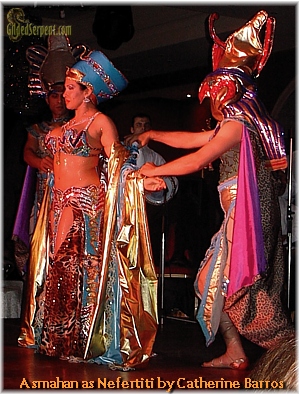
"One of the best-known and -studied vassal tribes, the Solluba . . . are dispersed all over the northern half of the Arabian Peninsula, and further to the north in the Syrian Desert and the adjoining territories, while according to some observers they can be found as far south as Yemen.  Solluba splinter groups are attached to practically every [noble badawin] tribe within this wide area, and while they all go under the name of Solluba, they can be identified more closely by the name of the tribe of which they are the clients . . .

 ". . . it may be mentioned that the women of vassal tribes generally enjoy more freedom than the women of the noble tribes.  Among the noble tribes there are several who veil their women.  The women of the vassal tribes, however, do not wear any veil, and therefore, especially in places where the noble women are veiled, are easily recognizable..  The Solubba women, for instance, never veil and rarely wear a milfa [a face or head veil as opposed to the burqa, face mask].  Among the Solubba, who are very fond of dancing, it is moreover customary for men and women to dance together — in itself a highly disgraceful and unseemly thing in the eyes of the noble tribes — and, what is even more shocking for them, in the course of the dance the men occasionally kiss their partners on the mouth before the audience . . .

"The theory of the non-Arab ancestry of the Solubba is supported by the non-Arab language that they use among themselves . . ."(2)     

Only a comparison of Nawari and Sollubi vocabularies would determine whether they are indeed the same people.  Patai’s caveat that the Solluba "can be identified more closely by the name of the tribe of which they are the clients" indicates just one of the potential difficulties in tracing the history of the Gypsies and Gypsy-like groups.  The important point for dance research, however, which I subsequently found supported by descriptions in many other accounts (e.g., Richard Burton, Gertrude Bell) is the association of such groups with music and dance; usually the only mention of Gypsies in an old Middle Eastern ‘travel book’ is in connection with a dance performance.

As stated in Part 10, the consensus of scholarly opinion is that the Gypsies split into two parts during their westward migration through Iran. One branched off to the south through Iraq, Syria and Egypt, and the other continued west through Turkey into Europe and hence the New World, these latter the ‘Romanies’ or Roma, whom the world at large knows as ‘Gypsies.’  The Roma, when they first appeared in Britain centuries ago, claimed to be from ‘Little Egypt,’ whence their name was distorted as ‘Gypsy’ in English.  (It is interesting, though probably fanciful, to speculate whether the dancer ‘Little Egypt’ of 1893 World Fair fame who, by one account, was from Syria, may not have been of the Nawar, slyly revealing her identity in her name.)  At any rate, the Roma, too, left a Ghawazi-like group in the East, in Turkey.  The Turkish Gypsies, the Cingene, have a major presence in Turkish danse orientale, attested in numerous sources.  There are the usual old travelogues, but in addition newer hints  — a brief but powerfully realistic scene of a Gypsy cengi (‘belly dancer’) in Turkish-born director Elia Kazan‘s film America America, for example, and more than one videotape of Turkish dance entitled ‘Sulukule Nights’ in recognition of Istanbul’s Gypsy quarter as Turkey’s chief dance venue. Researching dance in Istanbul after leaving Aleppo in 1977, I had the good fortune to find a copy of A Pictorial History of Turkish Dancing by Metin And, Drama Professor at the University of Ankara and long-time dance and drama critic for the Turkish press, as well as contributor to the American magazine Dance Perspectives.  Professor And emphasizes the Gypsy role in his description of cengi dance:

"The Turkish name for both dancing boys and girls is cengi . . . explanation of the origin of the word derives from its similarity in sound to the word cingene meaning gypsy and it will be remembered that the majority of the dancing boys and girls were, in fact gypsies . . .

"Sulukule is the quarter of gypsy dancing girls, and some have found shelter in the night clubs performing so-called Oriental Dancing, and a great number of them tour the Middle Eastern countries, Europe, and the U.S.A. and have performed in luxurious night clubs.  And some can still be seen in villages in Anatolia.

"In Europe cengi dancing is invariably called belly dancing or danse du ventre . . ."(3)

Thus, under one guise or another, we find Gypsies or Ghawazi-like groups as a fluid substratum of professional entertainers all over the Near East.  In view of the numbers and wide distribution of such groups, and their disproportionate representation in the entertainment arts because of the ‘respectable’ Muslim’s avoidance of these professions, it seems reasonable to suspect that the Gypsies left elements of their style(s) of music and dance wherever they passed, as well as appropriating elements of the styles of the regions through which they passed and spreading them to other regions.

 It has yet to be determined whether all of the Ghawazi-like groups are related to one another, what specific subcultural elements they share, where they have been, what they have left behind and what they took with them.  Perhaps, in today’s fast-changing world, it is already too late to do this, or to evaluate the extent of their role in the development and diffusion of the East’s lively arts, but the implications of their existence must be taken into account in any consideration of Near Eastern music and dance.

REFERENCES

(1)  Jarvis, C. S., Desert and Delta, London, John Murray, 1938, pp. 152-155.

(2)  Patai, Raphael, Golden River to Golden Road, University of Pennsylvania Press, 3rd ed., 1969, pp. 251, 259-262.

(3)  And, Metin, A Pictorial History of Turkish Dancing, Ankara, Dost Yayinlari, 1976, pp. 138-146.


use the comment box

Have a comment? Use or comment section at the bottom of this page or Send us a letter!
Check the "Letters to the Editor" for other possible viewpoints!

Ready for more?

  • Sirat Al-Ghawazi, Ghawazi Research, Part 10: 1977, Nawary Gypsy Background of the Mazin Ghawazi
    "They came to the aforesaid Shah and asked him for dwellings in his country … the greater portion he placed in Mazandaran as a check to the pride of the Uzbak, Turkmans, Umid, and the nomad Tatars, who are always starting raids, and acting as highwaymen."
  • Nagwa Sultan: Cairo Soul
    Like a number of other Egyptian dancers who retired in the early ‘90s, Nagwa couldn’t turn her back on the dance world entirely, however tarnished the glitter had become.
  • Khairiyya Mazin Struggles to Preserve Authentic Ghawazi Dance Tradition
    But when Khairiyya Mazin retires, one of the most distinctive traditions of Ghawazi dance may come to an end.
  • Egypt’s Golden Age, Timeline and Synopsis
    From around 1850 to 2000, Egypt saw the birth, rise, and transformation of its cultural expression through dance. With each period, a new energy in the dance was introduced and, with it, new dancers with new dance movements and new costumes.
  • An ATS Family Reunion, FCBD’s Annual Production of Devotion
    FatChanceBellyDance’s 2011 production of its Devotion was presented on Friday, June 17 at the Julia Morgan Theater in Berkeley, California. This year’s theme, “The Home”, was explored by six troupes and soloists and accompanied by FCBD’s home musicians, Helm.
  • Undercutting the Competition, A Problem of Ethics or Practicality?
    The Internet presence has created a whole new style of “elitism” in the dance world.
  • Interview with Nawarra of the UK and Morocco
    We met Nawarra in Marrakech, at Simona’s Mediterranean Delight Festival held there in June 2011. Nawarra grew up in Casablanca graduating from the university there. She now lives in Leed, near Manchester in Northern England. She has a troupe there, teaches and also takes several tour groups per year back to Morocco. She explains to us the term "sha’abi" and how it is used in the Moroccan dialect of the Arabic language.
  • A Month in Cairo, Egypt, Classes, Performing with Safaa Farid Band, Closing Gala, Classes at AWS
    She finished off the teaching part of the class with a cane dance filled with a variety of cane movements that were playful and fun. At the end, she had a real treat for us: She performed a short Oriental number in her unique style for us to watch and enjoy.
  • Gigbag Check #32 – Tito Seif
    In October, 2011, we found Tito Seif backstage at Hala’s Show in Redwood City, California. Tito is currently the most famous male dancer in the world. He shows us several of his costumes all of which he designed. Also included is a clip of one of his dances at Hala’s wonderful show. Thank you to Hala and Tito for your time and sharing.
  • From Syria with Love! Queen of Denial, Chapter 6: My Arrival
    You may think that the life of a traveling Belly dancer is filled with intrigue and love affairs, but this couldn’t be further from the truth!
 

Gilded Serpent presents...

Egypt’s Golden Age

a Timeline & Synopsis

Asmahan plays Nefertiti

by Sausan
posted December 9, 2011

We have always danced.  As a people, a nation, a country, a culture, we have assembled and we have danced, be it for weather, war, fertility, socializing, prosperity, or self.  We, in a word, dance.  Dance gives us a means of expression, a connection to our culture, and within the different countries of the world, dance has evolved within the structures of its culture and according to the culture from which it was born.

Egypt’s cultural expression through dance comes to us with many names.  Presently known in many parts of the world today as “Belly dance”, Egypt has given us one of the most dynamic, yet misunderstood, expressions in the world today–“Raqs Sharqi”.

The Pre-Classic Dance Era:  Before 1849

As far back as 1400 BCE, girls are depicted dancing on the walls of tombs.  One of the most popular illustrations of ancient Egyptian dance in any medium is a painted fresco from the tomb of Nebamun, an Egyptian "scribe and counter of grain" who lived during the New Kingdom and died sometime around 1400 BCE.  Then King Amenhotep, who later renamed himself as King Akhenaten, the Heretic King, ruled with wife and Queen Nefertiti in the 1300s BCE.  This was a time of artistic change and contribution and of productive building.  It was also a time of religious change.  As the pharaoh who declared that there was to be only one god, it is speculated that his wife Queen Nefertiti brought together all temple dancers and an Egyptian universal dance was born.  These dances would continue to evolve throughout the ages passing down its core movements in a cultural expression to the native people of Egypt.  Today, the West knows this dance as “Belly dance”.

From around 1850 to 2000, Egypt saw the birth, rise, and transformation of its cultural expression through dance.  With each period, a new energy in the dance was introduced and, with it, new dancers with new dance movements and new costumes.  Below listed are the three major periods of the Golden Age of Egypt’s Dance Era with the three most famous dancers in each who reigned supreme. Of course, the dancers listed as the three most famous ones are only a few, but they comprise the total of nine of the most remembered and celebrated of all Egyptian dancers of their time known to the West.

The Pre-Classic Period:  1850 – 1929

During this sixty-nine year period, artists, authors, and adventurers traveled to the Middle East and wrote about the exotic sights and sounds of the places to which they traveled.  As well, the occupation by the English in 1882 brought out British troops who would later spend their time in local nightclubs watching the exotic dancers of Egypt.  Out of this period came three celebrated dancers, Kuchuk Hanem, Shafika Al Cobtiya, and Badia Al Masabni.

  • Kuchuk Hanem
    (Famed beauty and Ghawazee dancer of Esna,  fl.1850-1870) is mentioned in two unrelated nineteenth-century accounts of travel to Egypt by the French novelist Gustave Flaubert and the American adventurer George William Curtis.  Flaubert reports that she was from Damascus.  She is remembered as a dancer with dance step known as “The Bee” or “The Wasp” where she is seen standing musing in a pensive posture until a buzzing insect flies into her clothing and she “flees” in terror, dancing rapidly, and removing articles of clothing in the manner of a provocative strip-tease.  Described within the literature of this period and the sensationalized, eroticism written about her, Kuchuk Hanem — or “Little Lady” — underscores early misrepresentations of non-western women in the imagination of the West.
  • Shafika Al Cobtiya,
    (Shafika the Copt, 1851-1926) is remembered as the icon of the Oriental dance who became the most famous dancer in Egypt, after her teacher, Shooq, passed away during the turn of the century.  She danced in the famous El Dorado Nightclub in Cairo and later opened her own, Alf Leyla Wa Leyla.  She was the first to have danced with a candelabra on her head while playing finger cymbals (sagat).  Sadly, Shafika Al Cobtiya suffered personal tragedies and  eventually died of a drug overdose.  A film released in 1963 starring Hend Rostom and Hussein Riad was made in Egypt, depicting the rise and tragic fall of the life of Shafika Al Cobtiya.
  • BadiaBadia Al Masabni
    (Mother of Oriental Dance, 1878-1970) is remembered as the owner and operator of Casino Badiya located on Imad El Din Street in in Cairo in the early 1900s during the influx of military personnel who began to patronize her establishment, enjoying the exotic dancing and music of Egypt.  She was always a business-minded woman with an eye on the Hollywood movie magazines, often brought in to her by her Western and European clientele. Her keen sense and understanding of their Western Orientalist hunger, and an ear for her client’s wishes to witness what they thought a dancer should look like according to these magazine pictures (out of Hollywood), Badia Al Masabni gave her clientele what they wanted and designed the costume herself; thus was born what we now see as the traditional two-piece “bedlah” or Belly dance costume.

Dancers in this era were not documented but one named Shooq was recorded.   

The Classic Period:  1930 – 1959

During this period, Egypt was introduced to the film industry. Dance and music talent soon dominated the silver screen with many of the dancers we know of today.  The three most celebrated dancers of this period were Taheyia Karioka, Samia Gamal, and Na’eema Akef.

TaheyiaSamia GamalNa'eema Akef
  • Taheyia Karioka (Queen of Oriental Dance, 1919-1999) is remembered for elevating the dance to the level we enjoy today and for being the first dancer to appear with significant story lines and dance performances in numerous Egyptian films. Thus, she opened the doors to other aspiring dancers and made it possible for them to enjoy the same success she attained as a movie actress and star, as well as a highly respected and sought-after dancer.
  • Samia Gamal
    (National Dancer of Egypt, 1924-1994) is remembered for bringing flair and energy to the dance by establishing and setting a trend for fashion design in her dance. She performed in costumes unlike the ones that were traditionally worn at that time, and was the first to dance with high heels during her performances (setting yet another trend for footwear outside the traditional slippers or bare feet).
  • Na’eema Akef
    (Premiere Star of the Egyptian Musical Cinema, 1929-1966) is remembered for the grace and beauty she presented in her innovative performances, coupled with her angelic voice, (influenced by her circus upbringing) that provided a strong foundation for her unique, theatrical, and sometimes, balletic dance choreography. Thereby, she introduced yet other elements of performance to the dance arena including the elements of ballet and theatrical choreography–entirely new concepts for her time.

Dancers included (but not limited to in this era) are:  Na’amet Mokhtar, Samiha Tawfiq, Zinaat Aloui, Katie, Hoda Shams El Din, and Nebawiya Moustafa.

The Post-Classic Period:  1960 – 1989

The Egyptian revolution of 1952 brought changes to Egypt, and thus, subtle changes to the dance.  In the 1960s, Nagwa Fouad, Suhair Zaki, and Fifi Abdo led the charts in the dancing entertainment world.

Nagwa FouadSuhair ZakiFifi Abdo
  • Nagwa Fouad
    (Princess of Cairo, 1943-Present) is remembered for her graceful arms, flowing chiffon veils and outlandish performances.  Her biggest fan was Henry Kissinger who visited Egypt 11 times and always requested Nagwa to perform for him during his visits as did America’s President Carter who visited Egypt with his wife.
  • Suhair Zaki
    (The Oum Koulthoum of Dance, 1944-Present) is remembered for having become the first Oriental dance artist to do a performance to a song that had been made popular by the great singer Oum Koulthoum. Following her lead, every Oriental dance artist today is expected to have at least one Oum Koulthoum song in her repertoire, among others.  She is remembered also for her distinctive hip and hand movements.
  • Fifi Abdo
    (The Queen of Shimmy, 1952-Present) is remembered most for her strong shimmy, exciting cane technique, and her energetic performances for the famous actors and musicians award dinners in Egypt.  She is the first to have used a hooka (or shisha) in her performances.

Dancers included (but not limited to) in this era are:  Nellie Fouad, Hanan, and Mona El Said, Hayatem, Hala El Safy, ShooShoo Amin, Aida Noor, Azza Shireef, Lebleba, Zizi Moustafa.

A Classic Golden Age of Egypt Raqs Sharqi Performance:

Belly dance during the the three major periods of the Golden Age of Egypt was flamboyant, expressive, and lively.  In fact, the dancers who danced in the chorus lines behind a solo dancer danced with individuality, unlike what we are used to seeing in the West.  Egyptian group performances did not resemble the chorus line of  a Las Vegas show or of the Ziegfeld Follies, but rather, a vivacious group of women dancing with energy in a like manner (but with evident individuality and gusto) employing a general choreographed dance.  

Pre-Modern Era:  1990 – 1999

LucyDinaAround 1990, with the onset of technology (and the ability to access it easily and readily) the energy began to shift again, and new dancers emerged, vying for the limelight.  In 1992, National Geographic set out to produce a program called “Cairo Unveiled” on a day in the life of one of Egypt’s Belly dancers and the world was introduced to Lucy.  It is said that Fifi Abdo’s publicist was asleep at his post and was soon fired after this interview was released.  Although Lucy attained notoriety almost overnight, Fifi Abdo continued to light up the marquee up until the end of the Twentieth Century along with a new young dancer named Dina.  The three dancers became known as the “The Big Three” with Fifi Abdo leading the team as “The Best of the Big Three”.

Modern Era:  2000 – Present

At the turn of the century, the dance began to evolve, incorporating a more Western look and feel, but still maintaining the cultural Egyptian feeling.  Dina’s reign on the dance floor began in earnest during the 2000s.  She is still a major dancer in Egypt today, with new celebrated dancers including Asmahan, Saroya, Randa Kamal, and Dandesh and others who enjoy the limelight and perform for tourists and travelers alike.

use the comment box

Have a comment? Use or comment section at the bottom of this page or Send us a letter!
Check the "Letters to the Editor" for other possible viewpoints!

Ready for more?

  • Ballet-ification of Belly Dance
    When did Ballet become a requisite for Belly dance, and why is it stated that it should be an essential part of a Belly dancer’s daily regimen?
  • The Egyptian Dance Code: Technique to the Perfect Dance
    Twenty-eight years after my first class in Belly dance, I looked at all the dancers once again and realized what they were doing to look Egyptian. I had discovered the Egyptian Dance Code. That was back in 2000.
  • Taheyia Karioka, Queen of Oriental Cabaret Dance
    In the 1980’s, the spread of Islam and its fundamental militancy proved to be a big blow for Egypt’s belly dance industry. As a result, several dancers publicly renounced their pasts and donned the Islamic veil.
  • Who Really Gave Us This Dance?
    And, in their quest for self-expression, they, too, would fall prey to the sweet expressive motions of a timeless dance only to find a cure for their soul in the performance of this expression in front of an appreciative audience.
  • Naked Belly Dance in Ancient Egypt, Part 1: Are They Really Belly Dancing?
    The real first question is, "What is belly dance?" Many elements of the modern practice of belly dance emerged in the 20th century. Our emphasis on the female soloist, the structure of the typical show in both the East and the West, the style of music we dance to, our costuming, our specific styles of relationship with the audience, and so on, are modern developments.
  • Naked Belly Dance in Ancient Egypt, Part 2: Are They Really Naked?
    What does nudity mean in a dance scene like this? And does this nudity reflect an actual practice of naked dancing as banquet entertainment?
  • Undercutting the Competition, A Problem of Ethics or Practicality?
    The Internet presence has created a whole new style of “elitism” in the dance world.
  • Interview with Nawarra of the UK and Morocco
    We met Nawarra in Marrakech, at Simona’s Mediterranean Delight Festival held there in June 2011. Nawarra grew up in Casablanca graduating from the university there. She now lives in Leed, near Manchester in Northern England. She has a troupe there, teaches and also takes several tour groups per year back to Morocco. She explains to us the term "sha’abi" and how it is used in the Moroccan dialect of the Arabic language.
  • A Month in Cairo, Egypt, Classes, Performing with Safaa Farid Band, Closing Gala, Classes at AWS
    She finished off the teaching part of the class with a cane dance filled with a variety of cane movements that were playful and fun. At the end, she had a real treat for us: She performed a short Oriental number in her unique style for us to watch and enjoy.
  • Gigbag Check #32 – Tito Seif
    In October, 2011, we found Tito Seif backstage at Hala’s Show in Redwood City, California. Tito is currently the most famous male dancer in the world. He shows us several of his costumes all of which he designed. Also included is a clip of one of his dances at Hala’s wonderful show. Thank you to Hala and Tito for your time and sharing.
  • From Syria with Love! Queen of Denial, Chapter 6: My Arrival
    You may think that the life of a traveling Belly dancer is filled with intrigue and love affairs, but this couldn’t be further from the truth!
  • Know Your Bellydance Audience
    A part of us may feel like we’ve earned an audience because we’ve worked so hard and perform a quality show. But the truth is that you have to win an audience every single time.
 

Gilded Serpent presents...

An ATS Family Reunion

FCBD’s Annual Production of Devotion

Carolena Nericcio always at Home center stage

A Concert Report by Renée Rothman
Photos by Raymond Van Tassel
Posted December 9, 2011

FatChanceBellyDance’s 2011 production of its Devotion was presented on Friday, June 17 at the Julia Morgan Theater in Berkeley, California. This year’s theme, “The Home”, was explored by six troupes and soloists and accompanied by FCBD’s home musicians, Helm. While the theme was not readily apparent to me at the time, in retrospect, I began to see their possible intent: family relations. 

Colleena Shakti and Elizabeth Strong, guest soloists, represented the nativity of Belly dance in North Indian and Gypsy dances. FCBD Studio in San Francisco descends from that lineage and is also the natal home of the uniquely American Belly dance form, ATS (American Tribal Style). FCBD’s sister studios, her progeny, returned here to dance their devotion for their origins–in the venue of their origin. 

Their return was both a “pilgrimage” and a family reunion.

The production was staged in such a way as to create a casual and cozy setting. It opened with sari-wrapped Carolena Nericcio, surveying her world. The scene resembled a garden scene on an Indian miniature: to one side, a group of musicians are permanently ensconced on a platform. Beyond, various dancers are practicing their arts. Nericcio established a picnic-like area in front of the musicians where tea and coffee were being served to the guests. As a group of dancers completed their set throughout the evening, they crossed to this area, greeted the current guests and replaced them. This kept a nice flow to the concert by connecting each of the artists in continuous succession, softening what are usually abrupt changes between acts. These exchanges also demonstrated the real camaraderie shared between these performers.

In addition to FCBD and Nericcio, this year’s production featured Devyani Dance Company, Colleena Shakti, Rakadu Gypsy, Raqset Il Olaal, Elizabeth Strong, and the Australian ATS troupe Ghawazi Caravan.  Aside from Shakti’s “Odissi Solo” to recorded music,  all the dancers were accompanied by the fabulous band, Helm, who played both original compositions and traditional Middle Eastern tunes. We saw dances that reflected or were inspired by ATS, North Indian folk and classical dances as well as Romani, performed in troupes and as solos, with both serious and comedic intent.

Troupes Ghawazi Caravan and Devyani demonstrated their devotion to the ATS tradition and to Nericcio’s tutelage. I was inspired by the inventiveness of their interpretations of American Tribal Style and excited by some fresh methods of transitioning between partners.

Theresa Tomb and Super Kate Slepicka, both of Rakadu Gypsy, strolled on stage dressed as gum-chewing housekeepers, carrying plungers. Wearing house-dresses and hairnets, they dusted and polished random instruments (and musicians) before breaking into dance without breaking out of character. The plungers became “canes” to be spun in traditional Egyptian style, inciting gleeful laughter from the audience. Later in the program, Tomb and Slepicka stripped off their comic guises and further delighted us with their animated American Tribal Style dancing.

Elizabeth Strong by Raymond Van TasselColleena by Raymond Van TasselElizabeth Strong and Colleena Shakti performed solos in their respective styles. Strong is an accomplished performer in Eastern European and North African Romani dances as well as Tribal Fusion. All influences were in play as Strong executed pirouettes, Turkish drops, and all those charming hand-gestures distinctive of Roman dance.
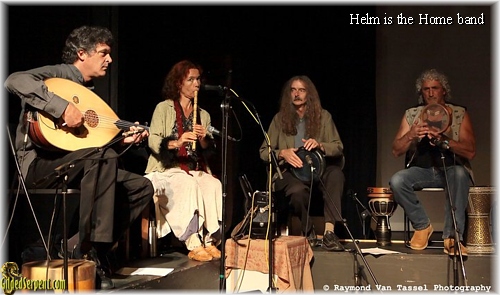
 
As mentioned previously, Colleena Shakti performed a spirited Odissi solo in the first half of the evening. Her proficiency in this classical art reveals her long study and dedication to the preservation and vitalization of Indian dance. In the second half, she partnered with Devyani director, Megha Gavin, to pair together the old and new traditions of Belly dance: Shakti’s Khalbelia folk dance from Rajasthan with Gavin’s ATS. They represented the reunion of two “homelands”: the place from which Belly dance originated in Northern India and the place where one of her progeny, ATS in San Francisco, has flourished.

The piéce de resistance of the evening was the solo by Carolena Nericcio. Nericcio strode onto the stage with majestic carriage, in basic ATS costuming but wearing a Nefertiti-styled hat—tall, black and dripping in rhinestones. While many of Nericcio’s technical abilities have diminished, her carriage and presence on stage remain remarkably strong. She can still roll and flutter her stomach muscles and with a smile set off a long round of zhagareets (vocal trills).

She’s still the head of this household, and she proudly (and rightly) holds the center of a dynamic network of ATS-inspired Belly dancers.

This was my first attendance at Devotion, which I believe is now in its fifth year. It began as a way for Nericcio to celebrate her many years of devotion to dance (24 this year). Based on comments by other audience members, in the past, the evening has had a prayerful or contemplative character, suitably devotional. Tonight’s concert, however, had a livelier quality. As befits the theme of “Home”, the performances were playful, animated, and inviting. Whether you feel at home in the old or the new Belly dance traditions, “Devotion” is a concert series that will remind you of your ancestral dance origins and will renew your own dedication to the living art of Belly dancing.


Helm is the Home band

FCBD share tea in a cozy corner of the stage

Theresa Tomb hams it up while Mark Bell enjoys a laugh

Carolena in ecstacy


use the comment box

Have a comment? Use or comment section at the bottom of this page or Send us a letter!
Check the "Letters to the Editor" for other possible viewpoints!

Ready for more?

  • Undercutting the Competition, A Problem of Ethics or Practicality?
    The Internet presence has created a whole new style of “elitism” in the dance world.

  • Interview with Nawarra of the UK and Morocco
    We met Nawarra in Marrakech, at Simona’s Mediterranean Delight Festival held there in June 2011. Nawarra grew up in Casablanca graduating from the university there. She now lives in Leed, near Manchester in Northern England. She has a troupe there, teaches and also takes several tour groups per year back to Morocco. She explains to us the term "sha’abi" and how it is used in the Moroccan dialect of the Arabic language.
  • A Month in Cairo, Egypt, Classes, Performing with Safaa Farid Band, Closing Gala, Classes at AWS
    She finished off the teaching part of the class with a cane dance filled with a variety of cane movements that were playful and fun. At the end, she had a real treat for us: She performed a short Oriental number in her unique style for us to watch and enjoy.
  • Gigbag Check #32 – Tito Seif
    In October, 2011, we found Tito Seif backstage at Hala’s Show in Redwood City, California. Tito is currently the most famous male dancer in the world. He shows us several of his costumes all of which he designed. Also included is a clip of one of his dances at Hala’s wonderful show. Thank you to Hala and Tito for your time and sharing.
  • From Syria with Love! Queen of Denial, Chapter 6: My Arrival
    You may think that the life of a traveling Belly dancer is filled with intrigue and love affairs, but this couldn’t be further from the truth!
  • Know Your Bellydance Audience
    A part of us may feel like we’ve earned an audience because we’ve worked so hard and perform a quality show. But the truth is that you have to win an audience every single time.
  • A Gilded Serpent Time Capsule Presentation, Rakkasah 1984 and 1986 (25 years ago) Photos by Lynette Harris
    While taking a nostalgic look through my photo albums recently, I realized that if I was ever going to share these photos, I had better go ahead and scan them into the computer now before they deteriorate even more than they already have. Yes, they are discolored and blurred, but I think they will be of some value to those who pay attentions to costume styles or those who were there and simply enjoy re-visiting the memories.