Gilded Serpent presents...

Indigenous Photography, Cliches & Studio Fantasy

Nayliya

Images of Algerian Women in Colonial Postcards

by Amel Tafsout
Images mostly from author’s collection.
Originally published in Belly Dancer Reader 2 in 2014,
republished here by author’s request in January 2021.

The Belly Dance Reader 2 is available on Amazon at new lower price- Belly Dance Reader 2 at Amazon. 29.99!

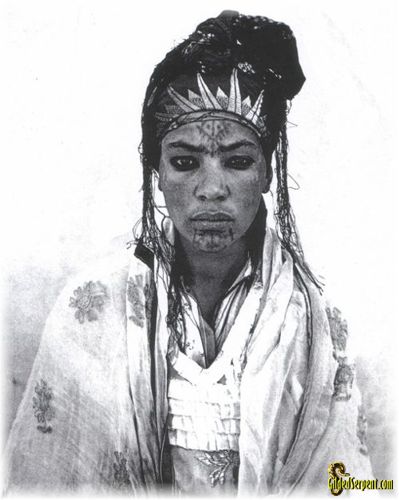
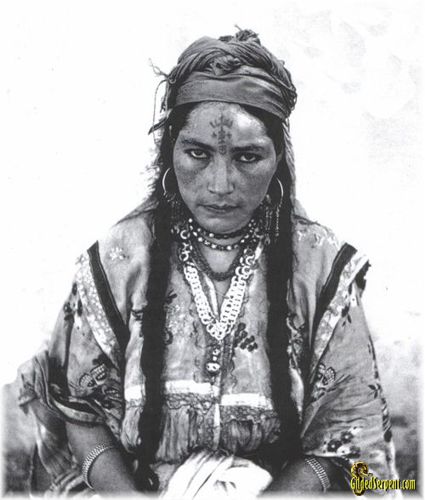
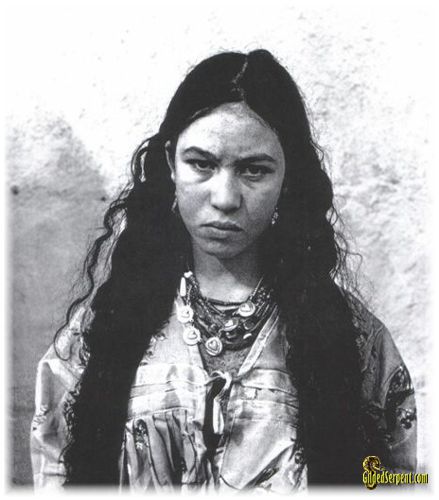
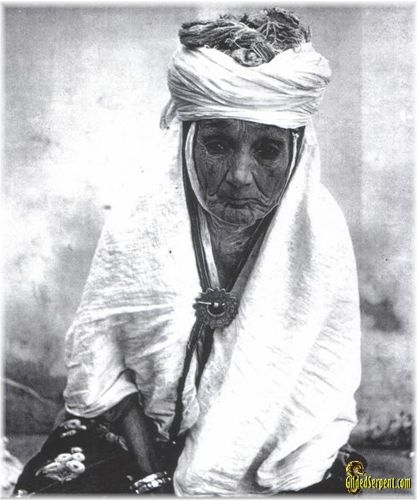
When I started working in the U.S, I was very surprised to find pictures of Algerian dancers on refrigerator magnets in various American dancers’ homes. This fascination with the exotic image that these postcards represent for Westerners seems to be quite common. I often wonder if these dancers have the information about how these Colonial postcards were made. They usually portray an Algerian “Mauresques” or “Desert women” of the Nayliyat or city girls posing with a tambourine or a cigarette between their fingers.

Beauty and Culture

Differences in taste within differing cultures become more obvious when considering other factors relating to the beauty of a woman. Western travelers’ accounts of the 19th and beginning of the 20th century described traditional attire, jewelry and make-up of Algerian women as “barbaric”. For the Western male society, semi-nudity is sensual and provocative, while in Oriental norms, it is immodest and tasteless. The breast for Western eyes is charged with sexuality while in the Orient, a woman’s breast is for feeding babies. A woman’s hair, ankle or neck, and knees draw more attention from an Arab man than from a Westerner. Orientals would reject models chosen by painters as beautiful dancers as bony. Being well-fed was something everyone aspired to in the 19th century in Algeria; and only the rich could afford it, so the more opulent a woman was, the more she was considered beautiful.

Visions of the Orientalist Painter

Furthermore, Orientalist painters illustrate a certain Orient close to their own vision. Since a painting is a static picture, in order to denote harmonious movement of the body, the painter added the presence of the accompanied music by showing musicians, knowing that the viewer’s attention would focus on the dancer. Even if he never met the dancer, he was able to easily find Oriental dance costumes in fashion magazines to dress his character. The painter would uncover the hands, the bosom and everything else he could on the dancer. His goal was to suggest the sexuality contained in belly dance as opposed to the dances in Europe such as ballet, couple dances in salons, or folk dances.

The Purpose of Colonialist Postcards

Between the turn of the 20th century and World War I, postcards became the mass media of communication and were collectible objects for the first time in French history. A significant portion of the millions of postcards produced annually in France displayed Algerian “views” and “ethnic” types. For 30 years, the French colonials photographed Algerian women, calling them “Fatma” and displaying their images on postcards that were sent back to France with casual or incidental messages. However, colonial postcards had complex origins. Since 1830 the French presence in Algeria had relied on capitalist involvement in tourism.

Top of page image:
Algerian Girl with Scarf
photo credit: public domain
caption: This postcard is titled “Danse du Mouchoir”, which means “the Handkerchief dance”. This postcard image seems to be staged, as the costume is compiled of pieces of other regions regalia in Algeria. Traditionally each part of the costume, including the scarf, would be used for a specific function in the dance which is mislabeled and inaccurately posed. The traditional “scarf dance” is referenced to a specific scarf dance from Andalusian origins, used in Algeria. In this uncomfortably staged photo, it only emphasized the staged look and non traditional uses of the props; such as the scarf in this photo and the awkward placement of different costume styles.
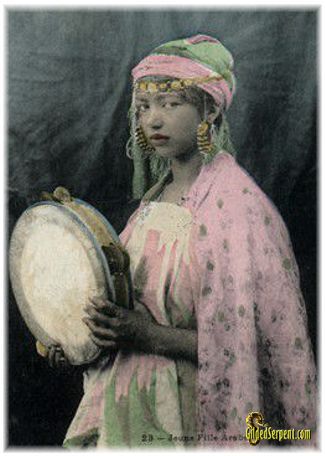
Algerian girl with tamborine
Image 2: Algerian Girl with Tambourine
photo credit: public domain
caption: This photo is entitled “Young Arab girl”. It was originally in black and white with the color tint being added later on. While entitled such, it could be that this young girl was originally from the Sahara Desert regions; though again aspects of the photo clash with the title. She is holding a tambourine (called a Tar in North Africa). It is obvious that this photo was staged and the placement done for the interests primarily of the Western World. The tambourine or Tar was never used in the desert cultures and by the placement of it in her hands; we can tell she does not know how to really hold or play it. By purposely staging these postcards, we get a confusing story that is misleading as to how the real costumes, etc would be shown. The most uncomfortable part of the portrait, is the obvious sadness and fear that shows in the young girl’s face. Many times the young girls used in these postcard style prints were threatened, and abused. They are not staging themselves nor comfortable with the process.

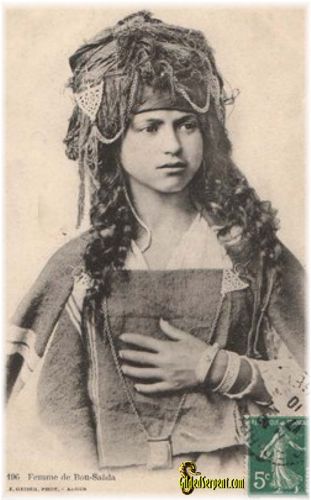
Desert woman

Image 3: Desert woman
photo credit: public domain
caption:In this photo we again see the reality of staging both the woman and her traditional regalia. It is rare for Algerian women in their traditional headdress, to allow this much of the hair to be shown. She is wearing the costume of her region and the title of this postcard is called “Femmes de Bousaada” (Woman of Bousaada). While she is wearing a traditional head dress it is unusual to ever see Fibulae attached to the headdress itself. The Fibula are also shown in their proper placement on the shoulders of her tunic. Her facial expression belies the fact that she is anything but happy about having her photo taken or her traditional costume posed inaccurately. We see the blank stare showing that she is being photographed and staged for foreigners and against her personal will. This is part of the picture of French colonialism and the extent to which they used the young girls to portray a false identity for consumerism; while also not being paid for modeling.

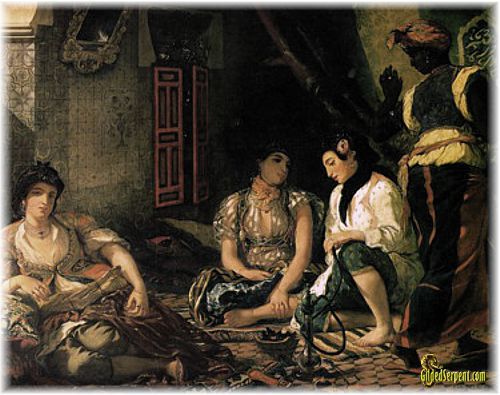
Delacroixe

image 5: Femmes d’Alger by Delacroix
photo credit: Painting by Eugene Delacroix
caption: This well known painting by Delacroix (1834) represents the Orientalist Painting style at the time. Most Orientalist paintings are not realistic depictions; but rather a melange of images made to fit stereotypes and fantasy. Delacroix was the first fine arts painter to be invited to see inside a real harem. He managed to sketch the women secretly in Algiers, as in the painting, “Women of Algiers in their apartments,” but he encountered difficulty in finding Algerian women to pose for him. This painting inspired many versions drawn by Picasso in 1955. It was also the title of a book by the Algerian writer, Assia Djebar, who gave a real voice to the women of Algeria. Fifteen years ago, I produced a show with the same title, showing it’s strength in giving the true aspects of the women of my country.

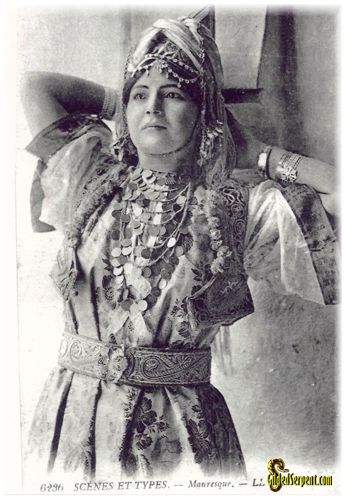
stilted photo

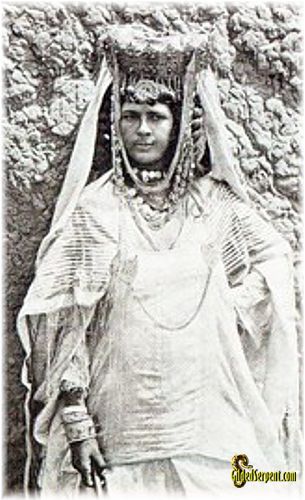
Image 8: Mauresque, Amel’s Private Pix
photo credit: “Courtesy of Amel Tafsout”
caption: In this stilted and stiff photo, we observe a rare picture of an Algerian woman completely wearing her traditional dress and jewelry. Outside of the traditional look of the costume and jewelry, this is far from realistic. It is considered very rude in Algerian custom for a women to be stretching her arms behind her back. This style of posing would imply that the woman is offering herself to the viewer; again creating a sensationalistic, erotic view for the Western observer.
nayila
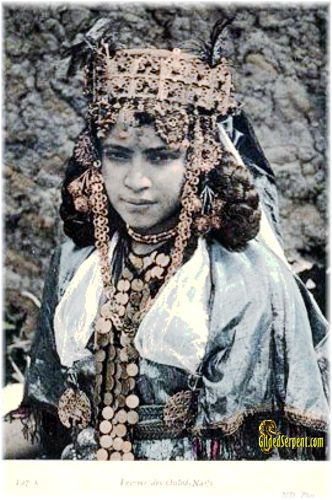
Image 9: Nayliya1
photo credit: public domain
caption: We are shown a proud and defiant Nayliya (Ouled Nail) woman in this postcard. Defying any images of staged happiness or the usual submissive look featured in stylized postcards of the day.
Naylila group in color
Image 10:
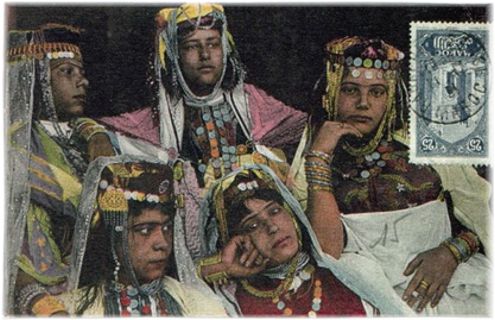
Photo by Jean Geiser: Amel Tafsout’s private collection
caption: We see another staged postcard of a group of women posing together. These are Nayliyat women from the Ouled Nayl Tribe. This is a distinct and rare postcard; showing the grouping of these Nayliyat women. In the photo not only do they stare in boredom, never looking at the photographer; but a definite sense of a frightened, caged animal exudes from the eyes of these women. They are in fear, terrorized, forced into sublimation. One imagines this terrified look is due to more than just photographs.
Nayilah 3
Image 12: Nayliya 3
photo credit: public domain, postcard owned by Amel Tafsout
and also used in the Colonial Harem of Malek Alloula
caption: Even today, many may view this photo as a true representation of the Ouled Nail woman. Unfortunately, it is not. We can tell from the stiff pose and unhappy visage. As well, she would not be wearing this profuse amount of jewelry on her body; weighing her down. This too was staged and overdressed by the photographer.
Nayila headress
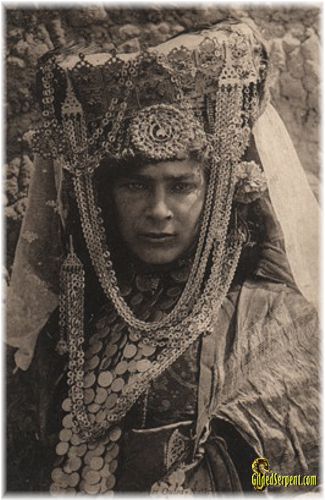
Image 13: Nayliya and Headdress
photo credit: Courtesy of Amel Tafsout
caption:Here is another version of the all too recognizable staged and dressed Nayliya woman for the sake of the photo shoot and not for it’s realism. The jewelry is piled on her frame, regardless of it’s application in reality. We see this by the exaggeration of the chains hanging down around her face, too heavy and awkwardly placed. Importantly, the round brooch in the middle of the headpiece above her forehead, is called a “shamsiya” (‘the little sunshine’) and would traditionally be worn on the chest area of the costume. The dancer looks uncomfortable in this overly made up scenario.

Neurdein Frères and Jean Geiser Postcards

By the turn of the century, the French government was funding Neurdein Frères, (or Neurdein Brothers (ND), in English) – ND images for travel guides and historic records because tourism expanded the colonial infrastructure and the postcards’ publicity stimulated private investment. ND covered Algeria extensively. ND studios sent photographers to the colony to take pictures. ND processed and edited the images in Paris and then marketed them to businesses in Algeria. Because the postcards were bought, sold and postmarked in Algeria, the role the French company took in their production was suppressed. The cards were misunderstood by the French to originate from the colony and to reflect the sensibilities of the indigenous population.

Neurdein Frères 1905 catalog divides the postcards into two main categories: “views” of major cities and “types and costumes” of Algerian people. The catalog lists 1320 views and 201 types. The ND travel souvenir books begin with panoramic overviews, move to the sites, and end with a picture of a smiling young woman. The cards express the difference and a separation between Europeans and Algerians. Photographers like the Swiss Jean Geiser between 1900 and 1930 brought large numbers of photos of scantily clad or naked Algerian women into the European market. The women in the photos are not named. The postcards have impersonal captions like “Woman from the Maghreb”, “Woman from the South”, “Woman from Algiers”. A dozen of them at most have names like “The beautiful Fatima”. The Oriental women remain general; a surface on which an image is projected.

In contrast to the views that can be sorted according to the land and the life within the city, the types exclusively depict Algerians. Physiognomy used physical features as a guide to individual character and class. The ND ethnic types categories take individual subjects and their clothing to represent traits of an entire race. This labeling by work and ethnicity erases social interaction, turning Algerian society into an historical series of categories served up for novelty and local color.

In his paper “Going Postal: On Colonial Algeria”, Leonard R. Koss explains:

“The insatiable thirst on the part of nineteenth-century photographers and their consuming public for supposedly “real” images of elsewhere is, without a doubt, a manifestation of a larger cultural paradigm in which the world, like its images, are subjugated to the hegemonic appropriations of European military and economic expansionism” (1)

According to Koss, the majority of circulating Colonial postcards of Algeria were not the result of the work of traveling photographers, but rather that of photographers like Jean Geiser, who had established himself in Algeria, where, in 1874, he opened his own studio in Algiers. He became the most well known colonial photographer in Algeria in the second half of the nineteenth century due in great part to his dominance in the field of postcard photography.

In images of the harem, eroticism is expressed by pronounced differences in racial representation. In “Mauresques” the women seem to look out, inviting us with their tambourines and tea ceremony to join the activities of the harem. Though all are labeled “Mauresques”, the dark women are more fully clothed, sit relatively upright, and gaze at the viewer with blank expressions. The light-skinned woman raises her eyebrows, suggestively glances at the viewer, and reclines with her legs spread apart and shirt drawn back to reveal her breast. The woman, physically closer to European conceptions of beauty, can offer herself for sexual exhibition.

Leonard Koss writes:

In recognizable sub-categories generically designated as “Femme arabe”, “Mauresque,” and “Bédouine,” pejoratively reductive appellations like “Belle Fatma,” ”Aïcha,” and “Khédija,” or specifically identified with a group like the Ouled-Naïl…the exotic North African woman. (2).

The Real Message of the Postcards

According to Alloula, in “The Colonial Harem”, the real message of the postcards, was neither casual nor incidental, but was instead a sign of conquest – of Western designs on the Orient, of violence. He provides an important interpretation of the images. He reproduces postcards of dancers and “harem women” and arranges the images into a narrative so that the models are progressively more unveiled. Beyond doubt, many of these images are tawdry, and Alloula has arranged them in an increasing order of degradation, ending his book with what he calls an ”anthology of breasts”. He writes:
“…The bust, at least freed from the garments designed only to be removed, offers itself either with arrogance or with submissive humility” (3).

The captions establish a complicity which duplicates soliciting by an invitation of the kind: ”Want to party, honey?” or ”Oh! Is it ever hot!” or ”The Cracked Jug.” The ordinarily hidden is made brutally visible; the private is perverted and made public. The model, Alloula tells us,

“…presents three distinct and yet closely related advantages: She is accessible, credible, and profitable. This is the three-legged foundation upon which will come to stand the whole of the enterprise pursued so relentlessly by the colonial postcard” (4).

Alloula explains how the model ends up representing all Algerian women. He writes, ”The model, in selling the image of her body…sells at the same time…the image of the body of Algerian women as a whole…” (5).

Alloula defines the postcard as “an immense compensatory undertaking”. He explains that, imprinted on the cards, Algerian women are reborn but at the same time, “They are available and consenting, welcoming and exciting, submissive and possessed” (6).

As Algerian women are offered “body and soul” they are used as trophies of ‘war booty’, he writes: ”These raided bodies are the spoils of victory, the warrior’s reward.” (7). In other terms, Algerian women are a surrogate for political and military conquest. 

Alloula’s motive in writing this book and in compiling these images is to send back these postcards to the French photographers, and to confront French colonialism. Barbara Harlow, who wrote the book’s introduction, explains that for Alloula it is a ”challenge and riposte” in order to reclaim a lost sense of honor as he writes:

”What I read on these cards does not leave me indifferent. It demonstrates to me…the desolate poverty of a gaze that I myself, as an Algerian, must have been the object of at some moment in my personal history.” (8).

I agree with Alloula’s statement, as I understand that his intention is to put the postcards in their socio-political contexts so that he can reveal the hidden goal of the French colonials in order to destroy the Algerian spirit. As an Algerian woman, I wonder whether Alloula’s anger comes from his concern for the women who were photographed.

I believe that the challenge Alloula returns to the French, the cultural dialogue he initiates, remains male-centered and concerned with women as property and as symbolic marks of (dis)honor or status for the men in their families.

If Algerian women were vulnerable and disgraced by their original display on colonial postcards, they are once again exposed by their display in this book. Their images leave them still silent and newly imprisoned by the very text that purports to liberate them.

In her book “Images of Women”, Sarah Graham-Brown explains:

“The figure of the woman as an erotic and exotic object…can be seen in the reclining, almost naked African woman posed against a studio backdrop representing ‘the jungle’; in the Japanese ‘geisha’ girl with her robe slipped from her shoulder…in the odalisque with her semi-nudity, her jewels and her water pipe.  All these studio photographs use pose…to suggest sensuality, sexual availability or primitiveness.” (9).

Images of Dancers

Alloula devotes a chapter to “Song and Dance: Almehs and Bayarderes”. As he mentions it rightly, this chapter follows the ‘rituals of the harem’, what he means is that it continues the phantasm on the exoticism of Orientalism. Alloula highlights that the dancer and musicians do not perform on stage or in front of an audience. He writes:

“As an exercise of the body, dance gives it a physical outlet. It rouses it from vegetative torpor to maintain it as a body-for-pleasure…Through movement, dance prolongs and perfects the erotic delirium…This feast of the body is first of all, a show for only one individual, the viewer-voyeur, namely the photographer.”(10).

Wanting to possess the Algerian land, French colonists first claimed the bodies of its women, using sex as a surrogate for an extension of another larger usurpation of culture.

During the 1980s, post colonial scholarship set out to unmask the colonial agenda in these postcards by linking non-political Orientalist iconography to the French colonial project.
Alloula compares the unveiling of Algerian women with the French colonial conquest of Algeria. He examines photography as an export of cultural appropriation, racism and Eastern exoticism.  He writes:

“The postcard…becomes the poor man’s phantasm: For a few pennies, display racks full of dreams. The postcard is everywhere, covering all the colonial space, immediately available to the tourist, the soldier, and the colonist. It is at once their poetry and their glory captured for the ages; it is also their pseudo-knowledge of the colony. It produces stereotypes in the manner of great seabirds producing guano. It is the fertilizer of the colonial vision.” (11)

Entering the Woman’s Private Space

The models and the backdrop against which Algerian women were photographed (often an image of nature) appear typified and simplified in these studio photographs. Alloula provides evidence that the models used in these photographs are not actually real “harem women”. Most of them are in fact victims of war, orphans and prostitutes who were required to pose for the photographer’s lens. The author doesn’t focus on the biographies of the models or their reasons for posing for the camera; instead he directs his criticism against the West. He analyses the view of the voyeur, who is not moved by ethnographic considerations, but by a passion for money and power.

The postcards were sent as evidence of the exotic; they were trophies. In terms of morals, a system of double standards was prevalent: It was acceptable for the women of the “department” (as Algeria was a French department at that time) to strip off, while photos of naked French women from the mother country were strictly forbidden.

The only photographer-painter who claims to have actually been in a harem is Eugene Delacroix. He created a scenes of inside the harem, most bombastic, called “Women of Algiers in their apartment”.

The walls of the harem delineate women’s private space and the images invite us to transgress these limits. In doing so, the postcards violate private, cultural and religious boundaries. Imprisoned by the photographer’s eye these women reclaim their historicity through the pages of Alloula’s book. Alloula uses so-called “harem postcards” to highlight all of the issues of the power structures between the ruler and the ruled, the Empire and the Colony.

Mailing the Postcards

When postcards were exchanged through mail, the images were linked with the tourist’s text. As tourists both men and women bought ND cards at kiosks and newspaper stands and exchanged the cards with either members of the same sex or opposite sex. By purchasing a card and writing a message on the back of the image, a French tourist marked or commemorated his presence at that place. The sender also asserted his position as someone with the money and leisure time to travel.

The small message space was intended for simple greetings, and because the postcard was not private, it was used for general communication. Postcard messages were abbreviated. An absence of descriptive messages characterizes images of Mauresques, Ouled Naïl dancing girls and the harem. Postcards showing topless women often have no message, stamps or postmark, suggesting either they were never sent and instead were kept by the purchaser or they were sent in an envelope. None of the messages comment on the images; most contain only brief salutations. A postcard of a “Jeune Mauresque” exposing her breast is signed ”bonjour lointain”, with a signature on the front and back of the image. Despite such acts of possession, the sender of the harem picture could not be understood to be saying “I was here and saw this”. Even though it is difficult to determine what hidden message, if any, was conveyed.

A similar silence surrounds images of Algerian women in guidebooks from the same time period, such as “la France africaine” showing an ND images of a “Mauresque d’Alger”. The woman is unveiled, but clothed, wearing lots of jewelry. The guide Joanne lists cafes with Ouled Naïl dancers but does not describe them, indeed, one travel account calls an Algerian woman’s dance “indescribable”. It is the pictures that promise most about what would be found in Algeria. Images of women smoking and exhibiting their bodies were not discussed, presumably because such a reference to sexuality was not appropriate in a guidebook. The truth is that tourists would never see Algerian women exposed as they are in these pictures. The postcard image shows what cannot be described. The ND and Geiser’s images of Algerian women were acceptable because it was another culture that appeared to be transgressing French morals. The image on the card introduced eroticism into social exchange.

Exotic Attraction and Racism

Although the collectors of postcards were male, collecting them was often represented as a feminine activity. The cards must have been produced to some extent with a female audience in mind. Many of the cards were addressed to Mademoiselle. Women frequently kept postcards in albums. Postcard collecting provided women with opportunities to engage in social exchanges with gentlemen callers and to display their creativity, their education and tastes. Therefore, colonial postcards expressed ambivalence about Algeria for the female viewer. Articles about Algeria were rare but representations of the Middle Eastern ‘Orient’ were very popular. Like postcards, the stories in women’s magazines could be used to travel imaginatively to different places, to safely live out exotic fantasies.

In Femina magazine’s article “Femmes du desertMme Jean Pomerol suggests a fascination with Algerian beauty rituals. She wrote:

“(The woman in the Sahara) has long, long periods of leisure…She uses them to adorn herself…and what adornment…Flowing draperies, attached by an abundance of barbarous jewelry…Henna on her hands that become a mahogany color…Make-up in her cheeks, applied without any intention of imitating nature…Muslin veils trailing on the ground…” (12)

The article seems to encourage French women to try exotic beauty rituals as their own private escape, but then, as to reaffirm the superiority of the colonizer, adds that these women only bathe once a week because of water shortages. The images may provide women an outlet for an erotic fascination but that fascination remains tempered with ambivalence. In the colonial postcards in the article in Femina magazine, Algerian women are presented to French women as both dirty and exotic. In the article, elaborated dresses and bejeweled dancers on a camel wear costumes like those of the women in the Mauresques postcards. This attitude of simultaneous attraction to and repulsion from the subjects, allows the women to experience both identification and distance.

However, collecting postcards of Algerian women was a rarely sanctioned occasion for women to view and display images of other women in exhibitionist and provocative poses. Yet French women identified with the erotic sexuality that Algerian women represented. This identification could have taken a form for women collectors, such as assuming an exotic identity and participation in Arab misery. For French Bourgeoises, Algerian women were representing the free expression of erotic sexuality.

The colonial postcards’ images reflected the interest of the commercial tourism industry and the French colonial government. They appealed to viewers because they reinforced bourgeois attitudes about race, work and gender. The silence around the images in guidebooks and in the personal messages written on the cards indicates viewer ambivalence about the images and evoked other interpretations of them.

The Algerian War of Independence

The Algerian independence war (1954-1962) for both France and for Algeria was a traumatic experience. It was like the Vietnam War for the Unites States. The difference is that the French are still living in amnesia, as it is very hard for them to confront the loss of Algeria. As Leonard Koss explains, there are only a few photographic documents available about the Algerian war.

Marc Garanger

The French photographer Marc Garanger is one of the few French photographers to publish a photographic book of Algerian women as a tribute to them. In 1960, Garanger was a 25 years old draftee who worked professionally as a photographer for ten years. He landed in the region of Kabylia, in the small village of Ain Terzine, South of Algiers. He was selected as the photographer of his regiment.

The photo historian and poet, Carole Naggar, writes that Garanger’s commanding officer decreed that the villagers must have identity cards: “Naturally he asked the military photographer to make these ID cards,” Garanger explains:

“Either I refused and went to prison, or I accepted. I understood my luck: It was to be a witness, to make pictures of what I saw that mirrored my opposition to the war. I saw that I could use what I was forced to do, and have the pictures tell the opposite of what the authorities wanted them to tell.” (13)

The women that Garanger portrayed came from neighboring villages. Either Amazigh Berber or Arab Algerians, they had never before come into contact with Europeans. When Garanger arrived, there was a detachment of armed men with machine guns across their shoulders, an interpreter, and the commander. The women would be lined up, and then each in turn would sit on a stool outdoors, in front of the wall of a house. Without their veils, their hair and their tattoos were exposed. Their lined faces reflected the harshness of their life. The stiffness of their pose and the intensity of their gaze showed their resistance. Garanger explains:

“I would come within three feet of them, they would be unveiled. In a period of ten days, I made two thousand portraits, two hundred a day. The women had no choice in the matter. Their only way of protesting was through their look.” (14)

He continues:

“It is this immediate look that matters, when one discharges a condenser, a spark comes out: To me, photography involves seizing just that instant of discharge. In these sessions, I felt a completely crazy emotion. It was an overwhelming experience, with lightning in each image. I held up for the world a mirror, which reflected this lightning look that the women cast at me.” (15)

Fifty years after Algeria’s independence was proclaimed, Garanger’s contested portraits have not lost their impact. When he went back to Algeria in 2004 to meet those he had photographed, he found that the pictures he had taken were often the only ones that the women ever had of themselves, and they welcomed his return. As Carole Naggar notices: “He had become the keeper of their memory”. His portraits were exhibited in Algiers at the Muséed’ArtModerne, from April 20th to  August 30th 2013.

An online commentator called Gohedrick wrote on Apr 24, 2013 these pointing true words:

“These photographs add still more faces to the cruelty of war. The women no doubt felt stripped naked and exposed to leering male eyes. The assault on their privacy and dignity was no doubt a horrific experience to them. These photographs can possibly be viewed without remorse of conscience today only because these women are anonymous and have gone ‘where fierce indignation can lacerate their hearts no more.’”(16)

I agree with the above commentator as I personally remember as a child the same situation, when the French soldiers came to our home to take pictures of my mother, grandmother and aunties. It was a real panic for the female members of my family as the tradition for women is to always wear a headdress; but the soldiers forced them to take their scarves off to be photographed in order to get an identity card. The reason for the identity cards was because Algerian women were forced to go vote for the new president as Algeria belonged to France at that time. The women never had a picture taken before that day and I still remember the look in my female family members’ eyes and the resistance to these invaders who seem to take their soul.

In conclusion, it is an irony to realize that today, collectors of Colonial postcards of Algerian women sell each postcard for a very high price, not because they are aware of the violation of their private space or they are concerned about them, it is because of greed and money as these postcards became “vintage” and everything “vintage” is so trendy! In the Middle East dance scene, there are only a few dancers who can see beyond the girl in the postcard. Obviously as some dancers would perceive it, thanks to these colonial postcards and the painting of the Orientalists, the costumes and jewelry can be seen, but what about the models, the girls who were orphans and were abused and badly treated by the French photographers? In these postcards the women rarely smile. To me they look unhappy and oppressed and their look transcends their resistance to Colonialism.

I would like to conclude with Alloula’s statement:

“A ventriloquial art, the postcard, even – and  especially – when it pretends to mirror the exotic, is nothing but one of the forms of the aesthetic justification of colonial violence” (17)


bullet seperator

Timeline of French Colonialism in Algeria
By Amel Tafsout
Feb. 2014

  1. 1830 to 1962 – French Conquest of Algeria
  2. 1848 – Algeria was annexed as three French departments
  3. Post 1848 and post 1881 During the nineteenth century there were two waves of French immigration. Consequences: The Algerians were systematically pauperized. Traditional patterns of land ownership were dismantled and French settlers were allowed to buy or confiscate land. The French faced much opposition in Algeria.
  4. 1832 The superior of a religious brotherhood,Muhyi ad Din, launched attacks against the French. In the same year, his son,Abd al Kader led the jihad. He quickly gained the support of tribes throughout Algeria.
  5. 1839 – Abd al Kader controlled more than two-thirds of Algeria. His government maintained an army and a bureaucracy, collected taxes, supported education, undertook public works, and established agricultural and manufacturing cooperatives to stimulate economic activity.
  6. 1847 – Abd al Kader was obliged to surrender.
  7. 1954 – French Algeria was a society rigidly polarized along racial lines, economically, politically and culturally. France maintained colonial rule in the territory that has been described as “quasi-apartheid”. There were one million French settlers and nine million Algerians. The relationship between Algeria and France, French and Algerians, was a racist, colonial one, based on violence.
  8. Nov 1, 1954 The Algerian war for independence started with the insurrection organized by the National Liberation Front (FLN).
  9. July 5, 1962 – Algeria became independent.
  10. 1954-1962 – One million and a half Algerians died.
  11. 1954 – 200,000 Algerians living in France. Of those 150,000 were working, the majority in the building or steel industries.

    The National Liberation Front  (FLN) organized the Algerians in France, in order to ask them to finance the war through a well-organized system of collectors.

    The unconventional, often illegal andhuman rights violating counter-insurgency measures applied by the French military against the FLN, namely torture, forced disappearances and illegal executions, were widely regarded as militarily successful, but also to have significantly weakened the French position due to the ensuing moral and political controversy.

  12. September 30, 1956 – The Battle of Algiers began, when three women, including Djamila Bouhired and Zohra Drif, were involved in the struggle.

    Women fulfilled a number of different functions during the Algerian War. The majority of Algerian women who became active participants did so on the side of the National Liberation Front (FLN). The total number of women involved in the conflict, as determined by post-war veteran registration, is numbered at 11,000, but it is possible that this number was significantly higher due to underreporting.

anger

Image 14: Beranger’s pix
photo credit: Marc Garanger in “Les Femmes Algériennes”, 1960
caption:
Strikingly in this French occupying I.D. photo, we see the belligerence and defiance from this Algerian woman that symbolizes the struggle, pride and resistance to French occupation and violence.

oppression

Image 15: Beranger pix 10
photo credit: Marc Garanger in “Femmes Algeriennes”, 1960
caption:
This photo forces us to see the anger and oppression through this woman’s facial expressions. This was forcefully taken by the French colonial powers to identify the people they were occupying. Again the disarray of her head scarf shows her defiance in removing it completely as was required. The entire photo captures the pain, and anger throughout her body language and facial expression, towards the French occupation.

anger

Image 16: Beranger
photo credit: Marc Garanger ( in “Femmes Algeriennes”,1960)
caption:
This picture shows in depth, the anger and resistance from the Algerian women whose pictures were being taken by the French soldiers to be used as I.D. cards. The French Soldiers forced the women from their homes and demanded that their scarves, which they traditionally wore, be removed; forcing them to do so as a colonialistic property of the government. Sadly, after many decades, the French government is still imposing on Algerian girls living in contemporary France, to remove their head scarves.

oppression

Image 17: Beranger’s pix 4
photo credit: Marc Garanger in “Femmes Algeriennes”, 1960
caption:
Painfully, we see in this elderly woman’s facial expression, the silence of resistance and a message of the constant struggle to survive while not giving in to colonialism.

References

1. Koss, Leonard. Going Postal: On Colonial Algeria. Case Western Reserve University, 2012. Web. June 2, 2014, 1.
2. Koss, Leonard. Going Postal: On Colonial Algeria. Case Western Reserve University, 2012. Web. June 2, 2014, 13.
3. Alloula, Malek, The Colonial Harem, Minneapolis: University of Minnesota Press, c1986, 106.
4. Alloula, Malek, The Colonial Harem, Minneapolis: University of Minnesota Press, c1986, 18.
5. Alloula, Malek, The Colonial Harem, Minneapolis: University of Minnesota Press, c1986, 118.
6. Alloula, Malek, The Colonial Harem, Minneapolis: University of Minnesota Press, c1986, 122.
7. Alloula, Malek, The Colonial Harem, Minneapolis: University of Minnesota Press, c1986, 122.
8. Alloula, Malek, The Colonial Harem, Minneapolis: University of Minnesota Press, c1986, 34.
9. Graham-Brown, Sarah. Images of Women. 1st. London: Columbia University Press, 1988, 40.
10. Alloula, Malek, The Colonial Harem, Minneapolis: University of Minnesota Press, c1986, 86.
11. Alloula, Malek, The Colonial Harem, Minneapolis: University of Minnesota Press, c1986, 4.
12. Pomerol, Jean.”Femmes du desert.” Femina, March 1933, 25
13. Garanger, Marc. Femmes Algeriennes de 1960. Paris: Atlantica, 2002, 2.
14. Garanger, Marc. Femmes Algeriennes de 1960. Paris: Atlantica, 2002, 3.
15. Garanger, Marc. Femmes Algeriennes de 1960. Paris: Atlantica, 2002, 4.
16.Gohedrick, Unknown. “Women Unveiled.” Time Lightbox. April 24, 2013, Reader’s Comment.
17. Alloula, Malek, The Colonial Harem, Minneapolis: University of Minnesota Press, c1986, 120.
 
Resources:
  • Author’s bio page
  • Further References:
  • Nagger, Carole, Algerian, Algiers, anthropology, France, historic, MarcGaranger, Muséed’ArtModerne, Jackbrown 1Apr 24, 2013
  • Nagger, Carole. “Women Unveiled: Marc Garanger’s Contested Portraits of 1960s Algeria
  • Saïah-Baudis, Ysabel. Haram : Itinéraire des femmes orientales. French. Paris, Editions du Chêne, 2003. Print.

use the comment box

Have a comment? Use or comment section at the bottom of this page or Send us a letter!
Check the “Letters to the Editor” for other possible viewpoints!

Ready for more?


Gilded Serpent presents...

Mawheba: A Journey Toward Teaching Dance

Notes from an Interview with Dandesh

Placeholder

by Caroline Evanoff
posted February 18, 2019

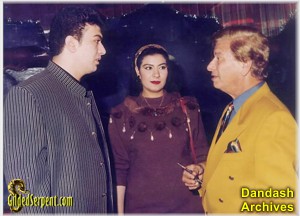
In Egypt you often hear people saying that the best dancers originate from Alexandria and Dandash is no exception. Born into a family of performers she was destined for fame. She also had a variety of influences over the years which helped create the unique style of the one and only Dandash!

Dandash’s parents performed as a singing duo on the radio in Alexandria as well as in weddings and parties.

From the tender age of seven Dandash was already an accomplished dancer and would accompany her parents and started to perform professionally.

The mesmerized guests would exclaim “how could someone so young dance like that! She must go on to be famous! ” . When I asked Dandash if she had been formally trained she replied that Allah had given her “mawheba”, that is a gift of talent from above. She added that she had seen Naima Akef on television and had fallen in love with her. Another influencing factor on her style was her love of ballet. She did not study ballet but would imitate the moves and dance around in her home as a child. At this point in the interview Dandash jumps up to demonstrate. With her arms raised and elegant execution of pirouettes on demi-pointe I am reminded of a music box dancer. She also demonstrates how she incorporated ballet leg lifts into raqs sharqi.

Dandesh at 8 years with her mom
Dandash at 8 years of age with her mother

I was curious as to what a performer of such a young age would wear on stage and she replied that she had many “thobes” (dresses) of all colours. They were modest and covered her chest although some were also short and often with matching sequined headbands.

She further surprised me by informing me that she actually made the costumes herself. Then to add to her talents she relayed that she also sang alongside her blind sister Noura. Noura was older than her, sixteen at the time and still sings for Dandash and other dancers to this day.

I asked her about her education and whilst she attended school right up until finishing level she admitted that she would day dream about dance in the classroom. Her favourite subject was Arabic which is not surprising for an artist who interprets the song meanings with her actions and movements.

The family became well known and was asked to attend various celebrations in the countryside outside of Alexandria. They travelled to cities such as Mansoura and Sonbat. Here Dandash saw for the first time performances by the Ghawazee of Sonbat and also Awalim who had travelled from Cairo to perform in weddings. These distinct styles were quite different from what she had seen on television and in Alexandria. She even incorporated a few moves she had seen which helped to mold her unique style and made her stand out later in Cairo.

Dandash’s star shone bright and she quickly rose to become the number one dancer in Alexandria. She performed in all the 5 star hotels such as Cecil Hotel, San Giovani as well as weddings and parties. She also began working in “masraheyat” stage musicals. So even though she was well loved in Alexandria the public realized that it would be a shame for her to stay and that she really needed to go to the centre of Raqs Sharqi, that is Cairo.

At 17 on left and with sister singing on right
On left is Dandash at the age of 17 performing at the Cecil Hotel Alexandria. She and Azza Sherif were the first Egyptian stars to have badlas made from leather.
Azza Sherif had the identical design only in black. On right is Dandash performing in Cairo with her sister Noura who is singing.

On TVOnce she finished high school, she married a musician who played keyboard for her and they left for Cairo. From the second day she arrived in Cairo she was working in nearly every venue. She changed costume designers from Hagga Torkeya who was in Alexandria, to the renowned Sahar Okasha amongst others. She also immediately started work as an actress on television as well as dancing in haflas that were also televised on channels such as Orbit and Nile TV. Within two years of the move she had become a superstar in Egypt.Mashrehaya

I asked Dandash what was her most memorable moment in her dance career and her face lit up as she recalled one special night that stood out from all others. She was performing at the famous Cave de Roi nightspot and in walked none other than world famous Egyptian actor Omar Sherif with his entourage. Suddenly she felt herself putting her best foot forward and dancing stronger than ever before because she knew that he was watching her. She had seen his films as a child and had been in love with him since that time. She was overjoyed that night and believes that it was her best show ever. During her set she stopped her band and motioned for the microphone. She then asked Omar Sherif if she may greet him and he replied if he could greet her in return. He then took the mike and announced to all that “If I don’t see Dandash dance, I don’t see the Pyramids”. At which point Dandash burst into tears. The whole event was published in the gossip columns of the papers the very next day.

With the increase in exposure also came the interest of foreign students to study with her. Dandash started teaching private students from her home (including myself). This was also around the time that the festivals started on home ground in Egypt. Dandash performed at the opening gala of Ahlan wa Sahlan in the Ramses Hilton in 2002. She stole the show with a tableau (also known as the manga routine) depicting dancers of the past: Souheir Zaki, Sami Gamal, Naima Akef, Taheya Karioka, Nagua Fouad, Fifi Abdou, Sahar Hamdi and Dina. Incredibly Souheir Zaki was in attendance and hugged her after her show because she was so thrilled. Here is the same tableau performed on TV:

The next year she also started to teach at Ahlan wa Sahlan. Dandash knows that her technique is difficult to grasp and humbly admits that she struggled with teaching in the beginning. Even Dina made the comment to Dandash “ the best thing about you is that your style is different and difficult. There is no way that any bellydancer can copy you”. There were not only language barriers to overcome but understanding how to teach her unique style which would take time. She went on to teach and perform in various festivals such as the Nile Group, Raks of Course and Camp Negum as well as abroad in Japan, USA, England, France, Germany, Italy, Sweden, Mexico, Ecuador and Greece. She has now spent the past four years working on herself and her teaching methods. She feels much more confidant as a teacher and this is one of the reasons behind why she has finally decided to create her own festival in Cairo. (See “resources” below)

Before I leave, Dandash proudly tells me one recent moment in her life that also had her in tears. Whilst in Japan recently she was taken to the “National Museum of Ethnology” in Osaka, for a “surprise”. As she wandered through the various rooms she had no idea what was in store for her. As she rounded the corner leading to the section devoted to Middle Eastern arts she was amazed to find her very own badla on display and a video screen of her dancing being broadcast. She was the only raqs sharqi dancer to be honoured in the museum.


Dandash in Alexandria
Dandash performing in Alexandria
2 unlabeled photos above-
Left: Dandash in red dress in a role in the television series “Hotline”
Right: Dandesh in a “masraheya” with Ahmed el Saka.
Resources:

use the comment box

Have a comment? Use or comment section at the bottom of this page or Send us a letter!
Check the “Letters to the Editor” for other possible viewpoints!

Ready for more?


Gilded Serpent presents...

Event Planning and Hosting Artists, Part 3

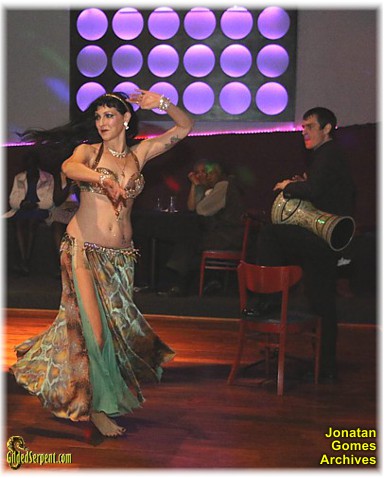
ISAMETD event- Jonatan and 2 musicians perform for a dancer

Promotion and Money – Finding Success

by Jonatan Gomes
posted January 6, 2019
part 1 here
part 2 here

Promotional Materials:

Flyers, handbills and posters are a must have, but this is really just for appearance mostly. Do not count on them as a prime source of promotional material. Just print up a few fancy looking things to pass about the city, do not over print as it is costly and not the most effective form of promotion. As I said before, social media is the best free promotion, and since so many people love to spend countless hours on the various social media outlets watching cat videos and playing games that grow virtual carrots and broccolis, you may as well milk it for everything it’s worth. Having one or more colourful and attractive posters featuring your top artist(s) as the superstar(s) that they are and sharing along with some fun details about the event and other promotional gimmicks is pretty useful.

Also, aside from the typical "Facebook Event Page", you may also want to create a group discussion page to where people can have access to a more organized discussion group. People can ask questions about the event, class materials and clear up any questions they may have. This one is pretty much a given and most people do this, but then again, some people don’t and there are also some people who do but are not as attentive to the potential attendees as the should be. Wix.com offers free websites, you can also create your own website just for the event in there. It’s more effort, but it shows you mean business! You aren’t playing around anymore. This thing has its own website too!? Wow! You can also put the web address on any flyers or posters so people passing by the local coffee shop, see the flyer, can get more info, even purchase tickets to the show.

Newspapers, city flyers, TV and radio are obviously the best, but are rarely cost efficient. Nevertheless, if you have access to any of these things, use it! Don’t be afraid to contact your local news morning show about the event either. You never know, but often I find there are a surprising number of people in local network television that find it beneficial to show cool happenings that show off their city as a place with fun, diverse activities for people to engage in. They may just invite you down to the station to give a quick promo for a few minutes. Then again, they may not. Either way, it’s just a simple phone call, try it.

Pace yourself, but do not slack, You started early, so just do a little at a time so you’re not overwhelmed when it’s go time!

Promotional Packages and Special Offers:

If you don’t have these in your event, you’re doing it wrong! Everyone likes to save money so give them the option to do so while simultaneously providing them with as much substance as possible. Let’s face it, virtually everything about this art form screams, “IT’S AN INVESTMENT!” $600 handmade costume from Cairo? “It’s an investment!” Travel expenses, lodging, workshops, show and a private lesson with Samira So and So? “It’s an investment!” Trip to Cairo, “It’s an investment!” Make-up, hair and nails? “It’s an investment!” DVD’s, CD’s Music Downloads? “They’re an investment!” Need I continue? Before you know it, you just might invest yourself into a subsidized housing project, trying to pay for your finger cymbals and fan veils with an EBT card.

Needless to say, no artist can do without training and experience and since this is an art that is of a foreign culture. Let’s face it, no community in the Occidental world will ever be as ripe with comparable teaching opportunities and experience of the Middle-East. Even if your preferred style is of a more contemporary nature such as Tribal and Fusion styles, we still all need to network as much as possible for the communities to grow. Therefore we can not skip the workshops and out of town artist experience.

Point being, all dancers want more information, skill sets and experience, not to mention the networking that comes with it, but never forget, most of them spend a lot of money on this art and they do so rather frequently. Setting prices of workshops too low, however, can cost you in the end.

So how do you provide what they want in an affordable way while still allowing you to profit? By offering multiple items for sale at regular price, but offering super saver-esc discounts when multiple items are purchased.

Set the lowest rate possible per workshop that you know will still turn a profit for you; if there are 2 workshops, multiply that number by 2 and that is the cost you charge if participants sign up for both workshops. Charge considerably more per each workshop if taken a la carte. This way you encourage people to take all things offered. If there’s a performance included, you can either offer workshop attendees a discount on the ticket sales, or charge a slight bit more for the workshops and just make the show free workshop attendees. Remember, the more items you have for sale = the more promotional services you can create, which means the more of a discount you can allow. So, more Items for sale = bigger discounts, bigger discounts = bigger profits. (Just never go below your bottom line) Reminder* Your bottom line for sale prices is determined by how much you need to turn a profit after all expenses are covered.)

What kind of profit should I expect to see?

This all depends on how realistic you are willing to be. One way to look at it is from the 70/30 perspective. Regardless of the event’s size, if the artist I’m hosting makes X amount of money, then if I can at least see 30% of that amount in my profits (after expenses), I did pretty dang good. Essentially, 70/30 split on profits between artist and host is industry standard pretty much, but since the host must also factor in the expenses involved in hosting, then the math should work as follows. Total event production cost = A. Total amount of money generated from event = B. Subtract A from B to get total profit. Total profit = C. Pay artist 70% of C and 30% of C goes to you. *Side Note! (This does not mean if you spend $1000 and profit $100 that the artist goes home with $70!; It probably goes without saying that most of us artists all have clauses in our contracts to prevent this sort of thing from ever happening…At least I hope we all do!)

I feel that if you just skid by with the bare minimum of all the things I mention here, then this should never happen to you, worst case scenario you break even. The point of this article, however, is for you to do far more than just “skid by” and break even and actually turn some sort of decent profit. Keep in mind, as many have stated before, the main thing is promoting art within your community and getting it to grow, money is secondary…But I feel it should not be a compromise either. If we’re making money, you should too. If in the beginning you only see a 5-10% profit, don’t give up, at least you didn’t lose money…so keep trying…unless of course, it’s just not your bag.

Keep a positive attitude, be friendly and kind to everyone. Be someone people enjoy to be around.

MO MONEY!

The final topic I would like to share is sadly one of the most underused tactics in this line of work, yet simultaneously one of the most effective for generating revenue. If done properly, you can generate anywhere from a few hundred dollars that can help to cut back on overhead cost, up to a potential sum of money that can cover virtually all your expenses so that all you see is straight up profit. This magical mystical financial enigma is found in the land of sponsorship, and no, you don’t need a business degree to pull this one off. All you need is a clear and concise, easy to understand sponsorship packet with reasonably affordable benefits that small business owners will want to take advantage of and a few different options for them to choose from. (Add dash of charisma and watch it work wonders.)

It’s actually not that difficult to find local businesses who would be willing to drop a few bucks your way if you can return the favor with some basic advertising.

It won’t cost you any extra to mention your gratitude towards said businesses for their contribution on your event posters and social media shout outs, and many local business would love to drop $25-50 or more for these promotions, especially since the more conventional means for them to promote their businesses can generally be of considerable cost to them.

For starters, imagine some of the cool businesses in your area owned by regular folks such as; restaurants, hookah lounges, craft shops, beauty salons, record shops, and even service providers. Maybe you have some friends starting up a lawn service, or your friends friend just started doing some sort of independent contracting. Do you know someone who owns an art gallery? Perhaps a tap dance studio. Virtually anything! Even if you don’t know them personally, there has got to be at least a dozen or more small businesses in your area to where you could easily contact the owner and meet with them.

What to Present to Them

Remember, these are small businesses that may or may not know you very well or even at all for that matter, so for starters you need to be the lovable, approachable friendly person that I know you are when you talk with them. Equally important is that you approach them with their business in mind. When you meet with them, sell your event. Tell them you are hosting a big name artist from out of town and that you will be doing a lot of promotion via social media, public distribution (posters/flyers/word of mouth) and all other avenues of promotion you intend to explore. Present them with several, affordable options to jump in on the bandwagon. I usually say, “Since I will be promoting a firestorm of this event, it really isn’t a big deal for me at all to throw the name of your business out there as a contributor.” From there I may proceed to inform them of the different promotional options available. Always make it affordable and as risk free to them as possible. Here’s a basic example, you can set your own prices based off of what you know of your city however:

I plan to promote this event x amount of times during the week via this manner and that… therefore:
$25 gets you x-amount of brief shoutouts on all social media outlets + your company name in small print on the event poster.
$35 gets you the same, but 2 extra shoutouts per week in addition to a weblink to your business on the flyer and social media pages
$50 gets you the same but more detailed shoutouts of whatever you want me to say about your business x amount of times, full company logo on event flyer in small print + web links to all our social media outlets.
$75 gets you the same but add this thing and that thing to make it better…
$100 gets you all that and a bag of chips, like hang up a banner or booth promoting your business at show, vip seating etc…be creative.

In my few years of experience with this, 80-90% of all new businesses that go for this do the most affordable options. So I basically make those options as desirable as possible because not only is it no skin off my back to throw their name about and a lot of these folks may not know me very well and probably aren’t sure if I can get the word out the way I claim.  So we keep it easy for everyone. If you get 5-10 $25 sponsors, watch your overhead costs diminish considerably!

Don’t forget, local businesses aren’t the only option. There are multiple online businesses that may enjoy frequent and affordable promotion such as online belly dance accessory supply companies, jewelry makers, costume designers and more.

Do you know any local artisans? Henna artists or costume / jewelry makers? Painters? Sculptors? Offer them a comfortable fee to set up a booth at the show. That sort of thing adds to the ambiance of the event and it’s fun for your guests and everyone has an opportunity to prosper, not to mention, you are spreading art, culture and awareness. These are the sorts of things media networks enjoy covering by the way because they help the local economy. Refer back to my point in the section on promotional materials, you may want to consider contacting your local news network if you are going to be featuring all of these cool things and promoting local businesses. Small efforts, such as a few phone calls and drop ins, can make a big difference. It all works full circle.

Conclusion:

Event hosting is not for everyone. Most of you reading this are likely artists such as myself who have either attempted event hosting in the past or are considering it in the future. It is extremely difficult to be both an artist and a business person at the same time. The two concepts when combined tend to produce an oxymoron of sorts. Granted, I have been working as an artist for the majority of my time on this fragile planet, and only now am I beginning to find ways to make it work for me. Personally, I feel it necessary to divide my abilities in such a way that allows me to pursue my artist career despite the compromises I must make to ensure certain stability. Not everyone can be so flexible but when it comes to the ever growing art that exists within the diverse Raqs Shari communities out there, we are blessed in many ways that extend far beyond our basic exposure to this amazing spectrum of cultural goodness…One of those ways that seems to stand out for me the most is the unity and togetherness of the dance communities around the world.

As a man living in a “man’s world”, there are few things I am privileged enough to witness that truly bring women together in a strengthened form of solidarity.

I feel very fortunate to have come as far as I have in a community that is virtually run by women, women who must endure living in this upside-down “man made” world that have made for themselves a truly remarkable and complex art form all of their own. This is more than just an art form that embodies the music and gives shape to musical passages. One cannot deny the apparent empowerment that a woman feels when she is free to express herself the way she was meant to. I have witnessed this same dynamic in many cities around the world and therefore feel that this is an art form that deserves as much attention as possible. So yes, I want my hosts to make money, but more importantly to keep the torch burning. But this torch will only stay lit if we can compete in this topsy turvy upside-down world.

If you are a woman and an artist and you are reading this and you are in a place to where you feel torn between the artist world and the business world, never forget that you are the creator of your own destiny. Do not confuse the business world for the “man’s world” just because it is generally men, and lame men for that matter, who have dictated for aeons a “pragmatic approach” towards attaining your goals. It is this overwhelming aspect of our society that tricks our brains into believing that we only have one narrow path towards success. Use the natural born instincts that you were given as a woman to change the game to fit your own personal goals and dreams. I know this is possible because my best friends in this business have been doing just that.

Hosting people is more than just exposing your community to new techniques and dance concepts, it is the spreading of information and concepts that teach the student far more than they ever expected. I have become enamored by the strength of communities around the world and I deeply wish to see it prevail with all of it’s potential. We need people who are willing to keep it going strong, and though my experiences may pale in comparison to the many much more experienced than I, it is with my deepest admiration toward the artists of this culture that I share what little I know in hopes to keep this torch burning.

Jonatan and Sadiia

Part 1 here

Part 2 here


Resources:

use the comment box

Have a comment? Use or comment section at the bottom of this page or Send us a letter!
Check the "Letters to the Editor" for other possible viewpoints!

Ready for more?

  • Producing a Middle Eastern Dance Festival
    "It is necessary to combine your organizational and public relations skills with your creativity."
  • Color, Graphic Design for Dancers, Part 2
    Now we’ll delve into applying colors in marketing materials, returning to the ever-present concepts of hierarchy and legibility introduced previously.
  • Typography, Graphic Design for Dancers, Part 1
    As artists of an often misunderstood dance, we dancers understand that everything we present publicly reflects back upon us as individuals, upon bellydance as an art form, and by extension, the Middle Eastern culture. When presenting these facets in the most favorable light to other dancers or the general public, good design becomes paramount because it is the most unmistakable way to demonstrate our worth.
  • The Festivals That Could Have Been, From the Point of View of an Organizer
    Finally, I started again, alone. I sold my car and my apartment, and I booked the five star Beach Resort with that money, including supplies, the gala room, training rooms, and a whole floor for the exhibitors.
  • Bellydancing With Fire with Leslie Rosen Reviewed
    Leslie gets an "A" on fire safety. Her safety section is a great overview, covers just about everything, and has clear visual demonstrations of fuel handling, dipping, and shaking out the excess fuel.
  • Judging the Judges, Training Judges for Competitions
    These are fine scoring points, but there are usually no detailed guidelines for each scoring section in each category, nor strict regulations for judges, which seem to cause some grey areas. Contestants have rules and regulations, why not the judges?
  • Certifications & Contests: Are They Meaningful?
    Its as if the contest win were a diploma, her ticket to teach!
  • Beyond the Restaurant: How Can We Bring Bellydance to a Wider Audience?
    But I’m under no illusions. That audience wouldn’t be present if wives, daughters or friends weren’t performing. And despite people saying we’ve opened their eyes to the beauty and spectacle of bellydance, the truth is that ours is still very much a niche and hobbyist dance genre.
 

Gilded Serpent presents...

Harem Girls

Placeholder

Our Very Own “Non-Arabs Got Talent” Show

by Zaina Brown
posted December 18, 2018

The following is an excerpt from Fire In The Belly, a memoir by Zaina Brown about the thrills and hard knocks of dancing in the Middle East and traveling solo in Africa, Asia, and Arabia. It is set to be released in January 2019 – follow on Facebook (https://www.facebook.com/FireInTheBellyBook) and Instagram (https://www.instagram.com/Fire.In.The.Belly) for publication updates and more sneak peeks!

Abdulrahman, a Syrian club owner, was a living nightlife cliché: Only interested in women and money, in no particular order. What set him apart from other dirtbags in Dubai was his exceptional lack of education and good sense. When he first bought the club with his crisp new money, he mistook it for a candy shop. He would show up knocking on the doors of female singers, who then threw a fit and threatened to go back to Lebanon. In order to work together, my agent Panos had to housetrain this puppy.

He gave Abdulrahman a copy of Nightclub Managing for Dummies, but the poor thing couldn’t read. With a helpful picture book, he finally learned the basic principle: Keep business and personal entertainment separate.

One Thursday night, Panos summoned a bunch of bellydancers to join him at Abdulrahman’s club. The task was to show him some new faces, and of course to decorate Panos’ table. Only the top-top girls didn’t need to bother. I was just happy I wouldn’t be the only dancer there.

The last time I accompanied Panos to this nightclub, we had sat opposite of Abdulrahman and a Moroccan hooker. The men talked. Abdulrahman fed the girl cherries off the fruit platter while she egged him on, twirling her tongue around each cherry before taking it into her mouth. It was hard to keep a straight face watching this spectacle from front row seats. Even Panos was taken aback, and once we were in the elevator, commented on Abdulrahman’s shamelessness. Walking through the hotel lobby at midnight in full makeup, tight jeans and a skimpy top, with the hundred-year-old Panos in tow, I was painfully aware of how I looked. I silently declared I was just going to some business meetings with my boss. It was perfectly believable in the eyes of no one.

Like Panos, Abdulrahman had a thing for tall women. This disqualified a few fantastic Brazilian dancers, but Panos had insisted they come along anyway. The girls took it all in good stride.
“Maybe when I grow up, I can work here,” one remarked.

Haifa WehbeOne by one, Panos ordered us onto the stage. Like obedient little harem girls, we danced to impress the sultan, so he would let us live another day. It was our very own “Non-Arabs Got Talent” show. Panos beamed with pride watching us.

Afterwards, I excused myself into the crowded bathroom. While I washed my hands I glanced at the girl next to me fixing her makeup. She’d had lots of work done on her face, creating a vague resemblance to a certain Lebanese songbird.

“You look like Haifa Wehbe!” I said, thinking it would probably make her happy.

The girl turned to kiss me on both cheeks, as if we knew each other.

“I have a lot of work for you,” she whispered into my ear.

“Oh no, thanks. I’m just…on vacation.”

She looked at me perplexed. I returned to the table.

If anyone earned themselves a contract with Abdulrahman because of that night, I never heard a peep about it. It didn’t work that way. We all knew Panos decided who went where. He told restaurants that the dancer they specifically asked for wasn’t available, even though they were, if he wanted to give the contract to someone else. As always, "I will do my best to find a contract for you" was his favorite line. It meant "This conversation is over."

Thankfully, even though Abdulrahman never gave me a second look, work had many ways of finding me.

“Fire in the Belly” by Zaina Brown is set to be released in January 2019 – follow on Facebook (https://www.facebook.com/FireInTheBellyBook) and Instagram (https://www.instagram.com/Fire.In.The.Belly) for publication updates and more sneak peeks!

Resources:

use the comment box

Have a comment? Use or comment section at the bottom of this page or Send us a letter!
Check the "Letters to the Editor" for other possible viewpoints!

Ready for more?

  • Cairo to Khartoum, Overland Follow the Nile and You Shall Bellydance!
    Africa is my big travel love, and I’m always happy to get some Sahara between my toes, but Sudan was never on my to do list of countries. I knew getting the visa was difficult, which is not surprising for a country with a wanted war criminal for president. Slap the merciless climate on top of that, and Sudan was something of a blank space on my mental map of Africa. Then, a good friend of mine announced he was setting up camp in the Sudanese capital Khartoum for a few months for his new UN gig. It was now or never for me and Sudan.
  • A Journey to the West Bank, A Lone Dancer Visits Palestine
    The refugee children were dressed in sweatpants and T-shirts, like school kids anywhere in the world. The coach was in a tracksuit, and his stern voice echoed over the young crowd. It could easily have been a basketball game, or perhaps a rehearsal for a play, that was about to begin in this gymnastics hall. But this was a dance rehearsal
  • Touching the Clouds: Impossible Bridge in Yemen
    I needed a place where I felt safe, had some friends, and knew my way around: a place like Yemen! Besides, there was a bridge there that I wanted to check out.
  • What Lies Beneath, Part 1, The Morocco & Western Sahara Tourists Don’t See
    When you say you are going to travel around in Morocco, usually, the response you get can be summarized with one word: “Marrakech”. Sure, Marrakech might be the “best of Morocco”, but it also wasn’t going anywhere.Some other places, however, may not always remain as accessible, and I had a few questions on my mind.
  • What Lies Beneath Part 2, The Morocco Tourists Don’t See, Suspicion, Lifestyle, Wedding, & Rescue
    What’s depressing about Laayoune is the idea of it: what it represents, not the city itself. Buildings, painted in salmon color like Marrakech, palm trees planted in pretty town squares, clean streets, restaurants and cafes, busy market places and a gorgeous plaza where people stroll at night. If you didn’t know any better, you would love this place! In reality, you are inside an enormous military base, while the city is a mere facade.
  • Changes in the Island Kingdom, The Bahrain Bellydance Scene
    Returning to Bahrain to work after four years felt like going back to my roots. This little island kingdom is where I did my first Middle East contract, busted my bra on New Year’s Eve, and returned several times in the following year. Those were the days. Now it had been a while. Had Bahrain changed? You betcha.
 

Gilded Serpent presents...

Event Planning and Hosting Artists

Part 2: Community and Network: Every Host’s Lifeline

Rose Noreen dances

by Jonatan Gomes
posted July 11, 2018
part 1 here

Community Involvement and Event Turnout:

Oh but this is a tricky one! Actually, it may not be as difficult as you may think.

First rule of thumb, never assume that because and artist has a a big name that they will guarantee a sold out event.

I have performed in cities where though I faired decently, other artists with much bigger names than myself suffered poor attendance. Promotion and networking is EVERYTHING! Virtually every traveling artist should have substantial promotional materials, such as: photos, videos, published works and materials for sale. These things should be plastered all over everything you touch every day from the moment you book them up until 5 minutes to show time. NO EXCEPTIONS and NO EXCUSES. If you own a dance studio, there is no excuse for your main majority of students to not only attend the event and workshops, but to also help considerably with the distribution of promotional materials.

Graces to social media, the spectrum of free and/or cost efficient promotion is abundant. Wear it out! You cannot over promote!

Network!

Networking means attending your dance community friends events and shows, show them you are willing to help them with things, this way, when it’s time for you to do your event, you can count on them for assistance. Reach out to anyone and everyone within your genre of dance, including communities of neighboring cities. If you do not know anyone in neighboring cities that do what you do, then you’re doing Facebook wrong. Find out who they are and where they are, make friends, invite them to your events. It doesn’t hurt to reach out to them from time to time with a personal private message.

Also, don’t be bashful about reaching out to other, seemingly unrelated artist communities, you may be surprised to find how many people have an interest and / or curiosity to learn about the type of art you’re into. Communities grow this way. Reach out to everyone you meet, find out where the other dancers hang out, perform and study, including Ballet, Hip Hop, Salsa, African and World Dance communities, etc.

Also, know dance related artist communities as well…basically anyone who looks cool, you never know how many people they know.

Your down time in between hosting and or performing events should include networking.

Stay on top of your local dance community colleagues!

Remember, people forget. It’s human nature. It doesn’t mean your event is not important to them, but everyone has deal with life. We can’t all be expected to remember everything we’re supposed to remember all the time, and that’s not including the event you’re hosting. So keep everyone in the loop. Stay on top of people who say they are either interested or are going to attend but have yet to sign up. Send private messages from time to time. Make it known to everyone that this is going to be an amazing event that they really do not want to miss because it’s true! Let it be known in your advertisements, social media comments and private messages to your friends that you wouldn’t be making such an effort if you did not believe in the artist you’re hosting.

Make it beneficial to your neighboring dance community friends to help you promote the event. People love to be a part of something big and cool.

Find ways to include your friends in your adventure any way you can. Don’t forget, hosting out of town artists is a way the attendees can get their network on as well. I have met so many cool artists through my travels this way, some of which I have even come to work with later on.

Take extra good care of your out of town workshop attendees!

Generally, if someone from another city contacts you about the event you’re hosting, it is a sign that this person is serious about the art. Serious enough to make an effort to invest in travel, lodging and classes all on their own dime. Chances are, they just might have some talent. Talk to them, ask them questions about themselves and if they have any videos or materials they can show you. If they are good, you may want to give them a spot in the show (provided it does not conflict with the contract of your featured artist)…and at the very least, invite them to your after party / dinner with your featured artist. (You are taking you’re featured artist out for dinner / drinks after the show right? You better!) Make it known that you appreciate their efforts to take part in your event. Also, those dedicated and motivated enough to make such efforts…well, you never know where they may end up one day. Those are generally the sort of people worth maintaining contacts. You may end up hosting them one day, or they may end up hosting you one day. That sort of thing happens all the time in this business.

Frustration is not a unique quality to have because it happens to everyone, therefore it obscures the things about you that make you special. Keep it off the stage!

SadiiaLamm dances with Jonatan

Coming Up: Part 3: Promotion and money – Finding Success


Resources:

use the comment box

Have a comment? Use or comment section at the bottom of this page or Send us a letter!
Check the "Letters to the Editor" for other possible viewpoints!

Ready for more?


Gilded Serpent presents...

Longevity In Dance

Overcoming Obstacles and Struggles

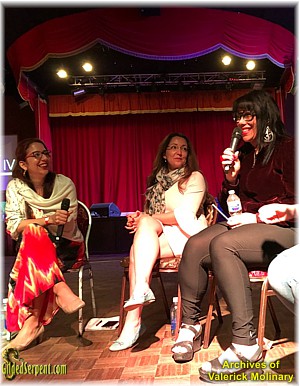
Panel discusses

by Sabrina Mijares
posted September 13, 2018

“The words "community" and "sisterhood" get used a lot in our field. And yet, sometimes words are so over-used that they get stretched out like elastic and lose the firmness, shininess and purpose that made them useful in the first place. Last Sunday was not like that. It was about recovering the power of words through concrete actions. It was about how holding safe and authentic spaces can help us see both what brings us together and the multiple possibilities we have available to us. The Lebanese Love Affair has been full of wonders. I want to highlight in particular our conversation on Sunday’s panel discussion, "Longevity in a Dance Career."

These women were real, open and giving. It was a nourishing and honest conversation on so many levels and I am grateful to all panelist and dancers who all not just came, but were fully present and open to the experience. This is how that infamous community actually happens. Thank you. Gracias. Shukran. May we meet again.” Diana Soto

The Lebanese Love Affair IV was the fourth of a yearly weekend long raks sharqi event in Miami, Florida, created and produced by Valerick Molinary. It featured an opening show, workshops with the infamous Soraia Zaied, a gala theater show, and for the first time this year, a panel discussion.

The panel discussion began on the Sunday morning of daylight savings, March 11, 2018. In the dim, warm lighting of the Flamingo Theater (an intimate theater bar in Miami), six panelists and host, Diana Soto, sat in a semi-circle at ground level, facing the group of dancers a few feet away eager to hear a discussion on a topic that’s so often neglected; “Longevity in a Dancer’s Career.”

The selected panelists, each with at least fifteen years of professional dance experience, were Adriana Echeverri, Amara Sayid, Francesca Sahar, Portia Lange, Tiffany Madera, also known as Hanan, and Valerick Molinary (see list below for more information). Each panelist achieved success in their dance careers through different avenues. Among the panelists are business owners, full-time non-dance professionals, mothers, artists, and full-time dancers. Each woman harnessed their diverse styles and pursuits in the belly dance community, demonstrating the various ways and perspectives of “making it”. The panel began with the intention of highlighting these differences, but what ultimately emerged was an open, vulnerable discussion that shed light on common threads between the dancers, and all lovers of Raqs Sharki.

Diana began the event with a question of intention – “How did you decide it was time to go solo and launch your professional career?” The panelists marked this moment as the decision to open a studio, perform a solo, perform in a venue, or enter a competition. The answers varied, but they fit into two categories: they were pressured to take the stage or felt propelled to move forward. The commonality amongst their experiences was the choice to take a risk, despite self-doubt. And just as taking risks comes with the possibility of failure, the conversation soon transformed into an honest telling of their faced obstacles.

The women shared stories of rejection and criticism from audiences, months or years of financial and emotional struggle, and even losing entire businesses and homes.

After becoming a highly successful belly dance teacher in Cork, Ireland, Adriana decided to move back to Miami and open a dance and spa center. Opening shortly before the economic crash of 2007-08, the business closed in a year.

“I basically put all my money into that…I lost my home, I lost my studio, I lost everything…I had no money to eat. I was living out of my car for about two months,” she said.

Other dancers recalled periods living off of sandwiches, driving to teach a class where no one would show, feeling defeated, sobbing on a street, and “sleepwalking” through life.

“I was sleep walking and numb,” was how Portia described her emotional and mental state when she first began belly dancing in Gainesville at 23. She dealt with severe body image issues and internalized shame for her “Maltese” background that isolated her from her Caucasian and Italian peers growing up. When she discovered belly dance, it became her coping mechanism.

“It was the only thing keeping me going. It kept me alive,” she said. It was this sense of purpose that steered the course of her life.

And as if their path was a destiny meant to be fulfilled, each woman acknowledged the obstacles as an integral part of the journey. The failures were lessons they needed to live through.
These anecdotes led Diana to probe the next topic; what skills are necessary to persist in this career. The panelists cited discipline, cultural education, consistency, focus, persistence, courage and more. Many touched upon sustaining their passion and vision. Amara noted, “Stay true to yourself and how you feel about it. Then I think you can make it.” Hanan resonated this message with her own dedication; “I believe so strongly, profoundly in my vision, that I never give up.”

But apart from drive, they emphasized the importance of relationships and unity within the community.

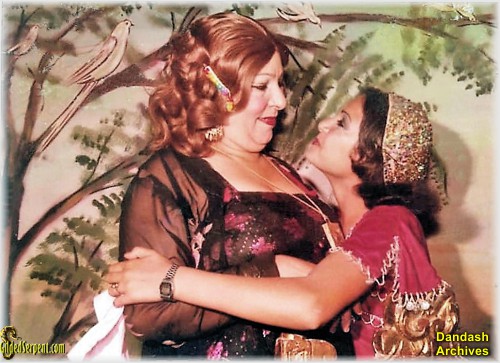
Not a single panelist overlooked the necessity of a support system in their career and life. The mothers on the panel seemed to regard this as the single most important thing in being able to balance motherhood, dance, and a career. Those with separate, full-time jobs detailed the importance of their relationships with dance colleagues to endure working two jobs.

With their tales of acceptance and support, came the antithesis; experiences of criticism and rejection from the community, where there were lessons to be learned as well. Valerick related a moment of heartbreak when Yousry Sharif severed ties with her for traveling to NYC to work with his ex-wife Nourhan. It ultimately led to a trip to Lebanon to find new teachers with Simon (also known as “Lebanese Simon”, a professional dancer and good friend of Valerick’s). There she studied with Pierre Hadad, Amani, and Sami Khoury, and learned, “there are no idols and heroes…everybody is totally normal.” Even more, it led to the creation of the Lebanese Love Affair, when she was encouraged by Simon to make a production and bring Pierre as a guest.

Hanan recalled when she launched her show, “Hanan With Other Friendly Gods and Goddesses”, that talked about female genital mutilation. Airing shortly after the events of 9/11, it was strongly rejected by the belly dance community, for fear of persecution. Tamalyn Dallal remarked, “People had an allergic reaction to it.”

To seek out the audiences that would understand her work, Hanan turned to the theater and art world. “It was then that I learned the belly dance audience was not my entire audience,” she stated.

These stories of rejection from the community are interlaced with a return to growth and acceptance. Through a sense of isolation, they sought out their place and purpose, developing new, stronger roots in the community.

“There’s different niches and different audiences…What do I really love? What do I really want to do? And who wants to see that? That’s how you can frame and position yourself,” said Portia.

In a modern, globalized world with an ever-expanding belly dance community, it’s important to focus on who you are versus how you compare to others.

“It can be really empowering to understand that there’s a plurality of audiences of people that can appreciate your art … understand that this is a huge, vast, immense world filled with human beings that can be inspired by your work and that maybe we can challenge ourselves to think deeper about what we have to offer and to bring it to different bodies that can officiate it,” said Hanan.

Hanan and Portia’s stories demonstrate the impact of finding ‘your’ audience, even beyond the belly dance community. Portia has targeted the general public with a commercial marketing style and Hanan has targeted artistic, experimental audiences through her various productions. Working with two separate and greatly different communities, both experienced ample success in their careers and empowered many women along the way.

Continuing on the subject of the dancer’s relationship to the audience, Francesca shared an anecdote of when she was hired by a client seeking a commercial belly dance show. She decided to “convey a message” by adding the cultural aspects to her performance.

“Now I laugh,” she recalls. “The people who are paying you don’t care sometimes… There are different audiences and you need to offer what your audience wants to accept. And learn that not everybody wants to be schooled on a birthday party.”

There are many worlds in the vast community of dance – the commercial, the cultural, the artistic, and more – and each with audiences seeking a specific experience.

Making the decision to pursue a dance career involves figuring out where you belong, who your audience is, and how to balance the ways you want to engage the different faces of this community. Adriana Echeverri and Portia Lange empower women through their dance studios, Adriana with an artistic intention and Portia with a commercial, fitness one. Amara Sayid pursues her love of the culture and dance through the development of an educational and culturally rich dance academy and dance ensemble. Francesa Sahar and Valerick Molinary balance participating in commercial, cultural, and artistic dance endeavors, engaging multiple audiences. And Hanan produces artistic and humanitarian projects through her dance career.

While these women have undergone very different journeys, there is something that connects them, and all dancers. They have felt and continue to feel self-doubt in their dancing and creations. But they persist because they know what this pursuit is about; why we dance. As Amara shares, “When I feel self-doubt I put the dance first. The love of the music, the love of the culture…You put aside all those fears and those doubts and you’re like, I just want to express!”


Panelists and their affiliations:

  • Adriana Echeverri – Creator and Owner of Belly2Abs
  • Amara Sayid – Director of Middle Eastern Performing Arts Academy – MEPAA and Director of Azhar Dance Ensemble
  • Portia Lange – Creator and Owner of Belly Motions
  • Francesca Sahar – Professional Dancer, Instructor, and Assistant Underwriter for Latin America and the Caribbean
  • Tiffany Madera, also known as Hanan – Documentarian, Creator of Havana Habibi, Artist, and Dancer
  • Valerick Molinary – Professional Dancer, Gig Dancer, Instructor, Director of the Belly2Abs Unveiled Troupe, and Organizer and Director of Lebanese Love Affair
Full Panel at Lebanese Love affair
Photo top of page,
from right to left: 1.Diana Soto, 2.Francesca Sahar, 3.Hanan.
This photo –
From right to left: 1.Adriana Echevarri, 2.Amara Sayid, 3.Portia Lange, 4.Diana Soto,
5.Francesca Sahar, 6.Hanan, 7. Valerick Molinary.
Resources:

use the comment box

Have a comment? Use or comment section at the bottom of this page or Send us a letter!
Check the "Letters to the Editor" for other possible viewpoints!

Ready for more?

  • From Evolution to Revolution, A Review of "Dark Side of the Crown"
    Jillina’s character is mean and abusive which makes us think that she may be the killer!
  • Retirement, Is There Life After Dance?
    Perhaps this was my mistake; I had a plan for my dance career, and I was not shy to tell it to everyone who would listen.
  • Event Planning and Hosting Artists, Part 1: Costs and Spaces
    Event planning is a huge part of the dance community and hosting artists from out of town is essential for expanding the knowledge, skills and diversity within your community.
  • Mahragan and the Voice of a Generation, Music and Movement h
    The daze brought on by sensory and emotional overload is quickly broken by a rage of autotune blasting from the line of tuk-tuks whizzing past you in traffic. It is there, in that autotune where the heart of the Cairo youth lives.
  • Cairo to Khartoum, Overland, Follow the Nile and You Shall Bellydance!
    Africa is my big travel love, and I’m always happy to get some Sahara between my toes, but Sudan was never on my to do list of countries. I knew getting the visa was difficult, which is not surprising for a country with a wanted war criminal for president. Slap the merciless climate on top of that, and Sudan was something of a blank space on my mental map of Africa. Then, a good friend of mine announced he was setting up camp in the Sudanese capital Khartoum for a few months for his new UN gig. It was now or never for me and Sudan.
  • Memorial to Jamila, Articles and Testimonials Regarding the Icon
    An influential and respected teacher whose techniques and formats have been shared all over the world, the iconic Jamila Salimpour was instrumental in helping mold many big names in American belly dance.
  • Life was a Cabaret, My Memorable New York Club Years: Part 3- Beyond Manhattan
    New York City was “club city” back in the early 1980’s, besides the Middle Eastern night clubs you had entertainment from around the world. Flamenco was alive at the Chateau Madrid, and you could see a Hawaiian revue at the Hawaii Kai on West 50th Street. When Ibis closed for the second renovation, all the dancers went scrambling around looking for another steady place to dance in. One club in particular where I got 6 nights a week of work was at Le Palais in Brooklyn.
 

Gilded Serpent presents...

Event Planning and Hosting Artists

Part 1: Costs and Space

Placeholder

by Jonatan Gomes
posted August 8, 2018

Introduction:

Event planning is a huge part of the dance community and hosting artists from out of town is essential for expanding the knowledge, skills and diversity within your community. I have been hired by a lot of people and companies who are fortunate to have a grant writer on their team, but that probably accounts for about 2-5% of all contracts work. The vast majority of all my travel gigs are hosted by other artists, who like myself, just have to learn this stuff through trial and error. Having been hosted in cities around the country as well as hosting a few out of town artists myself, I feel very fortunate to be able to say that the vast majority of which have been successful. Needless to say, there have also been a number of gigs that didn’t quite turn out the way I had hoped.

Whenever I am being hosted in another city, I like to be as engaging in the community as possible. I really like getting feedback from the workshop attendees about their experience, if they felt they learned things they can put to good use, if they feel they have enough exercises to work on afterwards and so on. I can generally get a sense of that from the students expressions and participation levels throughout the workshops, but what is not always so apparent, and equally important, is how well the host fared from the event.

Personally, I don’t think it to be very polite to directly inquire to the host specific business related details on the event as it may appear that I’m questioning their business practices, but I do like to ask them how they felt about the event and if they were happy with how it turned out. Almost always the responses are very positive and enthusiastic, but sometimes I will hear a tone in the voice or read an expression that suggests there may be a thing or two that wasn’t exactly spot on. Granted, event hosting can take a lot out of a person, it is a lot of work and most of us feel pretty drained afterwards, regardless of how successful the event may have turned out, so maybe that is what I am sensing. In this case I might ask my host how they did, and it is great to hear things like, “Yes, it was great! The dancers all seemed to really enjoy the experience and it is very nice to have the musicians perspective.” and so on… Where then I may casually ask, “Great! but how did YOU do?” (because I really would like for my hosts to make money as well)

After carefully dancing around the subject of money without actually bringing up the word itself, I will get all sorts of responses ranging from, “Yeah, we did really good, just a bit tired though” to a sadly more common, “Oh we don’t do this for the money, we really just like to bring art to the community and make it grow.” Which is a beautiful thing, however, everyone has bills to pay, not to mention, the more money you make, the more events you can have, the more art you can bring to your community and the bigger it can grow.

I have hosted enough events myself to know that great attendance doesn’t always mean good money for the host. There is often a lot of overhead to consider such as venue and studio rental, flyers and promotional materials and most of all, the travel and lodging expenses of the artist. That being said, I feel this is an important enough topic to share some of my experiences with others. Maybe you’re thinking about hosting an event yourself and are not sure where to begin. Maybe you have hosted events in the past that didn’t go so well, but rather than throw in the towel, you want to give it another shot. Perhaps you have hosted before and it was successful, but you would like it to be better. Whatever the case may be, I want to share with you a few things that I have found to be very helpful when it comes to event hosting. I’m not claiming to have the magical recipe to putting together the perfect event, especially with so many variables to consider. However, I feel pretty confident when I need to host someone in my city due to a few tricks I’ve picked up along the way. Maybe some of these will work for you too.

ALWAYS PLAN EARLY! 4 Months in advance is a basic minimum.

Establishing a base cost for your event:

Artist Fee:
Every artist is a little different, but most of us have, or at least should have, a standard contract for out of town work that is separate from our local work contract. You should never feel embarrassed to ask the artist to explain their contract if there is anything you find confusing. Also, if there are aspects of their contract that you feel will keep you from hosting them, be sure to express that thing to them, ask them if there is any way to Contractnegotiate something a bit more accommodating to your ability. I personally put a lot of “wiggle-room” in my contracts so that the hosts are free to work with me comfortably, but in a way to where I will still get paid accordingly. Not all of us artists do this, so do not be too upset if an artist is unwilling to negotiate, it is unfortunate, but if their expenses or demands are too far out of reach, then it may not be to your benefit to host them at that time. Later on though, after gaining a bit of experience with more accommodating contracts, you can try for the bigger names with greater ease.

As I said before, every artist is a little different, some of us charge a percentage of the workshop and performance income. Others have flat fees or even hourly rates. It may be harder to calculate your initial overhead through percentage based contracts, but often those are the most flexible to work with financially. Therefore if you have a reasonable idea of attendance and financial flexibility within your community, then you can easily come up with a ballpark figure to get a sense of your capacity to host this artist. Keep in mind, attendee rate and financial flexibility are topics I will cover soon enough, so don’t give up just yet if this portion seems out of range for you. Also, do not be alarmed if the artist asks for a deposit up front. This is to ensure that in the instance you decide to cancel the event, the artist will be accommodated for any loss of revenue from other potential gigs they may have missed due to agreeing to your event.

Be sure to check upcoming events in your area before booking, competing with other events is a no no!

Artist Accommodations:
Travel and lodging are two basic expenses that you will have to deal with. Planning early helps you to find better airfare rates as well as prepare all other odds and ends. Airfare sometimes, depending on current gas prices and other considerations, can often be surprisingly more cost efficient…but not always. Some artists are willing to drive if the distance is not too great. I personally am willing to drive to many gigs as long as the driving time does not exceed a certain number of hours. If work is expected of me on the day of my arrival, then I will limit my driving options considerably.

brown candyArtists can be funny about lodging, each person has his or her own comfort levels that must be met. If we are uncomfortable where we are staying, it may affect our performance. Personally, I am fine with a couch anywhere that has a shower and wifi, so long as said location is devoid of humans prone to suspicious and questionable behavior, screaming babies and creepy crawly things that get on you when you sleep. But other artists prefer and even demand absolute privacy and more specific accommodations. Granted, the champagne glass filled with only the brown m&m’s every morning in the artists dressing room is perhaps a tad too far reaching of a demand, (I had to remove this request from my contract for obvious reasons) But you should never be too shy to ask the artist if they would be comfortable staying at your or a friends home as this can cut down considerably on your overhead. I think most of us will agree to this, but may have some specifications. I know a few of my friends and colleagues have in their contracts such things like; suitable house, apt or loft space with kitchen, bath all to myself. So you may need to make arrangements to stay at a relative or friends house if need be. Don’t worry, in the end, this will also save you money. (Just pray that they don’t confuse your 16th century Ming vase for the bathroom and you should be fine.)

Never forget to have fun and share the fun with others!

Where to save, where to splurge: Suitable Performance Space

As I mentioned in the previous section, finding suitable and cost efficient lodging for your artist is a good way to save on cost. There are quite a few other things as well that you may or may not have considered, but remember, cutting down on cost and cutting corners are two separate things. I have done many events to where both the workshops and performances were in the same location. This is pretty common way for hosts to cut cost, just be sure that the location has an efficient sound system, restrooms and offer some sort of refreshments to the guests on the day of the performance. Workshop space should be well lit and all the things the artist requires should be present. If the same location is to be used as a performance space, please be creative.

Try adjusting the lighting to fit more of a “show like” atmosphere and provide good seating arrangements for audience members. Having an announcer is important and adds to the “showtime” feel. Do everything you can to make the performance event as fun as humanly possible!

Sometimes a separate venue is needed, night clubs or event halls are best, and though not always cost efficient, are almost always a big win for your audience members and will help you immensely in the area of ticket sales. (Though I generally prefer Night Clubs to Event Halls because night clubs have potential for random foot traffic, especially if it’s in a cool part of town.) People are generally more inclined to go to an event if it’s exciting, almost no one is going to enthusiastically pay $10-20 to attend an event at an old folks home or a junior high cafeteria. Providing a fun and memorable experience for your audience is more important than most people realize because you don’t want this to be your last event! Fun! Never forget the importance of that word!

Restaurants are sometimes used, but are excluded from many contracts, including mine, for even though many of us depend on restaurant work in our weekly to monthly performances at home, few of us wish to travel umpteen miles to perform under the same conditions in which we must endure on a regular basis. The all-too-familiar unsavory atmosphere of wall-of-sound-like chatter from the regular customers just wanting to dine and could pull a hair if Naima Akef herself returned from the beyond to perform for them, Waiters walking back in forth in front of the the performance space, clumsy people spilling foods and drinks and dishes on the floor, shall I go on? Most importantly, your ticket sale options are pretty much out of the question if you go with a public restaurant, unless of course you rent the space out, in which case, you may as well go for the night club or event hall at that point because the restaurant owner is going to charge you an average of what they would generally make on that night, (regardless whether they sell a ton of food and drinks or not.) which will likely be a weekend and their busiest time as well.

Do not feel discouraged at this point, however. Yes, if you’re going to have a gala show, it must be on point, but if the venue is more than you can afford, or you feel will severely cut back on your profit potential, don’t give up, just keep exploring your options. This is why it is always good to plan things way in advance. Ideally, if you are thinking about hosting someone, go ahead and start scouting venues and locations before you even contact the artist. Don’t be afraid to get creative. Often a simple redecoration of a sizable enough dance studio or neighborhood community center is plenty fine. String up some festive lights and other decorative items (kill the hospital bathroom-esc fluorescent lights that make everyone look like a blemished space alien), provide seating and refreshments, get you an announcer and viola! Instant Night-Club!

Always stay on good terms with your local dance community friends, you need them and they need you!

Jonatan Gomes Archives
This photo: 2014 – Adam Riviere, Andy Smith, dancer Deniz, Jonatan Gomes perform at event sponsored by
ISAMETD(Indiana State Association of Middle Eastern Teachers and Dancers)
Top of page: Devilla Raks and Jonatan Gomes perform during the Buff Bellydance Showcase in 2015
at the Rumba Room in Downtown Memphis, Sadiia Lamm‘s event.


Part 2: Community and Networks – Every Host’s Lifeline

Resources:

use the comment box

Have a comment? Use or comment section at the bottom of this page or Send us a letter!
Check the "Letters to the Editor" for other possible viewpoints!

Ready for more?


Gilded Serpent presents...

Mahragan and the Voice of a Generation

Music and Movement

Collage

by Aasiyah
posted July 11, 2018

Cairo, a bustling, multi-dimensional metropolis in which custom Range Rover and Lexus SUVs share the packed streets with multifamily mopeds, microbuses, and 1970’s Volvos spewing thick clouds of diesel. Hagas (slang term for older, covered women) selling 1 L.E. tissue packets out of pillowcases and old men smoking shisha outside block sized Ahwas (coffee cafes) are existing amidst the thriving new luxury suburban housing complexes, exclusive downtown nightclubs, and Mercedes Benz dealerships. As you try to soak it all in on the 20 km ride from Cairo International to a hotel along the Corniche it would seem as if any evidence of the 2011 revolution has disappeared.

The daze brought on by sensory and emotional overload is quickly broken by a rage of autotune blasting from the line of tuk-tuks whizzing past you in traffic. It is there, in that autotune where the heart of the Cairo youth lives.

This is no Umm Kulthoum. This music is called mahragan (Arabic for festival). It is a ubiquitous presence in Cairo life, roaring from the backs of tuk-tuks and motorbikes. The unique synchronization of electronic dance music supporting provocative lyrics has not only become the soundtrack to street weddings, this is the anthem of the new Egyptian generation. Artists such as Oka w Ortega, Sadat (No, not the former president, Anwar Sadat. He was assassinated in 1981), DJ Amr Haha, DJ Figo, and Madf3gya create pervasive messages discussing drugs, sex, harassment, violence, poverty, and politics. Topics that resonate with the lower-class, poor, young men of Egypt, a majority population that went relatively ignored by Cairo until 2011.

Although having only gained international attention due to association with the revolution in 2011, mahragan started making waves on the local Cairo scene in the early 2000’s. Pioneering artists DJ Figo, Sadat, Alaa Fifty, and DJ Amr Haha began creating sha3bi fusion music with cheap synthesizers in basement clubs of the Madinet-el-Salaam slums [1]. This fun, extravagant metallic mix quickly spread throughout Salaam City and the surrounding areas. Over time the music evolved from a party soundtrack popular at street weddings to a portal for political statement with the release of DJ Figo’s single Ana Baba, Yala (I am Daddy, Boy) and Sadat, Alaa Fifty, w DJ Figo’s Rab El Shab wEl Hokoma (Rap of The People and The Government).

Still, since it predates the overthrow of Hossni Mubarak, Mahragan artists don’t necessary associate the music with the revolution. According to Sadat, "Not all the Egyptians are part of the revolution – the slum areas until now are not interested in anything other than eating.” [1]


While the genre can take on a political tone, mahragan is at its heart, a social music. It is for celebrating and having fun. Take for example Oka w Ortega’s newest single El3b Yala (Play, Boy!), DJ Filo’s earworm Fartaka Fartaka (or as I like to call it Fart-taco Fart-taco), and Sadat’s classic Msh Haro7 (I Will Not Go). These are fun, light hearted songs meant for dancing. These will be played in clubs on mahragan night (for social reasons many major clubs have designated nights for mahragan) and at weddings and parties. While listening to this music you can hear the evolution of Egyptian society. The lyrics discuss changes in the social relationships between men and women bringing attention to the juxtaposition of a westernized youth emerging within the confines of a deeply traditional culture.

Alternative music label 100Copies has become the largest mahragan music distributor in Egypt. According to 100Copies founder and musician Mahmoud Refat “[Mahragan] is the most exciting thing that’s happening in Egypt, if not in the Middle East, if not in pop music on any scale. This is very original stuff. It has everything – It has the Egyptian culture.”[2]

With the international rise of artists like Oka w Ortega, documentaries such as Electro Chaabi (a term coined by French-Tunisian filmmaker Hind Meddeb), and social media which gives us a front row seat to any and all experiences regardless of location, mahragan has taken the world by storm. Type “mahragan” (or mahraganat, the plural of mahragan) into Youtube and the search will yield singles produced by big and small names alike, clips of ridiculously choreographed TV talk shows trying to bring in ratings, home videos of neighborhood guys tearing it up at street weddings, and an abundance of belly dancers trying their hand at this exciting street dance.

Like mainstream sha3bi, mahragan is a form of music and lyricism- it is not a form of dance. However since the street dance accompanying the music is such an important part of the experience, the music and dance have been conflated.

The movement performed to mahragan is similar to hip-hop or break dance but it is also distinctly Egyptian. Dancers pantomime (or, in some cases actually incorporate) the use of matawee (ma-TA-wee, pl. matwah, sin.) – small, very sharp knives carried by men for protection and use during street fights [3], [4], [5]. Performances are high-energy, athletic, and improvised with an effortless combination of isolations and flowing movements.

However, and this is important, elements of Raqs Sharqi technique should be kept out of mahragan dance performances.

Mahragan is not belly dance. At all. Some elements of Raqs Baladi do transcend into mahragan dance but they have a completely different execution and vibe. Furthermore, there is no place for cutesy children’s beauty competition expressions in this dance. It is tough and powerful. Originally, mahragan was performed by groups of young men at street wedding, and underground raves.

Today, men and women participate in the dance together but the women who do participate in these dance circles or parties are considered to be crossing social barriers.

As Egypt moves through this political renaissance, mahragan is an expressive form of modern
folk art. It has a message and sense of humor. It is the resonance of an ignored and
deprived generation that will make any attempt to make their voices heard.


Footnotes
1. Kinglsey, P. Cairo’s street music mahraganat both divides and unites. The Guardian, May 9, 2014,
2. Baird, S. 100 Copies: Interview with Mahmoud Refat and Hassan Khan. Afropop Worldwide, May 6 2012,
3. Chasek-Macfoy, N. Mahragan: The Story of Egypt’s Street Dance. Indegogo.com
4. https://www.youtube.com/watch?v=wGQqaObkRvA (embedded on page above)
5.https://www.youtube.com/watch?v=ytTwxT44EbI
6. Golia, M. Egypt’s Mahragan: Music of the Masses. Middle East Institute, Jul 7, 2015.


Resources:

use the comment box

Have a comment? Use or comment section at the bottom of this page or Send us a letter!
Check the "Letters to the Editor" for other possible viewpoints!

Ready for more?

  • From the Street to the Virtual Cafe, The History of Shaabi
    There were several movements throughout the world that seemed to simultaneously create music in the genre called "cassette culture". Most notably this type of music was evident in England and the U.S. with punk music, in Jamaica with Reggae, in Algeria with Rai and in Egypt with Shaabi music.
  • Ahmed Adaweya My Introduction to Shaabi
    Where once he was known as a master plumber, he had now become a master of Saltana.
  • Changes: Egyptian Dance – Has it crossed the line?
    Both festivals, held in Giza were isolated and insulated from the people and the Cairo that I know and love.
  • Cairo to Khartoum, Overland
    Follow the Nile and You Shall Bellydance!

    Africa is my big travel love, and I’m always happy to get some Sahara between my toes, but Sudan was never on my to do list of countries. I knew getting the visa was difficult, which is not surprising for a country with a wanted war criminal for president. Slap the merciless climate on top of that, and Sudan was something of a blank space on my mental map of Africa. Then, a good friend of mine announced he was setting up camp in the Sudanese capital Khartoum for a few months for his new UN gig. It was now or never for me and Sudan.
  • Memorial to Jamila, Articles and Testimonials Regarding the Icon
    An influential and respected teacher whose techniques and formats have been shared all over the world, the iconic Jamila Salimpour was instrumental in helping mold many big names in American belly dance.
  • Life was a Cabaret, My Memorable New York Club Years: Part 3- Beyond Manhattan
    New York City was “club city” back in the early 1980’s, besides the Middle Eastern night clubs you had entertainment from around the world. Flamenco was alive at the Chateau Madrid, and you could see a Hawaiian revue at the Hawaii Kai on West 50th Street. When Ibis closed for the second renovation, all the dancers went scrambling around looking for another steady place to dance in. One club in particular where I got 6 nights a week of work was at Le Palais in Brooklyn.
  • Life was a Cabaret, My Memorable New York Club Years: Part 2 – The Darvish, Cedars of Lebanon, and Other Clubs
    If ever there was a rival for the Ibis for the best in Middle Eastern entertainment, it was the Darvish. If the Ibis was a jewel box, then the Darvish was a diamond with rough edges. Located on 8th Street in the West Village, Champaign!this little hole in the wall was difficult to find.
  • Accepting Our Role as Artists, Politics in Bellydance
    These crucial functions are some of art’s most important contributions, placing artists in essential societal roles as dissectors of beliefs, expressers of feelings, and dissenters of popular opinion. Historically and currently, the term "artist" has a far more significant meaning than simply one who creates art.
  • Life was a Cabaret, My Memorable New York Club Years: Part 1-The Ibis
    I sometimes think how fortunate I was to have been a dancer in the 80s and 90s. We were the last generation to enjoy the club years, in the tradition not unlike that of the 1950s through the 70s. Our music was live with some of the finest musicians and singers around, who played and sang songs that touched your heart and made you jump with joy; and dancers that flavored their shows with their own inimitable style.
  • Iraqi Dance and Its Unknown Dance Styles, Khashaba Music and Dance,
    As is often the case with folkloric and traditional art forms, no one knows for certain when the Khashaba style first began to be heard, or when the cultural life of the city began to take notice. The earliest written sources yet found suggest an origin as recent as the 1930s, but some authorities, such as historian Dr. Mohamed Mahdi el Basier, claim that the roots of the Khashaba rhythms can be traced back to the time of the Thawrat al-Zanj, the Zanj Rebellion of 869–883CE.
  • Dancer Finds Body Acceptance After Battling Eating Disorder, Healing and Belly Dance
    I could not know then the amazing healing the classes would eventually bring to my life.
 

Gilded Serpent presents...

Memorial to Steve Duerksen

May 17, 1955 to Feb 20, 2018

last update: Feb 21, 2018

Feel free to leave Steve stories and other comments at bottom of page


Steve

Steve’s story about Glenn at Glenn’s memorial last year February 4, 2017

Steve's Tractor Garden

Steve’s Tractor Garden – published in 6-6-2002.

the last I heard, Steve had 32 antique tractors- mostly Caterpillar.


2015- Steve sent me these snake photos by Teddy of the rattler that passes through his house

rattler

rattler

Photo sent by Liesl

Steve, Rosemary, Anabelle

Steve, Rosemary (mother), and Annabell (Steve’s SO)

Steve's place in Windomar

Steve’s place in Windomar/Temecula.

Steve with his beloved Randi

Steve and Randi his dog

Steve working on tractor with kids in covina

Steve working on tractor with kids in covina

Steve in ~ 1995 after picking up a tractor in our area-

Steve and a new tractor

Steve Jokes

“My neighbor JAmie sent me a warning…soemtimes warnings are bogus, but she says this one is real… it someone comes to your front door saying that they are checking for ticks due to the warm weather and asks you to take your clothes off and dance around witrh your arms up, DO NOT DO IT…IT IS A SCAM! They only want to see you naked. Jaimie wishes she had got this warning yesterday. She feels so stupid….
Steve's addition to Johnny's card
Steve’s funny addition to the Johnny’s birthday card
front
inside
back

Steve Artwork:

Steve's church doodle of his bug eyed sprite

church doodles

Steve’s 2010 xmas card
Steve's 2010 Xmas card

Stories and photos to come:
Riding with Steve down steep curvy roads in the little yellow bug eyed sprite. The throttle cable broke and he had to wire the throttle wide open.
As kids, Steve catching a rattle snake and us helping. Roger holding the pillow case as Steve sinks the snake into the bottom with a stick. Then ties it up, puts it in his backback and takes it to the biology teacher at school.
Road rage in the desert with Steve in his old jeep and the other guy in a fancy car. Fancy car gets totaled.
-Looking for photos of Steve working overseas doing medical work

Please send photos to Lynette: editor@gildedserpent.com
i will add them to this page as I can.
thanks, l

tentative-> March 3, 10 am service near Loma Linda, lunch at Janets house in Redlands
Evite to event. More wonderful pictures too!
link to Evite


Gilded Serpent presents...

Cairo to Khartoum, Overland

Placeholder

Pimp my ride! Every minibus I traveled in had this kind of decor

Follow the Nile and You Shall Bellydance!

by Zaina Brown
posted January 11, 2018

Trip date: October 9-23, 2017​

Africa is my big travel love, and I’m always happy to get some Sahara between my toes, but Sudan was never on my to do list of countries. I knew getting the visa was difficult, which is not surprising for a country with a wanted war criminal for president. Slap the merciless climate on top of that, and Sudan was something of a blank space on my mental map of Africa. Then, a good friend of mine announced he was setting up camp in the Sudanese capital Khartoum for a few months for his new UN gig. It was now or never for me and Sudan.

As a citizen of Finland living in, but not a resident in, Thailand, I was low on options as for attaining that visa. I certainly wasn’t mailing my passport to a random European country and letting it sit at a Sudanese consulate while they contemplate my eligibility. Big hotels and tour companies surely arrange visas for their customers, but you have to shell hundreds if not thousands for their services. Luckily, there is one Sudanese consulate which issues tourist visas for basically anyone who asks – that is in Aswan, Egypt’s southernmost city. Being so near the Sudanese border, the logical way to Khartoum was overland. Besides, there were many points of interest along the way. So I flew into Cairo, hung out with friends for a few weeks, and hopped on a train from Cairo to Aswan. I only hoped the desert heat wouldn’t do me in before I reached the Sudanese capital.

I applied for the visa at the Sudanese consulate in Aswan on Monday, and they said it would be ready on Thursday. No, TOMORROW. No, Thursday. No, Sunday. I left the consulate very confused.

But, they kept their final word, and I received my visa on Sunday, well in time to catch the boat to Sudan which only departed once or twice a week. It sailed down on the Nile and Lake Nasser, reaching the Sudanese town of Wadi Halfa in about twenty-four hours. Being the odd solo female traveler paid off: as expected, I had the two-bed first class cabin all to myself. They couldn’t put a man in there with me, and local women hardly traveled alone.

map

While sailing smoothly across the border in the privacy of a cabin was great, without the unloading and reloading a crowded vehicle while attracting a motherload of attention that comes with crossing the border by bus, it’s important to understand the meaning of first class by local standards. The sheets are not changed very often, nor is the cabin all that clean, and the shared toilets down the hall are what they are. What you get, however, is a bed to sleep in, electricity outlets to charge your gadgets in, plus a meal of foul from the cafeteria when you want it. There are beverages on sale aboard, but I brought along my own snacks and drinks.

At 5:30am, a very loud az’an made sure nobody missed their morning prayer.

I fell back asleep but not for long: at the godless hour of 6:30am, an immigration guy knocked on the door to ask for my passport.

As the boat arrived in Wadi Halfa around noon, I was invited for a friendly chat with the immigration officer who completed my paperwork.

“What do you have in Abri?” he asked, when I explained my overall itinerary. A long-lost lover? A treasure buried in the sand?

Whatever answer he was looking for, my “I think there are some Nubian villages” wasn’t it. He had expected me to go to Khartoum directly. I told him that if I only wanted to go to Khartoum, I would have flown in and not bothered with a boat and a bus. This, he could understand.

But he wasn’t going to let me go without asking the most pressing question on the mind of every Sudanese who was to encounter me from here on.

"Why did you come alone? Most people come with a boyfriend or a friend or…"

Kids
With Nubian kids in Abri
ruins
Soleb temple near Abri
Boat
Fresh off the boat in Sudan 
Camerls
Camel dudes at Meroe pyramids – sorry, don’t want a ride
Dune abode
My taxi driver Hatem descending down a dune at Meroe
Pyramids
Nuri pyramids​ 

Instead of saying my HUSBAND – but thanks for leading with that boyfriend remark – is busy working, and when he’s on vacation we will travel somewhere else together, I gave him my stock answer.

"Who’s gonna come with me?"

Most of the time that wrapped up the topic, even if it failed to explain the inexplicable. Since all other female travelers managed to bring someone with them, it had to mean I refused to bring any of my numerous friends who wanted to tag along, and ran away from my man to be here stubbornly, ridiculously, by myself.

It’s worth remembering that for many people in the world, the only logical reasons for travel are seeing a family member, making some important purchase, or seeking medical treatment. On one of my bus rides from town to town, I sat next to a lone South Sudanese girl, who was quick to explain she was going to see a doctor in our destination.

When she heard I was in Sudan just to see places and how people lived, it didn’t seem to make much sense to her. Tourism, even shoestring budget travel, always comes from a place of privilege. It means you have energy and resources to spend beyond your family’s daily existence and wellbeing.

Add to that the fact that a woman who travels alone is perceived as vulnerable, being out in the world without the protection of (male) family members. Either she’s doing it because she has no choice…or because she’s, you know, easygoing. Yes. A local woman on a bus alone just might be promiscuous. A foreign woman, now that’s a wild card, her character is anyone’s guess. Exactly what the assumption is depends on the viewer’s amount of exposure to all things foreign, education level, the width of their worldview.

There are measures we solo female travelers can take to offset this bias, in Sudan or any other conservative country. The first and foremost is to look respectable in the eyes of locals. The question is not ‘Can I wear a T-shirt?’ but rather ‘Should I?’ When in doubt, think ‘Are any local women wearing T-shirts?’, and model yourself not after the one exception, but the vast majority. If nearly every woman covers their hair and no one wears pants, you should probably cover your arms and legs, and wear loose enough clothing to leave your feminine curves undefined. A head scarf in Sudan is not mandatory, but if your long locks are flowing freely in the wind, it may not be appreciated.

I once managed to rouse a scandal at a Somaliland market by wearing a baggy pair of pants, which in the minds of locals amounted to crossdressing. Ever since that mortifying incident, I’ve made sure to have some fool-proof clothing in my bag before arriving in obscure desert towns.

For Sudan, I packed two Vietnamese hoodies with extra depth in the hood – great for vampires like me always hiding from the sun, not to mention keeping most of my hair out of sight. I also brought a long skirt and two pairs of Thailand tourist pants, which I never wear in Thailand. To test the waters, I first wore my hybrid pants which begin at the waist as a skirt, before changing their mind and wrapping around the ankles and sealing at the hem. They turned out to be the perfect outfit for Sudan. I could sit carefree on the bus and in public places, and in any position the fabric draped between my legs like a big bag. And, this lovechild of a clothing article never invoked confused stares on the streets.

Next, I whipped out the other pair of loose pants, confident by now it wouldn’t cause a commotion. The long, wide skirt didn’t make it out into daylight until Khartoum – northern Sudan was quite windy.

Another attire option would be a long, straight tricot skirt and a pair of leggings. Easy to sit on the floor cross-legged, and even as the wind blows, the skirt clings to the leggings enough to keep it from flying away.

As for local women, I saw some black ‘abayas, and long, colorful, narrow dresses often topped with a tob, a wrap-around cloth similar to the West African melhafa. There must be something pragmatic about wrapping yourself in a single piece of fabric, made evident by its popularity in various desert nations, but it is not an attire for beginners. I’ve tried wearing a melhafa a time or two, but simply couldn’t move without it falling apart. Looking at Sudanese women in their tob, they don’t take many steps without yanking or rearranging the cloth. For them, it’s second nature. I for one need my clothes to stay on without any effort from my part!

Conservative attire, check. The other part of the respect puzzle is how we interact with the world. Do I have to give the time of day for random men trying to chat me up on the streets? Even if they are just being friendly and curious, I live by the principle that l don’t owe conversation to strangers on the street, anywhere.

"Hey! Hey! KHAWAGIA (foreign chick)! Come here!" was my soundtrack in the town centers of Karima and Shendi.

Now, they may give the same attention to a foreign man, if with less zeal. But would they try to stop a local woman passing them by on the street, for any other reason that she dropped something? I highly doubt it. And therein lies the line I don’t cross.

A friendly exchange with a shopkeeper, a taxi driver, a fellow passenger in public transport, those are within reason.

Entering Sudan through Egypt, it took me a while to comprehend that even though Arabic chatter still surrounded me, I had crossed the border between Arabia and Africa. I scoffed at the first few attempts by men to shake hands with me – that would never fly in Egypt. An old Nubian lady ASKED me to take a photo of her in Abri, which I found remarkable. I protested the seating arrangement in the minibus, where I was offered a middle seat between two men, unheard of in true Arab lands. There is just no reason to squeeze a woman between two men. I asked for the window and got it.

Thankfully in Sudan, it’s not hard to get what you want. People are nice and accommodating. Helpfulness is weaved into their DNA. When asked directly, a Sudanese person is simply unable to leave you hanging. I shamelessly asked proprietors of hotels I deemed too pricey to point me out to cheaper ones, even leaving my bag with them while I searched, and assigned a random person off the street to negotiate a taxi fare out of town for me. They will do all this and more without raising an eyebrow.

Helpful when asked, yes. But when a motorbike whizzing by on a dirt road collided with my shopping bags, and my foil-wrapped chicken and bottles of water and bread scattered on the ground, none of the dozen men sitting in cafes within meters got off their butts to assist.

In a land where foreign currency is always changed in the black market, money changers weren’t difficult to find. Everyone wants Euros and dollars. And, negotiating prices in hotels was never easier.

"How much is the room?"

"150 pounds (around seven US dollars).”

"But in Karima I stayed in a hotel for 100, and it was much better than this…can you make it 100?"

"Okay."

I was even more amazed how well this name-your-price approach worked at the number one tourist sight: the exquisite Meroe pyramids! True, I showed up in a beat up local taxi carrying nothing but a dusty little purse – the experience may be different in a nice SUV or with expensive camera gear visible.

"100 pounds."

"I thought it was 50."

"Okay, 50."

At least they could name a price. I was truly astounded by the disorganization at Nuri pyramids near Karima.

“Where’s the ticket? Where’s the ticket?!” the local police greeted me as soon as I stepped off the bus.

I don’t know, where IS the ticket? You want me to sell it to myself?

Once a consensus was reached that indeed, a ticket transaction was in order, they had me follow a guy to the pyramid site. There, he sat me down on one of those string beds that are widely used as benches in Sudan. Sitting on beds next to men felt awkward to me every time. The money collecting guy (to call him a ticket guy would be a stretch, I never received an actual ticket) showed up, and took a seat, too. The two men stared at me, made attempts to communicate in Sudanese Arabic, flipped through my passport page by page like it was a fascinating picture book, and finally asked for money. The only problem was, they weren’t telling me how much this ‘ticket’ cost.

Now, I wasn’t about to start any guessing games, so I simply stared back and commented on the weirdness of it all in English, for my own sanity’s sake. They pondered out loud how much I should pay, concluding 50 was an okay price for me. I quickly handed a 50-pound bill over and proceeded to the site, only to be followed around by a random young policeman who ignored my requests to be left alone and took pictures of me with his phone despite my objections.

While situations like this can be stressful as they unfold, in the case of Sudan, none of this is coming from a malicious place. Guys aren’t out to exploit or mistreat you – they simply have zero to little experience dealing with foreigners, especially independent travelers. They certainly can’t put themselves in the position of a woman who is there alone, surrounded by staring men. They themselves have probably never gone sightseeing, and thus have no point of reference for that whole ticket selling thing.

The flip side of rarely visited sites with no fence around them is that if you go there during off hours, you truly get the place to yourself, without any entry fees or questions. To see the pyramids at Jebel Barkal, I left the hotel in the town center of Karima at 5:30am. For forty-five minutes, I walked in complete darkness, cutting through sandy residential roads with the help of my phone GPS. I could barely see where I was stepping, and as a few dogs awoke and barked at me, I wondered if the whole thing was a bad idea.

It was still dark as I arrived, but the dawn soon revealed the magnificent sight around me. It was just me and the pyramids, in perfect peace. I couldn’t have asked for more.

In the town of Shendi, I settled for a run-down apartment for 150 a night. It was a single room with a dirty shared bathroom down the hall. With no clean sheets or clean anything, it was a major step down in quality from what I had found thus far, but since I was staying for two nights, I didn’t want to splurge on the only real hotel in town at a much higher rate. Later in the evening I discovered a communal balcony which ran behind my window, and was accessible from the hall. The torn-up curtain didn’t exactly cover the entire window. Great – anyone on the balcony could peek into my room. I jammed the curtain behind the window frame. It would keep it covered so long as nobody yanked the curtain from the other side.

room
My curtain situation in Shendi match
Nuba wrestling Gig ready
Ready to bellydance on a rooftop in Khartoum, Sudan for a friend of a friend’s house party. This had to be one of the most random shows I ever did.

A loud knock on the window, followed by a man’s hand pushing it open and a pair of eyes looking at me, gave me a near heart attack. Good thing I was fully dressed. This ‘building manager’ (or random busybody, how would I know) insisted I keep the window open because of some AC related issue. I gave his lecture, which I barely understood, about ten seconds before jamming the curtain back and closing the window.

Did he just come to check out the foreign girl?

Not before long, there was a knock on the door, and the guy who had the rented the place to me appeared to explain the same AC story. He let himself in to demonstrate how the window should be kept open. I told him there was no way in hell I was sleeping like that. Not for safety, the window had bars, but the idea of people seeing into my room while I was sleeping almost gave me hives. Furthermore, I couldn’t believe the concept of a woman needing privacy in her room had to be explained.

I told, or rather yelled, at him that the window was staying shut, and I didn’t want to see ANY MEN in my room anymore. I hoped he got the gist that that included him. For a while I wondered if renting an apartment had been a stupid idea, and if it was even safe. And why were they renting them by the night? Maybe this place was geared towards illicit lovers and not overland travelers.

“I know you love staying at these cheap places but I think you’re taking it too far,” my husband said as I shot him a series of expletive-laden messages. “Tomorrow, please go stay at a real hotel.”

He was right, but since the disturbances ended there, I didn’t bother moving the following day. While the October heat wasn’t exactly deadly, it was intense enough for me to avoid hauling myself and a bag from one location to another without a truly compelling reason. The afternoon hours were better spent indoors. Besides, it was the last night before I arrived in the capital, where a nice, clean apartment awaited me.

In Khartoum, English was suddenly not an anomaly. Amjads (tiny minivans used as taxis) and rikshaw drivers stepped up their game, asking for inflated foreigner rates for short distances. In the Amarat neighborhood, foreigners congregated in the predictable places: cafes with Western style offerings, and the sleek Afra mall down on Africa Road. The expat bubble was filled with alcohol, which was imported in diplomatic shipments, smuggled over the Ethiopian border, or brewed in the privacy of homes. The UN and NGO crowd threw rooftop parties, perfect for Khartoum climate, mixing and mingling with educated, upper class Sudanese.

“I thought Sudan would be boring, but actually I’m really enjoying it,” was a testimony I heard throughout the week from the foreign Khartoum residents.

I for one relaxed to the point I went out at night in a T-shirt. After six weeks in Egypt and Sudan combined, it felt like an act of rebellion, or perhaps amnesia.

Venturing out of the center and into Omdurman and Bahri (North Khartoum), I was quickly returned to the real world. After taking my seat to watch the weekly Nuba wrestling match at a Bahri stadium, I realized I was the only woman among the crowd of a couple of hundred men.

Maybe this is an all male event, and women aren’t supposed to come? Not that they would ever tell me to leave.

Close to the starting time, four foreigners including women arrived, breaking the spell. As the wrestling began, a handful of local women joined as well. At this point, all eyes were on the rink. I was fascinated to see the usually so mellow Sudanese show their feisty side, even more so when a fight broke out in the audience.

Several times during that week in Khartoum I momentarily forgot which country I was in – the difference between the mud brick villages and donkey carts along the Nile, and the capital with its high-rising buildings, was that drastic. I had plenty of love for both.

One thing that united both worlds was the open disdain towards the regime. The president Omar al-Bashir was charged with crimes against humanity by the International Criminal Court in 2009, but he continues to rule the country with an iron fist, pocket the wealth while the nation struggles to survive, and travel around Africa under the protection of his dictator buddies. The human rights situation is ugly: there’s genocide in Darfur, war with South Sudan, persecution of religious and ethnic minorities, annihilation of political dissidents. In recent years, student protesters have been gunned down in cold blood, and locals tell of young men being rounded up, detained, and tortured. While I waited for my visa, the US announced it was lifting the decades-old sanctions against Sudan. Hopes for an improved economy, and some relief from poverty, are tremendously high – but without regime change, I’m afraid the Sudanese population won’t be able to reach their full potential, and the freedom and prosperity they so deserve will remain a dream.


ruins and mountian
Jebel Barkal in early morning light


Resources:

use the comment box

Have a comment? Use or comment section at the bottom of this page or Send us a letter!
Check the "Letters to the Editor" for other possible viewpoints!

Ready for more?

  • A Journey to the West Bank, A Lone Dancer Visits Palestine
    The refugee children were dressed in sweatpants and T-shirts, like school kids anywhere in the world. The coach was in a tracksuit, and his stern voice echoed over the young crowd. It could easily have been a basketball game, or perhaps a rehearsal for a play, that was about to begin in this gymnastics hall. But this was a dance rehearsal
  • Touching the Clouds: Impossible Bridge in Yemen
    I needed a place where I felt safe, had some friends, and knew my way around: a place like Yemen! Besides, there was a bridge there that I wanted to check out.
  • What Lies Beneath, Part 1, The Morocco & Western Sahara Tourists Don’t See
    When you say you are going to travel around in Morocco, usually, the response you get can be summarized with one word: "Marrakech". Sure, Marrakech might be the "best of Morocco", but it also wasn’t going anywhere.Some other places, however, may not always remain as accessible, and I had a few questions on my mind.
  • What Lies Beneath Part 2, The Morocco Tourists Don’t See, Suspicion, Lifestyle, Wedding, & Rescue
    What’s depressing about Laayoune is the idea of it: what it represents, not the city itself. Buildings, painted in salmon color like Marrakech, palm trees planted in pretty town squares, clean streets, restaurants and cafes, busy market places and a gorgeous plaza where people stroll at night. If you didn’t know any better, you would love this place! In reality, you are inside an enormous military base, while the city is a mere facade.
  • Changes in the Island Kingdom, The Bahrain Bellydance Scene
    Returning to Bahrain to work after four years felt like going back to my roots. This little island kingdom is where I did my first Middle East contract, busted my bra on New Year’s Eve, and returned several times in the following year. Those were the days. Now it had been a while. Had Bahrain changed? You betcha.
  • Memorial to Jamila, Articles and Testimonials Regarding the Icon
    An influential and respected teacher whose techniques and formats have been shared all over the world, the iconic Jamila Salimpour was instrumental in helping mold many big names in American belly dance.
  • Life was a Cabaret, My Memorable New York Club Years: Part 3- Beyond Manhattan
    New York City was “club city” back in the early 1980’s, besides the Middle Eastern night clubs you had entertainment from around the world. Flamenco was alive at the Chateau Madrid, and you could see a Hawaiian revue at the Hawaii Kai on West 50th Street. When Ibis closed for the second renovation, all the dancers went scrambling around looking for another steady place to dance in. One club in particular where I got 6 nights a week of work was at Le Palais in Brooklyn.
  • Life was a Cabaret, My Memorable New York Club Years: Part 2 – The Darvish, Cedars of Lebanon, and Other Clubs
    If ever there was a rival for the Ibis for the best in Middle Eastern entertainment, it was the Darvish. If the Ibis was a jewel box, then the Darvish was a diamond with rough edges. Located on 8th Street in the West Village, Champaign!this little hole in the wall was difficult to find.
  • Accepting Our Role as Artists, Politics in Bellydance
    These crucial functions are some of art’s most important contributions, placing artists in essential societal roles as dissectors of beliefs, expressers of feelings, and dissenters of popular opinion. Historically and currently, the term "artist" has a far more significant meaning than simply one who creates art.