Gilded Serpent presents...

Memorial to Jamila Salimpour

Placeholder

Articles on Gilded Serpent and Testimonials regarding the Icon

posted December 21, 2017

August 16, 1926 – December 8, 2017

“From the moment Jamila entered the studio, I knew that I was in the presence of someone special. Great teachers are rare. If we are lucky, we will recognize that special person who has the ability to impart special knowledge and change the very course of our life… I found my ‘voice’ in dance. This is the gift Jamila gave to me.” – Yasmela , 2007

An influential and respected teacher whose techniques and formats have been shared all over the world, the iconic Jamila Salimpour was instrumental in helping mold many big names in American belly dance.

Clad in black and draped in ethnic jewellery and assuit, her face adorned with tribal markings, the charismatic former circus performer and club owner cut a striking figure even in 1960s San Francisco. Her exotic appearance and exacting methods drew many acolytes eager to absorb her teachings. Decades later, dancers still recall her classes with awe.

Jamila is credited as the founder of tribal belly dance, with her creation in 1968 of the influential troupe Bal Anat. In recent years her daughter, Suhaila, has revived her mother’s original format and teaches it alongside her own in classes worldwide.

Read the late Yasmela’s account of her early classes with Jamila, then explore the Gilded Serpent archives for more.

From our archives:

“She was, and still is one of the most amazing women I have ever had the honor of knowing … Her classes gave us so much more than just a Belly dance. Jamila, with her wonderful story telling and strong hand as a teacher gave me, and many like me, a new and fantastic feminist life-path that was strong and woman-dominated.” – Rita “Rebaba” Alderucci, 2010

“One day I saw in the campus newspaper an ad for Arabic dance lessons to be given by a retired professional – I answered that ad, met Jamila Salimpour, and changed the whole course of my life! From the moment I walked in, I was caught by the magic. There was incense burning by the front door, there were prints of Bakst’s exotic designs and photographs of Jamila in costume on the walls, an Indian throw on the couch, and that music – that music – filling the living room.” – Aziza Parker

“Jamila had created the mystic, this tribe to which we could belong. I’m thankful that she gave me a start in all this. I feel that I have continued with this with the creation of Hahbi ‘ru.” John Compton

Do you have a special memory of Jamila? Share it in the comments below the list of articles.

Articles and information on Gilded Serpent about Jamila Sallimpour

The Beginning Chapter #1
When she came out to dance in the audience, I thought to myself, "She better not get too near to my husband!"

Jamila and Yousef Chapter #3
Even though we were recognizably taught by Jamila, we were not the cookie-cutter girls she turned out later.

The Music and Musicians, Chapter #4
I was very lucky to have danced to live music almost exclusively throughout my career.

The Gilded Serpent presents the Stars of North Beach, San Francisco
Scroll horizontally down our hallway…

The Birth of Bal Anat and Other Adventures Chapter #9
belly dance will continue to evolve into things new and strange, limited only by dancers’ imaginations.

An Intro to Tribal Fusion
Since Tribal Fusion Belly Dance is a relatively new dance form, it is especially important to treat the genre with a level of professionalism, or else one runs the risk of discrediting the work of dancers who have dedicated their lives to creating and elevating Tribal Fusion Belly Dance.

"RETRO-TRIEVING"
I remember those days back in the ’70s when ethnic stylizing was the only "true" way to dance. Latest addition to our North Beach Memories!

Tribal Bible Reviewed
And I suppose to some dancers, it is a way of life. There is repeated emphasis placed on the concepts of bonding, healing, empowering, and connecting throughout the book. From the sound of it, American women are desperate to connect, to be part of a tribe, to belong.

The Jamila Experience
All of these feelings fled as soon as Jamila walked through the door. A big impressive woman clad entirely in black…

"No Path is Straight" Says Anne Lippe, One of the First Westerners to Dance in Egypt
Anne Lippe, a trend-setting costumer, was not only one of the original Western dancers to perform in Egypt, she was also one of the first teachers of Belly dance instructing there as well. Anne started studying Middle Eastern Dance with Jamila Salimpour in San Francisco in1969 and joined dance troupe Bal Anat.

My Lessons with Hillary and Aida Al-Adawi (part 1) "After only three classes, they would teach belly dancing!"

My Lessons with Jamila Salimpour  (part 2) Jamila teaches
… would dance instead, without pay.

Memorial to John Compton

My Costuming Roots, Chapter #21
Soon, however, it became obvious that I couldn’t do three shows a night, on and on, with only one costume! And Yousef,
owner of the Bagdad, supported this realization by telling me that if I didn’t get some more costumes, I was
fired.

Aisha Ali & The Birth of the Ghawazee
" This could not possibly be a dance to take seriously", people whispered

Learning Matrix: A Long Journey, The Belly Dance Scene in Taiwan
Sometimes, one might have to admit that learning only choreographies might lead students and dancers away from learning the essential elements of traditional Belly dance.

My Belly Dance Baptism, or A Tale of Armpit Hairs
There was a rumor (that was the truth) that I didn’t shave under my arms.

An Interview with Marliza Pons
Maya: Marliza, I thought this would be the perfect time to interview you, since I hear you are leaving Las Vegas soon, after having performed and taught belly dance here since 1965!
Marliza: Yes, I am moving home to Chicago. It’s time. My moms are elderly, and ill, and I want to be with them.

A Refuge for Innovation, Tribal Fest 2014
Although Tribal Fest is a live on stage, face-to-face event, it is the danced realization of a world in which the technological flows of transportation and communication bring images and bodies into correspondence with each other, and through the form create new images that move a global popular culture dialogue forward.

Have a special memory of Jamila? Use our comment section at the bottom of this page


Gilded Serpent presents...

Life was a Cabaret

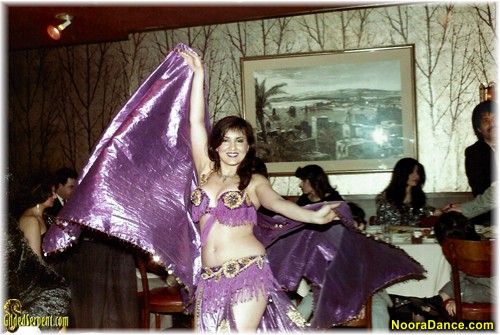
Noora dances at Molfetas

My Memorable New York Club Years:
Part 3- Beyond Manhattan

by Noora-Aphrodite
posted April 24, 2017

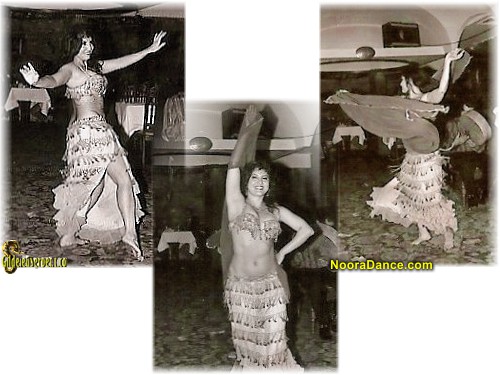
I sometimes think how fortunate I was to have been a dancer in the 80s and 90s. We were the last generation to enjoy the club years, in the tradition not unlike that of the 50s through the 70s. Our music was live with some of the finest musicians and singers around, who played and sang songs that touched your heart and made you jump with joy; and dancers that flavored their shows with their own inimitable style.
This is part 3 of my story.

Beyond Manhattan

New York City was “club city” back in the early 1980’s, besides the Middle Eastern night clubs you had entertainment from around the world. Flamenco was alive at the Chateau Madrid, and you could see a Hawaiian revue at the Hawaii Kai on West 50th Street. When Ibis closed for the second renovation, all the dancers went scrambling around looking for another steady place to dance in. One club in particular where I got 6 nights a week of work was at Le Palais in Brooklyn. It was not a favorite of the dancers and one girl even gave me her nights because she was not happy with the music. Well, dancing was my bread and butter and even though it was definitely not my cup of tea I bit the bullet, made the money and learned quite a few things from that experience. Le Palais was an international club owned by Israelis with an Israeli and international clientele. I learned a lot of new music there, like songs they didn’t play in the Arabic clubs. I also danced to regular trap drums instead of the tabla. I had befriended the star singer, a woman who sang in about ten languages. She was an amazing performer, helpful and very sweet.

In the beginning it felt like a culture shock, learning how the foreign male mind thinks. Even though they were different, they were alike in many ways. But, I learned how to be diplomatic and polite while handling sticky situations like getting paid on time, and dealing with unruly male customers while still getting the job done.

Actually, I started learning all this from day one at the Ibis, but this was new territory and it required a certain finesse. In Queens there was a Persian restaurant called Patogh that had just opened, it was more family oriented. The owner was nice and I didn’t have to struggle to get my tips or get paid. There were several clubs and restaurants across the river in New Jersey too with quite a few worthwhile places to dance in.

Molfetas

I worked the Greek scene at Molfetas in Hackensack, NJ and the Turkish crowds at Istanbul Taverna right off of Route 1-9 and the Lincoln tunnel in Jersey City, NJ. Sometimes I worked both places in one night and talk about an international bouillabaisse!

The interesting thing was that you could only dance to Greek music at Molfetas and there was no tabla! My experience from Le Palais served me well. Molfetas was owned and operated by Jerry Molfetas and his brother. It was a beautiful spacious nightclub with a striking Greek décor and two levels of seating. Besides the belly dancers, Molfetas featured seven or more musicians, a Greek and an international singer and also including a house photographer and a flower girl who sold carnations. The custom was the customers bought the flowers tore them apart and threw them at the dancer instead of money and that counted as tips! Everyone made money at Molfetas with all of us sharing in the pot including the house; it was really amazing that we all left with a nice amount in our pockets! Working at Molfetas were very long nights for me because at that time I didn’t have a car and I had to wait for one of the musicians or singer to ride back to the city (Manhattan) with, but I was working, dancing and I was making a living! Istanbul Taverna Biz card

Istanbul Taverna

The first time Istanbul Taverna (in North Bergen, New Jersey) opened and called me to work I was picked up by the owner’s teenage son and worked there as the house dancer for more than twelve years. Most things at Istanbul Taverna were on a smaller scale when compared to the other clubs. They stuck with only a couple of dancers the whole time I worked there. There were three of us as far as I can remember and we alternated working mostly on the weekends. It too was a roomy nightclub, but with a simple and plain décor. It was family owned and managed and everyone in the family worked there. The owner, Mohammed, and his wife were always present and mingling with the customers. Their daughter Cindy handled the tables and later Ray, the son, tended bar when he became of age. They started out in the beginning with a well-known Turkish band called The Sultans which the dancers got to work with, but soon that was cut and the dancer had to use tapes. After awhile I got used to it and the great thing is the owners didn’t care what you danced to (whether Arabic, Greek or Turkish) as long as you did a good job and the customers were happy. Besides the local singers they occasionally booked major singers from Istanbul for major parties and events.

Istanbul Restaurant and Taverna in New Jersey

Atlantic Antics Festival

Although Atlantic Antics is not a night club per se, it does most definitely belong here because it was and continues to be a place for belly dancers to dance! I honestly can’t even remember when I started performing at this yearly event in Brooklyn Heights. But every year up until four years ago I would get a call from Eddie the Sheik with his raspy voice around July or August to book me for the Atlantic Antics Festival. “Noora, don’t forget your robe and slippers” he’d say with his heavy Brooklyn accent!

It is one of the biggest festivals in NYC that fills several long blocks with food, crafts and vendors of every kind, but the best part of it is the entertainment! I always took the easiest route by subway and the #4 train to Court Street in Brooklyn and walk about 7 or 8 blocks delighting in the sights as I walk along the bustling Avenue full of merchants selling their goods. It was a real treat in the early years because back then there were a lot more Arabic restaurants and specialty shops that sold the most exotic goods from the Middle East. In particular was Sahadi’s our sponsor which also gave us the use of their spacious office upstairs to change into our costumes.

The minute you walked in you were hit by the smell of aromatic spices, dates, olive oil, freshly baked breads and good Middle Eastern home cooking. Eddie made sure we had an escort to bring us to the stage and back and it was mostly well organized. Each dancer would let him know ahead of time what music she wanted to dance to and of course we had a wonderful band comprised of the same musician’s we worked with in the clubs. Sometimes though you might not get the music you wanted depending on who got called first, but no matter what it was all good!

Things changed over the years, but for the most part Eddie put a good show together. He’d have up to 6 six dancers including a male dancer, a singer and sometimes a guest dancer or an impromptu guest like Bobby Ibrahim Farrah. We danced to packed crowds with the most amazing, electrifying and appreciative audience I had ever dance to. They knew us dancers by name and called out to us and Eddie knew how to work the crowd, he was the perfect emcee from beginning to end. He’d sing fun songs with everyone joining in and he knew the right things to say to get them going or he’d mention the dancer’s name or even dance a bit with us. The fun usually continued with some of the dancers, musicians and friends gathering to enjoy the good local food.

The Atlantic Antics of today is not the same as I remember. I noticed a difference on a recent visit, gone was the excitement of what it used to be, there wasn’t as much live music as before and the performers at the Middle Eastern stage have dwindled to half or less of what we use to have, even the crowds were less. Despite all that Eddie the Sheik still manages to run the show, God bless him. He made the Atlantic Antics one of my favorite gigs and that I’ll never forget!

Vanishing Clubs

Egyptian Gardens

I got to enjoy and work in some of the best clubs around, however I was sorry to see some of the older places disappear even before getting a chance to see them. While I was still a student at Serena Wilson’s I often heard the mention of the Egyptian Gardens; Serena had danced there and I even knew one of the advanced students who had also gotten work at the popular restaurant. I thought to myself “gosh how thrilling to be able to dancer there!” I kept making plans to go, but sadly the placed closed before I ever had a chance to see it.

Shecouffeh

Another place that disappeared was called Shecouffeh and I believe it was Persian. All I remember about it was that it had belly dancing and the building had these massive, ornate doors on the outside. I never did go inside

Haci Baba

Right before getting hired at the Ibis I had the pleasure of going to the Haci Baba, a Turkish place down in the village before it too closed. I went with a couple of dancers to see a friend that had been working there regularly. It was a cute place and all I can remember was the curtain décor and of course the entertainment. I did fancy myself performing there as well, but soon it too was gone.


Publications

Nothing was more enticing than to see the photo of a belly dancer in her magnificent pose and costume advertising a club or a restaurant. There were ads in all kinds of newspapers and magazines. Trade magazines usually listed all the clubs, occasionally highlighting the best and most prominent ones with what they offered and featuring a picture of a dancer or two. It was a delight to be the featured dancer in the following publications: New York Times, the Daily News, the Village Voice, Keys to the City, Dance Magazine, Latin New York and Arabesque Magazine as well as others. Another time, I was chosen to promote the NY State Lotto with fellow Ibis dancer Michelle. Reviews of the clubs by Michael Musto with my picture was used several times to advertise and promote both the Ibis and then later on Cleopatra/The Nile on the west side as well as the Cedars of Lebanon, to name a few. It was exciting and it was all part of a fulfilling time to be a belly dancer!


Forever thankful

I wanted to write this not only for myself, but for my students who are always so eager to hear about “the good old days” and to show them how much things have changed and in a sense, how much they haven’t. The dance has certainly evolved and there are a myriad of styles, yet many unrecognizable forms go under the umbrella of belly dance.

The focus seems to be on teaching workshops where for us it was dancing in clubs, the shows are shorter and the six part show is almost a relic of the past. Yet, dancers still struggle with just payment, the internet is a force and has leveled the playing field and we still have a ways to go to achieve a level of respect other dance forms receive!

For me, the 1980s was the epitome of glamour and excitement. Naturally, it was my beginning and everything was new and fascinating. I had entered a world that filled all my senses. It was intoxicating with music and rhythms, with costumes that were colorful and ornate, and foods that were savory and exotic for every kind of palate. The Middle Eastern club scene was a community that held onto their traditions and shared them at the same time. The clubs were vibrant and exhilarating with people whose culture, similar to mine, was warm and inviting. In the 90’s I had become a seasoned professional, and was still making new discoveries with my travels abroad. I got to be a part of the club scene and culture in the most amazing cities throughout the world. All this I discovered through a beautiful, feminine and enchanting art known by most as belly dance and I will forever be grateful!


More photos!

Istanbul Taverna

Istanbul Taverna

Istanbul TavernaIstanbul Taverna

Istanbul Taverna

Molfetas

Molfetas


Resources:

use the comment box

Have a comment? Use or comment section at the bottom of this page or Send us a letter!
Check the “Letters to the Editor” for other possible viewpoints!

Ready for more?


Gilded Serpent presents...

Life was a Cabaret

My Memorable New York Club Years:
Part 2 – The Darvish, Cedars of Lebanon, and Other Clubs

Noora dances at Cedars of Lebanon
Cedars of Lebanon- You can see Antonio’s face, the owner of the
Cedar’s, in the pictue of me dancing at Cedars of Lebanon
restaurant.  A young guy wearing glasses, has a mustache and
a suit on.  It’s the only face you can see!

by Noora-Aphrodite
posted March 10, 2017

To read Part 1 of this article click here

I sometimes think how fortunate I was to have been a dancer in the 80s and 90s. We were the last generation to enjoy the club years, in the tradition not unlike that of the 50s through the 70s. Our music was live with some of the finest musicians and singers around, who played and sang songs that touched your heart and made you jump with joy; and dancers that flavored their shows with their own inimitable style.
This is part 2 of my story.

The Darvish

If ever there was a rival for the Ibis for the best in Middle Eastern entertainment, it was the Darvish. If the Ibis was a jewel box, then the Darvish was a diamond with rough edges. Located on 8th Street in the West Village, Champaign!this little hole in the wall was difficult to find. The entrance was a simple door that led down a narrow staircase to a basement. At the bottom stood a doorman that looked like a genie on a bad day. I remember the first time I went there, the manager said to me “don’t worry he’s OK, he’s Egyptian.” I guess I looked a little afraid, but the guy (I don’t remember his name) turned out to be a real sweetheart! The décor of the club was like a tent with stripes on the ceiling; it had a much earthier feel than the Ibis. They also had a terrific band. For me you couldn’t miss the Darvish sound without the sweet flute playing of Tony Hajar; he was such a virtuoso! I always enjoyed doing my taxims and chifties to his exquisite, tantalizing playing. Some of the other great musicians were Tony Abajian, Said Emam, the amazing Tony Frangia and the fabulous bouzouki player Trifonas.

There had been a time where if you worked at the Ibis you didn’t work at the Darvish and as usual there was a core of dancers that danced on a regular basis in most of the clubs. Every once in awhile a new dancer showed up, but the owner Francois was particular, as was Samiha, about who was a regular or not. When I started working at the Darvish I was actually hired by both Francois and his girlfriend Carmen who was also a belly dancer. I remember the face of the Darvish changing only in terms of entertainment type. They were more open to international music than the Ibis was and they also did folkloric group numbers, with Yousry Sharif and his group performing there regularly. Another thing I loved about the Darvish was the dance floor. It was bigger than the Ibis of the east side. Combined with the cozy tent feel plus the variety of music, that made it the perfect atmosphere to dance in! Although a lot of the same customers came to both clubs, the Darvish had some of its own clientele too – like friends of the owner. One time I was dancing and Francois was sitting at a big table with a bunch of friends from out of town. I had been dancing a while and my set suddenly became longer as his friends requested specific songs. These guys made up for it by sending me a bottle of champagne, which the maître’d poured for me on the stage while I danced. Of course I had to stop to toast with them! It was such a special gesture – it felt like something out of the movies. It was the only time I had ever had a drink during a show, but it was worth it!

Cedars of Lebanon
Noora performing at the Cedars of Lebanon Restaurant, NYC

Cedars of Lebanon

The Cedars of Lebanon was not necessarily a club – more of a restaurant with music. It was known for its exquisite Lebanese cuisine, accompanied by fabulous music and dancers. It was owned and operated by brothers Tony and Carlos Hosri, with Tony running the show and booking the dancers. Later on they brought their sister Amal over from Lebanon. She took over the role of hiring the dancers. It was a rather small, narrow place with simple décor, located on West 30th Street. Besides the sometime tourists that showed up, the Cedars had its regular clientele that came to hear their favorite singer Tony Frangia and later on another wonderful singer and oud player, Maurice Chedid. Some of the musicians made the rounds of the clubs and restaurants just like the dancers did, while others specialized, working just in one place. Some of the other musicians at the Cedars were the great guitar player Carlo Fakhoury and crowd favorite percussionists Hanna Mirghe and his brother Maurice Mirghe. Each club and restaurant had its own sound that you could recognize right away. As I prepared in my dressing room, I could hear the belting out of the songs, the twang of strings and the pounding of drums, all blending to create that unique Cedars sound.

Some of these places weren’t glamorous at all. The Cedars had a makeshift dressing room down in the basement, which was dark. Dancers had to climb a set of steep stairs while making sure they didn’t dirty their skirts or veils. Sometimes I waited by the door one song too many, but no matter how long I waited in that dark cellar, I still emerged a beauteous butterfly ready to dance! Because the Cedars was a restaurant and in the shape of a narrow rectangle it was not the easiest place to dance in, but dancers there became experts at dodging the waiters and customers. There were usually three shows a night with one girl that did two shows and the other that did one. Those who did the single show were usually booked at other places and were in and out. Dancers who performed two sets might invite friends to hang out with and enjoy the food and the fun atmosphere. Sometimes I would hang out at the bar and chat with Carlos, the bartender, who became a good friend of mine.

Fazil’s

You could say Fazil’s was in a class of its own, as it was an after-hours club by night and a dance studio upstairs by day; in reality Fazil’s dance studio came first and the club was added later on. This studio and venue was owned and operated by Fazil Cengiz, along with his brother and sisters. Fazil’s was one of the cheapest studios to rent in NYC and it was home to belly dancers, tappers, flamenco and lots of Broadway dancers as well. I got the same thrill going to take Bobby’s (Ibrahim Farrah) and later Yousry Sharif’s class as I did when I first started at the Ibis. You could feel the stomping of the flamenco dancers, hear the clickitty-clack of the castanets and the Middle Eastern music; it was as if the whole building was dancing. Fazil’s was located on 8th Avenue between 45th and 46th streets in a seedy neighborhood that was a blend, at that time, of peep shows, souvenir shops and great restaurants in the nearby theater district. There were still street walkers in those days in the early 80’s and you did not want to stand to wait for anyone, lest you be confused for one. This happened to me once. I can tell you I ran up the stairs and into the dressing room faster than you can blink your eyes!

Fazil’s the nightclub was the place to go after doing your show; there were no frills, no fancy schmancy anything, just unbelievably good music and dancing and Elena Lentini. We would go to see the magic happen and learn from the star dancer. For me this place was raw, it was dark and it had a Gypsy feel to it. The music was a mixture of many different sounds, but mostly I remember the Turkish flavor and the saxophone that made you melt inside and out! I always left Fazil’s thoroughly inspired and ready to add another dimension to my dancing! Fazil’s night club was also the host to Bobby Farrah’s yearly workshops and the place was usually packed with local dancers and dance students from around the world. It really was a fascinating place to experience belly dance and of course the enchanting sounds of the band!

Other Clubs

Another nightclub I got to dance in around the same time I started at the Ibis was the famed Sirocco, owned by Ari San. This was at the beginning of my dance years and all I could remember was how busy and flashy it was. It reminded me of a saloon from the cowboy movies, bawdy and coarse at times. This place was always jam-packed and loud and it is where I met one of the nicest Egyptian waiters named Henry Nassif. He later became one of the most esteemed Maître’s of not only the Ibis, but of several other clubs and restaurants. I also met his lovely wife Christina when she was a dancer at Sirocco and showed me the “ropes” of working there.

I was most comfortable dancing to Arabic music and became an “Arabic belly dancer”, so I seldom ventured into the Greek or other Mediterranean style clubs, except for Molfetas. Two other places with belly dancers that I did not dance in were Sagapo on East 48th Street and El Avram down in the village on Grove Street, both with belly dancing and more Mediterranean style music and food.

Though I preferred to dance to Arabic music, I did not totally discount dancing at other places that had more Greek, Armenian and Mediterranean music. But in those days most of us were adept in Greek, Arrmenian and Mediterranean styles.Today the dance has changed a lot; it has morphed, evolved and split into many factions with specific labels. Today I am considered Egyptian in style, but back then it was just “cabaret.”

Beirut and Byblos

There were two other restaurants in Manhattan that were similar to the Cedars of Lebanon with live music and belly dancing: The Beirut on the corner of 32th Street, not far from Herald Square and Byblos. Both these places offered good Lebanese food but only Beirut, like the Cedars, had a small band and a singer. The customers at the Beirut could enjoy the singing of Violette, a young singer with a lovely voice who later married the boss and restaurant owner, George.

What I liked about the Beirut was that it had a nice little stage. This is where I perfected my dancing to the masmoudi rhythm. It happened that this was the drummer’s (Tony Zeitun) favorite rhythm to play during the drum solo. He would always ask me whether to play it or not and I would always say yes. Interestingly enough I don’t remember other drummers featuring the masmoudi rhythm as much as Tony; it was his signature drum solo rhythm after all, and it was quite good.

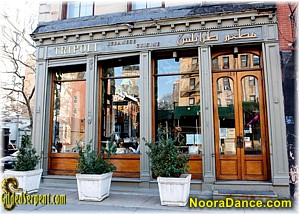
Tripoli today
The Tripoli as it looks currently in 2016

Over time I too became adept at handling this rhythm and have Tony to thank for it! Byblos was opened by Saba, the ex-manager of Beirut, later on. It continued to have dancing, but by then it was just using a keyboard player/singer that accompanied the dancer.

Noora dances at the Tripoli
Noora dances at the Tripoli restaurant on Atlantic Ave in Brooklyn

Tripoli

Another popular Lebanese restaurant just outside of Manhattan in Brooklyn Heights, the Tripoli, is actually still there. Back then it used the basement as a club with about three musicians and a singer. It was a small intimate space, nicely decorated with painted scenes of fishing villages in Lebanon; upstairs the theme was more rustic with even an ancient Phoenician boat carved into the seating arrangement.

It is a family place owned by Mahmoud and his brother. Mahmoud’s two sons work there as well. I saw the boys grow up in the restaurant and today you can go see the second generation running it. One day Omar, the older son, showed me a terrific drawing of me, Noora the dancer, as a superhero, which he had made. What a terrific surprise; a super belly dancer with Wonder Woman muscles! Tripoli had its special charm and all the waiters that worked there were very friendly. The place was always packed and you could count on seeing the regulars there every weekend, as with most places during these times.

Our dressing room was a large bathroom shared with the female customers. The customers often stayed to chat with dancers and sometimes I got a booking for a party right on the spot. I always had my dinner with the musicians between sets and had a good laugh with them too! One of the sweetest musicians around that I had the pleasure to work with not only at Tripoli, but at other places as well was Elias Sarkar, who was known for his sweet singing voice and terrific oud and violin playing. Some of the other regular Tripoli musicians were George Moussa on keyboard, singer Nafiz and drummer Amir Naoum.

Ginray

I want to add one final club here called Ginray, which happened to be Japanese and was located right across the street from the Ibis on East 50th Street. I don’t know what possessed me to go in there and propose doing a belly dance show for them. Maybe it was because I was still on a high from my trip to Japan, or maybe because it was close to the Ibis, but they agreed to it and loved it. Whatever it was, it was another place to dance and I got some of my other dance buddies work there too. In fact there were countless little restaurants, some whose names I can’t even recall that I waltzed into and got to work in; it didn’t matter if they were Middle Eastern or not. In those times, the market wasn’t as saturated as it is today.

As I developed as a dancer, I was lucky to be part of the Middle Eastern club scene of that time; it was a community that held onto its traditions and shared them at the same time. The Manhattan clubs were vibrant and exhilarating with people whose culture, similar to my own, was warm and inviting. But the dancing didn’t stop there…

Part 3 Coming soon!

Resources:

use the comment box

Have a comment? Use or comment section at the bottom of this page or Send us a letter!
Check the "Letters to the Editor" for other possible viewpoints!

Ready for more?


Gilded Serpent presents...

Accepting Our Role as Artists

Politics in Bellydance

Bellydance for Syria raised over $7,000 for the International Rescue Committee, an organization that responds to the world's worst humanitarian crises. Dancer pictured: Sandra (photo by Michael Baxter)

Bellydance for Syria raised over $7,000 for the International
Rescue Committee
, an organization that responds to the
world’s worst humanitarian crises. Dancer pictured:
Sandra (photo by Michael Baxter)

by Lida
posted January 24, 2017

As we move into 2017, Gilded Serpent will be presenting voices both from within and adjacent to our dance community that address historical and current issues of cultural appropriation, cultural appreciation, and wishtory within "belly dance" – an often frustrating but decidedly globalized term that covers a wide variety of dances.

These have long been hot button topics in the scene. With social media in constant development, Gilded Serpent hopes to remain a stable platform where various voices can be heard, assumptions can be challenged, and conversations can be recorded, in the spirit of providing greater depth, breadth and understanding of these complex topics.Your Gilded Serpent Editorial Team

“An artist’s duty, as far as I’m concerned, is to reflect the times. I think that is true of painters, sculptors, poets, musicians…. And at this crucial time in our lives, when everything is so desperate, when every day is a battle for survival, I don’t think you can help but be involved. Young people, black and white, know this. That’s why they’re so involved in politics.”
Nina Simone

Throughout human history, art and current events have been deeply intertwined, building on each other and evolving into a hefty body of work that continues to grow. Countless visual and performing artists use a wide variety of mediums to express their feelings and ideas. These creations are often unapologetically honest, revealing the artist’s place in society, their thoughts on the events of the time, their worries, and their hopes for the future. Artists and the larger movements they form have been instrumental in communicating alternate viewpoints, questioning the status quo, and inspiring social and political action.

These crucial functions are some of art’s most important contributions, placing artists in essential societal roles as dissectors of beliefs, expressers of feelings, and dissenters of popular opinion. Historically and currently, the term "artist" has a far more significant meaning than simply one who creates art.

As bellydancers, we strive to be taken seriously as artists. We often complain that we are overlooked, disparaged, or even discriminated against for our art. While it may not be the direct aim of a cultural dance to question beliefs, how can we expect attitudes toward us and the sources of our art to change without our willingness to take on the full meaning of “artist”?

Additionally, how can we maintain our integrity as practitioners of a cultural art if we do not support the cultures in which our dance is rooted?

I believe that the scope of our work goes beyond simply bringing joy and connection to an audience. We need to speak the hard truths and create greater appreciation for our art. If we choose to study a culturally-rooted dance and wear the name of “artist”, we would do well to ask ourselves whether we are truly ready to step into this role before fighting for it.

While some dancers work intensely to educate the general public and stand up for the cultures and people of the Middle East, I do not see action widely valued in our community. I see dancers detach from the crucial functions of art to examine, express, and motivate. I see them sit back when action is needed. I see them stay silent for fear of other people’s opinions and even criticize those who speak out, stating that issues impacting the Middle East are a separate, undesirable entity called “politics” that have nothing to do with bellydance. It seems these dancers do not realize that politics is part of our daily lives, influencing everything from birth control to taxes. It also determines how we treat various groups of people within our countries and abroad. Politics can drive up the price of food to astronomical heights, create violent animosity toward immigrants, or result in bombings. Whether it’s sanctions, war, or isolationism, the effects of political decisions are felt strongly by people in the Middle East and by people of Middle Eastern origin living in other countries. These are the same people whose passionate dancing, singing, and music we love and feel connected to. These are the same people whose art is the basis of our hobby or living. These are the same people who continue to create art based on their current experiences, including new music and dance styles that many of us use without understanding the politically-influenced words or feelings behind them.

Our deep connection with this region establishes an innate responsibility for bellydancers to acknowledge Middle Easterners’ perspectives about life (which includes art and politics) and to support their well-being along with our own by considering our choices in politicians and policy.

Ignoring the experiences of Middle Easterners while benefitting from their art degrades our integrity and reflects cultural appropriation in its clearest and most detrimental form.

This is real appropriation that needs to be recognized in the bellydance community, yet we seem to focus on who should wear ethnic jewelry or dance with a cane rather than examine this much more significant issue. While our opinions on the degree of responsibility that we carry may differ, I believe we each must contemplate our role, and learn to value social and political principles as they relate to our art.

In addition, it is also our responsibility as artists to back the many factions that make up our modern bellydance community.

We are part of a uniquely diverse group of races, religions, genders, and more who are bound by a common passion. We share many core emotions and beliefs. While it may not always feel like it, we have the capacity to build understanding, work together, and stand up for each other in concrete ways. We can do more than simply post on Facebook. We can make a difference in each other’s lives as an artistic community. It is not the job of an artist to take the easy route of self-separation and apathy, but to help shape policies that support fellow artists.

Opportunities to get involved are all around us. We can bring an understanding of Middle Eastern culture to the general public through lectures and educational showcases. We can seek out Middle Eastern perspectives through literature, stand-up comedy, theater, and concerts (even those that don’t offer dance performance opportunities). We can fundraise for or volunteer with organizations that provide services for Middle Easterners (or women or LGBTQ or people of low income or any other group in our artistic community). We can examine our political beliefs to ensure that we see the whole, interconnected picture with unity and empathy. We can become involved in politics, whether it’s by joining an action group, volunteering for a local politician who shares our values, writing to our representatives, donating to campaigns, or all of the above. With an abundance of readily available information and connections, we only need the willingness to fully step into our crucial roles as bellydancers and artists.

Dancers pictured: Ami Amoré (photo by The Dancer's Eye Photography), Jane Samira (photo by David McWhirter)
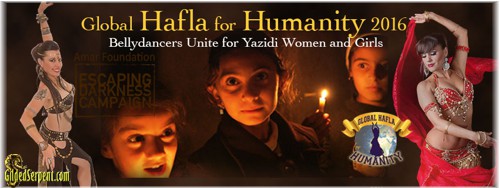
Hafla for Humanity is a global event that takes place in cities all over the world organized by
BellydanceU.net to give back to women in the Middle East. In 2015, dancers raised over $20,000
for Syrian refugees, and in 2016 they raised more than $8,000 for Yazidi women and girls escaping ISIS.
Dancers pictured: Ami Amoré (photo by The Dancer’s Eye Photography), Jane Samira
(photo by David McWhirter).


Resources:

use the comment box

Have a comment? Use or comment section at the bottom of this page or Send us a letter!
Check the "Letters to the Editor" for other possible viewpoints!

Ready for more?


Gilded Serpent presents...

Life was a Cabaret

My Memorable New York Club Years: Part 1-The Ibis

Club Ibis Promo

by Noora-Aphrodite
posted September 22, 2016

I sometimes think how fortunate I was to have been a dancer in the 80s and 90s. We were the last generation to enjoy the club years, in the tradition not unlike that of the 1950s through the 70s. Our music was live with some of the finest musicians and singers around, who played and sang songs that touched your heart and made you jump with joy; and dancers that flavored their shows with their own inimitable style.

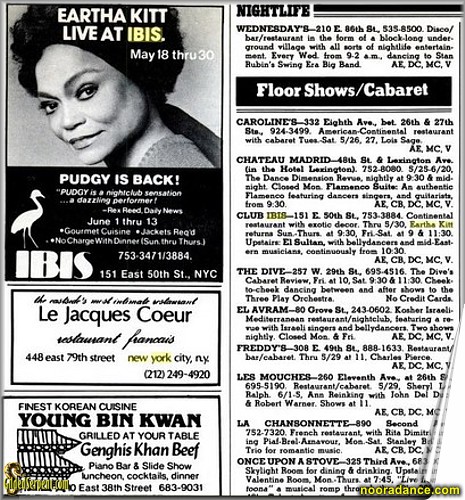
In those days the clubs were a melting pot of Middle Eastern and Mediterranean folks, young and old, families and the stars of the past; like actress singer Eartha Kitt and Laine Kazan and 1940s screen siren Dorothy Lamour. I remember getting the courage to go talk to Ms. Lamour one night and what a thrill that was! She was very nice and still beautiful.

The audience then had an appreciation for music from the old countries, kept it alive in their new home and introduced it to the younger generations. It was a blend of culture and arts that left you intoxicated.

Our costumes were glitter, beads and long fringe, our shows were long sets – about 30 to 40 minutes long. We danced the six-part show to the songs of the past, the classics that everyone loved. It was glamorous, it was fascinating, it was unique and it was fun. It was truly an amazing time to belly dance in New York and other cities worldwide. This was the standard that I came to expect in my travels later on! For me it was something more than special; I felt at home. Similar to those in my own Latin and Greek cultures, the people were warm, friendly and fun loving; they loved to dance and party and the food was flavorful and well-seasoned just like ours! It was a place where I felt totally comfortable and accepted. Here is a glimpse of what it was like to dance in the clubs during those years!

Club Ibis

Noora's audition at El Sultan (Ibis) 1981
Noora’s audition at El Sultan (before the venue became the Ibis)
in August, 1981

The first club I ever worked at was the Ibis. I remember my audition was on a hot summer night in August of 1981. I was thrilled and petrified at the same time because everyone knew the Ibis was the premier club for belly dancers. Mondays were audition nights. You had local girls who came to try out, girls from out of town and all over the world who wanted a chance to dance at the famous Ibis and savor the music from its incredible 7-piece band! Earlier that day Serena, my teacher and mentor, had prepared me for my try-out. Though my peach-colored skirt and veil with a red bra and belt weren’t up to par by Ibis standards, she made sure that the costume fit well and that the veil was wrapped around correctly. And because she understood how petty showbiz can be at times, she made a flower out of a small scarf and tucked it into my belt to cover my appendix scar. Unfortunately, the flower flew off after just a few minutes of being on the stage, but I kept dancing and smiling. She also gave me tips on steps and audience participation, and most important of all she told me not to forget to smile.

What sticks out the most in my mind from that night was my other teacher La Donn, who was sitting at a front table mouthing for me to “slow down, slow down!” I did smile, however. Maybe that helped, because out of the five girls that auditioned that night I was the only one selected to work there. I was so lucky to be living just twelve blocks away from the club. I would skip to work walking up the stairs, my heart full with the spellbinding music from my last show. Even the screechy sound of the musicians tuning up was sweetness to my ears.

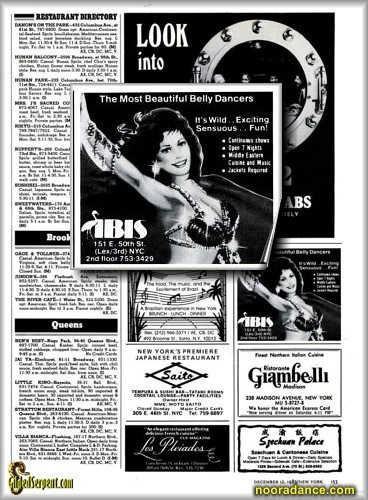
In those early days the Ibis was called El Sultan. It was this little jewel box perched atop of a winding staircase above the Café Versailles Club on East 50th Street and 3rd Avenue. It was actually two clubs in one – the Café Versailles offered a Parisian revue downstairs featuring headline acts from the best in show business. This was as good as it got for a young dancer with stars in her eyes, I thought when I first started there. The owner was an Egyptian woman named Samiha Khoura who ran the business with finesse and savvy. We were billed as “The World’s Most Beautiful Belly Dancers” with posters and postcards strategically placed on the tables downstairs inviting you to see the show at the little jewel box upstairs! We were all over the place in ads, with write-ups in trade papers and magazines such as Dance Magazine and newspapers such as the New York Times and the Daily News. How exciting it was to see my picture used to advertise the club in all three, and other publications as well.

Ibis Musicians

The Ibis became my training ground not only in dance, but in music and in culture too. I came in a novice and stepped out a professional. I got my stage name, Noora, from the lead musician Hamouda Ali. He also gave me great advice regarding music, professionalism and how to be not just a good dancer, but a great one. Dancers at the Ibis were exposed to top-of-the- line musicians such as Magdy Helmy (flute), George Tanous (accordion), Sharif Saraby and Ashraf Fouad (keyboard), Tony Frangia, Charbel, Ibrahim and Youseff Kassab (oud and vocals) and many others.

This was such a special time for belly dancers because we had live music. But it was also serious business, because you had to know your stuff! I especially loved working and learned so much with best of the best drummers like Gamal Shafik, Mohammed Abdel Aal, and of course, master drummer Gamal Gomma.

I got quite a lesson in Arabic music and soon I was learning the classics. I learned how to listen to and interpret each instrument individually then together, allowing the music to guide me flowing from moment to moment! I also learned how to captivate the audience with nuance and detail; a twist of the head or the rolling of one shoulder at the right moment was all it took! Although Egyptian music was not easy to understand at first, once you got it, it was magic and electric; you connected synergistically with the musicians and the audience and you were forever transformed.

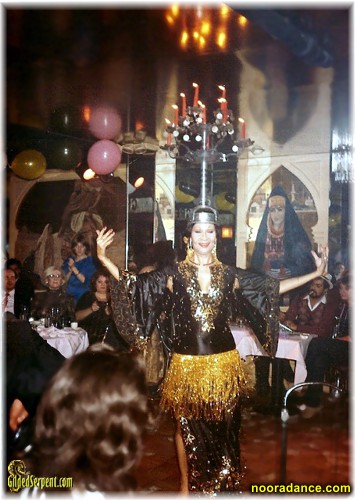
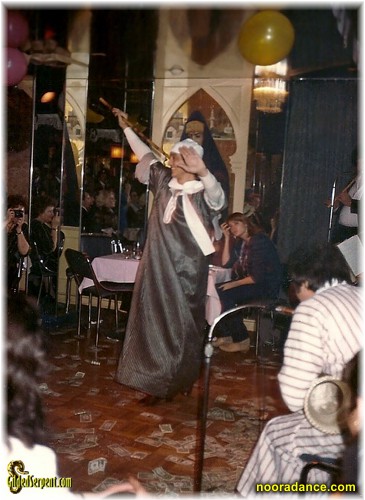
On New Year’s Eve, the Ibis was the place to be! Besides the belly dancers in their best beaded and long fringe costumes (the style of the ’80s), audiences always looked forward to Ahmed Hussein and his partner in their show-stopping cane number. It wowed the crowds every time. Occasionally the Ibis had a folkloric troupe of girls to dance along with the singer. But, the show-stopper for that night was our very own Samiha who strutted gloriously on the dance floor with a smile on her face, carefully balancing a candelabra headpiece. The place was so packed with revelers, there was little room to move, and the floor was so littered with money you couldn’t even dance. During festive times (and actually every night if you were the last dancer), performers stayed until the end of the night to count the tips with the musicians. Those times I was sure to leave in the early morning hours and often went for breakfast with the other dancers, musicians and friends, some who were the steady customers from the club.

Samiha dances with the shamdan!Ahmed dances with cane

Left- Samiha dancing with shamadan on New Year’s Eve, right- Ahmed Hussein dancing with cane on New Year’s Eve

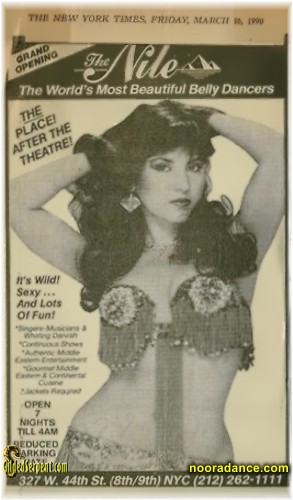
New York Times
New York TImes ad

Samiha was very particular who she hired. Besides dancing ability she also looked for dancers that carried themselves with confidence and had an attractive, polished, well put-together look. A Middle Eastern look with long flowing hair was a definite plus as well. She once told me to get rid of a braid I wore to keep my hair from flying into my face and she was very direct about it! Several years later she was more relaxed and she opened the doors to those who weren’t necessarily her ideal. I learned the value of many things while working at the Ibis, like always looking my very best, and dressing “to the nines”. Samiha always stressed we should look our best whether in costume or not.

Dressing well was about creating an image. We also had respect for the seasoned dancers and knew our place as the newbies coming in.

The Ibis was also a place where dancers made friends and had adoring fans. These fans were customers who came to see particular dancers, listen to their favorite music and have fun. Over time, dancers knew the regulars who also became their friends. One particular regular made crowns out of dollar bills for the dancers to wear. You never knew when you’d get one, but it was fun and a sort of honor to wear it. There was a special camaraderie among the core group of girls from my early years at the Ibis. We were not only on the weekly dance schedule, but got hired at big events and parties too. We learned from each other, had a healthy competitiveness, and some of us were fortunate enough to work at other local and even international venues together. Some remained friends for life.

The clubs were also a platform for getting work not only locally, but at interesting places around the world. Middle Eastern club or restaurant owners knew if they wanted the best dancers they would come to NYC. For belly dancers, they came to the Ibis. Dancers got booked for parties, grand weddings and traveled to local and exotic destination such as Paris, the Ivory Coast, West Africa or Tokyo, Japan in my case. Back in those days there was no social media. Getting work was all word-of-mouth! Dancers didn’t even have to audition. Anyone looking for a performer came to watch your show and if they liked your work you were hired. Before you knew it you were off to some exciting destination and dancing in the grandest of places!

Samiha and author Noora

In my experience most of the international jobs were legit, however you did have to do your due diligence and make sure you weren’t getting into a messy situation. I will never forget my two- day trip to the Ivory Coast. It was a grueling journey with several hours of layovers and delays, changing planes (and airports in Paris) because of an airline strike and getting on a rickety put-put plane in Senegal for the final destination to Abidjan. Upon my arrival, I was met by three gorgeous Lebanese men and I felt like hiding because I did not look or feel fresh and lovely. Another time on my second trip to London I was given the keys to the entertainers’ flat. Once I got there I found a bunch of Arabic men drinking and playing cards in a smoke-filled room and the door to my bedroom was hanging by only one hinge! I can say I did also have my share of unpleasant undertakings both local and international, but that will have to be another article or maybe a book! Whatever the deal, it was sure an adventurous chapter in my life.

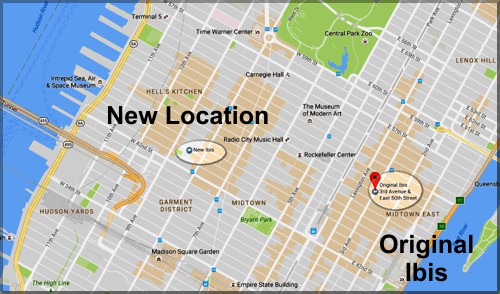
The El Sultan became the Ibis about a year after I started, with some changes to the interior. A couple of years later it had renovated completely, expanding to accommodate more people. Later, it moved to West 44th St. It took a while for the Ibis to prove itself and to create the same magic the El Sultan had. In that time we saw musicians and dancers come and go. An era was closing and a new one beginning.

It was 1989 when the Ibis relocated to the west side. It was a magnificent club that looked like you were entering a pyramid with giant Egyptian mummies that met patrons at the door and framed the stage. The décor was elegant with white, gold and turquoise as the main colors. It was the toast of the town again with write ups in the Daily News by Michael Musto and even a caricature drawing in the New Yorker. It was such a beautiful, well-designed club with a bigger stage.

Now there was room to do the Egyptian horse dance routine, which was an audience pleaser.

Although the concept, music and some of the entertainers were the same, this place was quite a different Ibis in many ways. One of the changes that came in the ’90s was the audience. There were not as many families as before, but a lot more tourists came in. Some of the charm of the little club on East 50th Street was simply not there. We were still enjoying the wonderful live music; little did we know that soon all this would be over. For now we were young, we were having the time of our lives. Tomorrow was just another day!

The recession of 1990-92 took a huge toll on business, and the Persian Gulf War began to change the economy and the general public’s view of Middle Eastern culture even before the move to the west side. The management tried to revitalize business by changing the club’s name a few times. For the record, it was known as the Nile, Cleopatra and finally the Ibis again before closing its doors around 1996.

Ibis Locations

Ibis ad in NY mag 1983

Ibis ad in New York Magazine 1983
Eartha Kit at the Ibis
Ad for Eartha Kitt appearing at the Ibis
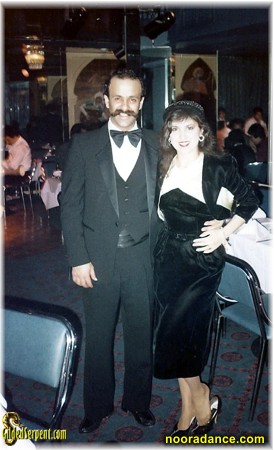
Zou Zou the Maitr'D
 Zou Zou the Maitre’ D and Noora on New Year’s Eve
Dollar Bill Crown at the Ibis in NYC
Left- Noora dances with dollar bill crown at the Ibis


Part 2 Coming soon- Noora tells of her memories working at the Darvish, Cedars of Lebanon and more!

Resources:

use the comment box

Have a comment? Use or comment section at the bottom of this page or Send us a letter!
Check the "Letters to the Editor" for other possible viewpoints!

Ready for more?


Gilded Serpent presents...

Iraqi Dance and Its Unknown Dance Styles


Saad El Yabiss, Iraqi legendary percussionist

Khashaba Music and Dance

by Assala Ibrahim
photos property of Mr. Karim El Issa and Juliane Krappe
Text edited by Emma Howard, Jo Hirons, and GS Staff

posted July, 15, 2016

IraqIn a country almost entirely landlocked, the southern city of Basra city is Iraq’s only gateway to the seas and oceans of the world. Over time this unique city developed its own style of music and dance which became known as El Khashaba. El Khashaba is so deeply-rooted in local culture and traditions that it has become synonymous with the identity of the region itself.

As is often the case with folkloric and traditional art forms, no one knows for certain when the Khashaba style first began to be heard, or when the cultural life of the city began to take notice. The earliest written sources yet found suggest an origin as recent as the 1930s, but some authorities, such as historian Dr. Mohamed Mahdi el Basier, claim that the roots of the Khashaba rhythms can be traced back to the time of the Thawrat al-Zanj, the Zanj Rebellion of 869–883CE.

During the early 9th century, Southern Iraq had seen a series of great floods and failed harvests, causing widespread devastation and saltwater poisoning of the land so that the people who traditionally lived there were forced to seek safety elsewhere. The Abbasid Caliph took this as an opportunity to reward his favourites and supporters with vast tracts of land and gave them the power to raise taxes throughout the South in order to purchase black slaves – Zanj – from East Africa. The appalling treatment of the black slaves, the near-starvation of the local Basrawis, and the new landowners’ further contamination of Bedouin land and water-sources led to the Zanj Uprising in which all three disaffected peoples came together to rebel against the injustices of the Abbasid Caliphate and many thousands died. Basra City was the centre of their revolution and the Zanj rebel leader, Ali ibn Muhammad, claimed descent from the family of the Prophet, just like the Abbasid Caliph, and whilst he remained in power he behaved like the lord of a rival Caliphate.

Just like the Caliph, the Zanj leader demanded entertainment, but the musicians amongst the Zanj were not all trained to play musical instruments in the established maqqams. Instead, they performed with percussion instruments only, and included East African drums and rhythms alongside more traditional fare. Even today, the traditional maqqams are still sometimes performed in Basra with percussion only.

The word Khashaba comes from the Arabic “Khashab”, meaning “wood”, and it is thought that the first performers were boat-builders and ship’s carpenters. They would take a break from work to sing and make music, using just the wood from the shipyards and workshops, together with handclaps, and earthenware water-jars for improvised percussion. The traditional work-songs often made allusions to the history of Basra, and the time of the Zanj is not forgotten. As El khashaba music developed and moved away from everyday work to evening entertainments, other instruments were introduced, such as the explosive khishba and kassur drums, which are now essential to Khashaba; the oud, violin and qanun were also introduced, and became major instruments as microphones advance. These new and foreign instruments enriched the repertoire of El Khashaba and gave it a unique voice easily distinguishable from both traditional and modern Iraqi music.

A recent performance

As with many port cities, Basra has always been a place where foreign ideas and arts are easily accepted and merged with the local music and dance. This is why El Khashaba has also adopted and adapted the popular music of other Arab countries: it has been influence by the songs of the famous Egyptian Singer Umm Kolthoum, and by those of legendary Lebanese stars Fairouz and Wadiah el Safi. This fusion of foreign Arabic songs with the native Khashaba rhythms helps create a distinct style of music, and as the music developed, the associated dances became more sophisticated and refined, whilst still retaining a perfect harmony with the Khashaba spirit, so that, together, they form a magical fusion of energy and popular entertainment. The El Kawliya Gypsies of Iraq have also gradually brought Khashaba music and dance into their performances, but it should be noted that when the Kawliya perform Khashaba songs and dance their interpretation will have a different mood to a performance by non-gypsies. Their gypsy spirit adds an exciting additional take on an already multi-faceted art form.


Assala (author) and Sajda Obied performing Khashaba at the International Gypsy Festival 2015 (Switzerland)

Khashaba music and dance began to be recognised and became popular throughout Basra city in the early 20th century, and, with the advent first of recorded music and then radio, the pioneer generation of singing stars emerged, together with musical ensembles and dance companies.

Some of the most popular early musical ensembles were women-only groups, such as those led by Umm Ali and Um Karim, who were adored by many.

This may have been originally because women’s voices were easier to record in unsophisticated studios, and the women’s groups were cheaper to hire by recording companies than established male bands. Whatever the reason, these early performances set a precedent which has continued today. Women were also able to perform Khashaba dance in public, although, historically male Khashaba dancers dominated the stage. This all changed in 1976 when the government began to officially support Iraqi dance and founded the first national dance companies. Women were allowed to join these dance troupes and started to appear on stage performing El Khashaba in public with the protection of official government approval.

Abo Aouf

Abo Aouf is one of the pioneers of the Khashaba

At the time of the 2003 US-led invasion of Iraq, there were more than 50 Khashaba music groups (“shada”) in Basra City alone. Each shada contained 20-30 members, including singers, musicians, dancers and a chorus (“Riwadiyd”). The Basra National Khashaba Group performed in more than 70 countries. They won many prizes in international music festivals, including the prestigious Leone d’Oro, the Golden Lion achievement award in Venice.

Since 2003, with the increase of austerity and religious intolerance, female musical ensembles have completely disappeared, and very few male musical ensembles still actively perform Khashaba in present day Iraq. Those who do exist struggle with a lack of financial support; and find it difficult, or near impossible, to rent rehearsal space and meet day-to-day running costs. Recently, Al Sada Net Magazine carried out an interview with one of the oldest and most famous female Khashaba dancers in Basra. For safety reasons she remained anonymous, publishing only her initials Z.H. In the interview, she explained:

“These last years have been the worst of my life. Each day I think this will be my last day alive. When I would to go to a rehearsal, or performance, I covered myself with a black long dress and a black hijab. Every time I took a different route in order not to attract the attention of the fanatical armed Muslim groups. They had already killed dancers less famous than me. I still hope for a better time when we can be free to dance.”

Despite Iraq’s troubles, the arts of El Khashaba continue to advance, albeit slowly, and despite war and political upheaval, they now flourish throughout Iraq and the Gulf States. This is due in no small part to the great efforts of generations of Khashaba artists who have brought this style the recognition it deserves, and gladly and passionately spread their precious knowledge. Among them are, the director of the Basra National troupe, the legendary khisba player, Saad el Yabis, and the well-known Iraqi composer, Kazem Gazar, who both play a vital role in keeping El Khashaba traditions alive. Special mention should also go to Karim el Issa, a freelance journalist from Basra, who for many years has contributed greatly to the survival of this beautiful art-form by carefully following and documenting the progress of Khashaba music in Iraq and abroad.

. El Khashaba Music and Dance Company

El Khashaba Music and Dance Company rehearsing


Saad el Yabis

Saad el Yabis and Karim el Issa

Saad el Yabis with his

Saad el Yabis and his band


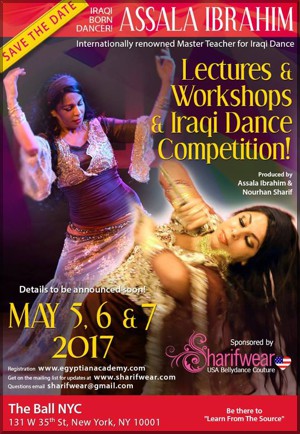
NYC flyer

I will give lecture and workshop about Khashab dance
in New York in May 2017

Resources:
  • Author will give lecture and workshop about Khashab dance in New York in May 2017 for Sharifwear.
  • Author’s bio page

Have a comment? Use or comment section at the bottom of this page or Send us a letter!
Check the "Letters to the Editor" for other possible viewpoints!

Ready for more?


Gilded Serpent presents...

Dancer Finds Body Acceptance After Battling Eating Disorder

Healing and Belly Dance

Megan

by Megan Cassidy
posted March 22, 2016

My first belly dance class took place a little over a year ago. I had just joined a local yoga studio, and the owner of the studio suggested that I try out a variety of classes to discover which class would be the best fit. To be perfectly honest, I chose the belly dance class only because I felt my middle could use some whittling. I could not know then the amazing healing the classes would eventually bring to my life.

From the ages of eleven to twenty-six, I suffered from EDNOS (Eating Disorder Not Otherwise Specified). EDNOS is the most prevalent eating disorder, but also the least well-known. It’s notoriously difficult to recover from due to a combination of symptoms which can include anorexia restricting, bulimic bingeing and purging, and exercise addiction. After some intensive therapy, I considered myself to be recovered. However, it was now almost ten years later, and while I was free from the behaviors marking my disorder, I still clung to many underlying thoughts and feelings regarding food and exercise, and I had continual battles with body image and self-esteem.

It should be no wonder then that I looked to yoga as merely a means of increasing flexibility and to belly dance as merely a cardio workout designed to trim my waistline.

However, in my very first class, I realized that belly dance could be much more than just a typical cardio routine.

My initial challenge came within the first thirty seconds of class when my instructor Sarah pointed to a basket of coin belts and asked me to choose one. While a seemingly simple instruction, her words immediately made me feel anxious. “I’m too curvy,” I thought. “What if the belts are too small? What if they’re only made for tiny skinny girls with flat stomachs? What if the other dancers stare at me?”

As these warped notions swirled through my mind, Sarah noticed my hesitation and kindly explained, “It’s easier to keep the rhythm of the dance. Plus it looks really cool!”
Hiding my worries with a smile, I chose a thin white belt and tied it tightly around my hips, finding the jangling to be just as promised—a pleasant way to hear the rhythm of my movements. But over the next hour, as Sarah led me through a few basic moves, I struggled to learn proper posture, my body seemed to jerk back and forth when doing ghawazi hips, and I nearly cried through an unsuccessful attempt to shimmy. After that first class ended, I felt frustrated, but I also felt a strange sense of accomplishment. I had put on the coin belt. I had danced for the first time since my kindergarten tap class. I worked hard and didn’t quit or leave early.

I was excited to come back the next week, but when I returned, I became frustrated once again. Sarah demonstrated a piece of choreography which included what seemed to be an impossible combination of shimmies, hip lifts, chest slides, and snake arms. I couldn’t imagine contorting or gyrating my body in that way, especially in front of the other women in the class.

Megan dances at Local event.

Thankfully, I found that the community I had entered was gentle and free from judgment. I was a beginner. No one expected me to know everything right away. Questions were encouraged and helpful suggestions offered.

This was the first way that belly dance allowed me to heal. So often as women, we cut each other down. It’s the Mean Girls Syndrome and each of us has seen it at one time or another.

Sometimes it takes the form of fat shaming, competing ruthlessly at work, or fighting over men. As a pre-teen and teenager, the bullying I experienced at the hands of other girls was a significant contributing factor in the development of my eating disorder. Conversely, I found the belly dance community to be incredibly supportive—a place where women of all shapes and sizes are not only accepted, but celebrated one another. The result was life changing; as I found acceptance within the community, I also began the process of accepting myself.

As the weeks went on, I began to notice, first subtle and then drastic, changes in myself that had nothing to do with my weight or appearance. I began to feel less anxious and stressed. I felt more present in my body, as opposed to the disconnect I had experienced nearly my entire life. One night, while practicing hip circles and pestles at home, I looked into my full-length mirror and something just clicked. I had been focusing on my reflection for nearly thirty minutes and no negative thoughts had come into my head! I had not thought, “My hips are too big” or “look at those flabby arms” or “I need to lose some weight.” When this realization hit me, I sank down onto the floor, giving thanks for this change of mind. It had been so long since I had just loved my body and paid attention to it without criticism that the tears came unbidden—my body’s natural way of thanking me for this unfamiliar care and attention.

After that moment of revelation, my renewed mind-body connection began to impact both my emotions and my movements. I began to feel more relaxed, open, and feminine, and my dancing became more fluid and graceful. Eventually, I began to move with confidence and act with fearless joy.

meganSo, when asked to participate in a performance with my instructor’s troupe, I jumped at the chance. I worried for a brief moment about putting my body on display for others to view and possibly criticize. But, then I quickly realized that I truly didn’t care what others thought. I felt more than comfortable in my own body. I felt beautiful and powerful when I danced, and I was ready to share my budding talent with others.

I performed for the first time only a few weeks ago, and I loved every moment of it. I know that my first performance won’t be my last. I’ve learned so much from the belly dancing community. I’ve learned how to care for my body, to ask for help, to learn from my mistakes, and to overcome challenges. I learned to look to dance as more than just exercise, instead experiencing it as a way to have fun, to meditate, to relieve stress, to participate in community, and to heal. I am excited to say that over this past year, I have developed a deeply peaceful connection with my body and have found a new passion while doing it!

Resources:

use the comment box

Have a comment? Use or comment section at the bottom of this page or Send us a letter!
Check the "Letters to the Editor" for other possible viewpoints!

Ready for more?


Gilded Serpent presents...

Cairo Shimmy Quake 2015 a Dancer’s Delight

Something old, something new makes the second annual Cairo Shimmy Quake 2015 an event you can count on!

Cris by Carl

by Vicky “Vichelle” Schell
photos by Carl Sermon
posted January 9, 2016

Event review – Cairo Shimmy Quake, held June 6-7, 2015 in Glendale, California, USA
Although this is only the second annual Cairo Shimmy Quake, it arguably has a history that is decades old, rich in Middle Eastern culture and dance. Currently it is produced by Marta Schill-Kouzouyan and Diamond Pyramid and a bevy of trusted colleagues. While still trying to regain its former following in the local belly dance community, it still brings together everything that the modern belly dancer could want. Both days are filled with workshops by expert instructors, shopping opportunities, the outdoor patio drum circle and a constant flow of dance performances on a real stage. The highlight of Saturday is the evening show, while Sunday’s schedule included a "mini Belly Dancer of the Universe Competition". So best to go for the whole weekend if you possibly can.

Al Wadi by Carl Sermon
Al Wadi

Marta Schill-Kouzouyan is well known among California’s belly dance community for bringing top level instructors to Los Angeles for a weekend of workshops and featuring them in an evening show and this year was no exception. The evening show, called A Choreographer’s Eclectic, was created by Kamala Almanzar and included the following performers; Tito Seif, Kami Liddle, Maryam, Amanda Rose, Aubre Hill, Princess Farhana, Sabrina Fox, Sumaia, Aubre Hill’s Lumina Dance Company, Luxora Dance Company, Kamala Almanzar, Karin Jensen’s Mandala DanceWorks, Co. Nouveau, Nasila, Sababa Dance Company, Jenna & Phoenyx: Bellydance Rising, Tamra-henna’s Henna & Dates Dance Theater.

I attended on Sunday, the weather was beautiful and parking is an LA bargain at $6 (including in/out) in a shaded structure beside the convention center. As I approached the entrance, I was greeted by the sound of the drum circle on the front outdoor patio area. Welcoming rhythms became welcoming greetings, as I came across friend after friend, then I got to the entrance table!

For me, returning to Glendale is a homecoming in every sense of the word.

Besides the fact that I was born in Glendale, the Civic Center was home to my favorite belly dance event, Cairo Carnivale, an event I helped organize over a decade ago. My high expectations were met by a relaxed atmosphere with a bustling undertow that only live performances can bring. The dance performances were in full swing, the event spanned the upper floor of this facility with seating for the shows, vending spaces, a dining area for the food from the kitchen, and large restroom facilities.

The Feldhouse Band
Feldhouse Band

Dining out at Middle Eastern events is always a treat for me. They had a great selection of full meal plates, ala carte items and of course vegan selections. I would say my favorites included the falafel sandwich and the shawarma chicken plate. The baklava was so good that they ran out on Saturday. Shopping is always fun and there was a good variety of vendors. As usual I found several booths I kept going back to. I got to speak with Harry Saroyan and was glad to see that his finger cymbals and coins will be back in production. After a quick viewing of the vending area for something I don’t have or haven’t seen (aka usually items beyond your traditional BD attire), I planted myself in the chairs to enjoy the dancers.

This photo: Nilay. Top photo: Cris and the Ya Ayuni Dance Co

This event facility offers dancers a top rated experience. Whether you’re a pro or a first time performer, you will have little to complain about. There is a roomy back stage area for the dancers’ changing area, well-lit makeup mirrors, and a backstage bathroom! The stage has real wings to enter from unseen and a market scene backdrop. Giving your performance the support it deserves was Moonlight Magic at the DJ booth and Arnie’s Video Productions capturing the dancer’s performance for posterity.

I am such a fan of the Belly Dancer of the Universe Competition and I was curious about a new opportunity being offered to dancers that day, a mini BDUC Competition. Each contestant performed a solo appropriate to a BDUC 2016 Category (3 minute to 3:15 second). The highest score won a fabulous package for the BDUC 2016 event including: entry into their 2016 chosen category, workshops and tickets for the entire event. I enjoyed this and it was a mini-glimpse into the event. Each performer’s entertainment value was judged by the audience and a people’s choice winner was also selected. I would like to take a moment to say to the competitor’s “Girls, you all danced beautifully and you each had an element of the dance that I hope I bring to my own performance”. Each category is specific to a style or part of the dance and you can’t win if you don’t meet the requirement, except of course, as the People’s Choice Category. It was close, but a very discerning audience selected the same dancer as the judges. Following this we were graced with the dancing of the 2015 Champion of Champions, Jasmina of California. Her performance left no doubt as to her talent and skill and demonstrated the level at which these dancers need to be.

The Fez Documentary was also previewed on Sunday, after the CSQ event. This film by Roxanne Shelaby captures the historical and social impact of the Fez Restaurant which was operated by her father in the Los Angeles area, and was the heart of the bellydance and Arabic social scene. With the recent loss of the beloved musician John Bilezikjian perhaps it’s a reaction to the loss, or just a reminder, to maintain connections to the people and things we love.

They say you can’t predict the earthquakes but this is one you can count on. As a true California girl, I enjoyed being in the middle of the Quake. Shimmy On, Cairo Shimmy Quake till next year!

Adrianne
Lara
Mesmera by Carl Sermon
Mesmera


Resources:

use the comment box

Have a comment? Use or comment section at the bottom of this page or Send us a letter!
Check the "Letters to the Editor" for other possible viewpoints!

Ready for more?


Gilded Serpent presents...

Translations of 1930s Gossip Column in a Local Cairo Paper


“New and Second Hand Costumes:
Our Elegant and Not So Elegant Dancers” &

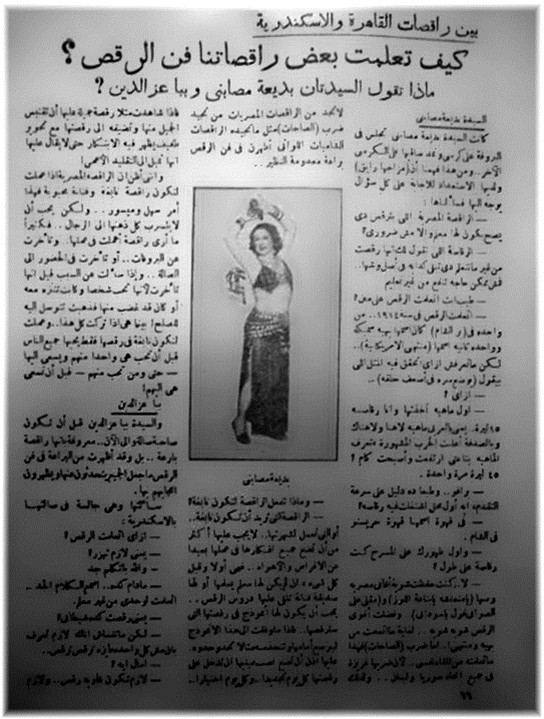
"Madame Badia Masabni"

Translations by Priscilla Adum
posted October 8, 2015

This article is from the early 1930s and it talks (gossips I should say) about the famous bellydancers of the time and their costume quirks, though not always in a very flattering way.
Thank you to KF for the very kind help. [Editor’s Note: This article supliments Pricilla’s articles in The Belly Dance Reader 2, page 38.
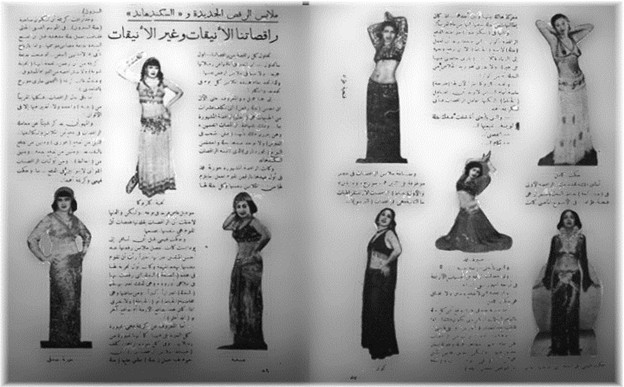
Multiple Costumes

The Picture Captions:
Top Right: Hekmet Kamel, Left page: Top: Taheya Carioca, Top Left: Fathya Fouad.
Lower Left: Khayria Sadki, Bottom Left: Kawsar,
Lower Right: Safya, Bottom Right: Hekmet Fahmy wearing the bedlah that she made with her own hands. Right page: Kneeling in the Center: Mounira Mohamed,

TITLE:
New and Second Hand Costumes:

Our Elegant and Not So Elegant Dancers

Each one of our dancers tries first and foremost to be unique in her elegance even more so than all of her fellow dancers, particularly when it comes to costumes. For this reason we see costume styles renewed and renovated regularly.

It is well known that the best raqs bedlah* which cost tens of pounds are those of the famous dancer Beba, and this is disclosed by other dancers themselves who say that she has no difficulty obtaining money** She doesn’t own any cheap costumes of the "wardnary" {fiery flower)} type that are worn by second rate dancers.

The famous dancer Houriya Mohamed made her own costumes when she began as a dancer and every one of her bedlah had a special and unique style. But her mother then noticed that other dancers copied her so she preferred to design and make them herself {for her}.

Hekmet Fahmy, before travelling to Budapest used to have her her costumes made by the best dressmakers but she finally thought of making them herself and her first attempt in this field was the bedlah that she danced in in the casinos of Europe, so she is enormously proud of this bedlah and from that moment forward she no longer goes to the dressmaker. We don’t know if that’s due to a financial crisis or due to other reasons. Only God knows.

As for Karima, it’s well known that she is zealous about her art, and she also wants to stand out among her colleagues so every season she asks her costume maker to make a bedlah for her and she names it the Bedlah of the Season. Karima wanted to have a bedlah of the season this summer, so she had a very wonderful bedlah made before Madame Badia Masabni opened for the season. But wind is what ships dislike and Badia didn’t allow Karima to dance, the reason given was that she was somewhat overweight and dancers must have slim bodies. At that, Karima responded "Well, what about Mary George?"

As for the rest of the dancers’ bedal, they’re almost all the same in style, except for the colors. It’s important for us to say something about the different ways dancers pay for these costumes. Some of them pay all at once, others pay in installments. Some pay fairly and others try to rip off the dressmaker. Among the most fair dancers are Beba and Hekmet and Karima Ahmed.

On the other hand, for example, the dancer who annoys costume makers the most is Fathya Fouad. Last week a big fight ensued between her and one of the costume makers because he demanded that she pay for a bedlah that he made for her a year ago. Right behind her and coming in second as far as not paying on time is the dancer Kawsar who, every time she wants a to have a bedlah made, the costume maker must look up towards heaven and say "My God, let me get through this safely!" We don’t know if he wants to stay safe from the bedlah or from Kawsar.
Taheya Carioca maintains a characteristic haughty attitude in front of people so she doesn’t want to deal with the costume maker and she deals with other dancers themselves. So she comes up to Karima Ahmed:

Taheya: I saw that you have a nice bedlah. Would you consider selling it, my sister?
Karima: You’re welcomed {to it}
Taheya: For how much?
Karima: How about 4 pounds, my sister?

And if Karima gets the 4 pounds within 4 months she can consider herself lucky.

One dancer who doesn’t pay up either agreeably or by fighting is Hekmet Kamel.
And what about Khayria Sadki? She pays the price of every bedlah in full…… but when would that be? When she meets one of the nincompoops.***

And thus, we find that many dancers present a beautiful appearance in front of audiences and are sweet talkers, but they’re like the adage that says: "He who sees the decorated front door doesn’t see how thirsty he is" {Meaning: You can’t judge a book by it’s cover}

The two main people in Egypt who are professional dance costume makers are George and Ellen. The first one is the costume maker for the classy dancers and the latter is for the second rate dancers.

*The original arabic article uses the words "raqs bedlah" or just "bedlah" to refer to bellydance costumes and "bedal" to refer to the plural form if they are talking about more than two costumes. However, TWO of them specifically would be "badlatain".

**The words used in arabic here, insinuate that Beba made money from other activities besides dancing and her clubs..and not particularly in a good way.

***Nincompoop meaning one of those men who habitually showered bellydancers with gifts.

button

Badia Translation

Priscilla Adum presents another translation- Madame Badia Masabni

WHERE DID BADIA MASABNI LEARN TO DANCE? Who Taught Her? In This 1930’s Interview (I don’t know the magazine’s name) Badia tells where she learned and who her teachers were. She has some words of advice for dancers which might be useful even today, eighty years later. Beba Ezz El Din also tells, though unfortunately her interview is incomplete and apparently continued on another page of the magazine. I can’t help wondering if some of Badia’s responses to the questions were a deliberte jab at Beba, an ambitious Lebanese girl who had started out in Egypt as one of Badia’s dancers and who had caused Badia quite a bit of grief in the past.
Thank you to KF for the assistance.

ENGLISH TRANSLATION: Title:

Among Dancers of Cairo and Alexandria, How Did Some Of Our Dancers Learn The Art Of Dance?

Badia Masabni and Beba Tell

Madame Badia Masabni

Madame Badia Masabni was sitting down during a rehearsal and had her legs propped up on another chair, so we could tell that she was in a good mood and would be willing to answer any question we asked her. So we asked:
"These Egyptian dancers who are dancing {here} right now, do they need to have a teacher, or is it not necessary?"

BADIA: Any dancer who tells you that she dances without having been taught is a liar. Nothing can be correct without having been taught.

INTERVIEWER: Ok then, so who taught you the dance?

BADIA: I learned the dance in 1914 from a woman in the Levant, her name was Baheya Simeka and another woman named Mountaha el Amerikaniya and you have no idea how that expression *youda3 sero fi ad3af khalco* really applied perfectly to me. {My Note*It’s an expression that refers to someone who proves to be talented or skillful at something that nobody thought they would be skillful in)

INTERVIEWER: How so?

BADIA: The first salary I had as a dancer was 15 lira which was nothing. As fate would have it the war began and do you know how much my salary increased to? It was suddenly 45 lira.

INTERVIEWER: Bravo, and this certainly means that you progressed quickly. Where was the first place you worked at as a dancer?

BADIA: At a café called Khristo Café in the Levant.

INTERVIEWER: So, was your first stage appearance as a dancer?

BADIA: No, I had learned some Egyptian songs such as ya men3anesh ya beta3et el lous (Ya fresh Ya Almond Seller) and makli fi el sawani foul soudani (Roasted Peanuts On A Tray) and step by step I learned to dance from Baheya and Mountaha. As for playing sagat, I learned that on my own because playing them is just instinctive in all of Lebanon and Syria. For this reason you won’t find any Egyptian dancer who can play sagat as skillfully as dancers from the Levant who are also skillful dancers as well.

INTERVIEWER: And what does a dancer have to do in order to become outstanding?

BADIA: A dancer who wants to become outstanding and who works towards becoming famous has to put all of her thoughts into her work before any other subject or interest. First of all, if she doesn’t have an instructor to coach her or a dancer colleague to give her lessons, then she must have an outline of the dance she’s going to perform. If she has success with this outline, then she has to renew it daily and add to it daily. For example, if she sees a beautiful dance, she can take the beautiful things from it and add them to her own dance and modify them somewhat so that no one can say that she is blindly copying others.

I believe that it’s easy for the Egyptian dancer to work towards being an outstanding and admired artist, however her mind must not always be thinking about men because many times I will see a dancer neglect her work and arrive late to rehearsals, or they arrive late to the sala and when I ask what her excuse is, she’ll tell me she’s late because she’s in love with someone and she went out with him, or that he’s angry with her and she was trying to convince him to make up with her. However, if she forgets about all of that and just works towards being an outstanding dancer, her public will be the first to love her and they will be the first to follow her.

Beba Ezz El Din
And Madame Beba Ezz El Din, before being a sala owner was well known for being a skillful dancer to the extent that people talked about her and about how well she danced. I asked her as she was sitting at her Sala in Alexandria, "How did you learn the dance?"
BEBA: Are you kidding?
INVERVIEWER: I swear by God that I’m serious.
BEBA: Ok, then listen to these serious words. I learned it myself without any teacher.
INTERVIEWER: Does this mean you just began to dance right out of the blue?
BEBA: Well, don’t forget that you must know that not everyone who wants to dance can dance.
INTERVIEWER: So?
BEBA: She has to be interesting in her dance

[unfortunately her interview is incomplete and apparently continued on another page of the magazine.]

Resources:

use the comment box

Have a comment? Use or comment section at the bottom of this page or Send us a letter!
Check the "Letters to the Editor" for other possible viewpoints!

Ready for more?

  • Badia Masabny, Star Maker of Cairo
    Due to the performance of a Hitler parody, however, Masabny was placed on Hitler’s list of people to be executed once he took over Egypt. Fortunately, the Germans never made it to Cairo!
  • From Café Chantant to Casino Opera, Evolution of Theatrical Performance Space for Belly Dance,
    Most students of Egyptian belly dance are aware of Badia Masabni and her famous nightclubs, and many believe Badia’s clubs to be the birthplace of theatrical belly dance, or raqs sharqi. However, fewer are aware that Badia’s clubs were neither the first nor the only venues of their kind.
  • Egypt’s Golden Age, Timeline and Synopsis
    From around 1850 to 2000, Egypt saw the birth, rise, and transformation of its cultural expression through dance. With each period, a new energy in the dance was introduced and, with it, new dancers with new dance movements and new costumes.
  • At the Crossroads, Discovering Professional Belly Dance at the Dawn of the Twentieth Century,
    The transition from awalem and ghawazee dance styles to theatrical raqs sharqi began during the last decades of the nineteenth century and the first decades of the twentieth in Egypt. Unfortunately, scant film footage exists of dancers from that period to reveal exactly what professional belly dance looked like during that critical moment in Egyptian dance history. However, still photos and travelers’ descriptions from the time do allow a few conclusions to be drawn about the nature of belly dance in Egypt at this important transition.
  • The Search for El Dorado…in Cairo
    The name “El Dorado” conjures up images of a fruitless quest for an unattainable, even mythical, goal. The El Dorado in this discussion, however, is neither myth nor fantasy. El Dorado was a sala or café chantant, an entertainment hall, located in the heart of Cairo’s Ezbekiyah entertainment district.
  • An Evening of Egyptian Music and Dance, a Report from El Leil
    Amina and the Aswan Dancers did it again! The sold out show at the Mission Cultural Center for Latino Arts was another stellar example of the kinds of show their fans have grown to expect and they have not yet been disappointed.
  • Tribal Fest Under Fire, Tribal Fusion Stars Quit California Belly Dance Festival
    as Co-organiser Admits Sexist Facebook Post
    ,

    Several leading dancers  have withdrawn their services from Tribal Fest after learning of festival co-producer Chuck Lenhard’s involvement in an offensive  Facebook group for DJs.
  • Dosland Documents "Dangerous" Divas, Dangerous Beauties produces "Aura – An Evening of Dance Theater "
    Many members of the group are internationally known, performing and teaching around the world. Some are multi-disciplinary artists whose work includes backgrounds in theater and film, costuming and the visual arts.
  • A Bellydance Production of Dante’s La Divina Commedia,
    Interview with Francesca Pedretti,

    Over a cold winter weekend in New York City, The Ruby Lady encountered a dancer and her project unlike anything she had seen before. Completely collaborative, experimental, theatrical and soaking in a uniquely Italian emotional authenticity, Milan’s Francesca Pedretti and her traveling production of Dante’s La Divina Commedia has the potential to transform belly dance communities around the world
  • Helene’s Seminar in Berlin, Traditional Dance Theater Project ANAR DANA 2013/14
    Together we studied seven traditional dances in a total of 10 weekends with the worldwide renowned dance ethnologist and choreographer Helene Eriksen and organized two final recitals of our program which included solo dances from Helene. It began with a very tight training schedule but later it actually turned out to be much more – together we embarked on an imagined voyage to the Orient, which finally was a travel to find ourselves. But we understood that only much later.
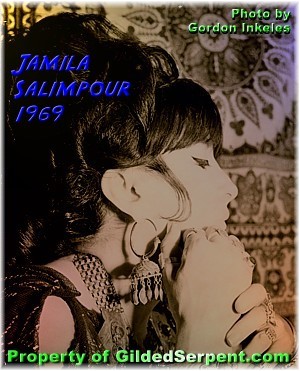
 

Gilded Serpent presents...

Tribal Fest Under Fire

Chuck and Kajira in 2012

Tribal Fusion Stars Quit California Belly Dance Festival
as Co-organiser Admits Sexist Facebook Posts

by GildedSerpent Staff
posted September 25, 2015

Several leading dancers  have withdrawn their services from Tribal Fest after learning of festival co-producer Chuck Lenhard’s involvement in an offensive  Facebook group for DJs.

Lenhard is the husband of festival creator Kajira Djoumahna.

The group of teachers and performers released their statement via Tumblr, initially anonymously, on September 20 2015, some three weeks after confronting the festival producers. It is understood that they were alerted to the existence of the private group, which featured degrading, derogatory and sexist comments about many of these dancers, by a DJ who had been invited to join and who took screenshots of what he saw there.

The signatories to the Tumblr statement, in which the dancers announced that they would no longer participate in Tribal Fest, are Jenn Aguilar, Terri Allred, DJ Amar, Ariellah, Rachel Brice, Hilde Cannoodt, Jennifer Faust, Lilly Freeland, Martina Hewett, Aubre Hill, Mat Jacob, Zoe Jakes, Sharon Kihara, Kami Liddle, Medina Maitreya, Nathalie, Carolena Nericcio-Bohlman, Dusty Paik, Jill Parker, Ebony Qualls, April Rose, Calamity Sam, Lacey Sanchez, Violet Scrap, Colleena Shakti, Amy Sigil, Michelle Sorensen, Alexis Southall, Tjarda van Straten, Amel Tafsout, Sherri Wheatley.

They emphasized that their action was not a boycott.

The full text, with link to the original Tumblr and list of signatories, is reproduced below.

Lenhard and Djoumahna separately published statements of contrition in the Tribal Fest Facebook group, which was subsequently closed to viewing by non-members.

Their statements are also reproduced below.

Teachers United Public Statement Regarding Tribal Fest:

It is with great disappointment that we have decided to no longer participate in Tribal Fest®.

It has come to light that offensive posts, photographs, and photo albums, which included sexual objectification, derogatory statements, and sexist comments, were regularly posted in a private Facebook group. The person who facilitated this group and participated in the behavior is involved in the production of Tribal Fest.

Because of this person’s involvement in and access to the festival, much of this content was focused on Tribal Fest® teachers, participants and attendees, and targeted our friends, colleagues, and students.This behavior was a violation and abuse of trust.

As leaders and members in this community, we strive to create safe, positive spaces for self-expression, personal growth, and healing. We cannot participate in an event or associate with an organization whose members use their standing in our community to engage in and promote stereotyping, dehumanization, and belittling comments.We cannot participate in an event or support an organization that does not reflect our own morals, ethics, and beliefs.
We have no desire to start a campaign against anyone or fight hate with hate. To the contrary, we hope to bring attention to the deeply negative impact of derogatory speech toward any group of people so that something positive may come out of this experience.

We are thankful to Kajira for the effort and vision she has brought to creating this 15-year event, which has nurtured the tribal belly dance community. We value her and honor her contributions to our art form. Our decision is not a reflection of our feelings for her as a person or a dancer.

Our non-participation comes only after much thought and deliberation. Each of us came to this decision as individuals of our own accord, but we stand together as a community.

Kajira Djoumahna’s statement:

Dear Tribal Fest® Attendees, Teachers, Dancers, Supporters, Vendors & Friends,

Please feel free to share this everywhere.

I am so very sorry, shocked, saddened, betrayed, disappointed and truly heartbroken to have found out that my husband and TF® Co-Producer for the past 8 years, Chuck, had a “secret” Facebook page in which there were photos of as many as ten different dancers who had to suffer sexist and rude comments by Chuck and other members of the group. I knew absolutely nothing at all about that page’s contents until the matter was made known to me, or I absolutely would have had it shut down immediately.

I have never condoned that sort of behavior from anyone, and it hurts me more deeply than I can express to know that the very people I created Tribal Fest® for in the first place have been equally devastated. I was notified by a dear friend and dance ally about the situation when it went public.

As soon as I found out, I immediately reached out with love and compassion to everyone in the photos via voice messages, texts and/or in a letter emailed on my behalf by the same friend, because I knew I could reach absolutely everybody in said group with my emailed message of support and sisterhood. I also confronted Chuck, and he is no longer TF® Co-Producer or a staff member.

Though only two teachers called me back, I was gratified to hear from them and feel good about our conversations, if not about the subject matter. I sent another message to the group and called and texted some more in the hopes that more of them would consent to talk about this, to no avail. In the meantime, I was not allowed to see any portion of their conversations or be involved in any way.

I believe it to be of utmost importance that you know absolutely that in no way have I, Kajira Djoumahna, or my beloved event, Tribal Fest®, EVER engaged in or promoted “stereotyping, dehumanization and belittling comments”! My event and I are completely innocent of these charges, and those of you who have attended TF® have seen and felt in your hearts and souls the love and that “special vibe” that makes Tribal Fest ours – yours and mine.
From inception more than fifteen years ago, TF was created out of my own pure love for tribal belly dance to be a place where we of like mind could gather to be ourselves. It was created to be a welcome home for all those who love tribal belly dance and its related forms, and it will continue to be so with your help and support.

My promise to you is that my original goal of co-creating with you the most wonderful, safe, supportive and accepting place to share your heart and art with others from around the world will never change. I am here and listening to what you need to continue to make Tribal Fest® the place you want to be. I will continue to do my utmost to bring love, beauty, acceptance and joy to the world!

Please help me to help our community move forward and heal from our collective wound. With this goal in mind, I am in the process of setting up the new Tanya Tandoc Tribal Fest® Scholarship Fund to benefit dancers unable to attend TF® without help from the community. This scholarship is in the name of our tribal bellydance sister, Tanya Tandoc, who was recently a victim of domestic violence.

Tribal Fest® will also contribute to the woman’s rights organization/s chosen by attendees via popular vote. Information about participation in both of these endeavors will be on the TF® web site when it opens on December 1.
I am here for you to call or text anytime: (+1) 1 707 978 8116. I am not the best with Facebook or email, but I will be working on checking and responding on a more regular basis.

Thank you so very much for reading and for caring.

Yours, Kajira Djoumahna

Chuck poses with a random dancer

Chuck Lenhard’s statement:

"Hello everyone,
As embarrassed and ashamed as I am to admit this, some of what you hearing is true and I wanted to apologize because I really do care about this community.

There was a private page on Facebook that started out as a place for DJs to go and vent and bitch and complain about events and people within our DJ community. As time went on, pictures of dancers were also posted and comments made that I am not proud of — nor did I stop them from being posted by others. I did not think that speaking of people in this manner could truly cause serious trauma to the individual and have considered and evaluated the impact it had on the women. I was told that I acted like an insensitive 12 year old boy trying to impress others. This does not excuse my actions.

Kajira did not know about this page, nor does it reflect on her love and support and admiration of the bellydance community. I am learning a painful lesson. I’m deeply ashamed to have hurt the community and my wife. I am hoping that you will continue to support Kajira, even if you cannot forgive me. This is not her fault. I was insensitive, obscene and rude.

When I found out that posts from this group had been made public, I was angry that the private posts were shared. But now I realize that it’s really a giant painful life lesson. I am sorry for the actions that I took the first day this came to my attention.

I did try and reach out to a number of dancers privately to apologize. I understand that if at this time you are not able to forgive me. I tried to reach out and make amends before Sunday’s "Public Statement Regarding Tribal Fest" went public, so that I could avoid the shame and embarrassment this would bring to my wife and her event, but I wasn’t able to find a way to effectively apologize.

It I realize now that words and images can hurt just as much and it was never my intention to cause that hurt. I am sorry that I violated the trust of friends, festival employees and attendees.
I am going to be seeking help for my issues and actions.

I understand why people are upset. What I did was beyond stupid and uncaring. I can only hope that time will show how sorry I am and how much I regret what I have done. To everyone I have upset and hurt, let me just say how sorry I am and offer my sincere apologies and I ask for your forgiveness. For those who reached out to me and talked to me and shared their feelings and thoughts on this, I say thank you."

Audience in 2011

Resources:

use the comment box

Have a comment? Use or comment section at the bottom of this page or Send us a letter!
Check the "Letters to the Editor" for other possible viewpoints!

Ready for more?

  • Tribal Tales
    The moods and flavors of the varied songs on this CD are sure to be useful for dancers and listeners who like something out of the ordinary to challenge and delight.
  • Kajira and Chuck Interview, Cultural Appropriation or Artistic Freedom? Part 1:Intro
    One of the common issues that the community has had with Kajira’s philosophy and with tribal dance in general is with the issue of cultural appropriation. In this series of videos we discuss different issues and how Kajira feels about them
  • Kajira and Chuck Interview, Cultural Appropriation or Artistic Freedom? Part 2: Quote in Question
    One of the common issues that the community has had with Kajira’s philosophy and with tribal dance in general is with the issue of cultural appropriation. In this series of videos we discuss different issues and how Kajira feels about them. Part 2 talks about using the term "belly dance"
  • . Kajira and Chuck Interview, Cultural Appropriation or Artistic Freedom? Part 3: Not MED
    Not MED, Misappropriation of the Rom culture, Ostracizing of Tribal. Find reference in Tribal Bible for time stamp 2:30. We found it- Page 215 at the top, "The parallels between the struggle of the Roma and that of bellydancers is undeniable. Both groups are fighting to gain respect and move away from social prejudice." This point is addressed in the review of the book.
  • Kajira and Chuck Interview, Cultural Appropriation or Artistic Freedom? Part 4: Rise of Tribal Fusion ,
    The Rise of Tribal Fusion. New terms- Spontaneous Group Improvisation, International or Improvisation Tribal Style. "Tribal Fest chronicles the rise of Tribal Fusion." Tribaret. No codification in our dances. Big difference betweem Tribal Fusion and Cabaret– Isolations, torso, arm movements. Kajira became certified in Rachel Brice’s format. ATS is a subset of Spontanteous Group Improv.
  • Kajira and Chuck Interview, Cultural Appropriation or Artistic Freedom? Part 5: Term Tribal
    Using the Term “Tribal”, The Modern Primitive Movement. Artists will fuse anything which is ok. What if we said “American Style Flamenco”? Morocco made this name up. Middle Eastern people get a feeling of “home” when they see tribal style. This is because we use authentic textiles and don’t use Hollywood fantasy. Doesn’t American Tribal sound like Native American? Modern Primitive Movement included tattoos, piercings, colored hair, alternative lifestyles. The hippy movement started the look of anything exotic being cool. Salimpour…
  • Kajira and Chuck Interview, Cultural Appropriation or Artistic Freedom? Part 6: Separate Community? Burlesque?
    Kajira believes that the Tribal community is bigger and more successful than the rest of the belly dance community. "We wish we could be accepted as a sister dancer form… As Artemis said, if you don’t like it, you don’t have to look." Burlesque is a separate art form.
  • A Refuge for Innovation, Tribal Fest 2014
    Although Tribal Fest is a live on stage, face-to-face event, it is the danced realization of a world in which the technological flows of transportation and communication bring images and bodies into correspondence with each other, and through the form create new images that move a global popular culture dialogue forward.
  • A Saturday in Sebastopol, a Few Photos from Tribal Fest 2013 on May 18, 2013
    Hahbi’Ru, Sasha, Ahsa World, Les Petite Bonbon, Anahid Sofian, April Rose, Aubre, and more! (We need help with names!)
  • Tribal Fest 2008, Saturday May,17 2008, Sebastopol, CA
    Event Produced by BlackSheep BellyDance and held in the Sebastolpol Community Center, photos and performance clips of Hahbi’Ru, Unmata, Sexy Scallywags, Romka, Tempest, Clandestine, Titanya, RockRose, Natium, Sabrina
  • Tribal Fest 3 photos
    Event produced by Ellen Cruz and Kajira, held May 17 and 18, 2003, in Sebastopol, CA
  • Sashi – Kabob
    The punctures appear to go under the skin into the subcutaneous fat layer and not through muscle tissue.
  • A Response to the Criticism of my Tribal Fest 2006 “Pierced Wings” Performance
    However, I feel that the Gilded Serpent articles, “Sashi-kabob” and “Weird and Beyond”, misrepresent my intentions and serve to illustrate a larger issue that our community struggles with, the ability to constructively critique one another.
  • Weird Rituals and Beyond: Exploring Current Controversies in Middle Eastern Dance
    If you are like me, (I know that many are not) you first responded viscerally and negatively to both situations. Then, as the shock wore off, perhaps you tried to make sense of it all.
  • Tribal Fest 2006, May 19 in Sebastopol
    Performances from Saturday late afternoon including: BlackSheep, Sashi, InFusion…
  • A Saturday in Sebastopol, a Few Photos from Tribal Fest 2013 on May 18, 2013
    Hahbi’Ru, Sasha, Ahsa World, Les Petite Bonbon, Anahid Sofian, April Rose, Aubre, and more! (We need help with names!)
  • Gigbag Check #30 – Suhaila Salimpour
    Suhaila take us on a tour through her gig bag and what is important for her to have with her for performance. This video was shot in May 2011 in the dressing room at Tribal Fest in Sebastopol, California.
  • Tribal Bible Reviewed
    And I suppose to some dancers, it is a way of life. There is repeated emphasis placed on the concepts of bonding, healing, empowering, and connecting throughout the book. From the sound of it, American women are desperate to connect, to be part of a tribe, to belong.