Gilded Serpent presents...

Have I Left Yet?

Queen of Denial, Chapter 12
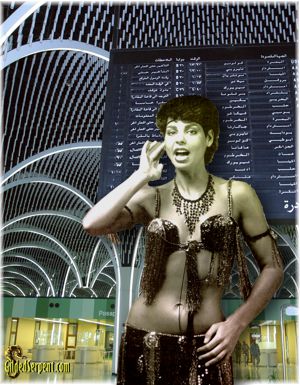
Baghdad Airport Collage

by Rebaba
posted January 29, 2013

I thought I was home free after my luggage was searched and I was waved past the rows of tables, soldiers and travelers.  As the fear began to lift from my body I felt like I was floating and glided above ground through the neon lit archway leading towards airline gates.  As I slowly relaxed into my skin again, I consciously inhaled for the first time since my arrival at the airport.  Just as I started breathing normally again, I looked ahead and saw that I was not quite finished with Iraqi customs agents.  I now approached a row of curtained cubicles with lady agents lined up on one side and male agents on the other.  They watched us hopeful passengers come through the archway and randomly selected whomever they felt warranted a full body search.  Of course they chose me, I was their perfect candidate.  Such an obviously western woman walking alone couldn’t possibly be ignored. 

As I approached these women with all eyes on me, carrying my brown paper bag filled with money and my gold vanity case, I had to contain myself from smiling at the thought of how I must look to these lady agents.

My thoughts were confirmed when the closest lady agent looked me up and down and motioned me into a cubicle.  The female agent who ushered me in was much younger than I, barely twenty years old from the looks of her.  She scrutinized me in a way that was intended to intimidate me before she got started with the search.  After coming this far, and now that my illegal booty was well on its way to the belly of the plane[1], I was feeling pretty fearless.  I wasn’t about to allow this young woman to scare me, and I had no intentions of being strip searched. 

After living in Middle Eastern countries for almost two years, and especially after the past three months shopping in war torn Baghdad, I knew how to use a bribe to my advantage.  The young agent began by looking into my paper bag full of travelers’ checks.  I knew as tempting as the checks may have appeared to this young woman, they were actually worthless in her own country and illegal barter.  My employer had explained that at that time only Iraqi money was legal in Iraq.  In fact, transactions with any other currency than Iraqi dinars were a crime; and considered on a par with treason should the person apprehended be an Iraqi national.  My young female agent made a big show of studying my government and bank documents that allowed me to take my earnings in US travelers’ checks out of Iraq.  She made tongue clicking noises and even shook her head a couple times just to make me nervous I’m sure.  Evidently she couldn’t find anything amiss and handed me back the bag with a look like she just did me a favor –instead of doing her job.  Then she glanced down at my vanity case with eyebrows raised, and I saw an opportunity to avoid further harassment and finally be on my way to the plane.  I opened the locked case and she picked up my perfume bottle and her eyes misted over with joy as she gave me a big toothy smile looking from my Miss Dior directly into my eyes.  Well, this little lady wasn’t going to get my favorite perfume without giving me something in exchange! At this point, we started the time honored tradition of bartering for my release sans strip search.  In the end, getting out of that cubicle without having to shed my clothing cost me one bottle of partially used French perfume, my hair brush, and my blusher. 

As I walked away from the curtained cubicle, my happy lady agent waved an animated goodbye to me as if we were best friends.  I waved back while my mind wandered many miles away envisioning the past month before my June 1st departure date.  My agent arrived in Baghdad on business that included purchasing my (departing) plane ticket.  He came to the villa to visit and while there he asked me what city I wanted to fly into when my contract was up.  Originally, I had planned to go to Beirut to visit my friends and sell my Iraqi dinars on the currency Black Market (as the price per dinar was the highest outside of Iraq).  However, by the time the question of destination was seriously  posed, my situation had become very different, and money in any amount was far less important to me.  I was extremely homesick and longed for the peace and freedoms I had grown up with in San Francisco.  So I changed my mind about going to Lebanon and requested a ticket to Paris, France, where I lived and worked between contracts.  All I could think about was the joy of seeing my friends again in Paris and finally calling home and talking to my family, friends and most of all, my mom.  I had had no communication with the outside world since my arrival in Baghdad.  I knew my parents must be extremely worried about me.  In the past, I had given them cause for concern when I travelled to Harare, Zimbabwe immediately after the self-rule rebellion and bloodshed.  Then I travelled to Syria and Lebanon where there were constant coups, border fights and terrorism making the US headlines.  However, as scary as these countries may have been depicted in our news, I was always able to contact home. 

Baghdad was the first place I had worked in where a complete communication blackout was ordered (no post, no newspapers, no telegrams, and no telephone access to the general public), and  a mere two weeks after my arrival.  For the very first time since I started traveling and dancing abroad, I was unable to call my parents (and vice versa) to assure them that I was fine regardless of what they were reading in the local newspapers. 

When my mind came back to the here and now, I smiled to myself as I realized I was actually on my way to the airline gates.  I had spent approximately six hours in the airport and six hours of keeping all my fears at bay.  Earlier that day when I joined the moving horde that took me towards the customs agents, I automatically began to detach my conscious self from my physical self.  In this way I could deal with and hopefully contain my mounting terror.  I felt like I was moving along side myself and watching from a safe distance while the active me maintained the role of an “irresistible American Belly Dancer that no one would dare throw in jail”!

When I finally sat back in my airplane seat realizing I was actually leaving Iraq,  I began to allow my feet to touch the floor again.  As the muscles in my face, neck and back started to unclench and the adrenaline began to seep out of my brain, I noticed a steward walking down the aisle shutting all the window shades.  His actions didn’t immediately register concern in my mind until we started taxiing to the runway and the captain’s voice came over the intercom.  He spoke first in Arabic then repeated his speech in French, which I thought I understood.  Finally my French comprehension was confirmed when the pilot repeated his message in English.

The captain had announced in all three languages that we were flying out of Iraq in total blackout!  This meant no lights inside or outside the plane until we crossed over into Jordan and left Iraqi airspace.

He went on to say that this was now a routine precaution during the war to ensure passenger safety.  What he wasn’t saying was that Iranian missiles had been targeting  commercial airplanes flying out of Baghdad.  I learned this fact from a businessman sitting across the aisle from me who had leaned over and whispered that it happened all the time and was kept from the public along with everything else about the war.  Silly me, I thought boarding the plane meant I was finally leaving the dangers that had plagued me for the past three months.  For many people flying is scary enough-but it wasn’t scary enough for me, oh no…Not only was I flying, but, I was flying in a commercial airplane over an active war zone in the dark.  Thank goodness that my desire to be out of Iraq outweighed my fear of being shot down, or I might have been in much worse shape during that flight.  Nonetheless, it was the quietest airplane cabin I had ever been inside.  I don’t think any of the passengers, including me, moved an inch in our seats until the pilot announced we were out of Iraqi airspace.  At that point, the entire cabin exploded with nervous laughter and then hearty applause for our pilot, our captain, our hero who had safely flown us away from the awful war! 

You may wonder why I accepted the offer to work in Baghdad in spite of the war I knew they were fighting, especially after some of the close calls I had so recently experienced during my time in Syria[2].  I can tell you it wasn’t the money that attracted me although the contract was my most lucrative offer to date.  I grew up in San Francisco where I heard my birthplace referred to as “Baghdad by the Bay.”  Before I ever took my first belly dance class, I had been mesmerized by the tales of 1001 Nights in the ancient city of Baghdad, home of Sinbad and his 40 thieves.  So when the opportunity was presented to me, I decided to accept the offer of working in the city of some of my earliest childhood Middle Eastern fantasies.  Would I take the same risks now I so blindly took in my youth?  Without hesitation, yes, I would do it all over again regardless of the potential dangers to my safety.  The lessons I learned about life, the wonderful people I met, lived and worked with as I travelled to these incredibly diverse countries were worth any risk that I might impose upon myself.  I acquired a keen understanding of the hardships war brings upon innocent populations simply trying to live their lives amidst the constant threat of violence.  Living in Iraq, more than any other country I had worked in previously, taught me gratitude for the freedoms I took for granted growing up in San Francisco.  I returned home humbled by these resilient, hard working people who continued to thrive despite living under siege for so many years.

Rebaba makes it our of Iraq!

Next Stop:

Hollywood, California and the story of the eventual end of the era of the Middle Eastern Supperclub… I moved from club to club beginning in 1983 through 1986, working until the final night and then moving on to the next one.  My musician friends started calling me the “jinx” as a joke of course, but, it was true that everywhere I worked eventually closed their doors for good.

Footnotes & Resources

[1] See Chapter 11 – My Perfect Hiding Place
[2] See Chapter 6 & 7 re: my time in Syria
Author’s bio page

use the comment box

Have a comment? Use or comment section at the bottom of this page or Send us a letter!
Check the "Letters to the Editor" for other possible viewpoints!

Ready for more?

  • Queen of Denial, Chapter 6: From Syria with Love! My Arrival
    You may think that the life of a traveling Belly dancer is filled with intrigue and love affairs, but this couldn’t be further from the truth!
  • Queen of Denial, Chapter 7: More Gorgeous Georges and on to Damascus
    He kept reassuring me that everything was okay, and finally, the second time that I made for the exit, he pinned me against the wall in the darkened hallway and gave me a long, luscious kiss that made my head spin!
  • Queen of Denial Chapter 8: Memories of Baghdad Part 1: Miss America, NOT!
    I had been performing as the featured “Miss America of Belly Dance” in an elite restaurant supper club for about two weeks when Saddam Hussein announced to his country that he was being betrayed by his number one ally in the war against Iran, the USA!
  • Queen of Denial Chapter 9: Memories of Baghdad Part 2: Bombs, Bodies, and Baby?
    As the war escalated in favor of Iran, our living conditions declined. The borders and post offices were closed, the newspapers were censored, and then one day the running water just stopped without warning. My friends and I hailed a taxi and literally went from store to store buying as much bottled water as we could lay our hands on. We paid from too high priced to absolutely ridiculous prices for cases of drinking water.
  • Too Much Time, Tips & Terror, Queen of Denial, Chapter 10
    My agent found me extremely upset, and I was adamant that I couldn’t possibly stay in Baghdad for another six weeks. I desperately wanted out of Iraq, and cried and pleaded with my agent to make it so.
  • My Perfect Hiding Place, Queen of Denial, Chapter 11
    Funny as it sounds, the incredible amounts of money we were earning nightly eventually became a burden.
  • Behind the Scenes, 3rd Coast Tribal Festival
    I had never been to a tribal dance convention before, even though I have been a professional (Egyptian style) belly dancer for 40 years. From my “glitz and tits” perspective, this belly dance offshoot wasn’t something I recognized as mine.
  • Cairo Revisited: Dancing into the ‘90s
    Originally written for Caravan Magazine 1992- The one thing on which you depend about dance in Egypt from year to year is that everything slowly changes. I’ve returned to Cairo each year now for nine consecutive years, and last year my visit was just before the short war we had with Iraq in which Egypt was our US ally. Cairenes seemed sad last year, because Cairo had lost most of its income from tourism, and many Egyptian nationals were returning from Iraq and Kuwait, where they no longer had employment. I did not know what to expect this year, except the inevitable fact of surprising, yet subtle, change.
  • Fabulous Hip Drops in 30 Seconds or Less!
    A principle is a single unifying and guiding idea that when we apply it to our alignment or movement, helps us move more effectively. An advantage of using a principles-based approach to dance or martial arts mastery is that it lets us use a single visualization or body sense to achieve a desired result, instead of having to remember lots of little details.
  • Creating a Healthy Belly Dance Community
    A vibrant dance community affords benefits to all of its members. In a healthy dance community, each and every person is relevant. For learning purposes or gathering a certain show cast, there is a large pool of talent from which to choose. Those with specialties and unique areas of expertise can share their knowledge, enriching the individual skill sets of everyone.
  • Diamonds in the Rough & Polished Perfection, 2012 Berlin SomerFestival-Thursday Competition,
    Produced by Beata and Horacio Cifuentes, Held in September, 2012. The costumes were innovative and personalized with many of the competitors from the Ukraine, Russia, and Asia. Many of whom are also ballroom competitors. As a result, the costumes were visually striking and elegant. The trend in costuming is floral with tribal going towards more colorful stylized burlesque (ala Chicago musical).
  • A Journey to Fuse the World, Aubre Hill’s Second Asia Tour and Great China Visit
    Aubre Hill earned respect for her teaching and dancing styles at the 2011 events in Taiwan. But when Kelli Li, the event sponsor, told me that she would sponsor Aubre Hill again in 2012 and with longer hours, I had my doubts about the feasibility of the project.
  • Whirling, Meditation in Motion or Spectacular Show?
    A dance could not be any more contradictory. The Whirling dance lingers between spectacular showmanship and meditation in motion; it combines trance and technique. It is a surprising paradox, unified like lovers within the dance.
  • From Café Chantant to Casino Opera, Evolution of Theatrical Performance Space for Belly Dance,
    Most students of Egyptian belly dance are aware of Badia Masabni and her famous nightclubs, and many believe Badia’s clubs to be the birthplace of theatrical belly dance, or raqs sharqi. However, fewer are aware that Badia’s clubs were neither the first nor the only venues of their kind.
 

Gilded Serpent presents...

Behind the Scenes

3rd Coast Tribal Festival

Arty packing for Texas

by Yasmin Henkesh
Held January 3-6, 2013, in Ft Worth, Texas
Report posted January 20, 2013

I had never been to a tribal dance convention before, even though I have been a professional (Egyptian style) belly dancer for 40 years. From my “glitz and tits” perspective, this belly dance offshoot wasn’t something I recognized as mine. It was part folkloric, part invented, and totally alien to my solo, improvised cabaret mind. Don’t get me wrong: it wasn’t that I didn’t like it; I just couldn’t see my old body doing it–the upper torso arch, the reverse undulations, the back bends, the drops, and the writhing on the floor like a snake. However, the first time I actually saw Tribal dance live (at a 2003 Bellydance Superstar performance) my opinion of the dance form changed forever. Rachel Brice undulating to weird electronic music and Sharon Kihara’s command of the stage blew me away. I thought they were the best acts in the show. (It’s amazing what a difference live versus video can make!)

After that, I saw a number of sinuous trail blazers at our local haflas. Fortunately, my area (Washington, D.C./Baltimore) has a rich and vibrant tribal community: performances by Ashara, Belladonna, Ariel, Naimah and Mavi are always a pleasure to watch. …but spend four days at a convention dedicated entirely to tribal? Nope, I hadn’t done that! Nor would I have considered it (even now) if it hadn’t been for Artemis Mourat and her foxes.

Artemis lives in the woods and loves to feed the foxes around her house. Less than a week before her teaching engagement at Third Coast Tribal, she slipped and fell on her way to deliver cold cuts to the fox she calls Zaki, the smart little guy who figured out my friend has a soft spot for red fur, pointed ears and a bushy tail. When she landed smack on her hand, she broke a finger, sprained two more and realized she wouldn’t be able to demonstrate twirling a cane in Texas.

That’s where I came in. I have a soft spot for Arty. So the day after New Year’s Day, I found myself bringing a long stick on a plane to the Lone Star State. I had no idea I was going to have so much fun! As the sponsor, “Z”, said, I was like a kid in a candy store.

Before I left, GS editor, Lynette Harris, suggested I do some background research on what I was about to see and referred me to April Rose’s article, “Improvisational Tribal Style”, in GS’s The Belly Dance Reader. After reading it, I finally understood what all the fuss was about; it is difficult for a group to improvise on stage, look polished, and give everyone a chance to lead and follow. It takes work to learn all those cues for when to turn and where to go.

The tribal work ethic and spirit of dedication were evident from the moment I walked into the convention hotel. There were volunteers everywhere to insure the event was a success. The classes were packed with eager women who had trekked great distances to this cowboy Camelot in search of the tribal “holy grail”.

The event had multiple Merlins, all teaching magic from the mists of Avalon – or Egypt, or Turkey, or Algeria, or even California and Boston. However, rather than tell you about what I saw, let me show you. Here are some highlights from behind the scenes at the Urban Gypsy 3rd Coast Tribal. Wick Sakit Photo also took the show’s official photographs, and hopefully, they will submit a selection of them soon.


Arty with suitcase and hand

Really, I wasn’t joking: Arty broke her hand, but insisted on bringing a suitcase the size of a mountain! As soon as we arrived in Fort Worth, she also acquired a hat…

Henna

Tribal performers always seem to have tattoos. So, while I wasn’t prepared to commit to an image for life, I thought a souvenir for a week or two would be fun. Wednesday night, before the festival’s official opening, there was a henna party, provided by Debi Varvi of Henna Crone. Z, Amel Tafsout and Rachel Brice took turns sitting patiently while the Crone worked her magic on their hands. In the picture, Rachel’s hands are bandaged so that she could sleep with the henna for a better stain. The next day it was my turn and definitely worth the wait. I got to wear glitter all day as the henna dried.

Amel's hands
Hands of Amel

Yasmin's glitter hands

Hand o Yasmin

Rachel watches

Rachel hydrates

Amel, Rachel

Amel, Henna Crone and Rachel

Shopping
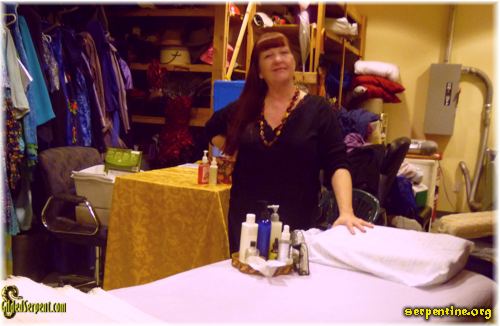
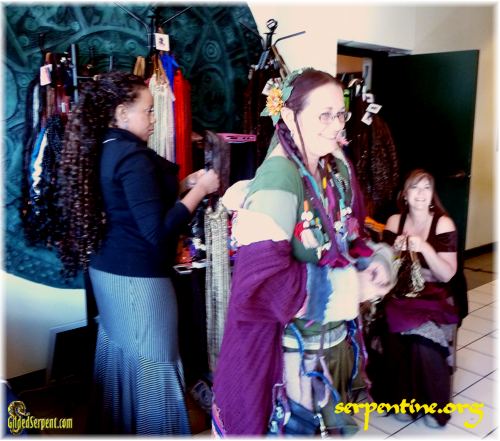
There was far too much stuff on which to spend my money! From dreadlocks and braids to bejeweled eyelashes and hammered pirate jewelry, there seemed to be something for everyone. Most of the stuff was handmade, not “Made in China”. Of course, I had to stop at Geisha Moth before she sold out of my size: I knew from experience that her creations go fast. I also signed up for a massage, and the next day, after a full day of classes, I was so grateful that I had.

Geisha Moth

Massage

Selling Hair


Classes

Some were large, others were small and intimate. Artemis Mourat, Sharon Kihara, Rachel Brice, and Zoe Jakes taught packed classes in the largest space while Amel Tafsout, Karim Nagi, and 20 other instructors shared spaces in the theater and the hotel. I signed up for a kick-ass drum solo by Sharon Kihara, odd rhythms (10/8 Sama3ee and a 18/8 Greek killer) by Rachel Brice and all of Amel’s sacred dance offerings (my favorite subjects).  Indeed, I was in workout heaven, even though I paid for it later.

Amel
Amel teaches
Arty
Arty lectures

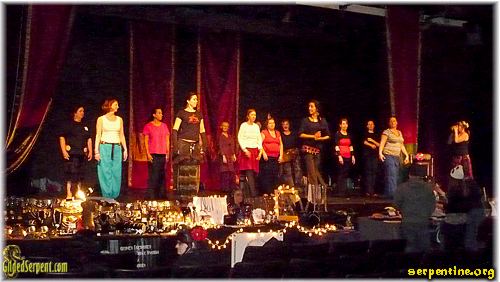
Class on stage

Class held on the stage.

Rachel’s class

Sharon’s class

Evening Activities

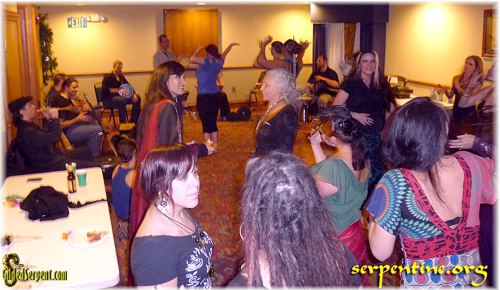
Of course, what is an event without evening entertainment? Boring! The organizers had this all planned out too, from Thursday’s talent show to Friday and Saturday nights’ performances and after-parties. The most touching moment had to be the  tribute for John Compton during Saturday night’s show, but all the performances were a pleasure to watch. They were original and well rehearsed: creativity meets the Puritan work ethic… Seriously, each number was better than the next. I didn’t see the time fly by. One minute they dimmed the lights to start, the next it was final curtain call. There were dancing skeletons and an Australian didgeridoo, tribal pompoms, and flamenco shawls. There were even (gasp) two-piece cabaret bedlahs and double veils (but no Isis wings, however). So much talent left the audience yelling and screaming for more. Oh well, there’s always next year. Who knows, maybe I’ll see you there. I was told Third Coast Tribal is like drinking from the Nile: “Once you’ve had a taste, you always want more.”

Amel

Drum circle
Drum circle
Talent Show
Talent show

Amel and Urban Gypsy. (individual names please!)

Christina of Blue Lotus, Zoe, Sharon, and Rachel.
Resources:

use the comment box

Have a comment? Use or comment section at the bottom of this page or Send us a letter!
Check the "Letters to the Editor" for other possible viewpoints!

Ready for more?

  • Planting Flowers and Dodging Riots, Dancing in Cairo After the Revolution
    I left Cairo on September 9th, 2012, after a three-week visit to research the zar. I wrote the following article on my flight home – two days before the Libyan tragedy* and the violence outside Cairo’s US Embassy. As my plane circled the pyramids I had no idea Egypt would once again become the center of world attention.
  • A Bust to Be Proud of…
    When she introduces me to her dance friends, it’s the first story out of her mouth – eighteen years after the fact. We still laugh about it.
  • Shoo Shoo Amin, A Forgotten Treasure of the 80s
    Twenty years ago when I told people I had worked with Shoo Shoo Amin in Cairo, the response was “Wow!” Now, people go “Who?” Today no one seems to know who she is. For belly dance purists, this is a tragedy. Every so often, someone my age or older will wax lyrical about her on-line, but for the most part, she’s an enigma – even to young Egyptians.
  • Sex, Belly Dance and the Afterlife
    To these people, sex was not dirty, shameful, frightening or forbidden. It was a natural part of daily life and the essential prerequisite for birth – on earth or in the Afterlife.
  • Cairo Revisited: Dancing into the ‘90s
    Originally written for Caravan Magazine 1992- The one thing on which you depend about dance in Egypt from year to year is that everything slowly changes. I’ve returned to Cairo each year now for nine consecutive years, and last year my visit was just before the short war we had with Iraq in which Egypt was our US ally. Cairenes seemed sad last year, because Cairo had lost most of its income from tourism, and many Egyptian nationals were returning from Iraq and Kuwait, where they no longer had employment. I did not know what to expect this year, except the inevitable fact of surprising, yet subtle, change.
  • Fabulous Hip Drops in 30 Seconds or Less!
    A principle is a single unifying and guiding idea that when we apply it to our alignment or movement, helps us move more effectively. An advantage of using a principles-based approach to dance or martial arts mastery is that it lets us use a single visualization or body sense to achieve a desired result, instead of having to remember lots of little details.
  • Creating a Healthy Belly Dance Community
    A vibrant dance community affords benefits to all of its members. In a healthy dance community, each and every person is relevant. For learning purposes or gathering a certain show cast, there is a large pool of talent from which to choose. Those with specialties and unique areas of expertise can share their knowledge, enriching the individual skill sets of everyone.
  • Diamonds in the Rough & Polished Perfection, 2012 Berlin SomerFestival-Thursday Competition,
    Produced by Beata and Horacio Cifuentes, Held in September, 2012. The costumes were innovative and personalized with many of the competitors from the Ukraine, Russia, and Asia. Many of whom are also ballroom competitors. As a result, the costumes were visually striking and elegant. The trend in costuming is floral with tribal going towards more colorful stylized burlesque (ala Chicago musical).
  • A Journey to Fuse the World, Aubre Hill’s Second Asia Tour and Great China Visit
    Aubre Hill earned respect for her teaching and dancing styles at the 2011 events in Taiwan. But when Kelli Li, the event sponsor, told me that she would sponsor Aubre Hill again in 2012 and with longer hours, I had my doubts about the feasibility of the project.
  • Whirling, Meditation in Motion or Spectacular Show?
    A dance could not be any more contradictory. The Whirling dance lingers between spectacular showmanship and meditation in motion; it combines trance and technique. It is a surprising paradox, unified like lovers within the dance.
 

Gilded Serpent presents...

Bellydance in the Real World- Shanghai to Russia

Bellydance Superstars ¨The Art of Bellydance ¨Live from Shanghai DVD
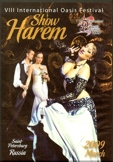
VIII International Oasis Festival Show Harem Saint-Petersburg Russia DVD

Placeholder

DVD Review by Martha Duran
posted January 20, 2013

I was recently given the opportunity to review these new DVD productions offering different perspectives in entertainment; so this is a review for all the belly dancers who are continually on the lookout for new performance videos on the web–or for those who are in the market in search of fresh new performances. Many new performances can open your mind to interesting, fun fusions from around the world and help you to prove how stylization can vary–country to country.

BDSS ShanghaiBellydance Superstars ¨The Art of Bellydance: Live from Shanghai” (June 2010)

I have seen every single DVD in the market from the Bellydance Superstars, and of course, as almost every bellydancer who owns them, you don’t see it only once and store it away!  This DVD starts with a giant screen backdrop, projecting some cool effects and images with a voice, welcoming the audience to the world of the Bellydance Superstars – from Tribal dancers to super-large Isis wings that begin the first choreography, lots of Arabesques, chasse turns, spinning and whirling around the stage. Needless to say, but I will say it anyway, it shows the same lack of artistic facial expressions in the dancers throughout almost all the DVD. 

You get to see some beautiful, fluid choreographies, but all are missing depth.

The second performance is by the always amazing drummer, Issam Houshan, who began his traditional interaction with the audience, then played an intricate drum solo with Sonia and her zills that she plays only in a part of the performance. Sonia is an elegant dancer on stage who just needs a bigger smile; I only saw her smile once or twice throughout this drum solo, while Issam smiles almost all through the performance.  Nevertheless, Sonia makes it look so effortless–so easy! Her pleasant ease makes it an almost-perfect performance.

Up next is the Tribal performance (in which I couldn’t stop noticing that the simple costuming has been worn by the superstars a lot lately) followed by “Beirut Nights”, which I found absolutely boring…  A very creative choreography was “Wheel Within a Wheel” that involved lots of Sufi spinning, and  Petite Jamila  handling up to 4 veils.  I consider this one of the best performances on this DVD.

The Sixth performance is “New Delhi Dank”.  I really liked the choreography in this piece, and I think it is lovely to see tribal dancers smile once in awhile!

"Fusionista" is a not-so-common choice of Fusion dancing. This performer is a lovely and strong dancer with an ugly costume!  However, it amazes me how she is able to make cart wheels look right while bellydancing!

The next performance is “Odissi Fusion”.  I loved the whole concept, but the execution was way too easy; we dancers want to see more than just an easy and clean choreography.  On the first DVD of the Bellydance Superstars, we were all enchanted with the wonderful master performers who were demonstrating their unique styles and their challenging, unforgettable choreographies.  Today, it seems to me that to become a Bellydance Superstar is merely a platform to get noticed by the world. One performs here and there and builds a career from that foundation. However, what I understand by their extraordinary title is that they should already be “superstars” when they become part of the team.

Another performance accompanied by Issam Houshan is “Party Drum 2010”; again he is interacting with the audience, and likewise, nothing outrageous emanates from the dancers. A second part of the “Beirut Nights” performance was next, with beautiful costuming; the skirt of the costumes made this choreography seem perfectly appropriate for the music. Beirut Nights was followed by “Ballet D’orient”–a gorgeous, flawless classical ballet-fusion performed to “Yearning” . “Ya Raitone” was one of my least favorite performances; the stylization on the dancers is too classical for such strong beats performed under this music genre.

Finally, a great Tribal performance “The Dude¨!  This video showed better costuming and an excellent choice of music.

“South Pacific Bellynesian” is introduced by Sonia with a sensible fusion of belly dance and Polynesian dance accompanied with a veil; it demonstrated a flawless technique and bright and beautiful costumes that make this fusion attractive to the belly dancer’s eye.
Next was a Tribal solo with Issam again and my reactions was that it was boring. The following performance was another drum solo with Issam Houshan but this time, with Kami Liddle. I really liked her style. She doesn’t get lost in the fusion and sticks with the belly dance-styled steps, but in this specific choreography, I did not see her really shine.

“Cairo Nights”,  “Wayward Farwell”,  and “We are One” are not enchanting at all–except for the ribbon dance performance--everything else is just plain boring!

These Superstar belly dancers are highly skilled dancers, but as performers, they lack the ability to enchant an audience. Nevertheless, this is a good DVD with interesting musical choices, excellent lighting, and a setting that is pretty much the same as other performance DVDs from the Bellydance Superstars. However, I must give credit:  finally, they have incorporated some cultural aspects and props–other than veils.

Rating:  3 zils
3 zil rating

Natalie Becker DVDVIII International Oasis Festival Show Harem Saint-Petersburg Russia DVD (March 2009)

First, let me say that most of the dancing is excellent; Russian belly dancers tend to have immaculate technique and incredible theatrical skills while performing. Natalie Becker and Ebru are incredibly skilled dancers who totally capture your attention while on stage. Their costuming is highly detailed in most of the performances and all the dancers on the Oasis Dance Ensemble do a wonderful job.

Many styles of dance are appreciated on this performance DVD that includes odd choices of music for such skilled dancers.

For the most part, the costumes are lovely, although I thought some of them were incredibly out-of-this-world, like the one used for “Space Tara” by dancer Shaharazad from Germany. She started in dimmed lights, performing a gorgeous Sufi dance and did some great tricks with the exceedingly heavy skirt, and up came the lights, revealing that Shaharazad was in Egyptian costume. Natalie Becker’s costumes were unique and perfect for every single one of her performances!

It is quite unusual how belly dancers from Russia interpret a song while performing. Almost every single dancer in this 2 disc DVD lip-syncs the song to which they are dancing.

This is a more than 3-hour-long performance DVD; the photography is excellent, the staging is perfect, lighting effects, editing and camera angles are squeaky clean. Some costumes were rather strange-looking because they were heavily adorned and more than 6 of the performances included a revelation from cover-up to costume, onstage, while dancing.

The show is pretty long, but with performances from very enthusiastic showmen like Luxzor from St. Petersburg make it fun to watch. Luxzor enters his performance dressed in a turban and a Sufi skirt, no shirt or shoes, and he begins dancing Egyptian style immediately, engaging the audience with his charisma. He does some amazing shimmies with his chest and  never missed a single beat of the drum.

I really loved the Bollywood performance on this DVD!  They fused both cultures starting off with candle dancing and following along with energetic Bhangra dancing.

You can expect anything from this show from Flamenco dancers, Samba dancers, and modern/contemporary male dancers who are executing a human ladder to Broadway hits (such as one of Bob Fosse’s), popular choreographies from 1969s “Sweet Charity” to Tango dancers and a interesting Chinese Tribal fusion. Stylization of the dancers is what kept me watching this DVD; no boundaries are set on these performances!  You can catch some dancers running to enter the stage as some of them are leaping their way out.

This is a great production team DVD with poor editing. The cover of the DVD is in English as is the menu of both of the discs, but all the credits are in Russian. Therefore, it is quite difficult to give deserved credit to the music; although I did recognize songs from Sarah Brightman and Michael Jackson.

Overall, the DVD contains accomplished dance performances to about 40 different songs.

Rating:  3 zils
3 zil rating

In closing, I must conclude you can be a superstar in bellydance and yet, not be able to fill in the holes of your performance. Also, you can try to be a superstar, but without a great producer and an excellent production team–even if you are wearing the most expensive costume and dance a great choreography with excellent artistic expression–you will not reach that point of superstar recognition if you are not up to date with the latest trends in music entertainment and excellent language. If you want to reach out to the world you have to speak their language.

Purchase info

Natalie Becker’s facebook page
Price: 950.00 Russian rubles

= ~$31

Resources:

use the comment box

Have a comment? Use or comment section at the bottom of this page or Send us a letter!
Check the "Letters to the Editor" for other possible viewpoints!

Ready for more?


Gilded Serpent presents...

Cairo Revisited:

Dancing into the ‘90s

Placeholder

by Najia Marlyz
posted January 15, 2013
Originally written for Caravan Magazine 1992 Vol.8 No.4

The one thing on which you depend about dance in Egypt from year to year is that everything slowly changes. I’ve returned to Cairo each year now for nine consecutive years, and last year my visit was just before the short war we had with Iraq in which Egypt was our US ally.  Cairenes seemed sad last year, because Cairo had lost most of its income from tourism, and many Egyptian nationals were returning from Iraq and Kuwait, where they no longer had employment.  I did not know what to expect this year, except the inevitable fact of surprising, yet subtle, change. 

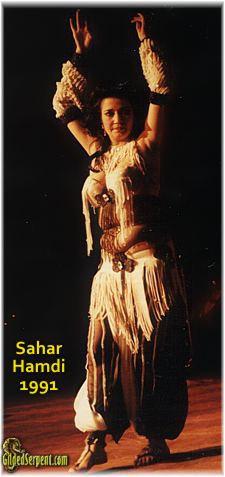
Sahar HamdiAt first, it seemed that Egypt had return to normalcy; however, I found myself wondering if it was my imagination that there is, somehow, less of everything in 1991 — everything that he is, except people! 

Perhaps many of the nightclubs reflect the state of the entire world economy. Many have disappeared and the few remaining do not seem to be presenting the grand shows they with which they had attracted tourists previously.

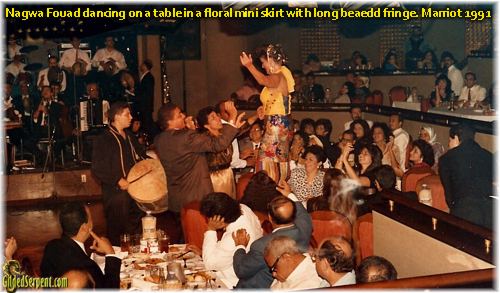
Dancers who once headlined at one five star hotel at 1:00 am and then in a nightclub miles away at 3am now is doing only one public gig, and that one starts around 3 am!  I was shocked to learn that the Fifi Abdu had quit dancing sometime last year and now has become a movie producer and a part-time movie and television actress.  I had noticed an upward spiral in her dance career in the past few years, and I had thought she would be the winner of the top position when Nagwa Fouad, and Soheir Zaki retire (again).  I believe now that we’ll not be seeing that!  I hope that Fifi will find an opportunity to present Egyptian dance in some of the movies she produces.  We dancers can hope that she will use her knowledge and experience in dance to present it with better artistry than it has had in the past. 

Our main costume liaison, Mahmoud El Ghafar, has also changed his venue.  He now has a new shop in a new, fancier location, and he has taken his (soon-to-be wed) brother as his partner.  The two of them have also begun to work with many sources of costume tailors, and there is much more variety in costuming than existed previously.

Many of the nightclubs are dark or are presenting fashion shows or Las Vegas/American style T&A dancers.  There is some extremely poor dancing presented In floorshows on the Nile cruise dinner boat and in the lesser-known nightspots.  Still, an oasis with a folklore show for tourists and high quality dancing is at the Ramses Hilton

The current costuming seen on dancers in Cairo still include sequins and beads, with rhinestones becoming ever more popular, and the result ranges from glamorous and stunning to the worst costumes I have seen–ever.  I would still give Dina a gold medal for innovation in both costuming and dance, however.  She shares the Marriott nightclub with Iman Hamdi, who dances on Dina’s nights off.  Iman is a good, if dull, dancer whose lack of stage personality caused me to enjoy, with perversity, the show put on by Sahar Hamdi over at the Meridien hotel’s top floor nightclub overlooking the city.  Sahar has changed for the worse since I first saw her dance eight or nine years ago at the Sheraton

Gone is the flirty ingénue with her sweet face; she toyed with musicians and mouthed the lyrics of the songs along with the singers in a disgusting manner.  She looks unwell and dances in a tasteless way to a large and wonderful orchestra.

  Her costumes were like sausage casings, and her once brown hair is dyed jet black — or perhaps it was a wig.  In any case, it appears the woman has led a hard life since I first saw her and was enthralled with her quality of dahlah.  After asking me “Where you from?” Sahar made a mistake and asked me over the microphone what I thought of her dancing,  I gulped hard and said her dancing was “unbelievable–and so different from the last time I saw you.”  I tried not to lie but was glad not to have been hooked up to a lie detector…  Also, I was disappointed to see Dina’s dance at the Sheraton, after having been quite impressed with her last year.  Nonetheless, if she can keep herself together long enough, stardom of the dance world in Cairo could belong to Dina — eventually. 

That is all that I can report for now about the dance changes in Cairo that I have noted personally. Nevertheless, 1991 seems a significant harbinger of change for the Egyptian dance era that became so dear (and authoritative) to belly dancers world-wide in the decade of the ‘80s.

Nagwa Fouad dancing on a table at the Marriot in 1991

Sahar Hamdi and band

Iman Hamdi

Aida Nour

>

Resources:

use the comment box

Have a comment? Use or comment section at the bottom of this page or Send us a letter!
Check the "Letters to the Editor" for other possible viewpoints!

Ready for more?

  • A Fan Speaks with Nagwa Fu’ad
    Nagwa seems to have excelled in innovation and creativity with the new compositions. She dances with the old favorites, but shines with the new orchestras playing current pieces.
  • Sharpening Your Dancer’s Edge: Performing Without Choreography
    The idea of dance governed by choreography is more a western notion that was not inherent originally a part of the Middle Eastern dance solo
  • Onstage In Search Of Our Dream: Historical American Dance Evolution
    Nonetheless, sometimes, what gives me an inner pang of pain is our self-imposed “sin of omission” in honest reportage. Sometime what is not said is more important than what actually makes it into print or into the report.
  • Teaching Down Under in 1988, A Bert Balladine Reminiscence: Australia & New Zealand
    International seminars make you do more than you think you can when you see the dedication and sacrifices people make just to attend.
  • Bully for You! The Science of Dance
    I have observed a cycle in which, periodically, emerging dancers who have obtained slightly more prominence in the craft begin to make recycled attempts to regulate it through instructional devices in order to control it to their own personal ends.
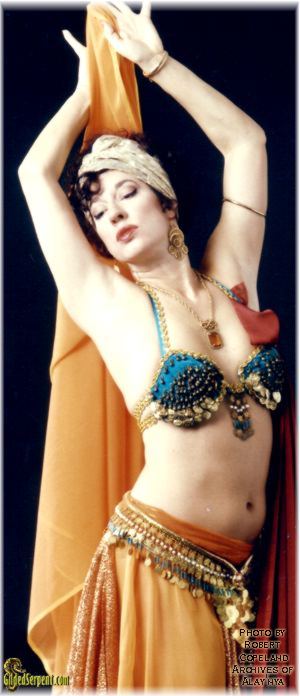
  • Living a Life Uncommon, A Mediterranean Tour with Rhea of Athens (picture of Mahmoud’s new shop)
    Rhea is like Socrates incarnate. Completely true to herself and a wealth of insight, she loves engaging the people she meets in conversations on history, society, and human nature.
  • Fabulous Hip Drops in 30 Seconds or Less!
    A principle is a single unifying and guiding idea that when we apply it to our alignment or movement, helps us move more effectively. An advantage of using a principles-based approach to dance or martial arts mastery is that it lets us use a single visualization or body sense to achieve a desired result, instead of having to remember lots of little details.
  • Creating a Healthy Belly Dance Community
    A vibrant dance community affords benefits to all of its members. In a healthy dance community, each and every person is relevant. For learning purposes or gathering a certain show cast, there is a large pool of talent from which to choose. Those with specialties and unique areas of expertise can share their knowledge, enriching the individual skill sets of everyone.
  • Diamonds in the Rough & Polished Perfection, 2012 Berlin SomerFestival-Thursday Competition,
    Produced by Beata and Horacio Cifuentes, Held in September, 2012. The costumes were innovative and personalized with many of the competitors from the Ukraine, Russia, and Asia. Many of whom are also ballroom competitors. As a result, the costumes were visually striking and elegant. The trend in costuming is floral with tribal going towards more colorful stylized burlesque (ala Chicago musical).
  • A Journey to Fuse the World, Aubre Hill’s Second Asia Tour and Great China Visit
    Aubre Hill earned respect for her teaching and dancing styles at the 2011 events in Taiwan. But when Kelli Li, the event sponsor, told me that she would sponsor Aubre Hill again in 2012 and with longer hours, I had my doubts about the feasibility of the project.
  • Whirling, Meditation in Motion or Spectacular Show?
    A dance could not be any more contradictory. The Whirling dance lingers between spectacular showmanship and meditation in motion; it combines trance and technique. It is a surprising paradox, unified like lovers within the dance.
  • From Café Chantant to Casino Opera, Evolution of Theatrical Performance Space for Belly Dance,
    Most students of Egyptian belly dance are aware of Badia Masabni and her famous nightclubs, and many believe Badia’s clubs to be the birthplace of theatrical belly dance, or raqs sharqi. However, fewer are aware that Badia’s clubs were neither the first nor the only venues of their kind.
  • Halloween Treat, Silvia Salamanca & Haflaween,
    There has been more interaction recently between the dancers in my current home of Augusta, Georgia, and in Columbia, the state capitol and largest city in South Carolina, which is approximately an hour and a half away. Some of the Columbia dancers have come down to dance with us at haflas and at our First Friday celebrations.
  • Memorial to Armando Mafufo, Drummer, Teacher, Friend
    Armando Mafufo, known to most of us in the music and dance community as "Uncle Mafufo" was, as someone posted today, "a man everyone loved." He was a person who could light up the room with his smile and radiated love.
 

Gilded Serpent presents...

Fabulous Hip Drops

In 30 Seconds or Less!

Author Alay'nya

by Alay’nya (Alianna J. Maren, Ph.D.)
posted January 18, 2013

Martial Arts Principles and Relevance to Oriental Dance

Like many of you, I’ve been studying Oriental dance for many years. Before I learned about Oriental dance, I was a dedicated martial arts student. I started with the “hard styles”: Taekwondo, Shotokan Karate, and Judo combined with Ju-jitsu; whatever and wherever I could find a teacher. Over time, I migrated to the “soft styles”; these included T’ai Chi Ch’uan, together with some less-well-known (but very effective) allied arts such as Ba Gua, Hsing I, and others.

One of the differences between hard and soft styles in martial arts is that in those considered the soft styles, the practitioner learns how to create the movements from the “inside-out.” A major way in which practitioners do this is to learn a set of underlying body-awareness principles that guide how they hold and move their bodies.

Dancers and martial artists both use principles in mastering their art. For example, Martha Graham, one of the most important American modern dancers and choreographers of the last century, built a number of movements based on what she called principles of “expansion and contraction”.

A principle is a single unifying and guiding idea that when we apply it to our alignment or movement, helps us move more effectively. An advantage of using a principles-based approach to dance or martial arts mastery is that it lets us use a single visualization or body sense to achieve a desired result, instead of having to remember lots of little details.

For example, by using the principles of “anchoring”, we align our body and get powerful results, but we don’t have to remember detailed rules such as “knees over toes” or “hold the pelvis level.” These all come about as a result of using a triggering image (which in this case, is the notion of having a ship’s anchor suspended from ones center).

There are several important principles that can be applied to dance. For the purpose of this dance discussion, the single principle that can transform your hip drops, and in fact all of your dance, is that of anchoring.

Anchoring

I consider anchoring to be the first principle to use for integrating body and mind into dance. First, stand with your knees slightly bent. (This is crucially important!) To the best of your ability, lengthen and align your posture.

Now imagine that in the center of your body, you have a hook, and suspended from that hook is an anchor. This will become your visual or kinesthetic trigger. Use this imagery and combined feeling to generate the alignment change in your body instantly, without having to remember lots of little pointers.

Make your anchor very heavy – fifty pounds or even more. This internal anchor will cause your lower back to become lengthened. As your lower back lengthens out, you may notice three things:

  1. Your abdominal muscles become much more engaged. Especially, your lower and more internal abdominal muscles (internal and external obliques) are working harder now. They are now structuring your lower torso, much like a girdle of muscles. Take notice, ladies: We don’t need Spanx, or control-top pantyhose; what we need is to anchor because it will result in immediate torso toning!
  2. Your upper thighs begin to feel the burn when you are well anchored. This is good. It means that they’re doing the workload that your lower back had been doing previously. The more that your thighs are burning, the deeper you are doing this technique.
  3. Your weight is shifted just a little bit forward. When your lower back was not completely lengthened, the weight vector of your body was directed slightly backwards. Now, your weight is going straight downward. You will feel that the center of your weight is now located more towards the center of your feet, and less towards your heels.

Each of these three things that you may notice is an indication that you are executing this anchoring principle correctly.

Now, while staying anchored, shift your weight so that one hip is free to move. Experiment with a hip drop. Just try a few pelvic techniques such as drops and thrusts, fast and slow, forward and back.
Do you notice how much looser your freely moving hip is? Try some “power drops and thrusts.” That’s right, do something strong, emphatic, and percussive. There’s a big difference, isn’t there?

Shift back and forth between your new state of being anchored and your previous unanchored state in which your lower back became just a little tight and pulled you out of perfect alignment. Notice the difference in your pelvic work. When you use the anchoring principle, your hips are loose, and your techniques are powerful. It is even easier to do faster dance techniques, like those some call “Little Cascades.”
Practice this over the next few days and continue using the anchor visualization to access immediately your new, much more powerful, anchored state. Especially, at home or at work when you find yourself in a stressful situation, remember to anchor. This imagine technique will help you feel more grounded and present, and more able to cope.

You can improve your anchoring ability by doing some yoga. The Downward Dog pose is an excellent move to release your lower spine, and every day if you can, do several sets of the Sun Salutation, which includes the Downward Dog and other poses.

The more that you practice anchoring, the more you’ll notice that your other movements are becoming both more connected and more expressive. You’re taking the first step toward the internal art of Oriental dance; you’re applying T’ai Chi principles to your dance training.

References:

* Alay’nya, Unveiling: The Inner Journey (McLean, VA: Mourning Dove Press, 2011).
Chapter 22: “Looking Like a Dancer (Even if You’re Not)” describes two Principles; Anchoring and the Lotus Flower. These two Principles work well together.
** Peter Ralston, Cheng Hsin: Principles of Effortless Power (Berkeley, CA: North Atlantic Books, 1999). (A good description of martial arts Principles that are applicable to dance as well as martial arts.)

use the comment box

Have a comment? Use or comment section at the bottom of this page or Send us a letter!
Check the "Letters to the Editor" for other possible viewpoints!

Ready for more?

  • How Quickly Can We Become Better? 3 Tips to Improve Your Dance .
    All of us want our dance to be beautiful and captivating. Yet often, especially when we are new, we see a great distance between our own movements and the expressive power of our teachers or the favorites whom we watch on YouTube clips and DVDs. Is there a way to accelerate the process of becoming better? If so, what are the secrets?
  • Morgana’s Animal Magnetism, Interview with Morgana of Madrid
    After seeing Morgana’s Serpent Dance, where she embodies the personality of the serpent, I was hooked. Any snake lovers or snake dancers will have a special appreciation for this piece.
  • Art, Activism & Magic: Krissy Keefer In Her Own Words
    …women dancers are not expected to think and speak.
  • Karen Andes: World Dancer
    Karen Andes has cooked up a unique fusion of eastern and western movement that that provides rich nourishment for the minds, bodies and spirits of women.
  • Halloween Treat, Silvia Salamanca & Haflaween,
    There has been more interaction recently between the dancers in my current home of Augusta, Georgia, and in Columbia, the state capitol and largest city in South Carolina, which is approximately an hour and a half away. Some of the Columbia dancers have come down to dance with us at haflas and at our First Friday celebrations.
  • Memorial to Armando Mafufo, Drummer, Teacher, Friend
    Armando Mafufo, known to most of us in the music and dance community as "Uncle Mafufo" was, as someone posted today, "a man everyone loved." He was a person who could light up the room with his smile and radiated love.
  • Making Superstars out of Top Dancers, BDSS Tour 2012
    From the beginning, the Bellydance Superstars troupe has had the great fortune to attract the top dancers in the field even though, at first, we were criticized within the bellydance community for “having no stars”; so how dare we call the troupe the Bellydance Superstars?
  • In Sharp Contrast, Dancing in Lebanon and the US
    Lebanon has something called “super night clubs" which are, basically, strip bars or cabarets. The term “nightclub” can be misunderstood easily–so it is best to tell them that you work at a 5-star place and not a cabaret.
  • Kajira and Chuck Interview, Cultural Appropriation or Artistic Freedom? Part 6: Separate Community? Burlesque?
    Kajira believes that the Tribal community is bigger and more successful than the rest of the belly dance community. "We wish we could be accepted as a sister dancer form… As Artemis said, if you don’t like it, you don’t have to look." Burlesque is a separate art form.
 
Gilded Serpent presents...

Creating a Healthy Belly Dance Community

Placeholder

by Princess Farhana
posted January 17, 2013

A vibrant dance community affords benefits to all of its members. In a healthy dance community, each and every person is relevant. For learning purposes or gathering a certain show cast, there is a large pool of talent from which to choose.  Those with specialties and unique areas of expertise can share their knowledge, enriching the individual skill sets of everyone.

Creativity becomes contagious, because it is encouraged to thrive.

Less experienced dancers have the opportunity to learn the ropes from competent professionals, while practiced dancers can keep current with latest developments and newest trends.  Community members of all ages and ranges of experience can interact freely and respectfully with each other, gaining insight, while every individual can also pull in new members, who could also potentially enrich the existing group.

In an ideal dance community, every member would be considered important enough to have a say, and every individual can make a contribution to the whole.

With dancers from all over the world interacting online, there is even more to learn. Individual groups from far-flung areas are no longer isolated and self-sufficient; the various communities can experience each other’s triumphs and tragedies with the click of a mouse. Still, nothing replaces face-to-face interaction, so keeping a live, local dance community running smoothly is paramount for it to be a nurturing environment for its members.

If we were to use the modern urban model for a city, a dance community would be composed of the city itself, which is comprised of everyone involved in that particular dance community.  The citizens of that city include everyone–from nationally known established dancers to regional professional and semi-professional dancers, as well as students. The city council might be composed of the leaders, indicating that they were the most high-powered community members. The city council might pass certain ordinances that would include establishment of fair pricing or a specific going-rate for gigs, or creating safe spaces for the community’s less experienced members to hone their craft.

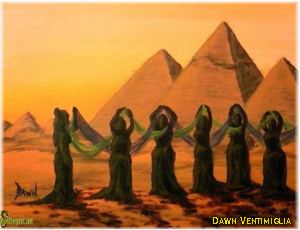
Painting by DawnAlso, there would be the city’s various neighborhoods (dance schools, troupes, as well as individual dancers who are not attached to either) and the surrounding suburbs, made up of people adjacent to the dance scene, such as: musicians, costume makers, club owners, theater managers, photographers, booking agents, dance supply vendors, dancers’ families, fans and the like.

If there were a problem in a certain neighborhood, such as an incident of price undercutting, theft of a costume, a gig, or some other sort of bad (illegal) behavior, the rest of the community would find out, undoubtedly, and act accordingly, somehow rebuking the offender(s), sometimes by driving them out of the community.

Although these problems do exist in a strong dance community (…and there are many of them) these sorts of things are less likely to happen because of the community’s sense of ethics.

In my Los Angeles dance community, there seems to be less discord and fewer problems between the dancers, undoubtedly because there are so many world class, name-dancers living here. Professional behavior and courtesy are the norm, and instilled in inexperienced dancers from day one.  In LA, as with anywhere else, there are always more performers than gigs, and there is an occasional kerfuffle over real (or imagined) trespasses, but it just seems to be handled a bit more…professionally.

You may be wondering what you have to offer your community, or how you can help to foster a great dance community atmosphere where you live.

There are many ways to go about it, but the most significant, simply, is to get involved!

Volunteer

Offering your services to your own dance community–whatever they may be–will always be helpful. This can be anything from assisting backstage to donating a few hours of your time at local dance festival. Consider offering to teach pro-bono classes, even if it is just a one-off as a form of outreach, maybe at a women’s shelter or for a group of underprivileged children. Perform gratis at a local hospital, rest home, or at a benefit for a charity organization in which you believe.

Share Your Knowledge

Imparting information is a huge way to ensure your community’s sustainability and continuing legacy. Raise your “children” (students) well; prepare them for their life as dancers as best you can. Mentor a student or students; take the time to make sure everyone in your classes understands and respects, not just technique, but also local dance history, and as much universal history as you know about your particular dance form.
If you teach, verse your students thoroughly in professional etiquette, be it onstage, backstage, or within the community itself.

If You Don’t Have Anything Good To Say, Don’t Say It At All

Sharing ideas or constructive criticism is one thing. Sharing gossip or spreading rumors is a whole other animal!

Slandering or defaming other dancers, whether in “real life” or on the Internet, tears down a community; put yourself in the other person’s place and think about how you would feel if this were happening to you.

Though it may be tempting to pass on a juicy tidbit, post a catty comment on a social media site, or stir up the pot with a little hearsay, please think twice about doing it!

Give Back To Your Community

Give generously of whatever you have to offer–even if it’s just a compliment! What you give back can be anything:  providing advice, shoulder to cry on, collating programs for a show, or tidying up a dressing room (without being asked) at the end of the night.  Maybe you’d consider waiving all or part of your performance fee to help out a friend who is bringing in a guest artist.

Giving back might also be donating used props or costume pieces to a dance studio or a “newbie” performer, or extending a free service, such as graphic design or sewing to someone within your community who needs it.

It can be offering a scholarship at your dance school, or making sure you show up to support events–even if it’s just a student show!

It may be going a little out of your way to drive a dancer whom you don’t already know to her home from a gig; that favor could wind up as a friendship or an artistic collaboration.  It can be offering words of support to a nervous new dancer, and being an enthusiastic audience member.

Do what you can; whatever you give to your community will always come back to you in some way–often when you need it most!

LA teachers at Love for Laura event

A few of the LA artists from our community at the Lover for Laura benefit.
Zahra, Fahtiem, Princess Farhana, Jillina, Issam


This article is an excerpt from Princess Farhana’s upcoming book, “The BellyDance Handbook” that will be published in March 2013.

Resources:

use the comment box

Have a comment? Use or comment section at the bottom of this page or Send us a letter!
Check the "Letters to the Editor" for other possible viewpoints!

Ready for more?


Gilded Serpent presents...

Diamonds in the Rough & Polished Perfection

2012 Berlin SomerFestival-Thursday Competition

Produced by Beata and Horacio Cifuentes
Held in September, 2012

photos and text by Ma*Shuqa and Carl Sermon
posted January 15, 2013

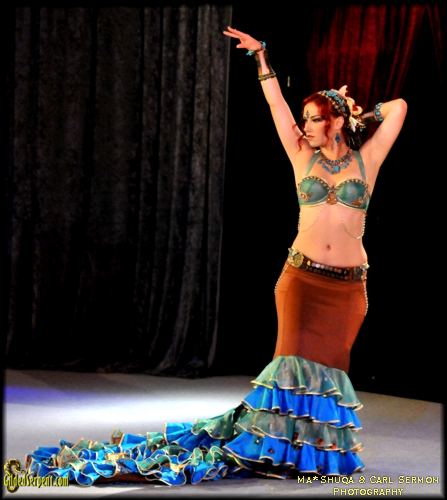
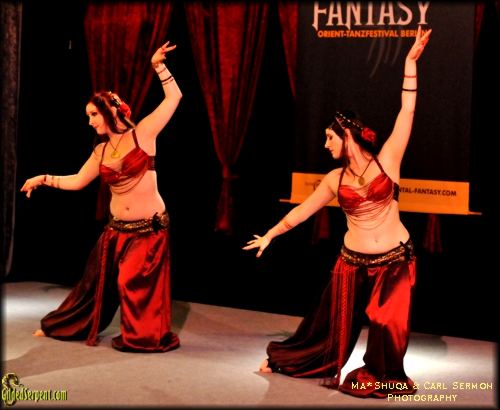
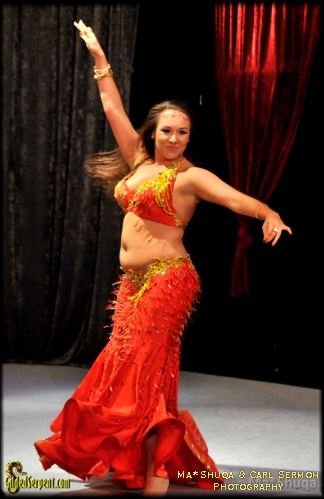
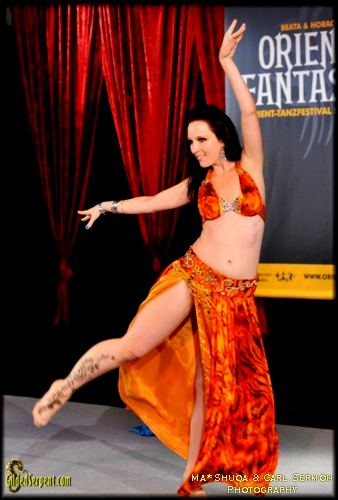
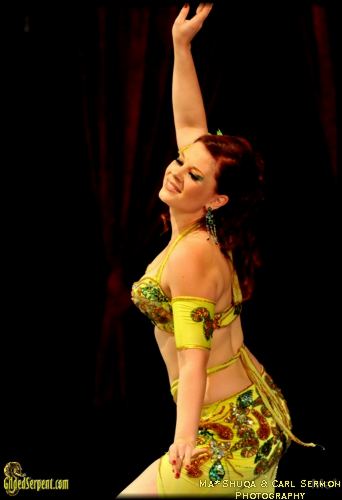
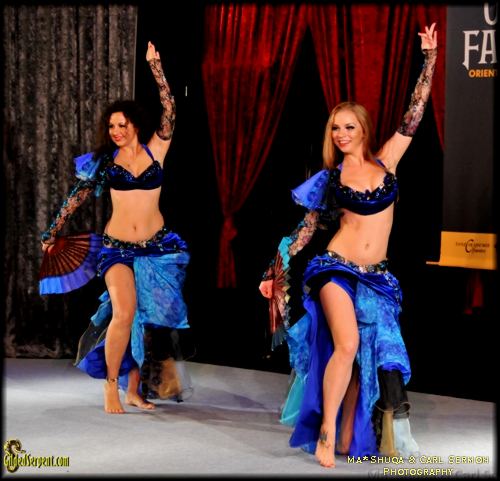
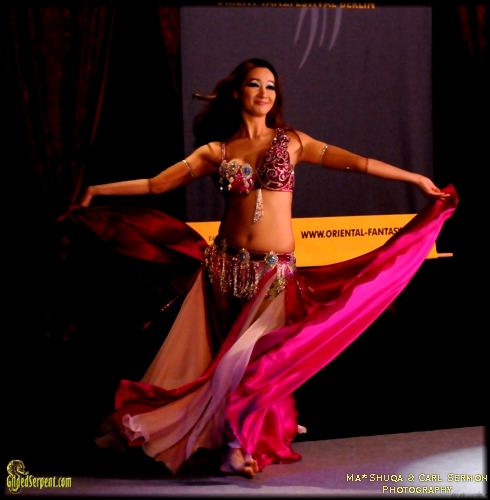
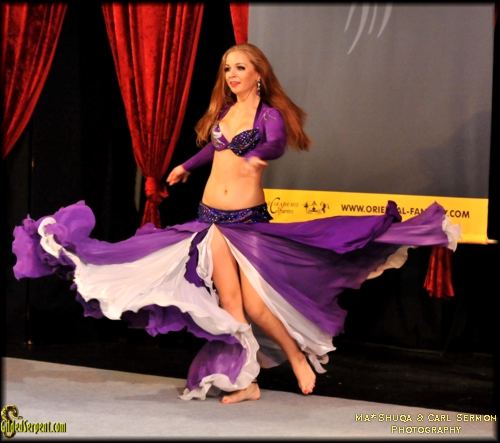
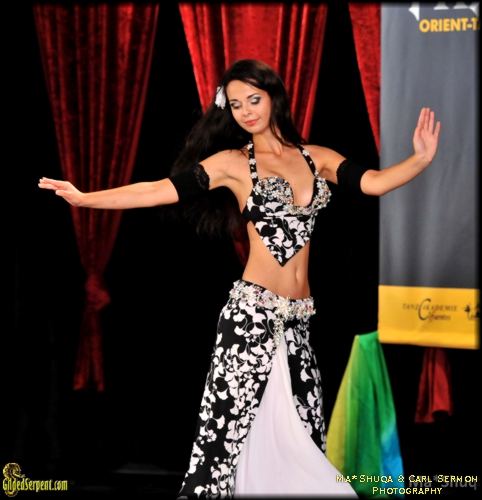
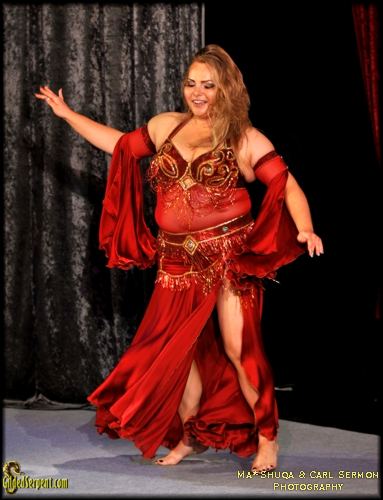
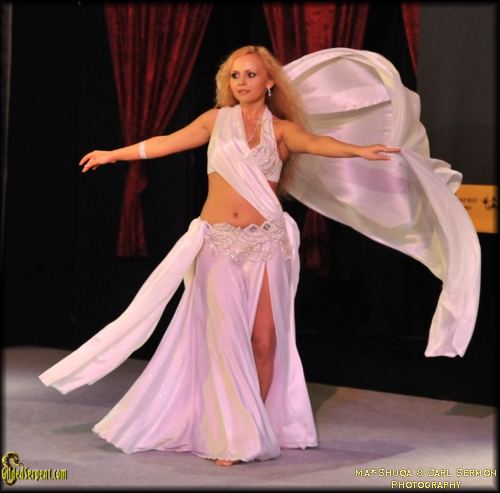
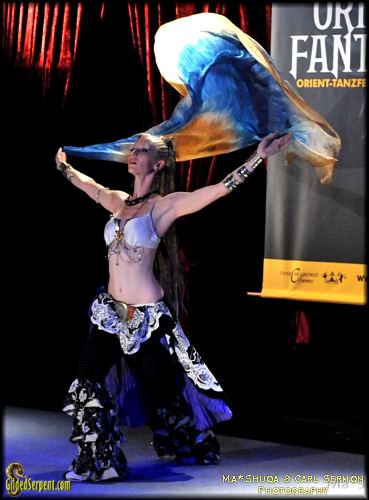
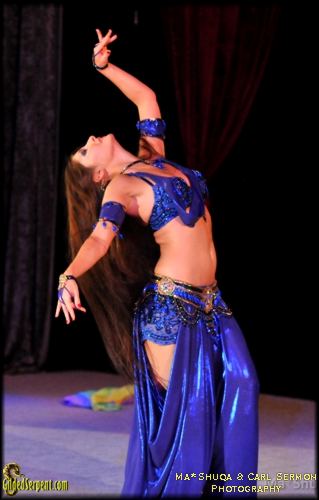
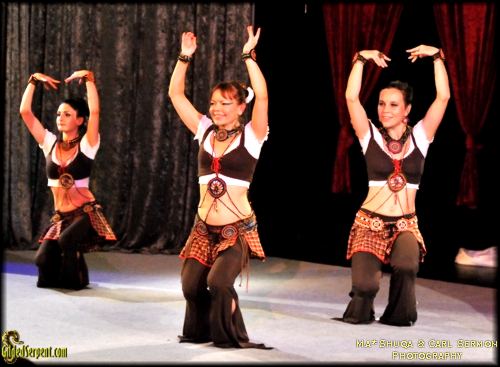
“Diamonds in the Rough and Polished Perfection" – a perfect title that sums up the array of dancer style and talent at the 2012 Berlin SomerFestival produced by Beata and Horacio Cifuentes of Oriental Fantasy.  As you can see from the image highlights of dancers and troupes who competed – this is one amazing weekend of competitive performances.  The performances were innovative including toe shoes and ballet movements and dance lines that were seamlessly well-integrated into the troupe show – one of the hallmarks of those who study with Horacio Cifuentes.  The costumes were innovative and personalized with many of the competitors from the Ukraine, Russia, and Asia. Many of whom are also ballroom competitors. As a result, the costumes were visually striking and elegant.  The trend in costuming is floral with tribal going towards more colorful stylized burlesque (ala Chicago musical).  This competition is extremely high level – thus the "diamonds in the rough" in this competition  would be top notch performers here in the U.S.; however, in this competition the audience is thrilled to see “polished perfection” from dancers who incorporate ballet and/or ballroom expertise and conditioning into dazzling performances.

Categories included:  Oriental Semi-Professional, Oriental duo-trio, Tribal solo, Tribal Due-trio, Oriental Solo Professional.  Judges were the festival celebrity workshop teachers and performers:  Horacio and Beata Cifuentes, Ilhan, Turkey; Patricia Zarnaovican, Germany; Mercedes Nieto, Hungary; Samantha Emanuel, UK, Rachel Brice, USA


Photos of many of the
Thursday Evening Competition Contestants

Agata

Agata

Alice and Jasmin

Alice and Jasmin

Angela Burnmeister

Angela Burnmeister

Anna

Anna

Anna Formenkova

Anna Formenkova

Dilek
Dilek

Dominika
Dominika

Dominika Pro

Dominika Pro

Ekaterina Bochkareva

Ekaterina Bochkareva

Elena

Elena

Horus

Horus

Hsiao chien Ni

Hsiao Chien Ni

Inara

Inara

Inside Duo

Inside Duo

Inspirit

Inspirit

Irina

Irina

Jang Jin Sun

Jang Jin Sun

Karolina

Karolina

Karolina and Dana

Karolina and Dana

Koriana

Koriana

Kristina
Kristina

Lenka Pokoma

Lenka Pokoma

Leyla

Leyla

Lucie Coufalova

Lucie Coufalova

Marina Kupriyanova

Marina Kupriyanova

Marschenko

Marschenko

Meyzan
Meyzan

Naniolala

Naniolala

Natalya

Natalya

Nyla
Nyla

Rosalia

Rosalia

Suheila

Suheila

Trio Insomnia

Trio Insomnia

Veronika Esnerova

Veronika Esnerova

Vologdina and Zverova

Vologdina and Zverova


use the comment box

Have a comment? Use or comment section at the bottom of this page or Send us a letter!
Check the "Letters to the Editor" for other possible viewpoints!

Ready for more?


Gilded Serpent presents...

A Journey to Fuse the World

Aubre performs a solo

Aubre Hill’s Second Asia Tour and Greater China Visit

by Lisa Chen
Photo courtesy of Kelli Li & Hsiao-chiu Yao
posted January 14, 2013

In 2012, Aubre Hill, an American dancer based in Los Angeles,  returned to Taiwan for the second year running as a workshop teacher and performer.  There were good reasons why many sponsors would have avoided the challenge of bringing a workshop teacher back so quickly, but sponsor Kelli Li had a plan.

Is “Coming Soon” too soon?
Aubre Hill earned respect for her teaching and dancing styles at the 2011 events in Taiwan.  But when Kelli Li, the event sponsor, told me that she would sponsor Aubre Hill again in 2012 and with longer hours, I had my doubts about the feasibility of the project.

  • The first reason is that belly dance is relatively new in Taiwan.  Workshops that teach choreography have been the most common way to communicate dance skills to workshop attendees because choreographies are considered the easiest to learn.  Students who attended in 2011 might not be enthusiastic about coming back and learning choreographies from the same teacher.
  • The second reason is traditional Chinese respect for teachers.  It is part of our culture to value and respect our teachers.  We should not and would not ask or question our teacher on how she chooses to teach.  In addition,  traditional cultural values and folk customs have long regarded a superficial politeness and harmony as a great merit, which in turn discourages people from verbalizing  their true feelings or thoughts or constructive suggestions. This may be universal but it is particularly true in Eastern society.   Therefore, one could not be sure that positive word-of-mouth would mean good attendance during the second year.
  • The third reason is our ability to absorb new information rapidly and then move on.  Our island has experienced repeated colonial invasions. We adapted to the many changes and different cultures of  those colonial rulers over a period of  four centuries. As a result, we have developed an ability to be very open to new cultures and information and are willing to give them a try,  but we also put things away easily for newer material.  Belly dance in Taiwan has had its heyday in terms of popular attention and high curiosity. To develop this artistic transplant  into a rooted art form with serious interest and respect is another story.

But Kelli had a plan!

Because of the reasons listed above, bringing Aubre back so soon was a financial risk.  But Kelli’s approach to achieving success, based on collaborative planning between sponsor and artist, overcame these obstacles.  Kelli says that workshop instructors have professional knowledge, technique and experiences but they don’t know what workshop attendees really need without the sponsor providing background information or discussion in advance. “You really want to bring out the best neutral interest for the two parties.”  Kelli, who is both a dancer and  a professional event organizer, wanted Aubre back because “Aubre is very willing and open to discuss and be out of the box in terms of teaching approaches and content resulting in better learning results.”

Kelli has observed a new trend in the local community.  “More and more dancers and students realize the importance of technique, and they also realize that learning technique could be acquired in many different ways rather than just from others’ choreographies.” Kelli said. “They just don’t know how and where to find and learn about those techniques.”

That is why last year Kelli and Aubre worked out a “combo-style” workshop plan. Kelli thought bundling choreography and technique workshops together would be attractive to those who really want to move beyond choreography to technique, while also giving dancers who usually limit themselves to learning choreographies a chance to  experiment with the essence of technique within the safety of the choreography  they just learned.

The workshops went over very well. Teachers who attended recommended and encouraged their students to sign up for Aubre’s workshops this year.

2012 built on the successes of 2011 with more workshops, more locations,  concerts and a lecture.

This June, Aubre spent almost one month in the “Greater China” area,  teaching in Mainland China and Hong Kong as well as Taiwan. Her first stop on this tour was Taiwan, where she taught two weekend workshops and two weeklong workshops.

The weekend workshops were targeted at the general public, with the subjects chosen after feedback (via questionnaires) from attendees at the 2011 workshops, Kelli’s observations of the local community, and Kelli’s discussions with Aubre.  (The top three workshops from 2011 were Layering Gone Wild, The Geometry of Hipwork,  and Drum Solo; the top three workshops in 2012 were Layering Gone Wild, Abs for Every Bellydancer, and Dynamic Drum Solos.)  Kelli said that Aubre is very generous about sharing her decade of dancing and teaching experience to make workshops richer in terms of content and atmosphere.

Weeklong workshops are not new in Taiwan, and they are increasingly popular with professional dancers and committed artists who want longer hours and more material. Working together through such long hours facilitates a trusting relationship and  instructor and attendees get to know each other better. And, as Kelli observes, the attendees get to know each other well and it is becomes organic to have those local dancers and students exchanging and co-working together.

In 2012 Aubre taught two different styles at the weeklong workshops. The afternoon session was fusion choreography with a femme fatale theme. The evening session was raks sharqi choreography.  Each session ran for two hours and for five days.  In the first hour of each session Aubre focused on technique, polishing of steps and movements, and background knowledge and information.  (For example, at the raks sharqi session, Aubre talked about the specific aesthetics of raks sharqi and saidi as a cultural concept as well as an artistic expression.)  In the second hour, Aubre led workshop attendees to integrate what they just learned with the choreography.

During Aubre’s stay in Taiwan, she also gave a lecture on the history of bellydance, including the origin of tribal belly dance and belly dance fusion.  Lecture-style courses are common in the global bellydance communities. For Taiwan, this was probably the very first formal one.

Fuse the World! – A Collective Effort for an Amazing Evening

One unique feature for the weeklong workshop sessions in 2012 was an audition for the event performances; a new idea here. Since most bellydance performance events in Taiwan are troupe recitals or joint recitals, it is assumed that all performers are either troupe members or students taught by the troupes.

aubre and
Aubre and Hsiao-chiu Yao

This audition was open to those who attended weeklong workshops. I asked Hsiao-chiu YAO, a professional belly dancer and instructor, as well as a beautiful and proud new mom, about the audition. She signed up for both weeklong workshops as the set-up gift after giving birth to a cute baby boy. Hsiao-chiu said that weeklong workshop attendees could decide if they want to attend this audition. They were arranged into several groups to dance the choreography in turns. Those who applied for audition performed first and those who preferred not to later. Hsiao-chiu said that Aubre’s teaching truly inspired her especially after giving birth and breast-feeding her son. She enjoyed both workshops as well as both choreographies very much so that she wanted to dance in front of Aubre as a way of gratitude expression. She was not nervous when auditioning and she felt so honored to be able to dance in front of Aubre.

A stage production cannot consist of only two choreographies. Kelli said that she didn’t picture a grand-scale bellydance performance but rather something different. Since Aubre is well known as a bellydancer fluent in different  fusion styles, it was quite reasonable to present a stage production with both dance and music fusion. That’s how “Fuse the World” evolved.

It was truly out-of-box thinking. Instead of having a conventional Middle East band, Kelli talked to several musician friends ( including percussionist Alex Wu, cello artist Jun-lien Yeh, and traditional Chinese string instrument Pipa artist Yi-ren Chao) about live music. Those young musicians were very excited at working together with dancers  on non-conventional music pieces.

In addition to fusion with music, there were also dancers from other dance forms such as Jazz, Modern dance and Ballroom dance. Kelli said that since the local bellydance community is so interested in fusion bellydance styles, it would be helpful for this community to watch some examples of dance forms they want to fuse with as reference.

Even the audience was assorted. Unlike conventional belly dance stage productions or performance events here, with the majority of the audience coming from the local bellydance community, this event attracted people who had never seen bellydance before. Kelli even persuaded some corporations to sponsor this event by purchasing tickets for employees to enjoy an evening of music and dance.

Three Regional Flavors for One Universal Drink

Taiwan, Hong Kong and Mainland China not only are geographically very close to each other, but they also connect with each other historically and culturally. This Greater China area is  developing rapidly in terms of global economics. There are also  artistic and cultural exchanges and conversations in this region. Bellydance is no exception to this.

Bellydance first came to Hong Kong about thirty years ago. Mey Jen Tilley,  a veteran dancer and instructor, taught foreign expatriate wives until a few years ago, when the bellydance boom attracted the attention of  the local society.  Nowadays belly dance has become a very popular  activity among Hong Kong residents.

About a decade ago, bellydance was introduced to Taiwan, and it arrived in mainland China a few years ago.  Among the three areas,  Taiwan seems most interested in developing a foreign art form into a local-rooted one.

After the very successful workshops and the much-applauded Fuse the World stage production at Taipei, Aubre and Kelli travelled to Shanghai, China for a weekend with Lulu Yuan and her troupe. Then they travelled to Hong Kong to participate in the International Dance Extravaganza 2012 organized by Suzette Ackermann. Aubre taught at both Shanghai and Hong Kong and shared the stage with Serkan Tutar and other outstanding dancers and musicians.

I asked Aubre her thoughts about teaching in the three different places afterwards. As an outsider without much knowledge on the three places, I thought Aubre would be an objective observer. Aubre said that certainly there are qualities that are shared by workshop attendees while each place possesses unique features. Most workshop attendees were very willing to commit to the procedure and contents of workshops and they tried very hard to do what the instructor asked for.

The adherence to and total trust of  teachers is common to workshop attendees from Shanghai, Hong Kong and Taiwan.

Aubre enjoyed her first visits to Shanghai and Hong Kong. At Shanghai Aubre observed that the majority of workshop attendees belonged to one local group or troupe and thus the atmosphere is very intimate, while Kelli noticed some dancers coming from other major cities like Beijing or provinces such as Guandong. The local attendees seemed to be paralyzed on the first day, Aubre recalled, because they had never before seen the techniques she taught in class; they had no idea who Bob Fosse was,  even though they signed up for a Bob Fosse Jazz fusion choreography workshop. Next day, attendees seem to be much more relaxed and open and they immediately embraced new knowledge by asking many questions.

Hong Kong, with a Western colonial history, presented a more familiar experience to Aubre. The workshop attendees were mostly a mixture of  professional instructors and advanced students, more prepared for fusion style bellydance than those in Shanghai. Also, with the advantage of English as the former governmental language, English-speaking foreigner instructors need not rely on a translator in workshops, making some aspects of the teaching more smooth and efficient.

I think that Aubre’s remark about local tastes for one global drink best describe her experiences and observations on bellydancers at the three workshop venues. Aubre ordered her favorite iced green tea latte with soy milk at all three places.. She found that  the soy milk at Taiwan tasted very different from the flavor in the States and she could adjust it by asking for half the amount of sugar. At Shanghai, the preferred local flavor was again totally different and the green tea latte was overly sweet. Upon arriving in Hong Kong, she finally had a very American-style green tea latte with soy milk. Belly dance has been introduced to the three places much as the global coffee brand has been, and it naturally has been fused with some local features and preferences.

Resources:

Workshop in Hong Kong
Group photo after workshop at Hong Kong

Taipai
Group photo after workshop with Aubre at Taipei
send names of individuals here

Shanghai
Teaching at Shanghai

Aubre gives a lecture

Aubre gave a lecture on the historical roots and history of bellydance at Taipei

Hong Kong show participants
Group photo after gala show, Hong Kong
L to R: unknown artist, Minga Lin, Christine Du, Jane Chung, Serkan Tutar, Kelli, Suzette Ackermann, Dickson Chueng, Anthony

Shanghai sponsor
Aubre, Kelli with Shanghai sponsor Jacky Lee and Lulu Yuan

Aubre performs a solo
Aubre performing at Fuse the World, June 10, 2012, Taipei (top photo also)

Aubre and Kelli duo

Aubre and Kelli performing at Fuse the World, June 10, 2012, Taipei

Aubre and Kelli Duo

use the comment box

Have a comment? Use or comment section at the bottom of this page or Send us a letter!
Check the "Letters to the Editor" for other possible viewpoints!

Ready for more?

  • Taiwan Bellydance: 2 Events Are Perfect Ending for 2010, Nefertiti Bellydance Carnival & Bellydance Evolution
    I admire those dancers participating in the production for their talents, skills, and artistic qualities, however, I feel the framework of story-telling compromises dancers from better expressing their love for this dance (or through it). They are acting through dance rather than dancing to the music.
  • Argentine-Arab Dance and Music Charm Taiwan, Gina Chen promotes Live Music for Local Dancers
    I have to say it is quite different from any other American or Egyptian style choreography I learned before; you almost always keep your feet into ballet position and body weight is relatively higher. The physical dynamic is much exaggerated. I guess this is the Argentine style bellydance and I could see why local dancers are fond of it, owing to the quality of fluidness and lightness, very outward gestures and wonderful live music.
  • 2008 Drum, Dance, & Music Festival Raqs Taiwan with Karim Nagi!
    She wishes to find the bridge between dancers and musicians, performers and audiences while still keeping its cultural roots alive. DDM is the platform for dancers and musicians working together and exchanging their professional experiences.
  • A True Arabic Experience, November 2010 Arab Dance Seminar in New York City
    His seminar emphasizes the cultural roots and context of this dance form; it is a form that is experiencing a disconnect as more dancers are entering the community through fusion and often not developing an understanding of its historical origins. Each seminar is themed to focus on a variety of elements within the culture, dance, and music of the Arab world.
  • Aubre Hill, New Fussion Energy in Taiwan
    As time has passed, the local community has found itself on a changing path. The heavily choreographed (written notation) dance trend remains the staple of the main stream while increasingly, local dancers (and instructors as well) have begun to realize that there is something else in addition to set notations of dance movements to learn.
  • Whirling, Meditation in Motion or Spectacular Show?
    A dance could not be any more contradictory. The Whirling dance lingers between spectacular showmanship and meditation in motion; it combines trance and technique. It is a surprising paradox, unified like lovers within the dance.
  • From Café Chantant to Casino Opera, Evolution of Theatrical Performance Space for Belly Dance,
    Most students of Egyptian belly dance are aware of Badia Masabni and her famous nightclubs, and many believe Badia’s clubs to be the birthplace of theatrical belly dance, or raqs sharqi. However, fewer are aware that Badia’s clubs were neither the first nor the only venues of their kind.

  • Halloween Treat, Silvia Salamanca & Haflaween,
    There has been more interaction recently between the dancers in my current home of Augusta, Georgia, and in Columbia, the state capitol and largest city in South Carolina, which is approximately an hour and a half away. Some of the Columbia dancers have come down to dance with us at haflas and at our First Friday celebrations.
  • Memorial to Armando Mafufo, Drummer, Teacher, Friend
    Armando Mafufo, known to most of us in the music and dance community as "Uncle Mafufo" was, as someone posted today, "a man everyone loved." He was a person who could light up the room with his smile and radiated love.
  • Making Superstars out of Top Dancers, BDSS Tour 2012
    From the beginning, the Bellydance Superstars troupe has had the great fortune to attract the top dancers in the field even though, at first, we were criticized within the bellydance community for “having no stars”; so how dare we call the troupe the Bellydance Superstars?
 

Gilded Serpent presents...

Whirling

Meditation in Motion or Spectacular Show?

Author turning

by Nicole McLaren
photos by Patrick Gutenberg
posted January 11, 2013

Whirling dance is popular in Egypt! However, on the big stages in Europe, it is still rarely seen. It is a fascinating dance, one-of-a-kind, and full of contradictions; it lingers between meditation in motion and a spectacular show about the dervishes of Turkey and the Tanoura dancers of Egypt–about dizziness, LED lights and tanouras (skirts) that are on fire.

A dance could not be any more contradictory. The Whirling dance lingers between spectacular showmanship and meditation in motion; it combines trance and technique. It is a surprising paradox, unified like lovers within the dance. This one-of-a-kind fusion is the reason why, as a performing art, the stage variation of the old Turkish whirling rite inherits a special place within the Oriental dance styles.

In general, turns bear something original, something genuine, something archaic. Kids spin playfully around their axes until they fall to the floor, giggling. They enjoy the sensual experience of a temporary loss of orientation. In physics, mathematics, literature or philosophy, turns, circular concepts, wheels, and cycles are omnipresent in many sciences and art forms. Especially in dance, first and foremost in ballet or ice skating, repetitive turns belong to the fundamental movement repertoire. Yet, dances of all sorts celebrate the great aesthetics of the turn in all its grandeur. Is there a dance style existent that knows no turns at all?

A Dervish whirls for hours

The spinning of the whirling dervishes of Konya, Turkey, rose to worldwide popularity. It is an integral part of their religious ceremony “Sema“, (which means listening or listening within). During this rite they turn, sometimes for hours, around their own axes, and while the Dervishes whirl, their  awareness focuses inward. The trance like effect that constant whirring may cause, brings the Dervishes (or Sufis, according to Sufism, the mystical movement within Islam) in religious ecstasy closer to Allah.

Sufis strive for a mystical experience of the divine: the Unio Mystica, a union with the divine, a state of oneness with God. One of the key concepts of the Sufism doctrine is: everything is; we all are part of the great whole. The dervishes of Konya experience this belief within the whirling rite.  

"Come, come, whoever you are."

Also in the case of an audience present, for the Sufis, whirling is less an outer performance than the sharing of a mutual experience. They consider the audience as true participators of the ceremony. Therefore, the spectators should not clap at the end of the rite. Hereby they would state that they do not belong to the ceremony, but are mere outsiders watching the whirlers as they perform. Consequently, this would represent a dualistic vantage which goes against the Sufistic credo of everything being part of a greater entity.

Throughout the centuries, Sufis sometimes faced repression because of their beliefs. Some considered their way of life and religious approaches as inadequate; for example, music being played during religious ceremonies was considered a worldly approach. The great Persian Sufi poet, Rumi, to whom the order of the Whirling Dervishes traces back, sparked additional resentment by his famous quote: “Come, come, whoever you are.“ Opponents considered these words as heretical because they could be interpreted as showing a tolerance to other religions.

In 1925, Mustafa Kemal Atatürk, the first President of Turkey, wanted to modernize his country and model it into a more western oriented state. Consequently, he made all Islamic brotherhoods illegal, including the Mevlevi order (the Whirling Dervishes). This order is still illegal, even though in 1954, the practice was partially allowed once again; the whirling ceremony turned out to be lucrative because it allured innumerable tourists.

Rumi Inspired Goethe and Madonna

Rumi, who lived in Turkey from 1207 to 1273 A.D., initiated the whirling rite that the Sufis of the Mevlevi order still practice.

It is said that Rumi once wandered over to a market in Konya, and heard the beating of a hammersmith. Within, he thought he heard the words “La ilaha illa-llah“, one of the most important Sures in the Quran. Deeply moved, he spread out his arms and started whirling.

Rumi left behind a huge heritage also concerning other fields: as a poet he created a great lyrical opus in his Persian mother tongue, beyond it “The Great Divan“. His poetry affected people worldwide, and throughout the centuries. Rumi inspired the great German writer, Goethe, who wrote “West-Eastern Diwan“. UNESCO honoured Rumi in 2007 on the occasion of his 800th birthday, and pop singer Madonna used Rumi’s lyrics in her song “Bittersweet“ in 1998. The Turkish musician, Mercan Dede, named his first album “Sufi Dreams“, the one of 2009 “800“; he called it his birthday cake for Rumi.

The Dance with the Tanoura

Whirling dance for the stage is not to be confused with the religious whirling rite of the Dervishes. Some Sufis feel offended if they are called “dancers“. For them, whirling is religious meditation. On the contrary, a dancer on stage performs in order to please an audience. Therefore, one may avoid the incorrect term “Derwish dancer“ when referencing the stylized stage variation.

The Egyptians adapted the whirling technique of the Dervishes in Turkey, and it grew into a one-of-a-kind stage artform. The extremely popular dance with the tanoura (the Arabic term meaning skirt) is a performance for an audience; the whirlers usually don’t belong to a Sufi order. Also, the tanoura underlines the show aspect: a full-circle skirt, often made of a highly colorful fabric. Sewed into the rim is a hemp rope, rubber, or a chain. So, the skirt will unfold with whirling, thanks to centrifugal force, it will hover like a plate. Often, the tanoura is multilayered, and sometimes the dancers wear multiple colorful tanouras simultaneously. Highly skilled and popular tanoura artists of today, include names like Ziya Azazi from Turkey and Austria or Bondok from Egypt and Germany.

Embrace dizziness; release control

The music for the Whirling dance on stage is sometimes inspired by the Sufi music, and creates a mesmerizing atmosphere. The rhythm which is often used is the 2/4 Rhythm of Ayub or a Zaar rhythm (Dum – Tak Dum Tak). Often a ney (a reed flute), one of the central instruments in Sufi music, is used. They say that its soulful and melancholic tone portrays the flute’s great sorrow of having been cut out of the reed from which it came, as well as its deep longing of being unified again with its origin. This metaphor of striving for a reconnection expresses beautifully the Sufistic idea of everything being part of a greater whole.

Paradoxically, for the Whirling dance, it is extremely important to consciously release control. The dancer strives for a dedication to the whirling experience, and the sensual effect that accompanies it; a temporary disorientation–a sensation of letting go, of letting loose.

This is a challenge, physically, as well as mentally because dancers, in particular, try to achieve the greatest body control possible on the one hand, while on the other, the constant and repetitive whirling movement is new to them and might somehow feel odd for the body. Consequently, some dancers might get dizzy in the beginning while others won’t feel anything at all. If someone experiences dizziness, rather than fighting it, embracing it will help to overcome. Ultimately, once the feeling of a possible initial discomfort is left behind, the whirling experience may bless the dancer with an overwhelmingly intense awareness of the moment–a simultaneous sensation of great calm and euphoric joy.

Whirling with a Burning Tanoura

Initially, one might think a whirling choreography for the stage wouldn’t be complex, but rather, plain and simple. A differentiated view unfolds a great variety of possibilities, though. The dancer can combine calm and meditative elements with spectacular show moves using the tanoura. Besides using torso and hips, smooth and fluent arm moves, and wild head turns, there are different whirling techniques such as: jumping, skipping, hopping on one leg. They may skillfully integrate the whole space of the stage, whirling fast and slow, dynamically and steadily. Additionally,one may use black light or LED lights sewn directly into the tanoura. Of course, nearly endless possibilities of props, can be combined creatively with the tanoura: drums, veils, zills, swords, Isis wings, Tibetan sleeves or Chinese ribbons.

Furthermore, the tanoura presents a wide array of possibilities: The so-called wheel, either at hip, shoulder, or over-head height, evokes wowing effects. In order to create it, the dancer holds the tanoura in a certain way so the skirt will hover diagonally around her. Moreover, the dancer can take off the tanoura, fold it into the popular “baby“, use it as a cape, whirl it around single handedly, throw it high into the air, and let it waft down onto her. Additionally, she may light the rim of a special pyro-tanoura, and spectacularly, whirl in a ring of fire. Using all these possibilities–and with a playful “jester’s license“ state of mind–many more possibilities are yet to be explored. A dedicated dancer can choreograph outstandingly creative performances. The stage is beckoning!

Whirling within a Dance Routine

Within the Oriental dance scene, whirling dance has not yet become a mass phenomenon, although the ability of spinning around one’s own axis, vastly enhances the skills of an Oriental dancer and ameliorates one’s repertoire. A dancer who masters a constant whirl will seamlessly, (and seemingly effortless) cope with a lot of fast, consecutive spins, which are very popular in the great finale of a classical dance routine.

The deep aesthetics of the whirling movement only unfolds its full beauty if the dancer is able to completely devote herself to these turns: grounded, centered, with a strong inner axis and an upright composure.

Besides the refinement of the dancing skills, whirling dance also broadens the spectrum of styles within a show, and enriches its diversity. On many big stages, the whirling dance is still rarely seen; hence, the effects of the danced turns unroll all the more.

A Paradox, Unified within the Dance

Within the Oriental dance styles, the Whirling dance is often accredited to having a certain, exceptional position. Although the stage variation has progressed a long way from its ceremonial Sufi origins, whirling still blends performance and meditation, skills, and spirit. The dancer may find (somewhat contradictorily) great calmness within the movement.

Generally, the Whirling dance combines an enthralling set of oppositions. It is a spectacular stage dance, but at the same time often focuses inward, striving for immersion and self-absorption. It creates a deep deliberation, and while the body is  in full motion, it bears simultaneously meditative calmness and rousing joy of life. Its ambiance harmoniously meanders and can be playful and strong,or sublime and solemn. It raises the awareness of the moment, while the whirler journeys to the core of himself.

For a dancer, whirling is an exceedingly sensual experience; intense, delightful, and even trancelike. For the audience, though, the one-of-a-kind mystic atmosphere, the forceful energy, and at the same time, hypnotizing inwardness, mesmerizes the spectators. This unique art of dance lingers between control and letting go, between trance and technique. It seems to touch the invisible, a dance that has the power to enchant–like a secret from another world.

Author
author
Resources:

use the comment box

Have a comment? Use or comment section at the bottom of this page or Send us a letter!
Check the "Letters to the Editor" for other possible viewpoints!

Ready for more?

  • Leila Delivers Live Music Under the Stars, Camp Negum 2010
    Camp Negum did indeed happen May 4-8, 2010. It was everything Leila promised and more – 5 days and nights of music and dance classes, almost all to live music.
  • Planting Flowers and Dodging Riots, Dancing in Cairo After the Revolution
    I left Cairo on September 9th, 2012, after a three-week visit to research the zar. I wrote the following article on my flight home – two days before the Libyan tragedy* and the violence outside Cairo’s US Embassy. As my plane circled the pyramids I had no idea Egypt would once again become the center of world attention.
  • Facing the Truth, Working as a Dancer in Egypt
    Sometimes the dirty facts of dancing in Cairo can be more interesting than the pristine Oriental fantasy… at least, it is when you tell the story later! PHOTOS!
  • As the Music Fades, Egypt’s January 25 Revolution’s Impact on the Muscians and Dancers
    We can’t attain what they had in the past because we are not free. Our minds are full of work and what we should and shouldn’t do. There’s no time for good art. Politics mixed with religion does not make for an atmosphere where the arts can flourish.
  • A Month in Cairo, Egypt, Report No. 3: Fresh Eggs and the Festival Begins, Ahlan Wa Sahlan, Part 1
    One of the aspects of AWS that I enjoy most is the contact it offers with dancers not only from Egypt, both Egyptian and foreign-born, but from all over the world. It’s a rare opportunity to find out that our dance idols are real people who are warm, friendly, and eager to share their knowledge.
  • Living a Life Uncommon, A Mediterranean Tour with Rhea of Athens
    Rhea is like Socrates incarnate. Completely true to herself and a wealth of insight, she loves engaging the people she meets in conversations on history, society, and human nature.
  • We Will Rak You! My Dance Experience with Queen
    I’ll admit I wasn’t too familiar with the music of the British rock group Queen. The year was 1977, the month of December, in Los Angeles. I was invited to perform at a dinner party where Queen, in Los Angeles for several concerts, was the guest of honor. The job came to me through Dianne Webber.
  • Magnouna in Cairo, aka My Cairo Adventures in April 2008
    The tally of dance shows for this trip was 3 Nile dinner cruises (Lorna Gow, Basima and Leila), the Tannoura show, Dina (at the Semiramis) and the Opening Gala at the Nile Group Festival (Dalia, Liza Laziza, Leila, Hayem, and Asmahan).
  • From Café Chantant to Casino Opera, Evolution of Theatrical Performance Space for Belly Dance,
    Most students of Egyptian belly dance are aware of Badia Masabni and her famous nightclubs, and many believe Badia’s clubs to be the birthplace of theatrical belly dance, or raqs sharqi. However, fewer are aware that Badia’s clubs were neither the first nor the only venues of their kind.
  • Halloween Treat, Silvia Salamanca & Haflaween,
    There has been more interaction recently between the dancers in my current home of Augusta, Georgia, and in Columbia, the state capitol and largest city in South Carolina, which is approximately an hour and a half away. Some of the Columbia dancers have come down to dance with us at haflas and at our First Friday celebrations.
 

Gilded Serpent presents...

From Café Chantant to Casino Opera

Evolution of Theatrical Performance Space for Belly Dance

Placeholder

by Heather D. Ward (“Nisaa of St. Louis”)
posted January 10, 2013

Most students of Egyptian belly dance are aware of Badia Masabni and her famous nightclubs, and many believe Badia’s clubs to be the birthplace of theatrical belly dance, or raqs sharqi.  However, fewer are aware that Badia’s clubs were neither the first nor the only venues of their kind. 

In reality, clubs like Badia’s grand Casino Opera were the culmination of a trend in Egyptian entertainment venues beginning in the late nineteenth century, and the transformation of awalem and ghawazee dance into raqs sharqi was already underway in the earlier, lesser-known cafés chantants or salat of Ezbekiya and Shari’ Emad ad-Din. 

This discussion explores how developments in popular entertainment and performance space in Cairo impacted the evolution of belly dance and ultimately gave rise to the dance form we now recognize as raqs sharqi.

In the nineteenth century, the modernization projects of Mohamed Ali and his grandson Isma’il transformed Cairo into the Paris of the Orient, and the environs of the Ezbekiya Gardens emerged as the bustling hub for arts and entertainment in the city (Hassan 1998, 1999).  Ezbekiya was originally the site of a lake that formed annually during the flooding of the Nile.  Many of Egypt’s rulers built their palaces on the periphery of the lake, and Napoleon based his headquarters there during the French occupation.  Under Mohamed Ali, the lake was drained and gardens were laid out on the site.  Isma’il continued the development of the gardens, employing a French landscape architect to create a lush setting styled after the public parks and pleasure gardens of Britain and France.  Hotels, theaters, restaurants and cafés were established in and around the Ezbekiya Gardens as the area became increasingly popular as a travel and recreation destination.  The grand Shepheard’s Hotel, located at the northwest corner of the gardens, rivaled European hotels of the time in luxury and opulence, and the original Cairo Opera House, located just south of the gardens, was the site of the world premiere of Verdi’s “Aida”.

Map
survey map of Ezbekieh Gardens and environs 1920 – from Library of Congress
(top photo- Egyptian hotels Ltd., Cairo. Shepheard’s Hotel. Exterior – 1920s or 1930s)

By the turn of the century, numerous venues in Ezbekiya were offering “variety shows” that included music, singing, dancing, theatrical performances, and more – in the mold of European cafés chantants and music halls.

There seems to have been no unifying term for these establishments at the time, (1) though the generic term sala (“hall,” plural salat) was sometimes used and is adopted throughout this article for convenience.  Some of these venues were referred to by Western travelers and tourists as cafés chantants or occasionally cafés concerts.  An 1886 article by an Australian correspondent in The Queenslander newspaper writes of El Dorado, a sala that turns up frequently in travelers’ accounts and guidebooks:

At the El Dorado Café a troupe of danseuses with singers, acrobats; while in the next room merrily goes the roulette ball, while the fascinating baccaret and trente et quarante attract the jeunesse dorée, who, if they win have champagne suppers, and if they lose take ditto for consolation.  (The Queenslander 27 February 1886, 336)

Two years later, the Arabic-language daily Al Ahram mentions that the owner of El Dorado was adding theatrical performances to the program (Al Ahram 1 December 1888, 2).  Thus, like music halls in Europe and the United States, these venues offered a broad range of entertainments.  However, dance was certainly on the bill at many of these establishments.  Indeed, by the 1910s, female professional dancers, or awalem, could be found performing in salat throughout Ezbekiya (Sladen 1911: 114-115).

Prior to the nineteenth century, the term almeh (plural awalem) had designated a “learned woman” – a skilled female entertainer who wrote and recited poetry, composed and sang songs, and occasionally danced, but only in the hareem, or women’s quarters, of an Egyptian home (Lane 1836: 354-355).  The awalem contrasted markedly with the ghawazee (singular ghaziyeh), dancers who performed publicly (in streets, in courtyards, and at saint’s day celebrations) in provocative dress (by the standards of the time) and who were thus considered less than respectable (Lane 1836: 372-377).  In the early nineteenth century, there was increasing overlap between lower-class awalem and ghawazee (Van Nieuwkerk 1995: 35).  In 1834, both the awalem and the ghawazee were banned from Cairo, and by the time that the ban was formally lifted (under the reign of Abbas Basha, between 1849 and 1854), the distinction between these two classes of female entertainers had been irrevocably blurred. 

By the end of the nineteenth century, the term almeh came to designate a professional singer/dancer, while the term ghaziyeh increasingly referred to dancers in the rural villages outside of Cairo (Rushdy 2010, Van Nieuwkerk 1995) (though Western travelers and tourists still frequently used the terms almeh and ghaziyeh interchangeably).

Although the awalem and ghawazee were permitted to return to Cairo, there were apparently restrictions placed on where they could perform within the city (Leland 1873: 126-137, Van Nieuwkerk 1995: 36-37).  Reynolds-Ball states:

Genuine performances of these dancing girls are seldom seen in Cairo, except occasionally at weddings among the rich Cairenes; and, in fact, the public dances of the Ghawazee are forbidden by the authorities. They can, however, be seen at most of the towns of the Upper Nile Valley, especially at Keneh and Esneh. (Reynolds-Ball, The City of the Caliphs, 1898: 191-192)

Dancers and other entertainers were omnipresent at Cairo’s Moulid An-Nabi (the immense annual festival celebrating the birth of the prophet Mohammad) in the 1880s (Charmes 1883: 179-181).  Yet, S.H. Leeder, describing the moulid in 1912, states:

The dancing-girl no longer has a place in such festivities, and the buffoons and conjurers had no stage here that I could discover; and I could find no representative of the lower orders of dervishes who used to chew and swallow red-hot coals and crunch and swallow glass with apparent enjoyment. (Leeder 1913: 253)

Nevertheless, as Reynolds-Ball notes, dancers could be found in the cafés chantants of Cairo, such as El Dorado:

There are several good cafés and cafés chantants, such as Café Egyptien, close to Shepheard’s, the Eldorado, Rue Ezbekieh (native dancing girls). (Reynolds-Ball, Cairo To-Day, 1898: 12)

Toward the turn of the century, although dancers continued to perform at a variety of private functions for the upper classes, at weddings for the middle and lower classes, and at saint’s day celebrations (mawalid, singular moulid) in rural towns and villages, in Cairo at least, the sala was becoming a significant performance venue for dancers.

The move of belly dance in Cairo from traditional performance settings such as weddings and mawalid to the salat of Ezbekiya marked a fundamental shift in the nature of the dance.  In traditional contexts, belly dance was embedded in an occasion.  In other words, professional dancers were engaged for a performance if there was an occasion to observe, such as a wedding, a moulid, a sebo’ (party for a seven-day-old baby), or even a dinner party for visitors(2).  The sala, on the other hand, was a formalized performance venue – one which existed specifically for the display of performing arts like music, dance, and theater.  The attending audience was composed entirely of paying customers who attended with the intent of seeing the show, as opposed to a gathering of family, friends, and neighbors (as in a neighborhood wedding) or a casually aggregated mass of observers (as in a moulid).  A 1902 newspaper article describes admission at El Dorado:

The entry is generally free, but one is expected to order at least five piastres worth of something, or else pay that money for a seat.  (Star, Issue 7512, 20 September 1902, 2)

Further, the dance of the awalem and ghawazee in traditional contexts was not a strictly theatrical dance.  Theater dance, or concert dance, is performed as entertainment for a non-participating audience, and there is a clear distinction between the performers and the audience.  While the awalem and ghawazee were certainly performing for others, the boundary between the performers and the audience was not precisely defined.  As Van Nieuwkerk (1995: 36-37) notes, some Western observers were shocked by the casual air of association between female entertainers and their clients.  Lane writes:

In some parties where little decorum is observed, the guests dally and sport with these dancing-girls in a very licentious manner. I have before mentioned (in a former chapter) that on these occasions they are usually indulged with brandy or some other intoxicating liquor, which most of them drink to excess. It is a common custom for a man to wet with his tongue small gold coins and stick them upon the forehead, cheeks, chin, and lips of a Gházeeyeh (Lane 1836: 494-495).

Consider also Lady Duff Gordon’s description of an experience with a dancer in the Sa’id:

I dined last night with Mustafa, who again had the dancing-girls for some Englishmen to see. Seleem Efendi got the doctor, who was of the party, to prescribe for him all about his ailments, as coolly as possible. He as usual sat by me on the divan, and during the pause in the dancing, called “El Maghribeeyeh,” the best dancer, to come and talk to us. She kissed my hand, sat on her heels before us, and at once laid aside the professional gaillardise of manner, and talked very nicely in very good Arabic, and with perfect propriety, more like a man than a woman; she seemed very intelligent. What a thing we should think it, for a worshipful magistrate to call up a girl of that character to talk to a lady! (Duff Gordon 1865: 224-225)

The setup of the sala, with its clearly defined performance stage for the entertainers, established greater distance between performer and audience (3).  In essence, the movement of the dance into the formalized performance setting of the sala signified the transformation of belly dance into a fully theatrical dance form by the end of the nineteenth century.

It is clear that two significant features of what would become raqs sharqi – performance for the sake of performance, and performance for a primarily non-participating audience – were in place much earlier than the establishment of Badia Masabni’s first sala in 1926 (4).  Yet belly dance was only one among many entertainments offered in the salat of Ezbekiyah.  When entertainment venues expanded west from Ezbekiyah into Shari’ Emad Ad-Din and neighboring streets in the early twentieth century, the salat that opened there followed the already well-established model for variety entertainment.  Research by Priscilla Adum (n.d.) regarding the history of Badia Masabni’s establishments in Cairo reveals that dancing was not the only draw at the Sala Badia on Shari’ Emad ad-Din when it first opened its doors in 1926.  In fact, though Badia included some dancing (her own) in the show, no other dancers were on the bill, and the show seems to have been focused primarily on singing and acting (ibid.).  When Badia did begin including dancers in her programming the following year, some of those she hired were already established entertainers (ibid.).  Badia did not set out to create a new dance form; rather, quite successfully, she attempted to out-do her competitors in an already proven format for variety entertainment that included dance.  The stage for raqs sharqi had already been set within the walls of the salat of Ezbekiya.


Der Esbekieh-Garten in Kairo, Ägypten, fotografiert aus einem Ballon – aerial photograph by E. Spelterini created in 1904 published in 1928
References
  • Adum, Priscilla. "The Lady and Her Clubs."  All About Belly Dancing, by Shira, n.d.  <http://www.shira.net/about/badia-lady-and-clubs.htm>.  Accessed November 15, 2012.
  • Al Ahram.
    1 December 1888, 4 February 1911, 1 July 1925.  <http://digital.ahram.org.eg>.
  • Arab Music Magazine, “Sheikh Salama Higazi, Pioneer of Musical Theater.”  Arab Music Magazine, 2012.  <http://www.arabmusicmagazine.com/index.php/ar/2012-03-12-12-51-00/50-2012-05-11-13-31-37>.  Accessed November 15, 2012.
  • Charmes, Gabriel. Five Months at Cairo and in Lower Egypt.  London: Bentley, 1883.  From Travelers in the Middle East Archive (TIMEA).  <http://hdl.handle.net/1911/19581>.
  • Duff Gordon, Lucie, Lady. Letters from Egypt, 1863-65.  London: Macmillan, 1865.  From Travelers in the Middle East Archive (TIMEA).  <http://hdl.handle.net/1911/9169>.
  • Hassan, Fayza. "How Green Was This Valley."  Al-Ahram Weekly Online.  Issue No. 400.  22 – 28 October 1998.  <http://weekly.ahram.org.eg/1998/400/feature.htm>.
  • Hassan, Fayza. "Well May They Weep."  Al-Ahram Weekly Online.  Issue No. 427.  29 April – 5 May 1999.  <http://weekly.ahram.org.eg/1999/427/special.htm>.
  • Lane, Edward. Manners and Customs of the Modern Egyptians.  1836.  New York: Cosimo Classics, 2005.
  • Leeder, S.H. Veiled Mysteries of Egypt and the Religion of Islam.  New York: Charles Scribners’ Sons, 1913.  From Travelers in the Middle East Archive (TIMEA).  <http://hdl.handle.net/1911/9177>.
  • Reynolds-Ball, Eustace A. Cairo of To-Day: A Practical Guide to Cairo and Its Environs.  London: Adam and Charles Black, 1898.  From Hathi Trust Digital Library.  <http://catalog.hathitrust.org/Record/009261008>.
  • Reynolds-Ball, Eustace A. The City of the Caliphs; a Popular Study of Cairo and its Environs and the Nile and its Antiquities.  Boston, London: Estes and Lauriat, T. Fisher Unwin, 1898.  From Travelers in the Middle East Archive (TIMEA).  <http://hdl.handle.net/1911/9297>.
  • Rushdy, Noha. "Baladi as Performance : Gender and Dance in Modern Egypt."  Surfacing 3.1 (2010) : 71-99. 
  • Sladen, Douglas. Oriental Cairo: The City of the "Arabian Nights."  Philadelphia: J. B. Lippincott Company, 1911.  From Travelers in the Middle East Archive (TIMEA).  <http://hdl.handle.net/1911/9189>.
  • Star. “The Ghawazee of Cairo: The Picturesque Dancing Women of Egypt.”  Star [Canterbury, New Zealand].  Issue 7512.  20 September 1902: 2.  <http://paperspast.natlib.govt.nz>.
  • Timaru Herald. "Social Egypt."  Timaru Herald [Timaru, Canterbury, New Zealand].  Volume XXIV, Issue 1417.  13 May 1876 : 3.  <http://paperspast.natlib.govt.nz>.
  • The Queenslander. "Our Cairo Lettter."  The Queenslander [Brisbane, Queensland, Australia] 27 February 1886 : 336.  <http://trove.nla.gov.au/ndp/del/article/19803700>.
  • Van Nieuwkerk, Karin. A Trade Like Any Other : Female Singers and Dancers in Egypt.  Austin : University of Texas Press, 1995.
  • Leland, Charles, The Egyptian Sketch Book. London: Strahan and Co., Trubner and Co., 1873. From Open Library. <http://openlibrary.org/books/OL23388032M/The_Egyptian_sketch_book>.
Footnotes
  1. For example, Sheikh Salama Higazi, pioneer of Arabic musical theater, performed at “Sala Santi” in the Ezbekiya Gardens before opening his hall “Dar Al Tamtheel Al Arabi” in 1906 (Arab Music Magazine 2012).  Sala Santi was still in existence as late as 1925; an Arabic newspaper advertisement from that year announces an upcoming performance there by Um Kulthum (Al Ahram 1 July 1925, 5).  (It is unclear whether “Sala Santi” is the same as the restaurant “Santi” that is referenced in Western sources.)  On the other hand, Higazi’s “Dar Al Tamtheel Al Arabi,” though clearly offering variety shows – a 1911 advertisement describes a program that included a play, musical performances during the intermissions, and a comedy show (Al Ahram 4 February 1911, 3) – was generally referred to as a theater.
  2. Although it was apparently frowned upon to engage dancers for “common” occasions, this did occur (Lane 1836: 191, 496; Van Nieuwkerk 1995: 25).
  3. However, the practice of fath – sitting, socializing, and drinking with customers – kept the performer/audience boundary somewhat blurry.  Fath was commonplace  in the salat of the 1920s and 1930s (Van Nieuwkerk 1995: 43-45), but the practice occurred as early as the 1870s (Timaru Herald, Volume XXIV, Issue 1417, 13 May 1876, 3).
  4. It is worth noting that other forms of traditional entertainment (music, singing, acting, comedy) were following a similar path at this time.
Resources:

Coming soon – a description of the sala El Dorado, its precise location in Cairo, and the famous Egyptian entertainers who worked there.

use the comment box

Have a comment? Use or comment section at the bottom of this page or Send us a letter!
Check the "Letters to the Editor" for other possible viewpoints!

Ready for more?

  • When Victoria was Queen, and the Ghawazi Ruled. Amusing, Illuminating, and Disturbing Tales of 19th-Century Encounters with the Ghawazi
    The first dancing of all ghawazi is simply moving about to the music and undulating the body. Then waves of motion are made to run from head to foot, and over these waves pass with incredible rapidity the ripples and thrills, as you have seen a great billow in a breeze look like a smaller sea ribbed with a thousand wavelets. All is done in perfect time with the music.
  • Khairiyya Mazin Struggles to Preserve Authentic Ghawazi Dance Tradition
    But when Khairiyya Mazin retires, one of the most distinctive traditions of Ghawazi dance may come to an end.
  • Badia Masabny, Star Maker of Cairo
    Due to the performance of a Hitler parody, however, Masabny was placed on Hitler’s list of people to be executed once he took over Egypt. Fortunately, the Germans never made it to Cairo!
  • Taheyia Karioka, Queen of Oriental Cabaret Dance
    In the 1980’s, the spread of Islam and its fundamental militancy proved to be a big blow for Egypt’s belly dance industry. As a result, several dancers publicly renounced their pasts and donned the Islamic veil.
  • Oriental Dance: Myth and Reality, The Harem Slaves
    To say so would be like saying that playing music, singing, and reciting poetry are also only the occupations of slaves.
  • Living in Yemen, Part I – Tafruta
    A simple question was all they needed to get them into motion!
  • Dancing in Yemen, Part 2: El Arous
    I had been to many Middle Eastern weddings before, but none were as visually
    impressive as the ones I attended in Sanaa, Yemen.
  • Researching Dance Origins with the Mazin Family, Photo from Pepper’s Archives Part 2
    Yusuf, Khairiyya and Raja looked a Pepper’s hopeful face with the tears standing in her eyes and caved in. A private performance was arranged to take place on the flat roof of the Mazin’s home in full costume with live musicians.
  • Halloween Treat, Silvia Salamanca & Haflaween,
    There has been more interaction recently between the dancers in my current home of Augusta, Georgia, and in Columbia, the state capitol and largest city in South Carolina, which is approximately an hour and a half away. Some of the Columbia dancers have come down to dance with us at haflas and at our First Friday celebrations.
  • Memorial to Armando Mafufo, Drummer, Teacher, Friend
    Armando Mafufo, known to most of us in the music and dance community as "Uncle Mafufo" was, as someone posted today, "a man everyone loved." He was a person who could light up the room with his smile and radiated love.
  • Making Superstars out of Top Dancers, BDSS Tour 2012
    From the beginning, the Bellydance Superstars troupe has had the great fortune to attract the top dancers in the field even though, at first, we were criticized within the bellydance community for “having no stars”; so how dare we call the troupe the Bellydance Superstars?