Gilded Serpent presents...

Beyond DVDs – Try Live Streaming!

Online Dance Instruction: Ansuya, Sadie, and Cera Byer
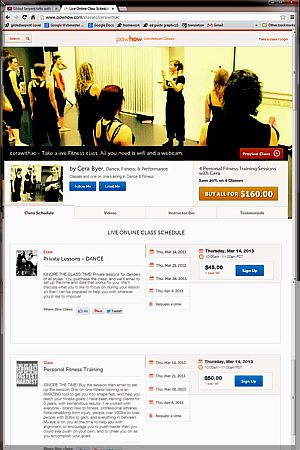
Screenshot of Cera's class list

Reviewed by Nivasi
posted March 10, 2013

Oh, Technology!  You’ve brought us so many new ways of advancing our dancing skills: instructional DVDs, belly skypes, Raqs TV rentals, recorded classes online–and now–live, interactive classes online.  Just how helpful are these cyberlearning tools?  Let’s talk about the “Powhow” classes.

If you haven’t heard, Powhow.com is a fairly new website that offers live, interactive classes streaming online in just about every subject imaginable.  That’s their plan, at least; they’re still getting started, so I’ve searched for several classes that don’t exist yet.  So far as I can tell, the only requirement for teaching on Powhow is a willingness to pay them for the use of their site, so the quality of teachers might vary.  This is probably for the best, as I doubt the people running Powhow would know how to judge who was good enough to teach all potential subjects.  I suspect the system is self-regulating, and bad teachers won’t make enough money to keep offering classes.  However, good teachers could also end up lacking enough students and therefore, income to keep teaching online. With that in mind, I offer my opinions on classes I took with 3 different, well-known belly dance teachers on Powhow: Ansuya, Sadie, and Cera Byer.

About me

I have been dancing for 10 years, and I learned primarily from a teacher who uses Suhaila Salimpour’s technique to perform Oriental or Egyptian, as well as American Tribal Style and Tribal Fusion.  This means to me that I’m fluid stylistically but have high standards for technique.

Powhow itself:

I had a lot of technical issues with my first online class, which turned out to be because I was using the wrong web browser.  I always use Google Chrome, but I saw after the first class that Powhow is designed to work with Internet Explorer and Mozilla Firefox, but not Chrome.  It’s not like any buttons were missing or anything obvious, but the video froze, jumped, lagged, and broke up frequently when I used Chrome, so I wasn’t really able to drill the combinations well. 

Powhow has technical assistance on standby during all classes, and they are prompt and try to be helpful.

They told me that the problem was my ping rate, which is a little higher than their recommended rate (which is ridiculously low).  I haven’t had any major technical issues since I started using Firefox for classes, so you can still take classes with slower Internet than they recommend.  There is occasionally a little lag between video and sound, but it’s small enough that I can choose between following what I see or what I hear.  I have also learned that the video works better if you only watch the teacher, and turn off the feed for the other students (there is an arrow above the thumbnails of the other students; clicking it switches the video on and off).  It’s very easy to setup and start the class, they offer multiple payment methods, and customer service responses are quick. 

If you have super slow internet, Powhow will be a frustrating, and probably not worthwhile, experience for you, but if you have decent Internet that’s close to their recommendations in terms of speed, I recommend it.  However, because of the frequent minor lag, it is much better for learning concepts and working on technique than learning combinations and choreography.

Rating:  2.5 zils 
2.5 zil rating


Ansuya:

Ansuya is currently offering 3 classes on Powhow: Pure Bellydance, Bellydance Fusion Workout, and Advanced Bellydance Technique, all on Saturday in the middle of the day (depending on your time zone).    Ansuya is a warm, funny teacher, and is very conscientious about checking in on the students to see how they’re doing and if they have any questions (she can see all the students in the class, and students can see each other at the same time as watching the teacher, but only one at a time).  Taking an online class will never get the same amount of feedback as a live, in-person class, but Ansuya does her best.   I have taken Bellydance Fusion Workout and Advanced Bellydance Technique, and I definitely preferred the Advanced Bellydance Technique.  I didn’t get much of a workout from the Fusion Workout, but that may be because I have been dancing for so long and I practice enough that it takes more for me to work up a sweat.  This was also the class where I had the technical issues, so that probably contributed to my lack of sweatiness.  We learned some fun hip-hop fusion combinations, drilling them a few times before adding on to the mini-choreography.  It was a fun class, and would be useful for a challenge if you’re a newer dancer, or appropriate for more experienced dancers who want something to make them move.

I have taken the Advanced Bellydance Technique class twice, and both times we worked on a drum solo choreography.  The first time, we did some soft, Hula-inspired warm-up movements, perhaps because Ansuya has just moved to Hawaii.  In learning choreography, I found her explanations of movements clear, concise, and entertaining.  She is careful to show combinations from the front and the back, and always checks in with all the students before moving on.  She will provide technique explanations if needed, and sometimes just throws in some technique details.  I enjoy getting different teachers’ points of view on beginning technique, especially when someone gives new little details without coming across as patronizing.  I feel Ansuya pulls this off well.  My only real criticism of this class is that there isn’t enough time at the end to drill the choreography and really get it down.  Otherwise, Ansuya is a detailed-oriented, caring teacher, and has gone to great lengths to make a professional presentation; her home studio is decorated with colorful Indian and Middle Eastern textiles, giving it a harem feeling, and it seems to be a room devoted to dance. 

I also enjoy Ansuya’s focus on community and spirituality in belly dance.

She has a Facebook group for students who take her Powhow classes or subscribe to her website with recorded classes, and she regularly shares her class plans, as well as photos and tips she finds inspiring. I think this is especially important if you are looking into online classes because you don’t have a local belly dance community.  Overall, I definitely recommend online classes with Ansuya.

Rating: 3 1/2 zils

Zil Rating- 3


Sadie:

Sadie now has 2 classes: Group Bellydance Technique and Combinations on Saturday mornings, and a 6 week Drum Solo Technique Intensive on Wednesday evenings.  I took the group technique class, and we worked on shimmies.  Again, her explanations of technique were clear and concise, and she differentiated between straight-legged/Egyptian shimmies, bent-legged piston hip-type shimmies, and the small vibrational or “freeze” shimmy.  We drilled all of them for a long time, and did some layering as well. I really appreciated the lengthy drilling; it’s important, and it’s a common mistake to not drill something enough after explaining it. 

Sadie is also exceptionally diligent about showing things from the front and the back, looking at all of the students, checking in to see how they’re doing, and if they need any help.

After all the shimmy drilling, Sadie taught a short combination one might use at the end of a drum solo.  We drilled it a lot, and I appreciated the cultural/belly dance tradition information she gave along with it.  Although I felt Sadie’s presentation was lacking some ambiance, she is articulate, friendly, and helpful, and I recommend her class.

Rating:  3 zils

3 zil rating

Cera Byer: 

Cera Byer is not currently as well-known as either Sadie or Ansuya, and she is a Tribal Fusion dancer. 

Having taken an in-person workshop with her at 3rd Coast Tribal and her Stretch/Tone/Strength class on Powhow (now called dance conditioning), I  believe firmly that every belly dancer of every style should study with her.

  Why?  Because she’s more a mainstream dancer than a belly dancer.  She’s extremely knowledgeable about anatomy and Western dance technique, and can provide the solid general dance foundation that is so often lacking in belly dance instruction.  I think this foundation is really important, but if you’re not into that, then classes with Cera Byer are probably not for you.  In addition to the dance conditioning class, Cera offers a fusion belly dance drills and combinations class, and will soon be offering recorded classes to stream anytime.  I found that the time in her class passed quickly, and although I didn’t feel like I was working as hard as I expected for a dance conditioning class, my body felt totally different at the end of it.  Her presentation environment is less professional than the other 2 – clearly, we were dancing in her bedroom.  Personally, I have no problem with this, but it might disturb some students.  I felt that Cera’s explanations were clear, and she gave good feedback to ensure we were doing the exercises right and getting the most out of them.  Cera is straightforward and entertaining, and  I recommend her classes.

Rating:  3 zils
3 zil rating

As stated above, I recommend Powhow in general (as long as you have good internet), and classes with all 3 instructors.  Although the technology for live streaming classes still needs improvement, it provides a rare opportunity to expand your dance education, and the feedback it offers is essential if you’ve only been learning from DVDs.  I have given Ansuya a half zill more than the other 2 because her presentation is more professional, and she offers more classes, as well as the online community.  Despite the higher rating for Ansuya, I recommend all 3 teachers equally because they all offer different things.  For straight Egyptian belly dance technique information and practice, I think Sadie is the best option.  For a community, an experience that emphasizes sensuality and feminine empowerment, and a lot of combinations that you can use, Ansuya is the best choice.  For dance conditioning, drills, and  general dance technique, Cera Byer is the way to go.  There are also several lesser-known dancers offering a variety of classes on Powhow, and I encourage you to check them out – you never know what you might find. 


click for enlargement.

Resources

use the comment box

Have a comment? Use or comment section at the bottom of this page or Send us a letter!
Check the "Letters to the Editor" for other possible viewpoints!

Ready for more?


Gilded Serpent presents...

A Special Meeting in Barcelona

Munique Brings Wael Mansour for a Workhop and Show

Photos and text by Gabriel and Helwa
posted February 20, 2013

At Academia de Danza del Vientre Munique Neith  on 29th  and 30th of September 2012, two workshops took place with Munique Neith (the sponsor), Wael Mansour and young talents of Oriental dance from Spain, Italy, Portugal and France.  Tradition and modernity merged together on this warm weekend.

A full workshop with Wael Mansour.
Wael founded the school of The National Elkawmia Folklore Dance Troupe at El Balloon Theatre


Vending during the workshop


The teacher Wael Mansour


Workshop participants pose for a group photo.


The young talent of Folklore Group Al Macaamah of Spain

The charming Oriental wings of Shasa’s silk fans (Italy)


Su’ud Cirque of Spain lead by Amaru Sabat (center)


Su’ud Cirque of Spain


Tati Alves of Brazil


Asala and Goretti of Spain


Ahmar of Portugal

Jelila of Spain

Miriam of Spain


Grupo Folklorico- Cantaro of Spain
(Munique Neith director?)


Catalina


Ilina of Spain has a school in Tarragona


Ballet Munique Neith


Munique Neith is Brazilian of Arabic descent.


Wael Mansour of Egypt


Wael Mansour of Egypt


Amaru Sabat


Jelila of Barcelona


Grupo Folklorico – Saidi (Munique Neith, director)

Munique Neith


Lylia of France. She discovered bellydance in 2004 with Latifa Saadi
and began intensive training with Leyla Aidara


Ballet Munique Neith

Munique Neith

Munique Neith

Wael Mansour

Wael Mansour

Munique Neith (The sponsor) and Wael Mansour having fun in the finale closing


Closing Gala

Wael and Munique


Resources:

use the comment box

Have a comment? Use or comment section at the bottom of this page or Send us a letter!
Check the "Letters to the Editor" for other possible viewpoints!

Ready for more?

  • Our Art’s Flame is Alive in Lebanon, The Amani Oriental Festival 2012 photos
    The charming Lebanese city of Beirut welcomes people from all the world to the Amani Oriental Festival.
  • Dancing One’s Fortune: Told in Tarot Cards, Photos from Mariona’s "Book of Thoth" Production
    Each dance of Mariona’s 2012 show was an interpretation from one of the Tarot cards with their specific stories, characterizations and magical spells. The show begins by presenting a circus titled "Habibirot" that was formed by artists from many parts of the world.
  • Dance in Palma De Mallorca, Helwa’s Studio, photos by Gabriel Monserrat Lopez
    Helwa, Belly dance teacher and director of Academia Helwa de Danza del Vientre pioneer of teaching this art for more than 12 years in Palma de Mallorca, Balears Island, Spain
  • The Stars Converge in Barcelona, El Festival Internacional de Danza Oriental 2012,
    Munique Neith is Brazilian of Arabic descent. She is the prestigious and well traveled organizer of the International Oriental Dance Festival in Barcelona. More than 1500 people take part every year in the 2 gala shows, the competitions, and in different workshops with the best international master teachers.
  • Amani Oriental Festival Photos, October 25-29, 2011, Beirut, Lebanon
    As a professional performer, I was impressed with the high caliber of dance instructors. The majority of instructors were Lebanese and offered a diverse repertoire of Lebanese Oriental and folkloric technique with emphasis in dramatic moves, staging and communication through movement with modern dance components.
  • What Lies Beneath Part 2, The Morocco Tourists Don’t See, Suspicion, Lifestyle, Wedding, & Rescue
    What’s depressing about Laayoune is the idea of it: what it represents, not the city itself. Buildings, painted in salmon color like Marrakech, palm trees planted in pretty town squares, clean streets, restaurants and cafes, busy market places and a gorgeous plaza where people stroll at night. If you didn’t know any better, you would love this place! In reality, you are inside an enormous military base, while the city is a mere facade.
  • Does Your Teacher Have Your Best Interest at Heart?
    Remember that you are your own person and you can use your talents any way you want. Nobody owns anybody else. And nobody owns Belly Dance. Belly Dance is an exciting world that gives women and men many artistic and entrepreneurial opportunities.
  • Emotion Inspired by Song, Interpreting Arabic Orchestral Music
    What’s most important is the feeling. Listen to lots of music, and let yourself be moved. Even if you don’t know the words, you can still access the feelings. When you get on stage, express these feelings honestly to the audience. They will love you for it.
  • Everyone’s Uncle, In Celebration of the Life of Drummer Armando Mafufo
    In fact, so many artists wanted to perform in his honor that many had to be turned down or else we might have had to stay all night.
  • Make New Friends & Keep the Old, Response: A Dance Perspective for Today
    After living in the Middle East for 25 years and continuing to work in the region for music and dance, I have a pretty good idea of what talent and creative ideas exist in the region.
  • The Evolution of Jillina, An Interview Regarding Change, Flexibility and Lessons Learned
    Working with Jillina for the last six years or so, I’ve been a fly on the wall for a lot of this transition. I’ve been there for marathon rehearsal weeks, brainstorming sessions, the stress of taking a show on the road, the flops, and the standing ovations.
  • Have I Left Yet? Queen of Denial, Chapter 12
    Baghdad was the first place I had worked in where a complete communication blackout was ordered (no post, no newspapers, no telegrams, and no telephone access to the general public), and a mere two weeks after my arrival. For the very first time since I started traveling and dancing abroad, I was unable to call my parents (and vice versa) to assure them that I was fine regardless of what they were reading in the local newspapers.
  • Behind the Scenes, 3rd Coast Tribal Festival
    I had never been to a tribal dance convention before, even though I have been a professional (Egyptian style) belly dancer for 40 years. From my “glitz and tits” perspective, this belly dance offshoot wasn’t something I recognized as mine.
  • Cairo Revisited: Dancing into the ‘90s
    Originally written for Caravan Magazine 1992- The one thing on which you depend about dance in Egypt from year to year is that everything slowly changes. I’ve returned to Cairo each year now for nine consecutive years, and last year my visit was just before the short war we had with Iraq in which Egypt was our US ally. Cairenes seemed sad last year, because Cairo had lost most of its income from tourism, and many Egyptian nationals were returning from Iraq and Kuwait, where they no longer had employment. I did not know what to expect this year, except the inevitable fact of surprising, yet subtle, change.
 

Gilded Serpent presents...

Suspicion, Lifestyle, Wedding, & Rescue

What Lies Beneath, Part 2: The Morocco Tourists Don’t See

I'm doing this completely wrong. You're supposed to hold the pitcher really high and not close to the glass like I'm doing it. The Sahrawis have a specific way of pouring the tea, once in the glass they pour it back and forth with another glass a couple of times

by Zaina Brown
posted 2-19-13

Click here For What Lies Beneath, Part 1, The Morocco & Western Sahara Tourists Don’t See

Laayoune

“Lonely Planet” calls Laayoune (El Ayoun in Arabic, meaning the springs–or the eyes) depressing and says to avoid it if possible. I suspected this to be mostly a political statement, in a book that must stay neutral if only to prevent travelers from getting into trouble for carrying it. I was right. What’s depressing about Laayoune is the idea of it: what it represents, not the city itself (at least when protesters are not being butchered). Buildings, painted in salmon color like Marrakech, palm trees planted in pretty town squares, clean streets, restaurants and cafes, busy market places and a gorgeous plaza where people stroll at night.  If you didn’t know any better, you would love this place! In reality, you are inside an enormous military base, while the city is a mere facade.

My hotel was fairly cheap, and best of all, had a bathroom with a shower. Hooray! You don’t even realize how much you miss a real sit down toilet until you have one–all to yourself. I ventured out and found a nice restaurant. The food was great and the bill was close to nothing. After Smara, I really appreciated Laayoune for what it had to offer, politics aside.

The following day, after having breakfast and walking around a little, I decided to call up Ahmed, the shopkeeper from Smara. I had returned to the shop to get more water, and to have a word with him without any peacekeepers hijacking the conversation.

I’d said I was coming to Laayoune, and he’d told me he would be in town too for his cousin’s wedding. Of course, he invited me.

"Where are you staying?"
"At the xx hotel."
"When did you get here?"
"Yesterday."
"Why didn’t you call me yesterday?"
"Well…I’m calling you now."
"Okay. I’ll be there in ten minutes."
Whoa! I needed to put some clothes on.

Sure enough, Ahmed was downstairs moments later, and I got in the car.
Its windows were down and music was blasting. I asked if it was Sahrawi music, and he declared that, yes, this was Polisario music! We cruised through the town and arrived at his family’s house. He promptly shoved me into a room full of women getting henna tattoos on their hands and feet, and he left. I was pretty amazed at my good fortune. I should talk to random guys more often!

A Sahrawi wedding was unlike any other I’d seen. Culturally, the Sahrawis are a cross between Arabs and Africans. The wedding traditions really highlighted this. It was a days-long process. No fancy gowns or suits were involved, and the bride and the groom got legally married at some point, but that was not the focus of the celebrations. The party of families and friends began without the actual couple; women and men were separate for the most part, but not strictly so. They gathered in different areas, but people walked in and out as they pleased. Most of the time, the wedding really involved just hanging out. When someone got tired, they slept a little bit on the floor or the couch. Food appeared at certain intervals, couscous and meat or chicken–eaten communally. It was all very unofficial and relaxed.

Couscous
Culturally, Sahrawis and Moroccans (which is a diverse group) are totally different. Sahrawis speak Hassani Arabic, Moroccans speak Darija and Berber languages. The desert people have a distinct way of life. Nothing is the same: food, customs, clothing, music etc.
Next photo:Lucky me, I was invited to a Sahrawi wedding. The event goes on for days and most of the time is spent just hanging out. On this day, all the women were getting henna. Married women do their hands and feet, unmarried women hands only.
Top photo: I’m doing this completely wrong. You’re supposed to hold the pitcher really high and not close to the glass like I’m doing it. The Sahrawis have a specific way of pouring the tea, once in the glass they pour it back and forth with another glass a couple of times. Playing dressup- Melhafa is not easy to wear when you’re not used to it!
You have to keep adjusting it for it to stay on,
and if you don’t
know how, you yank the wrong part of the fabric in the wrong direction
and the whole thing falls apart. For Sahrawi women it’s like second skin,
they make it look so easy

There were no white girls in Laayoune. This town was not used to visitors either–especially ones that made it inside private homes. Someone asked if I worked for the UN. (That’s probably what people who saw me on the streets assumed as well, and it worked to my advantage. Laayoune was big enough to offer some anonymity. The last thing I wanted was any more Smara-like attention.) All in all, the women seemed delighted to have a guest who had traveled all the way to the Sahara to see how they lived, and they were proud to show me their culture. Little girls with a glow in their eyes surrounded me. They wanted to know everything about me and tell me everything about themselves. I could tell that people here loved their community. I came from another world. We lived alone, ate from separate plates, had our own personal things and space. Families were small. I for one had no relatives around me whatsoever.

Such a life was unthinkable here. While the women marveled at how much I had traveled, I’m sure they secretly felt sorry for me for being "alone". (In places like this, I often want to lie about my age, just to make myself look less suspicious for not being married. Each year the eyebrows rise higher and higher. "30 years old and single?" Maybe they think I’m a hermaphrodite.)

After about four hours I told Ahmed that I needed to go back to the hotel. That would be cutting our day short. He insisted that I sleep over at the house. Why would I want to go to a hotel room and be all alone? Did I have something better to do? Did I not like his family? It was one of those moments where each person acted out their own cultural agenda, what they deemed right and appropriate. I had barely eaten, not because there was no food, but because I was not good at eating without using utensils. With all the attention and noise around me, I was starting to feel like a circus animal and needed to be somewhere where I could be calm, by myself. It was not so easy to converse in Arabic with people here. I was exhausted, for reasons no one would understand. Again I stuck to my guns, and he brought me back. I thanked him for the lovely time and told him I’d come again the next day. The look on his face told me that he had no idea if I actually would.

HennaThe next day, I went out for a big breakfast and braced myself for another day at the Sahrawi wedding. I called Ahmed and told him I was ready. This time, I was going to stay late to make up for my abrupt exit the night before. I felt oddly comfortable from the moment I walked in. The women greeted me like an old friend. The little girls kissed and hugged me. I already knew that in this crowded, noisy house, privacy was a foreign concept. Why would anyone want privacy and quiet time alone? Sharing and togetherness was what it was all about. I stopped looking at the time and let time just be. I began to appreciate this state of non-hurried existence, just spending time with women. Lounging on the couch that ran next to all four walls in the big living room, with about thirty melhafa-clad women around me, and a woman lounging next to me playing with my hair, I could almost imagine how it would feel if I were living like this. No problem would be quite so big with all the support around you. Whatever life brought your way, you wouldn’t have to face it alone.

At some point that night, Ahmed appeared at the house. The time had come: I asked him everything I’d been wanting to know all along, and he answered exactly as I’d expected. In this country, if you said you wanted independence, that you wanted Polisario, you went to prison. It was as simple as that.

Ahmed compared Morocco to Israel. The Sahrawis’ resentment towards the occupation was loud, clear and unanimous.

Detentions and torture had touched every family. Ahmed’s father had been blown into pieces by a landmine. His mother and brother had spent time in prison for protesting. There was not one Sahrawi who would vote against independence, if ever given the chance, he said. Without Morocco, this could be a rich country. With its natural resources, and a miniscule population, it might be, perhaps, as prosperous as the Gulf. One thing was for sure: the Sahrawis would never give up. After decades of living in political limbo, they continued the fight for their rights. They had nothing to lose. The pain they had been through was too much to forget.

I remembered the slum in Smara, and showed Ahmed the photos and the little video clip in my camera. Why were the people living like that? "Oh yeah, the government keeps those Moroccans there, and feeds them and clothes them", Ahmed casually answered. My heart began to race. The slum residents were Moroccan? Ahmed explained the whole scenario to me: Just like Moroccans were recruited to work in Sahara, poor people were brought into the desert, in order to outnumber Sahrawis. They had them in every town. They existed in their mud houses, for no other reason than to vote one day for integration with Morocco. If there ever were an election, the government would try to pass them as Sahrawis, or otherwise claim them eligible to vote. I didn’t have to take Ahmed’s word for it; it was self-evident. Despite the shocking living conditions, the slum kids didn’t run around town begging or stealing; they were well-fed and dressed. At the time I went there, I didn’t have a clear idea what Hassani Arabic sounded like, but I did now, and it’s nothing like Moroccan Darija. Which is exactly what the boy had been speaking to me. He had even asked me if I was a journalist; he knew he wasn’t allowed to talk to one. What about the men wearing Sahrawi clothing? They were just playing dress-up. Now the whole ugly picture made sense. It gave me chills.

By the third night, sometime after midnight, the actual wedding party began in a tent out on the street. A band played Sahrawi music, a female singer with a strong piercing voice performed. Women got up to dance, which was really interesting to watch. The dance was basically sharp shoulder moves, small steps, and twirling hands. These were the first Arabian women I’d encountered who didn’t bellydance; they’d told me that it wasn’t a part of the desert culture. This was the women’s party, but young boys were allowed in, and you saw the occasional guy peeking in. There were male waiters serving non-alcoholic drinks and food. I bet the men were drinking beer wherever they gathered. That night, I finally caught a glimpse of the young groom, but I never saw the bride. They said “maybe” she was making an appearance later that night, but I had to get on my way. I said my goodbyes as the music was playing, and Ahmed took me to the bus that would bring me to my final stop in Western Sahara.

Laayoune
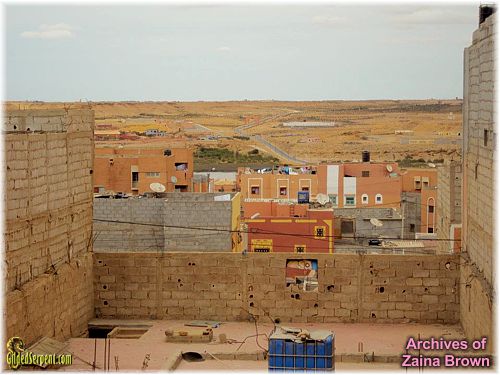
Laayoune is a sizable city. It’s easy to forget you are actually in the middle of Sahara, until you reach the outskirts of the town

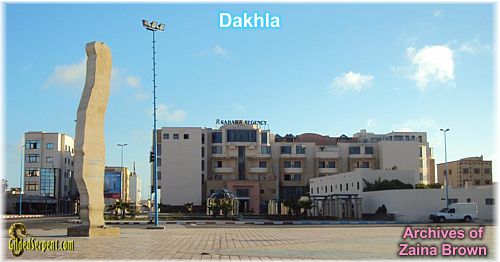
Dakhla

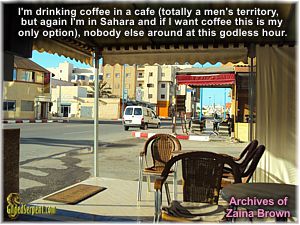
Cafe in DakhlaDakhla

As with the two other towns, I did not know what to expect from Dakhla. On the map, it had stared at me, enticing me, challenging me, and I’d wondered if I’d make it that far. Closer to Mauritania than Morocco, it was another eight hours south of Laayoune. I dreaded that night on the bus, but managed to doze off for a few hours.

The wind was the first thing I noticed as I stumbled out onto the empty streets around seven in the morning. I had a cab take me to a hotel that I’d picked beforehand. I checked in but they told me my room wouldn’t be ready for another few hours. I left my bag in the reception and wandered outside. I was hungry, but restaurants were not open. I bought some freshly delivered bread with processed cheese in a shop and took my breakfast to a cafe across the street where I was the only customer.

Click this map for larger easier to read image

I continued my morning walk on the windy streets, with almost no people in sight. I was getting increasingly tired, and started to feel sort of detached from reality. Randomly passing through a residential area, I heard a cry. It sounded like someone very small, definitely a child. I stopped. Who’s crying? I walked towards the sound. Then I saw her crawl from underneath a truck. It was the most pathetic sight I’d seen in my life! Her face was so dirty that one of her eyes was sealed shut. Thick mud covered her paws and her tail which was hanging heavy. She was probably around a month old. Maybe because I was so out of it, I just went with my instinct and picked her right up. I walked a few steps over to a shop and asked for milk. As I held the dirty kitten with one hand and tried to dig out money with the other, the shopkeeper looked at me with a mix of confusion and displeasure. Careful not to touch my hand, he gave me my change.

"Je crois qu’elle est malade", I think she’s sick, he told me, with the kind of tone you use when speaking to a kid or an unintelligent person. I agreed, the cat was most likely sick. She had pus coming out of her eyes, and she was shaking, which was probably not a good sign–but he didn’t get it; that information was of no importance to me. She needed to be fed. Clearly, she didn’t have anyone looking after her, and she couldn’t take care of herself.

I went around the corner looking for shelter from the wind. I put the cat down and poured some milk on a plastic bag. I tried and tried to get her to drink. She wouldn’t. Finally I just picked her back up and held her against my chest. I didn’t know what to do.

dirty kittyA woman appeared to clean her doorstep next to me. She looked at me curiously, and smiled. She went back in, and came out again to take a second look at me. Moments later a young boy appeared with bread, and gave it to the woman. He looked at the strange sight by his door with utter surprise. He said hello, and I explained that I’d found the cat and was trying to give her milk. He went in, and a moment later they both appeared at the door and invited me in. I politely refused. They insisted. (They must have thought I was a pathetic sight. Clearly, I had no one to take care of me, and I needed to be fed.) I felt that the mother sincerely wanted me to come in. What about the cat, which by now I was unable to put down? Bring her, they said. So there I was, sitting in the living room of a Moroccan military family, cradling a muddy street kitten while they served me breakfast. I have to say that was one of the most gracious gestures I’ve seen in my life. This lady simply had a heart of gold. I remembered the plane blanket I had in my bag, and made a little nest for the kitten. She fell right asleep, and I realised she wasn’t shivering anymore, now that she was warm. Maybe there was hope for this little one! I pondered what to do with her now, and my hosts urged me to bring her with me to the hotel. But where would she go to the toilet? "It’s a big hotel!" the boy, Mehdi was his name, proclaimed. He had a point. It wasn’t like I was going to put the sleeping baby cat (who at this point had been named Julie at Mehdi’s suggestion) back on the cold street either. She was coming with me. let’s call him Mehdi

Julie feels better!Sneaking a sleeping cat inside my purse into the hotel was easy. Sleep was all she seemed to want to do. I spoon fed her milk because she still wasn’t drinking on her own. I wiped her face with a wet cotton ball. That opened up her eye. Now she could see, but it wasn’t until I gave her tuna that she really responded. This baby was hungry! Maybe she was too young to eat it  but I felt that milk was not gonna cut it; she was that weak. The tuna worked wonders. After eating that, she got up and began to explore her surroundings. The mud had mostly dried up and turned into dust. The wide-eyed kitten that emerged from the blanket looked nothing like the sad little creature I’d picked up from the street. Later at night, she began to play. I wiped her eyes once more, and after that they were clear. It turned out that Julie wasn’t sick after all! She was just too little to take care of herself. As soon as she was warm, clean and fed, she was fine.

Dakhla was nothing like the other two towns in Western Sahara. It was difficult to believe that I was in the same country. You got the feeling that hashish was available on every street corner. Sahrawi culture was nearly invisible. Yes, coming into Dakhla it was the same checkpoint routine: I’d been pulled out of the bus, asleep, to tell someone what I did for a living, but once inside, no one seemed to notice me. The police presence was less obtrusive than elsewhere. It turned out this town (located on a peninsula, hence the constant, mad wind) actually received some real tourism.

Dakhla was an excellent site for kitesurfing. This brought in some Europeans, as well as an unpleasant side product, Moroccan hustlers.

Kite SurfingTheir only employment was trying to make a buck out of tourists any way they could, mostly by selling them other people’s services and taking commissions, and as a girl by myself, I was a major target for all idiots-at-large. I had guys holler at me on the streets as if I were in Tangier. One especially obnoxious dreadlocked creep followed me around, to the point that I threatened to get the police. (No need to call 911, just go on the street and shout, "I want Polisario!")

Actually, I hadn’t been to the desert yet–aside from traveling between towns. Most of Western Sahara is not made of the pretty sand dunes seen in postcards; it’s rocky, bare ground. But I didn’t discriminate. It was still beautiful. I found myself a Sahrawi guide to take me into the desert. Ahmed had told me "You’re not going with the Moroccans", and I wouldn’t have anyhow. Once in the car, I began talking politics – you can’t do that in public; you don’t know who’s listening – and my guide repeated the same story of detentions and torture that Ahmed had told me. We stopped at the kitesurfing site. Many of the tourists go there directly from the airport, stay at the hotel on the beach, and never venture into town. I’m sure the government likes it exactly that way. A Moroccan flag was flying on the beach, as if the one hour flight from Casablanca hadn’t crossed any border whatsoever. Any Moroccan map actually has no border between Morocco and Western Sahara. This makes Morocco appear twice its actual size. I love how history can be re-written, and maps reimagined.

I also saw the occasional house in the desert, far off the main road, in the middle of absolutely nowhere. It was the traditional way to live, plus water and electricity. I could understand completely how some people preferred to live old-school, far away from Moroccan military compounds. I petted some camels as they returned home to drink water after a day out and about.

Ferris WheelIn the evenings, I got together with Mehdi and his cousin. To my huge relief, the cousin said he would take Julie when I left. He’d had a cat before, and liked animals. He would keep her inside the house, and he knew how to make a toilet for her and what to feed her and everything. I thanked my lucky stars. The two boys showed me around town. Morocco imports a lot of fish from Dakhla into European Union countries, and here was a big fish market and even an amusement park with a few kids’ rides and a ferris wheel. It was a great view from the top, and the suspicious sounds the rusty old wheel was making just added to the excitement. The boys told me that despite the tensions between Moroccans and Sahrawis, there was a peaceful coexistence as well. Many people had integrated friendships, and spoke one another’s languages. That was comforting to hear. The situation was not all black and white. (According to them, the slum people had moved into the desert all on their own, an idea that I disputed as laughable. At least they weren’t denying their Moroccan-ness.)

Here’s the question: If one is born in a place occupied by their parents, do they then automatically become occupiers as well? Don’t we all have a right to live in the place where we’re born, regardless of how that happened? Or am I just imposing American ideas on others here? This sort of resembles the post-colonial white African situation that many countries had. There must be a way to return the power to whom it belongs, without kicking out those who have no ill intentions, and begin living together under new rules, but as one family, since we’re all children of God. I’m just sayin’.

On the day that I was flying to Casablanca, I went back to Mehdi’s house for lunch. Getting Julie out of the hotel quietly was not easy. Instead of the weak, pathetic thing I’d brought in, she was now a feisty little kitten who did not understand why she had to be stuffed inside a bag. She kept trying to stick her head out and made lots of noise. I passed by the reception as fast as I could. Being in a new house was scary for her, and I was already choking back tears at the thought of leaving her. It’s amazing how hard you can fall in love in four days–although, I think it already happened the moment I first picked her up. Arabs are not big on pets, and it was endearing to see the whole family play with Julie. Even the mother, who first just looked at her from a distance, began cuddling with her. The father, a navy officer, did the same. He stated the obvious: if I hadn’t taken her that day, she would have died.

Man and his camels who are drinking waterAs soon as I had landed in Casa, my agent told me I would have a contract in Tunis in two weeks. My original plan had been to get out of the country rather immediately. There had been some back and forth about the Tunis gig, and had I known it would come through, I may have made different choices. I now had two more weeks to kill in Morocco. Casablanca was the last place I wanted to be, but what bothered me most of all was that I’d left Julie for no reason. I could have stayed with her longer. I missed her so bad. I cried in bed for days. I was just so brokenhearted. Mostly about the baby cat, but also about the country.

I tried walking around in Casa the first day, and it was almost enough to give me a panic attack. After that, I mainly stayed inside the unpleasant hotel room and just went out to get food. The highlight of my week was a trip to Morocco Mall, and I couldn’t even get there without a fight with a taxi driver. It didn’t help that I’d heard so many warnings of the thieves and the muggers. I have never loathed a city as much as I loathed Casablanca; I wanted none of it. The flags and pictures of the king made me want to vomit. The medina was completely uninteresting compared to some of the real gems I’d seen elsewhere in the country. I didn’t even go to see the famous Hassan II mosque, the only real monument in town; I just didn’t care. I’d never felt that way, anywhere. I had to escape. At this point, the only place that really made sense was Marrakech. Fine! I booked myself a four star hotel there for a week to soothe my nerves. The atmosphere would be much more relaxing for me than Casablanca. (Granted: the one year anniversary of the Djamaa el Fena bomb attack happened to be that week.)

I tried to get excited about Marrakech, but mostly failed. I had good moments, and managed to see some sights, but for me, Morocco was over. I finally found a name for the disgusting feeling that had become my constant companion. I was disillusioned. Having seen the flipside of Morocco in Western Sahara, and knowing that pretty much the entire population supported the occupation, just killed it for me. None of the pretty things that Morocco showed me could distract me from the ugly face of oppression.

I kept counting the days until finally, I flew out. The next day I uploaded a video on Youtube, featuring a certain slum I’d happened upon in Smara. By doing so, I almost certainly blacklisted myself from entering Morocco again, and I won’t be trying my luck. There was no sacrifice there. I had seen a lot of the country. I’m glad I had the opportunity to dance there, and I’m glad to scratch it off my to do list for good.

Resources:

use the comment box

Have a comment? Use or comment section at the bottom of this page or Send us a letter!
Check the "Letters to the Editor" for other possible viewpoints!

Ready for more?

  • What Lies Beneath, Part 1, The Morocco & Western Sahara Tourists Don’t See
    When you say you are going to travel around in Morocco, usually, the response you get can be summarized with one word: "Marrakech". Sure, Marrakech might be the "best of Morocco", but it also wasn’t going anywhere.Some other places, however, may not always remain as accessible, and I had a few questions on my mind.
  • Touching the Clouds: Impossible Bridge in Yemen
    I needed a place where I felt safe, had some friends, and knew my way around: a place like Yemen! Besides, there was a bridge there that I wanted to check out.
  • Interview with Nawarra of the UK and Morocco
    We met Nawarra in Marrakech, at Simona’s Mediterranean Delight Festival held there in June 2011. Nawarra grew up in Casablanca graduating from the university there. She now lives in Leed, near Manchester in Northern England. She has a troupe there, teaches and also takes several tour groups per year back to Morocco. She explains to us the term "sha’abi" and how it is used in the Moroccan dialect of the Arabic language.
  • Does Your Teacher Have Your Best Interest at Heart?
    Remember that you are your own person and you can use your talents any way you want. Nobody owns anybody else. And nobody owns Belly Dance. Belly Dance is an exciting world that gives women and men many artistic and entrepreneurial opportunities.
  • Emotion Inspired by Song, Interpreting Arabic Orchestral Music
    What’s most important is the feeling. Listen to lots of music, and let yourself be moved. Even if you don’t know the words, you can still access the feelings. When you get on stage, express these feelings honestly to the audience. They will love you for it.
  • Everyone’s Uncle, In Celebration of the Life of Drummer Armando Mafufo
    In fact, so many artists wanted to perform in his honor that many had to be turned down or else we might have had to stay all night.
  • Make New Friends & Keep the Old, Response: A Dance Perspective for Today
    After living in the Middle East for 25 years and continuing to work in the region for music and dance, I have a pretty good idea of what talent and creative ideas exist in the region.
  • The Evolution of Jillina, An Interview Regarding Change, Flexibility and Lessons Learned
    Working with Jillina for the last six years or so, I’ve been a fly on the wall for a lot of this transition. I’ve been there for marathon rehearsal weeks, brainstorming sessions, the stress of taking a show on the road, the flops, and the standing ovations.
  • Have I Left Yet? Queen of Denial, Chapter 12
    Baghdad was the first place I had worked in where a complete communication blackout was ordered (no post, no newspapers, no telegrams, and no telephone access to the general public), and a mere two weeks after my arrival. For the very first time since I started traveling and dancing abroad, I was unable to call my parents (and vice versa) to assure them that I was fine regardless of what they were reading in the local newspapers.
  • Behind the Scenes, 3rd Coast Tribal Festival
    I had never been to a tribal dance convention before, even though I have been a professional (Egyptian style) belly dancer for 40 years. From my “glitz and tits” perspective, this belly dance offshoot wasn’t something I recognized as mine.
 

Gilded Serpent presents...

Luscious: The Bellydance Workout

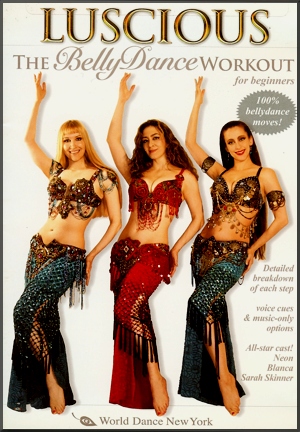
DVD cover

A DVD Review by Martha Duran
posted February 18, 2013

“This is not an aerobics program,” Neon states in the opening introduction. This a 100% dance program; so you won´t be surprised with a 20 minute yoga warm-up. This DVD provides an Intermediate Level workout of dance combinations. That is–it is much more like dancing, opposed to an aerobics class, with some Belly dance moves included. If you are looking for something that is a mix of dance practice and a workout, then I think you will enjoy this DVD.  It is a perfect selection of moves that are combined to work on your stamina, polishing your technique for choreography. This workout is divided into sessions: each session is named after the moves that are going to be practiced in different variations. All of these sessions are set in different tempos. You begin with a slow tempo and move up from that throughout the workout.

The dancing starts off with a simple move such as a hip circle, then adds something else to it in order to make short combos that are repeated a few times. Another simple move is introduced and this process is repeated throughout the combination. The movements match the music and are (generally) easy to follow. Simple layering of movements is introduced along the second session, such as: Hip Bumps over a traveling step.

The first section is “Circles”, led by Blanca. The moves covered are Hip Circles: Circles (using 1 hip only), Interior Hip Circles, and Chest Circles. There are 3 combinations in this section with suggested arm movements to practice. This section is pretty relaxed and is conducted in a slow tempo, including some stretching in large circular motions.

The next section is “Infinity Loops”, with Neon. Her big, strong movements make her dancing crystal clear and easy to follow. The moves are: Horizontal 8s, Chest Figure 8s, Vertical Figure 8s (both up and down with some variations) and One Hip Figure 8s. There are 8 combinations. This section moves along quickly; it is accompanied by a more upbeat tempo with Neon. There are a lot of quick changes, but they aren’t always announced with enough warning.

Section 3 is “Undulations” with Sarah Skinner. The moves are: Snake Arms, Side Undulations, and Up and Down Undulations with Variations; there are 3 combinations. Sarah Skinner is careful and clear on the movement that is in action as well as the one that is soon to be introduced.

Next is “Hip Accents” with Neon. The moves are: Vertical Lifts and Drops, Horizontal Hip Slides, Un-weighted Lifts and Drops (with variations), and Hip Bumps. There are 8 combinations. This is a section that needed a little bit more observation; it is accompanied by music with a little faster tempo, featuring more intricate dance steps and some quicker changes in choreography.

The “Shimmies” section is presented under the instruction of Sarah Skinner.  In the section called “Basic Hip Shimmy”, I can see a little bit of Muscle Shimmies, Twist Shimmies, and Twist Locks in a traveling combination, along with Shoulder Shimmies. There are 4 combinations.

Next is “Body Line” with Blanca. This is more like a “cool down section”.  There is a lot of swaying shown with some flourishes and accents. Blanca also does Torso Drops, Back Arches, Pivot and Three-step Turns and Arabesques. There are 6 combinations presented here. I thought this was actually the hardest section to do–while still looking “pretty”.

Last, is the choreography section, the putting-it-all-together in a dance session. This DVD contains a special tutorial option in its menu that can be useful for beginning level students who are interested in a challenge because this DVD is a little too complicated for a complete beginner. If you are interested in a good dance workout, yet, want to focus in on some moves at the same time, this is a suitable DVD for accomplishing your goal.

The video, sound, lighting and camera work are all professional. The video is clear, sound is crisp, voice overs are appropriate, lighting is moody (but not too dark), camera angles are helpful.  The costuming shown is inspirational, and it does not block the view of the movements. The entire DVD includes many features; for instance, the tutorial section is easy-to-use to access the sections in a more detailed way. It has explanations on how to do the moves and how to do the combinations used in the workout, and there is an option in which you can do the workout with voice-over cues or without them.

The music is enjoyable. You dance to various pieces by Dj Mosavo; they are songs like:"Naga  Kava” and “Crimson” by Solace. The menu has a special section for music credits and additional background music, listing several songs by Hossam Ramzy, “Eclipse” by Steve Booke, and “Awake” by The Rotating Leslies.

Rating: 4 zils
Zil Rating- 4

Also available from the producer here

Resources:

use the comment box

Have a comment? Use or comment section at the bottom of this page or Send us a letter!
Check the "Letters to the Editor" for other possible viewpoints!

Ready for more?


Gilded Serpent presents...

Does Your Teacher Have Your Best Interest at Heart?

Placeholder

by Sa’diyya
posted February 18, 2013

“A candle loses nothing by lighting another candle.” ― Erin Majors

How do you know if your Belly Dance teacher has your best interest at heart? Here are some important questions to ask yourself and, perhaps, others:


  • Is your teacher qualified to give you a proper foundation for technique as well as cultural references?

    When searching out a Belly Dance teacher, don’t be shy about asking for the teacher’s credentials. If you are going to spend time and money learning to Belly dance, make sure you start the journey off with the right teacher so you won’t have to back-track later.

  • Does your teacher give you honest critiques and feedback?
    Do you have to constantly wonder what your teacher really thinks about your ability? If you can’t get an honest answer out of your teacher, even in a "one-on-one" situation, then it may be time to look elsewhere if you expect to progress. Sometimes, teachers can’t bring themselves to risk hurting a student’s feelings, even if the student is asking for the truth and even if it means the student will benefit from hearing honest feedback.

  • Are your teacher’s classes and troupe a positive and healthy environment?
    Most teachers of Belly Dance truly love to teach so they can pass their knowledge on to others. However, teachers exist who thrive on belittling and controlling their students. This type of environment may not be apparent at first glance, which is why it is important to occasionally take the time to analyze your dance classes and troupe experience. If your Belly Dance teacher tries to manipulate you, control you, put you down, especially in front of others, or if she tries to make you feel guilty or unworthy about anything, especially for having any ambitions regarding your Belly Dance goals, then you should consider finding a more loving and healthy dance teacher/troupe/studio.

  • Does your Belly Dance teacher encourage you to learn from other teachers, even from other local teachers and at other local events that offer workshops?
    If your teacher is threatened by the idea of you enrolling in workshops and lessons from other people, then you have a clear sign that she does not have your best interest at heart. However, if she does, then she would be happy to hear that you are expanding your skills. A healthy-minded teacher should be confident enough to not worry about losing students as long as she is constantly updating her curriculum and performance opportunities that she offers to her students.

  • Does your teacher offer performance opportunities, or at least routes for you to gain them on your own?
    If you answered “No” to the question above, you may want to consider finding a teacher who encourages performing experience for those students who are interested.

  • Is your teacher helping you develop your own style?
    If you have progressed past a certain point and are desiring to perform as a soloist, then you need a teacher who wants to see you become “your own dancer”, meaning that you will probably no longer want to emulate the exact style of your teacher. If you are put down or restrained for experimenting with your own style and for branching out, then you should find a teacher who can assist you in your journey to find your unique style.

  • Is your teacher helping you accomplish your personal dance goals?

    This question becomes really important when students get to an advanced level and they start to develop ambitions to perform, teach, and produce events. Sometimes, teachers can feel threatened when students express that they want to do what their teacher is doing, whether that is performing professionally, teaching Belly Dance classes, or even to produce their own events. Teachers who have your best interest at heart will feel genuinely happy and proud when students achieve goals! Talk about leaving a legacy! If you have a teacher who discourages you from your ambitions for whatever reason (the real reason is often hidden behind other excuses) then you need to find another teacher or a mentor who will put you on the right track. It is to be noted that some students who desire to perform professionally, teach, or produce events may not be ready, but it is the teacher’s duty to train correctly students who have these goals, or to lead them to a teacher who will help them. Even if a teacher feels that an insistent student is not ready for a particular endeavor, the student should never be put down or discouraged. There is a always a positive way to handle any situation.

  • Lastly, does your teacher make you feel that if you leave her classes/troupe/studio, you will have no opportunities without him or her?
    Teachers should realize that when accomplished students reach a certain level, they will need to "leave the baby bird’s nest." It is a natural cycle and should be viewed as such. Many students will stay with a teacher for years upon years simply for social and recreational purposes, but oftentimes, advanced students will want to move on in order to progress further. If your teacher makes you feel bad or guilty for leaving the classes/troupe/studio, then you know that teacher doesn’t have your best interest at heart.

Remember that you are your own person and you can use your talents any way you want. Nobody owns anybody else. And nobody owns Belly Dance. Belly Dance is an exciting world that gives women and men many artistic and entrepreneurial opportunities. Everyone is benefited by the success of others within a community!

Sa'diyya and troupe
1- Wendy Valera, 2- Joanna Devoto, 3- Tricia Slocum, 4- Saritza Velilla, 5- Margot Steffenhagen, 6- Cindy Edgin, 7- Lilliana, 8- Sa’diyya
Resources:

use the comment box

Have a comment? Use or comment section at the bottom of this page or Send us a letter!
Check the "Letters to the Editor" for other possible viewpoints!

Ready for more?

  • Gigbag Check #33 with Sa’diyya of Texas!
    Gilded Serpent catches Sa’diyya backstage at the Belly Dancer of the Universe Competition in February 2011. She shows us her tools of the trade, including:safety pins (of course), mirror, curling iron, carpet tape, and all of her jewelry organized in a binder full of zip lock bags. She also tell us about using a fedora in a modern folk dance from Iran or Persia. Her mother helps her with her costumes.
  • A Transformational Week, A Fan’s View of Jillina’s Weeklong Intensive Report
    I think that’s another benefit of having scholarships in the world of Bellydance because it gives dancers another goal to work towards: “What do I have to do to rise to the occasion, to receive this other kind of award?”
  • Teacher or Coach: What’s the Difference? Why All Performing Dancers Need a Dance Coach
    Most performers have a great deal of untapped potential; additionally, many consider it cheating to engage a professional coach and yet, that is exactly what they would look for if this were the Olympics and they were competing for the gold!
  • Improvisation: Method Behind the Madness
    One of the biggest mistakes we western Bellydancers have made is presuming that the dancing to which Arabs refer as the “Eastern Dance” is a theatrical dance that ought to be choreographed as if it were a ballet, or that its steps and movements are traditional like those of the Greek Hasapiko, an Arabic Depke, or a Hawaiian Hula.
  • The Dance Teacher: By Divine Design or Default?
    …nearly everywhere, dancers in this particular form seem to have found it necessary to “do it all” in order to earn a living by dance career alone
  • Cult or Bellydance Class? Cartoon
    "Pity those who do not study on our path, for they know not what they do not know!"
  • Rhythm and Reason Series, Article 3, Community Warfare
    Time and again I hear dancers deplore the fact that in many parts of the country there are warring camps among dancers; that is, groups that openly oppose each other and that try to keep all useful information and all jobs to themselves.
  • Everyone’s Uncle, In Celebration of the Life of Drummer Armando Mafufo
    In fact, so many artists wanted to perform in his honor that many had to be turned down or else we might have had to stay all night.
  • Make New Friends & Keep the Old, Response: A Dance Perspective for Today
    After living in the Middle East for 25 years and continuing to work in the region for music and dance, I have a pretty good idea of what talent and creative ideas exist in the region.
  • The Evolution of Jillina, An Interview Regarding Change, Flexibility and Lessons Learned
    Working with Jillina for the last six years or so, I’ve been a fly on the wall for a lot of this transition. I’ve been there for marathon rehearsal weeks, brainstorming sessions, the stress of taking a show on the road, the flops, and the standing ovations.
  • Have I Left Yet? Queen of Denial, Chapter 12
    Baghdad was the first place I had worked in where a complete communication blackout was ordered (no post, no newspapers, no telegrams, and no telephone access to the general public), and a mere two weeks after my arrival. For the very first time since I started traveling and dancing abroad, I was unable to call my parents (and vice versa) to assure them that I was fine regardless of what they were reading in the local newspapers.
  • Behind the Scenes, 3rd Coast Tribal Festival
    I had never been to a tribal dance convention before, even though I have been a professional (Egyptian style) belly dancer for 40 years. From my “glitz and tits” perspective, this belly dance offshoot wasn’t something I recognized as mine.
  • Cairo Revisited: Dancing into the ‘90s
    Originally written for Caravan Magazine 1992- The one thing on which you depend about dance in Egypt from year to year is that everything slowly changes. I’ve returned to Cairo each year now for nine consecutive years, and last year my visit was just before the short war we had with Iraq in which Egypt was our US ally. Cairenes seemed sad last year, because Cairo had lost most of its income from tourism, and many Egyptian nationals were returning from Iraq and Kuwait, where they no longer had employment. I did not know what to expect this year, except the inevitable fact of surprising, yet subtle, change.
 

Gilded Serpent presents...

Emotion Inspired by Song

Interpreting Arabic Orchestral Music

Placeholder

by Alia Thabit
posted February 15, 2013

When we talk about Arabic orchestral music, we’re talking about songs that are often known as tarab songs, Um Kalthoum, Farid al Atrach, Mohammed abdel Wahab, and so on. This is music from the classical genre that has crossed over into dance, though not originally written as dance music. While some of it is instrumental, much of it has lyrics. The lyrics are often exquisite poetry, and thus difficult to translate, as Arabic is a particularly rich and suggestive language. There are, however, several sites that have kindly developed archives of lyrics. [See Resources below]

Because of the poetic nature of the lyrics, these songs are emotionally complex, and this influences the interpretation of the song. They are also musically complex, with multiple parts. They are a far cry from the verse – chorus – taqsim structure of the repertoire associated with Vintage Orientale or folkloric music such as baladi or Sai’idi. They are also different from, though similar to, the Oriental dance genre of the Mergence (pronounced merjensee), which is a dancer’s emergence or entrance music, as a Mergence has been written for dance yet also includes many different moods and rhythms.

1. Complex Structure

Tarab songs typically have multiple sections, many more than we, as dancers, usually hear. Coincidentally, there are often dance gems in those other sections. Most of what we think of as Um Kalthoum songs, for example, are the overtures to songs that last forty-five minutes or more. It is well worth while to start collecting original full-length versions of these songs and getting a feel for them in their natural form. The stops and changes are often striking, and there are musical themes that reappear and morph over the course of the song.

These songs are best danced after careful listening, to have a sense of the structure as a whole. The first time I ever heard Alf Leila wa Leila, I was performing to it. The same goes for Darit il Ayyam.

….and here is the proof (above)

Having heard the songs even once or twice would have made it a lot easier, because they are often asymmetrical in form, have dramatic, musically complex structure and accents, sudden shifts and stops, and abrupt changes in mood and rhythm. In this way, they resemble the Mergence, but because they are connected to their lyrics, they take on another layer of emotional energy.

2. Emotional Content

Safaa Farid, an accomplished singer and orchestra leader in Cairo, encourages dancers to know the meaning of the words when they dance to tarab songs. And he means each word, so you always know what the singer is saying, even if you are dancing to an instrumental version of the song. This grounds you in the emotional experience the song provides, whether that is the pain of unrequited love, a nostalgic memory of a lover or a time long past, or a looking forward to future possibility.

The emotional content is not dependent only upon the lyrics; the music itself is fraught with emotional timbres. These elements influence the dancer’s choice of persona. In everyday life, our emotional state colors our every move and facial expression. We bring that quality into the dance, so that the dance becomes infused with a body line and facial expression that resonates with the content of the song. (And there is a big difference between expressing the emotional content of a sad song and moping around on stage because our puppy ran away. Once we get on stage, we must be completely present for the audience.)

3. Orchestral Flourishes

Heterophony is the process by which each musician ornaments the melody line. While it varies from orchestra to orchestra, in general, the freedom of the artist to embroider the music is alive and well. Abdel Wahab’s band had to play the music the way he wrote it. Um Kalthum’s orchestra, however, were never given written scores. Her musicians learned the songs by heart, the better to bring their hearts and souls to their interpretations. Plus there are many, many moments of small taqasim from the various instruments, and the interaction between the singer and the lead instrument (often the kanoun, which is thought to best approximate the human voice, or the violin). We also have the tradition of lazima, small flourishes, often a high-pitched filip played at the ends of lines to ornament the space before the beginning of the next line. These are lovely for accents, gaze and directional changes.

4. Dancing

So, that’s a lot of stuff. How do you dance to all that? Well, here are three strategies. All work with choreography or improvisation.

  • Literal (Form): This method’s goal is to articulate every note and flourish of the music. It is prioritizes musical complexity and form, including moves, and lots of them, over emotional content. Though there may be some reference to the song’s lyrics, it is usually highly stylized. Dancers who favor this have whiz-bang technique, and they want to show it off. It is a tour de force when well done, and suitable to many people’s style.
  • Literal (Content): This focuses on the meaning of the song. It emphasizes the lyrics and acts them out, including mime and specific references. For example, if the song mentions tears, the dancer may draw a finger down from the eye, showing the tear track. This method prioritizes emotional content over musical complexity, but often incorporates both. When done with genuine emotion, it can be quite moving.
  • Impressionist: This method acknowledges both musical and emotional complexity, but emphasizes the dancer’s artistic expression over literal representation. The dancer may articulate only some of the musical and lyric content, choosing to fully articulate some moments and surf over others, or may forgo the literal meaning of the lyrics to articulate the emotional timbres of the music itself.

Everyone has their own style, and can adapt the above methods to suit themselves. What’s most important is the feeling. Listen to lots of music, and let yourself be moved. Even if you don’t know the words, you can still access the feelings. When you get on stage, express these feelings honestly to the audience. They will love you for it.

Here are some songs you might enjoy:

Alf Leila wa Leila
(and
this is the whole thing, so you can see what I mean about the overture)

Fakarouni


Enta Omri

Resources:

use the comment box

Have a comment? Use or comment section at the bottom of this page or Send us a letter!
Check the "Letters to the Editor" for other possible viewpoints!

Ready for more?

  • Hossam Ramzy Plays Fast and Loose, Two CDs for Classical Egyptian Dance
    Honestly, I hadn’t expected to like this album (noodling has not been to my taste in the past), but I found it refreshing and rather healing, as the relaxation and delight shifted my state of mind every time I danced to it.
  • Dance Emotion, Part 2
    The audience is not going to care, or even notice, that a dancer did a high-stepping Fandango Walking Step with an over-lay of a Soheir Zaki Head Tilt and a really fine
  • Dance Emotion, Part 1
    "The place of dance is within the heart."
  • Dancing Inside Out
    People come to see dance most often as music translated by movement, not just made visual by it, and to enjoy the character the dancer creates in her little drama set into the music by the composer.
  • What Middle Eastern Audiences Expect from a Belly Dancer
    Audiences in the Middle East, especially Egyptians, see bellydancing as something to be participated in, critiqued, and loved (or hated) with gusto.
  • Dance – Deeper than the Moves
    A dancer who feels “safe” in the rhythm, footwork, technical movement feels grounded and secure as she dances. A grounded dancer will be less "in her head” and allow the authenticity of feeling to come through her body as a flowing, emotive movement that expresses the music and how she “feels” the music.
  • Streets of Cairo- Egyptian Rhythm, Language and Dance
    Cairo’s streets are much like its dance – streams of freestyle movement guided by intuition rather than rules. There are no ‘principles’ as such in both circumstances – it’s the organic-ness of Egyptian life that creates order in chaos
  • Everyone’s Uncle, In Celebration of the Life of Drummer Armando Mafufo
    In fact, so many artists wanted to perform in his honor that many had to be turned down or else we might have had to stay all night.
  • Make New Friends & Keep the Old, Response: A Dance Perspective for Today
    After living in the Middle East for 25 years and continuing to work in the region for music and dance, I have a pretty good idea of what talent and creative ideas exist in the region.
  • The Evolution of Jillina, An Interview Regarding Change, Flexibility and Lessons Learned
    Working with Jillina for the last six years or so, I’ve been a fly on the wall for a lot of this transition. I’ve been there for marathon rehearsal weeks, brainstorming sessions, the stress of taking a show on the road, the flops, and the standing ovations.
  • Have I Left Yet? Queen of Denial, Chapter 12
    Baghdad was the first place I had worked in where a complete communication blackout was ordered (no post, no newspapers, no telegrams, and no telephone access to the general public), and a mere two weeks after my arrival. For the very first time since I started traveling and dancing abroad, I was unable to call my parents (and vice versa) to assure them that I was fine regardless of what they were reading in the local newspapers.
  • Behind the Scenes, 3rd Coast Tribal Festival
    I had never been to a tribal dance convention before, even though I have been a professional (Egyptian style) belly dancer for 40 years. From my “glitz and tits” perspective, this belly dance offshoot wasn’t something I recognized as mine.
  • Cairo Revisited: Dancing into the ‘90s
    Originally written for Caravan Magazine 1992- The one thing on which you depend about dance in Egypt from year to year is that everything slowly changes. I’ve returned to Cairo each year now for nine consecutive years, and last year my visit was just before the short war we had with Iraq in which Egypt was our US ally. Cairenes seemed sad last year, because Cairo had lost most of its income from tourism, and many Egyptian nationals were returning from Iraq and Kuwait, where they no longer had employment. I did not know what to expect this year, except the inevitable fact of surprising, yet subtle, change.
 

Gilded Serpent presents...

2 Instructional DVDs: Unprofessional or Homespun?

“The Basics With Outi” & “Step-By-Step Bellydance”

Placeholder

A Review by Elianae
posted February 12, 2013

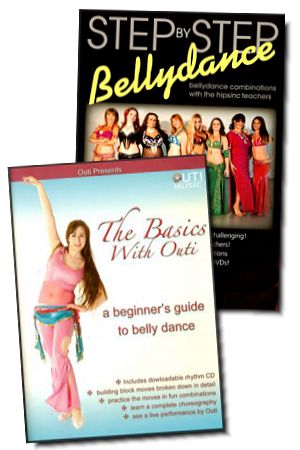
The two DVDs that I received for review and comparison for Gilded Serpent were by a group and individual with whom I was unfamiliar. In fact, I had never heard of either one. The first one was “The Basics with Outi”. Outi is a dancer from Finland who currently resides in Cairo, Egypt. The second was “Step-By-Step Bellydance” by Hips, Inc. from the UK. Both had their strong points, but  in my opinion, were fraught with significant problems also.

Outi DVD

“The Basics With Outi”

Surprisingly, this DVD was produced by Michelle Joyce of Cheeky Girls Productions, although this title is not listed under that label. Nevertheless, as such, I expected a high level of professionalism in the recording, and for the most part, I was not disappointed. The main menu was divided into 9 accessible sections, but once I chose the beginning, I had to turn my volume up high to hear Outi talk. The lighting and camera work were acceptable, however, and Outi did a thorough job describing simple, basic movements, such as: Hip Circles, Figure Eights, Camels, Snake Arms, and Tummy Rolls.

I did, however, find her pace to be exceedingly slow and a bit tedious. Sometimes Outi would talk for almost 7 minutes about a movement, with no music, before you would actually practice the movement with her. In fact, I counted 14 m

inutes from the introduction until the first movement practice session. This combined with Outi’s heavy accent, and the poor sound quality, made it a bit boring for me.  Also, I found her loose Egyptian style a bit too untrained for my personal liking and noticed, when doing movements, she constantly rolled her left wrist, and raised her arms, when they were extended to her sides, almost to eye-level.

Nonetheless, one great selling point about this DVD is that dancers are introduced to all the different rhythms that traditionally accompany the movements. The Masmoudi rhythm was demonstrated for Hip Circles, as the Maqsoum was for Figure Eights. Also included in the DVD price that I believe is around $29, was a downloadable CD of all the rhythms used in class. At the end, she teaches a simple choreography that she performed, live, at a restaurant. I found her pronounced lip-synching to the song unnecessarily distracting, but I know that some audiences appreciate a dancer’s knowledge of the song.

If you’re looking for a workout, this is not the DVD for you, but all things considered, for a beginner dancer who has had limited access to outside teachers but still wants a lesson in Egyptian dance and culture, I think this would be a decent DVD.

This product is available for purchase Studio Henna here and Studio Dum Tek here

Rating: 2 zills
Zil Rating- 2


Charlotte's DVD

“Step-By-Step Bellydance”

This is a double DVD set by a dance school called Hipsinc. in the UK. This set is divided into combinations for beginners in the first DVD, and more advanced students in the second.

First of all, let me tell you the most upsetting part of this product: this DVD would not play in my Blu-Ray player at all. It claims to be suitable for all regions, but it did not play. This is a thwarting drawback!  However, I did get it to play in my computer. The second major drawback was–once I got it to play in my computer, I had to fast-forward through each of the sections, and could not skip to the next. Annoyingly, each DVD played like a VHS tape, and I had trouble navigating it. The sound quality was fair, though a little spotty, and the production seemed somewhat homespun.

After I got over these irritating major technical problems, however, I quite enjoyed the combinations and technique presented. I found all of the teachers to be knowledgeable, and the combinations to be cute, useful, and satisfying for Western cabaret-style Belly dance. I especially loved the drilling sections, in which they would repeat a combination with you for at least 7 or 8 minutes continuously before moving on to the next one.  They also briefly touched on rhythms, and had an intriguing section of Gothic-Tribal and Street-Tribal fusion dance, in which, although a bit too hip-hop for my taste, the instructor was noticeably skilled. 

At the end, they showed the instructors performing in full costume, and even brought the camera crew out. It was obvious that this homespun DVD was really a labor of love for all those involved. (Oddly, they dedicated the production to Princess Farhana who is still very much alive.) I found it interesting that both DVDs were supported by (or dedicated to) American dancers. I rate this DVD as low as I do only for its obvious technical problems, as those cannot be ignored.

This product is available for purchase from the Hipsinc here.

Rating:  2.5 zils 
2.5 zil rating

Out of the two productions, I preferred the second one, but technical problems cannot be ignored! However, why not be the judge and compare them both for yourself?

Notes & Resources:
  • Author’s bio page
  • Ed note: The "Step by Step" DVD did play on my 2012 Macbook Pro, Sophia’s Asus laptop, and my son’s Xbox. The DVD did not work on our Samsung Blu-Ray DVD player connected to our TV.

use the comment box

Have a comment? Use or comment section at the bottom of this page or Send us a letter!
Check the "Letters to the Editor" for other possible viewpoints!

Ready for more?


Gilded Serpent presents...

Everyone’s Uncle:

In Celebration of the Life of Drummer Armando Mafufo

Uncle Mafufo with Crystal

by Renée Rothman
posted February 12, 2013

“And remember, my sentimental friend, that a heart is not judged by how much you love, but by how much you are loved by others.” (The Wizard of Oz to the Tinman). From The Wizard of Oz by L. Frank Baum.

Armando Mafufo had such a heart. He was beloved by everyone as a favorite uncle, brother, father, husband, friend, teacher. His eyes twinkled with delight; his smile sent giggling waves of joy outward tickling all those in his presence. His joking stories—enigmatic, silly, wise—delighted all, even if we didn’t always understand them. To be in his presence was a balm to the difficulties of daily life. To hear him play a drum could lift one’s spirit to transcendent heights. Yes, Armando was much loved by others.

Knowing the breadth of his influence, his family kindly arranged for a public memorial celebration at Santa Cruz’s famed Kuumbwa Jazz Club. With a courtyard, stage, seating for 200, and a small kitchen, this was a perfect venue for the special events prepared for the day. These would include performances by many of the musicians and dancers who worked with and learned from Armando over the course of thirty years.

In fact, so many artists wanted to perform in his honor that many had to be turned down or else we might have had to stay all night.

I didn’t know Armando as intimately as others did, but he did teach me to play dumbek, one of my favorite experiences. Armando was omnipresent in the Santa Cruz Belly dance scene, playing music with any number of local and visiting musicians, teaching or accompanying a dance class, or simply watching from the audience in support. Armando, by the way, accompanied every generation of Belly dancers in Santa Cruz since the 1970s. He was everywhere and always.

Crowds of family and friends congregated, arriving from all over the San Francisco region and beyond. Those who couldn’t make it in the flesh sent letters and notes by way of Facebook, all of them exclaiming the sheer pleasure of knowing Armando. He made everyone feel like his best friend, as one wrote.

The stage that day was filled with Flamenco, Middle Eastern, Balkan, and Salsa artists spanning Armando’s life in music. I couldn’t count nor can I name all the musicians and dancers who appeared on stage to pay tribute to Armando, but I can say that they were inspired. Each song, each dance was a prayer, an offering, and Hanya, Armando’s lovely wife of 55 years, graciously accepted each and every one.

The memory of Uncle Mafufo’s heart will not soon be forgotten. His spirit resides in everyone of us who had the honor of meeting him—and that’s a lot of people. What greater legacy could be left by a man? Blessed be, gentle Armando.

Resources:

use the comment box

Have a comment? Use or comment section at the bottom of this page or Send us a letter!
Check the "Letters to the Editor" for other possible viewpoints!

Ready for more?

  • An ATS Family Reunion, FCBD’s Annual Production of Devotion
    FatChanceBellyDance’s 2011 production of its Devotion was presented on Friday, June 17 at the Julia Morgan Theater in Berkeley, California. This year’s theme, “The Home”, was explored by six troupes and soloists and accompanied by FCBD’s home musicians, Helm.
  • Memorial to Armando Mafufo, Drummer, Teacher, Friend
    Armando Mafufo, known to most of us in the music and dance community as "Uncle Mafufo" was, as someone posted today, "a man everyone loved." He was a person who could light up the room with his smile and radiated love.
  • Tribal Tales
    The moods and flavors of the varied songs on this CD are sure to be useful for dancers and listeners who like something out of the ordinary to challenge and delight.
  • Armando’s Drumming Dazzles the Dancer
    Video review of "Uncle Mafufo’s Riqs & Defs: a practical approach to Middle Eastern Frame Drums"
  • Review and Rating of 2002’S MIDDLE EASTERN DRUM CD/TAPES
    This is a review of eight of the most popular Middle Eastern Drum recordings produced this year. Incuding works by Reda, Susu, H Ramsy, Zaid, Mafufo, and more…
  • "Zig n Zag", a Music Review
    All of the instruments used for this recording are acoustic, providing a warm and genuine sound; nothing is looped, sampled or synthesized.
  • A Gilded Serpent Time Capsule Presentation, Rakkasah 1984 and 1986 (25 years ago) Photos by Lynette Harris
    While taking a nostalgic look through my photo albums recently, I realized that if I was ever going to share these photos, I had better go ahead and scan them into the computer now before they deteriorate even more than they already have. Yes, they are discolored and blurred, but I think they will be of some value to those who pay attentions to costume styles or those who were there and simply enjoy re-visiting the memories
  • Memorial to John Compton
    Please add your comments and send in your photos for posting on this page. Thanks!
  • Make New Friends & Keep the Old, Response: A Dance Perspective for Today
    After living in the Middle East for 25 years and continuing to work in the region for music and dance, I have a pretty good idea of what talent and creative ideas exist in the region.
  • The Evolution of Jillina, An Interview Regarding Change, Flexibility and Lessons Learned
    Working with Jillina for the last six years or so, I’ve been a fly on the wall for a lot of this transition. I’ve been there for marathon rehearsal weeks, brainstorming sessions, the stress of taking a show on the road, the flops, and the standing ovations.
  • Have I Left Yet? Queen of Denial, Chapter 12
    Baghdad was the first place I had worked in where a complete communication blackout was ordered (no post, no newspapers, no telegrams, and no telephone access to the general public), and a mere two weeks after my arrival. For the very first time since I started traveling and dancing abroad, I was unable to call my parents (and vice versa) to assure them that I was fine regardless of what they were reading in the local newspapers.
  • Behind the Scenes, 3rd Coast Tribal Festival
    I had never been to a tribal dance convention before, even though I have been a professional (Egyptian style) belly dancer for 40 years. From my “glitz and tits” perspective, this belly dance offshoot wasn’t something I recognized as mine.
  • Cairo Revisited: Dancing into the ‘90s
    Originally written for Caravan Magazine 1992- The one thing on which you depend about dance in Egypt from year to year is that everything slowly changes. I’ve returned to Cairo each year now for nine consecutive years, and last year my visit was just before the short war we had with Iraq in which Egypt was our US ally. Cairenes seemed sad last year, because Cairo had lost most of its income from tourism, and many Egyptian nationals were returning from Iraq and Kuwait, where they no longer had employment. I did not know what to expect this year, except the inevitable fact of surprising, yet subtle, change.
  • Fabulous Hip Drops in 30 Seconds or Less!
    A principle is a single unifying and guiding idea that when we apply it to our alignment or movement, helps us move more effectively. An advantage of using a principles-based approach to dance or martial arts mastery is that it lets us use a single visualization or body sense to achieve a desired result, instead of having to remember lots of little details.
  • Creating a Healthy Belly Dance Community
    A vibrant dance community affords benefits to all of its members. In a healthy dance community, each and every person is relevant. For learning purposes or gathering a certain show cast, there is a large pool of talent from which to choose. Those with specialties and unique areas of expertise can share their knowledge, enriching the individual skill sets of everyone.
 

Gilded Serpent presents...

Make New Friends & Keep the Old

Response: A Dance Perspective for Today

April Rose

by Miles Copeland
posted February 11, 2013

A response to comments made below Mile’s previous article here.

After living in the Middle East for 25 years and continuing to work in the region for music and dance, I have a pretty good idea of what talent and creative ideas exist in the region. Additionally, with the Bellydance Superstars, I have produced over 800 shows in 22 countries and a few festivals as well as Club Bellydance dates; so, at this point you could say I have a large body of experience about the business side of bellydance.

Whatever naivete I may have had at the beginning has long since been beaten out of me, and the world of reality (especially financial reality) has been beaten into me on a daily basis. So, replying to comments comes not from what I would like to have been reality but what reality actually is – as I have experienced it.

Sabrina

Regarding including a live band into the BDSS shows:

On the live band front, all I can say is: Add the cost of musicians, added crew, set up time, equipment, additional transport, hotels, salaries, etc. and you are talking about ticket prices more than tripling to pay for these added costs. Most likely, it would be a recipe for the company to go broke twice as fast! I am sorry to say so, but when I hear people make comments such as: “BDSS needs a live band”, for purely financial reasons, I consider them as a cuckoo-land critic.

It means one would have to restrict the music of the show to be what one band could play, meaning that all sorts of music would not be available to use in the show. A band that can do genuine Arab music convincingly would be out of their depth when it comes to what our Tribal dancers require.

Regarding incorporating folkloric dance into our show:

Although, on one level, one can appreciate so-called "folkloric dances" for what they are, at the performing arts level, in competition with major dance shows, I am sorry, but these dances are as boring as they appear easy to do; hence, they are called "folkloric". To the trained eye and those who are knowledgeable, folk-dancing actually may be difficult, but to the untrained eye they may appear too simple and easy, so why would I want to pay to see them? A juggler may juggle 4 balls while the average person can’t keep even three in play, but in a world of Cirque du Soleil, unless you can juggle 10 balls while riding a horse upside down, you are not in the game. There is not one Middle Eastern folkloric company that can compete and win before a Western audience–and none have ever done so! Perhaps a one-off date here and there has been successful, appealing to a largely ethnic audience, but certainly with no consistency, as a show like the BDSS needs.

So, I beg to differ on the opinion held by some that folkloric styles would deliver a large potential audience.

If one is talking about a small gathering of 100 people, this is minute in the world of the mainstream where 1,000 people in the audience every night 5 to 6 nights per week is a minimum to be in the game in any real way (and even that would not be considered a home run by most promoters).

Meanwhile, at the risk of offending some bellydance experts, I contend that bellydance, as it is performed today, is not a folkloric dance, and I would also contend that it did not stem from any folkloric traditions that I have seen. Today’s Bellydance is way too "sexy" to fit with what Arabs consider an acceptable dance for women to perform in public. That is why it is generally accepted in parts of the Arab world that it is a dance akin to prostitution. Of course, although I find this idea highly offensive and untrue for many, there is no doubt that it is the accepted idea for the majority of the Middle Eastern population. If you think I am wrong, just ask any of the Arab bellydance teachers who live in Egypt or Lebanon.

SabahFor those who live in the belief that there are "folkloric" roots to bellydance, I ask simply, “How do you equate the fact that Arab women are covered from head to toe with only eyes showing as a mark of correct morality and even ones wearing Western dress now almost all cover their heads with a scarf?” The entire moral thrust of that society is about control of women through "modesty", and let’s face it: Bellydance is not a dance of modesty! No Arab family would want their daughter or mother doing bellydance outside the home, which is why the dancers performing in the Middle East now are 99.9% non-Arab. Furthermore, it is not getting any better.

Let’s not forget that the first thing that happened in Cairo with the "Arab Spring" was all the clubs that had bellydance entertainment were burned down.

In short, as I see little connection between what is folkloric dance in the Middle East, and bellydance as we know it, I see no reason to feel that I need include folkloric in a BDSS show to somehow have more accuracy or credibility to my audience. If we develop a piece incorporating folkloric elements (and we have done so in past shows), just as we might incorporate ballet, Polynesian or other styles it has to be because it works within the piece and is there because it works and for no other reason.

Regarding expectation that our dancers have other dance skills besides Bellydance:

Finally, regarding what you need to be able to do as a professional dancer certainly means connecting with the audience and the music. However, for a show like the BDSS presents, you also need to be able to do complicated choreography accurately, which means absolutely that you need to be able to chaine across the floor properly. The idea that the basics of dance are not important has been a major factor in keeping bellydance from being taken seriously by other dance arts, and I know is a pet peeve many noted bellydance teachers have as well.

The truth is: a really good dancer (who is serious about dance) will be able to both connect with an audience and the music and also, be able to chaine accurately or whatever else is required. I would go so far as to say if a dancer cannot chaine across the floor, then she is not serious about dance.

If that offends, then so be it, but that is the reality. Meanwhile, if you want to be able to do a prestigious show with refreshing choreographic ideas, you need dancers who can execute those ideas, or all you do is limit the choreographer to work within the limits of the dancers. Why hire dancers with limits when you can find ones that have everything?

The whole point of the BDSS is to push this art form to excellence beyond what others have done; so why would I want to refocus on what bellydance has been: bellydance that you can see any day of the week and has been done repeatedly. Why relive old news as if that were something good? Been there, done that! I really don’t get the idea that bellydance has to live in a box with myopic rules set in the past. Any art that is worth anything will only blossom when new creative ideas are welcome rather than shunned out of hand. Of course, not every new idea and fusion works or advances the art, but some do and that inspires more to try. That experimental effort keeps bellydance interesting and makes the art ever more relevant to today’s dance world.

I believe in the idea of the song lyric: "Make new friends but keep the old; one is silver and the other–gold."

I would translate this idea to dance as: “Keep the basic resource of bellydance as one’s ‘gold’ but add the new takes on that art as one’s ‘silver’.” Together, both make for a better show than only one.

BDSS does a fan dance

Resources:

use the comment box

Have a comment? Use or comment section at the bottom of this page or Send us a letter!
Check the "Letters to the Editor" for other possible viewpoints!

Ready for more?

  • Making Superstars out of Top Dancers, BDSS Tour 2012 (The above piece is a response to comments made below this article)
    From the beginning, the Bellydance Superstars troupe has had the great fortune to attract the top dancers in the field even though, at first, we were criticized within the bellydance community for “having no stars”; so how dare we call the troupe the Bellydance Superstars?
  • Are You Breaking the Law? Dance Workshops with Foreign Nationals
    It is the sponsor’s obligation to deduct this; if it is not deducted and the full fee paid to the foreign teacher and discovered several years later in an audit or investigation, the sponsor will be forced to pay the taxes then and may even be fined.
  • Certifications & Contests: Are They Meaningful?
    Its as if the contest win were a diploma, her ticket to teach!
  • BDSS Update: New Choreographers contribute to 2009 Show
    I will admit that I have never been a big fan of the more ‘folkloric’ approach to Bellydance, but then again I have to be open to try something new with each show.
  • Carl’s Raqs LA Photos, Best from the Stage on the Lower Level
    Photos by Carl Sermon text by Carl Sermon, Ma*Shuqa and Marta Schill
  • Divorcing Belly Dance From Burlesque
    As it is traditionally understood, I do not find Burlesque, (meaning nudity-no matter how hard one pretends it does not) amusing or creative in the slightest when it comes to including Belly dance, an art that has suffered too long with such unfortunate associations. I find it completely irresponsible and detrimental.
  • Western Dancer’s Guilt, a Response to Naajidah,
    People have occasionally suggested Arabs would be “horrified” by the inclusion of the Tribal style in our show but I can tell you that this style is extremely popular with Middle Easterners who come to our show.
  • The Evolution of Jillina, An Interview Regarding Change, Flexibility and Lessons Learned
    Working with Jillina for the last six years or so, I’ve been a fly on the wall for a lot of this transition. I’ve been there for marathon rehearsal weeks, brainstorming sessions, the stress of taking a show on the road, the flops, and the standing ovations.
  • Have I Left Yet? Queen of Denial, Chapter 12
    Baghdad was the first place I had worked in where a complete communication blackout was ordered (no post, no newspapers, no telegrams, and no telephone access to the general public), and a mere two weeks after my arrival. For the very first time since I started traveling and dancing abroad, I was unable to call my parents (and vice versa) to assure them that I was fine regardless of what they were reading in the local newspapers.
  • Behind the Scenes, 3rd Coast Tribal Festival
    I had never been to a tribal dance convention before, even though I have been a professional (Egyptian style) belly dancer for 40 years. From my “glitz and tits” perspective, this belly dance offshoot wasn’t something I recognized as mine.
  • Cairo Revisited: Dancing into the ‘90s
    Originally written for Caravan Magazine 1992- The one thing on which you depend about dance in Egypt from year to year is that everything slowly changes. I’ve returned to Cairo each year now for nine consecutive years, and last year my visit was just before the short war we had with Iraq in which Egypt was our US ally. Cairenes seemed sad last year, because Cairo had lost most of its income from tourism, and many Egyptian nationals were returning from Iraq and Kuwait, where they no longer had employment. I did not know what to expect this year, except the inevitable fact of surprising, yet subtle, change.
  • Fabulous Hip Drops in 30 Seconds or Less!
    A principle is a single unifying and guiding idea that when we apply it to our alignment or movement, helps us move more effectively. An advantage of using a principles-based approach to dance or martial arts mastery is that it lets us use a single visualization or body sense to achieve a desired result, instead of having to remember lots of little details.
  • Creating a Healthy Belly Dance Community
    A vibrant dance community affords benefits to all of its members. In a healthy dance community, each and every person is relevant. For learning purposes or gathering a certain show cast, there is a large pool of talent from which to choose. Those with specialties and unique areas of expertise can share their knowledge, enriching the individual skill sets of everyone.
  • Diamonds in the Rough & Polished Perfection, 2012 Berlin SomerFestival-Thursday Competition,
    Produced by Beata and Horacio Cifuentes, Held in September, 2012. The costumes were innovative and personalized with many of the competitors from the Ukraine, Russia, and Asia. Many of whom are also ballroom competitors. As a result, the costumes were visually striking and elegant. The trend in costuming is floral with tribal going towards more colorful stylized burlesque (ala Chicago musical).
 

Gilded Serpent presents...

The Evolution of Jillina

An Interview Regarding Change, Flexibility and Lessons Learned

Placeholder

by Lauren
posted January 31, 2013
posted April 11, 2013 Español!, translated by Daniela Gomez

Making the transition from performer to producer: knowledge gained, lessons learned, and compromises met, to take artistic expression to the next level.

Anyone who knows Jillina knows that she is not only an infinite pool of creativity and ideas, but has boundless energy, often referred to as a "flash of red zipping across the room". With each performance, opportunity, and experience; Jillina pushes herself to provide a larger, grander, more spectacular experience for her audience. This, paired with a strong work and business ethic, proves that Jillina will push bellydance as far as she can, to the broadest audiences, on the largest stages. Her dance career began like many dancers; admirer, student, performer, choreographer, director, and now producer.  The transition between student and producer did not happen overnight. Many experiences shaped Jillina into the person she is today.

Working with Jillina for the last six years or so, I’ve been a fly on the wall for a lot of this transition. I’ve been there for marathon rehearsal weeks, brainstorming sessions, the stress of taking a show on the road, the flops, and the standing ovations. Recently Jillina and I sat down to chat about some of the lessons she has learned over the years. We hope you find these anecdotes enlightening, entertaining and a resource for developing your own performances and careers.

Lauren: In the mid 90s, you got your bread and butter from dancing at clubs and restaurants. What are the essential lessons you learned from dancing in the nightclub circuit?
Jillina: “When performing bellydance in a city like Los Angeles, it is very important to do some research about your audience. Showing up to the gig with just your “greatest hits” mix CD is like playing Russian Roulette, with more to lose than just tips. Your audience could be Armenian, Egyptian, Turkish, Lebanese, Saudi, Greek or Martian. It is very important that your music choice not only gets audiences excited, but also reflects and celebrates their culture. This seems obvious, but how many times has a dancer lost a gig for playing Turkish music for an Armenian audience? In addition to geographical compatibility, the theme and lyrics of the music should be appropriate for your performance. If you feel uneasy about bellydancing to your favorite hymn, then I recommend researching the lyrics to the songs in your set to make sure that they aren’t religious lyrics. Shaking your toosh to such songs will likely not get you the desired effect.” 

Lauren: How about performances with live musicians. How much say do you get with music choices and how do you recommend communicating with musicians?
Jillina: “I’ve been fortunate to perform with the greatest musicians in Los Angeles and these experiences helped me tremendously a few years ago in Cairo. Dealing with musicians in the United States is different, because they work for the venue NOT the dancer vs Cairo where they are hired by the dancer. Either way, when you do get the wonderful opportunity to perform with live musicians, it’s important to be respectful but firm and knowledgeable about the material. Learn the Arabic words and their meaning, the names and purpose for the different rhythms and how to use hand gestures to cue the band to play faster, slower & stop.” 

Sahlala Dance Co
Sahlala Dancers:
1-Stacey, 2-Peri, 3-Louchia,4-Jillina, 5-Shannon, 6-Larisa
Top of page: Jillina dances to the singing of Fidel Fayed

Lauren: Once you have your style, reputation, and nightclub career established, how do you keep things fresh to ensure a steady flow of employment?
Jillina: “In the 90‘s, perhaps at the height of my night club career, I found myself getting increasingly busy, despite an increasing level of competition. To stay ahead of the game, I had to come up with new concepts, shows, choreography, and costuming, everything short of plastic surgery, to keep my show fresh and to keep audiences’ attention.  My first major step with this was creating the Sahlala Dance Company. Nothing makes you stand out in a crowd like backing yourself with 4 amazing dancers. I could then incorporate more variety and costume changes into a seamless 30 minute show. Convincing club owners to go from paying one dancer to paying five dancers wasn’t easy. I had to prove the show was worth the investment, and I did. The Sahlala Dance Company has been performing at Carousel Restaurant every weekend since 1999. Not only do the Sahlala dancers have a wide repertoire to choose from week to week, they change their closing and opening numbers and costumes at least twice a year. 

This is so important as our audiences are always returning and want to see a variety. Also, I highly encourage hiring choreographers that specialize in different styles to add variety and legitimacy to the show. This is so important as there are so many distinct styles that fall in the category of “Middle Eastern Dance”. We want to celebrate all those cultures and be sure that our audiences are represented.”

Lauren: How did your experiences with Sahlala prepare you for stage logistics on tour with the Bellydance Superstars?
Jillina: “Changing venues night after night with Sahlala, whether we were in a large banquet hall or small night club, I gained a lot of experience quickly re-staging choreography to adapt to stage size, audience, and time requirements.  This helped out, especially in the early years of Bellydance Superstars when the company was touring in rock ‘n’ roll nightclubs and small art spaces before making it on the large theater circuit. Stages were often oddly shaped, covered in carpet with low or uneven ceilings and little or no wings to hide entrances and exits. Tech rehearsal was often spent scratching heads and reorganizing basic logistics for staging the show. One essential tip was getting the stage specs a day in advance so that I got to the venue with at least a general idea of the challenges that were waiting for us. Though nothing could prepare them for our gig at “Trees”, a small rock club in Dallas that featured an actual tree – in the center of the stage.”

First BDSS
First Bellydance Superstars show

Colleen, Louchia, Georgiane, Kaeshi,
Jillina, Sonia, Ansuya, Amar Gamal
(w/ Sahlala dancers Collen, Louchia & Georgianne)

Lauren: What about the technical aspects of performing on stage:  how does this differ from a typical nightclub performance?
Jillina: “Performing on a professional stage in a professional production usually means that you get to add a whole other element of presentation to your performance; lighting. Lighting can add mystique, create drama, suspense, and add energy to your performance. When working with a lighting director it is important to be familiar with some basic terminology so that you are sure to get the most for your performance. For example, always request a follow spot, this will make it easier for the audience to follow and focus on you when you are on a large stage. The spotlight will also make your costume look especially sparkly. Request “specials” or a focused lighting from above. This is great for a dramatic or suspenseful part of your performance. Depending on the language of your venue, lighting directors will have different terminology for the same elements. For example, don’t get offended if you find yourself in Belgium and the lighting director continues to offer you a shower (Le Douche) during tech rehearsal. This is their word for an overhead focus.”

Cool lighting during Bellydance Evolution by Carl Sermon
Dramatic lighting during Bellydance Evolution.
Photo by Carl Sermon

Lauren: In addition to learning the technical and logistical aspects of performing on stages and in theaters with Bellydance Superstars, how did you grow as a director and manager with this new and larger project? 
Jillina: “Directing the Bellydance Superstars presented new opportunities, as well as new challenges. It was my mission to get the most out of my team while trying to satisfy the requirements of a mainstream producer without sacrificing my artistic integrity. This was no easy feat. I think one of the highlights from the BDSS experience was working with Tribal Fusion dancers. Creating pieces that incorporated the powerful mystique of Tribal Fusion with the explosive energy of Cabaret bellydance was uncharted territory. Luckily, getting to collaborate with talented dancers such as Rachel Brice, Sharon Kihara, and Kami Liddle, we were able to create pieces with beautiful counterpoint. It was the excitement and rush from these and other collaborations that really pushed me to think big, think outside the box and finally go all out with my own independent production, Bellydance Evolution.”

Lauren: At this point The Bellydance Superstars are performing at large festivals, and touring in venues such as large concert halls, historical opera houses, and 2,000 seat theaters. You are out of the rock ‘n’ roll club circuit and into professional theaters. Why did you decide to leave BDSS to start Bellydance Evolution?
Jillina: “While the Bellydance Superstars did a lot to propel my career and elevate bellydance to a new and grander stature, I was hungry to create something beyond the “Vegas Review” formula of the Superstars’ show. I needed to break the mold that my art had been confined to, and present bellydance in the form of a grand ballet with characters and a storyline. I wanted to be in charge of the creative direction of the show and that meant striking out on my own and producing my own theatrical touring company.”

Lauren: How has your new role as producer changed things for you? What new challenges are you facing, what more is required of you?
Jillina: “Directing and producing Bellydance Evolution is exciting. I am finally free to bring my imagination into reality and to work with some of my favorite dancers and artists that I’ve met throughout my travels. But with all this excitement comes a great deal of responsibility, and a long list of tasks; some easy and some very difficult, that need to be accomplished to get the show on the road.
There are so many facets to producing a show at this level such as finding and working with sponsors for the show, choreography,  storyline development, finding artists who will best fit the show, logistics and planning, finances, and finally bringing all of these elements together to create something spectacular.  

REhearsingin Mexico
Rehearsing in Mexico
Backrow: 1-Louchia ?, 2 Sakura(Japan), 3 Rin (USA), Alissa (Italy), 5 Brad, 6 Margarita (Spain), 7 Heather, 8 Kaeshi,
Bottom Row: 1. 2 Ingel. 3 Corel (Argentina) . 4 Ashmina (Mexico) . Corel Argentina  (Mexico)., 6-Lauren. -Jillina7. 8. 9. 10 Daniella (Mexico). 11 Natalya ( Mexico) . 12.Daniela ( Mexico)  13 Danielo 

Lauren: What are some of the biggest challenges with producing Bellydance Evolution?
Jillina: “International contracts and agreements are always risky. Not only do you have language and culture getting in the way of understanding and negotiations, you also don’t have the security of the US legal system to back you up and hold parties accountable with contracts and agreements. It requires a great deal of trust and mutual respect to organize a bellydance festival tour. In general, I have been really lucky and I have a long history and good relationship with many of my sponsors. However, our tour logbook is not without a fair share of drama. 

One of the red flags for me is when someone does not reply to emails within 24 to 48 hours. Organized sponsors normally reply quickly to important emails.

I smelled something fishy when our sponsor in Venezuela wasn’t responding as quickly to my emails as our tour approached. My suspicions were soon confirmed as half my cast showed up to the airport and found out their tickets were canceled.

My sponsor completely dropped the ball and didn’t tell me. The week progressed and everyday was a new catastrophe. We ended up being locked out of our hotel rooms after breakfast because the sponsor didn’t finish paying for our reservation, workshops were canceled because the sponsor didn’t pay for the rest of the workshop space. The final blow came when we discovered that the venue hadn’t been paid for and was locking us out. I couldn’t believe it:  all these women who had traveled and been there for a week of rehearsals were beyond disappointed, we were all furious. One of my local dancers actually petitioned the government to open the venue for our show. And they did, with only 3 hours until curtain we were allowed in the venue. It was one of the most emotional performances I have ever done and definitely a hard lesson, and expensive, lesson to learn.”

Travelling with BD Evolution
Traveling with Bellydance Evolution
1-Sharon, 2 Aya ( Japan) , 3 Angella (Korea) , 4 Samira ( China) , 5 Nutnicha  ( Thailand) -Jillina, 6 Sherlyn ( Malaysia) , 7 Lenka ( Czech Republic), 8,- Kaeshi, 9 Jacqueline  ( Taiwan) , 10.Gift ( Thailand) 11. Danielo

Lauren: What new lessons have you learned about collaborating with dancers and choreographers on the level of Bellydance Evolution?
Jillina: “ Patience! I have learned to be more patient. When things don’t happen as fast I would like or not according to plan, I have learned to go with the flow. And frankly working with other people’s scheduels has opened me up to more creative possibilities. For example I like to do things really fast (1,2,7,8 no time for 3,4,5,6). When working with Kaeshi, I enjoyed how she really likes to spend time developing characters and I feel that this has helped me artistically, especially when trying to tell stories through dance. This requires patience, thoughtfulness, and time to be sure our story reads with the audience.

I am lucky to have a good team that has been loyal to me since the beginning and are motivated by their passion. Working as a solo artist is much more financially rewarding so I feel especially honored to have such great artists be part of this group. There is no room for diva’s in Bellydance Evolution. The show is a team effort and each cast member is responsible for bringing their best ideas and positive energy to the table. Rehearsal time is extremely limited and requires everyone, from the lead cast to the troupe dancers, to bring their A game, and to share the stage, space, and time with their fellow dancers. To me, casting a big name is not as important as casting a team player. For the first run of “Immortal Desires” I originally hired a big name who wanted to monopolize rehearsals, and limit the amount of supporting dance roles in which she participated. This did not work. My dancers have to understand the flow, pace, and limited time we have to get the show ready for the stage. Rehearsals are for the troupe, not soloists. With very few exceptions, my team; from my lead core dancers, to the local dancers that are cast for the ensemble roles, have been amazing, open to new ideas, and the hardest working dancers in the industry. I feel so honored and blessed to a part of this amazing experience and can’t believe how amazing my career has been thus far.”

BDE Dream Team
Bellydance Evolution Dream Team
1 JD Twixx , 2 Eglal, 3-Kaeshi, 4, -Sharon, 5-Louchia, 6 Danielo, Heather, 8-Jillina, 9-Ozzy

Resources:

use the comment box

Have a comment? Use or comment section at the bottom of this page or Send us a letter!
Check the "Letters to the Editor" for other possible viewpoints!

Ready for more?

  • Jillina Drum Solo Video from International Bellydance Conference of Canada
    Jillina dances for drummer, Suleiman Warwar. This performance was held at the Acrobat Lounge in Toronto, Ontario, Canada.
  • MaShuqa interviews Ali Hamidzadeh of Turquoise International,
    Ali tells us about how he came to produce his first cymbals. He is interviewed by MaShuqa. He also talks about Dahlena, Bobby Farah, his education, inferior copies of his zils, how to know that you have genuine Turquoise cymbals. Testimonials from Jillina, Princess Farhana, and Marta Schill.
  • Competition Strategies, A Judge’s Suggestions
    Choosing a costume that fits and flatters your choreography is equally important. If you want to highlight your amazing hip work, be sure to choose a costume with lots of fringe and tassels on the hips so the judges cannot fail to see that hip work.
  • A Transformational Week, A Fan’s View of Jillina’s Weeklong Intensive Report
    I think that’s another benefit of having scholarships in the world of Bellydance because it gives dancers another goal to work towards: "What do I have to do to rise to the occasion, to receive this other kind of award?"
  • Taiwan Bellydance: 2 Events Are Perfect Ending for 2010, Nefertiti Bellydance Carnival & Bellydance Evolution
    I admire those dancers participating in the production for their talents, skills, and artistic qualities, however, I feel the framework of story-telling compromises dancers from better expressing their love for this dance (or through it). They are acting through dance rather than dancing to the music.
  • My Dream: Dancing in Cairo!
    To be asked to teach at Ahlan Wa Sahlan is an amazing honor, but to be performing, in the biggest show of the year? It was unbelievable! This was the most significant phone call I have ever received in my entire career.
  • Have I Left Yet? Queen of Denial, Chapter 12
    Baghdad was the first place I had worked in where a complete communication blackout was ordered (no post, no newspapers, no telegrams, and no telephone access to the general public), and a mere two weeks after my arrival. For the very first time since I started traveling and dancing abroad, I was unable to call my parents (and vice versa) to assure them that I was fine regardless of what they were reading in the local newspapers.
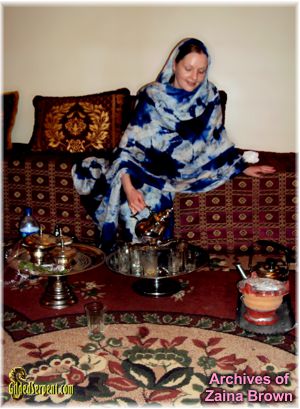
  • Behind the Scenes, 3rd Coast Tribal Festival
    I had never been to a tribal dance convention before, even though I have been a professional (Egyptian style) belly dancer for 40 years. From my “glitz and tits” perspective, this belly dance offshoot wasn’t something I recognized as mine.
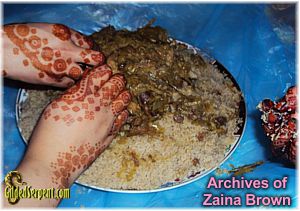
  • Cairo Revisited: Dancing into the ‘90s
    Originally written for Caravan Magazine 1992- The one thing on which you depend about dance in Egypt from year to year is that everything slowly changes. I’ve returned to Cairo each year now for nine consecutive years, and last year my visit was just before the short war we had with Iraq in which Egypt was our US ally. Cairenes seemed sad last year, because Cairo had lost most of its income from tourism, and many Egyptian nationals were returning from Iraq and Kuwait, where they no longer had employment. I did not know what to expect this year, except the inevitable fact of surprising, yet subtle, change.
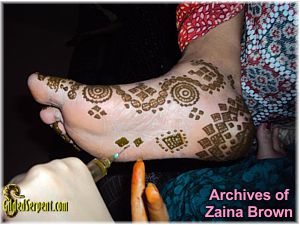
  • Fabulous Hip Drops in 30 Seconds or Less!
    A principle is a single unifying and guiding idea that when we apply it to our alignment or movement, helps us move more effectively. An advantage of using a principles-based approach to dance or martial arts mastery is that it lets us use a single visualization or body sense to achieve a desired result, instead of having to remember lots of little details.
  • Creating a Healthy Belly Dance Community
    A vibrant dance community affords benefits to all of its members. In a healthy dance community, each and every person is relevant. For learning purposes or gathering a certain show cast, there is a large pool of talent from which to choose. Those with specialties and unique areas of expertise can share their knowledge, enriching the individual skill sets of everyone.
  • Diamonds in the Rough & Polished Perfection, 2012 Berlin SomerFestival-Thursday Competition,
    Produced by Beata and Horacio Cifuentes, Held in September, 2012. The costumes were innovative and personalized with many of the competitors from the Ukraine, Russia, and Asia. Many of whom are also ballroom competitors. As a result, the costumes were visually striking and elegant. The trend in costuming is floral with tribal going towards more colorful stylized burlesque (ala Chicago musical).