Gilded Serpent presents...

The Golden Era of the Arabic Nightclubs in London
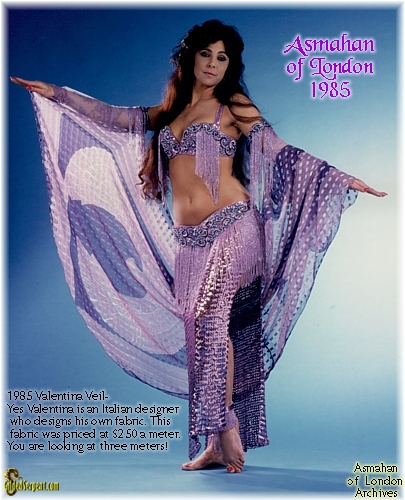
Asmahan of London in 1985

Part 2: A New Era

by Asmahan
posted March 9, 2012
Part 1: here
30 minute video tour added 3-27-12

Lynette contacted me with the idea of a video tour of the famous London Arabic nightclubs. We would go to the premises and film where the clubs previously existed. I would describe the clubs as they were in the glory days. I was a California dancer, who had come to London to dance in the Arabic night clubs. It was my privilege to be a part of that wonderful time. The following is my article about these fabulous clubs, the dancers, musicians, and singers who made this time sensational. [Ed note- 3-9-12: the video is coming!]

A new era in the club business started with the arrival of two important nightclub characters from Pyramid Street in Cairo (an area where dozens of night clubs line the street and all compete with each other for talent). Ahmed Whardany and Samir Sabot brought a great energy and expertise to London. The club they opened was El Nile, located on the corner of Clifford Street and New Bond Street. It featured a mega show– six dancers on one night, another six the next night, and El Nile presented five singers each night. The star dancers who performed there were Nahed Sabri, Nelly Fouad, and Safa Yousri. I was very fortunate at this time, as the manager of the Pars Persian nightclub was a very distinguished gentleman called Samir Zaki, who later became the director of the Cairo Opera House. He introduced me to the manager of El Nile, Samir Sabot, and I was able to get a good time slot dancing there. I told Samir that I did not “open champagne” and that I loved dancing and wanted to dance every night. Having seen me dance at L’Auberge, he granted my request. I danced every night, as did the star, while all the other dancers performed one night and came just to open champagne the next.

All dancers rehearsed with the orchestra when they started a new venue. We all had to have different music; if a dancer was already using a piece you wanted, you had to choose another. If a new star dancer came, she could “take” a piece from a lower dancer, and the lower dancer would have to change her set.
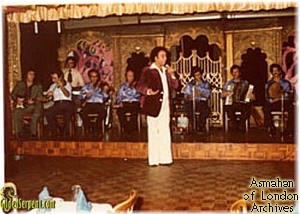
El Nile
Samir Adeweya performing at El Nile with his orchestra

The standard format was for a magency, taqsim, classic piece, popular song, balady, drum solo and finale. Only the star dancer did a costume change with a second show. A dancer was expected to dance for thirty to forty five minutes, with the star performing an hour. The magency pieces at this time were: “Tammera Henna”, “Siqa”, “Sahara”, “Hany”, “Ranet el Khol Khal”, “Rebab”, “Losy”, “Henna Ya el Henna”, and “Samera”. The famous dancers would bring their own original music and the musicians had to learn it; for instance, when Nahad Sabri came, she had the music “Mashaal”.

The famous singers performing at El Nile were Mohammad Abdel Mouteib, Souhad Mohammed, Nahad Foutah, Adel Salem el Khir, and Mohamed Gamal. There was a fifteen-piece orchestra with Bashir Abdel Al playing nai, Nabil Abdel Al on guitar, Nagati on violin, Sukar al Ghouri on accordian, Samir bin Yamin on def, and on the tabla–the renowned Nabil Hassan. Aboud Abdel Al played a solo violin show. El Nile had the most prestigious clientele. Rolls Royces would pull up in front of the entrance, and when the doors opened, the smell of perfume would fill the air. There was red carpeting on the sidewalk, and it was lined with flowers. The Saudi Arabians, who were so classy and sophisticated that they almost seemed like they were from another planet, would enter the glamorous showroom–this was before the film, “Death of a Princess”, was shown and the Royal Family would still come to the club. It was also the Sadat era when Egyptian tourism was flourishing.

The "Death of a Princess" was a television documentary about a Saudi Arabian Princess who was tried and executed for adultery. It was shown in Britain on the BBC. All the countries in Arabia had copies the day after as videos were made and sent out. The Saudi Arabians took great offence at this. They did not come to London for their summer holiday, they started to go to the South of France and Marbella and to Los Angeles.

Dubai was still under construction; the oil business was flourishing in Libya, Saudi Arabia, the Gulf States; and Iraq was funding the lavish life style of businessmen, diplomats, and the wealthy elite of the Middle East.

All these people loved hearing live music and seeing their favorite dancers and singers. Every wedding in the Middle East hired a dancer to entertain and bring good luck to the occasion. No expense was spared and all the dancers looked forward to these occasions. I was fortunate to dance at many weddings, including the wedding of the daughter of Sheik Yemani, the oil minister of Saudi Arabia.

The artists’ union in London was called “Equity”, and it was very powerful. All the clubs were required to employ one British act for each club. This meant that every show had some kind of girl/dancing act, a rock band, a popular singer, magician, or variety act. These acts started the evening show. All the nightclub premises had once featured English show clubs, and the new Arabic takeover of show business met resentment.

Most of the dancers were coming from Cairo to work in the clubs; the British belly dancers resented this and used to report the Egyptian dancers to Equity to see if they all had work permits. At El Nile, a new precedent was being set with not one British act in the show. In addition, a new policy was adopted in which the club would began to take a third of the tips.

There was a lot of money for the artists at this time. Mona Said could make two thousand pounds on the stage at one time. Once she was even given the keys to a Rolls Royce! Some singers could have five thousand pounds on the stage in a one night. El Nile was so influential that if you wanted to perform there, you were obliged to give them a cut of your tips. Soon, all the clubs followed suit.

There were many distinguished Egyptian Diplomats who came to the show. They always talked about the difference in dancers and had to state who was their favorite. Most said that Suhair Zaki was the best dancer, and after her, it was Fifi Abdou. (I was surprised that not many mentioned Nagwa Fouad.)

Vienna

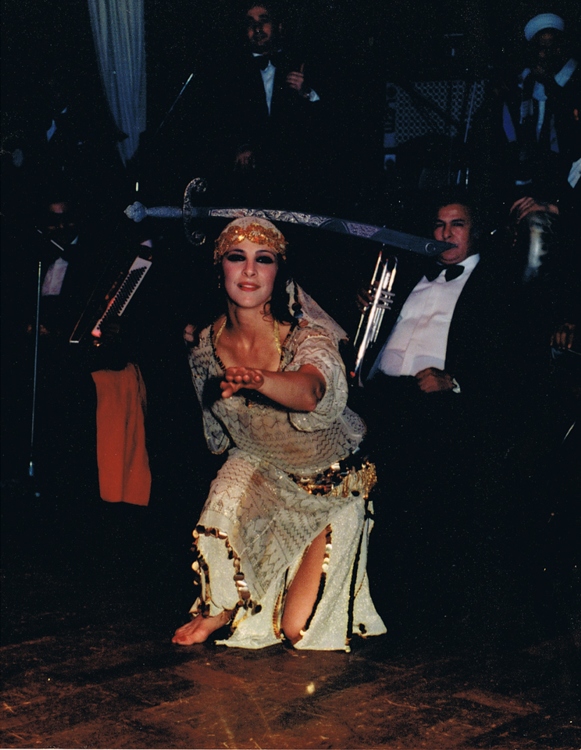
It came time for me to travel, and I went to dance in Vienna for six months. It was there that I became a star for the first time. I performed at a club called Asmahan. It was owned by a Jordanian businessman and was located in the square across from St. Stephens Church, just around the corner from where the Spanish Riding Academy has its famous shows of Lipizzaner horses. I brought my sword, coin costumes, Assiute cloths and some new, glamorous balady costumes that I had just made. Wearing a headdress, using fabric over the crown of my head, helped me balance the sword. These were beautiful to look at; I love the look of coins, jewels, and beads around my face; it just looked so “old world” and Oriental.

The music and choreography for the show was what Metqual had designed. The song for the beginning of the show was the “Hamama Balady”, and I used a Saidi version of “Salam Allay” for the second part with the sword on my head.

The first time I placed the sword on my head, the audience broke into applause; this continued every night, and my show was a sensation. Many of the customers were Saudi Arabian, and the national dance of their country is a sword dance; so it was a big hit.

OPEC had its headquarters in Vienna, and I was invited to dance at their parties. I made exceptionally good money and saved it so that I could go to Cairo. The following two years, I was performing in Cairo. The five-star hotel shows all had a Parisian-style, feathered showgirl act with multiple costume changes and an Egyptian dancer as the star of the show. The famous dancers of this time were Nagwa Fouad, FiFi Abdou, Suhair Zaki, Azza Sharif and Nelly Fouad. I performed at the Meridien, the Mena House, the Nile Hilton, the Cairo Sheraton, the Hayatt el Salem, and the Holiday Inn. There were no singers in the shows at that time. The audiences were always full of movie stars, producers, directors, diplomats, society figures, government ministers, and wealthy business figures, as well as some tourists. However, mostly it was Egyptians, as the foreigners did not know about this secret world. The shows were extravagantly expensive and everyone dressed up. They had fabulous dinners and beautifully set tables. Every night, I did my sword dance as the second show.

Back in London

Upon my return to London, I found the nightclub business was flourishing. All the existing clubs were doing great and London had a worldwide reputation as the place to go to see the top entertainment. A new venue had opened; it was called The Empress and was owned by Mr. Mercer. He had started in Paris with Yil Dis Lar, and brought his concept of a regal, elegant, and glamorous Lebanese-style to London. The club was in beautiful premises in Mayfair, on Berkeley Street, next to L’Auberge. They featured such singers as Tony Hanna, Walid Tawfic, and Warda. A new management took over with the Syrian owner Mr. Attassi. The star dancer was the Egyptian dancer, who danced at El Leil in Cairo, ShuShu Amine. The famous singers who appeared there were Sabah, Yasmine, Adnan Adlan, Wadia Safie, and Fauzi Bakri. Aboud Abdel Al performed his solo violin show. The musicians in the orchestra included Gamal on organ, Mounir Abel Al on violin, Ali Kamal on accordion, Bashir Abdel Al on flute, Attia on tabla, Farouk on tabla, Sheik Tarha on accordion and Mohamad Abdel Al on motzar.

My experience on the stage as a professional dancer was now ten years. It was my dream to have my own music to suit my style of dance. I had seen the shows in Cairo, where every dancer has her distinct performance. Having original music distinguished a dancer, giving her prestige and allowing for personal artistic development. All the star dancers brought their own music and often came to London with a few of their own musicians to produce their show on a high standard.

Mohamad Salem was an Egyptian accordionist and composer who had written several pieces of music that I admired. He had been performing with the orchestra at Omar Khayyam. I commissioned him to write a magencie for me and he composed a wonderful piece that I absolutely loved. I thought that it was the best entrance I had ever heard, he could have sold it to a more famous dancer for much more money. We arranged for the best musicians in London to learn this music and we made a recording to be my demo tape. He gave me the notes, which now prepared me to be on a new level as dancer. Now I had to get a booking in a club that would give me a higher level opportunity. I wanted to have an entrance to original music and do a costume change for my sword dance.

The Empress

I was looking forward to using this music for the first time at The Empress and I had a good meeting with Mr. Attassi who hired me and arranged for my rehearsal which is called a Prova. The manager, a Lebanese gentleman who was very important and considered one of the best in London, had seen me dance in Cairo. He brought me to the club and wanted me to be in the show. The competition between the clubs was fierce. Booking the best artists for the show and then convincing them to get along was difficult.
The atmosphere was rife with jealousy and rivalry.

I knew all the musicians in the orchestra, this was a fabulous collection of talent, several of the Abdel Al family were included in the group. We were beginning the rehearsal, the only musicians who read notes are the violins, organ, accordion and sometimes kanoon. The rest learn a new piece of music by ear. It is amazing how quickly they all learn the parts and put together the show.

I was playing the demo tape and ShuShu Amine came into the room. She told me that I could not use this music, I had to use ANY MUSIC, which meant the public domain pieces that we used every night. She had heard music which was better than hers and she was there to stop me.

She said that her ‘husband’ owned the club and she would say what happened in the show. She was the boss’s girlfriend and could have her way. I told her I was going to use my music and she fired me. So that was it! I was heartbroken as the beautiful stage which curved into the regal room would have been a dream environment to dance in. It reminded me of the Hyatt el Salem in Cairo. This was classic old fashioned elegance, with chandeliers, silver, linen and so charming…….Oh well, there were other clubs.
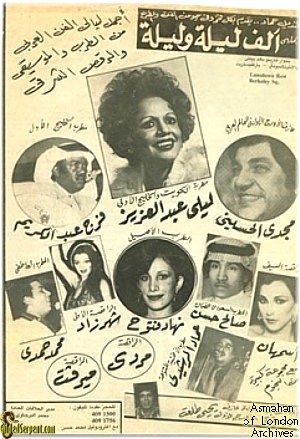
Club Ad
Advertisement in an Arabic paper for Elf Leila Wan Leila

Elf Leila Wah Leila

Another new club opened in Mayfair on Berkeley Street, it was called Elf Leila Wah Leila, at the location that was the famous English variety club called Churchills, a huge premise owned by Andeel Hammad. The singers included Layla Abdel Aziz, Fareg Abdel Karim, and Mohamed Gamal. Magdi Houseini played his organ solo. The musicians in the orchestra included Ibrahim el Minyawi (who had been my tabla player in Cairo), Ahmed Mouad, Shariffe Zaki, Yahiya Talat, Ali Serour, Farouk el Safi, and Issam el Matrawo. Mamoud Rahsad and Ahmed el Hafauwi were two musicians who had worked with the famous Om Kalsum.

As I now had earned a name from dancing in Cairo, I could do a costume change. The musicians played a show for me, but it was not the same without the mizmar. The star dancer was Safa Usri. She was now using “Mashaal”, since Nahad Sabri had gone back to Cairo. Also dancing in the show was Sheherezade, Mardi, and Nahad Business.

This club was open late and featured singers from the Gulf; for example the Saudi Oud player, Sallah Hassan, who brought many late customers in. The star dancer was on at four o’clock in the morning, and then they would present a singer who would perform for hours or until the police would come to close the club for “illegal drinking” or “being open after the license regulation”. This was not my style of club, and it came time for me to move on. It was my good fortune that an agent who specialized in booking dancers for the Gulf and Arabic venues saw me dance at Elf Leila and approached me about dancing at Cave du Rois.

Cave Du Rois with Sword
Performing with sword at the Cave Du Rois

Cave du Rois

Across from the Ritz Hotel was a jewel of a club called Cave du Rois. It had a gorgeous décor in white leather and marble. It was exclusive and catered to an elite clientele. It opened for dinner with a select menu with elegant service, and the show ended at an early three a.m. It was owned by a Lebanese business man, Hassan Awada, who was also creating a showboat in Paris to sail down the Seine–lovely glass boats that are such a sensation with the French. This club was frequented by celebrities, and the actor, Omar Sharif, was a customer.

The star singer was Sabah–the most famous Lebanese diva of all time. Other singers who were performing included: Fahed Bahlen, Isam Raja, Tony Hana, Souad Mohamad, George Wasouf, Ahmed Dowal, Naga Salem, and Wadia Safie. The star dancers were Zizi Moustafa and Louisa. In the orchestra was Abdel Aziz El Sayed on kanoon, Emile Bassili, on violin (who worked with Om Kalsum), Bashir Abdel Al on nai, Sukar el Ghouri on accordion and Ali Abdou Salem on tabla. The flute player, Sayed, also played mizmar. This was a great advantage to me as there were not many musicians in London who played this instrument, and with it, my sword dance was really special.

Cave du Rois had a changing room built for professional showgirls; so there were vanity tables, mirrored lights, costume compartment, a toilet, and shelves for makeup. It was a pleasure to dance there. The management was very capable, and it was just a smooth and elegant environment. They served a lovely dinner to the staff every night, and I could have even a hot fudge sundae–if I wanted it.
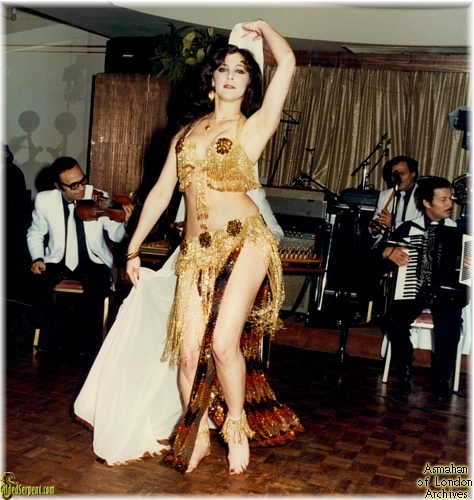
Cav du roi with Emile
This is the Cave du Rois with Emile Basili on violin playing behind me. He played for Om Kalsum


More Clubs

I had been sewing costumes for years, and by now, had become known for my original designs. I had great ethnic sword dance outfits with lots of coins and jewelry. All the Arab girls enjoyed being modern, but I loved to look like something from the past. I was wearing my Assiute cloths and headdresses, and the audience always clapped when I put my sword on my head. This tradition had started in Cairo from the first night I had performed this dance at the Meridien Hotel. It became an addiction, to hear that applause every night in the middle of my show! Arabs love to see a dancer balance something on her head, and the sword is just the most dramatic and surprising thing.In the United States, there are a lot of sword dancers, but when I danced it in Cairo in 1981, it had never been seen there. Then, in London in the 1980s, it was still a novelty.

I had brought my dream to life. I had seen the sword dance at the Renaissance Faire, brought my sword under my arm on the plane to London, and I had the most famous Saidi rebaba player in the world to teach me. Then, I carried my sword to Cairo and performed this dance in the most famous venues in the Middle East. Now I was known in London as a dancer with a special show.

There were many smaller less important clubs also in London. Safa Usri opened a small club on Marylebone St. near Baker Street tube station. It was first called Arizona, after the name of a club on Pyramid Street in Cairo, and later, it was called Venus. Hany Mehana was the head of the orchestra; he played the organ and Mustafa Nahas was a singer who performed there, as well as Katcut el Amir, Adel Salam el Khir, Hossam el Amir, Mohamad Fahti, and the famous Warda. The dancers performing were Safa Usri as the star, Shererzade, Amal Sami, Nahad and Mardi. The musicians were Mohamad Abdallah Ragab (who worked with Nagwa Fuoud and Azza Sharif), Asharaf el Sarki, Mounir el Khatib, Surkar el Ghouri, Hagag Quenwi Metgal and Sheriffe on tabla, Abdel Azziz el Sayed, Ali Adbe Salem, Mustafa el Arabi, and Said el Bing on motzar.

The Baracuda Club a casino on Baker Street, became an Arab nightclub for a few years. It was owned by a Lebanese businessman, Habib Ghanim, who had made his money in Africa. All these clubs needed owners with a lot of money who could take a risk and afford the high costs of running these first class clubs. The Baracuda Club existed in the latter period when all the other clubs were all competing for dancers, singers, musicians, and customers. All the clubs only admitted customers that they approved at the door. (No women were admitted without a known customer.) It was not possible for groups of girls to have a night out at these clubs. Most of the clubs did not allow photography with the exception of the resident photographer, as it was very important that customers’ privacy was respected. Many diplomats, members of royal families, ministers, government officials, prestigious businessmen, actors, directors, movie producers and high society people attended these shows.

The Baracuda featured Mona Said as the star, the other dancers were Latifa, Safia, and Naziha. The orchestra featured the composer Mohamad Salem on accordion, Sayed el Fahim on organ, Ibrahim el Akhar on tabla, Ali Ahmed Ali played tabla for Mona, Fouad Abdel Al on violin, Hany Mehana was the chef d’orchestre, Wael on flute, Maher on nai, Ali Abdel Sabour, Khalid Fouad, and Said el Bing on motzar. The famous singers who performed were George Wasouf, Tony Hana, Layla Afram, Fauzi Bakhri, and Gamal Salani. Magdi Housani performed his solo organ show, doing songs from Abdel Halim Hafez.
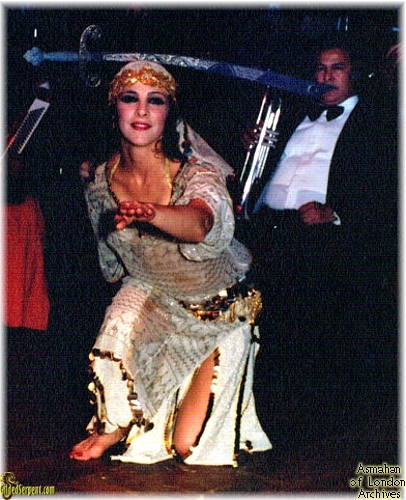
Sword
My sword dance at Mena House in Cairo
linked to uncropped enlargement

The End of an Era

The Gulf War, which started on January 15, 1990, was the end of the glory days of the nightclub business in London, and also in Cairo. After this, clubs were all struggling, and everyone was affected by the war, either economically, culturally, or socially. I was working at Ramses Hilton in Cairo and could not get another contract for the winter season. I came back to London on a plane on January 14, with a lot of movie stars, the day before the war started. There was a recession in London and lots of clubs were closing and restaurants that had previously featured a dancer now did not offer a show. Islamic fundamentalism was affecting society, and many people did not want to be seen at a nightclub. Many people also could no longer afford to go to these expensive venues.

My experience dancing in those great clubs among the Arab dancers, singers, musicians, management, and customers was amazing. I lived my dream of having an exciting, glamorous and incredible adventure. A dancer could play the clubs any way she wanted. Some dancers “opened champagne” socializing with customers. Although I never did, it did not stop me from dancing in the top clubs at a fortunate time and making good money. My dream was to look like an Arab, dance like an Arab, and be accepted by the Arabs. I wanted to design and sew beautiful costumes, look great on the stage, have amazing music, dance well, and earn my living as a professional dancer. I danced on the stage for a living from the age of 22 to 50. All I did was dance six nights a week, sometimes two or three shows a night.

The generosity and hospitality of the Arabic people still astounds me. They allowed me into their world–even though my Arabic language skills were limited. Arabs have a fabulous sense of humor and the most colorful personalities: everything is a drama, everyone is late, everything is done the hard way, but it always works out in the end! They gave me opportunity, taught me, and provided the most beautiful stages, lights, music, and dynamic environment in which to perform. I was never intimidated, abused, manipulated, compromised, or cheated in any way. Always, they paid me in cash promptly and showed me respect and admiration for being an American but dancing like an Arab.
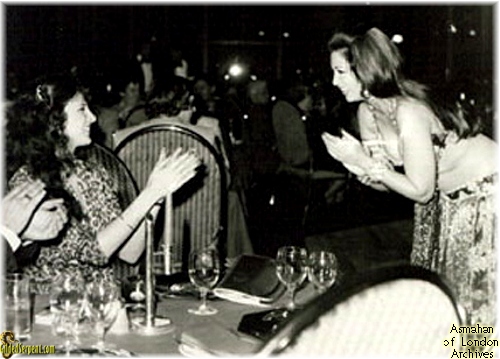
Asa Sharif
Asmahan applauds for Azza Sharif at her show in Cairo at the Holiday Inn


30 minute video: June 2011-Asmahan takes Lynette on a taxi and walking tour of London.
We visit the sites of many of the famous Arabic, Turkish and Greek clubs.

Part 1 of this article here:The Golden Era of the Arabic Nightclubs in London:
Making the Move from San Francisco to London

use the comment box

Have a comment? Use or comment section at the bottom of this page or Send us a letter!
Check the "Letters to the Editor" for other possible viewpoints!

Ready for more?


Gilded Serpent presents...

Tribal & Textile Arts Fair 2012

IPhone Photos of Pretty Stuff from a Trade Show

Iphone report

by Lynette
posted March 7, 2012

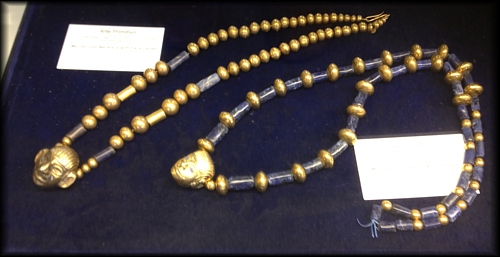
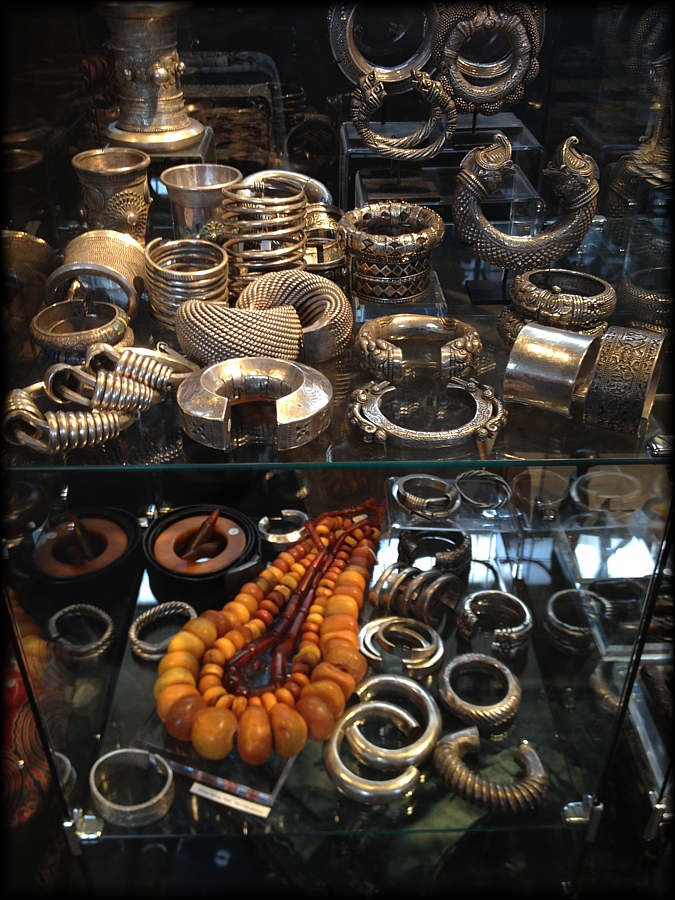
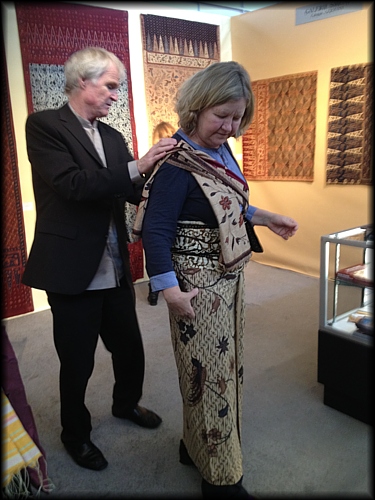
On February 12, 2012, at Fort Mason in San Francisco, my husband George and I made a quick visit to an annual folk arts show. This visit soon turned into a report for Gilded Serpent! There were so many items I could see that our readers would appreciate that I asked the vendors if could snap a few photos on my little phone. They didn’t turn out too bad! Next time I will take better notes about each piece.

George talked to one of the vendors about the history of some of the items. Some of the pieces seemed too valuable to not be in a museum. The vendor told him that the organizers of the show had a whole separate room of items that they wouldn’t allow to be shown because they lacked "provenance". The sellers of those items could not show documentation that they were obtained legally.

Prices for the items on sale were way out of range for most of us. However it was nice to be able to touch the ones that probably should be in a museum. All photos were taken on an iPhone 4s.


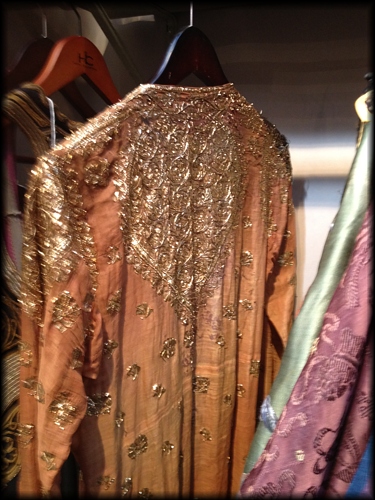
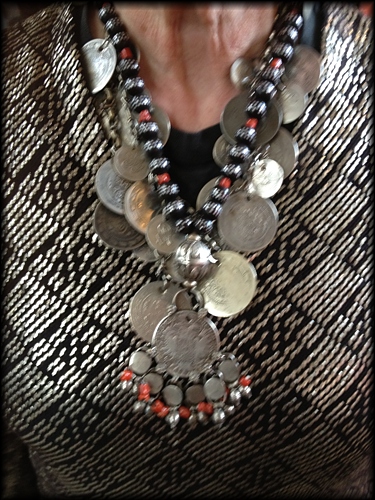
A beaded mesh dress, South East Asia?

Central America?

Click photo- linked to larger image

Uzbekistan? " Needlepoint Lakai" per exhibitor-Caravanserai

That Siwa dress was on sale for over $600!

Egyptian appliquéd party tapestry

This is all embroidery- not print! Central America?

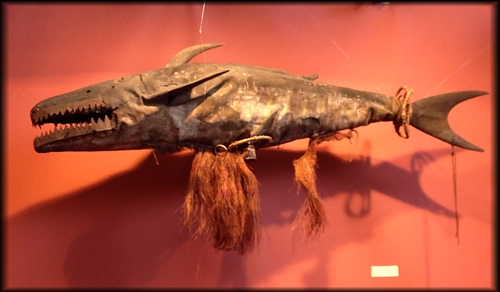
Tribal Fish

These little people were fringe on a rug.

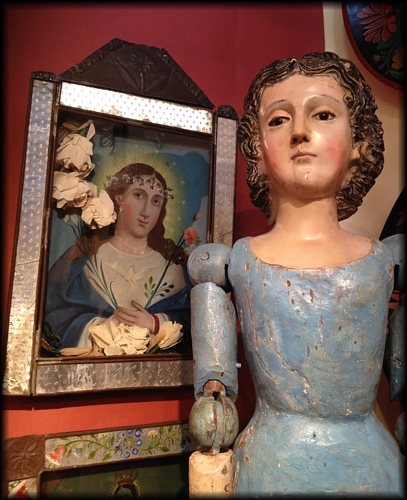
Early 19th Century, Spanish Colonial, Oil on Canvas, exhibitor-Colonial Arts in SF

Detail of alligator harp above- Burmese, 19th Century, Sutterfield Tribal Arts, East Bay SF, CA
The vendor said this harp used to be covered in precious stones.

Head Hunter’s Trophy Basket. Each face represents a real head.


A modern Moroccan rug made out of currently more available materials

Indian?

Nancy Hernandez in her assiut / assuit finery!

Snake women show up everywhere!

below the 2 hats is a pocket for scissors. I think Davina needs one of these!

Dealer helps potential buyer try on SE Asian sarong

Ethiopian Shield for $4500!


One more treasure at this fair- Mike Glad.
Beautiful photos and a wonderful documentary.
Go to his site and look at the wonderful photos!


Website for this Tribal & Textile art show


use the comment box

Have a comment? Use or comment section at the bottom of this page or Send us a letter!
Check the "Letters to the Editor" for other possible viewpoints!

Ready for more?


Gilded Serpent presents...

1st Annual Shimmy in the City

How I Organized an International Festival and Survived (just!)

Asmahan Teaching

by Charlotte Desorgher
Photo credit: Satoyuki/Bellydance Japan
posted March 5, 2012

Our headline star was stuck in Cairo, her visa refused. Another star’s visa had arrived after his flight had left; now he had to come by a different route and would arrive a day late, at the wrong airport, at two in the morning! A star costumier had a similar visa problem and had had to pull out completely.

I suppose that if we had really thought about the date of our first-ever Shimmy in the City, which took place on 25 September 2011, it might have occurred to us that it would be very close to the tenth anniversary of 9/11, but I’m not sure we would have considered that the anniversary might have a direct impact on our bellydance festival. I can’t say for sure that heightened security between Arab nations and the UK was directly responsible for the problems our stars had. In all the years I’ve been arranging international bellydance events I’ve never had so many problems getting dancers into the UK. I’m a Government Registered Sponsor and had arranged work permits for everyone, so I had thought it was a done deal, but not so! The British Embassy in Cairo was clearly on high alert and was undertaking far more stringent and time-consuming steps with all Egyptian residents applying for visas, which I think accounted for the difficulties we had.

Khalid's showThere’s no doubt that organizing a major international bellydance festival was one of the most challenging, stressful and nerve-wracking things I have ever done. It was also more satisfying, joyful and life affirming than I could ever have hoped! The main reason for that? My festival partner, Khaled Mahmoud.

If I were writing this article as a handy checklist for people thinking of putting on a major bellydance event, item number one would definitely be get yourself a partner you trust, and who has an unerring ability to make you laugh.

Hope to goodness you manage to stay friends right through to the end! Which, despite all our challenges, thankfully we did!

Shimmy in the City was conceived as an intimate festival, with a small number of top-line stars, held in one of the most vibrant and exciting cities on earth – London. We hoped that the combination of major superstars and an iconic city would prove an irresistible draw. And so it was. We had participants come from every corner of the globe – from Russia, New Zealand, Japan, US, Scandinavia and all over Europe, east and west.

But that in itself brought challenges. For example, we hadn’t realized that many eastern Europeans still don’t have credit cards, and for them, payment in advance was a real problem. The Siberian dancer who won the male competition arrived with an unreadable music disc. Thank goodness there was another Russian in the room with a PC that could read it!Competition

Our major challenge was undoubtedly the fact that Soraia Zaied (the wonderful Brazilian dancer who has been resident in Cairo for many years) was refused a visa on the day before she was meant to fly out to us! Soraia had unfortunately made a mistake on her written visa application and, despite the fact that I had already arranged her work permit, the authorities had refused her entry to the UK. It’s every event organizer’s worst nightmare and I remember exactly where I was standing when I took the call from Khaled and just how sick and scared I felt hearing the devastating news.

Thankfully Khaled is an international star with an address book to die for! We allowed ourselves two minutes of panicking and then he got straight onto the phone to Asmahan, another fabulous South American star with a worldwide following.

He literally woke her up at 5am, asked for her help and she immediately dropped everything and got straight on a plane to London! What a star indeed!

It was a nerve-wracking time on the first day of the festival, waiting to hear whether Asmahan had been allowed into the country to save our skins. I had been up since 5.30 am, doing a radio interview, and when I got the call from Khaled at 8.30 to say they were on the motorway with Asmahan in the car, the relief was enormous. I will never quite get over the incredible generosity of spirit that Asmahan demonstrated in dashing across the Atlantic to help out a friend. So, at last everything was in place and the festival could swing into action! [Ed note- Also, Asmahan had just arrived home from Japan the evening before!]

Khalid drums for TitoDancers arrived from around the globe, full of excitement and anticipation. The souk vendors unpacked their fabulous wares and our team of volunteer helpers arrived to greet people and direct them to the various rooms in our venue. It certainly was a great venue! Theatre, ballroom, rehearsal studio and several conference rooms under one roof, and only 15 minutes by train from both central London and London Gatwick airport. It’s where I teach my weekly classes and one of the things that made our life so much easier was the fact that the venue staff all know me and worked really hard to make everything run smoothly.

On Friday we ran an international competition with competitors from around the globe: from Japan to Siberia, Europe to the US. It included what we think was possibly the first-ever international male bellydancer competition and the standard was extremely high throughout. It was followed by a hafla with a truly international vibe, set in the venue’s glittering chandelier-lit ballroom. I have magical memories of that night: the bright faces of dancers of multiple nationalities dancing together, their language differences of no consequence; of Tito in jeans and t-shirt dancing a tabla solo with Khaled drumming for him, and of some fabulous bopping from our stars.

Oh my goodness, what stars! I’ve left them until last because they were really what made everything so special. Having top quality stars makes an event organizer’s life so much easier. When you have stars of the quality and professionalism of Jillina, Tito, Asmahan and young fusion star, Anasma you can be sure your workshops will not only fill up very quickly, but that your delegates will leave buzzing with joy and excitement. Khaled and I taught too, even though it wasn’t easy combining teaching with organizing and performing!

The workshops were full, the teaching excellent. The show on Saturday evening was cheered to the rafters, from Wael Mansour’s opening tannoura, through Khaled’s glittering showcase, Jillina’s incredible three sets, Tito’s jaw dropping stick and drum solos, Anasma’s amazing theatrical pieces and of course Asmahan’s show-stopping finale. The look of joy on audience members’ faces was unforgettable and I felt truly honoured to be part of such a stellar lineup.

We all celebrated on Sunday night with a trip by red London double decker bus to an Arabic nightclub where Tito and Asmahan generously performed and the rest of us boogied until 1am.

Check out the clip of Tito dancing on the top deck of the bus!


Asmahan and Lynette in GS shirts!The response and the buzz from delegates made all the hard work truly worthwhile. Despite the fact that we had lost a major star, the goodwill was remarkable! We had so many positive messages in the days afterwards and people left with armfuls of our leaflets for the next one.

Ah yes, the next one! A festival organizer’s job is never done and before the festival had even started we had already booked our stars for 2012. When you are working with big names you have to book everything at least 18 months in advance and this year we have the biggest – Dina! Indeed, as I write this (in early January 2012) Khaled has just flown out to Cairo to book our stars for September 2013, I have the venue contract for 2013 on my desk ready to be signed and the September 2012 website is ready to go live. Bring it on!

For more information: www.shimmyinthecity.com

Have a comment? Use or comment section at the bottom of this page or Send us a letter!
Check the "Letters to the Editor" for other possible viewpoints!

Ready for more?

 
Gilded Serpent presents...

Photos from the Performance of
"Dangerous Beauties"

February 18, 2012
Dark Room Theater, San Francisco

by Brad Dosland
posted March 5, 2012

See event review & report by Davina here.

Native Brew
Native Brew
Adriana as Sita


Tatseena
Tatseena
Tatseena as Medusa


Nyla as Salome
Nyla as Salome


Rose Harden
Rose Harden
Rose Harden as Mata Hari and as Helen of Troy


Terry as Cleopatra
Terry as Cleopatra


Surreyya
 
Surreyya
 
Surreyya as Lillith and as the Sphinx


Princess Farhana
Princess Farhana
Princess Farhana as Emily Hahn’s opium vision


Dusty
Dusty
Dusty Paik as Baba Yaga


Nyla
Nyla as Elizabeth Bathory
 
Princess Farhana
Princess Farhana
Princess Farhana
Princess Farhana as Louise Brooks
 
The Cast


use the comment box

Have a comment? Use or comment section at the bottom of this page or Send us a letter!
Check the "Letters to the Editor" for other possible viewpoints!

Ready for more?


Gilded Serpent presents...

High Concept – High Style

“Dangerous Beauties”, February 18, 2012

Surreyya

A Show Review by Davina
Photos by Alisha “Zemira” Westerfeld
posted March 5, 2012

Last weekend, I was fortunate enough to attend the sold-out Dangerous Beauties Show held at the Dark Room Theater in the heart of the Mission District of San Francisco.  This collective of dancers is the brain child of Surreyya Hada and Nyla Crystal, whose mission is to bring to the dance stage pieces that explore the essence of the femme fatal.  

The entire production was moody, dark and intense; just the way a Dangerous Beauty would like it.

The headline for the show was the Princess Farhana of Hollywood, who was in town to teach a workshop the next day. She was stunning in two pieces. In the first piece, “Pipedreams and Poppies” she transformed herself into a heady opiate vision of alluring destruction. A wispy grey veil floated around her body like smoke that swirled and enveloped her torso, framing her supple body movements and mesmerizing us viewers.

Princess Farhana

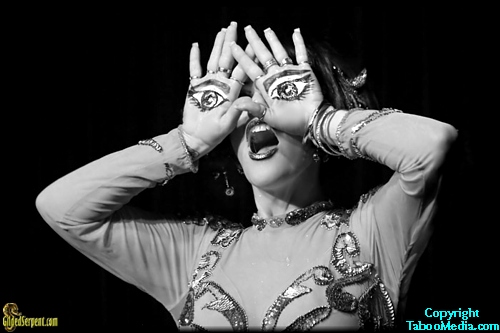
In her second piece, The Princess recreated her role as “Lousie Brooks,” one of the first Hollywood actresses to be labeled a femme fatale. She looked breathtakingly nude in a sheer mesh dress with strategically placed sequin, bead and rhinestone patterns. A pair of electric blue peacock feather fans played about her body, a non-strip tease of conceal and reveal. At the climax of her show, the audience gasped for breath, as she lifted her face from the floor, revealing striking eyes painted onto the palms of her hands, winking seductively and flirting with the audience with four eyes.

There were many more outstanding performances.  Tatseena of Dublin, CA. was a vision of terror as Medusa with her deeply earthy style and her sinuously supple partner, her snake.   Although her mask popped off a bit early, there was no mistaking exactly who she was portraying… Fortunately, she didn’t actually turn us to stone!

Tatseena as Medusa

Surreyya (as the Sphynx) presented a double sword piece. She stalked out onto the stage and literally pulled a pair of swords from inside her costume–an absolute surprise to me, and I still wonder where they were stashed inside her bedlah.

Terry (as Cleopatra) was absolutely stunning.  I’ve seen her dance many times and she continues to be one of my favorites.  However, in this show, she brought an evocative intensity that was at once queenly and seductive, and I must add, I really thought she was smoking hot in her costume!

Terry Del Giorno

Adrianna (as Sita), an Indian goddess, came out in a gorgeous sari-fusion costume and evoked the spice and flavor of India in an improvisation to live music.  She transformed her high-energy, glamorous style into a deeply intense Indian-inspired taxim in which she was able to showcase her stunningly supple arms and hands.

Adrianna

There were many more lovely dancers with interesting and entertaining pieces, but these whom I have written about are the ones that stand out in my mind as show-stoppers.  

Overall the quality of this dance concert was quite high and embraced diversity in its cast, with dancers of many different ages, sizes, styles, and experience levels, showing all at a high state of accomplishment in their craft.  I would have liked some of the dancers to embody their characters a bit more fully, for although the dances were all lovely, at times, I had to look to my program to see who they were portraying.

The Dark Room Theater was intimate and was standing-room only.  The lighting was, at times, so dark and moody that the dancer seemed to disappear into the backdrop.  As is frequently the case in live theater, there were a few unfortunate snags and glitches.  At times, we could see directly into the dressing room through the curtain located behind the stage; it was a large bright triangle that stood out against the black.  Sadly, this opening allowed an occasional glimpse at an upcoming performer, dissipating some of our anticipation and surprise.

Personally, I would have wished for the performers to have had a longer “tech-check”, and perhaps, work with the lighting engineer a bit longer to perfect the show.  Some of the lighting choices did enhance the performance, but some were downright distracting from the performer. The use of the red gel was quite heavy-handed.  Nonetheless, as is the case with many venues, there just isn’t enough time before a show for everyone to run through all the pieces.

With luck, this collective of fine dancers will have the opportunity to perform again – and when they do, go see them!   Well, that is, if you can face the danger…


Nyla, Surreyya, and Rose portray the Sirens


Dusty portrays Baba Yaga


The Cast


More photos from this show by Brad Dosland

HERE

use the comment box

Have a comment? Use or comment section at the bottom of this page or Send us a letter!
Check the "Letters to the Editor" for other possible viewpoints!

Ready for more?

  • Assiut / Assuit, Fascinating FAQs
    However, mosquito netting was invented by the Egyptians and dates back thousands of years.
  • Fashion Trend Report 2011 What’s New This Year at Rakkasah?
    What I noticed, first and foremost, was not the costuming, but rather, a change in the sellers themselves. The seller demographic has radically altered, creating a new vendor landscape. Without a doubt, this is a response to the on-going sluggish economy and the need for companies to reduce expenses. The reduction in costumes and products coming out of Egypt also affected the merchandise. Many small factories had a gap in production, and shipping has become even more problematic.
  • Nonprofits for Middle Eastern Belly Dancers, Is a 501c3 Right for You?
    By understanding the nature of non-profits, how they are organized and run, you can see their potential for developing successful arts organization, performance space, dance company or troupe.
  • By Dancers, For Dancers DVD reviewed
    As working professionals, these dancers present the style of performance you would see in an intimate restaurant or at a house party.
  • Kohl:Drawing the Line
    Along with henna, kohl has been part of the beauty regimens of women since the dawn of history, and an unbroken line connects the eyes of today with those of the ancients.
  • On The Costumer’s Bookshelf
    Beaded Embellishment Techniques & Designs for Embroidering on Cloth by Amy C. Clarke & Robin Atkins
    Well-written directions for all of the most useful stitches for the application of beads are accompanied by clear illustrations.
  • Touching the Clouds: Impossible Bridge in Yemen
    I needed a place where I felt safe, had some friends, and knew my way around: a place like Yemen! Besides, there was a bridge there that I wanted to check out.
  • How I Met the Tuzsuz Family in Istanbul
    As for taking lessons with her – her teaching has improved over the years and her repertoire has expanded (although her large movement base was what attracted me to her as a teacher in the first place, so it has always been extensive).
  • Veiling in the Desert, Moving to Egypt to Study Bedouin Dance, Culture, and Language …and Maybe to Buy a Camel!
    I was a little nervous about dancing in front of the Bedouin musicians. Although I had been itching to get up and dance all evening, a fear of causing offense or of behaving inappropriately in some way had stopped me from asking.
  • The End of the Banat Mazin? Struggles with Religious Fanatics, Real Estate Management , and Other Ghawazi
    Yusuf Mazin, a Nawari Gypsy, had wandered the land dealing in livestock, entertaining the villagers with stories, delivering messages and generally making himself useful until his non-Gypsy wife blessed him with five beautiful daughters. Beautiful, talented daughters who could master singing and dancing — the arts of the ghawazi, as such women were traditionally called in the countryside — were the best hope for the prosperity of a Nawari family in Egypt.
  • Organic Cycle Enters Taiwan’s BD Community: 2 “Unusual” Taipei Workshops Demonstrate New Trend , Traditional Chinese Translation here
    Taiwan, as one of Belly dance communities in the Asian region where Belly dance has been blooming in the past decade, is no exception from a heavily choreography-oriented mainline trend.
  • The Mystery of Tulle bi Telli, Assuit Shawls, a Research Paper from 1979
    The romance that surrounds these shawls harkens back to a different era, when handicrafts were valued for their own sake, and intricate decoration of everyday objects was part of everyone’s life.
  • Amani Oriental Festival Photos, October 25-29, 2011, Beirut, Lebanon
    As a professional performer, I was impressed with the high caliber of dance instructors. The majority of instructors were Lebanese and offered a diverse repertoire of Lebanese Oriental and folkloric technique with emphasis in dramatic moves, staging and communication through movement with modern dance components.
 

Gilded Serpent presents...

Touching the Clouds:

Impossible Bridge in Yemen

Rocky road to Shahara

by Zaina
Excerpt from Zaina’s ebook titled “Stories of a Traveling Bellydancer”
posted March 1, 2012

November 2008

I had a couple of more weeks to kill before my next assignment in good old Bahrain. I had seriously considered going to Kenya, but was still recovering from the nasty stomach bug. I didn’t feel up for Africa. Being sick in a new country (in which I knew nobody) would suck twice as much. I needed a place where I felt safe, had some friends, and knew my way around: a place like Yemen! Besides, there was a bridge there that I wanted to check out.

The village of Shaharah, six hours north of the capital, was not always accessible for travelers. The government habitually shut down the road if they felt that the security situation was worse than average. Luckily for me, that was not the case when I got to Sana’a. The travel agent still tried to talk me out of it. The trip was never completely safe: the tribal lands were not government friendly, and foreigners have been kidnapped in Yemen time and again. Therefore, shortly after exiting Sana’a I would first need a police escort who would travel in a convoy with me until I was handed over to a tribal escort who’d take me the rest of the way. The trip would also be kind of expensive as I’d have to pay both.


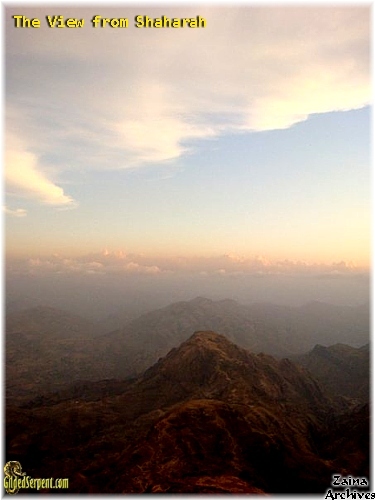
EscortThe view

However, that made me feel very well protected; Yemeni guys are no pussies, so they wouldn’t think twice about taking someone down if they were under attack. True, the road leading up to the mountain top-village was in horrendous condition and seriously nauseating, but whatever. Great! When could I go?

My driver, Mohamed, quickly understood how to speak Arabic to me in a way that I would understand. We had nice conversations along the way, touching many topics about life in Yemen and abroad, and my experiences so far. I brought up the incident that had made news worldwide: 10-year-old Nujood being forcibly married to an older man who beat and raped her until she got a divorce. Mohamed said that what had happened to the little girl had angered people all over the country. To be fair, that particular family was in a dire situation: the father was disabled and couldn’t work, and the older children were already begging on the streets to feed themselves. They were concerned for the girl’s safety, and marriage had seemed like the honorable alternative.

We passed what felt like ten checkpoints along the way. Mohamed handed out a copy of my passport at each one, and answered questions about my nationality and where we were headed. A Qat-chewing crew of six policemen soon joined us for a few hours until we were handed over to the tribal escorts. (That means tribal men who accompany you, not tribal belly dancers who turn tricks; they don’t have those in Yemen.) All the while, I didn’t even have to open my mouth; it was smooth sailing.

The village

I’ve been on some bumpy roads, but the road leading up to the village of Shaharah, at the altitude of 2600 meters (8500 feet), takes the cake. We parked the SUV by the foot of the mountain and hopped on a pick-up truck belonging to the villagers. Everyone said “Bismillah ir-rahman ir-raheem”. Indeed, we needed all the protection God would grant us! Carved close to the mountain’s edge, the road was literally a pile of rocks and gravel, and it seemed never to end. The higher we got, the more spectacular the view became, but this, absolutely, was the craziest trip I had ever taken. Getting into that village to see a bridge seemed like “Mission Impossible”. For a moment there, I really questioned my judgment… Since when did I have such an unwavering interest in architecture? The last stretch of the road was really steep and the truck was bouncing up and down. I just had to pray. Afterwards, Mohamed casually mentioned that a car full of tourists had flipped over once, and they died. Somehow I wasn’t surprised.

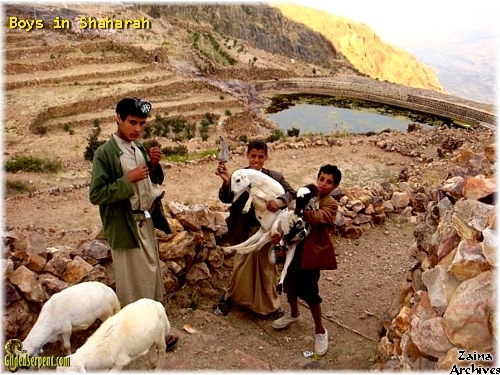
The boys of Shaharah

A teenage boy was assigned as my guide and off we went, walking around while there was still some daylight left. Trekking on the cliffs was tricky for me. Even with sensible sneakers on, I had to place my foot carefully to not stumble face first into the rocks. I stopped many times to catch my breath while the boy patiently waited. There was very little oxygen in the air; we were basically at the level of the clouds. Miraculously, the village women strutted up and down the mountains as if it were Fifth Avenue; their faces (including their eyes) were covered, and they were wearing slip-on sandals. How they didn’t fall and twist an ankle or worse, I couldn’t fathom.

I saw a little boy by himself riding his bike right on the edge, close enough to make my heart skip a beat! I asked my guide if children sometimes fell off the mountain’s edge. Yes, he said. Sometimes they did.

The sun set over the mountains and a distant azan could be heard from many directions. I felt as if I were in a parallel universe. The village was like a dream: so peaceful and beautiful. I had never felt such isolation, such distance from what I was used to thinking was the world. For the people here, this was the world. It had all they wanted and needed. I was speechless.

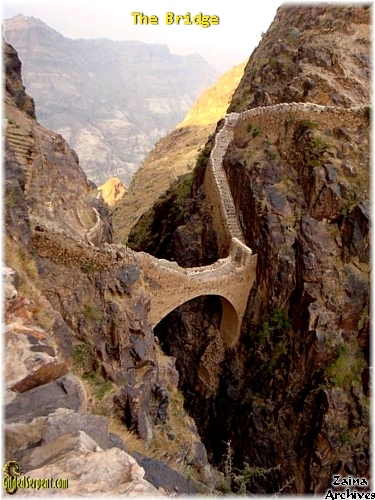
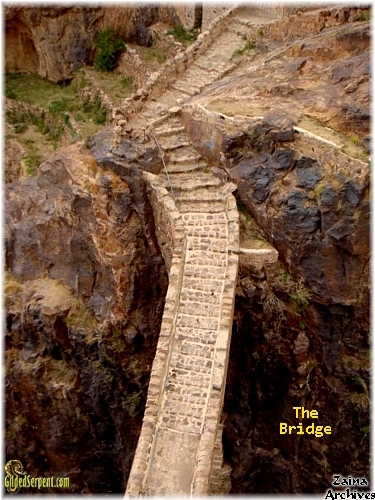
After the sundown, all I could do was wait for the morning. There was electricity for the night hours in the simple hotel where all visitors stayed. I was very well fed. Traditional Yemeni meals were brought to my room on a tray without ordering. In the morning it was time to see the bridge. Was it all that it was cracked up to be? You bet it was! It was a formation of rocks – a bridge – connecting two mountains, just hanging in the air on–nothing. It dated back to the early 17th Century, and I don’t know how they managed to build it. The view down from the bridge was intoxicating. Thus the trip was complete. I came, I saw, I conquered, and took a lot of pictures.

The Bridge!


After a couple of days of rest and relaxation in Sana’a, I was ready to get back on the road. I headed southwest for a four-day tour to the cities of Hodeidah, Taiz, Ibb and other points of interest on the way. That part of the country was considered as safe as Yemen got; there was no red tape, and getting around was easy. This time, my driver was a young guy called Abdullah. He popped a khaleeji CD in, turned the volume up and drove off with one hand on the horn and a cell phone in the other the entire time.

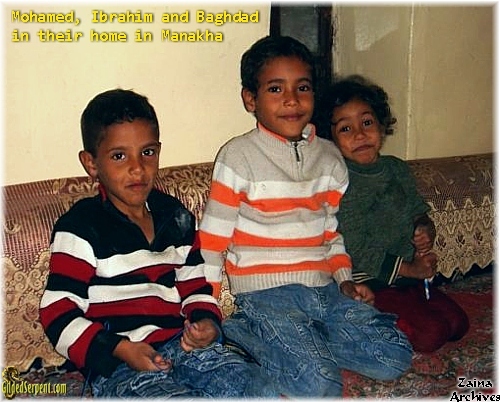
Our first stop was a pretty village called Manakha. We walked around, and I took pictures of buildings, while Abdullah talked into one of his several cell phones. At some point, I mentioned to him that I hadn’t seen any women. He immediately approached a couple of kids on the street. Before I could stop him, he’d told them to bring me to their house to meet their mother. Shy and embarrassed as I was to intrude, it was intriguing to meet local people and see how they lived. I sat down with the mother and the children. The teenage girls were working on crafts that they sold, and kids were playing. Talking was a bit hard, but we managed. One of the little girls was called Baghdad, which was a completely unusual name for a Yemeni girl. She had been born just when the US invaded Iraq. I drank tea, took a photo of the younger children, and was given a hand-sewn cell phone case with some bead work, along with fresh, hot bread. I was a happy girl when I got back to the SUV.

Bagada and her brothers


Getting closer to the coast, the nature began to look different, as well as the people. The air smelled different, and green leafy trees grew like in a jungle. Many people had very dark skin. Were they African? No, they were Yemeni, Abdullah said. The African influence in the area goes back many generations. Zabid

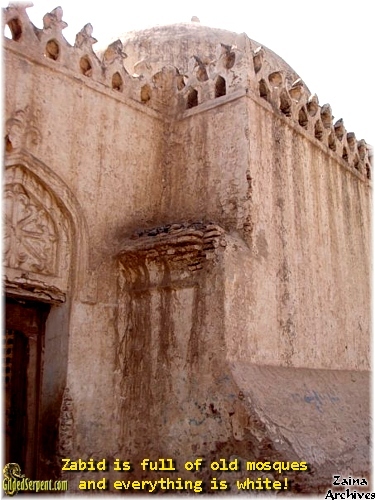
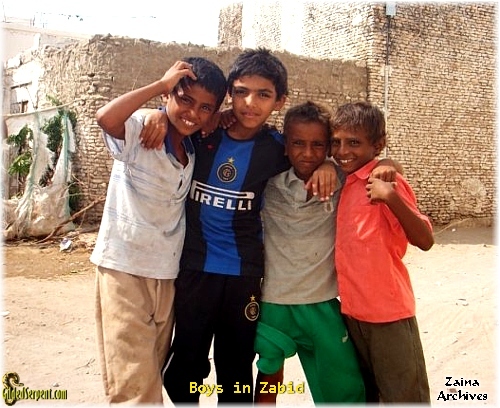
The coastal city of Hodeidah had an atmosphere of a fishing town. The air was humid, and you could smell the ocean. We saw some sights and stayed for the night. Back on the road the next day, I discovered what would perhaps be my favorite place in Yemen. It was the village of Zabid. All the buildings were white. Zabid had the biggest mosque in the country excluding the Sana’a extravaganza that president Saleh built with his “own” money, for millions of dollars. (It pays to be the president.) A teenage boy showed us around town, navigating through the narrow alleyways between white-walled buildings. We climbed onto the rooftop of one building, and I was pulled inside a home. Two old women asked me dozens of questions and showed me the things they had for sale. I was trying to refuse politely, but they were so incredibly sweet and enthusiastic and touchy-feely that I just had to buy something. I’m a sucker for old-lady love. It reminds me of my grandma. My purchase was the strangest type of perfume I’ve ever seen. It was a lump of sticky brown mass inside a little plastic bag, and had a strong scent. They rubbed it onto their hands and then on my neck and wrists and abaya, and I smelled nice, I had to admit.

Boys of Zabid

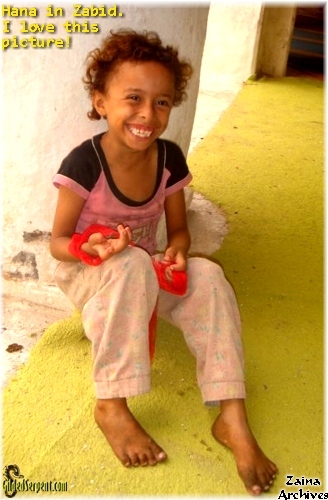
As I continued the tour, a little girl called Hana joined us. She held my hand and giggled as we walked around. When I asked her how old she was, she said ten, but with a little coercion she admitted to being only five. I jokingly told the guide that she was my daughter. He got the joke but contested: “How could you have a daughter when you’re not married?” For a second I wanted to tell him exactly how that would be possible, but decided to leave him at his innocent state. (An ethical tourist should neither throw garbage nor corrupt the youth.)

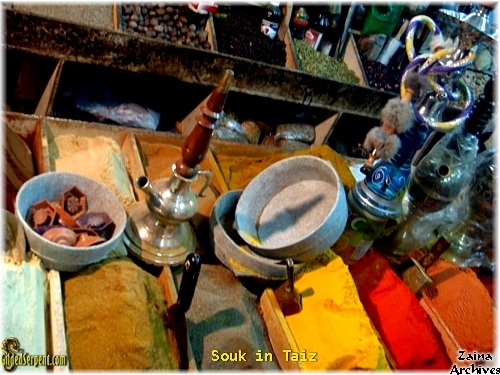
Taiz and Ibb resembled Sana’a, only they were smaller. We went to the souq in Taiz, and it was intense. There was a little mountain right outside Ibb, which offered a nice view down. People were chilling and enjoying Qat and the city lights.

Zaiz Souk

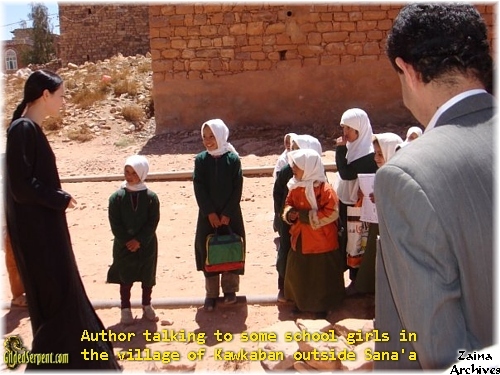
We stopped at a small town called Jiblah. It was like straight from a story book–so pretty. Narrow streets and colorful buildings squeezed each other tightly; this place had character. Our little guide was called Abdo. He was around ten years old, and spoke five languages. It was pretty remarkable to have a Yemeni child show me his town, speaking understandable English.

Once on the road, I called my friend back in Sana’a, gushing about Jiblah and how cute it was. “I don’t like that place”, he said. “That’s where they killed the American doctors.”

Abdullah took good care of me, finding accommodation and restaurants and restrooms along the way, always checking if I needed anything or wanted to stop to see something. At one restaurant, we ordered chicken, and it came as expected, bones and all. I asked for a knife. They tried to find one to accommodate my strange request, but came back to explain that the drawer for such special cutlery was locked and the guy with the key was chewing Qat somewhere. I didn’t have it in me to stick my fingers and face into the chicken, so I was going to skip the whole thing and just settle for rice. Abdullah wasn’t having it, and told them to find a knife. All eyes were on me as staff and customers alike wondered “What’s the matter with the foreign girl; why won’t she eat her chicken?” About twenty minutes later, a knife appeared. The waiter had gone to his house to get it. I ate.

It was dark as we approached Sana’a. Abdullah made a stop to buy Qat to bring home, for himself and his wife. When women get married it becomes socially acceptable to chew with their husband, but before marriage, it is frowned upon. (Supposedly, it might make you horny, but as far as I could see, it just makes you lazy.) As we got to the city he met up with a friend and his wife on the street. In the darkness of the night, I saw the three of them chat, his friend’s wife putting her gloved hand on Abdullah’s arm as she laughed. That was something you never saw in broad daylight. She came over to the car to meet me. I could see the smile on her face, even if her eyes were the only part of her that was visible. She invited me to visit their house sometime. Too bad I was flying out the next day.

The saying “There’s more than meets the eye” is especially true of Yemeni women. So many times, when I heard them talk and giggle behind their niqabs, I wished I could get their side of the story for once.

Despite what you hear in the news, I always feel safe in Yemen. In many other countries, I’d think twice about road tripping alone with a man I’ve never met before, but not here. For a Yemeni driver taking care of the customer – especially a female – is not just a job, it’s a matter of sharaf. Upon whom do you rely for your safety–anywhere in the world? The police? The government? Of course not! It’s the people around you who count. Either they protect you, or they don’t. Therefore, the way I see it, values like sharaf go a long way.
As I packed up and got ready to leave, I was very content with all the places I’d been able to fit into my ten days. I was already looking forward to the next time. There’s a lot of Yemen left to see, and I can hardly wait.


use the comment box

Have a comment? Use or comment section at the bottom of this page or Send us a letter!
Check the "Letters to the Editor" for other possible viewpoints!

Ready for more?


Tags:

Gilded Serpent presents...

How I Met the Tuzsuz Family in Istanbul

Elizabeth in Istanbul

by Elizabeth Strong
posted February 29, 2012

I met two American women at a restaurant in Sultanahmet (a tourist district in Istanbul) back in 2000. I was traveling with my boyfriend at the time. After some conversation, these women invited us to a Sufi zikker for the following Sunday. We took a bus out to Eyüp (another district in sprawling Istanbul) on a Sunday, and arrived at a 400-year-old home with an ancestral tomb near the street and a large meeting room where the zikker was held. That day the ceremony consisted of singing and chanting, followed by socializing over tea and cookies. I was introduced to Sinan Erdemsel, the grandson of the last sheik of that order of Sufis, and an excellent musician. I mentioned my desire to learn about dance and music, particularly Rom (gypsy) style.

He invited us to meet his friend, Hüsnü Tuszuz, a Rom violinist who was to play at a restaurant in Beyoğlu the coming Wednesday. We went to see Hüsnü play in an upstairs restaurant on Istiklal Cadessi, and met him that same evening. Hüsnü spoke no English, while Sinan spoke English quite well, so Sinan helped me to arrange a dance lesson with Hüsnü’s wife and neighbors.

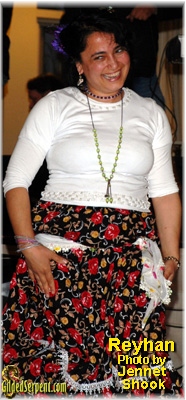
I took a bus to Gazı Osman Paşa (the next township out from Eyüp) and met with Hüsnü in the main square. He walked me down a few streets and eventually led me down a sketchy cement staircase with Kırımızı Gül Sokak (Red Rose Lane) sprawled in red paint on a wall. We made our way down the steps carefully, and then I looked up to see shanty houses on the little hillside, and clotheslines hanging across yards. It was kind of strange that this little hillside community existed among all the tall apartment buildings; it seemed to me like its own little world apart from the rest of the city.Reyhan I was led into a two-room house, and it was just exactly that: two rooms. One room for cooking and showering, and one for sleeping in at night and entertaining in during the day. Reyhan entered and yelled at me in Turkish. All I could understand was that she was indicating the house we were in, and remarking how great it was because it had two rooms. She and another woman then led me into the other room and sat me down on the couch with a glass of orange soda.

They put on some music (a çiftitelli, I think) and started to dance. In retrospect, I think they thought I wanted a show, or something. But I quickly got up and managed to communicate to them that I wanted some 9/8 music by pointing to the cassette tape and saying “nine” and “eight” in Turkish ("dokuz sekiz!"). After a little confusion, they found a song with a 9/8 rhythm and started to dance differently than before.

I immediately got excited and tried to follow their dancing. I started to write moves down in my notebook. My excitement seemed to egg them on and they started showing me more and more stuff.

The end of this first visit was a little strange. One of the kids ran into the room with a bag of food and sat down in the middle of the room. Everyone there began to eat as if they were ravenous. I sat by politely and didn’t eat anything – it didn’t seem appropriate. Even after awhile when Reyhan offered me food with a look on her face that clearly showed she hoped I would say ‘no’ I politely declined. After that, when I was paying for my lesson, they charged me for an hour and a half, instead of the agreed upon one hour price, even though I didn’t have a way to keep track of time during the lesson.

The next time I saw Hüsnü and Sinan, I bargained for an hour and a half long lesson for the original price and promised to come back at least six more times. Over the course of the following weeks, there were increasingly more neighbors, aunts, cousins and daughters coming to my lessons, both to watch and to dance.

One day, Reyhan brought me to a different house with a few women, but without the first woman I had met her with. In the middle of the lesson, this other woman came into the house looking upset, and there was some sort of discussion between she and Reyhan. After that, I had my lessons just with Reyhan and her two daughters, Meltem and Gülüzar, in yet a different house on the same hillside. By my last lesson and visit with the Tuzsuz family, they were feeding us meat and vegetables, tea and biscuits in their home and waiting on us like guests and friends. To this day, whenever a student comes to study with Reyhan or Husnu, it is often an afternoon long event that includes visiting over chai and food.

As for taking lessons with her – her teaching has improved over the years and her repertoire has expanded (although her large movement base was what attracted me to her as a teacher in the first place, so it has always been extensive).

She works on her dance often and is marvelous at it. Taking lessons with her is largely just following for dear life what her feet, hips and arms and shoulders and head are doing. She has become a much more popular teacher over the past several years and charges more than she did at one time. I understand. I think their family have come to rely on Reyhan’s teaching income by now, and it has afforded them the ability to stay in Istanbul while many other Roman are being forced out due to land development.

At the moment, the little hillside neighborhood on Kırımızı Gül Sokak (“Red Rose Lane”) is all but gone. The same thing is happening in Istanbul’s most famous Roman neighborhood, Sulukule. The Tuzsuz family and many others are looking for new homes. A great youtube video regarding this:


use the comment box

Have a comment? Use or comment section at the bottom of this page or Send us a letter!
Check the "Letters to the Editor" for other possible viewpoints!

Ready for more?

 
Gilded Serpent presents...

Veiling in the Desert

Moving to Egypt to Study Bedouin Dance, Culture, and Language
…and Maybe to Buy a Camel!

Shema performs for the Bedouin

by Shema
written February 8th, 2012
posted February21, 2012

I was a little nervous about dancing in front of the Bedouin musicians. Although I had been itching to get up and dance all evening, a fear of causing offense or of behaving inappropriately in some way had stopped me from asking. Finally though, it was too much and at the first hint that they were happy to play for me, I leapt up and flung my scarf around my hips. Internally at least…in reality, I slowly rose to my feet with slightly shaky legs and took as long as possible to tie my scarf whilst I tried to remind my body to breathe and dealt with the fact that all of a sudden I could only remember 2 moves.

Even after 12 years of dancing, the nerves never fail to make an appearance! It was an incredible night though: dancing on hand-woven carpets under a Bedouin tent by the edge of the Red Sea;  a myriad of stars glittering above; clapping from the audience of Bedouin and European tourists, the tea flowing freely; the smoke from the fire drifting into my eyes when I danced on the left-hand side; my head brushing the woollen roof every time I stood up straight; my toes getting caught in the rugs when I attempted to turn…ah yes, the glamorous life of a dancer! 

As the night wound down and people drifted off to bed, I stayed and quietly danced to myself in a corner, wrapped in my Moroccan Jellabah (it gets cold in the desert in November!), gently exploring the music without an audience. Or so I thought. After a while, I was called over to the fire by one of my students who had been talking to a young Tarabin Bedouin who has grown up in the camp with Europeans, speaking five languages fluently and switching seamlessly between two very different cultures. He asked me “What are you dancing?”, “Bedouin dance” said I. “No, no, no! That’s not Bedouin dance” said the boy with a laugh, “that is bellydance;  Egyptian dance”. I confess to feeling a moment of complete panic. So what exactly had I been learning in the UK? We spoke a little more as, although feeling naturally defensive, I was more intrigued to find out where the divergence in information or style had occurred. We eventually came to the conclusion that the style I had learned was probably from the North, around Cairo, where the young women are more heavily influenced by Egyptian dances; although he himself had never witnessed it. 

“I will take you to my sister; she will show you what real Bedouin dance is”. Now, how can a dancer ever refuse an offer like that?! I waited a few days until the rest of the group had trundled off on camels into the depths of the Sinai desert and finally arranged the long-awaited visit.

‘Long-awaited’ because it was not my first contact with the Bedouin culture and dance: this was the second of two trips taken with Chas Whitaker and Maren Lueg – initially as a guest in 2009, when we also visited Cairo, and then this second trip as they had invited me to teach on their music, drum and dance holiday at Rocksea Camp in Nuweiba.  Looking back at my journals from that first trip, I have found a comment from my last day: ‘I love the idea of basing myself there […] dancing, studying the Bedouin culture, playing music and learning Arabic’. I haven’t looked at those journals since they were written, so there must be something very special in the Sinai for it to keep drawing me back, even after years have passed. It is also comforting that after everything which has occurred over the last few years, I still have the same essential goals for my dance career! During my past two trips to Nuweiba, I have spent many hours in various houses across the village: drinking tea and trying to speak Bedu Arabic with the women and girls; looking at wedding photos; feeding the goats; and eventually- once the men were out of the way and the doors and windows locked- being pulled up and draped with an Abaya (a rectangular piece of black fabric, often decorated with sequins in the shape of palm trees, hearts, or fish) to dance a new and strange dance which bears little resemblance to any Egyptian style I have learned over my years of research.

Inevitably though, there is more to this than just a whim to learn Bedouin dance.  The economy in the UK, like in so many places, has plummeted and inevitably, the public is less willing to spend on anything which they consider to be a luxury; including dance classes, workshops, and performances at weddings or parties. I have spent the past three years since returning from living in Toronto, fighting to rebuild my business in the UK, but if I am totally honest, I no longer have the energy to compete with ‘wiggle and giggle’ classes,  or the myriad of so-called professionals who will happily perform for £20 a night (approx. $30).

After spending more than a decade developing my knowledge and my skill base, I am not willing to devalue myself and the art form, for such a ridiculous and shameful fee. The chance to live in a place where I can learn to connect with the culture, develop my language skills, and perform for fees which at the very least reflect the cost of living around me, is, I believe, an opportunity which I just cannot ignore.  And I need to perform. This is not an idle need for adulation but the tug of the stage for an artist, the neglecting of which frankly makes me miserable and depressed. I prefer to risk everything on the chance of progress than to sit here and wait for things to improve. Bakra the Camel

After all, the most exciting art and writing comes out of times of intense stress or even social unrest. For once in my life, I want to be at the cutting edge, to push myself as a dancer, artist, musician and writer.

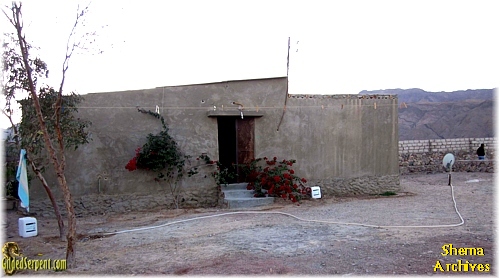
Therefore, I will return to Nuweiba at the end of March- just before it starts to get too hot- and will settle myself into a Bedouin house which I have rented. It is built out of concrete, with wooden doors and windows. There is no flooring, no furniture or lock on the door, the water is not connected and the toilet is a hole-in-the-ground (I confess, this is first on my list to change!). There is, however, electricity, a satellite TV and even a twin-tub washing machine. Oh yes, and a yard big enough to house a camel and a goat! I will continue to study the Tarabin dance with the local women and will spend time with them in our houses, learning the language and in return teaching them English (whilst the men are often fluent, the women generally stay at home and so do not have the same contact with tourists in order to learn or practice other languages). I am in discussion with hotels and other local dancers for cabaret shows (although sadly in Sinai there are few opportunities to work with live music, something which I intend to challenge), I will offer private tuition in my dance studio in the house and also workshops for tourists, in the desert with the Bedouin musicians. Of course, there will be regular trips to Cairo to meet with dancers, take classes and buy costumes. I also intend to travel across the Middle East extensively, to learn about the culture, music and dance in places such as Israel and Jordan, Alexandria, the North coast of Egypt and Sinai, Luxor and, well, anywhere else I am invited!

It is a dramatic change and although I am extremely excited, I am also realistic about the situation, constantly watching the news and speaking to my friends in the area. I am also scared!

This is going to challenge me physically, emotionally, professionally, and culturally. But if I am totally honest, as an Egyptian dancer, this is going to be a dream-come-true. A dream which will no doubt be filled with doubt, heat-stroke, stomach upsets, loneliness, language difficulties and perhaps with a small risk of abduction, but, it is my dream, so I will take the rough with the smooth.

Almost as soon as I announced my plans, I was bombarded with demands for regular updates, so I have set up a daily blog which is initially about the process of leaving my home and entering a new culture, and, once in situ, will contain observations on my dance experiences as well as a separate page for Bedouin culture, and life. It will be a great way to document and remember this journey, so I am grateful to those of you who have pushed me into writing it!

Gilded Serpent has, as part of this, kindly agreed to publish regular articles where I will delve into those elements which deserve more attention and detail than a blog can provide, bringing together all of my experiences in the Sinai on a deeper level. I look forward to this entire experience with a mixture of trepidation and exuberance, and with only a few weeks left until I leave, no small amount of panic at how much I still have left to do!

My House in Tarrabiin

More soon!


Resources:
Chas Whitaker (www.arabicdrum.co.uk)
Maren Lueg (www.arabicmusicband.com)
Rocksea Camp (www.rocksea.net)

use the comment box

Have a comment? Use or comment section at the bottom of this page or Send us a letter!
Check the "Letters to the Editor" for other possible viewpoints!

Ready for more?

 
Gilded Serpent presents...

The End of the Banat Mazin?

Struggles with Religious Fanatics,
Real Estate Management , and Other Ghawazi

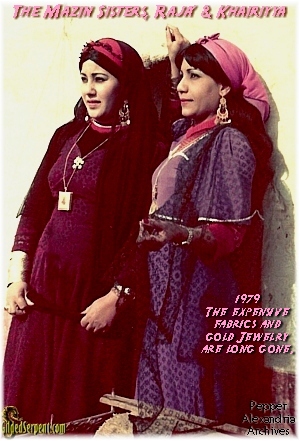
Khairiyya and her father Yusuf, 1979 from Pepper's archives

by Edwina Nearing
A portion of this article was published in Habibi Magazine in 1993
posted February, 2012

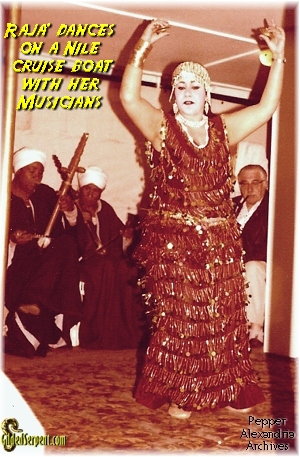
Yusuf Mazin, a Nawari Gypsy, had wandered the land dealing in livestock, entertaining the villagers with stories, delivering messages and generally making himself useful until his non-Gypsy wife blessed him with five beautiful daughters.  Beautiful, talented daughters who could master singing and dancing — the arts of the ghawazi, as such women were traditionally called in the countryside — were the best hope for the prosperity of a Nawari family in Egypt.  So as soon as Yusuf’s oldest daughter, Su’ad, was seven years old, she was put on stage behind her aunt Labiba, a famous dancer in Yusuf’s home province of Qena.  The other daughters, Fathiyya ("Touha"), Feryal, Raja’, and Khairiyya, the youngest, were served similarly, although Khairiyya, from the age of ten frequently requested to take a turn in mufti at stick dancing, for which audiences had somehow discovered her extraordinarily gifted, was allowed to stay in school until the age of fourteen.

By the mid-1970s the Banat Mazin — "Daughters of Mazin" — were as famous in Qena as oriental dance star Najwa Fu’ad was in Cairo.  The girls wore wide gold bangle bracelets, and usually at least two of them shared with Yusuf a comfortable, spacious house from which he reigned over a peaceful Dandara Street near green pastures on the outskirts of Luxor.  Yusuf prepared stuffed, roast pigeon for honored guests like Cecil B. DeMille with his own hands; fair-voiced Su’ad recorded audio cassettes in Cairo; she, Fathiyya and Feryal sang and danced in the Egyptian film Al-Zauja al-Thania; and Khairiyya portrayed a Napoleonic-era ghaziyya temptress in a French dramatic production.  Fathiyya and Feryal finally married wealthy men and retired.  Even in winter, the "off season," the remaining girls often had more work than they could comfortably handle.

Tahtib and dance with Su’ad, Fathiyya and Ferial singing
and dancing in the 1967 film Al-Zauja al-Thania

Then, in 1985, Yusuf Mazin died, and everything fell apart.  There were wars and rumors of war; religious fundamentalism gained the upper hand in Egypt and the government caved in to the "fundos" professed hatred of dance.  Tourism and the economy plummeted.  Su’ad retired.  Fathiyya died of cancer; a brother died mysteriously after his family perished in a fire.  Raja’ married the personable non-Gypsy proprietor of a large souvenir shop that eventually went out of business from the decline in tourism, after which they became economic refugees, always on the move one step ahead of the latest landlord.  By the early 1990s there were no more "Banat Mazin" — Khairiyya was alone.  Khairiyya gave in to the blandishments of a persistent admirer who had pursued her for decades, the youngest son of a powerful family who was wont to dissipate any money that came his way — including Khairiyya’s — on drink and drugs, but predictably the marriage foundered. 

Khairiyya, fearing to end up a madwoman begging in the streets like her aunt Fahima, was now struggling to finish building a small house on the edge of Luxor. I remembered Fahima as the wraith-like figure whom I had seen acting as chaperone and luggage guardian during the girls’ performances in 1976. But Khairiyya held in her mind the image of the mad beggar. “Al-sura da’iman quddami!” she had once told me in a small, shaking voice, “The image is always before me.” She was determined not to become another bunch of black rags in the street, but she ran out of funds before she could complete building her house.

Sisters Bazin
Khairiyya’s eldest three sisters Fathiyya, Ferial and Su’ad
(from left to right) in the 1960s

When I arrived in Luxor in the winter of 1993, I found Khairiyya sitting on the floor of the unfinished, unfurnished house, trying to keep warm in front of a small brazier of coals.  Wisely, she had not stopped working while she was married, telling her husband, "Either you support me or I work."  But there was no work, and scarcely any ghawazi to do it.  The nearest ghaziyya was a Bahlawaniyya in the provincial capital, Qena City, about an hour’s drive away, who had been blinded in one eye by accident during a knife fight — a good dancer, Khairiyya said, but unable to work with another dancer in a duet or follow cues and hence not very useful for performances.  (The Bahlawan, the Mazins had told me, were another distinct ethnic group like the Nawar, with their own language, of which the Mazins had been able to learn only one word, gorwa, "money."  Many Bahlawan were dancers.)

Khairiya upheld the honor of her family by making me a luncheon of stuffed, roast pigeon during my stay in Luxor, a la instar Yusuf Mazin, and when I left for Cairo late one evening, unable to find a carriage, insisted on accompanying me to the train station on foot and carrying one of my two suitcases.  My last sight of her was of a small form picking its way down the deserted railroad track in the darkness, eerily reminiscent of the doomed ghaziyya movingly portrayed by Majda al-Khatib in the final scene of the movie Musafir bila Tariq (Traveller without a Road).  When I reached Cairo, I did not stir from my hotel room for two or three days until I had finished the following article for Habibi Magazine.


"Ghawazi on the Edge of Extinction" (1993)

Researching the traditional arts of the Middle East is a bit like salvage archaeology — one races ahead of the bulldozers to save what cultural remains one can before all is crushed into oblivion.  Economic pressures and the lemming-like rush toward westernization have induced the peoples of the Middle East, like most of the world, to turn their backs on their own rich and diverse cultural heritages and to build themselves, literally and figuratively, shabby cement boxes to house body and spirit.  In the process, many of the Middle East’s curious and beguiling arts, crafts, customs and environments have already been lost.  A few researchers scramble to record what yet survives, both for its own sake and for the delectation and inspiration of a future which, they hope will value it more than does the present.

Middle Eastern dance, that most curious and beguiling of arts, still survives in its homeland, perhaps because there it is a "social art," and Middle Easterners in general are very social people.  Dance in the Middle East celebrates war and peace, birth and the other passages of life; affirms the solidarity of the family, the tribe, the people; even effects oneness with God or the All, in the Muslim dhikr, sema‘ and hadra ceremonies.  The line between spectator and participant often disappears; dancers, musicians and audience are interchangeable when the call of the blood, the rhythm of the pulse, the heartbeat, breaks down social barriers.  In the ancient Middle East, and among the Arabs before Islam, the blood was the life, and the qaum — "the people," the Arab tribe — dances the dahiyya to the rhythm of the blood.

But it is moot whether Middle Eastern dance will continue to endure in any of its traditional differentiated forms.  The tribe, be it Arab, Turkic or Berber, appears to be breaking up, although it would be premature to consign it to history as some have done, for the qaum’s blood runs deep. 

Dinet's Ouled NailThe same forces which have weakened the tribe have struck at the dance in the Middle East; westernization and economic pressures have largely destroyed many of its forms, its practitioners and its venues.  Where, for instance, are the notorious Ouled Nail who haunt the paintings of Dinet and emptied the pockets of Foreign Legionaries in the "Restricted Quarters" of Algeria only 40 years ago?  Where Syria’s dazzling Sayf wa Turs dance-duel, its clash of sword on shield mingling with the shrill ululations of female onlookers?  Still, the blood of the qaum runs deep — the bedouin have not entirely relinquished their dahiyya, nor the tenacious peasantry of Egypt ceased to hire those women of mysterious origin, the ghawazi, to sing and dance at their festivities. 

So we trek to Luxor to see the ghawazi, and take for granted the steady but slow decline of what remains of the region’s traditional dance arts.  But now an old enemy, religious intolerance, has joined hands with the modern forces arrayed against the dance, threatening to turn a slow decline into a fatal hemorrhage.  More than once in the past, a relatively few but violence-prone extremist adherents of Islam, the Middle East’s dominant religion, have caused dance, sometimes even music, to be banned and harried its practitioners.  Heretofore the rhythm of the blood has always proven stronger than the brief spasms of fanaticism and repression.  Now, however, religious intolerance has strong, new allies: world recession, undercutting financial support for the arts; inflation, increasing the price of admission to venues showcasing professional dance to beyond the reach of most pockets; infatuation with the powerful West, rejecting things Eastern and embracing things Western in hopes that some of the West’s perceived power will rub off; the spread of technology, making it cheaper and easier to watch a videotape at home than to dress up and buy a ticket to an expensive dance show; even overpopulation, skewed heavily toward an unproductive and growing majority under 25 years of age, mostly the impoverished children of teeming cities, raised on American television soap operas and cut off from their own cultural heritage.

Dance cannot be legislated or coerced out of humanity, but as we have seen, specific forms of dance can perish, along with all their associated traditions and accessories.  For the last two years or so — at least since 1991, if not earlier — the ghawazi have been a focus for the hostile forces converging on the dance in the Middle East.  The ghawazi are the famed traditional, largely hereditary female entertainers of the Egyptian countryside, and ghawazi dancing, which is attested to in literature for several hundred years, is the primary source of the Egyptian danse orientale or "belly dance." 

A century and a half ago most of the professional dancers of Egypt in both the cities and the countryside were referred to as "ghawazi;" now the term is used in Egypt to describe the dancers of the countryside who still perform in the old manner, who have not added anything to their repertoire from ballet, Latin American or modern dance as have the "oriental dancers" of the city nightclubs.

The ghawazi are also distinguished by being largely, though not entirely, of non-Egyptian and non-Arab origin.  The early 19th century orientalist Edward Lane, in his book An Account of the Manners and Customs of the Modern Egyptians, called them "a distinct race" who "sometimes make use of a number of words peculiar to themselves."  My own research among the Mazin family of Luxor, which for many years have provided the leading ghawazi of Egypt, confirmed what I had come to suspect, that the ghawazi contain at least several obscure ethnic groups; the Mazins listed Nawar, Bahlawan, Halab and Shahaina.  Each group, apparently, has its own language; the Mazins, who are of the Nawar, claim that their language is unrelated to any of those spoken by the other groups.  The small Nawari vocabulary I have collected demonstrates some affinities with Hindi, suggesting that the Nawar may have originated in or near India, probably North India or Pakistan, consistent with researchers’ identification of the Nawar as Gypsies.

Ghawazi are still in demand in the villages of Upper Egypt to perform for the same functions for which, according to Lane, they were employed over 150 years ago: engagement parties, weddings and circumcision celebrations.  It is thought to bring honor to a family to provide a ghawazi show for the people of the village at such auspicious times; in Upper Egypt, from three to five ghawazi — even more if finances and availability allow, which is no longer the case — are hired to perform virtually all night, usually on a high wooden stage built outdoors especially for the occasion.  The ghawazi of the Luxor area, most conspicuously the Mazins, also carry on another tradition recorded by many 19th century travelers, that of performing indoors or on Nile boats for private parties organized for tourists visiting the pharaonic monuments that abound in Egypt.  These take place mostly in the "off" or "cold season," from November to April, when the weather is more agreeable to foreigners; the rest of the year, the "warm season," is preferred by Egyptians for the outdoor festivities at which the Mazins and other ghawazi perform.

But now, in January of 1993, there are no ghawazi performing in Luxor.

The economic situation, the videocassette recorder, and the soap opera syndrome have taken their toll of the ghaziyya’s popularity of late, but when I visited Khairiyya Mazin early last year, she and her sister Raja’ performed at least five times during the week or so I was in Luxor, and it was clear that they had lost none of their skills.  One of their performances, for a group of middle-age Finnish tourists who appeared to have imbibed too much beer, was barely adequate, but another, for a minuscule group of American dance enthusiasts, was superb.  Their slow movements in the dance, accompanied by sighing violin-like rababas, had the mesmerizing, self-absorbed languor of an odalisque in an orientalist painting, and seemed to slow down Time itself. 

Their fast work was infused with such energy that the dancers seemed to vibrate, and they "played off each other" — subliminally took cues from each other’s movements as they improvised, and meshed accordingly — such that at times it was as if there was an electric current running between them, a marvelous tension that hypnotized the onlooker.

Mazin SistersI had entertained some thought of working at least part of the "warm season" with Khairiyya and Raja’ as I had in the past; their sisters had retired, leaving just the youngest two to carry on, and the villagers preferred to hire groups of three or more ghawazi for greater honor and a braver show.  Of equal importance to Khairiyya and Raja’ was the respite that a third dancer would give them — the village performances average five to seven hours in length, with no intermission, so the more the dancers, the less the workload on each.  But Khairiyya had disturbing news.  The authorities in the provincial capital had outlawed public dance performances in the villages where they were most popular.  Although it was not clear to me at the time, I suspect that such performances had been, or at least are by now, banned throughout the province, although it may in some cases be left to the discretion of the local authorities in the various districts to enforce the ban, for Qena Province is large.

This was disheartening news to me, not so much for how it affected my own short-term plans, but for what it meant for the survival of the ghawazi and their art.  Over the years I had seen village after village close its doors to the farahat, the great public celebrations of weddings and other happy occasions of which the ghawazi were the centerpiece and which, like fairs, attracted visitors from surrounding areas.  Indeed, it was the very popularity of the farahat which contributed to their downfall, for in the crowded excitement of the night, with beer often freely available and firearms being discharged in the traditional Arab "joy shots," fights sometimes broke out.  It was not unknown for an outsider in a state of vendetta with an individual or family of the host village to take advantage of the farah to attempt a revenge killing.  So it was that the dominant factions in some villages had ended the great public dance farahat, and it was not unnatural for me to assume that the central authorities, in the name of law and order, had decided to ban them entirely.  "But it will take more than a few policemen to keep the Sa’aida — the unruly people of Upper Egypt — from their wonted pastimes," I tried to reassure myself, uneasily aware that Time itself was against the ghawazi, that with increasing westernization, the traditional farahat had already been losing popularity.

"And why have they banned the farahat?" I asked Khairiyya.  "The Islamic fundamentalist groups.  They want to forbid dancing, stop tourism, and," she added disgustedly, "make women cover themselves completely, even their faces!"  To all Middle Easterners, the term munathamat islamiyya (Islamic organizations) had come to signify a major destabilizing force in Middle Eastern society, for good or ill, depending on their viewpoint.  To many, it simply means "those dangerous religious fanatics."

Extremist members of the munathamat, the irhabiyyin, or "terrorists," had attacked "godless foreign tourists," killed Egyptian policemen, and broken up farahat, sometimes precipitating bloodshed.  In Cairo, it was rumored, irhabiyyin had thrown acid in the faces of oriental dancers.  Everyone lived under their threat.  The authorities in Qena didn’t care to give them any excuse for violence; indeed, the munathamat had sympathizers, even members, among the Qena authorities and constabulary.  A few Sa’aida continued to hold public farahat in defiance of the munathamat and the new regulations, especially in the far north, in the region of Al-Balyana, but the 1991 "warm season" had been a disaster for the ghawazi.  The Banat Mazin had been virtually unemployed.

"Ta’ishi zayy?" I asked Khairiyya.  "How are you surviving then?  How will you finish building your house?"  The house was the equivalent of a narrow one-bedroom apartment in the West; after her father had died in the mid-1980s, the Mazin family house had been sold and Khairiyya had to fend for herself, all her sisters being married at the time.  She had rented a modest flat, scrimped and saved, and finally been able to buy a tiny piece of land on the edge of town.  She hoped to build a second story to her house and reside there so that she could rent out the first story; the rent would be a sort of "social security" or pension when she became too old to dance.

Khairiyya assured me that although she could no longer work at the farahat, opportunities for work within the town of Luxor itself had increased dramatically.  Travel agencies, hotel management and restauranteurs had finally awakened to the fact that the hordes of tourists who descended on Luxor during the winter to see the tombs and temples of the pharaohs wanted something to occupy their time in the evenings too, and that there could be profit in it.  The folkloric shows which for years had been presented regularly at the Winter Palace, Luxor’s oldest large hotel, were proven crowd pleasers, and the other big hotels had slowly followed suit.  Perhaps the occasional groups of Middle Eastern dance enthusiasts who have been coming to Luxor over the last decade or so and arranging their own ghawazi parties also gave the movement a nudge.  Now everyone in tourism, it seemed, had gotten into the act, and there was enough work in Luxor to keep the ghawazi fully employed, at least in the winter — dancers were even being brought from Cairo.  Hence I was able to see several performances by the Banat Mazin during my brief stay in Luxor in 1992, and I had reason to hope that the ghawazi would survive for a while longer.

Within minutes of my arrival at Khairiyya’s house in January, 1993, I learned that my hope was ill founded.  "Everyone is forgetting the karama — the honor, the high prestige — of the Banat Mazin," Khairiyya lamented.  "No one respects art anymore.  The town is full of belly dancers from Cairo and Al-Minya; no one asks for us… " 

Khairiyya at homeShe had no work, so she had allowed her licenses to expire, papers without which a dancer is not permitted to work in Egypt and which have to be renewed yearly: the expensive 200 L.E. license from the Ministry of Tourism, the license from the ‘Adab (the "vice squad") and all the others with which Egyptian bureaucracy burdens the performing artist.  Her sister and performing partner Raja’ had married a well-to-do gentleman of the town, leaving her without anyone to work with who knew the Jihayni, Nizzawi and other dances that require more than one person.  Khairiyya was trying desperately to finish her house so that she could let the downstairs portion; later I found that she had no money to finish the work, and had already received and spent a deposit on the downstairs apartment, which she would have to vacate when the new tenants took possession in another month or two.  The upstairs apartment, to which Khairiyya was supposed to move, was still half-mortared walls and rubble.

That evening and on subsequent ones, we huddled around a clay pot full of burning charcoal in the smallest room of the house, wrapped in layers of clothing and blankets, and I heard more.  Khairiyya apologized for the brazier; she had had to sell her electric space heater; her television and refrigerator also, I had noticed, were gone.  She had tried to work the previous summer at the farahat which some Sa’aida in the distant Al-Balyana area still attempted to hold in defiance of the law and the munathamat.  The ghawazi in that area, she said, were mostly of the Bahlawan rather than her own people, the Nawar, who referred to them by the Nawari term sharistiyya, "thieves."

As it took nearly all day to reach Al-Balyana from Luxor by the cumbersome local transportation system, Khairiyya took up residence with Umm Hashim, a prominent ghaziyya of Abu Shousha, the ghawazi quarter of Al-Balyana.  "To see her on stage, you would say she was a queen," Khairiyya said, "but she was dirty — she stank!"  As did all the ghawazi of the area, in my friend’s opinion.  Umm Hashim’s bathroom was so filthy that Khairiyya was hard put to bathe after a performance; she didn’t even want to touch the cushions on the divans, let alone recline on them, for they too stank.  She lasted a week with Umm Hashim; "seven days in hell," Khairiyya said.

The "sharistiyya" comment was explained.  Khairiyya’s Bahlawan "colleagues," as she called them sarcastically, had stolen most of her costumes, wigs, and other things of value.  But her days among the ghawazi of Al-Balyana were numbered anyway, for after a few performances the police raided a farah and dragged her and her "colleagues" off to jail where they all spent the night shivering in the cold in their costumes.  One officer told Khairiyya that if he caught her again, he would kill her.  Then she was formally arraigned, "as if I were a great criminal, a public enemy, and not an artist."  As her experiences in Al-Balyana did not augur well for her future in the area, she reluctantly decided to give up the farahat there.

I asked Khairiyya if the ghawazi of Al-Balyana were still working.  So far as she knew, they were.  "The police catch them and imprison them one day and they just appear somewhere else the next."  And the people of Hamadat, Qenawiyya, and the other villages in Qena where the Mazin ghawazi were popular, were they still hiring dancers for farahat?  They were, a little, and when I wondered aloud that the villagers were not afraid of the authorities, Khairiyya said that they kept a sharp watch for the police and as soon as any were sighted the villagers would "grab the dancers and throw them into the cultivation " — the fields of sugarcane or whatever around the village — to hide.  This, however, was dangerous; it was too easy for a dancer alone in the dark, in the fields, to be harassed or even attacked, especially in the excitement of a raid.  At any rate, Khairiyya sighed, her health was not good and she couldn’t endure much of this sort of treatment.  Her sister Su’ad later told me that the police of Qena had specifically warned Khairiyya not to work in the area, claiming that they could not protect her from the irhabiyyin, the terrorists. 

So Khairiyya had passed the long "warm season" with little work and less income, hoping that the winter tourist season would be better.  But winter found Luxor inundated with oriental dancers from Cairo, dancers whom she claimed were sahilin,"easy," willing to exchange sexual favors for work or gifts and to perform in any venue, under any circumstances. 

Su’ad said that some of these dancers tried to pass themselves off as folkloric artists by wearing folkloric costumes, but she wasn’t impressed, saying that they ruined the visual effect with "foreign-style make-up and hair-do’s."

Dance on the Boat She thought that they had come down from Cairo out of fear of the irhabiyyin.  I thought that it was more likely that they were just looking for steady work and had heard of the demand for dancers in Luxor.  Whatever the reason, their numbers and easy availability had driven out the true folkloric artists; even the local musicians had turned against the Banat Mazin, Khairiyya claimed, preferring the more accommodating dancers from Cairo.  And the favor of the musicians was important for obtaining work in Luxor, as most employers in the town, often inexperienced in the entertainment business or from outside the area, left it to the musicians to recommend or provide dancers, unlike the Sa’aida of the countryside who knew their dancers and contracted with them directly.

Khairiyya was now the last ghaziyya in the Luxor area, her own relatives having married and retired.  And she, accomplished exponent of an antique art, she, still young, whose arms and neck had once been draped in gold, could no longer support herself.  In desperation she was considering an arranged marriage but, as she said, "How can I know if the man is good?  I would rather work for a thousand years than live one day with a man I hated."  Nor did she really want to "sit at home all the time and get fat and forget how to dance."  She had told me just the previous year that even if she were comfortably married she would not wish to stop working entirely, both to maintain a position of strength from which to deal with her husband, "and that the fame of the Banat Mazin not perish."

I tried to think of something that would assure her of an adequate, reliable income and enable her to remain in her chosen field, something, moreover, that might improve the odds that the dance of the ghawazi would survive for a while longer in spite of all the forces which were gathering against it like an unlucky conjunction of the planets.  An answer lay ready to hand, suggested by a recent encounter with a Swedish dance student on her way to Luxor who had asked me if I knew of any ghawazi who might be willing to give dance lessons.  I had given her Khairiyya’s address with a note of recommendation, confident that Khairiyya, who had helped me to learn something of ghawazi dance and seemed to have an almost telepathic ability to understand foreigners despite her ignorance of Western languages, would oblige.  The student had never appeared, but the idea was good — the Swedish student had not been the first to ask me about ghawazi dance lessons.  I broached the idea to Khairiyya, and she was enthusiastic.  We settled on a rate if 60 L.E. — about U.S.$18.00 — for an hour-and-a-half lesson, in accordance with what was charged by oriental dancer Nadia Hamdi in Cairo.  This would not solve Khairiyya’s immediate problems, but if she could somehow hold on for a few months longer until word of the "Mazin Institute for Folk Arts" spread through the international dance community — well, the idea was good.

If she could hold on.  If the dancers of Al-Balyana could hold on, if the Sa’aida could hold on, if lovers of art and freedom — the two somehow seem intertwined — could hold on.  It must not be thought that Khairiyya Mazin’s story is an isolated phenomenon.  Given the present inimical climate of religious intolerance, bureaucratic obstruction, economic recession, and westernization, similar stories must be unfolding all over the Middle East.  Recent years have seen oriental dance outlawed in countries from Libya to Iran, but oriental dance is an eclectic, ever evolving form, and as such can absorb interruptions, and its suppression in one country merely tends to cause it to flourish in another.  But if the ghawazi are long suppressed, they will likely perish, and if they perish, one of the last major, distinct Middle Eastern dance traditions perishes with them.  The ghawazi arts have proved tenacious, surviving into the late 20th century where others have failed.  If they, too go down the road to extinction, can the remaining Middle Eastern dance traditions, traditions which are the roots of oriental dance, be far behind?

O Believers:  Inna Allaha jamilun wa yahubbu al-jamal
"Verily God is beautiful and loves what is beautiful"
–A hadith

(Revised 2012)
Author’s note:  Khairiyya Mazin is still performing and teaching.
[Ed note- Khairiyya will be in Toronto at IBCC this May 2012, GS will be there and so should you!]

use the comment box

Have a comment? Use or comment section at the bottom of this page or Send us a letter!
Check the "Letters to the Editor" for other possible viewpoints!

Ready for more?


Gilded Serpent presents...

Organic Cycle Enters Taiwan’s BD Community:

2 “Unusual” Taipei Workshops Demonstrate New Trend

Karim Nagi and Kelli Li
Karim Nagi and Kelli Li,
the event sponsor had a great live percussion bridge section.

by Lisa Chen
posted February 13, 2012
Photos courtesy of Kelli Li & Jane Chung
Lisa’s Chinese Translation here
Click here for Traditional Chinese Translation

Taiwan, as one of Belly dance communities in the Asian region where Belly dance has been blooming in the past decade, is no exception from a heavily choreography-oriented mainline trend. Lately, under such atmosphere, there has been also another phenomenon sprouting among local Belly dancers (including dancers, instructors, students, and percussionists). It is a continuing educational approach which focuses on historical and cultural background information–as well as advanced techniques covering different aspects of Belly dance.
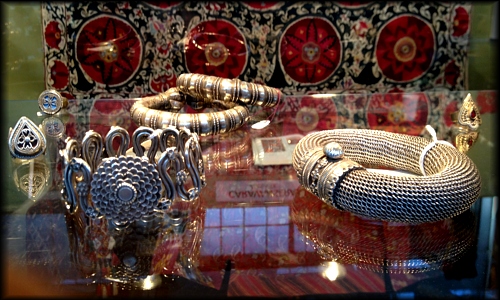
Two Taiwanese workshops that were held recently in late November are excellent examples for this new direction; they were presented by Karim Nagi and Andrea Sendek, respectively. The two workshops shared some characteristics in common but also indicated the diverse sides of this new path.

Part I. Wide coverage of what every Belly dancer should know

Karim Lectures
Karim Nagi gave a lecture to college students at
Fu Jen Catholic University, Xinchuang Dist., New Taipei City

Sponsored by Kelli Li, Karim Nagi, on his third visit to Taiwan, not only gave a series of inspiring and informative workshops with relatively specific topics, but also brought us the first-ever party featuring Arabian music and live drumming for local Belly dancers during his two-week stay in late November.

This type of class is not the usual first choice for most Belly dancers. Karim understood and appreciated this fact. For instance, the playing finger cymbals (zills in Turkish or zagat in Arabic) is not merely use of a stage prop to show off a dancer’s technique; they are instruments with which to respond to music and to make one’s own music as well. It is almost impossible to master playing finger cymbals and performing with them on stage without years of practice and learning. Indeed, in a Belly dance community where the ready-made choreographed dances are a dominant resource and highly demanded topic for a sold-out workshop, what Karim teaches at his workshops is seemingly far too “inefficient” for teaching, training and performing in a short period of time.

I translated for Karim at his five-session workshop in Taipei as well as a campus lecture on Arab music and art at the Fu Jen Catholic University. Although I had translated for him at his workshops in the previous two visits, still, I felt inspired and benefited by his teaching and demonstrations during class. Karim showed the workshop attendees that the music and performing arts in the Arab world are worthy of a life-time of learning and exploring.

Some workshop participants are not newcomers, and not all of them are dancers exclusively. This year, I saw that many young dancers, both male and female, had joined the workshops. In addition to instructors and dancers, we also had percussionists in class. This presence is very unique for our local community since we don’t have many interactive experiences with drummers or other musicians. In most cases, dancers and teachers adapt recorded music rather than using live band music, since it is unavailable.

“Rhythms for Dancers”, “Cymbal Songs” (zill compositions)”,and “Drum Solos” (dancers-drummer communications), are not new topics for this instructor’s workshops. In the past two visits, Karim had covered them already, but this time he offered more material to those who have attended his workshops before as an update. In the “Cymbal Songs ” class, dancers learned different sounds made by finger cymbals. For some, it was their very first time to successfully play the gallop pattern. Karim also guided us to listen to Leilet Hobb (written for singer Umm Kalthum) by explaining that different instruments play solo during certain phrases; therefore, dancers could apply different sounds to respond in kind.

“Music Ensemble Class”, “Maqam and Taxim for Dancers” are new topics for workshop participants. Since we don’t have many musicians available, Karim gave a vocal singing class instead. He taught Gena el Hawa by the legendary male singer Abdel Halim Hafez. While singing the English pronunciations for Arabian lyrics, Karim explained the meaning of the lyrics, and also, he explained the delicate maqams. Maqam (scale) and Taxim (sans-rhythm improvisation) is a relatively new concept for Taiwan’s local dancers. Karim said that 20 years ago including a taxim in your performance was considered to be a must-have for every Belly dancer and now it is rapidly declining because, he explained, “Many think the taxim is too difficult to learn and understand.” There is specific beauty and emotion for each taxim and dancers should understand and properly express the specific emotions they contain.

By the end of this 5-session workshop, Karim said that his teaching was meant to offer insider information and background knowledge for those who love Arabian music and art while providing techniques for dancers to develop their own styles and freely express themselves–without offending the audiences comprised of people who are from the cultural roots of the dance.

As one workshop, a participant commented: in such workshops, she/he “comes to learn how to fish rather than just be fed with fish”. Once you absorb the techniques and knowledge, you have more strength and freedom to better express yourself and your passion toward this beautiful dancing art form.

Signature Tabla Touch Group Photo
linked to larger photo
Signature Tabla Touch Group Photo, Photographer: Pippen Ma
Standing in the back (L to R): two ladies, Little Chou, Amy Ma, Jessica Sun, Dustin Huang, A-vin Huang, Christine Du,

Wen-yi Tsao, Nei-dan Hsu, Hera Dai (male), Sandra Hsu, Yu-ting Hung, Abbie Pan, Hsiao-chien Li, lady in glasses
Standing in the middle row(L to R): Lisa Chen, Shao-ping Lin, Shadow Metis, Sarah Huang, Lan Wang,

Cynthia Chen, lady hidden beside Christine Du, Sophia Chiu, May Liu, Lady in purple top, Carol Cheng (far)
First row (L to R): Kelli Li, Chia-chi Cheng, Pei-wen Bao, Irene Lin, Yu-shan Hsieh, Lina Lin, Karim


Part II. In-depth development for a Belly dancer with serious interest and commitment

Following Karim’s weekend workshops at Taipei, Andrea Sendek, from Suhaila Salimpour’s Dance School in California, came to Taipei as part of her Asian trip to Hong Kong and Taipei.

This time, Andrea gave an 8-hour workshop consisting of three classes: “Folkloric Fusion”, “Layering”, and “Standing Sword Choreography” by Suhaila Salimpour. Many students and attendants felt very frustrated, at first, because they found they were incapable of following the instructions in class, even though they have been training for a period of time within this system. From our cultural background and learning experiences, people sometimes cannot accept the fact that they need to take a longer time and use more effort to achieve what others can effortlessly do.

In this type of workshops, students or workshop attendants don’t come to learn choreographic pieces or techniques created based on Sendek’s own styles and her personal skills. Rather they are “updating” and reviewed within a training system on regular basis. They come to learn something advanced and return home to practice with those materials.

Attending workshops to get certification is not something peculiarly new for the local Belly dance community. Rather, it is common because some dancers require such paperwork when applying for teaching jobs at institutions, such as community colleges. As a result, many workshops with foreign instructors (as well as local instructors) have to provide a certificate stating a certain amount of hours have been spent with a specific instructor of Belly dance. Nevertheless, in addition to such one-shot certifications, there are also certification systems that require a serious amount of time, attention, and training.

For those who attended this workshop, this was quite a new experience that they never had had before: receiving updated information and something new in a system of instruction in which they have been taking training for a period of time. For most local dancers and students, it is nearly impossible to imagine the extent of time and money it take to absorb a technique while one is training to be a Belly dancer. Particularly, those who take a long-term training often don’t show instant change or effects after taking a workshop featuring choreographed dance.

When being asked why they would rather choose workshops like this, most participants said that they want to learn some techniques that could help them to develop better capacity for learning Belly dance while some told me that, with a properly-trained body, they could better execute a choreographed dance piece.


Group Photo after workshop
Back row L to R: Yu-ting Hung, Fi Fi Tsao, Vanessa Lin, Amy Ma, Panny Chou, Tzuling Huang, 高大可, Shao-ping Lin, Shu-hwa Cheng
Front row L to R: Chinghan Chiang, Tzu-Chin Lai, Jane Chung, Andrea Sendek, Purple Peacock, Christine Du, Alison Chiang, Kelly, Lisa Chen


Part III. A positively promising prospective for a sustainable future

Jane and Andrea
Andrea Sendek and sponsor Jane Chung

(the lovely greeting girl: Yu-ting Hung)
Karim
Friday Fever!
The first ever Arabe Dance Party with

live drum at Taipei by Karim Nagi

Indeed, Belly dance is an art form that requires years of study as well as a lot of knowledge. It is not merely some body movements, but an art form with certain cultural, historic, social values, and aesthetics.

We cannot deny the fact that the use of choreography can carry certain short-term functions. It is very easy to promote. Choreographed dance serves as the most convenient visual example for those who are not familiar with the essence of Belly dance. Many entry-level students in particular benefit very much from memorizing a choreographed dance and performing it in order to gain a sense of achievement.

Once Belly dance develops long enough in Taiwan, the local community will face the eventual urge to have this art establish deeper roots and develop. It is not a fashion trend that dissipates as the public curiosity fades away. It demands serious interest and committed passion to deliver the true beauty of an ancient art with certain historical and cultural roots, to which we should pay respect.

At Karim’s workshops, he noticed that most participants are either dancers with certain performance experience, or they are instructors who already have a job teaching Belly dance. I think this is a positive sign that teachers and dancers are willing to invest themselves with broader skills and knowledge other than just reliance upon choreographed dances. One Belly dance teacher even brought her students to attend Karim’s campus lecture about Arabic art and culture.

At Andrea’s workshops, attendants experienced that under a systematic format one could continue polishing and improving their dance so that they are better prepared and are ready for performing both improvisation and choreographed dance. In a way, now, at least, we know there are other aspects surrounding the performing of choreographed dance and teaching: musicality, notation, taxim, maqam, improvisation…etc.

The two workshops were not the ordinary Belly dance workshops with high demand. They indicate that Taiwan, as part of the global community, is stepping onto the path toward a sustainable future and is catching up with other areas and countries–in terms of developing more and better awareness, understanding and respect for this art form. In the end, such continuation of learning will result in dancers and teachers who are more skillful in executing the choreography provided to them and improvisation of their own dances. It will be an organic cycle, ensuring a positive outcome for Taiwan Belly dancers in such a highly competitive dance market.


In Karim’s class "Rhythms for Dancers",

workshop attendants learn to vocalize Arabe rhythms into their body movements.

Understanding and learning to sing Gena el Hewa by Abdel Halim Hafez

A fun time with dabke!

Karim Nagi demonstrated Dabke with some dancers on the campus lecture
L to R: Karim Nagi, Kelli Li, Terry Liao, Lan Wang, Dustin Huang
 

At Suhaila Salimpour Format Workshop with Andrea Sendek


use the comment box

Have a comment? Use or comment section at the bottom of this page or Send us a letter!
Check the "Letters to the Editor" for other possible viewpoints!

Ready for more?