Gilded Serpent presents...

The Festivals That Could Have Been

From the Point of View of an Organizer

Canceled Festival

by Katalin Schafer of Hungary
posted April 7, 2012

In the Summer of 2010, I decided to organise a huge Bellydance festival and world cup competition. I wanted to organise a festival that would show the world the variations and artistic levels of this genre of dance. I had many ideas concerning how to involve the media and attract the public with this program.

Finally, I would like to feel that just once, when someone asks me, "Hey, what are you doin’?" I will not have to answer deceptively that I’m a teacher of ballet and folklore or an Oriental Jazz dancer, so that people recognize the artistic side and do not confuse what I do with, for example, Go-Go dancing.

I would like to create a high-quality competition with the support of television, showing the artistic and theatrical side of Belly dance, and after that, I can say proudly that I’m an Oriental dancer and teacher!

From the beginning, I envisioned that I would need a business partner to accomplish the organisational aspects. I would add my name and creative intellectual work to this project, but the rest of the organisation, such as the business and marketing part, would be my partner’s duty.

For the location, I chose Turkey. Although it is one of the Middle Eastern countries, it is safe, and its capital, Istanbul, is called the “New York of the Middle East”. It seemed perfect!

The first partner I chose was a member of the Turkish political life. With his help, I hoped that we could qualify for subsidies from the state, if there were a framework for cultural events.

Soon of course, it became apparent that there would be absolutely no help from the government, and additionally (according to them) Belly dancing is not considered an art, and and they do not feel that it is part of their culture.

My second partner was a Turkish businessman, and the festival would have been organised in one of his hotels. Consequently, I travelled to there, and we agreed on a date in November of 2011. I worked intensively on the advertising and promotion, inviting such great dance stars as Randa Kamel and Didem. After 2 months of truly hard work, it became obvious that my organiser was not responding to my letters. He was not sending the official company information that would be necessary to start the website.

Later it turned out, that he thought I was “too pretty” to work together, and he would risk his family if he had a woman business partner… and other crazy thoughts…

The festival was cancelled 4 months before the event… but I didn’t give up. I cut the budget and found a Lebanese investor. He was not pleased that I wanted to have this festival in Turkey, but he showed enthusiasm anyway and encouraged me–until that time that he called me saying, "We could sleep together; don’t you think, Baby?"
That was the last straw! Honestly, with all of my heart, I wanted to have this festival! I would like to give a chance to the young, talented dancers. I thought that the Universe had to be with me in a mission like this!

Finally, I started again, alone. I sold my car and my apartment, and I booked the five star Beach Resort with that money, including supplies, the gala room, training rooms, and a whole floor for the exhibitors.

I needed help in marketing, so I looked for companies. From my previous experiences, I chose only those whose owners were women. I tried to create as best I could; I wanted to have a gorgeous festival and competition with unbelievable prizes like 1000 Euros cash, a copyrighted drum solo, a haute couture designer costume, video, photography, and in addition, I found dance managers and club owners to support the festival with dance contracts.

This sounds quite good, huh?

Last night, only 2 months before the scheduled time, I have officially cancelled my big, fat dream festival. There weren’t enough participants! To be exact, there were only 11! Despite the fact that the program and the website visits broke records!

Since then I have puzzled about where I made my mistakes:

1. I shouldn’t have started a huge project like this without beginning a business investment as a simple artist–just to show the world that a woman could do it.

2. I should have considered that (nowadays) there 2 festivals every weekend throughout the world. All of the teachers must travel to every venue sometimes even without compensation.

3. Organisers must remember that Belly dance festivals are not always run for business purposes, but for reasons of artistry, involving extensive and expensive attention to details. There are many entrepreneurs in the dance world who are hoping to create money-making festivals, and therefore, it is likely that heavy financial losses may be the reward for those (such as me) who are focused on the artistic requirements of the event.

April 28, Orientalesque Festival – Berlin
April 28, Cairo By Night Festival – Stockholm
May 2-6, International Bellydance Conference, Canada
May 4-6, Orient Express Festival – Vienna
May 10-14, Mediterranean Delight Festival – Marrakech
May 10-13, Cairo Festival – Budapest
May, Turkish Delight Festival – Istanbul
June, Ahlan Wa Sahlan, Cairo
June, Nilegroup Festival, Cairo
June, Habaib Festival – Cairo
June, Randa Of Course- Cairo

Why do I want to organize a festival?
In my opinion, with more and more festivals, the quality does not rise consistently but may actually decrease. Everywhere, people are trying to accomplish success within a small budget but the media is not interested in these amateur festivals that have been organized in community centers (even though they are international) and only involve a small number of people within the public.

When my festival’s website opened, in the first week, at least 15 teacher wrote to me, saying that he or she wanted to come to teach and would for free! However, those dancers who would like to improve, and learn the dance from a new side, were not demonstrating much interest. There would be many teachers without students to teach!

Most everyone wanted to belong to the stars and be designated and headlined as a “master teacher”, which is absolutely understandable; it was in my thoughts, too. I planned a theater show to be presented at the opening gala, which was supposed to impress the participants and feature me like a new shining star of the Oriental dancers!

If everybody plans and organises events such as this, the festival and workshop genre (which in the beginning was forged out of the love for the Oriental dance) will continue declining in public interest and in motivating and promoting artistry as well.

How can we save this dance and raise it to a worthy place in the eyes of society?
The answer is very simple. We must put aside our egos, even though it may be difficult or even impossible as an artist. The success we would like to experience may lie beneath our feet; we do not notice it because we have already crossed it, and because we are not satisfied, or happy, and always want more.

Some artists may come from a family where they don’t feel loved. That is the reason why we are hungry for success, hungry for the love, and hungry for the accolades! However, love is in us, and from others you will never get that what you can give to yourself. Change!

As Gandhi said: "Be the change you want to see in the world!"

As we accept and love ourselves, and recognise our unique qualities that only we possess (and no one else) then the world will change. There will be no need for an even bigger success because we will see it in our student’s eyes. There will be no need for a bigger reputation, because those who are priceless are already around us and they make our lives complete. We notice and respect each other’s individuality because there is no more or better, just different. Everyone has his or her own following and reputation, and that is amazing!


use the comment box

Have a comment? Use or comment section at the bottom of this page or Send us a letter!
Check the "Letters to the Editor" for other possible viewpoints!

Ready for more?

  • Belly Dance Costuming Evolves, Photos and Commentary from a Rising Star of Costume Design
    Video interview with author. "Because our colorful dance form is still living, changing, and evolving day-by-day, the costume designers will inspire us endlessly. This movement is a never-ending energy flow full of elegance and ferocity, sensuality and femininity. I hope that I will be a part of this wonderful Oriental dance life for a long time."
  • Europe’s Newest Dance Destinataion, Split Tribal Festival in Croatia
    It’s like an Italy that one can actually afford, due to the fact that it is not yet an European Union country, and therefore not subject to the massive cost of living spikes of EU member nations.
  • Serpent Tour 2011 Journal- London, Madrid and Marrakech! NEW VIDEO UPDATE-7-8-11
    An experimental travel blog. Let see how it goes! The plan is to update this page frequently.
  • Belly Dancing in Estonia
    As in the rest of the world, the Egyptian style of belly dance is the most popular one in Estonia. Most of the instructors and dancers are specialized in that style. The American Tribal Style Belly Dance is also becoming more known each day. The general impression of belly dance in Estonia is glamorous, feminine, luxurious, modern and elegant. It’s a time where Estonian dancers can truly say that they can be proud to be a Middle Eastern dance artist in Estonia.
  • Photos from Cifuentes’ Sommer Festival in Berlin
    The idea of presenting a dance festival together with a contest is to promote talent, encourage excellence, and motivate dance artists from all over the world to come to Berlin and participate and results in this special and amazing event of learning and performance.
  • My Winning Experience at Leyla Jouvana and Roland’s 1st Bellydancer of the World
    Author is winner of the 1st place in the Solo Raks Sharki and 3rd Place in the Solo – Fusion Fantasy Categories
  • Bellydance in Iceland
    Recently, I was able to witness first hand how truly global the world of bellydance has become. Dances of the Middle East and North Africa are no longer a mystery and unknown “exotic” style of dance.
  • Making New Musical Inroads in France and Ireland
    Helm takes Rhythm Diatribes Workshops to Europe, series continues…
  • Roma Tribal Forum, More of Helm’s Musical Adventures
    The growing interest for both styles of Tribal Dance inspired them to hold a Tribal Meeting in this ancient city.
  • Roots Raqs – An International Belly Dancer Goes Home to Macedonia
    The musical folklore of this region deserves full debut in the World Music scene, and those of us in the MED community worldwide are ripe for the breath of fresh air that Chochek and Gypsy Brass Music can bring us. It is an original, organic and time-honored fusion, brought about by history, geography, and most importantly, tolerance and mutual cultural celebration.
  • Dance Festival Warms Oslo Winter, Oslo Oriental Dance Festival 2011
    This competition is not open to professional dancers, and judges are required to give constructive feedback to encourage growth.
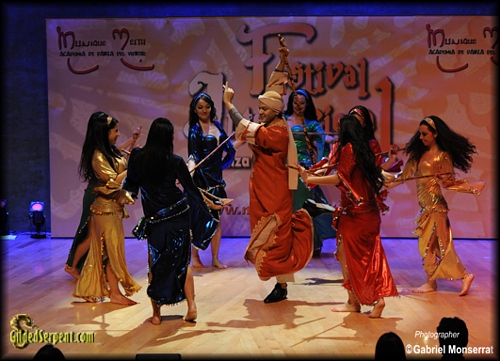
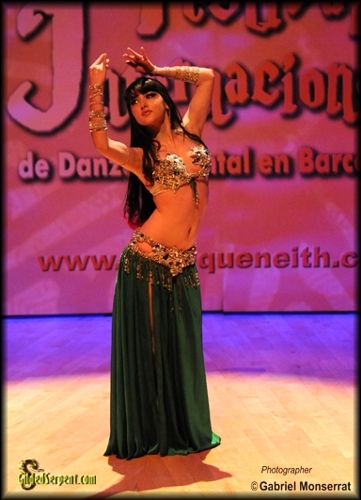
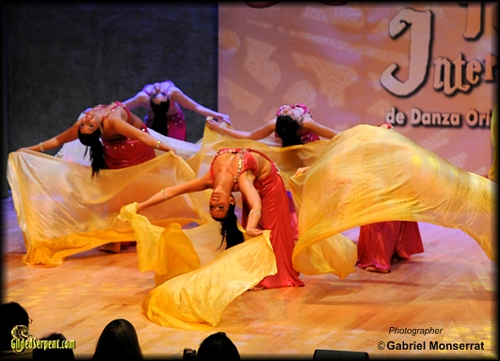
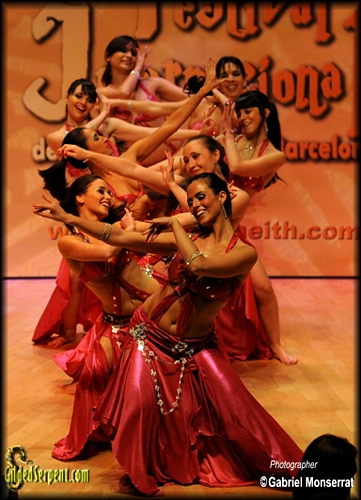
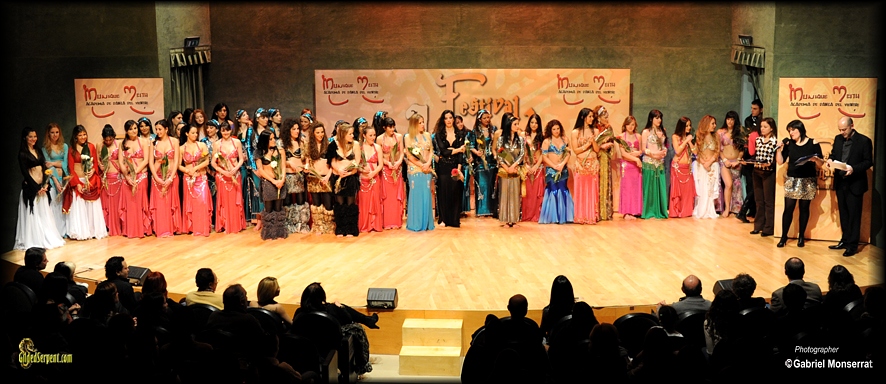
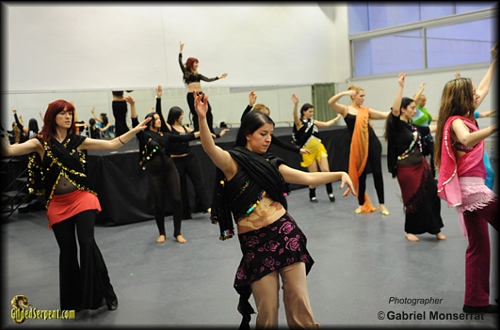
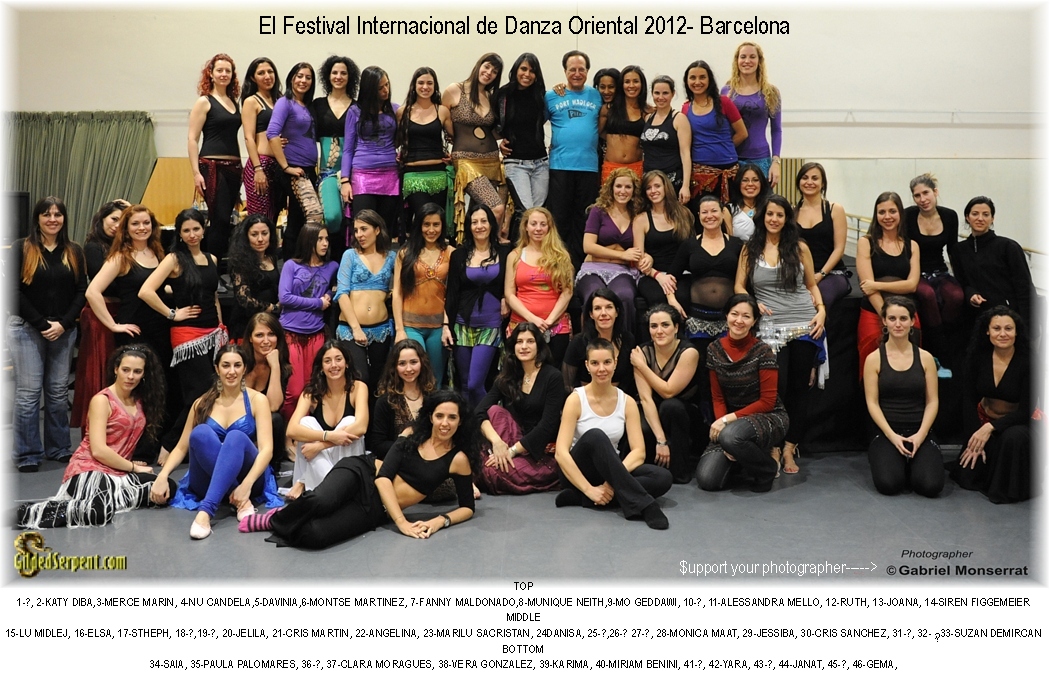
  • The Stars Converge in Barcelona, El Festival Internacional de Danza Oriental 2012,
    Munique Neith is Brazilian of Arabic descent. She is the prestigious and well traveled organizer of the International Oriental Dance Festival in Barcelona. More than 1500 people take part every year in the 2 gala shows, the competitions, and in different workshops with the best international master teachers.
  • Nesma, Dancer of Passion
    To manage the orchestra is quite complicated. They are all men and the dancer must always keep her distance from them. You have to use the service of a manager who is the intermediary between you and the other persons involved in the business. It is very important to have a good manager, a good professional and good person as well. And it is not so easy to find, I can tell you.
  • Morgana’s Animal Magnetism, Interview with Morgana of Madrid
    After seeing Morgana’s Serpent Dance, where she embodies the personality of the serpent, I was hooked. Any snake lovers or snake dancers will have a special appreciation for this piece.
  • The Cairo by Night Festival, November 4-7, 2010, Stockholm Sweden
    From the first moment that I arrived in Stockholm until I left, I felt warmly welcomed, relaxed, and it felt so fantastic to be with Zeina and Mohamed Abu Shibeka, that I spend my most memorable time there!
  • The Birth of a Dance Scene, The History of Oriental Dance in Switzerland
    Please allow me to introduce some of these groundbreakers so that you will appreciate what it was like to be an Oriental dancer in Switzerland in the early 1980s.
  • Queen of Denial Chapter 8: Memories of Baghdad Part 1: Miss America, NOT!
    I had been performing as the featured “Miss America of Belly Dance” in an elite restaurant supper club for about two weeks when Saddam Hussein announced to his country that he was being betrayed by his number one ally in the war against Iran, the USA!
  • El Balie Arabie, Dancing in Chile
    I discovered finding a teacher was going to be a lot harder than I originally intended.
  • Raqs LA Photos, Page 2: H-Z
    Glendale Civic Auditorium, California, April 16 & 17, 2011, produced by Bellydance Superstars and Miles Copeland

  • Missing Tahia’s warm welcome got the tour off to a disappointing start. Her huge red smile would have reassured us that the promise of this tour was on track. It was but the first of many hiccups and unfulfilled promises that was to characterize this tour and reveal essential truths about Egyptian culture and society.
  • Gigbag Check # 35 with Hala
    Backstage with Hala, she shows us what she carries to performances in her bag. This interview was conducted in October 2011.
    Tito Sief is also in the room.
  • Sohayr Zaki, The People’s Dancer
    "When Sohayr Zaki Jumped in Front of President Nixon, American Security Men Moved In," ran the title of the June 1974 article in Al-Shabaka. The popular Middle Eastern magazine continues…
 

Gilded Serpent presents...

Memories of Baghdad, Part 1: Miss America, NOT!

Queen of Denial, Chapter 8

Rebaba in Baghdad

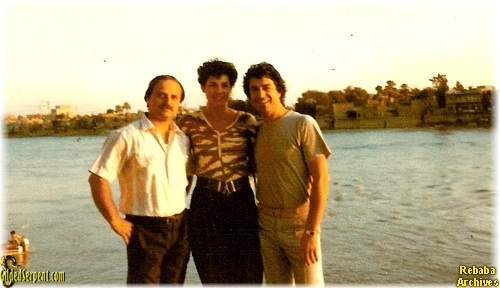
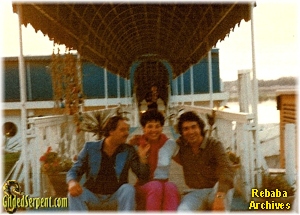
After our boat ride we sometimes dined at one of the many, many fresh fish restaurants that dotted the shores of the Tigress River.

by Rebaba
posted April 6, 2012

My friends were glued to the big, old-fashioned television set for most of the morning and early afternoon which is when I descended from my bedroom on the top floor of the villa we all shared in Baghdad, Iraq. They tried to translate in very broken French what was being said over and over again by Saddam Hussein and his military elite on the two government owned television stations. Both stations had been playing the same thing since very early that morning. Although my band mates were from Lebanon, Iraqi Arabic dialect was difficult for them to understand. With their very limited French, I finally got the gist of the dialog with help from one of the Polish disco band members who also shared our villa and spoke a tiny bit of English. With patience on my part and lots of hand gestures I was made to understand a terrifying message, and one that would have a direct affect on the remainder of my stay in Baghdad.

I had been performing as the featured “Miss America of Belly Dance” in an elite restaurant/supper club for about two weeks when Saddam Hussein announced to his country that he was being betrayed by his number one ally in the war against Iran, the USA!

One of the reasons I agreed to come to this war-torn country (even Lebanon & Syria were at peace while I performed there), was the fact that Iraq was fighting for democracy against the extremist regime ruled by the Khomeini in Iran. The owner, himself Lebanese, thought it would make great business to have an American Belly Dancer headlining the Middle Eastern portion of his nightly show. He offered me more money than I had ever dreamed of (nor will I earn ever again) to travel south to this hot bed of a city for three months of seven nights a week work dancing…He assured my agent located in Beirut that the fighting was far away and insisted that the bombing would never come to Baghdad. There were far too many foreign businesses, military from both sides of the war (a large US presence as well as Russian), as well as all the foreign press living and working in Baghdad. Such was the lucrative economics of war for both sides of what I perceived as a superpower chess match for control of the Persian Gulf.

To his credit, my boss was absolutely correct in his assessment of my reception as the “Miss America of Belly Dance”. I was a huge sensation, arriving on stage to standing ovations, and audience members competing to get on stage and shower me with money before I could even make my first dance step.

The tips were amazing, and nightly for those first precious weeks, there was so much money on the stage that I literally couldn’t dance. Everyone was thrilled as all of us in the Middle Eastern Show shared the tips. The owner of Al Kawakub (The Star in Arabic), the beautifully appointed restaurant located on the shore of the Tigress River where we were performing, said I was the best dancer he ever hired. Hah, most lucrative perhaps, but as for actual dancing, he didn’t see my show for many weeks yet due to the wild reception I received once announced.

They say all good things must come to an end, and only two weeks after my arrival mine did by way of television, war and politics.

Just as I was beginning to adjust to our meager living conditions, a small sacrifice I thought considering all the money we were making, the news of the USA betrayal to Iraq hit the airwaves and the war escalated in favor of Iran. The year was 1983, and I was only two weeks into a three month contract at the Al Kawakab Restaurant.

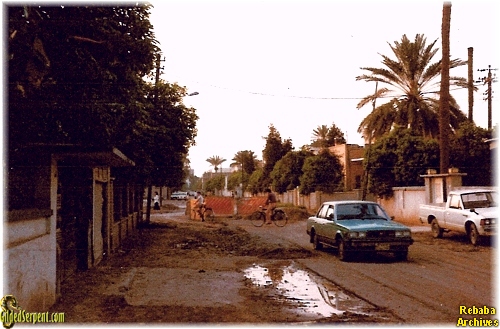
I arrived in a Baghdad being worn down (literally) by the extremely long war with Iran. US dollars and Russian Rubles both contributed to a rebuilding plan and the creation of “New Baghdad; however, what I saw as I made my way around the ancient city was a Baghdad of unpaved streets. Bulldozers had been left like ancient dinosaur bones piled in the middle of incomplete intersections when what was left of the work force was sent out to defend their country as the war escalated.

Rebaba's band
Our stage and my guys playing for one of the featured singers (another Sammy) from Lebanon.
In this picture you can see that Asham has switched to a full drum set and my def playing Sammy
has switched to a dumbek. They were both excellent percussionists and could play a variety of
drums and Middle Eastern framed drums.

For the first couple of weeks in Baghdad, we were the toast of the town with a packed house every night filled with the crème de la crème of Baghdad society, meaning both the military elite and business executives from around the globe. The Iraqi people in the audience threw money on the stage like it was confetti, in fierce competition with one another. By contrast we lived on a street with no sidewalks, and in a house (though large and once majestic on the outside), with no air conditioning. There was no plumbing on the top floor where my room was, and pretty unreliable plumbing on the first three floors. Oh, and did I mention that the electricity was installed after the walls were built? Bare light bulbs hung from wires throughout the “villa.” During my first month there the weather wasn’t yet a problem, but, before I left on June 1st, the temperature would rise to 108 degrees in the daytime and about 98 degrees at night.

Thank goodness the restaurant always had air conditioning, food and water…It seemed like weekly we would lose something critical to our survival and ironically every night we were making more money than we could spend.

After President Bush’s betrayal of Saddam Hussein (which of course would come to be known as the “Iran/Contra” affair in the USA many years later), my immediate problem was how on earth I could continue to perform without being assassinated! It seemed to me like everyone in town knew I was “Miss America”, and now they were being told to hate the country of my birth. It was quite a predicament for one so young as I was only 27 years old and scared to death!

My boss decided that I should now be announced as the “Belly Dancer”, naming no country of origin. This was basically unheard of on stages from Europe to Egypt; the MC always said what country the dancer was from as it could and did indicate the caliber of dancer. Also, Middle Eastern people are a very proud lot and expected to hear perhaps their own country recited in the introduction of the Belly Dancer. So, we argued, my Lebanese musicians and I, that this would be a disaster, and that the audience would be more perplexed and upset by no country than even the fact that I was American! I suggested South American, Canadian, French (as I speak French), or why not Lebanese as I’ve been told so many times that I look Lebanese. But, no, my boss didn’t want to risk lying. Right, he called me “Miss America” of Belly Dance and I know that was a lie, but, he was unwilling to say I was “French” and possibly save my life!

On the first night of my new found anonymity as “The Belly Dancer”, I made my entrance and for the first time I was able to dance my entire show. It was very eerie; and the almost packed house was almost silent for most of my show. I kept thinking any minute now someone is going to shoot me!

No, I finished my show and as I bowed and threw air kisses to the audience for not killing me, several people stood up and started talking to me in Arabic. Of course I had no idea what they were saying, so I smiled politely and got the hell off that stage! Back in my dressing room, my poor band, who were also my best friends in Baghdad, came in on their break to check on me and tell me what was going on with the audience. Evidently, and not surprisingly, the audience was totally perplexed by this dancer from nowhere! They wanted to know what country I was from which is exactly what we told our boss could happen and did. I was actually being accused of denying my culture, because I was most certainly Iraqi, no, Lebanese, no, I had to be Syrian, but, no, in fact and without a doubt I had to be Egyptian! My audience from all over the Middle East were arguing amongst themselves about my country of origin; and claiming me as one of their own!

This dancer from “nowhere” actually almost caused a fight that evening as two opposing customers vied for my country of origin!

From that night forward I told my boss if he wasn’t willing to give me a fake country, then just tell the truth, that I am “American”, just don’t say USA, and I would take my chances. Fortunately, my auburn coloring lent itself well to both Middle Eastern and South American. At that time (pre-internet, videos, skipe, etc.), people still stereotyped North Americans as “blond”, just as we stereotyped Middle Eastern people as being swarthy. Therefore, being “American” wasn’t as hazardous as you may think as my audience always jumped to the conclusion that I was from Mexico! There were a few who still thought I was denying my culture and truly from the Middle East, but, I just smiled, laughed and said no, “Ana Americanea”.


Memories of Baghdad: Part II: Coming soon to GS

As the war escalated in favor of Iran, our living conditions declined. The borders and post offices were closed, the newspapers were censored, and then running water stopped. My friends and I got a cab and literally went from store to store buying as much bottled water as we could lay our hands on! We paid for cases of drinking water ranging from overpriced to absolutely ridiculously-priced!
“Live and learn” became my motto du jour, and this was just the beginning of the dramatic and then horrifying situations that were to befall me in the weeks to come.

More Photos


I arrived in Baghdad, Iraq, in March 1983, in the rainy season. This.is the picture looking our street from the "villa" where all the artists under contract at Al Kawakab lived together. As you can see no pavement to be found, and with rains and humidity I ruined most of the shoes I brought with me. The mud got into everything and was almost impossible to wash away.


The view from my rooftop terrace outside my bedroom which was a little penthouse. Our neighborhood looked very nice from this vantage point. You can see that in April the rains stopped and the temperature began to rise!


My best friends in Baghdad, my oh so handsome drummer Asham, and my "clown" percussionist Sammy, who never stopped making me laugh (and everyone around him).
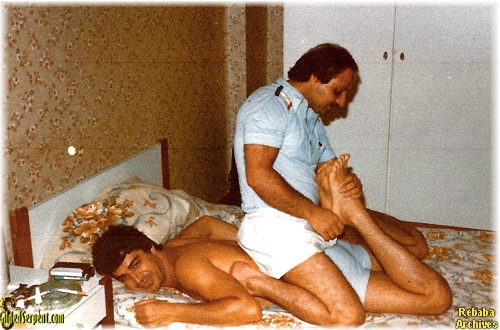
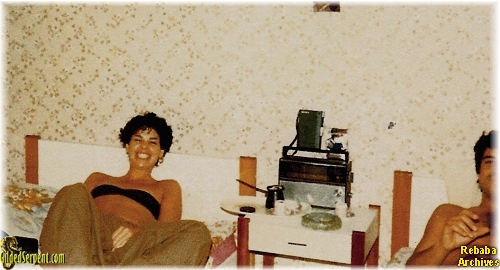
These two wonderful gentlemen (and they were always), had worked together in Lebanon for years and were best friends. We became fast friends and they took me under their wing as their American sister. During the first month and half or so, the rain almost never stopped and we were pretty much house bound for days at a time. It was hot and humid, with no air conditioning as mentioned in the article. We spent most of our time entertaining each other when we weren’t napping or reading.

foot massage
Sammy giving Asham a foot massage, that Sammy could take any situation and turn it into a comedy act! He had such a expressive face that it hardly ever mattered that we spoke different languages. We all managed to communicate just fine with our limited French, Arabic and English.


Sammy entertaining us as usual while taking pictures!


A view ofthe Tigress River at its fullest during the month of March.


The Polish Disco Band that performed after the "Middle Eastern" show each night did lots of 70s cover tunes for dancing. Most of the band members were classically trained in Poland but they couldn’t find jobs in their own country that paid fraction of what they were making in Baghdad. The Poles had their own floor and kitchen in the "villa", and frequently threw great "Vodka" parties for everyone after work whenever one of them received a care package from home.


Once it stopped raining and river was full, a pleasant way to spend an afternoon was taking a boatride. The little boats reminded me of Dories in Mexico. Fairly large wooden boats some with canopies, and all of them painted vibrant colors.


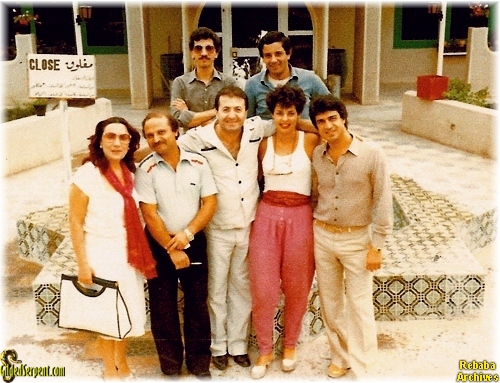
This picture was taken after a "Farewell" lunch at one of the fancier riverside restaurants for our very sweet and talented female featured singer whose contract was over. We were all envious that she was going back to Lebanon as by this time the war had started to move its way towards Baghdad.


use the comment box

Have a comment? Use or comment section at the bottom of this page or Send us a letter!
Check the "Letters to the Editor" for other possible viewpoints!

Ready for more?


  • I think it was around this time when I had gotten to know my co-workers and escorts well enough to allow them to try explaining their way of life and thinking processes to me, that I realized I was in a “no win” situation.
  • Queen of Denial, Chapter 6: From Syria with Love! My Arrival
    You may think that the life of a traveling Belly dancer is filled with intrigue and love affairs, but this couldn’t be further from the truth!
  • Queen of Denial, Chapter 7: More Gorgeous Georges and on to Damascus
    He kept reassuring me that everything was okay, and finally, the second time that I made for the exit, he pinned me against the wall in the darkened hallway and gave me a long, luscious kiss that made my head spin!
  • El Balie Arabie, Dancing in Chile
    I discovered finding a teacher was going to be a lot harder than I originally intended.
  • Raqs LA Photos, Page 2: H-Z
    Glendale Civic Auditorium, California, April 16 & 17, 2011, produced by Bellydance Superstars and Miles Copeland

  • Missing Tahia’s warm welcome got the tour off to a disappointing start. Her huge red smile would have reassured us that the promise of this tour was on track. It was but the first of many hiccups and unfulfilled promises that was to characterize this tour and reveal essential truths about Egyptian culture and society.
  • Gigbag Check # 35 with Hala
    Backstage with Hala, she shows us what she carries to performances in her bag. This interview was conducted in October 2011.
    Tito Sief is also in the room.
  • Sohayr Zaki, The People’s Dancer
    "When Sohayr Zaki Jumped in Front of President Nixon, American Security Men Moved In," ran the title of the June 1974 article in Al-Shabaka. The popular Middle Eastern magazine continues…
  • The Stars Converge in Barcelona, El Festival Internacional de Danza Oriental 2012,
    Munique Neith is Brazilian of Arabic descent. She is the prestigious and well traveled organizer of the International Oriental Dance Festival in Barcelona. More than 1500 people take part every year in the 2 gala shows, the competitions, and in different workshops with the best international master teachers.
  • The Sisterhood of South African Belly Dancers, Australian Finds Community
    I saw that dancers should take criticism well and learn from it (I definitely needed to improve my arm posture and hands) and additionally, it showed me that I had progressed a long way.
  • Raqs LA Photos Page 1: A-H
    Glendale Civic Auditorium, California, April 16 & 17, 2011, produced by Bellydance Superstars and Miles Copeland
  • The Golden Era of the Arabic Nightclubs in London Part 2:" A New Era
    A new era in the club business started with the arrival of two important nightclub characters from Pyramid Street in Cairo (an area where dozens of night clubs line the street and all compete with each other for talent). Ahmed Whardany and Samir Sabot brought a great energy and expertise to London.
 

Gilded Serpent presents...

El Balie Arabe:

Dancing in Chile

Athena dances in Chile

by Athena
posted April 5, 2012

I first went to Chile for a study abroad program for my undergraduate degree.  After years of taking several belly dance classes a week and performing frequently, I knew I would have to keep dancing while I was there. This turned an already adventurous trip into one of the most memorable trips of my life.

I knew trying to find a teacher or a place to dance  was going to be a bit difficult due to only living in Chile for a month. I thought I should give it a shot. I searched throughout the internet, but the belly dance directories I found either had broken links to non-existent websites or to emails that only bounced back to me. I discovered finding a teacher was going to be a lot harder than I originally intended.

Chilean style belly dancing deviated from the South American belly dance style I was expecting. From watching YouTube videos, I was convinced I was going to see high kicks and scandalous costumes. However, the style I saw predominantly in Chile was Classical Egyptian. When I remarked on this, I was quickly told that there is a new tribal school opening up in Santiago and to not stereotype them.

There were some shocking costumes, one in particular had more cutouts than fabric, but most were the traditional skirt and bra costumes that are common in the US.  They  were a lot more colorful than I imagined, but the colors were put together in a novel way, making each dancer stand out. I felt a bit frumpy in my “easy to travel with” costume, but they fawned over it. Sadly, I could not convince them to part with any of their costumes.

To help any dancer who is thinking of  taking a trip to Chile, (which I would highly recommend) I created a few tips based on my experience. I hope they are helpful for you, or at least, help make your trip as eventful as mine ended up being!

1.  Be prepared

Before you go, dedicate some time to thinking about what you want to do in Chile. Seriously consider if you want to dance while you are there and or if you want to take classes. Dancing is a big time commitment, the same time commitment as dancing professionally in the United States. Also if you are not proficient at Spanish, you do have to be prepared to learn enough Spanish to discuss styles of belly dance, rates and to gather information about any events you might be involved in.

While I was dancing in Chile, I would frequently be booked to dance with a local D.J. In the United States, we would discuss upcoming shows and go over these events in detail via email. But, once I arrived in Chile The D.J. would not respond to my phone calls or emails. On the day of the event he would call me; tell me the venue and how much he would pay me. In the US I would never accept that, and I had to learn how to handle these situations if I wanted to continue to work with him.

Now, this is not how most of my shows worked in Chile, but I was dancing in an area that did not have a regular working dancer, so I had to dedicate time to teaching people how to book me, which was both a test of my Spanish and my patience.

Also, before you commit to dance somewhere, make sure you know where in the country you have agreed to perform. Chili is a long country, and takes a long time to travel through it, so be careful to not commit to dance in the southern tip if you are staying in Santiago. I almost made that mistake, until the dancer I was working with told me it would be a 29 hour bus ride. Even though people were as helpful to me as possible, I made it my responsibility to know these things.

2.  Be patient

Culturally, there is a big difference between the way dancers work in the United States and the way dancers work in Chile. For example, I found most of the people I talked to had a lax attitude towards their email. While in the United States, I could anticipate a response with a day or two, I would wait up to a week for a response email from the teachers I wanted to take from. If you want to take classes or workshops in Chile (and I assume most of South America) you should dedicate at least two months to find a teacher, especially if you are looking for a specific technique or style.

When they did respond, they were happy to be helpful and quite excited to have me there. A dancer hired me to dance at a restaurant based solely on my word that I was a professional dancer! Everyone was so open and accepting, and happy to see how the “gringa” dancer would do.

3.   Be protected

 This next tip is something your first dance teacher will always tell you as you are off to your first event, “always bring another person, just in case.” While in Chile, I had a large group of people, who would accompany me to shows, but they were not used to accompanying me as my escorts.

One night after a show, I dropped off my belongings and we all went out to another club. Without notice, a man from my previous show left the show I danced at, followed my group and went into our club. When he was in the club, he came up to me, separated me from my group and began to try to touch me inappropriately. I, being a woman who does not waste time, took care of it immediately, and handed him over to the club bouncers to take care of.  But, I was shaken up, and left the club almost immediately afterwards.

This is not to scare anyone, or to say Chile is full of dangerous people. The same thing could happen anywhere. Realistically, this could have been avoided if I had told my attendants to keep an eye out, or given them any other sort of tips on accompanying me to events.

However, if you are ever involved in a situation like this, know you do not deserve this type of treatment and do not allow people to treat you in any inappropriate way.  Kick, punch, scratch, heckle, and brandish your sword! No one can treat you that way, and make sure any potential assailant knows that quickly.

4.   Be ready for anything!

One of the most fascinating aspects of my trip was to discover how universal belly dance is. Within minutes of arriving to Santiago (the capital of Chile) I was surrounded by belly shirts and harem pants. It was apparently the new style, and I was immediately in heaven. As a gesture of goodwill, my host family bought me a Chilean belly shirt to match my host sister. Along with this, my professor was taking belly dance classes, and my host sister was involved in a teen belly dance club and was in the middle of making her first belly dance costume. Everywhere I went, I was able to encounter belly dance, with just a little bit of effort. Chile will continue to surprise you, as long as you are willing to work with whatever strange circumstance the dance brings you.

Finally, one travel tip for any dancer going through an airport  if you are like me and will only put your costume in your carry-on bag; dedicate some extra time to security.

In the scanners, rhinestones can come up completely black, making security think it is something dangerous. After they open it up, they tend to get a chuckle, but it is not okay when you don’t have much time to catch your plane!

Overall, my trip to Chile was fantastic. I learned so much about myself, my personal value system, and about the universal language of dance. No matter how far you travel, you will always find the sisterhood of dance.

Athena dances at a school in Chile

Resources:

  • Surimay:
    A dancer located in Santiago, she is one of the best initial contacts if you are going to Santiago. She responds to emails quickly, and sends out helpful newsletters including her current classes. Her studio is large enough to have an option most days of the week, which is really helpful when traveling.
    surimay.star@gmail.com
  • Karen Elizabeth:
    She is the teacher who was located in the small city I was living in, Valdivia. She does Egyptian style primarily, and has some English skills. Barring any language barrier, she is really skilled at seeing issues in movement and suggesting new ways to think of them.
    karencita1982@hotmail.com
  • Viviana Flores
    This woman is the ultimate connection in Chile. When I emailed her and told her where I was going, she suggested a person to contact in every area. She is also an amazing dancer in her own right, and I regret not being able to take classes from her.
    seforahcaris@gmail.com

use the comment box

Have a comment? Use or comment section at the bottom of this page or Send us a letter!
Check the "Letters to the Editor" for other possible viewpoints!

Ready for more?

  • Its All in the Flavor! Bellydance in Mexico
    Those were tough times for us teachers. Students were very shy in the classroom but eager to learn; some of them even thought that Shakira had created Bellydance! They didn’t have much information about Oriental Dance, its origins, or different styles. Some aspiring dancers even sat through several classes just to check out what Bellydance was or if we teachers danced it as well as Shakira.
  • Megacity Megafest, 1001 Brazilian Flavors at Mercado Persa 2009 and Beyond
    So, it was with these butterflies in my belly that I bounced home last December after almost two years teaching and performing on the road. Sao Paulo, population 20,000,000+, is the iconic “megalopolis” of the futurists when they predicted the “rise of the third world”. And Brazil is making huge strides – in government, economy, and broadening international appeal. My adopted country – I was going back to set up housekeeping after gypsying around the globe for an eternity, and I was more than ready for a dose of my sprawling, energetic, chaotic, mesmerizing home.
  • Belly Dance in Brazil
    …they are trying to organize a Code of Ethics
  • Joweh’s "Call to Dance" In Guatemala, Part 1: Arrival
    Even our exhaustion couldn’t dampen our excitement and eagerness to explore our fascinating new surroundings.
  • Joweh’s "Call to Dance" in Guatemala, Part 2 of Dream Trip to Guatemala
    Waiting in the wings of the nearly completely darkened stage, holding fire-colored fan-veils aloft, listening to the first strains of Egyptian orchestral music, I couldn’t help thinking that this experience was both familiar and foreign, in the literal and figurative sense.
  • Paula, 2011 Champion of Champions, Belly Dancer of the Universe Competition
    I do not know exactly what will happen, but I know it’s a beautiful start to present a Dominican dancer to the dance world. One very important thing also is that this award means to me that dreams do come true. I always wanted to be a dancer, and I could never really make it work because my country does not considered it a true profession.
  • Shimmying on the Shores of Paradise, The Dancers of the Dominican Republic
    White sands and turquoise waters come to mind when most picture the Dominican Republic, but the Caribbean paradise offers visitors far more than its natural beauty. It may come as a surprise that the small tropical country most known for its pristine beaches and Caribbean hospitality also has a vibrant and thriving belly dancing scene.
  • Mama Raqia: Approachable Dance Deity Visits Mexico
    Raqia Hassan gave away 3 prizes in the event. One in recognition to Niral for her outstanding effort on organizing the event and welcoming her to Mexico. Raqia took about 20 minutes on the stage saying that she was so sad and angry that other teachers didn’t come to greet her at the event.
  • Raqs LA Photos, Page 2: H-Z
    Glendale Civic Auditorium, California, April 16 & 17, 2011, produced by Bellydance Superstars and Miles Copeland

  • Missing Tahia’s warm welcome got the tour off to a disappointing start. Her huge red smile would have reassured us that the promise of this tour was on track. It was but the first of many hiccups and unfulfilled promises that was to characterize this tour and reveal essential truths about Egyptian culture and society.
  • Gigbag Check # 35 with Hala
    Backstage with Hala, she shows us what she carries to performances in her bag. This interview was conducted in October 2011. Tito Sief is also in the room.
  • Sohayr Zaki, The People’s Dancer
    "When Sohayr Zaki Jumped in Front of President Nixon, American Security Men Moved In," ran the title of the June 1974 article in Al-Shabaka. The popular Middle Eastern magazine continues…
  • The Stars Converge in Barcelona, El Festival Internacional de Danza Oriental 2012,
    Munique Neith is Brazilian of Arabic descent. She is the prestigious and well traveled organizer of the International Oriental Dance Festival in Barcelona. More than 1500 people take part every year in the 2 gala shows, the competitions, and in different workshops with the best international master teachers.
  • The Sisterhood of South African Belly Dancers, Australian Finds Community
    I saw that dancers should take criticism well and learn from it (I definitely needed to improve my arm posture and hands) and additionally, it showed me that I had progressed a long way.
 

Gilded Serpent presents...

Fire and Ice-Sugar and Spice!

Mystic Moves With Ava Fleming &
Hip-Notic Bellydance With Kaya

Collage of Ava and Kaya's DVDs

by Elianae Stone
posted April 4, 2012

I have had the pleasure of reviewing two very good DVDs: Mystic Moves with Ava Fleming and Hip-Notic Bellydance with Kaya. Both dancers adhere to different styles of Cabaret or Oriental Bellydance, and I found their approaches both engaging and refreshing!

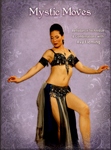
Ava's DVDMystic Moves is produced by Hollywood Music Center and has over two hours of combinations and technique. The sound quality, lighting and set are warm, calming, and pretty and Ava has a precise, patient, teaching style. She mostly faces a mirror with her back to you, so that you can follow along with her. She trains you on level changes and “mystifying” basic movements through subtle variations. After learning several basic movements there is a flow section of fun combos with names like “Bambi”, “Side Winder”, and “Red Wine”. I love the fun names she gives the graceful combos, and her style is light and delicate. She finishes off all the technique with a costumed performance, which is lyrical and lovely. I would consider her style to be modern Egyptian, with an emphasis on the grace and dignity of the dance. Interestingly, she is the only dancer I’ve seen recently who wears her hair in a bun during performance. That, and an understated Bella costume, made for a classy, balletic performance.

Rating: 4 zils
Zil Rating- 4

Kaya's DVDHip-Notic Bellydance with Kaya is produced by IAMED Bellydance and also has over two hours of material. The set is black and sparse in this DVD and Kaya does the majority of the instruction facing the front. The sound quality is fine. The DVD covers several topics, not just technique. There are several sections on body awareness, stage presence and connecting with your audience, then there are exercises in hair tossing and fun drills like drawing the alphabet with your chest. In my opinion the highlight of the DVD is the abdominal drilling – there are advanced abdominal drills such as diagonal and horizontal bellyrolls (which so far I’ve only seen Fatiem do), abdominal “sprinkler” and flutters. If you are looking for a DVD that will get your heart rate up or teach you lengthy combinations this DVD is not for you, but Kaya does cover some important aspects of the dance. She finishes with a very sensual candle and floor dance which is lovely, but a bit too “roll-ey on the floor” for my taste. Kaya’s earthy style is refreshing though, and I think she is a good example of the modern Cabaret dancer.

Rating: 3 1/2 zils
Zil Rating- 3

I personally preferred Ava’s DVD to Kaya’s, as there was more traditional technique drilling in it and Ava’s style resonated more with my own ballet background. Also, as I mentioned, the set and timing of Ava’s DVD gives the whole production a friendly, warm feel. Although I like Kaya’s dancing and found her section on bellyrolls to be very informative (I was told once at a dance competition that modern Cabaret dancers don’t generally do as much abdominal work as in the past), I felt the DVD as a whole was a bit more plodding. There were some drills that were very advanced, and others that were very basic, and the set and lighting were dark and uninviting. Still, both have a lot to offer for the price and, depending on what kind of dancer you want to be, either could add a bit more sugar and spice to your repertoire!

Trailers


Purchase Information

Ava Flemming-
Hollywood Music
– $24.99

Kaya –
IAMED -$44
Kaya’s Site – $40

use the comment box

Have a comment? Use or comment section at the bottom of this page or Send us a letter!
Check the "Letters to the Editor" for other possible viewpoints!

Ready for more?


Gilded Serpent presents...

Raks LA, 2011

Page 2: H- Z

by Carl Sermon
posted April 2, 2012

Glendale Civic Auditorium, California, April 16 & 17, 2011
produced by Bellydance Superstars and Miles Copeland
Page 1: A-H, here

Inka

Inka

Irena Irem

Irena Irem

Jaqui Lalita

Jaqui Lalita

Jayel

Jayel

Jayna

Jayna

Jeanie
Jeanie

Jellyfish Kiss
Jellyfish Kiss

Jewels of Meihana
Jewels of Meihana

Katrelya

Katrelya

Khani Zulu

Khani Zulu

Lappis
Lapis

Latin Mirage
Latin Mirage

Leela and Salome Jihad

Mandala Dance Troupe

Mandala Dance Works

Mandala Dance Works

Maryam
Maryam

Medea Desert Mirage
Medea Desert Mirage

Meera
Meera

Mirage Motion

Mirage Motion

Neena Nour
Neena Nour

Rahana's Bellynesian Bellas

Rahana’s Bellynesian Bellas

Rasa Vitalia
Rasa Vitalia

Sultry Sabrina
Sultry Sabrina

The Hoop Unit
The Hoop Unit

Troupe Sahira
Troupe Sahira

Troupe Mosaic
Troupe Mosaic

Uwash Bollywood
Uwash Bellywood

Valentina
Valentina


Raqs LA wIll be happening this year in August at the El Portal Theater, in North Hollywood, CA

use the comment box

Have a comment? Use or comment section at the bottom of this page or Send us a letter!
Check the "Letters to the Editor" for other possible viewpoints!

Ready for more?

  • Raqs LA Photos Page 1: A-H
    Glendale Civic Auditorium, California, April 16 & 17, 2011, produced by Bellydance Superstars and Miles Copeland
  • SFBA MECDA Gala Show & Festival 2010
    Produced by the San Francisco Bay Area chapter of the Middle Eastern Culture and Dance Association, held on November 15, 2010, in the Hillview Community Center in Los Altos, CA
  • Sunday Photos from Rakkasah East- October 2010
    Barakat, Basema, Dena Shazadi, Fatima, Fire Blossoms, Ghada Girls, Habiba, Laura, Leila, Rega, Saiedah, Shadia, Tempest, Willow, Yuliya, Zenaiede
  • Friday Night Photos from Rakkasah East- October 2010
    Desert Embers, Dharma, Fahtiem, Leila Haddad, Mystic Wiles, Nadia Layla, Najma, NightShade, Phoenis, Raks Shiva, Troupe Shahibat
  • Carnival of Stars, Page 4: O-Z Photos
    The Carnival of Stars Festival is produced by Pepper Alexandria and Latifa at the Richmond Auditorium each year at the beginning of August. The stage at this facility is hard to beat. The wonderful lighting and the large stage make every dancer feel like a diva! Once again, Carl has done an amazing job catching the character of each dancer
  • Carnival of Stars, Page 3: I-O Photos
    The Carnival of Stars Festival is produced by Pepper Alexandria and Latifa at the Richmond Auditorium each year at the beginning of August. The stage at this facility is hard to beat. The wonderful lighting and the large stage make every dancer feel like a diva! Once again, Carl has done an amazing job catching the character of each dancer.
  • Carnival of Stars, Page 2: D-H Photos
    The Carnival of Stars Festival is produced by Pepper Alexandria and Latifa at the Richmond Auditorium each year at the beginning of August. The stage at this facility is hard to beat. The wonderful lighting and the large stage make every dancer feel like a diva! Once again, Carl has done an amazing job catching the character of each dancer.
  • Carnival of Stars, Page 1: A-C Photos
    The Carnival of Stars Festival is produced by Pepper Alexandria and Latifa at the Richmond Auditorium each year at the beginning of August. The stage at this facility is hard to beat. The wonderful lighting and the large stage make every dancer feel like a diva! Once again, Carl has done an amazing job catching the character of each dancer.

  • Maria, Nadika, Naiya-Hayal, Onyx Moon, Oreet, Raks Al Khalil, Raks Terayz, Raks the Casbah, Reda Darwish, Ruby, Sabiba, Sassafras, Shimmy Amour, Tatseena’s Troupe, Terry, Titanya, Troupe Aneena, Yolanda, Zahara
  • Photos from Rakkasah West 2011, Sunday A- L
    Adira, Anisa, Ashley Lopez, Orchids, Damascus, Danielle, Desert Dream, Diana, Dondi, Dancers of the Desert, El Asaab, Evangaline, Fahtiem, Fatima, Ghawazee, Alexandria, Jamilla, Joweh, Karavansary, Lisa
  • Ana Ra’asa Showcase: Egyptian Bellydance Past & Present
    My purpose for doing this show was to bring Bellydance to the stage. We have such amazing talent in the Bay Area, and I feel that those dancers deserved a stage to showcase such amazing talent.
  • Rakkasah West Festival 2011, Saturday, Page 2" J-Z
    This group of photos is from Saturday, March 12, 2011. Bands in the background include: Vince Delgado and Coralee, The Mediterranean Raqs Band, Pangia, and Al’Azifoon
  • Rakkasah West Fest 2011, Saturday, Page 1: A-J
    Afrita, Ahava, Ava Fleming, Bala Anat, Al Azifoon, Alea, Alnisa, Aruba, Banat El Hoggar, Black Diamond, Black Opal, Dancer of the Crescent Moon, Dancers of the Pharoah, Desert Heat Dancers, Elnora and Rhonda, Fringe Benefits, Hamsa, Hanna Lissa, Jasmine Jennifer, Jewels of the North
  • Rakkasah West Fest 2011, Friday Evening, Main Stage Only,
    Aisha, Arabian Jewels, Azura, Dancers of Denile, Ariellah and Deshreet, Tatseena and Dreams of Cleopatra, Elnora, Ghanima, Goddess Force, Halima, Diana, Inami, Khalilah, Latifa, Kiyoko, Leila Haddad, Shaida, Shadya, Tanya, Zia!

  • Missing Tahia’s warm welcome got the tour off to a disappointing start. Her huge red smile would have reassured us that the promise of this tour was on track. It was but the first of many hiccups and unfulfilled promises that was to characterize this tour and reveal essential truths about Egyptian culture and society.
  • Gigbag Check # 35 with Hala
    Backstage with Hala, she shows us what she carries to performances in her bag. This interview was conducted in October 2011.
    Tito Sief is also in the room.
  • Sohayr Zaki, The People’s Dancer
    "When Sohayr Zaki Jumped in Front of President Nixon, American Security Men Moved In," ran the title of the June 1974 article in Al-Shabaka. The popular Middle Eastern magazine continues…
  • The Stars Converge in Barcelona, El Festival Internacional de Danza Oriental 2012,
    Munique Neith is Brazilian of Arabic descent. She is the prestigious and well traveled organizer of the International Oriental Dance Festival in Barcelona. More than 1500 people take part every year in the 2 gala shows, the competitions, and in different workshops with the best international master teachers.
  • The Sisterhood of South African Belly Dancers, Australian Finds Community
    I saw that dancers should take criticism well and learn from it (I definitely needed to improve my arm posture and hands) and additionally, it showed me that I had progressed a long way.
 

Gilded Serpent presents...

Revisiting “A Belly Dancer’s Dream Come True”

The First Ground-breaking Belly Dance Tour to Cairo of September 1977

Placeholder

Pamela Sloane(aka Hirt)
posted March 28, 2012
Adapted from the original in Habibi Magazine
with many additional photos-we need help with names!

Veteran belly dancer Dalilah from Las Vegas sponsored a tour to Cairo for American belly dancers so they could learn from the cultural source of the dance.  She would leverage her connection with Egyptian film and dance legend Tahia Carioca to arrange special dance-related activities, including meeting Samia Gamal.

Dalilah also touted that the tour would feature dancing lessons with Cairo’s most prominent contemporary dancers including Fifi Abdou, Hala Sofi, Sohair Zaki, or even Nagwa Fuad.  It would be a dream come true if either they or Tahia and Samia would share with us their stylish moves.  In addition, around these lessons would be sightseeing tours for which Dalilah hired an Egyptian tour agency. 

The following is the original revised and edited account of that historical first belly dance tour of Egypt.  I did meet with Tahia and Samia on September 22, 1977 – my birthday – and this version features highlights of that exchange.

Part I. The Egyptian Odyssey Begins  

Thirty-three eager dancers participated in the very first ever belly dance tour of Egypt during the week of September 16, 1977, named “A Belly Dancer’s Dream Come True.”  We landed in Cairo after dark on Friday, September 17. The luminary Tahia Carioca herself, accompanied by members of the Egyptian press, had assembled at the airport to greet us and hold a publicity reception.

Instead, six hours later than our intended arrival time, Misr Tours greeted us with profuse apologies along with sincere regrets from Miss Carioca.  She and her retinue could no longer wait.  The tour rep then presented Dalilah with a bouquet of flowers Tahia had intended to give us. 

Further delays resulted when we discovered that several of the tour members didn’t have proper visas.  Once this was remedied, we learned that the luggage of those joining the tour from Los Angeles had failed to arrive, so half of the tour members were stuck wearing their stale travel clothing for the next two days.

We finally arrived at the Cleopatra Hotel by midnight. While most slept, Dalilah took a taxi to Tahia’s downtown Cairo theater to meet the Egyptian media star.  She reported that Tahia had spent three hours waiting for us at the airport, and that she regretted missing us.

Missing Tahia’s warm welcome got the tour off to a disappointing start.  Her huge red smile would have reassured us that the promise of this tour was on track.  It was but the first of many hiccups and unfulfilled promises that was to characterize this tour and reveal essential truths about Egyptian culture and society.

Misr Tours kicked in with an exciting itinerary for our first full day.  Accompanied by hired guide Dr. Yussef, our bus full of wide awake dancers laced its way through rural Nile-side villages to visit Memphis and Sakkara, two necropolises (cities of the dead).  We entered two major tombs, saw the archetypal step pyramid and various others all predating the Great Pyramid of Cheops.  We also visited the Great Pyramid of Giza.

billboard
A billboard in town

Part II:  Egypt at Night

Dancer in 1977

Dancer at Sahara City nightclub

Sahara City

There was barely enough time to return to the hotel and freshen up for that evening’s “Sound and Light Show” in front of the Pyramids and Sphinx, followed by a late dinner and viewing of the diverse entertainment at the Sahara City.  Located a few miles past Giza in the desert, Sahara City is a popular tourist spot offering dinner followed by a full range of nightclub acts, including – to our excited anticipation – an array of belly dancers.

 The club was housed in a lively tent-like affair elegantly draped in deep red fabric looping from the ceiling. 

While we ate dinner, a three-piece ensemble consisting of an organ, electric guitar and trap drum played popular tunes.  When it was time for the entertainment to begin, the small music trio was quietly replaced with a traditional Arab musical ensemble consisting of violin, kanoon, drums and oud.  The newly arranged musicians began a traditional Arab piece.  After several lilting measures, the much-awaited belly dancer sauntered gracefully onto the stage. 

She smiled at the audience, then promenaded in small swishy steps with only a few hand gestures.  In her early 20s, the stunning, somewhat tentative dancer wore a costume of a bright red top and skirt with a bit of fringe on the hip belt. Her style was characterized by a lot of promenading punctuated with poses with interesting hip and torso twisting combinations.

As the band played on after her dance, she spent a good deal of time going through the entire house posing behind two customers at a time while a photographer flashed their photos.  Of course afterwards, the customers were offered the folder of their photos for 50 piasters.

Saudi's party 1977

Saudis party at Sahara City nightclub

Word reached the manager of Sahara City that 30 belly dancers from the United States were in the audience, which caused him to promptly greet and invite us all to take the stage.  Perhaps prompted by the manager, one of the professional dancers took up the cause, urging Dalilah to come up. 

The Egyptians were not the only ones trilling and clapping as Dalilah finally accepted the invitation, rising from her seat and beaming broadly at her American protégés.   We clapped along with the rest of the audience to the resounding live music, encouraging Dalilah in her zealous brief solo that left the whole house begging for more.

A photo and concise description of this event appeared a day or so later in an Egyptian newspaper. 

The finale of the stage show featured a woman who picked up a table with her teeth and danced around while playing zills.  I recognized this stunt from Greek taverna shows, and all agreed that it was memorable note on which to end the evening of unforgettable dance and music.

The manager sought through our Misr Tours guide to engage the group for a formal performance that coming Thursday.  Most of the tour members relished this invitation as the chance of a lifetime to perform belly dance in the shadow of the Pyramids, especially since we’d already had a taste of the Egyptian stage that night.  But Thursday was a long way off and, as we had already begun to observe, even the best of plans were subject to unforeseen twists and turns in this land by the Nile.

Part III   Touring Egypt

Cairo MuseumEgyptian Museum

Dr. Yussef of Misr Tours was again on hand to narrate history as we trudged through the museum, gawking and peering at the artifacts in this unkempt Egyptian warehouse.  I had already seen the contents of King Tut’s display in a special exhibit in San Francisco, but seeing the duplicates here still stirred excitement. 

The mummies of such historic notables as Ramses, Seti, and Tuthmos and others, laid out in glass cases, did not disappoint, either.  Arranged in neat rows and revealed from the neck up, the facial features were so discernible that you could reconstruct what each mummy probably looked like as a living person.

The trip to the museum was followed by a buying frenzy at a bazaar to which Dr. Yussef escorted us and assisted in haggling for goods. While haggling is expected in Egypt, by the time the tour wound down most of us were tired of this effort, finding it to be troublesome and time-consuming.

The bazaar featured metal trays, cups and tea pots, all kinds of jewelry, clothing ranging from beautifully embroidered tunics to even some tempting Bedouin blankets. 

Monday and Tuesday mornings were to have been the essence of our tour, described in the literature as “…Belly Dance lesson at the hotel (or in front of the Pyramid.) by one of the most famous Belly Dancers at the present time.” 

Neither of these lessons materialized.  Apparently Nagwa Fuad, the reigning Nile Hilton belly dancer, did not honor her commitment confirmed through the Egyptian Embassy before we left the States. So, while behind-the-scenes finagling went on in attempts to remedy this blow to our belly dance dream, the Thursday optional tour to Luxor was moved up to Monday instead.

Hotel Problems

At this point dissatisfaction with the Cleopatra Hotel reached a peak. The travel agency had represented it as a first class hotel and had charged accordingly, but many felt very strongly that it was completely below standard.  Complaints included getting pins, flies and hair in food, which was barely edible most of the time anyway. 

Some said service had been poor, with “pestering” of the patrons by certain hotel employees.  One tour member even had a dress stolen from her room; others were missing money.  Though the Ministry of Tourism was called and sent a person to help rectify whatever he could, the fact remained that the hotel was first class by Egyptian standards, and there had been no misrepresentation.

Originally tour members were to have stayed in another first class hotel, the Jolie Ville near the Pyramids, but in August we had received a letter from Dalilah stating that for convenience sake, we had changed to the Cleopatra.  Now, in the emotional discussions following the open complaints, the suggestion was floated that we pay a few pounds extra and move to the Hotel Jolie Ville to “get our money’s worth.”

In the end, certain reparations were made, hot heads cooled, and we begrudgingly stayed at the Cleopatra.

lunch
Lunch at a café on the tour (yes, that’s Bert!)

The Valley of the Kings

Despite the dissatisfaction with our various disappointments, we went along with the schedule change moving Luxor up, hoping that going to Upper Egypt earlier would help buy time to arrange the promised belly dance lessons with “one of the most famous Belly Dancers at the present time.” 

Arriving at Luxor via a short plane ride, Msr Tours ferried us across the Nile to Queen Hatshepsut’s funeral temple, then the Valley of the Kings where we entered King Tut’s original tomb.

Dalilah greets Sohair

Back on the other side of the Nile, we went to the great Temple of Karnack.  Though much dilapidated with only a ghost of its original visage, I was awed by the enormity of its numerous columns and sheer enormity.

Tuesday’s cancelled dance lesson provided a windfall to get caught up on errands and rest, though enthusiasm had been dimmed overall.  Luckily, while we were enjoying our free time, Dalilah managed to enlist her old friend Tahia’s help, and the great danseuse agreed to host us at her downtown Cairo theater that afternoon. 

Tahia sent word reiterating emphatically that she refused to teach, but we were thrilled at the opportunity to meet and speak with her. After all, we had missed her welcome at the airport upon arrival.  A sudden bout of a recurrent illness delayed her arrival, keeping the group waiting for her at the theater for over two hours.

Publicity Photos by the Pryamids

Wednesday was the highlight of the tour.  Wearing our belly dance costumes, we assembled before the Pyramids and the Sphinx and with camels as props, indulged in an enjoyable photo-taking spree.  In time, the contemporary dancer Sohair Zaki actually showed up accompanied by her personal retinue and a gaggle of Egyptian press members.  We went to a nearby tent where she sat with Dalilah and watched some of our tour members dancing to taped music.  Of course, we had hoped for some dancing tips or even a brief demo of her softly fluid style, but her conservative flowered shirtdress communicated her intentions clearly.

An interpreter assisted, but even he could not persuade her to participate any further than sitting politely with Dalilah and smiling at our efforts.  After about an hour, she gingerly excused herself and left in a flurry with her entourage. I understand there was a blurb in the Cairo press about this event the next day.  Perhaps that’s why Ms. Zaki chose to join us in the first place.

Misr Tours came through on Thursday with the city tour, felucca ride down the Nile, and the trip to the famous Kan Kalili Bazaar.  That evening we had been scheduled to appear at Sahara City as a series of American belly dance acts. On hearing of this engagement, Tahia strongly advised against it, averring that dancing in such a place was “beneath us.”  

So, yet another highlight of our tour fell out from under us and certainly to the dismay of Sahara City’s enterprising and persistent manager.  But the change turned out to be a windfall in our favor, because Tahia offered in its stead to have us come to her theater for an exclusive engagement.  There we would dance on her stage, in the presence of her audience, in the protective aegis of her theater.  So next, we were due at Tahia’s theater in Cairo. 

Finally, a promise of the tour was to take place!

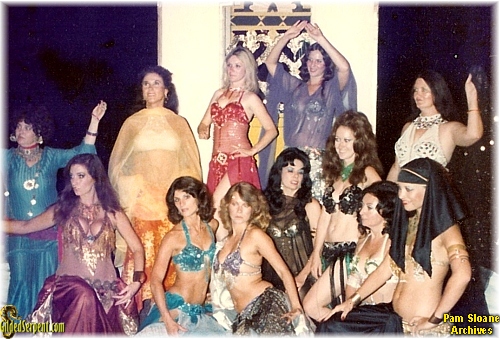
dancers pose
See Bert in there?
dancers pose
Names: 1, 2, 3 (behind), 4, 5, 6
posing
Author in red


Samia, Tahia, Dalilah 1977
Samia Gamal, Tahia Carioca and Dalilah, Sept. 1977*

Face-to-Face with Legends Tahia and Samia

Upon arriving at Tahia’s theater after a short walk from our hotel in the 120-degree afternoon heat, steady preparations got under way for the tour member dance performances.  A modestly equipped facility with capacity for several hundred, the darkened theater offered a humble but appropriate venue for tour dancers’ performances for Tahia and Samia. 

Everyone held strong hopes that these two living treasures of danse oriental might grace the theater with magical dancing pointers, or even a performance, no matter how impromptu or brief.  After all, we had come to Cairo seeking to enrich our knowledge of Egyptian dance.

Tahia’s husband and other friends greeted us and showed us around the theater as we posed for each other’s cameras and practiced dancing on the small wooden stage with a wooden painted arabesque backdrop.  An audience of about forty non-dancing tour participants and Tahia’s entourage looked on.

Finally the air stirred and there she was – Tahia’s effusive presence filled the theater. 

She had entered customarily over two hours late beaming and aglow at Dalilah’s side.  Now an older, less hale Tahia than seen in the movies greeted us, her once rosy visage paled by sweat and recurring unnamed illness.  A black caftan covered her corpulent body, and her dyed black hair was clipped in a smart, short hairdo quite unlike the flowing dark manes of her movie danseuses.  As her kohl-rimmed black eyes took in each of us, I felt privileged to experience her bold warmth and natural charisma in person.

At last this central expectation of the “Dream Come True First Belly Dance Tour to Egypt” had finally come about.

My notebook quotes a cultural informant at Tahia’s theater as saying: “Tahia is Egypt and Egypt is Tahia.” 

We hoped that Tahia might take to the stage this night and demonstrate what this meant. But the outspoken Tahia made it quite clear her performance days were over.  “I want see the American girls dance!” she declared in her Arabic-accented English. Later she stepped aside with me for an interview in which I recorded her feelings about American belly dancing and the current state of the dance. [Article “Interview with Tahia Carioca” coming soon!]

Recorded popular Arab dance music piped in allowed some dancers to perform onstage informally.  Tahia never stopped chatting and busying herself amongst us, always staying close to Daliliah.  We cajoled and begged her to show us a bit of her repertoire, but she firmly declined, choosing instead to encourage us to continue entertaining her with our Americanized form of the dance.  

After a few hours, the festive atmosphere was broken by a sudden flurry in the darkened back of the theater.  Samia Gamal’s presence caused a major displacement of energy throughout the theater.  Tahia stepped back, embraced her protégé warmly, and then introduced her to Dalilah.

[Article “Interview with Samia Gamal” coming soon!]

Reda Troupe 1977Reda Troupe at the Balloon Theater

That night we attended the Balloon Theater in downtown Cairo for a performance of The Reda Troupe for a refreshing program of Egptian folkloric dance.

Several of us who had managed to meet Mahmoud Reda, director and choreographer of the troupe, were invited to his downtown studio Friday evening for dance lessons. Mahmoud and one of his leading dancers, Raika, lead us through beladi and other routines Reda had researched throughout the Egyptian countryside.  One of his star dancers, Farida Fahmy, greeted and chatted with us as well.

His surprise dance lessons helped offset some of the disappointment of not receiving dance instruction from any of the reigning stars as we had hoped.  Instead, he respectfully took us back to the Nile countryside where the entire dance lexicon originated, thereby doing us an even greater honor.

Last Day

The final, free day in Cairo was spent variously by the now wearied and somewhat disillusioned touring belly dancers.  Some shopped, went to Alexandria, and revisited the Pyramids and museum, while others caught up on their rest before our departure early the next day.  The evening was spent in much the same way – returning to see a favorite performance or dine at a favorite restaurant.

Conclusion

For most, the 4:30AM wake-up call from the hotel desk was acknowledged shortly after returning from the evening’s outing.  Eyes stinging from lack of sleep surveyed the dawn sights of a fascinating city teeming with her awakening people setting out to do their daily work as the tour bus headed to the airport.

As of departure, no one could quite yet manage to put together the disparate pieces of a frantic week of delights and disappointments.  The sight-seeing had broadened our understanding of Egyptian history and culture; the nightclub performers and traditional dance of the Reda Troupe had been inspirational.  But the failure of the dance lessons from contemporary performers as promised, along with the dead weight of empty time waiting for alternative arrangements in their stead, left a bitter taste – even outright anger – for many.

In the final analysis, the very notion of what “A Belly Dancer’s Dream Come True” would be was based on American notions and expectations.  Could such a dream, conceived in an American mindset, ever have come true?   Learning about another culture in order to better inform the dance you’re performing is a noble enough undertaking, as long as cultural disparity is understood from the outset.   No two cultures are alike, and that is the point we learned through this experience. 


More Photos

Soheir ZakiSoheir

Sohair Zaki!

 
dancers pose
Names 1, 2, 3, 4, 5- Pam, 6, 7, 8, 9, 10, 11, 12- Delilah
 
dancers pose


Pam Camel

Pam tent
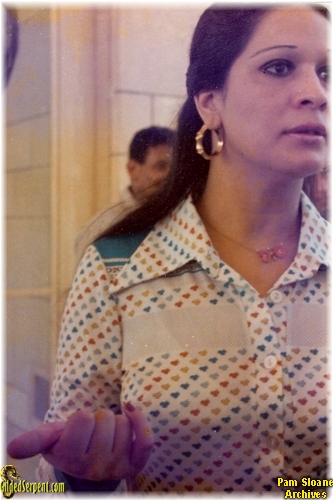
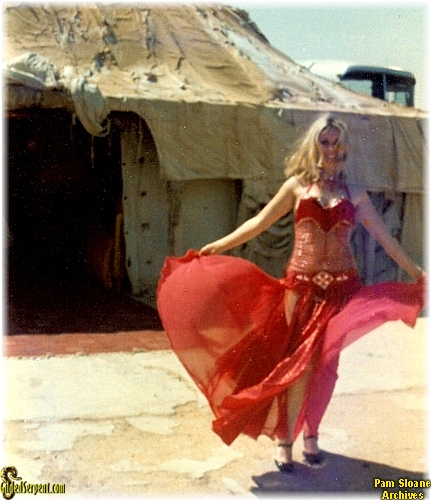
Pam Sloane in front of emir’s desert tent near Pyramid, Sept. 1977

DalilahDalilah
Dalilah

Desert Tent behind the pyramids

Desert tent behind Pyramids


Cairenes Cairenes

use the comment box

Have a comment? Use or comment section at the bottom of this page or Send us a letter!
Check the "Letters to the Editor" for other possible viewpoints!

Ready for more?

  • Egypt’s Golden Age, Timeline and Synopsis
    From around 1850 to 2000, Egypt saw the birth, rise, and transformation of its cultural expression through dance. With each period, a new energy in the dance was introduced and, with it, new dancers with new dance movements and new costumes.
  • Taheyia Karioka, Queen of Oriental Cabaret Dance
    In the 1980’s, the spread of Islam and its fundamental militancy proved to be a big blow for Egypt’s belly dance industry. As a result, several dancers publicly renounced their pasts and donned the Islamic veil.
  • Tribute to Dalilah!
    Dalilah began dancing in the 1950s…passed on September 18, 2001
  • Sohayr Zaki, The People’s Dancer
    "When Sohayr Zaki Jumped in Front of President Nixon, American Security Men Moved In," ran the title of the June 1974 article in Al-Shabaka. The popular Middle Eastern magazine continues…

  • Doing it my way
    For me, dance is not cerebral, but highly emotional.
  • Interview with Mahmoud Reda Part 1: The Beginning
    The Ministry of Culture should be of help, not a source of problems. But anyway, they had control of all the theaters, so to find a theater we must go to them, but they gave us problems. I don’t know why; maybe they were jealous!
  • At Home with Fifi Abdou
    In America, one of the things that especially pleased me was the inclusiveness of the dance scene there – in my classes I saw women of many different ages – and body types – enjoying dancing, and that made me happy
  • The Stars Converge in Barcelona, El Festival Internacional de Danza Oriental 2012,
    Munique Neith is Brazilian of Arabic descent. She is the prestigious and well traveled organizer of the International Oriental Dance Festival in Barcelona. More than 1500 people take part every year in the 2 gala shows, the competitions, and in different workshops with the best international master teachers.
  • The Sisterhood of South African Belly Dancers, Australian Finds Community
    I saw that dancers should take criticism well and learn from it (I definitely needed to improve my arm posture and hands) and additionally, it showed me that I had progressed a long way.
  • Raqs LA Photos Page 1: A-H
    Glendale Civic Auditorium, California, April 16 & 17, 2011, produced by Bellydance Superstars and Miles Copeland
  • The Golden Era of the Arabic Nightclubs in London Part 2:" A New Era
    A new era in the club business started with the arrival of two important nightclub characters from Pyramid Street in Cairo (an area where dozens of night clubs line the street and all compete with each other for talent). Ahmed Whardany and Samir Sabot brought a great energy and expertise to London.
  • Tribal & Textile Arts Show 2012, IPhone Photos of Pretty Stuff from a Trade Show
    On February 12, 2012, at Fort Mason in San Francisco, my husband George and I made a quick visit to an annual folk arts show. This visit soon turned into a report for Gilded Serpent!
  • 1st Annual Shimmy in the City, How I Organized an International Festival and Survived (just!)
    He literally woke her up at 5am, asked for her help and she immediately dropped everything and got straight on a plane to London! What a star indeed!
 

Gilded Serpent presents...

Sohayr Zaki

The People’s Dancer

Sohair Zaki

by Edwina Nearing
(Originally published in Habibi Magazine in 1977 or ’78)
posted March 22, 2012


"When Sohayr Zaki Jumped in Front of President Nixon, American Security Men Moved In," ran the title of the June 1974 article in Al-Shabaka. The popular Middle Eastern magazine continues,

"Last Wednesday Sohayr Zaki danced before the guest of Egypt and the Arab people, the American president Richard Nixon. The occasion was the official dinner party which Egyptian President Sadat arranged as a greeting for his distinguished guest. The celebration was held in the garden of AI-Quba Palace, on a stage decorated with pharaonic columns and the gateway of an ancient temple, and a backdrop of the Nile covered with lotus blossoms.

”The music began, a pure oriental tune, for about a minute, and then Sohayr Zaki appeared in a green dancing costume. ‘My dance was my greeting to President Nixon,’ she said later. ‘I chose the green color because it represents Egypt.’ She started to dance, all soft movement, graceful arms – her hair gets in her face and she moves it away with her hands. She turns on the stage like a butterfly. She moves to the center of the stage, every step exactly in rhythm, a dazzling smile on her face … she finishes a section and begins another, this time with cymbals on her fingers, adding another tune to the music.

"The dance becomes forceful, then gentle again, then more lively with the rapid vibration of her body, and Sohayr pirouettes across the stage on which all eyes are fixed. Then she runs to the curtains and everyone thinks she has finished, but she comes back after two minutes wearing a dancing gown, with a cane in her hands – the oriental stick dance, which every real Egyptian man and woman knows how to do. She starts out on the stage but then jumps off in order to dance especially for the guests in the first row. She stops in front of a laughing President Nixon, and security men begin to close in with worried expressions, afraid of what might happen next. She dances before Patricia, President Nixon’s wife, who exclaims, ‘What a beautiful artist!’ Sohayr stays a moment longer among the guests in the first row and then jumps back up onto the stage and finishes her dance midst the audience’s applause."

Seldom has a performance of the East’s famous dance been accorded so many words in its own homeland. At the same time Arab readers were buying their copies of Al-Shabaka, color photographs of Ms. Zaki dancing before President and Mrs. Nixon appeared in such internationally distributed magazines as Time and Newsweek. Two months later, Al-Shabaka reported that Ms. Zaki had flown to Beirut to appear at an exclusive, Western-style nightclub in the Lebanese capital. There was to be no other Middle Eastern entertainment on the program, but the inclusion of Sohayr Zaki was deemed appropriate: the name of the club was The Watergate. This item, of course, was not reported in Time and Newsweek, for the irony would have been lost on Western readers. Sohayr Zaki, whose fresh, unaffected smile is familiar to every Arab home, is virtually unknown in the West, even to followers of the dance arts…

Decorated by President Habib Bourqiba of Tunisia and commended by her own government, the tall, raven-haired dancer with the famous smile and the head and shoulders of a Victorian cameo is referred to in the Middle East as "one of the three great oriental dancers of our time, along with Nagwa Fu’ad and Nahed Sabri," sometimes even as "the first of the three great dancers of the Arab world." While some might dispute the latter claim, most observers would concede that Ms. Zaki is the most popular dancer in the Arab World. Middle Easterners also consider her style the most classical, the most ‘oriental.’

"Anyone who is well acquainted with the oriental dance would say that Sohayr Zaki is the dancer who captures its real spirit … She is an oriental dancer one hundred percent … She has put her own special imprint on the dance, a style which differs from all others, but at the same time has retained its basics, its characteristics and its rules." (Al Kamera,
No. 25, 1976)

It is a mark of the esteem Sohayr Zaki enjoys that she was chosen by a government which merely tolerates ‘belly dancing’ to represent Egypt on such an occasion of state as President Nixon’s visit and, more recently, asked to dance at the wedding of President Sadat’s daughter. Indeed, it seems likely that Ms. Zaki will someday be given much of the credit for the degree of respectability which the dance has achieved in Egypt over the past few years. Watching this demure danseuse at any of the four clubs where she appears nightly, it is difficult to find anything in her performances that would move the most fastidious guardian of Egyptian public morals to repudiate the oriental dance. She seems to float in and through the music, queenly, unperturbed.

She soothes the eye rather than exciting the senses, drawing the onlooker into a sort of underwater realm where all movement is soft, rounded, buoyant, swaying to the gentle ebb and flow of the tide, circling to the tug of unseen moons.

Here you see Sohayr at the Palais Versailles, a little European- style supper club in an expensive section of Cairo, in a fifteen minute spot for the chic young crowd which has filled the club to capacity by 11 p.m. She appears on the small dance floor with no fanfare, wearing a bodice and broad girdle of fishscaled gold coins over a transparent sheath of garnet chiffon and matching skirt set off with delicate traceries of gold spangles. Her long black hair, parted in the middle, flows unconfined down her back. Golden ballet slippers protect her feet. The audience is reserved, distant, and Sohayr does not exert herself — she has other places to dance tonight. To her customary music, the songs of Um Kalthoum composed by ‘Abdel-Wahhab, she glides around the floor with a series of fluid ribcage lifts, leading with her right foot — a sequence repeated several times during the course of the dance. Another favored sequence: she moves clockwise about the floor in a great semi-circle, facing outward, rolling the right hip forward in time to the music. Her right hand frames the hip as she smiles over her right shoulder, while her left hand is held up, out and forward at head level, palm in, forearm at right angles to the floor. Simple movements, these, but perfectly defined and executed with consummate grace. Pacing herself, she fills in much of the dance with lyrical
spins and artful manipulation of her swaths of chiffon.

More than two hours later you see her at the New Arizona on AI-Ahram Street, a broad thoroughfare leading to the Pyramids long renowned for its many casinos. The New Arizona, not unlike a large gilt cafeteria with a stage, is patronized by Egyptians and foreigners from nearly all levels of society. At two o’clock in the morning Sohayr is visibly tiring, but she
will dance better and longer here than at the Palais Versailles. Applause breaks out as soon as her name is announced, an unusual response in view of the apathy with which even the biggest dancers are generally greeted in Egypt. Applause and cries mingle when she appears in a green dancing costume accented at left shoulder and right hip with silver-spangled rosettes. The audience remains hers for the next 25 minutes as she swirls as if caught up by a playful draught, or marches around the stage with a gentle shimmy, her arms, as always, the soul of spring zephyrs and flowers opening to the sun. "Ya hamama! O thou dove!" breathes a smitten oil sheikh. A girl jumps up onto the stage and joins her in the dance
for a minute or two, opening the way for several more people to ascend the stage and thrust bills upon the unruffled Sohayr, who smiles graciously and pauses just long enough for their pictures to be taken with her. Then, as others press upon her, she exchanges a few smiling words with them and they melt away, not at all discountenanced. She blows kisses at the audience, and their eyes light up; she claps her hands and they join in immediately. This is Sohayr, the dancer of the people.

The next day you see her on film. Her movements are larger, faster, more intricate, more convoluted. She dances in a small area, not utilizing the large floor-space, and uses her skirt hardly at all. This is Sohayr, the classical stylist.

The star who recently danced for the presidential family’s wedding began dancing when she was eight years old, according to an unusually comprehensive interview printed in the January 5, 1976 AI-Shabaka, "at wedding parties in Al-Mansoura, her home town. Her salary was a piece of chocolate. Still a child, she left for Alexandria with her mother and step-father to
find a better living, and performed in the Alexandria nightclubs until the producer Sa’id Abu aI-Sa’ad saw her and presented her on television. Then Muhammed Salem took over her television career, and she and her family came to Cairo. ‘Muhammed Salem was giving me money out of his own pocket to live, saying “You can pay me back later’ in order not to hurt my feelings,’" Sohayr remembers.

Sohayr rose to prominence in the mid-1960’s, not only as an oriental dancer but in both acting and dancing roles in movies and television serials.

“’Nagwa Fu’ad suffered more than me,’" she says, "because there wasn’t television in Egypt when she began dancing. Television lead me to success.’" She married cinematographer Muhammed ‘Emara. Her sunny smile and unaffected girl-next-door manner became her trademark all over the Arab World — indeed, she has even been reproached in the press for not keeping up a stellar image. "’I am not a clothes-horse,’" she replied in the Al-Shabaka interview.

"’My mother and her husband managed all my affairs. They made the contracts with the entrepreneurs, bought my clothes and my costumes and prepared them for me. They were buying everything for me and I didn’t concern myself with any of that except for seeing my accounts in the end … only two years ago,
when I read those accusations in the newspapers, I began to really look at myself, to choose for myself the clothes and costumes I would wear … ‘  ‘Beginning dancers say that you perform too much and get too little money and are ruining their business that way,’" the interviewer probes. "’I began to perform when I came from Alexandria … for two pounds ($3.00) a night,’" she replies. "’I had problems with accommodations, costumes and transportation. I started at the bottom. As for those who accuse me, they began at 15, 20, even 50 pounds
a night. There is nothing wrong with being the people’s dancer, and I am available to perform at any average clerk’s wedding. Is it wrong not to charge too much?’"

Not everyone approves of her style of dancing, either. Dancer Aza Sherif, for instance, asserts in a December 8, 1975 Al-Shabaka interview, "’Sohayr puts herself in a certain restricted area and does not try to get out of it. She does not try to develop or renew her dancing.’" But this is largely a matter of taste, and Sohayr claims that other dancers are becoming something neither oriental nor modern, but in-between.

"’I don’t like to ‘improve’ the oriental style for fear of becoming a sort of modern dancer and losing the oriental style which I perform and which distinguishes me from other dancers … I present the old oriental dance with little change, and I dance without tension or frenzy … I am like a pretty old antique – it is possible to polish it and add a little to it, but I am not going to ruin the old oriental heritage’." (Al-Shabaka,
January 5,1976) "’It didn’t bother Um Kalthoum that I danced so much to her songs. She asked me to dance for her and I did, after which she didn’t mind my using her music. I perform this dance with my soul, which is quite different from just shaking the belly. I feel my way through the melody first, then choose the rhythm which fits it. Sometimes I get someone to help loosely choreograph the dance I’m going to perform …’ " (AI-Kamera, 1976)

But Sohayr Zaki seems able to maintain a healthier perspective than most of her colleagues in the face of the accusations and other trials that habitually beset a star in the entertainment world, and this relative equanimity of spirit is reflected in her dancing. "’I am happy in my artistic life with the empathy of the audience, their appreciation and affection, and I am happy at home because I have an honest husband and parents who care for me, surrounding me with faith and love. The time I feel unhappy is when I look around me for people who love and respect one another and fail to find any of these beautiful human feelings in the artistic environment.’" In her early 30’s now, Sohayr has no plans for retirement yet, though she has at times said that she would quit while at the height of her powers, "’ in order to leave a good memory in the minds of the public.’" Once, when asked "’What is the proper age at which to leave the dance?’" she is supposed to have replied, "’At 53 years of age, assuming that the dancer has maintained her health, suppleness and looks.’" (AI-Kawakib,June 19, 1973) "’I am trying to provide for my future now. I bought a piece of land a few years ago. I am trying to build an apartment house on that land, and I will live in one apartment and rent the others. That way I shall be able to live at the same level I’m living at now when I quit dancing… I had to get a 45,000 pound loan from the bank in order to build it… I have a family and some sisters. My father, who died recently, left them for me to take care of … I’m depriving myself of many things. I can’t live a normal life like most people but live an unorganized existence, staying up at night and sleeping during the day, not getting rest, going to work when I am too tired … this is a burden on my health and my marital life … ‘"(AI-Shabaka, January 5, 1976)  But fortunately for all who love the Dance of the East, Sohayr Zaki seems far from giving it all up. "’When I appear on stage,’" she smiles, "’I feel that everybody is my friend, especially when they say to me, ‘We missed you, Su-Su.’ And when I finish they say, ‘We’ve made you tired,’ and I answer, ‘I am nothing without you.’"

2012:  "Those were the days, my friend;
                      We thought they’d never end . . ."

Have a comment? Use or comment section at the bottom of this page orSend us a letter!
Check the "Letters to the Editor" for
other possible viewpoints!

Ready for more?


Gilded Serpent presents...

The Stars Converge in Barcelona!

El Festival Internacional de Danza Oriental 2012

Text and Photos by Gabriel Monserrat Lopez
Event date:February 2-5, 2012,
Auditorio Axa, Barcelona, Spain
Posted March 16, 2012

Munique Neith is Brazilian of Arabic descent. She is the prestigious and well traveled organizer of the International Oriental Dance Festival in Barcelona. More than 1500 people take part every year in the 2 gala shows, the competitions, and in different workshops with the best international master teachers.

The idea for this event came up as a way to bring a piece of Egypt to Barcelona, giving a chance to dancers who have not had the opportunity to go to Egypt to learn. In 2007, Munique started this incredible festival that is considered one of the most important in the world. In the six years of the festival, Munique invited the best known experts to Barcelona. The artists include: Raqia Hassan, Dr. Mo Geddawi, Randa Kamel, Momo Kadous, Zaza Hassan, Soraia Zaied, Gamal Seif, Mohamed Shahin, Ashraf Hassan, Amir Thaleb, Jillina, among others. They have shared their knowledge and art with the participants coming from all around the world.


Munique

Munique Neith is originally from Brazil and is the the organizer of the 6th Barcelona International festival.
She also found time to also perform and teach. She is sensitive and energetic, spreading emotion with her dance.

Muique

Munique

Dr Mo

Dr. Mo Geddawi of Germany and Egypt,
co-founder of Reda Troupe, is always present at this festival as Guest of Honor

Mo Shahin

Mohamed Shahin performs an authentic Saidi cane dance.

Mo Shahin

Mohamed and Munique with their Raks al Assaya group performance
The choreography, created for this gala, was danced with perfect sintony.


Mo

Mo Shahin performs a Lebanese Dabke dance.

Soraia

Soraya Zaied of Brazil dances a classical routine full of emotion.

Soraia

Soraya

Al Baladi in its whole expression

Aziza

Aziza Abdul Ridha of Italy,
a respectable dancer and researcher of many styles, performs a creative Oriental dance.

Amara

Amara of Brazil
An amazing dance with huge veil wings that turned her into a flower!

Amir Thaleb
Amir Thaleb of Argentina
An emotional gesture of the master of Oriental dance in South America.
He was taught workshops on Oriental routines and Khaligi dance.

Tony Mouzayek
Tony Mouzayek of Syria
The pioneer of Arabian music in Brazil is one the most respected singers of the Oriental modern music.
He has produced and sung more than 60 albums.

Elsa of France
Elsa of France
A surprising dance with double veil and classical style.

Evelina
Evelina Papazova of Bulgaria and Italy,
has a charismatic, sensual and powerful dance in her distinctive style.

Amaru Sabat

Amaru Sabat of Spain,
presents a different performance of Tribal Fusion style.
Nobody can take their eyes off of her.

Helwa of Brazil
Helwa of Spain
performing a homage to the Divas of the Golden Era in a classical routine

Nuar Nair

Nuar Nair of Spain
Sensibility and grace in a magical dance!

Al-Macanah

Al-Macanah of Spain-
1st Prize Winner Group Category.

The camera catches this group forming an Oriental orchid.

Anastasia

Anastasia of Russia
1st Prize Winner Professional Individual Category. Absolutely divine!

Diana Costa

Diana Costa of Portugal
1st Prize Winner Amateur Individual Category. Fresh and emotional style!

Chiara

Chiara Saccomano of Italy,

Finalist in the Professional Solo category

Davina

Davinia of Spain,
Finalist in the Professional Solo category

Gitza

Gitza of Spain
Finalist in the Professional Solo category

Alika

Alika Hannan of Brazil
A classical style dance by a young perfect performer

Jelila
Jelila of Spain
The modern Egyptian dance by an experienced young dancer

Carla

Carla Pedicone of Argentina
Oriental Tango Fusion performed a well studied choreography with traces of both cultures.

Florencia

Florencia Kirlis of Argentina
A secure, beautiful and personal style.

Florencia and with Nico

Florencia and Nico Kirlis of Argentina  
The siblings bring to the stage the talent inherited

from the one the most important family names of Oriental Music.

Ballet of Munique

Ballet of Munique

Ballet of Munique Neith of Spain
The grace and ability of one most disciplined and talented young groups of Oriental dance

Family photo

Family photo of National Gala
All the artistic participants on the National Gala
[linked to larger image]

Artist

36- Artists at the International Gala
Amara – Mohamed Shahin- Amir Thaleb- Soraia Zaied – Tony Mouzayek – Aziza – Dr. Mo Geddawi – Raqia Hassan – Munique Neith

Dr Mo gets gift

Mo Geddawi of Egypt and gift
Mo Geddawi receives a representative gift handed by Albert Pujol,
the host and organizer of the Festival with Munique Neith

Aziza gets gift

Aziza Abdoul Rida of Italy and gift
Aziza receives a gift from Albert Pujol

Amara gets gift

Amara Saadeh of Brazil and gift
Amara receives a representative gift handed by Albert Pujol, the host and organizer of the Festival with Munique Neith

Raqia and Munique

Raqia Hassan of Egypt and Munique Neith Brazil

Amara

Amara of Brazil teaching her
Oriental Routine and Arabian Pop workshops

Mo teaches

Mohamed Shahin,
a multifaceted teacher at Shaabi, Modern Arabian Oriental; Folklore: Felahi and Saidi workshops

Aziza teaches

Aziza Abdoul Rida of Italy
The energetic drum solo with shimmy and Melaya Laff workshops


Class photo

Mo Gedawi
The always crowded Saidi and Oriental routine workshops
[click photo for larger image!]

left to right and from the top to bottom:
TOP
1-?, 2-KATY DIBA, 3-MERCE MARIN, 4-NU CANDELA, 5-DAVINIA, 6-MONTSE MARTINEZ, 7-FANNY MALDONADO, 8-MUNIQUE NEITH, 9-MO GEDDAWI, 10-?, 11-ALESSANDRA MELLO, 12-RUTH, 13-JOANA, 14-SIREN FIGGEMEIER
MIDDLE
15-LU MIDLEJ, 16-ELSA, 17-STHEPH, 18-?, 19-?, 20-JELILA, 21-CRIS MARTIN, 22-ANGELINA, 23-MARILU SACRISTAN, 24DANISA, 25-?, 26-?, 27-?, 28-MONICA MAAT, 29-JESSIBA, 30-CRIS SANCHEZ, 31-?, 32- , 33-SUZAN DEMIRCAN
BOTTOM
34-SAIA, 35-PAULA PALOMARES, 36-?, 37-CLARA MORAGUES, 38-VERA GONZALEZ, 39-KARIMA, 40-MIRIAM BENINI, 41-?, 42-YARA, 43-?, 44-JANAT, 45-?, 46-GEMA,

Munique and her husband

The Couple, Pujol-Neith.
The hosts and organizers of the 6th Barcelona Festival.

use the comment box

Have a comment? Use or comment section at the bottom of this page or Send us a letter!
Check the "Letters to the Editor" for other possible viewpoints!

Ready for more?


Gilded Serpent presents...

The Sisterhood of South African Belly Dancers

Tina's Troupe
Beth Montes, Hannah Dreier, Terri Traas, Tina Kapp,

May Caroni and Chloe Montes

Australian Dancer Finds Community

by Tina Kapp
posted March 16, 2012

I’m an Australian. Well, even that is barely true! I was born in Hong Kong, grew up with missionary parents travelling around Asia, and did my schooling in Japan. I lived in 6 of the 7 continents, spending the last 11 years of my life in Africa, namely: Zimbabwe, Uganda, and South Africa. The one thing I have had since I was very young is an undeniable love for the stage which has grown into a passion for dance in particular. I love to learn from everyone and every style and have felt a very special connection with Bollywood and Belly dance.

The colourful costumes, the sparkles, the excuse to be a grown up and still dress up like a princess while learning to move with control and grace, has been a perfect combination.

In Uganda, where I lived for 8 years, there wasn’t a Belly dance community at all. I was running a Bollywood dance group there and started learning to Belly dance from some Turkish and Lebanese friends. It was the first time I learned about improvisational dancing and I found it very intriguing!

In 2008, I moved to South Africa and was introduced to 4 things, Rugby, braai’s (our word for barbecue), my South African husband, and the demand for Belly dance classes!  I focused on learning more about Belly dancing from every source possible and ended up teaching “Belly Dance for Fitness” at a friend’s dance school. This was an experience that helped me compound what I had learned. I also secured a regular gig performing at a Turkish restaurant that had an upstairs and downstairs; so, we did an hour-straight show with 30 minute shows on each floor. Those hours of performing helped boost my fitness levels and drop the excess weight I had been having a difficult time losing. (Yay me!) The owners were a Lebanese and Turkish couple and the wife gave me great tips about transforming my dance style from stage to close quarters and focusing on smaller movement isolation and control, an excellent refinement! I saved up my money and upgraded my costumes over time, assembling a nice collection and added the use of props to my shows–including fire sticks, veil, zills, sword and candle tray.

I’ll readily admit I adore the right props because of the way using them engages the audience and focuses them on different aspects of the dance.  A veil shows the grace and femininity.  The sword shows the edgy, strong side. Using the fire sticks gets every-body’s attention during a show opening and shows your costume and movements in a different light, literally!

After two years of dancing there, I branched out to other events and competed in “Miss Belly Dance South Africa 2010”, a competition that has a panel of judges.

Competitors are judged on:

  1. Professionalism (overall appearance, stage presence, audience connection, facial expression),
  2. Technique (entrance and exit, use of stage, tempo / flow / transition, timing),
  3. Presentation of technique (presentation, posture, quality of execution, range, and difficulty of movements),
  4. Originality (personal style, creativity, and artistic interpretation),
  5. Music (suitability and use)
  6. Use of stage props (Does the stage property enhance or detract from the performance?).
As a whole, I hadn’t had any contact with the Belly dance community but more with different dancers who also performed at the restaurant. Most of them were lovely people and beautiful dancers, and I learned from them as well. Largely, I had been self-taught which, (if you have the right motivation) is a lot easier these days, considering the amount of information online, on YouTube, as well as websites such as Gilded Serpent and hundreds of personal dancer sites and blogs.

I enjoyed watching the styles of the other performers against whom I was competing. Although I like to think I should have placed better than I did (4th), and I felt that some of the judges’ comments contradicted each other, I was happy with what I took away from the experience.

I saw that dancers should take criticism well and learn from it (I definitely needed to improve my arm posture and hands) and additionally, it showed me that I had progressed a long way.

I found the encouragement I received from the audience overwhelming! It was an event that was organized in a professional manner, and it was satisfying to see so many schools participating. I made new friends among Belly dancers from all over South Africa.

Tina & AnsuyaTina & BozenkaI’ve since been able to attend some of the workshops organised by Natalie Misplon from Dancing Divinity and Angela Angelotti from Belly Dance Goddesses who I feel are the glue of the Belly dance community in “Joburg” (Johannesburg).  I’ve seen Natalie participate in almost every major event and workshop across South Africa, and she regularly liaises with a Belly dance school in Namibia. Her humility and positivity are something I really admire. They have worked together to bring international dance teachers such as Ansuya, whom I absolutely love for her free style and connection with the audience, Bozenka, a true picture of grace and elegance, Aziza and Karim Nagi, both brilliant performers, and many others. I also try to attend more local workshops from different teachers and attended an ATS workshop by the FCBD “sister school” here and found it fascinating–even though my main style is Turkish/Cabaret.
Some of the annual Belly dance events here are Syncopate a feast of dance workshops, costuming, and networking that is organized and run by Ava and Symi here in Joburg but attended by dance schools from all over South Africa, and Tribalation by Amira (also held in Joburg). In Cape Town, we have the annual International Oriental Dance Festival (IODF) that is including this month an attempt at breaking the Guinness World Record for most people Belly dancing to a routine simultaneously! The IODF is organised by Marina Asja Samia from Palace of the Winds. Marissa from Soma in Cape Town, holds International Tribal workshops, bringing in dancers such as Samantha Emmanuel. The opportunities for a Belly dancer here are limitless, and one can train fully in whatever aspect of Belly dance one might wish to pursue to very high standards–due to the hard work and determination these women.

I’ve started up my Joburg Bollywood and Belly dance group, Oriental Fire, and we’ve been invited to perform at several Belly dance school shows and year-end functions and I always love being a part of them. For the most part, it’s a positive sisterhood!

One thing I have observed is that there are two main schools of Belly Dance in South Africa. One of them sticks very closely to authenticity, focusing a lot of training on Egyptian, Turkish, Tribal or ATS rules, history, tradition, and folklore. They usually dance to authentic ethnic music and try to interpret it properly with the correct style, rhythms, and culture attached to the music. I’ll call these dancers the “Traditionalists”.

The other group loves to teach what they know in a free spirited, modern, interpretive, and fusion-inspired way. They use mainly modern music in their shows or a large dose of it, and like to bend the rules of tradition in both their costuming and dance style. I would call these the “Modernists”.

I have found that both groups have good points that appeal to different audiences, and attract different types of students.

I believe that’s a good thing! However, students should be made aware of the nature of the teacher’s goals; for instance, if a student joins a school for the “Modernist”, and they want to be there for fitness and fun and to network with other women, dance to favourite pop and rock hits, and mix dance styles because it is possible, it’s brilliant! They should realize, however, they’re not learning traditional Belly dance and their style might not be recognized as authentic Belly dance in an authentic Middle Eastern cultural setting. Absolutely, that’s the student’s choice, and in a relaxed and positive environment, I think what these schools do, is take the benefits of Belly dance to a wider audience who are not likely to be keen on learning lots of background or tradition. That’s unique!

The “Traditionalists” are clear-cut in teaching, Egyptian, Turkish, or Tribal styles, and most of the teachers have studied under master teachers in Egypt, Turkey, or the US and have passed the training down to students directly. This is what will keep Belly dance authentic; it respects the traditions of the countries from which these dances came and sets the standard for teaching a dance that is steeped in history and culture. Students from some of these schools can choose to be graded and choose to take exams which are recognised by several associations such as the Belly Dance Association of South Africa (BDASA), recognised by South African Dance Teachers Association (SADTA) and the Middle Eastern Dance Association of South Africa (MEDASA).

I’ve thoroughly enjoyed working with both Modernists and Traditionalists. As my personal reason for dancing (besides the sheer enjoyment of it) is to raise support for the faith-based charity projects with whom I work: Family Care-South Africa and The Family Africa. Different schools from both groups have helped organise numerous fundraising shows for charity and/or sponsored workshops for some of our volunteers, and it has touched me to see how much heart all these women have. It’s a community of which I’m proud to be a part! 

Resources:
Natalie Misplon from Dancing Divinity and Angela Angelotti from Belly Dance Goddesses (http://www.bellydancegoddess.co.za/)
(http://www.dancingdivinity.com/)
Syncopate’ (www.syncopate.co.za)
Ava and Symi (www.akasha.co.za)
‘Tribalation’ by Amira (http://www.inharemsway.com/tribalation.htm )
Marina "Asja Samia" from Palace of the Winds (http://www.ajsasamia.com/index_files/Page793.htm).
Marissa from Soma (http://www.soma.co.za/) in Cape Town,
Oriental Fire
BDASA- Belly Dance Association of South Africa (http://www.bellydancingsa.co.za/)
MEDASA- Middle Eastern Dance Association of South Africa (http://www.medasa.org/) .

use the comment box

Have a comment? Use or comment section at the bottom of this page or Send us a letter!
Check the "Letters to the Editor" for other possible viewpoints!

Ready for more?


Gilded Serpent presents...

Raqs LA, 2011

Page 1: A- H

by Carl Sermon
posted March 15, 2012

Glendale Civic Auditorium, California, April 16 & 17, 2011
produced by Bellydance Superstars and Miles Copeland

Ana

Ana

Andrew and Briana
Andrew and Briana

Angelika Nemeth Ensemble

Angelika Nemeth Dance Ensemble

Anisa and Oriental Baladay Dance

Anisa and Oriental Baladay Dance

Angelica

Angelica Scannura

Aphrodite's Daughters

Aphrodite’s Daughters

Ariel and Devon

Ariel and Devon

Artemis

Artemis

Ashly Lopez

Ashley Lopez

Atlantis

Atlantis

Aubres Prep Group

Aubres Preparatory Group

Babylon Mood

Babylon Mood

Beach Bellies

Beach Bellies

Belly Oasis and West Side

Bella Oasis and West Side Belly Dance

Carmen

Carmen

Carmen in Red

Carmen in Red

Dalia Carella

Dalia Carella

Danse Du Ventre

Dance du Ventre

DaVid

DaVid

Devon and the Band

Devon and the Feldthouse band

DHyanis

Dhyanis

Edenia

Edenia

Enchantresses of the Dance

Enchantresses of the Dance

Fahtiem

Fahtiem

Farrah

Farreh Talei

Fatimah and the Butterflies

Fatima and the Butterflies


Feldhouse Violinist

The Feldhouse Violinist

Gregory

Gregory

Heather

Heather Shoopman


Raqs LA wIll be happening this year in August at the El Portal Theater, in North Hollywood, CA


use the comment box

Have a comment? Use or comment section at the bottom of this page or Send us a letter!
Check the "Letters to the Editor" for other possible viewpoints!

Ready for more?

  • SFBA MECDA Gala Show & Festival 2010
    Produced by the San Francisco Bay Area chapter of the Middle Eastern Culture and Dance Association, held on November 15, 2010, in the Hillview Community Center in Los Altos, CA
  • Sunday Photos from Rakkasah East- October 2010
    Barakat, Basema, Dena Shazadi, Fatima, Fire Blossoms, Ghada Girls, Habiba, Laura, Leila, Rega, Saiedah, Shadia, Tempest, Willow, Yuliya, Zenaiede
  • Friday Night Photos from Rakkasah East- October 2010
    Desert Embers, Dharma, Fahtiem, Leila Haddad, Mystic Wiles, Nadia Layla, Najma, NightShade, Phoenis, Raks Shiva, Troupe Shahibat
  • Carnival of Stars, Page 4: O-Z Photos
    The Carnival of Stars Festival is produced by Pepper Alexandria and Latifa at the Richmond Auditorium each year at the beginning of August. The stage at this facility is hard to beat. The wonderful lighting and the large stage make every dancer feel like a diva! Once again, Carl has done an amazing job catching the character of each dancer
  • Carnival of Stars, Page 3: I-O Photos
    The Carnival of Stars Festival is produced by Pepper Alexandria and Latifa at the Richmond Auditorium each year at the beginning of August. The stage at this facility is hard to beat. The wonderful lighting and the large stage make every dancer feel like a diva! Once again, Carl has done an amazing job catching the character of each dancer.
  • Carnival of Stars, Page 2: D-H Photos
    The Carnival of Stars Festival is produced by Pepper Alexandria and Latifa at the Richmond Auditorium each year at the beginning of August. The stage at this facility is hard to beat. The wonderful lighting and the large stage make every dancer feel like a diva! Once again, Carl has done an amazing job catching the character of each dancer.
  • Carnival of Stars, Page 1: A-C Photos
    The Carnival of Stars Festival is produced by Pepper Alexandria and Latifa at the Richmond Auditorium each year at the beginning of August. The stage at this facility is hard to beat. The wonderful lighting and the large stage make every dancer feel like a diva! Once again, Carl has done an amazing job catching the character of each dancer.

  • Maria, Nadika, Naiya-Hayal, Onyx Moon, Oreet, Raks Al Khalil, Raks Terayz, Raks the Casbah, Reda Darwish, Ruby, Sabiba, Sassafras, Shimmy Amour, Tatseena’s Troupe, Terry, Titanya, Troupe Aneena, Yolanda, Zahara
  • Photos from Rakkasah West 2011, Sunday A- L
    Adira, Anisa, Ashley Lopez, Orchids, Damascus, Danielle, Desert Dream, Diana, Dondi, Dancers of the Desert, El Asaab, Evangaline, Fahtiem, Fatima, Ghawazee, Alexandria, Jamilla, Joweh, Karavansary, Lisa
  • Ana Ra’asa Showcase: Egyptian Bellydance Past & Present
    My purpose for doing this show was to bring Bellydance to the stage. We have such amazing talent in the Bay Area, and I feel that those dancers deserved a stage to showcase such amazing talent.
  • Rakkasah West Festival 2011, Saturday, Page 2" J-Z
    This group of photos is from Saturday, March 12, 2011. Bands in the background include: Vince Delgado and Coralee, The Mediterranean Raqs Band, Pangia, and Al’Azifoon
  • Rakkasah West Fest 2011, Saturday, Page 1: A-J
    Afrita, Ahava, Ava Fleming, Bala Anat, Al Azifoon, Alea, Alnisa, Aruba, Banat El Hoggar, Black Diamond, Black Opal, Dancer of the Crescent Moon, Dancers of the Pharoah, Desert Heat Dancers, Elnora and Rhonda, Fringe Benefits, Hamsa, Hanna Lissa, Jasmine Jennifer, Jewels of the North
  • Rakkasah West Fest 2011, Friday Evening, Main Stage Only,
    Aisha, Arabian Jewels, Azura, Dancers of Denile, Ariellah and Deshreet, Tatseena and Dreams of Cleopatra, Elnora, Ghanima, Goddess Force, Halima, Diana, Inami, Khalilah, Latifa, Kiyoko, Leila Haddad, Shaida, Shadya, Tanya, Zia!
  • The Golden Era of the Arabic Nightclubs in London Part 2:" A New Era
    A new era in the club business started with the arrival of two important nightclub characters from Pyramid Street in Cairo (an area where dozens of night clubs line the street and all compete with each other for talent). Ahmed Whardany and Samir Sabot brought a great energy and expertise to London.
  • Tribal & Textile Arts Show 2012, IPhone Photos of Pretty Stuff from a Trade Show
    On February 12, 2012, at Fort Mason in San Francisco, my husband George and I made a quick visit to an annual folk arts show. This visit soon turned into a report for Gilded Serpent!
  • 1st Annual Shimmy in the City, How I Organized an International Festival and Survived (just!)
    He literally woke her up at 5am, asked for her help and she immediately dropped everything and got straight on a plane to London! What a star indeed!
  • Photos from the Performance of “Dangerous Beauties”, February 18, 2012,
    Dark Room Theater, San Francisco, California. Adrianna, Dusty, Terry Del Giorno, Princess Farhana, Surreyya, Nyla Crystal, Rose Harden…
  • Touching the Clouds: Impossible Bridge in Yemen
    I needed a place where I felt safe, had some friends, and knew my way around: a place like Yemen! Besides, there was a bridge there that I wanted to check out.
  • How I Met the Tuzsuz Family in Istanbul
    As for taking lessons with her – her teaching has improved over the years and her repertoire has expanded (although her large movement base was what attracted me to her as a teacher in the first place, so it has always been extensive).
  • Veiling in the Desert, Moving to Egypt to Study Bedouin Dance, Culture, and Language …and Maybe to Buy a Camel!
    I was a little nervous about dancing in front of the Bedouin musicians. Although I had been itching to get up and dance all evening, a fear of causing offense or of behaving inappropriately in some way had stopped me from asking.
  • The End of the Banat Mazin? Struggles with Religious Fanatics, Real Estate Management , and Other Ghawazi
    Yusuf Mazin, a Nawari Gypsy, had wandered the land dealing in livestock, entertaining the villagers with stories, delivering messages and generally making himself useful until his non-Gypsy wife blessed him with five beautiful daughters. Beautiful, talented daughters who could master singing and dancing — the arts of the ghawazi, as such women were traditionally called in the countryside — were the best hope for the prosperity of a Nawari family in Egypt.
 

Tags: