Gilded Serpent presents...

Joweh’s “Call to Dance” in Guatemala

Susu drums for dancer

Part 2 of Dream Trip to Guatemala

by Chloe Villarreal
posted March 27, 2011
Part 1: Arrival here

Saturday evening would be our first performance of the trip to Guatemala. That afternoon, we stepped onto the stage of the Instituto Guatemalteco Americano (IGA) Theater to begin our formal dress rehearsal and last minute lighting and staging issues, not to mention costume changes that were timed down to the second! The rehearsal ended all too abruptly as we rushed back to the hotel to eat, complete last-minute wardrobe reinforcements, and begin our transformation into our fabulous stage personae (Read: apply layers upon layers of complicated stage makeup!).

Just before showtime, we stood in a tight circle, gripping each other’s hands, while TerriAnne led us in our grounding ritual. We were dressed for our opening number that swung back and forth between sections of modern Egyptian and Tribal Fusion styles. Our Tribal dancers, Jodi and Teresa, were decked out in dark, rich colors, dripping with coins and chains, while the rest of us wore bright, glittering bedlahs and sleek, form-fitting skirts. Everyone looked gorgeous, ready, and just a bit terrified!  (Well, maybe the last bit was just me.)

Waiting in the wings of the nearly completely darkened stage, holding fire-colored fan-veils aloft, listening to the first strains of Egyptian orchestral music, I couldn’t help thinking that this experience was both familiar and foreign, in the literal and figurative sense.

Along with all the usual worries about any large production, I wondered how well we would connect and communicate with an audience that was wholly new to us. These concerns began to dissipate soon after we spun, one by one, into the swirls of stage smoke. Our audience was modest and a bit more reserved, but number after number was met with increasingly heartfelt applause. Audience appreciation kept our energy high through the two-hour show. Our finale, a rousing drum and zill collaboration with Susu and some wonderful guest players, ended to satisfyingly loud cheers and even some zaghareets! We skipped back to our hotel grinning, too giddy to sleep for hours.

Admittedly, we were tired the next day but felt bolstered enough by our success to do it all over again gladly. Sunday’s performance went even more smoothly–leaving some of us to wish we could stay longer, since now, we had hit our stride! After our finale, we came back onto the stage to sign posters and take pictures with members of the audience.

My favorites were a couple of awestruck little girls who were lifted onto the stage by their parents; I now have an inkling of what portraying a Disney princess must be like! We also reunited with some of the wonderful students from our workshops and were once again moved by their warmth and appreciation.

Now that the “work” part of our adventure was finished, we could enjoy our designated vacation day. We rose early on Monday morning to pile into a tour van to Antigua, the historic, former capital city. Our lingering “performance high” and sense of adventure kept us from feeling our exhaustion as we eagerly explored the city’s cobblestone streets on foot. Our first stop was the amazing Santo Domingo Monastery, which was fascinating in its beauty and history. We could have spent several hours exploring the ruins, the shops, and the museums full of colonial, indigenous, and modern art, but there was so much more to see in our day of freedom!

After Santo Domingo, we visited the home of our friend, Kati, a gracious hostess who lives with quite a menagerie of animals! Kati led us to several more points of interest around Antigua, including the markets (We had become old pros at haggling by now.), the Catalina Arch, beyond which we could see one of the famous volcanoes, the Central Plaza and its beautiful cathedral, looking like a great, majestic cake with its bright yellow and white paint.

Listening to a solemn hymn sung by the congregation of the cathedral, we ventured out into the waning light of the Central Plaza. As our last evening in Guatemala began, the air cooled and the sky darkened with rain clouds–a fitting end to our adventure. The shelves under the windows of our shuttle van served as pillows and the sound of the engine lulled several of us to sleep as we headed back to Guatemala City. That night, we packed our bags sleepily, and a bit regretfully, not wanting it all to be over quite yet.

Tuesday was a day of good-byes: to Juan and Silvia, to the hotel and its staff, and temporarily, to Jodi, TerriAnne, and Susu, who would be staying for another week of workshops and small performances. While we were glad to be going home to our families and all the familiar comforts of California, we couldn’t help feeling a little sad to leave the place we had all come to love in such a short period of time. On the plane, we watched distant thunderstorms out the window and comforted each other in our mutual plans to return one day, to perform (or even just to visit) and explore. Personally, I’ve already made several trips back to Guatemala–if only in some delightful, lovely dreams.

Troupe on stage

use the comment box

Have a comment? Use or comment section at the bottom of this page or Send us a letter!
Check the "Letters to the Editor" for other possible viewpoints!

Ready for more?

  • The Magic of "The Grapleaf", 1976-1997
    Back in the early ‘80s when I was performing at the Bagdad Cabaret on Broadway, a customer strolled into the Northbeach nightclub and told me about a little known restaurant
  • 3-25-11 Is "Cabaret" a Dirty Word? Using the Terms Cabaret vs. Night Club by Leyla Lanty
    So, is “cabaret” a dirty word? It depends on whose definition you want to use! In Arabic, the name “cabaret” is interpreted differently from what it is in English, leading to the confusion about nightclubs and cabarets. Here in the U.S., we think of a cabaret as a synonym for nightclub.
  • 3-24-11 A Transformational Week, A Fan’s View of Jillina’s Weeklong Intensive Report by Sa’diyya of Texas
    I think that’s another benefit of having scholarships in the world of Bellydance because it gives dancers another goal to work towards: “What do I have to do to rise to the occasion, to receive this other kind of award?”
  • 3-17-11 Empowering Women in India through Belly Dance by Jasmine June and Samar
    The company works with less fortunate and troubled families and women, and pays the women a decent sum for their crafts as a way of helping them out.
  • 3-15-11 MaShuqa interviews Dahlal and Tim Kent on the Cairo Revolution for the Gilded Serpent Video report on the Community Kaleidoscope
    In February 2011 while at the Belly Dancer of the Universe Competition, we catch Dahlal/Debbie Sinclair and Tim for an interview. Discussed are the affects of the curfews, blocked streets, and lack of cell phone coverage on the production of costume orders. They also talk about the difference between Cairo and US designed costumes.
  • 3-15-11 Shamadan or Candelabra: Dances Along the Nile Part 4 by Gamila El Masri and Lucy Smith/ Scheherezade
    The style is very earthy and includes great “tricks” like the splits, stomach work while on the floor, rolling over full length on the floor and posturing — complete with quivering buttocks, and various other individual talents.
  • 3-10-11 Cultural Traditions vs Sexual Stereotypes Part 2 of The Female Gaze or "Medusa Dualities in Female Bellydance Performance and How the Gaze Continues to be Relevant Today" by Shema
    There is a fine line between respecting cultural traditions and histories and reinforcing behaviours which are inherently damaging to the perception of the female body and its rights.
  • 3-7-11 Gigbag Check #29 with Samantha of the Bellydance Superstars Video on the Community Kaleidoscope
    Samantha is from Brighton, England. Sam starts to tell of her start with the troupe when Rachel joins the conversation briefly to help out and testifiy to Sam’s talent and commitment. Sam was discovered in Rachel’s workshop in Birmingham. Sam also shows us her gig bag and her favorite skirt made by Madi Love. Sam suggestions bringing a sewing kit and tells of problems getting her
    belt ornaments tangled in her bracelets. This footage was filmed February 15, 2009 backstage at the Marin Civic Center in San Rafael, California
 

Gilded Serpent presents...

The Magic of “The Grapeleaf” 1976-1997

Gabe Michael and Sausan

by Sausan
posted March 28, 2011

Back in the early ‘80s when I was performing at the Bagdad Cabaret on Broadway, a customer strolled into the Northbeach nightclub and told me about a little known restaurant (well, little known to me at that time) located out in the avenue boonies of the outer Richmond District of San Francisco; it was called The Grapeleaf.  Not to let any performance opportunity pass me by, I set my sights on auditioning for the owner, and a week later I drove out to find a single building restaurant adorned with a blue and gold awning.  Little did I know that on that very day, my life would change forever!

The Grapeleaf was owned by Gabriel Michael, a first-generation Lebanese American who was born and brought up in Brooklyn, New York–one of nine children.  A Vietnam war veteran, Gabe, as he was affectionately called, opened his first restaurant, also called The Grapeleaf, in Burlingame in 1973.  After several years of successful operation, he moved his restaurant to San Francisco to the location where I had driven, to audition.  After renovating and upgrading the inside of the building, Gabe opened The Grapeleaf at 4031 Balboa Street in December of 1976 with DeAnn of Light Rain Belly dancing non-stop for three days. 

The dining area resembled that of a courtyard setting, reminiscent of a Moorish garden, and diners felt like they were dining outdoors.  The banquettes were made of tuck-and-roll maroon vinyl and the floor was painted a dark brick color.  A canvas, hand-painted by DeAnn, depicted the Lebanese country side and hung on the east wall while an indoor awning shaded the diners from its make-believe sunlight.  A profile line drawing of a camel named Clyde (the name appropriated from the lyrics of Ray Stevens) gripped a grape leaf in its mouth and oversaw the menu as the restaurant logo.  Gabe offered Lebanese cuisine made from his family’s recipes and hired the best in Belly dance performers.  I was proud to have been hired as one of them on that day of my audition.  That was in 1984.

Gabe and I became man and wife in 1986, and I quit my day job with the U. S. Post Office.  During the time we were joined in matrimony, I embraced all aspects of restaurant life and learned the workings of the restaurant business.  The Grapeleaf served customers from the Egyptian Consul General to the private parties of corporate CEOs and catered parties from the United Arab Emirates to health food promotions.  I started out as Wednesday night dancer and soon graduated to a weekend dancer.  Soon, I became immersed in the business in more ways that I could have ever imagined!

Sausan dances to the music of John and Helen

The Bilezikjians playing at The Grapeleaf; Sausan dancing

The Heyday

The Grapeleaf opened the doors of opportunity for me in many ways.  Gabe and I introduced a prepared packaged food line under the name Culinary Clyde’s to the health food industry.  The line was distributed to over 100 health food and specialty stores across the Bay Area for about ten years with four independent distributors.  Susan Green’s California Cuisine gourmet catalogue, which was distributed nationwide, featured our Limon Wa Zeit salad dressing in it s pages for about five years.  We catered the Desert Dance Festival for over 12 years as well as many other belly dance festivals during that time.  Before the birth of the Internet, I produced and mailed a free quarterly newsletter and called it Dining with Clyde, which included event and class fliers from local and out-of-area dance teachers in its mailings, to the over 2000 belly dancers in the Greater San Francisco Bay Area as well as a free annual magazine called Clyde’s Resource Directory Guide which was supported solely by advertising to over 12,000 belly dancers across the globe.  Every Christmas, we presented “Christmas with Clyde and Friends” and invited celebrated Belly dance guests including Sese, Dunia, Siwa, Jordan Dancer, Amina and others to perform on that evening.  On several occasions, we featured the diverse musical talents of John Bilezikjian and his wife Helen to packed houses.

From 1986 to 1996, The Grapeleaf featured live music every Sunday of the month.  During its span of ten years, well known and celebrated musicians including DeAnn and Doug Adams of Light Rain; Mimi Spencer, Devija Kroll, and Vince Delgado of Jazayer; Ellen Cruz and Coralie Russo of Coral Rose; Mary Ellen Donald, Marty Coyne, Nazir Latouf, Jad Elias, George and Hany Dubai, Reda Darwish, Mohamed Ameen, Louai, Imad, Musa Hanhan, Susu Pampanin, Amina and her many students, and many others played on those nights to up-and-coming Belly dancers who took advantage of this wide array of musical talent.

Pillars of the dance community held their grand extravaganzas at The Grapeleaf.  Magaña Baptiste celebrated her after contest events at The Grapeleaf and hosted Bobby Farrah and Dr. Mo Gedewi.  Horacio Cifuentes, now of Germany, was among them as well as Leila Haddad of Paris, France and Tamalyn Dallal of Florida.  Amina and Jacques El Asmar hosted educational events at The Grapeleaf.  I, in partnership with Shamira, sponsored various and sundry dance teachers including Rebaba, Alexandra King, DeAnne, Shareen El Safy, Tonya and Atlantis, Amaya, Bert Balladine, Rhea, and Giselle.  All of them performed their knowledge and experience atop The Grapeleaf dance floor to awe-struck viewers and packed houses. 

The Grapeleaf also saw the AIDs epidemic strike home during the late 1980s when the partner one of its waiters fell victim to the deadly disease.  The plight of Kamaal and Vince sent shock waves through our dance community.  In an effort to raise money, Sharifa, Jaleh, and I banded together, convinced the president of the San Francisco’s Lyons Club to donate their stage, and we held one of the biggest aids benefits in the history of Belly dance in its lodge.  While well-known San Francisco Bay Area dancers donated their talents in support of the benefit including Suhaila Salimpour, Devi Ananda Baptiste, Amina, Sharifa, Hoda, Dunia, Leea Aziz, Karri Duke, Horacio Cifuentes, Asia, Baraka, Jawahare, Sabiba, Shamira, Hassan Deeb, Rashid, Jordan Dancer, Neyehma, Lynette, Jaleh, and myself, Gabe gave of his Middle Eastern cooking expertise and donated all the catered cuisine to the effort as everyone paid for food as well as their entrance tickets.  Again, we saw a packed auditorium who came to give their support to Kamaal and Vince.  It was another testament, under The Grapeleaf umbrella, to what could be done when the community of Belly dancing like-minds banded together in support of each other.

Mimi, Devi, Vince play for Sausan
Mimi Spencer, Devi Delgado, Sausan.  (Vince Delgado on drums behind Sausan)

On numerous occasions, guest dancers would arrive in San Francisco from out of town and call The Grapeleaf to perform as a guest.  One of these lovely dancers was Ameera Phaedra.  Shahira also graced the dance floor with her performance as did Fahtiem and numerous others..  And occasionally, local teachers would bring in their students in for a student recital.  Leea Aziz, Asia, and Jordan Dancer were among the many.  Moataz, a former cook, and Kamaal, a former waiter, both danced at The Grapeleaf.

But The Grapeleaf was not without its own dance talent and beauty.  Dancers including Stasha, Asia, Jaleh, Rashid, Zulya, Yvonne, Dhyanis, Claudia, Shamira, Connie, Neyehma, Baraka, Karen, and DeAnne; and, of course, myself, were among the many regulars that passed through its dance floor.  In fact, GS’s own Lynette Harris had her start there.  And each year, the five current belly dancers of The Grapeleaf met at the restaurant for photos with Gabe as the Pasha, and a calendar was printed for its patrons.

The Rebirth

Sadly, in December of 1996, Gabe and I parted ways.  It was the beginning of the end, and suddenly, I felt lost.  In 1997, I found myself alone, trying desperately to run a restaurant as well as make and distribute a food packaging line by myself with little to no help.  I felt a kind of despair that comes with the loss of a partnership.  The energy that I tried to put into continuing the events at The Grapeleaf was robbed by the depression that took over, feeding into the emptiness that I experienced when Gabe left.  Consequently, I closed Culinary Clyde’s, stopped publishing my newsletter and magazine, and began to withdraw from the Belly dance community.  In 1998, I met Dr. Hatem El-Sayed, an Egyptian-born artist who offered his help and support in moving forward; and in December of 1999, after a year of renovation, Al-Masri, an Egyptian restaurant, opened in its location.

Culinary Clyde’s prepared packaged food line

I hold dear the days of The Grapeleaf.  While, at the time, it didn’t seem to me that what I was doing was important (certainly, those who were a big part of it may have felt betrayed when it closed) I am forever grateful to those who believed in The Grapeleaf and who helped to make the restaurant a place and a time to remember.  The Grapeleaf was a significant place for those who ventured in an out of it during those years, much like the Bagdad and the Casbah were on Broadway.  It was a place with rich offerings which helped to promote and support dancers and musicians alike, who have since gone on to play or dance at bigger venues or to teach other up-and-coming dancers and musicians of today.

Al-MasriThe Grapeleaf still lives in the space of Al-Masri.  It’s spirit still dances on its floor and brightens the courtyard setting with remembrances of yesteryear, and I’m happy to see past participants begin to venture back into its dining room.  While Hatem no longer walks the floor of its dining area expounding on his beloved Egyptian homeland, and Gabe no longer dictates the dishes of its Lebanese menu as they were taught to him by his mother, I have gained a sense of pride and responsibility for the importance for such a place and of great respect for its former and present diners and participants.  Now a restaurant owner and celebrated chef in my own right, as well as Belly dance performer and teacher, my vision has become clear.  The thirteen years I worked at The Grapeleaf in entertainment and food production, coupled with the twelve years I have worked off and on at Al-Masri as chef and owner of the restaurant, have taught me that without the contributions of everyone who participated in any way — small or big — that The Grapeleaf may not have been the hub it was in its heyday.  For these are the very people, with their very participation, support, and contribution, who make a place like The Grapeleaf, albeit Al-Masri, come alive.

While Al-Masri may have replaced The Grapeleaf, it replaced it only with a business name and regional cuisine.  It is still one and the same, run and now owned and fully operated by the same person; namely, yours truly, Sausan.  From my first audition at The Grapeleaf in 1984, until it closed in 1996, and the end of the second partnership under the Al-Masri name in 2008, my own personal management style brought about by experience of the past 26 years makes the restaurant space unique and safe for the Belly dance community.   You can experience it once again–or for the first time–the magic of The Grapeleaf inside the doors of Al-Masri, for it truly was, and still is, a magical place!


Dancers and Gabe poses outside of the restaurant
Outside The Grapeleaf with Claudia, Neyehma, Gabe Michael, Yvonne, Shamira, Sausan


Cover of 1996 Clyde’s Resource Directory Guide

L-R Lou Sheleby once owner of The Fez, Los Angeles; Sausan; Eddie Kojak singer on LPs, Harry Saroyan of Saroyan Mastercrafts.

Photo images in Susan Green’s California Cuisine catalog featuring Limon Wa Zeit Culinary Clyde’s packaged salad dressing

  The Grapelaf yearly calendars
1989 – Asia, Jaleh, Sausan, Shamira, Lynette, Gabe Michael

First volume of Dine with Clyde

Gabe Michael and Sausan Christmas with Clyde 1992 flier.

The Grapelaf yearly calendars
   1991 – Yvonne, Claudia, Sausan, Shamira, Lynette, Gabe Michael

1995 Desert Dance Festival program cover photo


use the comment box

Have a comment? Use or comment section at the bottom of this page or Send us a letter!
Check the "Letters to the Editor" for other possible viewpoints!

Ready for more?

  • Jodette: Undeniably Authentic
    “Why do students go against their own teacher,” Jodette continued, “and spread ugly rumors?” I looked at her a shook my head. It’s a lament that I, too, have experienced from time to time as teacher of this dance.
  • The Egyptian Dance Code: Technique to the Perfect Dance
  • Twenty-eight years after my first class in Belly dance, I looked at all the dancers once again and realized what they were doing to look Egyptian. I had discovered the Egyptian Dance Code. That was back in 2000.
  • Taheyia Karioka, Queen of Oriental Cabaret Dance
    In the 1980’s, the spread of Islam and its fundamental militancy proved to be a big blow for Egypt’s belly dance industry. As a result, several dancers publicly renounced their pasts and donned the Islamic veil.
  • Nakish- An inteview with "The Lady with the Eyes"
    worked hardest for the dancers in San Francisco to wipe out the discrimination factor and to make sure that all cultures were included in the performance of this dance.
  • Who Really Gave Us This Dance?
    And, in their quest for self-expression, they, too, would fall prey to the sweet expressive motions of a timeless dance only to find a cure for their soul in the performance of this expression in front of an appreciative audience.
  • Sausan’s First Egyptian Dance Seminar
    What would you think if you heard somebody say, “There are no isolations in Egyptian Belly dance"?
  • The BDSS Experience and Miles Copeland; Doing What He Does Best
    Even though Miles Copeland’s vision is similar to that of mine and the majority of belly dancers I have canvassed in my lifetime, he and I differ in our mission approach to elevating the dance, and this is where the discussion became a heated debate.
  • Dancing in North Beach
    On the occasions when the door was still locked, I was often invited to drink coffee next door, where young girls made their money stripping.
  • Sausan’s Saga at The Grapeleaf Restaurant
    Phoenix-like, arising from the ashes of a dreadful divorce and forced closure, petite and spunky owner-operator Sausan has persevered and returns stronger than ever with her new partner from Egypt.
  • 3-25-11 Is "Cabaret" a Dirty Word? Using the Terms Cabaret vs. Night Club by Leyla Lanty
    So, is “cabaret” a dirty word? It depends on whose definition you want to use! In Arabic, the name “cabaret” is interpreted differently from what it is in English, leading to the confusion about nightclubs and cabarets. Here in the U.S., we think of a cabaret as a synonym for nightclub.
  • 3-24-11 A Transformational Week, A Fan’s View of Jillina’s Weeklong Intensive Report by Sa’diyya of Texas
    I think that’s another benefit of having scholarships in the world of Bellydance because it gives dancers another goal to work towards: “What do I have to do to rise to the occasion, to receive this other kind of award?”
  • 3-17-11 Empowering Women in India through Belly Dance by Jasmine June and Samar
    The company works with less fortunate and troubled families and women, and pays the women a decent sum for their crafts as a way of helping them out.
  • 3-15-11 MaShuqa interviews Dahlal and Tim Kent on the Cairo Revolution for the Gilded Serpent Video report on the Community Kaleidoscope
    In February 2011 while at the Belly Dancer of the Universe Competition, we catch Dahlal/Debbie Sinclair and Tim for an interview.
    Discussed are the affects of the curfews, blocked streets, and lack of cell phone coverage on the production of costume orders.
    They also talk about the difference between Cairo and US designed costumes.
 

Gilded Serpent presents...

Is “Cabaret” a Dirty Word?

Map of Downtown Cairo

Using the Terms Cabaret vs Nightclub

by Leyla Lanty
posted March 25, 2011

Heard in a conversation among aspiring dancers in the US:“Cairo cabaret or Cairo nightclub – what’s the difference?!  I thought all nightclubs were cabarets and vice-versa, but the experts are telling me they’re not!  What gives?  Is ‘Cabaret’ a dirty word?  Why shouldn’t I tell an Arab that I’m a cabaret dancer?  And by the way, if I go to Cairo, where can I find nightclubs, restaurants, cruises, and yes, cabarets that feature dancers?”  In my visits to Cairo, I’ve spent many wonderful, fun-filled evenings at almost all kinds of entertainment venues that feature Oriental dancers, singers, and other acts and have found there are definitely differences. 

Confusion of terms:
As I understand it, there are four main types of places in Cairo that feature Oriental dancers and singers: 

  1. theaters and concert halls,
  2. four-star, and five-star luxury hotels,
  3. Nile dinner cruises,
  4. night clubs. and
  5. cabarets. 

So, is “cabaret” a dirty word?  It depends on whose definition you want to use!  In Arabic, the name “cabaret” is interpreted differently from what it is in English, leading to the confusion about nightclubs and cabarets.  Here in the U.S., we think of a cabaret as a synonym for nightclub. 

In Egypt, the tiers of respectability are this: theater and concert hall shows are most respectable. They are orderly, usually involve no alcohol, and attract a well-mannered middle to upper class clientele. On the other hand, nightclubs are considered relatively less respectable than theaters, while cabarets are on the bottom of the respectability scale.  (See the table of terms at the end of this article for a summary of the definitions.)

Because they use their bodies to make money, the general public regards dancers in the same way as prostitutes.

For the most part, their level of respectability is linked to the respectability of the venues in which they perform, particularly the social class of the clientele, orderliness (How likely is it that a fight will break out in an evening?), cleanliness of the establishment, and the recognized, but tolerated, presence of full-time prostitutes in the audience who are there specifically for the convenience of hooking up with moneyed male customers.

Although I’ve never seen identifiable prostitutes in concert halls, theaters, and four and five star nightclubs, I’ve seen a number of them looking for business in the Haram (pyramid) district’s nightclubs, located on Haram Street between downtown Cairo and the pyramids of Giza.  The presence of prostitutes seems to be tolerated as a service for male customers–as long as they don’t do anything to annoy the rest of the clientele or disrupt the show.  How do I know they’re prostitutes?  If a foreign visitor (like me) is not aware that respectable Egyptian women do not go to nightclubs without male escorts, the visitor would think these women were just having a “girls’ night out” with their friends.  To a certain extent that can be true, but they really have their business goal in mind – a wealthy hookup while they’re enjoying the entertainment. 

Another indication that they are probably prostitutes is that they often engaged in short conversations with male customers with gestures and actions that looked like exchanges of phone numbers.  The same holds true for the cabarets, but the interactions of the prostitutes with male customers is often far less subtle and dancers in those establishments may also be looking for after-hours hookups, too.

Dowtown Cabaret
"Downtown Cairo Cabaret"
Still fairly early in the evening (close to midnight) in the 1990s, an hour or so later
many of those empty chairs were filled and a fight broke out.  We left as quickly as possible.

Conversing with Arabs about your being a dancer:
By now, I think you, dear reader, understand why, when talking with an Arab, if you say you’re a dancer, that is not generally an appropriate thing to say. Unless you know the person, male or female, pretty well, you shouldn’t say you dance in a cabaret or that you are a cabaret dancer because it means that you might well be both a "working dancer" and "a workin’ girl,” –namely, a prostitute.

Where are these places? 
Theaters and concert venues, along with hotel nightclubs and restaurants are scattered throughout the city from near Cairo International Airport  to the pyramids of Giza, but the non-hotel nightclubs are mostly along El Haram Street in the "Haram District" in the suburb of Giza, between the middle of Cairo and the pyramids. (Pronounced haram, El Haram means “the pyramid”.) 

Famous nightclub names include El Leil, Parisianna (Lucy’s club), Al Manar, Al Andalous, Ramses, and Sunset

The Nile dinner cruises originate at several locations along the Nile between downtown Cairo and its southern suburb Maadi. The cabarets that I know about are located downtown in the neighborhood bordering on Tahrir Square (wust el balad – middle of the city) or in districts situated very close to wust el balad, such as Bulaq
(For detailed information about locations of many Cairo venues, see the Gilded Serpent Cairo Clubs page describing them. 

Table of Terms – as you can see, confusion arises from different definitions between Arab and western culture. 

Arabic speaker
would say and think:

American English speaker
would say and think:

Theater and Concert hall,

customers well off (not necessarily wealthy), respectable venue.

Theater and Concert hall,
customers well off (not necessarily wealthy), respectable venue.

Restaurant in hotel or independent of hotel with Oriental floor show*, wealthy customers, respectable entertainers.
Niledinner cruises are generally considered in this category.

Restaurant in hotel or independent of hotel with floor show, wealthy
customers, respectable entertainers. (Many examples in Hollywood, New York and other large American cities.)

Nightclub (nadi al layl in Arabic),
wealthy customers,
respectable entertainers (but not as respectable as those in the above group). 

Nightclub, supper club, cabaret (synonym for nightclub in English),
wealthy customers,
respectable entertainers but not as respectable as those in the above group.

Cabaret” (they use our word), synonym for “dive” or very low class place, customers well off, not necessarily wealthy, women on stage often are “workin’ gals”, available for after-hours gigs in private places. 
Less orderly,
a fight could break out among
customers at any time.

Dive” or very low class place, not a nightclub or cabaret in English.  customers well off, not necessarily wealthy, women on stage often are “workin’ gals”, available for after-hours gigs in private places. 
Less orderly,
a fight could break out among
customers at any time.

Disclaimer:  I don’t know how British and other dialects of English use these terms.
*“Oriental floor show” means a floor show featuring mostly Arabic style entertainment. 
This term is used in Cairo’s English language newspapers in their entertainment listings.


This photo is from 2008 taken at El Leil nightclub.  The dancer is Kholoud.

Dina at 5-star Haroun Al Rashid nightclub at the Semiramis, 2005
 
"Hisham Leyla Nile Hilton"
Singer Hisham Abbas show at the Nile Hilton Hotel nightclub in the 1990s. 
Leyla got up to dance, and he invited her to stay and dance to another song!
"Outi on Pharaon"
Finnish dancer Outi performing on the Pharaon Boat, a nightly
Nile Dinner Cruise in 2008.
"Samir Sabri Linda Grondahl"
Hugely popular singer and entertainer Samir Sabri show at the Marriott Hotel’s Empress nightclub
in the 1990s called for audience participation and Linda Grondahl of San Francisco answered.


use the comment box

Have a comment? Use or comment section at the bottom of this page or Send us a letter!
Check the "Letters to the Editor" for other possible viewpoints!

Ready for more?


Gilded Serpent presents...

A Transformational Week

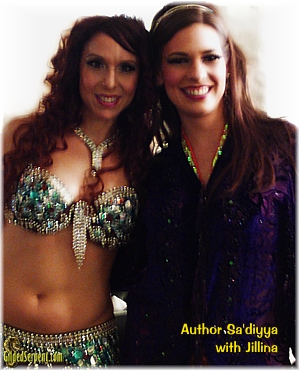
Author with Jillina

A Fan’s View of Jillina’s Weeklong Intensive

Report by Sa’diyya of Texas
posted March 24, 2011

I have always been a huge fan of Jillina.  I admire her ability to create flashy staged presentations of Bellydance.  She continues to educate herself and stay ahead of the trends.  Her musicality and creativity are impeccable and her costumes are unique.  I took classes from Jillina every time she came to Texas and studied her DVDs, too.  I heard about her 1st Annual Weeklong Intensive, but unfortunately couldn’t attend the first year. 

So I was determined to catch the next one, and I did.  And it was one of the best Bellydance experiences I’ve ever had.

The weeklong was held on January 2-7, 2010.  Back in July of 2009 I went to her website to pay for all the classes and noticed a scholarship application.  Her website stated that she was going to start offering scholarships on a regular basis for various workshops that she teaches.  Of course we have all heard of this in terms of higher education, and I have heard of it in the mainstream dance world, but rarely in Bellydance.  I thought it was a neat idea and extremely generous.  So I filled out the extensive online application and wrote the required essay.  What meant to take a few minutes of paying with a credit card online for the event turned into an all-night typing and proofing fest, and badgering my husband to edit my essay until it was just right.  I really didn’t think I’d receive the scholarship.  I imagined that everyone who went to pay for the classes applied for it, plus she was only giving two scholarships out for this event.  I figured I had nothing to lose.

The News!

I called Jillina a couple months later to ask her for some advice, which she always takes the time to answer, and she said, “By the way, you got the scholarship!”  I couldn’t believe my ears!  I really didn’t think I’d receive it.  A dancer from China named Molly and I were the two recipients of the scholarships!  So now all I had to pay for was my hotel, car rental, airfare and food.  Not bad!  I am very grateful and flattered that Jillina extended one of the scholarships to me.  She has always been one of my Bellydance heroes (and will always be), so the fact that she saw something special in me was so very special to me. 

I think that’s another benefit of having scholarships in the world of Bellydance because it gives dancers another goal to work towards: “What do I have to do to rise to the occasion, to receive this other kind of award?”

The closer we got to the weeklong, Jillina started to send out information we needed to know like the schedule, tips for surviving the week and more.  When I read some of the “survival tips,” I knew that when Jillina said intensive, she meant INTENSIVE! (She said this several times before and during the weeklong, too!) 

The event started on the second of January at 10:00AM, so I had to fly out on New Year’s Day after a long night of performing New Year’s Eve parties.  I’m sure some of the participants had the same situation.  I made sure to get lots of rest that first night I was in L.A.  We had to bring our own lunch everyday (no time to go out to eat), so I ran by the store that first night and packed my hotel fridge with healthy food for the week, including LOTS of water and calcium magnesium, as specified in the survival tips. 

The participants were from all over the world including Asia, Europe, USA, Canada and Central America.  It was great to meet such talent from all over.  It was interesting to see how these ladies, some who live on the other side of Earth, have a very similar life and schedule to mine – teaching Bellydance classes, performing on the weekends and directing troupes.

When we arrived at Evolution Dance Studios in L.A., Jillina so generously gave each participant one of her new “Bellydance Evolution” yoga mats!  Along with her generous welcome gift, it was made clear that a lot would be expected of us over the upcoming week, including being on time, attending all classes and putting forth total effort in every class. 

The week started off with an Oriental choreography to “Nagwa.”  The arrangement of “Nagwa” Jillina used was unusual and beautiful.  The choreography was awesome and the pace of the class was perfect – not too slow, not too fast.  I knew after that class that we were in for something special.

Each day was packed with about 9 hours of classes with Jillina and other guest instructors.  Jillina taught Oriental, fan veils, drum solo (with Issam drumming LIVE), khaleeji, Um Kolthum (with Issam and Naser Musa LIVE) and falahi.  The guest instructors were Ahava (Beledy), Issam (Percussion), Louchia (Bandari and Russian gypsy), Jamie-Lee (Stage Makeup), Heather (Ballet), Stephanie Sullivan (Debke), Aubre (Pilates) and Lauren (Finger Cymbals and Percussion).  I liked that Jillina featured other instructors who specialized in certain topics.  I got to see how she surrounds herself with other smart, successful people and they work well together and compliment each other.  The guest instructors were many of the same people who work with her on the “Bellydance Evolution” tour, and the wonderful synergy was apparent. 

Along with all of these classes, Jillina spent the lunch break every day leading discussions about various Bellydance business-related topics like booking parties, directing troupes, running a studio, becoming a workshop instructor and more.  I loved how jam-packed the schedule was.  I still smile when I think about our really short bathroom breaks – if we were in there too long, Jillina would come running through clapping her hands and telling us to hurry for the next item on the schedule!  It was high energy and fast-paced, but Jillina made sure we were finished by 7:30PM most days.
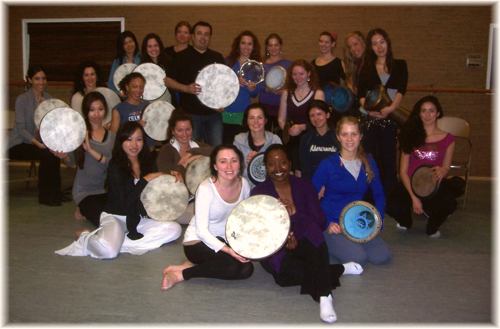
Class photo
Class photo
backrow l-r: 1- Jennifer, 2-Nabila, 3-Chiaki, 4-Rebecca, 5-Maria, 6-Issam, 7- Jillina, 8-Eglal, 9-Yeli, 10-Sa’diyya, 11-Ericka, 12-?
Middle row: 1-?, 2-Molly, 3-Erica, 4-Sarah, 5-Siri, 6-Dahab, 7-Emalee, 8-Daisy
Front row: 1-Neena, 2-Ahava

Day 1

As mentioned above, we learned an entire choreography to “Nagwa” on the first day.  That was just the beginning.  We also learned the basics of hand drumming on a tabla and a duff.  Lauren, from the Bellydance Superstars and Jillina’s Sahlala Dancers was the instructor for this class.  Lauren has a very clear manner of explaining things.  I had never played a duff before, so that was new and fun!

Ahava taught one of the cutest choreographies I’ve ever learned! 

It was a balady piece that had many different sections including a short drum solo.  She taught the first two thirds and then asked us to improvise the last section.  She gave us tips on dancing to balady style for the improvised section.  She was a very humorous and nurturing instructor.  She even gave individuals in her class a chance to shine by showcasing the improvised solos at the end of her workshop.

Day 2

After not much sleep (due to my racing thoughts, plus it’s hard to fall asleep without the hubs on my right side), I was up at 8AM for another exciting full day.  Day two started with a fan veil choreography taught by Jillina.  I’ve dabbled with fan veils, so this workshop gave me a lot of needed ideas and technique for dancing with this prop.  It was a piece from Jillina’s Bellydance Evolution production.  She taught it to us for use as a soloist or for a group, which was very insightful for those of us who were troupe directors.

I’d like to mention how Jillina, along with the guest instructors, let us video-record all of the dances we learned.  That has been so helpful in retaining the material.

Next was drumming with Issam.  I can’t help but smile when he’s around!  His class was super fun!  We learned how to play the entire drum solo that Jillina would teach us choreography to the next day.  It was much easier to memorize the order of the steps because of the introduction to the music the day before.

Later that same afternoon we had our first class with Louchia from Jillina’s Sahlala Dancers and Bellydance Evolution.  Along with Bellydance, Louchia is a master of Central Asian folk dances, including many Russian, Iranian and Afghan dances.  This day she taught a Persian Bandari dance, which I loved.  Louchia is very knowledgeable and a clear instructor.  She seemed like a very serious person as an instructor, but dinner later that night would reveal her wacky, wild story-telling side!

Next was Stage Makeup with Jamie Lee.  Jamie shared her extensive knowledge of stage makeup application with a sense of humor and friendliness.  I have always studied makeup application techniques, so I already knew a lot going into the class.  But I learned many new things anyway, which I still use now.  My main complaint about this workshop was that there wasn’t enough time.  I heard other attendees who admitted that they hardly had any knowledge of stage makeup and who were really looking forward to expanding their abilities, vocalize that it was frustrating to be rushed and not really have a chance to try the makeup techniques and have them “double-checked” by Jamie Lee.  I would have also liked hair styling tips to have been addressed.

A get-together over dinner was scheduled for that evening at Bucca di Beppo.  Not many people showed up to socialize, but we were already feeling the mental and physical exhaustion creeping up on us.  It was fun to see the people who went to dinner cut loose outside of the “classroom.” 
Khaliji time!Day 3

This day started with a Ballet class by Heather from Jillina’s Sahlala Dancers and Bellydance Evolution.  This class was very helpful with posture, turns and kicks.  I had only a few classes in Ballet before this, so I was surprised how much it influenced me.  I ended up choreographing a DRUM SOLO of all things with all kinds of crazy turns, kicks and jumps, inspired by Heather’s Ballet for Bellydancers class!  Heather is a lovely, articulate teacher.  She is one of my favorite new performers, as well!

Next was the Issam/Jillina drum solo!  We were all excited to learn it because we had heard the music the day before.  Let’s just say her dance lived up to our expectations.  When Jillina choreographs a drum solo, it’s like her moves were meant for those sounds.  This particular drum solo had some unique sections in it like a Persian 6/8, where she incorporated classical Persian dance steps. 

Here’s another neat quality about Jillina: she gave Louchia the spotlight to teach the Persian section of the dance.  She admitted that is wasn’t her forte and showcased Louchia instead.  It was a great dance and it was extra special that we got to dance to live music by Issam!

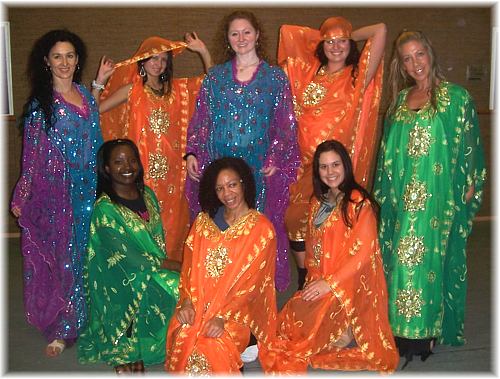
Khaliji-time!  Her Khaliji dance was very sassy and fun.  Jillina always finds the best music – I ended up creating my own choreography (inspired by Jillina and other skilled Khaliji dancers) to the music Jillina used in this class.  We also got to see how she used her choreography as a troupe dance with staging and level changes.  And we learned some Khaliji “fashion tips” to make the dresses more figure-hugging and attractive for stage.

This same evening was our dress rehearsal in preparation for the show that was scheduled for the upcoming Thursday.  We had only one hour to do hair, makeup and get into our costumes.  Then we performed our dances in a mock-up theater in her Evolution Dance Studios, complete with stage lights and an audience (being each other).  It was great seeing everyone all made up – we all looked like totally different people.  It was here that I realized even more all the talent at this event. 

Jillina gave us all feedback right there, on the spot, in front of everyone.  She gave your strengths and told you what you needed to fix before Thursday’s performance.  No pressure.  It was good though.  I always say that compliments are nice, but critiques are better, because I can grow that way.  Let’s just say that I went back to the hotel and choreographed “like the dickens.”

Day 4

Day four started with another Ballet class by Heather, which was just was good as the first one, with a little different content.

We had a really special treat for our next workshop, as both Issam and Nasser Musa were providing the music for our Um Kolthum class!  Jillina taught sections of choreography and we were supposed to fill in the gaps with improvised dancing.  We were supposed to focus on emotion during this class.   I wish we had been given some tools to tap into different emotions – it wasn’t covered on how to emote much.  I have to say that mental fatigue was really starting to squash me during this class.  I enjoyed the music and whole lesson so much, but felt like I didn’t get as much out of it because I was drained after almost thirty hours of dancing in only three days.

The class after lunch was Falahi.  I got a blast of energy and was ready to go again!  Jillina’s choreography was so creative and fun. 

We used drums as “water jugs” for our character, and then later danced on the drum, which I was petrified to do, but have since overcome (since then I’ve created an entire troupe dance with everyone dancing on a drum!)

  Jillina gave us tips on how to dance on a drum without breaking our necks.  The only thing I would have liked added to this class would have been more history and general information about Falahin dance and music.

The most aerobic, athletic dance was saved too far towards the end of the weeklong.  Debke.  I did learn some new steps and I really appreciated the instructor’s talent.  This class was taught by Stephanie Sullivan, who is a great Debke dancer with a laid back personality.  I became very frustrated in her class because she chose to teach the steps from the get-go in a line…with twenty people.  It became insanity because half of us couldn’t follow without the steps being broken down before we got in a line holding hands. 

As a student, I would have liked the individual debke combinations taught before we were instructed to get into a tight-knit line.

Starting off in the line meant that we couldn’t see her very well as she continued to teach the choreography.  It also meant that if I or the dancer next to me made a mistake, everyone around would get off the timing and it made it all the more frustrating.  Also, the music was exceptionally loud.  She and her workshop assistant kept turning it up and up and UP!  Even when asked to turn it down – it would just go up again.  I had an incredible headache and couldn’t hear or see her instruction anyway.  I had to leave.  I think my frustration was apparent, but it was so hard to cover up what I was feeling considering the conditions.  Now in all fairness, even though ¾ of the class had dropped out like flies (and this was the first class everyone didn’t ride though), a handful and students toughed it out and seemed to have no problems at all.  So I do attribute part of my reaction to my physical and mental exhaustion.  Luckily, along with all the other instructors, Stephanie was gracious in letting us film her choreography so we could go back and really learn the awesome choreography she taught.
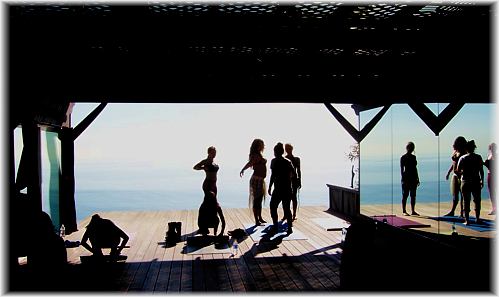
Jillina's home studioDay 5

This was the day we got to see Jillina’s Malibu sea-side studio. 

It was amazing!  If you haven’t seen it, picture an open-air gazebo-like huge dance studio with one side completely open hanging over-a-Malibu-cliff over looking the Pacific Ocean.  Breathtaking. What a great place to create!

Our first class this morning was a much-needed Pilates class, taught by the very limber Aubre.  It was nice and relaxing.  But not too relaxing, as she too had to kick our behinds just a little.

We had a restful afternoon that included lunch prepared by Jillina in her home, followed by a video viewing.  It was a nice break.

Back to another of my favorite new dancers, Louchia taught a Russian Gypsy dance with a skirt.  I really liked this dance and she has inspired me to learn more about this style.

Our last class of the weeklong was with Lauren.  She taught various finger cymbal patterns accompanied with bellydance combinations.  It was a little too slow paced considering the level of the attendees at the weeklong, but it was fun.  A bellydancer can never practice her/his zills too much!

It was around 7PM when Lauren’s class concluded.  Jillina invited us in to eat dinner, chit chat, and she took the time to individually meet with everyone.  So while everyone was waiting their turn, we just hung out and got to know each other a little better.  I already had a meeting with her the day before, so I went out to her sea-side cliff-over-hanging studio that’s in her backyard for a little while and worked on my drum solo some more.  Then I realized that it was getting dark and I was alone.  I started to fear that a mountain lion might come eat me for dinner, so I went back inside her home.

I couldn’t believe how generous Jillina was with her time and advice.  She gave everyone more one-on-one time than my doctor gives me at an appointment!  She truly cares about the dance and her students.

Day 6

This was the big day.  We didn’t have to be at the theater until 2PM, so I slept in a little, woke up and practiced my dance and then headed over to the on-site dress rehearsal.  I like seeing how Jillina runs a show and I learned about having high standards in producing a bellydance show.  It makes a big difference in the outcome. 

Showtime was here and I had to tell myself that “it is what it is.”  I was getting ready up until I had to go on (I hate waiting around – it makes me nervous).  I performed and remembered my whole dance, of course adding the suggestions Jillina and my peers shared, which made it much better compared to the dress rehearsal two days prior.  I went out and watched the remainder of the show and saw incredible talent from all over the world. 

I have to say that I was disappointed there weren’t more people from Los Angeles to watch the show.  It was a Thursday night, so there probably wasn’t too much competition in terms of other bellydance shows going on.  And Jillina is such a Super Star, you’d think more of her local peeps would be out there supporting her.  I thought the place was going to be standing room only.  It was a great show, anyway, and I was proud to be a part of it.

Jillina’s weeklong was one of the best bellydance experiences I have ever had.  It was beyond expectations and I feel like I’ve grown ten-fold since I attended it.  Jillina is the consummate Bellydance professional.  I have a theory that we love the dancers we love because something kind and loving shines from within them that they share with us when they perform.  Jillina is a true star who shows those qualities both on and off stage.   


Eglal, Dahab, Rebecca, Nabila, Emalee

use the comment box

Have a comment? Use or comment section at the bottom of this page or Send us a letter!
Check the "Letters to the Editor" for other possible viewpoints!

Ready for more?

  • My Dream: Dancing in Cairo!
    To be asked to teach at Ahlan Wa Sahlan is an amazing honor, but to be performing, in the biggest show of the year? It was unbelievable! This was the most significant phone call I have ever received in my entire career.
  • Carl’s Camera Captures Jillina’s Bellydance Evolution
    Jillina Carlano’s Bellydance Evolution marked the beginning of an era in which bellydance moves beyond dance Oriental imported from Egypt and performed in clubs.
  • Jillina Advances Dance Theatre, A Review of Jillina’s Bellydance Evolution,
    Bellydance Evolution is a full-length theatrical event directed by dancer and choreographer Jillina, ushering belly dance into the world of dance theater. The production is a melding of narrative with a wide variety of traditional and cutting-edge Middle Eastern dance and music. I saw the dress rehearsal of Bellydance Evolution when it debuted in Glendale, California in August, 2009.
  • An American Belly Dancer: The Significance of Jillina
    workshop sponsored by Amina Goodyear, at Dance Mission, San Francisco, California, January 25, 2004
    It seems quite evident that it wasn’t Jillina’s motivation to become the Superstar title which now precedes her — that she is, in fact, just doing what she loves, being who she truly is, working hard at it — and the rest sort of fell into her hands.
  • 3-22-11 Taiwan Bellydance: 2 Events Are Perfect Ending for 2010, Nefertiti Bellydance Carnival & Bellydance Evolution by Lisa Chen
    I admire those dancers participating in the production for their talents, skills, and artistic qualities, however, I feel the framework of story-telling compromises dancers from better expressing their love for this dance (or through it). They are acting through dance rather than dancing to the music.
  • 3-16-11 Amera’s Dina DVD Reviewed An evening of Arabic Dance and Music featuring World Renowned Belly Dance Artist DINA Review by Amina Goodyear
    Nonetheless, we need to move beyond her expressions. Her dance is Dina. She is agile, melodic, rhythmic, and her movements are so intertwined with the lyrics and the music that she exists as the music–always reaching out to us and, thereby, bridging the gap.
  • 3-17-11 Empowering Women in India through Belly Dance by Jasmine June and Samar
    The company works with less fortunate and troubled families and women, and pays the women a decent sum for their crafts as a way of helping them out.
  • 3-15-11 MaShuqa interviews Dahlal and Tim Kent on the Cairo Revolution for the Gilded Serpent Video report on the Community Kaleidoscope
    In February 2011 while at the Belly Dancer of the Universe Competition, we catch Dahlal/Debbie Sinclair and Tim for an interview.
    Discussed are the affects of the curfews, blocked streets, and lack of cell phone coverage on the production of costume orders.
    They also talk about the difference between Cairo and US designed costumes.
  • 3-15-11 Shamadan or Candelabra: Dances Along the Nile Part 4 by Gamila El Masri and Lucy Smith/ Scheherezade
    The style is very earthy and includes great “tricks” like the splits, stomach work while on the floor, rolling over full length on the floor and posturing — complete with quivering buttocks, and various other individual talents.
  • 3-10-11 Cultural Traditions vs Sexual Stereotypes Part 2 of The Female Gaze
    or "Medusa Dualities in Female Bellydance Performance and How the Gaze Continues to be Relevant Today"
    by Shema

    There is a fine line between respecting cultural traditions and histories and reinforcing behaviours which are inherently damaging to the perception of the female body and its rights.
  • 3-7-11 Gigbag Check #29 with Samantha of the Bellydance Superstars Video on the Community Kaleidoscope
    Samantha is from Brighton, England. Sam starts to tell of her start with the troupe when Rachel joins the conversation briefly to help out and testifiy to Sam’s talent and commitment. Sam was discovered in Rachel’s workshop in Birmingham. Sam also shows us her gig bag and her favorite skirt made by Madi Love. Sam suggestions bringing a sewing kit and tells of problems getting her
    belt ornaments tangled in her bracelets. This footage was filmed February 15, 2009 backstage at the Marin Civic Center in San Rafael, California
 

Gilded Serpent presents...

Taiwan Bellydance: 2 Events Are Perfect Ending for 2010

Han-yun Chang
Han-yun Chang
One of the three Taiwan dancers selected to be BDE dancers

Nefertiti Bellydance Carnival & Bellydance Evolution

by Lisa Chen
posted March 22, 2011
Images courtesy by Violet Lee Arabesque Belly Dance Troupe & Christine Du

December is always a high season for the Taiwan Bellydance community: year-end parties, recitals, and workshops featuring foreigner instructors. 2010 was no exception–but rather an impressive one because of its two events: Nefertiti Bellydance Carnival featuring Randa Kamel and former Bellydance Superstar Jillina, with her new group Bellydance Evolution (BDE).

The two events both had local sponsors and consist of workshops and a performance; in addition, Nefertiti held a dance competition. Nefertiti’s Bellydance Carnival was hosted by Bella Wang, a Taichung-based Bellydancer and instructor. BDE was hosted by Violet Lee and her Arabesque Bellydance Troupe, the first Bellydance group in Taiwan.

Experience the Real Balady Fever with Randa Kamel:

posterNefertiti’s Bellydance Carnival featured the Egyptian Bellydancer Randa Kamel, and several outstanding Bellydancers from other countries:

  • 2007 World Cup Bellydance Champion Simona Minisini from Italy,
  • Nathalie Zarate from Argentina,
  • and Ehab Gadalla from Egypt.

Randa brings her own band with a male singer for her teaching and performance. Although this was not the first time we had had foreigner instructors bring their own band for live music, Randa’s five-person band was the first time for local audiences and dancers to see and hear an authentic performance of Arab/Egyptian Bellydancing and live music.

There is no doubt that live music and an experienced band are the best (as well as the most challenging) for Bellydance performers. Randa and her band gave us one of the best demonstrations of the true beauty of Egyptian Bellydance: a highly expressive art form–a very intimate conversation between dancer and musician as well as between dancer and audience.

I went to see the opening gala show of the whole event series at Taipei. It started with Randa Kamel’s band consisting of keyboard, accordion, frame drum/riqq, and Egyptian tabla. The band played “Alf Layla Wa-Layla”, the song of the legendary Um Kalthoum, and the audience instantly adored the beautiful arrangement. This is the first time I have listened to the live version of this song, and I was thrilled totally by the power and details of live music. Friends who came with me confessed that now they have more ideas and feeling to dance with this song.

Bella’s dance company, Desert Rose, performed with Isis wings, Tango-fusion Bellydance, and Khaleegy. Simona Minisini and Nathalie Zarate both performed choreographed pieces and live drum solos. The two skillful dancers showed their personal styles and the audience loved them. I particularly liked Nathalie’s interpretation to Warda’s “Akdeb Aleek”. Singer Samir sang several highly popular Arabic songs. Even though the audience didn’t have much understanding of lyrics, they felt it in their hearts.

Everyone anticipated Randa performing a grand finale, and she didn’t let the audience down. When she came out, walking around the stage like a queen, the audience shouted loudly to greet her. While she danced to the song the singer performed, we realized she interpreted also the lyrics and emotions of songs with her facial expressions, hand gestures and dance movements. Her dance is more like a lively drama!

In the middle of her dance, Randa stopped to request turning down the stage lighting because “she could not see the audience.” She said she needed to have eye contact with her audience, and then, spontaneously, she would know how to dance.

Indeed, when Randa approached toward us when she was on stage, we felt like she was coming to say something. She danced several different styles, and we were very lucky to watch a Shaaby piece. This is quite new to many local audiences since our local Bellydance community knows something about Oriental dance or modern Egyptian Bellydance and some of them regard this dance form as the only type of Egyptian dance.

Perhaps the best aspect of Randa’s performance is that the audience enjoys so much about the whole presentation–regardless of not understanding the lyrics. Together, Randa and her band show the lively and earthy charm of Egyptian dance performed by a native Egyptian.

At the end of the show, Randa Kamel thanked her audience with a very touching comment: “Thank you; you make me dance!” I think this attitude is why Randa Kamel’s dancing is so widely admired by global fans.

Jillina and Violet
Jillina and Violet Lee shared the applause from audiences at curtain bow
Drummers’ Trio – Christine Du(Taiwan), Ozzy(BDE) and Dickson Cheung(Hong Kong)
Drummers’ Trio – Christine Du (Taiwan), Ozzy (BDE) and Dickson Cheung (Hong Kong)

BDE: Western Theatrical Production of Bellydance:

Two weeks after Randa Kamel won-over local audiences and brought inspiration to the local Bellydance community, Bellydance Evolution greeted Taiwan with a substantially different presentation: a totally Westernized theatrical production.

BDE is led by Jillina, formerly with the Bellydance Superstars and now on her own. BDE tours around the world with a theatrical production called “Immortal Desires.” Fundamentally, it is story-telling through an arrangement of different styles or stage-props.

This is not new for students of local sponsor Violet Lee because Violet’s annual recital or show has been presented as a story-telling theatrical production for years and remains as one of the signature characters of her troupes.

What differentiates BDE from local theatrical presentation of Bellydance is that BDE brings more Arab or Middle East folk dance styles such as Persian dance (by Louchia) and Central Asian dance (by Zurab Dudashvili and Guram Buchukuri) onto stage. In addition, widely-admired young Bellydancers such as Sharon Kihara and Elizabeth Strong were brought here and the audience was able to see a more ontemporary fusion presentation other than the stereotype impression of Tribal Fusion.

While BDE tours, Jillina chooses some local dancers to work with the production, which provides great opportunities for dancers around the world to be trained and work with professional theatrical productions.

All candidates are required to submit a video with the required choreography. The competition is, no doubt, very fierce! For performances at Taipei and Beijing, three Taiwanese dancers were selected: Han-yun Chang, Vicky Wen-yin Lee and Susan Hsiao-san Huang. Together with dancers from German, Mexico, Malaysia, and South Korea, they had been intensively trained and had rehearsals for a week, a wonderful and unforgettable experience.

Ozzy Ashkenazi, a young percussionist touring with BDE, came to Taipei and brought a great chance from drummers from Taiwan, Hong Kong and Mainland China jamming together. Christine Du (Taipei), Dickson Cheung (Hong Kong) and Dolphin (Beijing) performed with Ozzy as guest percussionists. He also gave workshops for local drummers and ME percussion students.

BDE offered workshops during the weekend after the show. I signed up for one with Elizabeth Strong. She shared her love and what she learned about Turkish Roma dance with us in class. By the end of class, we had learned background information about Turkish Roma dance and music, and a beautiful Jazz-Turkish Roma fusion choreography.

Two Shows–Two Faces of Contemporary Bellydance Trends:

The two events provided fine examples of contemporary trends in the Bellydance world, at least for the Taiwan Bellydance community.

In a way, the story of Immoral Desires is quite easy to understand: a love story between two couples through some ups and downs, with a happy ending. Stage design, lighting, and music were all professional quality. It was like a huge feast from the first sight; only later on, does one realize it is more like a sampler of everything.

I admire those dancers participating in the production for their talents, skills, and artistic qualities, however, I feel the framework of story-telling compromises dancers from better expressing their love for this dance (or through it). They are acting through dance rather than dancing to the music.

Watching the BDE show is a pleasant experience, and by the end, I realized that I missed Randa Kamel and her wonderful band. I like a “pure” Bellydance performance because it preserves all the qualities I like about Bellydancing: body interaction and interpretation with Arab/ME rhythms and maqams. Dancers should enjoy the music and dance and have direct, in the moment interactions with the audience.

BDE has good intention and is a commercially-successful presentation. Because most of us are not native to the lands of Belly/Oriental dance origins, adapting it into a familiar form to express what we know and learn about Bellydance is an aid. Adaptations are also helpful to audiences, who know nothing about Bellydance or its original cultures, to enjoy watching it.

The two events are like double action, demonstrating two sides of Bellydance to Taiwan audiences and dancers. Both Randa Kamel and BDE brought us great experiences and memories, a perfect ending for 2010.

use the comment box

Have a comment? Use or comment section at the bottom of this page or Send us a letter!
Check the "Letters to the Editor" for other possible viewpoints!

Ready for more?


Gilded Serpent presents...

Empowering Women in India through Belly Dance

India Collage

by Jasmine June and Samar
posted March 17, 2011

When people associate countries with belly dance, they often think Egypt, Lebanon, Turkey, Morocco, and India, among others. However, the belly dance scene in India is small and virtually unknown compared to these other countries. Belly dance in India barely peeps out of the shadows of the increasingly popular Bollywood scene. As well, the movements in belly dance are sometimes equated with the gyrating hips of modern Western dance styles, and give belly dance a taboo status.

Despite being one of the more taboo forms of dance in India, belly dance is able to empower Indian women.

There are several levels in which empowerment occurs. From creating the textiles for the costuming to selling the costumes from a family owned storefront to becoming an instructor, belly dance is able to transcend its taboo status and empower the women who are involved with this dance.

Samar is a business man in India who represents Craft India Overseas, an establishment involved in manufacturing and supplying Middle Eastern costuming, accessories and jewelry to all facets of the belly dance scene. As such, he has an informative opinion on how belly dance is perceived in India. He says that until around 2004, belly dance was referred to as the “shameless show”. He continues to explain that, “Well that is what a conservative society response would be. India is the land of Hindus, Muslims, Sikhs, Christians, Jains, Buddhists and Zorastrians. All the mix in the world, but still the core of the Indian society is conservative.”

He also touches on the hypocrisy of the Indian culture embracing Bollywood, but frowning upon belly dance. The term Bollywood derives from the more popular cousin of the West, yet is considered an inspiration from Hindi songs during the 80’s and early 90’s. The “Burger” generation has been pushed into a belief that Western shimmies are vulgar and that the Indian gyrations are acceptable. This is hypocrisy to an extent, but also includes the fear of losing Indian identity. Surprisingly, the Indian majority forget that the youth can add to the art of belly dance just as it has evolved from a traditional Middle Eastern dance into the more dramatic Tribal Fusion and American Tribal Style in the United States.

Samar's ParentsDespite the mark of taboo, belly dance has flourished in India, as is evident from Samar’s business success. Craft India Overseas was created by Samar’s parents in 1992. He explains,

“Our family was not into belly dance, no one in our family knew anything about this art. When the making of these costumes and accessories started in 1992, we were just as curious about it and started to research this. With the advent of the Internet in India in 1994, we were already browsing and learning about this dance form. We were the first ones out of Asia to get a catalog online with belly dance costumes and stay on till now and hopefully for a long time to come.

Being through many phases in the business, we were amongst the earlier ones to get into design copyrights. We started to streamline the business with more process clarity and a better system to be able to respond to the customer in case of queries. We are probably one of the early Oriental dance costumes and accessories manufacturers to be an ISO 9001:2008 quality management systems certified establishment.

This was a small business set up by my Father and Mother, honestly with a dream of financial independence. It became much bigger along the way and they started enjoying being apart of it for what it was. It is now an integral part of the family discussions, day to day life even and yet surprisingly no one in the family knows how to dance. Isn’t that something? I guess I’d have to learn it someday.”

Samar and his family have made a successful living from one of the key components of belly dance: costuming. While Craft India Overseas is involved primarily with the distribution end of things, the business also provides jobs to the women who make the textiles and costumes.

The company works with less fortunate and troubled families and women, and pays the women a decent sum for their crafts as a way of helping them out.

For example, one of the groups is run by a widowed women who employs other women to make crafts for the company. A lot has been said about how the dancing part of belly dance empowers women, but empowerment trickles down even to the finer components of the dance. The women craft the products for Samar’s company are not belly dancers, and yet they achieve financial stability because of the demand for belly dance costuming.

Another aspect of empowerment is how belly dance in India affects the dancers themselves. Dancers, such as Essa Duhaime, Meher Malik, and Katie Holland, have labored to change the opinion about this art. They have been instrumental in creating a belly dance scene in India and carrying it forward. Not only are these dancers able to generate an income from performing and teaching, but some of their students go on to perform and teach, as well. Meher Malik operates the Banjara School of Dance and the school has grown to about five hundred students in just three years. How’s that for success?

These women continue to dance, despite being frowned upon by conservative society. Katie explains that she has it exceptionally difficult as a white belly dancer because people often equate her with a prostitute! Some prostitutes in India dress up as belly dancers, which obviously worsens the situation.

While there still may be a sense of taboo surrounding belly dance, the nature of the dance to create community amongst women has allowed belly dance to gain enough popularity in India that studying and performing the dance is at least tolerated. This isn’t to say that studying and performing belly dance is not met with hardships, but that perhaps the stigma is slowly starting to fade.

More from Samar soon!
use the comment box

Have a comment? Use or comment section at the bottom of this page or Send us a letter!
Check the "Letters to the Editor" for other possible viewpoints!

Ready for more?

  • 2-26-11 Not So Steam punk Belly Dance by Jasmine June
    Since Tribal Fusion is also easily accessible, there have been dancers who begin performing and calling themselves professional when really they are just hobbyists. A professional belly dancer would never label her dance genre based on an aesthetic.
  • 12-14-10 Tribal Fusion: An Evolving Dance Form by Jasmine June
    The biggest contrast between ATS and Tribal Fusion was that improvisation was the basis for ATS while Tribal Fusion, at least in its earliest phase, had a strong emphasis in choreography. This allowed Jill Parker to play around with musicality and to explore musical genres that were appealing to her.
  • 11-3-10 An Intro to Tribal Fusion by Jasmine June
    Since Tribal Fusion Belly Dance is a relatively new dance form, it is especially important to treat the genre with a level of professionalism, or else one runs the risk of discrediting the work of dancers who have dedicated their lives to creating and elevating Tribal Fusion Belly Dance.
  • 9-16-10 To Berlin and Back, Bridging Cultures Through Belly Dance by Jasmine June
    In this way, he demonstrated that belly dance isn’t something that is defined by culture. Rather, it is an art form that can be perfected by anyone who puts their mind to it, and it’s an art form that can be used to bridge cultures rather than divide them.
  • Hindu Extremists Riot at Belly Dance Show
    At the time, I was beginning to understand that this was a potentially dangerous and explosive situation. But I had no way of knowing how much danger I was really in.
  • The Grand International Bellydance Tour or How We Fled India at Midnight, Eluding Our Captors and Evading our Go-Go-Dance Responsibilities. or What Would Fifi Do? It may not have been such a problem for us had the prostitutes not been posing as bellydancers!
  • Return to India – This Time it’s Personal!
    We thought that the misfortunes associated with our previous performance tours of India were simply anomalies in the blissful and glamorous world of dancing overseas.
  • 3-15-11 MaShuqa interviews Dahlal and Tim Kent on the Cairo Revolution for the Gilded Serpent Video report on the Community Kaleidoscope
    In February 2011 while at the Belly Dancer of the Universe Competition, we catch Dahlal/Debbie Sinclair and Tim for an interview. Discussed are the affects of the curfews, blocked streets, and lack of cell phone coverage on the production of costume orders. They also talk about the difference between Cairo and US designed costumes.
  • 3-15-11 Shamadan or Candelabra: Dances Along the Nile Part 4 by Gamila El Masri and Lucy Smith/ Scheherezade
    The style is very earthy and includes great “tricks” like the splits, stomach work while on the floor, rolling over full length on the floor and posturing — complete with quivering buttocks, and various other individual talents.
  • 3-10-11 Cultural Traditions vs Sexual Stereotypes Part 2 of The Female Gaze or "Medusa Dualities in Female Bellydance Performance and How the Gaze Continues to be Relevant Today" by Shema
    There is a fine line between respecting cultural traditions and histories and reinforcing behaviours which are inherently damaging to the perception of the female body and its rights.
  • 3-7-11 Gigbag Check #29 with Samantha of the Bellydance Superstars Video on the Community Kaleidoscope
    Samantha is from Brighton, England. Sam starts to tell of her start with the troupe when Rachel joins the conversation briefly to help out and testifiy to Sam’s talent and commitment. Sam was discovered in Rachel’s workshop in Birmingham. Sam also shows us her gig bag and her favorite skirt made by Madi Love. Sam suggestions bringing a sewing kit and tells of problems getting her
    belt ornaments tangled in her bracelets. This footage was filmed February 15, 2009 backstage at the Marin Civic Center in San Rafael, California
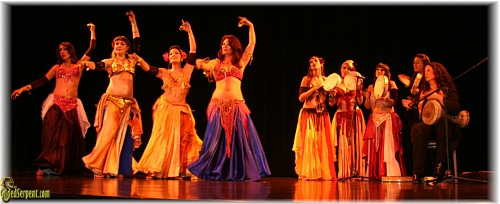
  • 3-4-11 Pangia Does Texas: A Warm Howdy! by Denise Manion, photos by Carl Sermon
    Carmine Guida (New York) Pat Olson (Californina) and I, are all members of the band, Pangia. In August of 2010, we had the pleasure of teaching workshops and performing at Yaa Halla, Y’all! in Grapevine, of the Dallas/Fort Worth area of Texas. It was a distinct delight to have enthusiastic, involved, and engrossed participants in attending our workshops.
  • 3-2-11 Video Report of Barbara’s recent trip Cairo, VIdeo on the Community Kaleidoscope
    We caught Barbara at the Belly Dancer of the Universe Competition in Long Beach in February 2011. She tells us of her trip to Cairo trying to attend the Nile Festival. Included are descriptions of getting to her hotels, rode blocks, checkpoints, neighborhood militias, attending classes, cell phone video, curfew, teachers including Aida Nour, How caring Mohamed was of his group. Barbara is a vendor of belly dance costumes.
  • 2-28-11 The Cairo by Night Festival, November 4-7, 2010, Stockholm Sweden by Nabila
    From the first moment that I arrived in Stockholm until I left, I felt warmly welcomed, relaxed, and it felt so fantastic to be with Zeina and Mohamed Abu Shibeka, that I spend my most memorable time there!
 

Gilded Serpent presents...

Amera’s Dina DVD Reviewed

Placeholder

An evening of Arabic Dance and Music featuring
World Renowned Belly Dance Artist DINA

Review by Amina Goodyear
posted March 16, 2011

 When one mentions a super-star of Egyptian Belly dance, usually Dina’s name is also in the same sentence, but that was not always the case. At one time, the title Belly Dance Super-Star could have been given to Nagwa Fouad. She had earned it by presenting the most spectacular revues with male and female chorus dancers (and, probably, having the most musicians in her orchestra).

One evening in a Cairo hotel, I think I remember counting (or maybe I stopped counting when I reached 58) the number of musicians on stage for Nagwa’s show. With this large number of musicians, the music and show could only be spectacular!  She featured male and female group numbers, preceding and encircling Nagwa who constantly left to change: costumes, wigs (long hair, short hair, braided hair), stage personality, and dance style.  The group danced, she danced, the group danced, she sang, the group danced again, and she ran off to change–only to reappear in something more grandiose or outrageous than the preceding costumes.

Shortly before her final piece, Nagwa stopped singing in order to speak. She wanted to acknowledge a special person in the audience. We all looked to see who that special person was, and Nagwa introduced a young dancer named Dina. There were audible gasps in the room! Dina was, at that time, an up-and-coming dancer who was rumored to have a few personal problems. Nagwa invited Dina to come to the dance floor to do a short number. My friends thought it was wonderful of Nagwa to support Dina at that time in her life.

I remember saying to myself, “Dina? Dina who?”  Then, a young, shy woman came from the audience, and (in her street clothes) she performed an extremely touching and poignant piece that will forever be imprinted in my emotional memory bank. Dina danced from the heart and my heart could feel it, and for me, Nagwa, without realizing it, had just passed the torch.

A decade later, Dina was on her way to earning the title Egyptian Belly Dance Super-Star. At first, it was based upon: "What was Dina wearing?" "How short was it? How outrageous was it? How ridiculous? Where can I get one?" Next, the question was "How many times did she change costumes?" Later, it was "How can she stay in her costumes?" "Is she wearing any … ?" and even later, it became, "How many people do I know who are copying Dina’s signature movements?"

Now, a couple of decades after my first seeing Dina, she is the Egyptian Belly Dance Super-Star! In Amera’s Palace” DVD, this star quality is so evident, and she doesn’t have 58 musicians backing her up. In fact, she doesn’t even have one single musician backing her up! Dina is dancing to recorded music! She runs onto the stage and takes command, and she is just one person on a stage that could hold that 58 piece orchestra. She has confidence. She is comfortable. She is personable. She is Dina, and there is only one Dina!

Dina performs a number of pieces and makes a number of costume changes as well as mood changes. Her dances range from highly energetic, to flirtatious and dellae (coy, coquettish, spoiled) from fun and lively to emotional and above all, heartfelt. It is the latter that my heart and mind remembers most… In all her pieces, Dina is alive and real. Her expressions are alive and the real seems to draw from memories of a past-life or experiences that may or may not have been painful.  Her ability to reach within herself and express those feelings to a large audience is nothing short of spectacular! In this DVD, Dina’s performance and emotions are tailored specifically for the size of the house, and she never, even for a moment, (in spite of technical sound problems) loses control of her audience.

Nonetheless, we need to move beyond her expressions. Her dance is Dina. She is agile, melodic, rhythmic, and her movements are so intertwined with the lyrics and the music that she exists as the music–always reaching out to us and, thereby, bridging the gap.

In this DVD, her costumes are almost conservative for Dina. At first glance, they are all quite simple, yet beautiful, but additionally, there is a subtle Dina-daring quality in style or cut with which only Dina can get away. On the DVD, she performs a total of 8 dances with costume changes. I can honestly say I liked all of her dances.  Each one captured a different feeling and used different movements and dance styles. In all of her dances, she is at her best and although, at times, the follow-camera could have followed the dance better, on the whole, I would say the camera work was able to capture adequately all her moods.

Dina photo from back cover of DVDLike fine wine Dina has aged well. To my eyes, she hasn’t aged at all, but, since I have been seeing her perform for over 20 years…
I can quite honestly say that I enjoyed watching her in this new DVD more than older DVDs.

Is this Dina DVD for entertainment? Yes.Is this Dina DVD to be used and analyzed by a teacher and/or a student to learn how to command an audience and transmit emotions to an audience? Yes! Yes! Yes!

Well, there it is: Already, I have  awarded a 4-zil rating! (Furthermore, I haven’t even yet mentioned the entire first part of the DVD.)

Amera’s Palace, an iconic fixture in Sydney’s Bellydance scene for over 2 decades, has maintained cultural connections with Egypt by successfully hosting many international events. In 2008, five of Egypt’s top dancers and twelve musicians came to Sydney for The Farha Tour of 2008.  Last year, 2010, Amera’s Palace hosted another 5-star event with Belly Dance Super-Star, Dina, in a 3-day extravaganza, consisting of a competition, workshops by Dina, and a show starring her, as well as troupes: Attar, Hathor Dance Theatre, Pyramidstique, Raks Harissa, The Eastern Stars’ Middle Eastern Band, and Singer, Khaled el Amir.

The Dina DVD was produced by Amera’s Palace, and it includes artists from the 2010 Belly Dance and Arabic Music Extravaganza held last August in Sydney.  Favorite dance troupes from Sydney and Perth performed group numbers with many yards of silk veils, ribbons, and dance wings. The dances varied from balletic theater style, an Arabic dance influenced by modern dance, a take-off on Dandash‘s "Manga" impersonations, and traditional Arabic dance-formation choreography. The singer, who sang two pieces composed for Abdel Halim and Adaweya, was quite accomplished and was accompanied by a 5-piece band.

In conclusion:

You might ask, “Would I recommend this DVD?” Yes, I would. It belongs in your Dina library. Whether you have a collection of the rather scarce videos of Dina performing in various compilation videos or not, maybe this could be the start of your own library, because, in this video, she certainly hits her stride! Also, as I mentioned in this article above, it is a very important learning tool for both teacher and dance student who face the prospect of dancing on a huge stage.

Rating: 4 zils
Rating 4 Zils  

purchase info


use the comment box

Have a comment? Use or comment section at the bottom of this page or Send us a letter!
Check the "Letters to the Editor" for other possible viewpoints!

Ready for more?


Gilded Serpent presents...

Cultural Traditions vs Sexual Stereotypes

Female Gaze

Part 2 of the Female Gaze
or "Medusa Dualities in Female Bellydance Performance
and How the Gaze Continues to be Relevant Today"

by Shema
posted March 10, 2011

In Part 1, we explored how the Medusa myth expresses the challenges for female performers. In this section, we explore the dynamics of becoming objectified by dance via the gaze.

We are often confronted with images of women in seductive pose as witnessed in the crossover of stock images in pornography to art, fashion, and advertising.  In these images, the model, although she may be aware of the voyeur, is passive in her acceptance of the gaze. The certain pleasure in looking and also in being looked at is referred to as “scopophilia.” According to Freud, this is a type of gaze that is “curious and controlling” gaze resulting in the objectification of a person. Traditionally, scopophilia occurs with the female in a passive role that is both exhibitionist and restrictive and the male in the active role. Although often attributed to be naturally exhibitionist in character, women have also been denied the freedom to express this part of their characters. The resulting tension within the woman raises the question of whether the extended portrayal (of women as objects) has forced women into an unnatural role (of being restricted from exhibitionism).

Part of the difficulty in understanding the scopophillic gaze lies in our perceptions of exactly what an object is and whether our bodies can truly fit into that category at all. As one intellectual, Merleau-Ponty, stated, we are not so much products of history, genealogy, sociology, etc., but rather products of our choices and their effects on our consciousness. Thus, when we view any object, the sensation produced only exists as a result of the qualities that we place on it, which we are only able to apply from our previous experiences.

The idea of a pure sensation devoid of context is not possible since we would have to have had no previous experiences at all in order to not lay our prior knowledge on that situation. Thus, we are not pure objects.

Male GazeHere we find the core of one of the issues surrounding Belly dancers for an audience that is unfamiliar with the cultural and individual history of the dance. Bellydance is an expression of passion, emotion, anger, elation and pure femininity (as opposed to media sourced femininity). 

Since, audience members will apply their previous experiences and knowledge of sensual female dancers in an intimate space, such as strip-tease and lap dancing (even if this experience is not first-hand but through other media such as television, film or magazines), to bellydance, its meaning is obscured.

Merleau-PontyHowever, the matter becomes more complicated; as we all inhabit a body of our own, how can we then view other bodies as objects, when by experience, we must all know what it is to be perceived as an object? Essentially, to call something “an object” is to ascribe to it one viewpoint that is unchanging; it is “observable, situated”.  As Merleau-Ponty again points out: “Our body is not in space; it is of it.”

This observation is about using our vision to explore a subject, without losing ourselves in its perspective, allowing the gaze to view from a non-penetrative point, which, nevertheless, gives us the freedom to focus on the exploration. If the point of an object is that it is not involved in the observing, then surely, the very fact that we know we are being observed changes that?

If a dancer is performing, she knows that there is a process of observation taking place and will respond in any number of ways which show a “conversation” taking place–a form of communication which must put her body beyond that of an object.

Perhaps the illusion of an object is important within performances of a sensual nature: if there is a visual confrontation or communication (beyond the physical), then the title of “object” cannot be applicable.  However, if there is no eye contact made and the dancer appears to be unaware of the audience, then perhaps, she  becomes the object, or at least appears to become the object for the purposes of the performance.

Peggy PhelanThe use of fantasy in representation is driven by a sexual need which precipitates “the gaze”, as discussed by Peggy Phelan in Acting Out:

Implicit in her [Debi Sundhal] argument is the idea that representation is driven by a kind of sexuality in which objectification is constantly assumed. But is all sexuality motivated by objectification? And if not, what might happen to representation if the sexual desire motivating it were different?

Who owns our bodies and how we are to control the way we allow society to present them and our sexuality?

Even vanishing from view is not a guarantee against the gaze, since it is in human nature to want what is denied us and metaphorical or literal hiding can be as alluring as putting ourselves on show. 

There are many techniques for removing the body within performance, and within Belly dance there is, of course, the literal use of veils as stage props. Should dancers take more responsibility for the cultural and sociological associations within the use of the veil? There is a fine line between respecting cultural traditions and histories and reinforcing behaviours which are inherently damaging to the perception of the female body and its rights.

Veiling implies secrecy. Women’s bodies, and, by extension, female attributes, cannot be treated as fully public, something dangerous might happen, secrets be let out, if they were open to view. Yet in presenting something as inaccessible and dangerous, an invitation to know and to possess is extended. The secrecy associated with female bodies is sexual and linked to the multiple associations between women and privacy.

Part 3: "Transformation of Beauty”, coming soon!

Footnotes:
  1. Freud, Sigmund (1905) 3 Essays on sexuality’
  2. Merleau-Ponty, Maurice (1962) Phenomenology of Perception  Routledge and Kegan Paul
  3. Merleau-Ponty, Maurice (1962) Phenomenology of Perception  Routledge and Kegan Paul
  4. Merleau-Ponty, M (1962)
  5. Hart, Linda and Phelan Peggy (1993) Acting Out-Feminist Performances University of Michegan Press
  6. Schneider, Rebecca (1997) The Explicit Body in Performance Routledge

use the comment box

Have a comment? Use or comment section at the bottom of this page or Send us a letter!
Check the "Letters to the Editor" for other possible viewpoints!

Ready for more?

  • 8-15-10 Inverting the Gaze, Medusa Dualities in Female Bellydance Performance and How the Gaze Continues to be Relevant Today by Shema
    This is not so hard to understand when we consider that the representation of female sexuality has been so over-developed as to become almost a parody of itself.
  • 4-16-10 Belly Dance and Feminism: Different Issues, Different Perspectives Introduction to IBCC 2010 Panel on Bellydance and Feminism
    Feminism embraces more than one point of view, and feminist perspectives lead to many different decisions and courses of action. Feminism is a tool for thinking – for understanding and putting a name to issues you may be wrestling with in your own dance life, and for seeing belly dance in the light of broader economic, social and political realities.
  • One Hip in Each Camp, My Experience of Working in Both the Arabesque Dance Company and the Arabesque Orchestra e
    My dancing is fuelled by my understanding of the music and now, my playing is influenced by the emotions I experience when I dance. It is a cyclical experience which has been boosted by this incredible opportunity to work with some of the most talented Arabic musicians on the scene.
  • The Bellybutton Revolution, Feminism & Bellydance by Yasmina Ramzy
    When I grew up and became a bellydancer, needless to say, my Mom was perplexed and wondered where she had gone wrong.

  • The following is a kind of “manifesto” or set of guidelines that Bellydancers could follow that might help contribute to our community of artists in gaining respect
  • 7-17-07 Belly Dance, Through the Eye of the Camera by Ishtar
    Males dominate photography and film industries in both the west and the east. As well as ideas concerning the status of the dancer and gender, films involving belly dancers can give us information on the class dynamic and stratification that exists.
  • 8-27-10 Identity Through Bellydance:An Arab Descendant’s Viewpoint by Lynette Harper PhD
    While some Arab women turn instead to ballet and western contemporary dance, others, like me, have embraced belly dance genres as a way to connect with our cultural heritage–only to disappear behind another veil, because Arab women dance artists in Canada are obscured within a huge belly dance community.
  • 7-18-10 Belly Dance in Patriarchy, Escaping the Switzerland of the Soul by Andrea Deagon PhD
    However, I do believe that belly dance is able to attain such vitality and complexity in the modern world precisely because it’s embroiled in serious cultural and personal contestations. It is precisely clashes of aesthetic values, conflicting paradigms of sexuality and gender, and economic as well as political inequities that strike the dance’s most beautiful notes.
  • 4-16-10 Belly Dance and Feminism: Different Issues, Different Perspectives Introduction to IBCC Panel on Bellydance and Feminism
    Feminism embraces more than one point of view, and feminist perspectives lead to many different decisions and courses of action. Feminism is a tool for thinking – for understanding and putting a name to issues you may be wrestling with in your own dance life, and for seeing belly dance in the light of broader economic, social and political realities.
  • 3-7-11 Gigbag Check #29 with Samantha of the Bellydance Superstars Video on the Community Kaleidoscope
    Samantha is from Brighton, England. Sam starts to tell of her start with the troupe when Rachel joins the conversation briefly to help out and testifiy to Sam’s talent and commitment. Sam was discovered in Rachel’s workshop in Birmingham. Sam also shows us her gig bag and her favorite skirt made by Madi Love. Sam suggestions bringing a sewing kit and tells of problems getting her
    belt ornaments tangled in her bracelets. This footage was filmed February 15, 2009 backstage at the Marin Civic Center in San Rafael, California
  • 3-4-11 Pangia Does Texas: A Warm Howdy! by Denise Manion, photos by Carl Sermon
    Carmine Guida (New York) Pat Olson (Californina) and I, are all members of the band, Pangia. In August of 2010, we had the pleasure of teaching workshops and performing at Yaa Halla, Y’all! in Grapevine, of the Dallas/Fort Worth area of Texas. It was a distinct delight to have enthusiastic, involved, and engrossed participants in attending our workshops.
  • 3-2-11 Video Report of Barbara’s recent trip Cairo, VIdeo on the Community Kaleidoscope
    We caught Barbara at the Belly Dancer of the Universe Competition in Long Beach in February 2011. She tells us of her trip to Cairo trying to attend the Nile Festival. Included are descriptions of getting to her hotels, rode blocks, checkpoints, neighborhood militias, attending classes, cell phone video, curfew, teachers including Aida Nour, How caring Mohamed was of his group. Barbara is a vendor of belly dance costumes.
  • 2-28-11 The Cairo by Night Festival, November 4-7, 2010, Stockholm Sweden by Nabila
    From the first moment that I arrived in Stockholm until I left, I felt warmly welcomed, relaxed, and it felt so fantastic to be with Zeina and Mohamed Abu Shibeka, that I spend my most memorable time there!
 

Gilded Serpent presents...

Off the Beaten Path

Placeholder

Cory Zamora’s "Belly Dancing for Seniors" &
"Learn the Art of Male Belly Dancing"

Review by Jeanne Fogler
posted February 2011

Dancer and instructor Cory Zamora of Fresno, California, has created quite an extensive selection of DVDs. Some of the selections cover the usual territory offered by many other dancers/instructors: a series of belly dance basics, veil, some performances, etc. However, Ms. Zamora also presents some topics that are off the beaten path.

Senior BD by Cory

“Belly Dancing for Seniors”

The first unusual offering is a DVD that addresses a niche not previously filled. In this DVD, Ms. Zamora teaches a simple selection of basic moves; she is joined by some of her students, and then she combines all the dance moves and continues with some veil work. Instruction of the basic moves (which are very old-school in style) is clear and easy to follow.

However, I have a couple of issues with this DVD. One of my issues is that, other than stating the ages of the students (60, 63, 75) and making a fleeting mention of a few physical issues they have (problems with feet, back, etc.), there is not a great deal of material specific to senior dancers.

In order to address the topic in a more concrete way, some substantive discussion of common physical problems that seniors might face would have been appropriate and helpful (problems such as arthritis or osteoporosis, and how each condition might limit a person’s dancing, or how the problems might be alleviated by dancing).
 
My other issue is that there is a sharp increase in complexity level between the basics portion and the veil section that follows. The veil routine actually is quite well constructed, but after the laid-back format of the opening sections in which basic moves are introduced and then practiced at a leisurely pace, the complicated progression of one veil move after another does not seem to be aimed at the same audience.


Male BD DVD"Learn the Art of Male Belly Dancing”

Although men are still a minority presence in the belly dance world, they have gained somewhat in numbers and visibility. In light of that, it is a bit surprising that there is little in the way of DVD instruction aimed at male dancers specifically.  I don’t know of any such DVD other than this one! In it, Cory presents her former student, Wesley Gomes of Seattle, who is the main instructor on this disc. He teaches a collection of moves similar to those in the DVD for senior dancers previously reviewed here, such as basic weight changes, camels, flat-ball-ball-ball, and snake arms, sometimes noting details such as arm positions that can give a move a more “masculine style”. 

In passing, I feel I need to mention that some of Wesley Gomes’ remarks seem a little questionable to me. I’m thinking of one in particular in which he introduces a chest circle and says it is one of the biggest differences between male and female style, claiming that women do vertical circles and men do a flat (i.e., horizontal) circle. Um, really? Most of the women dancers I know perform using both, or even favor using the horizontal circles.

After demonstrating a move, Wesley adds zils (sagat). This becomes a bit of a problem because the music in the background sounds like it was dubbed in later, not like he’s actually dancing to it; the threes that he plays (often quite slowly) tend to be out of tempo with the music. It grows kind of maddening after a while.

When the instruction is finished, Cory and Wesley chat a bit, including the topic of costuming. It would have been more instructive to see this idea expanded by displaying some examples of ideas for male costumes, rather than just saying, “Wear a shirt and a vest, but don’t wear camel tassels.” At the end of the DVD are several satisfactory performance clips, featuring Wesley and also another male dancer, Gregory, who studied with Cory.

Cory’s videos tend to be quite basic in production values.  They have been recorded in her studio space, which looks fairly simple and not overly large. The lighting, videography, and the dance-wear of both instructors and students are merely average. Nonetheless, at a fee of under $20, and boasting fairly generous run times of 50 to 70 minutes respectively, both DVDs are a pretty good bargain.

Rating: 1.5 zills each
1.5 zil rate


Purchase info

Artist’s site or

use the comment box

Have a comment? Use or comment section at the bottom of this page or Send us a letter!
Check the "Letters to the Editor" for other possible viewpoints!

Ready for more?


Gilded Serpent presents...

A Day of Middle Eastern Rhythms
Taught by Adriane & Tezrah

Placeholder

Workshop Review by Nuriya
posted March 6, 2011

Workshop Held at the Brazilian Cultural Center in Rancho Cordova, CA, on January 23, 2011

Every belly dancer who has dedicated herself to the constant improvement of her dance has enrolled in a workshop, only to feel disappointed at having spent money on a few hours where nothing new was learned. That was not the case in my experience taking a day of workshops centered around Middle Eastern Rhythms, put on by Adriane and Tezrah, two prominent members of the Sacramento belly dance community.  The day was split into two workshops.  The morning was spent drumming and zilling to different rhythms with Tezrah, an experienced dancer and drummer who has performed with notable bands such as Flowers of the Nile, while the afternoon was spent exploring dance combinations to each of those rhythms with Adriane, one of Sacramento’s premiere belly dancers and winner of the 2011 Jewels of the Sierra competition in the Live Music category.

The two workshops combined a brief tutorial in the history of rhythms, practicing skills, and learning new combinations.  I received a solid foundation in identifying and developing a familiarity with Middle Eastern rhythms.

Tezrah familiarized the dancers with her background in music and belly dance.  She then demonstrated a variety of drums commonly associated with Middle Eastern belly dance music. Tezrah introduced the group to the basics of drumming, which included technique and provided instruction in the “doums, “teks,” and “kas” needed to interpret Middle Eastern drumming rhythms.  The rhythms ranged from common rhythms such as saidi, masmoudi, baladi, to less common rhythms such as wahda kabira and semaii.  Each was taught according a worksheet breaking down each rhythm according to two varieties, the core beat and a more complex rhythm.  Each rhythm began with a brief historical introduction and an explanation of where a dancer would commonly encounter that rhythm in music. 

Adriane also provided a handout laying out a choreographed set of two 8-counts for each Middle Eastern rhythm taught earlier.  Adriane highlighted the beauty of an individual rhythm.  Although initially I had been intimidated by some of the combinations, they proved simple to learn as Adriane broke down the steps into 4 or 8-counts.  During the combinations, Adriane danced either in front of the group or in the middle of the dance circle. Some of the combinations proved to be more challenging for the group (such as semaii, due to the 10/8 count), but when this difficulty became apparent, Adriane simplified the learning process by removing the motion from the steps.  As the dancers practiced the combination without travelling, the steps became much easier to grasp, and afterwards, the travelling was reintroduced.

Although at times the combinations proved challenging, I felt I had learned a graceful set of interpretive steps for each rhythm.  I finished the day absolutely exhausted and worried that I would not be able to remember the combinations after leaving.  But after a relaxing cool-down, Adriane also allowed the participants to film her performing the combinations to help dancers practice at home.

All in all, I felt that the two workshops complimented each other perfectly so that I not only learned key rhythms, but was able to capitalize upon that knowledge later that same day.  This provided a deeper and more utilitarian experience than most workshops by capitalizing on visual, audio and kinesthetic learning skills.  I left 1) challenged and optimistic for my future dances and musical interpretation, knowing that I had developed a deeper understanding of my dance that would serve me for years to come, and 2) eager to see what future workshops would cover.

On a related note, dancers were invited to showcase their talents later that evening at a showcase with live music provided by Flowers of the Nile, professional photography and videography, homemade Middle Eastern cuisine, and a wide array of dance styles from the Sacramento belly dance community:

Class photo
Class photo
back row: Nuriya, Bonnie Lewis, Zakkiyya, Nancy Asiya, Kathi Gandara, Susan Cole, Kallista, Radhia
middle: Sawako Ama, Julia, Tasha, Jan Lowry, Tisha Leigh, Sara Pope, Ivy
front: Linah, Adriane, Tezrah

use the comment box

Have a comment? Use or comment section at the bottom of this page or Send us a letter!
Check the "Letters to the Editor" for other possible viewpoints!

Ready for more?

  • 12-1-10 Practice Makes Perfect, or Does it? by Adriane
    It is because mediocre or non-existent practice makes for a mediocre performer and perfectly consistent practice makes for a perfect performer.
  • 2-15-11 Turkish Dance DVDs: For the Birds? Danceuse by Asena” and “Sema Yildiz: Turkish Belly and Gypsy Dance” 2 DVD reviews by Joette
    I enjoyed her Roma dancing the most and felt that it would be amazing to watch Sema in person to experience all the facial and tiny pelvic movements.
  • 2-11-11 Egyptian Classical Music: Entertainment or Education? 2 CD Reviews by Amina Goodyear
    The Art of the Early Egyptian Qanun Vol. 1 & 2, performed byThe Traditional Arabic Music Ensemble & Egyptian Taqasim: Produced and distributed by Nesma
  • 1-17-11 Get Down to the Root of it! Yasmina Ramzy’s Asala I & II, DVD Review by Joette
    Ramsey’s ability to show movements of grace and femininity comes across strongly by presenting the dance as respectable and as a valid form of dance expression.
  • 12-30-10 Dances of the Mahgreb, Tamazgha, or Berbers, Amel Tafsout in Performance, DVD revioew by Janine Ryle
    I’m glad Amel included her singing and drumming along with her dance performances. Her Berber Chaoui song is especially strong and powerful.
  • 12-15-10 Where There is Music, There is Dance. Ahla Andalusi, 40 Days & 1001 Nights Review by Amina Goodyear
    They are islands of beauty and as the two albums dance in my head, I am lost in a dream of visions – colors, light and dark, pure and hazy, and smells of incense and flowers wafting in the breeze of temperate temperature which encircle me and the choreographies of my mind.
  • 3-4-11 Pangia Does Texas: A Warm Howdy! by Denise Manion, photos by Carl Sermon
    Carmine Guida (New York) Pat Olson (Californina) and I, are all members of the band, Pangia. In August of 2010, we had the pleasure of teaching workshops and performing at Yaa Halla, Y’all! in Grapevine, of the Dallas/Fort Worth area of Texas. It was a distinct delight to have enthusiastic, involved, and engrossed participants in attending our workshops.
  • 3-2-11 Video Report of Barbara’s recent trip Cairo, VIdeo on the Community Kaleidoscope
    We caught Barbara at the Belly Dancer of the Universe Competition in Long Beach in February 2011. She tells us of her trip to Cairo trying to attend the Nile Festival. Included are descriptions of getting to her hotels, rode blocks, checkpoints, neighborhood militias, attending classes, cell phone video, curfew, teachers including Aida Nour, How caring Mohamed was of his group. Barbara is a vendor of belly dance costumes.
  • 2-28-11 The Cairo by Night Festival, November 4-7, 2010, Stockholm Sweden by Nabila
    From the first moment that I arrived in Stockholm until I left, I felt warmly welcomed, relaxed, and it felt so fantastic to be with Zeina and Mohamed Abu Shibeka, that I spend my most memorable time there!
  • 2-26-11 Not So Steam punk Belly Dance by Jasmine June
    Since Tribal Fusion is also easily accessible, there have been dancers who begin performing and calling themselves professional when really they are just hobbyists. A professional belly dancer would never label her dance genre based on an aesthetic.