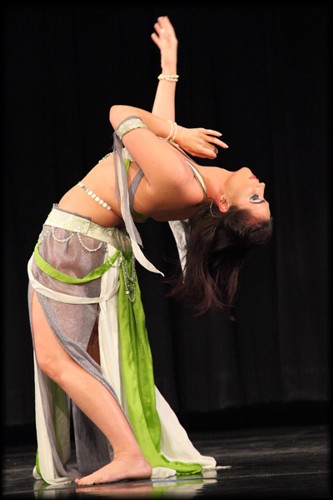
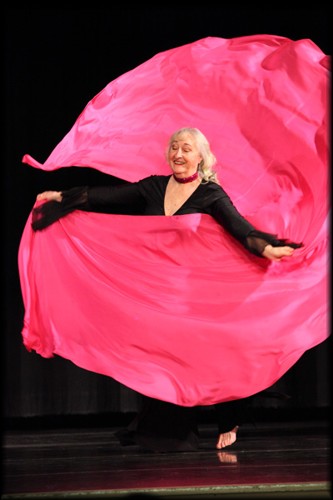
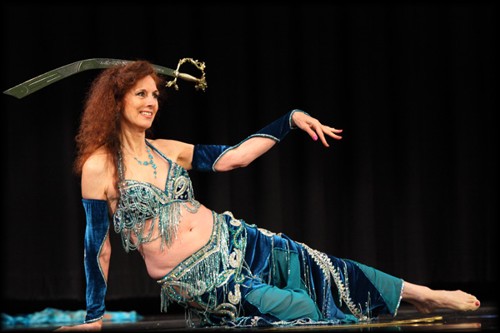
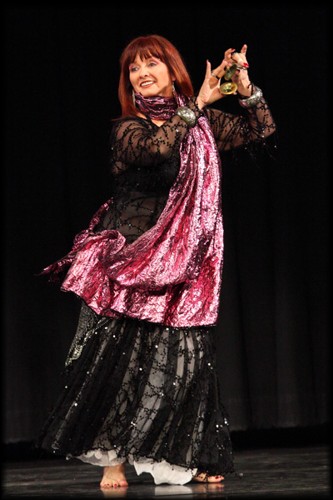
Gilded Serpent presents...

“Where the Middle East Meets the Frozen North” Show

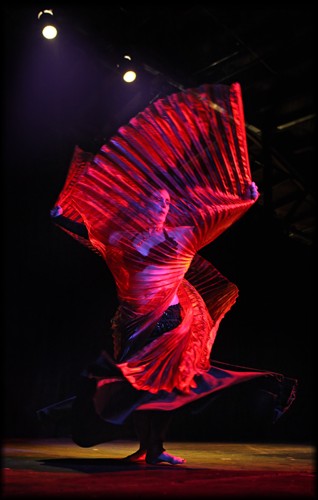
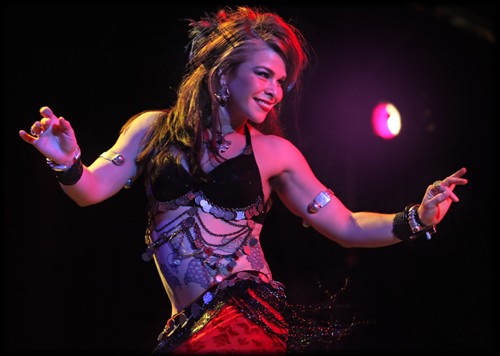
Eva by Keith Darkchilde

Review of Eva Cernik’s Performance on Friday, October 2, 2009

by Melissa Wanamaker
posted May 13, 2010
Photos by Keith Darkchilde

The last frontier and the largest state in the union might be a surprising place to find a thriving Middle Eastern Dance community but look again.  Alaska boasts significant populations of dancers in Anchorage, Girdwood, Palmer/Wasilla, Chickaloon, Kodiak, Seward, Fairbanks and Juneau.  A diversity of styles including regional folkloric and traditional, American Vintage Orientale, Golden Age Egyptian, ATS Tribal, ITS Tribal, Urban Tribal/Tribal Fusion/Tribaret, Eastern European, Theatrical, Healing Belly Dance and more coexist more or less peaceably supporting each others efforts, and collaborating and competing in a manner that is raising the bar for all of our efforts.  The last several years have brought a plethora of successful workshop instructors but perhaps none so rewarding as the recent one by Tundra Caravan in Fairbanks who hosted Eva Cernik.

The Bellydance Communities of AlaskaDue to family obligations I was only able to attend 2 days of a 3-day workshop but Eva’s workshop ranked at the top of the more than 25 weekend workshops I have had the pleasure of taking.  Sword is one of my strongest skills and I spent two solid hours adding new skills to my repertoire.  We ALL need to work on our zills to even play in the same room with virtuoso’s like Artemis and Eva and her Turkish Romani workshop was rock solid.

Besides the content being fresh and fantastic, Eva is as authentic, quietly funny and personable a woman that I’ve met in this business.

A Star without being a Diva (reverse-osmosis-filtered bottled water anyone?), we got a giggle when I bought a CD from her and she immediately used the money I gave her to get a CD from workshop host Susan who returned to Eva’s table with the same money to buy yet another CD all in a matter of 2 minutes.

On the topic of aging gracefully in this form, Eva who has reigned as the Queen of props and the “spectacular show stopper moves” for much of her career gave me this beautiful advice that I’d like to share with you all.

“Back then, I felt like I knew almost everything and that my body strength could support any risks I took  … now I know how much there is yet to know … and that "strength" is in knowing how to guide your movements, alignment, and posture, like "sailing" rather than "motoring" through a dance.”

It is my pleasure to share this review focusing on just one of her outstanding dances to remind you of one of America’s best-kept secrets.

On a darkened stage, the lilting sounds of an energetic Turkish Romani 9/8 rhythm fills the air.  It is often referred to as Sulukule rhythm, after the neighborhood in Istanbul where large numbers of Romani families settled hundreds of years ago.  Sulukule is being bulldozed as we speak with tenants given insufficient relocation sums leaving them homeless with nowhere to go.  This is just the latest chapter in the dramatic history of this small segmented marginalized minority often referred to by Westerners as “Gypsy”, thought currently to have left Northern India in a series of migrations between 400 and 1000 A.D. through Syria to begin their worldwide diaspora.(1)

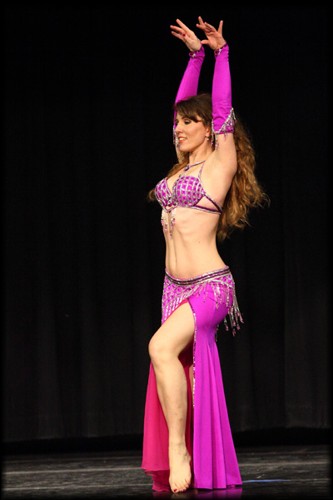
As the lights come up and a couple of 9-counts go by (1, 3, 5, 7-8-hold 9, 1,3,5,7-8-hold 9) suddenly a tiny fit dancer bursts from stage left adorned simply in a full red skirt wrapped with a black and red flowered shawl with the triangle in front, worn fairly high on the waist just over the navel.  She also wore a simple lightly adorned choli, a scarf in her hair, and a chunky silver metal necklace.  A few inches of bare midriff, cutout shoulders and small amount of sparkly embellishment on the skirt and choli were minor theatrical embellishments.  She danced her solo on an unadorned stage with simple background and only basic theatrical lighting.

She entered using simple steps with heel drops accenting the “7-8-hold” to spiral a circle around the stage ending center and allowing the spiral to continue into her body with a large hip circle into small hip and rib circles corkscrewing up and launching her dance.

Presenting a regional, ethnic, folk dance in a theatrical setting to a Western audience can be a challenge.  Keeping the audience enthralled as a solo dancer for over 10 and a half minutes with such a dance without resorting to flashy tricks, interesting props, elaborate music, lighting or stage effects is an even larger challenge.

Eva had her audience by the heartstrings from the first in this simple, unadorned, prop-free dance for reasons that are difficult to put into words.  Where does the magic live that makes a performer a master? Is it her focus? Her expression, persona or acting ability? Her posture?   Is it her technique? Her beauty?  Her strength, flexibility or balance?  Her acrobatics? Her sexuality? Her humor?  Something else?

Portion of Performance from October Show

Part 1 of 2009 Gilded Serpent Interview with Eva

While her gaze occasionally landed on and included members of the audience, much of her dance was internal and her gaze was equally likely to be up or down as out.  Her expression varied along a gamut of emotions.  She wasn’t the Priestess, the Goddess, the Matriarch, the Pretty Princess, the Coy Girl, the Mother, the Queen or any of the archetypes so familiar to our form. She was never the “scary”, angry Flamenco persona that many interested in presenting Romani dance theatrically try to adopt. She smiled, relaxed, used humor, and occasionally used emotions to spice and accentuate her body positions and gestures (“oh my aching back” or the perfect expression to show the drudgery of doing the wash while really wringing her skirt).  She was the girl next door, your best friend, with a story to tell.  A story where she can see the humor of her own crazy situation even though she isn’t happy about it.  A story I didn’t want to ever end.

While her upper arms had excellent carriage, her posture was in no way stiff or frozen.  No evidence of holding kegels while sliding her scapula together and down or hugely defiant “Flamenco” posture with elbows unnaturally high.  Kinesthetically her dance was perfect.  Earthy but not bound.  Energy radiating forward and back.  Never losing her posture, never approaching the edges of her considerable ability.  She was easily in her comfort zone and she helped the audience be there too.  Lower back long and crown chakra proud and reaching towards heaven with arms framing her every movement, she absolutely owned her space.

Her technique was flowing with her breath, like a jazz improvisation on a theme, decorating, embellishing, repeating phrases and circling around in an almost hypnotic fashion.  The movements and combinations rang true as authentic to the Turkish Rom genre.  Minimizing the “mudra” hands I’ve learned from other Turkish Romani dance instructors, she kept many of the common “day to day” gestures: punches, slices, sawing, pregnant belly “Kathak arms”, bracelets, prayer hands,  “Roma blood in my veins”, “oh, my aching back” and the ubiquitous skirt wringing/washing. 

In fact she used gestures much more intensively than has been fashionable in recent years when the mantra has been “Turkish Rom is not a gesture dance”.  It’s kind of funny how an expert will say something, perhaps to criticize another dancer and we all follow, repeat it and ape it like sheep until someone else goes, gets a different teacher or has a different experience and we find out we were wrong, or at least not right in a blanket sense. 

Eva heavily used gestures in much of the second part of her dance when the music slowed down and got heavy, still in a 9/8 time signature.  The gestures accented the one, one-three, one-three-five and she’d stretch the rest of the phrase.  She used the heel drop/hops so iconic to Turkish folk dance and changed the accents around from 1-2, 1-2, 1-2, 1-2-3 to 1-2, 1-2, 1-2-3, 1-2 playing with syncopation.  She accented pelvic drops similar to the common “Göbek Atmak” (translates as “Toss Your Belly”) moves and made small contractions and tiny “tossed” circles on the sagittal plane with her heart/rib cage.

On stage an ageless, timeless beauty, her 30 years as a professional dancer have given her poise, wisdom and a huge range of emotional expression.  Her great expressive eyes dominate an elfin face that will pull you into her pain or disgust one moment and crack you up with a sparkle, head slide and lip shimmy the next, all washed down with a wink and natural smile that says not to take that too seriously either.

Eva didn’t keep it a secret in the workshop that she had one fairly serious knee injury (from skiing).  It wasn’t evident in her performance, though, looking back at the video, she kept “big tricks” to a minimum in this number.  She really didn’t need them to have us all on the edge of our seats.  She did levels to the floor and back to standing like curling drifting smoke.  She did much of this hoppy athletic dance on the balls of her feet and went into releve several times contracting and balancing with her weight off center to stretch or accent the music. Her flexible supple spine was constantly tracing barrel turns while she traveled in circles in gorgeous fluid mandalas.  While strength, balance, and flexibility were all her assets, none of them alone were the secret to her Duende (2), a Spanish Gitano word that I understood to roughly translate as “spice that makes life worth living” (or for my purposes a dance worth dancing or watching).

Though she didn’t overplay it, Eva wasn’t afraid of dancing her sensuality.  I don’t believe Turkish or Turkish Rom style could feel authentic if “cleansed” of this energy, despite the Academicians’ need to distance themselves from it to prove they are “serious researchers and ethnologists”. Feminine sensuality was beautifully, naturally, organically present: fingers on tummy to accent stomach and pelvic isolations and shimmmies (in the typical Turkish style), eye contact and lip shimmy, lifting the skirt and flashing a little leg on floor work. Not contrived, not overdone, not ignored.

 I think perhaps her “magic” lives in her abandon and fresh “in the moment” interpretation using movements she knows in her bones (I confirmed later my gut feeling that she was performing an improvisational dance over a skeleton or spot choreography).

I felt that I was in the presence of a fleeting art that would never again be seen in exactly the same way (just as it was meant to be performed in it’s natural state).  Eva’s excellence/perfection of musical interpretation made me feel like the music itself had taken form.  Her ancient gestures, many whose meanings have been lost to time had me straining to catch a bit of the story, a story as old as time whose smoky wisps danced on the edge of my memory but certainly resonated the feeling and heart of the dance.

The dance of the Turkish Roma is at risk, as are many of the ethnic, folkloric and traditional dances of the Middle East, to being lost to time, rising religious conservativism, modernization, and globalization.  I feel l was given a special gift, seeing it performed so authentically and beautifully by one of our American dance masters.  Thank you Eva for this gift. 

footnotes:
1- Ian Hancock, “We are the Romani People”, 2002
2- Eva questioned my use of “Duende” and I could not recall my source so I researched a bit more deeply.  I heard a variety of inadequate replies from “Leprechaun” (from a Central American student) to “charismatic goblin” to “the power to attract through personal magnetism and charm” (Meriam-Webster).  The reason it popped into my head as I was writing about Eva was best captured by Wikipedia:
 “The meaning of duende as in tener duende (having duende) is a rarely-explained concept in Spanish art, particularly flamenco, having to do with emotion, expression and authenticity. In fact, tener duende can be loosely translated as “having soul”.
El duende is the spirit of evocation. It comes from inside as physical/emotional response to music. It is what gives you chills, makes you smile or cry as a bodily reaction to an artistic performance that is particularly expressive.”
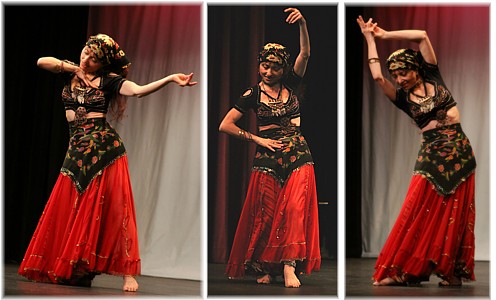
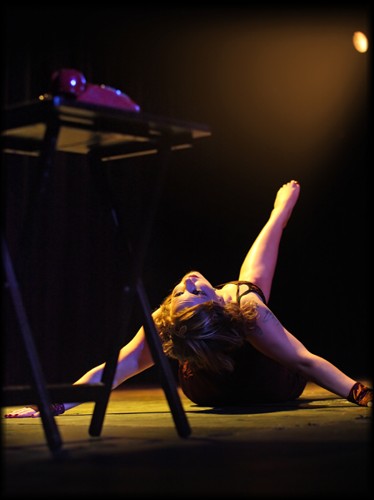
Eva Triplicate

use the comment box

Have a comment? Use or comment section at the bottom of this page or Send us a letter!
Check the "Letters to the Editor" for other possible viewpoints!

Ready for more?

  • More Than You Ever Wanted to Know About Living With Constrictors
    My heart beat stronger and stronger, until something in my human reasoning kicked-in. "I wonder if I’m causing all this?
  • Little Istanbul in Japan
    For several years, belly dance has been rated as one of the top three favorite hobbies for women who are in their 20s and 30s in Tokyo.
  • Tania Luiz A Romany Fusion Artist in Osaka
    At this time I think I was longing for a well-documented dance, old and structured. I was a little sad because I saw how people who were not properly trained but who just had a costume would teach Oriental dance. Plus the deep connections of Indian dance to the Divine were very interesting to me. At the end of it all, I realized that my body, my soul and my blood are meant to do Oriental.
  • Omar Faruk Tekbilek demonstrates the Ney
    Also incuded are short performance clips of Omar with the instruments and band members as well as his wife, Susie, performing a few Turkish style dance gestures
  • "Just feel the music when you’re on stage!”Interview with Ozgen, Male Turkish Belly Dancer,
    Well, I think my heart still beats for big shows and productions, as much as I know how stressful and difficult that show-life can be. I seem to not be able to live without it.
  • Folk Tours 6th Annual Middle Eastern Music and Dance Camp
    held at Camp Greenlane in Pennsylvania, May 2008. The authenticity of the camp is amazing. I love Rakkasah and Tribal weekends as much as anyone else, but watching and listening to Arab musicians play Arab music and Turkish musicians play Turkish music, well, that adds a little something! After the nightly shows, the musicians keep playing to the wee hours and the camp dances in the big dining hall until we drop.
  • Adventures in Turkey 2006
    I am not exaggerating when I say that Sandra actually threw herself into Bella’s arms and wept when she first laid eyes on her.
  • Bargaining for Injeers
    Bargaining is not just about the money, although that is a qualifier. Bargaining is a medium in which two strangers can have a conversation. Turks love to bargain, and it may be how they get to know you…
  • We Shop, We Bathe, And We Eat! Justine’s Culinary Adventures in Turkey
    The Egyptian spice market in Istanbul is a wonderful place to be a new chef, not only does it hold a treasure chest in spices, it has the most charming men, who know how to cook.
  • Kayla in Turkey, (A Daily Journal) Turkish Bath House (Hamam 1)
    All my Turkish girl friends, had of course been to Hamams, but only in their youth,
  • Two For One, Two very different DVDs on Turkish Dance reviewed
    I Love Turkish Dance by Sarah Skinner & Turkish Style Belly Dance by Elizabeth Artemis Mourat
  • Unveiled Musical Gems, 3 CD Reviews
    Raqs El Qamar by Chris Marashlian, Rhythms of Turkey by Tayyar Akdeniz, Angelika Unveiled, by Angelika Nemeth and Raul Ferrando
 

Gilded Serpent presents...

Queen of Denial, A Tale about Life and Belly Dancing

Rebaba dancing at the Casbah

Part 1: The Safety of the Stage

by Rita Alderucci (aka Rebaba)
posted May 6, 2010

In September of 2004 my life was out of control, the addict in me was running the show and it had finally usurped my ability to function anywhere near normal on a daily basis.  It was at this low point in my life that my nearest and dearest, both my immediate family and my Hahbi’Ru family, came to my rescue in the unwanted form of an intervention to save my life.  With nothing but love and fear for my life they put their foots down, and took away the last connection I was desperately trying to hold on to which was dancing.  I had convinced no one but myself that I could keep dancing in that horrible condition. Thank God, they were brave enough and scared enough to say “NO MORE”, and do the one thing that would force me to get the help I needed, take the dance away.

With their love and unending support I entered a rehabilitation program.  In this program I was finally able to accept the fact that I was (and still am) sick with a chronic (but not terminal) illness. 

I started the long and difficult job of getting my illness under control, and learning how to live my life without drugs.  It was the hardest thing I’ve ever done, but, the joys of once again “living” in the true sense of the word are without parallel.  I can truly say that I have never been happier or more at ease in my own skin.

In my story that follows I will take you on my life journey, the good and the bad, dancing and then not dancing.  I hope this will entertain you as well as help you understand a little about the illness of addiction.  Addiction continues to grow in our country in epidemic proportions.  The sad truth is that there is still no real hope of getting the necessary help to those that truly need it.  The statistics are staggeringly low, with a success rate of less than 5% of those that seek, or who are forced to seek treatment through the courts.  I am one of the lucky ones that have beaten the odds, and I know it and will continue the work for the rest of my life!

To you my dear family and friends, I dedicate this story of my ups and downs, told truthfully and without remorse to all of you.  The lessons you all helped me learn have given me more than I could have ever imagined.  I love you all and will work hard to maintain the wonderful life you have helped me rebuild.  With all my heart I thank you.

 Where should I start?  Do I begin with my career overseas? Should I start upon my return to the USA, or from the very beginning?  I promised an article that will include my story of drug addiction and on-going recovery; so it should begin in San Francisco, with the ’60s era of the “flower children”.  As an alternative, I could begin at the beginning when as a child I became a student of Theater Arts, ballet, modern dance, jazz, and different ethnic dance forms.  I also began suffering with insecurities, anxieties, and eating disorders!  In the ’70s, the disco era, I began my career as a professional Belly dancer in San Francisco’s North Beach, I was 17 years old.  Or, I could begin during the time when I moved to Hollywood, and witnessed the arrival of Egyptian musicians in the cocaine infested nightclubs, and I could mention the fact that in these seedy clubs you could hear some of the best Middle Eastern music in the country!  I just don’t know exactly where I should begin my story…

There is much to tell, with and without adding my addiction to the mix!  I am hoping, though, that you will be as interested in my dance career as you are in the drug scene that enveloped me before, during, and after it!  Therefore, I will begin at the time I started performing, and discovered a new safe place for me.

For many years, the most secure and safe place for me was on stage–dancing and acting.  Performing gave me the security and love for which I yearned  (both with and without drugs). 

So, for many years I was able to keep my addictive illness in check, and maintain a certain amount of control over my life.  Not to say that I didn’t "do" drugs, but, my drug use hadn’t yet escalated to become the monster that took control over my life, and eventually could have ended it.


Rita at 13

Rebaba dancing in an improv class.
Caption- " This photo is taken of when I was in the Performing Arts Workshop (PAW). I was in the Work-Study Arts Program and spent a minimum of 2 hours a day studying drama, improv, Ballet & Modern dance & Circus Arts. I was  a student there beginning in Junior High School abnd until I graduated from High School. It was the closets thing to a performins arts school in existence at the time in San Francisco, I was 13 years old in this picture. Gloria Unti, the director, is pictured in the background, left.
Rita at 14
Rebaba at age 14 dancing with her first pot, selected with the help of Nakish. This photo was taken by my mom on the night of the day I bought my first pot with Nakish at White Front (which used to be on 16th Street and Potrero, and was kind of like the first Target) I was 14 years old and the year is 1969.

My Childhood 

I was born and raised in San Francisco (and that reminds me, we, my group of “artistic” friends,  had a club for a while in High School, and we made T-shirts emblazoned with “B&B NSF”), and I grew up here in the ’60s and ’70s.  I was a product of that very special time in San Francisco: a “chemical child”, a very young, hip “party girl” if you will.  Perfectly suited to this era of non-stop pot smoking, which was hardly considered “doing drugs” in those days. (In fact, drinking alcohol was considered a much more serious problem for a teenager, and of course it still is one.)  In the ’60s and ’70s, many dancers and artists believed that the natural high from smoking pot was an enhancement to our art and increased our creativity!  When I began dancing full-time in San Francisco’s North Beach Belly dance venues, almost every dancer I worked with smoked pot.  I don’t know about you, but, I tended to “dance for myself” when dancing stoned. 

Eventually, I learned to remember I was onstage while dancing high, (at least most of the time) and overcame my tendency to space-out, lose focus and end up with a blank stare on my face.  I trained myself to look at my audience, keep listening to the music and smile. Never stop smiling!

The Obsession of My Youth

It was many years later that the hard drugs that I had convinced myself I could control, completely consumed me.  Between then and now, I managed to have an interesting and successful career as a Belly dancer.  Traveling to distant countries helped me keep my ugly demons at bay and even sober up for much of that time. (Although, I replaced drugs with eating particularities/disorders.)  During the years that I danced overseas in the late ’70s and ’80s, I didn’t do drugs–except when I visited my hometown. Then, it was non-stop partying for up to a month, mostly smoking pot, snorting cocaine and drinking alcohol.  Then I would stop, cold-turkey, and return to my life of dancing 7 days a week, 365 a year.  I filled my time with dancing onstage, and in jazz classes during the day while living and working in Paris, and in the gyms while dancing in the resort hotels of the Middle East and Africa.  I would starve myself and then binge about once a week, taking laxatives daily to be able to relieve myself at all, which becomes almost impossible when you don’t consume any oil in your diet. 

I was high on controlling my eating habits, which by-the-way, is the addictive high of anorexia and bulimia, and I was the thinnest I’ve ever been.  European Belly dance venues expected their dancers, and especially their star dancers to look like a professional dancer, meaning thin, very thin and beautiful, which I was though I didn’t know it at the time.

Of course, being the sick person I was, I took every criticism to heart, from anyone, onstage or off.  When you are constantly being judged by men, owners, musicians, and fans, you can never win.  I was too fat, then too thin, and I believed them all.  Unfortunately, all these opinions of me only fed in to my psychosis and insecurities, allowing me to justify my actions as being necessary for my "art".  So, even when I wasn’t actually indulging in drugs, I most certainly remained a victim of my obsessive/compulsive behavior.

In hindsight, these years of traveling, and living in Paris were the happiest of my young life, and during this time, I was as close to sane, though clearly still not quite right, as anyone (and more than many).  My life was a fairy tale, and if I had to starve myself to attain and maintain it, that was a small price to pay.

(No!  The damage I did to my body during those years of laxatives and food obsessions didn’t show up until I stopped the behavior.  I am sterile, do you think these were contributing factors?  Most likely they were–along with lots of flight time and tons of exercise.  It’s possible this may have occurred without the eating disorders, but, they certainly didn’t help, and most likely were a major contributing factor to my sterility.)

My Public Image

Now that I have exposed some of my guts, my skeletons in the closet, I would like to tell you more about the image that I vigorously maintained for many years. It is the story I naturally believed to be my public life, and not the big secret that I tried (with varying success) to keep hidden.  I was the last person to understand that I was sick.  I had become an expert at convincing myself that my behavior was more normal than not.  I was a professional dancer and entertainer, travelling the globe, being paid to do what I loved best, dance, dance, dance!  I had convinced myself that drugs and eating disorders were as natural and necessary as were my costumes and makeup!  The reality was that during the years that I was dancing and touring professionally, I was able to successfully keep my additive nature under control.  My most destructive behavior began later in life, once Belly dancing became my hobby, and I was no longer an entertainer by profession.

As a child, my obsessive/compulsive personality drove me to hone my dance skills at a very early age via incessant repetition.  My unwavering concentration and absolute need to perform led me to seek out venues to feed this need as far back as I can remember.  These aspects of my obsessive/compulsive behaviors were not totally destructive.  There was definitely a part of my nature that lent itself perfectly to the demanding life of an artist, or, any person who specializes in one field and strives for perfection in it.  From my earliest memories, I was unhappy, spending my waking hours doing anything else besides dancing and performing. 

Of all the activities with which children and teenagers usually occupy their time, dancing was my major preoccupation.  I managed to be dancing or acting most of the time, in school and after school.  I began performing onstage when I was 10 years old, dancing the hula with Leilani Rodgers Company.  When I was 12 years old, I was enrolled in the Performing Arts Workshop. PAW is still in existence today, under the direction of the daughter of the woman who founded it in the early ’60s, and with whom I studied both theater and Modern dance as a child, and then teenager, Gloria Unti [pictured in second photo above].  I was fortunate enough to be accepted into the PAW’s Work/Study program in junior high school.  (In the ’60s this was the closest thing to a high school for the performing arts.)  I went to school from 8:30 a.m. until 11:30 a.m. to take my core academic classes, and then went to the PAW every afternoon.  I was paid $20. per week, which was a small fortune for a kid back in the ’60s!  On top of the multitude of classes I received in the PAW, both dramatic arts and dance, I was taking Modern dance classes at the Margaret Jenkins studio, Polynesian dance with Leilani Rodgers at the Buchanan Street Berkeley YWCA, and I started taking Belly dance classes with Jamila Salimpour at the Presidio Avenue studio where she began teaching Belly dance in San Francisco.  I was involved in all of these activities before I turned 13 years old!  Fortunately for my single mother, most of these classes were free, or they became free to me once I distinguished myself, making it possible (affordable) for me to take all these different classes.  I was obsessed with dance and better than the average kid at it.  By the end of 1969, I started to perform with Bal-Anat

1st Ren Faire1st Ren Faire
1st Ren Faire
These two photos were taken at the first Renaissance Faire at Black Point in Novato California in 1970. Aida and I shared Pot Dancer duties (she is in the back round along with:
Jamila and Suhaila, Mark Bell, Galia, Mehta, Lisa (the first Bal Anat snake dancer), Sharon Carew (who did the occational finali, Snake dancer and then Kahslama with me some years later).

Jamila

In 1970, I performed at the first Black Point Renaissance Faire in Novato, California.  Aida and I shared the first water-pot dance, alternating shows three times a day.  It seemed like a dream come true for me, dancing with Jamila’s incredible dance company.  I had first seen Bal-Anat as an audience member about a year earlier (1968) at the very first Renaissance Faire held at China Camp in Marin County.  I  fell in love immediately with the hypnotic drums, music, and mysterious beauty of the performance art that was Jamila’s fabulous creation, Bal-Anat.  I started taking lessons as soon as her classes resumed after the faire, and exactly one year later, I was up there with Jamila, and a very young Suhaila, the exquisite Nakish (who was my faire chaperon because of my young age, and took me to Novato every weekend as I didn’t yet have a driver’s license).  I was performing on the same stage as the incomparable Galya, Rhea, Anne Lippe, Reyna, Mehta, Lisa, and many other beautiful women, all dancing with sabers, snakes, pots, veils, cymbals, and draped in assiute cloth, lots of assiute!  It was an incredible, unique blend of fantasy and reality, based upon Jamila’s vision of Egyptian Tribal Dance.  She was, and still is one of the most amazing women I have ever had the honor of knowing.  I consider her an astute historian whose personal research and unending fascination with Egypt and the Middle East, close to a singled-handed resurrection of an art form in San Francisco, of all places! 

Her classes gave us so much more than just a Belly dance.  Jamila, with her wonderful story telling and strong hand as a teacher gave me, and many like me, a new and fantastic feminist life-path that was strong and woman-dominated. 

Casbah Dressing room shot, taken in 1973, I just graduated from High School, and was dancing Tuesday and Thursdays there before leaving the states to go to school in Switzerland.

It gave me a sense of pride and self-esteem for the very first time in my life.  It was the first time in my short life that far that I felt truly special, beautiful, and talented!  I was mature enough to realize that I wasn’t alone in my new found sense of self-worth.   Many young American women who began taking Jamila’s Belly dance classes at this time had similar experiences.  I have always felt extremely blessed to have met Jamila, and studied with her when I did, and especially at my young age (12 years old).  As you can imagine, from what I have previously described to you so far, Jamila’s influence over me was very instrumental in helping me become a stronger and much more secure young woman, much more so than I might have done if left to my own devices.  Her classes and Belly dance in my life gave me the outlet I so desperately needed to keep my addictive nature in check for many, many years. 

Belly Dance Saves Me

Believe me; my later drug abuse problems might have taken a much earlier and uglier chunk out of my life if I hadn’t started Belly dancing.  These classes in the ’60s were the beginning of what was to become a historical force in the woman’s movement San Francisco, the Bay Area and eventually the rest of the country.  The Belly dance craze in the ’60s and ’70s wained in the ’80s, and then returned with a vengeance and new direction in the ’90s with the advent of American Tribal Style (ATS).  That is also when John Compton, Paula, and I created Hahbi’Ru Dance Ensemble in 1992… I was, for more than once in my life, in the right place, at the right time, and with the right mind!  Belly dance embraced me like another mother, and gave me a secure path in life which could only be described as kismet!  From my teens to my 40s Belly dancing was like a safety net with a strong enough influence in the right direction, the good and healthy life direction, that it helped to keep me sober (and at the very least, a functioning addict) for many years at a time. 

North Beach

After graduating from high school, and approximately 18 months of university study at San Francisco State as a dramatic arts major, I dropped out to take my first dance contract and travel to Calgary, Canada, to perform for two months.  Two days before I was to leave the owner passed away!  So instead of traveling to Canada to dance full time, I started performing on Broadway at the Casbah Cabaret as a regular dancer (described in North Beach Memories, Part I)…  I was 17 years old, and in heaven!

Travel 

In my nineteenth year, I left San Francisco and the Casbah, to go abroad.  My mother’s father was from Switzerland, although he died very young, a long time before I was born, his (and now my) family were plentiful with 6 sisters and one brother all living in Switzerland.  In 1974, I had my Grandfather’s sisters and brother still living in Geneva and Lausanne, Switzerland.  It was time for me to meet more of them, and see France, Spain, and Italy as well.  I saved up and left with a Eu-rail Pass (a gift from my mom) for what was supposed to be a summer long trip through Europe.  I arrived in Frankfurt, Germany, and decided right then and there that I wasn’t going home anytime soon!  With help from my mom and my Great-Aunt (my Grandfather’s oldest sister), I secured funding from the Swiss family bank to pay for my education.  I was invited to room with another Great-Aunt, and my mom committed to send me spending money.  I started intense language school in September of 1974, with the hopes of passing the strenuous language tests necessary to gain admission to the International School of the University of Geneva, Switzerland

My intent was to study the French language and eventually go on to one of the many translator schools Geneva is famous for and that supply the United Nations.  I imagined myself working in the UN as a translator and living in Europe full time.  Well, I got as far as a year and a half of 8-hour a day language school under my belt, before dropping out and jumping a train for Paris, France.  In Paris my best girlfriend (and she still is), was working as an “Au Pair”, taking care of a single mother’s two girls.  She had also taken some Belly dance classes with Jamila Salimpour in San Francisco back when I first began to study with her.  She had written to me while I was still in Geneva, saying that she had met some Arabic musicians playing in the Metro.  They told her about an Algerian restaurant named Al Jezair, off the Place de Ste. Michel, on the left bank of Paris, where they played nightly in an orchestra, and there were Belly dancers in the show!  When she told them her girlfriend was a professional Belly dancer in San Francisco, they laughed, and said there was no such thing as an American Belly dancer!  She tried explaining the current fad/trend in San Francisco that Belly dancing had become over the last couple of years, but, they were hard-pressed to believe it.  They said that I should go to Al Jezair for an audition when I arrived in Paris.  (Personally, from what my girlfriend told me, I think they were just being nice and flirting with her as she was, and still is, also a beautiful Jewish girl from NYC.)  When she wrote me this story, it took me exactly one day to decide to give up my dreams of becoming a translator at the UN, and jump on the next train to Paris with 8 dollars in my pocket, and the hopes of a job Belly dancing on the left bank!

To be continued…

Don’t miss-Author Rebaba will be performing with Hahbi’Ru at the upcoming Tribal Fest held in Sebastopol, Ca Sunday, May 16th at 4pm(ish), 2010.

use the comment box

Have a comment? Use or comment section at the bottom of this page or Send us a letter!
Check the "Letters to the Editor" for other possible viewpoints!

Ready for more?

  • 10-1-08 North Beach Memories- Casbah Cabaret, Part I Circa 1973 by Rebaba
    We performed what I have dubbed “conveyer belt dancing”, that is three dancers doing three shows each, starting promptly at 8:30 p.m. without stopping until 2:00 a.m., whether we had an audience or not.
  • 11-8-05 My Adventure Begins! by Asmahan
    At last, another North Beach Memory! "I was creating my life as an adventure, I was making my own destiny; this was Kismet!"
  • 6-10-03 North Beach and Mark Bell from an interview with Lynette
    A lot of my getting the jobs was because I was there available when the opportunity arose.
  • 3-22-00 Wave #2 of North Beach Memories!
  • 1-4-00 LatifaThe Rest of the San Francisco Dance Scene- Powell St Station.
  • 2-25-00 Bert Balladineat long last Bert begins his story
  • 2-25-00 George Eliasa tribute written by his daughter, Nadia Elias.
  • 3-22-00 John ComptonFinnochios, Bal Anat, to Hahbi’ru
  • 3-22-00 Abdullah Kdouh well known musician interviewed by mail
  • 5-5-10 Bellydance in Utero by Keti Sharif
    When pregnant, I practiced Belly dance moves each day in preparation for giving birth, mainly focusing on the circular, soothing and stretching movements but avoiding shimmies and moves that were contra-indicated by midwives and sports professionals.
  • 5-3-10 A Very British Kind of Bellydance by Charlotte Desorgher
    This incongruity is something that characterizes the English bellydance scene. Many of our festivals are held in historic sites, such as castles or ancient towns, and we are used to the surprising sound of Arabic music floating across an English lawn.
  • 4-28-10 Nights Out in Cairo, Part 2: Sunday Through Tues day by Nicole
    I realized that I’m more at home on a felucca sounded by Egyptians with Shabii music blasting than in a hip hop club, with girls in short skirts rubbing up against guys. In my life in San Francisco, my friends and I were living a combination of both, but we had to have Arabic music at the end of the day, because that was what moved us.
  • 4-27-10 San Francisco Bay Area Chapter of the
    Middle Eastern Culture & Dance Association (SFBA MECDA) 2009 Fall Gala Showcase Photos
    by Oscar Cwajbaum, Introduction by Davina

    We were fortunate to have a new photographer at our last gala show on November 14, 2009. It was Oscar’s first belly dance event, and though I invited him purely to get photos of my own costuming work, he spent the entire day snapping shots from our show and has fallen in love with our art form. Here are some of my favorite shots from that day.
  • 4-16-10 Belly Dance and Feminism: Different Issues, Different Perspectives Introduction to IBCC Panel on Bellydance and Feminism
    Feminism embraces more than one point of view, and feminist perspectives lead to many different decisions and courses of action. Feminism is a tool for thinking – for understanding and putting a name to issues you may be wrestling with in your own dance life, and for seeing belly dance in the light of broader economic, social and political realities.
  • 4-15-10 Mass Media, Mass Sterotypes: Beginnings by Shira
    From the very beginning of moving pictures technology, moviemakers have used “Middle Eastern dance” as a means of adding sexual innuendo and sexy eye candy to their productions.
  • 4-14-10 Nights Out in Cairo, Part 1: Wednesday Through Saturday by Nicole
    The beauty of Cairo is often in the every day things, the small things that we wouldn’t consider so worthwhile, but in fact, make up the real substance of what it’s like to live here. I don’t go to museums or monuments or see famous Belly dancers every day, but I am here in Cairo every day and that is special in and of itself.
 

Gilded Serpent presents...

Bellydance in Utero

Keti and Child

by Keti Sharif
posted May 5, 2010

Belly dancing is a wonderful experience for the pregnant woman, because it yields tremendous physical and emotional benefits. I endorse dance for all my pregnant students because it definitely keeps you limber as your baby grows and your body ripens and changes, providing a lovely connection with your unborn child. Belly dancing was an important part of my life during my pregnancy, but of course, with the ever-expanding belly, my dance practice changed direction as my pregnancy progressed, and it changed again after the birth last year of my daughter Serafina. I’m sharing my experiences so that other new mums might be able to use these tips before and after giving birth, and apply them to their own dance lifestyles.

When pregnant, I practiced Belly dance moves each day in preparation for giving birth, mainly focusing on the circular, soothing and stretching movements but avoiding shimmies and moves that were contra-indicated by midwives and sports professionals.

Being a first time mother at 39, I wanted to be certain to do everything properly. In many ways I was extra cautious, having updated my sports training certificate in Perinatal Fitness just a year prior to my pregnancy. Studying the American-run AAFA Perinatal Fitness course in Cairo was an eye-opening intensive, complete with emergency first aid for expectant mothers. With safety precautions in place, I was alternating dancing and practicing yoga daily but kept it slow and easy at the same time.

The dance was an integral part of my life throughout my entire pregnancy experience. I was teaching Belly dance workshops until my eighth month and remember teaching an energetic two-hour workshop at the Nile Group Festival in Cairo with an 8-month rounded belly! It was an Astro-Belly "Birth and Beyond" class, modified for pregnancy and post-partem, with dance teachers from around the world, including three pregnant Belly dancers, joining in to learn more. Participants were amazed that I could dance so energetically, considering the size of my belly, but daily practice and looser ligaments made it easy. In fact, my stamina surprised even me, but surely, it was the daily dance exercises that helped.

During my pregnancy, I hosted many workshops and seminars in Cairo, including several intensive week-longs with Farida Fahmy and Mahmoud Reda. Hosting workshops was a great way for me to learn during that time, because dancers can learn from stepping aside and watching, listening and taking notes when they are unable to dance for any reason. The workshops were wonderful to host, and it was awesome being around the legends of dance and such lovely ladies from around the world. As Farida taught, I handled the music and cds for her lessons. My baby kicked vigorously each time the music started, especially to the Muwashahat music (classical Andalusian style), and even today, it seems to be the music that Serafina loves most! She bounces excitedly to all the Arabic rhythms she had heard in utero as well. She becomes lively and jiggles with the tabla rhythms, and seems to prefer them to regular Western music–or even nursery rhymes.

Serafina was quite overdue, and as any expectant mother knows, those last days of waiting are challenging! I used this time to prepare some essential oils and a "birthing cd" of all my favourite Belly dance tracks for the occasion. Indeed, they came in handy! I burned beautiful oils and danced right through my labour, and did the entire A-Z routines…  It was comforting to have a drill to go through, and it really kept my mind and body balanced as labour progressed. When each contraction came on, I simply squatted deeply into the contraction and let the wave of pain pass over, throughout my body, then got up and kept dancing. I believe that the dancing movements helped keep me strong, both physically and emotionally and helped the labour along.

The entire labour was much easier than I had expected, and quite a powerful experience. We did encounter a problem with the birth though; after several hours, the doctor’s ultrasound showed my baby’s arm to be caught up in the umbilical cord, so therefore, she was unable to descend. Within half an hour of the discovery, Seraphina was delivered by cesarean section; my beautiful, chubby little girl was born!

I left the hospital after just two days, instead of the obligatory 5-8 days post op, because the cesarean healed so quickly. The nurses were asking many questions about Belly dancing and believed my strong pelvic floor and healthy back was a result of the dance. The main midwife’s last words were, "You can go home; you’re as fit as a fiddle!" At home, for the first few weeks, I did very gentle hip circles and stretches. The uterus takes six weeks to reach pre-pregnancy proportions, so I believe it’s best for a new mother to take it easy. It is not a time for crash diets and fitness regimes (like the Hollywood actresses push themselves through for the sake of the camera). It is a time to nurture your body, your baby and focus on the beauty of life that came from within. I resumed yoga and dance six weeks after delivery, and slowly progressed to full powered shimmies and fitness after four months. My back and pelvic floor are both still strong and took very little maintenance to return to full pre-pregnancy strength.

As baby gets older, although your time becomes more limited, you can still practice Belly dancing. Class time may be less, but baby enjoys the music and dancing at home. If you have a few friends with children who wish to join you, allocate turns for a "baby sitter" during class; although children like it so much, they often become a part of the fun class!

If you go to class, check if there are teachers that run "Mother and Child" classes, or alternatively, get a baby sitter or family member to look after baby the same time every week so you can continue your hobby. The Internet becomes a great source of learning when your baby keeps you at home. I allocate a half hour timeslot each day (when little Serafina sleeps) to get my emails done, and use the time to surf the web.

As children get older, children’s Bellydance and Folkloric dance classes are such fun to teach, and they are a great way to clean the studio too, because, at the end of the class, you can ask them to collect sequins off the floor, and they can keep the sparkling treasures that they find!

Resources:
  • Maha Moussa has written a beautiful book called "Dance of the Womb", and I recommend it highly. To all the Belly dance moms out there I say, "Continue dancing and sharing information about the wonderful, empowering benefits of Belly dancing for birth and beyond!"
  • Author’s bio on Gilded Serpent

use the comment box

Have a comment? Use or comment section at the bottom of this page or Send us a letter!
Check the "Letters to the Editor" for other possible viewpoints!

Ready for more?

  • 9-14-07 Dancing the Big Belly, Bellydance Prenatal Fitness and Dance Instruction Program DVD review by Erica
    The slow pace may seem agonizing for a fit, nonpregnant dancer and may seem slow during earlier stages of pregnancy, but as that weight starts adding up and the fatigue returns in the third trimester, I have a feeling the pace does not seem so slow.
  • 10-10-07 Belly Dance Wisdom– For Fitness, Pregnancy and a Divine Sexuality Book Review by Surreyya
    This book, although not as deep on certain subjects as some may expect, does a great job at rustling the leaves away from a crooked sidewalk or blowing the dust off an old spice jar revealing an inner glow of warmth to share with others.
  • 5-3-10 A Very British Kind of Bellydance by Charlotte Desorgher
    This incongruity is something that characterizes the English bellydance scene. Many of our festivals are held in historic sites, such as castles or ancient towns, and we are used to the surprising sound of Arabic music floating across an English lawn.
  • 4-28-10 Nights Out in Cairo, Part 2: Sunday Through Tues day by Nicole
    I realized that I’m more at home on a felucca sounded by Egyptians with Shabii music blasting than in a hip hop club, with girls in short skirts rubbing up against guys. In my life in San Francisco, my friends and I were living a combination of both, but we had to have Arabic music at the end of the day, because that was what moved us.
  • 4-27-10 San Francisco Bay Area Chapter of the Middle Eastern Culture & Dance Association (SFBA MECDA) 2009 Fall Gala Showcase Photos by Oscar Cwajbaum, Introduction by Davina
    We were fortunate to have a new photographer at our last gala show on November 14, 2009. It was Oscar’s first belly dance event, and though I invited him purely to get photos of my own costuming work, he spent the entire day snapping shots from our show and has fallen in love with our art form. Here are some of my favorite shots from that day.
  • 4-16-10 Belly Dance and Feminism: Different Issues, Different Perspectives Introduction to IBCC Panel on Bellydance and Feminism
    Feminism embraces more than one point of view, and feminist perspectives lead to many different decisions and courses of action. Feminism is a tool for thinking – for understanding and putting a name to issues you may be wrestling with in your own dance life, and for seeing belly dance in the light of broader economic, social and political realities.
  • 4-15-10 Mass Media, Mass Sterotypes: Beginnings by Shira
    From the very beginning of moving pictures technology, moviemakers have used “Middle Eastern dance” as a means of adding sexual innuendo and sexy eye candy to their productions.
  • 4-14-10 Nights Out in Cairo, Part 1: Wednesday Through Saturday by Nicole
    The beauty of Cairo is often in the every day things, the small things that we wouldn’t consider so worthwhile, but in fact, make up the real substance of what it’s like to live here. I don’t go to museums or monuments or see famous Belly dancers every day, but I am here in Cairo every day and that is special in and of itself.
  • 4-10-10 Carl’s Photos from Rakkasah East Festival 2009, Page 4: R-Z by Carl Sermon
    Raks Helm, Raks Sheva, Ranya, Raqs Caravan, Rasa, Sahara Shimmer, Salit, Samra, Scheheresade, Sera & Solstice, Shaula, Shayda, Shushanna & Sean, Soverign Reign, Surayyah, Suzanna, Tanya, Tapestry Tribe, Tasha, Tempest, The Nixies, Troupe Little Egypt, Troupe Solice, Troupe Zoryanna, Valerie Rushmere, Wild Gypsy Fired, Yame, Yasmine, Za-Beth
 

Gilded Serpent presents...

A Very British Kind of Bellydance

Victoria Hall

by Charlotte Desorgher
posted May 3, 2010

A magnificently decorative concert hall set in a quaint Victorian village right in the heart of Bronte country. Welcome to bellydance, British-style!

The bi-annual Jewel of Yorkshire festival is known colloquially as JoY, and a joy it truly is. The festival is held in Bronte country – where the Bronte sisters, Emily, Charlotte and Anne lived and wrote their novels. Emily’s novel, Wuthering Heights in particular, vividly describes the windswept moors and dark crags that characterise this area of northern England.

In the nineteenth century, the fabulously named Victorian philanthropist, Sir Titus Salt, built a village to house workers at his woollen mills. Built of dark Yorkshire stone, the village has a brooding air, despite the charming Victorian decoration on many of the buildings.

At the centre of the village is the grand Victoria Hall – an architectural masterpiece full of stuccoed decoration. Walk with me through this monument to Victorian philanthropy, through the lofty arch of the entrance hall, past grand staircases and walls adorned with ornate plasterwork, until we reach the heart of the building – the magnificent Concert Hall.

And there you will find…..a bellydance bazaar!

This incongruity is something that characterizes the English bellydance scene. Many of our festivals are held in historic sites, such as castles or ancient towns, and we are used to the surprising sound of Arabic music floating across an English lawn.

The British bellydance scene isn’t as old as that in the United States. Many would say our development was held back by the strong influence of Soraya Hilal’s rather restrictive style over many years. But we’re catching up! Bellydance is booming in the United Kingdom and our dance scene has been maturing fast in the last ten years.

uk mapJoY was founded six years ago by Mandy Teasdale and Chris Ogden. Mandy makes stunning bellydance costumes under the name Shimmy Shop and Chris leads an unusual tribal troupe fusing tribal bellydance with English country dancing! Mandy and Chris bring some of the top names in international bellydance to this tiny village on the Yorkshire moors. Egyptian superstars such as Randa Kamel rub shoulders with stars from the New World such as Ava Fleming and Lulu Sabongi. And the international lineup is well augmented by experienced teachers from around the UK.

But let’s get back to that Victorian concert hall and I’ll fill in the colours of the picture I started to paint.

Around the perimeter of the hall are brightly coloured bazaars. The elegant plasterwork of the walls and balcony contrast with the seqinned sparkle of cabaret costumes and the handmade pompoms of tribal wear. And in the midst of it all are groups of bellydancers chattering and drinking tea.

One of the great things about working in a niche industry in a small country is that you soon get to know the major players. Festivals and weekend workshops bring us all together and when we meet, conversation flows easily and we all happily exchange stories and information.

To help the conversation along, we English really do need tea. And Yorkshire is renowned for a good, strong cuppa.

The workshops are taught in large rooms within the Victorian building, several going on at any one time. And in the evening the hall is transformed into a decorative Victorian Music Hall style theatre, with traditional proscenium arch stage. There the festival teachers perform to a wonderfully appreciative crowd. The warmth I felt from the audience was palpable, the applause honest and spontaneous. It was an honour and a pleasure to dance there.tea

I hadn’t originally been booked to teach or perform. But the day before the festival a volcano had erupted in Iceland, sending a gigantic ash cloud over the UK and northern Europe. JoY had three international teachers due there: Amir Thaleb, Khaled Mahmoud and Yasmina of Cairo. But all flights into and out of the UK had been cancelled hours before each of them had been due to fly.

For a festival organiser it was the stuff of nightmares. The workshops couldn’t be cancelled, because the international teachers might manage to get there, at least on one of the days. And since they had contracts, they would expect to teach, and to be paid. So Mandy and Chris had to continue with the festival, asking local teachers to be prepared to cover if necessary, knowing that many people were coming specifically to take classes with international teachers and would be unhappy with local substitutes.

When I arrived there was a certain amount of tension amongst people who clearly hadn’t put two and two together – that closed airports in an island country mean international visitors can’t arrive, even to teach bellydance workshops! But as the weekend went on, everyone relaxed, and the atmosphere that JoY is renowned for started to manifest itself. 

I had booked workshops with Amir Thaleb and was tickled to end up teaching the workshop I had originally booked on! And I was so grateful to the workshop students. They were very accepting of me, gave me back so many smiles and worked really hard. Even though it was the last workshop of the weekend and they were probably exhausted.

At the end of the weekend, after one last look around the bazaars and one last cup of tea, people slowly departed to their own corner of this small island. Wherever you live in the world, I’d encourage you to come to the UK and experience the very special nature of an English bellydance festival. It may surprise you, it will probably make you smile, and you’ll certainly get a good cup of tea!

JoY
Larger Image

Inside the bazaar

Resources:
Author’s Bio Page
http://www.jewelofyorkshire.co.uk/

use the comment box

Have a comment? Use or comment section at the bottom of this page or Send us a letter!
Check the "Letters to the Editor" for other possible viewpoints!

Ready for more?

  • Festival Fantasia: A New Direction
    I had a vision of the whole dance scene becoming one and being aware of one another.
  • The International Belly Dance Congress and the winner of the contest professional category
    September 28-30, 2007, in Bogner Regis, England Gala photos provided by Josephine Wise, others by author.
    Not being able to prepare my planned choreography properly for the Oum Kalthoum song, which is not easy to interpret to begin with, I quickly turned to emotions in order to fill up the space.
  • The London Belly Beat!
    They have nothing against tribal or fusion styles and seem to enjoy all belly dance.
  • From Rags to Rhinestones
    I am most proud of having taken up dance later in life and having become an acclaimed professional-level performer.
  • The Ramzy Tour of 2003
    Photos from:Brazil, Brisbane, MaryBorough, Wellington, London, Singapore and Tibet? Readers- please help us with matching names to these faces!
  • Getting Shagged on Virgin Atlantic
    This is about a trip that took two days but never went anywhere.
  • Rainy Night in London Town
    That’s how after a day at the Tower of London, I found myself navigating the Edgware district after dark, in the fog and light rain, looking for dinner. Christina trailed behind me, feet dragging, whiney and hungry, but hanging on after a full day or of walking.
  • 4-28-10 Nights Out in Cairo, Part 2: Sunday Through Tues day by Nicole
    I realized that I’m more at home on a felucca sounded by Egyptians with Shabii music blasting than in a hip hop club, with girls in short skirts rubbing up against guys. In my life in San Francisco, my friends and I were living a combination of both, but we had to have Arabic music at the end of the day, because that was what moved us.
  • 4-27-10 San Francisco Bay Area Chapter of the
    Middle Eastern Culture & Dance Association (SFBA MECDA) 2009 Fall Gala Showcase Photos
    by Oscar Cwajbaum, Introduction by Davina

    We were fortunate to have a new photographer at our last gala show on November 14, 2009. It was Oscar’s first belly dance event, and though I invited him purely to get photos of my own costuming work, he spent the entire day snapping shots from our show and has fallen in love with our art form. Here are some of my favorite shots from that day.
  • 4-16-10 Belly Dance and Feminism: Different Issues, Different Perspectives Introduction to IBCC Panel on Bellydance and Feminism
    Feminism embraces more than one point of view, and feminist perspectives lead to many different decisions and courses of action. Feminism is a tool for thinking – for understanding and putting a name to issues you may be wrestling with in your own dance life, and for seeing belly dance in the light of broader economic, social and political realities.
  • 4-15-10 Mass Media, Mass Sterotypes: Beginnings by Shira
    From the very beginning of moving pictures technology, moviemakers have used “Middle Eastern dance” as a means of adding sexual innuendo and sexy eye candy to their productions.
  • 4-14-10 Nights Out in Cairo, Part 1: Wednesday Through Saturday by Nicole
    The beauty of Cairo is often in the every day things, the small things that we wouldn’t consider so worthwhile, but in fact, make up the real substance of what it’s like to live here. I don’t go to museums or monuments or see famous Belly dancers every day, but I am here in Cairo every day and that is special in and of itself.
 

Gilded Serpent presents...

IBCC 2010

volcano

Reports From The International Bellydance Conference of Canada

by Gilded Serpent Staff
posted April, 2010

At last we are beginning to bring our readers our promised reports! Check this page frequently for additional video coverage of the International Bellydance Conference of Canada.

This is the third conference produced by Yasmina Ramzy. The first conference was held in 2007 and then in 2008. This year’s conference was complicated by the volcanic eruption in Iceland. The ash clouds grounded flights all over Northern Europe. Attempts were made to rerouted flights through other than Northern European cities to allow international instructors to teach as planned. In the end, Mahmoud Reda, Khairiyya and Shema were not able to attend. Conference organziers attempted to set up alternative means for scholars to participate virtually through the internet remotely from their home locations. This too was unsuccessful. Shema was able to send a video and notes by way of online file transfer prior to the event but not to actually be active in the panel discussion she was to participate in.

Even though the two top stars were not able to attend the conference it was remarkable how quickly the organizers, instructors, scholars and attendees quickly adjusted to the changes. Cassandra was able to help fill in on very short notice and other teachers added classes to their own schedules. The mood and moral was upbeat and no complaints were heard by this observer. Networking and sharing of ideas continued.

This page was set up to allow posting quickly of video reports. The reports may be posted a bit out of order as we await materials from writers and photographers.

As always please let us know if you find errors or omissions.

Thanks,
Lynette (editor)

Wednesday- Opening Night, Thursday Daytime Activities, Thursday Evening Main Stage Performances...
Coverage of previous years is linked at bottom of page under "ready for more".


Day 1-Wednesday Evening Opening Night Gala

Because Gilded Serpent didn’t quite make it to the hall until the show was over, we are very grateful that
Brigid Kelly consented to give us her report from the Wednesday evening performancec. The dance photos overlayed on this video are by Samira Hafezi.

scheduled to perform are:
Mahmoud Reda of Cairo (didn’t make it!), Tamalyn Dallal of Florida, Ranya Renee & COmpany of New York, Habeeba Hodieka Folklore Ensemble of Ontario, Lynette HARPER or British Columbia, Righteous Rougues of Ontario, Mairyah of New York, Shades of Araby of Ontario, Arabesque Allspice of Ontario, Edmonton Bellydance Ensemble, Mayada of Ontario, Amelia of Quebec, Roula Said of Ontario, Serena Kerbes of Alberta, Danielle Davies of Quebec, Ishra of Ontario, Les Trib”elles of Quebec, Mirage of Ontario

Day 2- Thursday Workshops, Panels, and Lectures

scheduled workshops:

Khairiyya Mazin , Amel Tafsout, Sema Yildiz, Delilah, Mahmoud Reda
Scheduled Lectures and Panels:
Aurora Ongaro lectures on The Anatomy of Bellydance, Dr Sawa- Rhythmic Notation for Bellydancers ,
Panel on Feminism & BD led by Andrea Deagon, Shira– Mass Media, Mass Stereotypes

Thursday Night on the Main Stage

scheduled to perform are:

Amar, Cairo Ala Nar, Dahab, Denai’s Dancers, Dina & Sayed, Edmonton Bellydance Ensemble, Ethereal Tribal, Flor Coelho, Ioana & Haifa, Laura Selenzi, Maha, Maki Natori, Maria Shazadi, Michelle Marinho, Rosanna McGuire, Shema, Sultanettes, Tasnim

Day 3- Friday Workshops, Panels, and Lectures

comings soon!

scheduled workshops:
Hadia, Sera Solstice, Khairiyya Mazin , Jillina, Sema Yildiz,
Scheduled Lectures and Panels:
Meiver De La Cruz, Amel Tafsout, Mahmoud Reda, Panel on Body Image,

Friday Night on the Main Stage

scheduled to perfrom are:

Akimi, Ala Nar, Ashira, Daluah, Danza Della Luna, Earth Shakers, Ebony Qualls, LauraBellydance, Maryfer, Monique Ryan, Raqs Sahara,
Roshana Nofret, Sa’Diyya, Sabaya, Sarah Skinner, Sofia & Chanty, Tribe Maya Fire

Day 4- Saturday Workshops, Panels, and Lectures

comings soon!

scheduled workshops:
Delilah, Mahmoud Reda, Sera Solstice, Hadia, Amel Tafsout
Scheduled Lectures and Panels:
Dr Sawa, Khairiyya Mazin, Panel on Globalization of BD, Sami Abu Shumays

Saturday Gala Performance at Ryerson Theatre

scheduled to perform are:
Khairiyya Mazin, Sema Yildiz, Jillina, Hadia, Amel Tafsout, Sera Solstice, Delilah, Yasmina Ramzy, Arabesque Dance Company & Orchestra,

Rany Renee & Company, Habeeba Hobeika Egyptian Folklore Dance Company, Zikrayat

Day 5- Sunday Workshops, Panels, and Lectures

comings soon!

scheduled workshops:
Jillina, Sema Yildiz, Yasmina Ramzy, Mahmoud Reda, Khairiyya Mazin,
Scheduled Lectures and Panels:
Mahmoud Reda, Panel- Cultural Appropriation, Tamaly Dallal

Sunday Closing Night Party at Acrobat Restaurant & Lounge

comings soon!

Scheduled to perfrom are:
Bassam Bishara, Sulieman Warwar, George Barbas, Walid Najjar, Milad El-Zaher, Eddy Suleiman


use the comment box

Have a comment? Use or comment section at the bottom of this page or Send us a letter!
Check the "Letters to the Editor" for other possible viewpoints!

Ready for more?


Gilded Serpent presents...

Nights Out in Cairo

Part 2: Sunday through Tuesday

by Nicole
posted April 28, 2010
Part 1: Wed-Sat, here

Author NicoleI am asked often what life is like in Cairo by everyone–from friends, to family, to strangers who have stumbled across my blog.

The beauty of Cairo is often in the every day things, the small things that we wouldn’t consider so worthwhile, but in fact, make up the real substance of what it’s like to live here. I don’t go to museums or monuments or see famous Belly dancers every day, but I am here in Cairo every day and that is special in and of itself.

Here are some examples of what I end up doing out and about in Cairo each evening. I have chosen them as examples from the past two weeks so that I look extra busy and not like someone who, in fact, hangs out at home every other night, and so that the reader isn’t bored with my avid life of writing papers and practicing Arabic. This is what life would be like if I went out every night, which is more or less how the summers evolve when the weather gets very hot. Cairene style involves not even waking up before noon when there isn’t work or school, so the nights are when all the action happens!

Sunday:
Sunday I go to work with Hallah Moustafa after school, and she is out in Giza so that’s the day I most of the time hang out with my Giza and Dokki friends: (another) Sherif and Jimmy. Sherif lives very close to Haram street, the famous Pyramids Road that stretches from a midan in central Giza not too far from The Nile all the way out to the edge of the plateau where The Pyramids are. It’s a huge street, and the hub of the "cabaret" night-life where you can supposedly go see some horrible Belly dancing but sometimes hear good music. Lucy‘s Club is on this road as well as a couple other famous ones: Al Lail and Andalusia. I haven’t properly gone out on Haram Street yet, but when I do, I’m sure there will be an article!

Sherif and I, instead, opted to head to Dokki and meet up with Jimmy who was hanging out in his usual cafe. There’s a turn of phrase here where if you frequent one cafe to the point where if they recognize you and greet you by name, you pretty much referring to it as "your" cafe.

So we headed over to "Jimmy’s cafe", where we smoked shisha, played backgammon, and I devoured a sandwich. Admittedly, I was having ridiculously good rolls with backgammon as we sat playing and puffing out clouds of red-bull scented smoke, but the waiter said it all when he wandered over and said, "I swear, this girl has the luck of a Belly dancer!" He then looked puzzled when my friends first roared with laughter and then translated for me. (I caught "Belly dancer", but not "luck" so I was very confused) at which point we all began gasping for breath and wiping tears from our eyes. In the end, Sherif won the game though; although I hear no one at the cafe believes him about that since they only witnessed the first half of the game. Trust me, he got his revenge!

Later that night, I ended up back in my lovely apartment, well-ensconced on the couch, writing by 1 a.m. when another friend, Ramy, called saying he was passing through Maadi and asked, "Did I want to come for some cheesecake and tea?" Well of course! Ramy is the proud driver of the same model as my car: a Toyota Corolla in white. However, let’s just say mine is over 10 years younger than his, so we got to bump, rumble and giggle our way about ten blocks away to a branch of the Egyptian version of Starbucks. Cilantro is a little chain of over-priced cafes that feature food and American style coffee drinks as well as a decent cheesecake, which is all well and good, but I don’t go in much unless I am in search of a clean bathroom. However it was a nice place to plop down at in the middle of the night, grab some desert, and have a good chat. I love hanging out with Ramy because we get into really deep controversial topics while still remaining fairly casual and relaxed. That’s cultural exchange at it’s finest when you can share and have differences without judging, and so I like to indulge in some quality conversation when I can catch him.

Monday:
Birthdays are a fun affair here, although Egyptians seem to place less emphasis on it as a birthday so much as an occasion to party as a group! They aren’t much for gift-giving but my friend Asser’s birthday definitely warranted the whole crew getting together at a restaurant in Al-Manyal for dinner and cake. The boys picked me up after I caught the bus downtown from AUC, and suddenly, I found myself in a car crammed with 4 young Egyptian guys high on life as it was their friend (and the driver) who was the birthday boy! As one can imagine, much hysterics and joking occurred in Arabic as we made our way over to Al-Manyal (an island in the middle of the Nile south of Zamalek). We finally located the place after getting lost down the twisty, tiny streets, and found parking. The boys continued to joke around as we gathered more people, Mohamed Saiid, taking my big school bag to be polite and ending up deciding it just looked "so shiiiic" on him.

Alex arrived as the sole person with a gift, albeit rather odd: a two-foot high bright yellow inflatable bunny which squeaks when squeezed. We decided that was also pretty chic, and proceeded to take over half the restaurant for dinner, having been a 15-person party. While everyone seated themselves and poured over the all-Arabic menu, a bunch of the boys ran downstairs to the attached bakery to purchase cakes for desert. Dinner wound down and the enormous cakes they had selected were placed on the table at which point I had to stifle a giggle, as the nearest one said: HAPPBIRTH" on a little white chocolate banner. A huge knife was produced, and small plates, but the cakes were not to meet their fate yet. The restaurant was supposed to be closing, and in a fit of pity, we decided to pack up the two giant cakes and go elsewhere to eat them, perhaps by the Nile.

As things tend to happen in Cairo in the middle of the night with a big group of people out celebrating, we ended up on a boat! Arabic music was played through a crappy speaker system turned all the way up, wired next to garish neon lights on the framework of the felucca, and we plied the Nile while dancing like crazy. The weather was perfect to stand on the bow of the boat and feel the breeze rippling across your face while taking in the lights of the city on the shore. We broke out the cake shortly after setting sail, then we realized that we had only plastic forks and paper plates–but nothing to cut the cake. After looking around at each other for a minute, we dove in with our forks instead, creating frosting and fruit ruins before even a photo could be taken!

The dancing went on and on, us dragging everyone at some point into the circle of people to try out their shimmy. The young Egyptian guys here are really good dancers, and it’s hilarious to see them dancing and joking around with each other doing a sort of pseudo-Belly dance style. I would say what most of the boys dance here is not shar’i and definite not Oriental, it’s a masculine shabii style that uses moves colloquially thought of as "Belly dance moves," but the posture and styling is both more masculine and casual than formal Belly dance.

It’s a social, fun, party dance style that you see at weddings here when people are just joking around with each other. Thus I have to use "Belly dance" as a sort of shorthand for what they are actually doing, but it’s very different from what most of us are used to seeing. Not that these guys don’t have stage attitude and aren’t dramatic, but when doing so, they’re often jokingly imitating famous dancers instead of doing it for the sake of performance or putting on a show.


Feluca Party Larger image names needed!

Tuesday:
So far we’ve danced the night away, in a couple different flavors, sailed The Nile, hit a variety of cafes and famous places for good measure, and now we’re back to the middle of the week, so what’s a girl to do? Go out for a hip hop night at a club, of course!

I don’t think it’s important to go into details about going to a club for a hip hop night, because it’s pretty much what you would expect when going out in the US. We arrived after midnight on purpose, the music was loud, the drinks were expensive, there was dirty dancing, –the usual thing. The only difference was very significant eyeing-up by a few Egyptian boys, which made me glad we brought our own guy friends along. In a way it was nice to come full circle here by enjoying a slice of American life, but I found myself a little bit unsatisfied by the end of the night. For Drift, my room mate, this is a part of the culture she comes from and it feels familiar to her, but Egyptian music and culture has been my adoptive culture in the US. I don’t feel "right" dancing hip hop, so it’s still awkward mentally for me, even if I can fake the moves–I am a dancer after all.

I realized that I’m more at home on a felucca sounded by Egyptians with Shabii music blasting than in a hip hop club, with girls in short skirts rubbing up against guys. In my life in San Francisco, my friends and I were living a combination of both, but we had to have Arabic music at the end of the day, because that was what moved us.

Tonight, I’m sitting on my balcony enjoying the first hot, sticky night of the season. I just finished some dance practice so I’m feeling nice and limber and stretched out. I’ve got my spindly potted trees; their luminous blooms glowing blue-white with twinkling Christmas lights, my cup of tea, and Oum Kulthoum playing. No matter how much I go out and enjoy the night life here, nothing quite compares to being able to take a night to relax and enjoy some Egyptian music in the quiet of the night at home!

Back to Part 1: Wedensday through Saturday

use the comment box

Have a comment? Use or comment section at the bottom of this page or Send us a letter!
Check the "Letters to the Editor" for other possible viewpoints!

Ready for more?

  • Here Comes the Aroosa! Cairo Weddings
    Frankly, the Egyptian girls can get away with being a bit raunchier, and I do try to be more modest with my movements so as not to look like a saucy little American number straight off the plane.
  • 10-14-09 Ramadan in Cairo by Nicole
    This idea of renewed religious commitment and the character of Ramadan to involve self-deprivation makes many of us westerners think that this is a somber time, but in fact there is another side to the month of Ramadan that is quite lively and exciting.
  • 7-15-08 Egyptian Wedding Stories by Leila of Cairo
    All the guests were staring at us. The father of the bride demanded to know who ordered the bellydancer and it seemed a fight was going to break out between representatives of the brides’ family and the hotel organizer.
  • 3-7-06 Streets of Cairo- Egyptian Rhythm, Language and Dance by Keti Sharif
    Cairo’s streets are much like its dance – streams of freestyle movement guided by intuition rather than rules. There are no ‘principles’ as such in both circumstances – it’s the organic-ness of Egyptian life that creates order in chaos.
  • 4-27-10 San Francisco Bay Area Chapter of the Middle Eastern Culture & Dance Association (SFBA MECDA) 2009 Fall Gala Showcase Photos by Oscar Cwajbaum, Introduction by Davina We were fortunate to have a new photographer at our last gala show on November 14, 2009. It was Oscar’s first belly dance event, and though I invited him purely to get photos of my own costuming work, he spent the entire day snapping shots from our show and has fallen in love with our art form. Here are some of my favorite shots from that day.
  • 4-16-10 Belly Dance and Feminism: Different Issues, Different Perspectives Introduction to IBCC Panel on Bellydance and Feminism
    Feminism embraces more than one point of view, and feminist perspectives lead to many different decisions and courses of action. Feminism is a tool for thinking – for understanding and putting a name to issues you may be wrestling with in your own dance life, and for seeing belly dance in the light of broader economic, social and political realities.
  • 4-15-10 Mass Media, Mass Sterotypes: Beginnings by Shira
    From the very beginning of moving pictures technology, moviemakers have used “Middle Eastern dance” as a means of adding sexual innuendo and sexy eye candy to their productions.
  • 4-10-10 Carl’s Photos from Rakkasah East Festival 2009, Page 4: R-Z by Carl Sermon
    Raks Helm, Raks Sheva, Ranya, Raqs Caravan, Rasa, Sahara Shimmer, Salit, Samra, Scheheresade, Sera & Solstice, Shaula, Shayda, Shushanna & Sean, Soverign Reign, Surayyah, Suzanna, Tanya, Tapestry Tribe, Tasha, Tempest, The Nixies, Troupe Little Egypt, Troupe Solice, Troupe Zoryanna, Valerie Rushmere, Wild Gypsy Fired, Yame, Yasmine, Za-Beth
  • 4-6-10 The Pirate, the Psychic and the Mummies in the Basement, Malia’s Story Part 1 by Malia DeFelice
    So, at age 4, my world was good. I had a rich imagination sparked by images of Egyptians in the crawlspace and iron ore waiting to be turned into gold. I had a family that consisted of pirates, genies, fortune tellers, wanderers and minstrels. Most of all I had been captivated by the bejeweled beauty in the dancing tattoo. It was 1957 and I knew, like my Uncle Omar and great Aunt Katie, I would one day grow up to be someone who would follow a special calling. I decided, at age 4, that it was my destiny to become a Belly dancer!
  • 4-4-10 Carl’s Photos from Rakkasah East Festival 2009, Page 3: K-Q by Carl Sermon
    Kaoru, Kinnari, Kismet, Latifa, Lili, Lisa, Luja Mahalat, Marabesh. Maisah, MaShuqa, Melanie, Mia Naja, Naheda, Naimah, Nubian Moon, Pyramidiva, Queens
  • 3-31-10 Can a Non-Arab Dancer Really Belly Dance? by Margaret MacLennan
    Belly dance is seen as an Arab art form, and has gained considerable popularity outside of that circle. But can a non-Arab belly dancer really belly dance? Should a non-Arab represent a cultural art form when she is not a part of that culture? This article is an attempt to arm a non-Arab belly dancer against the inevitable questions leveled about whether her ethnicity or cultural background should prohibit her from dancing.
 

Gilded Serpent presents...

San Francisco Bay Area Chapter of the
Middle Eastern Culture & Dance Association (SFBA MECDA)


2009 Fall Gala Showcase

Featuring photos by Oscar Cwajbaum
Introduction by Davina/Dawn Devine
Event held November 14, 2009 in Palo Alto, California
posted April 27, 2010

Each year, the San Francisco Bay Area chapter of MECDA hosts a gala show.  For several years we were located in the lovely auditorium of Cubberley Community Center in Palo Alto.  We loved our old facility, but it is currently being used during a major remodeling project.  We were fortunate to have a new photographer at our last gala show on November 14, 2009.  It was Oscar’s first belly dance event, and though I invited him purely to get photos of my own costuming work, he spent the entire day snapping shots from our show and has fallen in love with our art form.   Here are some of my favorite shots from that day. 


adriana

Adriana

Aneena

Aneena
Dunia
Dunia

Gameela Awi Awi

Gameela Awi Awi
Ghanima
Ghanima Gaditana
Jahmra
Jahmra
Karavansaray Dance Company
Malia and New Moon Company
Malia & New Moon Belly Dance Ensemble
Maria
Maria
Naiya & Numa'ir
Naiya & Numa’ir

Be sure to save the date or four next SF/BA MECDA Gala Show which is
Saturday, November 13, 2010
http://www.sfbamecda.org
at the Hillview Community Center in Los Altos.  

About SF/BA MECDA:
SF/BA MECDA is the local Bay Area chapter of the Middle Eastern Culture and Dance Association.  We host quarterly events throughout the region and a gala show each year.  If you would like to find out more about our events, visit our website at http://www.sfbamecda.org and be sure to sign up for our mailing list.

use the comment box

Have a comment? Use or comment section at the bottom of this page or Send us a letter!
Check the "Letters to the Editor" for other possible viewpoints!

Ready for more?


Gilded Serpent presents...

Tribal Belly Dance Matures into its Prime

L'Anonyme Collective

It All Unfolds at L’Amour de la Danse

Review by Kristina Nekyia
Photos by Brad Dosland
Review posted April 16, 2010
Event held Saturday, March 13 2010 at The Oakland Metro Operahouse in Oakland, CA

Something is happening in the world of bellydance… something exciting. As the belly dance style known as American Tribal enters its third decade as a major player, it has inspired numerous splinter styles. This opens up a whole new world of belly dance called fusion and theater. As the genre matures, more and more virtuoso performers emerge with their own interpretations and skills. Now shows like L’Amour de la Danse are possible where different generations of Tribal dancers share the stage and make each performance both dazzling and unique.

L’Amour de la Danse is the latest incarnation of the San Francisco Rakkasah After Party following in the footsteps of Ultra Gypsy’s Undulation and Taboo Media’s Nouveau Nights. This event was produced by L’Anonyme Collective, a Bay Area-based belly dance troupe lead by Abby Star, Tanja Odzak, and Erin Harper. It took place at The Oakland Metro, a boxy warehouse venue in Jack London Square, on Saturday, March 13th after the close of this year’s Rakkasah festival.

Although the show was not intended to be a Tribal show, because the Bay Area is the cradle of Tribal style, the line-up did a marvelous job of presenting this genre’s rich variety.

Below is a review of each performance. My one disappointment was that, on arriving at the venue about 15 minutes before showtime, all the room around the stage was packed, and only VIP ticket holders had seats. Also the venue was set up more for a band or dance event than a sit-down show.

I was forced to spend most of the night hopping around on the cement floor trying to watch the dancers, and missing all the beautiful floorwork. I do wish these shows would be held in theaters where the audience could be comfortable and have a clear view of the dancers. That said, all of the dancing that I did see I enjoyed. I am pleased to report that there was not a dud in the bunch.


Bal Anat


The show opened with Bal Anat. Bal Anat, founded in 1968 by Jamila Salimpour to showcase the many folkloric and “tribal” styles of dance from North Africa and the Middle East, was reborn in 2001 under the direction of Jamila’s acclaimed daughter, Suhaila Salimpour. Many of Jamila’s original choreographies were recreated by Suhaila. The movements and aesthetics of Bal Anat’s dances inform the modern incarnation that we call Tribal Style belly dance. This group is widely credited with providing the initial inspiration for a return to a more earthy, folkloric style of dance. Starting off the evening with a performance by Bal Anat was a respectful tribute to the roots of all that was to follow, and was an eye-catching surprise.

Although I had seen Bal Anat perform before, never had I seen their most powerful piece, the “Birth Magic Ritual”, done with such a sensuous and voluptuously pregnant pair of goddesses as the lead. Front and center was L’Anonym’s own Tanja Odzak. She wore a mask but the taut, bronze-colored belly could belong to no one else, and it was difficult to focus on anything else as she moved through the highly ritualized hand and torso movements that make up this ceremonial dance. Though the piece was a long one, and contained no footwork or complex layering of movements, it was absolutely captivating. It was the perfect way to start the show.

Malia


Following Bal Anat, Malia DeFelice, who is another mainstay of Bay Area belly dance, took the stage. Malia, a storehouse of information, drew on the traditional dance forms based on her travels and studies in the Middle East. But her piece had an undeniably modern twist. Sweeping onto the stage with Isis wings flowing, she performed a Zambra style number to a heavy metal flamenco song. It turns out the Isis wings lend themselves beautifully to the thrashing, soaring riffs of heavy metal, and Malia’s expertise in Zambra and her patented hair flip grounded the piece in some solid, authentic technique.

She rounded out the act with a solid, technical drum solo. In all, her piece was entertaining and unusual and hinted at the sense of humor I have always admired in Malia’s performances.

Gibson Pearl


Finishing up the first act was Gibson Pearl, a former principal dancer in Ultra Gypsy who has been a major player in the Bay Area belly dance scene both on stage and behind the scenes. Ms. Pearl and I took our first dance classes together, so I always enjoy seeing the innovative and smoothly confident dancer she has become. She performed a very theatrical piece to Prince’s “How Come U Don’t Call Me Anymore?” It couldn’t have been more different than the two preceeding acts with her costuming, movements, and music reflecting the cutting edge of Tribal Fusion. However, it rounded out the first act by showing the full progress of the genre into the present day.

Moving into intermission I was starting to feel my one real critique of the show — the timing. We were promised a 15 minute break to refresh our drinks, mingle, and shop, but it was over half an hour before the MC took the stage to announce the second act. It is a bone I have to pick with so many variety shows that never seem to run according to schedule. Time lags between sets, the audience dwindles, feet start to hurt.

Carolena of Fat Chance Belly Dance


However, my aching feet were temporarily forgotten as the second act fired up when perhaps the most well-known of the Tribal Belly dance founders took the stage – FatChance Belly Dance! It was FatChance’s Carolina Nericcio who coined the moniker “American Tribal Style” and spread the gospel of lead and follow improv. FatChance’s style has changed little throughout the years. They still rock with the cholis, cake skirts, and heavy coin bras that flabbergasted the cabaret community in the 1990s. The now iconic troupe has refined the cues, steps, and zil patterns that make up their lead-follow repertoire to the point that only the most hawk-eyed observer can detect the lag time between leader and follower. Carolina herself appeared to float over her cake skirt – her unearthly belly isolations and serpentine arms hypnotizing as always.

After FatChance we were treated to wunderkind Gina Bruno, Suhaila Salimpour’s first Level 5 certified dancer. For those of you unfamiliar with Suhaila’s level system, achieving level 5 requires an almost superhuman ability to layer devilishly difficult movements at speeds a hummingbird would envy, while playing a dizzying syncopation on zils, and looking gorgeous, all at the same time. Gina does this without seeming to break a sweat, tossing her burnished curls artfully and beguiling the audience with her smile. Her performance was more American Cabaret than Tribal, but this girl could perform anything. She is impossible not to love from the moment she steps on stage, and did I mention that she is insanely sexy?

Ariellah


Following Gina, another masterful artist of the isolation with an aesthetic that could not be more different, was the dark gothic goddess Ariellah. Ariellah slid onto the stage in simple black pants and halter top, her waist-length black dreadlocks captured beneath a black blindfold. What has always impressed me about Ariellah is the quiet, smoldering confidence of her movement and this was not diminished by the fact that she was dancing blind. It was a compelling beginning, but I still enjoyed the piece more once she removed the blindfold and gave the audience one of her sly smiles out of the corner of her eyes as she stalked, catlike about the stage. She represents one of the most stylized offshoots of Tribal, Gothic Bellydance, without compromising the rigorous technique and dynamic stage presence that I saw in her back in her days with the Indigo.

At this point in the show my dogs were really starting to bark and I found myself draped at the bar with a gaggle of similarly hobbled dancers already blistered from a day or two of wandering around Rakkasah. We grumbled through another lengthy intermission, but there was no way anyone was going to leave before the star-studded finale.

L'Anonyme Collective

At long last our hosts of the evening, L’Anonyme Collective, took the stage. They opened with another solo from my favorite dancer of the evening, Tanja, this time in her bedlah performing a Suhaila Salimpour drum choreography with zils. This was no simple choreography, being both technical and athletic, and Tanja must have made that baby in her belly seasick with all her undulations, but it looked fantastic. The crowd roared as she was joined by the rest of L’Anonyme’s dancers including Erin, Erica, Kristen, and Keri. Their act was a saucy, upbeat, series of choreographic vignettes that drew from burlesque and included a comedic tango between Kristen and Erica. It was bold in its blatant sexiness, and I particularly enjoyed Erin’s role as the smoldering temptress in the middle, tossing her hair and winking at the audience.

Ohh Lala

All of the acts up until this point in the evening I would consider, at least loosely, to fit under the Tribal umbrella. But if you were going to break that trend by throwing in a cabaret act, you couldn’t do better than Shabnam Pena and Ooh La La. The four ladies of Ooh La La, dressed in white and alight with genuine smiles, performed a truly impressive acapella zil choreography that absolutely blew me away. Their synchronization was flawless, even without a beat to anchor them. I can only imagine the hours and hours of rehearsal, and the kind of trust and connection necessary to pull off a piece like that. Shabnam herself entered alone once her troupe had exited. Known as the hardest working woman in belly dance she confirmed her title with a short solo on three wine glasses that showed off her signature, muscular style and included a slide down into middle splits and, amazingly, back up to standing without so much as a wobble. Very impressive.

AShabnam

Jill Parker

No Tribal tribute show would be complete without the next performer, who has earned the right to be called the Mama of Tribal Fusion, Jill Parker. Jill has trained or directed so many of the top Tribal performers working today (including your humble reviewer). As director of Ultra Gypsy she was one of the first to push belly dance in the realm of dance theater, and to experiment with costuming in a new way. She appeared at L’Amour without her new troupe, the Foxglove Sweethearts, in a solo from her Ultra Gypsy days with a more flirtatious style. Watching her dance, it was clear where so many of the other performers on the stage that night had gleaned some inspiration, stylistic and technical.

Unmata

The final act of the night was a new piece from the powerhouse of Tribal, Sacramento’s Unmata. I was very curious to see this choreography because director Amy Sigil had mentioned that it was very, very personal. This is a side of Unmata that is perhaps less known than their turbo-charged quad-cruching fist-pumping standards. I do not know the story behind the piece, titled “Funeral”, but the love and sadness was clear in the movements and faces of all four dancers. The group’s belly dance skills were still apparent, yet the expressive lines, the interaction between the dancers, the music, and the phrasing were reminiscent of modern dance. It was a perfect example of the future of Tribal Fusion, where the boundaries between genres disappear and the audience forgets about technicalities, overwhelmed by the emotion of the dance.

Unmata was a perfect ending to a long evening on my feet, and as it was after midnight and my friends had a long drive ahead, I must confess that I did not stay to watch the finale mash-up.

For those planning to head to Rakkasah next year, I recommend rounding out your experience with an evening at L’Amour de la Danse. But unless they change the venue to a more comfortable theater setting, wear comfortable shoes and plan to get there early.


use the comment box

Have a comment? Use or comment section at the bottom of this page or Send us a letter!
Check the "Letters to the Editor" for other possible viewpoints!

Ready for more?

  • 1-8-2010 Jillina Advances Dance Theatre, A Review of Jillina’s Bellydance Evolution, by Kristina Nekyia, photos by Carl Sermon
    Bellydance Evolution is a full-length theatrical event directed by dancer and choreographer Jillina, ushering belly dance into the world of dance theater. The production is a melding of narrative with a wide variety of traditional and cutting-edge Middle Eastern dance and music. I saw the dress rehearsal of Bellydance Evolution when it debuted in Glendale, California in August, 2009.
  • 12-31-08 8th Annual Blood Moon Regale: Disease 101 Photos and text by Brad Dosland
    the interpretations ranging from comic to poignant, dancers portrayed a gamut of disorders from Scarlet Fever to Head Lice, Elephantiasis to Anorexia. Many of the performances were touchingly powerful, while others such as Origin’s depiction of Crabs had the capacity audience at the grand old Colonial Theatre laughing out loud (and scratching themselves subconsciously).
  • 4-6-10 The Pirate, the Psychic and the Mummies in the Basement, Malia’s Story Part 1 by Malia DeFelice
    So, at age 4, my world was good. I had a rich imagination sparked by images of Egyptians in the crawlspace and iron ore waiting to be turned into gold. I had a family that consisted of pirates, genies, fortune tellers, wanderers and minstrels. Most of all I had been captivated by the bejeweled beauty in the dancing tattoo. It was 1957 and I knew, like my Uncle Omar and great Aunt Katie, I would one day grow up to be someone who would follow a special calling. I decided, at age 4, that it was my destiny to become a Belly dancer!
  • 5-15-07 Thribal Throwdown Photos and Workshop Review for Heather Stants’ “Appetite for Deconstruction: Urban Tribal Style” Review by Eleyda Photos by Brad
    March 17, 2007 Live Oak Center in Berkeley. Heather’s task was to transmit that fusion thought in the workshop. She did an excellent job.
  • 4-3-06 Rachel Brice Goes Balkan: Pogonometric Revue Reviewed by: Rebecca Firestone, Photos by Brad Dosland
    Sunday, March 12, 2006, CELLspace, 2050 Bryant St., San Francisco, Cost: $15 and worth every penny
  • 6-6-08 A Moment with Amy Sigil, Interview and Videos by Lynette Harris
    If life doesn’t get any better than this, then, it’s okay with me! I feel so fortunate. I know so many dancers that are more talented than I; yet, here I am! When my time is over, I will bow out gracefully. I am thankful from the bottom of my heart.
  • 3-16-07 In Tribute: Rhonda/Baseema of Troupe Ooh La La by Shabnam
    There were times she could barely walk due to a flare up of Lupus, but she always came to rehearsal and gave a 110%–despite the pain or trouble, she was going through that day. Rhonda soon became the troupe mascot because of her courage and commitment. "If Rhonda can do it, you can do it!" became our motto. She was a great source of inspiration and motivation for all members of Ooh La La.
  • 4-16-10 Belly Dance and Feminism: Different Issues, Different Perspectives Introduction to IBCC Panel on Bellydance and Feminism
    Feminism embraces more than one point of view, and feminist perspectives lead to many different decisions and courses of action. Feminism is a tool for thinking – for understanding and putting a name to issues you may be wrestling with in your own dance life, and for seeing belly dance in the light of broader economic, social and political realities.
  • 4-15-10 Mass Media, Mass Sterotypes: Beginnings by Shira
    From the very beginning of moving pictures technology, moviemakers have used “Middle Eastern dance” as a means of adding sexual innuendo and sexy eye candy to their productions.
  • 4-14-10 Nights Out in Cairo, Part 1: Wednesday Through Saturday by Nicole
    The beauty of Cairo is often in the every day things, the small things that we wouldn’t consider so worthwhile, but in fact, make up the real substance of what it’s like to live here. I don’t go to museums or monuments or see famous Belly dancers every day, but I am here in Cairo every day and that is special in and of itself.
  • 4-10-10 Carl’s Photos from Rakkasah East Festival 2009, Page 4: R-Z by Carl Sermon
    Raks Helm, Raks Sheva, Ranya, Raqs Caravan, Rasa, Sahara Shimmer, Salit, Samra, Scheheresade, Sera & Solstice, Shaula, Shayda, Shushanna & Sean, Soverign Reign, Surayyah, Suzanna, Tanya, Tapestry Tribe, Tasha, Tempest, The Nixies, Troupe Little Egypt, Troupe Solice, Troupe Zoryanna, Valerie Rushmere, Wild Gypsy Fired, Yame, Yasmine, Za-Beth
 

Gilded Serpent presents...

Belly Dance and Feminism:

Different Issues, Different Perspectives

Meiver portrays

Introduction to IBCC Panel on Bellydance and Feminism
posted April 16, 2010

Top photo:Meiver models "Arabiia" a computerized belly dance costume that turns into a burqa,
created by Lebanese designer Ayah Bdeir. Photo by Cati Vaucelle.

“Feminism” is a familiar word in the 2010’s, but what exactly does it mean?  How does it relate to belly dance?  And how can it help belly dancers navigate the pitfalls (and pleasures) of our adopted art?  At the International Bellydance Conference of Canada, April 21-25, in Toronto, EmmaLucy Cole (Shema), Meiver De la Cruz, and Andrea Deagon will present different perspectives on feminist issues in a panel called “Dancing in Your Own Voice: Feminist Belly Dance in a Changing World.”

 Feminism embraces more than one point of view, and feminist perspectives lead to many different decisions and courses of action.  Feminism is a tool for thinking – for understanding and putting a name to issues you may be wrestling with in your own dance life, and for seeing belly dance in the light of broader economic, social and political realities.

Feminism and belly dance have been intertwined in North America since the 1960’s, so many different varieties of feminism have influenced belly dancers over the past 50 years.  Meiver points out that goddess thealogy, physical fitness, spirituality, and “ownership” of childbirth have given a feminist Meivergrounding to belly dance at different times in its development, while ATS (American Tribal Style), with its “formulations about diffusing ‘the [male] gaze,’ avoiding glitz, and dancing in groups of women with no leader,” provides another feminist interpretation of belly dance.  In addition, she points out its economic influence: “Many women all over the world are doing business (and making good money, and careers) out of selling merchandise, teaching, making costumes, etc., related to belly dance.  It’s a women’s industry, to some extent.”

All three panelists feel that changing times require revision of the feminist perspectives that supported the first Western belly dancers of the 1960’s and ‘70’s. 

Andrea DeagonFor Andrea, one issue is that some women-oriented readings of belly dance gloss over problematic areas in how belly dance actually functions in the West. “Some feminist ideas have found a home in belly dancing from the very start: sisterhood, solidarity, claiming power over one’s sexuality, claiming a voice, acceptance of all bodies, using the body as a tool for spiritual experience that can also be sensual, and so on.”  But in professional performance, many dynamics “contradict the lovely atmosphere of the first dance classes – and we often fail to acknowledge this.  I think we need to be aware of places where the myths of belly dance as always enhancing to women are overturned, so we can incorporate a more honest awareness of the ways belly dance is situated in the real world.”

Shema or EmmaFor Emma too, observing some of the unpleasant dynamics of belly dance in both England and North America fuels her own interest in feminist perspectives. “There have been so many moments performing when I have resented the ‘sexually available’ representation of belly dance – from having my bottom pinched at a hunt ball, to being propositioned with no expectation of refusal, to the assumption that as a belly dancer I cannot possibly also be educated and intelligent.”

 For Andrea, one of the ways belly dance can help address this public perception is from within, if belly dancers face hard questions like “Are you complicit in creating situations, for yourself or for others, that do not promote respect for women?  Are you true to yourself?  Are you responsible to others?  Are you falling into traditional cultural patterns that actually undercut your own and others’ ability to function as dancers?” Andrea’s perspective reflects one of the most common tenets of feminist thought: that awareness can ultimately lead to change.  Emma agrees. “As women, as individuals, and as artists, we have the capacity to make choices and to change perceptions even on a local level. We do not have to fit into pre-assigned roles or images.”

“Roles” and “images” are problematic for many dancers, not only because of the tiresome stereotypes still present in the general public’s views of belly dance, but also because belly dancers almost always adopt the stereotypical trappings of “femininity.” 

Andrea comments, “One of the issues I had with belly dance when I began performing was the ‘girliness’ of it.  I had always been a tomboy and had never used makeup, done my nails, sprayed my hair, or any of that.  When I moved into performing, I had mixed feelings about adopting such a traditionally feminine self-presentation as a vehicle for my own experience of life, the music, and all the other things belly dance expresses.” While she ultimately came to accept and even enjoy this self-presentation for its archetypal positioning of the dancer and the polished, powerful position “beauty” offered her, she still wrestles with the cultural dynamics of why belly dancers, who speak so often of empowerment, acceptance of difference, and individuality, are so willing to embrace this stereotype.

 This is a key issue for Emma as well. “It can be very easy for dancers to become caught up in the mythical ‘fantasy’ element of being a belly dancer – from the sequins to the hair pieces, from perfect nails to that perfect ‘California’ smile. I do not believe that there is anything inherently wrong with choosing an assigned role when it is so relevant to the sale of the dance as a performance, but perhaps if dancers were able to engage in discussion about these areas, then our community as a whole would learn that there are many sides to this dance – not just the predictable harem-dancer image portrayed so insistently by the media.”

For Meiver as well, media images, including subtexts such as the dancer’s “beauty and acquiescence,” are significant, especially since dancers incorporate these images into their own dancing.  Taking a broader view of how performance creates roles and polarizes complex realities, she is particularly concerned with “the way in which women are presented and represented on stage, and in the element of control which we have over our perceived femininity and place as performers in society.”   These issues are more than skin deep, since they include “the social expectations and media-induced assumptions applied to our bodies.” 

 As a performer with substantial experience outside North America, Meiver is particularly aware of how the worldwide prevalence of North American media reproduces stereotypical Western ideas of other cultures that perpetuate misleading (and often racist and sexist) fantasies.

“Belly dance performers, especially those in North America and Europe, are global media and image makers.  I am concerned with increasing awareness of how the images dancers create not only represent those individual dancers, but also impact how the world consumes Eastern art forms, and sees the cultures that these dances come from. My feminist approach is one that looks at how sexist oppression intersects with class and racial oppression.

In that approach a practice that is racist cannot be considered feminist, because racism negatively impacts the lives of women of color around the world.”

Meiver teaches
Meiver teaches a dance workshop to the young ladies of WEPA
(Women Engaging in Physical Activity)

 For Emma, feminism offers belly dancers many different ways to address issues they encounter in their dance lives.  “From an individual perspective, there are so many elements of feminism which could inform and develop a dancer’s performance – from an awareness of social politics, gender relations, and the implications and responsibilities of using a dance which emanates from countries which often have poor reputations for women’s rights, to the ownership of the body and the history of women as performers.”  Andrea agrees, giving these issues a personal twist: “The key belief of feminism, in some definitions, is that the root (historically and otherwise) of all human oppression is the oppression of women.  Everything else leads from that.  This means, to me, that if we are to address inequities in the real world, we need to speak from a very honest place when we assess who we are and what we want to accomplish.  If we aren’t honest about our relationship to the world as gendered beings – female or male – then it will be hard to be honest about anything else.”

 As Meiver sees it, feminism itself requires a broad perspective.  “Beyond intellectual and artistic production, and beyond social contexts and social movements, feminism is about everyday life: our right to vote, to own property, to drive ourselves around.  Who makes the food we eat, and what they are paid, who makes the clothes we wear, where [they are] in the world … our personal family decisions to bear children or not, who we are in relationships with and how those relationships are defined, who provides our health care and what access to health care choices we have, what we wear and how our appearance is read by others.”  Along with this perspective comes the responsibility to act on it, as a belly dancer, in socially accountable ways.

 Andrea’s talk, “Belly Dance in Patriarchy,” discusses the ways in which conventional views of belly dance as matriarchal and empowering mask how it is really situated in the world. 

She raises issues such as the problems of birth and fertility in the popular explanations of belly dance, the feminizing of Arab performance aesthetics, and the ambivalent functions of archetypes, arguing that recognizing patriarchal dynamics allows for a more truthful and grounded experience of belly dance.

Emma’s contribution, “Inverting the Gaze,” uses the ancient Greek myth of Medusa, whose beauty was transformed into ugliness and whose gaze could turn what it touched into stone,

–to interpret the role of fantasy in belly dance: why the myth needed to exist in the first place, how ‘beauty’ can both create and destroy us as dancers, and how the role of fantasy or myth is key to our acceptance as female artists.

 Meiver’s paper, "Women of Color Feminisms and the De-Colonization of Arab Dances," focuses on several key questions of how belly dancers might really seek liberation – not only from personal constraints, but from problematic cultural dynamics that influence every aspect of belly dancing. Many belly dancers have embraced feminism as a philosophy of liberation, but is the dance form itself liberated? If not, then what does it need to be liberated from? Although we claim to live in a ‘post-colonial’ era, many of us still either live under colonial relationships, or struggle with colonizing mentalities.

Can a dance form be liberated (de-colonized) or liberating, if its practitioners are not? Who can de-colonize belly dance, and how?

 The “fourth panelist” is the audience, and discussion will follow.

Shema-Emma does fire sword
Shema or Emma does Fire Sword

Panel Discussion-
"Dancing in Your Own Voice: Feminist Approaches to Belly Dance"

will be held, Thursday April 22, 2010
at the International Bellydance Conference of Canada in Toronto, Ontario

Gilded Serpent will be reporting from the event.

use the comment box

Have a comment? Use or comment section at the bottom of this page or Send us a letter!
Check the "Letters to the Editor" for other possible viewpoints!

Ready for more?


Gilded Serpent presents...

Mass Media, Mass Stereotypes: Beginnings

Theda Bara plays Salome

by Shira
posted April 15, 2010

It has been over a century since the Middle Eastern dancers at the 1893 Columbia Exposition in Chicago sparked controversy and scandal. Although the North America public today is much better educated and sophisticated than it was then, when it comes to belly dancing, many people still cling to the old “seducing the Sultan” and “dance of the seven veils” stereotypes from long ago.  Admittedly, some of this can be explained by bad behavior by attention-hungry performers who represent our dance poorly to the public. However, it goes deeper than that.  The mass media of television, motion pictures, newspapers, and magazines have continued over the years to reinforce the stereotypes even now, in the 21st century.

From the very beginning of moving pictures technology, moviemakers have used “Middle Eastern dance” as a means of adding sexual innuendo and sexy eye candy to their productions. 

Whether the film depicts a concubine dancing for the Sultan, a spy thriller with some of the action set in the Middle East, a harem full of beauties waiting to serve their master, or a modern-day Moroccan restaurant in New York with a dancer, the primary purpose for including the scene is often to exhibit scantily-clad women to please the male audience members.  Often, the characters watching these performers make comments that reinforce the “dancer as seductress” stereotype.

A list compiled by Maria, a now-retired dancer in Boulder, Colorado contains nearly 200 movies made in North America and Europe that feature either “Middle Eastern dance” scenes or scenes of women lolling about in costumes that the public would perceive as being associated with our dance form. Maria also compiled a list of over 150 television shows with such scenes. In addition to Maria’s work, I have discovered 19 cartoons, some dating back to 1926, which depict “Middle Eastern dance”.

To understand how the entertainment industry’s fascination with harems and belly dancers began, and why such scenes appeared in even the earliest moving pictures from the 1890’s, it is helpful to look at the larger context of European and North American culture of the 19th and early 20th centuries.

The earliest motion picture technologies were developed in the 1890’s by the Lumiére brothers in France and Thomas Edison in the U.S.  By this time, Europe and North America had already spent a century cultivating a fascination with the exotic East. This fascination was generated by:

Thomas Edison's movie of Fatima

Daisy Duck

Bugs Bunny

  • Governments and commercial enterprises used the Sinai Peninsula as a gateway to colonial holdings in India and other Asian countries.
  • Treasure hunters became interested in tomb raiding – the beginnings of what we know today as “archeology”.
  • Tourists saw the Middle East as an exotic place to visit.  Diaries of some travelers, such as Gustav Flaubert, were widely read.
  • European painters exploited the attitude that it was okay to create images of nude “barbarian” women to serve as the pornography of its day, whereas such images of European women would have been unacceptable in their society.
  • Accustomed to corset-clad European women who could barely breathe, let alone move their midriffs, Europeans became fascinated with the torso-based dance styles they observed being done by women of the region.

Gerome's painting of a slave purchase

Thus began an obsession with “the Orient” that lasted for well over a century. In the 1890’s and early 20th century, several additional events fueled this fad further, including Oscar Wilde’s play Salomé with its salacious dance of the seven veils, the 1893 Columbia Exposition in Chicago with its associated scandals, and the debut of the opera  Salomé based on Wilde’s play.

Therefore, it is no surprise that when technologies to create and project moving pictures were invented in the late 19th century, Oriental themes became prominent. Thomas Edison’s actualités (mini-documentaries) included Near Eastern entertainers.

  Several early movies utilized themes of Salomé and Cleopatra. The 1916 movie Intolerance included a segment set in ancient Babylon.  The 1920’s brought us Rudolph Valentino starring in The Sheik and The Son of the Sheik. Tales inspired by 1001 Nights, particularly those of Aladdin, Ali Baba, and Sinbad, have enjoyed enduring popularity.

Over the course of the 20th century, many movies, cartoons, and television shows portrayed “Middle Eastern” themes which presented opportunities to display bare female midriffs or provoke cheap laughs. Interestingly, many of the early cartoons and movies provide tantalizing insights into what “belly dancing” and its spin-offs of the “hoochy coochy” and “the shimmy” looked like in the decades immediately following the infamous Columbia Exposition of 1893.

With 100 years of such material having been promoted by a profit-hungry entertainment industry, it is no wonder that certain stereotypes of the Middle East have persisted to this day. As we watch these programs, we can see Disney’s Daisy Duck doing the dance of the seven veils,  a cute “harem girl” mouse dancing for the Sultan in a Mighty Mouse cartoon, Bugs Bunny wearing a turban surrounded by female rabbits in harem girl costumes, and more. In a Star Trek episode, Captain Kirk and his companions lasciviously eye the dancer and nudge each other, a theme which is repeated in an episode of The Simpsons.

In my lecture Hares in the Harem and Fantasies of Seduction which I developed to present at the International Bellydance Conference of Canada on April 22, 2010, I explore many of these images that I have gathered in my research over the years and I show how they have contributed to the continued misconception held by the North American public that “Middle Eastern dance” is somehow part of the sex industry.  By understanding how our dance has been depicted in the media, we realize that the imagery the North American public grew up with often has very little to do with the reality behind the dance form we know today as “belly dancing”.  

As dancers in North America, we are often very frustrated when the public’s stereotypes about our dance form limit our opportunities. Middle Eastern dance artists have been denied the use of a church basement for classes, banned from performing in a city festival, or rejected from obtaining an arts grant to fund an event. Often, our first reaction is to complain about the ignorance of those who made these decisions. However, when we examine the pervasive stereotypes about our dance that have been created by more than 100 years of mass media misrepresentation, we realize that these people’s mistaken ideas actually did come from somewhere.

Don’t miss Shira’s lecture on this subject at IBCC on Thursday April 22, 2010.
Gilded Serpent will be reporting from the event.

use the comment box

Have a comment? Use or comment section at the bottom of this page orSend us a letter!
Check the "Letters to the Editor" for other possible viewpoints!

Ready for more?

  • Expo: Magic of the White City The Chicago World’s Fair of 1893 DVD Review by Shira
    Alas, there is a dark side to what could have been a superb documentary – the way it handles nearly every subject related to women, including the Middle Eastern dance performers.
  • Photos from Sumaya’s Chicago South Side Hafla by Shira
    Being new to the Midwest, I thought it would be fun to attend one of Sumaya’s haflas and meet other members of the greater Midwestern dance community.
  • Daughters of Shahrazad: Face to Face Cultural Encounters Through the Expressive Arts
    of Middle Eastern Women On March 5, 2005, a unique conference in Iowa honored International Women’s Month.
  • Initiating Dance Dialogue: Current Trends, The Panel Discussion at Carnivals of Stars Festival, transcribed from video by Andrea, Panel members included: Heather as moderator, Monica Berini, Shira, Barbara Bolan, Amina Goodyear, Debbie Lammam.
  • Rainbows of the Desert Sponsor Aziza Sa’id to Des Moines, Iowa
    It was clear from the overall setup that the Rainbows are very experienced at sponsoring large workshops.
  • 5-30-06 Fresh Old Sounds by Charmaine Ortega Getz
    Seeking fresh sounds in belly dance music? Consider a trip back to the 1950s up to the groovy ‘70s when a new style of music was bringing the East to the West.
  • 6-15-07 Seeking Sol Bloom by Kharmine
    Unbeknownst to Bloom, the troupe had a hired Algerian guide, “a giant Kablye,” who had lived in London and was able to chide Bloom sternly in an accent “normally heard in an English drawing room.
  • 8-12-08 Review: "Allure of the East: Orientalism in New York, 1850-1930" at the New York Historical Society by Thalia
    This small one-room exhibit with its narrow geographic focus–the city O. Henry dubbed “Baghdad-on-the-Subway”–presents much for dancers to consider. As belly dance continues to gain popularity, what is this continuing "allure" of the Orientalist inspired arts? When is attraction to this aesthetic drawn from a desire to understand other cultures and when is it driven by desire to market ourselves?
  • Saturday Gala Peformance Part 1 of the International Bellydance Conference of Canada
    Performers include: Lopa Sarkar, Sacred Dance Company of Victoria, Nath Keo, Roshana Nofret & Maria Zapetis of Bozenka’s BD Academy, Ensemble El Saharat of Germany-
    Mayyadah & Amir of Germany, Ferda Bayazit of Turkey, Arabesque Dance Company & Orchestra of Toronto
  • 7-17-08 Saturday Gala Peformance Part 2 of the International Bellydance Conference of Canada video and photo report by GS staff
    Performers in Act 2 : Aisha Ali of Southern California, Bozenka of Florida, Amy Sigil & Kari Vanderzwaag of Unmata from Sacramento, California, Tito Seif of Egypt, Aida Nour of Egypt
  • 4-14-10 Nights Out in Cairo, Part 1: Wednesday Through Saturday by Nicole
    The beauty of Cairo is often in the every day things, the small things that we wouldn’t consider so worthwhile, but in fact, make up the real substance of what it’s like to live here. I don’t go to museums or monuments or see famous Belly dancers every day, but I am here in Cairo every day and that is special in and of itself.
  • 4-10-10 Carl’s Photos from Rakkasah East Festival 2009, Page 4: R-Z by Carl Sermon
    Raks Helm, Raks Sheva, Ranya, Raqs Caravan, Rasa, Sahara Shimmer, Salit, Samra, Scheheresade, Sera & Solstice, Shaula, Shayda, Shushanna & Sean, Soverign Reign, Surayyah, Suzanna, Tanya, Tapestry Tribe, Tasha, Tempest, The Nixies, Troupe Little Egypt, Troupe Solice, Troupe Zoryanna, Valerie Rushmere, Wild Gypsy Fired, Yame, Yasmine, Za-Beth
  • 4-6-10 The Pirate, the Psychic and the Mummies in the Basement, Malia’s Story Part 1 by Malia DeFelice
    So, at age 4, my world was good. I had a rich imagination sparked by images of Egyptians in the crawlspace and iron ore waiting to be turned into gold. I had a family that consisted of pirates, genies, fortune tellers, wanderers and minstrels. Most of all I had been captivated by the bejeweled beauty in the dancing tattoo. It was 1957 and I knew, like my Uncle Omar and great Aunt Katie, I would one day grow up to be someone who would follow a special calling. I decided, at age 4, that it was my destiny to become a Belly dancer!