Gilded Serpent presents...

Choosing Finger Cymbals
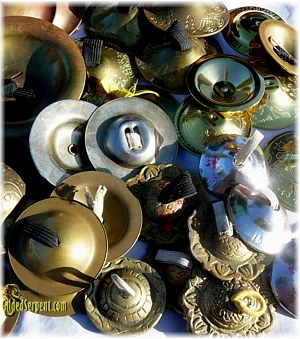
A Zill Collection

by Lara Lotze

Learning finger cymbals can be intimidating for many dancers. It is not just another prop, it is a musical instrument that should be used to enhance the dance and help accent the music. One the major barriers to learning finger cymbals is simply finding a good pair of cymbals that you like. I have talked with many, many dancers who quite literally hated finger cymbals, until they found the right pair to work with. Just like any other instrument, quality will affect the sound and the student’s continued interest in playing!

Everybody is different and expecting everyone to like the same cymbals doesn’t make sense. A tone and weight that one person loves may drive another person up the wall. If you are going to be practicing for hours on end, you really need an instrument that you actually like! Before you give up cymbals all together, here are a few things to consider:

Weight

Many instructors recommend using light weight cymbals for beginners, but I like my students to start with slightly heavier gauge. 130 grams is the lightest I allow in my classes, because I think the slightly heavier cymbals are actually easier to play!  Enough weight allows the cymbals to ‘bounce’ more naturally, allowing for a nice, clear ring without extra effort, and up through about 180 grams is generally not too heavy for beginners to handle. I do suggest holding off on cymbals over 180 grams until you have built up hand strength. I love the sound and feel of the 180+ gram cymbals but it is tiring if you haven’t worked up to it, which can be discouraging for beginners!

Tone or Pitch

This is probably the most important factor in finding cymbals that you like enough to eventually fall in love with. The set of cymbals my first teacher started us all out with had a tone that literally put my brain to sleep. One of my students used a pair that I loved but gave her migraines. In both cases, switching to another pair helped us fall in love with cymbals! It is really amazing how quickly my student’s cymbal technique improved once she had a pair of cymbals she liked! Once you are proficient enough to go public, there are a few other pitch issues. I have several pairs for use in different venues – a lower, more mellow tone is better if you know you will be playing for people with specific hearing issues, in a nursing home, for example. If you will be in a very noisy restaurant, it is easier to hear the high pitched cymbals. For stage, I generally prefer a mid toned, heavy weight cymbal that carries well to the back of the auditorium. One pair of cymbals I own sounds beautiful, but clashes with some of my music, so music choice can also affect which pair I choose.

Size

I hear dancers use the excuse of small hands over and over again when they are trying to avoid the heavier cymbals, but there are cymbals that are both over 130 grams and small enough for beginners & small handed people to handle.  It is difficult for a beginning dancer to handle very wide cymbals and it is worth finding something you are comfortable holding, but if you really like the mellow tones of some of the larger cymbals, a little stretching & a lot of practice can prepare most people for dealing with the larger diameter cymbals.

Color

Many dancers choose their cymbals based on what color will match a costume. That is fine as a secondary consideration, but if the tone doesn’t settle with you, the best color match in the world won’t make a bit of difference to your long term happiness! Fortunately, there are many cymbals out there in both gold & silver & even bronze. None of these factors should be considered in isolation, and I readily admit that I want pretty cymbals too!

Single Hole or Double
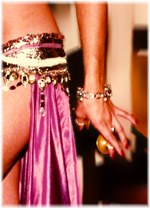
dancer with zillsI used to think that single hole cymbals were inferior and harder to play until I took a class with Artemis and she showed us that single hole cymbals are just different. Many dancers do prefer the stability of the double hole cymbals, but if you find a set of single hole cymbals that you love, you can either learn single hole technique or use various tricks (such as sewing a small button to the elastic on the underside of the cymbal) to make them more stable. I highly recommend the Zill Speak and Sagat Speak instructional CDs by Artemis and Yasmin for specifics on how to play either style.

Use & Care

Everybody’s hands are shaped a little different. Some dancers recommend putting the elastic over the first knuckle while others will tell you to put it just above the knuckle. Either method is fine, you need to experiment and see which position is most comfortable for you and secure enough to keep the cymbals on your fingers during a spin or two. I recommend using pins at least the first few times a set of cymbals is worn so the elastic can be adjusted. Please pin them on top of your fingers since putting the pin under the cymbal will deaden the sound and may scratch the cymbals as well. Once you are sure how tight the elastic should be for a good fit while dancing, you can choose to either sew them shut or stick with small safety pins. If you sew them, they are inherently less adjustable. If you use pins, you need to make sure they are holding up and not about to pop before each use. No one has ever noticed that I still use pins rather than sewing. I prefer the adjustability and there are enough other things to distract the audience, no one seems to notice the little gold glint on the elastic.

For my silver & brass cymbals, I try to wipe the set clean with a soft cloth after each use to prevent oxidizing, and use a little brass or silver polish about once a year. I actually like the patina on my bronze cymbals and do not polish those at all.  Polish does make elastic stiff, so be careful when cleaning your cymbals. The elastic will need to be replaced periodically. There are only so many times you can tighten elastic before it gives out, and it is best to check the elastic after a performance rather than be surprised at the beginning of your next performance!

Some dancers like to bake or cure their cymbals. Heat (& cold) changes the tone of cymbals. I prefer not to bake mine since the tone I sample them at when buying is generally the tone I want. If a cymbal looses it’s original tone, however, curing the full set in the oven does generally return them to their original tone. Do not leave your cymbals in a hot car or let them freeze. Besides, no one wants to get frostbite from their cymbals (ouch!).

A Collection of Finger Cymbals or Zills

use the comment box

Have a comment? Use or comment section at the bottom of this page or Send us a letter!
Check the "Letters to the Editor" for other possible viewpoints!

Ready for more?

  • Whose Dance is This, Anyway? Where Do Men Fit into the Belly Dance World?
    As soon as he was born, dancers of all stripes immediately started in with "Oh, a new little drummer for the troupe!". Excuse me? Why is there an instant assumption from birth that all little boys will be drummers and all little girls will be dancers just like mommy.
    —Added Feature! See our Gallery of Men in Middle Eastern Dance
  • Two Finger Cymbal Products reviewed: Belly Dancing Book & Kit Zill Speak, CD and Booklet by Artemis
    The finger cymbals: The cheapest money can buy, likely made by orphaned children in a third world country, yet an exceptional value for $9 at Borders books.
  • Zills: “Voice” of Bellydance 2 CDs of Finger Cymbal Instruction: Mastering Finger Cymbals By Mary Ellen Donald, Raqset al Sajat, An interactive CD
    A special thanks to the artists and producers who made these CDs possible, and may they individually and collectively preserve and revitalize an aspect of the dance, playing finger cymbals, that, sadly, has been withering on the vine in the community of late.
  • Thrillin’ Zillin"; DVD Review of "Belly Dance with Zills
    This is helpful for dancers who have a problem playing zills while dancing, or who are OK with just a drum playing the rhythm but get confused when playing to a song.  Elsa uses some familiar songs in this DVD which will give you the feeling of  "Oh, I’ve danced to this before; maybe next time I’ll add my zills".
  • Finger Cymbals
    Above all this cross-cultural cacophony soared my mom’s perfectly paced zills, right left right, right left right, right left right left right left right. If you put me in a room blindfolded, I could distinguish her playing from any other dancer on earth.
  • From the Land Down-under,Part 3: More of Our West Coast Dance Adventure
    "Hi, I’m Suhaila’s mum; I hear you Underbelly girls are good zillers!"
  • Dancing with Sheltiesl
    Bashing zills and barking shelties competed.
  • Dunia’s response
    "My dear: some of these people have zills older than you."
  • Zil Thrills in the ’70s, Memories from another Viewpoint
    My experience with Bert was the opposite, however; the cymbals were hardly a secret.
  • Back in the Bay Area
    …my zils flew off into the audience, and George stopped playing, went down into the audience…Was I embarrassed!
  • 5-30-10 Building A Dance Community by Mary
    A community does not operate in a vacuum and there is no room for cattiness or drama if the community is to be effective and truly benefit the area as a whole
  • 5-26-10 Dancing with Legends: Interview of Freddie Elias, Part 5: Today’s Music by Artemis Mourat
    If they are good musicians, they will abide by the rules and respect the dancer. We have to work for her, not against her. The young lady depends on you. She depends on the musicians.
  • 5-24-10 Loyalty, A Virtue Out of Fashion? by Beata and Horacio Cifuentes
    Some do not stop to think that it is a matter of basic manners to express your gratitude to an individual who has made an effort to provide well-being and knowledge. They just go and move on to their aerobics classes, horseback riding sessions, judo drills, or other, while the teacher is left behind wondering if any aspect of their lesson caused the pupil to go.
  • 5-18-10 Sula, An Artisic Life by Monica
    Sula continued to study with Bert through the early 1970s, though by 1972 she called him “my ex-teacher and now equal partner”. Bert was extremely proud of Sula, as she was among the first students he trained who began teaching seriously.
  • 5-17-10 A Bust to Be Proud of… by Yasmin Henkesh
    When she introduces me to her dance friends, it’s the first story out of her mouth – eighteen years after the fact. We still laugh about it.
 

Gilded Serpent presents...

Creating and Experiencing Musical Ecstasy

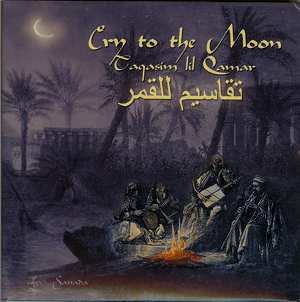
Cry to the Moon

CD Review-Yasmin’s "Cry to the Moon, Taqsim lil Qamar"

Reviewed by Amina Goodyear
posted May 31, 2010

Wikipedia says that "Taqsim is the name of a melodic improvisation style that could be metric or non-metric which usually precedes a composition in Arabic, Turkish, Greek or other Middle Eastern music. The taqsim is usually performed by a solo instrument, yet sometimes the soloist can be backed by a percussionist or an instrumentalist playing a drone on the tonic of the maqam… "

It is widely seen as an art of improvisation in a specific maqam, but usually modulation to other maqams (maqamat) are present in a taqsim.

Taqsim traditionally follows a certain melodic progression… Following the introduction, the improviser is free to move anywhere in the maqam and even modulate to other "maqams" as long as he returns to the original. Taqsim is considered by many to be a connection to the spritual world.

Taqsim for the Moon (qamar) is just that and more. This CD produced by Yasmin of Washington D.C. brings to mind the word spirituality and also ecstasy, tarab and saltanah. Most importantly I believe it is probably Yasmin’s wish to subliminally educate her audience, most of whom are dancers, while entertaining and feeding their souls.

Cry to the Moon, in my opinion, is a very different CD. It is a special CD meant to be listened to, studied and enjoyed rather than to be used as a performance CD. (However, there are many danceable tracks.)

The booklet that accompanies this CD includes very important information on Arabic music including definitions on taqsim and maqam; information on the musical instruments; short but complete and interesting bios on Om Kalthoum and Farid al Atrash and transliterations and translations of the songs used.

This booklet alone is reason to buy the CD.

Yasmin introduces six songs and a drum solo. The songs are accompanied by solo instruments playing a taqsim. Some of these instruments are traditional such as nay and oud and some are modern (but probably also considered traditional in today’s world) such as the organ and the accordion. I have many favorite tracks in this CD, the oud, the nay and more, but my most favorite selections are performed by Karim Henkesh:

  • tracks 11 and 12 – violin taqsim and violin for ana fi intizarak.
  • tracks 20 and 21 – violin taqsim and violin for al hob keda.

The word tarab comes to mind in these pieces.There is no word in English that accurately translates the word tarab from Arabic to English. It is definitely the emotional effect of the music.

This is when one (both the musician and the listener) can become intensely involved – both emotionally and physically. This extraordinarily emotional state evoked by the performance might be also enhanced by the foreknowledge of the songs and somewhere in the subconscious seeing and hearing the great Om singing the words to these two songs.

Another favorite is tracks 22 and 23 – the oud taqsim and ya beta’a al-yasmin. Tarab also can connect the music to memories. In this case, I grew up in clubs where the oud played a very important part of the show and I spent many hours dancing and connecting with various oud players and their endless incredibly beautiful noodling (my word for taqsim). The oud taqsim on "vinyl" (what’s the word if it’s digital?) can evoke those memories and make "yesterday" be "today". Track 23 which follows the oud taqsim has a very special haunting quality and brings to mind images from Naguib Mahfouz’s "Cairo Trilogy" – the first volume, I believe. The image of the young girl peeking through the mashrabiyya looking at and imagining the young man below would be her prospective husband. As the song progresses we are reminded that many songs such as Taht il Shibak (Beneath the Window) are really songs of a different era and culture.

Track 24 – drum solo by Khamis Henkesh is as Yasmin states in her booklet, not intended for performance, but rather for meditation and contemplation. Many times accompanying the word tarab is the word saltanah. This word also is difficult to define in 5 easy words or less. There probably is no equivalent in the English language. In the book "Making Music in the Arab World" The Culture and Artistry of Tarab, written by Ali Jihad Racy, Cambridge University Press, there is one chapter alone devoted to the word Saltanah. To quote A.J. Racy,

"In a saltanah state, the performer becomes musically self-absorbed and experiences well focused and intense musical sensations. Whereas the concept of tarab characterizes traditional Arab music in general and connotes a trait permanently present in tarab works whether recorded or played live, saltanah is more often a temporary state generated before and during the performance proper. Also unlike the feeling of tarab, which extends to all the participants in the musical process, especially the audience members, saltanah typically applies to the musicians specifically in connection with performing. Saltanah is the condition that inspires affective music making. Although musically and emotionally part of the overall tarab experience, it is the magic that momentarily lifts the artist to a higher ecstatic plateau and empowers him or her to engender tarab most effectively. In this sense saltahah is creative ecstasy."

Saltanah – this is what I feel Khamis Henkesh achieved in track 24. In fact, if you listen to this CD, you may find other such moments in other tracks as well. I used to call this "the musicians were so good, they tranced out".

Purchase information: http://www.serpentine.org/SoT/002Taqsim.htm

use the comment box

Have a comment? Use or comment section at the bottom of this page orSend us a letter!
Check the "Letters to the Editor" for other possible viewpoints!

Ready for more?

  • 2-15-10 Drumming for Bellydancers and Bellydance Drumming Wannabes: 3 Drumming DVDs reviewed by Amina Goodyear
    However, the three "how to play the drum" DVDs I am reviewing really do introduce the beginning drummer to the drum and, if used as a three unit package, these three DVDs can take the drummer or dancer/drummer from absolute beginning level to the stage.
  • 7-12-09 Heartbeat of the Dance: Review of 4+ Drum Solo CDs Reviewed by Amina Goodyear
    Sabla Tolo 1 & 2 by Hossam Ramzy, Drum Attack by Tony Chamoun, Pulse of the Sphinx by Henkesh Brothers
  • 4-17-09 Two
    Dance CDS for Performance and Listening
    , "The Soul of Cairo" & "The Masters of Bellydance Music" review by Amina Goodyear
    This family is dedicated to producing (and also finding) the latest and most popular bellydance music as well as reissuing classic albums in a remastered format with updated liner notes.
  • 3-15-08 The Magic Sounds Studio of Cairo, 3 Albums reviewed and Compared by Amina Goodyear
    CDs- Oriental Fantasy #12- Talisman, Nesma:Del Nilo al Guadalquivir(From the Nile to the Guadalquivir),Nesma, Memories of Cairo.
    In a world where Egyptian dancers dance in the "less is more" tradition, the world of musicians seemed to be – more is better and lots more is best.
  • 12-13-05 The Zar by Yasmin
    We do know that today thousands of women in Africa and the Middle East use this music to cure all kinds of illnesses. They literally dance until they drop.
  • 1-27-10 Shoo Shoo Amin, A Forgotten Treasure of the 80s by Yasmin
    Twenty years ago when I told people I had worked with Shoo Shoo Amin in Cairo, the response was “Wow!” Now, people go “Who?” Today no one seems to know who she is. For belly dance purists, this is a tragedy. Every so often, someone my age or older will wax lyrical about her on-line, but for the most part, she’s an enigma – even to young Egyptians.
  • 9-17-09 Sex, Belly Dance and the Afterlife by Yasmin Henkesh
    To these people, sex was not dirty, shameful, frightening or forbidden. It was a natural part of daily life and the essential prerequisite for birth – on earth or in the Afterlife.
  • 5-30-10 Building A Dance Community by Mary
    A community does not operate in a vacuum and there is no room for cattiness or drama if the community is to be effective and truly benefit the area as a whole
  • 5-26-10 Dancing with Legends: Interview of Freddie Elias, Part 5: Today’s Music by Artemis Mourat
    If they are good musicians, they will abide by the rules and respect the dancer. We have to work for her, not against her. The young lady depends on you. She depends on the musicians.
  • 5-24-10 Loyalty, A Virtue Out of Fashion? by Beata and Horacio Cifuentes
    Some do not stop to think that it is a matter of basic manners to express your gratitude to an individual who has made an effort to provide well-being and knowledge. They just go and move on to their aerobics classes, horseback riding sessions, judo drills, or other, while the teacher is left behind wondering if any aspect of their lesson caused the pupil to go.
  • 5-18-10 Sula, An Artisic Life by Monica
    Sula continued to study with Bert through the early 1970s, though by 1972 she called him “my ex-teacher and now equal partner”. Bert was extremely proud of Sula, as she was among the first students he trained who began teaching seriously.
  • 5-17-10 A Bust to Be Proud of… by Yasmin Henkesh
    When she introduces me to her dance friends, it’s the first story out of her mouth – eighteen years after the fact. We still laugh about it.
 

Gilded Serpent presents...

Building a Dance Community

by Mary
posted May 30, 2010

As a baby belly, I was lucky enough to enter the dance world in the large, vibrant and varied dance community of South Florida and in my naiveté I thought this vibrancy was normal for all communities around the country. Then my husband and I moved to Middle Georgia. When I discovered the dancers in this area, I found that there was a community, but not what I was used to, and most of the events here revolved around involvement with a particular instructor or school. I got involved with one group, but still missed the “busy-ness” and number of events and social options my old community had to offer. And so, with others in the area, we went about building and expanding the Middle Georgia belly dance “scene.”

Building a dance community will not happen overnight and it cannot be accomplished effectively by a sole individual, especially if there are several established instructors/schools already in the area.

Looking back over the past three and a half years and seeing the growth that has happened here locally, my hope is that sharing the gathered information and experience will help others create stronger dance communities in their own towns as well.

Getting Started

The first step to putting together the dance community is to identify your local key players. The easiest way to do this is to contact all local instructors or performers in the area and try to set up a meeting. It’s best if everyone meets at one time, but individual meetings may also be necessary due to schedules and when you are still learning about the community (if you are not already familiar with everyone).

Approach everyone with a spirit of cooperation – this is not high school and for a community to come together, individual ‘issues’ need to be put aside and eventually resolved.

FatimahIn Middle Georgia everyone was excited at the idea of having an active local community where dancers cooperated with each other to hold events and parties where everyone felt welcome. Being in the middle of the South, there are many misconceptions we work to dispel about this dance form and as a group we are much more effective as the community can provide a consistent and unified message rather than appearing as a group of factions that cannot agree with each other.

We decided that our goals to improve the community were to:

  • plan two workshops annually with dance instructors we felt would have something to offer everyone in the community
  • hold local socialization events like swap meets or casual haflas to expose students to the social side of dance
  • organize student shows and/or support each others’ student shows to encourage new dancers who wish to grow into performers or just conquer stage fright
  • encourage a code of professional standards for performing/teaching dancers
  • provide a central location for the general public to find quality dancers in the area and participate in local events and festivals that will help us promote understanding and culturally enhance the local area.

Picking a Structure

There does not need to be an official “committee” to build a community, a general consensus is enough if several of the key players are already putting on haflas, etc, and all members are willing to support each other’s events. We did not have an official committee for a long time, just open communication between individuals and it worked relatively well at the time.

We have recently created Southern Raq (www.southernraq.com) for our area, because the dancers here feel the community has grown enough to now merit a more “official” central group with representatives from all areas of the community. Another reason is that the community as a whole benefits from the workshops we host here about twice a year and a committee is a good way to share the responsibility for planning events.

To avoid creating a clique though, officers rotate annually, so new members can volunteer to join, meetings are open to all who wish to attend and everyone who wishes to submit input or suggestions can feel welcome to do so, because a committee is not effective if it doesn’t serve the community.

When building your community you may also find that an e-mail list, Facebook group or community calendar webpage can work well for sharing information with everyone. If the information is not publicly searchable and/or easy to find (like with a website), it is recommended that any dancer who has a website adds links to the location or clearly identify the e-mail address where interested individuals can request information about community events.

Keeping it Together

After dealing with the challenges of getting everyone together, deciding what kind of community you want to build and how you plan on doing so, you must remember that everyone on the committee is human and with that comes complications.

A community does not operate in a vacuum and there is no room for cattiness or drama if the community is to be effective and truly benefit the area as a whole.

  • If there are pre-existing conflicts between individuals, it may be beneficial for a neutral party to talk to both sides and try to mediate, particularly if these individuals are key players in the area. You don’t have to become best friends with everyone, but the dancing is more important than the drama.
  • If conflicts arise while everyone is trying to come together to work on building the community, deal with the issue early. It may just be a small misunderstanding or mis-perception of intentions and if it is not addressed early, it can grow, fester and destroy what everyone is working to create.
  • If conflicts arise after the initial period, once again, deal with them immediately. The best advice I can give based on the experience we’ve had locally is to go directly to the individual or a neutral party if you need a mediator and talk it over like adults. Gossiping to your friends, your students and anyone who may listen is not only in poor taste, it reflects badly on you and will create rifts in the community.

So, why bother?

There are a lot of challenges and obstacles to overcome in working to build a community, but being a part of a dance community can be one of the most rewarding aspects of being in belly dance. Many dancers may come into this dance older, or perhaps not wish to ever dance professionally but prefer to keep it as a hobby, and dancing can be a major part of their social life and a great source of joy. The Middle Georgia community grew more quickly when we were actively working to build the community as a whole than when we were operating as individuals because students can have more fun, instructors and performers get the opportunity to remember one of the reasons they fell in love with the dance to begin with and everyone can feel a sense of pride in knowing they are a part of something that not only benefits the dancers, but adds variety as a whole and enhances the community in which they live.

Captions for photos:
  • Sword photo dancers: Top row L to R: Bela Zaphyre, Mary, Mahira, Bottom Row (L to R): Debra, Trish. Photo by MiaVonni Photography
  • Veil Dancer: Fatimah dances at the 2010 Macon Cherry Blossom Festival. Photo by Penny Kojak (aka Karabela)
  • Class performance: I don’t know all the dancers there… The group is Perry Bellydance and the instructor Trish is in the center (blue, feather in hair) and Bela Zaphyre is at the far right
  • Fourth of July parade (L to R): Bela Zaphyre, Debra, Aaminah, Trish, Mary

use the comment box

Have a comment? Use or comment section at the bottom of this page or Send us a letter!
Check the "Letters to the Editor" for other possible viewpoints!

Ready for more?

  • Academia? Like it or Trash it!2 Books Reviewed: Dancing Communities & Dancing Fear and Desire
    One thing that I have found within our community is the general lack of scholarship and a feminine voice within the research.
  • Photos from Sumaya’s Chicago South Side Hafla
    Being new to the Midwest, I thought it would be fun to attend one of Sumaya’s haflas and meet other members of the greater Midwestern dance community.
  • Bellydance Grows in West Virginia
    It has allowed us to build upon the ties we already have and extend them to other dancers, making a community of sharing and support.
  • Rhythm and Reason Series, Article 3, Community Warfare
    Time and again I hear dancers deplore the fact that in many parts of the country there are warring camps among dancers; that is, groups that openly oppose each other and that try to keep all useful information and all jobs to themselves.
  • Rhythm and Reason Series, Article 10-How to Avoid Being Eaten by Sharks
    Not so fortunate are those people who feel threatened most of the time, limping from one extreme response to another.
  • 5-26-10 Dancing with Legends: Interview of Freddie Elias, Part 5: Today’s Music by Artemis Mourat
    If they are good musicians, they will abide by the rules and respect the dancer. We have to work for her, not against her. The young lady depends on you. She depends on the musicians.
  • 5-24-10 Loyalty, A Virtue Out of Fashion? by Beata and Horacio Cifuentes
    Some do not stop to think that it is a matter of basic manners to express your gratitude to an individual who has made an effort to provide well-being and knowledge. They just go and move on to their aerobics classes, horseback riding sessions, judo drills, or other, while the teacher is left behind wondering if any aspect of their lesson caused the pupil to go.
  • 5-18-10 Sula, An Artisic Life by Monica
    Sula continued to study with Bert through the early 1970s, though by 1972 she called him “my ex-teacher and now equal partner”. Bert was extremely proud of Sula, as she was among the first students he trained who began teaching seriously.
  • 5-17-10 A Bust to Be Proud of… by Yasmin Henkesh
    When she introduces me to her dance friends, it’s the first story out of her mouth – eighteen years after the fact. We still laugh about it.
  • 5-10-10 IBCC 2010, Wednesday April 21, Opening Gala Report From The International Bellydance Conference of Canada by Gilded Serpent Staff
    Because Gilded Serpent didn’t quite make it to the hall until the show was over, we are very grateful that
    Brigid Kelly consented to give us her report from the Wednesday evening performancec. The dance photos overlayed on this video are by Samira Hafezi.
 

Gilded Serpent presents...

Freddie, Part 5: Today’s Music

Placeholder

Dancing with Legends: Interview of Freddie Elias

by Artemis Mourat

posted May 26, 2010
part 1, part 2, part 3, part 4

[Ed note- We took a bit of a break after the first 4 sections of this interview. We were hoping that Mr Elias would send us more pictures to go with this last section. Now maybe he will once he sees this last section. If so, we will have a part 6!]

Middle Eastern music – it’s not the same anymore. That is definite. And different types of people come in. Everyone is trying to develop a new concept, destroying the original authenticity. Where is that beautiful articulate dancing? Now the dancers, and I mean this respectfully…all they can do is come up to you and say; “Give me a fast intro, give me a ciftitelli in the middle, give me a fast 9/8 out.” How could I write an arrangement on that? They should take the beginning and develop a form from there.

Nowadays, everyone’s trying to develop a new concept. I take my hat off to them and I know that everything has to change.

The challenge is to develop something you want, but don’t destroy the authenticity. Don’t destroy the Byzantine or the authenticity of Turkish music.

Turkish music is great. Some musicians take Turkish songs with unusual time signatures and make them 2/4. They make the song like a hasapiko. Unfortunately and respectfully with the highest dignity, there are great bands out there who turn everything into a 2/4.

I also suggest things to the musicians. I tell them; “You really are playing a certain way (and I explain it). Be a little softer. Do this or do that. And while you are playing this, try that.” (He beats a rhythm on the table). Or I say: “Don’t do this {He plays more on the table} and how about that (He plays something different on the table and hums). Learn the developments, the arpeggios and so forth. You have to study. In other words, again we come back to the tuxedo pants to share the glory. You have to study.

Advice for Dancers

I think, a very humble personal opinion, dancers should familiarize themselves with the music and with the compositions that they are working with. And I don’t know if this would be a helpful suggestion, but when John Tatassopoulas and I worked in Washington, we used all Abdul Wahad numbers. They are classical listening numbers created for vocals.

Now if the average individual would listen to Abdul Wahad numbers, they would learn so much. There are unbelievable movements in there. There are different rhythms in there. There are Saidis there and malfoufs.

Take those and if you’re not happy with that, make your own form. Become an arranger in your own shows. Talk to the musicians. Say; “I want this too fast and I want that too slow and I want my karsilama very penetrating.”

Oh, and another thing, when I was in Washington, DC, the dancers and I and John and the guitar player, we used to work from 8:00 PM until 2:00. It’s hard to believe sometimes but from 2:00 to 6:00 AM we rehearsed with the dancers. And I took my pen and said, “You know when you’re doing that pivot, let me write that down so we can coordinate.” 

Coordination is the most important partner development of the dancing. Dancers should work with musicians. I, for one, would love to rehearse here every night with any dancer that would come to work here.

I would be glad to. If they want me to come at 4:00 in the afternoon, I’d just make it my business to cancel what I have to do, even a doctor’s appointment. I would come here and this is true. I proved it with my band. I used to drive from Manchester, New Hampshire to Peabody, MA with my band every Monday. For thirty two years. You can ask anybody. We rehearsed. It was so important. Maybe when you write an article, you can let the dancers know that they should try to get a hold of the musicians to rehearse with them. Because when you rehearse, you may have an idea that will help me.  And, I may have an idea that will help you. In other words, the bottom line is that we have to work together. If you don’t want to work together, forget it, don’t be in the business. 

Qualities of a dancer: Presentation, of course. Personality. Always smiling, like this one here (Points to Za-Beth). She could make a mistake and people will not notice or they will forget it, because they see her smiling. That’s the secret.

When I graduated from the conservatory, my French teacher was a great man, Gaston Elcus. He said, “When you leave here, all you have to do is put some Brilliantine on your hair, brush your teeth and smile. It is easy. You are gonna make it.” Tend to your hair with Brilliantine, brush your teeth, smile, and you can never go wrong. (We all laugh)

Dancers should get a hold of their craft and make sure they know what they are doing. They should protect their craft, respect it and protect it. They should go up to a musician and say; “I want a karsilama, not too fast, not too slow, but what I want you to do please, is to give me a little feeling and dynamic expression. When I come this way, slack the music down. When I come up, do that. When I go around, do something else. I’m going to drop to the floor at the end.” This makes it coordinated.

If they are good musicians, they will abide by the rules and respect the dancer. We have to work for her, not against her. The young lady depends on you. She depends on the musicians.

The musicians have to pay attention to the dancer and they have to look at her feet and her face. What are you poor dancers going to do if musicians just want to do what they want to do at any time they want? The musicians are there to please the dancer and the audience too.

Yes, like I said before, I’m not particularly prejudiced here, but Michael is one of the greatest drummers. First of all, he’s got feeling. He works with the dancers. Any movement you have, he catches it. He’s not looking up in the sky or thinking about who he is going out with tomorrow. He is right there with the dancer. It is a professional job he is doing. He’s looking at you with his undivided attention. Here is a secret for you too. When he is doing that, he’s gonna give you a little pitter-pat 9Freddie taps his heart rhythmically). You don’t have to orchestrate everything or write every note. You want the musician to feel you

use the comment box

Have a comment? Use or comment section at the bottom of this page orSend us a letter!
Check the "Letters to the Editor" for other possible viewpoints!

Ready for more?


Gilded Serpent presents...

Lots and Lots of Combos!

Review of 2 Belly Dance Combinations DVDs:
IAMED’s Ultimate Combos #5 and
Combination Nation #2 by Cheeky Girls

by Tracey Farmer
posted May 24, 2010

With the Belly dance market being saturated with all plethora of instructors, genres, production companies, etc., it’s inevitable that the same type of DVDs will be produced.  As I’ve said before, its difficult to decide which titles to buy unless you are certain you enjoy the dancer/instructor.  Both IAMED and Cheeky Girls have done just that! Most dancers want to learn different combos from famous instructors and most of us are developing our own unique dance style that represents what we have learned.

  • ULIMATE COMBOS #5 by IAMED-This instructional boasts combinations taught by the best: Aradia, Jamileh, Katia, Ava Fleming and Zahra Zuhair.
  • COMBINATION NATION Vol.1 by Cheeky Girls-
    Boasts instructions from Belly dance’s hottest performers: Ahava, Aradia (again!), Bahaia, Lotus Niraja, Princess Farhana, Ruby, Shoshanna, Summer Sahar and Zafira. It’s obvious both contain material from notable and up and coming stars; both have a history of good production quality.  IAMED has 5 of these combo DVDs, and so far, Cheeky Girls has only 2.

Let’s start first with "IAMED’s Ultimate Combos #5".

There are 5 instructors on this one:

  • Ava Fleming teaching Egyptian traveling steps, then eights. 
  • Katia teaches 2 Egyptian Rhumba steps. 
  • Jamileh has three sets, an Egyptian combination, slow Saiidi and then another combination with a veil. 
  • Aradia gives us three Egyptian style combos.
  • The legendary Zahra Zuhair gives us 2 Egyptian style combinations. 

 As you probably have figured out, this instructional focuses on Egyptian style Belly dance. Though this DVD focuses on the same genre of Belly dance, you can see the different styles and techniques of the different dancers , which is how it should be; no dancers should dance alike! This was filmed at a real studio with the ladies looking straight into the camera–although they do change position to give you a view of the choreogrpahy from behind, the side, etc. I haven’t seen the other IAMED combinations DVDs, so I’m not sure if they focus on more American Cabaret or E-gypsy or Fusion.  Since there is no introduction on this DVD, its difficult to say if this was the motive.

 There is no discography included, and though I’m sure most of us have heard the music used, this is a glaring omission and shows lack of respect for the music artists.

  As mentioned before, there was is no formal introduction; instead, we have the usual IAMED introduction and the chapters about IAMED, Belly dance history and "Dancer’s Tips" which is always a useful feature. Though known for their top quality, it just doesn’t feel like the same time and effort was put into this DVD. It appears that Suzy Evans has so many instructional clips and chapters already filmed by so many dancers that she selected clips from these 5 ladies and put together a DVD.  This seems unusual, coming from the "no stone unturned" quality from IAMED.  At the end, we are treated to a stellar performance by Ava Fleming.
Purchase Information: IAMED Store

Combination Nation by Cheeky Girls

features more dancers, more quantity, and what seems like a more complete production.  It includes an introduction explaining that you’ll be learning different combinations from various popular dancers using their own unique style that you can blend with your dance style.

These ladies demonstrate their combinations while facing a mirror, giving you a classroom feeling.  Both this method and IAMED’s method are effective: it’s just a matter of taste.

  The combinations here are a mixture of American Cabaret, Egyptian, and Tribal.  Bahaia and Summer Sahar teach 2 combonations each.  The rest include Shoshanna, Lotus Niraja, Zafira (who was my favorite), Ruby, Aradia, Princess Farhana, and Ahava.  I also liked the way each instructor’s website was flashed across the screen for extra individual publicity for each dancer so that you can familiarize yourself with any who was unknown to you at the time. The performances at the end are from Summer Sahar, Princess Farhana, and Zafira–dances that look like excerpts from the "By Dancers for Dancers" series.   All of the music used is from the "Ya Bahaia" CD except the performance music used for Summer Sahar, "Saiidi Dub/ Tabloa Solo 2" by Drumspyder.

I am giving this DVD a higher rating because it appears to be more complete in production (not so much that there are more dancers). You can have 1 or 2 instructors and receive a multitude of combinations; it’s just that I think that this DVD will satisfy a wider variety of palettes and doesn’t seem like it was rush-produced.
Purchase Information: CheekyGirls Store

DVD Cover
Zil Rating: 2 1/2 zils
Zil Rating

DVD cover
Zil Rating: 3 1/2 zils
Zil Rating


vol 2 not 5!

Ratings:

Instructional Skill:  Both DVD’s contain dancers who are qualified and give clear instruction.
Quality of Production:  Both are of significantly high professional quality.
Level of Instruction:  Intermediate to advanced, demonstrating an understanding of rhythms and Egyptian dance technique.
Ratings: 

  • IAMED’s Ultimate Combinations #5: 2 1/2 zills,
  • Cheeky Girls Productions’ Combination Nation #2 : 3 1/2 zills


One more note needs to be said: 
I have noted with Combination Nation along with other DVDs by the Cheeky Girls that they appear to keep the dancer firmly in mind when producing their DVDs.  They appear to be aware that this dance form is supported by dancers of various ages, sizes, and colors.  I have seen this representation in all of their By Dancers for Dancers series. 

Cheeky Girls is marketed for the Belly dance community and seems to appeal to the mass audience with whom they choose to dance in their shows or give instruction. 

I think the Belly dance community appreciates this; we actually get to see dancers with hips, butt (cheeky), a little extra padding, women of color, and older dancers giving stellar, professional performances–and the audience is okay with it.  I hope other productions companies take note of this because Belly dancers are a fast growing, yet still small, community. We should embrace each other–not just try to promote the "next hot thing" and show respect for Middle Eastern culture.


Have a comment? Use or comment section at the bottom of this page orSend us a letter!
Check the "Letters to the Editor" for other possible viewpoints!

Ready for more?use the comment box


Gilded Serpent presents...

Loyalty

Maki of Japan

A Virtue Out of Fashion?

by Beata and Horacio Cifuentes
posted May 24, 2010

Beata and MimiThe subject of loyalty has been going through our minds recently due to two very different events that have occurred. One was an invitation to teach and perform in Japan, the other was a 5-page interview in a dance magazine with two of our former students.

As a dance teacher one is used to the fact that students come and go, often without warning or with some less than sincere excuse for why they cannot continue with their lessons.  Countless times throughout the years we have tried to convince ourselves that we are not emotionally affected by a pupil who discontinues her or his lessons, often times leaving without so much as a thank you or a goodbye.

It is necessary, and surely most teachers out there will agree, to grow a callus. Yet, under this emotional epidermis lies a heart, which hurts again and again. It is easier to accept this knowing that most pupils have no ill intend as they exit your life; that perhaps they are less emotionally attached to the teacher than the other way around (we nurse some sad memories of children and teenie classes).

Some do not stop to think that it is a matter of basic manners to express your gratitude to an individual who has made an effort to provide well-being and knowledge. They just go and move on to their aerobics classes, horseback riding sessions, judo drills, or other, while the teacher is left behind wondering if any aspect of their lesson caused the pupil to go.

All of the above, painful as may be for the teacher, is mostly unintentional. What really goes below the belt is when former students suddenly suffer from what we like to address as “professional amnesia”.

We have always been fascinated by the Japanese culture, their finesse, attention to detail, and strive for perfection, and -among many other virtues- respect for authority and loyalty to those who have served in their process of growing as individuals in life.

Maki, our sponsor in Japan, is a very talented young woman who was inspired to become an oriental dancer after she saw one of our first shows in Tokyo in 2001. “It is their style, and none other, what I will pursue” said Maki after she saw our show. With that thought in mind, Maki phoned Berlin and asked if we would accept her as our student. She moved from Tokyo to Berlin for six months and signed up at our dance academy for every dance class, including, ballet, yoga, and even children’s classes. She was there to truly learn, never missed a lesson, and was as concentrated as she could be. At the end of her stay she asked: “What should I do next?”

Under our advice, Maki moved on to spend a few months in Cairo where we met and introduced her to various dance teachers and tailors. Maki was now on her way to getting the real Baladi feeling, exploring the Arabic culture and developing a new wardrobe and a repertoire. Back in Tokyo, Maki continued with her dance studies. A year later, she returned to Berlin for more intense studies at our academy. A lovely friendship developed between Maki and us. Sometimes she would phone from Tokyo just to chat.

She was not prepared to begin her first steps as a teacher unless we consented. She not only valued our opinion but cared about her dignity as a dancer and teacher.

Maki is now a well-respected teacher with many classes per week and a healthy student body. She directs her own dance group and has become an inspiration to many Japanese women who love and respect her. She is asked to travel all over Japan to give workshops and to perform. She even has gotten a show on television where she is teaching bellydance.

Our performances in Tokyo last fall were a tremendous experience for us. After two very enjoyable shows, we sat at a restaurant with 65 of Maki’s pupils who had participated in the performances and had tears in our eyes as Maki stood, glass in hand, toasted us and told everyone that thanks to us she was the dancer she was, and that she had been dreaming of presenting us in Tokyo for many years. It was a very touching moment.

Class in Japan
click photo for enlargement. Names for faces would be appreciated!

During the very same fall season we experienced the other end of the spectrum: two dancers who co-direct a belly dance school near Berlin, former students of our academy, were interviewed about their studio and dance life. Both had been our students for many years and also had been members of our Oriental Fantasy ensemble and as such, experienced the way we conducted rehearsals, including the entire logistics of a performance backstage. One had also been a member of our staff as a teacher for quite some time and thusly was introduced to the system of how we run our dance studio and  also was coached during regular meetings.

They have made a life from that what they learned from us. This is indeed a good feeling to know that one’s work serves to provide a life for others. It was, however,  sad to read this five-page interview and to realize that they forgot to mention our name. On the other hand, Maki in Japan even insisted that we were mentioned in the booklet of her television appearances.

In Berlin there exists quite a few cases of “professional amnesia” with dancers and dance teachers who not only forget where they learned how to dance and teach, but also even prevent their students from attending our events.

At the end of the day, one has to look in the mirror and see the truth, just as at the end of one’s life, each human being has to make amends with him/herself, and remember what kind of a person he or she has been. Here the subject loyalty is a fundamental one.

We may now take the opportunity to say that  Horacio was inspired by Magana Baptiste, from San Francisco, California, to become an oriental dancer. And even though his start with her was a long time ago, he still phones her, thanks her for the inspiration and visits her at any given opportunity. Just the same, Beata always remembers that it was Bert Balladine who presented her to the American bellydance community and provided her with support and professional advice during her earlier years as a dancer.

There is something fundamentally right about being loyal. It has to do with a warm heart and with the essence of being a human being.

Horacio performs with a class of kids


use the comment box

Have a comment? Use or comment section at the bottom of this page or Send us a letter!
Check the "Letters to the Editor" for other possible viewpoints!

Ready for more?


Gilded Serpent presents...

Sula

Sula on stage

An Artistic Life

by Monica
posted May 18, 2010
Some photos are linked to enlargements

Sula Frick (1937-1978) was a San Francisco Bay Area belly dancer, costumer, promoter, teacher, publisher, shop owner, studio owner, and would-be record producer. Although, she was with us for a relatively short time, she managed to pack in a full dance life while also spearheading many innovative ideas and projects for the belly dance community that endure to this day.

A Young Dancer

Sula was born and raised in Contra Costa County, California, 30 miles east of San Francisco. She was active in the arts from a young age, studying painting, lettering, design, acting, and folk dance. She was a member of the Shell Folk Dancers of Martinez at 13. By 17 she was teaching social dancing at Yolanda’s in Oakland. In 1963 she studied Tahitian dance, and performed group dances with Dances of the Pacific and a lead soloist for the Lei-Aloha Dance Troupe. In 1965, she began taking belly dance classes with Bert Balladine in San Francisco. She would continue full time in belly dance for the rest of her life.

Belly Dance Education and Teaching

Sula studied with Bert that first year for a minimum of 6 hour per week. By 1966 she was dancing at several clubs in and around Northern California, including the Baghdad in San Francisco, Zorba’s in Sacramento and San Jose, Arabian Nights in Fresno, and more in the East Bay. In 1967 she opened the Belly Dance Navel Academy in Walnut Creek, teaching 4 classes per week. She later changed her studios name to “Sula’s Belly Dance World”, and it is still in business today at the original location under the name “Belly Dance!”, run by a former student of Sula’s, Leea Aziz. By 1972, Sula was teaching ten classes per week at her studio, and 4 more at Concord Cultural Arts. Sula also had a troupe called “The Khadines’ that danced at county fairs around Northern California.

Sula continued to study with Bert through the early 1970s, though by 1972 she called him “my ex-teacher and now equal partner”.  Bert was extremely proud of Sula, as she was among the first students he trained who began teaching seriously.

In addition to Bert, between 1969 and 1972 she also studied with Fatma Akef, a “belly dancer of 30 years experience from Cairo, Egypt”,  Amina, “featured dancer from the Bagdad Cabaret in San Francisco”, and Jodette Camilla, a “famous Egyptian belly dancer”.

In 1971 she began to study Arabic drumming with Vince Delgado at the Ali Akbar College of Indian Music. According to her resume, “teacher went to east coast on a scholarship or I would have continued”. She went on to study percussion with Henry Hurst, lead drummer at the Bagdad.

By the early ’70s, Sula’s focus was less on performing and more on teaching dance and costuming. According to Leea, Sula’s strength as a teacher was in breaking down steps. Leea uses some of Sula’s methods to this day to explain certain movements.

Leea AzizCostuming

Costuming was always a big part of Sula’s belly dance life, and it had become a core part of her business by the early 1970s.

Her fine art and design background combined with a strong sewing ability culminated in her creating original patterns, designs, and dance costumes for herself and for other dancers. Most dancers of this time made their own costumes, but Sula’s artistic eye made her well-known throughout the community.

Her sketches were inspiring, and her costumes were of quite a high quality compared to what else was around at that time. In 1972 both the Concord and Pleasant Hill public libraries had a display of her costumes at their branches. She had a “Handmade by Sula” tag sewn into all of her work, some of which can be seen on long-time dancers to this day! Her original patterns are also still commercially available. After Sula passed away, her sister Wanda continued to make costumes for the belly dance shop Sula founded until she left the area.

Publications

Sula was the publisher of Belly Dance Magazine which began in 1972. The magazine focused on local topics for working dancers, and had teacher spotlights, cultural information about the Near East and North Africa, belly dance record reviews, book reviews, costuming tips, advertisements, letters from other dancers, and lots of photographs of local dancers performing. By 1977 Sula had sold the magazine, though she continued to write for it along with other local dancers including Nakish.

Sula authored two books, including “Astrology for Belly Dancers” and “Secrets of Belly Dancing”, the latter co-authored with her mentor, Bert Balladine. Sula and Bert are also credited with co-authoring Adela Vergara’s “The New Art of Belly Dance”.

Sula and BertBelly Dancer of the Year Pageant

In 1973 Sula developed what would become one of her proudest achievements, The Belly Dancer of the Year Pageant. The Pageant was a culmination of several different events Sula had produced in the late ’60s to the early ’70s. She wanted to create something that would last, and the pageant became that something. At the time of this writing the Pageant is entering its 37th year! It remains a well-respected event that attracts high quality competitors and judges.

After Sulas death, her long time student, assistant, and studio instructor Leea was asked directly by Sula’s 17 year old son to continue the Pageant in Sula’s name. That was in 1978, and she has honored her promise to him by keeping the Pageant going through today.

Other ideas

Sula had in mind to release records for dancers to use in studios to teach and practice to, and in fact had purchased the rights to some music for that purpose. Unfortunately, the record was never released.She also mentioned an interest in taking dancers to Cairo, Egypt to study dance. We’ll never know if this would have come to fruition.

Sula’s Legacy

In 1978 Sula was diagnosed with malignant melanoma only six weeks before she passed away. The suddenness of her passing left a void in many lives. Leea Aziz bought the business from Sula’s husband after her passing. Jack Frick remained close to Leea and her family until his own death.

The studio that Sula established in Walnut Creek, California, is still open and actively run by Leea, who teaches ten classes per week, books professional dancers for restaurants, parties and weddings, and operates a full service retail belly dance shop. Leea has trained many dancers who have gone on to work professionally, and in some cases to teach.

Leea continues the legacy both Sula and Bert left, with an emphasis on live music, continuing education and training for dancers, and a focus on professionalism and keeping belly dance the class act Sula taught it was.

Though I never met her, Sula is my dance grandmother. Through my first teacher, Leea, one of Sula’s protégés, I was able to study regularly with Bert Balladine throughout much of the 1990s. Sula in many ways was a silent and powerful link between Bert and Leea, and her dance voice lives on in many of their students who are dancing today. Sula’s ideas were vast and varied, and we still enjoy many of them today.


Attempted restoration from a photo of a photo

Just part of the vintage photo collection at Leea’s Studio

Leea, that’s also Leea higher up on the page with the sword on her head!

one more restored from a photo of a photo


use the comment box

Have a comment? Use or comment section at the bottom of this page or Send us a letter!
Check the "Letters to the Editor" for other possible viewpoints!

Ready for more?


Gilded Serpent presents...

3 Music CD Reviews: The Dancer’s Choice

Amera – Asal: Music for Arabic Dance
Soul Nahawnd – Music for Kitty
Leila presents Sukara: Egyptian Bellydance Music Vol. 2

by Tracy Benton
posted May18, 2010

It’s always intriguing to find music presented by or influenced by a particular dancer. What does it mean for the album in question: was the music composed for the dancer? Did the dancer participate in the composition or recording of the music? Perhaps she worked with the musicians to select the arrangements… perhaps she chose already-recorded tracks… without inside information it’s difficult to say, except to conclude that certainly the dancer’s taste is on display. Here are three such CDs for your consideration:

Amera Asal

Amera – Asal: Music for Arabic Dance

Amera of Australia has been dancing for more than two decades and has performed all over the Arab world; this CD probably reflects what she likes to see in an Arabic music album. First of all, most of the songs have translations in the liner notes! The first track, a majensi, is an instrumental version of "Min Gher Leh" — but she includes the song lyrics anyway, with the note

"This is the actual wording of the song, though not sung as a vocal track on this CD, it is always good to know what the original lyrical version conveyed." Amera knows dancers need to understand what the music is about.

This CD has a variety of types of music on it: the opening majensi, the perky "Ya Wad Ya Eskanderany", a driving drum solo, and the title track, the classic Sabah song "Zay al Asal" (Like Honey). The CD also offers three Khaleegy numbers: two modern-sounding songs and a drum solo that will start you moving! (I believe the CD is a companion to Amera’s "Learn to Dance Khaleegy" DVD.) The tracks are of varying lengths, from under two minutes to just over seven. The music does sound synthesized, but the "instruments" were not tweaked into sounding too unnatural. While the CD doesn’t offer a standout "star track," it’s a solid addition to a collection, particularly for those wanting to add more khaleegy music to the library.

Rating: three zils
Zil Rating- 3

Purchase directly from the artist here: www.ameraspalace.com.au


Soul Nahawnd* – Music for Kitty

This Yousry Sharif production was assembled for dancer Kitty Lam, a longtime protege of his who performs and teaches in Hong Kong. Yousry Sharif’s CDs over the years have added many a "standard" to bellydancers’ sets, most notably with the Wash ya Wash series. This album has a similar feel, jumping right in to the "Raqset Kitty! Oriental." Composed by Reda Saad specifically for Kitty, it includes several tempo changes and solos by various instruments, a wonderful entrance for your restaurant set. It’s followed by an upbeat "Medley" featuring smooth vocals, then "Taqsim Rainbow" including ney and violin solos.

The taqsims were a little disappointing; they did not need to be laid over peppy synthesized drums during the last third of the track–I thought they would have stood alone nicely.

A rumba track is thrown in as a bonus before the sparkling "Raqset Kitty Finale."

The usual short drum solo, "Samah Huss!" throws variety in the face of the usual by layering some very deep drum sounds against the doumbek, and later adding vocal sounds and cymbal crashes. It is certainly memorable. The last four tracks present another set of music that could be used together; "Amar el Layali" is another orientale composed for Kitty, this one by Mounir Abdel Aziz. In this set I found the Nubian folk tune "Trilla" to be particularly catchy and fun. At 4:35 it would make a great basis for a class choreography, but one might wish for a translation of the lyrics. Overall, this album offers some fine options for the solo dancer if she is a fan of the Yousry Sharif production style.

Rating: three zills
Zil Rating- 3

Leila presents Sukara: Egyptian Bellydance Music Vol. 2

Leila of Cairo started her bellydance career in Seattle . She has danced in Cairo since 2002 and this is one of two CDs she has sponsored. The opening majensi, "Leila Sukara," was written for her by Reda Saad (whose work appears on many modern CDs — no coincidence that he composed for Kitty’s album as well).

The remainder of the tracks on this album are big, lush full-orchestra arrangements of favorites – old and new — just as if you were to see Leila in a fancy hotel in Cairo!

While the liner notes give an idea of the song lyrics, I did wish that the play times appeared somewhere. This version of "Esmaooni," for example, turned out to be over seven minutes long, and the Abdel Halim Hafez classic "Mo’aood" is eleven.

The sound on this album is perhaps not as crisp as it could be. It’s almost as if the orchestra was recorded in one of those huge hotel ballrooms, despite the fact that it was recorded in the same studio as Soul Nahawnd. But if you’re looking for big-sounding recordings of very traditional dance music, from "Beledi al Wad" to Oum Kalthoums "Ansak," you are likely to find something to like on this album. My favorite was actually the original "Leila Sukara" with its encyclopedia of rhythm and mood changes.

Rating: two zills
Zil Rating- 2

No matter how deeply a dancer is involved with album production, the resulting CD bears her name (and usually photo!) for all to see. Even if your taste and hers do not agree, you may rest assured that the music on the CD will be danceable — and that’s not always the case.

*We found this spelled variously “Nahawnd” and “Nahawand.

use the comment box

Have a comment? Use or comment section at the bottom of this page or Send us a letter!
Check the "Letters to the Editor" for other possible viewpoints!

Ready for more?


Gilded Serpent presents...

The Art of Listening

Placeholder

CD Review of Madar

by Amina Goodyear
posted May 18, 2010

Classic Arabic Instrumental Music and Improvisations

(For students of music, all the pieces name the maqam and rhythm progressions.)

In the Arab world when one thinks of perfection, of classic music, cultural and artistic innovation, of musical and spiritual tradition, one thinks of Syria, of Damascus, of Aleppo, of Muwashah (Andalusian sung poetry), Sabah Fahkri, the Salateen al Tarab, Dervishes, Sufi and more.

This CD is recorded by two master musicians from Syria: Samer Farah and Faisal Zedan. Together they will take you on a musical excursion throughout their world and they will enrapture you with their Saltanah, their creative process and their self-expression.

As you delve in this journey and experience their Saltanah, you will reach the world of Tarab: the world of musical ecstasy, the world of memories… and you may audibly or silently utter – ah, allah or ya salam.

In order to do this, you must be prepared to give this CD your 100% complete, undivided attention*.
I first did this with earphones and later, again, in a silent room, save the speakers delivering concert level sound. I cleared my mind of all distractions and did not allow any visual interference. Low lights in a darkened room with candles would be ideal.

I then let Madar transport me. Madar is that unseen force which binds two people through borders, time and space. And Madar let me in.

  • Track 1: Sibooni Ya Nas – "People Leave Me Alone" –
    The Qanoon (a trapezoidal  zither-like stringed instrument) begins with clear melodic notes that seem to ripple like water. It is quiet, melancholy, sentimental. The Derbakki (goblet drum, dumbek, Egyptian tabla) begins with wahda kabira and later changes to malfoof. The drumming is precise; not rushed.The journey begins and I am transported with feelings of  longing.
  • Track 2 –  Hijaz Taqseem
    The piece begins with the Riqq (tambourine). This piece is a Taqseem (an instrumental improvisation) and provides a perfect opportunity to achieve Saltanah with the riqq being the binding factor.
    Sometimes when I listen to jazz I often note that the instrument that solos "noodles". In this piece the Qanoon expresses a creative energy with the same "noodling" intent and the Riqq offers a "noodling" exchange..
    The Riqq slips easily into another rhythm and a conversation between the two instruments occurs. This creativity in the moment, this Saltanah brings about Tarab – the sensation, the ecstasy that I, the listener, will feel. As the rhythm evolves, the piece fades out. This is probably due to the fact that the entire piece is too long for the CD. (This cut version is almost 11 mnutes. ) When on a musical roll/journey, it is hard to set a time limit to creativity – so perhaps they just faded?
  • Track 3  – Ya Banat Iskindiria – "Girls of Alexandria" –
    The piece starts with the drum and there are complex changes of rhythm.
    Mohamed el Bakar in the 1960’s first introduced me to this song in what was probably one of my first "Belly Dance" albums. Later while working at the Bagdad Cabaret, also in the 1960’s, I used to dance to this song. It was a favorite of the owner and violinist Yusef Kouyoumjian who was Turkish Armenian (from Bagdad, Iraq). The rhythm plays with many ornaments that seem to just spontaneously appear. There is a wonderful Qanoon Taqseem that  shows off how clear and well mixed this recording is. There is very good separation.
  • Track 4 – Weli Weli Min Hubun – "Her Love Torments Me" –
    In this piece the Derbakki is rocking – it does it’s thing. There is complex drumming under the Qanoon. At one point the drum pulls back for the Qanoon Taqseem, but the drumming still plays intricate ornamentations and changes.
  • Track 5 – Bayati Taqseem
    The Riqq introduces the Taqseem and takes the Qanoon on another journey as it takes lead and changes rhythm. The two musicians are totally in synch and travel the same road. The addition of the Riqqs’ Zils add another dimension. (I remember wondering if Faisal overlaid the track with the cymbals but decided that it was probably done in one take as he has lightning-fast adept fingers.)
  • Track 6 – Aziz Alaya Elnom – "Can’t Sleep Thinking of You" –
    The instruments start together. The Derbakki plays with three different 2/4 rhythms – malfouf, adani and karatchi to keep the piece moving and alive. The drum easily moves and glides within the three rhythms and you can’t tell the changes until way after they’ve changed.
  • Track 7 – Ahla wu Sahla Bil Ahbab – "Welcome All Beloved Friends" –
    On my nights off from working in Arabic clubs, I used to work in a number of Greek clubs – all called Zorba’s. This music was used for audience participation line dancing and I used to call it "The only dance I know".  The percussion instrument is the Tar  (hand-held wooden frame drum). There is a Qanoon Taqseem.
  • Track 8 – Bastah – An Iraqi folk composition
    The rhythm is an Iraqi rhythm called jorjuna. Is it 6/8? Is it 10/8? Is it both? Well, it is 10/8 with a 6/8 feel. I’ve tried to play it on the drum and, if left to play on my own, – I fail. There is a feel to it that is not easy. (Feel don’t count?) The music in this piece conjures up the Silk Road. It is an Iraqi piece but brings to mind neighboring Iran. The drum plays a Taqseem improvisation within the Qanoon Taqseem while the jorjuna mood is felt throughout.
  • Track 9  Hijaz Hahi – A traditional Sufi composition Sufi – tar. This piece definitely evokes memories of rapture and spiritualism.
    I have never had the opportunity to experience the Sufi dancers of Syria in Aleppo, but in Cairo, Egypt in a large stone palace, Al Ghoury Palace, the sound of a lone flute and a whirling dancer named Bunduq, imprinted in me memories of muted colors, serenity and harmony with the universe. This track ,Hijaz Hahi, takes me back.  The Qanoon and the haunting Tar give off a mystical imagery – a spiritualism, quiet solitude – a oneness with a higher being. The Taqseem rolls and spins as in whirling and the Tar enhances the fervency of the Taqseem and takes the listener to the next level – a higher elevation . The Taqseem continues to whirl in intensity and as the piece ends, I wish it were longer. I would have liked a single CD devoted to just this one piece. (Eight minutes seemed way too short.)
  • Track 10 – Rast Taqseem
    This Taqseem is a great follow-up to track #9 but it ends abruptly. It left me wanting more.

    A good solution would be to loop it back to the beginning and play the entire CD again. And this is what I did.

Madar is an excellent CD and is an extremely clean and clear recording. All the tracks definitely have a live music quality without the ouside disruptions and peripheral annoyances of unwanted noise.The rhythm is not just a time-keeper. it is the glue, the integrity of this album and it creates the magic that is called Madar.
____
Samer Farah, (Qanoon) was born in the Syrian village of Ras El Ain to a Turkish father and Syrian mother and was exposed at an early age to Kurkish, Assyrian, Iraqi, Aramaiac, and Turkish music. After attending Aleppo’s music college, Samer studied and performed Arabic music in Los Angeles, California in the UCLA ensemble led by Dr. Jihad Racy and group Kan Zaman, led by Wael Kakish. There he met percussionist Faisal Zedan and started a longtime friendship and collaboration with him playing Muwashah (Arabic musical poetry sung to complex rhythms). Samer is also highly proficient at the art of Arabic calligraphy.

Faisal Zedan, (Derbakki, Riqq and Tar) grew up in the small Syrian village of Oum Dbaib. There, he began his study of percussion by learning from cassette tapes and the only drummer in the village. After moving to California, Faisal studied the academic aspect of Arabic music and ensemble work with noted Professor Ali Jihad Racy at UCLA and French Qanoon player Julien Jalaluddine Weis. Outside of teaching, Faisal focuses his work on the study of Muwashah, modern Syrian styles of percussion, and rejuvenating the classical Arabic dance known at the Muwashah dance. Faisal performs regularly and has shared the stage with many of today’s top Middle Eastern musicians and dancers.

*It is difficult to attain a oneness with this CD in a dance class situation.  One needs all levels of the mind or you will only get the superficial sounds and will not reach the depth required to fully enjoy this CD. This CD is best for dancing in the mind, not in the class. (There are, however, several tracks that are dance pieces.)

In my opinion, it is an excellent CD for background music in restaurants. It appeals to the subliminal senses.

Available for purchase from the artists here: http://www.dhavir.com/

Rating: 4 zils
Zil Rating- 4


use the comment box

Have a comment? Use or comment section at the bottom of this page orSend us a letter!
Check the "Letters to the Editor" for other possible viewpoints!

Ready for more?


Gilded Serpent presents...

A Bust to be Proud Of …

by Yasmin Henkish
posted May 13, 2010

 "YOUR TITS LOOK LIKE [MANURE] IN THAT COSTUME!"

Arty (aka Artemis Mourat) will never let me live that comment down. When she introduces me to her dance friends, it’s the first story out of her mouth – eighteen years after the fact. We still laugh about it. She recently found a photograph of herself in the famous costume and got a third party opinion … Ask her about it the next time you see her. Joking aside, I think that’s what friends are for, to tell you stuff others are afraid to. So let me share some friendly tips with you, so you never have to hear a comment like mine – or worse, have people think it but say nothing.

You do not have to be endowed by Heaven to look that way. Nor do you have to resort to plastic surgery. Fixing a costume bra is an art, but it is not difficult. There are a few simple tricks that only require thick thread, a needle and lots and lots of cotton. Surgical cotton is best, but even make-up remover puffballs will do in a pinch. In France, where I learned this time-honored skill, cotton comes in large bags to wipe babies with, so it is easy to find. In the US you may have to look harder. Yet this costume slight of hand was not developed by the French. I learned it from the Egyptians there who sold me my first Madame Abla bedlah.

I’m getting ahead of myself. Stuffing cotton is the last step to sculpting a beautiful bust. Three other things need to be adjusted first.

  1. The front – this measurement should ideally be considered before you buy the costume, along with the cup size. If the cups are too close together, too far apart or too big, you are better off not buying the costume to begin with. These defects are hard to fix. Is the bra your size? In general, one letter over your normal cup size is as large as you should go. More than that and you will look top heavy. Do your breasts squeeze out the side of the cup, a condition known as “underarm tit” syndrome? This, too, should be a deal breaker. Make these important decisions first, before you attack your brand new costume with a stitch-ripper.
  2. The back – measure the hook placement so the wire of the undercup sits just under your breast flesh. It should fit snuggly, but not so tight that you burst the hook when you lift your rib cage. The only thing worse than seeing breast tissue slip out from underneath the cup is flashing nipple. We’ve all seen it, thanks to YouTube. It’s not pretty.
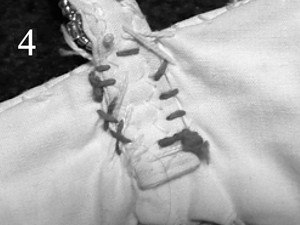
  3. The straps – Breasts should be perky, not hang down to the waist like cow udders. They should form a shelf, that ideally you can rest a cane or a sword on. Pull up the straps at the shoulders until you get the desired height. Measure the excess. Open the back lining and strap attachment and re-sew it to take up the slack (with heavy button thread – #4). If you are going to resell the costume, fold up the excess and use the same color thread to sew it under. Otherwise just cut it off (I took the short cut). It is more comfortable if you adjust a strap equally front and back, but most costumes have beading on the front seam that can’t be touched.
  4. The stuffing – This is the fun part! In my experience, most newbie dancers do not pad their bras enough, if at all. This leads to cup-gap, where the breast separates from the top of the cup and gives audiences far more for their money than they expected – nipple flash. Or worse, the breast bounces out of the cup entirely for a Janet Jackson photo op. Shimmies and backbends are notorious “oops” moments. Many professionals use two-sided tape to prevent such embarrassing faux-pas. Did you know that dancers with D cups and above pad their costumes, too? It gives them a nice rise to the top of the breast and an even cleavage. So, whether you have an A cup or G cup, grab your stitch-ripper, thread and cotton and let’s get started.


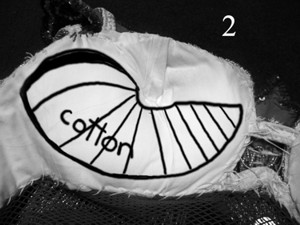
I have included pictures of a Madame Abla costume that I stuffed in the 1980s. I know, times have changed, materials too. But the principle of where to place padding remains the same. It goes underneath the breast for lift and along the wire under the arm for cleavage. The point (nipple – #1) is sewn to keep the padding from shifting. Carefully open the lining seam of each cup under the arm. Gently push the cotton to position it according to the diagram (#2). Leave a “shelf” without padding on the upper inner section of each cup (#3). That is where your breast tissue will rest. Adjust the amount of padding until it feels comfortable, then sew the lining back up.

There are other ways to create beautiful cleavage. I have had students who pinned pads to the cups, to remove them later for washing or to sell the costume. If you sweat profusely, this may be the way to go. I have seen others stuff bras with handkerchiefs, socks and even toilet paper in a pinch. This is NOT the way to go. What happens when they fall out during a performance? A skit worthy of Saturday Night Live. Besides, makeshift solutions never give as good a profile as padding sewn to fit. Nowadays, the upper-end designers use pre-fabricated synthetic cup enhancers, which are lovely if you are comfortable sweating in nylon. But for those who can not abide swimming in their own unabsorbed perspiration, stuffing with cotton is the way to go. No matter what you chose to do however, do something. A snug fitting bra is essential for a professional presentation. Besides, who wants the audience to think her tits look like manure?


use the comment box

Have a comment? Use or comment section at the bottom of this page orSend us a letter!
Check the "Letters to the Editor" for other possible viewpoints!

Ready for more?

  • Shoo Shoo Amin, A Forgotten Treasure of the 80s
    Twenty years ago when I told people I had worked with Shoo Shoo Amin in Cairo, the response was “Wow!” Now, people go “Who?” Today no one seems to know who she is. For belly dance purists, this is a tragedy. Every so often, someone my age or older will wax lyrical about her on-line, but for the most part, she’s an enigma – even to young Egyptians.
  • 3-30-10 Be Your Own Design Diva, Costume Bra Alteration: How-To Change Halter to Conventional Straps by Davina
    However, the halter styling of the bra had straps that were far too short to fit around her neck limiting her ability to lift her arms over her head.
  • Sex, Belly Dance and the Afterlife
    To these people, sex was not dirty, shameful, frightening or forbidden. It was a natural part of daily life and the essential prerequisite for birth – on earth or in the Afterlife.
  • Making Wise
    Choices in the Belly-Dance Wear Market-place
    by Susan Good
    So
    how does one find a good costume amongst all the piles on vendors tables,
    amongst all the .jpg files on-line?
  • Ahlan Wa Sahlan 2008, Not So Welcoming this Year
    Prices have gone up everywhere, and Egypt is no exception. The reality hit me as soon as I walked into the Mena House. Bottled water was $4.00, where out in the street the same bottle was $.50. A bottle of beer was $10.00. Internet connection was $30.00 / hour. At those prices, life’s little pleasures didn’t seem important anymore.
  • 1-25-07 One Banat: An Exploration of Some Belly Dance Costuming Origins by Tasha Banat
    Since the establishment of Israel, the definition of the term “Middle East” seems to have changed and now has come to refer to a conglomeration of a number of unrelated countries in the Asian and African parts of the hemisphere.
  • To Buy or Not to Buy – A Guide to Mass Market Belly Dance Instructional DVDs
    Most producers ask or hire others to write glowing reviews. You will often see the same people reviewing a producer’s entire line of product. Those are suspect. Look for the one-off comments. They will give a better overview, along with anything less than 5 stars.
  • 5-10-10 IBCC 2010, Wednesday April 21, Opening Gala Report From The International Bellydance Conference of Canada by Gilded Serpent Staff
    Because Gilded Serpent didn’t quite make it to the hall until the show was over, we are very grateful that
    Brigid Kelly consented to give us her report from the Wednesday evening performancec. The dance photos overlayed on this video are by Samira Hafezi.
  • 5-6-10 Queen of Denial, A Tale about Life and Belly Dancing, Part 1: The Safety of the Stage by Rebaba or Rita Alderucci
    For many years, the most secure and safe place for me was on stage–dancing and acting. Performing gave me the security and love for which I yearned (both with and without drugs).
  • 5-5-10 Bellydance in Utero by Keti Sharif
    When pregnant, I practiced Belly dance moves each day in preparation for giving birth, mainly focusing on the circular, soothing and stretching movements but avoiding shimmies and moves that were contra-indicated by midwives and sports professionals.
  • 5-3-10 A Very British Kind of Bellydance by Charlotte Desorgher
    This incongruity is something that characterizes the English bellydance scene. Many of our festivals are held in historic sites, such as castles or ancient towns, and we are used to the surprising sound of Arabic music floating across an English lawn.
  • 5-2-10 IBCC 2010, Thursday Activities Report From The International Bellydance Conference of Canada by Gilded Serpent Staff
    We begin our video reports with the Thursday Activities: dance workshops by Amel Tafsout, Sema Yildiz, Delilah, and Aurora Ongaro lectures on The Anatomy of Bellydance, Dr Sawa on Rhythmic Notation for Bellydancers, Shira on Mass Media, Mass Stereotypes and a Panel on Feminism & BD led by Andrea Deagon,