Gilded Serpent presents...

Serena Wilson (1933-2007)

A Student of Ruth St. Denis
Part 3:Serena’s Books
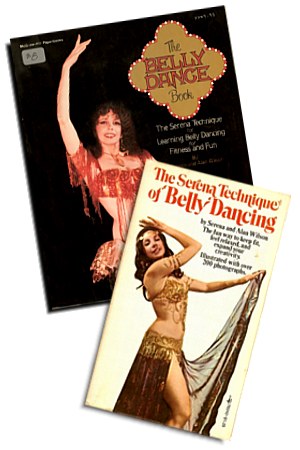
Serena's books

by Barbara Sellers-Young PhD
posted March 16, 2010
Part 1 can be read here
Part 2 can be read here

Serena Wilson, a member of the first generation of New York’s belly dance teachers, died on June 17, 2007. Current and former students immediately eulogized her on youtube.com with images of her dancing in a Greek temple and on the Egyptian pyramids. This essay looks at her life in relationship to the evolution of oriental dancing in the early part of the century from the stages of Vaudeville and the Salome Craze to the impact of the dance metaphysics of Ruth St. Denis. As such, it provides a glimpse into how one of the pioneers of bellydance in the United States combined the various influences in her life to evolve her version of the feminine through the vocabulary of bellydance.

The Serena Technique of Belly Dancing and The Belly Dance Book (9)
Now we have another page in the history of dance with the Serena technique: blending the old with the new; searching for the natural and ultimate truth of woman. But this is where we come in….now it’s your turn to write some history! (Serena Wilson, 1972, 20) 

See the GS Resource List of Bellydance books published in the 1970s & 80s

In 1972, the same year that Ms. magazine first appeared on the stands, Serena, with her husband Alan Wilson, made one of the first attempts to systematize the movement vocabulary of belly dance in the The Serena Technique of Belly Dancing.(10)  

The introduction to the book clearly defines Serena’s position:

"I have chosen dance as my way to self-expression because it represents the qualities of poise, grace, stamina, femininity, and an enormous challenge to free creativity. When I say free creativity, I mean that the movements are natural to a woman rather than distorted and artificial as they are in ballet. The technique I have created is mine, just as Shakespeare’s plays are his. Words were in existence long before Shakespeare used them, but what he created was new. Women danced belly dance thousands of years before I came along, but what I have done with the steps is new. Actually my dance shouldn’t be called belly dance at all, but it is a version of it, and since the term is so well known, I’ll let it stand….at least for a while". (1972, 3-4)

With the publication of her technique, Serena approached questions regarding a woman’s role in society and related sexual expression that had become part of the national discourse. In this national discussion there were a range of opinions, expressed most succinctly by two east coast women, Helen Gurley Brown and Betty Frieden. Helen Gurley Brown’s 1963 publication Sex and the Single Girl provided advice on the art of being a woman and how women could fill their lives with romance and delectable men. Betty Frieden’s The Feminine Mystique was also published in 1963 and approached women’s politics from a completely different angle. Frieden, who would found the National Organization of Woman in 1966, shared in her manuscript the results of a questionnaire she had distributed to her 1942 Smith College graduating class. The women’s responses indicated that they were dissatisfied with a position in society in which their primary identity and meaning was through their role as wife and mother. In combination, these two books brought to public attention a series of questions, including: 

What was the private and public role of an intelligent, competent, capable woman? How did she negotiate an identity that allowed her to express her sensual side? Or to engage in sexual activity? How did a potential new image of herself as a woman integrate with a public conception of wife and mother?

Serena Wilson, with the publication of The Serena Technique of Belly Dancing, was fashioning a performative space which attempted to play between the separate articulations of the feminine offered by Brown and the Frieden. A woman could express her sensuality, but still embody a very traditional notion of the feminine.

Essentially, she used the Orientalist trope of the dance as a representation of the feminine in order to evolve a technique that physically embodied her concept of femininity, of which the three major attributes were poise, grace and stamina.

In her book Serena did not negate the popular conception of the dance as sexually simulating to men. In fact, she advocates in the introduction of the book that the dance is not an arousal for men, but is alternatively an individual experience of a woman’s sexuality through her demeanor of femininity which by its presentation would be attractive to men. Or as she states it, “A woman who is capable of arousing herself is also attractive and arousing to men as an entire being rather than just as a sexual toy” . Her feminine beauty is holistically defined according to Serena by her “control and grace”; a state which is not limited by age because “an active, interested, enthusiastic, flexible woman is young” . This embrace of the body’s femininity through the dance contributes to the overall well being of the participant’s physical and emotional well being and positively influences important aspects of her life associated with childbirth and marriage.

Consequently, Serena argues for the dance’s position within the life of a woman to create an identity that can maintain personal health and familial relationships, while still providing opportunities for creative and sensual expressiveness.
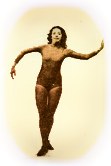
Serena does Snake ArmsSerena provides a detailed example of how a woman balances all aspects of her self in the instructional segment of the book. It is divided into how to warm-up the body, those steps that are in the beginner, intermediate and advanced categories followed by a short choreography for each which are labeled routines. The student is encouraged to learn the movements in front of a mirror, in order to observe whether or not they are performing the movement in a manner that combines “a state of tension” with an attitude of relaxation; and to be certain that “movements are never jerky or sudden”. Beyond this, each section (referred to as a step, of which there are 85 illustrated steps in all) is designated as an appropriate exercise for specific body types (that have been identified in the “How to use this book” chapter) as: 1) Normal, 2) Riding Breeches Type, 3) Shoulder and Breast Bigness, 4) Belly and Thigh Bigness, 5) Large Extremities, and 6) Juvenile. For example, Step 18–Parallel Arm Circle is designated as especially good for body types 3, 5, and 6. Performed to slow music step 18 integrates a gesture of the arms with a flexion and extension of the spine. Step 22 or Turkish Arm Pose focuses on the isometric use of arms in a palms together gesture above the head which is supposed to be good for body types 3 and 6. Those with body type 4, belly and thigh bigness are encouraged to focus on steps such as step 23 Hip Extension and step 25 Hip Circle.

For those readers wanting to focus specifically on steps related to their body type, there is an appendix at the end of the book that outlines the steps for each body type. Serena’s goal for the reader is for them to develop a body that is toned and capable of sensual expression.
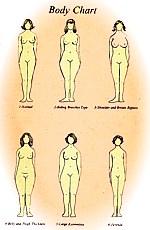
Serena's Body ChartThe book contains detailed photos of Serena performing each of the 85 steps. The names of the steps suggest Serena’s interweaving of movements she learned while working in restaurants and nightclubs with those that were part of her previous dance background or borrowed from Hollywood films. For instance, the basic posture is a variation of a ballet stance of shoulders down, chest arched, and knees slightly flexed with feet slightly turned out. Step number 43, Basic Kashlimar in 9/8 time is an evolution of a Turkish couple dance. The Hindoo Arm of step number 35 is adapted from Hollywood choreographer Jack Cole. Other steps have names that would identify them with a region such as Anatolia or with an image of North Africa and the Middle East, as in the Camel, Arabic Coffee Mill, Oasis, or Hubble Bubble. Those steps not otherwise designated by dance style or image are named for the part of the body’s anatomy engaged in the movement–Hip Roll with Walk, Hip Circle, Belly Flutter, Hip Twist, etc. The steps gain in complexity as the reader moves from the beginning to intermediate and advanced, with several variations and combinations added. At the same time, readers are reminded that the dance is an opportunity for them to use the movement vocabulary as a basis to create a unique expression of themselves.

The dance direction Serena provides in The Serena Technique of Belly Dancing is similar to the directions she gave when teaching class. She advised students in a beginning class that the “dance is not difficult, what is difficult is the postural basis of the dance.”(11) With each new movement she coached students to “maintain the rib cage high, keep the knees relaxed, and allow the energy to shoot through the finger tips to allow for beautiful hands and beautiful wrists.”(12). Intermediate students studying how to manipulate a three yard length of cloth referred to as a veil were reminded to “keep the arms nice and high in order to maintain a beautiful posture.”(13) In an advanced class in which the class was observing videos of Egyptian dancer Fifi Abdou, Serena pointed out to the students that Fifi’s sassiness interacted with her overall demeanor of soft femininity.

The intermediate and advanced chapters end with a sample routine or choreography that lists a set of steps for the student.

The advanced chapter also includes a witty ‘No-No List’ of what not to do when performing. For example, a dancer is not to tilt the pelvis toward the audience either in a standing or kneeling position as this is the vocabulary of a stripper.

Unless the performer wants to be considered as performing the Cecil B. De Mille version of the dance they should never lift their leg above the waist. Stroking the body is considered not only vulgar but also an indication they have the personality of a narcissist. The dancer who rolls around on the floor appears more like a carpet sweeper than a dancer. Jerky arms that move quickly up and down are great for hailing a taxi, but have no place on the dance floor. And there is the Hollywood Sphynx who performs with “one hand under the nose pointing forward, the other hand at hip level pointing to the rear, with knees bent. Usually combined with a slow walk and a smouldering expression of the eye” .

Serena also gives information on how to make a costume and how to organize and stage a performance. This advice is pivotal for the student, as all students are expected to perform either at small informal events which take place in the studio or at events held in the community at local restaurants and other venues.

These events attended by other students (friends of the student with an audience primarily of women) were an opportunity for a woman to demonstrate her ability to perform the technique and thus demonstrate her creation of a new form of femininity that was in most cases in opposition to the one in which she was inculcated as a child.

Through repetition, Serena taught in the book and the studio what I refer to as the ‘postures of the feminine’. These postures acknowledge the sensuality of the female body through the interplay of hips and torso graciously integrated with head, arms and hands. Serena’s ‘postures of the feminine’ did not include movements that obviously highlighted the pelvis or breasts or brought the audience into visual view of the dancer’s crotch, as does the leg lifted over the head. Serena expands upon the idea of posture in her second book published in 1984 and titled simply The Belly Dance Book. In this book she devotes the entirety of Chapter Fourteen to “Poses and Props.” The women pictured in the chapter provide an extended glimpse into definitions of femininity as they lift a hip with one hand behind the head and other on the hip, kneel with one hand lifted over the head and the other on the hip, reach upward with the arms as they gaze upward, hold cane with one hip lifted, balance candles and swords on their heads, hold one or more snakes on their arms and torsos, sweep a fabric over their body and through the space that surrounds them, and finally holding a feathered fan around the back of hips, turn to face the audience. The poses are reminiscent of the Hollywood films Serena references as part of Chapter Two, “History.”  In each case, feminine presence is to bring pleasure to her male partner–because of the dancer’s acknowledged sensuality–but does not spatially challenge him through inappropriate or physically aggressive behavior.
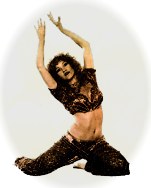
La Donn Amato  models moves in Serena's second bookIn this regard, Serena was teaching through the ‘postures of the feminine’ a form of gender display which Judith Butler in Bodies that Matter (1993) locates in her theory of performativity; in particular the aspect of learning a dance form which requires constant repetition or what Butler refers to as iterability. For Butler performativity and repetition, or iterability, are intertwined as it is repetition of an act which ultimately defines subjectivity. As she phrases it, “this repetition is not performed by a subject; this repetition is what enables a subject and constitutes the temporal condition for the subject. This iterability implies that ‘performance’ is not a singular ‘act’ or event, but a ritualized production”. Students came to the studio with one set of gender displays learned as a child in a socialization process that Pierre Bourdieu would refer to as habitus (1980). Serena’s technique challenged and reoriented their notion of the feminine and provided opportunities to perform their new “postures of the feminine” borrowed from Hollywood images in the safety of a community of women in the studio and in the more public environment of restaurants and New York stages.

Serena’s approach saw women as joyful, soft, and feminine. They were responsible for and in control of their sensuality and by extension their sexuality. The dancers were not encouraged to challenge men by their physical presence, but neither was their physical presence and personal desire controlled by men.

The control remained with the dancer and in her dancing the revelation of desire. It might be observed by men, but was not created by their gaze. This is a subtle distinction that was articulated with the gender politics of the 1970s by Judy Alves-Masters 1979 research Changing Self-Esteem of Women Through Middle Eastern Dance. Her research demonstrated that the dance gave women permission to be powerful sensual beings in public as well as private spaces, and, by extension in positions of public power. As a result, dancers often describe their experience of learning the dance as transformative.

Within Serena’s approach, there was no place or space for the male dancer. Belly dancing was a representation of the feminine and male dancers were by definition male and could not represent the feminine. The movement vocabulary and the aesthetic of the dance did not permit it. Besides which, Serena’s history of the dance as outlined in the Serena Technique of Belly Dancing and the Belly Dance Book moves from the functional dances of fertility associated with tribal groups, to the street versions of the 1893 Chicago World’s Faire, to visions of the Orient of St. Denis, and the revisionist performances of Casino Opera House in Cairo, Egypt. The male dancers spoken of by Edward Lane (1973) and Metin And (1996) in their descriptions of the dances of Egypt and Turkey are erased in Serena’s version as are the performances of Mohammed the male dancer of the Chicago Faire (Carlton, 1994). Serena’s historical rendition is indicative of the history of the dance in New York City. The Orient was feminine and the dancers, whether they were on Coney Island, on Broadway or the Greek Clubs of 8th Avenue, were creating representations of the feminine.  

Within her history of belly dance, Serena references not only Ruth St. Denis, but also her contemporary Isadora Duncan. She indicates that neither dancer had much regard for ballet. She quotes Duncan as saying:

"Those who enjoy it [ballet] see no farther than the skirts and tricots, but look under the skirts, under the tricots are dancing deformed muscles. Look still further; underneath the muscles are deformed bones. A deformed skeleton is dancing before you. This deformation through incorrect dress and incorrect movement is the result of the learning necessary to the ballet. The ballet condemns itself by enforcing the deformation of the beautiful woman’s body. No historical, no choreographic reasons can prevail against that!" (Wilson, 1972, 19) 

Serena follows this quote with reference to both dancers as preaching “the naturalness, healthful benefits, the creative expression, the femininity,

Serena’s placement of St. Denis and Duncan as Oriental dancers within the history of belly dance is an attempt to connect belly dance’s evolution in the United States with the history of modern dance.

This is not a statement dance scholars have made, or would make, as Duncan’s and St. Denis’s legacy is continued through the Isadora Duncan Dance Foundation and former Denishawn dancers, Martha Graham, Doris Humphrey, Charles Weidman and the dancers trained by each of them. The distinction between Serena as an interpretative belly dancer and the legacy of Ruth St. Denis was alluded to by St Denis in her statement, “My final art is impersonal, for when I dance I am really an abstraction, a creature set apart from time and space, unrelated to human things in the ordinary sense. I feel a certain limitless state of being, a curious unending movement not only of my dance, but of my very being” (242). Serena identifies herself with the freedom of the female body ascribed to by Duncan and St. Denis, but does not conceive of herself as an abstraction. Instead, Serena’s aim is to revise an interpretation of the feminine for women who had just discovered the freedom of the birth control pill. For women searching for a new definition of femininity, Serena provided it and through publications such as The Serena Technique of Belly Dancing that ultimately reached beyond New York City to women throughout the United States.

End Notes:

9. Serena and Alan Wilson collaborated with three books, Serena Technique of Belly dance (1972),  The Belly Dance Book (1983); and The Legacy of Little Egypt: A History of the Belly Dance in America (1994).
10. Other ‘how to’ books on belly dance written in the early 1970s were Sula and Roman Balladine’s The Secrets of Belly Dancing, California: Celestial Press, 1972; Julie Russo and Marta Schill’s The Compleat Belly Dancer, New York: Doubledaly, 1973; and Dahlena’s Art of Belly Dancing, New York: Bantam Press, 1975.
11. From class observation May, 2000.
12. Ibid.
13. Ibid.

Coming soon!– Alan (Rip) Wilson’s additional notes regarding this 3 part article by Barbara.use the comment box

Have a comment? Use or comment section at the bottom of this page or Send us a letter!
Check the "Letters to the Editor" for other possible viewpoints!

Ready for more?

  • Serena Wilson (1933-2007) A Student of Ruth St. Denis, Part 1: Childhood
    Serene Blake was born in the Bronx on Aug. 8, 1933 into a Vaudeville family of performers called Blake & Blake. Her mother sang and her father played the banjo. Her childhood and adolescent years intersected with the Vaudeville stage, on which she often appeared with her parents in the 1930s.
  • Serena Wilson (1933-2007) A Student of Ruth St Denis, Part 2: Salome and Her Impact
    When suited to the context, she also had no hesitation in using the term belly dance as she considered the dance as evolving as an Americanized version based on primarily Middle Eastern as opposed to North African influences.
  • The Bellybutton Revolution, Feminism & Bellydance
    When I grew up and became a bellydancer, needless to say, my Mom was perplexed and wondered where she had gone wrong..
  • Tamalyn Dallal’s DVD- 40 Days and 1001 Nights
    Thus, the film did expand my visual awareness. Now, did it deepen or extend my understanding of what that diversity implied? My response would have to be no.
  • Scott Wilson’s CD "Efendi"
    Scott’s quest is to make Mid-East music more accessible to American audiences…
  • Scott Wilson’s CD “An American in Istanbul”
    The entire CD is laced with instrumental solos featuring each artist, many of whom are from the Mid-East, most notably George Strathos on clarinet, plus Rip Wilson, Scott’s darabuka-playing Dad.
  • A Trade Like Any Other: Female Singers and Dancers in Egypt,
    Van Nieuwkerk had as her main objective an examination of the professions of musician and belly dancer in contemporary Egypt and an identification of the influence of these professions on the status of their practitioners, the underlying question being "Are dancers and singers considered disreputable, and if so, for what reasons?"
  • Academics and Belly Dance, Two Books Review
    Belly Dance: Orientalism, Transnationalism & Harem Fantasy edited by Anthony Shay and Barbara Sellers-Young & Choreographic Politics: State Folk Dance Companies, Representation, and Power by Anthony Shay
  • A Book Review: Iris Stewarts’s "Sacred Woman, Sacred Dance"
    For years, I’ve used dance and movement to commune with the Divine.
  • Creating Camp Negum
    The idea came to us as we laid on the beach at Ras Sidr, a resort town near Suez on the west coast of the Sinai Peninsula. It was one of those rare times when my husband, Safaa Farid, and I could slip away from work for two days. We were watching the wind surfers and listening to Om Kalthoum on the clubhouse speakers when the question just popped out.
  • Ask Yasmina #12: The Importance of Oum Kalthoum, Undercutting, and Kid Bellydancers
    When a client hiring a performer or a student looking for a teacher is at a point where they want quality, they know they have to pay a fair price.
  • A Sense of Humor: It can Help! Quest for Beauty, Part 3
    What follows here are several humorous anecdotes. Some of them are about being a male in a female dominated field while some are merely about being a Bellydancer in the first place. My first rule concerning being weird ("weird" as evidenced by some reactions to my previous articles) is to have a good sense of humor!
  • Latest Craze- Egyptian Oriental Dance, The Fitness Benefits of Our Dance
    This is a fabulous idea, except for the very important and primary fact that the majority of efforts in this direction have attempted to fit this archetype of feminine activity into the current prevailing masculine model of linear strengthening and tightening, complete with fitness speak, crunches, squats and sweat!
  • Life as a Bellydancer: A Dancer’s Dilema
    Next came my surprising reality check. It stung me pitifully when I was introduced at my family reunion as "Evelyn’s daughter, the Kootch dancer"! I still thought of myself as a graduate student, learning fascinating things about ethnic studies and folklore.
 

Gilded Serpent presents...

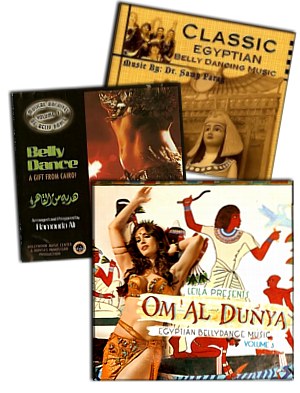
A Look at Three Different Classical Egyptian CDs

# Cds reviewed by Taaj

Leila’s "Om Al Dunya",
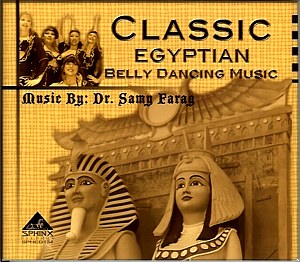
Samy Farag’s "Classic Egyptian Belly Dancing Music",
Hamoudi Ali’s "A Gift from Cairo",

reviewed by Taaj
posted December 12, 2009

Classical Egyptian music and dance style have been around for decades. This is both positive and negative for dancers looking for music in this style. On one hand, there is a lot to choose from. On the other hand, it’s so easy to locate the best known pieces by the best known artists that it is hard to find something new and inspiring. Here is a look at three very different CDs that may narrow down your choices a bit.

Leila's Om Al DunyaLeila Presents Om Al Dunya Egyptian Belly Dance Music Volume 3

I love Classical Egyptian belly dance music. I think it gives the dancer the most soulful opportunity for expression. It reminds me of Egypt. It can be an emotional journey for the audience. So why wasn’t I blown away by this truly classical collection of music? I really wanted to be.

The opening overture was a great way to begin, but it leads up to something and then stops. I don’t think that it’s versatile enough to just tack on to your own music and keep going. It has it’s own sound and begs to be followed up with something with the same feel.

Most of the music is fine, but when you are looking for something to dance to, you don’t just want “fine.” You want something that is going to move you. Most of the songs sound like you are at a wedding and the band is tired after doing its second gig of the day. There is not much inspiring here.

The CD has some stand out cuts that make it a worthwhile buy for me.

Track 5 is a medley of Al Eine Moonayity and Dari ya Dar. Al Eine Moonayity is an old song that has been redone here of course, but this is a lively version that fades into a cute drum solo and then into the second song that is a complete let down. I’d use the three minute version of Al Eine Moonayity and cut it where the short drum solo fades.

The other piece that makes this CD a keeper is the 3 minute drum solo.

It sounds as if it was created for dancers.

It is fun with none of the strange little hiccups that some drum solos contain that can jam a dancer up. It’s got good variety and gives the dancer ample opportunity to show her stuff.

All in all Om Al Dunya is a decent CD. There is nothing bad about it. You just probably already have at least 10 other CDs that sound just like it. I rarely find anything that has more than a song or two that I really like however,

so for me, it is a winner.

Rating-2 zils
Rating- 2 zils


Dr Farag CdClassic Egyptian Belly Dancing Music by Dr Samy Farag

When I get a new CD by an artist that I am already familiar with and like, I hope that the new one will be a blend of the old things I love and new things that inspire me to keep me interested. This CD wildly exceeds my dreams in both those departments.

I tend to dislike techno-y versions of Classical music, but Dr. Samy expertly weaves elements of modern electronics into classical pieces in ways that actually work well! The electronics enhance the music instead of overwhelming it. The musicality and emotion are intact, so you can be driven by an upbeat rhythm and be expressive at the same time. I think this is a wonderful blend for new dancers coming into the dance as well as established old timers like me who enjoy the classics.

My absolute favorite is Hungarian Dance, which is a remake of Brahm’s Hungarian Dance No. 5. Oh, my God does Dr. Samy show off his depth of passion and creativity in this one!

If you are a ballerina looking for a good fusion piece, this is it!

It opens with a haunting ney overlayed on top of a funky bass beat that doesn’t hint at the romantic familiar tune that follows. The blend of piano, voice, electronics, and Middle Eastern touches are sheer genius. Dr. Samy has taken fusion to a new height that I can’t imagine will be soon eclipsed.

Danza Mora (Malguena) is another example of incredible fusion. This piece sounds like nothing I have ever heard before. It is dreamy, passionate and filled with tension of longing. Dr. Samy squeezes every ounce of emotion out of every note, choosing each accent and instrument for maximum effectiveness. The end result is pure pleasure. What an awesome reproduction of this song.

Track ten is a waltz! Can you imagine a belly dance waltz?! I never would have thought it possible, but Dr. Samy pulls it off.

Ballroom dancers looking for a new twist to add to their repertoire now have a song that is made just for them. To top it all off Dr. Samy gives us a drum solo. It’s not a new one. It’s recycled from another CD,

but after everything else he’s delivered, who cares? You probably already have it anyway. If you don’t, you should because it’s a good one.

I have to tell you that I am enraptured with this CD.

There is probably nothing on it that I would ever dance to,

but I could listen to it over and over and continue to marvel at the inventive interplay of old and new, eastern and western. If you are prone to experimentation, you must have this! It is brilliant.

Rating-4 zils
Rating- 4 zils

A Gift from CairoBelly Dance- A Gift from Cairo arranged and prepared by Hamouda Ali

Hollywood Music Center puts out a TON of music. Belly dancers around the world are lucky to have them; however, this one is not one of their shining stars. There is nothing “bad” about it, but is sounds formulaic and familiar. I think some of these songs are on their other CDs. Nothing jumps out as sounding fresh. Nothing inspires me to get up and dance NOW. However, “formulaic’ for Hollywood Music is still a cut above an untried stab in the dark.

They put out a quality product. As far as song selection goes, it has a lot of songs on it that every dancer should know.

It just doesn’t compare favorably to their other products or other CDs out there.

Rating 2 zils
Rating 2 zils.

John Keats once said, “A thing of beauty is a joy forever.” So it is with Classical belly dance music. There are pieces that have always and will always move you, no matter how you change or times change. Those are the timeless benchmarks that other artists have to measure up to.  The bar is high which makes buying a new, impressive CD in this genre difficult. There are treasures here and there, so I wouldn’t give up looking. The two above are fine if you haven’t yet found those treasures. Dr. Samy’s is great is you are looking for something with classical foundations yet is outside of the box.


Have a comment? Use or comment section at the bottom of this page or Send us a letter!
Check the "Letters to the Editor" for other possible viewpoints!

Ready for more?

  • Improving Breathing for Better Dance Performance
    We also hold our breath when we concentrate or get nervous. This brings tension into our bodies. The more tension we have, the more shallow we breathe. It can become a vicious circle!
  • It’s Not Me; it’s You: Toxic People and What to do About Them
    The problem is, sometimes it’s hard for a reasonable person to tell if she or he is under attack by a toxic person who intends harm.
  • 3-12-10 Creating Camp Negum by Leila of Cairo
    The idea came to us as we laid on the beach at Ras Sidr, a resort town near Suez on the west coast of the Sinai Peninsula. It was one of those rare times when my husband, Safaa Farid, and I could slip away from work for two days. We were watching the wind surfers and listening to Om Kalthoum on the clubhouse speakers when the question just popped out.
  • 3-10-10 Ask Yasmina #12: The Importance of Oum Kalthoum, Undercutting, and Kid Bellydancers by Yasmina Ramzy
    When a client hiring a performer or a student looking for a teacher is at a point where they want quality, they know they have to pay a fair price.
  • 3-3-10 A Sense of Humor: It can Help! Quest for Beauty, Part 3 by Zorba
    What follows here are several humorous anecdotes. Some of them are about being a male in a female dominated field while some are merely about being a Bellydancer in the first place. My first rule concerning being weird ("weird" as evidenced by some reactions to my previous articles) is to have a good sense of humor!
  • 3-2-10 Latest Craze- Egyptian Oriental Dance, The Fitness Benefits of Our Dance by Hadia
    This is a fabulous idea, except for the very important and primary fact that the majority of efforts in this direction have attempted to fit this archetype of feminine activity into the current prevailing masculine model of linear strengthening and tightening, complete with fitness speak, crunches, squats and sweat!
  • 2-26-10 Life as a Bellydancer: A Dancer’s Dilema by Najia Marlyz
    Next came my surprising reality check. It stung me pitifully when I was introduced at my family reunion as "Evelyn’s daughter, the Kootch dancer"! I still thought of myself as a graduate student, learning fascinating things about ethnic studies and folklore.
  • 2-17-10 Shimmying on the Shores of Paradise, The Dancers of the Dominican Republic by Sylvia Richards
    White sands and turquoise waters come to mind when most picture the Dominican Republic, but the Caribbean paradise offers visitors far more than its natural beauty. It may come as a surprise that the small tropical country most known for its pristine beaches and Caribbean hospitality also has a vibrant and thriving belly dancing scene.
 

Gilded Serpent presents...

Creating Camp Negum

MapDahab

by Leila of Cairo
posted March 12, 2010

The idea came to us as we laid on the beach at Ras Sidr, a resort town near Suez on the west coast of the Sinai Peninsula. It was one of those rare times when my husband, Safaa Farid, and I could slip away from work for two days. We were watching the wind surfers and listening to Om Kalthoum on the clubhouse speakers when the question just popped out.

“Wouldn’t this be a great place for a dance event?” We had tossed around the vague idea of a live music festival for dancers before, but this was concrete. Belly dancing to live music on a Red Sea beach – sounded like fun to me.

We took things slowly. With the help of our violinist friend, George, who now owns a travel agency, we discovered all the reasons why the Sinai Penninsula, and Dahab in particular, was the perfect place to hold an Egyptian music and dance camp. As we researched hotels (a great excuse to go to the beach) it became obvious that Ras Sidr is known for wind surfing but not much else. I loved its unspoiled coastline and proximity to Cairo but, as George pointed out, not everyone likes deserted beaches.

The hotels were nice, but not what I was thinking. I wanted something rustic, like a camp. After I vetoed the fourth hotel, George gave up. “If it’s a camp you want, then you need to go to Dahab.”

Dahab is one of my favorite places on the Red Sea. It is the most laid back of Sinai’s beach resorts. Twenty years ago it was nothing but a few Bedouin tents pitched on the region’s magnificent gold sand (“dahab” is the Arabic word for gold). The only people living there were the Mozzina Bedouins, Israeli soldiers looking for R&R and hard core divers drawn to the region’s world-class dive spots. Just north of the Bedouin settlement of Asilah can be found some of the most pristine conditions and exotic species on the planet (particularly a place called The Blue Hole).

Dahab has grown since the 1980s, but it still retains its Bedouin feel. The Mozzina tribe migrated to the region over 800 years ago. In spite of 4-wheel-drives replacing camels for transportation, these ancient people have maintained many of their traditions – including their music and dances.

Another tribe only an hour away in the mountains is even older. The Jebeliya, who live around Mount Sinai and Saint Catherine’s monastery, are not considered Bedouins, however. They were originally Christian soldiers sent in the sixth century by the Byzantine Emperor Justinian to protect his recently fortified monastery. Once Mohammed and his faith arrived a century later, these Greek and Slavic soldiers adopted Islam, married women from local tribes and created a tribe of their own. These former protectors of the Burning Bush and its well, have guided tourists and pilgrims around the area’s holiest sights since the Crusades.

Bedouine photo by Leila's sisterToday Dahab’s laid back, sixties style atmosphere has something for everyone. Veggie burger and brown rice places sit next to restaurants serving fresh gourmet fish. Most of the town’s businesses line the beach. Camps dot the coastline. They used to be tent villages, but to protect the reefs, they were replaced with permanent structures. Which one to choose? We tried Camp Miami at George’s suggestion. The minute I peered into the turquoise water with my snorkeling gear and saw the most amazing fish swimming in a foot of water, I knew I had come to the right spot. Dancers could persuade their husbands or friends to accompany them if diving, snorkeling or beach time activities were available while they attended class. History, culture, happy significant others and a Bedouin tent on the beach for workshops and evening shows – we had found our venue.

The easiest part of planning the camp was the live music. My husband’s orchestra has played all over the world and for years with the Nile Group Festival. We had also both been involved with Kay Taylor’s Farha Luxor tour, where classes were taught to live music.

That was the atmosphere we wanted for our camp; belly dance classes to live music plus music classes for musicians and dancers. It is rare that dancers can study with a 10 piece Egyptian Orchestra, or have tabla rhythms broken down for them by one of Egypt’s premier drummers.

As we planned the details, we put out feelers to the dance community. An inquiry to events sponsor Karima of Moscow had 30 people respond who wanted to attend. Eshta of Ukraine also received an enthusiastic reply from Eastern European dancers. There was interest from Mexico, Greece and the USA. Ok, we thought, let’s try it!

Leila, Safaa, and YousefThe next step was to choose the teachers. After a few false starts, we decided to bring teachers that were not readily available at the big Egyptian festivals. I asked a good friend, Yasmin of Washington DC (a tireless crusader for Egyptian dance and authentic music) and she suggested Shoo Shoo Amin, a dancer she had worked with in the 1980s. “Who’s that?” I replied. But when I asked Safaa the same question, he sang her praises. “She was a great dancer, but no one has heard from her in 20 years.” Yasmin tracked her down with the help of the Henkish brothers, and she agreed to teach. At the same time, I talked to Sahra Saeeda, who was in Cairo leading a tour. Her experience performing in Egypt plus her amazing research (and the fact she is an incredibly nice person) made her an easy choice. Safaa suggested Rabeh Abu Talab, the long time assistant of Ibrahim Akef (Naima Akef and Fatma Akef ’s brother), who has been training Egyptian dancers for years. Rabeh agreed, as well as Yasmin of DC (who will give several lectures on the history of Egyptian dance and other racier topics). I would teach my favorite classes with live music, Safaa would teach a voice class, Mounir Abdle Aziz and Youssry Hefney would teach tabla and Saeda Lacky would teach sagat. The camp was coming together!

The most difficult part of planning was the website. It seemed to take forever to figure out how to register people over the internet. I hate computer things so maybe it just seemed to take longer. Finally www.campnegum.net was set up with all the information about the teachers, classes, location and registration.

It seems our brainstorm on the beach will become a reality. Camp Negum will be May 4-8, 2010 – 5 days and nights of music and dance classes (14 hours to live music), and an opportunity to perform with an Egyptian orchestra in a Bedouin tent on a golden beach in a biblical part of Egypt. I plan to enjoy every minute of it.

use the comment box

Have a comment? Use or comment section at the bottom of this page or Send us a letter!
Check the "Letters to the Editor" for other possible viewpoints!

Ready for more?

  • Inside Peek at Making Music Videos: Hakim, Khalid Selim, Walid Toufic, Ali el Hagar, Elam, & Samira Said
    I was either crying or yelling at Hakim for most of the shoot and went home each day with a headache from it.
  • 1-27-10 Shoo Shoo Amin, A Forgotten Treasure of the 80s by Yasmin
    Twenty years ago when I told people I had worked with Shoo Shoo Amin in Cairo, the response was “Wow!” Now, people go “Who?” Today no one seems to know who she is. For belly dance purists, this is a tragedy. Every so often, someone my age or older will wax lyrical about her on-line, but for the most part, she’s an enigma – even to young Egyptians.
  • Egyptian Wedding Stories
    All the guests were staring at us. The father of the bride demanded to know who ordered the bellydancer and it seemed a fight was going to break out between representatives of the brides’ family and the hotel organizer.
  • I Dance; You Follow
    As Westerners interested in an Eastern dance form, we might want to ask ourselves if we are missing certain critical aspects of Raqs Sharki because we are not open to Eastern teaching methods.
  • Interview with Safaa Farid
    These days there are times I feel I’ve seen everything an Egyptian dancer can do in the first five minutes of her show. She doesn’t change. But foreigners study the dance very hard and they put much time into their show so that is it interesting for a whole hour.
  • What Middle Eastern Audiences Expect from a Belly Dancer
    Audiences in the Middle East, especially Egyptians, see bellydancing as something to be participated in, critiqued, and loved (or hated) with gusto.
  • 9-17-09 Sex, Belly Dance and the Afterlife by Yasmin Henkesh
    To these people, sex was not dirty, shameful, frightening or forbidden. It was a natural part of daily life and the essential prerequisite for birth – on earth or in the Afterlife.
  • 7-30-08 Ahlan Wa Sahlan 2008, Not So Welcoming this Year by Yasmin
    Prices have gone up everywhere, and Egypt is no exception. The reality hit me as soon as I walked into the Mena House. Bottled water was $4.00, where out in the street the same bottle was $.50. A bottle of beer was $10.00. Internet connection was $30.00 / hour. At those prices, life’s little pleasures didn’t seem important anymore.
  • 3-27-08 To Buy or Not to Buy – A Guide to Mass Market Belly Dance Instructional DVDs by Yasmin
    Most producers ask or hire others to write glowing reviews. You will often see the same people reviewing a producer’s entire line of product. Those are suspect. Look for the one-off comments. They will give a better overview, along with anything less than 5 stars.
  • 3-10-10 Ask Yasmina #12: The Importance of Oum Kalthoum, Undercutting, and Kid Bellydancers by Yasmina Ramzy
    When a client hiring a performer or a student looking for a teacher is at a point where they want quality, they know they have to pay a fair price.
  • 3-3-10 A Sense of Humor: It can Help! Quest for Beauty, Part 3 by Zorba
    What follows here are several humorous anecdotes. Some of them are about being a male in a female dominated field while some are merely about being a Bellydancer in the first place. My first rule concerning being weird ("weird" as evidenced by some reactions to my previous articles) is to have a good sense of humor!
  • 3-2-10 Latest Craze- Egyptian Oriental Dance, The Fitness Benefits of Our Dance by Hadia
    This is a fabulous idea, except for the very important and primary fact that the majority of efforts in this direction have attempted to fit this archetype of feminine activity into the current prevailing masculine model of linear strengthening and tightening, complete with fitness speak, crunches, squats and sweat!
  • 2-26-10 Life as a Bellydancer: A Dancer’s Dilema by Najia Marlyz
    Next came my surprising reality check. It stung me pitifully when I was introduced at my family reunion as "Evelyn’s daughter, the Kootch dancer"! I still thought of myself as a graduate student, learning fascinating things about ethnic studies and folklore.
  • 2-17-10 Shimmying on the Shores of Paradise, The Dancers of the Dominican Republic by Sylvia Richards
    White sands and turquoise waters come to mind when most picture the Dominican Republic, but the Caribbean paradise offers visitors far more than its natural beauty. It may come as a surprise that the small tropical country most known for its pristine beaches and Caribbean hospitality also has a vibrant and thriving belly dancing scene.
 

Gilded Serpent presents...

Ask Yasmina #12

Oum Kalthoum

Importance of Oum Kalthoum, Undercutting, and Kid Bellydancers.

by Yasmina Ramzy
posted March 7, 2010

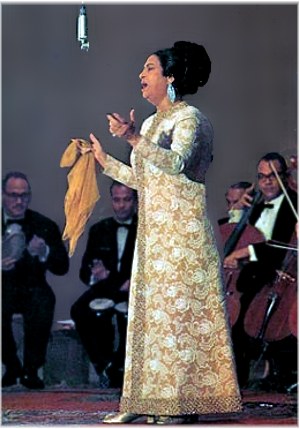
Question #1: Why is Oum Kalthoum so important to Bellydancers?

Answer: Understanding the importance of Oum Kalthoum and her music offers profound insight into Arab culture, poetry, art, nuance and most importantly, the music that Bellydancers dance to. Almost every Bellydance CD on the market includes at least one or two of her songs. You have heard the melodies so often. Below is some information distilled from Wikipedia that sums up her importance musically.

“ Imagine a singer with the virtuosity of Joan Sutherland or Ella Fitzgerald, the public persona of Eleanor Roosevelt and the audience of Elvis and you have Oum Kalthoum, the most accomplished singer of her century in the Arab world. ”
— Virginia Danielson, Harvard Magazine

When the Egyptian singer Oum Kalthoum died in 1975, millions flooded the streets of Cairo in mourning. Her songs deal mostly with the universal themes of love, longing and loss. They are nothing short of epic in scale, with durations measured in hours rather than minutes. Oum Kalthoum has been a significant influence on a number of musicians, both in the Arab World and beyond. Among others, Jah Wobble has claimed her as a significant influence on his work. Bob Dylan has been quoted as saying, "She’s great. She really is. Really great." Jean-Paul Sartre, Marie Laforêt, Salvador Dalí, Nico, Bono, Farin Urlaub, and Led Zeppelin are also known to be admirers of Kalthoum’s music. She was referred to as "The Lady" by Charles de Gaulle, and is regarded as "The Incomparable Voice" by Maria Callas. Oum Kalthoum is remembered in Egypt, the Middle East, and the Arab world as one of the greatest singers and musicians to have ever lived. She is also notably popular in Israel among Jews and Arabs alike, and her records continue to sell about a million copies a year. Even today, she has retained a near-mythical status among young Egyptians.

The movements that Bellydancers express were passed down by Tahia Carioca, Samia Gamal, Sohair Zaki and Dina etc. Whether they are new, old or revamped, all of the movements were created as an emotional reaction to Arab music. The music and poetry of the songs of Oum Kalthoum is the pinnacle of Middle Eastern music. Until one makes the profound connection to her music and finds oneself blissfully lost in one of her hour long songs, one has not really felt or experienced the meaning of the movement. Since her songs speak of unrelenting love, one should also read the story of Majnun and Leila* to understand which is the love she is singing about and the love expressed in our dance.

Please see Ask Yasmina Column #1 for more practical details concerning dancing to the music of Oum Kalthoum.

*Majnun and Leila is the original love story told by word of mouth for generations by Arab Bedouins long before Romeo & Juliette or Tristan & Isolde. It was eventually written down by an Azerbaijani poet in Farsi. So much of Asia, North Africa and the Middle East claim this story their own. Every generation of young lovers relate to this story. It is an intimate part of all of these cultures from Morrocco to China.

Snake Question

Bum TeacherQuestion #2: What is the difference between undercutting and simply sharing the art at accessible rates?

Answer: Undercutting can get a few beads and coins twisted in a knot. There will probably always be those who feel they can close the deal with a cheaper price or those so eager to perform or teach, they will offer their skills for next to nothing which would put into question their actual skills. My philosophy is the following. For the most part, a client gets what they pay for and when someone says they can get another dance artist or teacher for less, this is what I tell them.

When a client hiring a performer or a student looking for a teacher is at a point where they want quality, they know they have to pay a fair price.

When placing a price on your own skills, know that you are charging for your years of training and experience, your expensive costume collection, your time and money spent marketing as well as the 30 minutes or so you will be performing or teaching and the time it takes to prepare. When a client asks for a break on the price because it is for charity, I choose to oblige for free because of the cause or not at all. Lowering the price only diminishes the value and I am all about giving value and respect to our art. It benefits everyone if Bellydancers continue to keep raising the prices, even if ever so slightly in increments. If everyone followed the thinking of the undercutter, we would soon have no value at all. I have always found it interesting that as soon as someone pays a higher price for something, they automaticlly value and appreciate it more whether it is acually worth it or not.

Snake Question

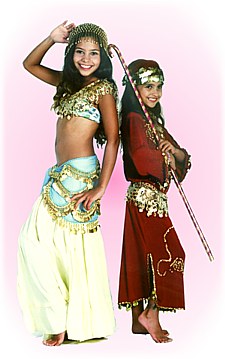
Asha and SophiaQuestion #3: Should children be Bellydancing or is it too sexual?

Answer: I have seen some awesome young dancers at ages from 7 to 13 in many countries in the world. In my own school, most of our young students are from proud Arab families. I love watching all ages dance. Yes, Bellydance is sensual and can be a sexual expression as well, but life is sensual and revolves around sexuality. Sensuality is so beautiful when it comes from a place of respect and honour. Stavros Stavrou, a wonderful Bellydancer and author of "Dancing, Fear and Desire" from Cypress has a great quote in this YouTube clip at the 29 second mark [see sidebar]. He was speaking on a panel called "Straddling Sexual Issues in Bellydance" at the 2008 IBCC.

I think if Bellydance is presented as a cultural folklore or an expression of pure sensuality, it can be a great empowerment tool for young teenage girls struggling with their sexual identity. They learn to own and value their body as a sexual vehicle and thus be less likely to be promiscuous.

Please note that not all Bellydancers whether Arab or not have held true to valuing the art. Some have chosen to undermine its art and beauty with degrading sexual exploitation. Hey, but this happens in many art forms. We just want to keep our children clear of this kind of behaviour whether it is Hip Hop, Lambada*, Jazz or Bellydance.

*Original Brazilian Lambada was a soft flowing dance mimicking the waves of the sea. It wasn’t until it was appropriated by other cultures that it began to take on the pelvic grinding with heavy sexual overtones. – Sound like a familiar story?

use the comment box

Have a comment? Use or comment section at the bottom of this page or Send us a letter!
Check the "Letters to the Editor" for other possible viewpoints!

Ready for more?

  • Sticky Situations: Ask Yasmina #11- Inappropriate Audience Members, Competitive Teachers, Fickle Students by Yasmina Ramzy
    Trying to please and appease those who already disrespect you leads to a miserable dead end. My advice is to say "NO" and give the inappropriately behaved person a good wack across the face.
  • Ask Yasmina #10: Bellydance Business, Finding Musicians, Certification by
    Yasmina Ramzy
    This experience has made me very wary ever since of people with certificates.
  • The Bellybutton Revolution, Feminism & Bellydance by Yasmina Ramzy
    When I grew up and became a bellydancer, needless to say, my Mom was perplexed and wondered where she had gone wrong.
  • Ask Yasmina #9: Teaching Differences, New Troupes, Men in Bellydance by
    Yasmina Ramzy
    As an ensemble becomes larger and more professional, it will find that it is more efficient and effective if it models itself like a professional company with defined roles
  • 5-6-07 How to Charge What You Are Worth by Michelle Joyce
    The first step to becoming an effective negotiator is to emotionally detach yourself from the outcome. If you can’t walk away from the deal, you have already lost.
  • 7-27-05 Calling all professional dancers! How much do you charge? by Nanna Candelaria
    Over the years, we dancers have unwittingly kept the general rate ridiculously low in restaurants and nightclubs
  • Mailbox Missives -Kid Dance
    Is belly dancing a good activity for young girls?
  • 6-27-06 Om Kalthoum, The Voice of Egypt by Yasmin
    She was without contest the most well-known singer of the Arab world. She was also the most influential woman of her time in the Middle East.
  • 3-3-10 A Sense of Humor: It can Help! Quest for Beauty, Part 3 by Zorba
    What follows here are several humorous anecdotes. Some of them are about being a male in a female dominated field while some are merely about being a Bellydancer in the first place. My first rule concerning being weird ("weird" as evidenced by some reactions to my previous articles) is to have a good sense of humor!
  • 3-2-10 Latest Craze- Egyptian Oriental Dance, The Fitness Benefits of Our Dance by Hadia
    This is a fabulous idea, except for the very important and primary fact that the majority of efforts in this direction have attempted to fit this archetype of feminine activity into the current prevailing masculine model of linear strengthening and tightening, complete with fitness speak, crunches, squats and sweat!
  • 2-26-10 Life as a Bellydancer: A Dancer’s Dilema by Najia Marlyz
    Next came my surprising reality check. It stung me pitifully when I was introduced at my family reunion as "Evelyn’s daughter, the Kootch dancer"! I still thought of myself as a graduate student, learning fascinating things about ethnic studies and folklore.
  • 2-17-10 Shimmying on the Shores of Paradise, The Dancers of the Dominican Republic by Sylvia Richards
    White sands and turquoise waters come to mind when most picture the Dominican Republic, but the Caribbean paradise offers visitors far more than its natural beauty. It may come as a surprise that the small tropical country most known for its pristine beaches and Caribbean hospitality also has a vibrant and thriving belly dancing scene.
  • 2-16-10 Digital Dancer! Belly Dancing in Second Life by Caitlin McDonald
    In Second Life, the dancing is done digitally by applying a computer program that causes one’s avatar, the digital representation of the self online, to move in a prescribed manner. Instead of learning movements and needing time to practice them, they are loaded onto the avatar just like Nero learns Kung Fu in the “Matrix” films.
 

Gilded Serpent presents...

A Sense of Humor: It Can Help!

A Quest for Beauty, Part 3

Zorba by Sharif

by Zorba
most photos by Sharif & Richard G Lowe Jr
posted March , 2010
part 1, part 2

I opened the show at a recent performance at Moss Landing’s "Haute Enchilada Restaurant", where I am a house dancer as well as the scheduler. As I danced out with my zills pinging away, a male voice from a nearby table said, "This isn’t what I signed up for!"  I immediately replied in my best stage voice, "The women need something to look at too!"  Laughter ensued throughout the room, saving us all from a possibly sticky situation by a healthy sense of humor. By the way, the man in question later told me that he really enjoyed the show (even me) and thanked us for our performance.

What follows here are several humorous anecdotes. Some of them are about being a male in a female dominated field while some are merely about being a Bellydancer in the first place. My first rule concerning being weird ("weird" as evidenced by some reactions to my previous articles) is to have a good sense of humor!

Zorba in a skirtSkirt Man

A number of years ago, I was in a workshop with the fabulous Alexandra King–a "Gypsy style" workshop featuring a ton of skirt work. Although it was one of the first times, if not the very first time, I’d tried skirt work, apparently Alexandra liked what I was doing because she invited me up to the front of the class to assist her in a demonstration of a combination involving two dancers using skirts. She said. "Don’t worry, I won’t embarrass you!"  In reply, I reached down, lifted and spread my skirt widely and replied, "Do I look like I can be embarrassed?"  Hilarity ensued.

Goose & Gander

When I take a class or workshop with a new teacher, I always try to tell her my philosophy of "teach me just like any other student" so she won’t worry about what to do with me. In a workshop with Nourhan Sharif, I hadn’t had the opportunity before class to speak with her, so at the midway class break, she approached me and apologized for her female-centric language and said that she did not want me to feel left out, etc. Bless her! I put her at ease by telling her that "In this context, I just consider myself an honorary woman; it just makes it easier for everyone. If women often have to deal with male-centric language in many places, I figure I can deal with the inverse. What’s sauce for the goose is sauce for the gander!

The Choreographic Pariah 

Choreography can be a challenge to me. There was one spot in a certain cane choreography that I was always ending up on the wrong foot. The more I thought about it, the more panicked I felt and the worse the situation became.
During one rehearsal, I was thinking to myself, "here it comes!"  Sure enough, I ended up on the wrong foot. The instructor immediately cut the music. "Uh-oh" I thought to myself.
She stalked up to me, looked up at me with her hands on her hips, and became four foot nine of red headed wrath: "Zorba," she started, "we’ve been doing this dance for two years, and you always, always, always, do this movement backwards every single time! It’s–the–right–hip!"

I’d like to be able to say that I never screwed it up again, but I did get significantly better after that–whatever it took to get through to my clumsy male brain!

Zorba by SharifAsleep at the Switch

Once upon a time I was ready to dance a veil number at Monterey’s historic Kalisa’s La Ida Cafe. I was folded up on the stage, veil covering me, waiting for my music to start. Waiting… Waiting… Waiting… No music.  I wondered, "What’s going on? (or not going on?)"  A low murmur started in the audience. Time for some comic relief. I let out a loud, fake snore. Utter silence–but still there was no music. I produced another fake snore, even louder than the first. A titter ran through the audience. I was about to peel my veil back, stick my head out like a turtle’s, and inquire of the sound person something to the effect of "Sometime this week would be nice…" but, just then, the music began, and I danced my veil piece to an audience glowing with smiles!

There’s nothing worse than sound problems – and I’ve had my share of them, many much worse than the one I have just mentioned above. Music suddenly starts doing the herky-jerky? I’ll often herky-jerky along with it. That wins the audience over every time, because you certainly cannot hide the problem. One time, it was so bad that I pantomimed kicking the errant stereo and "shot" it with a thumb-and-finger pistol!

Mr & Mrs Zorba perform

Feral Women 

I’ve had any number of encounters with what I call "feral women" who are the inverse of the creepy guys with whom female Belly Dancers are all too familiar.  My wife isn’t always present to fend them off, so sometimes I find myself in some "interesting" situations. On one such occasion, a dance brother and I were walking out after the conclusion of a show in which we’d both danced. A woman was waiting for us outside, and immediately expressed her admiration for both our dance performances and, let’s just say she was pretty explicit about the effect same had upon her. Thinking fast, I said "Well, today’s just not your day; I’m married, and he’s gay!"

Dance Workout 

I was never the athletic type; as a child, I was a bit of an ugly duckling–clumsy, klutzy, and shy. I was always the one chosen last for "the team", and I detested P.E. classes. So now, as a member of Janelle’s Santa Cruz class, I’m working harder than I ever have in my entire life! "101 Creative Ways to Torture the Bellydance Student" is the title of a book I’m sure she will be announcing that she has had published any day now. "Paramedics standing by at every class!" Several of us enjoy teasing the long-suffering (and humorous) Janelle about her strenuous workout format.

The Bet 

I had just finished dancing with Jamaica Sinclair’s "Troupe Diva"  at a street fair, and I was collecting my veil et al when a member of the local country western band (who were performing following us on the same stage) walked up to me and asked "Did you lose a bet?" "Oh Goddess!" I thought to myself, "I hope my dancing was better than that!" but replied aloud, "No, but I think you just did!"  (I’d noticed him in the audience during the performance, and it was fairly obvious that I was the subject of a discussion.)Zorba in green in Mesmera's class

Some Rejoinders 

How do I handle the rare female detractor who wants to keep me in a narrow "male box"? I handle it with humor of course–but I also drive the point home by adding a rejoinder such as:

  • "If that’s the case, why are you wearing pants?"
  • "Yes, I see that you don’t conform to outdated gender roles yourself."
  • "No, my wife doesn’t confine me to the kitchen."

Overcoming Prejudice 

I have enjoyed overall good acceptance from the members of the general public whom I have encountered. Most of the gals love me, many men accept me as a dancer; but there are the occasional people, mostly men, who are obviously uncomfortable in my presence when I Bellydance. I guess they think if they look at me too much, or I get too close, that they’ll turn gay or something. Whatever! However, I usually find that a humorous rejoinder is the best way to defuse potentially tense situations–and it often helps an insecure male if I "let slip" that I’m married. It is interesting psychology, and I’ve won over quite a few folks with some fast thinking and humor–even some older Middle Eastern men!

use the comment box

Have a comment? Use or comment section at the bottom of this page or Send us a letter!
Check the "Letters to the Editor" for other possible viewpoints!

Ready for more?

  • A Quest for Beauty, Part 1: Beauty is Discovered
    My wife of 17 years asked, "You’re going to do…. what?"when I told her of my desire to take Bellydance lessons.
  • 9-10-09 A Quest for Beauty, Part II: Damn the Torpedoes and Full Speed Ahead! by Zorba
    I recognized that "femininity/masculinity" was an entirely artificial construct, and femininity/masculinity was based on reality, i.e. biology.
  • 3-2-10 Latest Craze- Egyptian Oriental Dance, The Fitness Benefits of Our Dance by Hadia
    This is a fabulous idea, except for the very important and primary fact that the majority of efforts in this direction have attempted to fit this archetype of feminine activity into the current prevailing masculine model of linear strengthening and tightening, complete with fitness speak, crunches, squats and sweat!
  • 2-26-10 Life as a Bellydancer: A Dancer’s Dilema by Najia Marlyz
    Next came my surprising reality check. It stung me pitifully when I was introduced at my family reunion as "Evelyn’s daughter, the Kootch dancer"! I still thought of myself as a graduate student, learning fascinating things about ethnic studies and folklore.

  • 2-17-10 Shimmying on the Shores of Paradise, The Dancers of the Dominican Republic by Sylvia Richards
    White sands and turquoise waters come to mind when most picture the Dominican Republic, but the Caribbean paradise offers visitors far more than its natural beauty. It may come as a surprise that the small tropical country most known for its pristine beaches and Caribbean hospitality also has a vibrant and thriving belly dancing scene.
  • 2-16-10 Digital Dancer! Belly Dancing in Second Life by Caitlin McDonald
    In Second Life, the dancing is done digitally by applying a computer program that causes one’s avatar, the digital representation of the self online, to move in a prescribed manner. Instead of learning movements and needing time to practice them, they are loaded onto the avatar just like Nero learns Kung Fu in the “Matrix” films.
  • 2-16-10 Hot Bellydance Event in Tijuana by Martha Duran
    Leila Farid from Cairo Egypt is a sweetheart! She is what many Mexican dancers aspire to look and dance like. Wow! She is gorgeous and mesmerizing – as well as extremely nice, polite and down to earth! My star struck students were amazed to catch her snacking on Mexican Rancheritos (chips) and eating breakfast like a Mexican, with tortillas! She’s so fit that we couldn’t imagine she snacked on chips tortillas like the rest of us. Her master class was magnificent.
  • 2-11-10 Paul demonstrates the Oud another Musical Instrument Tour
    Paul shows us his instrument, including the tuning he uses, why there are not frets, who his mentors are and the makers of his instrument.
  • 2-9-10 Carl’s Camera Captures Dancers from Z to A, Tatseena’s Fantasy Festival 2009, photos by Carl, introduction by Ma*Shuqa
    This festival was a festive day of good vibrations with dancers sharing their talents on the raised stage, and on the beautiful wood dance floor. The day was replendent with beautiful dancing, beautiful costumes, and wonderful music – with the bands: Al Azifoon and Light Rain. This is a favorite festival for dancers in the East Bay area.
  • 2-3-10 Bellydancer in 21 Days: My Internship with Aunt Delilah by Averill
    I am incredibly fortunate to be a junior at a very nice independent school in Toledo, Ohio. One of the programs they offer is called "Winterim". No one goes to their normal classes for a month; instead, all the students embark on some kind of intensive independent study program.
 

Gilded Serpent presents...

Lastest Craze-Egyptian Oriental Dance!

Hadia's flexible body

The Fitness Benefits of Our Dance

by Hadia
posted March 2010

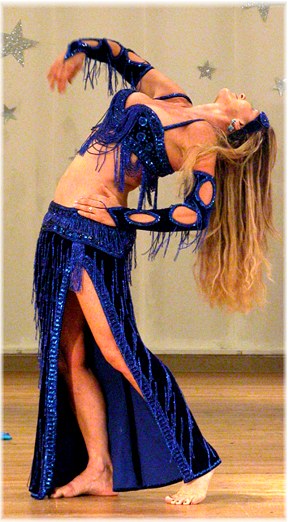
Great news! A brand new fitness trend is about to hit the belly dance market! It includes revolutionary concepts; Fun with a capital F; easy to learn; safe; feels good and IS good for you; trims, tones and sculpts your body into womanly curves. So what is this hottest, latest craze called? Drum roll please… ta daaaah – Egyptian Oriental dance!

The past few years have seen innumerable changes, innovations, inventions and marketing trends imposed upon this ancient art form, most of which bear little, if any resemblance to anything Middle Eastern. One of the more recent and popular trends has been to sell belly dance as a fitness regimen.

This is a fabulous idea, except for the very important and primary fact that the majority of efforts in this direction have attempted to fit this archetype of feminine activity into the current prevailing masculine model of linear strengthening and tightening, complete with fitness speak, crunches, squats and sweat!

Drills replace simply dancing and practicing. Combinations have no relationship to any music –they just exist. Six packs aim to replace a smoothly curved abdomen. Do tight buns and 12 year old boy thighs really need to replace odalisque women’s hips? Should the magic diagonals that make every move and every body lusciously feminine and interesting be replaced by two dimensional step-it-out right, left, front, back? Plus, most contain no aerobic component or teach anything that could possibly make anyone sweat.

So why would anyone want to take all the innate fun and the natural beauty, sensuality and artistry out of our dancing and replace it with dry and boring repetitions of masculine movements? Isn’t that one of the primary reasons why belly dance became so popular in the first place?

Women wanted to get and stay in shape, but also wanted to have fun, be creative and artistic, stay motivated, develop refined and intricate new skills, celebrate the power of their femininity, feel proud of their accomplishments and perhaps even learn about another culture and open doors to a world of possibilities.

So let’s back up a bit and talk about what exactly is fitness? It would appear that there is no clear definition of fitness, other than an individual’s perception of this illusive quality or state.

According to Webster: the state of being fit, which is defined as adapted to the environment so as to be capable of surviving.

According to Wikipedia: These days, physical fitness is considered a measure of the body’s ability to function efficiently and effectively in work and leisure activities, to be healthy, to resist hypokinetic diseases (conditions that occur from a sedentary lifestyle), and to meet emergency situations. There are also references to the physical, mental and emotional fitness triangle with important consideration given to cardiovascular fitness, flexibility, strength, muscular endurance, body composition and skill training relative to age, lifestyle and gender.

Now, I would like to have a quick look at a few of the myriad of feminine fitness benefits of Oriental dance.  Although all types of dancing are physically, mentally and emotionally beneficial in many ways, many can be very physically demanding or even result in injuries. However, if correctly taught and practiced, Egyptian style Oriental dance gently tones the body while being completely safe for all of our joints and muscles. It also improves posture, energy levels, circulation, breathing, digestive, elimination and reproductive systems plus it is almost impossible to do without smiling and having fun, which is one of the most powerful factors in maintaining good health!

Strong, Flexible and Fluid Spine

Today back pain is the most common of all physical problems. It is a well known fact that in order to maintain a healthy lower back, we must strengthen our abdominals and what better way than slow, self-resisted, diagonal undulations which strengthen and tone the massive and powerful abdominal oblique muscles in direct balance with the entire length of large erector spinae muscles of the back. This unique combination of lengthening and shortening contractions sculpt the torso into beautiful feminine curves while maintaining optimal length and flexibility. It is also important to keep all spinal joints healthy and free by doing movements in all directions. These diagonal movements keep all of our vertebral joints healthy by moving them through rotation, flexion and extension.  We can add a side-bend of these joints with our full body lifting lateral figure 8s (so lovely!). Repeated short range and unidirectional abdominal strengtheners such as crunches can lead to joint compression, will strengthen the muscles in a bulky shortened position and often create strain on the neck and lower back (which is what they are supposed to be helping).

We have also heard a lot of references to core strengthening and its importance in maintaining a healthy back. Crunches, isometric V and C position, back extension machines, straight leg lifts, etc. also put major strain on the neck and lower back. These can also overwork and shorten the hip flexor muscle called the iliopsoas (which is a principal generator of lower back pain), over strengthening the back muscles and abdominus rectus and rarely balance the opposing sets of muscles or equalize muscle strength and length.

For an "alien adventure in inner space" – try this. Contract and lift the adductors up and into the pelvic floor, continue to lift the pelvic floor muscles up inside the body like an elevator and continue up the navel and beyond. Then slowly, VERY slowly, do a pelvic rotation, then focus it on one hip then the other (always moving from the focus hip front into the navel), then try up and in diagonal hip figure 8’s (Samia Gamal style), and very, very slowly do full torso diagonal undulations resisting your own movements, alternately lengthening and shortening the obliques, in direct opposition to your back muscles. Now this is “core work supreme” and as yummy as it gets.

Supple Shoulders

In today’s computer oriented and sedentary culture, rounded shoulders and slumping posture has become epidemic. Although not usually as debilitating as lower back problems, nagging, tiring and painful upper back and shoulder pain is often difficult to correct. Chest lifts, rib circles and sways, take pressure off of the overstretched upper back muscles and create more freedom in the upper back vertebral joints. Large gentle shoulder rolls and gentle shimmies keep the shoulder joints free. Using our arms in a full range of motion with veil work, arabesques and long swooping elevated arm movements not only tones the arms but also adds important aerobic benefits to our dancing.

They also lengthen the pectoral area muscles to open the chest and allow the shoulder blades to move towards the spine to correct this rounded shoulder posture and restore healthy muscle balance. All of these arm and chest movements also dramatically increase our breathing capacity and depth. However, it is important to note that large “snake arms” done in a shoulder, elbow, wrist sequence will almost certainly create rotator cuff damage and frozen shoulder syndrome.

Healthy Happy Hips and Knees

Very few activities have such a direct and beneficial effect on the hips and pelvis as Oriental Belly dance. All hip push ups, pull downs, side tilts and shimmies are created and controlled by the large and powerful “yin” adductor muscles on the inside of the thighs. Strong adductors in turn maintain healthy and stable pelvic and SI (sacro-iliac) joints. The easiest and definitely the most fun way to get and maintain powerful adductor muscles is to dance with awareness of these muscles. It is that simple. Hip Figure 8’s in all directions are wonderful for toning the muscles surrounding the hips, as well as the waistline, provided that they are within the normal range and do not overstretch these muscles. Large downward mayas, large hip circles with straight legs and hip accents done with a large curve in the lower back will strain the hip muscles and damage both hip and lower back joints. Strong hip shimmies over a period of time, as in drum solos, are also a wonderful way to get the heart rate up without putting strain on joints and muscles. Hip shimmies and twists also keep our internal organs massaged and moving freely, while very slow pelvic rotations, undulations and inward Fig 8’s can strengthen both the gluteus maximus muscles as well as the pelvic floor muscles.

Another major advantage of our dance form is the fact that our movements are all no- impact and therefore avoid damage to joints, especially the knees.

Unlike many fitness practices or other dance forms, our dance does not include knee hyperextensions, squats, lunges, deep knee bends that either directly damage the knee joints or indirectly create knee problems by overloading and unbalancing the quadriceps. The knees simply and gently move between a very slight bend and a relaxed but straight knee position, staying healthy and keeping us happy and forever mobile.

In summary, I am sure that you will be very inspired to know about all of these fabulous benefits of our very special dance form and I can’t wait to send this on to you all, shut down my computer, put on my music and go get in shape while have fun, create moving art to beautiful music, play, breath, feel luscious and alive and inspire myself to explore the new, as well as the familiar, as I celebrate being a woman (with fitness thrown in at no extra charge)!

use the comment box

Have a comment? Use or comment section at the bottom of this page or Send us a letter!
Check the "Letters to the Editor" for other possible viewpoints!

Ready for more?

  • 7-17-05 Hadia Speaks: a Telephone Interview by Erica
    Hadia’s experience is that, although many dancers in Middle Eastern countries are wonderful artists, they generally lack the skills to teach in an effective, methodical, safe way.
  • 8-12-09 Words of Wisdom: Interview with Hadia by Jalilah Lorraine Chamas
    Unfortunately, this hyper-saturation, along with the current international economic crisis, has led to a self-initiated devaluation of both dancers and teachers, as they compete for contracts and students in an extremely competitive market.
  • 1-25-10 Behind the IBCC, a Talk with the Founder, Yasmina Ramzy by Laura
    I wanted it to be more scholarly, no competitions and not a festival. I felt it was important that all viewpoints were shared.
  • 4-2-07 “In a Beirut Mood”: Jalilah’s Raks Sharki 6, A Review by Amina Goodyear
    I found the selections included make exciting listening. Each selection is a beautiful arrangement and a good mix. Best of all: each musical selection is useful and conducive for dance.
  • 12-8-02 Oriental Dance: Myth and Reality, The Harem Slaves By Jalilah Lorraine Chamas
    To say so would be like saying that playing music, singing, and reciting poetry are also only the occupations of slaves.
  • 3-20-01 Living in Yemen, Part I – Tafruta by Jalilah (Lorraine Zamora Chamas)
    A simple question was all they needed to get them into motion!
  • 11-4-08 The Skinny on Abdominal Strengthening by Venus (Marilee Nugent), BSc, Kinesiology, BA Art & Culture
    You’ve probably heard the terms neutral spine and core balance being bandied about, and seen numerous class offerings for Pilates, body ball, and core workouts. You may be wondering, is this the sort of thing you should be checking out?
  • 7-9-08 Journey into Womanhood by Elizabeth Artemis Mourat
    Our mission, as women, is to encourage others to joyfully anticipate all the decades of their lives. Those who have gone before us have always and will always help us on our paths.
  • 5-3-08 Improving Breathing for Better Dance Performance by Taaj
    We also hold our breath when we concentrate or get nervous. This brings tension into our bodies. The more tension we have, the more shallow we breathe. It can become a vicious circle!
  • 11-2-06 The Constant Grind by Margo Abdo O’Dell
    Today, the bitter truth is that the curvaceous and fleshy female figure is constantly disrespected by the media and pop culture.
  • 5-16-06 Got Strength? Buffing up for Bellydance by Aruna
    Muscles are like smart-aleck teenagers. If you ask them to do something, they do just enough to get the job done—and no more.
  • 11-16-05 Belly Dance Secrets for Fitness and Rejuvenation by Keti Sharif
    The most important factor in sustaining an exercise program is the ‘fun factor’; Belly dancing comes with great music, exciting moves, noisy coin belts and its own special dress code.
  • 6-29-00 NIA: A Journey in Mind and Body Fitness by Jawahare
    I believe that I am on a fascinating journey and that on of the destinations is the path, itself.
 

Gilded Serpent presents...

Life as a Bellydancer:

Najia

A Dancer’s Dilema

by Najia Marlyz
(Originally written for Caravan Magazine 8-07-96)
posted February 26, 2010

When pursuing my career as an Oriental Dancer in 1971, I learned I had disappointed my mother terribly by choosing dance. Mom had waited patiently while I struggled through the University of Washington School of Education to earn my teaching credential. (My daughter, the school marm!) Her hopes rose even higher when I seemed to be a promising children’s storyteller in the Bay Area after graduating from the University of California, Berkeley with my master’s degree from the School of Library Science. (My daughter, the Librarian!) Then came my misdirection and ultimate path change—my husband claimed he was “old fashioned and didn’t want his wife to work”.

He thought I should pursue the arts, any of the arts, and stay out of his business, and I believed him because I was a child of the forties and a teenager of the fifties.

Next came my surprising reality check. It stung me pitifully when I was introduced at my family reunion as "Evelyn’s daughter, the Kootch dancer"! I still thought of myself as a graduate student, learning fascinating things about ethnic studies and folklore. It felt terrible when a casual acquaintance blamed my eventual divorce after my 20-year marriage on my insistence on being a "Bellydancer". My husband, who was in the midst of a typical male mid-life crisis at age forty, had moved in with his widowed secretary.
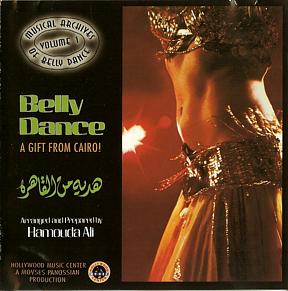
Though she was ten years my junior, she wasn’t prettier or smarter or more talented, but she “cared about his business” and what mattered to him rather than trying to find her own potential.

In the meanwhile, I saw myself as a martyr, a free spirit new-age woman, the unique and fascinating Oriental dancer. I was an innovator in the teaching of dance utilizing video. (Nowadays DVD video is a matter of course but it was unique at the time.) Also, I became an entrepreneur by opening a dance studio in my immediate area which was the only one devoted to Bellydance as a primary objective. So while I thought of myself immodestly as an exceptional dancer, a credentialed teacher, and a businesswoman, my personal life rapidly became a shambles. I found myself abandoned along with my cat and my dance and I proceeded to make a living for myself for the next four decades by teaching and performing the elusive "Bellydance". No longer could I treat dance as if I were a dilettante.

So here I am, four decades older. I occasionally ask myself if it has all been worth the sacrifice of my financial wellness and the ultimate fact that I neither have children or husband? The fact is, I have been involved on the fringes of show-business for all these years and have had the rare opportunity to meet famous and not-so-famous performers who, to say the least, are among the most vibrant and interesting of earth’s inhabitants—the tattooed and pierced, the drug cases, the family counselors and psychiatrists, the shy and lonely beloved by thousands, the creative award-winning inspirational dancers, musicians who have touched the hearts of people on numerous occasions, performers and explorers of the human condition. It has been a privilege, and perhaps it was worth the sacrifice. That remains to be seen, but now my chickens are coming home to roost. 

Again I struggle to renew my dance career as a dance elder, to find a way to alter my it in such a way as to honor my past involvement in it while continuing to look after my physical, mental, emotional, and yes, financial security. I do not believe that grinding out more of the same dance activities year after year, until death, will do the trick for me! 

I hope to renew the dance within and to pass it on in some form to those dancers who follow. I believe that the most difficult aspect of aging as a performer is that what you are absolutely best at doing (and that in which you have the most experience) is no longer appropriate, for the most part, or even terribly lucrative.

The needs and wishes of today’s dance clientele has shifted and mutated due to time pressures and demands that did not exist even a few years ago. Here I should remind you that most dance students are not aware that this shift has happened and they seem to wonder why they are not able to learn this dance efficiently, quickly, economically, and they demand instant availability of ornate costuming that they would have to have designed and beaded themselves in former decades.

Even the teaching of dance needs to be adapted to a changing wellspring of energy and an altered perception of one’s own self-image. Sadly, these things are forbidden to be spoken aloud and are denied to women in any field. Women are expected to remain forever young and ageless or be transferred post-haste to the trash heap. Where is the veneration for our growth, wisdom and change? I do not find these values widely honored, and that is why I mention it here. 

Before I find myself relegated to the prison of non-ending instruction of dance to young women who think it would be a pleasant way to "get a good physical work-out" or "flatten the old abs", I want to adapt to the possibilities of coaching those few performers who aspire to be creative artists. This is totally different from teaching classes, seminars, or even private lessons; it involves pulling and coaxing dancers toward more fulfilling and daring careers as dance performers, or perhaps dance teachers, by utilizing their own particular dance technique. I have learned that I have a talent for breathing new life into dances that appear to have little inherent emotion, drama, or relevance. 

Do you find it shocking that I would say that about our beloved dance? Then you must consider that what makes Oriental dance so special is that it demands that the performer bring to it relevance and emotions. There is nothing inherently interesting about an "Egyptian Basic Hip Bump”, "Beledi Walk", or the deepest backbend if it does not tell a story to the audience! 

No, Bellydance is not the objective; it is only a vehicle for exploration of the content of music and the tool that allows the dancer to make artistic choices, conveying his or her own understanding of the human condition. A dancer who has not embarked upon many adventures in her past will not have very much about which to dance now. Perhaps that is why I have found myself butting heads with so many unusual people, and why I have sought out this life in dance when I might have had a more stable career of which Mom would have been proud.

use the comment box

Have a comment? Use or comment section at the bottom of this page orSend us a letter!
Check the "Letters to the Editor" for other possible viewpoints!

Ready for more?

  • My Dance Career’s Dark Side: As seen through a fog of murky emotion
    Will recounting my dark stories help me to purge them? Should one forget those special moments of insult and bad human behavior that all performers face?
  • 12-14-09 The Wine Glass or The Wine? Dance Conversation with My Mentor by Najia Marlyz
    Sometimes, the mere beauty of glassware can be so impressive that it can far surpass the content.
  • 8-23-09 Improvisation: Method Behind the Madness by Najia Marlyz
    One of the biggest mistakes we western Bellydancers have made is presuming that the dancing to which Arabs refer as the “Eastern Dance” is a theatrical dance that ought to be choreographed as if it were a ballet, or that its steps and movements are traditional like those of the Greek Hasapiko, an Arabic Depke, or a Hawaiian Hula.
  • 6-19-09 The Dance Teacher: By Divine Design or Default? by Najia Marlyz
    …nearly everywhere, dancers in this particular form seem to have found it necessary to “do it all” in order to earn a living by dance career alone
  • 5-3-09 The Quintessential Performer: Attitudes for the Stage by Najia Marlyz
    What can you rightfully expect of an audience of persons who are not, themselves, involved in performing (or related to you)?
  • 3-3-09 Recieving Filthy Lucre: Justifying Payment for Your Art by Najia
    Belly dance can be a respectable art and teaching it should be a respected employment. Often it isn’t, and that is why you have to set your career goals—and don’t forget to consider the money!
  • 1-16-09 Thorn of the Rose:Making Friends with Criticism by Najia Marlyz 11-28-08
    Thorns make the rose ever more precious; though one’s ego rarely treasures moments of having felt the sharp thorn of stinging criticism. If the dancer is open to criticism—valid or invalid—it can open the door to the process of re-evaluation that otherwise might never happen.
  • 2-17-10 Shimmying on the Shores of Paradise, The Dancers of the Dominican Republic by Sylvia Richards
    White sands and turquoise waters come to mind when most picture the Dominican Republic, but the Caribbean paradise offers visitors far more than its natural beauty. It may come as a surprise that the small tropical country most known for its pristine beaches and Caribbean hospitality also has a vibrant and thriving belly dancing scene.
  • 2-16-10 Digital Dancer! Belly Dancing in Second Life by Caitlin McDonald
    In Second Life, the dancing is done digitally by applying a computer program that causes one’s avatar, the digital representation of the self online, to move in a prescribed manner. Instead of learning movements and needing time to practice them, they are loaded onto the avatar just like Nero learns Kung Fu in the “Matrix” films.
  • 2-16-10 Hot Bellydance Event in Tijuana by Martha Duran
    Leila Farid from Cairo Egypt is a sweetheart! She is what many Mexican dancers aspire to look and dance like. Wow! She is gorgeous and mesmerizing – as well as extremely nice, polite and down to earth! My star struck students were amazed to catch her snacking on Mexican Rancheritos (chips) and eating breakfast like a Mexican, with tortillas! She’s so fit that we couldn’t imagine she snacked on chips tortillas like the rest of us. Her master class was magnificent.
  • 2-11-10 Paul demonstrates the Oud another Musical Instrument Tour
    Paul shows us his instrument, including the tuning he uses, why there are not frets, who his mentors are and the makers of his instrument.
  • 2-9-10 Carl’s Camera Captures Dancers from Z to A, Tatseena’s Fantasy Festival 2009, photos by Carl, introduction by Ma*Shuqa
    This festival was a festive day of good vibrations with dancers sharing their talents on the raised stage, and on the beautiful wood dance floor. The day was replendent with beautiful dancing, beautiful costumes, and wonderful music – with the bands: Al Azifoon and Light Rain. This is a favorite festival for dancers in the East Bay area.
 

Gilded Serpent presents...

Shimmying on the Shores of Paradise

The Dancers of The Dominican Republic

by Sylvia Richards
posted February 17, 2010

White sands and turquoise waters come to mind when most picture the Dominican Republic, but the Caribbean paradise offers visitors far more than its natural beauty. It may come as a surprise that the small tropical country most known for its pristine beaches and Caribbean hospitality also has a vibrant and thriving belly dancing scene.

Belly dancing arrived on Dominican shores in the 1970s, when Dominican businessmen introduced the Middle Eastern dance form to a popular local restaurant, El Maunaloa, after returning from a trip abroad. The Dominican Belly dancing community has been growing steadily since. In the 1980s, Ana Luna opened the country’s first Belly dancing school. The school produced many of the island’s most prominent belly dancers, such as Vanessa Angulo, who was hired in the late 1980s to dance in the popular variety show, “El Show Del Mediodia.” Angulo accrued many followers in the Dominican Republic, as well as in Dominican immigrant communities in the United States.

In 1986, she went on to found her own belly dancing school, Vanessa Angulo & Su Grupo, which boasts four professional studios and over 800 students. The school, which has drawn international stars like Yousry Sharif and Mohamed Shahin, has been the backbone of the belly dancing community in the country. Angulo also helped to fuel the Dominican belly dancing community through the organization of local belly dancing contests and festivals.

Today, the Dominican Republic’s Belly dancing community is small but flourishing. My recent trip to DR to work on our upcoming festival has really shown me that belly dancing is beginning to penetrate the country’s media, particularly in numerous television shows.

There are also venues throughout the country that hold Belly dancing performances and workshops. These include Ballet Teatro Dominicano, Casa de Teatro, Country Club Dominico-Americano, Casa de Espana, Country Club Rotario, Country Club Los Prados, Mohamed Restaurant and Bar. In addition, countless resorts across the country showcase local belly dancers.

The Barceló Bávaro resort complex, in which Festival Isis will be held, is one such resort. The festival will take place March 15-21, 2010, and will showcase the talent and flair of DR’s own Vanessa Angulo, Sahar Sami, Jannelle Cortes, Cristal Rodriguez, Esther Vasquez, and dozens of others. Belly dancing aficionados will have the opportunity to explore the diversity of the art form as they take workshops with local dancers, as well as with international stars such as Fifi Abdou, Randa Kamel, Saida, and more.

In light of the recent earthquake in the neighboring country of Haiti, a portion of the festival’s profits will go to Haitian relief funds. Despite its proximity to Haiti, the Dominican Republic is stable, and the festival will go on as planned.

This March promises to produce a new and exciting page in the story of Dominican Belly dancers, as thousands of fellow shimmy seekers touch down on the island, and members of its belly dancing community, shown here, gain international prestige and distinction. 


Vanessa Angulo

Vanessa Angulo
Vanessa Angulo began to teach professionally in 1986, recognized as the first oriental dance choreographer in the Dominican Republic. Considered the most outstanding dancer Dominican Republic has had in Oriental Dance, she has contributed largely to the popularity that Arabic dance has achieved in recent times in her native country.

Sahar Sami

Sahar Sami

Born in the Dominican Republic, Sahar Sami is a master instructor, choreographer, performer, and director of the Academy of Egyptian Dance, the largest school in Southern California dedicated strictly to Egyptian dance. Her annual dance productions seek to educate the public about Egyptian history and Egyptian Dance, while providing a professional setting for students to present what they learn in class to the community.


Jannelle Cortes

Jannelle Cortes

Dominican native, Jannelle Cortes choreographs and performs for a wide range of cultural, corporate and commemorative events — from weddings and parades to summer festivals. A charismatic teacher inspiring to students of all ages, Jannelle recently made her television debut on the Telemundo morning news, bringing the art of belly dancing to a wider audience.

Lorelei Acosta

Lorelei Acosta:
Lorelei Acosta is one of the most dedicated dancers and instructors of Arabic Dance in the Dominican Republic, having spent the last 10 years immersing herself in this form of art.  Her awestruck students and loyal fans enjoy the sparkle and soul put into her every performance. With each move, Lorelei masterfully exhibits her spirituality, elegance, sensuality, and most of all, a deep love for dance. She has her own dance studio called “Lorelei Acosta, Danza Oriental”.

Easther Vasquez

Esther Vasquez:
Esther Vasquez is one of the most prestigious teachers and dancers from the Dominican Republic. Throughout her artistic career she has done important performances at restaurants, theaters, cultural activities, as well as TV shows.

Graciela Coiscou

Graciela Coiscou:
Graciela Coiscou is a belly dancing instructor and certified choreographer. She has had more than 10 years of experience, and is the director and owner of the Belly Dance Shelim School in the Dominican Republic.

Raksindia

Rakssindia:
Architect, dancer, choreographer, instructor, and director of Oriental Dance Studio, Sindia Fernandez, known by her stage name, Rakssindia, has a unique style of dancing characterized by creativity, talent, stage presence, and charm.

Gisselle Ubiera

Gisselle Ubiera:

Gisselle Ubiera was born in the Dominican Republic, the home that fostered her love for the art and culture of Raqs Sharqi from the age of 15. Today, she dances, instructs in, and is the director of the Gibelly School of Dance.

Rosanna Valera

Rosanna Valera:

Rosanna Valera has 10 years of artistic experience, and since 2005, has been the teacher and official dancer of the famed Lebanese-Syrian-Palestinian Club. She dances in many private as well as public events, including the Arabian Colony of Port Prince.

Cristal Rodriguez

Cristal Rodriguez:

This great dancer, much appreciated by her audience, discovered the magic and fascination of the Raqs Sharqi arts 10 years ago. Also a singer and actress, Cristal Rodriguez has presented her art throughout the Dominican Republic, currently working as a dance instructor in several schools in the country, including the prestigious Lebanese-Syrian-Palestinian Club.

From Vanessa Angulo School

Liz Emely

Liz Emely:

With only 4 years of experience, Liz Emely has proven herself to be extremely talented as a choreographer and dancer, receiving First Place in the Junior Belly Dance category of the Eastern National Dance Competition in DR.

Genesis Jimenez

Genesis Jimenez:

Genesis Jimenez began studying with Vanessa Angulo at the age of 7. She taught beginners at age 12, and today, is an amazing instructor within Vanessa Angulo School. She is an excellent choreographer and dancer, and has participated in all national events prepared by the company of Vanessa Angulo.

Sharom Schnabell

Sharom Schnabell:

Sharom Schnabell is one of the youngest in Vanessa Angulo School. Trained in other forms of dance, she has been studying the Raqs Sharqi arts for 5 years, and is one of the most requested dancers in private activities today. Currently, she receives training as an instructor within the school, and participates in all workshops and events and countless national television programs.

Luz Aura Ortiz-Goico

Luz Aura Ortiz-Goico:

Luz Aura Ortiz-Goico started belly dancing at age 12. Her beauty and dynamic personality is an inspiration to many, and she is currently training to become an instructor.

Alicia Mata

Alicia Mata:

Alicia Mata is a professional choreographer and dancer, starting at age 7. She has been trained in many different genres of dance (ballet, jazz, hip hop, etc.), and has had 17 years of experience at Vanessa Angulo School, participating in numerous international workshops, TV programs in Santo Domingo and the U.S. She won First Place in the Professional Dancers category of the first National Dance Competition in East DR. 

Carolina Angulo

Carolina Angulo:

Carolina Angulo is Vanessa Angulo’s daughter, and began her studies at the school at the age of 6 years. She is the first and only practicing dancer of Femina Tannour in the Dominican Republic. An excellent choreographer, she has participated in countless programs, events and workshops with her mother, while a teacher and dancer at the school.

Vanessa Robert

Vanessa Robert:

Vanessa Robert is a dancer and teacher with over 8 years of experience.  Placing second in the Business category of the first National Dance Competition in East DR, Vanessa has participated in numerous shows and national and international workshops.

Nathaly Reyes

Nathaly Reyes:

Nathaly Reyes teaches and dances in Vanessa Angulo School, with 10 years experience within it. Third Place Winner of the East DR National Dance Competition, in the category of Dance Professionals, Nathaly is an excellent dancer and choreographer of the company.

Alexandra Ramirez

Alexandra Ramirez

has had 8 years of experience with Raqs Sharqi, and is also well recognized as a Flamenco Dancer. She is a teacher and dancer at Vanessa Angulo School, and has traveled outside the country to participate in numerous artistic events of the company.

Manuelia Medina

Manuelia Medina:

Manuelia Medina has had 8 years of experience within the art, and her passion continues to flourish as she participates in countless national and international workshops as well as festivals and private activities. Today, she trains to be an instructor. 

Jennifer Bibieca

Jennifer Bibieca:

Jennifer Bibieca, with just 5 years of experience in the dance, is one of the youngest of Vanessa Angulo School. She is the 2nd. Place Winner in the Junior Category of the first belly dancing contest in the country, with international judges and world renowned belly dance stars, Sahar Sami and Mohamed Shahin.


Barceló Bávaro Resort: The magnificent Barceló Bávaro Resort is the site location of Festival Isis de Baile
Photo at top of page:
Bávaro Beach:


Resources:
www.festivalisis.com


use the comment box

Have a comment? Use or comment section at the bottom of this page orSend us a letter!
Check the "Letters to the Editor" for other possible viewpoints!

Ready for more?

  • Traveling with the Touareg
    This was my 5th trip to Algeria since 2000 and I have been amazed at the rapid economic development. The government is working very hard to make Algeria a very popular tourist destination once again.
  • Fifi Reloaded! Review of Fifi Abdo Workshop and Show
    Sponsored by Little Egypt Holiday Inn Select, Dallas, Texas May 18-20,2007
  • Tasting Cairo Stars in Your Home: Randa, Diana, Leila, Natasha’s Video Package-"Masters of Egyptian Choreography"
    Begin with the interviews and you will benefit from an understanding of their individual teaching methods.
  • Belly Dance in Brazil
    …they are trying to organize a Code of Ethics
  • Indonesia’s Introduction to Belly Dance: The Mainstream Media’s Influence
    Extensive mainstream media attention has been a mixed bag of blessings and, well, “somewhat less than blessings,” as most Indonesians would diplomatically say.
  • Belly Dance in Japan Reaches New Heights of Popularity
    Japanese audiences are extremely receptive, supportive and interested in this form of entertainment.” Conservative elder Japanese may still disapprove of the sensual aspect of belly dance, but among the younger generation it is seen as cool and trendy.
  • Its All in the Flavor! Bellydance in Mexico
    Those were tough times for us teachers. Students were very shy in the classroom but eager to learn; some of them even thought that Shakira had created Bellydance! They didn’t have much information about Oriental Dance, its origins, or different styles. Some aspiring dancers even sat through several classes just to check out what Bellydance was or if we teachers danced it as well as Shakira.
  • Fire in your Belly: My Dance Story
    I’ve always wanted to be a dancer. I vividly remember when I was four years old and had just started ballet, the driveway became my stage and the African sun my spotlight as I did plies, twirled, and pitter-pattered on tiptoe to a growing audience of passers-by. I remember curtsying to a young schoolboy who stopped to stare. Today, I realise it wasn’t my extraordinary dancing that stopped them in their tracks.
  • The Soltice Festival, Belly Dance in Spain- Part 1,
    held June 23-26, 2006. Part One- Workshops and Setting, Event organized by Maria Cresswell of Tribal Girona at Sanctuari Els Arcs, Girona, Spain. A medieval hostelry with a chapel, set in the beautiful volcanic natural park of La Garrotxa near the picturesque village of Santa Pau.
  • The Bellydance Scene in Taiwan Toss Hair Dance
    The women were much more skillful than I expected: just 3 years ago, nobody in Taiwan really knew anything about Bellydance.
  • 2-16-10 Hot Bellydance Event in Tijuana by Martha Duran
    Leila Farid from Cairo Egypt is a sweetheart! She is what many Mexican dancers aspire to look and dance like. Wow! She is gorgeous and mesmerizing – as well as extremely nice, polite and down to earth! My star struck students were amazed to catch her snacking on Mexican Rancheritos (chips) and eating breakfast like a Mexican, with tortillas! She’s so fit that we couldn’t imagine she snacked on chips tortillas like the rest of us. Her master class was magnificent.
  • 2-11-10 Paul demonstrates the Oud another Musical Instrument Tour
    Paul shows us his instrument, including the tuning he uses, why there are not frets, who his mentors are and the makers of his instrument.
  • 2-9-10 Carl’s Camera Captures Dancers from Z to A, Tatseena’s Fantasy Festival 2009, photos by Carl, introduction by Ma*Shuqa
    This festival was a festive day of good vibrations with dancers sharing their talents on the raised stage, and on the beautiful wood dance floor. The day was replendent with beautiful dancing, beautiful costumes, and wonderful music – with the bands: Al Azifoon and Light Rain. This is a favorite festival for dancers in the East Bay area.
  • 2-3-10 Bellydancer in 21 Days: My Internship with Aunt Delilah by Averill
    I am incredibly fortunate to be a junior at a very nice independent school in Toledo, Ohio. One of the programs they offer is called "Winterim". No one goes to their normal classes for a month; instead, all the students embark on some kind of intensive independent study program.
 

Gilded Serpent presents...

Digital Dancer!

Author's Avatar

Belly Dancing in "Second Life"

by Caitlin McDonald
posted February 16, 2010

What does it mean to incorporate a culturally significant practice from one society, not into another culture or social tradition, but rather into an imagined, fantasized and idealized world?  This is one of the questions I will be discussing during my talk “Digitizing Raqs Sharqi during the International Bellydance Conference of Canada in April.  I have been conducting some virtual fieldwork, looking at Belly dance in Second Life, an online game created managed by Linden Labs of Seattle, Washington.  

“Virtual fieldwork” is fieldwork in a digital setting; for example, looking at online magazines, message boards, social networking and video sharing websites to learn about what people do there and why.  It also includes looking at multi-player online games such as Second Life, where people from around the globe can interact in a simulated online world. 

When the issue of Belly dance in Second Life first arose in one of the research interviews I was conducting for my PhD, which is about the international dance community and the globalization of Belly dance, I was intrigued.  Through my interviews I had learned just how much the Internet has changed the way dancers interact with one another in the past nineteen years, reflecting the way it has radically changed the way people communicate and interact with one another more generally in that time.  However, it had not occurred to me that people would turn to an online game to dance, an activity that (until then) I thought of as something that couldn’t be done digitally.  Though my research on the ways dancers communicate online took a different direction for my PhD thesis, I remained interested in this phenomenon.

In Second Life, the dancing is done digitally by applying a computer program that causes one’s avatar, the digital representation of the self online, to move in a prescribed manner.  Instead of learning movements and needing time to practice them, they are loaded onto the avatar just like Nero learns Kung Fu in the “Matrix” films.

When a particular bit of code is applied to the avatar, it does exactly the same thing every single time.  Though Second Life users are free to walk around, run and even fly in the game, when they run these bits of computer code that are known as “animations”, the users are not directly controlling the movements of their characters using a joystick or a prerecorded video animation; rather, the code itself causes their avatar to move in a certain way.  There are several ways Second Life users can access these pieces of code, such as buying an animation that the avatar can then carry about, or clicking on a button within the game that causes an animation to take place within a particular area. I will speak more about this at the IBCC.  I will also be looking at what it means to perform dance and to learn to dance in a non-physical realm compared to the way we learn and teach others about dance in the real world.

I am especially interested in the community aspect of dance in Second Life—real life Belly dancers are often connected with a community that meets at local, national and international events like the IBCC, as well as communicating online in listservs, by reading one another’s blogs, and looking at videos of each other on YouTube.  Is the Second Life Belly dance community a part of the global Belly dance community, or is it something else? I will be comparing how dancers connect online in other venues (blogs, online dance magazines like Gilded Serpent and on YouTube) with how Second Life dancers interact with one another and whether there is overlap between these communities.  

For an idea of what Second Life Belly dance looks like, have a look at the videos below, also available through my research YouTube channel, www.youtube.com/caitietube under “Playlists:  Second Life and Motion Capture Belly Dancing”.

A fairly traditional example of a Pharaonic-style show: compare the song, costume, and choreography to a real-life performance.

Again, choreographically very recognizable movements happening in this example, but the costume is a very different aesthetic choice than in the first video–though unlike in real life, no need to worry about wardrobe malfunctions…

And finally, a very traditional-style cabaret show, with a bit of faux ‘old fashioned’ footage near the end.

Gilded Serpent readers who want to get in touch and share their personal experiences with belly dancing in Second Life can reach me at cm268@exeter.ac.uk.  You can also find me on Second Life under the name Zarafa Merryman

If you haven’t yet tried it but want to, head over to www.secondlife.com to download the software.  Joining Second Life is free, but there are some activities which cost money in the game, like buying costumes.  Once you sign up there are tutorials to take you through creating an avatar, and special spaces for "newbies"–new players in the game–where you can ask for help and learn how to do various things.  Once you’ve gotten past the initial ‘culture shock’ and are used to being in the game, to look for like-minded dancers, join groups like "Bellydancers" and "Serenity Belly Dance."  Club Habibi, the Belly Dance Room in the Sultan’s Oasis Club, and Zadi’s Dance Club are popular dance venues.  Or try visiting Virtual Morocco and Virtual Egypt.  I look forward to meeting many of you in April if not in Second Life before then.


use the comment box

Have a comment? Use or comment section at the bottom of this page orSend us a letter!
Check the "Letters to the Editor" for other possible viewpoints!

Ready for more?


Gilded Serpent presents...

Rainbow Dancers of the Dunes

Khaleegy DVD

Amera’s "Learn to dance Khaleegy"

DVD review by Bonita
posted February 16, 2009

I have been waiting for a Khaleegy Instructional DVD to come on the market for some time and was delighted to review and learn from  "Learn to dance Khaleegy" by Amera..

Amera, a legendary Australian dancer who worked in the Middle East, begins with a brief poetic, documentary presentation of Khaleegy basic background history and how it personally touched her heart. There is an excellent, readable booklet in the DVD jacket that includes history, glossary, step outline and the modern Khallegy song  translation for the choreography piece.   

The choreography, set to the song  "Moushtagaliek" is simple, charming and would be a nice novelty act for a belly dance recital to introduce students to khaleegy basics or could be danced by a professional troupe to expand its repetiore.  A minor editorial misprint is that the chapters on the DVD  back cover are a bit off and do not line up with the actual chapters on the DVD. 

The steps themselves are introduced gradually, built upon with more layers and explained and demonstrated clearly and thoroughly throughout the process.

  There are basic steps we are familiar with such as  the Hair Swish- but there are also interesting layered add ons as well that keep within the Khaleegy rhythm but can take even the professional dancer beyond the tiresome, trite few tricks up her Khaleegy sleeve (maybe I am only speaking for myself here?)..I really liked how the Hair Swish was explained- I must say it has always sadly eluded me and Amera’s hints were terrific..  

The DVD is beautifully produced and climaxes with stunning thobe clad dancers as a rainbow chain on infinite dunes. I would love to see a Beyond the Basics or more Advanced Khaleegy DVD come out from Amera in the future. 

Zil Rating:4
Zill Rating: 4

Purchase directly from the artist here: www.ameraspalace.com.au


use the comment box

Have a comment? Use or comment section at the bottom of this page orSend us a letter!
Check the "Letters to the Editor" for other possible viewpoints!

Ready for more?