Gilded Serpent presents...

Serena Wilson (1933-2007)
A Student of Ruth St. Denis

Serena Wilson on New York City

Part 1: Childhood

by Barbara Sellers-Young PhD
posted January ?, 2010

Serena Wilson, a member of the first generation of New York’s belly dance teachers, died on June 17, 2007. Current and former students immediately eulogized her on youtube.com with images of her dancing in a Greek temple and on the Egyptian pyramids. [ed- see below] This essay looks at her life in relationship to the evolution of oriental dancing in the early part of the century from the stages of Vaudeville and the Salome Craze to the impact of the dance metaphysics of Ruth St. Denis. As such, it provides a glimpse into how one of the pioneers of bellydance in the United States combined the various influences in her life to evolve her version of the feminine through the vocabulary of bellydance.

I am a woman, wrapped in chiffon and jewels,
Thin silks and girdle of gold.

I stretch my arms…
The embrace encompasses a universe.

I can control a quiver in my hips,
Tell a thousand stories with my eyes,

Skip with child-like glee,
The smile of experience on my lips.

Glide in innocence, endure with age.
Spin like a dervish; undulate in sensuality…

Excite, promise, create, change, tease, mock,
Unveil my passion.

Untiringly seduce the world as I move my body,
For I am a woman…

I am the dancer.(1)

Blake and BlakeSerene Blake was born in the Bronx on Aug. 8, 1933  into a Vaudeville family of performers called  Blake & Blake. Her mother sang and her father played the banjo.(2) Her childhood and adolescent years intersected with the  Vaudeville stage, on which she often appeared with her parents in the 1930s. This was, however, an era when the Vaudeville stage was in decline as the population flocked first to the silent films and then the talkies. In the end, Serena’s parents quit the Vaudeville and settled in New York where they organized soirees in their Upper West Side apartment that integrated a Vaudeville format of dance, singing, and comic routines.  During World War II, Serena joined her parents in entertaining the troops at various military posts and in veteran’s hospitals following the war. Between performing, Serena’s Budapest-born mother provided her an artistic education, most importantly dance lessons at age seven with Ruth St. Denis.

Ruth St. Denis

Serena’s artistic mentor Ruth St. Denis is considered one of the founders of contemporary modern dance. Raised in the contemplative surroundings of a New York farm and trained in the basics of the movement vocabulary of Delsarte, Ruth St. Denis moved with her family to Brooklyn in 1893.  In her early career, she performed as a skirt dancer in the fast paced environment of Vaudeville in which performers commanded the stage through the tempo of their performance. Inspired by the pageant ballets that created an imaginary Orient such as Egypt through the Centuries and Genevieve Stebbins’ dances based on Greek statuary, St. Denis was not satisfied with being a Vaudeville skirt dancer or a dancer and actress in David Belasco’s company, a fact that she acknowledged to herself while in Buffalo on tour. Sitting in a café, her eyes happened on an image of the Egyptian goddess Isis that was part of a cigarette ad. Convincing the clerk to give her the poster, she placed it on the wall next to her bed. Contemplating it, she saw: a modernized and most un-Egyptian figure of the goddess Isis. She was sitting on a throne, framed by a sort of pylon. At her feet were the waters of the Nile with lotus growing. Her knees were close together; her right hand was on her right thigh, while with the other hand she held a lotus-tipped staff. The coloring was harmonious and the composition pleasing but undistinguished.

Despite the contrived nature of the ad, it set off an epiphany that embraced past contemplations on spirituality and art: It was like the white light which contains all the colors, like the apparent stillness which contains all motion. It was, however, not merely a symbol of Egypt, but a universal symbol of all the elements of history and art which may be expressed through the human body.

Her destiny, as she was to phrase it, “had sprung alive” in the moment of contemplating the image and she acknowledged an internal state of rapture and a commitment to become “a rhythmic and impersonal instrument of spiritual revelation rather than a personal actress of comedy or tragedy” .

 Ruth St DenisHer realization was to take her on a search through New York’s libraries and museums in search of the sources that could aid in the revelation of her new found understanding. In the process, her choreographic interests moved from Egypt to India and she consequently searched the environments of New York’s Indian community for support of her project based on the goddess Radha, consort of the god Krishna.

My intense interest in India had sent me into the byways of New York and I collected a little company, which used to meet in our flat to rehearse two or three times a week. They were of all varieties –Hindus, Moslems, Buddhists. Some were clerks from shops, some were students at Columbia, and one or two were unmistakable ne’er do-wells. They would sit on the floor and answer in a chorus the questions that I flung at them.

 St. Denis performances were situated at the conjunction of information gained from books, art, and the explanations of spirituality provided by the Indian immigrant community. Her first performances based on India were staged in the private homes of New York elites for guests such as the Gaekwar of Baroda. Supported by a group of society women charmed by her version of the Hindu goddess Radha, St. Denis received a positive review in the New York press which ultimately provided her the necessary financial backing to tour throughout the American Vaudeville circuit. Although St. Denis would return to New York throughout her life, her career and the development of the company Denishawn with husband Ted Shawn would integrate ongoing tours of the United States with a school in Los Angeles and involvement in the Hollywood film industry.

The company’s repertoire combined images from across the Orient–from North Africa to Japan–notably the evening length piece Egypta.

St. Denis’ career evolved from her involvement with New York City’s unique dance aesthetic formed by the immigrant communities that shared information on Asian religion to the libraries and museums from which she derived the thoughts and images, and finally to the stages that provided opportunities to perform. She offered her rendition of these images through portraits of female spirituality such as Egypta (Isis) Rahda, Ishta and others. For St. Denis, performing images of the divine was an opportunity to embody the essence of certain iconic symbols that reflected to her the human struggle to comprehend the body in time and space: The symbol of Egypta was the balanced faculties of the bisexual or complete being, expressed in the negative and positive of day and night, in the manifold life and culture of man and woman, and in the complete cycle of life and death. Radha was the symbol of realization, that only by complete denial of the attachments of sense does one experience the golden lotus of il lumination. Ishtar was the desire principle of creation, that living power that manifested itself first in human love and passion, and then in the ramifications of those energies of love which are expressed in the combativeness of war, in the imagery of the arts, and in the illumination of religion.

The Orient for St. Denis was not a lived space of actual people, but an abstract space that had been revealed to her through her meditations on art and such texts as–The Bhagavadgita, Christ and the Indian Road by Stanley Jones, The Gate Beautiful by John Ward Stimpson, and Buddha and the Gospel of Buddhism by Ananda Coomaraswami. Instead, St. Densis admits:

My final art is impersonal, for when I dance I am really an abstraction, a creature set apart from time and space, unrelated to human things in the ordinary sense. I feel a certain limitless state of being, a curious unending movement not only of my dance, but of my very being.
LeMeriWhile her performances have been categorized by some dance scholars (Desmond 1991) as fitting within Orientalism’s framework, her concern was not overtly related to the construction of power articulated by Said. Her performances were instead a staged version of a personal and metaphysical quest of which the female gods of the Orient were symbolic representations.

Serena began lessons with Ruth St. Denis during a period of transition in St Denis’ life. Denishawn was dissolved and St. Denis had started the School of Natya with La
Meri (Russell M. Hughes)
. Ruth St. Denis’ contribution to the school’s curriculum was her interpretative style of Oriental dance, while La Meri taught the actual dances of India and Spain. Although Serena would have been exposed to the dual dance environment of the studio, there is no indication that she took lessons with La Meri. Her memories of the lessons with Ruth St. Denis, however, were still vivid in 2000. As she described it:

"Ruth St. Denis was seated on a couch that was draped with a silk fabric brilliantly patterned with flowers. She sat throughout the entire lesson, and only dealt with movement of the arms. After I had taken a few classes with her, Miss St. Denis presented my mother with a copy of her book, An Unfinished Life. In it she had inscribed, ‘To my youngest student at this time, Serene Blake, whose future I watch with great affection.’(3)"

The sixty-two year old St. Denis left a life-long standing impression on seven-year-old Serena. For the young girl, St. Denis was the embodiment of femininity in performance, an image of poise and sophistication with a movement vocabulary in which each simple gesture expressed emotional volumes. These were images Serena would later attempt to incorporate in her performing as well as convey the importance of them to her students.

Serena’s dance classes with Ruth St. Denis were part of an eclectic arts education that also featured classes with various proponents of the Russian school of ballet, and when she was a teenager, art classes with such notables as ink artist Dorothy Dent and sculptor Maurice Glickman. As a young adult, she also attended classes at the Fashion Institute of Technology where she met her husband-to-be Alan

In 1952 at the age of 19, Serena married Alan Wilson, a percussionist and Dixeland band leader of the Jane Street Boys, with whom she would perform and collaborate with on numerous projects throughout her life. Their joint performance career began in the early 1950s when Alan’s band was hired to perform at a celebration that required a belly dancer. The band adapted their Dixeland repertoire to include well known musical renditions of the Middle East such as “Miserlou” and the “Sheik of Arabi.” Serena utilized her diverse dance traning, including the lessons with Ruth St. Denis, to improvise her version of Oriental dance with a water jug as a prop.

Following a brief period in New Orleans where Alan was stationed in the Army, Serena and Alan returned to New York.  Through an old friend who was a member of the entertainers’ union, Serena gained her union card and thus the right to perform in nightclubs and at the Catskill Mountain resorts. Her decision to pursue dance coincided with the popularity of Middle Eastern restaurants that had started with the 1950s opening of Port Said. By 1960 New York’s show business paper Variety reported that:

"New York’s version of the Casbah is becoming one of the faster growing forms of nightclubbing. The belly dancer once relegated to the burlesque circuits and carnies is now in her glory in the cafes. The section is a bit of old cultures and customs that have obtained a foothold in New York. It is attracting many of those who used to go to Harlem for off beat entertainment, and who seek some of the more unusual aspects of night life."(4)

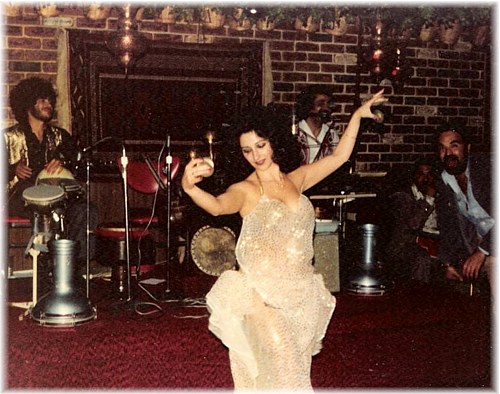
With the support of Armenian oud player Chick Ganimian, Serena got a job at the Egyptian Gardens in Greektown. Reflecting on her experience she later wrote a poetic and humorous account titled The Girl with the Star that reflected her experience dancing in New York’s Eight Street nightclub the Egyptian Gardens.


The Girl with the Star, by Serena

I sat on that stage, night after night,
And on my right sat the “Turkish Delite.”

Behind me, musicians, half asleep, bored.
Twanging bouzoukee, the guitar player snored.

“Egyptian Gardens” was the name of the place,
But the owners were Greeks, Ouzo flowed by the case!

Phoney palm trees adorned the dimly-lit walls,
While murals of dancing girls covered the halls.

The place was a “den” to some coming in,
And the sounds drifting out made a terrible din!

Sometimes, late at night, there would be a scene;
Glass flying, sailors fighting, drunk and mean.

But sometimes a stranger would sit and stare
At the Turkish girl’s leg, and the star drawn there.

Just below a dimpled knee,
She drew it there for all to see.

O’ Gypsy wonder with waist-length hair,
You sole-eyed beauty from God-knows-where.

Half saint, half devil, all women you are!

Just think, your admirers who travel so far,
Would give anything to sit for a night,
Just where I am, with you on my right.

Yes, I watched her dance a thousand times or so,
With the mark of a star, a long time ago.

Serena’s poem describes the experience of the American dancer in the nightclubs who is expected to sit next to the Turkish or Egyptian dancer and play finger cymbals or drums with the band when she is not performing. Her poem also conveys the complex position of the American dancer within an environment that participated in the exotification of the Orient through, as Serena phrases it, “Phoney palm trees adorned the dimly-lit walls, While murals of dancing girls covered the halls.” A restaurant which is owned by a Greek who was perpetuating an image of Egypt via the Egyptian Gardens. And yet, the dancer–in particular the Turkish and Egyptian dancers in the Greek town restaurants– symbolized for the Americans, especially women who flocked to see them, a sensuality they desired to inhabit; a desire that would cause the women to note the American dancer sitting next to the Turkish dancer and inquire how they could also learn to dance.

End Notes:

  1. This is the poem written by Serena Wilson that accompanied her video performance in the Greek temple that appeared on youtube following her death.
  2. She later changed her name to Serena.
  3. Personal Interview, May 2000.
  4. Quoted in Adam Lahm “Looking Back: The New York Middle Easten Dance Scene,” Arabesque 9/4 (November/December 1983) 6-7, 18-19.

Serena, Part 2: Salome and her Impact

Have a comment? Use or comment section at the bottom of this page orSend us a letter!
Check the "Letters to the Editor" for other possible viewpoints!

Ready for more?

use the comment box

  • 8-14-07 Tamalyn Dallal’s DVD- 40 Days and 1001 Nights, reviewed by Barbara Sellers-Young
    Thus, the film did expand my visual awareness. Now, did it deepen or extend my understanding of what that diversity implied? My response would have to be no.
  • 12-26-04 Scott Wilson’s CD "Efendi" review by Ma*Shuqa Mira Murjan
    Scott’s quest is to make Mid-East music more accessible to American audiences…
  • 8-11-04 Scott Wilson’s CD “An American in Istanbul” review by Dhyanis
    The entire CD is laced with instrumental solos featuring each artist, many of whom are from the Mid-East, most notably George Strathos on clarinet, plus Rip Wilson, Scott’s darabuka-playing Dad.
  • 7-8-08 When Two Doors Close Two Doors Open, New Venues in New York City, by Sarah Skinner
    Scott was thrilled with the new place and said it reminds him of the late night clubs in Istanbul, Turkey. At the end of the night I walked out into the hot summer air feeling invigorated and inspired.
  • 9-13-08 Folk Tours 6th Annual Middle Eastern Music and Dance Camp Report and Photos by Nina Amaya
    held at Camp Greenlane in Pennsylvania, May 2008. The authenticity of the camp is amazing. I love Rakkasah and Tribal weekends as much as anyone else, but watching and listening to Arab musicians play Arab music and Turkish musicians play Turkish music, well, that adds a little something! After the nightly shows, the musicians keep playing to the wee hours and the camp dances in the big dining hall until we drop.
  • 6-10-09 Carl Capture Character: Rakkasah Festival East, Saturday Dancers L-Z, photos by Carl Sermon
    Latifa, Banat Al Beled, Leena, Lotus Niraja, Mahira Tribe, Mahrabesh, Majestic Hip, Malweh, MaShuqa, Mayumi, Nabila, Naheda, Natica, Nixies…
  • My Adventures in the Big Apple by Nisima
    So there was really a “mystique” in the 1980’s about dancing styles in other parts of the US, and especially about the New York style, so different from what we were used to in the Bay Area.
  • Who Died and Made You Queen of Dance?
    This lack of background basic performing experience would be unheard of and un-tolerated in any other dance form
  • 11-23-03 Egypta, a Revivification of Ancient Sacred Dance performed by The Silk Road Dance Company Kennedy Center Millennium Stage, Washington D.C. report by Pen Katali, M.L.S.
    Egypta impressed me as a stunning artistic success, splendid beyond belief.
  • 5-20-03 Loving Remembrance & Requiem: the Best “School” That Ever Was, Part 1 by Morocco/ Carolina Varga Dinicu
    I looked at her & said, “If I can’t do better than that, I’ll hand in my feet!” A case of having more guts than brains.
 

Gilded Serpent presents...

The Muwashahat

with Mohamed Shahin and Karim Nagi

Shahin

Workshop Review by Thalia
Photos by Yi-Chun of New York

posted January 16, 2009

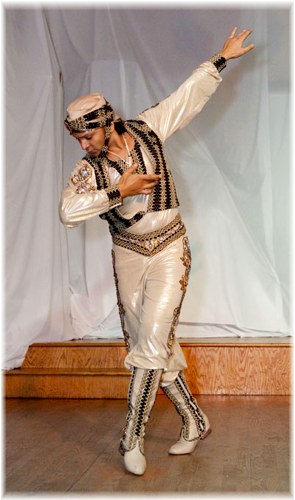
The classically derived Muwashahat dance form has gained new visibility in the Middle Eastern dance field, and New York City area dancers were presented with a thorough introduction to the style by Egyptian folkloric and Oriental dancer Mohamed Shahin and Egyptian musician Karim Nagi this October. The two-day workshop culminated with a final day of benefit performances featuring both teachers and local dance troupes. This event was sponsored by Nourhan Sharif.

The Muwashahat genre is inspired by tenth century court poetry of Arab-Andalusia, developed when Arab intellectual and artistic culture flourished in Spain. The rhythms are complex.

 Musician Karim Nagi began the weekend series with a breakdown of the specific rhythms that would be featured in Shahin’s choreographies. A lively and articulate teacher, Nagi incorporated both a verbal and physical breakdown of the Samai Thaqil (10/8) and Daarj (3/4) and York Sama’i (6/8). Nagi emphasized that this classical form of music was designed for concert halls and should be approached differently than folkloric or traditional Arabic music.

Nagi and Shahin both suggested that, like Pharonic style dance, the Muwashahat is a reconstructed or invented dance form. Though there are historical references to dancers during the form’s peak, no direct reference or description of the choreographies exists. According to both instructors, even the musical rhythms and lyrics have evolved through studying remnants of the formal, metered poetry. The Egyptian style Muwashahat was first developed for the stage relatively recently, 1979, by renowned choreographer Mahmoud Reda

Shahin’s first dance workshop began with a tribute to his teacher, Mahmoud Reda. The two-hour session covered two separate sequences using the rhythms broken down by Nagi. Shahin’s precise instruction included description for the mood and carriage that characterize the form. Muwashahat choreographies avoid the flourishes typical of cabaret and raqs sharqi styles, such as shimmies and head tosses. Light and flowing movements, graceful weight shifts, and restrained undulations marked Shahin’s combinations.buzuq

As an instructor, Shahin was attentive to students. He analyzed movements thoroughly while managing to push dancers forward through the complex footwork and turns the musical genre demands. Shahin’s calm and focused intensity conveyed well the innate elegance of the dance style.

The second day began with second energetic musical presentation from Karim Nagi regarding the complex nature of classical Arabic maqam. Nagi conveyed a great amount of technical material in an entertaining and engaging manner. As musicians often insist, a strong dancer understands the rhythm but interprets and ornaments and connects to the audience through a song’s melody. While playing the buzuq, Nagi introduced the concept of the musical maqam and led participants line by line through the lyrics of the day’s choreography, "Habib Elrouh," using Shahin’s translation. According to Nagi, the words of Muwashahat poetry reveal an ecstatic passion. From "Habib Elrouh": "…The love of my soul, I give you my all….my all, my all, I surrender…." This mysterious devotion could pertain to either a specific person, a leader, or denote religious/spiritual fervor. 

The choreography to "Habib Elrouh," also featured on Shahin’s CD, is challenging. Like the first evening’s combination, elaborate footwork and turns and arm undulations challenged dancers of all levels. Shahin’s enthusiasm for this unique style kept the students in the full studio engaged throughout the four hour session. Despite the typically humid, airless New York City studio, Shahin had more energy than any of the dancers in the room. 

These emerging instructors’ willingness to support each other was notable. Nagi and Shahin frequently called on each other’s expertise. Nagi assisted Shahin with the recorded music and also provided percussion during the dance session. Their combined abilities (and detailed handouts) made this complex and intellectually challenging form accessible while keeping dancing– high intensity dancing–the focus of this three day event. Dancers left the studio sweaty, worked out, inspired by new movements and a deeper appreciation of the complexity of Arabic music, and infused with the underlying sentiment of Muwashahat poetry — remnants of centuries old bliss. 

The weekend event ended with a show that benefited Doctors Without Borders and featured solos by both instructors and many local troupes. Due to other dance obligations, this writer could not attend. Nourhan Sharif’s enduring dedication to presenting classical and contemporary Egyptian dance and music continues to benefit New York City dancers and many worldwide. 

More information:
Farida Fahmy’s online article on Mahmoud Reda’s exploration of the Muwashahat: http://www.faridafahmy.com/Muwashahat.html.)

Photos from evening show-

Nagi kicksNagi
Karim Nagi
Shaheen
Mohamed Shahin
Shaheen Shaheen


use the comment box

Have a comment? Use or comment section at the bottom of this page orSend us a letter!
Check the "Letters to the Editor" for other possible viewpoints!

Ready for more?

  • Review: "Allure of the East: Orientalism in New York, 1850-1930" at the New York Historical Society
    This small one-room exhibit with its narrow geographic focus–the city O. Henry dubbed “Baghdad-on-the-Subway”–presents much for dancers to consider. As belly dance continues to gain popularity, what is this continuing "allure" of the Orientalist inspired arts? When is attraction to this aesthetic drawn from a desire to understand other cultures and when is it driven by desire to market ourselves?
  • 2-13-09 Tarot:A Fantasy Belly Dance Concert by Thalia
    The large, well rehearsed cast–musicians, temple maidens, acolytes, and servants with a variety of props–deftly played up the campy quality of the piece, contrasting the work’s darker messages about the fickle cycles of gain, loss, and impermanence5-30-07 Photos of Gala Show for Raqia, photos by Carl Sermon, prep and layout by Michelle Joyce
    On Saturday night there was a show at the Veteran’s Hall. The Show was: Big on technique; sometimes a little too studied. The soloists were selected mostly for being Raqia’s students.
  • 1-6-09 2008 Drum, Dance, & Music Festival Raqs Taiwan with Karim Nagi! by Lisa Chen
    She wishes to find the bridge between dancers and musicians, performers and audiences while still keeping its cultural roots alive. DDM is the platform for dancers and musicians working together and exchanging their professional experiences.
  • 11-27-09 My Dream: Dancing in Cairo! by Jillina
    To be asked to teach at Ahlan Wa Sahlan is an amazing honor, but to be performing, in the biggest show of the year? It was unbelievable! This was the most significant phone call I have ever received in my entire career.
  • 9-13-08 Folk Tours 6th Annual Middle Eastern Music and Dance Camp Report and Photos by Nina Amaya
    held at Camp Greenlane in Pennsylvania, May 2008. The authenticity of the camp is amazing. I love Rakkasah and Tribal weekends as much as anyone else, but watching and listening to Arab musicians play Arab music and Turkish musicians play Turkish music, well, that adds a little something! After the nightly shows, the musicians keep playing to the wee hours and the camp dances in the big dining hall until we drop.
  • 5-24-07 Elegance and Power, A Weekend Workshop with Raqia Hassan, Gala Performance Show, Review and Report by Rebecca Firestone
    April 21 and 22, 2007, Odd Fellows Hall, Redwood City, CA. Her personal style was an oddly elusive mixture of street attitude and elegance, both "fierce and friendly" as one person said.
  • Rakset Assaya: An Introduction to Egyptian Saidi Technique
    So what could be better than learning Egyptian Saidi technique from an Egyptian of Saidi background who is the renowned master of the dance? How about learning it from his partner, who breaks the steps down verbally in the American teaching style!
  • 1-10-06 The Dina Show! Photos by Catherine Barros, Slideshow coding by Tammy Yee
    Event sponsored by Little Egypt on May 28-30, 2005 at the Crowne Plaze in Miami, Florida
 

Gilded Serpent presents...

More Fans, More Veils…

2 Veil DVDs

DVD Review

by Tracey Farmer
posted January 15, 2010

Mahsati's DVDHere are 2 reviews for more advanced techniques using an extension and addition to the standard 3-yard veil in Belly dance.

Fan Veilz Level II: DVD by Mahsati Janan

I reviewed Mahsati’s 1st Fan Veil DVD and noted that I would be quite interested in seeing what she had in store for Level II; I was not disappointed!
In my review of that 1st DVD, I remember being impressed with how much ground material she covered with the fan veil DVD.  I was surprised when it was titled "Level I" because I didn’t know how much more she could cover.

She includes a lot more ground information by using combinations, aptly named tables and turns, and the introduction to a lengthier fan veil that is 3 meters long instead of the standard 1.5 meters.

There is no warm up in this DVD as there was on the first, but Mahsati advises that you should be warmed up, keep proper posture, and that this DVD is for people who already have some knowledge of dancing.  She gives advise on costuming concerns, and being mindful of your dance space. You won’t want your fan veil to land in someone’s food–and how the silken veils can easily get caught up on costume beads and coins! Mahsati even goes into how to tuck your veils into your costume without being awkward.

In the 1st DVD, you are advised on how to hold the fan veil, how to make it flutter, etc. This DVD begins with the assumption that the viewer has already seen this DVD or has a basic knowledge of fan veils. Mahsati immediately addresses combinations with one, then two, 1.5 meter veils. The 1.5. meters are the shorter, standard fan veils and the majority of her combinations center around these.  With the combinations, Mahsati describes and demonstrates verbally, repeats the combination along with the music, and demonstrates from behind, giving you a different view.

Next, she moves on to 3 meter veils that are roughly 10 feet in length. These combinations are more familiar in their interpretation. Mahsati reminds us that this is a lot of fabric and, again, to watch your costuming and dance space. She reminds us that the steps have to be more open and that you must make your moves bigger in order to accomodate so much yardage. You can drape the 3 meter fan veil as if it were a regular veil, and Mahsati shows us different tucks into the costume. The 3 meter combinations are not as extensive, but she does present a few double 3 meter fan veil combinations and reminds the viewer that there is no limit to them.

Masati next presents a 5 part choreogrpahy called "Lila".  She encourages us to use all of the combinations and the choreography in our dances but always advises us to come up with our own moves–all while being mindful of costuming and performance space.

The DVD ends with performances by Masahti and 2 guest artists, Miki Bow and by Lisa Zahiya.  All of the music is provided by Desert Mosaic, Miss Rose Lee, and Desert Rain.  The tune used for the choreography "Lila" is by Desert Rain.  As in the 1st DVD, the performances are an array of Cabaret, Tribal, Tribal Fusion and Egyptian to show you how fan veils can accentuate all types of Bellydancing. 

This DVD is produced by Neo Films who did the 1st Fan Veil DVD. It is performed on a stage with a black background, which makes the colors of the fan veils "pop" on screen. It will be intersting to see if Masati comes out with Fan Veilz III.

Rating-3 zils
Rating- 3 zils


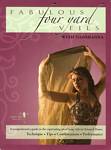
Shoshanna's DVDFabulous Four Yard Veils with Shoshanna

This is another quality instruactional DVD from Cheeky Girls Productions.

Shoshanna does an excellent job explaining veil work. She begins with an introduction, explaining what will transpire in the DVD; then she tells of her own dance experience and "coming in to your own" as a dancer–as she has done.  Shoshanna is known for dancing with veils so who better to do a veil instructional? Exceptional veil work is her trademark.

With the four yard veil, you work with more material and it does require work on technique.  This DVD is useful for all levels, for a beginner to learn, and even more advanced dancers to re-learn from the beginning.  The technique and moves become more advanced as Shoshanna goes through her clear instruction.

After her introductions, Shoshanna demonstrates a sampling of veils that are most popular such as silk, rayon chiffon, polyester chiffon, and circular veil. She ends the sampling with a  beautifully luminescent 5 yard veil.  She explains how each fabric can give off a different flow or ‘fluff’ depending on the material and its shape.

The instructional matter starts off with a warm-up (which is a good idea with all of the flipping and tossing in the upcoming chapters).  Shoshanna starts with the basics on how to hold your veil, as well as positioning your arms and fingers.  I would have liked her to include information on holding the veil with finger cymbals in your hand since in old-school American Cabaret, I was taught that you never put you zills down. (Perhaps that’s just me being nit-picky.)

The 1st section is basic flipping and tossing and the "around the world" moves. This is great for beginners! From here, Shoshanna progressed into more intermediate and advanced moves that incuded turns, reveal and conceal, tossing and catching the veil, and much more.  Shoshanna advised that there can be a good amount of turning with veil work so it is imperative to know how to do turns, to start off slowly and practice so that you won’t get dizzy or bounce up and down. There are a lot of combinations on this DVD with which you may work that might take a couple of viewings.  You may want to stop the DVD at points and just practice (and perfect) 2 or 3 combinations at a time. Just a couple of these combinations would give you an acceptable veil choreography for a short taxim or a great entrance–if you are an Egyptian style dancer. The advance moves include more spinning with your veil–and though quite a sight to see–please heed her advice and practice before trying to perform a dazzling Pinwheel. You wouldn’t want to get dizzy after 2 turns.

Shoshanna (and the students accompanying her) use 4 yard veils, but she reminds us that all of these combinations can be accomplished with a standard 3 yard veil. Shoshanna reminds us that four yards of fabric is a bit more material, so you must "step out" or extend your arms more to get that height and fluff and not get tangled and to not be afraid, it does take practice.  Shoshanna is 5′ 2" and admits her instructor told her that she only needs 2 1/2 yards for her small frame, and as you can see, she’s not intimidated by the length!

All of these moves are accomplished while facing the viewer with the 2 students in the background. When we get to the combination choreography, it is done in front of a mirror with her back facing the audience, giving you the feeling of being part of the class. The choregraphy is then performed in a group but would work also with a solo dancer.

At the end, we are treated to a satisfying Shoshanna performance with a 4 yard veil, which is featured on the By Dancers by Dancers Vol. IV DVD.  All of the music provided is by Qadim featuring Eliyahu Sills.

Shoshanna covers a lot of basic information concerning veil work on this DVD.  She even has a "troubleshooting" section in which she talks about getting caught in your costume or hair piece and how to get out of it (which is helpful for me because veil has never been my forte and getting "caught" in my veil is one of my nightmares).

  Shoshanna also reminds us that when using a 4 yard veil, you should try to have plenty of space around and above you because you don’t want to get caught in the chandelier above or toss your silk veil in someone’s food.  This DVD is recommended for anyone interested in veil, 4 yards, shorter or longer, intermediate students or anyone interested in new ideas for dancing with a veil. I believe the brief appearance of that incredible 5 yard veil is a hint concerning Shoshanna’s next level of veil instruction via DVD.

Rating-4 zils
Rating- 4 zils

Summary

  • Instructional Skill:  Both ladies are qualified and give clear instruction and explanations.
  • Quality of Production:  Mahsati–medium quality, similar to the same used in her 1st Fan Veil DVD.
    Shoshanna–exceptional, professional quality.
  • Level of Instruction:  All levels on both DVDs
  • Ratings:  Mahsati–3 zills,
    Shoshanna–4 zills

Purchase information:

use the comment box

Have a comment? Use or comment section at the bottom of this page or Send us a letter!
Check the "Letters to the Editor" for other possible viewpoints!

Ready for more?


Gilded Serpent presents...

Sweet Memories of Vietnam

After a week of teaching in Hanoi, Author relaxing in a cruise at Halong Bay, Vietnam

Not THAT Vietnam

by Samra
posted January 12, 2010

I have sweet memories of Vietnam, not THAT Vietnam, but one seen through the eyes of a dancer. In August, 2009, as an extension of my trip to Malaysia this year to teach some workshops, to
see dear friends, and eat delicious Malaysian food, I decided that I wanted to go to Vietnam.  Taking seriously the saying that a day without dance is a day not lived, I took the initiative of arranging some dance opportunities while there.  Through the wonders of the internet and a network of friends I connected with dancers in Hanoi and Ho Chi Minh City (Saigon).  My life simply will never be the same!  I admit I say this each time I experience a new culture, but this trip was one of those transformational ones.  I will dedicate another article later to my stay in Malaysia.

An

Hanoi

When I arrived in Hanoi I was met by two young drivers hired by my hostess, An, owner of Apsara Studio.  I was immediately impressed and couldn’t help giggling at the creativity of my transporters to get my attention.  They were holding a big flyer of my workshops with name and photo in Belly Dance costume.  It certainly beats the dry names written by tour agencies to meet their arrivals.  Not knowing the country, I felt uneasy about what people in the airport would think of me as a belly dancer.

Soon I was to find out that I had nothing to worry. Hanoi is a vibrant cultural city and Belly Dance is the new rage.  It is respected as the true art form that it is, and dance students are hungry to learn more and more.

I was taken to Apsara Studio which is in fact a cultural center holding dance and fitness classes in many styles, as well as the home of Hidden Hanoi, a school where visitors and new comers can learn Vietnamese cuisine, language and folk dances.  An, the very beautiful owner and mother of 2, teaches the cooking classes and Latin dances, and her Australian husband owns a youth hostel downtown.  They do a wonderful job of sharing Vietnam with all visitors and are very welcoming hosts.  I stayed for 8 nights at Apsara studio. It is beautifully decorated, where dance students have a lounge with refreshments, comfy sofas and free internet access.  They can stay and relax as long as they want before, after or in between classes.

Hanoi is a very unique city in all aspects, including their houses.  I noticed and commented to a tourist guide on my way to Halong Bay that I had not seen two similar houses in the whole city and the countryside.  She said she never noticed or thought about it, but it was true.  They are very creative and individualistic!  An explained to me why the houses are so narrow.  She said that most people owned a business in front of their houses, and taxes used to be charged not based on the income of the business, but based on the size of the front room.  So the houses were very narrow and long!

The city has a modern section, the French District and the Old Hanoi.  The French District is the section with the widest Boulevards, fountains and it looks very different from the rest of the city.  I loved shopping in the Old City, because each street specializes in a certain category.  So, if you want fabrics, you go to the fabrics street, etc.  There are also big enclosed markets as well as modern boutiques and galleries.  Hanoi also has several lakes and parks and the government is enhancing the natural beauty of the city with preparations to celebrate their first millennium next year.

I don’t recall seeing Western fast food restaurants, although I am almost sure there are some somewhere. I ended up being too busy teaching several hours each day, preparing for the Hafla, and eating with my new friends who invited me to their homes or to ethnic restaurants nearby.  I even ate at a “restaurant” down the street from the studio, which is a local version of fast food and it was totally yummy.  I am a bit picky about clean food, but I had no trouble eating a couple of meals at this place. 

The food was prepared on the street. Cauldrons of extremely hot broth boiled on. The vegetables were crisp and fresh and the diners sitting on the only bench moved over to make room for me!  Everyone was friendly and smiled as warmly as the wonderful noodle and veggie soup!

Ara, the Belly Dance instructor in HanoiHanoi streetSome westerners may have a wrong impression of Hanoi as dirty and chaotic.  I might agree a little with the chaotic traffic, although it has its own flow.  But although at the end of the day one sees trash on the side streets (mostly from

pedestrians and motorbike riders), the people are always sweeping the streets.  The thing that some tourists don’t realize (and I wouldn’t have understood if I hadn’t stayed with Vietnamese) is that people practically live on the street in front of their houses. They cook, eat, play with their children, let their chickens run free. Sometimes they will put down a mat and sleep!  It is just a different way to do things.

After a few hours of exploring the city I always returned to the studio to teach classes to wonderful ladies eager to learn.  Although my workshops and classes in general were as affordable as possible, Vietnam is not an affluent country and people who attend classes are very dedicated and eager to grasp each new concept, each move.  There are several instructors in Hanoi; however, I worked mainly with Ara Twang, who trained with masters in Europe and Asia. She teaches workshops in France and several Asian Countries.  Although she started teaching in Apsara only two years ago, she has brought her students to a very skilled level and she insists on presenting the art of Middle Eastern dance in a very traditional and classy style.  Therefore her troupe, Bastet Douad and her students are sought by some of the best venues and events.  Ara is from South Korea and is a very talented dancer of many styles, with a very cheerful personality.  I really enjoyed hanging out and dancing with her.

Like all around the world, Vietnamese dancers love to shimmy.  So, the shimmy workshop and the drum choreography were very popular.

  Zills became the focus of my visit because most of the dancers hadn’t had the opportunity to play with them.  Everyone wanted to try a little and some caught on very quickly and fell in love with them.  But I think the most fun everyone had was during the workshop “Fusion for Fun”; I taught a playful choreography to a Shakira’s song fusing Samba, Salsa and Belly Dance.  The ladies really enjoyed it.  I still remember that one of the dancers wanted to learn this choreography so much that the detailed notes I gave out were not enough for all the details she wanted to grasp.  I would not permit videotaping in class, but suggested to her after she called me a couple of times, that I would allow her to videotape herself following me, and as long as only she appeared on the video, she could use that as a practice tool to reinforce the notes.  Unfortunately, the only time I had available was at 11:00PM of my last night in Hanoi.  She agreed to come pick me up where I was having dinner with friends and take me to the studio so that we could do this project.  I was tired and needed to pack, but I really felt touched by such desire and commitment.  It is truly amazing what we do for art.

I did take two days off to cruise Halong Bay, one of the most peaceful (if you ignore the other boats and hundreds of other tourists) places on earth. It is one of UNESCOs World Heritage Sites.  But it is magically beautiful and I am glad I took this side trip.  Hanoi will never be forgotten and I hope to return, but now it is time to leave this beautiful city and its wonderful people and fly south to HCMC.  I really felt like I was leaving a new family behind at Apsara Studio.

Halong Bay
Halong Bay is north of Hanoi, about a 4 hour drive.

HCMC or Saigon

When I arrived in HCMC (Saigon), it was night and I was met by my hostess, Sandrine, who teaches Belly Dance at the Dancenter one
of the upscale studios in the city.  Lihn Rateau is the owner of this beautiful studio, and also a very welcoming and friendly hostess.

Because it was still summer vacation, and since this studio is more oriented to children and youth, regular classes had not yet started so it was quieter there than it had been in Hanoi.  I had planned a shorter stay in HCMC and I didn’t get to wonder around the city on foot, cyclo, taxi and motorbike as I did in Hanoi.  Sandrine welcomed me in her home along with her gracious husband and two teenage sons.  This was a very kind gesture because they returned from Switzerland, their home country on the same day I arrived after been gone nearly two months.  Sandrine took me everywhere in the city.  She was always so patient and protective, even through my indecisive shopping.

HCMC is very different from Hanoi, not only because it is much bigger, but it also is more modern with new construction rising everywhere.  It is divided into districts, and due to my limited time I stayed mainly in two districts, so I can’t say that I got a true flavor of the city.  It gave me a feeling of being more western in appearance and structure.  I did most of my Vietnam shopping in Saigon because of luggage weight restrictions in domestic flights.  I guess my favorite purchase was a silk pink lotus lamp, and my miniature water puppet.  

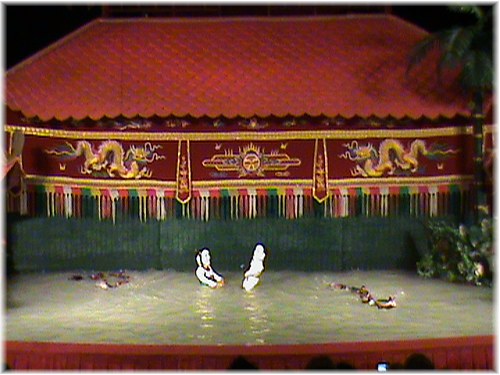
Seeing a water puppet show was one of the highlights of my stay in HCMC.  I am a fan of puppets of all kinds and water puppetry was unknown to me.  I thoroughly enjoyed the show, although I could not understand a word.  But the dragons and the battles and fights with lots of splashing water was fun. And the music by the live orchestra was hauntingly beautiful at times and comical when needed.  I actually got the passage about the turtles because I had heard about the legend of the turtles in Hanoi and had seen the turtle monument in the middle of the main lake there.  But the part I could really identify was the dance segment, where two dancers came out dancing with Wings of Isis!  Totally adorable.

Water Puppet Show in Ho Chi Minh City

Another highlight of my stay was our evening at Byblos, a Lebanese Restaurant and Shisha Lounge in the heart of the cultural district.  Lauren and Donald, the Lebanese owners had heard of my upcoming visit and invited me to come dine with them.  The meal was absolutely scrumptious.  Besides providing a meal to delight everyone’s taste buds, they are great supporters of Belly Dance, featuring local dancers on a weekly basis.  I met another HCMC dancer, Tran and her two students who performed that night.  I recommend this restaurant strongly.  The quality of the food and the friendliness of the owners and staff is an asset to the city and the art of Belly Dance.

Bylbos in Saigon
Evening at Byblos,  Saigon
L to R: Samra,  Donald, a friend,  Lauren, Sandrine,  Tran

I enjoyed teaching at the studio.  The dancers were very focused and disciplined, but some of the workshops were a bit of a challenge for some because I actually had some participants who had never attended a class before.  Several were traveling through the city or or were expats from Europe and UK.  But as usual, I teach in layers thus everyone seemed to have had a great time, getting what they could according to their background and our class time limits.  Finally the day came when sadly I had to say goodbye to the lovely Sandrine and her family, and leave Vietnam, a country to where I really hope to return.  I depart on my flight to Malaysia to stay a few days before returning home.  Little did I know the adventures that awaited me in Kuala Lumpur, which has become one of my homes away from home. Stayed tuned for the that story in my next article!

Resources for Dance in Vietnam

Hanoi:

  • An – Owner and Director of Hidden Hanoi
    Apasara Studio
    137 NGHI TAM, HANOI
    (+84 4) 3 7197916

HCMC (Saigon):

  • Linh Rateau
    Director 
    DanCenter
    46/2 Nguyen Cuu Van
    BT dist. HCMC
    3 840 69 74
  • Byblos Restaurant and Shisha Lounge
    11 Ngo Duc Ke Street | District 1
    Ho Chi Minh City | Vietnam.
    (84-8) 3825 7781 | Fax: (84-8)  3822 3104
    Website: www.byblos.com.vn

Apasara Studio
click for enlargement
After a workshop in Apsara Studio in Hanoi
Hopefully names will be added here soon!

Dancenter

Double Veil workshop in Dancenter, HCMC
Hopefully names will be added here soon!

Samra

Samra takes Hanoi by Cyclo

Tropical downpour in Hanoi

Tropical downpour in Hanoi

"national" dish of Vietnam.   Pronounced like  "fur"

This is the "national" dish of Vietnam.   The name is pronounced like  "fur".

.East meets West in the kitchen

Shopping in HCMC

Modern Shopping in HCMC

Born to ride!

Born to ride!

Last note from author: I FORGOT to mention that in Hanoi,  I had the BEST MASSAGE EVER!

Don’t forget to mention the tour to Egypt!  Leyla is hoping to have everyone signed up ASAP since we are going around Easter and it is hard to secure flights at the last minute. www.egyptnationaltours.biz


use the comment box

Have a comment? Use or comment section at the bottom of this page orSend us a letter!
Check the "Letters to the Editor" for other possible viewpoints!

Ready for more?

  • Indonesia’s Introduction to Belly Dance: The Mainstream Media’s Influence
    Extensive mainstream media attention has been a mixed bag of blessings and, well, “somewhat less than blessings,” as most Indonesians would diplomatically say.
  • The Ramzy Tour of 2003
    Photos from:Brazil, Brisbane, MaryBorough, Wellington, London, Singapore and Tibet? Readers- please help us with matching names to these faces!
  • Troupe Tabu goes to China!
    It should be noted that somewhere between passing the audition and performing, it was announced that three out of four dancers in the group (not including myself) were pregnant.
  • Return to India – This Time it’s Personal!
    We thought that the misfortunes associated with our previous performance tours of India were simply anomalies in the blissful and glamorous world of dancing overseas.
  • Fire in your Belly: My Dance Story
    I’ve always wanted to be a dancer. I vividly remember when I was four years old and had just started ballet, the driveway became my stage and the African sun my spotlight as I did plies, twirled, and pitter-pattered on tiptoe to a growing audience of passers-by. I remember curtsying to a young schoolboy who stopped to stare. Today, I realise it wasn’t my extraordinary dancing that stopped them in their tracks.
  • Carl’s Camera Captures Jillina’s Bellydance Evolution
    Jillina Carlano’s Bellydance Evolution marked the beginning of an era in which bellydance moves beyond dance Oriental imported from Egypt and performed in clubs.
  • Sticky Situations: Ask Yasmina #11- Inappropriate Audience Members, Competitive Teachers, Fickle Students
    Trying to please and appease those who already disrespect you leads to a miserable dead end. My advice is to say "NO" and give the inappropriately behaved person a good wack across the face.
  • The Original Mish Mish, The Golden Age of Tinseltown
    I was working one evening at Khyams and still doing my old style of dance. I came out for my entrance covered with a veil and right at the beginning of my show, she came up on stage and started peeling my veil off me and threw it on the floor. She shook her finger at me and said in broken English "Lah, this isn’t Egyptian!" I was so embarrassed and humiliated I could barely finish. Talk about being intimidated!
  • Are Reviews Relevant Anymore? Facing Our Wealth of Bellydance DVDs
    I sometimes wonder how dancers are supposed to choose in the face of this overwhelming amount of information.
  • Welcome to the 2nd Miami Bellydance Convention, A Selection of Photos
    Intercontinental Hotel in Miami, Florida, on September 4- 6, 2009, Winners,Teachers, Performers
  • Ozgen in LA, Turkish Dance Star in Los Angeles
    He charmed everybody with his cute non-traditional names for intricate footwork patterns as well as his verbal expressions – at one point he referred to the flirtatious shoulder movements of Turkish Oryantal as “cuddly”!
  • The Wine Glass or The Wine? Dance Conversation with My Mento
    Sometimes, the mere beauty of glassware can be so impressive that it can far surpass the content.
 

Gilded Serpent presents...

Galit Mersand Teaches

The Shisha Dance

Galit's Shisha DVD

DVD review by Martha
posted January 13, 2010

This is a self produced DVD that starts with a very entertaining and fun performance. It continues with a brief introduction of how Galit Mersand started dancing with the shisha, and then it takes you through a step by step instruction of how to assemble your shisha, how to hold it and how to smoke it.

Inside the DVD case there’s a booklet that has many of the steps written down that are going to be taught in the DVD.  I am watching this DVD holding my booklet waiting to stand up and dance along Galit. After twenty minutes into footage of her dancing you finally get to stand up and follow the wonderful instruction. The setting is a dance studio with a teacher talking with a foreign accent. She demonstrates each step, then does it with music, and in this case, again with the shisha.

There is a segment that focuses on framing your body with the shisha while dancing. Also included are several ways to enter and traveling steps are explained along with the details on where the shisha is placed along the body. She teaches you steps that are recommended to use within your shisha dance. Galit dedicates a whole segment to exiting combinations.

Galit takes a moment to say that she is not recommending smoking and that it’s not her intention to make you smoke.

I did not find other DVDs of this kind for comparison. I have only seen a video clip on you tube in which  Fifi Abdou is dancing and smoking shisha. But she doesn’t dance with the shisha. Somebody holds it for her. In fact, in this live performance clip of Fifi she barely dances! She uses some shoulder shimmies, a few signature hip drops here and there, but she is never holding the shisha. Then the dancing part comes in the second video. No offense to Fifi Abdo’s fans, because Fifi is one of the greatest dancers of clear movement. Her movements look effortless and crisp, with clean technique, but I never saw her dancing with the shisha at the same time like Galit.  I surfed the net for these Fifi videos because on Galit’s website she notes that her shisha dance was inspired by Fifís shisha dance. Inspired, not copied! Tarik Sultan is another dancer that dances with a shisha but in another entertaining way, by balancing it on the head while playing finger cymbals.

This DVD is 59 minutes and it’s for an intermediate dancer or advanced performer. A beginner would be left with many questions of stylizations and movement fundamentals.

This is a unique dvd for the performer who wants to widen her horizons.

The quality of the production is average, not a high tech production, but enough quality to make it worth every cent.

Zil Rating-3
Zill Rating:3 zill


DVD is available for purchase from Galit here

use the comment box

Have a comment? Use or comment section at the bottom of this page orSend us a letter!
Check the "Letters to the Editor" for other possible viewpoints!

Ready for more?


Gilded Serpent presents...

Carl’s Camera Captures

Heather Aued as Aello summons the Oracle’s army

Jillina’s Bellydance Evolution

Introduction by Ma*Shuqa Mira Murjan,
Photographs by Carl Sermon

August 30, 2009, Alex Theatre in Glendale, CA.

Enjoy this sampling of photos from this historic event that captures the energy and magnificence of this evolutionary performance and you will be ready to participate in the next Bellydance Evolution Festival presented somewhere in the world.

Jillina Carlano’s Bellydance Evolution marked the beginning of an era in which bellydance moves beyond dance Oriental imported from Egypt and performed in clubs. The "Bellydance Evolution" marks a new milestone in her showmanship, the construction of a bellydanced narrative along the lines of the classical ballets with original music composed by Paul Dinletir.

From traveling the globe and seeing up and coming dancers, came the idea for an online casting competition.  The amazing result of the online dancer competition was an eclectic group of dancers who won the competition and came to Los Angeles from all over the globe: Norway, Australia, Japan, Republic of Georgia, and Netherlands. These dancers joined Jillina’s Los Angeles based Sahala Dance Troupe to learn 14 new choreographies for the show in ten days of intensive rehearsal.

Winning the talent competition was a unique gift for winning dancers and for the audience.  Dancers of the highest technical level had a rare opportunity for intensive study combined with the opportunity to dance in a top notch professional production. 

A special Pre-Show piece featured solos by some of the Bellydance Evolution competition winners: Jennifer Cormier Daly, Shamiram, and Vilia (California), Aisa Lafour (Holland), and Kael (Australia). Siri, a dancer from Norway, was the “People’s Choice” competition winner and performed a solo at the end of the Pre-Show set.

Jillina says, “The goal of the Bellydance Evolution Festival is to entertain and educate people of all backgrounds about this beautiful ancient art form.” Thus, in 2010 she has plans to take the Bellydance Evolution Festival around the world to Germany, Hungary, Morocco – and on to Asia.

15
Jillina as Medusa is flirting on Apollo

41

Elayssa as Oracle, Louchia as Aphrodite and Heather as Persephone
17
Kaeshi as Pandora, Jillina as Medusa, Elizabeth as Thailia.

46
Zurab as Apollo and Jillina as Medusa

7
L to R, Aisa Lafour as Peitho, Elayssa as Oracle, Kael as Ate, Vilia as Iaso, Shamiran as Eutychia
14+
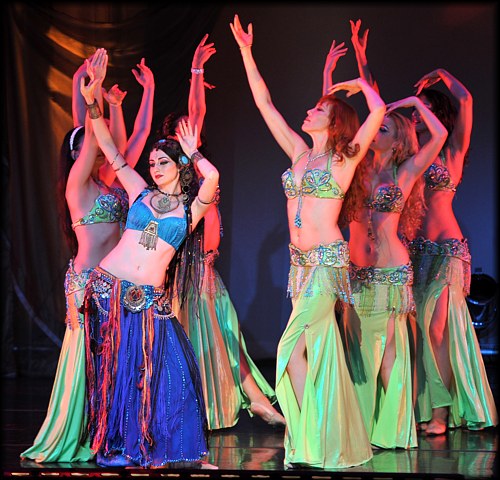
 
Heather as Persephone
45
Heather as Persephone

42
Heather as Persephone and Zurab as Apollo

43

21
Elizabeth as Thalia and Kaeshi as Pandora

22
Elizabeth as Thahlia, scene “Thalia shows off”

28
Zurab as Apollo and Jillina as Medusa about to steal the scarf

15
Jillina as Medusa in scene “Medusa’s Realization”

18
Jillina as Medusa and Gia Mikeladze as Loki is handed the sleeping potion.

11

12

Scene “Searching for Persephone” includes: Aisa, Fiona, Heather, Jeni, Kael, Shamiram, Vilia

49

Elayssa as Oracle, Jillina and Kaeshi

50


48


40

Gia as Loki and Heather as Persephone,
Sleeping potion

39


47

Aisa lafour as Peitho is casting a spell on Loki
24
Louchia as Aphrodite in scene “Aphrodite’s compassion”

25
Louchia as Aphrodite with Fiona, Heather, Jeni, Jill ,and Jillina

27

25

44
Heather as Persephone in scene “Persephone’s Idea”

4
Jillina as Medusa and Gia as Loki in scene “Medusa’s fury”

5

2

3

9

10

8
Troupe in Oracles Army, scene “The Oracle’s Army” Aisa, Elayssa, Fiona, Heather, Jeni, Jill, Kael, Shamiram and Vilia.
13
Elizabeth as Thalia in scene “The Oracle’s Army”, Apollo surrounded by Amazon warriors to protect Apollo

1
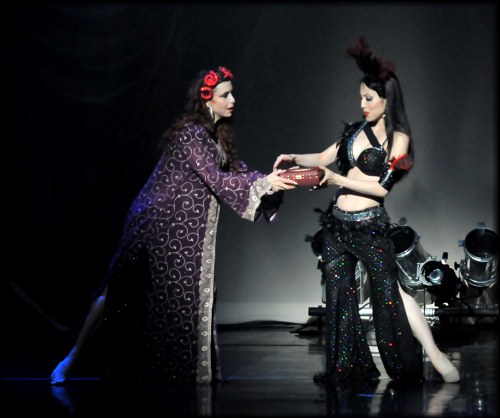
Medusa gives Pandora the box, scene “Pandora’s Torment”.

33
Apollo is tormented by Pandora. Kaeshi, Elizabeth, Elayssa, Heather, Jillina, Kael

35
34
Kaeshi as Pandora

30

31

Zurab as Apollo and Gia as Loki in scene “Apollo’s Revenge”, Apollo wins over Loki.

32

 
18
Scene “True Love does conquer all”

23
37

36


20
38

Musicians names: Ozzy, Donavan, Gia, Zurab
6


More Information about the coming tour of this performance


use the comment box

Have a comment? Use or comment section at the bottom of this page orSend us a letter!
Check the "Letters to the Editor" for other possible viewpoints!

Ready for more?


Gilded Serpent presents...

Jillina Advances Bellydance Theatre

Kaeshi and mask

A Review of Jillina’s Bellydance Evolution

by Kristina Nekyia
photos by Carl Sermon (more soon!)
posted January , 2010

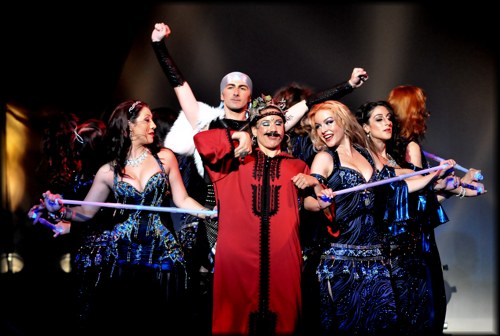
Bellydance Evolution is a full-length theatrical event directed by dancer and choreographer Jillina, ushering belly dance into the world of dance theater. The production is a melding of narrative with a wide variety of traditional and cutting-edge Middle Eastern dance and music. I saw the dress rehearsal of Bellydance Evolution when it debuted in Glendale, California in August, 2009.

The performance tells a love story featuring characters named after figures from Greek mythology. The plot itself is unrelated to actual Greek myth, however it contained many of the Greek’s favorite themes including betrayal, jealousy, underworld journeys, and redemption.

While the storyline is at times difficult to follow in its twists and turns, the clear archetypes portrayed by each character made the scenes enjoyable even if you miss out on some of the more intricate subplots.

As with ballet and other forms of dance theater, the plot of Bellydance Evolution is told entirely through movement. At times it feels as though a pre-existing choreography was pressed into service in a particular scene, but for the most part the dance does tell a story, and the dance is excellent.

The great strength of Bellydance Evolution is the artistry, both in its quality and diversity.

Guys fight sometimesI see it as a great credit to Jillina that she collaborated with a number of dancers to develop the show, rather than setting herself as the sole choreographer and star. The guest artists, all highly skilled, vary in their aesthetic, background, and style. This makes each scene refreshing, at times surprising, as the audience tours contemporary belly dance in all its forms. A few of the notable moments include a sinister masked dance choreographed by and featuring Kaeshi of Bellyqueen in her signature angular, pop and lock style; a sword solo from Elizabeth Strong drawing on her extensive study of Turkish Rom dancing and intense athleticism; a sensuous fan dance around the luscious Louchia as Aphrodite; and a haunting portrayal of the Oracle from the long, willowy Elayssa that gave me chills.


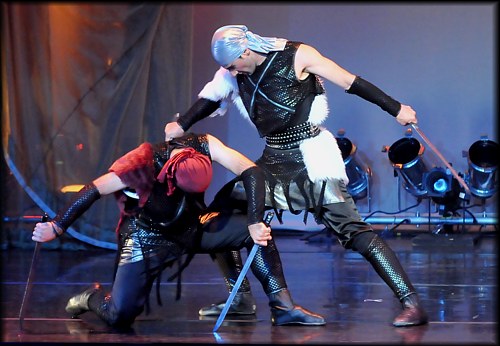
I was also pleasantly surprised by the presence of two men in the cast. Zurab Dudashvili and Gia Mikela were born in the republic of Georgia where they performed in the Georgia State Dance Company. They execute wildly acrobatic, fierce, masculine dancing and sword fighting, including some astonishing leaps and knee spins. Not only were they captivating in their own right, but they provided a contrast to the unadulterated femininity that is belly dance.

The tension and harmony between masculine and feminine made each form more exciting to watch.

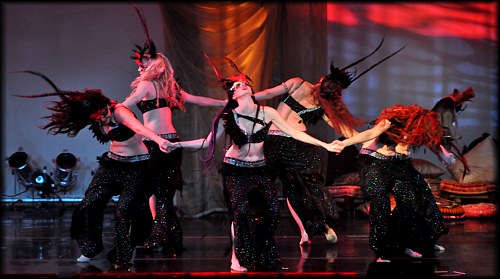
Within this great diversity, BDE was still a belly dance show. Jillina’s many years of expertise and her devotion to and mastery of the art form are apparent throughout. Much of the group choreography is her creation, featuring tradition props such as veils, fans, zils, and canes. The chorus dancers are tight, precise, gorgeous, and well rehearsed, though I did occasionally glimpse the twitchy smile and rigid neck of a nervous performer.

Jillina’s two solos are both flawless.

I was particularly enraptured by her drum solo with master drummers Donovan and Ozzy during which she performed cane dancing and a perfect, staccato turn while standing on the head of a doumbek. That alone is worth the price of admission. I loved her interactions with the drummers as well, and I hold out hope that down the line the entire production could be set to live music.

My only real criticism of the show is the same criticism I have for the vast majority of shows, including, at times, my own. It is too long. Towards the end the plot seemed to fall away after the lovers were reunited, and all of a sudden we were watching another belly dance showcase. Each of the soloists emerged to perform another solo, sandwiched by group numbers, and I found myself slightly confused. The dance itself was still top notch, but I was less enraptured because I was too busy trying to figure out if the story was still unfolding, or if this was some kind of encore.

Often as artists we become a bit too enamored with our creations and struggle with editing out what is unnecessary. In the case of BDE, I felt that a heavier hand was needed towards the end.

The lengthy encore not withstanding, I left Bellydance Evolution feeling uplifted and inspired. It is the kind of show that I would like to see more often: high production value, really good lighting, collaboration between dance styles, talented and professional artists, and a foray into the world of integrated, narrative-based theater. Jillina has once again proved her ability to produce a world-class event and I encourage dancers and dance enthusiasts everywhere to witness this next step in the evolution of bellydance.

Thanking the Musicians


use the comment box

Have a comment? Use or comment section at the bottom of this page or Send us a letter!
Check the "Letters to the Editor" for other possible viewpoints!

Ready for more?


Gilded Serpent presents...

Sticky Situations

inappropriate audiance

Ask Yasmina #11:Inappropriate Audience Members, Competitive Teachers, Fickle Students

by Yasmina Ramzy
posted January 4, 2009

Question #1: How does one say "no" to inappropriate behaviour by audience members in a night club and not risk losing the regular gig in said night club?

Answer: Twenty minute special event Bellydance performance; $300. Regular weekly Night Club gig; $150. Self respect; PRICELESS. Disrespecting a Bellydancer; punishable by severe admonishment and dance artist quitting. Trying to please and appease those who already disrespect you leads to a miserable dead end. My advice is to say "NO" and give the inappropriately behaved person a good wack across the face. If your employer does not demand an apology from the rude audience member, then quit working in such an establishment that d oes not respect Bellydancers. That is what Samia Gamal would do. I used to perform for years in a beautiful Arab night club where the owner once threw a musician down the stairs for raising his voice at me. Needless to say, that musician later became a great friend who respected me. Demand nothing less. There are so many ways to make money without losing your dignity. If you can make money performing Bellydance while being a proponent of beautiful and appreciated art, perfect. If not, make money other ways and keep dancing where ever you are respected.

Student pulled by 2 teachersQuestion #2: I am a student of Bellydance for only one year. I am loving it and loving learning many styles from the different teachers in my city. However, some of them get bent out of shape when I mention another teacher’s name. Some even go so far as to tell me to stay away from other teachers for a variety of negative issues from bad dance technique to personal sex life. Isn’t Bellydance supposed to be about women supporting each other?

Answer: One would hope so. Unfortunately, as in all aspects of life, there are always a few with low self esteem or insecurity who find it necessary to belittle others in order to make themselves feel better. I think it is probably more polite not to talk about other teachers you are taking classes from when in the hospitality of one teacher. I also believe that any kind of teacher, especially a teacher of Bellydance has a responsibility to be an example of dignified human behaviour. If you have a choice of teachers in your area, then you may be better off choosing to stay away from such petty behaviour and not let your experience of Bellydance be soiled with negativity. Why do we learn any subject? Because we want to grow and improve our quality of life. There are so many ways to better oneself and certainly Bellydance is my favourite. Remember, becoming a more fulfilled and happier person is far more valuable than the perfect hip drop. As an aside, I never let my judgement of anyone be dictated by someone else’s opinion. I will wait to make my own judgement. If I had listened to every person and situation I was told to stay away from, I would have missed out on enjoying many wonderful people and great experiences.

Question #3: Please explain how to handle students who adore you the teacher in the beginning and then turn on you a year or two down the road.

Student bubble will burstAnswer: I often wonder if this phenomena happens when teaching other performing arts as well. My theory as to why it happens in Bellydance is because of the powerful transformation that happens to students in so many layers of their life when they embark upon the Bellydance journey. A whole book could be written on this subject, but I will try to keep it short. Beyond the strengthening of appropriate muscles and the power to perform magic with them, the learning of Arab music and culture, and the dancing to inspiring choreography, a Bellydance student starts to awaken and discover latent issues about their sensuality and sexuality. When asked by their teacher to repeat a movement which was formerly known as taboo and then be congratulated when it is perfected rewires how a person views themselves and their relationship with the world around them. Ones relationship with their sexuality is integral to the very core of how one feels about themselves and their experience of life.
 I also believe Bellydancers tap into an ancient archetype which is very empowering. Because of these factors, many students experience a sense of liberation which in return allows them a fearlessness about realizing dreams they would have formerly deemed impossible. Some students experience this liberation but their self esteem has not caught up with the process. When this happens, they tend not to own the experience and instead, project it onto you, the teacher, thus placing the teacher in an unrealistic saviour role. Then one day, usually after their second performance when the bliss of ignorance is destroyed, you the teacher become the horrible deliverer of reality. As a teacher, the more you can lead a student to the understanding that their world, the good and the bad, is created by themselves and they are the only one who controls it – not a Bellydance teacher – then they can hopefully take responsibility and enjoy owning their Bellydance experience, the good and the bad.

use the comment box

Have a comment? Use or comment section at the bottom of this page or Send us a letter!
Check the "Letters to the Editor" for other possible viewpoints!

Ready for more?


Gilded Serpent presents...

The Original Mish Mish

Mish portrait

The Golden Age of Tinseltown

by Kamala
posted January 2, 2010

Author KamalaThis is my second interview with a dancer from the mid 1970’s Hollywood Arabic nightclub scene. I first saw Mish Mish on stage at one of the early MECDA shows, and was impressed by her professional and authentic style. I was a "newbee", and realized I had a long way to go to attain her level of proficiency. There was so much opportunity for belly dancers at the time, and I was doing the Armenian nightclub circuit. The local version of the Holy Grail was the big Arabic nightclubs in Hollywood. Mish Mish was one of the established dancers. I met her on the set of a movie, and she and Jacqueline Lombard persuaded me to try my luck in "Tinseltown", which set my dancing off on a whole new course. As many of the dancers of this period did, Mish Mish split her dance career between California, Denver, Salt Lake City, and London. I am focusing on the ladies who were very popular with the Arabic audiences. I believe they deserve recognition because they were the top performers of their time, yet didn’t teach or write articles about themselves, so their history was in danger of being lost. There were no videos I know of, and very few pictures, so I am hoping these interviews give the reader a mental image of this era in American belly dance.

Kamala: when did you start Belly dancing, and who was your teacher (teachers)?

Mish Mish: The first time I ever saw a Belly Dancing troupe was 1971 at the Northern California Renaissance Pleasure Faire. Being vertically challenged, I made my way up to the front of the stage right at the exact moment a dancer did an incredible spin with a sword on her head and while turning, grabbed the handle and ended in a back bend stabbing the sword into the stage on the final drum beat right in front of where I was standing! I later found out the name of the dancer was Rhea who at the time was in the troupe "Bal Anat". I decided right then and there, I wanted to learn how to do this incredible art form. I began studying with Jamila Salimpour the following spring of 1972.

I learned very fast and became a principle dancer at that year’s fall Renaissance Faire. That year was so much fun! Besides dancing at the Faire, I started dancing at the Casbah on Broadway in San Francisco.

apricotBetween Fadil Shahin, owner of the Casbah, and Jamila, they came up with the name Mish Mish, meaning a sweet little juicy apricot. Hah! Or, as I was told, it was like the American saying "what a hot tomato". Fruits, vegetables…whatever? I liked it, it fit, and it stuck. I’d like to say that I’m the original and not to be compared with the other dancer in Seattle. After I got married I added the surname El-Atrash, to distinguish between the two of us. I feel dancers should choose their names more carefully and make sure it’s not being used by another. 

I give credit and thanks to Jamila Salimpour for my formal training in the art of Belly Dancing, and also studied a bit with Samia Nasser. I’ve studied Tap, Ballet, Flamenco, Hawaiian, Tahitian, Polynesian, and I especially loved Balkan and International Folkloric Dance. Some of the groups I worked and performed with are: Bal Anat, Pitu Guli or later called BabaganoushAvaz with Tony Shay as director, and helped form the Gypsy Moor Dancers, later to be known as Hahbi Ru .

Samia Nasser and Mish

Kamala: What do you remember about the Los Angeles Arabic nightclub scene from the late 70’s to early 80’s? Which clubs did you work in?

Mish Mish: There were so many clubs I worked at in LA ! I was there six years.

  • Arabic Clubs:  The Fez, Ali Baba, Khyam, Abu Nawas
  • Persian: Delila, Caberet Teheran, Colbeh, Sahara
  • Greek: Greek Village, Athenian Gardens

I remember having the time of my life! I’ve never been an early riser so sleeping in late everyday was wonderful. It was like getting paid to party. Unfortunately, many of us could have easily become alcoholics, with customers continually sending us drinks. That was the worst part of the club scene other than constantly being hit on by customers, club owners, and musicians. It was difficult trying to maintain a professional and businesslike manner and to keep everything separated- not mixing business with pleasure.

Unlike in San Francisco, the club owners were fairly flexible with letting us work in more then one club. That made it easy to have a full schedule. What I loved the most about working in LA was that most of the dancers stuck together and supported each other. We weren’t going to let the club owners take advantage of trying to pit any of us against each other. We even went on strike and tried to form our own union and got contracts with better working conditions. That original organization was M.E.C.D.A. (Middle Eastern Cabaret Dancers Association).

Dancing in xx in Los Angeles
Delila’s Restaurant with Meghdi on drums and Manouch Sadeghi on Santur.

Kamala: Do you remember any of the musicians and what music was played for you at that time?

 At left is Maroun Saba Oud player and the owner of the Fez in LA, on the right is a singer, I can't remember his name.
The guy on the left is Maroun Saba and oud player and the owner of the Fez in LA. The guy on his left was a singer but can’t remember his name.

Mish Mish: Of course I remember many of the musicians but just a few pieces of music:

Maroun Saba, Maurice, Jamil, Adel Sirhan, Suhail Nasser, Saadoun Al Bayati, Najib Khoury, George Hyatt, Kasim, Ali Darwish, Suhail Kaspar, Hanni Nasser, Aziz Khadra, Tony Ayad, Henri, Manoush Shadeghi, John Belizikjian, Bashir, Raja, Semon Shabkie, Abdel Khalik, Ussri Esmaiele, Adel Moursi, Moustapha Sax, Reda Darwish, Ghazi Darwish,  Abdulla Kdouh, Jihad Racy, Mohamid Murray.

Some of the musical pieces played for me were: of course I often got Hemawaya Mish Mish, but also Nebtidi Menien El Hikaya, Fatet Ganbena, Ala Hasb Weddad, Sawah, Sallam Alei, Zaina, Inta Omry, Toubie,Tamra Henna,  Arousa,  Leyl Ya Layali, Mashael, Sahara City.  Click for enlargement

Kamala: Do you remember when the scene changed in about 1977 or 78 with the coming of Egyptian music and dancers to Omar Khayam?

Mish Mish: What was so incredible when the Egyptian musicians arrived was the fact that they actually played entire musical pieces. That was when everything changed within the shows. I believe that was also the time when most of the improvisational style of dance changed as well. Some of us were even given rehearsal time with the musicians and able to choreograph our shows. It became more professional.

There was an Egyptian dancer who worked at Koko’s prior to Nahed Sabri‘s arrival. Her name was Sahar. I’ll never forget, we were all appalled at her color schemes in costumes! This was the first time we ever saw orange and green mixed together. She was so cute and different and that was actually the first time we had seen a dancer have a rehearsed and tight show, the way the shows were done in Europe. This was so completely new and foreign to all of us girls here in the U.S. We always had five parts to the dance, came out veiled, had our entrance, first taxim where we removed our veils, then fast again, then floor work, then fast again, then drum solo, and finale. Those were such long shows! The Egyptian style was usually three parts. A short entrance with veil and almost immediately discarded, taxim, drum solo and finale. Sometimes she used a prop. That was the first time I ever saw the candelabra balanced on someone’s head.

There was also another dancer prior to Nahed that did a European style dance that we later dubbed Egyptian style. Her name was Suzie Ashar.
She bought and opened a club on Hollywood Blvd. near Grauman’s Chinese Theater and called it Sahara. She was a wonderful dancer and I remember now that she resembled Mona Said in looks and stature. Her gimmick was to balance something like six canes. One on her head, one on her chest, one or two on her hip and one in each hand. I had the opportunity to work there for a while also.

Nahed SabriNaheds arrival:
What a little spit fire! She barely spoke any English so we always needed an interpreter. Luckily for my sake, she warmed up to my husband Faisal, and I was able to pick her brain, and get some constructive criticism when she’d come to our house for visits. I remember a really fun party that Shirin had at her house in welcoming her to our community of dancers. Everyone was there (most of the working LA Dancers) and we got a private show.

Her shows were hot and so was she! Being so very temperamental there were many times that she was not happy with something in the show whether it was the music not to her liking or someone saying or doing something in the audience like not showing her respect by talking during her show. She would sometimes start cursing in Arabic and walk off the stage, thus ending her show. She was so pampered by the musicians and nightclub owners and they catered to her every whim. Most musicians were in reality scared to death of her. But they all told me that she was their favorite dancer to have ever worked with.

Faisal
Faisal El-Atrash
The picture was taken at Khyams when he was manager there.

I remember one night while watching one of her shows, she was dancing with a huge candelabra, one of the largest I’ve ever seen.

 Customers were showering her with money, and she literally was burning the smaller bills on the candles. As if to say she was worth more than that, so people began giving larger currency!

Her style of dancing was unlike any of the other Egyptian dancers I was later fortunate to see. Her phrasing, timing and musical interpretation was incredible.

I was working one evening at Khyams and still doing my old style of dance. I came out for my entrance covered with a veil and right at the beginning of my show, she came up on stage and started peeling my veil off me and threw it on the floor. She shook her finger at me and said in broken English "Lah, this isn’t Egyptian!" I was so embarrassed and humiliated I could barely finish. Talk about being intimidated! 

Kamala: What were the working conditions at that time? Can you give a description of a typical night in one of the nightclubs?

Mish Mish: Working conditions varied in different clubs. The Fez, Ali Baba, and Abu Nawas (later to be Grapevine and then Koko’s) had decent sized dressing rooms not like Khyams that was the size of a closet and didn’t have a lock on it for the longest time.

There were usually two dancers a night and shows were about a half hour long. There were always friends in the audience or regular customers that many of us felt comfortable sitting with. Most of the managers kept a pretty good watch on their dancers to make sure no one got out of line. 

Many times at Khyam fights would break out. Someone would call someone’s mother a donkey or whatever and I remember several times tables and chairs being flung across the room with people scattering out of the way and running out of the club.

One such night another dancer and I ran to hide in the kitchen to get out of the way but then freaked ourselves out by thinking that someone could come in and get knives, so that wasn’t such a good place to be. We always had to be on high alert working there.

Kamala comments: Fights were a common occurrence at Omar Khyam! I remember a wonderful dancer Yasmin and I, ducking in the corner of the dressing room, fearing bullets might start flying! When things quieted down, the owner (Majid) knocked on the door to tell us he needed a dancer onstage! We peered out the door to see tables overturned, broken bottles and bruised bodies strewn about. What a time to make an entrance!

I remember one incident that happened to me one night at Khyam. There was a young prince from Saudi Arabia that used to frequent the clubs when he was in town and was a good friend to my husband Faisal. He invited me over to his table for a drink before my show. I realized it was time for me to go get ready for my show and excused myself. Well, he had a new body guard and it must of been his first time in this country, and he didn’t know the etiquette here. As I was walking across the room, I suddenly felt a vice like grip on my arm with this big brut trying to drag me back to the table where I had just left. He was cursing me in Arabic and saying how dare I leave the table without Prince So & So’s approval. I started screaming and yelling at this guy to take his hands off of me and how dare he, and things were different in this country and if he wanted to stay, he’d better learn the rules here. Finally Majid (the owner) came over, and even he had a hard time pulling this guy’s hand off of me. It was so humiliating and such an embarrassment. But, the show must go on. After all of that he was made to come over and extend an apology. I didn’t accept it and told him to just stay away from me.  

Movie- Bogart's FaceKamala: I met you on the set of "The Man With Bogart’s Face". As you are finding out, there are people out there obsessed with the dance scene we were in, which is considered the longest in an American film. What are your recollections of that experience?

Mish Mish: I went to the cattle call/ audition with Jacqueline. It was almost like they knew immediately that we were who they wanted for the film. I was wearing a cobalt blue costume that they insisted that I wear in the movie. Of course later finding out why. Because of Franco Nero’s character being obsessed with the color blue and the nightclub in the movie was called the Blue Fez.

I remember being totally embarrassed because I didn’t know at the time who Franco Nero was and stupidly asked him what films he had previously been in. I think he was a bit insulted….Sorry! Of course later found out he had been in the Godfather and was Rudolf Valentino and in many other films.

I sat one day on a break with Michelle Phillips and her child or children, and she was so sweet and friendly. Since we had no knowledge of the script, I was a bit shocked in the partial stripping scene that Cybil Danning did, but felt it was done tastefully.

It is really amazing how many people are aware of this film and I was shocked to discover parts of us on Youtube. But I am grateful to whoever posted it as I was able to reconnect with you after all these years. And so glad to see you are still involved in the art and thank you for this interview!


Kamala: Many of us who danced in LA at that time crossed the pond and danced in London as well. There seemed to be a lot of back and forth of LA dancers and musicians at that time. Did you go to London, and what clubs and memories do you have of the London club scene at that time? 

Dancing in London
Grecian Taverna, Bar & Grill
London, UK

Mish Mish: I was back working at Pasha and living in San Francisco and remember getting a call in 1983 from a couple of friends and musicians Khalil Aboud and Ussri that were working in London at the time. A new restaurant and nightclub named "The New Omar Khyam" was opening and they were looking for new dancers. The owners paid my airfare and I was supposed to be making 350  pounds a week. I was young and dumb and accepted this on word value and not knowing that the going price at most other clubs was 500 pounds a week.

My good friend Jacqueline was working at Omar Khayam on Regent St. and made arrangements for me to meet them. At that time they had more then enough dancers working there but opened up an early slot for me. My show was at 11pm, the first dancer of the night. Sometimes there wasn’t even anyone in the audience because most of the clubs didn’t fill up until just before the casinos closed at 3am. I really didn’t care though because I had a wonderful 12-16 piece orchestra playing for me. I was in heaven! All of the songs were played note for note like hearing them on a recording from beginning to end. The musical piece I chose was "Mashael."

I accepted this slot and a cut in pay making only 300 pounds a week. I was able to leave right after my show and not have to stick around to hustle drinks like some of the other dancers that were required to stay the entire evening till early morning hours.

The minute a dancer was asked to join a table of customers, a waiter immediately came over to ask what she’d like to drink. We were all asked to order champagne. If the customer okayed Dom Perion the better and bigger commission the dancers got. For every bottle that a dancer opened, she received an extra 10 pound note. The club usually closed between 6-9am. I also got a job over in Greek Town on Percy St. If I remember correctly, I think the club was called Grecian Taverna and Grill

Aboud Abdul Al was playing at a club called La Roche and there was always another super star there like Fifi Abdu just to mention one.

At Omar Khayam, there was always someone there picking up all the tips as they dropped to the floor. Even while dancers were in the middle of a performance we had to be careful not to collide with him. The money was divided after the show in 3 ways, to the house, the musicians, and the dancer. Khayam’s star performer and idol of mine at the time was Mona El Said.
I loved watching her shows. I’ll never forget the first time meeting her. She actually scared the you know what out of me. She was truly treated like royalty by her audience and management. Every night she made an spectacular entrance just coming into the room.

Let me set the scene for you. First of all, the entrance to the club had curb service for all the limos, blacked out windows so you couldn’t see inside but the doorman and host or concierge could see who was arriving. Woman were not allowed into the club without an escort unless maybe she was another visiting dancer and could talk her way in. There were 3-5 flights of stairs you had to go down to get into the club. There was a coat check girl and also cigarette girl in this little lobby. You then went into the lounge area that looked like a Middle Eastern tent and then through there you entered the main dining room and night club area.

I discovered later the reason for having the club so far down below street level was because if there was going to be a raid, the doorman upstairs would step on a button that revolved rotating red lights in the ceiling warning the waiters to take off alcohol from the tables when it was after hours and give illegals time to sneak out the back door into the alley before the police got there. All of the dancers were required to have their purses with them while sitting at tables between shows so if any of us were illegal, it would seem like we were just customers too.

But getting back to Mona’s entrance. The minute she arrived at curbside coming into the club, word traveled all the way from upstairs announcing Ms. Mona had arrived. She would make her way down and stop in the doorway always in an elegant gown and most of the time with an incredible fur draped over her shoulder or dragging it on the ground as she went around the entire room greeting each and everyone there and blowing them kisses, until she made her way around the stage and into her private dressing room. What a trip! That was a show in itself.

8. Kamala: When did you stop dancing in LA? And briefly tell us what you are doing now.

Mish Mish: I moved back up to San Francisco in 1980 and worked at many different clubs and the Renaissance Faire there full time until 1992. It was at that time that I fell in love with a different culture and type of music. I began working with a group of Andean street musicians from Ecuador, Peru, and Bolivia. I became their booking agent and manager. I started my own entertainment agency called "World Rhythms" where I specialized in booking ethnic artists at different events. 

I fell in love with one of the members from Ecuador (Cristobal Jaque) and got married.  We traveled and toured all over the states performing at different venues. Using my knowledge of different rhythms throughout my dancing career made it became easy for me to become the percussionist in our group.

It was in 1997 that I set up work for us in Alaska. I fell in love with this wonderfully beautiful state. The end of 1999 I bought my first house in a little town called Chugiak which is about 30 miles north of Anchorage and moved here in the spring of 2000.

We continue to play music in the summers as we are only able to work seasonally because 7 months out of the year, it’s winter. People on the whole up here are so friendly and look out for each other. It’s a matter of survival.

I feel blessed at my age to be able to continue performing and sharing another art form with the rest of the world.  I will never forget my past, as it has made me who I am today, and will always have these wonderful memories to look back and reflect on when I am old and gray!

Mish and her band
Alma Andina: top left to right are Cristobal Jaque, Bolivar Cruz, Tawney Cruz.
Bottom left to right are Nico Torres, Sarah Levin, Me

More photos below!

The Lovely Mish Mish
links to larger image of Lushcious Mish
Taken in Steven Arnolds LA studio who was the founder of the Midnight
Movies at the Palace Theater in SF and debued the Cockettes.
The Snake Dancers of Bal Anat
Bal Anat Snake Dance
The snake dancers: Grindal (Samira) forgot the middle girl? Think her name was Judith?
Other people in the background of the Bal Anat Snake Dance were Jamila,
other dancer in Black Asuit was one of the Pot Dancers (Kismet) musician is Darioush Sami on Santur and lady next to him with the turban, Susheila.
Pita Guli
Next comes (taken at Southern Ren. Faire) when we first called ourselves "Pitu Guli" prior to becoming "Babaganoush".
Left to right is David Shochat, Patty Farber, Sharlyn Sawyer, Steve Theodore, Me, Katie Levin, and Neil Siegel.
BabaGanoush
Babaganoush
(still Pitu Guli) David, me Katie, Steve, Patty, Sharlyn, Neil
Glowing Angel of Bal Anat
Dancing at the Ren Faire with Jamila and Suhaila behind Mish.
Kashlama Costume
Kashlima Costume
Gypsy Moor Dancers
Gypsy Moor Dancers
top left to right are:Sage Hobin, John Compton, Rebaba (Rita Schwartz).
Bottom: Mish Mish, Paula Oxman.

This was the very first Kashlama dance at the Dickens Fair. Yes, that was Jamila in the background.

Traditional Ecuadorian Dress
Traditional Ecuadorian dress

Abu Nawas. Later to be called Grapevine, then Coco’s.
The two guys in the back are the brothers or cousins owners of the club (forgot their names???). I am sure Marie Silva will remember though and will ask her.
Sitting next to me is a friend Yousef and next to him is Faisal. That was the first night I met my future husband. Yousef introduced us. Hee Hee Hee.
Mish doing Floorwork
Mish doing floor work
Coy Mish
Mish
Nahed Sabri dances with Fard Al Atrashe


Have a comment? Use or comment section at the bottom of this page or Send us a letter!
Check the "Letters to the Editor" for other possible viewpoints!

use the comment box

Ready for more?


Gilded Serpent presents...

Are Reviews Relevant Anymore?

Medusa chooses a DVD

Facing Our Wealth of Bellydance DVDs

by Kyria
posted December 29, 2009

It seems that a new belly dance DVD is produced every day, and most of those DVDs are produced in the U.S.A., and I consider this a positive change from the times when VHS tapes were hard to get. Information is available now for anyone who’s willing to learn. However, I sometimes wonder how dancers are supposed to choose in the face of this overwhelming amount of information. For decades, the general consensus on intelligent choosing was reading the reviews written by other belly dancers. That would help you decide on the quality and content of the VHS/DVD, but here are a couple of reasons why this method is not working as well as it used to:

  • First of all, you need to know what DVD you want to buy or wade through piles of reviews. For example, numerous drum solo DVDs are on the market. In order to know which one you might like best, you still have to read reviews on all of them.
  • Secondly, reviews are biased by nature because they represent the reviewer’s opinion or point of view on the DVD. It’s possible that it doesn’t represent your needs. When you make a purchase, following the advice of a reviewer, you still won’t know if the DVD suits your expectations.

what?One of the solutions is reading reviews for several similar DVDs written in one composite article, like some recent reviews appearing in the Gilded Serpent. This is not a solution to the problem, merely an attempt to get a grip on the amount of DVDs out there. There’s another way to determine the importance of a DVD for your collection that will save you valuable time: you can look at the source where the DVD was made and the vision behind the product. Most DVDs are produced by dancers, producers, or entrepreneurs who are both.

DVDs made by Producers:

By comparing the vision of the producer, it is easier to determine whether their products will be valuable to you. Considering my personal DVD collection, the recording and sound quality of each disk is acceptable to excellent. What I need to know before buying a product is: what kind of information is on the DVD and what is the thought behind this information? The vision of the producer creates the framework for the format. Reading up on the vision is faster and easier then reading the reviews of the DVDs one by one. As an example, here are five different viewpoints from producers:

  • IAMED:"The International Academy of Middle Eastern Dance (IAMED) was established to provide belly dancers, belly dance enthusiasts, and the general public with high quality belly dance concerts and videos, and to recognize the international stars of belly dance, their achievements, and their contributions to this beautiful art form."
  • Bellydance Superstars:"The first concerted effort to take this ancient art form into the mainstream of international entertainment up there along with ballet and shows like Riverdance."
  • Cheeky Girls Productions: "Cheeky Girls Productions is committed to producing quality DVDs with professional dancers in an environment of dignity and respect. We try to equally showcase popular, in-demand dancers and lesser known, but equally talented, ones. All of the dancers featured in our DVDs were nominated by fellow artists. "
  • Natural Journeys: "Naturaljourneys™ offers high-quality DVD, video, and audio programming in such areas as Pilates, yoga, tai chi, belly dance, dance fitness, pregnancy fitness, ball fitness, weight loss, meditation, and other fitness disciplines."
  • World Dance New York: "Female-owned and managed, we produce, publish and distribute a wide variety of dance- and fitness-related video on DVD and in other formats."

Some companies specialize in belly dance while others have a broader view and create fitness DVDs. One company chooses local dancers nominated by fellow artists, while another wants to give recognition to the international stars of belly dance. There are pros and cons for every one of them and you can use this information to narrow your search.

DVDs made by dancers:

There are several DVDs that are used repeatedly. They contain information that is interesting for belly dancers, regardless of level. They are easy to use and put in a format that makes them suitable for short or long practice sessions. Not surprisingly, professional dancers have made most of these DVDs. My absolute favorites for practice are:

  • Aziza Practice Companion (recently redistributed by Hollywood Music Center)
  • Learn how to Bellydance series by Delilah
  • Shape up ‘n hip out! By Jillina
  • Stretch and Tone by Suhaila

These give me a good crossover between belly dance and working out, and they contain information to which I constantly return. Remember: just because they are my favorites won’t necessarily make them your favorites too! The dancers themselves produced these DVDs, and it shows!

I will have to admit that the producers who are run by dancers, like IAMED, Cheeky Girls and World Dance New York also create good products that are geared toward dancers. To be able to sell a large amount of DVDs the producer has to make them attractive to non-Bellydancers. For me, this makes them less suitable for the Bellydancer who is not specifically interested in fitness, pleasing her husband, or looking for a way to feel sexy.

Production companies that are run by dancers understand what dancers are looking for and know how to create valuable and useful products for the dance community. I applaud their initiative, and I hope that they will continue to produce DVDs in the future! Remember to ask yourself each time you consider a purchase: who made this product and what was their motivation?

use the comment box

Have a comment? Use or comment section at the bottom of this page or Send us a letter!
Check the "Letters to the Editor" for other possible viewpoints!

Ready for more?