Gilded Serpent presents...

“But Others Do It Too!”

Placeholder

Pirating Recorded Music

by Horacio Cifuentes
posted February 1, 2011

“But others do it, too!” was the answer we received from a well known International Belly dance instructor, Khaled Mahmoud.  The Egyptian born dancer, now residing in London, felt that with that statement he was free of any kind of wrong-doing concerning pirating of music, a subject that  has served for many discussions among the Belly dance community recently.

In order to explain how we even arrived at the point of receiving such an answer, from Khaled Mahmoud, I would like to tell you a little bit about how Beata and I ended up becoming music producers at all:

The idea of producing music was the furthest from my mind when I was first learning how to dance. I have been in love with dance since my childhood, and attended several dance academies throughout the world in disciplines such as classical ballet, modern dance, flamenco, etc.

While I was a member of the San Francisco Ballet, I used to enjoy a relaxing yoga session at the Baptiste Center after the long rehearsal days, and it was there that I discovered the legendary Magana Baptiste and her Royal Academy of Bellydance. Soon I found myself taking her lessons. That was the start of a life-long passion for Oriental dancing.

On the other side of the globe, another passion was being born about the same time. Beata walked into a book and  music store lured by the sound of Om Kalthoum. She studied at a performing arts school in Berlin. Her focus was mainly Modern dance, Jazz, Ballet, Tap and Flamenco. However, once discovering Oriental dancing, Beata knew that she had found home. It was during this period that Bert Balladine had begun to travel to Berlin, and they became friends. Bert became Beata’s teacher and mentor, and through him, she was introduced to the dance world in the United States.

Several years later, I met Beata, and we became dance partners. Shortly thereafter, we married, and I transferred to Berlin, Germany, where we co-direct an academy for Oriental dance, Ballet and other dance styles.

Our first trip to Cairo together took place in the early nineties. Beata had been to Cairo several times before, but for me, it was an awakening experience to see a dancer framed by a 35 piece orchestra! We realized then that Egyptian dancers draw from their musicians, and their ability to deliver such strong performances lies within their magnificent orchestras.

After I saw my first Egyptian dancer (Mona Said), Beata and I went on a quest, searching for the kind of music we had heard in that elegant Cairo Night Club–unsuccessfully. We searched and searched, and learned that the Egyptian divas were not interested in recording their music, for which they paid handsome fees to the composers, because they did not want it stolen. In our naïve enthusiasm we embarked in the mad undertaking of hiring a composer and a full Egyptian orchestra in order to reproduce the sound with which we just had fallen in love.  With hard-earned “shimmy money” funds, which we had diligently saved after many gigs and workshops, we commissioned our first CD.

It is not uncommon knowledge for those of you who have been to Cairo, even if only to shop for tourist artifacts at the Khan El Khalil Bazaar, that hustling and haggling with foreigners is one of Egypt´s national sports!

Well, to make a long story short, we learned many things about the Egyptian culture by embracing the music industry. Sometimes, it would take three days to agree on a price. Another time, after the recording was finished, the composer demanded several thousand dollars more than we had agreed upon, or he would not give us our master CD. During one recording, the engineer placed the violin too close to a percussionist and the recording ended up with type of ”Wooomm, wooom!” on each beat during the final recording.

All musicians had been paid, the composer had gone home, it was 5:00 a.m., we were exhausted, and the engineer just said, ”Mahalesh” (Nevermind). The recording was expensive and useless.

Yet, these difficult experiences were dwarfed by glorious moments in the recording sessions, when masters such as Saad Mohammed Hassan hypnotized everyone present with his violin during a recording of “Ana Fintizarak”! We discovered the richness and complexity of Oriental rhythms and nuances and became more mature dancers for the experience.  Beata, being as passionate as I am, was my “partner in crime” along this journey. We would return to Cairo again and again, in love with this song and that the song, and ended up working with some of the most fantastic recording artists and composers in the field.

The result is the Oriental Fantasy Music Series, Volumes 1-12. I can honestly say that each music CD is done with the dancer in mind. We were present at each recording for many, many hours (while being practically poisoned from cigarette smoke). Yet, we were able to contribute our dancer knowledge concerning the type of sound, tempo, beat, and accents, which are required for a good dance performance.

I figured we were investing in our future. “One day”, I thought, “we can retire from dance and collect the fruits of our efforts as music producers.” For a while we were able to retrieve our investment and go into profit. Unfortunately, this has changed now.

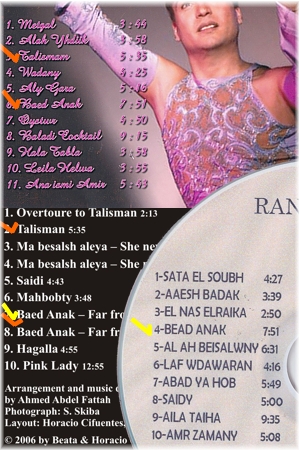
Comparing song listsA group of international teachers have developed a very easy way to make a lot of money out of other people´s productions. They make pirated copies of our and other music, put their picture on it, and sell the CDs at workshops. This practise is accepted by many organizers of events. Apparently, if a teacher makes a lot of money by selling CDs, he or she might accept lower fees for teaching at the event.

We consulted lawyers, only to learn that suing someone internationally is a lot more complicated than one might expect, and the costs are higher than any value we could gain. These teachers are aware of this limitation and that is why they continue with their criminal activity, doing very well at convincing themselves that, because some of their colleagues do it as well, it is permissible. Khaled, one instructor alone, has sold our music on one thousand CDs, (one thousand times $20 –well, you do the math)!

When I realized finally that our latest music CD entitled “Talisman” (It includes 30 top musicians and fantastic new compositions.) had not even retrieved its original investment, I fell into a deep depression. “I had such good intentions!” I thought. “After two decades of investing all our shimmy money in this music, all these thieves are just stealing it!” We were both torn between anger, fear for the future, and sadness.

Khaled Mahmoud, this same dance intructor (who stands at the top of my list of music pirating, along with several of our other colleagues such as, Mohammed Kazafy, Lubna Imam ,and yes, even Randa Kamel copied “Baed Anak”) in the past, has been invited as a guest teacher and instructor at our dance academy as well as the international Raks Sharqi Festival in Berlin. After his third guest performance in Berlin, and many (quite personal) conversations, we had been under the impression that we were friends.

When one of our students bought a CD copy from him at the Cairo Nile Festival for the outrageous sum of 20 dollars (US), she was up in arms when she found out that she already possessed two of the songs from our music series, especially the song “Talisman”. Another dancer was upset because her copied CD did not last long, but she never got a response when she requested a replacement.

We have also received news from musicians in Cairo who complain that, lately, they don’t get enough jobs recording and they and their families suffer financially.

I emailed the offending instructor several times but received no answer. I phoned him. Unable to reach him personally, I left messages in his answering machine. “Khaled My friend,” I said, “this problem will not go away by remaining silent!”

He phoned back and said to me, ”I am not the only one doing this! Besides, it will cost you too much to sue me! What do you want? I already said that I am sorry.”

So, that is our music story. The limits of the law have a way of protecting criminals and those who offend at times. We have decided not to release our latest recording, more than one hour of marvellous music with full orchestra. At the prospect of being robbed like this, we have decided to use some of it for our performances, and the rest will remain un-released, until, through a change in consciousness and methods, teachers and organizers come to the understanding that they are destroying the music business. Also, we have made a lot of our music available as a download from our web page.

In the summer of 2010, we had the great Jillina as our guest. She was selling original copies and was prepared to purchase music from us at a wholesale price. We wish that more teachers would do ethical business like Jillina does, in a considerate and professional manner.

Beata and I appeal to the dance community not to support music pirating and to understand that such activities kill the very source from which they benefit.

Beata & Horacio- http://www.oriental-fantasy.com/english/musik.html

use the comment box

Have a comment? Use or comment section at the bottom of this page or Send us a letter!
Check the "Letters to the Editor" for other possible viewpoints!

Ready for more?

  • 5-24-10 Loyalty, A Virtue Out of Fashion? by Beata and Horacio Cifuentes
    Some do not stop to think that it is a matter of basic manners to express your gratitude to an individual who has made an effort to provide well-being and knowledge. They just go and move on to their aerobics classes, horseback riding sessions, judo drills, or other, while the teacher is left behind wondering if any aspect of their lesson caused the pupil to go.
  • 8-17-10 And I thought I Knew Him, Horacio Cifuentes: Confessions of a Male Belly Dancer Book Review by Amina Goodyear
    Yes, I thought I knew Horacio Cifuentes, a San Francisco dancer who moved to Berlin to be with and wed Beata Zadou. After reading his book, I realized I really did not know him. The book, “Confessions of a Male Belly Dancer”, is exactly that. It is a self-produced autobiography written in a very sincere, almost shockingly honest way. It is personal and personable.
  • 3-16-05 About my teacher Magana Baptiste by Horacio Cifuentes
    At the time when her husband placed second in the Mr. America body building contest, and mind you, these were the days when body builders took no steroids and were true examples of healthy humans, Magana placed first runner up in the Miss USA beauty competition held in Los Angeles in 1951.
  • 3-15-08 The Magic Sounds Studio of Cairo, 3 Albums reviewed and Compared by Amina Goodyear
    CDs- Oriental Fantasy #12- Talisman, Nesma:Del Nilo al Guadalquivir(From the Nile to the Guadalquivir),Nesma, Memories of Cairo.
    In a world where Egyptian dancers dance in the "less is more" tradition, the world of musicians seemed to be – more is better and lots more is best.
  • 7-16-07 Music Copyright Law for Belly Dancers (or for any Performing Artist) by Yasmin
    From Hollywood blockbuster movies down to clips on YouTube the law is the same and it applies to anyone who uses someone else’s music for their own purposes.
  • 9-28-09 Give Credit where Credit is Due! by Dondi Simone Dahlin
    However, some dancers are using the same music, costumes and choreography in their performances that they first see elsewhere. This begs the question: at what point does copying someone’s original concept or choreography cross over from homage to stealing?
  • 2-1-11 Attention Dancers: Have You Seen this Man? Text and photos by Denise Mannion
    I promised that I would let the world of Belly dance know about this singular character! Watch (out) for him at you next event, for he could be anywhere!
  • 1-30-11 Fun TImes at the Third Annual North Bay Belly Dance Bazaar, A Northern California Community Event by Katherine Goldsby and photos by Carl Sermon
    Deborah Bennett and TerriAnne Gutierrez co-produced the third North Bay Bellydance Bazaar (NBBB) which was held on September 18 & 19, 2010 at the Sebastopol Community Center in Sonoma County, California.
  • 1-28-11 The Unpleasant Truths, Part 3 of Being a Professional by Naajidah and Ashiya
    If you really want to be a professional, first and foremost you must understand you are not so much a professional dancer as you are an entertainer.
  • 1-27-11 Joweh’s "Call to Dance" In Guatemala, Part 1: Arrival by Chloe Villareal
    Even our exhaustion couldn’t dampen our excitement and eagerness to explore our fascinating new surroundings.
  • 1-25-11 The Fusion Category, Photos from the 20th Annual Belly Dancer of the Universe Competition by Carl Sermon
    Amani Jabril, Apsara, Dilek, Eliza, Gina, Jane, Kellie, Khuzama, Lucia, Maria, Mireya, Rachel, Tiaja, Tracy, Valentine, Zondra
  • 1-24-11 Smooth Growth of Community Event, Las Vegas Intensive report by Neferteri
    It was interesting to note that everyone I talk to said they came to the convention so they can say that they had danced in Las Vegas.
  • 1-20-11 Queens in Arizona? USA Belly Dance Queen: Arizona Arab BD Contest by Roza
    To be honest, my favorite part was that the show presented an interesting challenge to many American dancers. They were required to identify the regional and cultural style of music they would be dancing to and represent that root in their technique, costume, and dance styling.
 

Gilded Serpent presents...

Attention Dancers: Have You Seen this Man?

Hakim poster

Text and photos by Denise Mannion
posted January 31, 2011

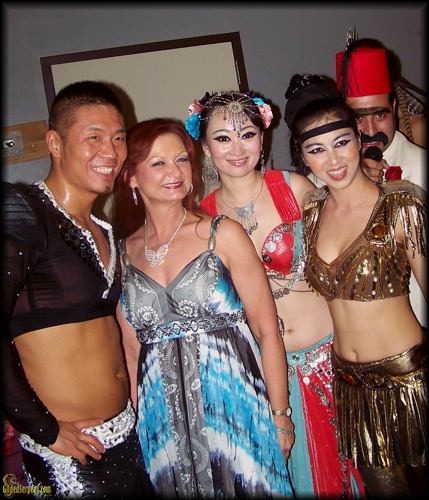
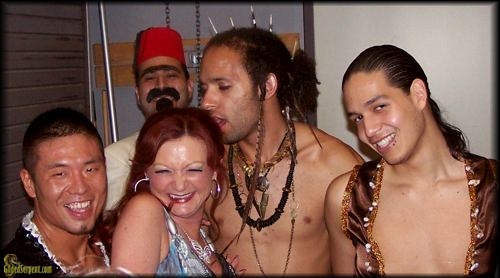
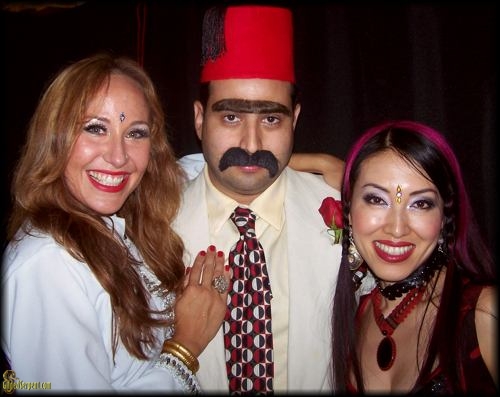
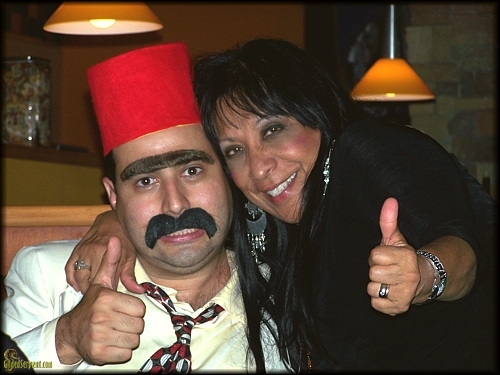
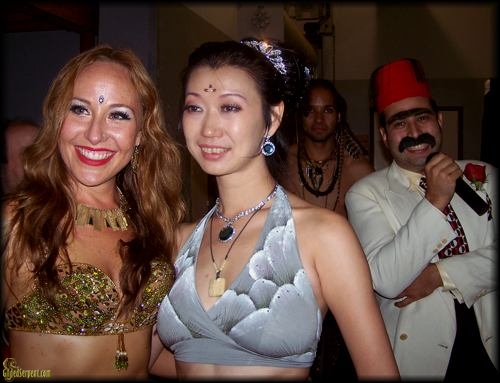
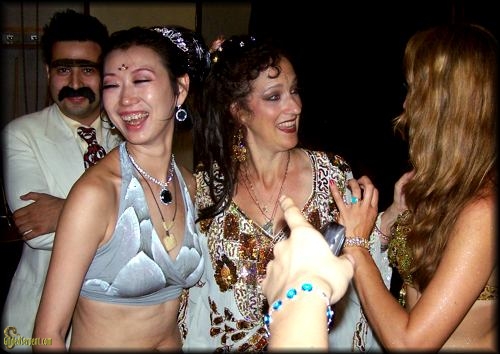
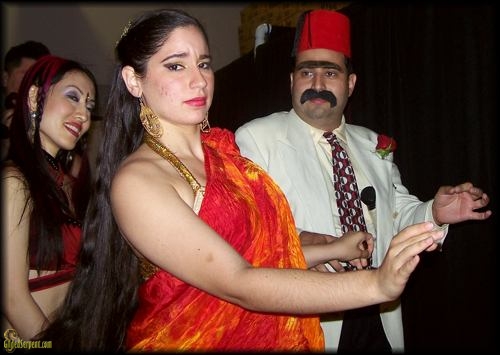
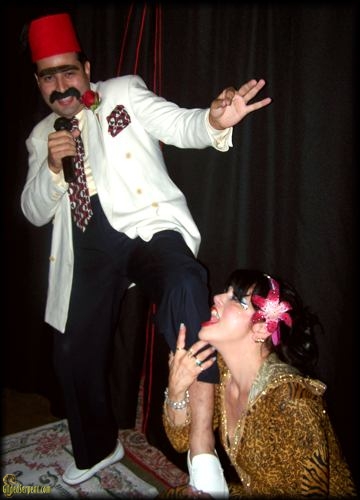
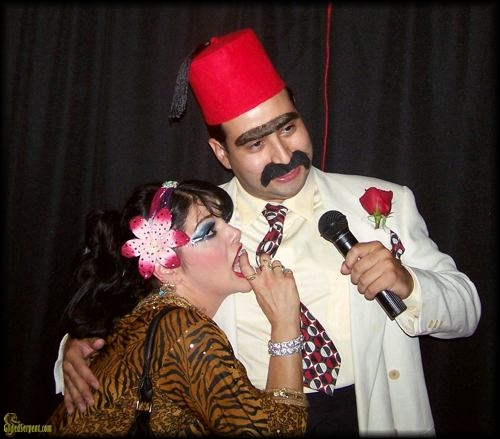
Last seen in Texas at Y’Halla Y’all, the man pictured here spoke of himself as “Hakim”–soon to be performing with James Brown! (hmmm?)   Among the dancers, he was referred to as “The Mono-brow Backstage Stalker”. With his ever-present microphone and consummate photo-bombing skills, he persisted backstage throughout the Saturday evening show and endeared himself to everyone…

I promised that I would let the world of Belly dance know about this singular character! Watch (out) for him at you next event, for he could be anywhere!

Backstage at any event is normally quiet, fairly calm and professional, but, as you can see from the photos, it was quite the opposite this time! In addition to the abundance of participants, there was a film crew from China making a documentary. Interviews were conducted in Mandarin, and “Hakim” made the most of it! He could be spotted slyly skulking, and sometimes, flying into the photos, popping out from every conceivable hiding place to the surprise of everyone.

All of the dancers and musicians now have wildly preposterous photos of the event with Hakim in every one of them!

Enjoy some of the backstage antics!


Bozenka meets Hakim

Bozenka and Yao notice Hakim
Hakim again
and there he is again!
Hakim again
and again…
Hakim Bozenka and Kaeshi
Bozenka, Hakim and Kaeshi
Hakim and Amaya party on!
Hakim, Bozenka and Estelle from China
Bozenka, Estelle and, of course, Hakim
Hakim, Estelle, and Tamalyn
Hakim, Estelle, Tamalyn and Bozenka
Hakim Frank
Frank, Virginia, Bozenka astounded by Hakim and his singing
Mia Politely avoids
Mia politely avoids Hakim
Hakim
Moria, Virginia, Bozenka and Hakim
Hakim and Pangia
Hakim and Pangia
Hakim sings
Pat can’t believe Hakim’s song to Princess Farhana
Hakim and Princess Farhana
Princess Farhana calls security
Princess Farhana contemplates calling security after hearing Hakim sing.
Hakim tries to be interviewed
Hakim tries to get interviewed for the Chinese documentary
Virginia tries to discourage Hakim
Virginia finally convinces Hakim
Virginia is quite convincing!


use the comment box

Have a comment? Use or comment section at the bottom of this page or Send us a letter!
Check the "Letters to the Editor" for other possible viewpoints!

Ready for more?


Gilded Serpent presents...

Fun Times at the Third Annual North Bay Bellydance Bazaar

A Northern California Community Event

Text by Katherine Goldsby
Photos by Carl Sermon
posted January 30, 2011

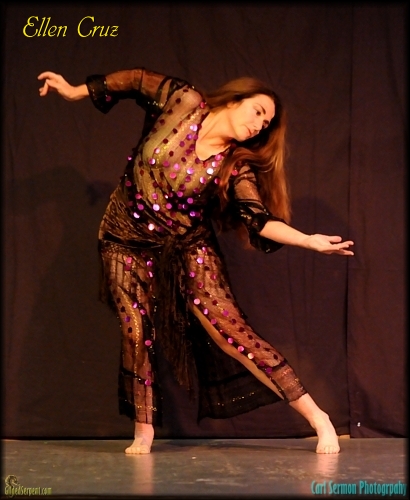
Deborah Bennett and TerriAnne Gutierrez co-produced the third North Bay Bellydance Bazaar (NBBB)  which was held on September 18 & 19, 2010 at the Sebastopol Community Center in Sonoma County, California.  This is the same location as the very popular TribalFest produced by Kajira Djoumahna and friends.  The ‘NBBB’ is reminiscent of Festival Fantasia from years past that was produced by Ellen Cruz and she also gave a rare performance in a lovely pallet dress. 

Ellen is well known within the dance community for her highly professional dumbek style on stage as well as in the classroom as an instructor of both dumbek and authentic Egyptian dance.

  In my eighteen or so years of attending events, as well as being one of her students in the past, this was only the second time I’d ever seen her take the stage in costume as a dancer.  Many friends welcomed her back from a bit of a break and she is once again teaching dance in Santa Rosa.

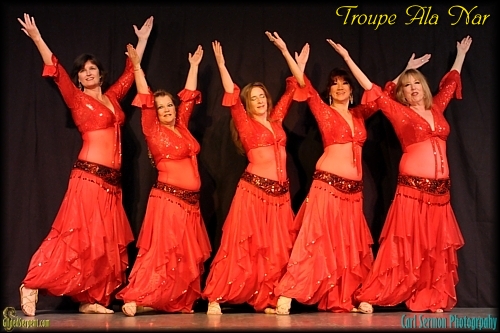
On Saturday Troupe Ala Nar, one of three troupes headed by Sherry Briar, spun red veils passionately and wore lovely all-red costumes with billowing paneled harem pants that looked terrific as they spun.  Earlier in the day, one of Sherry’s students Diana Helmuth soloed a well-crafted Latin Fusion piece that helped set the energy tone for the rest of the day.  Clearly she had no shyness as the mesmerized audience captured her essences evoked from the modern yet classic music.
Troupe Ala Nar
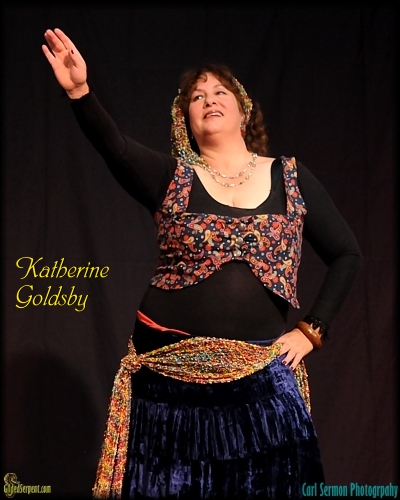
On Saturday, DJ Chango B wowed the crowd by spinning Gypsy/Balkan/World music in between sets of performances, and on both days Ron of Sonoma Magic presented some truly amazing illusions.  When interviewed Ron claimed that he brings a great deal of potential material along and never knows how his shows will turn it out.  Usually performing for adults prompted him to tone down the gore and keep the kids and the young-at-heart happy with endless ribbons, amazing card work, and lots of silk butterflies that just kept appearing out of thin air.  My Roma performance on Saturday was some fun story telling with a less exciting ending than planned due to my skirt sliding down a bit too far.  So it’s a good reminder that last minute blouse changes aren’t wise without a test run!  At least, my authentic Gypsy style can be modified to ‘hands on hips.’

Katherine Goldsby
author

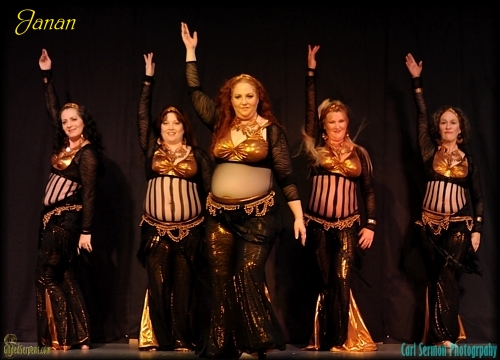
Closing Saturday evening was the Dancers of Janan, under the direction of TerriAnne Gutierrez with percussion by Susu Pampanin and a young student. To make a point about the longevity of this art in out lives, it was announced as a troupe of women all over forty including special guest Eva Stein.  Modern fusion costumes are certainly in this year and this playful ensemble touched the crowd rhythmically with an array of zills, canes, and frame drums, as well as two dancing dumbeks.

Janan

TerriAnne’s Troupe Joweh was preparing to leave for a series of performances in Guatemala, and this event took place a week before the Desert Dance Festival in San Jose.  On that same weekend, there was The GlendiFestival in Santa Rosa, which offers food and dance from Middle Eastern to Russian, Eritrean, and Greece; not to mention the popular Much Ado About Sebastopol Renaissance Faire taking place in nearby Ives Park.  The timing of the Bellydance Bazaar may have affected attendance and though the festival attracted well known vendors like Artemis Imports, L.Rose Design and much more; there was no outdoor souk as advertised on the website. 

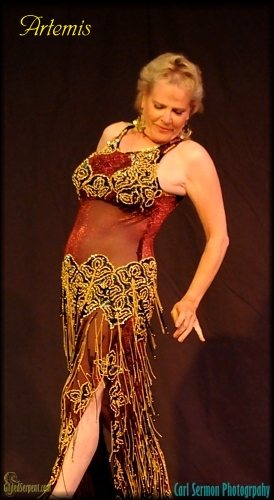
Artemis

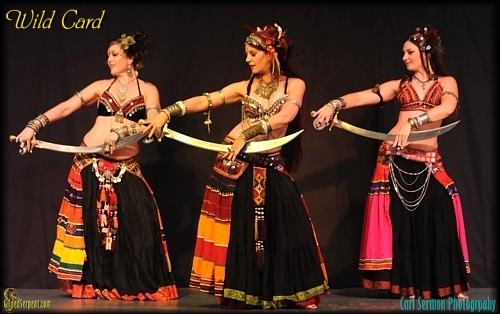
Wild Card
Perhaps the vendors and patrons were saving their energy for the coming weekend at Desert Dance in San Jose or they chose to attend the other fun events happening around the area.  Despite the high level of instruction available both days; class attendance for every instructor was lower than expected.  A wide variety of classes were available including Elana Quihuis with Shimmies 101, I taught my light hearted Zilly Boot Camp, and Jodi Waseca inspired Contemporary Fusion Choreography.  Ellen Cruz was back teaching Bellydance Basics and the troupe WildCard Bellydance shared Tribal Combinations and Transitions. 

Jodi Waseca

Ellen Cruz

Jodette's Belly Dance Academy
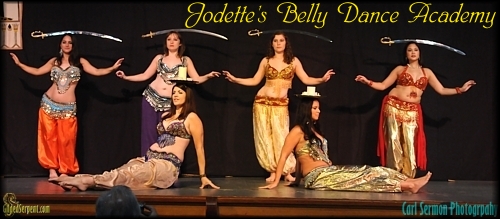
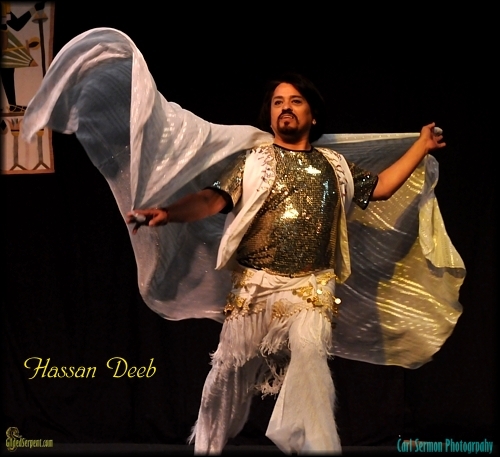
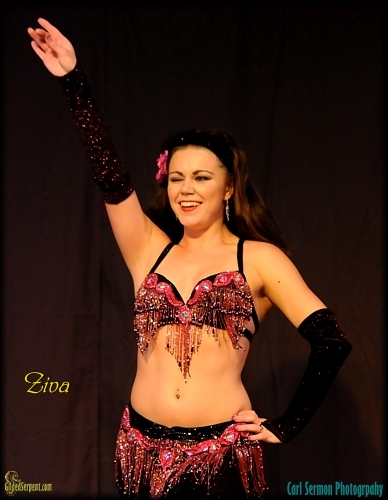
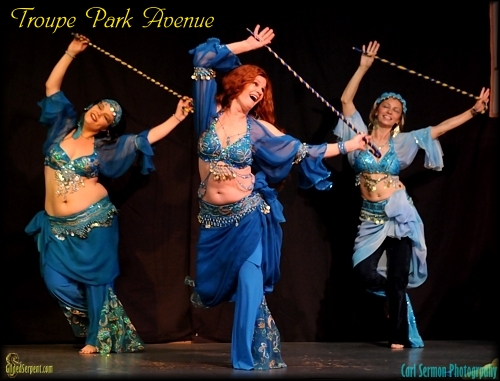
On Sunday, Jodette’s Belly Dance Academy dancers from Sacramento were just beautiful in every way.  From opening with veils, balancing candles on trays, and snappy choreography, no one could deny them attention.  Vendor and performer Hassan Yousef Deeb wowed us with classic yet modern male belly dance, including fabulous veil work.  Ziva gave a dynamic, well rounded cabaret style performance in slinky costume with gauntlets that gained great applause.  The developing Troupe Park Avenue came up from Monterey and did a wonderful job. I hope to see more of them at future festivals and they are named after the studio where they rehearse under the instruction and choreography of Janette Benedon-Brenner.

Hassan Deeb

Zia

Troupe Park Avenue

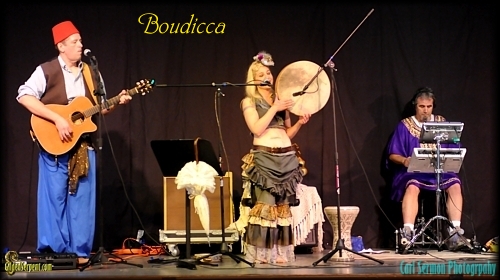
The live music portion from Boudicca on Sunday was good and varied but many festival attendees chose to leave early which was unfortunate for the final performers who came on after the band.  Overall, the event felt like old home week with a few new friends and younger dancers, but in general, it was a reunion of North Bay and other local dance community friends coming together as we have for the last twenty year.

Boudicca

More photos

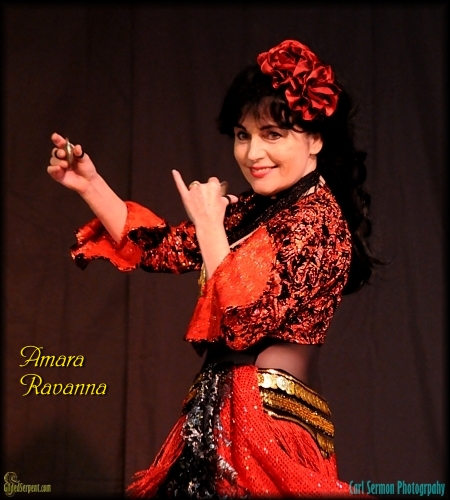
Amara

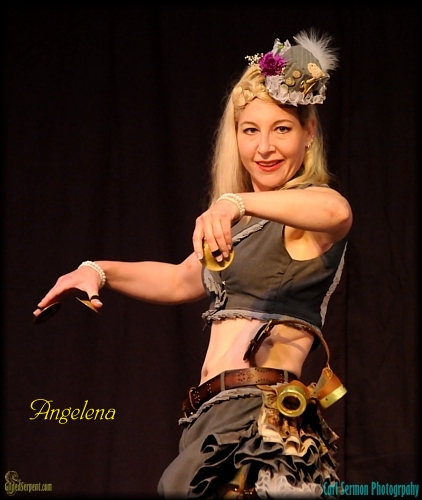
Angelena\

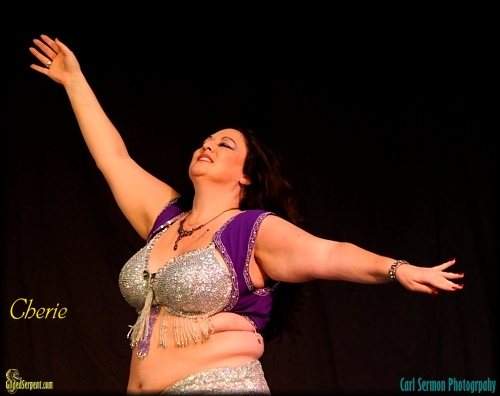
Cherie

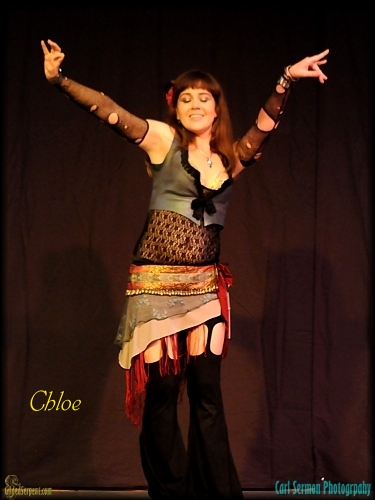
Chloe

Dance Journey

Dancers of the Desert

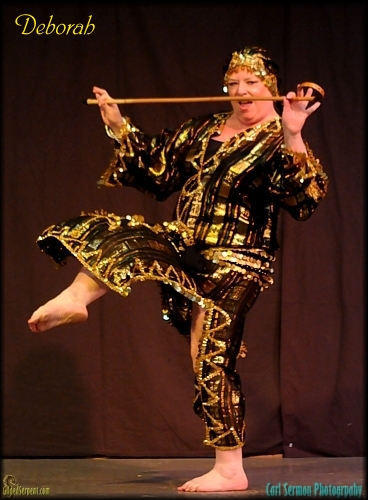
Deborah

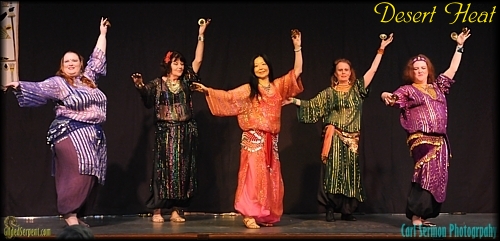
Desert Heat

Diana

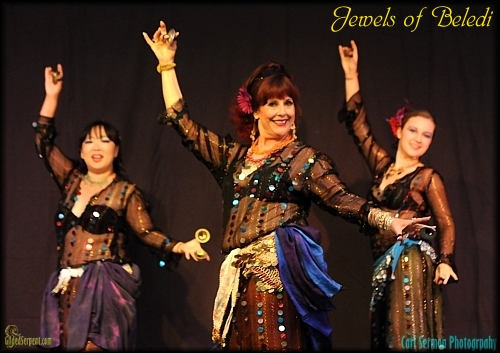
Jewels of the Beledi

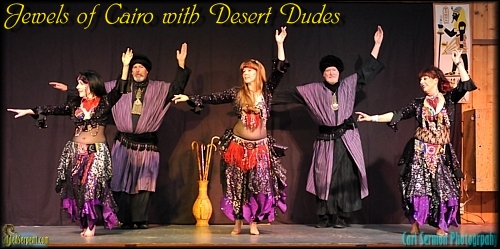
Jewels of Cairo with the Desert Dudes

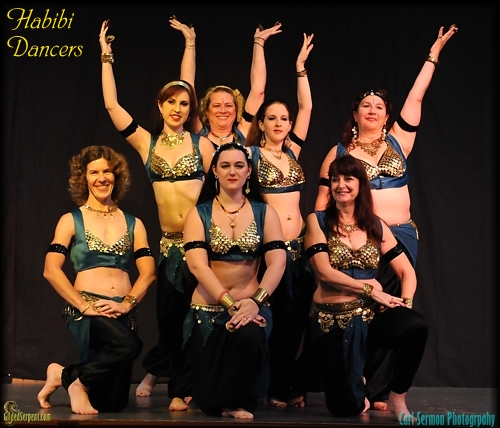
Habibi Dancers

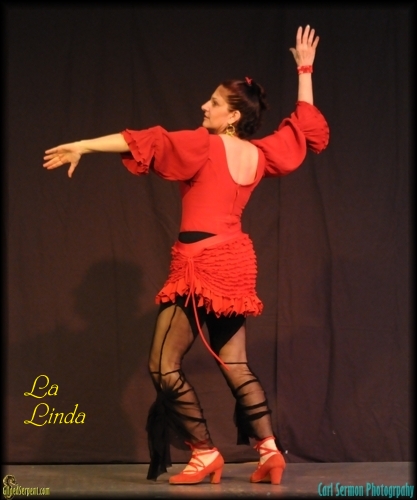
La Linda

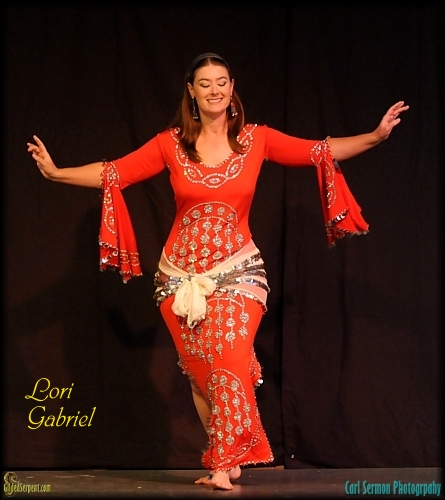
Lori Gabriel

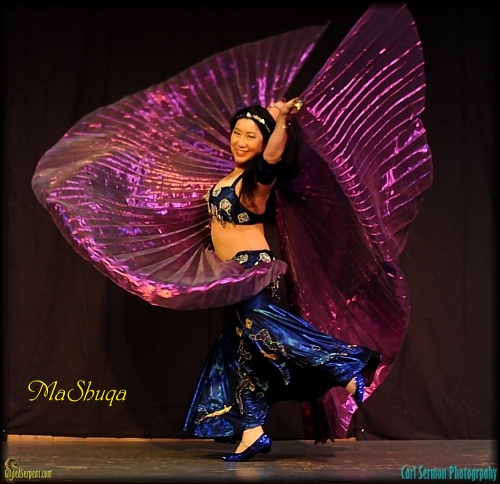
MaShuqa

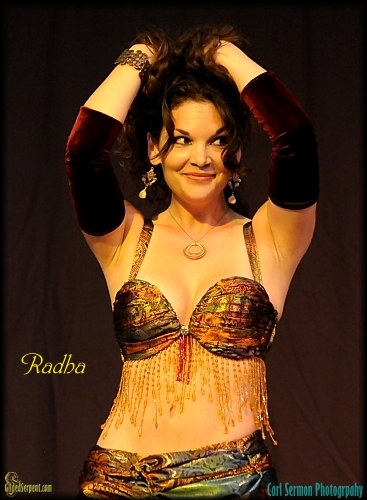
Radha

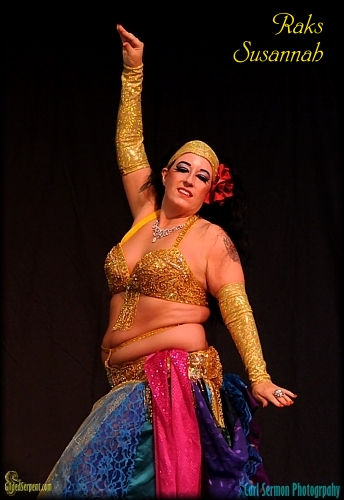
Raks Suzzanah

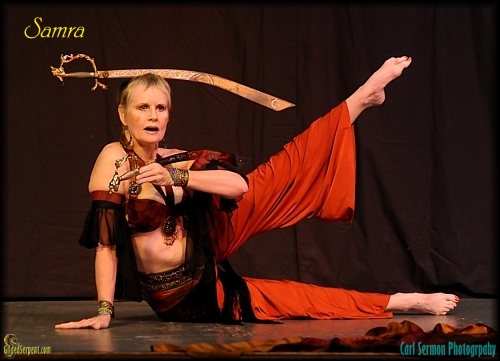
Samra

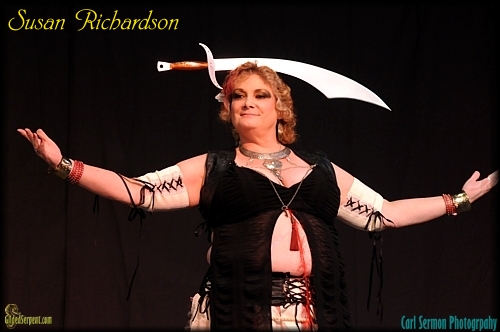
Sisan Richardson

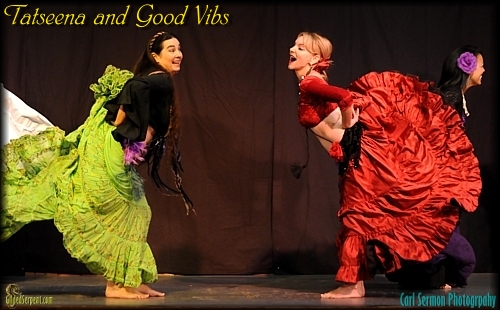
Taseena and Goods Vibs

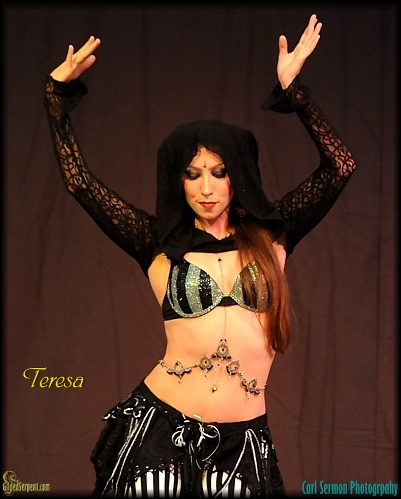
Teresa

Terry Del Giorno

For more information on this event see

www.northbaybellydancebazaar.com/

use the comment box

Have a comment? Use or comment section at the bottom of this page or Send us a letter!
Check the "Letters to the Editor" for other possible viewpoints!

Ready for more?


Gilded Serpent presents...

The Unpleasant Truths

Ashiya of Lincoln,Nebraska

Part III of Being a Professional

by Ashiya and Naajidah
posted January 28, 2011

In our last article we discussed the look necessary for a dancer if she wants to be a professional Cabaret dancer.  Now that you have your look, there’s even more!

Over the years we have learned by observation and by trial and error what it takes to get gigs.  The following may not seem fair to you, but the entertainment business isn’t fair.  It’s a tough job involving dedication, hard work and a lot of luck!!  We’re not telling you these things to be mean, but to help you navigate the sometimes cut throat, and always competitive world of entertainment! You’ll need to toughen up if your feelings are easily hurt because believe us when we tell you that they will be.

If you really want to be a professional, first and foremost you must understand you are not so much a professional dancer as you are an entertainer.

The average person hiring a belly dancer doesn’t go looking for the dancer with the best isolations, the best zill technique or the smoothest spins.  They are looking for an image, a package.  Think of a tube of toothpaste at the grocery store.  Which tube gets noticed?  The organic/generic plain tube with the plain lettering in the bin at the bottom of the aisle or the tube in the shiny box with the embossed/metallic lettering and the promise of new and improved?  The public is fickle; they generally want a look or an image and if you want to get hired you better fit the look.

Angel with harpA number of years ago when Naajidah was still playing harp professionally an acquaintance of hers who was a nationally known harpist confided that she often got gigs where the customer was looking for “a blond with a gold pedal harp”  This woman is one of the top harpists in the country!  Did they care? Nope.  Did they ask about her repertoire? Nope.  They wanted a blond with a big shiny harp.  Of course they wanted her to be good, but first and foremost to get the job in the first place, she needed “The Look”. 

The public wants a look – they want a sparkly dancer in a beautiful expensive glamorous outfit, they want you to look like a model.  Oh yeah – they also want you to dance.

On the other hand, Ashiya is a blond dancer in a dance world which is looking for the western image of the dark haired harem dancer.  She’s been told to her face that she isn’t the image they wanted for a particular show because she is blond and blue eyed.  Hard to take?  Sure, but if you don’t fit the image they want, then you don’t get the job.  So, you work harder and move on to the next performance and you quickly learn you cannot take it personally!  Learn to accept that you aren’t always the perfect fit for every event.  As a sideline to that particular event, she was eventually hired because the gal who had the “image” wasn’t a good dancer and after seeing Ashiya perform, she was hired on the spot.  As we said earlier…..fickle.

Here is a hard and fast rule.  When you are dancing professionally you do not get to call the shots.  It may not seem fair to you, but the customer is in charge.

Ah, the wonderful, glorious sound of music.  This is where we have seen a lot of dancers fail horribly and not understand why they didn’t get the gig or didn’t get asked back.  The secret to
repeat gigs is to give the customer what they want (within the bounds of propriety of course). You may just love that 7 minute piece with drums and mizmar, but we promise you that unless you are performing for other belly dancers or people from a Middle Eastern country, about 32 seconds into the music you will have lost your audience. The vast majority of our potential customers are Western.  They don’t really understand Middle Eastern music, it sounds strange, and the really good stuff is not going to be appreciated by them.  Keep it short and keep your pieces under five minutes, unless you are hired for a full show by yourself. It’s much better to leave them wanting more rather than wishing you’d hurry up and finish.  Listen with a critical ear.  Your music must be pleasing to the ear of a typical person, not someone who is schooled in the intricacies of non-Western music. 

What sounds normal and cool to you might very well sound horrible to the average person.

But – don’t think that simply switching to western music is the right thing to do either.  You are an Oriental dancer.  If you are representing yourself as such, then the public expects exotic music.  It’s an extremely fine line to walk, finding music that is representative of the culture while still being pleasing to the western palate.  Listen carefully, listen to lots of music (be prepared to buy tons of music that you will end up never using because after listening critically you realize it won’t work).  The sad, sad truth is that you loving the music is not the criteria for picking performance music.  The exception, of course, is workshops where other dancers will understand.  If you want paying gigs, you must keep firmly in your mind at all times who is paying you.  It doesn’t matter what you like/want, what matters is what the customer will like.

Know your venue and do your homework.

Tartar community birthday partyAnd it doesn’t end there.  Do your homework!  Who is your audience?  Did you get hired by a local charity to do a Night on the Nile fundraiser event?  Then you better start looking for Egyptian music!  This is not when you pull out your favorite Gobsmack numbers!  Get hired for a Greek dinner at the local college?  Again, do your homework.  This isn’t the time to be using your favorite Lebanese singer!  Greek music is in order.  Don’t like the style of music needed for the gig?  Too bad.  Get used to it, learn to love it or pass on the gig.  You will do yourself no favors dancing to music that you hate.  It will show on your face, and be reflected in your dance and your chances of getting asked back are slim to none.

This is a true story: A local dancer who was new to restaurant dancing was hired by a Greek restaurant to do two shows.  She was specifically told to use Greek music.  For the first set she did and it was well received.  For the second set she didn’t (she said she wanted to use her music that she liked) and the owner literally had a meltdown in the middle of the restaurant.  He yelled at her about the “horrible Lebanese music” and told her to “never use such garbage again”.  Needless to say, she has not performed at the restaurant again.

Your job is to entertain the audience.

For the average gig… you are wallpaper.  They truly don’t care how fast you can shimmy, or if your dance moves are Lebanese or Turkish.  For the average restaurant gig or party you are somewhere in importance between the quality of the food and the décor on the walls.  You are a small part of a very big event.  Don’t ever forget that.  Your job is to make the guests feel important, the host to feel special, and the customers to be glad they came.  People will remember the event… “oh yeah, the food was great, and the desert was to die for…… oh there was this belly dancer in a beautiful red costume with a sword on her head….did we mention how good the desert was”? 

You need to do your best, you need to make them glad that they hired you but you also need to not take it personally that people aren’t watching your every move, and are sometimes ignoring you.

Several years ago one of our student dancers performed with us as a guest dancer at the restaurant we worked at.  She had a beautiful gold costume, and had worked on her solo for months getting ready for her big chance.  When she finished she was visibly upset.  During her solo one of the customers was celebrating their birthday.  The table was right in front of the stage.  They brought out the cake with candles while she was dancing.  She was very angry that people ruined her solo with their party.  But – she missed something vitally important!  The customer or guest or person paying the bill was the most important person there, not her.  She could have turned this to her advantage.  Danced up to the guest of honor, made a fuss “oh, it’s your birthday… get up and dance with me”, draped her veil around them and made them feel special.  The restaurant owner would notice this, believe me.  The host would notice.  People would remember what a wonderful job you did making them feel special.  That is how you get gigs, not with a 10,000 mph shimmy, not with perfect hip lifts.  An attractive dancer who is good (not great) will trump a beautiful dancer who is a great dancer if she knows how to make the customer glad they came, and the host glad they hired her.  If you make your customers your number one priority you can’t go wrong!

Keep it changing!  If you have a longer gig don’t just use one kind of music.

spanikopitaThe average person watching you dance is easily bored.  Rather than using one long song, no matter how beautiful, you are better off with two or three short numbers.  Something fast and bouncy to start out with, a slow and very short middle (maybe with a veil) and finish it up with something fast.

We went to a restaurant in another town several years ago.  The dancer was very good, and had even brought her own drummer with her.  For her entire half hour show she danced to nothing but drumming.  Now, the drummer was excellent, and played many different rhythms – Baladi, Cheftitelli, Ayoub, etc.  But the average westerner in a restaurant doesn’t know an Ayoub from a Spanikopita.  They get bored easily.  Sure, use a drummer if you can because live music is always a big plus, but intersperse it with taped music if you are doing a long performance.  Also, you may do Cheftitelli beautifully, you may be able to hold a backbend rock solid for minutes, but the audience doesn’t care.  They’ll glance at you and go back to their dinner.  Keep it light, keep it bouncy, mix it up, and keep the slow stuff to a minimum.  Think MTV – flashy, fast, constantly changing.  Our western world is used to ordering at window 1 and getting it at window 2.  They are not a patient audience.

Believe it or not, you still have to be a good dancer. 

Yes, we’ve been talking about other stuff, but the bottom line is… if you can’t dance you aren’t going to last long in this business!  Practice, drill, attend workshops, keep learning, and keep growing!  We’ve been doing this for years and are still taking lessons and practicing.

And last but not least, what do you charge for you?

Pricing is going to vary depending on the area of the country.  We can only speak for what is standard where we live in the Midwest.  The important thing to remember is to not undervalue yourself, but don’t price yourself out of the job either.  Is that vague enough for you?  Our best advice is to talk to other dancers, find out what they charge and then charge accordingly.  We have a price guideline sheet that covers everything from Bellygrams to full shows.  When dealing with a potential client, you need to be confident enough in your skills as a dancer to ask for adequate pay for your performances.

One word of advice.  DO NOT UNDERCUT OTHER DANCERS.  If you are good enough to call yourself a professional dancer, then you deserve the same pay as other dancers in your area.

Coming next time…..Part IV:  Now you have arrived….What It Really Takes to Stay There

use the comment box

Have a comment? Use or comment section at the bottom of this page or Send us a letter!
Check the "Letters to the Editor" for other possible viewpoints!

Ready for more?


Gilded Serpent presents...

Joweh’s “Call to Dance” in Guatemala

Placeholder

Part 1: Arrival

by Chloe Villarreal
posted January 27, 2011

The few passengers and workers who happened to be at the San Francisco International Airport at 4 AM on a Thursday morning blinked bemusedly at the group of women approaching. I guess they had reason: hair in vibrant red waves or multi-colored and up in twists, some flared purple dance pants tied up above black leather boots, a few matching black T-shirts printed with a mysterious phrase: “Joweh R.A.W.” We trudged in pushing trolleys laden with drum cases and a suspiciously long and heavy cardboard box, heading for the Taca Airlines terminal and a 7 AM flight to San Salvador, then a connecting flight to Guatemala City.

So began Troupe Joweh’s biggest adventure yet.

After sometime of planning by our director, TerriAnne Gutierrez, and months of fundraising, we were thrilled to finally be on our way to Guatemala City, on the invitation of the nonprofit cultural arts center ArteCentro Graciela de Andrade Paiz. We would be spending ten days there, teaching workshops at the ArteCentro and performing our show, “A Call to Dance,” for two nights at the Instituto Guatemalteco Americano, accompanied by our drummer, Susu Pampanin.

Troupe in the JungleAfter a short layover in San Salvador, we arrived at La Aurora International Airport in Guatemala City, where we were welcomed warmly by ArteCentro’s general director Silvia Bolaños and dance coordinator Juan Domingues. They shuttled us (using a whole car just for our luggage!) to the Hotel Panamericana in the historic Zone 1, the oldest part of Guatemala City. What a wonderful place to stay! Our rooms were decorated with beautiful Mayan textiles and woodwork, and looked out onto a street that became a busy outdoor market in the evening. In the huge, 1920’s-style dining room, the friendly staff served us delicious traditional food; we loved the caldos and the pepián! We also still crave the pureed black beans, fried plantains, and fresh tortillas served with our breakfast every morning.

Even our exhaustion couldn’t dampen our excitement and eagerness to explore our fascinating new surroundings.

Juan and Silvia proved to be gracious hosts and even better friends, allowing us a glimpse of Guatemala that few tourists got to see. They instructed us in proper haggling etiquette at the Central Market and introduced us to some of their favorite spots to wine and dine.

The most amazing place they introduced us to, though, was the ArteCentro itself.

Opened in 2007 by Fundacion Paiz, the ArteCentro Graciela de Andrade Paiz is dedicated to the development of the community through education in the arts. Through ArteCentro, hundreds of Guatemalans of all ages and backgrounds have been able to learn dance, theater, visual arts, and music for little or no cost. The place itself is beautiful, inviting, modern, full of color and art displays, and often teaming with school age children who giggle and chat in the hallways as they wait for their guitar or acting classes to begin.Guatemala map

Over the next few days several workshops were given by TerriAnne and Susu at the ArteCentro: Cabaret choreography, percussion, zills, as well as a Tribal Fusion taught by Jodi Waseca. The most fun we had was at the close of the week, when we presented a special modern choreography class taught by all of the Joweh members. With Susu being fluent in Spanish, she became our official translator and we all had a blast getting to know our students and working together! We were very impressed with them as they learned to perform a whole Joweh choreography in just two hours!  That night we truly admired these Guatemalan bellydancers for their enthusiasm, hard work, and great senses of humor. After feeling the love, with many hugs, photos, and exchanges of email addresses, we were whisked back to the hotel by Juan and Silvia, to rest up before our big show. (All right, we may have stopped briefly at an undisclosed location for a few rounds of caipirinhas and impromptu singing of 70’s tunes, but only to calm our nerves!) We would be performing in Guatemala’s most beautiful, and prestigious, theater the very next day!
 
Part two coming soon….

Names of troupe members pictured in photo: Elizabeth Friend, Chloe Villarreal, Radha Romero, Tereasa Camp, Nicole McMasters, Jodi Wacesca,
Susu Pampanin sitting
Photo by TerriAnne Gutierrez

use the comment box

Have a comment? Use or comment section at the bottom of this page or Send us a letter!
Check the "Letters to the Editor" for other possible viewpoints!

Ready for more?

  • North Bay Bellydance Bazaar
    There were workshops all day (taught by Theresea, Susu Pampanin, Magidah and Hannah Romanza), a large bazaar, all-day dancing performances and an evening gala show. Everything a dancer could want.
  • Review and Rating of 2002’S MIDDLE EASTERN DRUM CD/TAPES
    This is a review of eight of the most popular Middle Eastern Drum recordings produced this year. Incuding works by Reda, Susu, H Ramsy, Zaid, Mafufo, and more…
  • Its All in the Flavor! Bellydance in Mexico
    Those were tough times for us teachers. Students were very shy in the classroom but eager to learn; some of them even thought that Shakira had created Bellydance! They didn’t have much information about Oriental Dance, its origins, or different styles. Some aspiring dancers even sat through several classes just to check out what Bellydance was or if we teachers danced it as well as Shakira.
  • Tajikistan: The Land of Dance Part One
    Video features: #1-Introduction by author, #2- A Map Tour on an ancient and modern map.
    " Communication with the outside world is difficult and expensive, and
    nearly impossible during the winter."
  • The Bellydance Scene in Taiwan Toss Hair Dance
    The women were much more skillful than I expected: just 3 years ago, nobody in Taiwan really knew anything about Bellydance.
  • The Birth of a Dance Scene, The History of Oriental Dance in Switzerland
    Please allow me to introduce some of these groundbreakers so that you will appreciate what it was like to be an Oriental dancer in Switzerland in the early 1980s.
  • Dance Journey to Nepal
    I will never forget Nepal and the dance adventures we encountered. They will remain etched in my mind forever. What I found most amazing is how much I learned about Middle Eastern dance going to Asia.
  • Belly Dance in Israel
    Belly dancers are the hottest trend at the moment, unlike the totally frozen attitudes towards the Arab culture in Israel.
  • 1-25-11 The Fusion Category, Photos from the 20th Annual Belly Dancer of the Universe Competition by Carl Sermon
    Amani Jabril, Apsara, Dilek, Eliza, Gina, Jane, Kellie, Khuzama, Lucia, Maria, Mireya, Rachel, Tiaja, Tracy, Valentine, Zondra
  • 1-24-11 Smooth Growth of Community Event, Las Vegas Intensive report by Neferteri
    It was interesting to note that everyone I talk to said they came to the convention so they can say that they had danced in Las Vegas.
  • 1-20-11 Queens in Arizona? USA Belly Dance Queen: Arizona Arab BD Contest by Roza
    To be honest, my favorite part was that the show presented an interesting challenge to many American dancers. They were required to identify the regional and cultural style of music they would be dancing to and represent that root in their technique, costume, and dance styling.
  • 1-18-11 Delilah, Women, Nature and the Body by Barbara Sellers-Young PhD
    This belief in the force of the earth is central to Delilah’s approach to teaching belly dance.
 

Gilded Serpent presents...

The Fusion Category

Photos from the 20th Annual BDUC 2010

Photos by Carl Sermon
posted January 25, 2011

The Belly Dancer of the Universe Competion is produced by Tonya and Atlantis in mid February each year.
This is the 20th year and was held in the Long Beach Convention Center.

Editor’s note:
Would the below contestants please add a comment at the bottom of this page giving a short description of your performance please!
What were you fusing and what kind of music were you using? Thank you!

Amani Jabril

Apsara
Dilek
Eliza

Gina

Jane
Kellie
Keren
Khuzama
Lucia
Maria

Mireya

Congratulations to Mireya, the Fusion Champion of 2010!

Rachel
Tiaja
Tracy
Valentine
Zondra

Belly Dancer of the Universe Competition

Belly Dancer of the Universe #21 coming soon!
February 18-21, 2011 in Long Beach California

Witness this year’s event with Gilded Serpent!

use the comment box

Have a comment? Use or comment section at the bottom of this page or Send us a letter!
Check the "Letters to the Editor" for other possible viewpoints!

Ready for more?


Gilded Serpent presents...

Smooth Growth of Community Event

Las Vegas Intensive 2010 Report

by Neferteri
posted January 24, 2011

Las Vegas is known for many things but in the last few years Belly Dancing is making it’s mark. We have several community halfa’s, workshops, conventions and great many dancers. There is a strong belly dance presence at the Renaissance Festival too! This year we have had all types of visiting instructors from near and far and a variety of dance troupes. There are several conventions such as The Wiggle of the West, and The Tribal Massive, and The Las Vegas Intensive. This year I was in town so I went to the “Intensive,” as it is called by those of us that live here.

This year the Intensive was held on the strip at The Flamingo Hotel. It was their 8th year to date. As a past instructor at the Intensive and I have witnessed it grow from an idea of bring community teachers together at a dance studio for a weekend of teaching to a 4 day event at The Flamingo Hotel. So yes, it has lost some of it’s intimacy, but it seems to be moving towards bigger and perhaps better things. I did get a chance to re-connect with some old friends and make some new ones.

Everything was well organize and seemed to run smoothly and the volunteers were awesome! My hat is off to the volunteer of this event. They were well prepare and were prepared to answer any question or concern anyone may have and I did ask. 

I enjoy going to events where everyone is well inform and knows what is going on. I been to a few events where I am dancing and the person at the event has no clue or they are 2 hours late. So, needless to say, I was impress with the efficiency at this event.

When I wasn’t day dreaming about some of the goodies that were for sale at the convention, I was able to watch the open dance show (I did a lot of sitting due to my injured toe). The show was well organize, and had a good stage area and sound system. I was also impress that they were running pretty close to schedule.  I hated standing around waiting to dance when the event is behind schedule so this was appreciated by me. The line up had dancers from Alaska to Isle of Man. I will say there was a strong tribal presence through out the event and around the hotel; Go Tribal!

There were cabaret dancers (including some men; yes I have pictures!) and tribal dancers. I did get a chance to talk to some of the dancers from other states as well as some of the international dancers. I asked some of the international dancers what they thought of American belly dancer? They say we were good maybe a little too good because we are very technical. Everyone did a wonderful job! It was nice to see everyone act very professional; I really didn’t see any diva behavior.

It was interesting to note that everyone I talk to said they came to the convention so they can say that they had danced in Las Vegas.

I over heard a dancer say she didn’t care if she was videoed in the parking garage as long as there was something that said Las Vegas! My, times have change! When I started dancing everyone wanted to go to California to dance at an event there (I still do).

There were lots and lots of vendors about 24, from near and far and their setup was well arrange as well easy access for the public. I have been to other events and vendors are push together, you can’t hear yourself talk. it was refreshing to see that their setup was comfortable to both vendor and buyer. I did stop by several vendors such as Firefly, Amira of Las Vegas and Joharah International, and they were excited to be in Las Vegas. When I spoke with a few of the vendors they did say that sales were down due to the economy. One vendor did say her sales were great last year but down by 15% this year.  So some are hoping that some mail orders will kick it. 

I had to buy something of course, so my new silk fan veils  have been added to my family props. I like them but of course they will never replace Seiti (my snake baby).

The fun did not stop with the convention there was an after party! The party was one of the highlights of “the intensive.” The after party was hosted by none other than  Mr. Harry Saroyan! He was a fabulous  M.C. and it was a good time had by all. There was food a live band and lots of dancing and of course an Elvis imperators, this is Vegas after all.

Top photo: Iihan of Las Vegas
unknown dancer1

Nina Nisha Castaneda of Las Vegas and Aurora

Bellydancers in Paradise

Makara of Volcano, Hawaii & Chandani of North pole Alaska


use the comment box

Have a comment? Use or comment section at the bottom of this page or Send us a letter!
Check the "Letters to the Editor" for other possible viewpoints!

Ready for more?

  • Fahteim in Vegas
    The Las Vegas 2006 belly dance season is off to a phenomenon beginning!
  • What Kind of Snakes are Good for Dancing?
    “So many snakes, so little time.” What is a girl to do? I am often asked what is a good snake to dance with. Well, that depends on two things.
  • Belly Dancing in Las Vegas (part 1 of 2
    I am pleased to introduce a few of “The Divas of Las Vegas!”
  • Belly Dancing in Las Vegas- Part 2
    Who are those good looking and talented men behind the dancers?
  • Belly Dancing with Snakes
    My snakes have their own room with a scenic view of Las Vegas, and it is temperature controlled.
  • Glass Dancing
    The art of dancing on glass is a true measure of talent and nerve. It can be one of the hardest things you can do as a dancer, but the rewards are awesome!
  • I am Neferteri
    There appears to be some curiosity about the racial background of a dancer. I don’t fully understand why anyone in today’s world would care, but they do.
  • Farouk
    "I am always looking for ways to enhance my performance and leave a memorable impression"
  • Using Magic is My Style
    Do you want to make more money at your next gig? The answer is Magic!
  • 2-6-09 The Las Vegas Bellydance Intensive 2008: Vegas and Belly Dance Celebrities Report by Mareeshka, photos by Brad Dosland
    Just as its host city brings together Paris’ Eiffel Tower , the fountains of Bellagio, and the pyramid of Luxor , the Bellydance intensive brings together this local talent with international stars, combining traditional cabaret with the latest tribal styles, to create a big event that feels comfortably intimate
  • 12-6-07 IBDC- Part 1 A Brand New Idea for Belly Dance: The Festival Idea in its Formative Years by Amina Goodyear
    I’m speaking of a festival and its promoters that promised more than they were able to deliver.
  • 1-7-08 IBDC Part 2:- A Gilded Serpent tale, Alex in Wonderland, by Amina Goodyear
    Unfortunately, the event did not draw the amount of vendors he had expected and, I believe, because he himself had not yet made a reputation for himself as a credible festival producer, he did not get the numbers of the dancers he wished for. Belly dancers are special people and Alex personally did not understand their basic nature.
  • 7-17-08 IBDC Part 3: The Community Response- Dream Big by Betsey Flood, Photos contributed by Masouma Rose and Monica
    What did those who attended that Las Vegas event last August – the one that strove to become the biggest belly dance convention ever –think about their experience? Their answers may surprise you.
  • 2-27-08 One Night at the El Morocco in Las Vegas by Anajim
    Oh God, now we have to stay or be rude. I had a brainstorm, and retorted, "Well, I only like Armenian music. If you can play any of that, we will stay".
  • 1-20-11 Queens in Arizona? USA Belly Dance Queen: Arizona Arab BD Contest by Roza
    To be honest, my favorite part was that the show presented an interesting challenge to many American dancers. They were required to identify the regional and cultural style of music they would be dancing to and represent that root in their technique, costume, and dance styling.
  • 1-18-11 Delilah, Women, Nature and the Body by Barbara Sellers-Young PhD
    This belief in the force of the earth is central to Delilah’s approach to teaching belly dance.
  • 1-18-11 Europe’s Newest Dance Destinataion, Split Tribal Festival in Croatia by Paola, Photos by Marin Culic and Dunja Cuk Podolski
    It’s like an Italy that one can actually afford, due to the fact that it is not yet an European Union country, and therefore not subject to the massive cost of living spikes of EU member nations.
  • 1-16-11 Sword Disasters: A Lighter Outlook on Belly Dance, Part 2 of The Dumb and the Restless by Tasha Banat
    I laughed at him, but that very night during my grand finale Sword Act… you know – that dramatic spin where you stop and the sword continues to spin on your head like a helicopter blade?
 

Gilded Serpent presents...

Queens in Arizona?

Winner of USA Competition Makara!

USA Belly Dance Queen: Arizona Arab BD Contest

by Roza
posted January 16, 2010

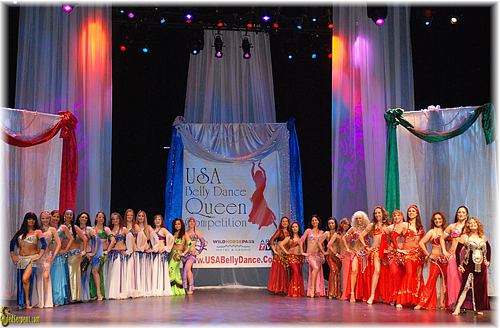
Curious to see how Arizona’s first ever Belly dance competition would go, I accepted an offer for my troupe to perform. I loaded my daughter into the car and set out for the USA Belly Dance Queen Competition.

It was a formal affair in the Ovation Room at the Wild Horse Pass Casino in Chandler, Arizona, and, I have to say, I love the name of the event!  It reminds me of Cairo, where dancers like Brazilian Wunderkind, Soraya, emphasize that while dancing your entrance, the attitude should be, “I am a queen;  this is my entrance”.  Egyptian Momo Kadous states with his customary dignity, “Your hip is the queen”. 

In Egypt, references to “queen” are abundant, which initially seemed unusual to this American traveller, yours truly, until after enough trips to the museum and historic spots spelled out to me the simple truth: queens are a natural part of Egyptian history and culture. 

Therefore, the term logically befits the carriage of a celebrated dancer, or any dancer in the mood for that matter.  The founder, Ashraf Elgamal, of Belly Dance Queen is Egyptian; so the title ties the theme together rather nicely.

The September 18th competition set a precedent on a gorgeous stage, high above the theater seating, light streaming down on the brightly colored ribbons flowing from the high ceiling; it made for an inspiring evening, absolutely fit for a queen. Shirley, a Tempe based dancer, declared she felt like a rock star performing on that magnificent stage!  Would the term “rock star” be the modern day equivalent of “queen” to some Americans? Either way, it sounds like a grand time, a way to really live and love life. Welcome to the glamour and light of Oriental dance, Arizona!

Venusahara competing

To be honest, my favorite part was that the show presented an interesting challenge to many American dancers. They were required to identify the regional and cultural style of music they would be dancing to and represent that root in their technique, costume, and dance styling.

Many dancers had never challenged themselves to find the songs titles, artists, lyrical translations–much less the cultural and regional dynamics that accompany this difficult art. Hossam Ramzy states in no uncertain terms that “until we treat this dance as a science, as they do in Flamenco or Classical Indian style, it will never be respected as a dance form, in the way that those dances, or even ballet or jazz dance are respected.”  (Personally, I think every Belly dancer should read the articles about dance on his self- titled website.) My point is that the USA Belly Dance Queen Competition was put on by the Arab American Association, which did a good job of goading us closer to the very goal of creating a higher level of knowledge about the art of Belly dance (and hence respect for the art).

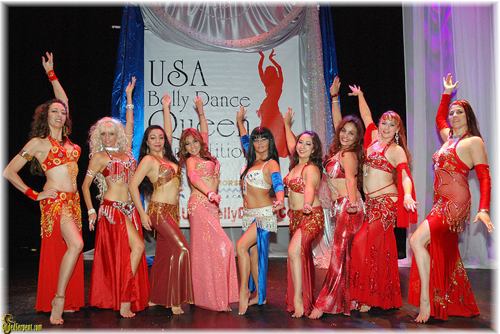
The show and competition lasted over two hours and styles ranged from Turkish to a highly finessed Egyptian style by Russian American, Inna of Iowa. Our grand prize winner, Makara, a well known Phoenix dancer did a dramatic Baladi style dance with Isis wings. (Makara, I may add, is a bit of an icon due to being unbelievably confident with her superb body and appearance, even after giving birth to seven, yes, ladies and gentlemen, seven children.) She clearly believed she was a Belly dance queen in every cell of her body and her stage presence and confidence filled the grand hall.

Hailing from Tucson Arizona, the winner of the intermediate section, Lara Grewe, displayed great confidence and a playful approach. We saw fabulous use of floor space by Amira of California, and truly professional Turkish and pop numbers from California and Arizona Dancers.  Carrie Konya of Sedona was at the top of her game in the final round where dancers performed a dance-off by choosing a CD from a stack provided by a DJ and improvising onstage to a soundtrack they may or may not have heard before. I was immensely impressed with the sportsmanship displayed by so many of these women, both in regards to the competition and treatment of each other. The quantity of contestants was not great but the talent certainly was, and I believe it was a very close competition.

My troupe, Shahrazad Dance Company,  did a guest appearance with a Hossam Ramzy drum solo and an Awalim-inspired number that I learned from Faten Salama this year in Cairo. It was exciting and also an amazing opportunity for some of our newest dancers to get their initial big stage performance experience. They all loved it.

It was an exciting time for Phoenix dancers and their fans, families, and friends.  We all made many new friends and contacts (I’m inviting Innah back to do a workshop in November.) and I am glad that the Arizona Arab American Association and founder, Ashraf Elgamal, put on such a fun event. I’m hoping to come closer to a fewf personal goals: to bring together the Arab American community with that of the dance community, and to raise Arizona’s standards in dance to more closely resemble those of Europe, Argentina, Korea, in short–the International community–and simply to have a more interesting and fun place to live.


Photo at top of page: Ashraf and Radwa award Makara with the winning trophy.
Photo above left is Venusahara
All Competitors
All Competitors

Judges
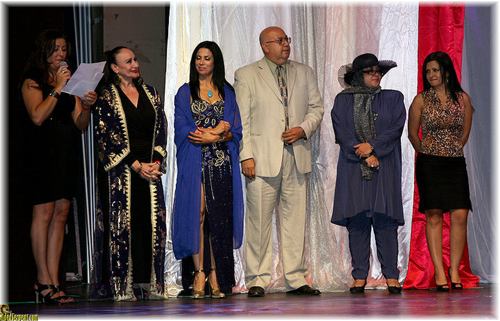
Announcer with Judges:
Helena Vlahos, Nabila Mitwali, Omar Omansi, Amani Elgamal , Rania Sweis
not pictured- Amani Sultan scheduled, but didn’t come, Ashraf Elgamal also a judge is pictured at top of page

Intermediate Winners
2010 USA Belly Dance Queen, Intermediate Category: Lara Grewe –  Tucson, AZ
1st Runner Up: Elisa Armetta – Boca Raton, FL
2nd Runner Up: Venusahara –  Mesa, AZ

Troupe winners
Guest Dancers Shahrazad Dance Company

More info on this competition

use the comment box

Have a comment? Use or comment section at the bottom of this page or Send us a letter!
Check the "Letters to the Editor" for other possible viewpoints!

Ready for more?


Gilded Serpent presents...

Delilah

Delilah

Women, Nature and the Body

by Barbara Sellers-Young PhD
posted January 17, 2011

Dance is a metaphor for life. As we are born, we are destined to move in life through time and space. As we learn to dance, we are also learning to move through time and space. Thus, the process of learning to dance can bring us information about living our lives, if we allow it to. We can learn how to move through our lives with fearless autonomy, grace and spirit; to flow with the melody line, be in the stillness or ride the chaos; to overcome the fear that puts us on the sidelines. We can listen to the voice in our head that says, I CAN DANCE!

Delilah 2008

Belly Dancer of the Year 1977Gathered in a circle, thirty women define hips and torsos as they move in a counter clockwise circle as the drum keeps up a steady rhythm. Shaking their shoulders, they gather into the center of the circle and back out again returning once more to the movements of hip and torso. Within the room there is a deep concentration and quiet dignity in the bodies of the dancers as Delilah’s choreography for ‘Birthing and Reclaiming Dance’ is repeated again and again. The dancers have come to the big island of Hawaii, to the quiet of the 120 acre Kalani retreat to be guided by Delilah in a communion with each other and with nature. The dance retreat is, for Delilah, an eighteen-year commitment to bringing women to an environment away from the distractions of their daily lives that allows them to investigate their relationship to their personal natures through an environment set in nature. This dedication to dance in nature is an extension of a philosophy of the feminine evolved from years of personal study which has included such authors as Joseph Campbell, Marjita Gimbutas and Barbara Walker while living in the Pacific Northwest city of Seattle, a city in which she is a teacher, performer and political activist.

Delilah’s initial introduction to belly dance took place while working her way through college as a hair dresser. In 1972, one of her clients told her about a class that was being offered at Grossmont Junior College and helped her enroll for the course taught by Scheherazade. It was a movement vocabulary that came easy to her and she was soon being asked by a group of Lebanese musicians based in San Diego to perform with them as entertainment for family gatherings such as birthdays and weddings. Soon she was also approached by a group of Greek musicians to perform with them at a San Diego restaurant. Like other dancers who started performing in the 1960s and 70s, she learned by doing. She had the opportunity to gather new vocabulary from the different dancers who were performing with her. After performing in venues throughout the United States, she permanently settled in Seattle in the 1980s.

Delilah’s involvement with belly dance is a celebration of the Earth. She is involved in environmental activism and in 1993, she entered and won the National Public Radio broadcast on the environment; more recently, she sent letters to the mayor of Seattle and the governor of the state of Washington with a suggestion of how to solve the increasing energy crisis. Her definition of the earth’s consciousness is not narrow but expansive. Recently, in an interview, I asked her whether or not she ever did site specific industrial performances. I anticipated a negative response. Instead, she replied “there is nothing on the planet that is not an extension of Gaia consciousness. This includes contrivances some might consider aberrant. To celebrate earth and the goddess is to celebrate her in all her aspects.”1

Energy through the Legs and Torso

Archeologist Marija Gimbutas writes in The Goddesses and Gods of Old Europe (1982) that “The teaching of Western civilization starts with the Greeks and rarely do people ask themselves what forces lay behind these beginnings”. One of the goals of Gimbutas’ research into the myths and related artistry of old Europe was to consider what aspects of the old were still extant in the modern world.

Delilah’s project is a similar reclamation in a desire to reconnect the body of the dancer with the primal belief in a relationship between the body as body and body as an ‘extension of’ and an ‘at oneness with’ the earth and its forces. This belief in the force of the earth is central to Delilah’s approach to teaching belly dance.

Underwater DelilahIn Delilah’s approach, the power of the earth moves from the feet into the pelvis and from this place of creativity throughout the upper torso, arms and head. As she phrases it, the energy moves as “if water were gushing through the body connecting you from your kinesthetic awareness to the great web of life and related creativity.”3 The basic stance to create this movement of energy comes from acknowledging the center line of the body that penetrates the head, torso and pelvis. This central core she illustrates by using a pole to demonstrate this vertical dimension.

The pelvis is engaged around this core through a release of the knees and the movement of the coccyx which allows for what she refers to as slack in the area between the knees and the rib cage. The slack created by this position allow the hips and pelvis to move fluidly in a variety of directions that she suggests emerges from an internal mapping of the individual’s creative forces.

The circles, spirals, twists, lifts, shimmies are an expression of the complex muscle system that integrates the pelvic floor with the spine and provides the strength for women to hold and give forth life. Delilah guides the students through what she refers to as ‘mapping the internal realms of the body,’ a process that unites the individual consciousness with a kinesthetic experience in an enhancement of a dancer’s felt presence.

These internal dimensions of consciousness are not new in Delilah’s conception of the female body. They are expressions of the ontology of the female principle in history as expressed through the body and reminiscent of ancient symbols archeologist Marija Gimbutas brought to public attention in her books on the goddess cults of Europe.4 Using examples of symbolic shapes of spirals, triangles, circles, and double spirals borrowed from the illustrations provided by Gimbutas’ writing, Delilah helps the dancer to traverse these ancient internal pathways within the spaces of her body. The culmination of this deep, internal, kinesthetic awareness of the energies within the pelvis and hips is a journey through the labyrinth.

Although most often associated with the Cretan myth of King Minos and Minotaur, the elaborate design of the labyrinth was symbolically etched on the walls of caves as well as incorporated into the designs of ancient and contemporary pottery. Historically, labyrinths were used to trap malevolent spirits, define a path for a ritual dance or in medieval times symbolize a path to God.

The average medieval person could not afford to travel to holy sites and lands, so labyrinths and prayer substituted for such travel. Labyrinths are used by modern mystics to help achieve a contemplative state of transcendence. Walking among the turnings, one loses track of direction and of the outside world, and thus focuses the internal energy. This is the state that Delilah, through the labyrinth exploration, guides the dancer. Yet, it is also her goal for the dancer to experience a revelatory awareness of the labyrinth as a representation of the complex interweaving of the energy body, which is a corporeal version of the labyrinth.

She expands the dancer’s internal mapping of consciousness by borrowing from nineteenth century French movement theorist François Delsarte’s system of connecting the inner emotional experience of the dancer with the various parts of the body in order to give ‘voice to the body’. Within this system, the body is initially divided up first by the head as the origination of the intellectual, spiritual and mystical, the torso as the emotive and personal, and the legs as the vital relationship to the earth. There are further divisions of the torso into upper torso intellectual, middle torso emotive and lower torso vital. This organization is reversed in the legs and feet, as the upper leg is the vital, the calf and knees the emotive and the feet reflecting an intelligent relationship to the earth. The arm is in a similar correspondence as the legs, with the vital connection in the upper arm and its attachment to the torso, the emotive in the forearm and the intelligence represented by the hands and fingers. The head is also divided into three areas with the forehead and the eyes as the place of intelligence, the cheeks as emotive and the chin and neck with its connection to the torso as vital.

Delilah teaches dancers to engage these different areas by guiding them through an ongoing improvisation that begins with the hips and pelvis and moves up and out through the head, arms and hands. As the dancers improvise, she encourages them to explore the various energetic pathways of their body. She reminds them to appreciate the support and balance provided by the legs and how the placement of the feet impacts the alignment of the pelvis, hips and torso. She asks them to feel the emotions coming from their central torso, supported by the upper arm and acknowledged by the forearm before the hands add the final communicative touch. She also points out “that where the eyes go has a lot to do with commanding the body.”5 She expands on this advice by noting that the direction and gaze of the eyes communicate a relationship between a dancer and their body and the dancer and the audience. As she guides them through a deeper relationship, she never critiques their personal method of exploration. Delilah’s goal for the dancer is to bring them to a conscious realization of a deep internal knowing that ultimately empowers them and allows them to creatively express their unique individuality in dance and in life.

Empowering Lives

To many, there is a rich feminine antiquity associated with its image, one that projects world heritage and a long lost esoteric past. These powers are due to be returned to us. The simple truth is that this is a beautiful dance art honoring life and the feminine experience….. When women get the wisdom of this truth then a whole world opens up to them. Woman = Body = Vessel = World. -Delilah 6

Empowering others is a central theme of Delilah’s approach to teaching belly dance. It is an extension of her liberal upbringing in which she was taught to be inquisitive and investigate the possibilities inherent in any idea. For example, she comments, “We read the Bible, but not as absolute truth, but as one way of knowing.”7 In her frame of reference, there are many ways of experiencing life and her goal is to help those who study with her to discover their personal potential.

Initially, she acts as a guide for the dancers in their individual discovery, but she enlarges their experience of empowerment in group explorations that commune with nature and ultimately in celebrations that bring the ethos of her teaching to the community of Seattle and beyond.

The group explorations require that the dancers take responsibility for the bodies of one another. One example is an exploration she refers to as ‘veil therapy.’ It is one she discovered while teaching a class for children in which her youngest daughter was participating. Delilah needed to find away of attending to her daughter without disturbing the flow of the class. Her solution was to have her daughter lie down in the middle of the floor while the other children carefully draped and removed large pieces of light fabric, referred to as veils. When the last veil was removed, her daughter sat up saying she was all better. It is now an exploration that she includes in her classes, retreats and workshops both in Seattle and in international venues.

The kinesthetic awareness the dancer has learned in mapping the internal dimension of the self is shared with the recipient of the veil therapy, as individuals or groups of two or more carefully lift three foot long pieces of light fabric and place the fabric across the body of the fellow dancer lying on their back on the floor. They then slowly pull the fabric over the dancer’s body. The fabric may cover the entire body or only sections. The different arrangements of the fabric provide a varied kinesthetic experience for the dancer on the floor. The dancers focus throughout the exercise is one of empathetic intensity as they silently respond to each other. This same focus is brought to other ensemble work in which the dancers are required to stay physically connected to each other while they improvise to music. Dancers learn to extend an internal focus outward from self to other and ultimately to nature.

Dance and Nature

We must remember the chemical connections between ourselves and the stars, between the beginning and now. We must remember and reactivate the primal consciousness of oneness between all living things. Barbara Mor. 8

Delilah’s approach to nature lies within the framework of one branch of eco-feminism in its exploration of women’s relationship to nature. Thus, one of the primary places to discover the potential of the self is in nature and for this reason Delilah organizes opportunities for women from around the world to dance in and with nature. As she phrases it:

"The process of dancing in nature is to be in-tune with the natural world around you, to invite nature in to inspire your dance. The student learns there is a difference between dancing with nature and dancing in front of nature. The more experience one develops, the closer one is able to come to the earth. The illusionary barrier that separates humankind from nature thins, and the realization of our sacred inter-connectedness with absolutely everything takes over".9

Within the dance and nature retreats she organizes, the above is realized in sunrise rituals as well as dances in the sea, gardens and forests. The dancers are in each instance taking the deep, internal, kinesthetic experience of nature imagery provided in the studio–the hips as earth revolving around the body’s sun core or the positioning of the arms as hugging a redwood tree–to an interaction with nature. Their quest is to allow a personal correspondence between the movements of their body and that of the tides and waves of the ocean or in relationship to the grass, trees, and other plant life. In the process of dancing in nature, they discover, as Delilah phrases it, the ‘sacred-interconnectedness’ between self and the environment. She believes this realization can lead to a transformation of consciousness that empowers the life of the dancer as it increases their appreciation for their place within the earth’s scheme. At the same time this expanded sense of self enlarges their sense of empathetic response to the earth and its fragility.

Delilah’s political activism is not limited to providing an experience for dancers within studio and natural environments. Her philosophy of the ‘self in the world’ extends to dancers being politically active in the world.

In a recent gathering of dancers in Hawaii, Delilah asked if anyone knew just how many belly dancers there were in the world and speculated on what a political force they could be if they all united in common cause. What would happen she asked if instead of signing peace and environmental agreements on a piece of paper, governments were required to sign them over the belly of a pregnant woman? She added, “The symbolism of the belly and the consequences to the future generation would not get lost as it sometimes does.”10
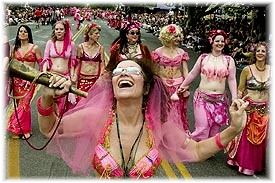
Delilah and friends in the parade!Delilah makes this image of the belly public in her involvement with events such as the Fremont Summer Solstice Parade at Street Faire in Seattle. The Summer Solstice Parade and Pageant is an annual event sponsored and produced by the Fremont Arts Council (FAC), an organization that supports the arts and artists in the Fremont neighborhood where Delilah has her studio. Started in 1989 by Barbara Luecke and Peter Toms, the parade quickly grew to over 80,000 participants. This local event with an international reputation is held the Saturday prior to summer solstice and culminates in the two-day Fremont Fair, a benefit for the Fremont Public Association. The event is distinguished by a sense of freedom in which anything goes, with the exception of no printed words or logos, animals (except guide animals), motorized vehicles, weapons or advertisements.

Delilah’s contribution has been to participate with other dancers from Seattle and elsewhere in theme based performances that are integrated into the parade. More recently, she has been referring to their performance as the ‘Billion Belly March’ as the number of dancers has increased to over 200 plus participants. Each year is a different theme. In 1999, it was the color blue and within this focus the dancers acknowledged the ‘Tuareg’of North Africa in deep blue costumes, in 2004 the dancers dressed in red as the symbol of women’s power. Delilah’s message to the dancers that year was:

"We are living in perilous times. They could very well be some of the last days. We cannot keep running things in the ways of the past. We need new energy, we need new ideas and creativity. We need women to be more present. We need the Mother energy. It is time for women to step up and take their turn. It isn’t even a choice anymore, it is a responsibility….. Start talking to each other about politics more. Don’t be afraid to voice your opinion and to influence women around you. We all have power! We all have opportunities for influence. What is your power? Define it for yourself! Use it! I am using my power by influencing you now. I say, ‘Make sure you are a registered voter!’ I’m not saying how to vote. I’m saying USE YOUR POWER!"11

A symbol of this power was the 2007 project to build a model of an ancient Egyptian temple which could be set up and taken down as the parade moved through the streets of Seattle. Over 200 dancers from across the United States participated. Some of these dancers received a DVD prior to the event that taught the choreography to be used in the dance. All of the dancers converged in Seattle prior to the Fremont parade to rehearse and to participate in a ten-day combination of workshops and classes. Delilah is planning an even larger events for the future such as the 2008 event dedicated to Peace in support of the woman’s organization Code Pink and using the color hot fuschia pink. Dancers will come from a variety of styles within the belly dance community from tribal to ethnic to cabaret. As with earlier projects, Delilah’s goal is to revise the vision of women as incapable of taking on the issues of the day, and replace it with but an image of a woman who like in Delilah’s image of Aphrodite is “pleasant, feminine, and charming,” but is also “powerful.”12

Controlling the Image

The powerful images on TV, in movies and magazines can throw us into obsessions and insecurities about our looks, age, weight, and economic or professional status. Ignored are real values such as nourishing our creative spirits, practicing compassion and care-taking of our families, communities, and our earth.
Delilah 13

Dance to the Great MotherDelilah communicates with the global belly dance community through her website titled Visionary Dance Productions. She created the website and associated production company in order to promote the image of her philosophy and her approach to the dance. An image that is resistant to mainstream television. For example, Delilah was able to perform and record “The Dance to the Great Mother,” a piece she performed at concerts in the Seattle area in 1985 when she was pregnant with her second child. In conversations, she notes it was not a project that would have been supported by the average production company as it does not reflect the media image of the seductive belly dancer. The video performance does, however, represent Delilah’s aesthetic philosophy of the magnificence of the female body and its ability to be creative whether in giving birth or in devising solutions to social problems. Besides which, twenty-five percent of the profits are designated to support women’s causes through ‘Birth and Life’ women’s shelters and the March of Dimes.

Beyond allowing her to promote video and digital projects about which she is passionate, the website also provides opportunities for correspondence between Delilah and the dancers from across the globe in blogs and in a large interactive group of essays referred to as Alexandra’s Library, a reference to the famous library of Egypt. The essays in the collection are by Delilah and other dancers. They incorporate personal reflections of individual dancers’ experiences of dancing in nature, the role of the dance in empowering their lives, references to dancing and pregnancy, dancing and body image, and health in general. The site is also where those interested in the Fremont Parade and ‘Billion Belly March’ stay in contact with each other.

The extensive web and production services also include a series of DVD’s that offer different levels of instruction and performances by Delilah as well as CD’s by musicians based in North Africa and the Middle East (Hakim Yaho) and renditions by American musicians (Sirocco, House of Tarab, Brothers of the Baladi), some which fall into the global beat category such as Necmi Cavli. She also sells belly dance accessories–costumes, veils, etc. Income generated from web sales is a fundamental supplement to the classes and workshops she teaches in Seattle and elsewhere.

Stay flexible in body, mind and spirit

Each stage of a woman’s life brings something unique: The strength and agile beauty of youth, to the zophtic, sensual nurturance and wealth of experience in mid-life, to the wise woman cultivated by charisma and maturity, and much more.

Delilah 14

One afternoon as the dancers in the Hawaii workshop were sharing their stories about the significance of dance in their lives, Delilah suggested that a flexible body helps evolve a flexible mind and spirit. A flexible stance is necessary to understanding the complex interrelationship between earth, wind, water, plants, and animals and, therefore, provides an opportunity for individuals to explore the possibilities of the flexible integration of their body, mind and spirit. This is a ‘state of being’ Delilah brings to her performance as dancer, teacher, artist, and political activist. She has not limited herself to specific stages or venues or styles. Instead, she has performed in the restaurants, on stages in choreographed pieces, created movement rituals, and performed in other venues that allow an expression of the joy and power within of female body. In this variety of performance modes, she serves to remind the dancers who work with her not only to stay flexible, but that they are the embodiment of earth’s consciousness.

Footnotes
1, 2- Personal Communication, September 1998.
3. Personal Statement from Absolute Beginning Bellydance
4. The Books by Marija Gimbutas The Living Goddesses, The Language of the Goddess, and The Goddesses and the Gods of Old Europe inspired many women during the second wave of feminism.
5. Delilah’s observation in retreat class, January 2008.
6. Delilah, http://www.visionarydance.com/revivingophelia.html, 2008
7. Delilah’s observation in retreat class, January 2008.
8. The Great Cosmic Mother: Rediscovering the Religion of the Earth, New York, Harper and Row, 1987.
9. Personal Communication, September 1998.
10. Delilah’s observation in retreat class, January 2008.
11, 12, 13, 14 Delilah. http://www.visionarydance.com various pages

Photo Credits
Gold Costumed photo is by Jennifer Richard
Trouphy Photo is by Joe Butts
Under Water photo by Steven Flynn
In the HOH Rain Forest by Steven Flynn
Parade Photo is by Jerry Johnson
China Syndrome is a Stock Photo
Delilah in the movie China Syndrome

use the comment box

Have a comment? Use or comment section at the bottom of this page or Send us a letter!
Check the "Letters to the Editor" for other possible viewpoints!

Ready for more?


Gilded Serpent presents...

Europe’s Newest Dance Destination

Detail of the city's old town.

Split Tribal Festival in Croatia

by Paola Blanton
photos by Marin Culic and Dunja Cuk Podolski
posted January 18, 2011

Imagine performing in a historic Roman palace – its time-worn pediment rising high above as the audience finds its place among ancient marble columns and stairs.  Colored lights cast a mystic glow as the music lashes out, grabbing the public’s attention and holding it rapt as international soloists and troupes cast their spell onstage.

For three days and nights in August, the Split Tribal Fest gave us that stage setting – and much more.  Croatia’s second largest city is the site of Roman Emperor Diocletian’s palace on the seaside and a living museum of antiquities.  In Split, it is not uncommon for one’s home to share a wall, a column, or an ancient walkway dating back to antiquity . Romance and history converse in its streets as the salty Adriatic breezes waft through its corridors, invoking a sense of timelessness.

Organizers Suncica, Dunja, and Slaven began their preparations a year in advance, sponsoring Sharon Kihara, Kami Liddle, the Uzume , and myself to present workshop topics for a diverse assembly of European dancers.  Croatia, Slovenia, Czech Republic, Italy, and Russia were represented in the workshops and nightly shows, showcasing the wealth of talent from the heart of Europe.

Croatia is one of Europe’s up-and-coming tourist destinations, and for many good reasons.  The Adriatic coast winds sinuously down the west of the country, where jagged fjords meet crystalline-blue waters teeming with the fruits of the sea that grace the country’s excellent cuisine.  Foodies, don’t think twice for here is a Mediterranean marvel, offering some of the region’s best wines, olives, produce, seafood, and of course, the famous smoked meats of Croatia, like prosciutto. 

It’s like an Italy that one can actually afford, due to the fact that it is not yet an European Union country,  and therefore not subject to the massive cost of living spikes of EU member nations.

ClassCroatia’s dry summers boast endless sunshine tempered by sea breezes, olive groves, vineyards, and cypress forests.  There is something about the light there, romantically Mediterranean, golden and reflective in a way that makes everything a touch more beautiful.

Combine its history, architecture, climate, food, wine, and warm Balkan hospitality, and you have a perfect setting for an international gathering of dancers who showcased Tribal, Fusion, and related styles.  Our workshops were held in the Hajduk Soccer Stadium’s modern cultural complex – a set of well-appointed studios with an upstairs café that served a hearty vegetarian lunch every day to festival participants for less than $5.

Nightly performances at Diocletian’s Palace were a Festival highlight, spanning creative Tribal Fusion and featuring international stars like Sharon Kihara and Kami Liddle.  I myself presented my Balkan Fusion style that derives directly from my own yearly research and festival in nearby Macedonia, sister republic to Croatia in the Former Yugoslavia.Map of Croatia

Innovation marked every aspect of this Festival.  I saw Tribal merging with lyrical expression from “Les Petits Bijoux” of Slovenia, comedic character-play from Stania and Irena of the Czech Republic, and pumped-up Electronic Trance fusion from Nina Stepic Cupic of Zagreb, Croatia’s capital city.  It goes without saying that Sharon Kihara and Kami Liddle were both gorgeous and inspiring onstage, crystallizing the impact the event had on the awed public. The  Adriatic and Central European  dance community is in love with belly dance in all its manifestations, as evidenced by the regular visitation of international stars like Kihara, Kami Liddle, Petite Jamila, Morocco, and Michelle Joyce, just to name a few.  For a first-time project for Dunja, Suncica and Slaven, it was world-class in all aspects.

The novelty and originality in the application of related dance forms and sensitivity to good fusion extended to great live music as well. This was showcased in the electrifying performance of the Mantra Fusion Band, of which Suncica is the violinist.  They wrapped up one of our shows in front of the Palace with a high-impact set cross-breeding Balkan music with Oriental and Indian tones, along with a dash of Rock to keep you on your toes. 

As an instructor, I enjoyed working with a highly organized team who took the time to anticipate my needs and to make me feel at home. Volunteer helpers like Josipa Vulic were always on hand to pick up, drop off, have a coffee or a wine, or just chat.  I felt like I was surrounded by friends because I was.  In the Balkans, hospitality is in the blood, and a generously warm and friendly spirit pervaded all aspects of this Festival.

In 2011, they will do it again, and you’re invited!  Imagine yourself on the ancient shores of an ancient land, surrounded by centuries-worn marble, dancing to your soul’s content among new friends in the heart of Europe.  Raise a glass of cold white wine, enjoy a platter of steamed mussels, and enjoy the show.  Split is a unique, world heritage setting, and Split Tribal Fest is a unique festival that will steal your heart and fire your imagination until you come back to the embrace of new friends in the spirit of our great Dance.

Audience
Audience
Diagnonal
Darma Dance Company from Italy

Duo

Russian Tribal Mafia Dance Company from Russia

Duo2

Les Petite Bijoux Dance Company from Slovenia
Group
Group photo taken at the end of the 1st night of the performances

Group 2

Belly-Freaks Dance Company from Croatia

Kami

Kami Liddle
Paola
Author Paola dancing a fusion piece to traditional Macedonian Zurli

Paola

Author Paola dancing to "Da Zna Zora" – by Sandy Lopicic Orkestar – Balkan Gypsy/Cabaret fusion.

Shades

Stania and Irena from Czech Republic


Tribal Trio

Tribal trio – The Uzumé and Sharon Kihara

Window

Your next window of opportunity to meet new friends in the heart of Old Europe will be
August 18-21, 2011
festival info:
http://www.orijentalni-ples.com
www.splittribalfest.com
Check above link for details on the festival, including, class schedule, lodging, vending etc


use the comment box

Have a comment? Use or comment section at the bottom of this page or Send us a letter!
Check the "Letters to the Editor" for other possible viewpoints!

Ready for more?

  • Dance Alchemy
    Dance can be the corporeal miming, shaping, and manifestation of the soul’s intent.
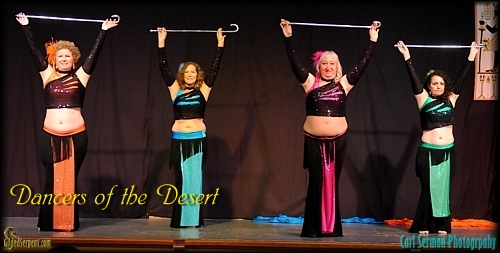
  • The Broken Vessel
    We, too, must believe in our movements, believe in their purpose and message, and we must deploy them with the array of human faculties that begin to evolve when the Art of the Dance is taken up.
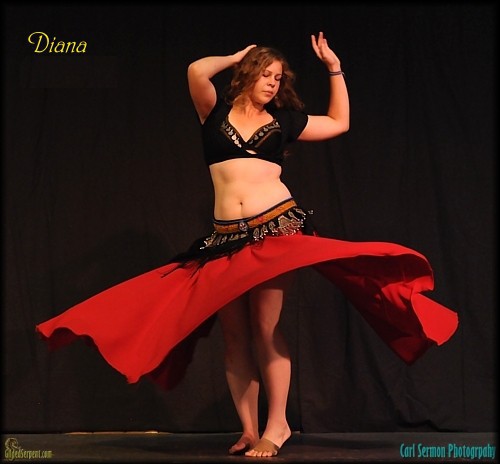
  • Visiting Cairo: You live a whole lifetime in one week!
    Laughter builds bridges, and in today’s world, bridges – between individuals and between cultures, are becoming more and more of an imperative.
  • Roots Raqs – An International Belly Dancer Goes Home to Macedonia
    The musical folklore of this region deserves full debut in the World Music scene, and those of us in the MED community worldwide are ripe for the breath of fresh air that Chochek and Gypsy Brass Music can bring us. It is an original, organic and time-honored fusion, brought about by history, geography, and most importantly, tolerance and mutual cultural celebration
  • An Interview of Rhea of Athens, Greece,
    (This interview has been edited and reprinted with permission.)
  • Adventures in Turkey 2006
    I am not exaggerating when I say that Sandra actually threw herself into Bella’s arms and wept when she first laid eyes on her.
  • Dancing in Yemen
    I had been to many Middle Eastern weddings before, but none were as visually impressive as the ones I attended in Sanaa, Yemen. Jalilah’s recommend reading list just added-10-24-01
  • Living in Yemen, Part I – Tafruta
    A simple question was all they needed to get them into motion!
  • Learning Matrix: A Long Journey, The Belly Dance Scene in Taiwan
    Sometimes, one might have to admit that learning only choreographies might lead students and dancers away from learning the essential elements of traditional Belly dance.
  • The Soltice Festival, Belly Dance in Spain- Part 2,
    held June 23-26, 2006. Part Two- The Evening Show, Event organized by Maria Cresswell of Tribal Girona at Sanctuari Els Arcs, Girona, Spain. A medieval hostelry with a chapel, set in the beautiful volcanic natural park of La Garrotxa near the picturesque village of Santa Pau.
  • The Soltice Festival, Belly Dance in Spain- Part 1,
    held June 23-26, 2006. Part One- Workshops and Setting, Event organized by Maria Cresswell of Tribal Girona at Sanctuari Els Arcs, Girona, Spain. A medieval hostelry with a chapel, set in the beautiful volcanic natural park of La Garrotxa near the picturesque village of Santa Pau.
  • Fire in your Belly: My Dance Story
    I’ve always wanted to be a dancer. I vividly remember when I was four years old and had just started ballet, the driveway became my stage and the African sun my spotlight as I did plies, twirled, and pitter-pattered on tiptoe to a growing audience of passers-by. I remember curtsying to a young schoolboy who stopped to stare. Today, I realise it wasn’t my extraordinary dancing that stopped them in their tracks.