Gilded Serpent presents...

Tribal Fusion in Mexico

Its Phenomenal Growth

Shasmsia Yarahum

by Martha Duran
posted August 30, 2011

To dance Tribal Fusion in Mexico is to dance beyond tradition and criticism; there are Oriental dancers who consider “technique” a form of folklore and “stylization” as a boundary. Despite their lack of dance education, most Tribal Fusion Belly dancers grow on passion, dedication, and their love for Middle Eastern music.Tribal dancers in Mexico carry their colorful, heavy skirts and their abundant jewelry proudly; turbans and tassels adorn their hips–just as any other “Tribal Fusionista” from around the world!

Nevertheless, how did Tribal Belly dancers in Mexico become educated in their style? Who was the first Tribal Fusion dancer? With whom did she study? Where and how do “Fusionistas” arrive there? It has been about a year since I have started traveling around, interviewing several Tribal Belly dancers in my country (Mexico) on a research journey to give to you the history of Tribal Fusion Belly dance here in Mexico.  We dancers who live just a few minutes across the border from the US, have found it easy to travel to workshops given by wonderful masters in Tribal and ATS such as Jamila Salimpour (back in the 1980s), Jill Parker or Carolena Nericcio (during the 1990s) but how do dancers even further south of Mexico reach out to learn Tribal Fusion?

Shamsia Yarahum

One of my first Interviews was with Shamsia Yarahum who is considered one of the pioneers of Tribal Bellydance in Tijuana, Baja California, Mexico.  In her country, she has studied at seminars and conventions, as well as regular classes and workshops with Belly dancers like Amar Gamal, Yazmina Zarod, Bahira from USA. She enrolled in a workshop with Sharon Kerr and studied rhythms with Fadii el Saadi from Lebanon just to name a few of the contributing  teachers  (as she stated during our Interview).

  • Martha: What  dance education have you acquired outside of Mexico?
    Shamsia answered: I danced in regular classes with Carolena Nericcio in San Francisco California, workshops on African fusion with Judeen in San Diego, California, Jillina and Angelika Nemeth’s workshops on choreography, Moorish Gypsy dance with Titanya, and also with Mariana from San Francisco, California, Tribal Style workshop with Rachel Brice, and on-going classes with Melhea.

  • M: What international dance teacher and artist has defined you as a Tribal Fusion Belly dancer?
    Shamsia said,  “Definitely, Carolena and Bahira grounded my fundamentals based on their discipline,  dedication to the dance, and respect for my colleagues, and the culture of the origins of our dance.”

  • What has Tribal dance given to you as a performer and teacher?
    Shamsia: At the end of each day, I am grateful to God for giving me the talent to dance as well as all of the tools to share with others the power of dancing throughout my life. Prestige, applause, and awards are just the results of hard work and dedication throughout the years.

Araceli de AndaAraceli de Anda
Another Tribal Fusion Belly dancer in Mexico I Interviewed is Araceli de Anda. She is considered one of the most skilled Tribal Fusion Belly dancers in the country; she has studied with masters of Belly dance from The Pineapple Studios in  London,  to Washington, and then, on to San Francisco´s Shoebox Studios. Araceli has received training from Cera Byer, Nourhan Sharif, Jamila Salimpour, Suhaila Salimpour, Rose Harden, Rachel Brice, Zoe Jakes, Mardi Love, Sharon Kihara, Amar Gamal, Petite Jamilla, Maraia, Mayada, Aziza, Sandra, Blanca, Zoe Anwar, Carolena Nericcio, Deb Rubin, Ariellah Aflalo, and Amy Sigil–among others.

She has shared the stage with world-renown dancers like Petite Jamilla (Birmingham Alabama), Sharon Kihara (San Francisco), Sandra (San Francisco), Aziza, Maraia (Argentina), Georgina Distazo (Argentina), Mardi Love, Gayathri Arumugham, Ariellah, and Blanca (New York).

Co-founder of Mexico’s first Arabic-contemporary duet, Viceversa, and founder  of the Black Velvet Troupe. She started her dance education in Jazz dance, then progressed on to Classical Ballet, Contemporary, Hip-hop, Burlesque, and Yoga training, and still continues to increase her educational level as a dancer as she travels from country to country–despite all the cultural barriers a Mexican dancer encounters when she attends workshops or ongoing classes outside of her own country.

  • How does a Mexican Tribal Fusion Belly dancer fit into a North American lifestyle when she attends workshops in the USA?
    Araceli: Cultural differences are obvious, but they are not something that shocks anyone. In London, I had the same experience. I think it’s something  normal in my life, since I suffer from “social phobias”, and it takes a lot of work for me to Interact with groups of people.  I prefer to work with only one or two people at a time. I concentrate on what I like, and I realize what bothers me about people and situations. However,  the question of culture, race, or modus vivendi is not something that I have because, in San Francisco, I am surrounded by dancers (especially Tribal Fusion dancers) and that makes it much easier for me to see the similarities between Mexican and North American dancers.  It is wonderful to share all the experiences  we go through, as Tribal Fusion dancers, with all the dancers I chance to meet, and I see how everyone deals with similar problems. Suddenly, the only thing that’s missing for me is that they do not speak my language, Spanish.

Xiaron Kerr and Elsanne Barrows

In my 2009 search to give Tribal Fusion Bellydance a sense of history in Mexico, I got to meet in a workshop at the Divine Dance Bellydance Convention in Tijuana  Baja California , Mexico, the dancer -teacher Xiaron Kerr, US born who learned Belly dance in Cuernavaca , Mexico, with Masha Hojjati.  Kerr continued her studies for several summers in San Francisco California with Fat Chance Bellydance Troupe and now is one of the most renowned Tribal Belly dancers and gifted teachers here in Mexico!

  • I asked her what the difference was between a Tribal Belly dancer in Mexico and one in the USA and she answered:
    ¨I have the impression that Tribal in Mexico is still in the idealistic stage of ‘we’re-all-one-big-happy-family-sisterhood-Tribal-love and all that’. We have our moments, difficulties and clashes, but in general, we’re all still united and supportive of each other. I’ve heard from US dancers that it’s not that way for them; there is a lot of envy, competition, and ugliness between Tribal dancers. That makes me sad; I thought Tribal would be different.¨

  • How has Tribal Fusion evolved here in Mexico?
    Xiaron answered: It is pretty chaotic, but it seems to be following the same path as it did in the US.  At first there were very few of us doing Tribal here. Actually, at first, there were only two of us: Elsanne Barrows from San Miguel de Allende and me, Xiaron Kerr, both of us gringas (US citizens). We were looked down upon by the Belly dance community. Belly dancers snubbed us, saying what we did wasn’t "real" Belly dance (as if ‘real’ Belly dance even exists), that it was simplistic, and unsophisticated. You name it; they said it!”Elsanne Barrows

    Then in 2003, the Bellydance Superstars came on the scene and everybody wanted to become Rachel Brice! So, we started seeing "Tribal Style" Belly dancers popping up on every corner, but what they were doing at first had nothing to do with real Tribal Style Belly dance. They just made imitation Rachel Brice costumes and put a few isolation movements and pops into their regular Belly dance choreography and called it “Tribal”. It was a mess! Once the Bellydance Superstars came into existence, they started doing workshops all over the globe, and that brought the fusion dancers into the country. Many, many Belly dancers started taking every Tribal fusion workshop they could and soon started teaching Tribal fusion classes. That’s when it sort of all got out of control and anything and everything was called "Tribal."

    Then Elsanne started her "Teachers of Tribal Certification Program”. She’s now on her seventh generation of a two-year long program of training Tribal Style Belly dance teachers, still spreading the Tribal love…

Elsanne Barrows and Xiaron Kerr have been advocating Tribal love in the Mexican Belly dance community for over 10 years now, and she is considered one of the pioneers of “true” Tribal Style in Mexico, both of them are sending the same message that Carolena Nericcio and Rachel Brice have been sending for years:

If you want to call what you do Tribal or Tribal Fusion, or anything Tribal, you should study ATS (American Tribal Style Belly Dance) and know what true Tribal is before you fuse it with something else.

Elsanne Barrows studied with Troupe Salamat in Arizona and is also considered one of the first Tribal dancers and teachers in Mexico.

  • Xiaron Kerr:¨Improvisational Tribal style Belly dance is growing in Mexico.” she said,  “Many dancers perform Raqs Sharqi, Tribal, Tribal Fusion, the whole gamut! Tribal has gained a lot more respect in the general Belly dance community. Nowadays, many of those teachers and dancers who at first dismissed Tribal are now offering it in their studios. There are still a lot of charlatans out there, as there are in Belly dance, Yoga, Ballet, Karate, or anything else. There will always be those who take 3 months’ worth of classes and then start teaching. It’s a shame. It cheapens everything, but I can’t do anything about them.  I just teach my classes and workshops and  keep spreading our Tribal love.

In Summary:

I remember the first day of one of my Tribal classes in 2003 that I taught in Danceme Academy; it was hard because of the lack of information the students had back then. As a teacher, I had to teach bits of historical background between teaching technique, drills, and step-combinations. Today, it is easier to teach, thanks to all the beautiful, famous Tribal dancers around the globe as well as the many videos on web sites.  Still, our history of Tribal Fusion Belly dance in Mexico is still in the making because it keeps evolving (side-by-side) with the growing dance community. It is still difficult to perform Tribal Fusion in some places here in Mexico because some people still say that  it looks like a Halloween-ish, spooky-fied, Break dance!

DanceMe Academy of Mexicali

Lorena Rojas

Mem Tribe

Shamina Tribe of Mexicali

Xiaron Kerr

use the comment box

Have a comment? Use or comment section at the bottom of this page or Send us a letter!
Check the "Letters to the Editor" for other possible viewpoints!

Ready for more?

  • Interview with Yamil Annun, An Argentinian Belly Dancer
    Yamil Annum has created his own dance style and has evolved his specific style of Oriental dance by using the well established foundations of classical Ballet, Ukrainian dance, Ballroom dancing, Celtic dances, Jewish folk-dance, Bhangra, Armenian and Argentinian Tango. His elegance on the stage has revolutionized stages all over Argentina and Latin America.
  • Hot Bellydance Event in Tijuana
    Leila Farid from Cairo Egypt is a sweetheart! She is what many Mexican dancers aspire to look and dance like. Wow! She is gorgeous and mesmerizing – as well as extremely nice, polite and down to earth! My star struck students were amazed to catch her snacking on Mexican Rancheritos (chips) and eating breakfast like a Mexican, with tortillas! She’s so fit that we couldn’t imagine she snacked on chips tortillas like the rest of us. Her master class was magnificent.
  • Bellydancing Fashionably
    Always remember that you’re representing a country’s culture!  Sometimes, less is more; sometimes, more is less.”
  • Its All in the Flavor! Bellydance in Mexico
    Those were tough times for us teachers. Students were very shy in the classroom but eager to learn; some of them even thought that Shakira had created Bellydance! They didn’t have much information about Oriental Dance, its origins, or different styles. Some aspiring dancers even sat through several classes just to check out what Bellydance was or if we teachers danced it as well as Shakira.
  • Debunking the "Golden Era" of Bellydance, Part 1
    Just like today, dancers had to create the place, the time, and the excuse to show or “sell” our newly-found artistry or resign ourselves to dance in parks and on street-corners or in syncopated troupe dances forever. So much for creativity and self-expression…
  • "Objects of Desire, Photos from Venus Uprisings April Performance
    The 7th fantasy bellydance concert produced by the New York City artistic salon Venus Uprising took place at the Merce Cunningham Studio on April 15th and 16th, 2011. Invited dancers were asked to create new works based upon the theme "Objects of Desire". The performers responded with an interesting array of interpretations, ranging from the literal to the highly abstract.
  • Video- Finding the Lammam Ensemble at the Cotati Accordion Festival
    A collage of clips of various music styles included in this world music festival in Northern California.
  • Arabian Nights at 12 Adler Place, North Beach Memories, Part 1:1961
    Leona had introduced me to her friend Josephine, whom she described as a lovely Sicilian American woman who had recently taken the stage name of Jamila.
  • Dallas Observer’s Recent Belly Dance Ruckus
    The silver lining in all this is witnessing the wrath of Belly dancers scorned.
 

Gilded Serpent presents...

Debunking the “Golden Age” of Bellydance, Part 1

Najia

by Najia Marlyz
posted August 29, 2011

Do you feel all dressed up with no place to dance?  Then, nothing has changed much in the last four decades of Bellydance opportunities, except our dancers’ expectations.

Perhaps, those of us who learned to perform back in the day, speak about the Bellydance phenomenon now as if it were some sort of “Golden Age” for dancers, (Privately–maybe! Collectively, let me assure you: it was not.)

When most people become involved in a specific form of dance for the first time, aspirations for the future use of that art or skill seldom enter the prospective dancer’s mind, at least, in the beginning. The same circumstances were true for me, too. At the end of the 1960s, when I embarked on my new Raqs Sharqi dance adventure, I thought of dance as a healthy, artistic, and constructive activity for my mind and body as well as a place to use my other (more important, I thought) artistic endeavors.

Specifically, my interests became centered on the creative re-use of textiles, especially antique laces and fabrics such as velvets and sheer silk chiffon that have little use in normal, everyday living.  It was my intention to learn the art of dance performance because it was the rage du jour, and it would offer me a valid excuse to use my abilities to repair and recycle vintage garments as well as detailed pieces of hand-work from decades past (such as Victorian times and the Roaring ‘20s), incorporating them into my dance costuming.  

Along with my goal of recycling and renewing vintage clothing, jewelry and other objects, I hoped to use my knowledge to widen my typically cloistered world as a young, childless married woman in an urban Northern California locale. I had been fulfilling simply what was usually expected of women back then: namely, running a household, dabbling in the arts, and getting on with domestic life —just  like everyone else of the era. We were singing the song that was new in 1963, which became Pete Seeger’s hit recording, “Boxes! Little Boxes, all made out of ticky-tacky…”  Yes, it was the ‘60s, but I had found a way to make something new, sparkling and fascinating out of forgotten things that were beautiful, handmade, and old rather than new and made of “ticky-tacky”. Granted, that took place for me four decades ago, but circumstances of employment via Bellydancing have not changed that much within our dance community, even now.

It occurs to me that we dancers of the ’60s and ’70s (inadvertently) may have misled today’s beginning professional dancers into believing that we danced in the spotlight of fabulous stages on the bill with the rich and famous while they seem destined (and doomed) to dance their frenetic foreshortened versions of the Bellydance before each other at parties and for strangers and friends in restaurants. Sometimes, I wonder if we are secretly motivated by the perverse schadenfreude of watching them fight over our imaginary crumbs! Perhaps, we long-time professionals should accept some of the blame for helping them lower their expectations concerning their prospects of finding a place to perform once they have perfected their art well enough to turn professional.

At the same time, we are sounding authoritarian and sometimes overly pedantic about how much remuneration one might rightfully demand for a public Bellydance performance. The fact of the matter for us was that often we had had to manufacture our own opportunities to dance where there were none previously; perhaps we have preferred to make the situation look hopeless nowadays in order to stay in control (or to believe that we are).

Some of us earned actual money over the years, but our naughty little secret is that (literally) sometimes Bellydancers were hungry hippies and flower-children of the ’60s, and they danced for tokes, onions, strings of beads and sometimes, nothing.

Most of us grew out of it and lived to tell the tale.  We may have become too complacent in our perceived empire (now called the Bellydance community) that we built a long time ago out of mud, straw, and wild ethnic/Orientalist fantasies. It was there that we found our secret "back door into showbiz"! (Sparkle, sparkle, sparkle!)

For us, it became clear: there was next-to-nowhere to perform as a professional Bellydancer even then, but that did not stop us! However, our circumstances were easily changed because we were entering untested waters: There were no traditions or preset standards that we were compelled to meet. We set about creating our own opportunities –some for pay, some not.  Then, quel horrore! Those monetary practicalities of over-head, expenses, and maintaining the dance venues that we had created or secured for ourselves concerning some of our most popular and successful experiments began to seep into our reality. We had created festivals, pageants, belly-grams, and showcases for Bellydancers, but then found that when planning these activities and events, we had to make progressively less time available per dancer so that we could pack more warm bodies into our shows and events because they usually brought along with the dancers, their corresponding, ticket-buying fans –just to satisfy our burgeoning overhead. We learned about "show-biz economics" the hard way!  It was a sobering moment that almost brought us back to earth.

nylonsThe era was certainly not a golden age for American women in general, either, by any stretch of the imagination! However, our surge toward feminism could not be thwarted quite so easily. Our fascination with Oriental dance was “gold-toned” around the edges if not pure gold; it promised and delivered absolute satisfaction – of experiment and creativity, if not dollars.  We intended to re-invent ourselves into "a new kind of independent woman" at a time when it was important to keep the seams of your nylon stockings straight up the back of your leg (held in place by the irritating gizmo called the “garter belt” or that other odd torture-device called the "latex girdle”).

Flower-children and assorted hippies were singing “Kumbayah” in the streets of Berkeley and burning their bras, while most of us were just enjoying a sigh of relief from trashing the hated garter belt in favor of the terribly expensive new invention called… “pantyhose".

A pair of pantyhose in the ‘60s cost about twenty to thirty dollars per pair; in today’s money, that was more than an average grade school teacher (which was my chosen profession) earned in one day, teaching 36 (yes, thirty-six!) children per each classroom. Though it may seem peculiar now, the invention of pantyhose, alone, was a giant step forward for freedom and comfort of modern womankind. I wore out many of them two decades later while dancing on-stage, but nowadays, dancers seldom wear such things as pantyhose anymore, preferring bare legs, torn tights, or too many skirts. I think the garment has become almost as strange as bloomers and tightly-cinched, boned corsets.

Nevertheless, there was a larger question brewing for women in the movement almost everyone called “Feminism”. Bellydancing in America hit an unprecedented popularity in many American women’s lives –especially on both coasts, starting in the East.

In general, our motivation was not related to money; therefore, it was not related to getting a job as a performing dancer (although some considered it a test of one’s mettle as a fine dancer).  Instead, we needed to free ourselves first and consider practicalities later.

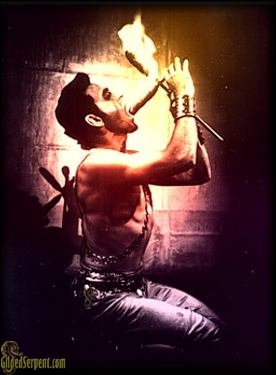
Bert posterBert Fire eatingMany of today’s instructors have given the impression to young professionals (who are now just entering show business) that there were all kinds of venues and opportunities in which to dance back in the day, and that potential audiences and employers were impatiently waiting for us to finish learning to dance so that they could hire us. Oh! How we wished it had been so! The fact remains hidden that some of today’s name movers and shakers never (or seldom) moved or shook on any stages or in any spotlights; they did not actually perform (at least, not solo) for a paycheck.  Therefore, some teachers of the performance art called American Cabaret Bellydance are not,  themselves, versed in either stage craft or solo performance, but they won’t tell you that and, for some reason of polite deferece, you don’t ask!  

Just like today, dancers had to create the place, the time, and the excuse to show or “sell” our newly-found artistry or resign ourselves to dance in parks and on street-corners or in syncopated troupe dances forever. So much for creativity and self-expression…

Fortunately, my mentor, the late Bert Balladine, a.k.a. Roman Balladine, had worked show venues such as Vaudeville, the circus, and smoky nightclubs as well as the cabarets of Europe as an entertainer, performing Adagio, Tap, and Acrobatic dancing, along with his infamous fire-eating act. Bert was among the early pioneers of Bellydance, bringing it to America and re-introducing it to Europeans, too.  Those few Bellydance pioneers such as Bert found a clientèle that had become increasingly reluctant to pay much for entertainers, but employers would often deign to pay for a “Bellydancer” because the dance form was considered unusual, rarely seen in the US, and was absolutely more exotic than the existing stage entertainment then available.

As Bert was fond of saying to those who attempted to clean up the reputation of our dance form:

“The image of Bellydance must stay a little bit naughty to the general public, because when it isn’t anymore, they’ll look for something else.”

To the people who were hoping to book entertainment, Bellydancing was only one baby-step away from actually being what was referred to as “exotic dance”, “stripping”, or "side-show hoochy-koutchy" and most of us struggled violently against that impression.

Just like today, Bellydancers were “all dressed up with no place to go”.  Before the ‘60s, there were precious few formal Bellydance lessons, except for tentative six-week courses in Bellydancing at the YMCA or YWCA or city recreation departments in large cities.  There were no Bellydance lessons offered in most variety dance studios, either, except for studios like Berkeley’s Denishawn Studio where Ruth St. Denis enjoyed the exotic kutch dance and other ethnic dances. Those who tried to include Bellydance found that it was unwelcome in most dance studios because of its stigma. If not being thought of as obscene, it was, at least, considered tawdry and low-class by dancers who were involved in other dance forms.

Ruth St DenisMy goal was to teach Bellydance in a college setting, but I quickly learned that my teaching certificate and my Master’s degree was insufficient for my being hired.  The administration officers informed me that I would have to teach one of the Physical Education Department’s instructors to dance so that she could, in turn, teach the course because my master’s degree and my teaching certificate had been earned with the wrong academic major subjects (i.e. not in the Physical Education department).

When I opened my first dance studio in Albany, California, I overheard two women on the sidewalk, peeking in the studio window, saying sadly, “Well, there goes our neighborhood…”

Generally, professional dancers had to build contacts among musicians who were part of bands and orchestras, because recorded music of the day sounded tinny and uninspiring. Realistic recordings for Bellydance simply did not exist. Extremely few Middle Eastern musicians had come to America to play until the ’60s. Even then, those who came did not come here to be a musician in a nightclub or restaurant, and they usually had a day job like house painter, restaurateur, or used car and insurance policy salesmen while some used it as a way to put themselves through a college education.  Getting a visa and buying a ticket to America was not feasible for most foreign professional musicians. Some who played here were amateur musicians at best.  Did you imagine that American orchestras and live bands played Middle Eastern music even as recently as 30 or 40 years ago?  No! However, most American bands could manage to play Fiddler on the Roof”, "Hava Nagila" “Green Eyes”, “Stardust”, and “Ahab the Arab”, and orchestras could play “In an Persian Market”, but that was about it! A dancer’s taqsim might be performed to a rendition of "Born Free".

Since it is central to our dance, music has been at the appreciable forefront of technological change for us.

Some things in the world do change with the passage of time and, sometimes, we dancers are compelled to change with them. Almost imperceptibly, technological changes also change us and our attitudes as we begin to embrace those new technologies.

We dancers have beautifully recorded music now –almost at our beck and call. Those vinyl recordings that were once so dear to us dancers, now sound scratchy and outdated, and the video tape cassettes of the eighties are terribly painful to watch because of their lack of resolution. 

You may often hear dancers of the early days express their heart-felt opinion that "you were not a real dancer if you were not dancing to live music" but the reality of the situation was that doing a gig that could accommodate the space and cost of a group of Middle Eastern musicians was not easily available. Many times, professional American dancers performed with live music that was so "homemade" that it was virtually laughable to call it music! However, if you take the trouble to listen and watch films and videos of early dancers on occasion (and get your brain past the cacophony they called their “live music”) you will find accomplished dancers performing and innovating with their dance. What the composers wrote, recorded in scratchy vinyl, remains not only valid but challenging, and the dance movements are as captivating then as now.

What has changed most, (other than the piling on of excessive spacial movement–sometimes called “use of stage”, folk-dance steps, and too many overly-complex dance movement combinations) are minor peripheral dance issues: hair styles and musical arrangements, beads vs. coin use, shoes/no shoes and other notions about what makes for reasonable authenticity and what makes memorable artistry. Imagine how dated, irrelevant, and off-putting today’s Disco-Mixes and Steam-Punk sounds and images will be in ten or twenty years!

Part Two–Debunking the Golden Age: Finding Gigs

use the comment box

Have a comment? Use or comment section at the bottom of this page or Send us a letter!
Check the "Letters to the Editor" for other possible viewpoints!

Ready for more?

  • Get Over It! Soundbyte Bellydance Part Two
    Imagine yourself dancing inside of a huge plastic jug full of gel or detergent. Pull and push your movements through the viscosity with conviction!
  • Sound-Byte Bellydance, Part One: Evolution of Bellydance
    Through her clear description of what she wanted to learn, I was able to look inside our recent dance evolution and see what we dance teachers in the west have done to change Bellydance here in the U.S., how we have changed and modified it into something it never was in the lands of its origins.
  • Teacher or Coach: What’s the Difference? Why All Performing Dancers Need a Dance Coach
    Most performers have a great deal of untapped potential; additionally, many consider it cheating to engage a professional coach and yet, that is exactly what they would look for if this were the Olympics and they were competing for the gold!
  • Improvisation: Method Behind the Madness
    One of the biggest mistakes we western Bellydancers have made is presuming that the dancing to which Arabs refer as the “Eastern Dance” is a theatrical dance that ought to be choreographed as if it were a ballet, or that its steps and movements are traditional like those of the Greek Hasapiko, an Arabic Depke, or a Hawaiian Hula.
  • The Dance Teacher: By Divine Design or Default?
    …nearly everywhere, dancers in this particular form seem to have found it necessary to “do it all” in order to earn a living by dance career alone
  • I Walk In Pain And Beauty
    I also walk with the Hope that other dancers will read this and know that they don’t balance on this double-edged sword alone.
  • The Skinny on Abdominal Strengthening
    You’ve probably heard the terms neutral spine and core balance being bandied about, and seen numerous class offerings for Pilates, body ball, and core workouts. You may be wondering, is this the sort of thing you should be checking out?
  • Journey into Womanhood
    Our mission, as women, is to encourage others to joyfully anticipate all the decades of their lives. Those who have gone before us have always and will always help us on our paths.
  • Improving Breathing for Better Dance Performance
    We also hold our breath when we concentrate or get nervous. This brings tension into our bodies. The more tension we have, the more shallow we breathe. It can become a vicious circle!
  • The Constant Grind
    Today, the bitter truth is that the curvaceous and fleshy female figure is constantly disrespected by the media and pop culture.
  • Got Strength? Buffing up for Bellydance
    Muscles are like smart-aleck teenagers. If you ask them to do something, they do just enough to get the job done—and no more.
  • Belly Dance Secrets for Fitness and Rejuvenation
    The most important factor in sustaining an exercise program is the ‘fun factor’; Belly dancing comes with great music, exciting moves, noisy coin belts and its own special dress code.
  • NIA: A JOURNEY IN MIND and BODY FITNESS
    I believe that I am on a fascinating journey and that on of the destinations is the path, itself.
  • Dancing on the Roof of the World, Community Festival in Tajikistan .
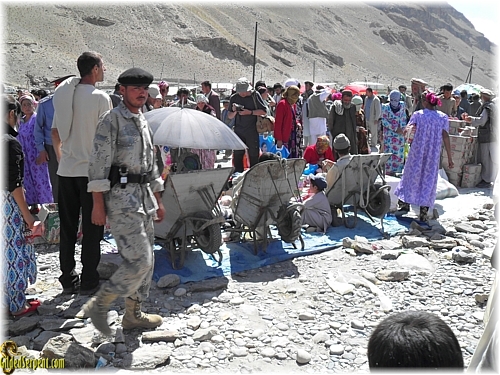
    After all my many travels to Tajikistan, filled with the frantic bustle of dance lessons, rehearsals, teaching, doing trip logistics, hunting for traditional bits and bobs for costuming, and getting fitted for stage costumes, I finally decided to try being a more-or-less normal tourist in one of my favorite places on Earth, the Pamir mountains of Badakhshan, eastern Tajikistan.
  • Serpent Tour 2011 Journal- London, Madrid and Marrakech!
    An experimental travel blog. Let see how it goes! The plan is to update this page frequently.
  • Photos from Rakkasah West 2011, Sunday A- L
    Adira, Anisa, Ashley Lopez, Orchids, Damascus, Danielle, Desert Dream, Diana, Dondi, Dancers of the Desert, El Asaab, Evangaline, Fahtiem, Fatima, Ghawazee, Alexandria, Jamilla, Joweh, Karavansary, Lisa
  • The Transformation of Beauty, Inverting the Gaza, Part 3
    As women and performers, why cannot we see beyond physical representation, when we, too, are trying our hardest to achieve such beauty in our own lives? Such hypocrisy ensures that we can never escape the limitations that society and, thus, we place these same limitations upon our own bodies.
 

Gilded Serpent presents...

“Objects of Desire”

Photos from "Venus Uprisings" April Fantasy Production

text by Tanna Valentine, photos by Brian Lin
posted August 26, 2011

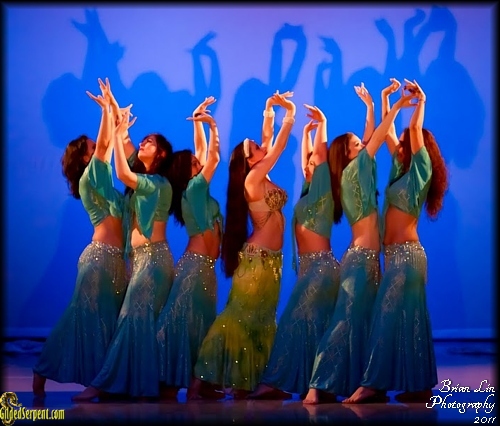
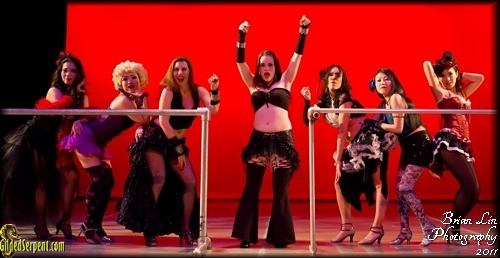
The 7th fantasy bellydance concert produced by the New York City artistic salon Venus Uprising took place at the Merce Cunningham Studio on April 15th and 16th, 2011. Invited dancers were asked to create new works based upon the theme "Objects of Desire". The performers responded with an interesting array of interpretations, ranging from the literal to the highly abstract.

Sisters of Salome

The most narrative piece was was Sarah Skinner and the Sisters of Salome‘s "Little Mermaid", who desired the handsome prince so much she eventually sacrificed her earthly life for him. This was the largest ensemble in the show, including an evil sea-witch, a competitive princess, a helpful sea-witch and of course a handsome prince.


Sisters of Salome

Autumn Ward in "Eve"

Another familiar tale was Autumn Ward‘s innocent yet beguiling "Eve" having the flames of her desire for the apple fanned by the darkly seductive serpent (Amador S. Juarez).


Layla

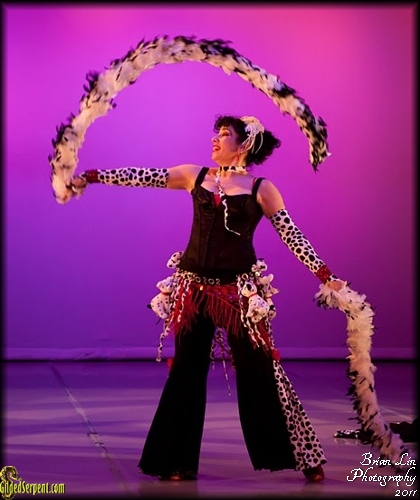
Still more literal (at least visually) was Layla‘s campy, crowd-pleasing "Cruella de Vil", complete with baskets of stuffed puppies and a dalmation-accented costume.

Tanna Valentine

Tanna Valentine‘s "Duty or Desire" portrayed the infamous object of desire Helen of Troy, whose personal desires remain unknown.


Shazad Dancers

Other variations on the desirable female theme included Dena & the Shazadi Dancers‘ playful "Inside the Haram", Neon‘s intriguing "Odalisque" and Elisheva‘s booty-kicking "Dominatrix (D)".

Neon

Neon

Elisheva

Elisheva‘s booty-kicking "Dominatrix (D)"

Zobeida

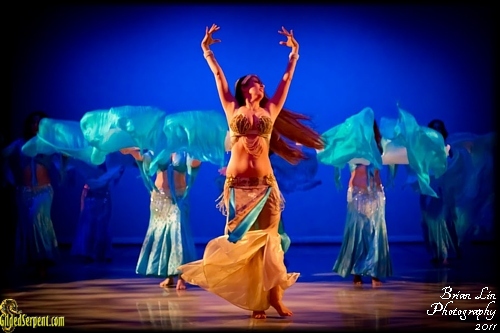
In "Le Papillon de Nuit" Zobeida utilized double veils to embody a wistful butterfly desiring light.

Ayshe and Zobeida

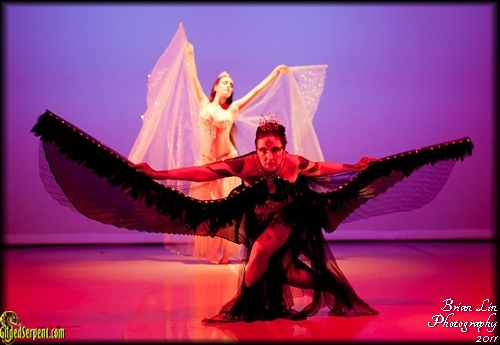
Elena Lentini‘s ensemble (Alanah, Andrea Anwar, Bashirah, Kerri O’Neill, Yoshina) filled the stage with color and movement and huge silk wings in "The Genesis of the Butterfly". Utilizing black and white wings respectively, Ayshe and Zobeida gave a nod to contemporary film culture with their version of the good versus bad desires found in "The Black Swan".


Neon, Angelys, and Jenna Rey

A more abstract interpretation was offered by Neon with Angelys and Jenna Rey in their ultra-modern "In Love With a Time Bomb", enhanced by amazing couture costumes from Gamila Elmasri.

Fayzah

Fayzah‘s minimalist "Love Line" and Alchemy Dance Theater’s dreamy and poetic "Sadhana" evoked less tangible objects of desire – love, enlightenment and peace.

Alchemy Dance Theater

Alchemy Dance Theater


Big Spender

That universal object of desire (money!) was celebrated in the final number with a sassy and rousing version of "Big Spender".


Big Spender

As always, Venus Uprising was fortunate to have photographer Brian Lin on hand to capture many moments from the show.


use the comment box

Have a comment? Use or comment section at the bottom of this page or Send us a letter!
Check the "Letters to the Editor" for other possible viewpoints!

Ready for more?


Gilded Serpent presents...

Arabian Nights at 12 Adler Place

Aisha Ali Archives
Almost my first, but actually my second costume, photographed at either the Torch Club or 12 Adler Place.

North Beach Memories, Part 1:1961

by Aisha Ali
posted August 17, 2011

AishaIt has been several years since Lynette Harris asked me if I would consider contributing to the Gilded Serpent’s “North Beach Memories, collection of articles and interviews by artists who were there during the ‘60s and ‘70s. At the time, I thought it would be a cinch; I would just slightly rewrite my old Arabesque article titled “Looking Back, the Dance Scene in California” Vol. IX, 1983. After retyping the article with my computer, (I had no e-file since it was written in the days of manual typewriters.) I realized that the section on North Beach was more of an overview and didn’t give a significantly personal report. Also, after reading all the other articles by artists who had performed in North Beach, I noticed that none of them had any recollection of me, (probably because most had arrived on the scene years later); although Dahlena, had not only shared the stage with me at The Bagdad Cabaret, we had shared an apartment!
 
12 Adler Place
The first part of my North Beach saga began in 1961. Previously, I had met my mentor, Leona Wood in Los Angeles when we were both performing for the Arab students at a UCLA International Festival. The very first Los Angeles Middle Eastern club had already closed. It was “A Thousand and One Nights” and had been at Farmer’s Market on Fairfax and Third. There were a few Middle Eastern club venues in Hollywood, such as The Greek Village, The Torch Club and The Fez, but there were only a handful of dancers in all of Los Angeles, so despite my inexperience, it wasn’t difficult for me to find work. I had been performing on weekends at the Torch Club in Hollywood while holding down a job as an engineering draftsman. In the evenings during the week, I attended sessions at UCLA’s Ethnomusicology Department and among other things, played ching-ching in several gamelan groups. The Ethnomusicology department was founded by Mantel Hood in 1960. His 2nd wife Hazel Chung headed the dance department, and at that time there was a close connection between the two departments when ethnic dances were involved. Leona Wood’s husband, Philip Harland, assisted teaching with the Master drummers that UCLA brought from Africa. Philip played Egyptian and Indian tabla as well.  Leona had introduced me to her friend Josephine, whom she described as a lovely Sicilian American woman who had recently taken the stage name of Jamila. Just divorced from the Indian dancer Satyia, Jamila had moved, or was in the process of moving, to San Francisco. Her new gentleman friend Yousef Kouyoumdjian, was playing violin at a nightclub just off Broadway, called “12 Adler Place”.

Aisha Ali Archives
Jamila, dancer, Adel Sirhan, oud player, Lemmy Pasha, Kanoun, Yousef, violin.

Well-established as a Jazz club, they were experimenting with Middle Eastern music and Yousef suggested to the Italian owners that they bring in Belly dancers to attract more tourists. Jamila reluctantly became one of the first performers, and since at the time, there were few (if any) Belly dancers in San Francisco, she took on the responsibility of finding other dancers for the club. For starters, she booked an Anglo-Indian dancer by the name of Nargis who lived in Los Angeles, and until she could bring dancers from the East Coast, she enlisted me for two weeks as the third dancer.

vw bugEager for the opportunity to appear nightly as a belly dancer, in an exciting new city, I arranged a two-week leave from my work and school, and prepared to travel to San Francisco.

Early on a Thursday morning Jamila arrived with Yousef in his VW bug to collect me. I climbed in the back between Adel Sirhan, the new oud player, and Yousef’s Mama, who was visiting from Iraq. For most of what was at that time an eight-hour journey, I sat immobilized with Adel and Mama Kouyoumdjian sleeping on my shoulders.

Alisha Ali Archives- Jamila
Jamila from that period, also doing “floor-work”.

Yousef had arranged for me to stay in the home of a nurse living near Golden Gate Park. Having come to Los Angeles directly from Pennsylvania, San Francisco seemed like a foreign country to me, and Leona had warned me that parts of the city were still equipped with ancient bathroom plumbing that still used water cabinets with chain pulls.
 
On the night we arrived, I was introduced to the other dancer Nargis and Ali, a young Persian musician who played a wooden drum that he called a “doumbeq”. He explained to me how it was different from the Arabic darabouka or tabla used for Arabic music.

Nargis was born in India to an English couple, but raised by an Indian doctor and his wife.  She was modest, shy and lady-like – with pale brown shoulder length hair. Although her look was not typical of a Belly dancer, she was experienced and her performance was professional. The choo-choo was her best movement and she executed it with precision, scooting rapidly and effortlessly on the balls of her feet. During a taqsim, (Our dances featured several slow sections, when the musicians played taqsim, in order to extend the dance music to 45 minutes.)

Nargis would demonstrate the yoga exercise which alternates isolating the rectus abdominus muscles in a hunched stance with hands braced on the knees. Our stage was a few inches above the bar top, so the customers viewed our feet at the level of their drinks and had to look up to see us in full if we were in front of them.

At that time, Broadway was not yet the center for X-rated entertainment that it is today. It was an exciting neighborhood representing a mixture of cultures and the streets were usually bustling with pedestrians. Fortunately, none of the demeaning practices such as having dancers go through the audience for tips, drinking with customers, or having a barker outside, had been thought of yet.

Performing for those two weeks at 12 Adler Place was a turning point in my life.  I began to have second thoughts about spending hours working as a draftsman to earn a living. Becoming a professional dancer would allow me to study and pursue my many creative activities, and the most immediate of these became to design and sew the ornamented costumes I would need to further such a career.

The Bagdad

In 1962, Yousef took the musicians and dancers from 12 Adler Place and opened his own nightclub, The Bagdad around the corner on Broadway. Jamila may have helped him in getting the license, and she worked hard to fix up and decorate the place. 12 Adler went back to being a Jazz club. At this time I was invited to come and dance for an extended time so I gave notice to the engineering company where I was working, which was the last time I ever had an “ordinary job.”  During this period, Dahlena was brought from the East Coast to perform at The Bagdad and the two of us shared an apartment with Jamila, Yousef and Yousef’s Mother. I remember months earlier, Jamila talking to Yousef about bringing Dahlena. They had met at the Greek Village in Hollywood where Dahlena had appeared briefly. Jamila described her to Yousef saying, “She moves like a fish!” – an attribute much appreciated by most Middle Eastern men.

Since there were not enough bedrooms for everyone in our apartment, Dahlena and I slept on the floor on thin crib mattresses, purchased by Yousef in a second hand store.  My quarters were in the empty dining room. It was winter and the floors of the mostly unfurnished apartment were drafty although I borrowed a heavy woolen Iraqi tapestry as a blanket. Both Dahlena and I soon developed bad colds with high fevers, but were not permitted to take off any sick time from The Baghdad.

There was no refrigerator in the kitchen, but I remember it was cold enough for us to keep all the perishable dairy, meat, and vegetables outside on the kitchen porch.  One of our treats would be when Yousef cooked eggs with Armenian sausage for breakfast. We would sit low on the floor around a frying pan, placed on a low wooden stool, reaching with our forks for a share. My memory is that, eventually, Dahlena and I did most of the cooking and cleaning as well as ironing the voluminous dresses that Yousef’s Mother wore.

It soon became apparent that Dahlena was pregnant with her first child. One of the customers, a nurse, brought it to our attention, saying that soon it would be obvious to everyone.  I remember helping Dahlena to design and make a costume that would cover her condition. The idea was to make a tobe baladi and since we had little opportunity or means to go shopping, all we could find was a kind of lacy curtain fabric that we hand-sewed, and I dyed scarlet with Tintex fabric dye. It wasn’t one of my greatest creations, but anything looked good on Dahlena! In exchange, she sometimes shared some dance movements with me.

I enjoyed all of the stories about her life as a Playboy Bunny in Chicago and her experiences with the mafia, who frequented the dance clubs there, men whom she described as “nice gentlemen”.

Condor club in 1973One night, during this period, two Algerian dancers auditioned at the Bagdad. Their names were Fatima and Soroya and because they were cousins, their last names were both Ali. They had come to America as brides of American servicemen, although marriage had not effected any change in their careers or lifestyles, which included additional professional activities after hours, with men that they met at the club.  Because my last name was Ali as well, they eventually began the rumor that I was also their cousin. I wouldn’t have minded, if not for their scandalous reputations.  Fatima was petite and had short frizzy hair.  The knife scars and Bedouin tattoos that decorated her face hardened her appearance and her attempts to cover them with makeup only made it worse. When Fatima danced, her arms would swing nonchalantly at her sides and her demeanor was often belligerent.  Soroya, on the other hand, had a look of comfortable amiability. She balanced a large clay water jar on her head during her dance and always wore long baladi tobes that covered her plumpish figure. Both dancers were able to maintain an effortless vibrating hip movement, which they could accentuate in a multitude of directions while shifting weight daintily on the balls of their feet. The audience seemed to love them, and they became a part of the North Beach Middle Eastern dance scene.

For a short time Lolita, a young stripper-turned-Belly dancer, performed with us. She always wore her blond hair in a ponytail and never attempted to look exotic. I didn’t know her very well but once offered to drive her to Auburn to visit her daughter who was in an orphanage. Lolita had become pregnant while still a young teenager and gave birth to a baby girl who had been taken away from her. I never heard from her or of her again after that, so she must have decided stripping was more lucrative.

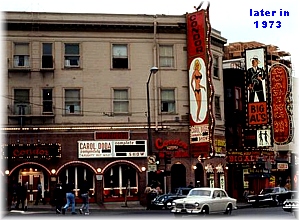
Carol Doda was performing topless at the Condor Club on the corner and was one of the first celebrities to advertise her breast enhancements. I also remember Finocchio’s across the street where transvestites performed. It was the topless clubs that initially brought more tourists to the area.

Aisha Ali Archives
My first photograph in a backbend, doing what we called “floor-work”.

When Gigi’s opened across the street, the tourist traffic on Broadway became even more interesting.  Sometimes, we were invited by customers to sneak away between our shows to see other performers on Broadway. People were going from one club to another making a night of it, which was why it was so important to always have a dancer on stage to hold the crowd.

Our dance sequences became longer and longer in order to make this possible. It was during this era that the part of the routine known as “Floor Work” developed. Each melodic instrument would play an extended solo with a chiftiteli “ground beat” and we would do a series of backbends in various positions and slither into splits or semi splits–anything to hold the audience.

The music played in the Middle Eastern clubs of San Francisco during that time had an exciting quality of its own, despite the fact that the combinations of musicians were frequently changing. The special sound derived partly from the cultural mix of musicians – Turkish, Lebanese, Syrian Armenian, Persian and even Hispanic. This sound was captured on several record albums featuring musicians from the different clubs. We all loved the local sound of the music and I never questioned its artistic value until the night Hrach Yacoubian, a well-known Armenian violinist, stopped by the Bagdad after his show at Bimbo’s. Yousef was happy to see him and we all sat around past closing time while he and Hrach chatted about their past and the style of music they were each playing at present.
 

Aisha
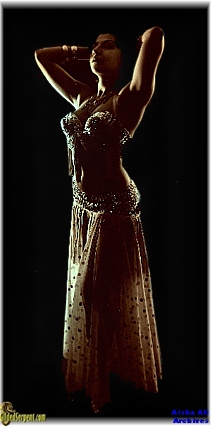
Gold dotted with sequin costume made for me by Leona Wood.
Aisha
Blue beaded costume previously owned by Dahlena and sold to me. It was created by Lisa, a popular costume-maker in Chicago

Next chapter coming soon: Hrach Yacoubian, Frank Sinatra, The “other” George Elias, Vince Delgado Fadil and
Photos: Walid, The Casbah, Marlene of Cairo, Bob Papas, and Dizzy Gillespie

use the comment box

Have a comment? Use or comment section at the bottom of this page or Send us a letter!
Check the "Letters to the Editor" for other possible viewpoints!

Ready for more?


Gilded Serpent presents...

Dallas Observer’s Recent Belly Dance Ruckus

Finger Symbol

by Jasmine June
posted August 18, 2011

Did you know that Belly dancing leads to masturbation? Neither did I. Yet, according to journalist Nikki Lott of the Dallas Observer, that’s a result of Belly dancing. In an article posted earlier in the Dallas Observer, Lott referred to the upcoming Belly dance convention in Grapevine, Texas, Yaa Halla Y’all, as a “Flicking Your Bean” seminar! (For those of you don’t know, that vile phrase is slang, meaning female masturbation.) Lott also encouraged women to decorate their vaginas (since women are going to all that trouble to bare their midriffs anyway) and started the article with the command: “Vajazzle your Jazzler”. You can read the full article here.

After a major unexpected backlash from the Belly dance community, the Dallas Observer pulled the article and replaced it with a cleaner, more condescending version. However, in explaining the update, the paper issued a weak apology at best and then caused further harm by accusing the Belly dance community of causing a “ruckus”. Sorry, Dallas Observer, but it’s the other way around; the poorly written and offensive article caused the ruckus. What the Belly dance community created was a powerful backlash.

The silver lining in all this is witnessing the wrath of Belly dancers scorned.

Certainly, Belly dancers world-wide ought to feel proud of the wit and intellect present in the dancers’ responses. For example, in Ozma’s Costumes Facebook note, the writer offers an apt description of how Lott’s article would read if applied to a more masculine art form, reading like this:

“Drop your cocks and grab your socks, fencing is coming to the Media Convention center and, let’s face it, we’re bored this summer. Now, I don’t know if the saber or lance or whatever is a symbol of phallic inadequacy for all fencers, and there is no reason to stop masturbating on my account, but it seems like there is something fairly Freudian about the whole thing…”

screenshot of offending articleThe note continues on in a witty fashion while simultaneously defending the integrity of the dance.

The Dallas Observer Facebook page is filled with hundreds of comments from Belly dancers, producers, and Belly dance fans. These comments come from all over the world, from as far away as the Philippines. While anger can be felt throughout the posts, most of the commentators made succinct and insightful points.

In fact, the hundreds of comments now make the Dallas Observer Facebook page a convenient source for all that is Belly dance. Culture, origins, history, costumes, health benefits, and other useful subjects are all mentioned and thoroughly described.

Dancers posted pictures of non-midriff baring costumes and videos of elegant performances. Other dancers explained the years of training involved in becoming a professional Belly dancer and the importance of treating the dance with respect. The wide array of Belly dance styles was clearly showcased, and yet, the force of the backlash showed that we are a united community, speaking with many voices and one voice at the same time.

In her blog, writer and dancer, Dilara Sultan, writes, “If anything, we can rest assured that when it matters, Belly dancers will take the stand to defend their art, proving to anyone that the last person you want to mess with is a Belly dancer.” Nevertheless, I think that Princess Farhana sums it up best with her version of a “finger symbol”.

use the comment box

Have a comment? Use or comment section at the bottom of this page or Send us a letter!
Check the "Letters to the Editor" for other possible viewpoints!

Ready for more?

  • Bellydance ‘n All that Jazz, Trends in Tribal Fusion
    For some dancers, it can be easier to relate to music from one’s own culture than it is to music from halfway around the world.
  • Empowering Women in India through Belly Dance
    The company works with less fortunate and troubled families and women, and pays the women a decent sum for their crafts as a way of helping them out
  • Not So Steam punk Belly Dance
    Since Tribal Fusion is also easily accessible, there have been dancers who begin performing and calling themselves professional when really they are just hobbyists. A professional belly dancer would never label her dance genre based on an aesthetic.
  • Tribal Fusion: An Evolving Dance Form
    The biggest contrast between ATS and Tribal Fusion was that improvisation was the basis for ATS while Tribal Fusion, at least in its earliest phase, had a strong emphasis in choreography. This allowed Jill Parker to play around with musicality and to explore musical genres that were appealing to her.
  • An Intro to Tribal Fusion
    Since Tribal Fusion Belly Dance is a relatively new dance form, it is especially important to treat the genre with a level of professionalism, or else one runs the risk of discrediting the work of dancers who have dedicated their lives to creating and elevating Tribal Fusion Belly Dance.
  • To Berlin and Back, Bridging Cultures Through Belly Dance
    In this way, he demonstrated that belly dance isn't something that is defined by culture. Rather, it is an art form that can be perfected by anyone who puts their mind to it, and it's an art form that can be used to bridge cultures rather than divide them.
  • “Ghannili Shwayya, Shwayya”, (Sing for me a little, a little), Musings: Music Choices at BDUC 2011
    Thirty-one contestants and thirty mergencies later, I had my answer.
  • Your Stage Name, Choosing the Right One
    Beware of letting others name you! Years ago, dancers were often surprised before going on stage to dance as they were announced by musicians or club owners by a name unknown to them that they hadn’t selected.
  • Gigbag Check #30 – Suhaila Salimpour
    Suhaila take us on a tour through her gig bag and what is important for her to have with her for performance. This video was shot in May 2011 in the dressing room at Tribal Fest in Sebastopol, California.
  • From Town to Goat Track, A Tour of the Pamir Mountains of Tajikistan
    One lithe young girl twisted her way through this crack and into the tiny cave, and brought back some mineral crystals, said to have healing powers.
  • Becoming the Object of Your Own Fantasy, "Perfumes of Araby" in the 1970s, Part 2
    We are packed tightly shoulder to shoulder, impulsing to the dramatic beat with great solidarity: traditional hand gestures, chest drops, all very serious and trance like. This mood was broken however by a guy at the back of the 200 plus audience, who stood on his chair, raised his beer glass and shouted "The one in the yellooooow…." then actually fell completely backwards like a tree that had just been cut! I hope he was OK!
  • Carnival of Stars, Page 4: O-Z Photos
    The Carnival of Stars Festival is produced by Pepper Alexandria and Latifa at the Richmond Auditorium each year at the beginning of August. The stage at this facility is hard to beat. The wonderful lighting and the large stage make every dancer feel like a diva! Once again, Carl has done an amazing job catching the character of each dancer.
  • Intervew with Ahmet Ogren, Bringing Gypsy Dance to the People
    Ahmet is a sexy and masculine dancer who combines a sense of playful humor and has the dedication and drive of a consummate professional. He pushed us hard, laughed, and encouraged us.
 

Gilded Serpent presents...

“Ghannili Shwayya, Shwayya”

19 minute video of interviews conducted for this article

(Sing for me a little, a little)
Musings: Music Choices at BDUC 2011

by Hana Ali
posted August 15, 2011

I was excited and full of anticipation as I settled into my carefully chosen seat and admired the new BDUC 2011 venue, eagerly awaiting the Egyptian preliminary competition to commence. The previous year, it had occurred to me that the percentage of contestants choosing to dance to a mergenci seemed disproportionately high. I wondered what this year’s music choices would be.

Thirty-one contestants and thirty mergencies later, I had my answer.

I should clarify that the term “mergenci” means an Oriental dance opening instrumental, and it is a composition specific for dance entrances, not to be confused with plain instrumentals that could be a Samai or instrumental versions of an Umm Kulthoum or Abdel Wahab or other classic composition. For the purposes of this article and especially the interviews, I used the terms “instrumental” and “mergenci” interchangeably, and it appears that (given the context) most dancers will understand my intent. However, the more accurate choice would have been mergenci.

In the spirit of full disclosure, I admit that I have a strong preference for music with singing and tend not to find most mergencies particularly inspiring. Maybe that is why the strong predominance of said form struck me so. I can understand a segment of the population choosing to dance to an instrumental piece for the sheer love of it…but 97% of the contestants? I’m no statistician, but that seemed significant enough to me!

Thus I enlisted the help of our gamely editor, Lynette of Gilded Serpent, and set out to find out why. My “highly scientific” approach involved scanning the field for giant sparkling eyelashes, dashing over and inquiring whether owner of said eyelashes had competed in the Egyptian preliminaries and were they to respond in the affirmative, to proceed to badger them with questions about their musical choices. This was day two of the event, so I only managed to interview eight of the thirty-one contestants (25%), because a lot of the non-finalists were no longer around, and others were just hard to get hold of at the time.

I also interviewed the five estimable personalities that judged the Egyptian preliminaries this year, namely: Aisha Ali, Amina Goodyear, Angelika Nemeth, Jillina and Sahra Saeeda. My so-called research was rather impromptu, and though not exactly worthy of inclusion in a peer-reviewed journal, it did begin to answer some of the questions in my mind and helped me to anchor some thoughts that had been floating around in there. Below is a summary of the interviews, followed by my personal take on the whole thing.

Contestants

The contestants’ responses (give or take) generally comprised of answers to the following series of questions:
What piece of music did the contestant choose for the Egyptian category?
What made him/her choose that particular piece?
Whether he/she usually prefers to dance to an instrumental piece versus a song (implying singing)?
(If applicable) Why so?
(If applicable) Follow-up questions, if the conversation called for it.

  • Mireyah Yamilet (Puerto Rico)
    Mireyah danced to a mergenci because she thought the piece was “exotic, sensual, and mystical.” She added that she generally prefers to dance to instrumental music. “It’s my favorite!” she declared.

  • Shereen (Czech Republic)
    Egyptian Champion BDUC 2011
    Taxim Champion BDUC 2011

    The music Shereen danced to was “definitely Sahra Saeeda‘s music,” chosen because she fancied it the most among all the tunes in her collection.
    “I picked an instrumental because I think that, mainly, people pick instrumental songs for the Egyptian category. It’s not a requirement, but for competition, I think it’s better to choose an instrumental piece of music because, with instrumentals, it allows for bolder technique and a bolder movement, but with a voice, it’s more about the emotion and the story in the song. It’s beautiful to tell a story by your dance, but I don’t think it’s the best thing for a competition.

    Competitions are not only about the technique of course. They’re also about the soul and stage presence.

    However, I think that emphasis is more on technique, and when you perform for a normal audience in a theatre, it’s not that much about the technique. That is not a priority, why everybody is going to the theatre. People are coming to see the emotions (the story), but in a competition, I think showing that you have good technique is one of the main objectives.”

  • Sa'diyyaSa’diyya (Texas, US)
    Universal Champion BDUC 2011
    Specialty Champion BDUC 2011
    2nd Runner-up Egyptian BDUC 2011

    Sa’diyya selected a mergenci from Asmahan‘s latest CD. Sa’diyya chose this piece because she found it charismatic, full of changes and well-orchestrated. She liked that the piece was energetic, with varying tempos and energy levels that she felt would help sustain the audience’s interest. She also thought that the variety of rhythms within her chosen piece of music would allow her to showcase commensurate variety in her dancing.
    “I prefer instrumentals. There is a lot of Belly dance music that is instrumental, that originally had lyrics with it, so we’re still supposed to know what the music means if we’re going to dance to it.

    However, I would say overall, just for a wider range of audience, most people are going to connect more to instrumental music, and you have more freedom to express yourself.

    I always prefer really energetic or robust music; it doesn’t matter about the mood. As for performing for a different kind of audience: yes, I might use this music in a restaurant…  That would be similar music.”

  • VenussaharaVenusahara (Arizona, US)
    Venusahara danced to a mergenci because:
    “The instrumentation of it was very beautiful, very complex…and it was a little above my level, but I wanted to strive for something just a little bit out of my grasp and push myself to another level.”
    She added that although vocals sometimes resonate with her, in this particular case, it just happened to be the instruments.
    “The instruments tell so much of a story. You hear them cry, and you hear them sing with joy, and I wanted to be able to try and portray that with my dance.”

  • TatianaTatiana Kuzmina (Russia)
    Tatiana chose a piece composed by Dr. Samy Farag because its tempo was quick and allowed her to “play” with her costume.

    Tatiana said that she usually prefers vocals over instrumentals, but chose an instrumental piece for the competition in compliance with BDUC rules.

    “Here, we can’t perform with song… In the Egyptian category, (there should be) no song … instrument … rules.”

  • Roxy (Washington, US)
    Roxy danced to a mergenci as well.
    “I don’t know what my song is titled. I got the it from Cassandra’s store. I took a workshop from her, and so I used the first piece of it. I was going to dance to a pop Turkish song, but I thought, because this is the Egyptian category, I picked that one…”
    “It’s an instrumental arrangement of a very traditional Egyptian song.” (author-I wondered what made it so traditional.)
    “I know it was Cassandra’s,” she said, “so I picked that song. It was supposed to be 38 min long, but we just have it for 2 minutes for that one.

  • Kenya (New York, US)
    Kenya danced to an instrumental piece by Mario Kirlis because she found it emotionally moving.
    “I usually listen for a piece that moves me and makes me feel good when I listen to it.

    They both (instrumentals and songs) move me, but if I don’t understand the music and the language that they’re speaking, I tend to stick with instrumentals.”

  • OlegOleg (Russia)
    (Translator: Natika)
    Fusion Champion BDUC 2011
    3rd Runner-up Egyptian BDUC 2011

    Oleg danced to a mergenci as well, although I was not able to gather any details about it. He said that his goal had been to try to show his emotions as well as to display his technique.
    “I like instrumental music more because the dancer should be like the orchestra and he should express every instrument.”

    He further opined, “Today I was surprised because America is behind Russia in technique and in music…and emotionality, too.”

JudgesJudges

In the interest of efficiency, we cornered four of the judges in pairs: Aisha Ali paired with Angelika Nemeth and Amina Goodyear with Jillina. Sahra proved to be the most elusive due to her judging and workshop schedule, and thus, was the last to be questioned (off the camera because, by this time, it was well past our illustrious editor’s bedtime and she was bravely using the last of her dwindling energy reserves to fight off a complete meltdown).

We briefly explained to the judges that I had been interviewing contestants about their music choices for the Egyptian category and that I was curious as to why it was predominantly instrumentals when in my view, there is so much more to Egyptian music than only mergencies.

 I posed the following question to the judges:
“If you were to advise a student on what music to pick to compete in the Egyptian category, to win, what would you recommend?”

  • Angelika Nemeth

    “(It should be) Egyptian, first of all, and I would say (that you should) choose something that’s produced by a really good orchestra in Egypt. So, you have to know a little bit about the musicians. So, (pick) something that (first of all) turns you on, because you have to listen to it many times and express the love, the joy, and the passion that the music calls forth in you. I think it should have variety. (It should have)…an exciting opening, some good taqsims; it should not be too long (because nowadays they tend to be rather short, attention span is short, and you don’t have a lot of time). (It should include) a good, short drum solo, followed by a nice finale that ties it all together. I like to hear at least three or four rhythm changes, just like a nice masmoudi, back to something folkloric, either saidi, bamboteya (in the chosen piece of music), so it shows the dancer has knowledge.”

    Angelika, while clarifying that vocals were permissible, issued a caution regarding their use: “You have to be careful when they have song, because you really have to know what’s being said, and you have to interpret that with gestures.”

    She agreed with Aisha Ali’s opinion that most dancers do not know what is being said and added, “unless they’re Egyptian–or unless it’s translated for them.”

  • Aisha Ali
    “I’m very much a traditionalist; so I would advise my students to choose what I love, which would be traditional Egyptian instrumentation played by about five musicians. Sometimes some of the new instruments do become Egyptian, like the trumpet did after 20 years and the accordion–and even the synthesizer. So, you could have some of those instruments if they’re really integrated with the music.

    Mainly, (the music should) have those instruments which elicit a virtuoso response from the dancer.”

    Aisha Ali was of the opinion that music containing lyrics require the dancer to understand the meaning of those lyrics and that most of the dancers “simply do not know…If they’re lip-syncing it, and they’re off, it’s embarrassing.”

  • Amina Goodyear

    Amina lamented that the contestants “showed more technique than themselves” and advised future contestants to select music that would allow for greater emotionality.

    “Choose about a 2 minute portion of an Oriental to just have the introduction for the ‘walk around’, and then, I would choose something emotional. If they don’t want singing, I would choose an emotional piece that, maybe, had singing but would be (predominantly) instrumental–such as an Umm Kulthum, Warda, or Abdel Halim Hafez that’s (been arranged as) an instrumental, so that I could see the emotion and the feeling behind the dance.”
    Agreeing with Jillina’s comment about including pop or shaabi and lightening the mood, Amina added, “ Then, a little bit of their personality would come out.”

  • Jillina
    Agreeing with Amina’s comments, Jillina said:

    “For me, watching thirty dancers all do Oriental instrumental pieces, the program got a little dry, so I was waiting for somebody to do a pop song maybe, to show a range of emotion.

    There was only one girl who did a little bit of Umm Kulthum with vocals that I loved. I was like, ‘Okay, this is pure Egyptian, and I actually really appreciate it.’ So I would try to do that; edit out a piece of music that has maybe a minute of entrance to get you on the stage, show (using some choreography) that you can travel, show an emotional range with some Umm Kulthum and maybe some pop, some shaabi, something fresh. (You need) something to lighten the mood, because it gets tense in the competition. We feel tense judging; they feel tense competing. Maybe (the music should have) a little bit of drum solo. However, with everybody doing the same thing, it made it hard to clean the palate.”

    She offered a related bit of advice to the dancers in the audience:
    “When you’re watching one of the other dancers, it’s really important to ask yourself:  ‘What am I feeling? Am I feeling sensitive? Hot? Am I laughing?’

    You have to make the audience, especially the judges, feel something, whatever it is. They can’t just say, ‘Okay, good technique, good dance, good choreography.’ What do I walk away feeling? What do I remember? That is the key.”

    Responding to my comment about having enjoyed the Fusion category the most, Jillina added,
    “I was surprised that I was actually judging fusion, and I got in there, and it was really exciting. I had a lot of fun. You’re right, people just brought out their best.”

  • Sahra Saeeda
    Sahra’s advice to future contestants was to use a piece of music with a grand beginning that would allow the dancer “to enter with flourish and command, followed by a section where she could do more internal stuff, and go inwards.” She suggested something with variety as a way to hedge one’s bets.

    “If you do something that’s all one piece or style then maybe I will love it, but another judge might hate it.”
     
    She did not think necessarily that instrumentals allowed for variety more than singing, but that a lot of the mergencies did possess that variety already. She was of the opinion that many audiences for whom most dancers perform, do not understand the music. Therefore, the lyrics and their meanings (their emotional content and the dancers’ emoting) tend to be lost on some audiences. “Also, a lot of the dancers, themselves, don’t understand the lyrics,” she commented.

SahraWhat did I walk away feeling? What do I remember? That is, indeed, the key!  At the conclusion of the Egyptian preliminaries, I felt mostly enervated. The dancers, their technique, choreography, costumes, all had been gorgeous and impressive. Yet, I could not shake the sense of boredom. The obvious cause of my vexation was the utter lack of variety in the music, of course. However, it goes beyond that alone.

Lack of variety in the music is frustrating enough, but even more so because it translates into lack of variety in the dancing.

When thirty people all dance to nothing but mergencies, it makes for thirty Oriental pieces infused with a heavy dose of ballet, jazz, or modern technique with limited room left for expression of emotional and cultural context, for a change in mood, or for that internalization that is so quintessentially Egyptian. Mergencies have their due place within the Egyptian show but are not the entire show. So why were they the predominant musical choice at the contest?

Apart from the occasional case of misconception that instrumentals are the standard for the Egyptian category (or possibly even a BDUC rule) I suspect that ease of use, and maybe in the case of some, a limited awareness of equally Egyptian alternatives, may play a role. Mergencies tend to have a lot of rhythmic variety built into the format, often with varying tempos and energy levels, so are ready-to-use versus the extra burden involved in devising one’s own cocktail or medley. 

Another possible reason seems to be the perception that competition equals technique equals mergenci–the belief that a mergenci allows for better display of technique, which, in turn, is the priority in a competition setting, even at the possible cost of feeling and story-telling (tarob).

I understand that technique is important, especially in a competition setting, but I do not understand why feeling and emotional expression should be thought of as something secondary to it. The two are not mutually exclusive. In fact, a good dancer is expected to display both concurrently. Is she not? So why the compartmentalization?

Finally, in my quest for answers, one of the most common refrains that I heard had to do with the language barrier.  Many dancers, as well as their audiences, do not typically understand Arabic lyrics or the cultural context behind much of the music. Instrumentals, therefore, offer greater freedom of expression to the dancers and make it easier to connect to an uninitiated audience.

I understand this status quo. What I do not understand is why it is acceptable for it to remain so. Why is it acceptable to disregard a beautiful song merely because the lyrics are not in one’s mother-tongue? I have yet to attend a Flamenco show where the dancers and musicians omitted the singing because I, as a member of the audience, did not understand Spanish. In fact, most serious Flamenco artistes make it a point to learn the language if they do not already know it. I feel that we “Egyptian-style dancers” should hold ourselves up to slightly higher standards. If a dancer is competing to claim authority in Egyptian style dance, it should be his/her obligation to understand or find translations of lyrics. Yes, it may not be his/her native language, but then neither is this dance style.

Dancers should be expected to give as much weight to understanding the language and cultural context as to learning how to execute a perfect Arabesque.  

Instead of brushing off the language barrier as an immutable fact of life, we should make a greater effort to educate, not only ourselves but, our audiences as well. The uninitiated will become initiated. I am not saying that all of us should, or even can, be fluent Arabic speakers, but at the very least, we should and can, mine the Internet for translations, pester our Middle Eastern friends and acquaintances for their help, train our ears to listen for key words and phrases, attempt to understand the cultural context of the music via movies, and yes, even YouTube! The resources available nowadays seem endless. Many dancers already do this and more. Unfortunately, many more do not. Rather than dismissal and disinterest, it would be nice to make the effort to understand and educate. What is the reward? …why, piles and piles of beautiful poetry to feed your dancing soul!

Here’s hoping for a better-mixed “cocktail” at BDUC 2012!

use the comment box

Have a comment? Use or comment section at the bottom of this page or Send us a letter!
Check the "Letters to the Editor" for other possible viewpoints!

Ready for more?

Related Videos:


Gilded Serpent presents...

Your Stage Name

Choosing the Right One

Ma*shuqa Mira Murjan

by Ma*Shuqa Mira Murjan
posted August 13, 2011

If you have been dancing and performing as an Oriental Dancer for at least a year, and you are serious about continuing to perform on the stage, there are several good reasons to select a stage name. 

First, adopting one begins the process of becoming professional and establishing your identity as a dancer. 

Second, a one-of-a-kind stage name will help avoid dancer identity confusion as you begin to: 

  • market and advertise yourself as a professional performer,
  • develop your marketing collateral (business cards, brochures, etc.),
  • building a website, 
  • and creating social marketing presence.

Third, with all of the marketing and visible presence both in print and on the Internet, you will want a stage name for safety reasons:

  • to protect your given name for separate career interests (more discussion on this in another article; 
  • and for personal safety, such as protection from stalkers, and identity theft problems. 

Beware of letting others name you! Years ago, dancers were often surprised before going on stage to dance as they were announced by musicians or club owners by a name unknown to them that they hadn’t selected.

  Thus, dancers often were given names by Middle Eastern men that were not at all appropriate:  a name like Haraka –it sounds like it could be a nice name, but is actually a word from the book Watership Down meaning “rabbit poop”.  One dancer, Heaven-forbid, was given the name Sharia! Again, this sounds like a nice Arabic name for a woman – but is actually the term in Islamic Law which deals with many topics addressed by secular law, including crime, politics, and economics, as well as personal matters such as sexuality, hygiene, diet, prayer, and fasting.

Let me share my own personal stage name history:  Ma*Shuqa Mira Murjan 

I chose my name for a very practical reason; I didn’t think my given name would be good on a performance program or theatre marquee.  During the time I was finding my stage name, my mother-in-law was raising Arabian horses; so I had the choice of real Arabic names such as: Tishana, Sharifa, Londa, and MaShuq.  I wanted the name Sharifa, but several dancers already had chosen this beautiful name. 

As it turns out, Ma’Shuqa means beloved or sweetheart. I chose my stage surname, Murjan, from clothing designer, Gloria Vanderbilt’s, designer blue jeans Murjani. (Research was difficult back in the days before the Internet), but I found that murjan meant "treasure or precious".  Mira means strong or to "carry a big stick" in Greek, and is also the name of an Indian goddess.  I chose Mira as my middle name from the movie Ben Hur.

There is a characteristic theme to both my given middle name and stage middle name. Mira was the name of the white horse in the team of four horses in Judah Ben Hur’s chariot team stable. Mira was the sturdy, stable horse, and favorite sweetheart of the old Arab owner that was placed on the inside spot of the chariot horse team. I find it quite interesting that the chariots in this movie raced counter-clockwise. I, too, always prefer to spin counter-clockwise and always seem to take the more difficult road and "go against the flow" in almost everything I do!

Most interesting to me is that my Japanese middle name, Kazue, is a rare name for a woman and is usually a man’s name, Kazuo, because it means "strong" (or strong-willed).  I think both Mira and Kazue are perfect as I come from Japanese samurai lineage. My given birth name means “strength” in English European history.  Asian cultures share similar views of proper female behavior with Middle Eastern cultures; thus my study and performance as an Oriental dancer, rather than a classical Japanese dancer, was not viewed positively by my parents and was yet another manifestation of my strong will. 

Luckily for me, the strength of my names gave me strength when I needed it most: in my recovery from a horrific childhood accident and later, in my fight against cancer.

While writing this article, I had an opportunity for some introspection regarding my dance experience, my dance persona, and what I have studied and learned about the dance and profession. This introspection has brought me to the realization that I have come full-circle and I now embody and exemplify my chosen professional dance name.  My selected dance name was my guide, and it gave me hope and encouragement to achieve my goal of becoming a professional dancer. 

I  see now that, in selecting my stage name, I named myself as I would have wanted to be known as a dancer: strong, reliable, and respected, treasured, and beloved for teaching and performance. Although when I first started this dance I dreamed of being a professional dancer who was renowned for excellence, my name selection was mostly a subconscious selection as I didn’t have the perspective and personal history that I have now experienced throughout my dance career.  Thus, I counsel that you will come to know which names are the right ones for you–if you engage in soul searching as you select your professional stage name.

Fun facts regarding my stage name:

I chose the name of one of my mother-in-law’s horses because I knew that since I was familiar with the Arabic name, I would respond when called by this new name and have a smile on my face because I would be thinking,  “Who is calling the horse?”  I often share a laugh with people who hear Ma*Shuqa as “Mashugana” (a Yiddish term used as an exclamation to describe something as “crazy or bizarre”). Sometimes the mis-hearing makes introductions hilarious!  To help with pronunciation, I added an asterisk symbol to the spelling of my stage name, which has given me a teaching tool. I tell dance students to use the symbol of the asterisk in Ma*Shuqa as a structure for developing dance styling (e.g. take every step you know and give it dimension by moving in different directions such as diagonal, etc.).  Born a Gemini, I also sometimes write my name with a star symbol instead of an asterisk.  I tell my students that when they re-structure dance steps learned as a drill using a star pattern, their performances will shine and they can be “stars of the stage” as they begin to develop their own dance styles and allow their own special personae to shine.

Today, I encourage dancers  to select a stage name to give themselves the opportunity to become a professional dancer. Just as you would approach applying for a job, highlighting your personal history to match the job description, I would advise you to select your dance name in much the same way.  What is your preferred style of dance?  What type of music do you like? Do you want to select an Arabic, Persian, Turkish, or Lebanese name that matches your dance style?  What attributes do you wish for yourself: strength, agility, fluidity, etc? Do you have any personal characteristics by which you are known?  e.g. flaming red hair, a sweet, shy smile, or powerful movements and flowing dance style? These (and other) questions can lead you to a dance name that will feel right for you!

In addition to researching on the Internet, you can look to books written to assist in choosing an appropriate dance name; Najia Marlyz (formerly Najia El-Mouzayen) who is a writer for Gilded Serpent, published the first dancer’s name book “What’s In a Name?: a Glossary of Names for Middle Eastern Dancers”, now available on Gilded Serpent.

Check with your relatives and community as your ancestry might provide information and relevant names.  (Amaya of New Mexico told me she may be distantly related to  the Spanish Flamenco dancer, the famous Carmen Amaya.)

Even with research, some name conflicts can’t be avoided.  An Internet search on YouTube for “MaShuqa” will provide you with over 100 YouTube videos of Indian Bollywood star, MaShuqa. Yes, the name has the same spelling as mine, but without the middle and surname.  She is a good entertainer (probably half my age) who wasn’t  born yet when I chose my dance name, but as a result, sometimes I’ll discover that I have new students who expect to learn Bollywood style dancing!

I am glad to have had a stage name early in my dance career to avoid a conflict of interest with my regular day job/career employment,especially in light of the recent situation in Northern California with an adjunct college professor being fired for discovery of her other employment in San Francisco as a dancer.  A stage name may offer some protection, shielding your given name for career interests and for personal safety issues such as protection from stalkers, and identity theft problems. 

Mu*Shuqa winks

My discussion of stage names and security issues for Oriental dancers will continue in an additional article.  I have already contacted many of the professional dancers I know who do not use a stage name, and I am awaiting their responses regarding the issues of professional conflict of interest or identity theft that they may have experienced.  I’ll also share some of my own experience with security and career issues.  Please contact me at MaShuqaDancer@gmail.com if you want to share your personal story about experiences as a dancer and your own naming process, or discuss any other issues related to your stage name.

use the comment box

Have a comment? Use or comment section at the bottom of this page or Send us a letter!
Check the "Letters to the Editor" for other possible viewpoints!

Ready for more?

  • Dance Passion and Burnout, Muses and Goddesses
    Is It Time For A Dance Counselor and Coach, or Dance Retreat To Revitalize Yourself and Your Life?
  • Scott Wilson’s CD "Efendi"
    Scott’s quest is to make Mid-East music more accessible to American audiences…
  • Gigbag Check #30 – Suhaila Salimpour
    Suhaila take us on a tour through her gig bag and what is important for her to have with her for performance. This video was shot in May 2011 in the dressing room at Tribal Fest in Sebastopol, California.
  • From Town to Goat Track, A Tour of the Pamir Mountains of Tajikistan
    One lithe young girl twisted her way through this crack and into the tiny cave, and brought back some mineral crystals, said to have healing powers.
  • Becoming the Object of Your Own Fantasy, "Perfumes of Araby" in the 1970s, Part 2
    We are packed tightly shoulder to shoulder, impulsing to the dramatic beat with great solidarity: traditional hand gestures, chest drops, all very serious and trance like. This mood was broken however by a guy at the back of the 200 plus audience, who stood on his chair, raised his beer glass and shouted "The one in the yellooooow…." then actually fell completely backwards like a tree that had just been cut! I hope he was OK!
  • Carnival of Stars, Page 4: O-Z Photos
    The Carnival of Stars Festival is produced by Pepper Alexandria and Latifa at the Richmond Auditorium each year at the beginning of August. The stage at this facility is hard to beat. The wonderful lighting and the large stage make every dancer feel like a diva! Once again, Carl has done an amazing job catching the character of each dancer.
  • Intervew with Ahmet Ogren, Bringing Gypsy Dance to the People
    Ahmet is a sexy and masculine dancer who combines a sense of playful humor and has the dedication and drive of a consummate professional. He pushed us hard, laughed, and encouraged us.
  • Carnival of Stars, Page 3: I-O Photos
    The Carnival of Stars Festival is produced by Pepper Alexandria and Latifa at the Richmond Auditorium each year at the beginning of August. The stage at this facility is hard to beat. The wonderful lighting and the large stage make every dancer feel like a diva! Once again, Carl has done an amazing job catching the character of each dancer.
  • Incredible Helena Vlahos! Magic, Mojo and Inspiration
    There was this beautiful, magical Belly dance woman who was bold, confident, and paving a wave of inspiration and independence.
  • Dancer Cancer, Part Two: Who? Me?
    Still, the human heart is woven with threads of hope, and mine did not doubt that if I could make it through the onslaught of doctors, surgeries, pain, and gymnastic therapy, I would, someday dance again.
  • Carnival of Stars, Page 2: D-H Photos
    The Carnival of Stars Festival is produced by Pepper Alexandria and Latifa at the Richmond Auditorium each year at the beginning of August. The stage at this facility is hard to beat. The wonderful lighting and the large stage make every dancer feel like a diva! Once again, Carl has done an amazing job catching the character of each dancer.
 

Gilded Serpent presents...

From Town to Goat track

A Tour of the Pamir Mountains of Tajikistan

Robyn and Gulnamo

Robyn in Khorog with Professor of English Language, Gulnamo Dustambaeva

by Robyn Friend
posted August 10, 2011

Why travel to such an out-of-the way place?  What is the attraction?  Dance, of course, was the first attraction for me. But there are many others: the breathtaking scenery, the kindness of the people.  There is also the realization, in a way that can’t be acquired just by reading about it, that this is how most of the population of the world lives, with little or no electricity, indoor plumbing, or paved roads.  There is nothing like a visit to a remote human habitation to come home with a greater appreciation of one’s own blessings. 

Robyn interviewed
interview at our riverside house in Khorog

After the festival, Neil and I stayed in Khorog for several days, recuperating from the whirlwind of travel and festival-going by visiting with friends, and relaxing at our river-front guest-house.  Eventually, we were caught up on our email and our sleep, and it was time for the next adventure: a tour of diminishing population, via a road trip down to the southern tip of Tajikistan. 

We engaged the same driver, Amri Khuda, who had driven us up from Dushanbe the week before.  We charted out where we wanted to go and the sites we wanted to visit, Amri Khuda putting in his recommendations as well.  We decided to follow the Oxus River almost to its source, then head up to the Khargush Pass, and thence back to Khorog. 

Khorog, the province’s administrative capital, has a population of 25,000.  The next city down the road has a population of 5,000.  After that, the next village has a population of about 1,000; the next one after that, about 300.  At the point where we were to turn north towards the pass, the villages looked to be even smaller; well under 100.  The last few hundred miles seemed to be nearly unpopulated.

At last the day came, and we headed south towards Ishkoshim, stopping along the way at Garm Cheshma (“hot spring”)  where men and women have separate rooms in which to soak in the hot mineral water. 

The Pamir Mountains are part of a complex of mountains (1) created by the northward motion of the Indian sub-continent, which for the last few million years has been colliding with Asia, resulting in the folding and lifting of the earth’s surface.  The movement of this huge landmass causes earthquakes, some of which open shafts deep into the earth so that superheated water can come to the surface, evidenced by the numerous hot springs throughout the mountains.


Looking from Ishkoshim, Tajikistan,
towards the Wakhan and the Hindu Kush Mountains

Ishkoshim is a very quiet town with one main street and one cross street.  From the eastern end, you can just look down towards the Wakhan Corridor, the long valley between the Wakhan Mountain Range and the Hindu Kush (2).  At Hani’s Guesthouse we got a room, plus meals.  I promptly fell asleep, and stayed asleep until supper.

During supper we met four Britons: two from the BBC and two climbers.  The climbers were hoping to be the first to climb the large mountains in the Wakhan Corridor, and the other two were there to document the first week of the journey.  The climbers had planned to buy some food and supplies in the Tajik city of Ishkoshim, and the rest in Sultan Ishkoshim, across the river in Afghanistan.  The only problem was that they did not know the words for any of the foodstuffs they planned to buy, like rice, bread, and so forth.  Fortunately, I was able to write out a grocery list for them in Tajiki that would work on both sides of the border.  The journalists eventually filed a series of reports of the part of the journey they witnessed (3).  That night we were invited to a concert in a nearby little theater, a showcase of local talent, including singers, dancers, and musicians.  It was lovely to see people appreciating their own culture and supporting their friends and neighbors.

Afghan Bazaar

About six years ago, the governments of Tajikistan and Afghanistan, with the aid of the Agha Khan Foundation, cooperated to establish a weekly market where Afghans and Tajiks could meet to swap, barter, and negotiate for each others’ goods.  I had been to the Afghan Bazaar, as the Tajiks call it, many times in Khorog, and had long looked forward to going to the one in Ishkoshim. 

The Ishkoshim Afghan Bazaar was held on an island in the middle of the Panj River.  From the Tajik side, we had to surrender our passports before walking across the bridge to this island – and suddenly, we were in Afghanistan! (4)

Among the many interesting items on offer there were used modern wares (sewing machines, cooking utensils, and so forth), but also atlas fabric, the hand-dyed silk for which Central Asia is famous.  Some of the atlas even came pre-cut and embroidered, ready to be made into the salwar-kameez-like outfit that Tajik ladies like to wear. 

bazaar
Afghan Bazaar, Ishkoshim.
Some women have tied scarves over their faces, not as hijab, but to keep from inhaling the dust

In several trips to the Pamirs, I had never before experienced altitude sickness, which can manifest itself in fatigue, shortness of breath, extreme headache, or dizziness.  By the time we reached Ishkoshim, we were at about 8,000 feet, and the slightest physical effort made me aware of the reduced oxygen level.  This awareness came first of all in the deep and lengthy sleep I had before our supper, and then later by the burning of my oxygen-starved  muscles as I climbed up and down hills to see the sites.  The local people are adapted to the altitude; a good thing, as at one point we had to hire local children to drag me up to the top of a hill to see some ancient ruins.

The high mountains and narrow valleys of Badakhshan make the Pamirs remote and inaccessible, with what seems a strong and active connection to an ancient past.  This is manifested most obviously in the form and structure of the cheed house, but also in the many petroglyphs and relics of the two main local religions before Islam, Buddhism and Zoroastrianism. 

After we left the guesthouse the next day, we continued our route along the Panj River, stopping at a fort built in 300 BCE to prevent invasion by the wild tribes from across the river.  The ruins of the ancient buildings remain, and are still used as a military outpost to prevent a different kind of invasion: drug smugglers.  Among the other sites we visited were a hilltop Buddhist stupa (5), ancient petroglyphs (6), and the hot springs of Bibi Fatemeh.  This hot spring had only one facility, so the ladies and gentlemen had to take turns.  This was unlike any hot springs I had ever been in – instead of man-made pools, there was the natural cavern full of water, and we waded right in.  There was a small window through which one could look up the canyon, and a tiny little cave at about waist height, through a narrow and oddly shaped crack. 

One lithe young girl twisted her way through this crack and into the tiny cave, and brought back some mineral crystals, said to have healing powers.

  She shared these crystals around, giving me one of them, as well.  This spring is also said to open a barren womb, and make it possible for a woman to get pregnant.  As seems to happen frequently when we travel in the Pamirs, we bumped into a friend; in this case, the mother of our landlord in Khorog, who had been making us breakfast just a few days before.  Right near Bibi Fatemeh was another, even more gigantic 2,000-year-old fort – almost 600 feet long, commanding an amazing view of Tajikistan, Afghanistan, and Pakistan.

fort
fort

The second night on our tour we stayed in a home with a family.  No hotels in a village of 300, of course, so a home-stay is the only option.  They even had signs in a few villages directing one to homes that offered accommodation.  Historically, travelling on foot from place to place up in the mountains, or down to the town, can take several days; because people need a place to stay overnight, traditional Pamiri houses have a separate room for guests.  Our home-stay had an outbuilding with three rooms.  There was another small building with a shower and sink, powered by a tank on the roof, filled by girls carrying buckets up a ladder.  The toilet, a “squatter”, as is most often the case outside of Khorog (7), was in its own little building out back.  We took our meals in the family’s part of the house, cooked for us by the family in a small kitchen.   

The family included a young woman with a baby; after our breakfast the next day, the woman put on some dance music and held the baby, moving the child to the music.  And that is how Pamiri children learn to dance so well!

Through the Khargush Pass

Back in Ishkoshim, we had been told that there had been a washout on the road farther up the Oxus River, the very road that we needed to take to get to the Khargush Pass, and our route back to Khorog.  The rock slide had occurred at a point where the hillside was very steep, and the road was very narrow – and several hundred feet up from the rushing river below.  One French engineer at our guesthouse who had gone up to see the damage stated that it would probably be three weeks before the road would be ready for vehicles again.

We had a conversation with Amri Khuda about the road, thinking about having to turn around and go the back way we had come.  He just smiled and said, “We will go there and see”. 

So, the next morning, we set off towards Langar, the last town along our road before we started for the Khargush Pass, visiting more sites, including a shrine and tomb to a local sufi saint, decorated with very pagan rams’ horns. 

In these mountains, elements of paganism, Zoroastrianism, and Islam are all evident and side-by-side. Many people appear to be aware of the ancient roots of some of their Ismaili Islamic religious practices, and seem very tolerant of the ambiguity and apparent contradictions.

Fort?
Shrine in Langar with rams’ horns

Shrine?

At the very last house beyond the very last village, we stopped at the home of the khalifa, the spiritual leader of the town of Langar (population: not very many), where we had a delicious lunch prepared by his daughter.  People in the Pamirs are generous, but they are also poor, so we paid for our lunch, just as we had paid for our accommodations each night in our home-stays.

While in Langar, Amri Khuda had heard that there was a German gentleman hitchhiking around the Pamirs, and would we give him a ride?  Of course, we had no objections to this.  We picked him up after our lunch, and were surprised to see that he was not a young man, but rather in his 70’s, with nothing more than a small backpack. 

MapAs we headed up hill towards the pass, I looked back and caught a fleeting glimpse of the Amu Darya plunging down a steep and narrow cliff on its way down towards the Aral Sea, many miles to the northwest (8).  Off in the distance on all sides as far as the eye could see, rose wave after wave of snow-topped mountains, each range taller than the one in front of it.  We eventually drove as high as 14,000 feet, but the mountains still rose up another two miles.

Soon we were at the point where the road had washed out.  There was plenty of time to view it because the road made a large hairpin turn hugging the opposite cliff.  

We were pleasantly surprised to see that the washout had been neatly filled in with large rocks up to the level of the road.  We crossed that patch of road fairly quickly, holding our breath and invoking the names of whatever gods protect the innocent traveler. 

But we made it across, and the road held up just fine.  In a land where the government is not there demanding a lot of red tape, safety inspections documented in triplicate, and formal contracts for acquiring materiel, people just take care of business and do what is needed.

As we worked our way slowly up towards our turn-off for Khargush Pass, the number of dwellings and visible people dwindled until we seemed to be the only humans for many miles around, except for the occasional goatherd with his flock.  Eventually the road leveled out even with the river, which was narrow and shallow at this point, more of a psychological border with Afghanistan, literally a stone’s throw away, than a real barrier.  Before we turned more directly north and away from the river, we saw above the opposite bank a small domed building with a few camels wandering around it.  This building turned out to be another tomb-shrine, far away from any apparent village or habitation. 

Finally we turned our backs to the river and climbed up towards the pass.  A small rill came down through a ravine, moistening and greening the land on either side.  At the top of the pass (9) was a small still lake, the source of the rill, backed by even more snow-capped mountains off in the distance.  Green natural lawns surrounded the lake; scampering over these lawns were brown animals the size of a large housecat that disappeared into their burrows as we approached.  Amri Khuda told us these were marmots, small mammals related to the North American groundhog, that live in mountainous areas all over the world.  “Khargush” means rabbit in Tajiki; we had fun joking about the very large “rabbits”.

At last, our road intersected with the Pamir Highway, that ancient trade route that would take us either west to Khorog, or northeast to Kyrghyzstan.  We said farewell to our hitchhiker (10), and took the west road towards “home”.

One can read weighty tomes about the history of Central Asia, the influence of Persian culture, the nomadic or agricultural life in the mountains, the diaspora of displaced peoples.  All those volumes by erudite scholars and travelers cannot replace the knowledge that smacks into one’s forehead by simply being there, observing the way of life, the harsh circumstances of geography, political boundaries, and rural poverty.  With all their hardships, still the people of the Pamirs are warm-hearted, welcoming, and as generous as they can be in their meager circumstances.

I would love to bring you with me on my next trip, so you can experience yourself the thrill of the mountains soaring overhead and the kindness of the strangers who will soon become your friends.  Who knows?  The Pamir Mountains and peoples pull me back again and again.  Who is to say they won’t pull you, too, someday?

farms
Amri Khuda and the author looking across the remains of an ancient fort and the Oxus river towards the green fields of Afghanistan

Robyn Friend is a scholar, writer, dancer, choreographer, and teacher.  She has a Ph.D. in Iranian linguistics from UCLA, and lives southwest of Los Angeles, where she is the favorite dancer and dance teacher of the large Iranian community of Southern California.  She has studied dance with distinguished teachers in both Uzbekistan and Tajikistan, and is the author of many books and articles.
Want to learn some Pamiri dances?  Visit www.robynfriend.com.


Footnotes

1-The others include the Tien Shan, Hindu Kush, and the Himalayas.

2- During the 19th-century “Great Game” between Russia and Great Britain the Wakhan Corridor was placed inside the borders of Afghanistan, so as to keep Russian-influenced Tajikistan separate from British-influenced India,which in those days included what is now Pakistan. 

4- A tightly controlled part of Afghanistan.  Without a passport or visa, we could not enter Afghanistan proper.

5- According to http://en.wikipedia.org/wiki/Stupa, a stupa (from a Sanskrit word literally meaning "heap") is a mound-like structure containing Buddhist relics, typically the remains of Buddha, and is used by Buddhists as a place of worship.

6- At 1,500 feet above the road, over 11,000 feet in elevation – I let Neil do that one without me!

7- And sometimes even in Khorog.

8- The Oxus at one time flowed all the way to the Aral Sea.  Now, however, due to the irri gation of cotton fields begun during Soviet times, the Oxus disappears into the desert sands of Turkmenistan before reaching the shrinking Aral Sea.  The loss of the Aral Sea as a heat sink for Central Asia is one of the major ecological disasters on our planet.

9- At 14,400 feet the pass is higher than the highest spot in the continental U.S. – and we drove there!

10- He caught a lift with an eastbound truck right away.

use the comment box

Have a comment? Use or comment section at the bottom of this page or Send us a letter!
Check the "Letters to the Editor" for other possible viewpoints!

Ready for more?

  • Dancing on the Roof of the World, Community Festival in Tajikistan .
    After all my many travels to Tajikistan, filled with the frantic bustle of dance lessons, rehearsals, teaching, doing trip logistics, hunting for traditional bits and bobs for costuming, and getting fitted for stage costumes, I finally decided to try being a more-or-less normal tourist in one of my favorite places on Earth, the Pamir mountains of Badakhshan, eastern Tajikistan.
  • Tajikistan: The Land of Dance, Part One
    Video features: #1-Introduction by author, #2- A Map Tour on an ancient and modern map.
    " Communication with the outside world is difficult and expensive, and nearly impossible during the winter."
  • Tajikistan Part II: Land of Dance
    After a performance of daf soz (songs with frame drum accompaniment), the musicians played maddoh, followed by raqs-i aspak (“horse dance”), in which a man dances wearing a costume which makes it look like he is riding a horse.
  • Becoming the Object of Your Own Fantasy, "Perfumes of Araby" in the 1970s, Part 2
    We are packed tightly shoulder to shoulder, impulsing to the dramatic beat with great solidarity: traditional hand gestures, chest drops, all very serious and trance like. This mood was broken however by a guy at the back of the 200 plus audience, who stood on his chair, raised his beer glass and shouted "The one in the yellooooow…." then actually fell completely backwards like a tree that had just been cut! I hope he was OK!
  • Carnival of Stars, Page 4: O-Z Photos
    The Carnival of Stars Festival is produced by Pepper Alexandria and Latifa at the Richmond Auditorium each year at the beginning of August. The stage at this facility is hard to beat. The wonderful lighting and the large stage make every dancer feel like a diva! Once again, Carl has done an amazing job catching the character of each dancer.
  • Intervew with Ahmet Ogren, Bringing Gypsy Dance to the People
    Ahmet is a sexy and masculine dancer who combines a sense of playful humor and has the dedication and drive of a consummate professional. He pushed us hard, laughed, and encouraged us.
  • Carnival of Stars, Page 3: I-O Photos
    The Carnival of Stars Festival is produced by Pepper Alexandria and Latifa at the Richmond Auditorium each year at the beginning of August. The stage at this facility is hard to beat. The wonderful lighting and the large stage make every dancer feel like a diva! Once again, Carl has done an amazing job catching the character of each dancer.
  • Incredible Helena Vlahos! Magic, Mojo and Inspiration
    There was this beautiful, magical Belly dance woman who was bold, confident, and paving a wave of inspiration and independence.
  • Dancer Cancer, Part Two: Who? Me?
    Still, the human heart is woven with threads of hope, and mine did not doubt that if I could make it through the onslaught of doctors, surgeries, pain, and gymnastic therapy, I would, someday dance again.
 

Gilded Serpent presents...

Becoming the Object of Your Own Fantasy

Diane Webber and the "Perfumes of Araby" in the 1970s, Part 2

Diane Webber

by Stasha Vlasuk
posted August 8, 2011
Part 1: posted here
Part 2: posted here You are here!
Part 3: posted here

From Part One: This article will focus on the iconic 1970s “Perfumes of Araby” belly dance troupe, lead by the almost mythical performer/actress/teacher Diane Webber, my teacher.  I was there!  Through a selection of our performances in that era we’ll explore dance and costuming as becoming the object of your own fantasy.  The article also touches on paradoxes of our art form: the performance setting creating a artificial boundary within which we feel free to have intimate exposure (and how costuming facilitates that), and the seeming female accommodation of male sexism actually a proclamation of autonomy and a pathway to power. 

The Perfumes moved on to several other outdoor festivals for the rest of the 70s.

At the Calabassas Pumpkin Festival, during the month of October, twice a weekend in often 100+ degree weather, more than a dozen dancers and half a dozen musicians put on an hour long show before quite a lively audience!  Each of us had a signature costume color, mine was yellow.  One memorable event happened during our performance of a serious North African Guedra dance.  The company all lines up stage front to create a screen while our Guedra dancers position themselves mid stage. 

We are packed tightly shoulder to shoulder, impulsing to the dramatic beat with great solidarity: traditional hand gestures, chest drops, all very serious and trance like.  This mood was broken however by a guy at the back of the 200 plus audience, who stood on his chair, raised his beer glass and shouted "The one in the yellooooow…." then actually fell completely backwards like a tree that had just been cut!  I hope he was OK!

pumpkin fest
1973 Pumpkin Festival


pumpkin fest
 1973 Pumpkin Festival Snake Dancer Teresa Davis


pumpkin fest
 1973 Pumpkin Festival L to R : Rhonda, Anaheed Mary Ann Cappa, Khadija Cynthia Beck, Ann Graca,
Yvonne Partidge, Margaret Turner, Sam King, Stasha Qamar Vlasuk, Donna Bella, ?
 
pumpkin fest
 Perfumes of Araby 1974 Pumpkin Festival, from R to L this time : Rhonda, Yvonne Partridge, Maryann Krakow, Margaret Turner, Shirin,
Pat, Ann, Jann Goldsby, Stasha Qamar Vlasuk (the one in the Yelloooow!), ?, Maya Knight, Ann Graca, Khadija Cynthia Beck, ? , ?
 Photo J. Webber
 
 
pumpkin fest
 1974 Pumpkin Festival,  
Photo J. Webber
 
pumpkin fest
  1974 Pumpkin Festival,   L to R: Stasha Vlasuk, Yvonne Partridge  
Photo J. Webber
 
pumpkin fest
 1974 Pumpkin Festival,
 Photo J. Webber
Photo actually from the H'wood party that was asked to "tone it down"
"One private party experience performed in the vast
back yard of a Hollywood mogul’s estate got so loud
and rowdy that the show was stopped mid way and
we were asked to tone it down!
"

Beginning in 1973 the prestigious Pasadena university Cal Tech invited the Perfumes of Araby to perform annually the week before finals in order to “relieve student tension”.  How delightful now to look at the audience in the background of these pictures: love that 70s fashion.  We also starred in the evening entertainment at the very first Equicon Science Fiction Convention, another bastion of brainiacs.

detailLos Angeles being a media town our performances often had “stellar” spectators. One Pumpkin Festival afternoon, off to the side of the stage stood David Carradine, star of the popular “Kung Fu” TV series, with his jaw dropped.  Although I didn’t see him, I’m told George Harrison, my favorite Beatle, attended one of our Beverly Glen Art Festival performances (he had a house in the neighborhood at that time).  One private party experience performed in the vast back yard of a Hollywood mogul’s estate got so loud and rowdy that the show was stopped mid way and we were asked to tone it down!
During the the mid-70s we added a costumer to our roster: Kathy Sanders added her expertise in helping us manifest Diane’s vision with continuity.  We all avidly scoured historical sources to create our “Turkish court costumes” and some of us included jeweled pillbox hats.

By 1975 Diane designed a bold new costume element inspired in part by Jerome’s “Woman of Cairo at Her Door”: an “under the bust” vest with a sheer blouse.  Because our outdoor festivals were so hot, most of us opted to create sleeveless versions.  Some of us varied the “peek-a-boo” factor by doubling the fabric or building the blouse on a sheer fabric bra.  In an almost archetypal will to power, Diane encouraged us to utilize our costuming – and our dance – as a way to search out and expand our own unique spirit, fantasy and physique, something I try to continue with my students today: become the object of your own fantasy.

How were we as a group bold enough to appear in public in these spicy outfits?  We achieved this confidence through combinations of sociological perspective that are most probably endemic in your performing troupe as well.  We brought all these factors to our shows.  Read all about it in part 3!

Logo by

Logo drawn by Alicia Austin
perfumes
 Cal Tech 1973
perfumes
Cal Tech 1973  with Louie Sayeg, drummer
perfumes
Beverly Glen Art Festival poster:

Regarding the festival poster: Shira Jane contributes, "
Suzanne Dunaway was the artist for the Beverly Glen Fair poster. She used to live in the Glen but now she lives in Italy with her husband. She is a really cool lady. – www.suzannedunaway.com/

Suzanne’s response to Stasha note regarding this article and our use of her artwork:

"Dear Stasha,
I am honored and touched that you used the dancer (I love it, too, I have to admit) in Diane’s tribute. She was one helluva woman and belly dancer, and my years in the Glen as editor of the Glenite and Glen Fair worker, and simply resident of the Glen, would never have been complete without her dancing each year at the fair. We adored her music and style and looks and personality and kind heart.
Thank you again for going ahead and using the symbol of her wonderful talent.
Affectionately, and sad to hear of her death,
Suzanne"

perfumes
 Beverly Glen Art Festival 1975, L to R : Teresa Davis, Anaheed Mary Ann Cappa, My Lucky Dad, me (Stasha Vlasuk) and Maryann Krakow


 Interesting links
Costume inspirations
Orientalist books to read online:
Author’s Photo Credits:
Most of the pix come from my personal archive; I supply the links for the web sites of other photos in the "interesting links" section.    I encourage you to visit these sites as they contain further (and interesting) information plus exciting video montages for which there’s simply not enough space in this GS article!  


use the comment box

Have a comment? Use or comment section at the bottom of this page or Send us a letter!
Check the "Letters to the Editor" for other possible viewpoints!

Ready for more?

  • Becoming the Object of Your Own Fantasy, "Perfumes of Araby" in the 1970s, Part 1
    The Belly dance scene in 1970s Los Angeles: It is difficult to spotlight succinctly even one portion of a vibrant, vast and quickly growing community of Middle Eastern dancers, their enthusiasts, and the ethnic communities, musicians, festivals and supper clubs that supported the dance arts. The abundance of inspiration in that era was almost beyond understanding; yet once upon a time before the Internet, music, imagery and information was less readily available.
  • We Will Rak You! My Dance Experience with Queen
    I’ll admit I wasn’t too familiar with the music of the British rock group Queen. The year was 1977, the month of December, in Los Angeles. I was invited to perform at a dinner party where Queen, in Los Angeles for several concerts, was the guest of honor. The job came to me through Dianne Webber.
  • 10-9-08 A Big Picture Book Review: Martha Burns’ "Belly Dance, Celebrating the Sacred Feminine" Reviewed by Stasha
    Every page is a work of art, a truly astonishing array of images. The content is very inclusive and features all age ranges, body types and styles. You will see yourself, your best self, in these pages.
  • 12-3-02 “Adventures In Belly Dance Costuming” by Stasha Vlasuk, Vol 1 book review by Robin Alnisa Wood
    This is a good book for both sewing veterans and beginners alike.
  • Carnival of Stars, Page 4: O-Z Photos
    The Carnival of Stars Festival is produced by Pepper Alexandria and Latifa at the Richmond Auditorium each year at the beginning of August. The stage at this facility is hard to beat. The wonderful lighting and the large stage make every dancer feel like a diva! Once again, Carl has done an amazing job catching the character of each dancer.
  • Intervew with Ahmet Ogren, Bringing Gypsy Dance to the People
    Ahmet is a sexy and masculine dancer who combines a sense of playful humor and has the dedication and drive of a consummate professional. He pushed us hard, laughed, and encouraged us.
  • Carnival of Stars, Page 3: I-O Photos
    The Carnival of Stars Festival is produced by Pepper Alexandria and Latifa at the Richmond Auditorium each year at the beginning of August. The stage at this facility is hard to beat. The wonderful lighting and the large stage make every dancer feel like a diva! Once again, Carl has done an amazing job catching the character of each dancer.
  • Incredible Helena Vlahos! Magic, Mojo and Inspiration
    There was this beautiful, magical Belly dance woman who was bold, confident, and paving a wave of inspiration and independence.
  • Dancer Cancer, Part Two: Who? Me?
    Still, the human heart is woven with threads of hope, and mine did not doubt that if I could make it through the onslaught of doctors, surgeries, pain, and gymnastic therapy, I would, someday dance again.
  • Carnival of Stars, Page 2: D-H Photos
    The Carnival of Stars Festival is produced by Pepper Alexandria and Latifa at the Richmond Auditorium each year at the beginning of August. The stage at this facility is hard to beat. The wonderful lighting and the large stage make every dancer feel like a diva! Once again, Carl has done an amazing job catching the character of each dancer.
  • Dance Festival Warms Oslo Winter, Oslo Oriental Dance Festival 2011
    This competition is not open to professional dancers, and judges are required to give constructive feedback to encourage growth.
  • Bellydance ‘n All that Jazz, Trends in Tribal Fusion
    For some dancers, it can be easier to relate to music from one’s own culture than it is to music from halfway around the world.
 

Gilded Serpent presents...

Canival of Stars- Page 4: O-Z

Photos by Carl Sermon
posted August 5, 2011

The Carnival of Stars Festival is produced by Pepper Alexandria and Latifa at the Richmond Auditorium each year at the beginning of August. The stage at this facility is hard to beat. The wonderful lighting and the large stage make every dancer feel like a diva! Once again, Carl has done an amazing job catching the character of each dancer. This is page FOUR of another lovely group of his photos. Check back for more soon! This year’s festival is just around the corner- August 6 & 7, 2011. Gilded Serpent will be there to witness and document this friendly event. See you there!
See Page 1 here
See Page 2 here
See Page 3 here

Oreet


Paloma


Pepper


Raks


Raks Rosa


Rayah


Ruth Amy


Sabiba


Alena


Samia Sisters


Sausan


Sharifa


Sister Sirens


Sonya


Sonya of Berkeley


Soukara


Stacie M Jones


Suhaila Dance Company


Sumaia


SUrreyya


Tabitha


Tatseena and Good Vibs


Troupe Tangiers


Troupe Tahiya


Una


Unmata


Valentina


Wasseema


Wildcard


Yolanda


Zahara


Zambalita


Zelina


Zemira


Zorba


Pepper leads

This year’s event starts tomorrow!


use the comment box

Have a comment? Use or comment section at the bottom of this page or Send us a letter!
Check the "Letters to the Editor" for other possible viewpoints!

Ready for more?

  • Carnival of Stars, Page 1: A-C Photos
    The Carnival of Stars Festival is produced by Pepper Alexandria and Latifa at the Richmond Auditorium each year at the beginning of August. The stage at this facility is hard to beat. The wonderful lighting and the large stage make every dancer feel like a diva! Once again, Carl has done an amazing job catching the character of each dancer.
  • Carnival of Stars, Page 2: D-H Photos
    The Carnival of Stars Festival is produced by Pepper Alexandria and Latifa at the Richmond Auditorium each year at the beginning of August. The stage at this facility is hard to beat. The wonderful lighting and the large stage make every dancer feel like a diva! Once again, Carl has done an amazing job catching the character of each dancer.
  • Carnival of Stars, Page 3: I-O Photos
    The Carnival of Stars Festival is produced by Pepper Alexandria and Latifa at the Richmond Auditorium each year at the beginning of August. The stage at this facility is hard to beat. The wonderful lighting and the large stage make every dancer feel like a diva! Once again, Carl has done an amazing job catching the character of each dancer.
  • 10-6-09 Researching Dance Origins with the Mazin Family, Photo from Pepper’s Archives Part 2, Text by Pepper Alexandria with additions by Edwina Nearing
    Yusuf, Khairiyya and Raja looked a Pepper’s hopeful face with the tears standing in her eyes and caved in. A private performance was arranged to take place on the flat roof of the Mazin’s home in full costume with live musicians.
  • Alexandria’s Archives, Part 1- A Sampling of Costume Creations, Authentic Ethnic, Fantasy and Everything in Between
    Pepper Alexandria says of herself: "I want people to know that I am not trying to bring down Belly dance, I helped create every aspect of it and everything that you’ve heard about me is true!"
  • The Magic of "The Grapleaf", 1976-1997
    Back in the early ’80s when I was performing at the Bagdad Cabaret on Broadway, a customer strolled into the Northbeach nightclub and told me about a little known restaurant
  • The Healing power of Dance
    Many dancer enthusiasts I have encountered come from wounded childhoods.
  • The Legend of Julius Squeezer by Sharifa of Martinez, CA
    I shall never forget my most gentle of beasts, my 14-foot long python," Julius Squeezer"! Weighing in at 80 lb., Julius was nearly impossible to pick up all at once.
  • 12-18-07 Bully Belly by Tatseena
    For example: a promoter is thinking about planning an event and is talking to a friend and says, “I can’t help it if some other teacher has planned a show on the same day or night; they are different styles anyway.”
  • Teaching American Bellydance: Ich Bin Ein Berliner!
    Amazing! The members of the workshop wanted more and more—and even Horacio began trying out my veil moves.
  • A Quest for Beauty, Part 1: Beauty is Discovered
    My wife of 17 years asked, "You’re going to do…. what?"when I told her of my desire to take Bellydance lessons.
  • Personal Truths in Truth or Consequences New Mexico’s Floralia Festival 2010
    Many times a turn of events will bring us to another place to make a new beginning–a deep and sudden loss inspired my original journey to California, and two recent losses inspired my return back to the desert, opening wounds I nearly forgot existed. It was fortunate to have Floralia to attend; it served as a focus on something I enjoy with all my heart–dance.
  • Gig
    Bag Check with Surreyya and Sultana

    What does a dancer need to carry in her gig bag? Surreyya has a very special friend she carries in hers! Sultana, a leopard spotted boa constrictor enjoys being displayed for us and having a dance with her partner. Footage was filmed at Carnival of Stars in November 2008.
  • Our Changing Dance World, a Response to Leila’s "Dance for Dancers"
    Of course, we learn musicality and so forth, but where dance classes in some places are an hour long, teaching long choreography is not sustainable to an instructor.
  • Sunday at Carnival of Stars, Page 5:T-Z
    November 9, 2008, Event Sponsors- Pepper Alexandria and Latifa
  • Sunday at Carnival of Stars, Page 4: R-T
    November 9, 2008, Event Sponsors- Pepper Alexandria and Latifa
  • Sunday at Carnival of Stars, Page 3: M-R
    November 9, 2008, Event Sponsors- Pepper Alexandria and Latifa
  • Sunday at Carnival of Stars, Page 2: D-K
    November 9, 2008, Event Sponsors- Pepper Alexandria and Latifa
  • Sunday at Carnival of Stars, Page 1: A-C
    November 9, 2008, Event Sponsors- Pepper Alexandria and Latifa.

  • Maria, Nadika, Naiya-Hayal, Onyx Moon, Oreet, Raks Al Khalil, Raks Terayz, Raks the Casbah, Reda Darwish, Ruby, Sabiba, Sassafras, Shimmy Amour, Tatseena’s Troupe, Terry, Titanya, Troupe Aneena, Yolanda, Zahara