Gilded Serpent presents...

Canival of Stars 2010- Page 1: A-C

Photos by Carl Sermon
posted July 16, 2011

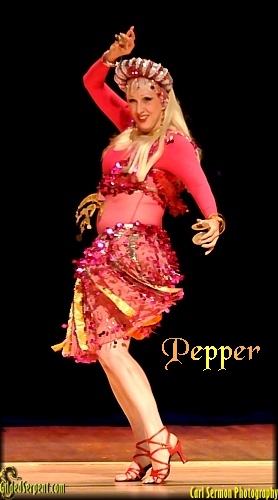
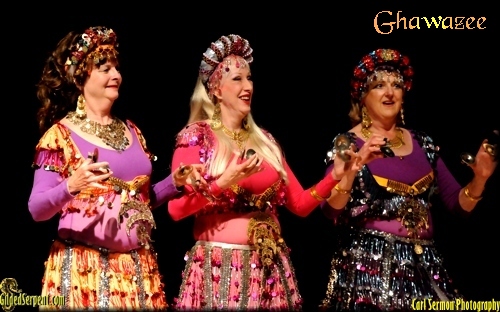
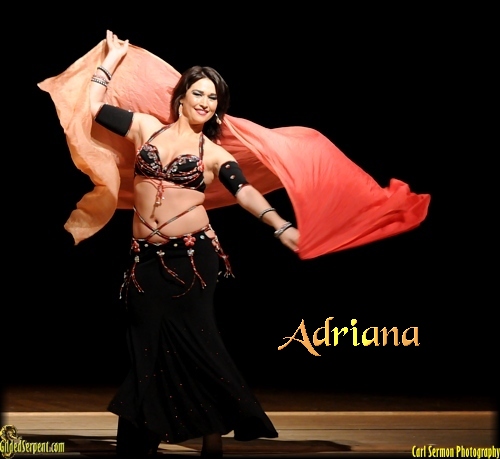
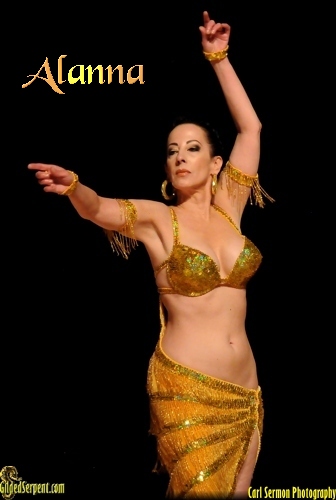
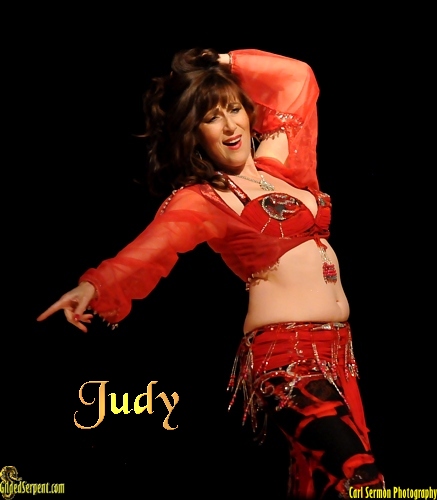
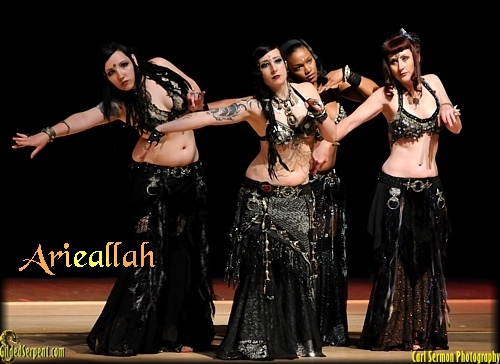
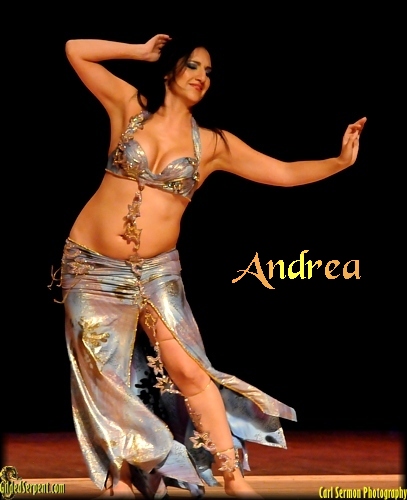
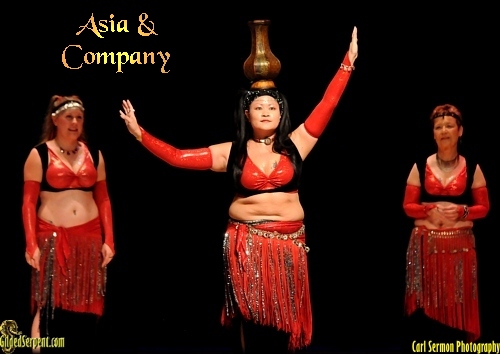
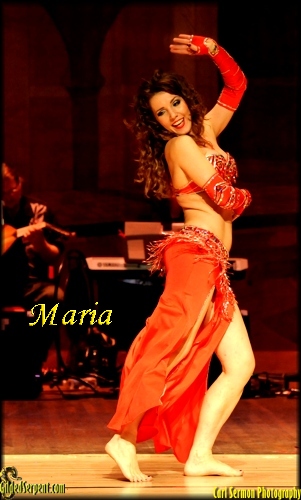
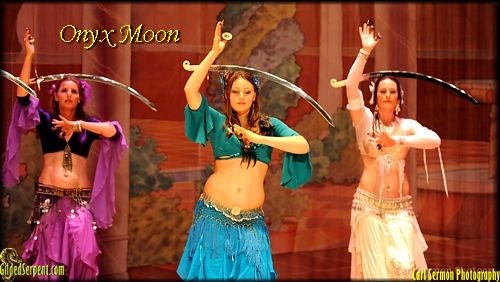
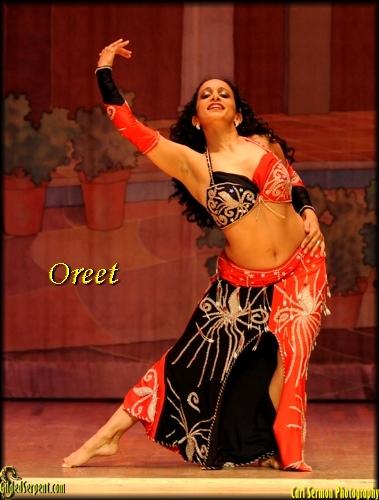
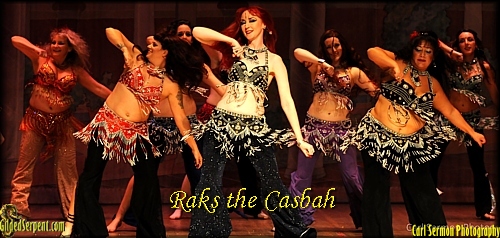
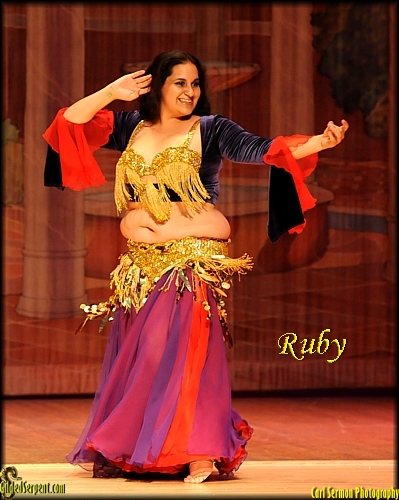
The Carnival of Stars Festival is produced by Pepper Alexandria and Latifa at the Richmond Auditorium each year at the beginning of August. The stage at this facility is hard to beat. The wonderful lighting and the large stage make every dancer feel like a diva! Once again, Carl has done an amazing job catching the character of each dancer. This is page one of another lovely group of his photos. Check back for more soon! This year’s festival is just around the corner- August 6 & 7, 2011. Gilded Serpent will be there to witness and document this friendly event. See you there!

Aazura Nour


Alexandria


Ghawazee


Adriana


Alanna


Ahava


Alnisa


Amina


Judy


Angie


Ariealla


Amira Ariana


Andrea


Asata Dancers


Asia and Co


Banat


Basinah


Birute


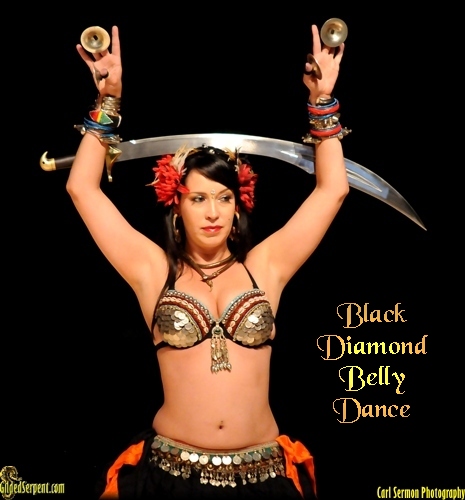
Black Diamond


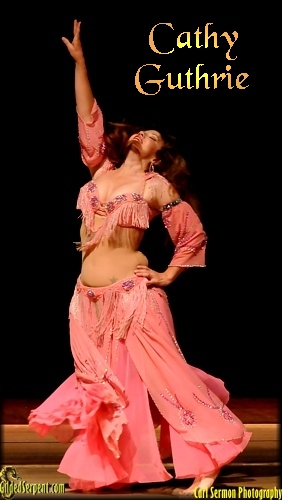
Cathie Guthrie


Celena


Cory Zamora


Crystal Nyla


Crystal Silmi


Crystal Silmi


use the comment box

Have a comment? Use or comment section at the bottom of this page or Send us a letter!
Check the "Letters to the Editor" for other possible viewpoints!

Ready for more?

  • Gigbag Check #22 with Cory Zamora!
    Cory talks with us after her performance at the Carnival of Stars Festival in Richmond, California, in August 2010. She shows us what she carries for her performance.Including an old style 2 piece cabaret belt, Egyptian style bra with no fringe and more. The performance clip includes beautiful floorwork done as only Cory Zamora can do!
  • Carnival of Stars, Performers L – Z Photos
    Latifa, Leyla Lanty, Lulu, Mahsati, Maila, MaShuqa, Monica, Monifa, Naiya Halal, Nera Brent, Pepper, Raks Al Khalil, Raska a Diva, Raks Hakohaveen, Robyn Lovejoy, Safiyah, Sarah Horbeein, Shadha, Shaunte, Sister Sirens, Sukara, Surreyya, Tanja, Tatseena, Tera Lynda, Trish …
  • Carnival of Stars, Performers A – J Photos
    Adriana, Ahava, April, Alexandria’s Ghawazee, Aruba, Asia, Asura Noor, Becca, Birute, Cathy Guthrie, Cheryl, John Stanley, Crystal, Dahlena, Dancers of the Crescent Moon, Danse Maghreb, Daughters of the Pharoah, Dunia, Elizabther, Ena, Esperanza, Evil Eye, Ghanima, Hala, Heather, Jamara, Jawahare, Jewels
  • Gilded Serpent reports- Gig Bag check with Amira and Mom, Sadiya
    What does a dancer need to carry in her gig bag? Amira and her mom, Sandra or Sadiya show off her fancy gig bag and all the costumes in it that Mom made for Amira. Footage was filmed at Carnival of Stars in November 2008.
  • Gig Bag Check with Surreyya and Sultana,
    What does a dancer need to carry in her gig bag? Surreyya has a very special friend she carries in hers! Sultana, a leopard spotted boa constrictor enjoys being displayed for us and having a dance with her partner. Footage was filmed at Carnival of Stars in November 2008.
  • Sunday at Carnival of Stars, Page 5:T-Z
    November 9, 2008, Event Sponsors- Pepper Alexandria and Latifa
  • Sunday at Carnival of Stars, Page 4: R-T
    November 9, 2008, Event Sponsors- Pepper Alexandria and Latifa
  • Sunday at Carnival of Stars, Page 3: M-R
    November 9, 2008, Event Sponsors- Pepper Alexandria and Latifa
  • Sunday at Carnival of Stars, Page 2: D-K
    November 9, 2008, Event Sponsors- Pepper Alexandria and Latifa
  • Sunday at Carnival of Stars, Page 1: A-C
    November 9, 2008, Event Sponsors- Pepper Alexandria and Latifa.

  • I think it was around this time when I had gotten to know my co-workers and escorts well enough to allow them to try explaining their way of life and thinking processes to me, that I realized I was in a “no win” situation.
  • Ask Yasmina #16, New Baby Dance, Taqsim Shimmies, and Cane Music
    However, there are many who had to resort to Cesarean after a long and arduous labor as well. It might be negligent to throw around such claims.
  • Egyptian Percussion Instruments by Dr George Dimitri Sawa
    From the medieval era to our own time, Arabic music has been predominantly rhythmic. For this reason, much effort has been spent to write a theory of Arabic rhythms.
  • Permits, IDs, Licensing, Foreign Dancers in Cairo,
    It dawned on me that some dodgy nightclub manager, whom I didn’t know personally, had complete control over my passport and my freedom to leave! So, I had no alternative other than to end my contract in order to get my passport back which also meant halting the lengthy paper process.
  • Dancing with Tigers, In China with Fleurs d’Egypte
    We had no idea what to expect of the actual location. However, with ticket and costumes in hand, we rode the wave. Arriving late at night, we were ushered to our rooms and straight to bed to sleep off our jet lag. We had no concept of the overwhelming size of the park and over-the-top eye-candy awaiting us the next morning!
  • Becoming the Object of Your Own Fantasy, "Perfumes of Araby" in the 1970s, Part 1
    The Belly dance scene in 1970s Los Angeles: It is difficult to spotlight succinctly even one portion of a vibrant, vast and quickly growing community of Middle Eastern dancers, their enthusiasts, and the ethnic communities, musicians, festivals and supper clubs that supported the dance arts. The abundance of inspiration in that era was almost beyond understanding; yet once upon a time before the Internet, music, imagery and information was less readily available.
  • Inaugural "Art of the Belly" Festival Rings in Spring in Style, Bellydance comes to Ocean City, Maryland
    Inside the hotel, waves of positive energy radiated all around. People were not just glad to be at this festival, they were honored. If you were from Maryland, this was your belly dance festival. Dancers were representing both themselves and the elements of various fusions. They wanted this to be done right.

  • Maria, Nadika, Naiya-Hayal, Onyx Moon, Oreet, Raks Al Khalil, Raks Terayz, Raks the Casbah, Reda Darwish, Ruby, Sabiba, Sassafras, Shimmy Amour, Tatseena’s Troupe, Terry, Titanya, Troupe Aneena, Yolanda, Zahara
 

Gilded Serpent presents...

On the Road to Zimbabwe!

Glam shot

Glam shot in my dressing room, (and yes, can you believe I had my own dressing room)!

Queen of Denial, Part 5

by Rebaba
posted July 13, 2011

I was having trouble navigating the slippery floor that smelled strongly of the beer below my feet as I made my way down the aisle towards the restrooms at the back of the plane.  I barely avoided slipping into a group of my fellow passengers that were congregated in the service area singing songs that sounded like they were usually sung in their neighborhood pubs at closing time.  Wonderful! I was surrounded by drunk and nostalgic men on their way to work in South Africa.

According to our stewardess, the group of men heading to South Africa, had managed to consume every drop of alcohol on the plane before we were even half-way there.  She confided this worrisome fact to me while she was searching for a place to hide for a moment’s rest.  These wailing gentlemen had taken over the back end of the plane for most of the flight, including the area that was normally curtained off for our poor stewardess to get some privacy and rest from her duties.  Unfortunately, things were not going her way during this very long flight. She finally ended up joining me in one of the many empty rows of five seats across to take refuge from her unsuccessful attempts at getting all these guys to “Sit down in your assigned seats please, and relax!”

My next vivid memory of the seemingly endless trip to Zimbabwe, Africa, was of being met at the arrival gate by an armed customs agent holding a sign with my name on it.

He escorted a very nervous me to what looked like a shabby hotel room and proceeded to lock me in like a criminal!  Unbeknownst to me at the time, and according to South African law, I had been labeled a “hostile alien” and was only granted overnight privileges within the boundaries of the airport because I had a connecting flight taking me out of the country.  I was locked up with my own guard outside the door in an airport holding-room specially for unwanted (but tolerated) guests, such as. travelers like myself, with boycotted passports (from the USA for example) arriving in South Africa while on their way to somewhere else.  They passed me a document through a slit in the door that explained my predicament (being locked up) while on South African soil due to the fact that I was a citizen of the anti-Apartheid US, meaning I was from a “hostile” country,  and I was without a South African Visa, implying that I didn’t even want to stay in their country!  The document also explained that I would be allowed to order food and that my food would be passed to me through the same little slit in the door, and that I couldn’t leave the room until my connecting flight was boarding.  Early the next morning, an armed agent escorted me once again to my connecting gate to board my flight to Harare, Zimbabwe.  Needless to say, I was extremely happy to leave South Africa!

My trip to Zimbabwe was beginning with an unexpected life-altering experience: my having been locked up, and over the next couple of weeks, I would be forced to do some deep soul searching that would end with my making more “unexpected and life altering” decisions.

Handsome Boss
Me posing with my (handsome Greek) boss!

Once again, I was going to be tested more than this Bellydancer from San Francisco had ever anticipated.  Relatively speaking, my now fading trials in Greece paled in comparison to the emotional roller coaster that was coming my way in Harare, Zimbabwe.  My new boss was of Greek dissent, and born in a large Greek population that existed in late 1940s in Zaire, Africa.  He and his family had immigrated to colonial Rhodesia from Zaire.  He was one of a small handful of Caucasian businessmen who had chosen to stay in Zimbabwe after their war of independence. 

This information had been provided to me by my agent, and I made the assumption that he stayed on because he was in support of “black rule” in the newly named country of Zimbabwe (formerly Rhodesia).  The capital was still in the process of being rebuilt after the war that ended with Rhodesia being slowly transformed into an independently ruled nation.  The old regime was still in office, but, only until the newly-elected black president and cabinet could be taught the finer points of ruling their own country.  To me this opportunity was very exciting, not only to travel to Africa for the first time, but, to visit a newly independent country just beginning the process of learning to rule itself.  What I didn’t fully understand until my arrival was that the old government, besides being a foreign colonial regime with a white ruling class, was still very much installed in this capital city and the majority of businesses were owned and run by this ruling class. 

These businessmen were holding tightly on to their financial empires and trying to avoid selling out to the new black government as their alternative was starting all over again in another country. 

The animosity that existed between the new government and the outgoing politicians and their white constituents was extreme.  The restaurant and nightclub in which I was going to be performing was one of these businesses, and the Greek owner was holding on to his business in the new capital city for financial reasons–not  political ones.

For you to fully understand my emotional reaction to the environment in which I found myself when I arrived in Zimbabwe, I will give you a brief description of my upbringing:  I was born and bred in San Francisco, California in the 1950s, and the first child to my union activist, left-wing bohemian parents.  We lived on Potrero Hill, which in the 1950s and ‘60s was a working class neighborhood.  The population consisted of white and black families, many of whom had “dads” that were Longshoremen and politically active in their union.  There were housing projects on the very top of our “Hill” that were home to predominately poor Latino families and even poorer white families from the Dust Bowl region of the United States (i.e. as close to real “hillbillies” as San Francisco knew about).  Potrero Hill and the surrounding industrial area of San Francisco was also home to many of the city’s bohemian artists. 

Downtown
Photo of the newly named capital city of Harare, Zimbabwe (formerly Salisbury, Rhodesia), the main street that ran down the middle of the very small downtown/financial district where the Restaurant/Nightclub was located (where the tallest buildings are in the photo).

It was in this true “melting pot” of America that I attended my first public school, and of course, my school mates were the children of all these ethnically and culturally different families.  This very eclectic and racially integrated society was my “norm”, and in fact, at that young age, I thought it was every one’s “norm”.  I didn’t learn about racism until I was older, when we moved to what was then considered a black “ghetto” that was being “integrated” by the city government; we were offered affordable housing for my then single mom, which was the Fillmore District of San Francisco.  At this time, I learned about racism, what this word meant, and the role racism began to play in my everyday life in the 1960s.

To say my initial introduction to Zimbabwe was frustrating and horrifying would be an understatement. 

I don’t recall much about my performances in Harare.  To be honest, it was Bellydancing at its worst for me, because I hated (and still hate) dancing to recorded music.  Even though it was an easy job, it was Bellydancing reduced to a “job” nonetheless.  I did seven 20-minute shows a week, with a matinee on Sundays, and Mondays off.  This was my first job overseas with a day off.  I was more excited about having the opportunity to be a “tourist” in Africa than I was about my performances, and actually justified taking the job at all because of the travel opportunity.  Having one day off a week would enable me to fully explore this newly liberated country for more than a few hours at a time.

Honestly, I didn’t expect to find that the black population was still enslaved both emotionally and financially to the white ruling class who had been pushed out of political power but still maintained the real power in this and any country–the money.  The white population, that had been, for many years, the ruling colonial class, had evolved and maintained the belief system that enabled their minority rule by adhering to the misguided and self-serving conception that they had bigger brains than the native black population.  According to their history, their complete domination over the native population was  an act of mercy and good will.  It was beyond comprehension and extremely shocking to me (as you can imagine)!  I immediately got myself into some very heated arguments about freedom and equality, and the basic human rights that I had always taken for granted in the environment in which I was brought up and educated–here in San Francisco.  The idea that the “white man” had “saved” the native population by taking over their country was about as foreign and evil a concept as I could imagine.  It went against every law of humanity that I had learned since birth and personally experienced while growing up in San Francisco.

During the first week, I struck up friendships with my housemates.  We entertainers were all housed together in a beautiful villa complete with grounds and a swimming pool.  Our temporary home also came with no less than 6 house servants as well as outside security and grounds men.  I had never been served like this before in my life and it completely unnerved me.  Especially when I discovered that our “servants” lived in little thatched huts that were hidden by a humongous hedge at the bottom of the property with no electricity or running water!  The way I discovered this awful fact was when our cook asked if he could take a bucket full of hot water home with him at the end of his work day.  I think I actually walked in on him in the act of taking the water, and he felt obligated to ask my permission.  I was appalled that it was necessary for him to take water home.  When he told me where his home was and that he didn’t have running water or electricity, I was so upset (both mad at his situation and feeling guilty because of the opulence we were enjoying in the villa) that I started crying.  The cook didn’t understand my reaction at all and started apologizing to me for making me cry, and that made me cry even more…

When I finally composed myself, I told him, “Yes, please take whatever you want: water, food!”  I think I offered him the clothes off my back, and he ran out of there looking at me like I was crazy. 

home away from  home
Two photos I put together to show the front of our "home away from home", the entertainer’s villa located in a suburb of Harare.


pool
The swimming pool down the slope from the villa. I arrived in spring and immediately started working on my tan!

It was after this first interaction with our house staff that I discovered something that made me more uncomfortable than even discovering their horrible living conditions right under the nose of our beautiful “villa” (but hidden so as not to offend us).  This was the fact that none of our house servants (or most of the black population I encountered during my stay) would look me in the eye when talking to me.  They all looked down at the ground avoiding any eye contact, as if they were bowing to me.  I found out that this “posture of respect” as it was called, was taught from birth.  The black native population was brought up and trained to react as if constantly immobilized by fear in the presence of their “superior” keepers, the “white” population (and yes, that’s exactly how it felt to me)!  The amount of subservient behavior was just awful and made me so angry that I was constantly looking for an argument with all the people around me, meaning the nightclub staff, the villa manager, his girlfriend, and of course, my boss who owned the establishment and the villa where we lived.  The most difficult thing for me to deal with was that all these people (who worked for the owner, my boss) were bending over backwards to make my stay a happy one and provide me with anything I wanted.  They were just as frustrated by my reaction to their society as I was to theirs, but for entirely different reasons.  All they wanted was for my temper to disappear so I could start enjoying myself in their beautiful country.  They tried explaining their up-bringing: how they helped the natives by bringing “civilization” to Zimbabwe and now they were being “paid back” by this ungrateful native population.  They truly believed that the natives would be living in trees like monkeys if the white colonists hadn’t come to Zimbabwe.  All their written history supported this basic fact, down to their grade school history and science text books.

I think it was around this time when I had gotten to know my co-workers and escorts well enough to allow them to try explaining their way of life and thinking processes to me, that I realized I was in a “no win” situation.

  If I were black American, I am certain I would have left the country.  As crazy as it sounds black Americans were treated just like they treated me, or any white American.  The reason for this was that they thought that because the American black population evolved from slavery, that all the Afro-Americans had some amount of Caucasian blood in their genetic make-up; and therefore, their brains had evolved to the same size and ability as the brain of the Caucasian American.  It still makes me cringe to write this down, but, they truly believed this insanity, and I, one person alone, had no chance of convincing them otherwise.

bush
Roadside view just outside the city which was surrounded by African "bush" as the locals referred to this dry landscape.

I had a big decision to make and one that weighed heavily on my mind.  I could leave and break my contract, costing myself and my agent quite a bit of money and aggravation, or stay and continue my self-assigned crusade for freedom and be miserable while continuing to make everyone who came into contact with me miserable as well.  What to do?  I decided that my main interest in coming to Africa was not for the work as an entertainer, but, see and experience this incredibly diverse country with all its beauty and blight.  I reminded myself that a good portion of my audience members were made up of the newly elected black government officials, the black high military officers, and the black-owned commercial elite of Zimbabwe.  Keeping this in mind, I made the conscious decision to leave my morals and belief system in my head and never again bring up the subject if possible. 

At this point, I was able to begin taking advantage of the many invitations  to show me Zimbabwe that were coming my way.  The people I befriended were truly kind and generous people–in spite of the fact that they were assigned to keeping me happy during my stay in their homeland.  In the end, my work ethic and love of an adventure won over my liberal upbringing, and I stayed and honestly enjoyed the remainder of my contracted time there.  Because of the generosity of my newly found friends, I was able to go with them on trips every week on my day off over the two months I worked in Zimbabwe.  I lived for these weekly trips!  I was extremely grateful to my hosts and that one day off per week which allowed me to visit Victoria Falls, the largest waterfall in the world, and to travel to the beautiful Hwange National Park, where I saw my first elephants in the wild–along with antelopes, monkeys, baboons and lion tracks (no actual lions unfortunately).  We also visited Lake Kariba, a very large inland mountain lake, and stayed in a beautiful resort town that reminded me of Lake Tahoe.

 Finally, while looking back on this adventure, I remember the very good friends I allowed to get to know me (and not just my temper).  My decision to stay gave me the unique opportunity to see this beautiful and still very wild country.  I realize now how incredibly lucky I was to have experienced this once-in-a-lifetime opportunity.  It’s not something that happens to everyone, and it certainly wasn’t something that typically happens to young Bellydancers from San Francisco…

To be continued…


River
Taken in Hwange National Park, a very wide part of the Zambezi River where we were looking for lions!
 
 
Arnie
Arnie was the General Manager of the Restaurant and our boss’ official "right-hand man". He maintained an office in the villa and spent part of each day "hanging out" with the entertainers. We became great friends and remained in contact for years after I left. He ended up relocating to Australia and working in sales for Esprit. He came to visit me years later in San Francisco while he was on a business trip.
Arnie
Arnie in his office at the restaurant.
Dinner out
Dinner out with friends on my night off (the woman was Arnie’s girlfriend)!
Sunbathing
Sunbathing with Arnie, his girlfriend and some other employees of the restaurant. (You can see me with my ever present "head-band" and perm, so 80’s!!)
Good Bye Party
The restaurant staff had a tradition of throwing "good-bye" parties for those entertainers that they particularly liked … Yes, I was appreciated and popular with the staff and "regulars" once I began keeping my controversial opinions to myself! The staff along with the owner brought this huge camel cutout up on stage and showered me with confetti. I posed with the camel in the bar after my show.

use the comment box

Have a comment? Use or comment section at the bottom of this page or Send us a letter!
Check the "Letters to the Editor" for other possible viewpoints!

Ready for more?

  • North Beach Memories- Casbah Cabaret, Part I Circa 1973
    We performed what I have dubbed “conveyer belt dancing”, that is three dancers doing three shows each, starting promptly at 8:30 p.m.
    without stopping until 2:00 a.m., whether we had an audience or not.
  • 5-6-10 Queen of Denial, A Tale about Life and Belly Dancing, Part 1: The Safety of the Stage by Rebaba or Rita Alderucci
    For many years, the most secure and safe place for me was on stage–dancing and acting. Performing gave me the security and love for which I yearned (both with and without drugs).
  • 7-15-10 Queen of Denial, Chapter 2: Dancing in the “City of Lights” by Rebaba
    I’m breathing very hard, and can tell I’m very, very shiny and red, even under the stage lights, but I think he likes me. And he is completely dumbfounded that an “American” girl is auditioning for a job as a “Danseuse Oriental!” I know I’m way too fat, but thank God I’m a belly dancer, and apparently a novelty, because I couldn’t get away with this in any other dance form! Fortunately, I’m only 19 years old and my excess flesh is young, tan and firm!”
  • 10-26-10 Queen of Denial, Chapter 3: Hooray for Hollywood! by Rebaba
    As for Khayam’s, it was the extremely popular nightclub and restaurant that was known for having the best live music show in town, with good dancers, good food; a constant supply of good drugs, and in particular the more and more fashionable cocaine.
  • On the Road, Queen of Denial, Chapter 4
    That night, I would find out that my arrival and subsequent feelings of having "made it to the top" couldn’t have been farther from the truth!
  • Ask Yasmina #16, New Baby Dance, Taqsim Shimmies, and Cane Music
    However, there are many who had to resort to Cesarean after a long and arduous labor as well. It might be negligent to throw around such claims.
  • Egyptian Percussion Instruments by Dr George Dimitri Sawa
    From the medieval era to our own time, Arabic music has been predominantly rhythmic. For this reason, much effort has been spent to write a theory of Arabic rhythms.
  • Permits, IDs, Licensing, Foreign Dancers in Cairo,
    It dawned on me that some dodgy nightclub manager, whom I didn’t know personally, had complete control over my passport and my freedom to leave! So, I had no alternative other than to end my contract in order to get my passport back which also meant halting the lengthy paper process.
  • Dancing with Tigers, In China with Fleurs d’Egypte
    We had no idea what to expect of the actual location. However, with ticket and costumes in hand, we rode the wave. Arriving late at night, we were ushered to our rooms and straight to bed to sleep off our jet lag. We had no concept of the overwhelming size of the park and over-the-top eye-candy awaiting us the next morning!
  • Becoming the Object of Your Own Fantasy, "Perfumes of Araby" in the 1970s, Part 1
    The Belly dance scene in 1970s Los Angeles: It is difficult to spotlight succinctly even one portion of a vibrant, vast and quickly growing community of Middle Eastern dancers, their enthusiasts, and the ethnic communities, musicians, festivals and supper clubs that supported the dance arts. The abundance of inspiration in that era was almost beyond understanding; yet once upon a time before the Internet, music, imagery and information was less readily available.
  • Inaugural "Art of the Belly" Festival Rings in Spring in Style, Bellydance comes to Ocean City, Maryland
    Inside the hotel, waves of positive energy radiated all around. People were not just glad to be at this festival, they were honored. If you were from Maryland, this was your belly dance festival. Dancers were representing both themselves and the elements of various fusions. They wanted this to be done right.

  • Maria, Nadika, Naiya-Hayal, Onyx Moon, Oreet, Raks Al Khalil, Raks Terayz, Raks the Casbah, Reda Darwish, Ruby, Sabiba, Sassafras, Shimmy Amour, Tatseena’s Troupe, Terry, Titanya, Troupe Aneena, Yolanda, Zahara
  • Dancer Cancer, Part One: "Hopping on One Foot
    Still, I was confident that there would be no further problem and that I was letting my vanity get the best of me. By wanting to look good, I had caused all my own discomfort, I reassured myself. He said I would have the biopsy report in a few days and to call my referral doctor to hear what the UC San Francisco laboratory report said.
  • Dancing on the Roof of the World, Community Festival in Tajikistan .
    After all my many travels to Tajikistan, filled with the frantic bustle of dance lessons, rehearsals, teaching, doing trip logistics, hunting for traditional bits and bobs for costuming, and getting fitted for stage costumes, I finally decided to try being a more-or-less normal tourist in one of my favorite places on Earth, the Pamir mountains of Badakhshan, eastern Tajikistan.
  • Serpent Tour 2011 Journal- London, Madrid and Marrakech! NEW VIDEO UPDATE-7-8-11
    An experimental travel blog. Let see how it goes! The plan is to update this page frequently.
 

Gilded Serpent presents...

New Baby Dance, Taqsim Shimmies, and Cane Music

Sophia dances with Lynette

Ask Yasmina #16

by Yasmina Ramzy
posted July 12, 2011

Question #1: I would like to know some specific traditions relating Bellydance to the celebration of a new baby. What is the connection of birthing rites to Bellydance?

Answer: Interesting question! I think a lot of people would like this answered, including myself. In my 30 years of Bellydancing, I have yet to find any concrete evidence of any connection. I will tell you what I do know.

Having a Bellydancer perform at baptisms in the Middle East is very common. In fact, the highlight of the performance is when the Bellydancer holds and dances with the baby.

On a similar note, many a time, an Arab mother has hired me to perform the Zaffah (wedding procession) at her daughter’s wedding. She warns me that her daughter does not want a Bellydancer present because her daughter has been “Westernized” and as a result, the bride is embarrassed in front of her friends about aspects of her culture. I have never asked why it  would be so important to the mother that I perform, in fact, so important that she would initiate this undertaking against the bride’s wishes. However, I always got the feeling that these mothers were worried (or possibly superstitious) that it would be bad luck for the daughter if her wedding did not include a Bellydancer. Whether this is because of luck in love, love-making, fertility or all of the above, I am not sure. Perhaps, it was just to appease the aunts and uncles of the previous generation. Even so, why this important?

Sometimes, I have seen Bellydance classes advertised as beneficial for labor and childbirth. I have not had the honor and pleasure of giving birth to a child, but many of my students attest to the speed and ease with which they were able to deliver due to strong pelvic muscles.

However, there are many who had to resort to Cesarean after a long and arduous labor as well. It might be negligent to throw around such claims.

Bellydance makes you more agile and fit, more comfortable with your body and sexuality. These claims are definitely proven across the board. Therefore, post childbirth, Bellydance must be beneficial. Is it good for pregnant moms? I would like to see more doctors attest to this before we dancers continue claiming it.

One more thing: an Arab woman told me many, many years ago that the act of shimmying while in the presence of a woman giving birth helps the new mother to loosen the womb so the baby can come out easily. I have always thought that if you couple that with an undulation, you would have great birthing technique. I wish that I had had the chance to try it out. Well, that is all I can think of right now. I hope that helps.

Snake Question

Question #2: In a workshop in Texas, you said that while dancing during a taqsim, a dancer should resist the urge to shimmy, especially for instruments that are plucked.  I was wondering why you said that. Why no shimmy, and the significance and/or difference with the plucked instruments?

Answer:  I was referring to the fact that often dancers feel the urge to shimmy during taqsims with plucked instruments such as an oud or qanun. While shimmying is  an appropriate interpretation of these instruments, it should not be the only interpretation. It can be satisfying to follow the undulating ebb and flow of the melody as well with other circular, long or rippling movements.Additionally, there is Fifi Abdou who shimmies to everything! 

Fifi Abdou in 1986

Snake Question

Question #3: Is the song “Taht El Shebak” appropriate to use for dancing with the Cane?  I understand the assaya is only used with Saiidi music.

SemsemeyaAnswer: “Taht El Shebak is Beledi music. Of all the Beledi styles of dance, the Raqs Assaya (cane dance) is the most quintessential. One of the more popular recordings of Taht El Shebak is sung by Fatma Serhan who used to sing for Nagua Fouad, then for Dina, and now Fatma records her own CDs. Taht El Shebak is not a Saiidi song, but then the Raqs Assaya is not limited to the Saiid or Upper Egypt. There is an Alexandrian Assaya, Lebanese, etc. The assaya is used throughout Egypt and, in fact, throughout the Middle East, including Saudi Arabia. I have seen many night club performances in Cairo back in the ‘80s in which dance stars (including Fifi Abdou) entered with Milaya Liff, high- heeled shoes, short Alexandrian dress and picked up an assaya to twirl.

  1. Tahtiib sticks are particular to the Saiid. Some Saiidi musicians take classic melodies from Warda or Oum Kalthoum, play the melodies with a mizmar and a Saiidi rhythm and a dancer twirls a Tahtiib stick. (I saw this in Aswan.)
  2.  A dance term was coined in the Bellydance community about 15 years ago called “Urban Beledi” to accommodate music (similar to the style of some songs by Nancy Ajram) that had Saiidi rhythm and some Saiidi instrumentation but with pop sensibilities. This kind of music gave room for interpretation, thus Urban Beledi was born.
  3. Another example is Tamr Hosni’s Arab Habibiwhich uses the Semsemeya (a lyre-type instrument particular to Port Said) but is not real Port Said music. The song Shamundaraby Mohamed Mounir has a similar rhythm, scale, language and nuances to Nubian music, but it is hardly very traditional.

It is always wise to learn and understand first the original and traditional forms of music and dance. Then, one can know what he is doing when playing with hybrids and fusion. When teaching, it is important to pass on this knowledge so when an artist decides to interpret fusion or hybrid styles in the future, she is aware of that style with which she is working, and thus, the audience can relate to something that may be new but holds weight and still makes sense.

Tahtil Shibbak – Fatme Serhan


use the comment box

Have a comment? Use or comment section at the bottom of this page or Send us a letter!
Check the "Letters to the Editor" for other possible viewpoints!

Ready for more?

  • Belly Dance in Patriarchy, Escaping the Switzerland of the Soul
    However, I do believe that belly dance is able to attain such vitality and complexity in the modern world precisely because it's embroiled in serious cultural and personal contestations. It is precisely clashes of aesthetic values, conflicting paradigms of sexuality and gender, and economic as well as political inequities that strike the dance's most beautiful notes.

  • The following is a kind of “manifesto” or set of guidelines that Bellydancers could follow that might help contribute to our community of artists in gaining respect
  • Ask Yasmina #14: Pro Dancer vs Religion, Importance of Training, Khaleegy Music
    Then, I would speak to them about being authentic. If Bellydance was chosen with conviction, love and integrity, then their relationship with God would remain real and honest and maybe one day they might win back the respect of her family. It was still a huge risk, but at least, they could have comfort in living an authentic life.
  • Ask Yasmina #13, FInd a Good Teacher, First Workshop, Non-Arab Dancers
    First and foremost, take a class or two from many teachers in your area so you can make a better informed decision. Please note that slick advertising and a good website indicate good organization and good marketing skills, not necessarily good Belly dance skills, knowledge, or even teaching skills.
  • Ask Yasmina #12: The Importance of Oum Kalthoum, Undercutting, and Kid Bellydancers
    When a client hiring a performer or a student looking for a teacher is at a point where they want quality, they know they have to pay a fair price.
  • Sticky Situations: Ask Yasmina #11- Inappropriate Audience Members, Competitive Teachers, Fickle Students by Yasmina Ramzy
    Trying to please and appease those who already disrespect you leads to a miserable dead end. My advice is to say "NO" and give the inappropriately behaved person a good wack across the face.
  • Ask Yasmina #10: Bellydance Business, Finding Musicians, Certification by
    Yasmina Ramzy
    This experience has made me very wary ever since of people with certificates.
  • Egyptian Percussion Instruments by Dr George Dimitri Sawa
    From the medieval era to our own time, Arabic music has been predominantly rhythmic. For this reason, much effort has been spent to write a theory of Arabic rhythms.
  • Permits, IDs, Licensing, Foreign Dancers in Cairo,
    It dawned on me that some dodgy nightclub manager, whom I didn’t know personally, had complete control over my passport and my freedom to leave! So, I had no alternative other than to end my contract in order to get my passport back which also meant halting the lengthy paper process.
  • Dancing with Tigers, In China with Fleurs d’Egypte
    We had no idea what to expect of the actual location. However, with ticket and costumes in hand, we rode the wave. Arriving late at night, we were ushered to our rooms and straight to bed to sleep off our jet lag. We had no concept of the overwhelming size of the park and over-the-top eye-candy awaiting us the next morning!
  • Becoming the Object of Your Own Fantasy, "Perfumes of Araby" in the 1970s, Part 1
    The Belly dance scene in 1970s Los Angeles: It is difficult to spotlight succinctly even one portion of a vibrant, vast and quickly growing community of Middle Eastern dancers, their enthusiasts, and the ethnic communities, musicians, festivals and supper clubs that supported the dance arts. The abundance of inspiration in that era was almost beyond understanding; yet once upon a time before the Internet, music, imagery and information was less readily available.
  • Inaugural "Art of the Belly" Festival Rings in Spring in Style, Bellydance comes to Ocean City, Maryland
    Inside the hotel, waves of positive energy radiated all around. People were not just glad to be at this festival, they were honored. If you were from Maryland, this was your belly dance festival. Dancers were representing both themselves and the elements of various fusions. They wanted this to be done right.

  • Maria, Nadika, Naiya-Hayal, Onyx Moon, Oreet, Raks Al Khalil, Raks Terayz, Raks the Casbah, Reda Darwish, Ruby, Sabiba, Sassafras, Shimmy Amour, Tatseena’s Troupe, Terry, Titanya, Troupe Aneena, Yolanda, Zahara
  • Dancer Cancer, Part One: "Hopping on One Foot
    Still, I was confident that there would be no further problem and that I was letting my vanity get the best of me. By wanting to look good, I had caused all my own discomfort, I reassured myself. He said I would have the biopsy report in a few days and to call my referral doctor to hear what the UC San Francisco laboratory report said.
 

Gilded Serpent presents...

Egyptian Percussion Instruments

Percussion Instruments

by Dr. George Dimitri Sawa
posted July 9, 2011

From the medieval era to our own time, Arabic music has been predominantly rhythmic. For this reason, much effort has been spent to write a theory of Arabic rhythms. The first to write his theory was the singer, composer, and lutenist Ishaq al-Maswsili (d. 850). He was followed by the philosopher al-Kindi (d.after 870) who used Ishaq al-Mawsili’s writings and blended them with Greek theories which were translated into Arabic in Baghdad. However, because al-Kindi was not a practicing musician, his writings were imprecise. Al-Farabi (d. 950) was both a philosopher and a practitioner, consequently, his writings were more precise. He used the writings of Ishaq (the practitioner) with those of al-Kindi and added the works of scholars in Arabic humanities, which encompassed the fields of poetics, prosody, grammar, philology, and added many branches of mathematics. Safi al-Din (d. 1294) used the theories of al-Farabi but added a wonderful notation system which he borrowed from the circle system of Arabic poetry.

 I have revived and used this system in my booklet Egyptian Music Appreciation and Practice for Bellydancers to notate 20 rhythms used in Egyptian dance music. Because Arabic music is so predominantly rhythmic, percussion instruments play a crucial role in it. This article high-lights the percussion instruments used in Egyptian dance, namely, Bellydance, folk, therapeutic and ceremonial dances.

There are four main groups of percussion instruments:

  1. Finger Cymbals,
  2. Tambourine,
  3. Darabukka,
  4. and Tabl Baladi (the double-headed drum).

The Cymbals

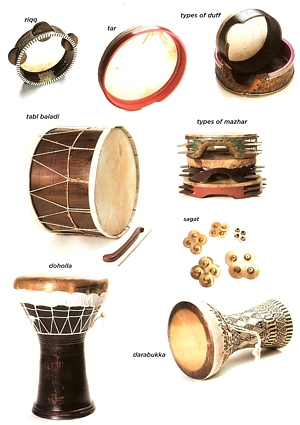
 Known in Egypt as sagat and in Turkey as zills, they are sets of four metal finger cymbals of various sizes. The smaller sets are used by Bellydancers, while tura and kas (the larger ones) are used in folk music, zar and other religious rituals (and colorful sales people in the street to attract attention to their products).

sagat

The Tambourine Family

The Duff is a goat-skin tambourine without jingles, used in  popular and folk music, zar, as well as other religious rituals.
The Tar isa large tambourine with a head made of goat-skin, without jingles, used in  popular and folk music, zar, and other religious rituals.
The Mazhar, also known as Bandir, is a large tambourine with a head made of the skin of goat, cow, or donkey, and it has five sets of four heavy brass jingles. It is used in popular and folk music, zar, and other religious rituals.
The Riqq is a small tambourine with a head made of fish or goat skin;  it has five sets of four brass jingles and is used in classical, popular, folk music and dance.

The Darabukka Family

The Darabukka, known also as tabla, is a clay, single-headed drum with a head of Nile fish-skin or a goat-skin head, used in classical, popular, as well as folk music and zar rituals. The body is conical at the head, while the base is cylindrical.
The Doholla is a larger-size darabukka with a head made of donkey-skin, used in popular and folk music as well as zar rituals.

Doholla

The Double-Headed Drum

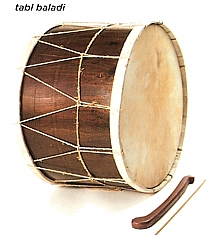
The Tabl Baladi is a wooden Upper Egyptian double-headed drum with goat-skin heads; it is beaten with two sticks, one thin and one thick, and is used in folk music. (The name also applies to an instrumental ensemble used in Upper Egypt consisting of the Tabl Baladi and three Mizmars.)

Today, all percussion instruments use plastic instead of animal skins. They do not need to be heated to tune them like the animal skin instruments, but their plastic-made sound can never come close to the beauty of the animal skin ones.

tabl beledi

Sources:
George Dimitri Sawa. Egyptian Music Appreciation and Practice for Bellydancers.
George Dimitri Sawa. The Art of the Early Egyptian Qanun, vols. 1 and 2.
George Dimitri Sawa. Music Performance Practice in the Early Abbasid Era 132-320 AH/750-932 AD. Ottawa: The Institute of Mediaeval Music, 2004.
George Dimitri Sawa. Rhythmic Theories and Practices in Arabic Writings to 339AH/950CE. Annotated Translations and Commentaries. Ottawa: The Institute of Mediaeval Music, 2009.

http://www.georgedimitrisawa.com/buy_music.html
Please also see the Gilded Serpent Musical Instrument Tour

use the comment box

Have a comment? Use or comment section at the bottom of this page or Send us a letter!
Check the "Letters to the Editor" for other possible viewpoints!

Ready for more?

  • Recreating Ritual, Enhancing our daily lives with drumming and dancing
    The rhythmic patterns and dance movements of this tradition, steeped in antiquity, steeped in women’s ancestry, rekindle a natural and sacred state of well being.
  • A Drummer’s Advice to Beginning Dancers
    "…Know your rhythms! I have drummed for bellydance classes where the instructor not only couldn’t clap baladi but didn’t even know what it was…"
  • Dancing to Live Drumming
    The Drum can express all human emotions: joy, sorrow, elation, and grief.
  • Permits, IDs, Licensing, Foreign Dancers in Cairo,
    It dawned on me that some dodgy nightclub manager, whom I didn’t know personally, had complete control over my passport and my freedom to leave! So, I had no alternative other than to end my contract in order to get my passport back which also meant halting the lengthy paper process.

  • Dancing with Tigers, In China with Fleurs d’Egypte
    We had no idea what to expect of the actual location. However, with ticket and costumes in hand, we rode the wave. Arriving late at night, we were ushered to our rooms and straight to bed to sleep off our jet lag. We had no concept of the overwhelming size of the park and over-the-top eye-candy awaiting us the next morning!
  • Becoming the Object of Your Own Fantasy, "Perfumes of Araby" in the 1970s, Part 1
    The Belly dance scene in 1970s Los Angeles: It is difficult to spotlight succinctly even one portion of a vibrant, vast and quickly growing community of Middle Eastern dancers, their enthusiasts, and the ethnic communities, musicians, festivals and supper clubs that supported the dance arts. The abundance of inspiration in that era was almost beyond understanding; yet once upon a time before the Internet, music, imagery and information was less readily available.
  • Inaugural "Art of the Belly" Festival Rings in Spring in Style, Bellydance comes to Ocean City, Maryland
    Inside the hotel, waves of positive energy radiated all around. People were not just glad to be at this festival, they were honored. If you were from Maryland, this was your belly dance festival. Dancers were representing both themselves and the elements of various fusions. They wanted this to be done right.

  • Maria, Nadika, Naiya-Hayal, Onyx Moon, Oreet, Raks Al Khalil, Raks Terayz, Raks the Casbah, Reda Darwish, Ruby, Sabiba, Sassafras, Shimmy Amour, Tatseena’s Troupe, Terry, Titanya, Troupe Aneena, Yolanda, Zahara
  • Dancer Cancer, Part One: "Hopping on One Foot
    Still, I was confident that there would be no further problem and that I was letting my vanity get the best of me. By wanting to look good, I had caused all my own discomfort, I reassured myself. He said I would have the biopsy report in a few days and to call my referral doctor to hear what the UC San Francisco laboratory report said.
  • Dancing on the Roof of the World, Community Festival in Tajikistan .
    After all my many travels to Tajikistan, filled with the frantic bustle of dance lessons, rehearsals, teaching, doing trip logistics, hunting for traditional bits and bobs for costuming, and getting fitted for stage costumes, I finally decided to try being a more-or-less normal tourist in one of my favorite places on Earth, the Pamir mountains of Badakhshan, eastern Tajikistan.
  • Serpent Tour 2011 Journal- London, Madrid and Marrakech! NEW VIDEO UPDATE-7-8-11
    An experimental travel blog. Let see how it goes! The plan is to update this page frequently.
 

Gilded Serpent presents...

Permits, IDs, Licensing

Me filming- in a TV series starring Medhat Salah and HayetemMe filming- in a TV series starring Medhat Salah and Hayetem

Foreign Dancers in Cairo

by Caroline Evanoff
posted July 7, 2011

Would you surrender your passport and freedom just to dance in Cairo? This is just one of the conditions foreign dancers agree to when applying for a license in Egypt. With the future of foreign dancers in Cairo in the balance, due to the recent Egyptian Revolution, you must consider the arduous process of obtaining and keeping a dancer’s license and what the future holds for those harbouring "the dance dream"!

Like most dancers who are arriving in Cairo for the first time, I was not fully aware of what it meant to obtain my "papers” in order to work. After signing a contract with Candella Nightclub in 1998, I began the long licensing process. After a few months, I needed to return home to Australia to attend my brother’s wedding.  At the time, I asked my manager if he could just get my passport back from the Mogamma (a government building in Tahrir Square) in order for me to travel. He informed me that the manager of the Candella did not agree, and that he was the one responsible to sign the permission for release of my passport.

It dawned on me that some dodgy nightclub manager, whom I didn’t know personally, had complete control over my passport and my freedom to leave!  So, I had no alternative other than to end my contract in order to get my passport back which also meant halting the lengthy paper process.

When I returned to Cairo, I was back to square one. I had to face the obstacles that all  dancers dreaming to work in Cairo must also face. The first and most important step is to obtain a signed contract (and that means signed by yourself as well). A manager  simply telling you that “yes, there is a contract” and that they are “doing your permission for you” is of no use.

Without your seeing and signing a contract, nothing can happen from there because this is the first and crucial step in the trail.

I have seen many dancers waiting for elusive work permits that never materialize because someone had promised them work and had  told them that they were sorting it all out for them. It happens all the time, and there have even been cases where a contract is even offered as a prize for winning a contest…

 In order to secure a contract, you will need to audition in a  venue (restaurant, hotel nightclub or cruise boat)  that is able to employ foreign dancers, meaning that it holds a permit to be able to make a license for a foreigner. This is a crucial point as not all places can legally employ non-Egyptians, and trust me, even though the manager of a place says that it’s no problem , that may not be the case! Checking this alone can save a lot of time and you will find it is usually only 5-star hotels that are able to do this (such as Pharaohs cruise boats which used to be run by the hotel chain Oberoi and Inter-Continental Semiramis). In actuality, there are very few venues (and even fewer now) that can obtain your permit, hence, the extremely low number of foreign dancers legally working in Cairo at any given time.

However,  before this step,  you must put together a band or find a manager to organize the band for you. You will need to rehearse  them to prepare your audition show which usually entails studio hire fees and payment of the musicians and their endless cups of tea- all from your own pocket. The alternative is to be your own band manager, but it really requires a few years experience in the scene first as well as cultural understanding and fluency in Arabic.

If successful, you need to go get at least  12 passport photos taken and with a contract in hand, you are ready to commence making your "paper trail",  which is also documented in  Yasmina‘s film "Journey of Desire":

gameboard to permitvilleStep 1. Take the contract and passport photos to the Artist’s Union (Necaba) office downtown. Join the Union, and pay the annual fees;  they will give you two papers, one for Immigration (Gowazet) and the other for the Censorship Board (Mousanefat).

Step 2. Go to the Employment Department (Koamala) either in Giza or Cairo, depending upon the location of your place of employment, with a copy of your contract and passport photos to apply for a work permit (which all foreign employees require, not just artists). You will have to undergo an HIV test at an unhygienic government clinic where in the back of your mind you are praying that the needles are, in fact, only used once. Then there’s the horror story to haunt you about the foreign dancer who was returned a positive result and told to pack her bags and leave. Luckily for her it turned out it was a false positive!  (At various points in history, the dancer was also  required to leave the country in order for the permit to be issued upon re-entry.) After payment, you will be issued a receipt and a temporary paper.

Step 3. Go to the Immigration Department (Gowazet) located in the  government building in Tahrir Square (Mogamma) and give them a copy of the contract, the paper from the Artist’s Union and the paper from the Employment Department. They will forward copies to State Security (Amn alDawla) for clearance. This has to be one of the dustiest, dirtiest and most crowded of the government institutions; I suggest that you wear old clothes and be prepared to stand for hours in the airless corridors.

Step 4. Go to the Censorship Board (Mosanefat) located in Kasr el Aini Street with copies of all the papers that you have collected from steps 1-3, and you guessed it, passport photos. Buy a folder (melaf) beforehand into which they can put your documents. There is a little kiosk (koshk) on the opposite side of the road with a photocopier and the little old lady who runs it knows exactly what photocopies you need (and how many of each) and even sells the right type of folder that you will need.  They then send your documents to the Vice Department (Adeb) and the Tourist Police (Shortat Siaha) and you are required to visit both offices in person and sign various forms. After payment of annual fees, you will be issued a pink receipt which means you are almost there, and some agents swear that this enables you to work, but legally, you must wait for your actual Censorship Card which is unique to the field of performers.

Step 5. Once you have been granted permission from all the above departments, you can then return to Immigration where you hand over your passport to be issued with your plastic ID card in it’s place. The person responsible for your passport and identification card is a mirthless man named  Shokry, whom both Liza Laziza and Lorna Gow mentioned  by name, and I think he takes great delight in seeing us dancers, who are known to be night owls, required to be at his dinky stall of an "office" before midday, yawning, and hardly being able to stay awake.

Without a passport, you no longer have the freedom to leave the country (as Lorna also found out during the recent revolution when our embassies were advising us to get out); she could not leave even if she had wanted. Tahrir and Mogamma were inaccessible during the riots. That is not the only concern; your replacement ID states your profession on it. So what? We are proud of our art! However,  remember this is Egypt, and dance is not viewed the same way as it is in the other parts of the world.

The significance of that did not dawn on me until I filed a minor complaint with the police, and they asked to see my ID. When they saw that I was a dancer, they strongly advised me to drop the complaint  as I would not be taken seriously! I didn’t even have the "power" of flashing a foreign passport to protect myself anymore!

However, lucky US citizens can avoid this pitfall and have a second passport issued. It was during a workshop in Sydney that I heard from Shareen el Safy that she was issued  a second passport. Some embassies will provide this service for certain individuals such as journalists and diplomats. When I approached the Australian embassy in Cairo, they scanned their list of applicable professions and Bellydancer was not on it; end of story!

If you are wondering how does one navigate the steps above, then one answer is to hire someone to do it all for you. As a dancer, you mainly work at night and probably sleep in ‘til late; so the idea of going to the government offices early is daunting. (Most of them close by 2pm.)  Not only that, but each step may entail several visits, not just the one. The process must be followed up, pushed along, etc…

It can make life easier, but can you be sure that the job (for which you pay handsomely) actually has  been done? I heard many times over the years of dancers being caught by the authorities and threatened with arrest because they were dancing without permits. The dancers had no idea that the slime-ball whom they paid to do it for them, took the money without doing the job! The other thing is that I want to know exactly where my passport is physically located  and also not to have to hand it over to a third party. So, I opted to do it myself which many people thought was crazy at the time –but it is possible.

Either way it is a lengthy, frustrating process that can take months to finish. Once you start earning money, you must apply for a Tax Card and make sure the venue is paying taxes on your behalf. Then, if you wish to perform in weddings at  the Shaoon Manaweya (subsidised wedding venues for the military and their families) means access to a huge market of weddings  then this involves another security clearance which can take up to a year to be granted! Most dancers follow this path as in order to "keep" their band  as you have to ensure that there is enough work for them. 

The golden ticket
The "golden ticket" a copy of my Mousanefat permission to dance

However, it doesn’t all end there…

Now that you have joined the ranks of the privileged few by managing  to get the "golden ticket’ to dance in Cairo, the task is to keep it. You have agreed to certain conditions in those documents you signed, and if you break them, in theory, you could be arrested or have your permit terminated. It is usually people from the Censorship Board who come to check on you, especially when you begin.

Some of these conditions have changed over time, but mostly, they are the same:

1. Your license must be current and on your person when you go to work. Both Yasmina and I remember times when we were between contracts or renewing licenses but still had  to work. During that period, someone from the band was on the lookout for the Censorship Board before we commenced work. On a cruise boat, once it set sail you were fairly "safe" if no inspector was spotted before.  However, one time does come to mind when  I nearly fell into the Nile, avoiding them by scaling the side of the boat in heels…

2. Foreigners can only work in one venue, where their contract is.

3. Your midriff must be covered either by wearing a dress or a "shabaka" net over the stomach and your costume is supposed to cover your legs. Yes, many dancers have flaunted these rules ( Yes, of course Dina springs to mind!) and have managed to have gotten away with it (Connections! Connections!) Still, they are the rules!

4. You may make no moves that are classified as too suggestive! Yasmina was once pulled up by the censorship inspectors whilst dancing at the Meridien Heliopolis being accused of having movements in her show that were classified as "lewd"; management and her musicians were mystified, because, at the time, Yasmina was classed as one of the most elegant performers.

What can happen if you do break the rules? Diana Tarkhan has precautionary tale about a nightclub manager in Alexandria who convinced  her to commence work without completion of her new permit. He assured her that he had an agreement with the tourist police and all was okay. (I heard that many times myself!) After a week, Diana heard that  a specific guest had booked a table to see her show. It turned out to be an enemy who was just ensuring that she would be at work that night in order to send the tourist police to catch her. Fortunately, Diana was suspicious and did not perform that night; otherwise, she would have been arrested when the police, in fact, did turn up. Either way she was still summoned to appear at the tourism police office and six months later in court. She was fined 50 Egyptian pounds but had to pay 1000 Egyptian pounds for a competent lawyer to help her with her case.

So what does the future hold for foreign dancers of Cairo? Now, in post-revolution Cairo the feeling is definitely  “Egypt for Egyptians”, regarding the workforce (not just for dancers –but across the board).

My Filipino cleaner was accosted in the street recently by Egyptians, yelling "What are you still doing here?" Companies are advertising (with pride) that they only employ Egyptians.  We have heard within dance circles that there will be no more licenses issued to foreign dancers nor will the current dancers be allowed to renew their permits. However, I have spoken to a couple of current dancers and they have successfully renewed their work permits for the rest of the year. So, it’s difficult to separate fact from fiction these days, and I guess, time will tell and we will have a much clearer picture after the elections later this year.

Dancing at teh Pharaohs in 1999
One of my earliest contracts on the Pharaohs circa 1999
(back when I was a blond and the days when dancers provided  "uniforms" for our own bands!)


use the comment box

Have a comment? Use or comment section at the bottom of this page or Send us a letter!
Check the "Letters to the Editor" for other possible viewpoints!

Ready for more?

  • Foreign Dancers in Cairo Timeline
    Amera Eid, Asmahan, Astryd, Feiruz, Jalilah, Keti Sharif, Leila, Leyla Amir, Nesma, Nour, Outi, Sahra, Shareen el Safy, Yasmina of Cairo, Yasmina Ramzy, Yasmin Henkesh, Zeina, and many more
  • Dancing with Tigers, In China with Fleurs d’Egypte
    We had no idea what to expect of the actual location. However, with ticket and costumes in hand, we rode the wave. Arriving late at night, we were ushered to our rooms and straight to bed to sleep off our jet lag. We had no concept of the overwhelming size of the park and over-the-top eye-candy awaiting us the next morning!
  • Becoming the Object of Your Own Fantasy, "Perfumes of Araby" in the 1970s, Part 1
    The Belly dance scene in 1970s Los Angeles: It is difficult to spotlight succinctly even one portion of a vibrant, vast and quickly growing community of Middle Eastern dancers, their enthusiasts, and the ethnic communities, musicians, festivals and supper clubs that supported the dance arts. The abundance of inspiration in that era was almost beyond understanding; yet once upon a time before the Internet, music, imagery and information was less readily available.
  • Inaugural "Art of the Belly" Festival Rings in Spring in Style, Bellydance comes to Ocean City, Maryland
    Inside the hotel, waves of positive energy radiated all around. People were not just glad to be at this festival, they were honored. If you were from Maryland, this was your belly dance festival. Dancers were representing both themselves and the elements of various fusions. They wanted this to be done right.

  • Maria, Nadika, Naiya-Hayal, Onyx Moon, Oreet, Raks Al Khalil, Raks Terayz, Raks the Casbah, Reda Darwish, Ruby, Sabiba, Sassafras, Shimmy Amour, Tatseena’s Troupe, Terry, Titanya, Troupe Aneena, Yolanda, Zahara
  • Dancer Cancer, Part One: "Hopping on One Foot
    Still, I was confident that there would be no further problem and that I was letting my vanity get the best of me. By wanting to look good, I had caused all my own discomfort, I reassured myself. He said I would have the biopsy report in a few days and to call my referral doctor to hear what the UC San Francisco laboratory report said.
  • Dancing on the Roof of the World, Community Festival in Tajikistan .
    After all my many travels to Tajikistan, filled with the frantic bustle of dance lessons, rehearsals, teaching, doing trip logistics, hunting for traditional bits and bobs for costuming, and getting fitted for stage costumes, I finally decided to try being a more-or-less normal tourist in one of my favorite places on Earth, the Pamir mountains of Badakhshan, eastern Tajikistan.
  • Serpent Tour 2011 Journal- London, Madrid and Marrakech! NEW VIDEO UPDATE-7-1-11
    An experimental travel blog. Let see how it goes! The plan is to update this page frequently.
 

Gilded Serpent presents...

Dancing with Tigers

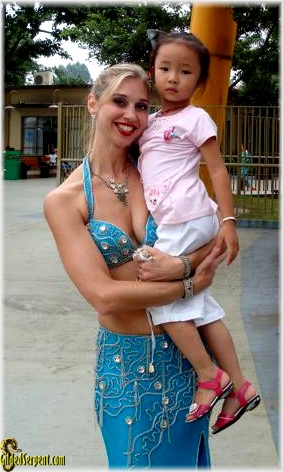
This little girl was so cute! She came to every show for 2 days straight and ran This little girl was so cute! She came to every show for 2 days straight and ran backstage every time I got off stage to change. Think she thought I was a life size Barbie doll.

In China with Fleurs d’Egypte

by Nadira
posted July 6, 2011

In September 2010, five dancers embarked on a unique adventure. Seattle’s Fleurs d’Egypte Dance Company received a contract for a month of performances in China. This sounded like fun, but wait…we only had two weeks to decide, work out a contract, get our affairs in order and head out! Talk about flying by the seat of your bedla!

Because the contract was on such short notice, some of our fabulous Fleurs couldn’t make it, so we had patient and fast learning dancers, Lisa and Ceanna, join us. They not only had the two weeks to get everything in order for travel, but that same amount of time to learn our group dances. They were troupers!

We had no idea what to expect of the actual location. However, with ticket and costumes in hand, we rode the wave. Arriving late at night, we were ushered to our rooms and straight to bed to sleep off our jet lag. We had no concept of the overwhelming size of the park and over-the-top eye-candy awaiting us the next morning!

The hotel houses live white tigers and pink flamingos (each in a different outside atrium, of course) for the dining room view; so we got to "dine" with white tigers at every meal. Anyone who knows me, knows I’m a huge fan of the big cats, and I was so excited for every meal. For some of our meals, we were met with what (we later learned) were mascots of the park: different caricature tigers. They messed with (entertained) diners during the meals! It seemed strange at first, but oddly, you got used to them and joined in the fun. There’s also had an enclosed mini zoo in the middle of the hotel to walk through or visible through the glass walls at the bar that houses solid white tigers, black and white swans and a bevy of birds. This was just the hotel; we hadn’t even seen where we would be performing.

The park is split into two main sections with the hotel in the middle. One side of the hotel hosts a massive water park where our soon to be new friends from Samoa and New Zealand performed a Tahitian show daily on a stage over the water. Our side was a theme park that housed all the rides, as well as an odd mix of shows, including a lumber jack show (Yup, real lumber jacks!), a stunt motorcycle show with crazy jumps and pyrotechnics, a Mongolian live band, a Japanese style dance, and our Bellydance show.

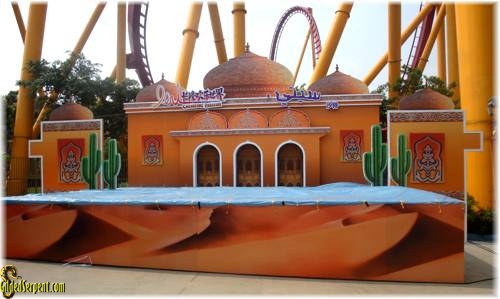
If you have been to China, you know that they like bright colors and lots of different kinds of shows. The park’s use of bright colors and over-sized designs are almost cartoon-like and fun. We arrived at our stage and had to laugh; it was an outdoor stage built specifically for us with an Aladdin theme and cacti on either side of the stage. Our backdrop was a massive roller coaster behind the stage. This was a new one for us, but we would rock it.

It took a few weeks to work through the cultural and language barriers, but we finalized our shows. We performed daily several times a day for hundreds of people. They loved the unique style of dance and wanted to take lots of pictures. It got so crazy during the busy days that we had to have security, holding a red rope and forming a barrier between us and the audiences, so we wouldn’t get trampled. It was overwhelming and exhilarating at the same time! Everyone was so excited and appreciative; it felt great to be a part of their positive experience and memories.

Additionally, during our time there, was the Chinese Independence celebration. We were honored to ride on a float and wave to the crowd. Now, I can say that is honestly something I never thought I’d do! Our float was like a scene from the film “Finding Nemo” and had absolutely nothing to do with Bellydance, but it was bright and cheerful! There was an over-sized octopus with lipstick, mascara, and tentacles that reached throughout the float. We each had our spot, and mine was holding onto the gloved finger pointed tentacle at the front with dolphins jumping next to me. I held on to that gloved finger for dear life! It was a blast, and definitely, a unique experience.

We learned there was also a circus and a zoo connected to the park. The circus was “Barnum & Bailey meets Cirque du Soleil”. There was no theme, just lots of animals and visual antics. It brought out the child in all of us, marveling at all that was happening. The zoo housed almost every animal out there. We were allowed to pet and feed giraffes, and of course, lots of tigers! There were newborn tigers, and a “Cub Camp” for the toddlers as well as adults. I was in big cat heaven!

All in all, this was an amazing experience. There were lots of ups and downs getting settled, and it was overwhelming, but the experience outshone it all. It was an honor for me to share this adventure with Fleurs d’Egypte, and I think we have many more to come!

our first view of the colorful park
Our first view of the colorful park
everything in the park was oversized and colorful
Everything in the park was oversized and colorful
first view of the stage with the cacti and roller coaster backdrop
Our first view of the stage with the cacti and roller coaster backdrop
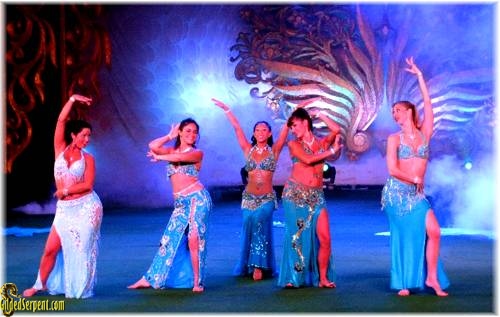
dancing on the outdoor stage, our main stage
Dancing on the outdoor stage, our main stage.
our view from the stage
Our view from the stage
everyone rushed for photo ops after every performance. Security had to add the red rope so people wouldn't trample us
Everyone rushed for photo ops after every performance. Security had to add the red rope so people wouldn’t trample us.
on days it rained, we performed on this amazing indoor stage
On days it rained, we performed on this amazing indoor stage
Tigers
The tigers in the atrium where we dined.
petting the giraffe at the zoo
Petting the giraffe at the zoo
Mascots
The mascots in action with Ceanna and I
Lisa, Najla and myself braving the roller coaster
end of the day...phew!relaxing back at the hotel on route to the pool with our favorite drink...coconut
End of the day…phew!               Relaxing back at the hotel on route to the pool with our favorite drink…coconut juice
our float for the Chinese Independence Celebration parade (daily for almost two weeks)
Our float for the Chinese Independence Celebration parade (daily for almost two weeks)
posing with some of the other float participants
Posing with some of the other float participants
Bella and I getting into position. Yes, that's a tentacle holding a lipstick!
Bella and I getting into position. Yes, that’s a tentacle holding a lipstick!
the float in action
The float in action
Ceanna and I with our new tiger hats (which we rocked for Halloween)
Fleurs d'Egypte (www.arabicbeat.com)
Fleurs d’Egypte (www.arabicbeat.com)


use the comment box

Have a comment? Use or comment section at the bottom of this page or Send us a letter!
Check the "Letters to the Editor" for other possible viewpoints!

Ready for more?

  • My First Experience in Egypt
    I have always felt a pull to visit Egypt to experience the history and culture of this dance I love so much. The chance came about just recently and it was so worth the wait.
  • 6-21-06 Photographic Review of the 33rd Annual Bellydancer of the Year Pageant Photos and report by Michael Baxter

    This show has some wonderful traditions.
  • 6-12-06 Belly Dancer of the Year 2006 Photos by Susie Poulelis
    Danville, Ca, Sunday May 28, 2006 BD of the Year – Finals, more photos coming!
  • 10-24-06 Adventures in Turkey 2006 by Michelle Joyce, photos by Michael Baxter
    I am not exaggerating when I say that Sandra actually threw herself into Bella’s arms and wept when she first laid eyes on her.
  • Troupe Tabu goes to China!
    It should be noted that somewhere between passing the audition and performing, it was announced that three out of four dancers in the group (not including myself) were pregnant.
  • Becoming the Object of Your Own Fantasy, "Perfumes of Araby" in the 1970s, Part 1
    The Belly dance scene in 1970s Los Angeles: It is difficult to spotlight succinctly even one portion of a vibrant, vast and quickly growing community of Middle Eastern dancers, their enthusiasts, and the ethnic communities, musicians, festivals and supper clubs that supported the dance arts. The abundance of inspiration in that era was almost beyond understanding; yet once upon a time before the Internet, music, imagery and information was less readily available.
  • Inaugural "Art of the Belly" Festival Rings in Spring in Style, Bellydance comes to Ocean City, Maryland
    Inside the hotel, waves of positive energy radiated all around. People were not just glad to be at this festival, they were honored. If you were from Maryland, this was your belly dance festival. Dancers were representing both themselves and the elements of various fusions. They wanted this to be done right.

  • Maria, Nadika, Naiya-Hayal, Onyx Moon, Oreet, Raks Al Khalil, Raks Terayz, Raks the Casbah, Reda Darwish, Ruby, Sabiba, Sassafras, Shimmy Amour, Tatseena’s Troupe, Terry, Titanya, Troupe Aneena, Yolanda, Zahara
  • Dancer Cancer, Part One: "Hopping on One Foot
    Still, I was confident that there would be no further problem and that I was letting my vanity get the best of me. By wanting to look good, I had caused all my own discomfort, I reassured myself. He said I would have the biopsy report in a few days and to call my referral doctor to hear what the UC San Francisco laboratory report said.
  • Dancing on the Roof of the World, Community Festival in Tajikistan .
    After all my many travels to Tajikistan, filled with the frantic bustle of dance lessons, rehearsals, teaching, doing trip logistics, hunting for traditional bits and bobs for costuming, and getting fitted for stage costumes, I finally decided to try being a more-or-less normal tourist in one of my favorite places on Earth, the Pamir mountains of Badakhshan, eastern Tajikistan.
  • Serpent Tour 2011 Journal- London, Madrid and Marrakech! NEW VIDEO UPDATE-7-1-11
    An experimental travel blog. Let see how it goes! The plan is to update this page frequently.
 

Gilded Serpent presents...

Becoming the Object of Your Own Fantasy

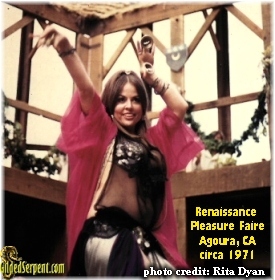
Diane, ren faire, 71

"Perfumes of Araby" in the 1970s, Part 1

by Stasha Vlasuk
posted July 5, 2011
Part 1: posted here You are here!
Part 2: posted here
Part 3: posted here

“I live by a man’s code designed to fit a man’s world, yet at the same time, I always remember that a women’s first job is to choose the right shade of lipstick.”
Carol Lombard quote from “Women’s Wit and Wisdom”

Dianne and GuyThe Belly dance scene in 1970s Los Angeles:  It is difficult to spotlight succinctly even one portion of a vibrant, vast and quickly growing community of Middle Eastern dancers, their enthusiasts, and the ethnic communities, musicians, festivals and supper clubs that supported the dance arts.  The abundance of inspiration in that era was almost beyond understanding; yet once upon a time before the Internet, music, imagery and information was less readily available.  Knowledge had to be directly and carefully mined from academic, ethnic and cultural sources.  We always performed to live music; recorded music was rare at dance events.  The sociological change of American society in the 1970s also informed our dance community. 

Now, as I reach back in my memory of these exciting times to compose this article, I’m grateful for the researched archiving amassed and available in today’s technological world.  I’ve tried to be precise: please forgive me where I’m hazy!  It was the ‘70s after all!  Please enjoy the links provided at the end of this article for more exciting information to further encourage and stimulate your own creativity as you, dear reader, move our dance form ever further.

This article will focus on the iconic 1970s “Perfumes of Araby” Belly dance troupe, lead by the almost mythical performer/actress/teacher, Diane Webber, who was also my teacher.  I was there!  Through a selection of our performances in that era, we’ll explore dance and costuming as becoming the object of your own fantasy. 

The article also touches on paradoxes of our art form: the performance setting, creating a artificial boundary within which we feel free to have intimate exposure (and how costuming facilitates that), and the seeming female accommodation of male sexism –actually a proclamation of autonomy and a pathway to power. 

Diane Webber was a Playboy centerfold –twice; there’s another whole story there – yet, we’ll stick with Belly dance this time.  Among her earliest Middle Eastern dance engagements were at Lou Shelby’s “The Fez” in Hollywood (Lou was our orchestra violinist.) and on the road with “Haji Baba” star, Guy Chookoorian, who was also the Perfumes’ stalwart oud player in our multi-piece orchestra. Throughout the ‘70s, Guy continued to call on various Perfume members for countrywide performances. Diane also appeared in “The Witchmaker” (1969) as the Nautch dancer.Witchmaker PR still

Diane’s self-made costuming was breathtakingly inventive, interpretive and well structured.  She drew inspiration from classic images of women in Orientalist paintings as well as cheesy Belly dance cover art and ground-breaking modern dancers such as Ruth St. Denis (my “great-grandmother” in Modern dance: my Modern dance teacher Pat McLaughlin studied with Martha Graham, who started with the Denishawn Dancers).  Diane inspired her dancers to create their own beautiful costumes and was intimately involved in their fabric selection and construction.

Diane at the ren Fair in 1971The Perfumes of Araby dance troupe was initiated in the Los Angeles area in the late 1960s for the Renaissance Pleasure Faire.  As producer, director, and lead dancer, Diane Webber chose the name from popular imagery of the early 1600s: Shakespeare’s “Macbeth” (written somewhere between 1603-1607), in the sleepwalking scene "…nor all the perfumes of Araby shall sweeten this little hand…" and Claudio Monteverdi’s 1607 libretto of “L’Orfeo”, where in the second act, nymphs sing to Orpheus, god of the underworld:

“Therefore, Orpheus, make worthy
of the sound of your lyre
these fields, where there blows
a breeze with the perfumes of Araby.”

What an appropriate moniker for these outdoor Belly dance extravaganzas! 

Perfumes of Araby’s repertoire included specialties like balancing on goblets (a.k.a. shimmy on glasses), candle dance, snake and sword dances, as well as folk dances of North Africa, Turkey, Armenia, Syria and Lebanon, with a cabaret style solo dance at the end.  Many members worked individually in nightclubs, and thus, brought a strong entertainment background to the performances.

article on censorshipYoung stagehand Scott Pierce has a fun memory of those days:
“I had the fantastic good fortune to spend many hours on stage with Perfumes of Araby, unobtrusively on the side or in back with the musicians, except for my star turn helping one dancer get her giant snake back in its basket. I remember one afternoon as if it happened yesterday, although it was almost 37 years ago.  We were on the small stage at a corner of the Faire for an early afternoon show. The lead drummer yelled out to the audience, "Baksheesh!", which throughout the Arab world means charitable giving.  Some guy in the audience threw about half a dozen fat joints of dope onto the stage, wrapped together with a couple of rubber bands.  My eyes popped out so far the pupils thought it was recess.  The joints landed a few feet in front of me. I thought to myself, “I’m 13.  I spend hours every day at the Faire on stage with beautiful, athletic, dancing women, and the audience throws drugs on stage!  Am I living one of the best lives a teenager can hope to have, or what?”

The Renaissance Pleasure Faire’s entertainment policy changed around 1972; with the questionable critique that “dancers could not show their bellies”.  The Perfumes were canned.  A splinter group composed of two members of the orchestra (Joe Carson and Geoff Hunter) and three dancers (Khadija Cynthia Beck, Maya Hunter and myself) appeared the next year (‘73) and took to a small stage.  In protest, I wore sheer harem pants with a diaphanous Egyptian beledy dress: high neck, long draping sleeves, yet completely sheer with just a wide hip scarf around my hips.  Yes, nude. Yes, sheer. Yes, I have a photo, and no it won’t be placed with this article, this is a family web ‘zine!  Yes, the Faire’s powers-that-be howled, to which I innocently rejoined: “…but my belly is covered… ”


musicians
Renaissance Pleasure Faire, Agoura, CA circa 1971

Candle dancerSnake Dancer


Diane Webber


From the 1970 performances until today, in group presentations or as solo artists, Diane Webber’s dancers continuously offer her philosophy of connecting to a spiritual understanding: driven to be in the moment and not think about the future, living life to the fullest in that moment, in our own way; aspiring for a visceral spiritual connection through the sharing of our dance. We are the objects of our own fantasy.

Coming soon!
  • Part 2: The Calabassas Pumpkin Festival Photos
  • Part 3+: More misc photos and stories from various events.
 Interesting links
Costume inspirations
Orientalist books to read online:
Author’s Photo Credits:
Most of the pix come from my personal archive; I supply the links for the web sites of other photos in the "interesting links" section.    I encourage you to visit these sites as they contain further (and interesting) information plus exciting video montages for which there’s simply not enough space in this GS article!  
Regarding the Top Photo: Diane in a pink kaftan at the Renaissance Pleasure Faire circa 1971: I really don’t remember where this pix came from, I seem to remember it coming to me around the time of Diane’s passing, perhaps with the notice of Diane’s passing sent to many by Jillina (another Diane student!). I fondly remember Diane dancing in this diaphanous pink silk kaftan; I remember how she made it, how she taught me to make it – it’s a pattern I still teach my students. I just archived the image with out a credit.
 

use the comment box

Have a comment? Use or comment section at the bottom of this page or Send us a letter!
Check the "Letters to the Editor" for other possible viewpoints!

Ready for more?

  • We Will Rak You! My Dance Experience with Queen
    I’ll admit I wasn’t too familiar with the music of the British rock group Queen. The year was 1977, the month of December, in Los Angeles. I was invited to perform at a dinner party where Queen, in Los Angeles for several concerts, was the guest of honor. The job came to me through Dianne Webber.
  • 10-9-08 A Big Picture Book Review: Martha Burns’ "Belly Dance, Celebrating the Sacred Feminine" Reviewed by Stasha
    Every page is a work of art, a truly astonishing array of images. The content is very inclusive and features all age ranges, body types and styles. You will see yourself, your best self, in these pages.
  • 12-3-02 “Adventures In Belly Dance Costuming” by Stasha Vlasuk, Vol 1 book review by Robin Alnisa Wood
    This is a good book for both sewing veterans and beginners alike.
  • On the Road
    She was the fiery “Bedouin” who argued with the band in apparent Arabic and seemed so real and dramatic.
  • Inaugural "Art of the Belly" Festival Rings in Spring in Style, Bellydance comes to Ocean City, Maryland
    Inside the hotel, waves of positive energy radiated all around. People were not just glad to be at this festival, they were honored. If you were from Maryland, this was your belly dance festival. Dancers were representing both themselves and the elements of various fusions. They wanted this to be done right.

  • Maria, Nadika, Naiya-Hayal, Onyx Moon, Oreet, Raks Al Khalil, Raks Terayz, Raks the Casbah, Reda Darwish, Ruby, Sabiba, Sassafras, Shimmy Amour, Tatseena’s Troupe, Terry, Titanya, Troupe Aneena, Yolanda, Zahara
  • Dancer Cancer, Part One: "Hopping on One Foot
    Still, I was confident that there would be no further problem and that I was letting my vanity get the best of me. By wanting to look good, I had caused all my own discomfort, I reassured myself. He said I would have the biopsy report in a few days and to call my referral doctor to hear what the UC San Francisco laboratory report said.
  • Dancing on the Roof of the World, Community Festival in Tajikistan .
    After all my many travels to Tajikistan, filled with the frantic bustle of dance lessons, rehearsals, teaching, doing trip logistics, hunting for traditional bits and bobs for costuming, and getting fitted for stage costumes, I finally decided to try being a more-or-less normal tourist in one of my favorite places on Earth, the Pamir mountains of Badakhshan, eastern Tajikistan.
  • Serpent Tour 2011 Journal- London, Madrid and Marrakech! NEW VIDEO UPDATE-7-1-11
    An experimental travel blog. Let see how it goes! The plan is to update this page frequently.
  • Photos from Rakkasah West 2011, Sunday A- L
    Adira, Anisa, Ashley Lopez, Orchids, Damascus, Danielle, Desert Dream, Diana, Dondi, Dancers of the Desert, El Asaab, Evangaline, Fahtiem, Fatima, Ghawazee, Alexandria, Jamilla, Joweh, Karavansary, Lisa
  • The Transformation of Beauty, Inverting the Gaza, Part 3
    As women and performers, why cannot we see beyond physical representation, when we, too, are trying our hardest to achieve such beauty in our own lives? Such hypocrisy ensures that we can never escape the limitations that society and, thus, we place these same limitations upon our own bodies.
 

Gilded Serpent presents...

Inaugural "Art of the Belly" Festival Rings in Spring in Style

Nina Amaya

Bellydance comes to Ocean City, Maryland

by Brandon Johnson
posted July 4, 2011

The birth of a belly dance festival often begins with a simple idea in a dancer’s mind. Baltimore, MD tribal fusion star Naimah wanted to bring a belly dance festival to her home state, which she would host along with members of her troupe, Amandari.

Amazingly, weeks after the official announcement of Art of the Belly, fans and friends got the vibe. Something special was about to happen. So many people wanted to be a part of it immediately. As Naimah updated online, performance slots for the weekend  filled up in an instant. 

The feeling was intensified when the ”Baltimore free daily paper did a cover story on Naimah and the festival. The fact that a brand new belly dance festival was getting so much local press signified that the festival was being taken seriously as an artistic showcase. When the festival arrived, Ocean City became one large paradise from March 18-20, 2011.

The Carousel Hotel had the honor of being the host venue for the city’s first major belly dance representation of any kind. Imagine walking to your workshop while seeing an indoor ice skating rink and when it’s over, feeling a need to walk outside and walk along the beach and look out into beautiful, transcending waters and soft sand under your feet. If it wasn’t for all the belly dance, walking up and down the highway and seeing the array of housing and hotels, the restaurants and other scenes was enough to send your jaw crashing through the ground.

Inside the hotel, waves of positive energy radiated all around. People were not just glad to be at this festival, they were honored. If you were from Maryland, this was your  belly dance festival. Dancers were representing both themselves and the elements of various fusions. They wanted this to be done right.

The activity was at a breakneck pace. The seating for Saturday’s performances were beyond standing room-only capacity. There was a small monitor that had a camera on the stage, so folks who were standing at an angle could follow the action on stage. To the left side, there was vending taking place while talented photographers from Stereo Vision Photography were snapping away, using the digital era elements of their craft to do numerous photo shoots of belly dancers all day and well into the evening. Talking to many of the belly dancers attending, I was surprised that getting pics done was so important. As the need for having a decent portfolio has increased, so too has the demand for quality photos.

 The workshop lineup for 2011’s Art of the Belly was special in that localized flair was strongly represented. The elite diversities that each teacher was capable of bringing to the table stood out even more. The potpourri of choices was enough to overwhelm anyone, with many ladies and some gentlemen mentioning they took multiple workshops during the weekend. The lineup included Ava Fleming, Azhia, Belladonna, Frank Farinaro, Kostana, Mia Naja, Naimah, Na’la, Piper, and Sera Solstice.

There were over fifty performances from belly dancers and troupes from the state of Maryland, plus dancers from other states, as well.  Also getting heavy praise and zaghareets abound was the house band of the weekend, Ishtar,from Pittsburgh, PA. Ishtar is la ”Turkish-style raqs band” with a melodic march of musical synchronicity that had every hand clapping and foot tapping the carpet. 

 With any belly dance festival, the real reason to attend is to be amazed by someone or something you haven’t seen before. I was already kicking myself in the ass for not being around on Friday night, where I missed performances from Project Belly Dance finalist Shems, Amartia, the Turkish joyfulness of Kostana, and international sensation Azhia.

The first glance of Belladonna and Ken Vegas made up for what I had missed on Friday. Belladonna is a tribal fusion dynamo for the DC-metro belly dance communities and co-founder of the DC Tribal Cafe. Belladonna blends in with the artistic bravado of Ken, a member of the DC Kings, which is one of the nation’s drag king performing collectives.The duo danced it up to a rendition of a song by Michael Buble, displaying a rare chemistry in performance art that embodied the evolution of fusion.

Frank Farinaro added a masculine touch to the festival. His movements (from his own signature Hammerhead Sharqi technique) were so crisp and precise, you almost forgot that it was a man performing. He would pop, lock, tick-tock, and undulate in ways that would almost leave you dizzy.  

Naimah and Amandari performed in angelic white and black attire, sandwiched with her solo abilities that makes her beloved in Baltimore and beyond.

Her physical strength and beauty is as at times intimidating, as she stands 5’11” and has been compared to a man-eating plant, a mechanical snake, and a tribal robot (phrases she’s actually proud of and are well-known for).

The above are just a sample of the weekend performances. Other highlights included belly dance to 1970s R&B tunes by Mia Naja, techno and African dance fusions from Shaell, and performances by Nadirah Nasreem, Na’la, Safiyeh, Talis, and Latifa and Banat el Beled, Bagoas, Willow, Zaira al Zahara, Gypsy Fusion,Troupe Hipnotic, Antonia, Piper,  and Nina Amaya and Aubergine

 The crowd on Sunday was more laid back and family and student supportive. The festival felt more like a personal playground. This was the perfect setup for the duo Eye of Isis, who sang a story, played a flute and a guitar, threw in an old wise tale, and tapped on a dumbek here and there, while also belly dancing their hips off. I feel like belly dance festivals are held to showcase talent such as this.

There were several other performances between the opening musical jams of Ishtar until my leaving point of 5pm. These included poi veil by Eva Nadira, former Zafiramember Jennifer Imashev in Ever After, Maia Alexandra, Scarlett, Shiraz, and Viviana. A showcase of such talent is what makes attending a festival so convenient. 

The presence of Art of the Belly with BellyPalooza in August and the Belly Dance Nationals in November has given the state of Maryland a ”triple crown” of belly dancing that shines a major spotlight on the belly dance map. In addition to the hard work done by the dancers and organizers, not enough compliments can be given to the audience that supports there artists. Friends and family, first-time onlookers, students and faculty all gave the shows a foundation from which to succeed.

 Months of preparation, hundreds of sacrificed hours, the spreading of words, setting the date, arranging the instructors, and having to prepare something on stage to make the effort come to life are just some of the components that made Art of the Belly possible. Some people say it’s hardest to better the first-born of anything, but we’ll see if Art of the Belly 2012 can top the original.. 


use the comment box

Have a comment? Use or comment section at the bottom of this page or Send us a letter!
Check the "Letters to the Editor" for other possible viewpoints!

Ready for more?

  • The Hippie Connection: Robert Altman’s 1969 In Utero Belly Dance Portrait of ME
    There it was, the second of a series of black and white hippy portraits –people raving, a woman blissfully breastfeeding, couples hugging, dogs leaping – THE SEMINAL PHOTO OF MY LIFE – only, I was cut out!
  • The Folk Tours Dance & Music Camp Review
    Once upon a time, in far away lands, I performed five shows a night, seven nights a week to great live music. I don’t miss the wily club owners, late nights, or cigarette smoke, but I do miss the music.
  • My Vision of the Desert Archidance

    I had heard about trance dancing before, but had never seen it in an authentic context.
  • Cabaret: Is it a dirty word?
    American Cabaret, the original fusion belly dance, is accessible and fun for everyone, regardless of one’s dance education.

  • Maria, Nadika, Naiya-Hayal, Onyx Moon, Oreet, Raks Al Khalil, Raks Terayz, Raks the Casbah, Reda Darwish, Ruby, Sabiba, Sassafras, Shimmy Amour, Tatseena’s Troupe, Terry, Titanya, Troupe Aneena, Yolanda, Zahara
  • Dancer Cancer, Part One: "Hopping on One Foot
    Still, I was confident that there would be no further problem and that I was letting my vanity get the best of me. By wanting to look good, I had caused all my own discomfort, I reassured myself. He said I would have the biopsy report in a few days and to call my referral doctor to hear what the UC San Francisco laboratory report said.
  • Dancing on the Roof of the World, Community Festival in Tajikistan .
    After all my many travels to Tajikistan, filled with the frantic bustle of dance lessons, rehearsals, teaching, doing trip logistics, hunting for traditional bits and bobs for costuming, and getting fitted for stage costumes, I finally decided to try being a more-or-less normal tourist in one of my favorite places on Earth, the Pamir mountains of Badakhshan, eastern Tajikistan.
  • Serpent Tour 2011 Journal- London, Madrid and Marrakech! NEW VIDEO UPDATE-7-1-11
    An experimental travel blog. Let see how it goes! The plan is to update this page frequently.
  • Photos from Rakkasah West 2011, Sunday A- L
    Adira, Anisa, Ashley Lopez, Orchids, Damascus, Danielle, Desert Dream, Diana, Dondi, Dancers of the Desert, El Asaab, Evangaline, Fahtiem, Fatima, Ghawazee, Alexandria, Jamilla, Joweh, Karavansary, Lisa
  • The Transformation of Beauty, Inverting the Gaza, Part 3
    As women and performers, why cannot we see beyond physical representation, when we, too, are trying our hardest to achieve such beauty in our own lives? Such hypocrisy ensures that we can never escape the limitations that society and, thus, we place these same limitations upon our own bodies.
 

Gilded Serpent presents...

Rakkasah West Fest 2011

Sunday, Main Stage only
Page 4: M-Z

by Carl Sermon
posted May 3, 2011

Rakkasah West Festival is held every year at various venues in the East Bay of San Francisco, California over Friday Eve, Saturday (Pg 1, Pg 2)and Sunday (Pg 3). This year the event was held at the Richmond Auditorium. This group of photos is from Sunday, March 13, 2011. Bands in the background include: Light Rain, Pangia, and Mary Ellen Donald.


Maria


Nadika


Naiya- Hayal


Najme's Rakstars


Onyx Moon


Open Floor


Oreet


Raks Al Khalil


Raks Terayz


Raks the Casbah


Reda Darwish


Ruby


Sabiba


Sassafras


Tatseena's troupe


Terry


Titanya


Troupe Aneena


Yolanda


Zahara


PHOTOS FROM CARNIVAL OF STARS 2010 COMING SOON!


use the comment box

Have a comment? Use or comment section at the bottom of this page or Send us a letter!
Check the "Letters to the Editor" for other possible viewpoints!

Ready for more?

  • Dancer Cancer, Part One: "Hopping on One Foot
    Still, I was confident that there would be no further problem and that I was letting my vanity get the best of me. By wanting to look good, I had caused all my own discomfort, I reassured myself. He said I would have the biopsy report in a few days and to call my referral doctor to hear what the UC San Francisco laboratory report said.
  • Dancing on the Roof of the World, Community Festival in Tajikistan .
    After all my many travels to Tajikistan, filled with the frantic bustle of dance lessons, rehearsals, teaching, doing trip logistics, hunting for traditional bits and bobs for costuming, and getting fitted for stage costumes, I finally decided to try being a more-or-less normal tourist in one of my favorite places on Earth, the Pamir mountains of Badakhshan, eastern Tajikistan.
  • Serpent Tour 2011 Journal- London, Madrid and Marrakech!
    An experimental travel blog. Let see how it goes! The plan is to update this page frequently.
  • The Transformation of Beauty, Inverting the Gaza, Part 3
    As women and performers, why cannot we see beyond physical representation, when we, too, are trying our hardest to achieve such beauty in our own lives? Such hypocrisy ensures that we can never escape the limitations that society and, thus, we place these same limitations upon our own bodies.
  • Belly Dancer of the Year 2011 Contestants! Who Will Win This Coming Weekend?
    Sneak preview of who you will see this weekend at this year’s contest
  • Iraqi Ra’qisa’s Life in America, North Beach Memories and More!
    “When I was watching you dance, I thought I was watching an Egyptian movie!”
  • Walk Like an Egyptian
    Before I learned to "walk like an Egyptian", I wanted to drum like an African! Since my early teens, I had been collecting African drum LPs (as well as conga and bongo drums) and was either dancing like a possessed child or trying to make rhythms happen on drum skins.
  • A Moulid in an Egyptian Village
    After the feast, the traditional Sai’eet (story teller), who could be a man or a woman, started telling stories accompanied by a full traditional orchestra. The entire village enjoyed stories about life, love, religion, and wisdom. Throughout history, the Sai’eet has been the educator, entertainer, and critic of life.
  • Back from Bahrain, Tiny Kingdom’s Riots are Puzzling
    Approximately at the same time as the invasions of the French, British, etc. upon the Ottoman Empire the art of Belly dancing was introduced in cabarets of Egypt and Lebanon, as well as Turkey (Istanbul). Get Over It! Soundbyte Bellydance Part Two
    Imagine yourself dancing inside of a huge plastic jug full of gel or detergent. Pull and push your movements through the viscosity with conviction!
  • Moroccan Dreams: My New Festival in Marrakech
    There is a mixture of faces in one region. There are so many different cultures that live in harmony –in the same place– that it is difficult to remain indifferent.
  • Ana Ra’asa Showcase: Egyptian Bellydance Past & Present
    My purpose for doing this show was to bring Bellydance to the stage. We have such amazing talent in the Bay Area, and I feel that those dancers deserved a stage to showcase such amazing talent.
  • Raqs Royalty Lights Up Atlanta! Black Orchid Danse, 2010
    She turned this modern Maghreb raqs raissa into a belly dance fusion fanatic.
  • Rakkasah West Festival 2011, Saturday, Page 2" J-Z
    This group of photos is from Saturday, March 12, 2011. Bands in the background include: Vince Delgado and Coralee, The Mediterranean Raqs Band, Pangia, and Al’Azifoon


Gilded Serpent presents...

Dancer Cancer, Part One

Little Najia catches a catfish

Hopping on 1 Foot

by Najia Marlyz
posted June 26, 2011

Maybe there was a life lesson in all of my dread in August of 2008; perhaps there were several — it remains to be seen. My “truly bad adventure” began on a scenic California beach, where I was walking along the water’s edge with my long-time friend and former dance student, Lillian Lehman. Lillian, whether she likes it or not, has become my role model in her retirement years. She had raised a large family of six children and accomplished many things in her own youth, but the part of Lillian that has grabbed and held my attention is the way in which she has re-created herself during her retirement years, becoming a fine arts sculptor. The woman has a gift, a talent that she is now exploring, and I have been inspired repeatedly by her ability to start life anew.

Lillian

When I first met Lillian back in the ’60s, and in the ‘70s became her dance teacher, who could imagine that the tables would turn and she would teach me? Moreover, she would help save my life with her sage advice.

Now, Lillian lives within walking distance of the long sandy beach near Bodega Bay with its wind-blown dunes of fine white sand, and she can view the Pacific Ocean from the front window of her home.

I was delighted to go to visit my friend for a couple of days and enjoy the peace, quiet, and inspiration of the artistic environment she has created there. As we walked along the beach that foggy August morning in 2008, with the cold foamy waves washing in and out over our feet and ankles, I mentioned to Lillian that I had an annoying “dirty-looking spot” on my right foot. I told her my story about how I had spilled my coffee on the kitchen floor and while wiping up the mess I had made, I noticed a spot on my sandal, wiped it away, and then noticed a small splatter of it on the top of my right foot. I had tried to wipe it away, only to find that it did not wipe off. It looked like just another large freckle (about the size of a one-carat diamond, I gauged). I had been aware of a round brown spot minimally for a long time and was quite annoyed that now it looked more like a splatter and it made my foot look dirty when I wore my dance shoes in the studio.  It also was noticeable while I wore my sparkling ballroom shoes for cabaret dancing.

Lillian said, “I’d have that looked at if I were you; it could be something dangerous.”
“Really?” I asked, “It seems too small and flat to be anything important.”
“Well, I have had a little incident with skin cancer, and you should just make an appointment and get it out of your mind,” she said. “If it is anything, they can just remove easily it while it is small.” 

Previously and coincidentally, I had scheduled an appointment with my general practitioner within a few days for my blood pressure check; so while I was there, I showed my offending foot-splotch to him. I was almost embarrassed to take up his time with such a small mark and commented that I knew how vain I sounded, but I did not like the “dirt-mark” on top of my right foot.  “Oh, I am sure that is nothing,” he said. “It is really small, but there is a well-known dermatologist just down the street. You can have him look at it and then you can forget about it. I’ll give you a referral.”

2003So down the street I went.  The dermatologist looked at it and said, “Humm… I don’t like the looks of that; I am going to biopsy it.”  “When?” I asked. “Right now!” was his answer. Lightly, he rubbed it with some anesthetic and used a stainless-steel thing that looked like a little potato peeler, peeling a narrow swath of flesh off the top of my right foot.  Foolishly, I thought that that would be the end of my annoyance, but I noticed that a darker spot was still there, beneath the deep little shard of flesh he had removed.

Still, I was confident that there would be no further problem and that I was letting my vanity get the best of me. By wanting to look good, I had caused all my own discomfort, I reassured myself. He said I would have the biopsy report in a few days and to call my referral doctor to hear what the UC San Francisco laboratory report said.

In four weeks, I returned to my general practitioner to weigh-in and have my blood pressure checked again and my doctor, an optimistic minimalist, looked at my file and said, “I see there is a lab report here that says you have a little cancer there on your foot.” I couldn’t believe that my biopsy had turned out such a hideous diagnosis! The Big C? On the top of my foot? A dancer’s foot? It was too much for me to digest and I must have appeared not to care because, uncharacteristically, I was speechless. My world seemed to shift beneath me as I took his referral to a specialist in skin-cancer surgery in a neighboring city, and my doctor urged me to “take care of it right away.”

It seemed that my perspective on all things was changing rapidly! My thoughts drifted back to a late dance colleague named Sula whose studio was in Walnut Creek, CA. She had created the “Bellydancer of the Year Pageant”. I remembered that her dance teacher and mine, Bert Balladine, told me that she had checked into the Kaiser Permanete Hospital there to have a Melanoma cancer removed from her thigh, and while there, she had died of an organ failure. I had attended her funeral, wondering why such a seemingly small thing had become overpowering and snuffed out her life so early. I became extremely apprehensive about my own prospects for having a future but was fortunate enough to have a compassionate dancer in my clientèle, Khalilah, who volunteered to drive me to my first dreaded appointment with the Walnut Creek skin surgeon. 

I am most grateful that she did because she calmed me and, most probably, saved me from a terrible traffic accident because I was in no shape to drive myself anywhere. These generous moments of giving mean so much when one is frightened!

The doctor’s referral was to an expert surgeon in Walnut Creek who had a reputation for doing “Mose” surgery (microscopic layers of removal with a minimal amount of scaring, each layer removed is inspected on-site until a safe margin of depth is reached) on skin cancer patients. We sat in his waiting room with about ten other patients, most of them with cumbersome bandages on their ears or noses.

“Now for a little bad news,” he said when he first saw me, “You have the most dangerous type of skin cancer called ‘Melanoma’; so we have to get it off of there as soon as possible. It is not advisable to do the Mose surgery because that could allow cancer cells to escape into other parts of your body.  We are going to do a regular surgery here in my clinic next week.” I began to develop an unsettling sense of urgency, but even then, while wrapping myself in shaky denial, I thought, “At least it won’t be in the hospital where Sula died.”

My surgery was scheduled within the month to allow my biopsy wound time to finish healing. I received the information that the surgeon would not be closing the surgical wound for over a week while the flesh he removed was sent to the UC Laboratory in San Francisco for analysis to see if there were sufficient cancer-free margins to provide for safety. If not, he would have to cut more tissue away.

By the end of the week after my surgery, I went back to the surgeon for the wound closing procedure, feeling confident.  My surgeon explained that–though my wound was small (only about a centimeter)– because it was on my foot where much flexibility is demanded, (especially in dancing) he would have to do a skin graft, taking flesh from my upper thigh.  I was beginning to have visions of Dr. Suess’ “Cat in the Hat” in which the pink goo became spread all over everything.  It seemed to me that every move I made, this “little dirt splotch” problem kept growing larger as I attempted to get rid of it. Now I was going to have a four-inch square on my thigh to heal as well as having my foot in bandages.

Never have I felt such pain as when they stitched my foot closed, debriding the wound after only one week’s healing! That, alone, should have told me that altogether, things were not going to go well for me!

The assistant surgeon sewed up my thigh after removing about four square inches of skin for the graft and she sewed it over my foot wound. She bandaged it, gave me instructions for self-care, and sent me on my way with instructions not to get my surgery site wet. Have you ever tried to bathe without wetting one of your feet?

Of course, I did not have the antibiotic cream I was supposed to apply to my surgical wound nor did I have the pain reliever, so, even though it was raining, I had to stop by my busy, not-so-friendly Walmart pharmacy on the way home with one bare foot wrapped in bandages. The pharmacist advised me that he would have my prescription ready in about forty-five minutes to an hour, and since there was no place to sit down, I hobbled around the huge box store with its dirty floor, trying to feel brave but wishing for home and a warm bed–or at least a place to sit.

I thought, “Of all things that could happen to a dancer, this small spot of Melanoma on the top of my foot seems so bizarre; it is causing me so much pain!”

The surgeon told me that the doctor-lore about Melanoma is that we victims probably have developed the beginnings of it by overexposure to the sun in childhood, and he had asked me about exposing the top of my feet to the sun’s rays when I was a child.  Well, I could remember only a normal amount of exposure at first, but also I recalled that one of my family’s major weekend activities was sport-fishing on the rivers, lakes, and streams of California.  Oh, of course, my mom had always made sure that my skin was protected from sun-burn by clothing and tanning oil, but not much was known that time about sun-screening lotions, etc. Perhaps here was the problem then: I usually took off my shoes in the sand and walked on the ocean beaches and banks of the rivers and lakes barefoot. In the boats, I would usually take off my shoes and drag my feet in the water. Certainly, I could have had too many of the sun’s rays pelting my skin with regularity during my early years!

Lil Najia catches a catfish

Additionally, I remembered how fun it used to be to go shopping for new shoes as a child. The newest sales gadget at that time was for the child to try on the new shoes and stick his/her feet into a freely accessible X-ray machine in the shoe department. I did that many times. Sometimes, I even jumped up on the machine just to look at the bones in my feet just for fun! My bones were so awesome-looking, and peeking through my skin seemed so harmless… but I noticed that a few years later, all those machines disappeared from the shoe stores. I wondered: had I given myself this melanoma by my childhood fun, looking at the bones in my feet? Or playing in the sand? Or propping my feet up on the bow of the boat as we trawled the river?

My surgery wound (that should have healed within a couple of weeks) began to become a dancer’s nightmare!

My skin graft slowly became discolored, then turned black.  It had become necrotic! 
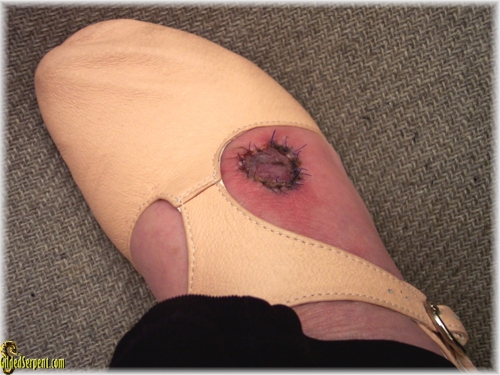
necrotic skin graph

The only shoe I could wear for many weeks were my soft kid-leather dance shoes from Capezio and Revolution Dance-wear. Still, in all my wildest dreams, I did not understand fully how close I had come to loosing my foot from infection until my general practitioner saw it and sent me packing to a near-by sports podiatrist. The sports podiatrist wanted to surgically debride the entire ugly wound once again and start over, and had I realized how much pain I was going to experience, and for how long, perhaps I would have let him. No, I thought that the whole hateful incident would soon be over —after all, I had been healthy and resilient all of my life! I decided I could “tough it out”.

After several months of caring for my foot, and struggling with throwing out nearly all the shoes I loved and buying shoes that were “more sensible”, I finally arrived at a point at which I considered myself cured in the Spring of 2009, but even my cure has proved imperfect.

I learned from the Internet that “Once you have Melanoma, you always have Melanoma”.  It is dangerous, and there is no cure.

Melanoma appears to go away when you cut it away, but it hides in your body and can slowly develop at another site.  A Melanoma victim has to have his/her entire body inspected for new occurrences and color changes elsewhere and everywhere, yearly. To my sorrow, I learned that I would never, for the rest of my life, be able to relax from the intense fear this irregular brown spot that I had mistaken for a large freckle and then a coffee splatter, had caused me.

A helpful “friend” mailed me a magazine article that stated near the end, without compassion, that most Melanoma patients were usually dead within seven years!

Nevertheless, I slowly began to re-direct my energy back into dancing. However, the months of pain and disuse of my feet had caused me to loose my keen sense of balance, and residual foot pain made my future in the world of dance seemed clouded. Still, I believed that I could resume my teaching, and I was certain that I could drop the extra weight that the months of inactivity had piled on my frame. I began to think that since I was vulnerable to this horror and had seemingly escaped, with both my feet relatively intact, that I could simply go on a diet, resume dance and my exercise regime, and I would be good to go in spite of the seven year prediction mentioned in the article I had received in the mail.  With my yearly skin checks, as well as attention to a reasonable life-style, I planned to keep my health under control, and my dance would keep me together, mentally and physically.

It has been two years now, since the rug was pulled from beneath my dancing feet. I still cannot wear beautiful shoes or dance as I once danced, but in spite of the next pieces of further bad news I received unexpectedly shortly after I began to teach dance again, I am still hopeful and dreaming of a time when I will be able perform in public once more.

My word of wisdom to you dancers concerning skin cancer is to keep yourselves (and your children especially) slathered in sunscreen lotion or stay out of the sun… maybe both, and wear a hat in the garden!

My brush with looming mortality has stirred up all kinds of questions for me about my plans for a lifelong career in dance:

  1. When is enough enough?
  2. How important is the show that “must go on”? …and important to whom exactly?
  3. Can a dancer be satisfied with “not doing it all”?
  4. Is there life after dance?

Next, please see Dancer Cancer Part Two: Who? Me?-Coming soon!

use the comment box

Have a comment? Use or comment section at the bottom of this page or Send us a letter!
Check the "Letters to the Editor" for other possible viewpoints!

Ready for more?

  • Get Over It! Soundbyte Bellydance Part Two
    Imagine yourself dancing inside of a huge plastic jug full of gel or detergent. Pull and push your movements through the viscosity with conviction!
  • Sound-Byte Bellydance, Part One: Evolution of Bellydance
    Through her clear description of what she wanted to learn, I was able to look inside our recent dance evolution and see what we dance teachers in the west have done to change Bellydance here in the U.S., how we have changed and modified it into something it never was in the lands of its origins.
  • Teacher or Coach: What’s the Difference? Why All Performing Dancers Need a Dance Coach
    Most performers have a great deal of untapped potential; additionally, many consider it cheating to engage a professional coach and yet, that is exactly what they would look for if this were the Olympics and they were competing for the gold!
  • Improvisation: Method Behind the Madness
    One of the biggest mistakes we western Bellydancers have made is presuming that the dancing to which Arabs refer as the “Eastern Dance” is a theatrical dance that ought to be choreographed as if it were a ballet, or that its steps and movements are traditional like those of the Greek Hasapiko, an Arabic Depke, or a Hawaiian Hula.
  • The Dance Teacher: By Divine Design or Default?
    …nearly everywhere, dancers in this particular form seem to have found it necessary to “do it all” in order to earn a living by dance career alone
  • I Walk In Pain And Beauty
    I also walk with the Hope that other dancers will read this and know that they don’t balance on this double-edged sword alone.
  • The Skinny on Abdominal Strengthening
    You’ve probably heard the terms neutral spine and core balance being bandied about, and seen numerous class offerings for Pilates, body ball, and core workouts. You may be wondering, is this the sort of thing you should be checking out?
  • Journey into Womanhood
    Our mission, as women, is to encourage others to joyfully anticipate all the decades of their lives. Those who have gone before us have always and will always help us on our paths.
  • Improving Breathing for Better Dance Performance
    We also hold our breath when we concentrate or get nervous. This brings tension into our bodies. The more tension we have, the more shallow we breathe. It can become a vicious circle!
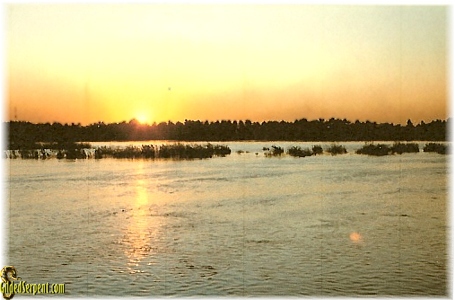
  • The Constant Grind
    Today, the bitter truth is that the curvaceous and fleshy female figure is constantly disrespected by the media and pop culture.
  • Got Strength? Buffing up for Bellydance
    Muscles are like smart-aleck teenagers. If you ask them to do something, they do just enough to get the job done—and no more.
  • Belly Dance Secrets for Fitness and Rejuvenation
    The most important factor in sustaining an exercise program is the ‘fun factor’; Belly dancing comes with great music, exciting moves, noisy coin belts and its own special dress code.
  • NIA: A JOURNEY IN MIND and BODY FITNESS
    I believe that I am on a fascinating journey and that on of the destinations is the path, itself.
  • Dancing on the Roof of the World, Community Festival in Tajikistan .
    After all my many travels to Tajikistan, filled with the frantic bustle of dance lessons, rehearsals, teaching, doing trip logistics, hunting for traditional bits and bobs for costuming, and getting fitted for stage costumes, I finally decided to try being a more-or-less normal tourist in one of my favorite places on Earth, the Pamir mountains of Badakhshan, eastern Tajikistan.
  • Serpent Tour 2011 Journal- London, Madrid and Marrakech!
    An experimental travel blog. Let see how it goes! The plan is to update this page frequently.
  • Photos from Rakkasah West 2011, Sunday A- L
    Adira, Anisa, Ashley Lopez, Orchids, Damascus, Danielle, Desert Dream, Diana, Dondi, Dancers of the Desert, El Asaab, Evangaline, Fahtiem, Fatima, Ghawazee, Alexandria, Jamilla, Joweh, Karavansary, Lisa
  • The Transformation of Beauty, Inverting the Gaza, Part 3
    As women and performers, why cannot we see beyond physical representation, when we, too, are trying our hardest to achieve such beauty in our own lives? Such hypocrisy ensures that we can never escape the limitations that society and, thus, we place these same limitations upon our own bodies.