Gilded Serpent presents...

Interview with Ahmet Ogren

Ahmet Ogren

Bringing Gypsy Dance to the People

by Maria Grayson
posted August 4, 2011

Recently, I had an incomparable opportunity to participate in a weekend of Oriental Gypsy music and dance, featuring the teaching of Ahmet Ogren of Istanbul, Turkey. He is a world-renowned dance master who excels at the Turkish Gypsy style of Belly dance, or as they say in Turkey, “Turkish Roman”.  The focus of the weekend was an intensive workshop, exuberantly taught by this dancing legend. During eight hours, we learned as much as we could absorb, about this expressive, yet little known style of Oriental dance.  In Ahmet’s capable hands, we got a solid introduction to the style; which is fun; theatrical, and usually fast, with a lot of animated footwork. At times, the dance seems almost irreverent, but delightfully expressive when executed well.

Ahmet’s friend, Ali Yenigun, (who is also from Istanbul but now resides in New Jersey) travels with him as his translator for describing the more complex ideas about the dance.  Ali was always available to answer questions. 

Ahmet starts by breaking down the rhythm of the Turkish 9/8 rhythm in a simple way, and teaches how to move with it like a Gypsy.

We learned the difference between Turkish 9/8 and Gypsy 9/8 dancing.

Next, we learned  moves and combinations, starting slowly to get the footwork and the timing down solidly. Ahmet made sure everyone got it! We drilled hard on the choreography that he has created with these moves. It was called an intensive workshop, and intensive it was!

 Ahmet combined teaching us some subtleties of the moves with more fun moves and another choreographed dance on day two. The moves and style are fun, and as I said before, at times irreverent, and exquisitely expressive when executed well. Tirelessly throughout the workshop, Ahmet demonstrated how to execute perfectly each move and combination. That in itself was a thrill to me!

Ahmet is a sexy and masculine dancer who combines a sense of playful humor and has the dedication and drive of a consummate professional. He pushed us hard, laughed, and encouraged us.

Ali was always available throughout the weekend  to answer any questions we had about the dance (or anything else). An amiable man, he is an outgoing and has a quick smile; he is a treasure trove of information about life in Istanbul, the Gypsies who live there, and Gypsy culture in general.

Ahmet gave us a rare treat when he danced spontaneously for us at the hafla party on Saturday night. After the workshop, I was privileged to interview Ahmet and Ali, and I thoroughly enjoyed getting to know them both.

The workshop and surrounding festivities (sponsored capably by local teacher, Joan Kafri) took place in Santa Fe, New Mexico in the spring of 2011.  

Interview

Maria:  Have you always done this style of dance, and are there other styles that influence you?
Ahmet:  “I started just doing regular dance, and have always loved to dance

Like going out to dance to the popular music?
“Yeah! My special style is Belly and Gypsy and that is what I do professionally. I only teach this style, this combination of Turkish Belly and Gypsy dance styles.”

What gives you inspiration in your dance?  (Here, I needed to define my term “inspiration”.) 
After some more translating,  Ali tells me: “I express myself with dance.Yes, when I listen to the music, my body moves.”

I was planning to ask you what your favorite music is for dancing, but now that I’ve taken your workshops, I know the answer to that. It’s all about the 9/8 rhythm; it is a lot of fast, slow, and medium tempos, all done in the Gypsy way of using the rhythm. Including that  important little pause, as compared to the Turkish style. From your workshop, I understand this so much more.

What is your favorite listening music?
“Music is international. I listen to music from all over the world. If I hear it and like it, I enjoy listening to it.  Even if it’s different and in a language I don’t understand, like Greek or other music. If I like it, I like it. I always enjoy hearing a variety of different music.”

Ali, Joan, and Ahmet Where are you going next on this workshop tour?
“I am going back home to Istanbul, then on to Australia, Japan, Belgium, Germany, Greece, and finally, Marakesh in Morroco.  I spend only 3 months on tour, then I return to teach in Turkey for most of the year.”

That’s fantastic! You are sharing this wonderful style with the world! What do you have planned after the tour?
“Istanbul! …performing, and  teaching in Turkey.  One renowned event there is a festival that is the biggest Gypsy festival.  I teach and perform there.”
 
How did you get started in dance? Is it part of your family or familia?   
“No, I’m not Gypsy. I learned to love this Turkish Gypsy dancing from when I was very young. Gypsies live all over Istanbul. From an early age, we always hung out with Gypsies in their camps and neighborhoods. I watched and learned this dance from them. I’ve always loved to  dance for fun. I was sixteen when I started dancing professionally. I have been doing the Turkish Roman style dance professionally for 20 years.”
 
What is the difference between this style of moves for women and for men? 
“The moves are all the same for men and for women. The difference is how they do it. The men do it more macho. The women do it more sexy, … like the way women are in life!”

Can you talk about men in Belly dance and how male dancing fits in the cultural traditions of the Roma life in the Middle East?  Also, in the U.S.A., men are not used to doing much dancing; how can teachers encourage them?
“It is part of the culture, not  just Belly and Gypsy style. Folk dancing too, it is different in each different area. When people see men dancing, they don’t think of it as “gay”. Also, men who dress like a woman dance; it is like theatre …called ‘Kotcheck’.”

It is like theatre, isn’t it?
“Yeah! …like theatre.  It comes from the tradition against women dancing in public. It is not considered “gay”. Now, dance is becoming more closed to men. Things are being influenced more by fundamentalists.   As for the cultural hangups here, they are a huge obstacle! It is a whole culture. Maybe you can do something to change it…  I just bring this dance to people, and they learn it if they want.”
 
Are there  some moves, and also costumes that are offensive to Roma or Gypsies when non-Gypsies are seen doing (or trying to do) them as ‘“Gypsy Dance”?
“I am into sharing this great dance style with anyone who wants to learn it. In Turkish Roman
dance there is no skirt swirling, but in other countries, like Russia and Spain, yes.  My personal opinion is that the swirling of a skirt is just an easier way to keep up with the music than actually keeping the beat with your footwork.”
 
Do you know if Spanish flamenco has evolved from Turkish Roman dancing? I saw your video on YouTube and you were doing that rhythmic, stomping kind of footwork,  tapping, and stomping with your boot-heel and toe.
“That is just me, having fun with the Gypsy musicians and the crowd. I was being playful, playing with the musicians and the crowd; creating rhythms and having the drummers go along.  I don’t do it as any style like Flamenco.”
 
Can you talk about what is most important to you to give to your students, and what you enjoy most about teaching workshops?   
“I offer the dance and make it available to anyone who wants to learn. If students take what I give, it makes me happy. I enjoy very much to see the students work so hard to learn what I am teaching to learn this style of dance.”

What is most important to give to your audience?
“When the audience enjoys it, I enjoy it more.  Like all performers, when I get a big response, it is more fun for me and satisfying to know that what I am giving is being received and appreciated.”
 
How do you feel about spontaneous performance vs. choreographed performance?
 “Spontaneous dance is better.  It’s not mechanical like choreographed dance is so much (except when it is done really well). For workshops though, one must teach using choreography. It is like you have to learn the alphabet first with choreography. Spontaneously is how I always dance when I am dancing solo. Gypsies always dance spontaneously when dancing solo. When dancing with a partner, then there must be some choreography.”
 
Do you have anything to say to teachers about how to teach students to dance spontaneously?
“The key is: 
1. I can demonstrate spontaneous dance, and I can teach you the moves,  
2. …but I cannot give you emotion, …feeling. This comes from the individual dancer.”
 
Thank you both very much for coming out here and doing this. It is a great opportunity to learn this wonderful style of music and to learn more about Istanbul and the Gypsy people.

Author Maria’s GS bio page
Ahmet’s Website

use the comment box

Have a comment? Use or comment section at the bottom of this page or Send us a letter!
Check the "Letters to the Editor" for other possible viewpoints!

Ready for more?

  • Serpent Tour 2011 Journal- London, Madrid and Marrakech! NEW VIDEO UPDATE-7-8-11
    An experimental travel blog. Let see how it goes! The plan is to update this page frequently.
  • Khamsa Holidays, A Dance and Culture Camp in Tunisia
    How do you judge a dance trip? Would you go back next year? …in a heartbeat. Damn the cost and mercury retrograde and the heat. It was that good!
  • Turkish “Roman Gypsy Dans”, Melting Any Heart!
    This dance of the Gypsies is about becoming a life-like character. It contains a wide range of moods and feelings for the dancer to express: The gray quality of everyday tasks turns into colorful dance that does not distinguish between the relative value of one color over another.
  • Little Istanbul in Japan
    For several years, belly dance has been rated as one of the top three favorite hobbies for women who are in their 20s and 30s in Tokyo.
  • What is Gypsy Bellydance?
    …it is a sore point for representatives of the Roma community whose advocacy groups are very clear on their preference for the term Roma or Romani and consider the term "Gypsy" to be suspect when used outside their own community.
  • 6-29-06 “Gypsy” Dance in America, by Caitlyn, photos of author by Rachel Ong
    Roma dance usually brings to mind tambourines and skirt-swirling, but these images are mainly a fantasy.
  • 11-29-01 Nomads of the Spirit by Sierra Suraci
    Know what are you contributing – either to their dilution as a people or the strengthening of their true image.
  • 3-28-08 Gypsy…Un, Deux, Trois, A Review on the “Journey Along The Gypsy Trail” Workshop by Denise
    with Hadia, Jalilah Zamora, and Amrita Choudhury, Photos by Denise and Tracey Vilbert, Event held on January 5, 6, 2008, in Montreal, Canada
  • Tania Luiz A Romany Fusion Artist in Osaka
    At this time I think I was longing for a well-documented dance, old and structured. I was a little sad because I saw how people who were not properly trained but who just had a costume would teach Oriental dance. Plus the deep connections of Indian dance to the Divine were very interesting to me. At the end of it all, I realized that my body, my soul and my blood are meant to do Oriental.
  • "Just feel the music when you’re on stage!” Interview with Ozgen, Male Turkish Belly Dancer,
    Well, I think my heart still beats for big shows and productions, as much as I know how stressful and difficult that show-life can be. I seem to not be able to live without it.
  • Adventures in Turkey 2006
    I am not exaggerating when I say that Sandra actually threw herself into Bella’s arms and wept when she first laid eyes on her.
  • Unveiled Musical Gems, 3 CD Reviews
    Raqs El Qamar by Chris Marashlian, Rhythms of Turkey by Tayyar Akdeniz, Angelika Unveiled, by Angelika Nemeth and Raul Ferrando
  • Turkish Bellydance:
    What an absolutely delightful surprise it was…
  • Dancer Cancer, Part Two: Who? Me?
    Still, the human heart is woven with threads of hope, and mine did not doubt that if I could make it through the onslaught of doctors, surgeries, pain, and gymnastic therapy, I would, someday dance again.
  • Carnival of Stars, Page 2: D-H Photos
    The Carnival of Stars Festival is produced by Pepper Alexandria and Latifa at the Richmond Auditorium each year at the beginning of August. The stage at this facility is hard to beat. The wonderful lighting and the large stage make every dancer feel like a diva! Once again, Carl has done an amazing job catching the character of each dancer.
  • Dance Festival Warms Oslo Winter, Oslo Oriental Dance Festival 2011
    This competition is not open to professional dancers, and judges are required to give constructive feedback to encourage growth.
  • Bellydance ‘n All that Jazz, Trends in Tribal Fusion
    For some dancers, it can be easier to relate to music from one’s own culture than it is to music from halfway around the world.
 

Gilded Serpent presents...

Canival of Stars- Page 3: I-O

Photos by Carl Sermon
posted August 2, 2011

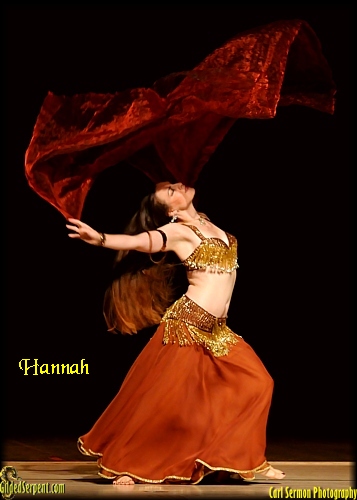
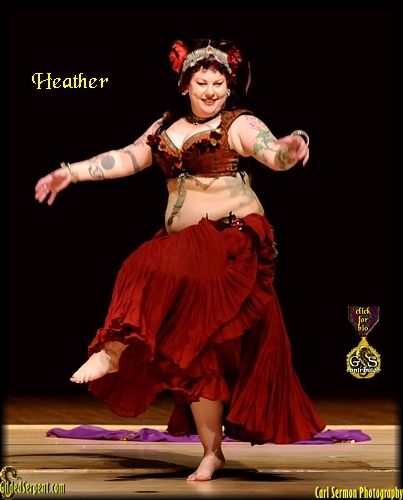
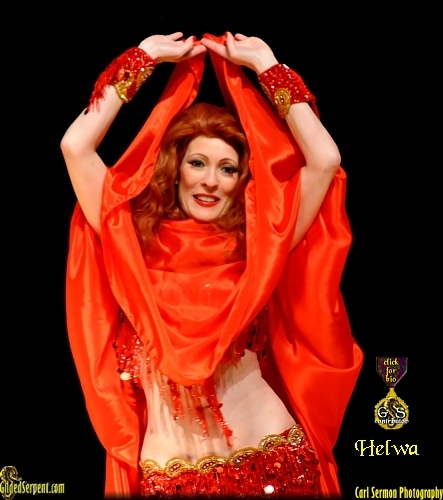
The Carnival of Stars Festival is produced by Pepper Alexandria and Latifa at the Richmond Auditorium each year at the beginning of August. The stage at this facility is hard to beat. The wonderful lighting and the large stage make every dancer feel like a diva! Once again, Carl has done an amazing job catching the character of each dancer. This is page THREE of another lovely group of his photos. Check back for more soon! This year’s festival is just around the corner- August 6 & 7, 2011. Gilded Serpent will be there to witness and document this friendly event. See you there!
See Page 1 here
See Page 2 here

Jane of Taiwan


Jahmra


Janelle and the Desert Dream Company


Jeanna


Judeen


Kanz al Sahara


Kathy Trewin


Kerry B


Khravansaray Dance Company


Latifa and the Dancers of DeNile


Leyla Lanty


Linah


Lulu


Mahsati


Malia Dance Company


MaShuqa


Melinda


Migarcia Dance Company


Monica


Monifa


Nanna


Narghes


Nera Brent Firefly

Open Floor


use the comment box

Have a comment? Use or comment section at the bottom of this page or Send us a letter!
Check the "Letters to the Editor" for other possible viewpoints!

Ready for more?

  • Carnival of Stars, Page 1: A-C Photos
    The Carnival of Stars Festival is produced by Pepper Alexandria and Latifa at the Richmond Auditorium each year at the beginning of August. The stage at this facility is hard to beat. The wonderful lighting and the large stage make every dancer feel like a diva! Once again, Carl has done an amazing job catching the character of each dancer.
  • Carnival of Stars, Page 2: D-H Photos
    The Carnival of Stars Festival is produced by Pepper Alexandria and Latifa at the Richmond Auditorium each year at the beginning of August. The stage at this facility is hard to beat. The wonderful lighting and the large stage make every dancer feel like a diva! Once again, Carl has done an amazing job catching the character of each dancer.
  • Live a DanceDivas’ Life! Interview with Jane Yee Shan Chung of Taiwan
    Then I saw the Suhaila technique workshop announced on her website and I just
    signed up without knowing exactly what her format is. I am the only person who did not learn Suhaila format before at that workshop. I was so naïve, I simply wanted to give it a try.
  • Off the Beaten Path
    Cory Zamora’s "Belly Dancing for Seniors" & "Learn the Art of Male Belly Dancing"

    However, I have a couple of issues with this DVD. One of my issues is that, other than stating the ages of the students (60, 63, 75) and making a fleeting mention of a few physical issues they have (problems with feet, back, etc.), there is not a great deal of material specific to senior dancers.
  • Hawaii Workshop
    Floor Work is a moving Yoga, and as in Yoga, one must let his/her body grow into more flexibility which develops with practice.
  • Middle Eastern Dance Meets Hip Hop Culture
    Issues Confronting a “Vintage Dancer” when her Audience is Half Her Age
  • Is "Cabaret" a Dirty Word? Using the Terms Cabaret vs. Night Club
    So, is “cabaret” a dirty word? It depends on whose definition you want to use! In Arabic, the name “cabaret” is interpreted differently from what it is in English, leading to the confusion about nightclubs and cabarets. Here in the U.S., we think of a cabaret as a synonym for nightclub.
  • Rhythms of Oriental Dance, Starring Nesma and Khamis Henkesh
    Nesma and Khamis’s discussion of the complexity of Arabic music and dance is both appealing and easy to grasp.
  • Cairo’s Costume Disasters
    Tacky, Bizarre, and Surprising Costumes Worn by Cairo’s Stars of Oriental Dance
    Like I said before, this video is for those who are familiar with belly dance
  • Fabulous Fan Veilzz w/ Mahsati Janan
  • already. The fan veil is a new concept and performance skill , as well as a new prop in Middle Eastern dance.
  • The Pirate, the Psychic and the Mummies in the Basement, Malia’s Story Part 1
    So, at age 4, my world was good. I had a rich imagination sparked by images of Egyptians in the crawlspace and iron ore waiting to be turned into gold. I had a family that consisted of pirates, genies, fortune tellers, wanderers and minstrels. Most of all I had been captivated by the bejeweled beauty in the dancing tattoo. It was 1957 and I knew, like my Uncle Omar and great Aunt Katie, I would one day grow up to be someone who would follow a special calling. I decided, at age 4, that it was my destiny to become a Belly dancer!
  • Scott Wilson’s CD "Efendi"
    Scott’s quest is to make Mid-East music more accessible to American audiences..
  • Sausan’s First Egyptian Dance Seminar
    What would you think if you heard somebody say, “There are no isolations in Egyptian Belly dance"?
  • Sula, An Artisic Life by Monica
    Sula continued to study with Bert through the early 1970s, though by 1972 she called him “my ex-teacher and now equal partner”. Bert was extremely proud of Sula, as she was among the first students he trained who began teaching seriously.
  • Troupe Tabu goes to China!
    .It should be noted that somewhere between passing the audition and performing, it was announced
    that three out of four dancers in the group (not including myself) were pregnant.
  • 7-27-05 Calling all professional dancers! How much do you charge? by Nanna Candelaria
    Over the years, we dancers have unwittingly kept the general rate ridiculously low in restaurants and nightclubs.
  • Sunday at Carnival of Stars, Page 5:T-Z
    November 9, 2008, Event Sponsors- Pepper Alexandria and Latifa
  • Sunday at Carnival of Stars, Page 4: R-T
    November 9, 2008, Event Sponsors- Pepper Alexandria and Latifa
  • Sunday at Carnival of Stars, Page 3: M-R
    November 9, 2008, Event Sponsors- Pepper Alexandria and Latifa
  • Sunday at Carnival of Stars, Page 2: D-K
    November 9, 2008, Event Sponsors- Pepper Alexandria and Latifa
  • Sunday at Carnival of Stars, Page 1: A-C
    November 9, 2008, Event Sponsors- Pepper Alexandria and Latifa.

  • Maria, Nadika, Naiya-Hayal, Onyx Moon, Oreet, Raks Al Khalil, Raks Terayz, Raks the Casbah, Reda Darwish, Ruby, Sabiba, Sassafras, Shimmy Amour, Tatseena’s Troupe, Terry, Titanya, Troupe Aneena, Yolanda, Zahara
 

Gilded Serpent presents...

Incredible Helena Vlahos!

Helena Vlahos

Magic, Mojo and Inspiration

by Surreyya
posted August 1, 2011

Flashback: late ‘70s. Chicago.

Two young girls separated by 12 years of age, but joined together in a love for belly dance, their eyes glued to a huge TV tube encased in a varnished wooden contraption with sparkling gold-upholstered speakers. 

A four-year old voice squeals toward the kitchen, “Hurry up!  Hurry up! She’s on now!” as an older brother emerges with an avocado-green gallon-sized Tupperware full of popcorn.  All eyes are transfixed on the screen while this magical woman appeared on our favorite show “That’s Incredible!”  She put nine coins on her tummy, and rolled them all – together, one at a time, every other one, then all of them (on our first color TV).  I asked my sister, “Can you do that?”  She replied with a silent sneer as she sewed sequins on a new bra top.

There was this beautiful, magical Belly dance woman who was bold, confident, and paving a wave of inspiration and independence.  Then, followed by an Enjoli perfume commercial, another stunning woman clad in business attire, reaffirming that she could make the big bucks, then, come home (and clean house for you) and still be sexy enough to charm your socks off.   “I am woman,” she seemed to say.  “I can do it all, and no one can stop me.”  What an exciting time!

Flash forward: Early ‘90s. Location: Lynette Harris’s “Snakeskin Studio” in Emeryville, California.
It was break time during one of Lynette’s costume-making workshops, and Lynette was playing some of her favorite dance clips on the VCR.  There she was again – Helena Vlahos!  I could hardly believe it!  Helena was one of my sister’s dance heroines–and mine.  I had seen her on “Dynasty”, “Dallas”, “Ripley’s Believe it or Not”, and you name it.  Lynette gave not only confirmation to my taste in dance, she opened doors in developing one’s own sense and style of dance. Helena was a super star, and truly, I wanted to be just like her as well as  my sword-slinging, snake-taming, goddess-like instructor, Lynette!  They both had pure Mojo!  Those were exciting times, my “baby dancer” years, soaking in all of it like a sponge!

Flash forward: Modern Times. New Mexico’s “Floralia in TorC”.
My dance partner Nyla Crystal and I were teaching and performing in New Mexico when we ran into Helena Vlahos at the opening night gala, and I had never been so nervous!  I’m sure I put my foot in my mouth several times, but she was fun, lively, classy and comedic. She quickly put me at ease and was every bit the star I remembered on our big TV.  I hadn’t yet found an interview with Helena online, so I decided to do it myself. 

What do you remember most about your journey to the United States from Greece?  What things do you remember being the most different about each place?

You must understand that I was only eight years old when I came to the United States and I came from a small island in Greece called “Hydra”. To this day there are no cars because there are no roads big enough to accommodate them. So everything was different for me. We came to New York by ship and went on to Chicago where we were supposed to live. (We wound up in Los Angeles instead.) The tall buildings, the people, the language were all so different. I was scared of all the commotion.

What drew you to Belly dance?

Greeks love to dance, and I am no exception. One of our many dances is Chiftetelli. It is a Belly dance that people do at parties or restaurants and clubs. I do not consider it a professional Belly dance. It is as the Arabs when they Belly dance at parties and restaurants. They do it for fun. It is not professional until the dancer studies and becomes a “Belly dancer”. The Greeks call the professional Belly dance “Oriental”. So I used to love to do the Chiftetelli and those who watched me loved it, so I guess I started that way. One of my relatives, Fofo De Milo was a singer and dancer. She was from the old school of Greek nightclubs. They sang and danced and played finger cymbals or the def on stage. Fofo liked the way I danced and taught me when she opened a Belly dance studio (1963).

What dancers inspired you early in your career?

Aisha Ali, Antoinette Awayshak Khoury, Marliza Pons, Tanya Lemani, Rico Marcel, Iklas Osman, Tahia, and Maria Vlahos, my sister.

Was there ever a time you thought about giving up dance?  How did you work through it?

I have seen myself on videos that I did not like, and I have wanted to quit. Especially one that was very bad. I got so depressed that I did not want anyone to see me as I saw myself on that video. I did not look at that particular video again until about four years later. I made myself watch it to see if my opinion changed. It was not as painful as the first time but it was not good. It did not make me feel as bad as the first time I saw it. I could live with it now.

I did stop dancing (as my main means of support) because I felt I was getting too old to perform in clubs. I went to school for Hotel Restaurant Management in Los Angeles. I came to Phoenix, AZ to work in a restaurant management position from 1990 until 2004. I only danced occasionally and taught only on Sundays (my only night off).

I finally got tired of working so many hours and no dancing in my life. I quit the restaurant and started teaching. Thanks to so many of my dance friends, I was able to get into it again more easily than I thought.

What advice would you offer to young dancers considering going professional?

Follow your dreams, work hard, don’t talk bad about anyone, appreciate and respect other dancers, and don’t let your head get too big. Remember that there are no rules there are only guidelines (as my student, Linda, worded it).

Have you ever experienced stage fright?  What do you do to tame it?

Of course I experience “stage fright” all the time. To tame it, I hold my head up high, I remember that I am a dancer who knows what she is doing, I go on stage, and let the music engulf me. I am a dancer; I must dance!

What inspired you to develop your famous coin routine?  How many hours of practice do you think it took to perfect this incredible routine?

I learned to roll and flutter my belly muscles propped up on my elbows because I could not do it standing. I incorporated the rolls and flutters in the floor-work portion of my dance. This became a very big part of my show. In 1968 at the “People Tree” in Calabasas, California, while I was doing this part of my dance, a customer placed a bill right where it caught perfectly in my belly fold, causing the note to flip neatly over. The crowd went wild! I realized that here was something really amazing I could add to my show. I began to practice the act in my spare time. At first I worked only with the bill, but then I thought to try it with coins. After experimenting with various coins, I settled on quarters as working the best for me. Years of persistence finally led me to the mastery of an incredible nine-coin row, a feat that hasn’t been matched since.

You ask how many hours of practice it took to perfect this routine? I say six years.

You’ve performed on many television shows; which one was your most memorable experience?

Some of the television shows had a live audience, which scared me to death!  I remember when I was on “The Merv Griffin Show”, I was so scared (not only by the audience) but earlier, we had a rehearsal and Merv Griffin was there watching. I had to come out from behind the curtains, and I could not find the opening. I was fumbling until I found, or someone backstage helped me find, the opening. Needless to say, I felt like a fool in front of Merv Griffin.

I also remember on “That’s Incredible!” my belly muscles were shaking from fright when I was on the floor waiting for Fran Tarkenton to place the quarters on my belly.  This made it difficult for me to do the coins. My voice was also trembling when I asked him to bring the quarters and place them on my belly as I was supposed to do.

Of all the celebrity encounters you’ve experienced, who was the most incredible and why?

I was hired to dance for Mohammed Ali‘s private 40th birthday party at his estate in Hancock Park. Muhammad Ali was enough of a thrill, but there was also Cary Grant! I loved him. I always love to watch the old movies and his are among my favorites. When I told Cary Grant how I enjoyed his films, he said, “Good of You”. That was so English and so like Cary Grant in movies. John Travolta was also there. He has the most incredible eyes in person. The whole evening I was all a-tingle with the thought that Cary Grant was there in the flesh, a dream come true!

What are the most significant changes you have seen in Belly dance over your career?

The Internet, which connects us all, the ready-made costumes that are so easy to buy, the Modern Egyptian style of dance, Tribal Belly Dance, Belly dance competitions, Miles Copeland’s Belly Dance Superstars!

Tell us something unique that not many people know about you.

I played finger cymbals in Damon the Gypsy’s album in the late 1960’s “Song of a Gypsy”. I also played for his remastered version of  “Song of a Gypsy” CD and his new album “Gypsy Eyes” a couple years ago. I am in a video of Damon’s “Dance Little Gypsy” http://youtu.be/1NxIEI0M8IQ . I am not Belly dancing in it; I am just changing from a hard businesswoman to a free spirit.


What contemporary dancers are you watching these days?

I imagine you mean overseas. Orit, Randa Kamel and any other Middle Eastern dancers I find on YouTube that interest me.

What style of music makes you dance without realizing it?

Any Middle Eastern music. Especially classical Belly dance music.

What was the most difficult decision you have had to make in your dancing career?

Moving away from Los Angeles, 1990. But good news! I am moving back at the end of August! I will miss all my students, troupe members and friends in Phoenix but it is past time for me to move back.

Any tips, tricks, or advice you would like to share with other dancers?

Stay true to the dance. Don’t let it get lost. Experiment with it, fuse it, but don’t lose the Middle Eastern music and flavor of the  Belly dance. Make it better–not obscure.

Is there any other style of dance to which you are particularly drawn?

I love Flamenco and Classical Indian dance. I have taken Flamenco in the past to help with my posture and arms. I did not want to devote the time to be a professional Flamenco dancer. I know how much time I would have had to put into it to be good, that is why I decided to stick to my Belly dancing which I love most.  I love watching Classical Indian dancing but I have not studied it yet.

Helena Vlahos will be here teaching workshops and performing at this year’s “Carnival of Stars Festival”.  I am super-anxious to learn the abdominal dexterity she is famous for and plan to soak up as much of her mojo as I can. 

More about Helena at http://www.helenavlahos.com/

Helena rolling coins in February 2011

Helena on Dynasty TV show

use the comment box

Have a comment? Use or comment section at the bottom of this page or Send us a letter!
Check the "Letters to the Editor" for other possible viewpoints!

Ready for more?


Gilded Serpent presents...

Who? Me?

Najia looking tribal

Dancer Cancer, Part Two

by Najia Marlyz
posted July 29, 2011

In essence, memorable dancers make music visible with their bodies! However, unlike musicians, when the dancer’s instrument wears out, becomes defective or broken, we cannot go shopping and simply purchase a new instrument. We often make magnificent efforts and campaigns toward the healthy and efficient maintenance of our bodies to elongate the projected lifespan of our precious dance careers. Many of us have been extremely successful in our battle, not only with our dance but in the maintenance of our careers through health, diet, exercise, and fortunate genes, but what happens to the dancer who loses her battle? In Belly dance, unlike Ballet, theater, or the cinema, “out of sight” usually means “out of mind” and “S.O.L.”!

I had had to face the terrifying question in my own career and life only a few months before when dealing with Melanoma surgery on the top of my foot. “Would life be worth living, having to hop about on one foot?” I had wondered. My answer usually had been yes, but sometimes it had been negative, depending on my level of pain and disappointment. The specter before me was one in which I, as a dancer and dance instructor, could have lost my right foot to the dark and dangerous Melanoma cancer. I had survived that ordeal, during which my skin graft had turned necrotic, and pain had made it nearly impossible for me to walk, let alone dance.

Still, the human heart is woven with threads of hope, and mine did not doubt that if I could make it through the onslaught of doctors, surgeries, pain, and gymnastic therapy, I would, someday dance again.

About six months later, while attempting to dance once more although my body was pathetically out of condition, I found that I could still dance; so that became my plan. It was my intention to return to teaching, coaching, dancing, and going to all the festivals and haflas that make the world of Belly dance so colorful and alluring. 

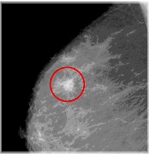
Random MamI began to recondition my body, and because it seemed prudent to start with a clean physical condition and healthy attitude, I scheduled my yearly mammogram. Mammograms often seem more an annoyance than any big deal; that is, they may seem so until you hear a radiologist say quietly, “We need to do a magnified mammogram before you leave today.” Still, I did not have any feelings of terrible foreboding as the radiologist said that the head radiologist also wanted to have “a word with me”. Her word was “biopsy”, and she sent me home with a packet of information about what was going to happen next.

breat ripperBiopsy of my breast tissue was a much more complex procedure for me than the biopsy of my foot Melanoma had been. I would have to go to another hospital in a nearby city and this same radiologist would do what was called a “Stereotactic 6-core Needle Biopsy”. This core needle would remove samples of tubular tissue from my breast in 6 separate sites in close proximity–rather like a core sample that geologists take from the earth. The samples were to be removed while I was lying face down on a pneumatically elevated table with one breast hanging through a hole in it. (In my mind, it resembled some sort of medieval torture device.) A tiny numbered metal tag would be inserted and left inside my breast that would identify the site. (I remember asking if it would set off the alarms at the airport.) Then, I would wait until one or two days hence, when my general practitioner would be able to interpret the report of UCSF’s laboratory findings.

The whole procedure had me quaking in my dance shoes! What if I had breast cancer? Would I die? Would I live a few more years with one breast, and then die anyway? Would I have the “lump” (that nobody could feel) surgically removed and go on with my life and my dance career? Would surgery leave an ugly scar or even a breast? Would I even care to dance anymore —to put on a costume and express the emotions contained in music? Would I be able to put on a glamorous costume without feeling self-conscious? My mind went rampant with questions, and I had not yet heard any results of my breast biopsy!

Still, after a few days had passed without word from my general practitioner, and I knew he would be gone over the weekend as usual, so I phoned his office and insisted to speak with him “sometime today”. His telephone dragon asked me, “Who did you say you were, again?” I pronounced my name for her once again and said that I wanted him to tell me the results of my breast biopsy. “Oh, yes… Well, I have already made an appointment with your surgeon.” “Surgeon? What surgeon? Surgery for what?” I shouted. “Your breast cancer,” she answered, matter-of-factually. My blood ran cold. Cancer! Breast cancer! I could barely speak. “Are you still there?” she asked.

“Don’t you think it would have been better if the doctor had called me and told me that I have a cancer before you made any appointment with a surgeon?”

I squawked, from a throat that had almost closed with fear. “What surgeon did you call? In what city? How soon is this appointment scheduled? How did you make an appointment for me without consulting with me?” I finally went silent, angry and frightened all at once.

“Well, do you want this appointment or not?” She could barely conceal her irritation. That was the beginning of the worst experience of my life that lasted throughout an entire year. Its ripples in my time will be with me the rest of my life.

My experience with breast cancer was and has been extremely unpleasant. Undoubtedly, every-one’s experience with breast cancer is unpleasant and frightful. However, all of my experiences in back-stage dressing rooms and repeatedly putting my body “out there” on the stage over years and years of gigs, the hardships of travel, and stage bravado in the face of performances unexpectedly going awry helped me face this personal catastrophe. Nevertheless, nothing could prepare me for the pain, discomfort, humiliations, and lackadaisical attitudes of the people in charge of my potential cure. In a misguided attempt to protect one’s sense of propriety, privacy, and modesty, medical workers who have the best of intentions cause you to feel prudish and ridiculous about your body on repeated occasions.

It was astonishing to learn that I would have numerous life-changing decisions to make about my own treatments that seemed to me like pure gambling.

I realized that I lacked fundamental knowledge about breast cancer and would have to do much reading and learning about ductile carcinoma in situ, DCIS, so that I could make, at least, semi-informed decisions for myself. I thank my lucky stars for the Internet and my dance students for their help in doing the research! (What do the “stage” numbers indicate? What does mine mean for me? What are my options?) I felt rather like a humored school girl being given the choice of wearing one of two or three hideous dresses to the prom.

First, I had to decide whether to have my entire breast removed by mastectomy, have only the so-called “lump” of cancerous tissue removed (lumpectomy)–coupled with a long course of radiation therapy, or simply do nothing and hope that I would die of something else before breast cancer became loose in my blood system and took over my organs. The latter seemed the least likely choice to me. How about you? The terms of the statistics run in percentages of chances one might have of a cure. It was 50% for this, or 85% for that and a boost of another 5 or 10% for something else. How far was I willing/wanting to go? How much fear does it take to motivate you?

I found that even with the affected breast removed, there would still be a small percentage of possibility of re-occurrence. Removal of the entire breast, then, would not be a 100% cure!  Also, there was the question of the other breast… What were the statistics of cancer developing in that one too?

Absolutely, I felt alone, swimming in a sea of statistics, but dancers who had already had their own experiences with cancer, began to appear as angels out of the blue to help me learn and help me decide what to do. One of my current students was about to undergo a “lumpectomy” but she was still dancing, so bits of hope began to build.

“I see shell-shock in your eyes,” my surgeon observed. “It seems impossible to decide what to do,” I complained. “It all seems so much a game of chance; it’s betting, using your own life as the stakes.” She went over the statistics with me, and we decided together that the lumpectomy coupled with six weeks of daily radiation was my best combo of choice, leaving a full mastectomy and chemotherapy as a possibility if the lumpectomy proved insufficient. It sounded like the least ugly dress to wear to the prom!

My surgeon said that it was “fortunate” to have only a “Stage 0 DCIS” (a beginning ductile carcinoma in situ), so I would not have to undergo the usual chemotherapy, which was the part of cancer treatments that would cause one’s hair to fall out. “Oh, goody,” I thought. “At least, my hair will be okay.” (You find yourself unwittingly grasping for small bits of comfort in the news of the day.) Up ‘til then, I hadn’t even been aware that there were different kinds of breast cancer and that they were assessed in “stages” of development.

My dreaded surgery day arrived soon enough. My friend, Claire, drove me to the hospital before sunrise. First, I changed into hospital garb and the nurse wheeled me back to the radiology department where a doctor whom I had never seen before, would “insert guide wires” into my breast to guide my surgeon to the exact spot that was the site of my cancer-that-nobody-could-feel. He attempted to inject four huge syringes of pain-deadening medication, and most of it ran down my side and into the hospital flannels I was wearing.  It became a prolonged two-hour pain-filled ordeal with my sore breast squashed and trapped in the mammogram machine’s grip, due to the apparent ineptitude of this doctor as he repeatedly struggled to insert the wires correctly. He attempted to blame me for “moving”, but there could be next to no opportunity to move a breast that has been squash flat in a Mammogram device.

The hovering nurses were worried that I was on the verge of fainting, but I was too angry to faint.

One nurse held my hand and tried to assure me that he was an experienced doctor, but until this day, I wonder about his actual level of competency! I actually asked her if this was his first day in this department and if he was an intern. I was angry enough and aware enough to speak of him as if he were not present, mirroring the irritable way he was speaking about me and my hapless, pancaked breast.  I was fortunate enough to have my friend waiting for me back in my hospital room who demanded “real drugs” for me when she saw that most of my brave composure had dwindled. My face had paled to alabaster, and I told her what had transpired with the wire-guy. (Subsequently, I wrote a scathing letter to the hospital ombudsman and the radiology department.)

Nonetheless, the lumpectomy surgery after my “wiring” was a relative piece of cake. I went home the same day and began to heal. I was allowed a month to heal and believed naively that it wouldn’t be a long recovery and soon I would be able to get back to my dancing. Soon? …well, as soon as I got past the required daily trips back to the hospital for seven weeks of radiation treatments! Fortunately, my dance client who had undergone the same procedures just one month before me was able to give me helpful information and advice, and for that, I am so grateful to her!

However, nobody, not even my dance friend who experienced radiation treatment herself, could properly prepare me the mental impact that my radiation treatments would have on me. I became just a little crazy. Before radiation treatments could begin, to guide the radiation assistants, I had to have three tiny dots tattooed on my skin as I lay in a CT-scan machine in an icy-cold, dimly lit room. The procedure for a radiation session itself was an odd and bizarre experience; I became adversarial and planned on telling my radiation doctor to forget it, after approximately five weeks of trekking back and forth every weekday to be radiated, because I had had enough of it.  I was fed up and decided that I would not be coming to submit to any more of it.

radiation symbol
Each day of treatment (in the California summer heat) I went to a dressing area where I picked up a flannel hospital gown from a cabinet stacked with them, put it on, and waited for my name to be called (usually backwards) over a loud-speaker. For a couple of weeks, I brought my Middle Eastern music and earphones and tried to forget where I was, but the atmosphere was pervasive, and I felt that my music wasn’t helping me at all. Everything began to annoy me. People without hair, people groaning, people in wheel-chairs and gurneys came and went. The closet where the gowns were kept smelled to me like the sweetness of dead people. The gowns smelled peculiar too. When my backwards name was called, I was to trek down the hall in my flannel hospital gown to the intimidating radiation room where I recited my name in correct order and rattled off my birth date so the assistants were sure they had the right patient.

Bright yellow and black radiation warning signs were on the door. There were always two assistants and sometimes more; usually they were female, but sometimes male. I was to lie on a lumpy, narrow pneumatic table, with my bare breast exposed and both of my arms inserted in holders high overhead while the machine was strategically aimed, and then it radiated and buzzed for three minutes here and two minutes there and everyone (except me) ran out of the room to safety. The first three weeks were easy enough, but then, my breast became “sunburned” and rosy-red, peeling large pieces of burned flesh, and it became so tender that it was impossible to wear any thing but a cotton sports bra. Even the cotton hurt me.

The whole experience became worse and worse, the focus of my days and nights, until the sight of those male nurses and other radiation assistants coming at me set my teeth on edge, and I arrived at my very last nerve. I announced firmly that I would not be returning, and one of the assistants told me that the doctor would like to see me.

radiated patientHe said with a smile, “I am going to grant you a one-week ‘vacation’,  and then we can discuss finishing your course of treatments.” It was hard to return, but I was afraid not to go back for fear that if my cancer re-occurred, I would be excluded from any further treatment because of my bad (non-compliant) behavior. It was weeks before I could feel comfortable in a real bra again, but my stress level remained for many long weeks.

The worst aspect of radiation treatment for me was a side-effect that was fairly glossed over by the pink and blue pamphlets describing the wonders and ease of radiation treatment, and it did not seem to affect my dance student the same way it affected me. It is termed “radiation fatigue”, and, for me, it was formidable. I became too tired to dance, too tired to think, too tired to go shopping, too tired to stay awake for a movie, and too tired to chew food. It was a deep tiredness that seemed to feed on itself. The more I slept, the more sleep I demanded. Perhaps, I was a little depressed.

Gradually my radiation fatigue faded away after several months, leaving me apparently with a compromised immune system. I may never regain that resilient and energetic part of me that hops out of bed in the morning, ready to hum a tune, feed my cat, shower, and hit the dance floor. My dance life is more Taqasim w’Tarob (solo with deep emotion) than Entrance ala Nar (with fire) these days, but at least, I still have a dance life.

My words of wisdom for you concerning breast cancer is to be sure to schedule your mammogram each and every year. My cancer was found when it was still at “Stage 0” and could not be felt, even by an experienced surgeon.

Even after my DCIS had been surgically removed along with a chunk of breast tissue about the size of a ping pong ball, (providing for safety margins) and my breast had been subjected to weeks of radiation therapy, my oncologist still recommended to me (and expected) that I would start taking daily doses of a drug for a period of “only” five years. My oncologist and I were supposed to chose the specific drug from a long menu of drugs recently introduced. I did my research on each of the drugs that he recommended and discovered that formidable side-effect problems exist for all of them. These were not just casual side-effects, they were deal breakers for me. The choice eventually boiled down to choosing the cheapest, most long-used drug called “Tamoxifen” that eliminates estrogen from one’s body, thereby starving stray cancer cells that feed on estrogen and lurk in every woman’s body, all the time.  However, even with the promise of a 50% higher cure rate, this time, my roll of the dice told me, “No five years of swallowing more drugs, dealing with their side-effects, and no more cancer treatments of any kind for this battle-weary game-player!” To his credit, my oncologist listened and has respected my answering “no to drugs” (so far).

Now I wait, but as my mother (a pragmatic philosopher) advised me years ago: “Try not to worry about every little thing; chances are that you are going to die of something.”   To her words, I add my own: “…but not without a fight!”

use the comment box

Have a comment? Use or comment section at the bottom of this page or Send us a letter!
Check the "Letters to the Editor" for other possible viewpoints!

Ready for more?

  • Dancer Cancer, Part One: "Hopping on One Foot
    Still, I was confident that there would be no further problem and that I was letting my vanity get the best of me. By wanting to look good, I had caused all my own discomfort, I reassured myself. He said I would have the biopsy report in a few days and to call my referral doctor to hear what the UC San Francisco laboratory report said.
  • Get Over It! Soundbyte Bellydance Part Two
    Imagine yourself dancing inside of a huge plastic jug full of gel or detergent. Pull and push your movements through the viscosity with conviction!
  • Sound-Byte Bellydance, Part One: Evolution of Bellydance
    Through her clear description of what she wanted to learn, I was able to look inside our recent dance evolution and see what we dance teachers in the west have done to change Bellydance here in the U.S., how we have changed and modified it into something it never was in the lands of its origins.
  • Teacher or Coach: What’s the Difference? Why All Performing Dancers Need a Dance Coach
    Most performers have a great deal of untapped potential; additionally, many consider it cheating to engage a professional coach and yet, that is exactly what they would look for if this were the Olympics and they were competing for the gold!
  • Improvisation: Method Behind the Madness
    One of the biggest mistakes we western Bellydancers have made is presuming that the dancing to which Arabs refer as the “Eastern Dance” is a theatrical dance that ought to be choreographed as if it were a ballet, or that its steps and movements are traditional like those of the Greek Hasapiko, an Arabic Depke, or a Hawaiian Hula.
  • The Dance Teacher: By Divine Design or Default?
    …nearly everywhere, dancers in this particular form seem to have found it necessary to “do it all” in order to earn a living by dance career alone
  • I Walk In Pain And Beauty
    I also walk with the Hope that other dancers will read this and know that they don’t balance on this double-edged sword alone.
  • The Skinny on Abdominal Strengthening
    You’ve probably heard the terms neutral spine and core balance being bandied about, and seen numerous class offerings for Pilates, body ball, and core workouts. You may be wondering, is this the sort of thing you should be checking out?
  • Journey into Womanhood
    Our mission, as women, is to encourage others to joyfully anticipate all the decades of their lives. Those who have gone before us have always and will always help us on our paths.
  • Carnival of Stars, Page 2: D-H Photos
    The Carnival of Stars Festival is produced by Pepper Alexandria and Latifa at the Richmond Auditorium each year at the beginning of August. The stage at this facility is hard to beat. The wonderful lighting and the large stage make every dancer feel like a diva! Once again, Carl has done an amazing job catching the character of each dancer.
  • Dance Festival Warms Oslo Winter, Oslo Oriental Dance Festival 2011
    This competition is not open to professional dancers, and judges are required to give constructive feedback to encourage growth.
  • Bellydance ‘n All that Jazz, Trends in Tribal Fusion
    For some dancers, it can be easier to relate to music from one’s own culture than it is to music from halfway around the world.
  • New Video added to Serpent Tour 2011- Shopping with Asmahan and Anna in Marrakech
  • Turkish “Roman Gypsy Dans”, Melting Any Heart!
    This dance of the Gypsies is about becoming a life-like character. It contains a wide range of moods and feelings for the dancer to express: The gray quality of everyday tasks turns into colorful dance that does not distinguish between the relative value of one color over another.

  • The dates were nearly sold out already; the dangers had been grossly exaggerated.

  • We were delighted when Colleena Shakti invited us to teach classes concerning Musicality for Dancers at the Colleena Shakti School of Dance in Pushkar, Rajastan. Last January, we made the trek over water and mountains to reach this fascinating land. Pushkar holds the only temple dedicated to Brahma, the creator, as well as many other temples.
  • Carnival of Stars, Page 1: A-C Photos
    The Carnival of Stars Festival is produced by Pepper Alexandria and Latifa at the Richmond Auditorium each year at the beginning of August. The stage at this facility is hard to beat. The wonderful lighting and the large stage make every dancer feel like a diva! Once again, Carl has done an amazing job catching the character of each dancer.

  • I think it was around this time when I had gotten to know my co-workers and escorts well enough to allow them to try explaining their way of life and thinking processes to me, that I realized I was in a “no win” situation.
 

Gilded Serpent presents...

Canival of Stars- Page 2 D-H

Photos by Carl Sermon
posted July 26, 2011

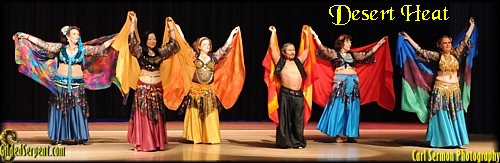
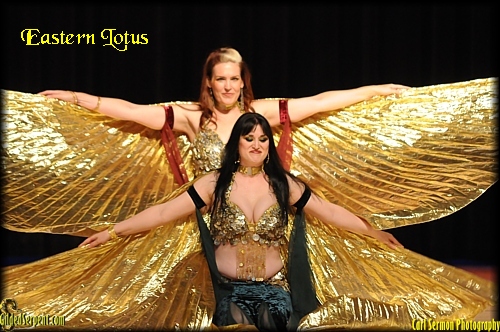
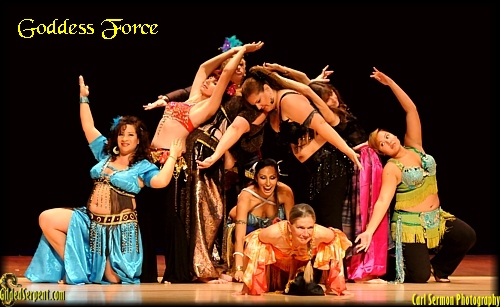
The Carnival of Stars Festival is produced by Pepper Alexandria and Latifa at the Richmond Auditorium each year at the beginning of August. The stage at this facility is hard to beat. The wonderful lighting and the large stage make every dancer feel like a diva! Once again, Carl has done an amazing job catching the character of each dancer. This is page TWO of another lovely group of his photos. Check back for more soon! This year’s festival is just around the corner- August 6 & 7, 2011. Gilded Serpent will be there to witness and document this friendly event. See you there!
See Page 1 here

Dawn Devine


Dance Pharoahs


Desert Heat


Desert Oasis Dancers


Dhyanis Dance Company


Dilek


DUmascus


Eastern Lotus


Egyptsies


Ena Cassia


Esperanza Zaza


Evangaline


Evil Eye Dance Company


Fayruz


Gamila Awi Awi


Goddess Force


Guest Dancer


Hala Dance


Hannah


Heather


Helwa


use the comment box

Have a comment? Use or comment section at the bottom of this page or Send us a letter!
Check the "Letters to the Editor" for other possible viewpoints!

Ready for more?


Gilded Serpent presents...

Dance Festival Warms Oslo Winter

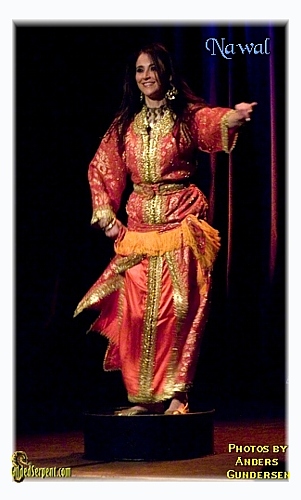
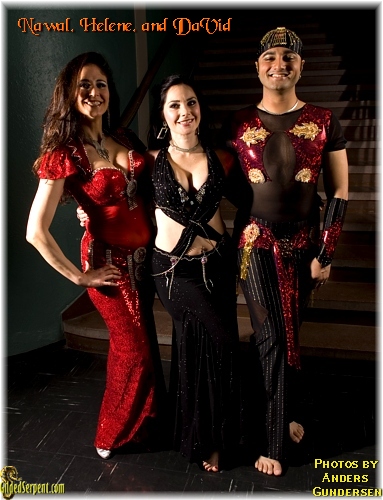
Nawal

Nawal Benabdallah
This attractive and classy woman is a well-spring of knowledge. Moroccan, but based in Paris, France…

Oslo Oriental Dance Festival 2011

by DaVid of Scandinavia
by Anders Gundersen
posted July 25, 2011

The Oslo Oriental Dance Festival 2011 took place February 11 through 13, 2011, at Studio Orient, Belleville, and Cosmopolite, in Oslo, Norway with the backdrop of idyllic snow clad streets, briskly cool air and fuzzy winter jackets. HeleneThe festival was started by performer, instructor and Studio Orient owner, Helene Skaugen, and continues to be hosted by Helene and the Studio Orient crew, bringing together dancers, instructors and performers from all over Europe for a weekend of dance immersion. It was a never-to-be-forgotten chance for dancers from near and far to catch up with each other.

The festival is structured with:

  • An Oriental Dance competition for the title of “Dancer of the Year”,
  • 2 gala shows with guest dancers from France, Norway, Denmark, and the USA, and
  • 9 workshops with 7 different instructors

The Oslo Oriental Dance Festival has hosted Middle Eastern dance dignitaries such as Raqia Hassan, Randa Kamel, Mona El Said, Hamada Hossam El Din, Momo Kadous, Samassem, Nesma and Ranya Renee. This year’s main instructors were to have been the founder of the Reda Troupe, Mahmoud Reda, and the Paris based Moroccan dancer, Nawal Benabdallah. However, due to the unforeseen unrest in Egypt, Mahmoud Reda was unable to come.

Nawal Benabdallah taught Moroccan Chaabi and an Orientale choreography in her workshops, and additionally also taught a special class on Balady geared for professional/advanced dancers. This year’s guest instructors were Helene Skaugen, Majken Wærdahl, Siri Ydstie, Mari Sletten, Shirin and myself (DaVid). Festival participants experienced the enjoyable range of workshop subjects from Introduction to Bellydance, Drumsolos, Step Combinations to Shaabi Music, as well as Entertaining Skills and Shimmies from which they could choose.

The workshop program kicked off Friday afternoon and continued with the Orientale Dance competition for the title of “Dancer of the Year” with judges Nawal Benabdallah, Helene Skaugen, Hilde Lund and myself.

This competition is not open to professional dancers, and judges are required to give constructive feedback to encourage growth.

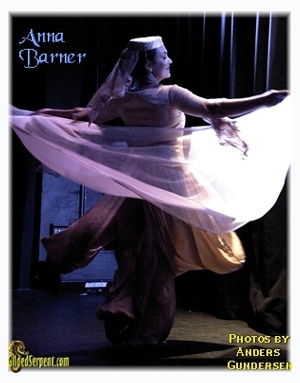
Anna Barner

Anna Barner

Eight brave dancers presented their Orientale pieces before the judges, and subsequently, Ingrid Kvam was crowned the winner, winning a costume by Istanbul Dreams, the title of “Dancer of the Year”, and hopefully, fame and glory. Rønnaug Stokke took 1st runner up, winning a DVD collection sponsored by Studio Orient and a year-long subscription to the Norwegian Middle Eastern dance magazine, “Al Raqassa!” and Anita Kjeverud took 2nd place runner up, winning a one year membership to the national Norwegian Orientale Dance Association,“Al Farah Orientalske Danseforening”.

The competition was followed by the Friday evening gala show at Belleville, featuring:

  1. Lizzie Hagen in a strong Orientale and
  2. Vigdis Bjørnøy in a mind-blowingly fun Moroccan Chaabi.
  3. Shireen presented a theatrical Jazz Fusion piece.
  4. Mari Sletten danced a sassy Burlesque Shaabi.
  5. Anna Barner, from Denmark, performed an elegant Mwashshahat.
  6. Christina Stjernsholm appeared in a sweet Orientale, and
  7. myself (DaVid) in an strong and upbeat Shaabi and an expressive Tarab piece.

The energy in the theater was enthusiastic, and we dancers peaked supportively at each others’ performances from backstage.

Saturday featured a day of workshops, shopping and cake-eating followed by the Saturday evening gala show at Cosmopolite featuring:

Nawal Benabdallah in an energetic Moroccan Chaabi and an ethereal Orientale,
Divas of Bellydance in a thrilling drum solo,
Helene Skaugen in a powerful Shaabi and a sweet drumsolo,
Majken Wærdahl in a flowing Orientale and a sultry Saiidi,
Hilde Lund in a playful Shaabi and an emotionally loaded Oum Kalthoum,
Michelle Galdo with a sassy Shaabi and a sultry Balady,
Siri Ydstie in a flowing Orientale, playful Shaabi with drumsolo, and
Madam Qadam in an athletic and smooth Orientale. Competition Winner Ingrid
Ingrid Kvam, “Dancer of the Year”, was invited to dance in Saturday’s gala (as per festival tradition) and delighted the audience with her winning performance. The theater was packed and the audience enjoyed the show throughout the evening.

HildeSunday was the last day of workshops, and the studios was, yet again, full of enthusiastic, motivated, and giddy dancers. I taught my shimmy technique and combination workshop on Sunday, and I had a hard working group of dancers of all levels in my class. They eagerly worked through the movements (even though, at times, challenged). It was an envigorating class!

However, let us talk about Nawal Benabdallah! This attractive and classy woman is a well-spring of knowledge. Moroccan, but based in Paris, France, she manages a dance company, tours the world, teaches at the Nile Group festivals in Cairo, produces dance works for Moroccan TV, produces a dance festival in Morocco, creates new dance works and assists Mahmoud Reda in his workshops from time to time, along with working to promote knowledge and skills in Moroccan folk dances and culture.

Nawal’s investment and engagement in dance is just intoxicating! Her workshops were packed with information on culture, dance mechanics, expressive quality and music. In her Chaabi workshop she ensured rhythmic knowledge and also set aside time for a group “dance-off”, with the class divided into two groups that would call and respond with dance movements, capturing the energy, playfulness and sentiment of Chaabi. Everyone enjoyed Nawal’s insights and thoughts on timing, expression and essence in the Balady class for professionals. Nawal’s Orientale class provided Reda-inspired foot work enmeshed with Nawal’s own flavor as a performer, choreographer, and dancer. Both of her performances in the Saturday night evening gala were graceful and enjoyable.  The audience received her Moroccan Chaabi, including rhythmic foot work on the Ka’ada (steel drum) with overwhelming enthusiasm.

The Oslo Oriental Dance Festival always takes place in February. If you have an opportunity to attend, I recommend that you do for an opportunity to experience the Norwegian capital along with many of the well-known Middle Eastern dancers of Norway.

Links:
Festival: www.orientaldancefestival.no
Studio Orient: www.studioorient.no


Nawal Helene & DaVid


use the comment box

Have a comment? Use or comment section at the bottom of this page or Send us a letter!
Check the "Letters to the Editor" for other possible viewpoints!

Ready for more?

  • 1001 Nights Oslo Belly Dance Festival, The Show May 2 – 4, 2003
    The festival began with a show at Oslo Concert Hall, and this year’s guest star was Lulu Sabongi from Brazil, who opened this year’s show.
  • Training Aids or Trainer’s Ads? 3 Books Reviewed
    The E.D.A. Handbook for Middle Eastern Dance by David of Scandinavia, Tribal Vision by Paulette Rees-Denis, Belly Dance for the Versatile Dancer V. 1: Foundations by Zanbaka
  • Belly Dancer of the Year 2005 Page 1 Duos, Trios & Troupes
    May 28, 2005, San Ramon, California.

  • We were delighted when Colleena Shakti invited us to teach classes concerning Musicality for Dancers at the Colleena Shakti School of Dance in Pushkar, Rajastan. Last January, we made the trek over water and mountains to reach this fascinating land. Pushkar holds the only temple dedicated to Brahma, the creator, as well as many other temples.
  • Carnival of Stars, Page 1: A-C Photos
    The Carnival of Stars Festival is produced by Pepper Alexandria and Latifa at the Richmond Auditorium each year at the beginning of August. The stage at this facility is hard to beat. The wonderful lighting and the large stage make every dancer feel like a diva! Once again, Carl has done an amazing job catching the character of each dancer.

  • I think it was around this time when I had gotten to know my co-workers and escorts well enough to allow them to try explaining their way of life and thinking processes to me, that I realized I was in a “no win” situation.
  • Ask Yasmina #16, New Baby Dance, Taqsim Shimmies, and Cane Music
    However, there are many who had to resort to Cesarean after a long and arduous labor as well. It might be negligent to throw around such claims.
  • Egyptian Percussion Instruments by Dr George Dimitri Sawa
    From the medieval era to our own time, Arabic music has been predominantly rhythmic. For this reason, much effort has been spent to write a theory of Arabic rhythms.
  • Permits, IDs, Licensing, Foreign Dancers in Cairo,
    It dawned on me that some dodgy nightclub manager, whom I didn’t know personally, had complete control over my passport and my freedom to leave! So, I had no alternative other than to end my contract in order to get my passport back which also meant halting the lengthy paper process.
  • Dancing with Tigers, In China with Fleurs d’Egypte
    We had no idea what to expect of the actual location. However, with ticket and costumes in hand, we rode the wave. Arriving late at night, we were ushered to our rooms and straight to bed to sleep off our jet lag. We had no concept of the overwhelming size of the park and over-the-top eye-candy awaiting us the next morning!
 

Gilded Serpent presents...

Belly Dance ‘n All that Jazz

Jazz Tribal Fusion Gig

Trends in Tribal Fusion

by Jasmine June and Kimberly Mackoy
posted July 24, 2011

In the past few years, dancing to Jazz music has become a trend in the Tribal Fusion Belly dance community. There are a number of reasons why Jazz influence is particularly en vogue recently. Everything old is new again. Prohibition-era fashion is sparkling onstage, speakeasies are once again in high style, and the flapper mentality is spreading like wildfire in the Tribal Belly dance community. In the midst of this, it would be very surprising if Jazz and Belly dance did not co-mingle. Jazz music is a decisively American genre, while the Arabic music (to which Belly dancers traditionally perform) is obviously from Middle Eastern roots. Yet, Belly dancing and Jazz go together in such a way that performances are seamless in combining a Middle Eastern dance form with an American musical genre.

This is a welcome place to explore, because it’s very much in line with the aims of Tribal Fusion—new sounds appeal to the eclecticism of fusion in the dance, and this new combination is both American and global, allowing it to be adopted in a similar spirit of rebellion that spurred Tribal Belly dancing as a movement in the first place.

While it’s fair to say that not all Jazz lends itself to the movement vocabulary or intentions of every Belly dancer, the range of Jazz musical experimentation is wide, and Jazz has historically crossed paths of many cultures and continents. As a result, there are a lot of interpretations that work, and the moods, tempos and approaches can vary a lot. At this year’sTribal Fest, for example, Charleston footwork traipsed across the stage at intervals, as did more sultry numbers that evoked images of smoky cabarets. Rachel Brice’s sinuous Jazz age choreography  solo (which she taught in her workshop) wound through horns that were themselves imagining a casbah-like setting. In contrast, Mardi Love’s choreography centered on an Indigo number forLe Serpent Rougethat had more sass and bounced gently through its fancy footsteps.

The reality of Jazz music and its roots clearly show why Belly dancing to Jazz works so well. The Jazz form may have originated in the United States, but the music carries West African and Arabic influences. The similarities between Jazz and traditional Arab music include:

  1. unequal temperament in tone pitches,
  2. an exaggerated use of vibrato,
  3. spontaneous improvisation, and
  4. the syncopation of rhythm (among other common traits).

The tradition of soloist improvisation within a song is an especially important similarity. A Belly dancer can relate to soloist improvisation in Jazz music the same way she can relate to a drum solo or Taqsim (usually solo instrumental improvisations) in Arabic music.

Another dance genre that is popular among Tribal Fusion dancers is Balkan music. This genre, too, is similar to Jazz in several regards. The use of brass instruments, such as tubas and trombones, are found in both genres, making it an easy cross over from Balkan to Jazz. There are bands, such as the Bay Area band “Zoyres”, that exist as a combination of both Jazz and Balkan music. Balkan and Jazz bands both have that big-band feeling. It’s easy to understand how a Tribal Fusion dancer who is used to dancing to Balkan music could make the transition to Jazz. All that brass, improvisation, and melodic rhythm is enough to make a Belly dancer swoon!

The Balkan trend, which provided a logical segue into the big band sensibilities of New Orleans Jazz and other permutations, has always had a strong Gypsy-Jazz element at play. The big skirts and brash confidence have given a little way toward the sleek and cool, opening up a space for improvising, alongside Louis Armstrong in addition to Taraf de Haidouks. Tribal Fusion pulls a lot from Gypsy culture, too. For example, dance artists such as Jill Parker have included Turkish Rom dance technique in their choreography. It is no stretch, then, to understand the transition to performing to Gypsy Jazz. One troupe inparticular, “Les Trois Petits Oiseaux”, popularises Belly dancing with Gyspy Jazz. The troupe teams up with the band “Avatar Ensemble” for performances that include a call and response feature between the dancers and the musicians that are similar to the relationship between Belly dancers and their Arab musicians. As in traditional live Arab music, Gyspy Jazz and other styles of Jazz provide a fluid “conversation” between the dancers and the musicians, rather than the dancers simply mimicking the music.

Aside from music, there is also a cultural component to Jazz that makes it appealing to Tribal Fusion dancers. Obviously, Tribal Fusion is not a traditional Middle Eastern Belly dance form; yet performing to Jazz music is attractive to Tribal Fusion dancers because it comes from the same country as Tribal Fusion itself–America.

For some dancers, it can be easier to relate to music from one’s own culture than it is to music from halfway around the world.

However, this is not to say that Tribal Fusion Belly dance and Jazz music can’t fit into the Belly dance world. Quite the contrary, both genres evolve from Middle Eastern origins. If mimicry really is the highest form of flattery, then Middle Eastern Belly dancers and musicians ought to feel flattered rather than put off.

Since Tribal Fusion is more subjective than some other Belly dance forms, the freedom to perform to Jazz music (as well as music of other genres) is encouraged.

This freedom also translates into costuming choices. Tribal Fusion dancers who perform to Jazz can often be seen in flapper-style costumes or in costumes with vintage accents such as lace, velvet, and pearls.

In this way, too, performing to Jazz allows a Tribal Fusion dancer to embrace the fashion traditions of her own culture. For example, the Blue Note Rendezvous event in San Francisco has a 1920s cabaret feeling, except that its performers are Belly dancers, rather than traditional Cabaret artists.

Like Belly dancing, Jazz is a genre that unites people. The music comes from a multi-hued society and has spread all over the world. Belly dance, too, has become a world-wide art form. Both Tribal Fusion and Jazz music are unique because they combine elements from two diversely different cultures. The real up-side in performing Belly dance with Jazz music is that it brings the art of Belly dance to a whole new audience! People interested in Jazz music who would not normally venture out to a Belly dance show get an added bonus when they see Belly dancers performing in a Jazz club. The ability of Belly dance to assimilate (almost effortlessly) into multiple cultures guarantees that it will be a genre that will continue to thrive–just like Jazz.

To catch a jazz inspired belly dance performance see authors’ bio pagesKim & Jasmina June

Dancing to Jazz


use the comment box

Have a comment? Use or comment section at the bottom of this page or Send us a letter!
Check the "Letters to the Editor" for other possible viewpoints!

Ready for more?

  • Empowering Women in India through Belly Dance
    The company works with less fortunate and troubled families and women, and pays the women a decent sum for their crafts as a way of helping them out.
  • 2-26-11 Not So Steam punk Belly Dance by Jasmine June
    Since Tribal Fusion is also easily accessible, there have been dancers who begin performing and calling themselves professional when really they are just hobbyists. A professional belly dancer would never label her dance genre based on an aesthetic.
  • 12-14-10 Tribal Fusion: An Evolving Dance Form by Jasmine June
    The biggest contrast between ATS and Tribal Fusion was that improvisation was the basis for ATS while Tribal Fusion, at least in its earliest phase, had a strong emphasis in choreography. This allowed Jill Parker to play around with musicality and to explore musical genres that were appealing to her.
  • 11-3-10 An Intro to Tribal Fusion by Jasmine June
    Since Tribal Fusion Belly Dance is a relatively new dance form, it is especially important to treat the genre with a level of professionalism, or else one runs the risk of discrediting the work of dancers who have dedicated their lives to creating and elevating Tribal Fusion Belly Dance.
  • 9-16-10 To Berlin and Back, Bridging Cultures Through Belly Dance by Jasmine June
    In this way, he demonstrated that belly dance isn’t something that is defined by culture. Rather, it is an art form that can be perfected by anyone who puts their mind to it, and it’s an art form that can be used to bridge cultures rather than divide them.
  • Antique Textiles Part 3: Creating Your Unique Statemen
    It is possible that you may never have performed professionally while wearing a lampshade on your head… but I have!
  • Part Two of Antique Textiles: Costuming Before the Reign of Egyptian Costumers by Najia Marlyz
    I view today’s dance values as interlopers—meant to mitigate Belly dance’s checkered past by exchanging its innate free emotional expression for speed and difficulty of execution and an over-the-top outpouring of energy that is neither sensual or exotic.
  • Antique Textiles: Renewed Life for Dance
    In fact, we often danced for many little luncheon gigs in offices and other places as a surprise birthday gift—to the music of our own solo sagat. Now, that is a skill that I have never seen anyone repeat since the early seventies!
  • Lace and My Muses: In Search of A Personal Style Part Three
    I suggest that “elevating Belly dance” to the standards of western dance would be counter-productive in the long-term rather than a valid goal for us to desire.
  • Turkish “Roman Gypsy Dans”, Melting Any Heart!
    This dance of the Gypsies is about becoming a life-like character. It contains a wide range of moods and feelings for the dancer to express: The gray quality of everyday tasks turns into colorful dance that does not distinguish between the relative value of one color over another.

  • The dates were nearly sold out already; the dangers had been grossly exaggerated.

  • We were delighted when Colleena Shakti invited us to teach classes concerning Musicality for Dancers at the Colleena Shakti School of Dance in Pushkar, Rajastan. Last January, we made the trek over water and mountains to reach this fascinating land. Pushkar holds the only temple dedicated to Brahma, the creator, as well as many other temples.
  • Carnival of Stars, Page 1: A-C Photos
    The Carnival of Stars Festival is produced by Pepper Alexandria and Latifa at the Richmond Auditorium each year at the beginning of August. The stage at this facility is hard to beat. The wonderful lighting and the large stage make every dancer feel like a diva! Once again, Carl has done an amazing job catching the character of each dancer.

  • I think it was around this time when I had gotten to know my co-workers and escorts well enough to allow them to try explaining their way of life and thinking processes to me, that I realized I was in a “no win” situation.
  • Ask Yasmina #16, New Baby Dance, Taqsim Shimmies, and Cane Music
    However, there are many who had to resort to Cesarean after a long and arduous labor as well. It might be negligent to throw around such claims.
 

Gilded Serpent presents...

Turkish “Roman Gypsy Dans”

Author Gul in performance

Melting Any Heart!

by Gul 

The 9/8 rhythm of the Turkish Rom music is considered to be unusual and unique. Those who dance it are proud of the way they can move their body and translate their steps and movements to the complex rhythm, even in the countries where this dance is almost routine.  In order to "catch" the music and its nuances, you either have to wait or speed up your steps. Once you cross that hurdle, the dance becomes very simple: the style of the hand is free, and you can combine your own movement ideas–just as all Gypsy dancers do–as long as you match the tempo!

This dance of the Gypsies is about becoming a life-like character. It contains a wide range of moods and feelings for the dancer to express: The gray quality of everyday tasks turns into colorful dance that does not distinguish between the relative value of one color over another.

This form of dance speaks to one on the level of the heart, and that ‘s why so many love to dance it, even if they are not from the Rom culture. One does not have to be beautiful to dance it either, nor does it require one to be ultra feminine. Instead, it requires other capabilities, such as being true to the way you are in life and expressing that quality within the dance.

Here are some ways one might count the rhythm:

  1. 1- 2, 1- 2, 1- 2, 1-2-3 (the hard way) or
  2.  1-2-3, 4  5 (the easy way)

The Gypsy dance serves as a messenger of the Rom people for others to view their living conditions through the dance: their beliefs, work, or their personal characters, and all of these things add up to power within the dance. For the Gypsy people, the dance also compensates for the difficult lifestyle they must live. The colorful costumes of the dancers divert one’s attention away from the poverty they often endure. Women decorate their hair or scatter it over their shoulders. They dance in dresses and full skirts, and sometimes, even more than one skirt!

Brightly colored scarves and shawls, some enhanced with golden threads, all help these dancers and viewers to forget about their difficult daily lifestyle.

One can easily distinguish between the particular people who are dancing by observing each movement, gesture, and rhythm inherent in it. The dancers almost “speak” through their moves; they live it without imitation or simulation because it’s in their nature.

Rom dance

The Gestures

Gestures that dancers typically use are from the daily life of the Rom: washing laundry, wiping sweat, anticipation ("Who is coming?"), admiring the jewelry that adorns the hand, playing the violin, or inflating the wheels of a bicycle. A lot of movements are done with fingers clenched as if they were punching the air. In many cases the dancers’ faces express power, daring, and arrogance.

For some movements, the hands take a rhythmical part, making a snapping sound which accomplished by friction and power of the dancers’ fingers.

Dance Movements

As in other folkloric dance forms, the steps comprise the major part of the dance, including tapping, stamping, twisting, or using chasing steps, sometimes rising up on the toes–usually  during the third part of the rhythmic phrase.

Generally, abdominal and hip movements are done as follows:
The stomach area moves in and out, usually repeating 5 times along with the musical indications, and so are twists and hip circles. Shimming the shoulders is used also–from time to time. However, there is no isolation between the torso and the dancers hands as there is in Oriental dance.

Clothing

The original Gypsy people dressed simply. For folk-dance, the woman has a flower-print skirt, but for the stage show we dancers often use a full, wide skirt with yards (meters) of fabric.  The Gypsy, of course, can’t afford such clothing.  A piece of fabric is tied around the hips, but the knot is in the front near the abdomen to emphasize the undulations of the belly (belly moving in and out).

History and  Background


The Gypsy tribe from Northern India was called "Rom" (which means human being). The Rom people are opposed to the name “Gypsy” and, more than that, they consider it a derogatory and offensive term.

In ancient times, almost 1000 years ago, the Rom people immigrated from India to Persia. Between the thirteenth and fifteenth centuries, they arrived and stayed in Europe.  Called “travelers” in Europe, their occupations are usually trades that give them freedom of movement, such as traveling show performer, blacksmith, tinsmith, fortune teller, or trader.

As a result of their temporary lifestyle, the Rom tended to collect dance movements from the various places through which they had passed. Inevitably, they added their own dance movements, such as sliding the head from side to side in isolation as it is done in Indian dance.

Today, there is a large community of Gypsy people living in Turkey. Their dance has become one of the national dances of Turkey, and the Turkish people refer to it as "Roman Dans"

Gul teaching the Turkish style “Roman Gypsy” dance

A choreographed Rom Gypsy dance by Gul

Gul Dancing with spoons

use the comment box

Have a comment? Use or comment section at the bottom of this page or Send us a letter!
Check the "Letters to the Editor" for other possible viewpoints!

Ready for more?

  • Little Istanbul in Japan
    For several years, belly dance has been rated as one of the top three favorite hobbies for women who are in their 20s and 30s in Tokyo.
  • What is Gypsy Bellydance?
    …it is a sore point for representatives of the Roma community whose advocacy groups are very clear on their preference for the term Roma or Romani and consider the term "Gypsy" to be suspect when used outside their own community.
  • 6-29-06 “Gypsy” Dance in America, by Caitlyn, photos of author by Rachel Ong
    Roma dance usually brings to mind tambourines and skirt-swirling, but these images are mainly a fantasy.
  • 11-29-01 Nomads of the Spirit by Sierra Suraci
    Know what are you contributing – either to their dilution as a people or the strengthening of their true image.
  • 3-28-08 Gypsy…Un, Deux, Trois, A Review on the “Journey Along The Gypsy Trail” Workshop by Denise
    with Hadia, Jalilah Zamora, and Amrita Choudhury, Photos by Denise and Tracey Vilbert, Event held on January 5, 6, 2008, in Montreal, Canada
  • Tania
    Luiz A Romany Fusion Artist in Osaka

    At this time I think I was longing for a well-documented dance, old and structured. I was a little sad because I saw how people who were not properly trained but who just had a costume would teach Oriental dance. Plus the deep connections of Indian dance to the Divine were very interesting to me. At the end of it all, I realized that my body, my soul and my blood are meant to do Oriental.
  • Two For One, Two very different DVDs on Turkish Dance reviewed
    I Love Turkish Dance by Sarah Skinner & Turkish Style Belly Dance by Elizabeth Artemis Mourat
  • Ozgen in LA, Turkish Dance Star in Los Angeles
    He charmed everybody with his cute non-traditional names for intricate footwork patterns as well as his verbal expressions – at one point he referred to the flirtatious shoulder movements of Turkish Oryantal as “cuddly”!
  • "Just feel the music when you’re on stage!” Interview with Ozgen, Male Turkish Belly Dancer,
    Well, I think my heart still beats for big shows and productions, as much as I know how stressful and difficult that show-life can be. I seem to not be able to live without it.
  • Adventures in Turkey 2006
    I am not exaggerating when I say that Sandra actually threw herself into Bella’s arms and wept when she first laid eyes on her.
  • Bargaining for Injeers
    Bargaining is not just about the money, although that is a qualifier. Bargaining is a medium in which two strangers can have a conversation. Turks love to bargain, and it may be how they get to know you…
  • We Shop, We Bathe, And We Eat! Justine’s Culinary Adventures in Turkey,
    The Egyptian spice market in Istanbul is a wonderful place to be a new chef, not only does it hold a treasure chest in spices, it has the most charming men, who know how to cook.
  • Turkish Shop ’til you Drop
    The Grand Bazaar in Istanbul is the Mother of all shopping malls and covers over fifteen acres.
  • Orient House Istanbul
    Despite fears about our security from friends, everywhere we went in Turkey, we met with nothing but perfect friendliness and assistance.
  • Kayla in Turkey, (A Daily Journal) Turkish Bath House (Hamam 1) April 22, 2002
    All my Turkish girl friends, had of course been to Hamams, but only in their youth,
  • Kayla;s Travel Journal- Turkish Bath/Hamam 2
    Some of the men joked: …if I really wanted to… but I opted out.
  • Unveiled Musical Gems, 3 CD Reviews
    Raqs El Qamar by Chris Marashlian, Rhythms of Turkey by Tayyar Akdeniz, Angelika Unveiled, by Angelika Nemeth and Raul Ferrando
  • Turbo Tabla Arabic music re-imagined Review
    Traditional Arabic and Turkish with House, Hip Hop and Techno. "Mostly, the Techno style appeared in the tabla solos. I loved this CD because it has a mix of songs that are traditional, old Arabic, and Turkish."
  • Turkish Bellydance:
    What an absolutely delightful surprise it was…
 

Gilded Serpent presents...

Japan

Castle

Post-Tsunami BDSS Tour

by Miles Copeland
posted July 21, 2011

In early April, it looked like our Bellydance Superstars’ second Japanese Tour that had been set for May 18 -25 was in serious jeopardy.  The venue booked in Tokyo was damaged and closed for repairs ’til I don’t know when and our dancers were hearing all sorts of stories that scared them to the point of thinking we were crazy to go until next year.  I was fully expecting the promoters to cancel. Because of that, we thought they might want to cancel the US West Coast dates we had organized in conjunction with the Japanese tour (as they would not be affordable without the Japan tour combination).  The situation worsened when several of our dancers made it clear that because of what they had heard, they definitely could not go at this time. 

After many e-mails and phone conversations trying to get the promoters to move the dates, along with a great deal of study of the actual situation in Japan, we were faced with the facts that our promoters did not want to cancel after all since they had found a replacement venue in Tokyo.

The dates were nearly sold out already; the dangers had been grossly exaggerated. 

Our reputation in Japan would be damaged should we not go and, of course, the promoters would loose a lot of money for what appeared a dubious reason: great exaggeration by the Western press.  Meanwhile, I had half of the troupe stressing about going; they were so stressed it became doubtful that we could actually present a show anything like what had been advertised in Japan.  It was a unique predicament and put a real strain on the "show must go on" tradition of the entertainment business!

Once my staff and I had fully ascertained that the dangers were so minimal that we could not in good conscience let our promoters nor our Japanese fans down at a tough time for them, we decided (as a company) to go–no matter how many dancers dropped out and we would  pull it off somehow.  In the end, we lost four of our dancers plus Kami (who now had a conflict as the tour was extended into other bookings to which she had committed, making 5 out of the 14 member show).  We were lucky to find a great Indian dancer in Canada, Shivani, to take Meera‘s place and enable us to pull off the Indian elements of the show with little change. Another lucky break came from our auditions at Raqs LA this past April where we found three great dancers who we already were hoping could join the troupe at some point.  Well, that point came quicker than anyone thought; Inka, Victoria and Edenia turned to be every bit as good as we had hoped!

As we had anticipated, we found no problems in Japan, and it was not long before everyone was feeling glad that we had gone.  We stayed in 5 star hotels, danced in nice venues, with sold out shows. We took two days off to go site seeing and shopping in the Harajuku hip fashion district made for a highly successful tour. 

To top it off, the major national TV station of Japan, NHK, filmed the final two shows in Tokyo for national broadcast in January.  That will be the first Belly dance show be broadcast nationally in Japan on a major network–meaning we have a potential audience of 190 million!

So at the end of the day, the ladies of the BDSS (and our new members) rose to the occasion with great aplomb; none of them is glowing in the dark and the show did go on!  We look forward to returning to Japan next year.

Crepes by April Rose

Masks on whiile at the train station in Japan

Cast on stage for final bow in Japan

Cast with Locals small, click for enlargement

Click for enlargement. Names would be nice to add here!


use the comment box

Have a comment? Use or comment section at the bottom of this page or Send us a letter!
Check the "Letters to the Editor" for other possible viewpoints!

Ready for more?

  • Are You Breaking the Law? Dance Workshops with Foreign Nationals
    It is the sponsor’s obligation to deduct this; if it is not deducted and the full fee paid to the foreign teacher and discovered several years later in an audit or investigation, the sponsor will be forced to pay the taxes then and may even be fined.
  • Certifications & Contests: Are They Meaningful?
    Its as if the contest win were a diploma, her ticket to teach! 
  • BDSS Update: New Choreographers contribute to 2009 Show
    I will admit that I have never been a big fan of the more ‘folkloric’ approach to Bellydance, but then again I have to be open to try something new with each show.
  • Divorcing Belly Dance From Burlesque
    As it is traditionally understood, I do not find Burlesque, (meaning nudity-no matter how hard one pretends it does not) amusing or creative in the slightest when it comes to including Belly dance, an art that has suffered too long with such unfortunate associations. I find it completely irresponsible and detrimental.
  • Western Dancer’s Guilt, a Response to Naajidah
    People have occasionally suggested Arabs would be “horrified” by the inclusion of the Tribal style in our show but I can tell you that this style is extremely popular with Middle Easterners who come to our show.
  • Shaking Up Shibuya" The Belly Dance Scene in Japan
    While belly dance in Japan originally came from American roots, it quickly grew to include Egyptian, Turkish Oriental, Turkish Roma, and various Tribal styles.
  • Belly Dance in Japan Reaches New Heights of Popularity
    Japanese audiences are extremely receptive, supportive and interested in this form of entertainment.” Conservative
    elder Japanese may still disapprove of the sensual aspect of belly dance, but among the younger generation it is seen as cool and trendy.
  • Little Istanbul in Japan
    For several years, belly dance has been rated as one of the top three favorite hobbies for women who are in their 20s and 30s in Tokyo.

  • We were delighted when Colleena Shakti invited us to teach classes concerning Musicality for Dancers at the Colleena Shakti School of Dance in Pushkar, Rajastan. Last January, we made the trek over water and mountains to reach this fascinating land. Pushkar holds the only temple dedicated to Brahma, the creator, as well as many other temples.
  • Carnival of Stars, Page 1: A-C Photos
    The Carnival of Stars Festival is produced by Pepper Alexandria and Latifa at the Richmond Auditorium each year at the beginning of August. The stage at this facility is hard to beat. The wonderful lighting and the large stage make every dancer feel like a diva! Once again, Carl has done an amazing job catching the character of each dancer.

  • I think it was around this time when I had gotten to know my co-workers and escorts well enough to allow them to try explaining their way of life and thinking processes to me, that I realized I was in a “no win” situation.
  • Ask Yasmina #16, New Baby Dance, Taqsim Shimmies, and Cane Music
    However, there are many who had to resort to Cesarean after a long and arduous labor as well. It might be negligent to throw around such claims.
  • Egyptian Percussion Instruments by Dr George Dimitri Sawa
    From the medieval era to our own time, Arabic music has been predominantly rhythmic. For this reason, much effort has been spent to write a theory of Arabic rhythms.
  • Permits, IDs, Licensing, Foreign Dancers in Cairo,
    It dawned on me that some dodgy nightclub manager, whom I didn’t know personally, had complete control over my passport and my freedom to leave! So, I had no alternative other than to end my contract in order to get my passport back which also meant halting the lengthy paper process.
  • Dancing with Tigers, In China with Fleurs d’Egypte
    We had no idea what to expect of the actual location. However, with ticket and costumes in hand, we rode the wave. Arriving late at night, we were ushered to our rooms and straight to bed to sleep off our jet lag. We had no concept of the overwhelming size of the park and over-the-top eye-candy awaiting us the next morning!
 

Gilded Serpent presents...

India

Ling and Mark fly to India!

Helm’s Musical Adventure

by Ling Shien Bell
posted July 17, 2011

Mark Bell and I, as the music group “Helm”, have been performing traditional music for tribal style dancers for decades, and we spend a lot of our time researching the music and dance styles of various ethnic groups. Therefore, we were delighted when Colleena Shakti invited us to teach classes concerning Musicality for Dancers at the Colleena Shakti School of Dance in Pushkar, Rajastan. Last January, we made the trek over water and mountains to reach this fascinating land. Pushkar holds the only temple dedicated to Brahma, the creator, as well as many other temples.


Brahma’s first wife, Gaïtri, dwells on the mountain at the opposite side of the lake. While his second wife, Savatri dwells on this side.

Located in the Old Rangi Temple, Colleena’s school offers a well structured training in classical Odissi dance, starting with a strenuous 2-hour warm-up class in the morning, accompanied with the live sound of the Pakawach drum, and ending with a theory class on the roof top, with the monkeys watching.

Old Rangi Temple to Lord Krishna

In the afternoon, I taught rhythm theory and how to apply it, playing finger cymbals, singing, and dancing. The students came from India, South America, and Europe, and they each had a strong Belly Dance background, but not much experience with finger cymbals.

Class

Putting it into action

Next, Mark came to play darbukka as we all played along.

Meher teaching

Meher Malik and Banjara Dance Troupe came from Dehli with a group of students, all very diligent and fast learners. They also took Megha Gavin’s class the following week along with fellow Devyani member DeAnna Padron Freeman. It was titled “ATS from A to Z”. I joined Megha’s class as well and learned a lot! Mark and I played live music at the end of each of her classes, and it was very helpful for me to connect ATS (Amercian Tribal Style Belly Dance) to the music in that way.

Every Saturday night, we shared the stage at the Saï Baba Haveli with the Khalbelia Gypsies of the nearby village. They performed their traditional music and dance, while we presented some of what we learned at the school that week (songs and dance with cymbals, ATS , Khalbelia dance with our instructor Raki.

Raki in her village

An experience I’ll never forget happened when the Been player started the snake song and Meher did the most amazing personification of a snake by the fire pit; it went on and on… Then, there was the time when our local “enlightened” Sadu Baba got carried away during our performance with Megha and DeAnna jumped in the fire and scattered burning embers all over us! (I was so glad my flute case was closed, and only got a scar) but we finished the song anyway… The show must go on!

Khalbelia dancer at the Saï Baba Haveli

The Khalbelia Gypsies invited us to their village, and they put on a little show; it was very moving. They are Colleena’s second family! The Khalbelia cast specialized in catching snakes with the haunting sound of the Been, a single reed instrument, and the snake venom was sold for medicinal purposes. Now they are entertainers with music and dance.

The rupee trick is learned at an early age.

a duet of very young dancers

Dancer

Colleena and her extended family

Been player and percussionists at the village

At the end of our stay, Colleena arranged for Murat Khan Langa and his family of musicians to come and give an intimate concert in the temple, and to record with us the following day.

Nizam

Nizam (on dholak)and Idu Khan Langa on algoza (flute like instrument),
Ling Shien at the session in the hotel room

After spending the afternoon all packed together in their hotel room, we made enough of a connection and common ground to be able to do a recording session, thanks to the help of our translator, Megha’s husband Vikas.

Vikas at the village

Recently, we have released our latest CD, “Tribal Spirit” produced by Carolena Nericcio, which includes some of the intimate concert as well as percussion tracks with Nizam Langa, the Dholak player, and Mark.

We spent our last day in Dehli, where Meher and some of her students showed us around.

Meher's students

The Red Taj

Humayun’s tomb

The Red Taj


One more shot—On our way on a camel cart to the Khalbelia village. Mark, Megha and DeAnna.


use the comment box

Have a comment? Use or comment section at the bottom of this page or Send us a letter!
Check the "Letters to the Editor" for other possible viewpoints!

Ready for more?

  • Ling Shien demonstrates the Accordion
    She came to the Gilded Serpent studio to tell us how she has modified a standard western made accordion to be able to play the quarter tones required in many of the Arabic modes.
  • Solstice Festival in Catalunia, Spain
    For the third year in a row, Maria Cresswell produced a dance and music festival honoring the Summer Soltice. This year’s three day event took place high up in the Catalunian Pyrenees, in a rustic hostel fed by fresh springs and bordered by a rushing river.
  • Making New Musical Inroads in Luxembourg 2005
    Helm takes Rhythm Diatribes Workshops to Europe. It was extremely educational for us to watch the learning process in three very diverse regions.
  • Adventure Amid the Tempest: The Biloxi Fest’s Near Brush with Hurricane Katrina,
    Consequently, we did not allow Hurricane Katrina stop us from driving 450 miles to immerse ourselves in and perform with Mark and Ling Shien Bell of Helm! MORE PHOTOS ADDED!
  • Making New Musical Inroads in Spain
    Helm takes Rhythm Diatribes Workshops to Europe, series continues…
  • Making New Musical Inroads in France and Ireland
    Helm takes Rhythm Diatribes Workshops to Europe, series continues…
  • Helm takes Rhythm Diatribes Workshops to Europe
    The musicians will be conducting a series of rhythm/music workshops in Ireland, Spain and Luxembourg this April.
  • North Beach and Mark Bell
    A lot of my getting the jobs was because I was there available when the opportunity arose.
  • Carnival of Stars, Page 1: A-C Photos
    The Carnival of Stars Festival is produced by Pepper Alexandria and Latifa at the Richmond Auditorium each year at the beginning of August. The stage at this facility is hard to beat. The wonderful lighting and the large stage make every dancer feel like a diva! Once again, Carl has done an amazing job catching the character of each dancer.

  • I think it was around this time when I had gotten to know my co-workers and escorts well enough to allow them to try explaining their way of life and thinking processes to me, that I realized I was in a “no win” situation.
  • Ask Yasmina #16, New Baby Dance, Taqsim Shimmies, and Cane Music
    However, there are many who had to resort to Cesarean after a long and arduous labor as well. It might be negligent to throw around such claims.
  • Egyptian Percussion Instruments by Dr George Dimitri Sawa
    From the medieval era to our own time, Arabic music has been predominantly rhythmic. For this reason, much effort has been spent to write a theory of Arabic rhythms.
  • Permits, IDs, Licensing, Foreign Dancers in Cairo,
    It dawned on me that some dodgy nightclub manager, whom I didn’t know personally, had complete control over my passport and my freedom to leave! So, I had no alternative other than to end my contract in order to get my passport back which also meant halting the lengthy paper process.
  • Dancing with Tigers, In China with Fleurs d’Egypte
    We had no idea what to expect of the actual location. However, with ticket and costumes in hand, we rode the wave. Arriving late at night, we were ushered to our rooms and straight to bed to sleep off our jet lag. We had no concept of the overwhelming size of the park and over-the-top eye-candy awaiting us the next morning!
  • Becoming the Object of Your Own Fantasy, "Perfumes of Araby" in the 1970s, Part 1
    The Belly dance scene in 1970s Los Angeles: It is difficult to spotlight succinctly even one portion of a vibrant, vast and quickly growing community of Middle Eastern dancers, their enthusiasts, and the ethnic communities, musicians, festivals and supper clubs that supported the dance arts. The abundance of inspiration in that era was almost beyond understanding; yet once upon a time before the Internet, music, imagery and information was less readily available.
  • Inaugural "Art of the Belly" Festival Rings in Spring in Style, Bellydance comes to Ocean City, Maryland
    Inside the hotel, waves of positive energy radiated all around. People were not just glad to be at this festival, they were honored. If you were from Maryland, this was your belly dance festival. Dancers were representing both themselves and the elements of various fusions. They wanted this to be done right.

  • Maria, Nadika, Naiya-Hayal, Onyx Moon, Oreet, Raks Al Khalil, Raks Terayz, Raks the Casbah, Reda Darwish, Ruby, Sabiba, Sassafras, Shimmy Amour, Tatseena’s Troupe, Terry, Titanya, Troupe Aneena, Yolanda, Zahara
  • Dancer Cancer, Part One: "Hopping on One Foot
    Still, I was confident that there would be no further problem and that I was letting my vanity get the best of me. By wanting to look good, I had caused all my own discomfort, I reassured myself. He said I would have the biopsy report in a few days and to call my referral doctor to hear what the UC San Francisco laboratory report said.
  • Dancing on the Roof of the World, Community Festival in Tajikistan .
    After all my many travels to Tajikistan, filled with the frantic bustle of dance lessons, rehearsals, teaching, doing trip logistics, hunting for traditional bits and bobs for costuming, and getting fitted for stage costumes, I finally decided to try being a more-or-less normal tourist in one of my favorite places on Earth, the Pamir mountains of Badakhshan, eastern Tajikistan.
  • Serpent Tour 2011 Journal- London, Madrid and Marrakech! NEW VIDEO UPDATE-7-8-11
    An experimental travel blog. Let see how it goes! The plan is to update this page frequently.