Gilded Serpent presents...

The Fez All-star Fundraising Show

Supporting Roxxanne’s Documentary
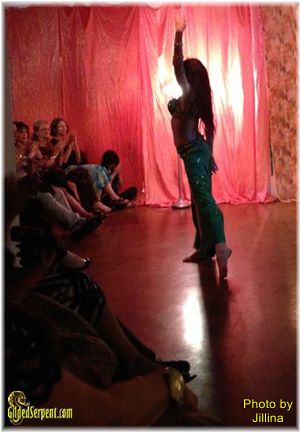
Tamra-henna at the Fez Benefit

by Christina “Tinah” Silva
posted August 8, 2013

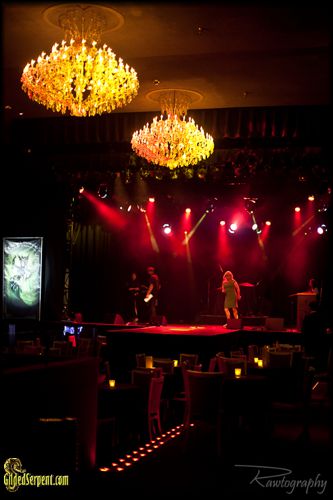
Located on Sunset Boulevard in legendary Hollywood, The Fez was the first Arabic night club in Los Angeles. During its heyday, The Fez was a popular haunt of celebrities.  Jayne Mansfield, Richard Boone, Danny Thomas were just a few who enjoyed the exotic ambience, and most of all, the beautiful belly dancers accompanied by Arabic music.

Live at the Fez LPLou Shelaby was the owner of The Fez from 1959 until 1971. During that time, Lou Shelaby was not just the owner; he was a musician, but above all, an extremely popular employer among the belly dancers.  Many belly dancers began or blossomed in their careers at The Fez; among them were: Feiruz Aram, Jenai Rathor (mother of Ansuya), Antionette Awayshak, Tonya Chianis (mother of Atlantis), Marta Schill Kouzouyan (mother of Jenna Kouzouyan) and Fahtiem. Many of these belly dancers credit Lou Shelaby with their growth as consummate performers and artists. The Fez was also known for Arabic music and even had an album called “Live at the Fez in Hollywood” (Aram). The Fez set a standard of what a Middle Eastern night club should be, and that standard has never again been duplicated. Many of the belly dancers who began their dance careers there went on to become leaders in the Middle Eastern dance community.

On July 14, 2013 Lou Shelaby’s daughter, Roxxanne Shelaby, hosted The Fez Forever Fundraiser at the Barsil Cultural Center and Copoeria Batuque. Roxxanne Shelaby is raising funds to create a documentary about Lou Shelaby, her father, The Fez Nightclub, and the artists who performed there. This documentary is intended to be not only a homage to her father. Roxxanne Shelaby believes this is a part of important Middle Eastern dance history that needs to be documented and preserved.

Although this fundraiser was a casual hafla held at a dance studio, a phenomenal line up of belly dancers agreed to perform. Some were alumni from The Fez, and others were well-known belly dancers. The lineup consisted of Lee Ali, Atlantis, Helen Vlahos, Fahtiem, Anisa, Jillina, Masa, Cory Zamora, Tamra-Henna, Anaheed, Aisha Ali and Sahra Saeeda. To spice things up, there was also the Samba trio Irani and The Sambarinas. Some of the dancers were accompanied by musicians such as violinist Maurice Saba, oudist Rico Orel, percussionist Var Daghevarian and on tabla, Achmend Al Aswar. On the schedule was a brief viewing of a trailer for the documentary and a raffle in which the prizes were vintage photos from The Fez.

When I looked around the packed room, I saw several notable people from different facets of the belly dance community. In attendance were: former owner/editor of Habibi Magazine and dancer Shareen Al Safy, IAMED director Suzy Evans, music producer Dr. Samy Farag, Princess Farhana, as well as Aubre Hill. The Fez alumni present (but not performing) were: Feiruz Aram, Jawaher, and Tonya Chianis, but unfortunately, Antoinette Awayshak and Saadoun Al Bayati were unable to attend.

Lou Shelby with Jane Mansfield at the FezPrior to the show, the room was full of joy and excitement as many people greeted each other and shared their stories from The Fez. I started belly dancing in 1996, so this was not my era, but listening to these women talk was fascinating! A woman sitting next to me named Vicky Schell shared with me that the first time she saw a belly dancer was at The Fez. In her bag was a copy of the album “Live at The Fez in Hollywood” that she was hoping to have autographed.  It was clear that, to these people, this was a timely and important project that Roxxanne Shelaby was undertaking.

When the show began, the room was abuzz with anticipation and excitement. The first performer, Lee Ali, looked as though she had stepped out of one of the vintage photos and delivered a marvelous performance to a medley of  Arabic music old favorites. The crowd went wild, and that set the tone for the night; this was a highly enthusiastic, appreciative audience. Atlantis followed wearing a costume that harkened to the glitz of the ‘70s and was a class act!  Helen Vlahos had danced at The Fez and looked ageless in a gorgeous blue bedlah, delivering a virtuoso veteran dance performance. Fahtiem, who was one of the last Fez belly dancers, followed, dressed in shades of purple and performed a playful routine with flirty interaction with the audience. Anisa had an infectious smile and danced with baladi sass. Jillina mixed it up with a Tahitian fusion piece followed by her signature drum solo.

During the intermission, Roxxanne Shelaby invited alumnae from The Fez up to the stage area so the crowd could applaud them. At the dimming of the lights, Roxxanne Shelaby presented a segment of her documentary. The documentary was clips of interviews inter-mixed with vintage photos, and it definitely whet the audience’s appetite for more.

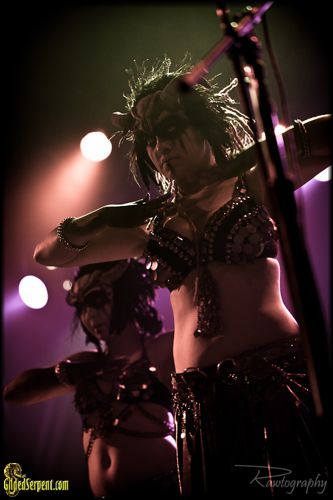
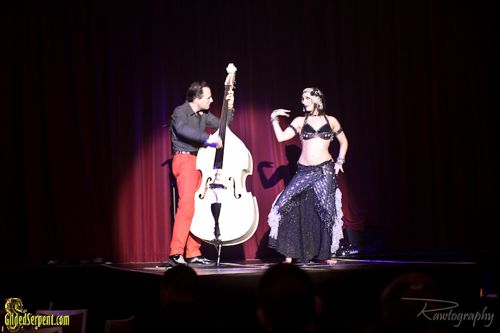
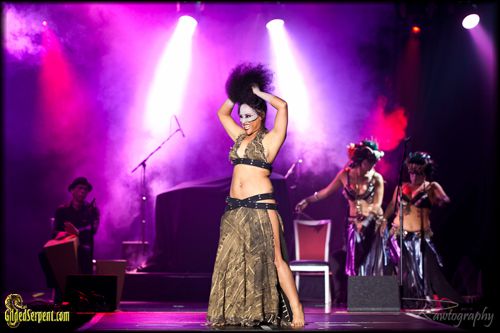
The live music segment of the presentation began with the Masa who glowed in bronze and expertly interpreted the music. Cory Zamora and Anaheed could have been mistaken for twins, wearing gold coins and white satin, both bringing their own vintage flavor to the show. Tamra–Henna,  costumed in emerald green, seemed like a cool breeze blowing in from the River Nile, and she delivered an elegant performance. Aisha Ali was regal in royal purple, while Sahra Saeeda rounded out the belly dancers, costumed in black and gold and performed her usual, expressive interpretation of the dance. Roxxanne Shelaby then created a pretty tableau with singer Hamid Abouleban to finish out a long (but fabulous) show.

The morning after, many people flooded various social networks and declared this evening had been magical for them. Electricity was nearly palpable in the air during the performances. My takeaway from this evening was the realization that the Middle Eastern dance, a.k.a. belly dance (this mysterious entity to which many of the people in that room had dedicated their lives) is an important cultural and artistic dance form that needs to be documented and preserved for the future! This is Roxxanne Shelaby’s goal.
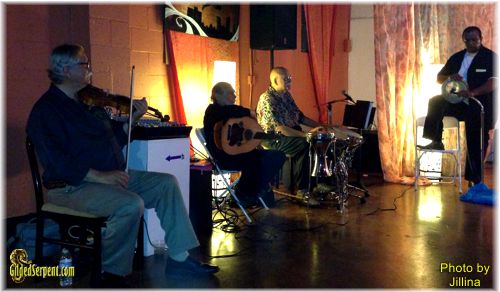
 
Musicians
Maurice Saba, oudist Rico Orel, percussionist Var Daghevarian and on tabla, Achmend Al Aswar.
Dancer in photo at top of page is Tamra-henna

Resources:

use the comment box

Have a comment? Use or comment section at the bottom of this page or Send us a letter!
Check the "Letters to the Editor" for other possible viewpoints!

Ready for more?

  • A Carousel of Challenges, Bellydancing at the County Fair
    Using correct terminology is important; belly dancers are community performers who are requesting to perform on a community stage.
  • Its Not Your Grandmamma’s Zar
    Luckily at some point we hear the distinct rhythm for a Zar and follow the drumming right to the front door of an apartment house.
  • Sahra gives us a reports on her friends in Cairo since the Jan 25 revolution.
    Sahra Kent with the help of Roxanne Shelby reports on what she has heard from her friends in Cairo since the protests began less than a month before this interview on February 20, 2011. It was conducted at the Belly Dancer of the Universe Competition in Long Beach, California
  • Inspiration and a Push from the Stars, A Dancer’s Destiny part 1
    Around this time, my mother was singing at Mahrajan’s when they held Arabic functions and there was a dancer by the name of Kanza Omar, who was my idol
  • A Dancer’s Destiny, Part 2: A New Dancer Emerges
    Lou Shelby had told me to begin that Friday night. (The Fez only had entertainment on the weekends at that time.) An Egyptian dancer, Maya, and a Las Vegas dancer, Cozette, were working there; so I was the third dancer on the program. I came in early for a rehearsal; Lou’s idea was to have a real Hollywood-like production: I was to emerge in a flood of colored lights amidst smoke from a smoke machine and open his show.
  • Southern Cal’s “Shira” Reminisces Dancing in Los Angeles Nightclubs in the ‘70s and ‘80s
    In the late 1970s and early 1980s, along with the multiple Arabic clubs in Hollywood, there was also a thriving Greek, Armenian and Persian nightclub presence in the Los Angeles area. Shira (Jane Padgett) was a popular dancer in those clubs and is still a popular working dancer in Southern California. In this business, there are the dancers with a presence in the dance community due to participation in showcases, competitions, teaching and self-promotion,and additionally, there are the "workhorses", those who slogged away at the clubs, entertaining the masses for years and years, flying under the radar.
  • A Dancer's Dancer in 1980s Hollywood, Interview with Yasmin
    L.A. was heaven for fabrics though. You could find anything you wanted, and if they didn't have it, you could have it made, like the beautiful gold lame' sunburst skirt and veil I had pressed for a costume.
  • The Original Mish Mish, The Golden Age of Tinseltown
    I was working one evening at Khyams and still doing my old style of dance. I came out for my entrance covered with a veil and right at the beginning of my show, she came up on stage and started peeling my veil off me and threw it on the floor. She shook her finger at me and said in broken English "Lah, this isn't Egyptian!" I was so embarrassed and humiliated I could barely finish. Talk about being intimidated!
  • Interview with Jacqueline Lombard, Queen of the Dancers in the Golden Era of Tinseltown
    They refused to play dance music or anything you asked for…got to admit, that really taught how to pull off a show & think quick on my feet. You never knew where they were going with the music, & they tried to make you look bad.
  • MECDA’s First 30 Years , The Middle Eastern Culture and Dance Association’s Changing Role in our Community
    Diversity, however, often leads to dissention, and controversy flew regarding the perception of the rather strict parameters of the Egyptian style.
  • Becoming the Object of Your Own Fantasy, "Perfumes of Araby" in the 1970s, Part 1
    The Belly dance scene in 1970s Los Angeles: It is difficult to spotlight succinctly even one portion of a vibrant, vast and quickly growing community of Middle Eastern dancers, their enthusiasts, and the ethnic communities, musicians, festivals and supper clubs that supported the dance arts. The abundance of inspiration in that era was almost beyond understanding; yet once upon a time before the Internet, music, imagery and information was less readily available.
  • Becoming the Object of Your Own Fantasy, "Perfumes of Araby" in the 1970s, Part 2
    We are packed tightly shoulder to shoulder, impulsing to the dramatic beat with great solidarity: traditional hand gestures, chest drops, all very serious and trance like. This mood was broken however by a guy at the back of the 200 plus audience, who stood on his chair, raised his beer glass and shouted "The one in the yellooooow…." then actually fell completely backwards like a tree that had just been cut! I hope he was OK!
  • Becoming the Object of Your Own Fantasy, Diane Webber and the Perfumes of Araby in the 1970s, Part 3:
    In an almost archetypal will to power, Diane encouraged us to utilize our costuming – and our dance – as a way to search out and expand our own unique spirit, fantasy and physique, something I try to continue with my students today: become the object of your own fantasy.
  • Interview with Kathryn Ferguson
    This was, probably, 1969. After I returned to America, a woman who had been a dancer at the Fez Restaurant in Los Angeles, came to Arizona. Mostly because of my positive memory of the music, I thought I’d like to get involved with the dance. At a nightclub in Los Angeles, I happened to be at a birthday party of a dancer named Antoinette Khoury. There I was in this nightclub! I was just beginning to learn about this dance.
  • Recognizing Accomplishment: Atlantis!
    I get so excited over the events they are producing, that I have no thoughts about them as dancers. All I think about is the person who is performing or teaching and the merchandise that the venders are selling. I only think of the sponsors as being effective with the business side of Bellydancing.
  • How MECDA Began
    M.E.C.D.A., (Middle Eastern Culture and Dance Association) is a nationwide organization which began in 1977 for the purpose of organizing working dancers, sharing information between teachers…
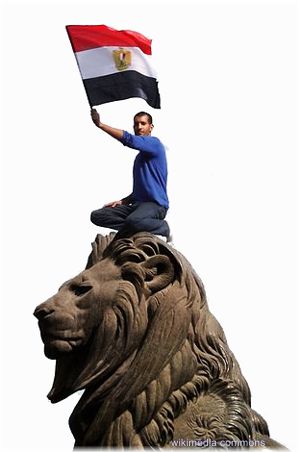
 

Gilded Serpent presents...

What Happened in Egypt

Egyptian Revolution Pt. 2: June & July 2013

Placeholder

by Leyla Lanty
posted July 24, 2013

The days from June 28 through July 3, 2013 brought significant events to Egypt, culminating in the Egyptian Army’s removal of Mohamed Morsi from the office of president.  The Army placed him and many of his fellow Muslim Brotherhood members and political appointees under house arrest.  Then, it  announced that it would soon put in place a “road map” toward a new Egyptian government and future elections.  The Army has begun since then to implement that plan.  Most of the world was caught by surprise and many wondered, “What just happened in Egypt?”, “Why did this happen?”, “Is it right?” and “What does it mean for the future of Egypt and the whole Middle East?”  I’m not a political expert, so I will only attempt to address what happened and why. 

I was in Cairo, Egypt, during the time leading up to the removal of the president and was able to ask Egyptians about the background of this story and about events as they happened.  I have also done extensive reading of news and analysis articles from what I consider to be reliable news and analysis sources.  Within this article, I hope to summarize, from an Egyptian/Middle Eastern point of view, the events that led to the mass protests against an elected government and to describe the changes that were subsequently set in motion.  I’ve included a few links to detailed articles on the Internet, and at the end, I’ve added a short list of online resources where more detailed information can be found.

On June 10, 2013, I arrived in Cairo, Egypt, for a three-week stay that would include visiting friends, attending Ahlan Wa Sahlan Festival (and maybe seeing a few sights).  What I got was all that–plus what I think of as “The Egyptian Revolution, Part 2”.  A few days after my arrival, I learned that demonstrations were going to take place on June 30, the one year anniversary of Mohamed Morsi’s presidency, to protest his perceived failure in that office and his and the ruling Muslim Brotherhood’s failure to improve the state of the Egyptian economy.  Although the news of the demonstrations was unsettling, the place where I was staying, as well as the Mena House Hotel where the festival would be held, were at the southern edge of greater Cairo, almost an hour’s drive from the nearest hotspot. 

I would have to rely on my Egyptian and expatriate friends for advice whenever I wanted to move away from this safe area. 

From June 19th through June 26th, I attended the week-long Ahlan Wa Sahlan festival.  Every day, while traveling to and from the hotel, it became more evident that things were changing in the country.  By the time the festival ended, I was wondering about what was going to happen and how everyone was going to cope with it. There was a major gasoline shortage with double and triple lines of cars with their drivers waiting hours for gas, only to find out that the stations were closing because their storage tanks were empty.  During the time I’d already been in Cairo, I’d experienced several of the rolling power blackouts ordered by the government because of power shortages.   Increasingly, Egyptians were blaming the rapidly deteriorating economic conditions over the past year on Morsi, the Muslim Brotherhood, as well as their political arm, the Freedom and Justice party.

As the day slated for the biggest demonstrations (June 30th) approached, my Egyptian friends told me they were stocking up on food and supplies and staying home from the 27th until after the big day and maybe beyond.  They advised me to do the same.  Everyone was nervous about what would happen on the 30th–not to mention during the three days of planned protests that would lead up to it.  No one wanted to be in the wrong place at the wrong time!  There are no guarantees; only likelihoods. 

The major demonstrations were in at least four locations in the city, including one that would be of special interest to artists of Middle Eastern music and dance that started around June 5th and continued through the 30th.  It was staged, literally, in front of the Ministry of Culture, which is responsible for maintaining and promoting the culture of Egypt, including music, dance and other arts.  Morsi had removed the Minister of Culture, Mohamed Arab, who had been the director of the national ballet, and replaced him with Alaa Abdel Aziz, a member of the Brotherhood who did not have any background in the arts. 

That new minister decided to try to ban ballet because it was “too naked for public viewing”.  This sparked a round-the-clock sit-in by many artists who took turns performing their art each evening to show their defiance.

  As of July 17th, Mr. Arab was reinstated as the Minister of Culture.  A link to an article about the sit-in is included among other links at the end of this article.

From my second week in Cairo, I began to hear and read more about the mistakes and power grabs that Morsi and the Muslim Brotherhood had committed over the past year and began to understand more fully the widespread anger and disappointment.  One of my Facebook friends posted a verified list of these actions that showed the Muslim Brotherhood’s steady march, led by Morsi, toward a takeover of all government minister positions, setting a path toward a dictatorship that most Egyptians feared would be worse than anything set up by Mubarak or any of his predecessors or even the ayatollahs of Iran.  What follows is a timeline for those actions, extracted from the list that my friend posted, followed by the events leading up to Morsi’s removal at the hands of the Egyptian army. After the timeline is a short list of online news and analysis sources about current events in Egypt.

  1. A few days after Mohamed Morsi took office on June 30, 2012, he issued a decree to reinstate the People’s Assembly that had just been dissolved by the Supreme Court, having been deemed unconstitutional.
  2. On July 30, Morsi gave a presidential pardon to 26 leading Islamists convicts who belong to the Muslim Brotherhood and Al-Gama’a Al Islamiya, a terrorist group that had been convicted of many attacks on tourists and Egyptians.
  3. On August 2nd, Morsi appointed an Islamic Prime Minister who then hired Muslim Brotherhood members in his government with clear disregard to the national unity goals that Morsi had espoused in his presidential campaign.
  4. On August 8th, 16 Egyptian Soldiers were attacked in Sinai leaving all of them dead. Fingers were pointed at Hamas or Islamists militants in Sinai, while Morsi and the Prime Minister turned a blind eye.
  5. Also in August, although the president doesn’t have the legal right to do so, Morsi dismissed the Prosecutor General and appointed another Islamic leaning Prosecutor General in his place. 
  6. On November 22nd, Morsi issued a new constitutional declaration putting him beyond the bounds of judicial supervision.  It shielded the Constitutional Assembly (a different body from the People’s Assembly) which had been ruled unconstitutional by the Supreme Court.  It also shielded the Shoura Council, which is also dominated by the Muslim Brotherhood. Finally, it gave the president the power to change and appoint the Prosecutor General every 4 years, guaranteeing the Muslim Brotherhood their status above the law.
  7. In December, 2012, all non-Islamist members boycotted the Constitutional Assembly.  Morsi, along with the Muslim Brotherhood majority of the Assembly, finalized the constitution in one night with little opportunity for review or opposition by the public.
  8. On January 8, 2013, Morsi appointed 8 new ministers, including 6 from the Muslim Brotherhood.
  9. In March, 2013, The Shoura Council tried to pass a law in order to have new parliamentary elections as soon as possible, but the Supreme Court ruled it unconstitutional.
  10. In June, 2013, Morsi appointed more ministers in the cabinet from the Muslim Brotherhood and appointed more Islamist governors in Egyptian provinces.  Most notable was the governor of Luxor, who is part of Al-Gama’a Al Islamiya that murdered 58 foreign tourists in the same province in the 1990s in an incident that is still well-remembered.

In June 2013, Anti-Islamist activists started the Tamarod (rebel) campaign, with millions signing a petition, withdrawing confidence from the president. By June 30, Tamarod had gathered over 22 million signatures; 9 million more than the number of people who voted for Morsi in the elections.

 The following points are my own timeline of what happened on and immediately after June 30th:

  1. On June 30th, by the end of the day, protesters issued an ultimatum that Morsi must leave office by Tuesday, July 2nd or they intended to start “civil disobedience.”
  2. On July 1st, Egypt’s Army handed Islamist President Mohamed Morsi an ultimatum to share power and compromise with the opposition, giving politicians from all sides 48 hours to compromise or the army would impose its own road map for the country.  The Egyptian Army saw that order was quickly breaking down because of increasing clashes between pro and anti Morsi factions and decided to step in and play the role similar to that of a referee in sports – separate the combatants and try to get them to communicate with one another.  Morsi’s refusal to cooperate and the opposition’s reluctance to negotiate led to the Army’s removal of Morsi. 
  3. On July 2, my last day in Egypt, I saw on English language TV that more people were expected on the street as Morsi had refused to recognize the 48 hour deadline.  On English language TV channels, there were interviews with two Muslim Brotherhood spokeswomen, both talking around questions rather than answering them.  In both interviews, it quickly became obvious that the representatives were reciting from a memorized script, not answering any questions but spouting the  propaganda of the Muslim Brotherhood and its Freedom and Justice party.  I wondered  why the Muslim Brotherhood chose women for this task.  In my opinion, they certainly don’t seem to think women are capable of such pursuits as politics or public relations.

There have been many developments since I left Egypt.  By July 17 there was a basic government in place, including an interim president, vice president, prime minister and a 34-member cabinet, all chosen for their expertise rather than their ideology.  My Egyptian friends, through telephone calls, Facebook posts and emails, are expressing their new hope for the future of Egypt through this period of  transition to future elections.

To follow events in Egypt from an Egyptian/Middle Eastern perspective, check these additional online resources in addition to the links that appear in this article:

Facebook: 

  1. Egyptian Streets
  2. Al Arabiya English
  3. My home page- Leyla Lanty -where I share items from reliable sources.

Other online resources:

  1. Link to the Reuters story about the Army’s ultimatum:  reut.rs/15WkNnO
  2. Detailed list of Morsi’s acts from June, 2012 through June, 2013 can be found at picoguindy.wordpress.com/2013/07/04/whats-your-democracy
  3. In depth analysis of Muslim Brotherhood’s actions over its history as well as the meaning of recent events:  www.dailynewsegypt.com/2013/07/18/egypts-clash-of-freedoms
  4. List of new Cabinet members:  en.wikipedia.org/wiki/Beblawi_Cabinet
  5. About the sit-in at the Ministry of Culture:  www.al-monitor.com/pulse/originals/2013/06/sit-in-warm-up-june-30-protests-in-egypt.html
  6. Al Arabiya Middle Eastern News in English:  english.alarabiya.net

Resources:

use the comment box

Have a comment? Use or comment section at the bottom of this page or Send us a letter!
Check the "Letters to the Editor" for other possible viewpoints!

Ready for more?


Gilded Serpent presents...

Photos from the Zulu Lounge

wikicommons-Privat-Livemont-Absinthe Robette-1896

May 3rd 2013 at the famous El Rey Theater in Los Angeles, California

Photos by Rawtography.com
Text and captions by Jillina
posted July 18, 2013

Below are a few highlight photos by Rawtography.com  from the Zulu Lounge show held May 3, 2013 in Los Angles, California. The show was produced by dancer Khani Zulu and her husband, tattoo artist Zulu, at the swanky El Rey theater. The show’s theme was "La Nuit d’Absinthe" which inspired artists to be creative with their pieces. Whether they wore green, used French music, or performed  with glow sticks to create a hallucinogenic effect, each performer had  a unique way of interpreting the theme.

L.A. is home to many creative fusion dancers and musical guest Fishtank Ensemble. This rich diversity was well represented at the Zulu Lounge.

Upon arrival to the theater we were greeted by drummers  Donavon Lerman, Faisal Zedan, Sean Krempa, and Marcos Ferrando in foyer. There were fairies and other elaborate dancers throughout the theater which created a cool circus atmosphere. The show was sprinkled with solos, trios, and group pieces showcasing a great diversity such as ITS, Tribal Fusion, French Can Can and Flamenco.

venue

The swanky El Rey Theater


Producers Khani and Zulu

Producers Khani and Zulu

Mandala Dance Works

Mandala Dance Works

Fishtank Ensemble

Jenn Aguilar of Red Moon Dance Company  doing a zombie piece
Jenn Aguilar of Red Moon Dance Company doing a zombie piece

Heather Shopman, Susan Frankovich ( not sure name of the other 2 dancers) fusion piece" Half man half woman"
Heather Shopman, Susan Frankovich (not sure name of the other 2 dancers) perform a fusion piece- "Half man, half woman"

Flamenco star Arleen Hurtado

Lauren Boldt, Stefanie Bernhard, Aubre Hill, Ariel Kasha

Lauren Boldt, Stefanie Bernhard, Aubre Hill, Ariel Kasha

Susan Frankovich w/ bass player from Fishtank Ensemble

Zulu MC for "Voodoo Ritual"

Olu opening the "Voodoo Ritual"

Entropy Arts with glowing double staff dance  (Jenn Biswas and Diana Cimamadore)
Entropy Arts with glowing double staff dance (Jenn Biswas and Diana Cimamadore)

Calamity Sam Tribal soloist
Calamity Sam, Tribal soloist

Les Petites Bonbons trio  (Michaella Manning, Hannah Trimbath, Molly Morgan)
Les Petites Bonbons trio (Michaella Manning, Hannah Trimbath, Molly Morgan)

Michaella Manning of Les Petites Bonbons


Chandelier

Resources:

use the comment box

Have a comment? Use or comment section at the bottom of this page or Send us a letter!
Check the "Letters to the Editor" for other possible viewpoints!

Ready for more?

  • The Evolution of Jillina, An Interview Regarding Change, Flexibility and Lessons Learned
    Working with Jillina for the last six years or so, I’ve been a fly on the wall for a lot of this transition. I’ve been there for marathon rehearsal weeks, brainstorming sessions, the stress of taking a show on the road, the flops, and the standing ovations. Español!
  • Jillina Drum Solo Video from International Bellydance Conference of Canada
    Jillina dances for drummer, Suleiman Warwar. This performance was held at the Acrobat Lounge in Toronto, Ontario, Canada.
  • MaShuqa interviews Ali Hamidzadeh of Turquoise International,
    Ali tells us about how he came to produce his first cymbals. He is interviewed by MaShuqa. He also talks about Dahlena, Bobby Farah, his education, inferior copies of his zils, how to know that you have genuine Turquoise cymbals. Testimonials from Jillina, Princess Farhana, and Marta Schill.
  • Competition Strategies, A Judge’s Suggestions
    Choosing a costume that fits and flatters your choreography is equally important. If you want to highlight your amazing hip work, be sure to choose a costume with lots of fringe and tassels on the hips so the judges cannot fail to see that hip work.
  • A Transformational Week, A Fan’s View of Jillina’s Weeklong Intensive Report
    I think that’s another benefit of having scholarships in the world of Bellydance because it gives dancers another goal to work towards: "What do I have to do to rise to the occasion, to receive this other kind of award?"
  • Taiwan Bellydance: 2 Events Are Perfect Ending for 2010, Nefertiti Bellydance Carnival & Bellydance Evolution
    I admire those dancers participating in the production for their talents, skills, and artistic qualities, however, I feel the framework of story-telling compromises dancers from better expressing their love for this dance (or through it). They are acting through dance rather than dancing to the music.
  • My Dream: Dancing in Cairo!
    To be asked to teach at Ahlan Wa Sahlan is an amazing honor, but to be performing, in the biggest show of the year? It was unbelievable! This was the most significant phone call I have ever received in my entire career.
  • Carl’s Camera Captures Jillina's Bellydance Evolution
    Jillina Carlano's Bellydance Evolution marked the beginning of an era in which bellydance moves beyond dance Oriental imported from Egypt and performed in clubs.
  • "Der Schnerkle" Its Proper Uses and Functions
    Therefore, I reasoned, the use of ones extremities for dancing (beyond transporting one across the stage or making a movement appear finished) was to gather and distribute performance energy from the stage rather than simply wave arms about in the air with artistry and grace.
  • Venue Woes, Adventures in Event Production
    My philosophy is that dance teachers should make a living wage, be well fed and rested, and then, they will give you a great product as a result. Attendees should have a place to stay that is near (or in) the venue of the event. Events should be reasonably priced, and affordable food should be available nearby. Simple, right?
  • A Carousel of Challenges, Bellydancing at the County Fair
    Using correct terminology is important; belly dancers are community performers who are requesting to perform on a community stage.
  • Beauty Has Its Price, The Quest for Beauty, Part 4
    Being involved with an art form that is all about beauty, I too feel the need to present myself as best and as beautiful as possible. Beauty costs in time, pain, and money; and as philosophers have pointed out for millennia: its only fleeting.

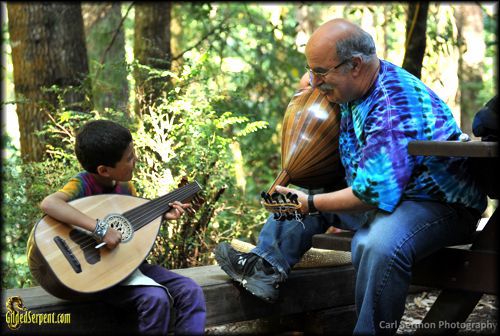
  • A week long immersion into Middle Eastern music and dance while camping in the Mendocino redwood forest. Expect live music every night and classes with many music and dance teachers each day. Many of the names are linked to video interviews we have conducted with individuals or to their bio pages here on Gilded Serpent.
  • Munique brings Egypt to Spain Again, 7th International Festival of Egypt in Barcelona 2013
    Barcelona welcomed teachers and lucky participants for a festival that brought Egypt to Spain with well attended lectures, workshops, and galas during four days of fun and learning, January 31st until February 3rd, 2013. This event provided a unique opportunity to learn the art of Oriental dance from the best names in Egypt. span class=”artist”>Randa Kamel (Egypt), Mo Geddawi (Egypt), Gamal Seif (Egypt), Bozenka (Cuba/USA), Amar Gamal (Cuba/USA), Amaru Sabat (Spain), who together with Munique Neith ran workshops throughout an intensive weekend.
  • Changes in the Island Kingdom, The Bahrain Bellydance Scene
    Returning to Bahrain to work after four years felt like going back to my roots. This little island kingdom is where I did my first Middle East contract, busted my bra on New Year’s Eve, and returned several times in the following year. Those were the days. Now it had been a while. Had Bahrain changed? You betcha.
 

Gilded Serpent presents...

Thoughtful Technique in a Beautiful Package

Jo Wise’s "The JWAAD Book of Belly Dance"

Placeholder

Book Review by Stasha
posted July 17, 2013

The JAWAAD Book of Belly Dance is a beautiful book to be savored; to be read over a cup of tea or a glass of wine, over a leisurely afternoon or long into the night.  You donʼt have that kind of time in your busy life?  Well, neither do I! 

Fortunately, this beautiful book can be opened at any time, to any page, for any length of time you can spare, and it will offer you concise instruction, illustrative photos, inclusive models, creative costuming, witty sayings, insightful technique and imaginative choreographic notes!

illustration from page 74A performer, researcher and teacher focused on the dances of Egypt and the Middle East since 1981, and who has helmed the Josephine Wise Academy of Arabic Dance (JWAAD) since 1990, Josephine Wise states a distinct purpose in making this book available:

"to enable westerners to understand both the physical technique and the cultural intricacies of Belly Dance."

Ms. Wise begins her book with a succinct history, giving an overview of the theories of origin and dissemination of Middle Eastern dance.  A brief synopsis of styles and costumes follows, as well as a review of instrumentation, song styles and  popular singers of the 20th and 21st centuries.  A breakdown of the most popular rhythms is presented in an instructive, easy-to-understand format.  With her background in teaching both Pilates and the Alexander Technique, Josephine focuses on the correct alignment and use of all the major muscle groups in her section on “The Basics” (postures and positions, warm ups and cool downs).

The “Techniques” section is the strong core of this volume; a description of many basic moves and patterns.  It is a textbook for teachers and students alike, offering a depth of technical advice.  As a dance form with a tradition of oral and visual transmission, any book on Middle Eastern dance can be a challenging way to learn these movements. 

For this reason, this book may not be appropriate for the absolute beginner, as the uninitiated may lack the insight particular to these postures.  That said however, all the steps are clearly articulated, and an adventuresome first-timer as well as a student with some basic Middle Eastern dance posture and movement history would be well served by these references.  For example, sometimes a movement is very subtle, as in the tilting small hip circle.  Featured on page 74, this movement is so subtle that the accompanying series of photos aren’t enough to adequately portray the movement; it is the combination of the photo series, text description, and the muscular technique hint (in this case a sequence of “ab” and “glute” contractions) that completes the knowledge transmission.

The same strategically descriptive method is used to convey over a dozen main "families of movement". For example, “Figure 8s” of hips and/or rib cage: forward, reverse, horizontal, vertical and (the cleverly named) "Roller Coaster" which designates a diagonal application.  Often associated with the Egyptian regional dance Hagalla, the so-called “3/4 Shimmies” are also explored in great variation.  As an instructor, I enjoyed the thoughtful teaching of the “Camel Walk” (page 91) and it’s nine variations.  That’s a difficult maneuver to teach, this would be a good tool for instructors.

The section called “Props” (stage properties) suggests several manipulations of fabric, such as a veil, using the same photo series plus text description used so effectively in the “Techniques” section.  The fourteen entries in this section also include an overview and choreographic suggestions for several balancing feats.  Folkloric dances, like the Egyptian “Melaya Lef” and the Khaleegy “Thobe Nashal” are also featured here.

In this Props section, I respectfully offer a different insight on one point she makes, and perhaps she is making it facetiously.  Regarding snake dancing: it would appear Josephine is not a fan of using a snake in a performance, and most assuredly, not every performance is appropriate for a snake.  As I’ve had the opportunity to dance with snakes myself and have known and performed with several remarkable snake dancers, I hope I can assure readers that Ms. Wise is joking when she warns a large constrictor can wrap around your neck and strangle you!  Snake dancers are performing with beloved pets.  (Although they can be mischievous! I’m remembering a show where Asia’s 8 foot boa sneakily reached his tail down and wrapped around one of her ankles, then as she lowered his head he quickly reached down and wrapped his upper body around her other ankle, effectively tripping her!  I swear I heard a "sss sss sss" as he laughed about it!)

A final section of the JWAAD Book of Belly Dance gives insight into the JWAAD Personal Development Program and encouragement on where to find and engage with the Middle Eastern dance community in your area.

Particularly as a teaching and learning tool, I believe readers would be interested in this  informative reference volume; it’s a natural for teachers as well as students, written by someone of deep experience and years of exposition.  I was inspired to jump up and execute many of the moves as I read them.  Yet, wouldn’t it be great if I had the time to just savor the book over a cup of tea or a glass of wine, over a leisurely afternoon or long into the night?

Rating: 3 1/2 zils
Zil Rating- 3

Resources:

use the comment box

Have a comment? Use or comment section at the bottom of this page or Send us a letter!
Check the "Letters to the Editor" for other possible viewpoints!

Ready for more?

  • Radio Bastet, Where the Hafla Never Stops! An Interview with Its Creator, Marisa Young
    Here’s one thing that is very frustrating: finding out that you have two or three copies of the exact same record, released on different labels, with different artists names, different track names and arrangements, and different covers!
  • Becoming the Object of Your Own Fantasy, "Perfumes of Araby" in the 1970s, Part 1
    The Belly dance scene in 1970s Los Angeles: It is difficult to spotlight succinctly even one portion of a vibrant, vast and quickly growing community of Middle Eastern dancers, their enthusiasts, and the ethnic communities, musicians, festivals and supper clubs that supported the dance arts. The abundance of inspiration in that era was almost beyond understanding; yet once upon a time before the Internet, music, imagery and information was less readily available.
  • We Will Rak You! My Dance Experience with Queen
    I’ll admit I wasn’t too familiar with the music of the British rock group Queen. The year was 1977, the month of December, in Los Angeles. I was invited to perform at a dinner party where Queen, in Los Angeles for several concerts, was the guest of honor. The job came to me through Dianne Webber.
  • A Big Picture Book Review: Martha Burns’ "Belly Dance, Celebrating the Sacred Feminine"
    Every page is a work of art, a truly astonishing array of images. The content is very inclusive and features all age ranges, body types and styles. You will see yourself, your best self, in these pages.
  • “Adventures In Belly Dance Costuming”
    This is a good book for both sewing veterans and beginners alike.
  • Festival Fantasia: A New Direction
    I had a vision of the whole dance scene becoming one and being aware of one another.
  • The International Belly Dance Congress
    Not being able to prepare my planned choreography properly for the Oum Kalthoum song, which is not easy to interpret to begin with, I quickly turned to emotions in order to fill up the space.
  • Tradition, Passion, and Fusion, “Ro-He, Classical Egyptian Dance” 2003, and “Egyptian Rai” 2006 by Hossam Ramzy
    In this review I am critiquing two CD’s by Hossam Ramzy. I write in detail about each CD, it’s interesting parts, or special interests as well as critique. I then compare the two at the conclusion of this article. Enjoy…the incredible talents of Hossam Ramzy!
  • Ramzy’s Old and New
    In conclusion, and personally being a purist with a lot of my Bellydance music, I like Hossam Ramzy’s “Best of the Best”; in my opinion, it’s hard to improve on that collection. However, I would recommend giving all of these albums a try, as they are all high-quality music. If you are a World-music fan, and love music that jams with a bit of rock thrown in, you’ll like “Rock the Tabla”!
  • Beyond DVDs – Try Live Streaming! Online Dance Instruction: Ansuya, Sadie, and Cera Byer
    Oh, Technology! You’ve brought us so many new ways of advancing our dancing skills: instructional DVDs, belly skypes, Raqs TV rentals, recorded classes online–and now–live, interactive classes online. Just how helpful are these cyberlearning tools? Let’s talk about the “Powhow” classes.
  • Luscious: The Bellydance Workout, a DVD Review
    If you are looking for something that is a mix of dance practice and a workout, then I think you will enjoy this DVD. It is a perfect selection of moves that are combined to work on your stamina, polishing your technique for choreography.
 

Gilded Serpent presents...

“Der Schnerkle”

Its Proper Uses and Functions

Medusa by Carvaggio

by Najia Marlyz
posted July 16, 2013

Sometimes it takes a multitude of people to open up your way to experience a personal epiphany in dance performance, but there has to have been a precursor—that foot in the door that keeps it open for awhile, allowing further development. However, initially, all it takes is one teacher or mentor (or even a critic) who either makes a casual comment, delivers a fully developed lesson, or something in between, to begin the process of understanding on a new level. For me, insights often began from casual comments or anecdotes about the experiences of Bert Balladine, my principle instructor.

Graceful Circles or Hair of Medusa?

During one break in the classroom, Bert (who spoke with a German accent with sometimes a few amusing German words thrown in for good measure) announced, “Girls, just concentrate on the basics of the steps and movements, and later on, you can add in “der schnerkles”. “What the heck is a ‘schnerkle’?” I asked aloud. Apparently, nobody else in the class needed or dared to ask. “Oh, it’s just something as simple as this,” he answered, as he twisted his lead finger in a small circle counter-clockwise quickly.

“You don’t have to wave your hands and arms around all the time like a bunch of snakes on the head of Medusa!” he added.

“I think I understand it,” I thought to myself. “It is like the little serifs on a traditional printing font that grounds the letters, making them more easily legible.” Although I thought I understood fully at the time, I learned eventually that there was much more to Bert’s little serifs for dance than mere “grounding”. I soon found that they could be useful as accents and punctuation in what I thought of as “musical sentences”, as well as effective points of energy release. They were to make a huge difference in my dance performances and became a mainstay of my future teaching of appropriate musical response.

On a different occasion, when we were talking about using hands and arms effectively in our dance, Bert said that we students had to stop flailing our hands and arms around in circles and waves because they were distracting to the audience. It would seem self-evident to me—but apparently not to everyone, that dancers use their hands and arms for many purposes and one of them is to attract attention to something special.

“Remember this girls: wherever the dancer’s hands are moving is where the eyes of the audience go also.”

For me, the two dance details seemed to be working at counter purposes with each other—on the one hand, don’t put hand movements in, but on the other, sometimes, you might need them.

Why? What was the true purpose of hand movements in dance? How do you know when to use them and when to stop them? Also, what do you do with your hands if they are not gracefully waving the air in snake-like motions or weaving the fingers in desperate wormy, weird configurations like I had seen so many dancers insist on doing—albeit graceful? Is graceful movement an end within itself? I struggled to make sense of adding in the graceful sensual motions and conversely, learning to leave them out! I imagined (briefly) that that it might be the reason that most dancers during the ’70s were playing their finger cymbals furiously, non-stop. That activity gave them something to do besides figuring out what to do with their hands when they didn’t want to “distract” the audience with their arm movements! It was a perfectly clear, but partially wrong, conclusion on my part.

Transference of Energy

It wasn’t until Bert explained that energy is transferred by the palm side of the hand, yet is stopped by the back of the hand, that all the puzzle pieces began to fall into place for me.

I began my long journey into responding to musical cues in a new and easily understandable guideline for expressing what I was hearing, as well as relating to the music in a more personal way. Strangely enough, I found that I had learned “over-night” that the judicious use of the hands and arms allowed me to translate music and relate to my audiences in a new way. So, use of energy was the next and most mysterious of the techniques that a dancer must master!

Previously, I had thought more about the use and nature of transferred energy than many young women of my age because I had needed to understand when learning to weld and solder in my college art and design classes, in glass blowing with my scientist husband, and when helping him to wire and solder our sound system at home. I realized that if the front of the hand was supposed to emit energy, there must be some way that the dancer could renew the source or she would soon “run dry” of any energy to send out to the audience for the movements to make sense.

Therefore, I reasoned, the use of ones extremities for dancing (beyond transporting one across the stage or making a movement appear finished) was to gather and distribute performance energy from the stage rather than simply wave arms about in the air with artistry and grace.

Venus arises from the wavesThis subtle epiphany caused a revolution within my dance performance that was, apparently, visible to audiences because I began to receive many compliments concerning how “different” my hands were from other dancers; this new understanding alone brought me my first real successes in performance, and I basked in the attention I began to receive.

Ocean Waves

I had learned that invisible energy could be felt by audiences and that a dancer had to give as well as receive and stop pelting the audience with dollops of unrelenting aggression—especially when that relentless aggression was perceived by the Middle Eastern culture as non-feminine—perhaps even masculine.

When teaching, I began to use the imagery of something with great power that both gives and takes—the ocean. I asked my students to imagine that they were like the ocean waves upon the shore. They had to learn to push energy clearly toward the audience by directing it in line and motion and then to release it when it was time for the wave to recede. There would be a moment of release and reversal, during which the energy stopped pushing and then began to pull back.

Many dancers I see performing these days are vividly energetic about sending their performance energy out, but few of them understand that they should also pause to release the energy, momentarily stop or finish the gesture, and then pull part of the “sand of the beach” back into themselves by motions of gathering in energy from the audience.

I caution that one must mind where, exactly, you put it after you have collected it. It is all too easy to bring it in your aura and unceremoniously and unconsciously stuff it into your nether-regions without considering the symbolic effect of that ungainly gesture! It is the balanced combination of push, release, pull, and placement that gives many dancers a greater skill level than others while in performance, even though they might use the same exact steps prescribed by a specific choreography.

Proper Use of Der Schnerkle

The exact moment of energy release is one obvious moment to employ the small flick or circle/flick of the fingers that constituted Bert’s “schnerkle”. However, this needs to happen both at times when there are clear fillips or embellishments in the music itself as well as when the dancer decides that the overall effect of pushing energy outward has been sufficient. Enough is enough! When a movement is finished, a dancer can, if she chooses, complete it with the use of Bert’s schnerkles (also known as an energy release) in the fingertips.

I recall Bert telling his students to “Save a little bit of yourself at the end, girls!” so that dancers could have the final flick of a fingertip or a small flip of the head to put an exclamation point or a period at the end of their musical sentences.

Additionally, if you get to the end of your movement before the music does, you will still have a little important something in your arsenal to finish sharply with the music, demonstrating that you have honed your “edge”. In this way, movements appear more clean and finished and the audience isn’t left waiting for the other shoe to drop. If you have ever felt an ominous silence at the end of your dance before the audience begins to applaud, you may not have released your energy visibly enough so the audience could feel at ease to begin clapping and break a silence that you have forbidden them to enter. In short, they must be given permission to applaud your dance by your indication that you are completely finished; otherwise, they would feel rude and silly to impose upon what may only be a momentary pause in your movements. Nobody wants to look foolish; least of all, members of an audience!

These are just a few of the secrets in the arsenal of experienced dancers pertaining to the use of hands and arms in dance. There others as well as methods of decoding the music itself in a simple, yet artistic, way that will keep you and your audience amused and intimately involved while you dance, making your time designated allotment fly past you all too quickly. If these technical matters seem to you to be too detailed and picky, perhaps they are, because dance should flow freely out of the music and the emotions it conjures up, but to quote my dance buddy, Bert Balladine—

“Just being young and beautiful may be enough in the beginning, girls, but eventually, you had better actually learn how to dance!”

Next: Decoding Music for Dance

Resources:

use the comment box

Have a comment? Use or comment section at the bottom of this page or Send us a letter!
Check the "Letters to the Editor" for other possible viewpoints!

Ready for more?

  • Taming the Wild Frilly-Lou Bird, Or Training Your Hands to Dance
    Once the dancer learns the skill of audience dialogue through energy transfer…
  • Put Your Dance on a Pedestal
    Many dancers make the mistake of using the entire width of the front part of their feet when they dance, because they have never been taught dancer’s footwork. "Ankle wobble"indicates..
  • The “It Factor”
    Between the two men, my dance teacher and my artistic lover, how could I not learn to bring the movements from the core heart) to the outside?
  • Painting Dance -Fabulous!
    I’d like dancers to understand how the ideas of color, texture, tone, shading, etc. can also apply to the art of speaking through movement.
  • Music to My Ears, How I Learned to Hear Like a Dancer
    Musical interpretation is the single, most important skill that can elevate the Oriental dancer from the chorus line to the spotlight.
  • Costuming Trends of 1987, At the Rakkasah Festival
    Although the trend at Rakkasah ‘87 was definitely toward better dancing than we have seen in the past; the costuming I saw would be high on anyone’s list of worn-out ideas.  Nowadays, we have more and more of almost everything; it is immediately apparent that there is more material in the skirts—such as double skirts, ruffles, tatters, tiers, beads, and even elaborate sequined patterns, and embroidery.
  • Tale of the Rat, Beginning to Teach, Part One
    He warned me! My German speaking mentor and dance partner, Bert Balladine, told me one day that teaching would change my dance—not necessarily for the better.
  • Venue Woes, Adventures in Event Production
    My philosophy is that dance teachers should make a living wage, be well fed and rested, and then, they will give you a great product as a result. Attendees should have a place to stay that is near (or in) the venue of the event. Events should be reasonably priced, and affordable food should be available nearby. Simple, right?
  • A Carousel of Challenges, Bellydancing at the County Fair
    Using correct terminology is important; belly dancers are community performers who are requesting to perform on a community stage.
  • Beauty Has Its Price, The Quest for Beauty, Part 4
    Being involved with an art form that is all about beauty, I too feel the need to present myself as best and as beautiful as possible. Beauty costs in time, pain, and money; and as philosophers have pointed out for millennia: its only fleeting.

  • A week long immersion into Middle Eastern music and dance while camping in the Mendocino redwood forest. Expect live music every night and classes with many music and dance teachers each day. Many of the names are linked to video interviews we have conducted with individuals or to their bio pages here on Gilded Serpent.
  • Munique brings Egypt to Spain Again, 7th International Festival of Egypt in Barcelona 2013
    Barcelona welcomed teachers and lucky participants for a festival that brought Egypt to Spain with well attended lectures, workshops, and galas during four days of fun and learning, January 31st until February 3rd, 2013. This event provided a unique opportunity to learn the art of Oriental dance from the best names in Egypt. span class=”artist”>Randa Kamel (Egypt), Mo Geddawi (Egypt), Gamal Seif (Egypt), Bozenka (Cuba/USA), Amar Gamal (Cuba/USA), Amaru Sabat (Spain), who together with Munique Neith ran workshops throughout an intensive weekend.
  • Changes in the Island Kingdom, The Bahrain Bellydance Scene
    Returning to Bahrain to work after four years felt like going back to my roots. This little island kingdom is where I did my first Middle East contract, busted my bra on New Year’s Eve, and returned several times in the following year. Those were the days. Now it had been a while. Had Bahrain changed? You betcha.
 

Gilded Serpent presents...

Venue Woes

Adventures in Event Production

Placeholder

by Ziah Ali McKinney-Taylor
posted July 11, 2013

I’ve been producing belly dance events and shows for 12 years now; I produce events so that teachers and attendees can have a humane, fun event that will fill their brains past endurance. As a dancer who has traveled for many years to teach and study, I have regularly encountered a lack of consideration for meals, rest, and money on the part of the event producers.

My philosophy is that dance teachers should make a living wage, be well fed and rested, and then, they will give you a great product as a result. Attendees should have a place to stay that is near (or in) the venue of the event.  Events should be reasonably priced, and affordable food should be available nearby. Simple, right?

Well, philosophies are grand, but they do not do leg work or networking for you. Last year, I had two (count ‘em: 2!) key venues sold right out from under me. It almost meant the end of the well-established tribal dance conference I had been producing for eight years at the time, called TribalCon.

When I found out I was going to lose the Decatur, Georgia, hotel for our TribalCon venue, I was just going to quit the whole thing! To me, TribalCon was that location. It had everything I thought made an event affordable for attendees:

  1. you didn’t have to rent a car,
  2. anything you needed was within walking distance, and
  3. it was on the train line to the airport.

The hotel was sold and being upgraded. They were putting so much into it that they needed to make a lot more money — more than they could make on a bunch of artists and performers. The hotel could make more during one Friday evening wedding reception than they would make on us for the whole weekend. The price they were asking was ridiculous for us to consider, especially when the staff response time was below par and full of attitude. (You wouldn’t even want to know how sticky the floors were backstage in the food service area.  …ick!)

My students expressed dismay at the idea of TribalCon’s end. It is hard to imagine that I even thought about that now. However, there have always been times when I wished secretly for TribalCon’s demise.

Please don’t get me wrong: I am terribly proud of TribalCon. It has been innovative in spotlighting thought-provoking lecturers like Donna Mejia and in putting such an emphasis on live music. However, each year I say, “I hear TribalCon is a great event; I’d love to go someday!” because I don’t get to experience much of its loveliness from behind a laptop in the staff room.

Event production on that scale involves a whole lot of time sitting in front of the computer year ‘round, and this means less time actually being a dancer. Also, as an introvert, the networking of walking around at events asking, “Have you heard about TribalCon?” can be pretty stressful, but this publicity is 100% necessary.

So, when I said, “Okay, fine! There will be no more TribalCon,” it was actually the hotel that encouraged me not to stop and said, “No, no! There will be plenty of other hotels that will want your business.” So, in one way, the hotel was uncooperative and discouraging about the whole thing because they didn’t even want to consider having us back (I felt heartbroken and my daughter was actually crying because she had grown up running in the halls of that venue) but also they were helpful to us by setting up meetings with a few hotels. Even other event producers in the sci fi and steampunk realm were encouraging by putting me in contact with their venues.

My search ended quickly. It was the third hotel I met with –I knew it was the one. The layout was exactly what TribalCon had needed all along plus they really wanted my event and they were willing to meet my price. Surprisingly, it didn’t turn out to be hard at all.

The best part was, and though I know this may seem silly, at this new location there were actually places to sit down! There were these cute crescent-shaped seating areas everywhere, including around the edge of the ballroom. Being a “convention” means that people should be convening and talking all weekend; suddenly, I had a venue with conversation areas.

We also had extra class space to hold a full track of lectures, a restaurant that was open all the time, free parking and a shuttle to the airport train station — not to mention that this venue had working elevators!

The old venue had one elevator that broke down every year, and every year I asked, “Okay, has the elevator been fixed?” and they would answer, “Oh yeah! They came out and completely gutted it and put in a whole new system.” Nevertheless, each year the same elevator would break down, and they would say, “Oh, well! It’s probably just the volume of people using it.” (However, TribalCon is not that big–compared to some of the large corporate events they held.) Luckily, we never had anyone stuck in it for more than three minutes, but I refused to ride in it!

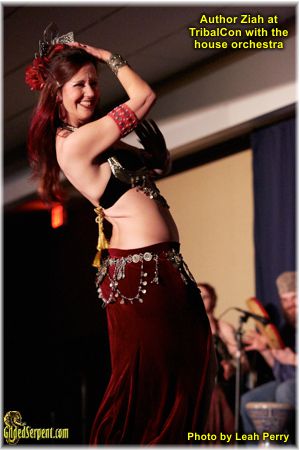
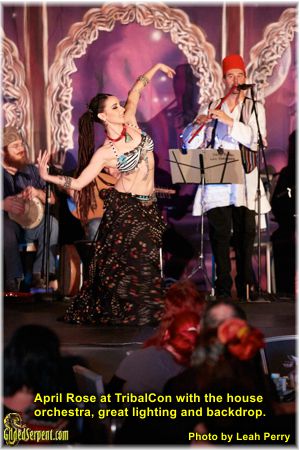
Pitfalls to holding events in hotel ballrooms is that there is very little ambience when it comes to a show. In the top picture you can see the ceiling and boring wall. Luckily we have an amazing backdrop so what most of the audience sees is what you see in the April Rose picture below. Severe side angles like shown in the above photographer’s picture unfortunately reveal what we cannot cover up. Hopefully the audience will forget about the lack of theater space and focus on the lights, backdrop, dancers and music as seen in April Rose’s lovely photo!  Both photos were taken this year- 2013.


April Rose dances at TribalCon

So, TribalCon’s “forced move” turned out to have a silver lining after all, particularly in terms of customer service.

I’ve come to realize that having a well-managed venue with great customer service is just as important as in which area of town your event is taking place.  To have the staff respond to what your customer requests, right when they need it, is worth its weight in gold. It comes down to this: when you ask them for something, do you hear an “Oh sure, I’ll go figure that out,” or do you hear a ‘huff’?

A lot of times belly dancers can only afford to go to one out of town event for the whole year. If they have a bad time because of poor customer service, it is unfortunate and discourages them from attending in the future. I’ve had plenty of those experiences. The problem is that you can’t really tell how well-managed a venue is until your event is in full swing. To make a well-educated guess, you can read online venue reviews and talk to other event producers, but you never really know until you’re in the thick of it.

For instance: Crossroads & Origins Fusion Festival, the other event I mentioned that had its venue sold right out from under it, had a lot more bruises than TribalCon in its first year (just last summer) and it is tiny–compared to TribalCon. Its venue was a small, casually run theater. It worked out great because it had a theater and dance studio all in the same space, which is just incredible, and exactly what you want.

Of course, anytime it’s your first year at a new venue there are going to be bumps. There were things they didn’t think to tell us about, such as:

  1. the location of the light switch for that really huge light or
  2. how to turn on the sound system (after the burlesque dancers who were in there rehearsing the night before switched it around, and now you can’t start your first class in the morning until you’ve figured it out).

With all of those first year debacles fleshed out and its inclusive layout, I would have loved to use that venue again. However, the building was sold and kept switching owners repeatedly because it was actually just one property in a large portfolio of properties.

Therefore, the theater people didn’t know what their life expectancy in the business was going to be. They said, “Well, we can book you six weeks ahead of time, but we can’t book you nine months ahead of time.”  They did end up having to move out of the building just one month before “Crossroads & Origins”. We would have been scrambling for an event space at the last minute!

Therefore, last summer, I was forced to find a new home for Crossroads & Origins; awesome, just what I love to do in my free time! I really wanted the show to be in a full-theater setting and the classes to be in an actual dance studio, like last year.

What I didn’t want to end up with was a mini-TribalCon with a stage set up in a hotel ballroom; I wanted it to be the opposite of TribalCon.

I looked hard for a venue in the uptown areas my attendees are accustomed to going to for events, but I couldn’t find anything that was affordable. Finally, Aziza Nawal, an Awalim Dance Company teacher and principal dancer, had the idea to use the studio in which she teaches as the venue. It just happened to be directly across the street from an intimate live-music venue with a small stage and a performance space; so even though it’s situated north of the city in a busy area, it seemed to be a great fit.

The best point about our new space is that, last year, I had to split attendees up into two tracks due to the small rooms and cross my fingers, hoping that half the dancers would go to one class and half of them would go to the other, but our new venue has a much larger dance studio, so I’ll be able to have everyone in the same class at the same time.

The live music venue is very happy to have us, as we have started working actively with musicians here in town — plus many of our dancers have picked up classic instruments and started learning to play Arabic and Turkish music. They will be able to strut their stuff! Of course, at the time of writing this article, Crossroads & Origins is still a few weeks out; so I don’t know if I chose wisely yet. As they say: “The proof is in the pudding.”

So, the moral of my story is: don’t be afraid of change and don’t be scared to venture out to an area that isn’t necessarily your first pick. Sometimes, that huge pitfall that makes you want to throw your hands in the air and scream, “I quit!” could actually be a blessing in disguise. Do your homework, pay careful attention to online venue reviews and try to be open-minded about outside-of-the box solutions whenever necessary. Happy planning!


The first year we were in the Decatur hotel in 2006, there is a clip of my tiny 15 month old daughter (0:20). You can tell I didn’t quite understand how to create ambience yet in such a sterile hotel venue


Two year later (2008) with much more ambience for the show


The old venue, a highlight vid from 2011 …with a clip of John Compton talking about the old days


Me excited about the new TribalCon venue


TribalCon at the new venue!

February 15- 17, 2013
Resources:

use the comment box

Have a comment? Use or comment section at the bottom of this page or Send us a letter!
Check the "Letters to the Editor" for other possible viewpoints!

Ready for more?

  • Producing a Middle Eastern Dance Festival
    "It is necessary to combine your organizational and public relations skills with your creativity."
  • Producing "Tales of Desire"; a Tribal Fusion Bellydance Experience
    We felt that the buzz in the community was that people were getting tired of seeing the same performers on every performance DVD that came out, so we really tried to mix it up and offer a more varied line up.
  • The Evolution of Jillina, An Interview Regarding Change, Flexibility and Lessons Learned
    Working with Jillina for the last six years or so, I’ve been a fly on the wall for a lot of this transition. I’ve been there for marathon rehearsal weeks, brainstorming sessions, the stress of taking a show on the road, the flops, and the standing ovations. Español!
  • How We Got our Video Groove
    Ultimately however, it seemed that getting a video is like getting a gig: sometimes, you have to create your own opportunities.
  • Going Bi-Coastal, "A Night in the Oasis"
    Our event evolved from a tiny community happening into a popular quarterly event, growing each year. When I migrated to Atlanta, Georgia, the one thing I knew I wanted to do was continue the tradition of producing “A Night in the Oasis.”
  • Hafla Schmafla, Buidling Communithy in Our Dance World.
    Per my understanding, a hafla, in its most basic sense, is a party. It can be a party centered around family events, a circumcision, birthday, engagement, promotion, whatever, and it is a term that comes from the Arabic speaking world.
  • Beyond the Restaurant: How Can We Bring Bellydance to a Wider Audience?
    But I’m under no illusions. That audience wouldn’t be present if wives, daughters or friends weren’t performing. And despite people saying we’ve opened their eyes to the beauty and spectacle of bellydance, the truth is that ours is still very much a niche and hobbyist dance genre.
  • A Carousel of Challenges, Bellydancing at the County Fair
    Using correct terminology is important; belly dancers are community performers who are requesting to perform on a community stage.
  • Beauty Has Its Price, The Quest for Beauty, Part 4
    Being involved with an art form that is all about beauty, I too feel the need to present myself as best and as beautiful as possible. Beauty costs in time, pain, and money; and as philosophers have pointed out for millennia: its only fleeting.

  • A week long immersion into Middle Eastern music and dance while camping in the Mendocino redwood forest. Expect live music every night and classes with many music and dance teachers each day. Many of the names are linked to video interviews we have conducted with individuals or to their bio pages here on Gilded Serpent.
  • Munique brings Egypt to Spain Again, 7th International Festival of Egypt in Barcelona 2013
    Barcelona welcomed teachers and lucky participants for a festival that brought Egypt to Spain with well attended lectures, workshops, and galas during four days of fun and learning, January 31st until February 3rd, 2013. This event provided a unique opportunity to learn the art of Oriental dance from the best names in Egypt. span class=”artist”>Randa Kamel (Egypt), Mo Geddawi (Egypt), Gamal Seif (Egypt), Bozenka (Cuba/USA), Amar Gamal (Cuba/USA), Amaru Sabat (Spain), who together with Munique Neith ran workshops throughout an intensive weekend.
  • Changes in the Island Kingdom, The Bahrain Bellydance Scene
    Returning to Bahrain to work after four years felt like going back to my roots. This little island kingdom is where I did my first Middle East contract, busted my bra on New Year’s Eve, and returned several times in the following year. Those were the days. Now it had been a while. Had Bahrain changed? You betcha.
  • At the Crossroads, Discovering Professional Belly Dance at the Dawn of the Twentieth Century,
    The transition from awalem and ghawazee dance styles to theatrical raqs sharqi began during the last decades of the nineteenth century and the first decades of the twentieth in Egypt. Unfortunately, scant film footage exists of dancers from that period to reveal exactly what professional belly dance looked like during that critical moment in Egyptian dance history. However, still photos and travelers’ descriptions from the time do allow a few conclusions to be drawn about the nature of belly dance in Egypt at this important transition.
 

Gilded Serpent presents...

A Carousel of Challenges

Bellydancing at the County Fair

Placeholder

by Tinah
posted July 3, 2013

Ah! The smell of buttered popcorn, the blare of ‘80s rock in roll, the burning sensation of your watering eyes; it must be county fair time again!  Every year, county fairs, large and small, occur, attracting millions of people across the United States to enjoy a day of good ol’ fashioned fun. For many belly dancers, the county fair is their only reliable performance venue. Always unpredictable, sometimes entertaining, they can be a good place to learn the ropes of belly dancing for the general public. Performing at county fairs requires certain skills and the venue is not for everybody, but I recommend dancing in the fairs–as long as you bring along your antihistamine.

To perform at a county fair requires forethought and tenacity. Often, you must contact a fair representative at least a year in advance to have your name and address placed on an email list for an application.

Using correct terminology is important; belly dancers are community performers who are requesting to perform on a community stage.

No, this is not a paid performance, but it is not unusual to receive applications six months prior to the county fair. At this point, you must look at your crystal ball and decide if you will be available. Some county and state fairs have byzantine application forms that require you to choose from a variety of days and times as well as supply the signatures of all potential participants. If you are accepted, you will be issued a time slot and free passes.  From my experience, fair organizers want to know in advance if you need to cancel, and sometimes, you will be required to return the passes you were given. I know of a large urban county fair that will blackball you if you do not cancel within whatever is deemed an appropriate time frame. At all times, remember that the fair’s representative is most likely a volunteer, so be patient!  Once you have performed, you will be on their email list, and you will be contacted automatically for the next year. Always respond, even if you are not interested, and tell them to keep you on their list. If you do not do this, you will have to start the process over again.

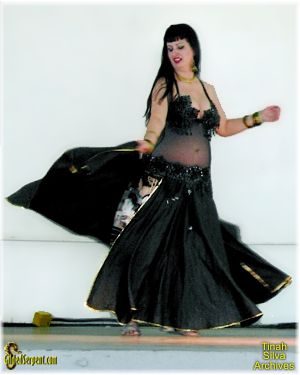
Tinah performsOn the day of your county fair performance, I recommend highly that you bring a print copy of any emails or forms that indicate you are scheduled to perform. Once again, you will be dealing with volunteers who have no idea who or why you are there! I expect to go through a rigmarole to gain entrance to the fair as a matter of course. Arrive at least an hour prior to your designated time slot. Expect to walk (sometimes a great distance), expect dust and dirt, and assume the worst. This is where patience, and often, the ability to improvise are important. I have arrived at fairs to discover the so-called stage is merely a grassy spot beneath a tree. Unfortunately, the absence of a sound system is common. If you ask “What do I do for dance music?” I have been told, “Don’t belly dancers play those clacker thingies?” Good point! Yes we do. At that point, you can either do an acapella routine or fetch your boom box from the car. Community stage presentations can vary from karate demonstrations to local church choirs, and I have found that officials of fairs have no idea what these types of acts need to present a good exhibition, and sadly, sometimes they do not care.  About this time, you begin wonder why you are doing this.

When you see your proposed dressing area, try not to cry. I have dressed in my car, random unoccupied offices, porta-potties, plastic pop-up tents, and (my all-time favorite) a tool shed. Needless to say, I try to wear most of my costume into the fair, fearing the dressing room dilemma. To add to it all, fairs are held in the summertime. Trying to dress and apply makeup in a tool shed in 100 degree weather should qualify you for sainthood, but wait, there is more! If you have a sound system, you should count your lucky stars!  I always have my boom box in the car along with batteries–just in case. The “sound guy” is a volunteer or your husband or maybe yourself. There really is no graceful way to segue from fiddling with your boom box to sashaying onstage to dance, so just do it with a smile!

During your performance, you will have to work to attract and keep an audience. Community stages can be located next to livestock or even inside noisy carnival ride zones. I have performed on stages next to mechanical bull rides, robotic dinosaurs, and racing pigs. It is not unusual to be unable to hear your music over the sound of wild carnival rides. There is nothing like vamping through a dramatic veil routine only to have the roar of a robotic T-Rex disrupt the mood. Worse yet is to realize that your performance coincidences and competes with frantic pig racing commentary. At one point during every fair, I just have to laugh!

Audience members can add to the surreal atmosphere. Remember, they serve alcohol at many fairs. I have dealt with hooting drunks, angry women, proselytizing people, dancing drunks, and sticky children. I have never had a problem that I could not diffuse, but I do recommend taking somebody along with you–especially if you are performing at night. What makes these performances worth it to me is the fact that I am performing for people who may never have seen a belly dancer. For every drunk I have had to dodge there have been far more people who have enjoyed my show, asking questions, and taking my business cards. Rachel Brice tells a story of seeing a belly dancer at a fair and being inspired to try belly dance. You represent the art of bellydancing, so be mindful of that.

Always bring a positive, flexible, and open attitude. I am a cabaret belly dancer who has worn folkloric costuming because the fair wanted a “family-oriented” presentation. I was not offended. Having volunteers joke about belly dance and realizing they think you’re a stripper is not unusual. I find the best tactic is to perform, not lecture.

The general public really, really does not know what belly dance is. Show them!

As summer approaches, I am gearing up to once again to belly dance through county fairs until the first chill of fall.   Shows held in fairgrounds are not glamorous but are always entertaining, and they are an important venue for promoting belly dance to the general public. Just don’t forget that the most important thing in your gig bag will be patience, and the ability to improvise.

Resources:
  • Author’s bio page

use the comment box

Have a comment? Use or comment section at the bottom of this page or Send us a letter!
Check the "Letters to the Editor" for other possible viewpoints!

Ready for more?

  • Beauty Has Its Price, The Quest for Beauty, Part 4
    Being involved with an art form that is all about beauty, I too feel the need to present myself as best and as beautiful as possible. Beauty costs in time, pain, and money; and as philosophers have pointed out for millennia: its only fleeting.

  • A week long immersion into Middle Eastern music and dance while camping in the Mendocino redwood forest. Expect live music every night and classes with many music and dance teachers each day. Many of the names are linked to video interviews we have conducted with individuals or to their bio pages here on Gilded Serpent.
  • Munique brings Egypt to Spain Again, 7th International Festival of Egypt in Barcelona 2013
    Barcelona welcomed teachers and lucky participants for a festival that brought Egypt to Spain with well attended lectures, workshops, and galas during four days of fun and learning, January 31st until February 3rd, 2013. This event provided a unique opportunity to learn the art of Oriental dance from the best names in Egypt. span class=”artist”>Randa Kamel (Egypt), Mo Geddawi (Egypt), Gamal Seif (Egypt), Bozenka (Cuba/USA), Amar Gamal (Cuba/USA), Amaru Sabat (Spain), who together with Munique Neith ran workshops throughout an intensive weekend.
  • Changes in the Island Kingdom, The Bahrain Bellydance Scene
    Returning to Bahrain to work after four years felt like going back to my roots. This little island kingdom is where I did my first Middle East contract, busted my bra on New Year’s Eve, and returned several times in the following year. Those were the days. Now it had been a while. Had Bahrain changed? You betcha.
  • At the Crossroads, Discovering Professional Belly Dance at the Dawn of the Twentieth Century,
    The transition from awalem and ghawazee dance styles to theatrical raqs sharqi began during the last decades of the nineteenth century and the first decades of the twentieth in Egypt. Unfortunately, scant film footage exists of dancers from that period to reveal exactly what professional belly dance looked like during that critical moment in Egyptian dance history. However, still photos and travelers’ descriptions from the time do allow a few conclusions to be drawn about the nature of belly dance in Egypt at this important transition.
  • Soloists, Belly Dancer of the Year 2013 Photos
    The goal of BDOY is to give qualified dancers a fair and equal opportunity to exhibit their skills, as well as promote and elevate the art of belly dance and support its amazing community. Khalilah wins!
  • Hafla Schmafla, Buidling Communithy in Our Dance World.
    Per my understanding, a hafla, in its most basic sense, is a party. It can be a party centered around family events, a circumcision, birthday, engagement, promotion, whatever, and it is a term that comes from the Arabic speaking world.
  • Costuming Trends of 1987, At the Rakkasah Festival
    Although the trend at Rakkasah ‘87 was definitely toward better dancing than we have seen in the past; the costuming I saw would be high on anyone’s list of worn-out ideas.  Nowadays, we have more and more of almost everything; it is immediately apparent that there is more material in the skirts—such as double skirts, ruffles, tatters, tiers, beads, and even elaborate sequined patterns, and embroidery.
  • I’m Back in the U-S-S-A! Queen of Denial, Chapter 13
    My first quarter at Cal-Poly wasn’t nearly as easy for me as finding work belly dancing. I had no idea what I was getting myself into academically when I registered as a business major.
  • Dreaming of the East, Orientalism in Early Modern Dance
    As a belly dancer and a modern dance student at York University, my attention was captured by the fact that a number of early modern dancers performed variations on Oriental themes. I became interested in how they interpreted the Orient through their modern dance technique, and how they represented the Orient in their choreographies, since their performances could have been loosely associated with actual Middle-Eastern dances.
 

Gilded Serpent presents...

Beauty Has Its Price

A Quest for Beauty, Part IV

Placeholder

by Zorba
posted July 1, 2013

The Sunday evening after Rakkasah finds me in the shower, painfully removing the five bangles that have adorned my left wrist for the past two weeks. Having despaired of ever finding bangles that would fit my huge wrists, I was delighted to find some on Amazon that actually did. Barely. Several dance sisters advised me to use soap or other slippery assistance to enable the bangles to slip over my hands. Employing this trick now, I have to remember not to merely try to fold my hand as small as possible, but to also keep it relaxed as this minimizes the pain. As it is, I will only put the bangles on if I’m going to wear them for at least a week – preferably two – as the price I pay in pain is significant each time they are put on or removed from my left wrist. My right wrist, where I’d really prefer to wear them, is out of the question – its slightly larger size prohibits even these large, three inch diameter (or Indian size 2.16) bangles from going on at all!

Thus is the lesson that "Beauty has its price" once again driven home to one who wasn’t raised, conditioned, or expected to ever embrace its seduction. Of course almost any woman can tell of the price to be paid – and a humble thank you goes to the many women, both dancers and non; who have guided, advised, and helped immeasurably my journey through a world few men have traversed.

Being involved with an art form that is all about beauty, I too feel the need to present myself as best and as beautiful as possible. Beauty costs in time, pain, and money; and as philosophers have pointed out for millennia: its only fleeting.

As I’m removing the bangles, I inspect my gel-over-acrylic finger nails and find that they will need to be renewed within the next week. My wife of 29 years and I both have a favorite nail salon that we frequent. Painted nails work fine for toenails, but we’re both murder on fingernails so yet another price is paid for this particular beauty item. At least there is minimal pain involved, although the expense is not trivial, and it takes a good two plus hours to accomplish. A relaxing and enjoyable two hours, but two hours nonetheless.

Speaking of pain, every 3 weeks I mix pleasure and pain by visiting our esthetician – the pain is shaping my unruly eyebrows into some semblance of beauty by plucking and waxing. The pleasure is the facial which follows, unless of course she finds a blackhead on my nose in which case she digs it out with something that feels like a dull tablespoon. The price I pay in time, money, and pain is worth it as my skin no-longer has oily proto-zits and my eyebrows actually look good. It took several appointments for the esthetician to figure out how she could work with what nature gave me and give me the desired, classic arched shape – but she’s a miracle worker!

Zorba's TattooAnother price was paid on my 50th birthday, when I decided to join my many tattooed dance sisters with a tattoo of my very own. Leave it to the "stupid male" to go for a tattoo on one of the more painful areas of the body – the lower back. The three black roses with supporting motif were worth the greatest pain I’d ever experienced – but thank Goddess for my Tribal Fusion teacher who showed up to hold my hand for the first hour or so; I wouldn’t have made it through without her! The Lotus flower on the nape of my neck that I added two years later in memory of my father’s passing, was "nothing" by comparison.

Like most middle aged men, I had problems with an increasingly large belly that no amount of dieting or exercise would really do much to. It just got to be too much – even for “belly” dance! So I had "work done". Expensive, a long recovery time, uncomfortable and painful (but not nearly as painful as that lower back tattoo!), the procedure reduced me back to something "more reasonable", although a lifetime swayback still gives a more rotund appearance than I’d like. Still, enough was gone that I had to have a lovely necklace/belly drape re-sized down in order to fit correctly again. Thank Goddess the vendor was at Rakkasah!

One of the side effects of the procedure is that I "lost" my navel piercing, which I had had for about 13 months and which had really just finished healing. The doctor made me remove it for the surgery, and sure enough, 24 hours later when I was able to get back to it, the site had closed. So I get to experience the pain, expense, and another year of healing to re-do it! My pierced ears were done so many years ago now that I seldom give them thought, although there is still the occasional instance of "These earrings are killing me…"!

The one thing that I can avoid, as a male, is the bra. Still, I know waaaaay more about bras than a guy has any business knowing – and it makes me darn glad I don’t have to contend with them. Every time a dance sister tries on a new costume – everyone gathers around her in a gaggle of clucking hens (me included). The costume is beautiful, the color is perfect, and its just *meant* for her – but the damn bra doesn’t fit. 30 minutes later, it still doesn’t fit but everyone has had their say about the proper way to fix it. None of them work…

But I’m subject to the rest of the experience. Learning how to do makeup has been, and continues to be, an interesting process. Overall, a pretty (pun intended!) fun experience – some of the disasters I’ve made out of my face are hysterical! I’m still not particularly good at it, but I’m learning and gradually improving – mostly! Once I got it through my thick male skull that makeup life is much better with the proper primers and preps, I’m having a better time of it. "Makeup Geek" and similar YouTube channels are wonderful!

Like everyone else, as I age my hair has started to turn grey. I have a lot of hair! Not only my mid-back length hair, but 2 colors of facial hair besides. The facial hair is probably the easiest, cheapest, and fastest beauty "line item" I’m currently dealing with: five minutes every couple of weeks with a hair dye product made for the purpose. My head of hair receives a henna treatment about every three months. Not painful, but annoying with a head full of green glop for six hours!

Is all this worth it? Most men, and many women would say "no". At the end of the day, it is always a personal decision. When I made my stage entrance at Rakkasah with all this maintenance behind me; wearing a beautiful costume, beautiful jewelry, beautiful makeup, and dancing to beautiful music: The Joy ripped out of my being! I felt beautiful, I felt joyous, I felt complete, I felt magical – and most importantly, my audience felt it too. If the dancer doesn’t feel the beauty and the joy, how can s/he transmit it to the audience? THAT is what its all about, and what makes all the pain, expense, and time totally worth it!

Resources:

use the comment box

Have a comment? Use or comment section at the bottom of this page or Send us a letter!
Check the "Letters to the Editor" for other possible viewpoints!

Ready for more?

  • I am Become Pure, Destroyer of Dreams, the Belly Dance Police
    The fact of the matter is, nothing in the universe is constant: except change. "Inauthenticity" becomes "authenticity" over space/time – and vice versa.
  • A Quest for Beauty, Part 1: Beauty is Discovered
    My wife of 17 years asked, "You’re going to do…. what?"when I told her of my desire to take Bellydance lessons.
  • A Quest for Beauty, Part II: Damn the Torpedoes and Full Speed Ahead!
    I recognized that "femininity/masculinity" was an entirely artificial construct, and femininity/masculinity was based on reality, i.e. biology.
  • A Sense of Humor: It can Help! Quest for Beauty, Part 3
    What follows here are several humorous anecdotes. Some of them are about being a male in a female dominated field while some are merely about being a Bellydancer in the first place. My first rule concerning being weird ("weird" as evidenced by some reactions to my previous articles) is to have a good sense of humor!

  • A week long immersion into Middle Eastern music and dance while camping in the Mendocino redwood forest. Expect live music every night and classes with many music and dance teachers each day. Many of the names are linked to video interviews we have conducted with individuals or to their bio pages here on Gilded Serpent.
  • Munique brings Egypt to Spain Again, 7th International Festival of Egypt in Barcelona 2013
    Barcelona welcomed teachers and lucky participants for a festival that brought Egypt to Spain with well attended lectures, workshops, and galas during four days of fun and learning, January 31st until February 3rd, 2013. This event provided a unique opportunity to learn the art of Oriental dance from the best names in Egypt. span class=”artist”>Randa Kamel (Egypt), Mo Geddawi (Egypt), Gamal Seif (Egypt), Bozenka (Cuba/USA), Amar Gamal (Cuba/USA), Amaru Sabat (Spain), who together with Munique Neith ran workshops throughout an intensive weekend.
  • Changes in the Island Kingdom, The Bahrain Bellydance Scene
    Returning to Bahrain to work after four years felt like going back to my roots. This little island kingdom is where I did my first Middle East contract, busted my bra on New Year’s Eve, and returned several times in the following year. Those were the days. Now it had been a while. Had Bahrain changed? You betcha.
  • At the Crossroads, Discovering Professional Belly Dance at the Dawn of the Twentieth Century,
    The transition from awalem and ghawazee dance styles to theatrical raqs sharqi began during the last decades of the nineteenth century and the first decades of the twentieth in Egypt. Unfortunately, scant film footage exists of dancers from that period to reveal exactly what professional belly dance looked like during that critical moment in Egyptian dance history. However, still photos and travelers’ descriptions from the time do allow a few conclusions to be drawn about the nature of belly dance in Egypt at this important transition.
  • Soloists, Belly Dancer of the Year 2013 Photos
    The goal of BDOY is to give qualified dancers a fair and equal opportunity to exhibit their skills, as well as promote and elevate the art of belly dance and support its amazing community. Khalilah wins!
  • Hafla Schmafla, Buidling Communithy in Our Dance World.
    Per my understanding, a hafla, in its most basic sense, is a party. It can be a party centered around family events, a circumcision, birthday, engagement, promotion, whatever, and it is a term that comes from the Arabic speaking world.
  • Costuming Trends of 1987, At the Rakkasah Festival
    Although the trend at Rakkasah ‘87 was definitely toward better dancing than we have seen in the past; the costuming I saw would be high on anyone’s list of worn-out ideas.  Nowadays, we have more and more of almost everything; it is immediately apparent that there is more material in the skirts—such as double skirts, ruffles, tatters, tiers, beads, and even elaborate sequined patterns, and embroidery.
  • I’m Back in the U-S-S-A! Queen of Denial, Chapter 13
    My first quarter at Cal-Poly wasn’t nearly as easy for me as finding work belly dancing. I had no idea what I was getting myself into academically when I registered as a business major.
  • Dreaming of the East, Orientalism in Early Modern Dance
    As a belly dancer and a modern dance student at York University, my attention was captured by the fact that a number of early modern dancers performed variations on Oriental themes. I became interested in how they interpreted the Orient through their modern dance technique, and how they represented the Orient in their choreographies, since their performances could have been loosely associated with actual Middle-Eastern dances.
 

Gilded Serpent presents...

Tradition, Passion, and Fusion

“Ro-He, Classical Egyptian Dance” 2003
and “Egyptian Rai” 2006 by Hossam Ramzy

Placeholder

CD Review by Sadira
posted June 27, 2013

In this review I am critiquing two CD’s by Hossam Ramzy.  I write in detail about each CD, it’s interesting parts, or special interests as well as critique.  I then compare the two at the conclusion of this article.  Enjoy…the incredible talents of Hossam Ramzy!

Ro-He by RamzyRo-He and Classical Egyptian Dance 2003

This review is going to start out quite differently from most reviews of CD material for dancing.  To me, the starring and important element of this whole CD, comes from its inner booklet, describing the CD completely.  The booklet contains an in-depth interview with Hossam Ramzy, his feelings about classical Egyptian dance and dancers, as well as an excellent background, explaining what comprises classical Egyptian music and dance.   I  recommend that all teachers and students who want to work with Egyptian or Arabic music seriously , read these liner notes.  He addresses the types of rhythms used extensively, as well as the importance for understanding the different rhythms used in Arabic music.  He describes the difference between melody and rhythm.  He goes into great depth about musical phrasing within a composition and how it is constructed in Arabic music.  You will have a greater understanding of what you should know to be a quality dancer in this arena after reading the interview that contains his own tips of what makes one dancer stand out from other dancers.  The key is about knowing your music intimately. 

A dance becomes an intimate part of the orchestration rather than separate from it.

What do the instruments generate in your feelings, and therefore, your body movements?  One must express the emotional dimension of the music being performed.  It is emphasized that dancers must know the music!

The three main components to know are: 

  1. The rhythm- where it originates from, and the stylization. 
  2. The main melody- which is separate from the rhythm.
  3. Listen to and practice to the particular orchestral arrangements; so you are one with that piece.
  4. All Arabic music is played in a “call and response” format. (Solo Instruments = the call,   the orchestra = the response or vice versa.)  Note that you may assume it is a pattern based on 4 of these or 8 of those count, but that is not the style or pattern.  Listen!

His quote: “Musicians pay attention to your dance if you are paying attention to the music of which you are a part.  The purpose of dancing is to create a 3 dimensional, holographic, visual of the sonnet, and make it visible”.

I, also, have found too many dancers (even some who are considered “top dancers”) specialize in the complexities of Egyptian dance; yet they have not found the main tenants of being part of the whole experience and rely only on (sometimes irrelevant) choreography.  This defeats the dance, proper interaction with the music, as well as allowing the emotion to be portrayed in an intimate tableau of personal interpretation.
Trust me when I tell you that he gives valuable information for you to know!  You may want to purchase this particular CD to (at least) understand the true elements of the dance you are performing.

Now, let us consider the CD performance itself:

  • The first piece is designed for a complete classical Egyptian 4-part dance.  It is smooth, with lots of changing patterns that are great to use as a dance classic for performing in restaurants, or environments that truly specialize in classical Egyptian style of music and dance.  If your dance style is purely classical Egyptian, this is the CD for you! However I have to warn, you must be a professional, classically trained Egyptian dancer to fully embrace the nuances and style of this orchestration!  The music is orchestrated with many special instrumentations and is conducted at a relatively medium fast pace for the entrance dance.  If this is not your style, it would be difficult to interpret and do yourself justice throughout your dance.  One must have a clear and clean Egyptian rhythm and musical interpretation to take on this piece.  The entrance clearly has the chorus that repeats phrasing; dancers must pay attention because it is complex.  It has interludes of taqsim and breaks throughout the entrance.  The style is reminiscent of the 1940s classical orchestration. 
  • Next, it moves into its slow taqsim section, which predominates with the nai and kanoun makkams and soloing.  Here, you can hear the classic “call and response” style between the oud and the nai.  The effect is fluid and graceful, but be careful not to overdance segments, using undulations with no other movements, or worse, using constricted movements.
  • From the taqsim, we are taken to a middle section that I think of as “techno-pixy”.  Personally, I don’t care for it; to me, it seems like a recording mix and strange use of instrumentation made in the studio.  It has high energy!  Dancers need to focus on the melody, and not the drum, or it will throw your dance off.  There are moments during which one could change pace as well as one’s interpretation.  Classical stylizing prevails, with the exception of the addition of techno-instrumentation.
  • Lastly, it ends with the typical drum solo, starting with a heavy, upbeat Beledi rhythm  into a running 4/4.  It has a solid heavy beat and convenient repeating pattern, utilizing the 4/4 rhythm.  Please note: during the middle of this section, finger cymbals play a galloping 4/4/rhythm while the def plays a heavy, upbeat Beledi rhythm at the start, emphasizing the rhythm as the drummer improvises over the top.  It is exceptionally complex, and earthy.  (I would recommend that the dancer not play finger cymbals along with any CD that already incorporates them as a part of its instrumentation; as you could very well be adding a wrong rhythm to it and making it sound chaotic.)  The dancer must be prepared to go from the drum solo into a moving transition and back to a melody line immediately. Reminiscent of the complex orchestration of the 1940s and ‘50s, it is not an easy piece that gives room for everyone’s ability to shine–unless you are well versed.
  • After the 15-minute dance routine, there are the brief solos or taqsims with oud. Though showcasing the virtuosity of the oud players and the mawwal, it does not lend itself well for a dance taqsim solo, because it is a steady, even-paced arrangement.
  • Again, we have another piece called “Elkol”.  While starting with a beautiful opening taqsim, I was put off once again by the addition of some techno-music instrumentations that sounded somewhat like wind chimes but seemed oddly out of place and awkward within this framework.
  • Next, there is a Saudi beat song, called “Bosara”, and while Saudi and Khaleeji dance and music are my loves, this is too highly orchestrated to give you that traditional hair tossing, rhythm driven Saudi traditional style.  The over instrumentation takes away from its roots; but if you like to add the Saudi rhythm as part of your repertoire you may find it a nice change.  Be warned: this is not your traditional, folkloric version of Saudi or Khaleegy music, just an adjunct of the particular rhythm mixed with classical Egyptian orchestration.

If you decide to use this CD for your dance piece, I would strongly recommend that you have a professional, practiced and exact understanding of classical Egyptian music and interpretive dance; otherwise, you will become overwhelmed or lose an ability to  interpret this outstanding piece of work with clarity.

Most importantly, do not accompany this CD with finger cymbals.  Finger cymbals are used periodically throughout the CD recording as a part of its percussion section, and you would only be destroying the continuity of what is included there.  I don’t think much of the cymbal playing herein however, as it is only a regular, galloping 4/4 constant rhythm in the background to keep pace and can be annoying.

The piece I loved on this CD, and would recommend for dance performance, is titled Elshebbak”.  It is a modernized, classical stylization of a well-known piece of musical arrangements used during the 1970s and 80s with its own twist.  You will recognizeLeilat Hob portions as well as Touta”!  Yet, they have redone it with a much more orchestrated feeling that calls for dedicated studying of this piece before you attempt to dance with it.  It is the most danceable piece for those doing classical Egyptian but who may not be technically proficient, and it is lovely to hear the interplay of old classics, presented with the new style .  You will enjoy this piece the most and it could be used for a short dance performance.

Purchase this CD for the incredible lessons it offers about Arabic and Egyptian music to enhance your own dance abilities from the informational interview with Hossam Ramzy; you will not be disappointed!

Rating:  3 zils
3 zil rating

Cd- Egyptain Rai by RamzyEgyptian Rai, Hossam Ramzy, 2006

“Rai came out of Algeria, but nevertheless, the concept holds true throughout the Middle East.  The idea behind “Egyptian Rai”, is to use different types of sounds, rhythms, songs, and feel, all from the Arab world.
It is my wish that anyone who listens to this album may get an eagle’s eye view over the Arab world.  Looking down on it from great heights, one realizes that it is a world in its own right.  It is at its best when it communicates with its own people’s as well as with other members of our Earth”
–Hozzam Ramzy (liner notation on the Egyptian Rai CD)

I love, love this CD from Hossam Ramzy!  Hossam Ramzy, apart from his incredible and remarkable skills as a drummer and musician, is far more than only that.  He cares about the culture and understanding of the music he has played and experienced over his many years of drumming since 3 yrs of age.  He has played with those who are (and were) among the recent “greats” of Egyptian, Arabic, North African, Bedouin music; also he studied the roots and sounds from the indigenous traditional peoples of these regions.  His soul radiates throughout everything he mixes to share his understanding of its world music’s versatility and uniqueness.  He has performed in the genre of World Music with Robert Plant, and most known for work with Peter Gabriel on the “Passion” CD, and many others as well.  Ramzy considers himself an ambassador for cultural integration and education about Arabic music and its different styles.

I call the music recorded on this CD “feel good music”!  Every song on this CD has you wanting to get up and move, express your inner-core connection with its rhythms and songs and have a good time. 

This is not a CD meant for a performance, but it is the kind of CD you could play at any kind of gathering, and guests will not be able to stay still.

There are gems and brilliant pieces on this CD that would work well with creative solo or troupe dances, and other group pieces.  Here, you can feel traditions that are 100s of years old, mixed with the recent genres of jazz, latin, or fusion, all combining into a tapestry that is unparalleled in its brilliance!  It moves you; it touches you. It brings the true meaning of “Saidi equals joy” into experiencing music for its dynamic soul, instead of dissecting it for creating a specific dance routine.

Go on! I dare you not to jump up to dance or find friends who know nothing about Egyptian, Moroccan, or Arabic music who start spinning and clapping, moving to their own connection of spirit! That’s the code word here: “Spirit”, and it is the basic foundation of dance; no matter its point of origin.  It comes from deep within, resonates within the heart, heralding forth from the spirit of sounds and the connection to the Divine and the human need for sound that reminds us that we should always be dancing in the cosmos. You can dance just for yourself or introduce others to music that stirs your heart.

The first song is entitled: “Gani Lasmar”.  It originates from Saudi-Arabian folklore and uses a traditional Yemeni rhythm.  If you love the Saudi influence, you will find this enjoyable.  The majority of it is based on the traditional Saudi rhythm but is mixed with Egyptian flavoring and an upbeat chorus that takes you to the traditional “call and response” style of Arabic musical construction.  It’s a piece that calls to mind, spinning, yearning, and joy.  It is worthy to use as a folkloric piece for a dance or a troupe routine. It is flavored with fusions of Latin spice and infectious pop!  It has the feeling of a Debke, the lively, communal line dances that incorporate the entire group.

Next is : “Othrak Ma-ak Othrak”,  another song from Kuwait.  It starts off melodiously with an oud taqsim and builds to a wild virtuosity of drumming–jazzy with flavors of Greek line dancing.

The third song is: “El-Hawazi”,  based on the traditional Moroccan 6/8 rhythm or Bedouin folk style.  This is true Shaabi music (the people’s music) for dancing in the coffee houses and out in the streets.  This is my favorite track!  I am familiar with the dances and rhythms from North Africa; so,  for me, it adds that fusion funk of instrumentation from Arabic countries.  Think of is as a Berber-Bedouin jam session out in the desert.  Images of the Ouled Nail and Shikhaat dancing are ever present; along with the trance standard of syncopated clapping that is special to North Africa.

Let’s talk about trumpets.  Yes, trumpets! They lay down some fantastic tracks throughout with the eminent trumpet player from Cairo, Sami El-Babil!  Imagine: New Orleans French Quarter and Louis Armstrong playing at Giza!  It is jazz, but still infused with the sounds of Arabic music with Hossam Ramzy’s amazing drum work.

I’m trying not to list every song here; but I have to say I was not disappointed by a single cut; each one is unique and each one a surprise when it came out of the speakers; evoking so many different feelings and memories!

For example: “El Ataba Gazaz”.  I was pleasantly surprised to recognize immediately that this was a popular tune used in the clubs during the  ‘70s and ‘80s.  It has become a standard favorite that has been revamped and Rai-ified on this CD!  It’s faster in pace than the original with lots of jazz overtones, but you can still hear the original piece in its melody. Soulful!

The next one I have to give credit to is the arrangement: “Eddalla Ya Aris”:  Here was my first Arabic song that I learned how to sing in Arabic!  It contains the “wedding beat” and is about the bridegroom  meeting his bride-to-be.  This is the wedding beat on fast play, but it works!  At the end of the album, there are two songs that are so melodic and beautiful, that I would consider using them for meditation or relaxation.  They transport you into a lyrical, mystical, mesmerizing journey.  The music reminds me of the moon shining in the black sky, with its soft beaming light shining over the silver Nile at night.  “The World Is My Oyster”; utilizing the same gulf rhythms that once signaled to the pearl divers who were diving at night that it was time to come up from the depths.  These last two pieces are made for dance and create a completely new creative interpretation to melodic rhythms that grab us; yet take us to the world stage.

As usual , I have to make mention of the fantastic insert accompaniment with the CD.  It explains each song, its origins and rhythms as well as the meaning of the original song. What a treasure!  Do yourself a favor and buy this for the tapestry of weaving traditional cultures with each other and fusing them into a whole experience from beginning to end that will captivate you.

Rating: 4 zils
Zil Rating- 4

Comparison of the 2 CDs 

To be honest, these are like night and day from each other.  If you want an excellent classically orchestrated Egyptian style CD to use for dancing at venues, then “Ro-He”; is what you will want. However, beware because this is for those at a high level of performing Egyptian style dancing. Personally, I did not find much of the music presented here of use for me or my aesthetics, accept to recognize a masterful work of classic Egyptian music with a few modernized glitches that didn’t seem to belong.  No finger cymbal playing alongside, and be well-versed in your style!  Don’t forget that everyone can learn something valuable from its liner notes written through an interview with Hossam Ramzy.  To each their own style!  I preferred “Egyptian Rai”; I could see dancing to it for audiences, but more importantly, it brought up a universal excitement to dance along with all its pieces.  Some of them are quite stellar in their development and would be a great adjunct to a less regimented style of dance and incorporating dance routines.   It also rocks as a piece of music all on its own that everyone will love and want to own; whether familiar with Arabic music or not.  It is brilliant in its combination of different styles.  Rai equals fusion with passion!

Resources:

use the comment box

Have a comment? Use or comment section at the bottom of this page or Send us a letter!
Check the "Letters to the Editor" for other possible viewpoints!

Ready for more?


Gilded Serpent presents...

Mendo Camp Life Photos 2012

Page 1 of Photos from Mendocino Middle Eastern Music and Dance Camp

photos by Carl Sermon
posted June 18, 2013

A week long immersion into Middle Eastern music and dance while camping in the Mendocino redwood forest. Expect live music every night and classes with many music and dance teachers each day. Many of the names are linked to video interviews we have conducted with individuals or to their bio pages here on Gilded Serpent. Joshkun is the organizer and has long been a supporter of Gilded Serpent, advertising seasonally before each year’s event. Thank you Joshkun! I hope this year is as wonderful experience as always! This year, the fun begins again on July 6!

Class in the forest

Forest classroom

Dror

Dror teaches drum ensemble

Musicians jam
1, 2, 3-Faruk Tekbilek, 4, 5-Hamid Saeidi

Aubre

Aubre

Group

Joshkun, Suzie (Faruk’s wife), Faruk, ?

Jewish Sabat

Friday night Sabat
Yuval Ron on oud, Dror in yellow cap

unknown

Unknown girl in lovely coat!

duet

Souren Baronian and Omar Faruk Tekbilek

Joshkun

Joshkun

Kitchen staff parade

Kitchen staff parade

kitchen duo

kitchen duo

organizer

Roy, an organizer

Paul teaches

Paul teaches a young dude

Salas toss

salad tosser

Shoshanna's family

Shoshanna and her girls

skirt

spinning skirt

Zombie musician

Zombie musician on a Persian Rabab?


Page 2 coming soon!

More info on the Mendo camp here

on their site

Check out our Magical Muscial Instrument Tour!

Mid East Music and Dance Camp


use the comment box

Have a comment? Use or comment section at the bottom of this page or Send us a letter!
Check the "Letters to the Editor" for other possible viewpoints!

Ready for more?

  • Diamonds in the Rough & Polished Perfection, 2012 Berlin SomerFestival-Thursday Competition,
    Produced by Beata and Horacio Cifuentes, Held in September, 2012. The costumes were innovative and personalized with many of the competitors from the Ukraine, Russia, and Asia. Many of whom are also ballroom competitors. As a result, the costumes were visually striking and elegant. The trend in costuming is floral with tribal going towards more colorful stylized burlesque (ala Chicago musical).
  • Raqs LA Photos, Page 2: H-Z
    Glendale Civic Auditorium, California, April 16 & 17, 2011, produced by Bellydance Superstars and Miles Copeland
  • Raqs LA Photos Page 1: A-H
    Glendale Civic Auditorium, California, April 16 & 17, 2011, produced by Bellydance Superstars and Miles Copeland
  • SFBA MECDA Gala Show & Festival 2010
    Produced by the San Francisco Bay Area chapter of the Middle Eastern Culture and Dance Association, held on November 15, 2010, in the Hillview Community Center in Los Altos, CA
  • Ana Ra’asa Showcase: Egyptian Bellydance Past & Present
    My purpose for doing this show was to bring Bellydance to the stage. We have such amazing talent in the Bay Area, and I feel that those dancers deserved a stage to showcase such amazing talent.
  • Pangia Does Texas: A Warm Howdy!
    Carmine Guida (New York) Pat Olson (Californina) and I, are all members of the band, Pangia. In August of 2010, we had the pleasure of teaching workshops and performing at Yaa Halla, Y’all! in Grapevine, of the Dallas/Fort Worth area of Texas. It was a distinct delight to have enthusiastic, involved, and engrossed participants in attending our workshops.
  • Fun TImes at the Third Annual North Bay Belly Dance Bazaar, A Northern California Community Event
    Deborah Bennett and TerriAnne Gutierrez co-produced the third North Bay Bellydance Bazaar (NBBB) which was held on September 18 & 19, 2010 at the Sebastopol Community Center in Sonoma County, California.
  • A Dancer’s Perspecitive: 2010 Yaa Halla Y’all Belly Dance Competition
    Yaa Halla Y’all is an action-packed, four-day event for all styles of
    Belly dance: Tribal, Alternative, and Cabaret.
  • Abdominal Freakish Delights: Aboard The Queen Mary! Photo Report from MECDA’s Cairo Caravan 2010, June 4-6, 2010 PAGE 1 AND PAGE 2
    Staying onboard the ship Queen Mary makes the event special and a unique and amazing experience As you walk the long curved and richly carpeted halls, you realize that you really are aboard a stately ship–named after a queen–a ship that once sailed the Atlantic Ocean.
  • Folk Tours 6th Annual Middle Eastern Music and Dance Camp
    held at Camp Greenlane in Pennsylvania, May 2008. The authenticity of the camp is amazing. I love Rakkasah and Tribal weekends as much as anyone else, but watching and listening to Arab musicians play Arab music and Turkish musicians play Turkish music, well, that adds a little something! After the nightly shows, the musicians keep playing to the wee hours and the camp dances in the big dining hall until we drop.
  • The Mendocino Middle Eastern Music & Dance Camp 2008, Part 1
    This morning the classes begin. Dinner and breakfast was quite good! The students on scholarship working the kitchen were cheerful and surprisingly bright eyed after being up so late last night!
  • Khamsa Holidays, A Dance and Culture Camp in Tunisia
    How do you judge a dance trip? Would you go back next year? …in a heartbeat. Damn the cost and mercury retrograde and the heat. It was that good!
  • 2005 Folktours Middle Eastern Music & Dance Camp Pennsylvania,.
    Look around and delight in the glory of the dancers and musicians.
  • The Folk Tours Dance & Music Camp Review
    Once upon a time, in far away lands, I performed five shows a night, seven nights a week to great live music. I don’t miss the wily club owners, late nights, or cigarette smoke, but I do miss the music.
  • Folktour’s 2nd Annual Music and Dance Camp
    Pennsylvania, May 2004, Dancers and musicians all over the East Coast (and abroad) came to participate in the four-day oriental dance and music camp.
  • The Photos & Poetry of David Ludwig o
    there is a time each year, when dancers and musicians gather, in a magic forest, to reconnect , with their creative source…
  • Report of the Eastern U.S. Middle Eastern and Balkan Music and Dance Camp October 2-5, 2003
    The camaraderie of a camp – bunking with strangers who soon become friends, "breaking bread" together, learning new dance steps, songs, and drum rhythms – has all the ingredients for a treasured experience, and this camp lived up to that potential.
  • MORE Photos from The Middle Eastern Music and Dance Camp in Mendocino
    Just the extra photos of our art and faces you know projected into a beautiful natural setting.
  • The Middle Eastern Music and Dance Camp in Mendocino
    There is nothing like immersing yourself in study and in the strange and unique culture of the Middle Eastern music and dance “scene”.